Pakistan’s Fascist Post-Modern Coup Regime Risks Replicating The East Pakistan Tragedy
By Andrew Korybko | March 15, 2023
The fascist authorities who were installed in Pakistan following last April’s US-orchestrated but superficially “democratic” post-modern coup against former Prime Minister Imran Khan risk replicating the East Pakistan tragedy if they don’t immediately stop shooting at their own people. The ousted leader’s supporters are rallying around his residence to prevent the local police from serving him an arrest warrant on a trumped-up graft charge that was concocted against him as “lawfare”.
Instead of reconsidering the wisdom of clashing with unarmed and purely peaceful civilians, the fascist authorities ordered their goons to assault them all with tear gas, rubber bullets, and reportedly even live ammunition that was shot into the air according to some accounts. This de facto declaration of war by the fascist post-modern coup regime on its own people could dangerously place the country’s political-security trajectory on the irreversible path towards civil war.
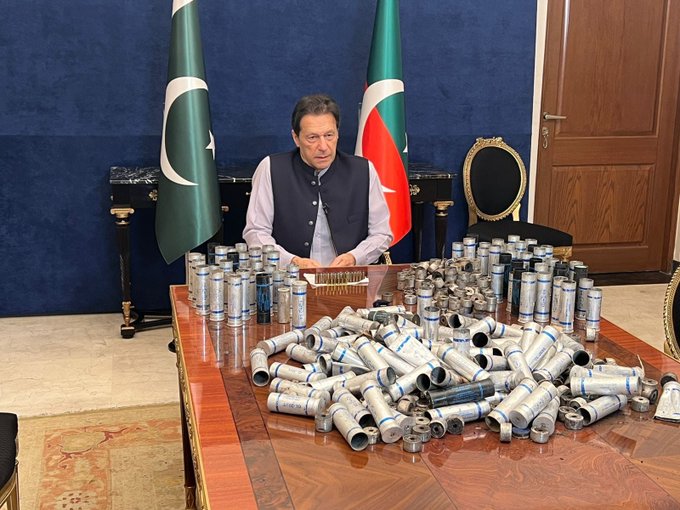
Former Prime Minister Khan warned as much in a tweet on Wednesday that he shared alongside a photo of himself sitting down in front of a pile of tear gas canisters that were shot at his home the other day. He wrote that “My house has been under heavy attack since yesterday afternoon. Latest attack by Rangers, pitting the largest pol party against the army. This is what PDM and the enemies of Pakistan want. No lessons learnt from the East Pakistan tragedy.”
The military-intelligence establishment must urgently rescind their de facto declaration of war on the Pakistani people, do whatever’s required behind the scenes to have the fascist post-modern coup’s leading figures resign as the first step towards national reconciliation, and then hold early elections. It’s only through this three-step process that the worst-case scenario of replicating the East Pakistan tragedy can potentially be avoided since anything less than that makes this more likely by the hour.
One of the most populous countries in the world is being pushed towards civil conflict by those conspirators who illegally usurped power with the US’ help last April and subsequently crashed the economy. This factual framing of Pakistan’s latest political-security dynamics proves that the increasingly violent clashes provoked by the fascist post-modern coup regime against its own people could lead to a global crisis in the event that they soon spiral even further out of control.
If the military-intelligence establishment continues waging war on the Pakistani people, then their victims should consider publicly calling on their iron brothers in China to urgently rein them in as a last resort to avert the worst-case scenario that former Prime Minister Khan just warned about. China’s diplomatic miracle in brokering the Iranian–Saudi rapprochement last week proves that it has the political capabilities to peacefully resolve the Pakistani Crisis if the people request for it to do so.
After all, the People’s Republic also stands to geostrategically lose if that neighboring nation descends into civil war. The China-Pakistan Economic Corridor (CPEC), which is the flagship project of Beijing’s Belt & Road Initiative (BRI) that’s aimed at creating a Community of Common Destiny for Mankind, would practically become inoperable should that happen. Not only could that block off China’s shortcut to the Indian Ocean, but it would deal an immense blow to its soft power and BRI’s reputation as well.
Without intending to come off as “conspiratorial”, observers can’t preclude the possibility that the fascist post-modern coup regime’s US backers encouraged them to provoke a civil war partially for the purpose of advancing America’s anti-Chinese “containment” strategy via unconventional means. At the very least, its military-intelligence establishment wouldn’t so publicly violate its people’s human rights and possibly even countenance war crimes against them without the US’ advance approval.
This means that the latest escalation of the nearly year-long Pakistani Crisis is connected to the US just like its origin is, thus extending credence to the preceding concerns that the events which Washington set into motion last April are actually part of its larger Hybrid War on China. This South Asian state was knocked out of the geostrategic game at the most sensitive moment in the global systemic transition shortly after this process accelerated following the start of Russia’s special operation.
That outcome hasn’t just proven disastrous for the Pakistani people who’ve suffered as a result of the crippling economic crisis that followed, but it also unexpectedly offset a key pillar of China’s grand strategy related to its reliance on CPEC as a non-US-controlled shortcut to the Indian Ocean. Furthermore, both the political and especially economic dimensions of the US-provoked Pakistani Crisis also raised serious doubts about CPEC’s future as well as that of BRI more broadly.
Nobody can therefore deny that the US’ regime change in Pakistan last year had very serious consequences for China that are becoming worse by the hour as that country’s fascist post-modern regime risks pushing it into civil war after de facto declaring war on its own people. China might already be working behind the scenes to try and de-escalate the latest and thus far most dangerous phase of this nearly year-long crisis on its borders, but it would still help a lot if Pakistanis publicly requested this.
That’s because this could compel China into taking urgent action behind close doors if it hasn’t already done so, not to mention creating the optics of Pakistan’s US-backed fascist post-modern coup regime literally shooting at Chinese-friendly peaceful protesters, which would force China to get involved. No other party apart from the US has the influence to peacefully resolve this crisis, and seeing as how Washington’s interests are perversely advanced by exacerbating it, the onus thus falls on Beijing.
Practically speaking, China has a credible chance of brokering peace and thus averting another Pakistani Civil War, but this best-case scenario can only happen if the fascist post-modern coup regime has the political will to save their country from this US-engineered collapse. If they do, then China can simply propose the previously suggested three-step peace plan related to immediately ceasing fire against unarmed peaceful protesters, creating a caretake government, and holding early elections.
The coup regime might agree to this in exchange for a Chinese bailout that could replace the IMF’s continually delayed one that’s full of strings and has thus far been withheld by that body’s US leader for the purpose of keeping its proxies in check in case they consider “defecting”. That last-mentioned observation is precisely what China would be tempting them to do, basically “defect” from the US in exchange for much-needed aid and thus averting the seemingly impending civil war.
The latest and thus far most dangerous phase of the nearly year-long Pakistani Crisis is rife with unpredictability since everything is moving so rapidly right now so it’s difficult to predict what might come next. In any case, it would greatly help the cause of peace and preventing a replication of the East Pakistani tragedy that former Prime Minister Khan just warned about if his unarmed peaceful protesters publicly called on China to diplomatically intervene and prevent this from becoming a global crisis.
Will Pakistan defy US sanctions to complete ‘Peace Pipeline’ with Iran?
By F.M. Shakil | The Cradle | March 7, 2023
Islamabad has formed a diplomatic channel to convince Washington to ease sanctions on Iran, which would finally allow for the completion of a crucial pipeline project to bring cheap Iranian natural gas to Pakistan.
Iran has vowed to take the matter to arbitration if Pakistan does not complete its portion of the pipeline by March 2024, as stipulated in an agreement between the two West Asian countries.
Discussions on constructing the massive pipeline project began almost 29 years ago, in 1994 – then called the Iran-India-Pakistan pipeline – which originally envisioned moving Iranian gas to Pakistan, Bangladesh, and China. The focus later shifted to constructing a pipeline between Pakistan and Iran only, but the project has never been completed.

According to the terms of the IP-GSPA (Gas Sales Purchase Agreement) signed between Iran and Pakistan, each country was obligated to construct the portion of the pipeline on its own territory, and the first flow of Iranian gas to Pakistan was to start January 1, 2015. The agreement stipulated Pakistan would pay Iran $1 million per day in exchange for 750 million cubic feet of gas daily, with a contract lasting 25 years.
Iran completed its portion of the pipeline in 2011, however, Pakistan has failed to construct its portion, largely due to difficulties caused by US economic sanctions imposed on Iran for the country’s alleged nuclear weapons program. US sanctions block Pakistan from purchasing Iranian gas, and this geopolitical risk has made Pakistani banks unwilling to finance the project.
Because of US foreign policy pritiorites, therefore, Pakistan continues to rely on more expensive liquified natural gas (LNG) to meet its burgeoning energy needs, which has greatly limited Pakistani economic growth and exposed the country to crises during periods of volatile LNG price spikes.
Due to these difficulties, Pakistan’s Inter-State Gas Systems (ISGS) and the National Iranian Gas Company (NIGC) signed a revised agreement in 2019 to allow Pakistan more time to complete its segment of the pipeline. The agreement stipulated that neither Iran nor Pakistan will take the other to court for delays or impose fines until 2024.
But US sanctions have continued to make Pakistan’s completion of the project difficult, and Iran is now threatening to sue Islamabad for $18 billion in fines if it breaks the agreement and fails to complete construction by the 2024 cutoff date.
Financial straits or US pressure
As Asif Durrani, a former Pakistan ambassador to Iran, tells The Cradle:
“Pakistan needs roughly $3 billion to lay a pipeline stretching over a radius of 781 kilometers inside the country. The question is who will finance this project, and secondly, the US sanctions on Iran, which took the air out of this project as far as Pakistan is concerned, need a revisit by the US authorities to protect the faltering economies of the region.”
The sanctions, he adds, were primarily focused on the energy sector of Iran and set a cap of $10 million on investments in the Iranian oil and gas sector.
Durrani is not convinced that US sanctions make completion of the pipeline impossible, however.
“These are lousy arguments because, despite these restrictions, Iran supplies Turkiye with almost $10 billion annually in natural gas,” he argues, adding that India and China have also resisted US sanctions.
Durrani contends that Pakistan and Iran are neighboring nations and that neighbors must always conduct business with one another. He urges private sector participation in the IP gas project to accelerate the development phase of this huge project.
Now a senior fellow at the Islamabad Policy Research Institute (IPRI), the former Pakistani envoy to Tehran had in 2021 criticized the US for sabotaging the Iranian nuclear deal, claiming that Iran, as a Non-Proliferation Treaty (NPT) member, had the legal right to use nuclear energy for peaceful purposes.
Dr. Muhammad Abdul Muqtedar Khan, an Indian-American academic and a professor in the Department of Political Science and International Relations at the University of Delaware concurs with Durrani’s logic, telling The Cradle that too many countries in this region tend to yield to US pressure unnecessarily.
India, he says, disregarded US outrage over the Russian oil issue and refused to capitulate, unlike Pakistan which is still in a state of vacillation. In the same way, Pakistan could proceed with the Iran gas pipeline project, citing its energy and resource constraints in the face of pressure from Washington.
“In 1990, India, China, and even Bangladesh showed interest in the peace pipeline – but, in 2008, as a result of the Indian nuclear accord with the US, New Delhi decided to withdraw. As the thing unfolded, Iran has already installed the pipeline on their side of the border, but Pakistan is still dilly-dallying about it because of the US pressure and lack of the financial means to begin construction,” Khan adds.
He says Iran has spent a considerable amount of money constructing its section of the pipeline and would want compensation for the resulting commercial loss. “Iran has granted sufficient time for the pipeline’s development, and if Pakistan begins building its gas infrastructure, it could gain some cushion to reduce its import bill.
Pakistan is hedging its bets
Pakistan’s Secretary of Petroleum, Ali Raza Bhutta, disclosed in a meeting of the country’s Public Accounts Committee (PAC) that Pakistan has spoken to the US about the gas project, seeking relief in sanctions on Iran to press ahead with the construction of the pipeline.
Islamabad’s top energy official went on to add that since there was a ban on importing gas from Iran, the government has conveyed to the US ambassador to either grant Islamabad permission to go ahead with the project, or compensate Iran for the penalty imposed for opting out of the project.
As Noor Alam Khan, Chairman of the Public Accounts Committee, tells The Cradle:
“I did not convene this meeting specifically for the IP gas project, the focus was only on the audit paras of the petroleum ministry, and I suggested during the meeting – not the secretary – that the Ministry of Foreign Affairs should approach the US to let them know how serious the situation is.”
When informed that the secretary of petroleum had briefed the committee on the IP gas project and that media had quoted him saying that either the US should pay the damages or permit the country to continue with the IP gas project under the terms of the Iran agreement, Khan, a member of a breakaway faction of former president Imran Khan’s Pakistan Tehrik-e-Insaf party, became irritated, said it was nonsense, and hung up the phone.
The Pakistan National Assembly’s Foreign Affairs Committee also discussed this matter last week. The committee’s chairman, Mohsin Dawar, raised fears about the fact that several nations in the region have received waivers for importing Iranian oil even though Iran is under sanctions.
Pakistan, however, was unable to secure such a waiver to conduct such lucrative oil and gas business with Iran. He pressed the appropriate ministries to examine opportunities for receiving exemptions for the IP gas pipeline with Iran, much as India and China had done for Iranian oil imports.
IP Gas Pipeline in perspective
The plan for the IP Gas Pipeline, which is also called the “Peace Pipeline,” dates back to 1994, when India was also part of the project.
The 1,700-mile (2,735 km), $7.5 billion project planned to move gas from the South Pars Gas Fields to India through the western part of Pakistan, Balochistan. Since its inception, the project has encountered numerous obstacles that have caused repeated delays in the execution of a natural gas project that was badly needed by energy-starved Pakistan.
In 2008, the three nations were close to reaching an agreement before India opted to pursue an alternative project, the Turkmenistan-Afghanistan-Pakistan-India pipeline (TAPI). The US pressure and sanctions on Iran appear to have impacted India’s decision to withdraw from the IP gas pipeline agreement and pursue an alternative that excluded Iran.
Then, in 2010, a 25-year-long Gas Sale and Purchase Agreement (GSPA) was signed, to construct a pipeline stretching across Pakistani territory from the Iranian border to Nawabshah, a distance of 781 kilometers.
Approximately 665 kilometers will travel through Balochistan while 115 kilometers will run through Pakistan’s Sindh province. The length of the Iranian portion of the pipeline is 1,100 kilometers. It begins in the energy economic zone of Pars and goes to Iranshahr and Bushehr. The route then continues through Fars, Kerman, Hormozghan, and Sistan-Baluchistan.
From the Pakistani border to Nawabshah, the pipeline will stretch around 781 kilometers. After completion, the IP gas pipeline was projected to supply 750 million cubic feet of gas per day to Islamabad from Iran. According to the deal, gas supplies from Iran would start in 2014. But, this assumption turned out to be a pipe dream and has not been realized during the past nine years.
A panacea for Pakistan’s economic woes
“Pakistan’s issue with foreign reserves would progressively get worse if it were unable to achieve a deal with Iran because years were spent in negotiations between Pakistan, Iran, and Turkey to create a close economic relationship for significant infrastructure projects, but the US sanctions and pressure shattered all these dreams,” Muqtedar Khan maintains.
He believes that Pakistan is currently dealing with a protracted foreign exchange problem that cannot be remedied by borrowing money from China, Saudi Arabia, or the International Monetary Fund (IMF) because Pakistan would still have to pay back the initial debt.
“Strangely, Pakistan and Iran have failed to create a mutual understanding despite their common Islamic background. As an alternative to US dollars, they may conduct business in their own currencies. Even though they are neighbors, it would be a diplomatic failure if they did not restore a reciprocal trade relationship,” Muqtedar Khan concludes.
Russia and Pakistan agree major energy deal
RT | January 21, 2023
Moscow and Islamabad have reached “conceptual” agreements on supplies of Russian oil and petroleum products to Pakistan, Russian Deputy Energy Minister Sergey Mochalnikov said at an intergovernmental commission meeting in the Pakistani capital on Friday.
Earlier in December, the minister of petroleum, Musaddiq Malik, visited Moscow to negotiate energy supplies to Islamabad and announced that Russia would provide oil, gasoline, and diesel to the country at discounts. He did not specify the price but noted that the talks were “more productive than expected.”
During the meeting in Islamabad, the sides also discussed “remaining questions” on the construction of the Pakistan Stream gas pipeline and the prospects for wider cooperation in energy and power engineering.
Mochalnikov said Russia presented a concept of future gas supplies to Pakistan, adding that “we must evaluate the position of the Pakistan Stream in this concept as soon as possible.”
The day before, Russian Energy Minister Nikolay Shulginov stated that Moscow is “ready to sign required corporate documents” to kickstart the construction of the pipeline.
Russia and Pakistan signed an intergovernmental agreement on the construction of the North-South gas pipeline (Pakistan Stream) from Karachi to Lahore in 2015. The launch of the project was postponed several times. The 1,100km pipeline with a capacity of 12.3 billion cubic meters of gas per year will link liquefied natural gas (LNG) terminals in the ports of Karachi and Gwadar in southern Pakistan with power plants and industrial gas consumers in Lahore in the north of the country.
The pipeline will transport both regasified gas and pipeline gas from various sources, including Iran and Turkmenistan, according to Shulginov.
“The approach to the implementation of such projects has to be comprehensive. It means not only a pipeline but also a source of gas for it. And we are currently discussing the project both from the point of view of transporting regasified gas and pipeline gas,” the minister said.
Islamabad is also seeking to negotiate long-term deals with Russia on imports of LNG, as there is currently no stable supplier for the country. Pakistan has been struggling with an acute energy shortage, and the surge in global oil and gas prices has worsened the situation. Imports of the fuel have become five to ten times more expensive due to increased demand in the EU.
Supreme Court Orders Police to File Case Against PM Sharif After Imran Khan Assassination Attempt
By Rishikesh Kumar – Samizdat – 07.11.2022
Pakistan’s Supreme Court on Monday ordered the police chief of Punjab to lodge a First Information Report (FIR) in the Imran Khan assassination case within 24 hours.
The police said that the provincial government was preventing Khan’s Pakistan Tehreek-i-Insaf (PTI) from registering the case despite several attempts.
Issuing a warning to Punjab police, the court said that suo-motu action will follow in case the complaint is not registered against Pakistan’s Prime Minister Shehbaz Sharif, Interior Minister Rana Sanaullah, and Maj. Gen. Faisal Naseer, all of whom, as Khan believes, were allegedly involved in the attack against him.
Khan’s “Absolute Freedom March” was halted on Thursday following the assassination attempt against Khan, whose convoy reached Wazirabad at that time. Khan openly accused Prime Minister Shehbaz Sharif and an army official of being behind the attack, in which one person died and at least nine people suffered bullet injuries, including the PTI chief.
“Under the criminal justice system, police can register the FIR itself. It’s been more than 90 hours but the FIR has yet to be registered,” the Supreme Court observed.
Local media also reported that the Punjab government was not in favor of adding Maj. Gen. Naseer, an official of the Inter-Services Intelligence (ISI) agency, in the complaint, but the request was rejected by the PTI.
Meanwhile, PTI’s Fawad Chaudhry has deemed the order the “first step towards justice.”
Khan, 70, sustained a bullet injury when two gunmen opened fire, shooting several rounds at him and his political aide on a container-mounted truck in the Wazirabad area of Punjab province on November 3.
After being discharged from the hospital, Khan announced he would resume the march to Pakistan’s capital on Tuesday. The Islamabad police warned the PTI of strict action if they carried out protests in the capital without the permission of the administration.
Former Pakistan PM barred from elections
Samizdat | October 21, 2022
Imran Khan, the former prime minister of Pakistan, has been banned from running in elections and becoming a member of parliament for the next five years. The decision by the election commission was rejected by his party, which has called for street protests in response to what they say is an act of political bias.
The Election Commission of Pakistan (ECP) accused Khan of failing to properly report how his government handled gifts that he had received while in office. It constituted “corrupt practices” that warranted his disqualification from holding public office, the body announced on Friday.
Senior officials in Khan’s Pakistan Tehreek-e-Insaf (PTI) party rejected the ruling and said they would challenge it in court.
Fawad Chaudhry, who was the minister of law under Khan, called the ruling a “slap on the face of 220 million” party supporters and claimed that the verdict was “written by Nawaz Sharif and signed by his servants,” according to local news website Dawn.
He was referring to the former Pakistani prime minister, who is also the brother of the incumbent head of the government, Shehbaz Sharif. Chaudhry declared the “beginning of the revolution.”
Reports of protests and some street clashes between PTI supporters and police have been coming from several cities, including the capital Islamabad, Lahore, Peshawar, and Karachi. On the Lahore–Islamabad motorway, people burned tires, according to videos shared on social media.
In the capital itself, police appeared to deploy tear gas to disperse demonstrators. Footage from the scene showed thick white clouds billowing in the streets, with people running away.
The Pakistani government called the verdict a proper execution of justice and said Khan may face prosecution for corruption. Law Minister Azam Nazeer Tarar also accused the PTI leadership of inciting “mobs” to attack Pakistani cities.
Khan was removed as prime minister in August in a no-confidence vote in parliament. He claimed that it was a soft coup orchestrated by Washington to place a more pliable politician at the helm of the country. Both Shehbaz Sharif and the US government denied the allegations.
The case reviewed by the ECP was related to four gifts from foreign countries, which Khan admitted to selling. In his formal reply to the commission last month, he insisted that he paid their value to the treasury when he received them.
Certain top government officials in Pakistan are legally obliged to declare all gifts but are allowed to keep those below a certain value. More expensive items must go to a special office called Toshakhana, but in some cases, the recipient can buy them back at around half their value.
Pakistan’s Energy Crisis Worsens as Gov’t Fails to Finds Bidder to Supply Natural Gas Before 2028
Samizdat – 04.10.2022
Pakistan Prime Minister Shehbaz Sharif has said that the European countries are purchasing most of the gas supplies available on the market, leaving Pakistan with no source of energy. Similar concerns about difficulties experienced by the ‘Global South’ in meeting their energy demands have been voiced by Indian Foreign Minister S. Jaishankar.
Islamabad has failed to find even a single bidder in response to a tender floated by Pakistan LNG Limited (PLL) for supplying liquefied natural gas (LNG) between 2023 and 2028, as per an official document.
As per tender documents, the PLL had in August invited bids for the supply of 72 units of LNG cargo starting in January next year. Under the terms of the tender, the government agency said it wanted to import 140,000 cubic meters of LNG every month for six years. The results of the bid were published on Monday.
A tender for procuring 10 cargoes of LNG floated by the Pakistani government in July had also failed to attract even a single bidder.
The latest development comes against the backdrop of an ongoing energy and economic crisis in the South Asian country, which is grappling with power shortages owing to a shortfall in energy supplies spurred by high prices and a surge in demand in the European countries.
Pakistan has also been facing the problem of depleting forex reserves and is awaiting the disbursement of $1.17 billion from the International Monetary Fund (IMF) after reaching a staff level agreement (SLA) in July.
Billions of dollars in aid are also awaited from other countries such as Qatar, Saudi Arabia and the UAE, the authorities have said.
S&P Global said last month that power shortages have been exacerbated by unprecedented flooding, as major grid stations have been endangered due to the climate disaster and connectivity options have been disrupted.
Before the floods struck in June-July, Pakistan was already reeling under high energy import bills, which had surged 91 percent to $4.98 billion on a year-on-year basis as of the end of the financial year in June, as per the Pakistan Bureau of Statistics.
A report by Institute of Energy Economics and Financial Analysis (IEEFA) has said that energy import bills could increase to more than $32 billion by 2030.
The global surge in energy prices has largely been blamed on Western sanctions against Russia in the wake of the eruption of Ukraine crisis, with many European countries looking for alternatives to Russian energy.
As the EU seeks to draw down its reliance on Russia, which has been EU’s primary supplier of gas, many EU countries have ramped up their imports from other countries such as Qatar, another major producer of natural gas.
In many cases, the richer EU nations have been offering better rates for sourcing energy than the developing countries.
Soaring Energy Prices Force Pakistani Industrialists to Close Businesses
By Aneela Rashid – Samizdat – 20.09.2022
Pakistan has a young and growing entrepreneurial population, with English as the main language for business, but inflation, as well as the recent political turmoil and devastating floods, are making it difficult for industries to flourish.
Tension among Pakistan’s business community is on the rise following unprecedented inflation caused by multiple factors, including COVID-19, monsoon floods and political instability.
Despite recent improvements in the business environment, many problems remain an issue for companies operating in Pakistan. Pakistan had previously climbed 28 places to 108 out of 190 countries ranked on the ease of doing business by the World Bank’s 2020 Doing Business report.
Considering that the country has a young population, with English as the main language for business, there are plenty of opportunities due to the expanding middle class which has a keen eye for imported goods and services.
Foreign retail and franchise outlets are also spreading rapidly in urbanized cities and the country has a natural endowment in agriculture and minerals.
The country’s most developed industries – cotton textile production and apparel manufacturing – account for about 66% of exports and almost 40% of the employed labor force, as stated in the report Pakistan Market Insights 2021.
Other major industries include cement, fertilizer, edible oil, sugar, steel, tobacco, chemicals, machinery, and food processing.
As such, the economic outlook of Pakistan presents many opportunities, but also many challenges, particularly in the long-term, which are harming the country’s industries and business opportunities.
Annual inflation in the country increased to 27.3% in August, the highest since May 1975, according to a report by Trading Economics. Inflation is causing panic amongst both urban and rural dwellers.
Transport prices recorded the biggest increase of nearly 65%, due to high fuel prices that have seen a 94.4% increase in urban areas and almost 100% in rural areas. Meanwhile, housing and utilities have seen a 27.6% rise, with electricity charges rising a whopping 123.4%. Food and non-alcoholic beverages also jumped in price by a record level of 29.5%.
The Pakistan rupee is expected to trade at 242.06 to the US$ by the end of this quarter, according to Trading Economics global macro models and analysts’ expectations. As Pakistan experiences economic disorder with fast-depleting foreign reserves, historic depreciation of the rupee against the US dollar and soaring inflation, the country’s industries and business community are taking a big hit.
Some 40,000 industries in the port city of Karachi alone are unable to continue production, according to a report by Bloomberg. Karachi’s power utility, K-Electric Ltd., warned that it may start widespread power cuts in the city of 20 million, which could include prolonged rationing to industrial zones for the first time in 11 years.
“These current conditions are severely hindering KE’s ability to procure fuel, causing a permanent curtailment of power generation that translates to as much as 10 hours of planned blackouts for some parts of the city,” Sadia Dada, a spokesperson for K-Electric was reported as saying by Bloomberg.
Speaking at a press conference on Monday, Lahore Chamber of Commerce and Industry (LCCI) President Mian Nauman Kabir said that the National Electric Power Regulatory Authority (Nepra) is doing great harm to the economy of Pakistan. “I am receiving messages from the industrialists every day, who say they are shutting their industrial units due to high electricity bills,” he said.
However, many of the country’s leading industrialists refrain from expressing their frustrations to the media, anxious not to land on the wrong side of current or future political leaders. However, there are some who are not afraid to voice their concerns.
An unnamed businessman told the Dawn newspaper, “If politicians fail to resist the temptation to take their conflict out of parliament it can make the country drift towards anarchy. Yes, we are worried for our businesses, but we are more concerned about the safety and security of our family and the future of this country.”
Similarly, businessman Musadaq Zulqarnain said that Pakistan needs a sustained growth of 7-8 per cent for several years. According to him, this continued growth needs to be powered by an increase in exports, if the country is to come out of its economic troubles.
A few other business leaders also expressed their frustration with the lack of clarity in politics and were critical of “mismatched priorities of successive governments.”
Meanwhile, a prominent member of Pakistan’s business community, Mian Muhammad Mansha, believes that the country needs to tell the untold story of its rich, untapped business opportunities, and change the world’s perception about itself. In an interview with Dawn, the billionaire industrialist said that it is vital to convince foreign investors to attract foreign direct investment (FDI) to shore up foreign currency reserves and boost economic growth.
“Our problems will be solved only when foreign investors start to invest here. You can’t build foreign reserves with exports alone. India has accumulated reserves of $650 billion mainly by attracting FDI,” stated Mansha.
His advice to the government was to borrow the needed money to stabilize the economy and then move towards rapid growth. “Once the economy starts growing, it will yield a lot bigger tax revenue than you can hope to collect by boosting the tax rates. The deficit will not matter any longer. We mustn’t just look at the budgets; these are just a small part of the economy. The bigger economy exists outside the budget and the public sector; we should grow that and tap the hitherto untapped potential of the country and opportunities it offers,” he further said.
On August 29, the IMF’s executive board approved almost $1.2 billion for Pakistan. Antoinette Sayeh, IMF deputy managing director and acting chair, criticized Pakistan’s government policies that caused “uneven and unbalanced growth,” saying that the country must implement “corrective policies and reforms” to regain economic stability, and sustainable growth.
In a recent interview with Reuters, Pakistan’s Finance Minister Miftah Ismail noted that the country was awaiting $4 billion for budgetary and other financial support from the Asian Development Bank (ADB), Asian Infrastructure Investment Bank, and the World Bank. He said that around $1.5 billion was expected to be disbursed to Islamabad next month from the ADB as a “countercyclical support facility”.
However, some reports suggest that this funding may not be enough to pull Pakistan out of its deep economic crisis. The floods alone are estimated to have caused more than $10 billion in damages, and these are just preliminary estimates. With Pakistan’s agricultural output brought to a standstill and 80% of the country’s crops destroyed, the food shortages will only exacerbate.
The concerns voiced by the business community echo the pleas of common Pakistanis, who are desperately waiting for the debilitating economic stress to ease off in the nearest future.
Iran given roadmap for joining Russia and China in major bloc
Samizdat | September 15, 2022
Iran has signed a memorandum paving the way to transition from its current observer status to full membership of the Shanghai Cooperation Organization (SCO).
The Middle-Eastern nation, which the US has long sought to undermine with diplomatic isolation and economic sanctions, made a formal step on Thursday to become the ninth member of the organization. Among the SCO’s heavyweights are Russia and China, two major powers that are on Washington’s list of geopolitical opponents.
The SCO was created in 2001 as an intragovernmental forum aimed at fostering trust and developing economic and humanitarian ties in Asia.
It currently has eight permanent members: China, India, Kazakhstan, Kyrgyzstan, Russia, Pakistan, Tajikistan, and Uzbekistan. The last is currently hosting the annual summit of the leaders of the member states in the city of Samarkand.
Iran has been an SCO observer since 2005. Its delegation to the summit is headed by President Ebrahim Raisi, who met with senior Uzbek officials on Wednesday.
The memorandum, which spells the commitments that Tehran will undertake to become an SCO member, was signed by Iranian Foreign Minister Hossein Amir-Abdollahian and SCO Secretary-General Zhang Ming, the host country’s foreign ministry reported.
Yury Ushakov, a foreign affairs advisor to Russian President Vladimir Putin, said earlier this week that Iran could qualify for being upgraded to full membership before next year’s SCO summit in India.
Uzbek President Shavkat Mirziyoyev touted this year’s event as a turning point for the organization. He cited the rapidly growing interest of nations in closer involvement with the SCO and said that it served as an example of how a “deep crisis of trust at the global level” can be overcome by parties willing to do so. He also stressed the scale of the group, which accounts for roughly half of the world’s population and a quarter of global GDP.
Belarus, also an SCO observer, is set to start the formal process for full membership this year. Egypt and Qatar formally joined the organization as dialogue partners on Wednesday. Saudi Arabia is scheduled to do the same, while Bahrain, Kuwait, the UAE, Myanmar, and the Maldives are expected to begin their respective paths to receiving the same status.
Pakistan threatens to cut off digital ID of “hecklers”
By Ken Macon | Reclaim The Net | August 23, 2022
Pakistan Interior Minister Rana Sanaullah Khan warned supporters of recently-ousted prime minister Imran Khan whose behavior could be considered “harassment and heckling” that they could have their biometric ID apps blocked, according to a report by The Nation.
The political climate in Pakistan is tense, with supporters of Khan threatening to “take over” and harassing government officials.
The government is now threatening those engaging in heckling and harassment will have their Computerized National Identity Card (CNIC), which is biometric, blocked. CNICs are used to access bank accounts, government services, and to register SIM cards. Blocking the ID would make life rather difficult.
Khan’s supporters could also be arrested, the Interior Minister said. On Twitter, the minister encouraged people to send identifiable videos of Khan’s supporters heckling to the Federal Agency’s Cyber Crime Wing.
Meanwhile, TV stations have been banned from airing Khan’s speeches live. The former Prime Minister accused the government of censorship for temporarily blocking YouTube on Sunday amid his speech at a political rally.
Pakistan: Imran Khan supporters prevent police from arresting him
Press TV – August 22, 2022
Supporters of former Pakistani Prime Minister Imran Khan gathered around his home on Monday to prevent police from arresting their leader, who has been charged under anti-terror laws.
Hundreds of supporters of the cricketer-turned-politician assembled outside his hilltop mansion in the capital city of Islamabad on Monday, vowing to “take over” if he was arrested.
However, Khan has now been granted pre-arrest bail until Thursday.
Since being ousted from power in April in what he and his supporters have repeatedly blamed on a “US regime change plot”, Khan has been a vocal critic of the government and the powerful military.
On Sunday Islamabad police issued an arrest warrant against Khan for allegedly threatening police officials and a judicial magistrate under sections of the anti-terrorism act.
The cricketer-turned-politician reportedly accused authorities of torturing his close aide, who is himself being detained under sedition charges.
Khan’s political allies warned on Monday that arresting him would amount to crossing a “red line”.
“If Imran Khan is arrested … we will take over Islamabad with people’s power,” a former minister in his cabinet, Ali Amin Gandapur, threatened on Twitter, as some party leaders urged supporters to prepare for mass mobilization.
Khan said in his speech on Sunday that he was being censured for not condoning the ruling coalition government which had voted him out of power.
He has also said that he “would not spare” Islamabad’s police chief and a judge for issuing a warrant, arresting and torturing one of his close aides on sedition charges.
Khan’s aide had called on lower and middle ranks of the military to defy orders from the top brass.
Last month, Khan’s Pakistan Tehreek-e-Insaaf (PTI) party won the by-elections in the country’s most populous province, Punjab, dealing a heavy blow to the government led by Pakistan Muslim League-Nawaz (PML-N) incumbent Prime Minister Shehbaz Sharif on his home turf.
PTI’s thumping win in Punjab is seen as a popularity test for Khan, whose government was dismissed by a no-confidence vote in April.
The use of anti-terrorism laws for leveling court cases against political leaders is common in Pakistan. Pakistani law experts claim that expressing public threats against officials put their lives at stake, and actually amounted to threatening the state, so that the anti-terrorism charges apply.
Khan’s aide, Fawad Chaudhry, told reporters outside an Islamabad court that the party had applied for bail for its leader ahead of his arrest.
Pakistani police surround ex-PM’s home
Samizdat | August 21, 2022
Ousted former Pakistani Prime Minister Imran Khan has been charged with violating the country’s anti-terrorism laws for allegedly threatening a female judge and two senior police officials during a rally in Islamabad on Saturday night. Video reportedly shot at his home on Sunday evening shows police surrounding the residence hours after a police report was filed against him.
In his speech during Saturday’s rally, Khan threatened to file charges of his own against Judge Zeba Chaudhry, two police agencies, the Pakistani Election Commission, and other political opponents, warning they should prepare to face “consequences” over their abysmal treatment of his chief of staff, Shahbaz Gill. He had organized the rally in Islamabad’s F-9 Park in solidarity with Gill, who was arrested last week on sedition charges.
Later that night, the country’s digital media watchdog, called PEMRA, forbid satellite stations from airing the speech – or any future live addresses from the ex-prime minister – without a time-delay mechanism “to ensure effective monitoring and editorial control.”
Khan has been “continuously targeting state institutions by leveling baseless accusations and spreading hate speech through his provocative statements against state institutions and officers,” PEMRA explained in its directive on preemptively censoring the politician. Khan’s so-called “hate speech” was “prejudicial to the maintenance of law and order and is likely to disturb public peace and tranquillity,” they claimed.
Khan’s attempt to livestream his speech on YouTube was also stymied when the Google-owned video platform was taken offline in a coordinated move by eight Pakistani internet service providers, according to Netblocks. The site returned to functionality as soon as Khan finished speaking.
Khan was ousted as prime minister in April following a controversial no-confidence vote that he dismissed as a US-led conspiracy to have him removed for opposing Washington’s “forever wars” in Central Asia and the Middle East.
Outrage as Pakistan’s Media Watchdog Bans Channels From Broadcasting Ex-PM Imran Khan’s Speeches

Samizdat – 21.08.2022
Pakistan’s media watchdog, the Pakistan Electronic Media Regulatory Authority (PEMRA), has banned TV channels from broadcasting live addresses by former Prime Minister Imran Khan.
The decision, effective immediately, was made on the eve of his rally in Rawalpindi on Sunday. According to the regulator, Khan is making “baseless allegations and spreading hate speech.”
“His provocative statements against state institutions and officers… is likely to disturb public peace and tranquility,” the PEMRA added.
The decision has been slammed by members of Khan’s Pakistan Tehreek-e-Insaf (PTI) party and his supporters.
Asad Umar, a senior PTI official, took to Twitter, saying that the ban would be challenged in court.
A local journalist said the watchdog’s decision actually had the opposite effect.
Since his ouster from power in April 2021, Khan has held massive rallies across the country, branding the government of his successor Shehbaz Sharif as “traitors” installed by a “foreign conspiracy” hatched in the US. He has also repeatedly said that Washington has made Pakistan a “slave” without invading it. Prior to the no-confidence motion that saw him voted out of power, Khan accused the US of seeking to have him removed.
Featured Video

Rewriting the risk? Inside the government’s vaccine safety messaging
or go to
Aletho News Archives – Video-Images
Book Review
“Davos Can Really Replace the UN”
Inside the book that maps the architecture behind global governance — from the Epstein files to the Pact for the Future
Lies are Unbekoming | April 1, 2026
On June 13, 2019, the United Nations and the World Economic Forum signed a partnership deal to “accelerate the implementation of the 2030 Agenda for Sustainable Development.” That same evening, WEF president Börge Brende — Norway’s former Foreign Minister — had dinner with Jeffrey Epstein at Epstein’s Manhattan townhouse. The Epstein files, released January 2026, contain an exchange between the two from the previous year. Epstein to Brende: “Davos can really replace the UN. C21, cyber, crypto . genetics… intl coordination.” Brende back to Epstein: “Exactly — we need a new global architecture. World Economic Forum (Davos) is uniquely positioned — public private.”
The next day, the UN General Assembly adopted the framework for restructuring global governance.
That sequence — the partnership signing, the Epstein dinner, the candid admission about replacing the UN with a public-private architecture, and then the formal adoption — opens Jacob Nordangård’s The Digital World Brain. Pages two and three. Footnoted to the UN resolution number, the Epstein files, and the General Assembly record.
I keep coming back to it because it captures what this book does that almost nothing else in the independent research space manages. I’ve followed Jacob’s work for years now and interviewed him about his research. Each book peels back another layer of the same institutional architecture, and each time I think he’s reached the limit of what can be documented, the next one goes further. Nordangård doesn’t speculate. He doesn’t editorialize much. He lays institutional actions next to each other in chronological order and lets the pattern announce itself. … continue
Blog Roll
 Aletho News
- How I fell foul of the BBC thought police
- The End of NATO
- 37 days of war on Iran cost US staggering $42bln, tracker shows
- Baghdad tells Asian refiners, traders to begin loading Iraqi crude amid Iranian exemption
- Under fire, Moscow and Tehran close ranks
- Iran, US receive Pakistan-mediated plan for ceasefire then final deal
- Iran submits demands for end to war as mediators scramble ahead of Trump deadline
- Iran Threatens Retaliatory Strike on Stargate AI Project in UAE
- US sent ‘a lot’ of arms to Iranian protesters – Trump
- Barak Ravid Launders Deception To Allow Trump To Back Off Of His Power Plant Threat – Again
- If Americans Knew
- Trump poised to “blow everything up” (ie. commit war crimes) in Iran – Daily Update
- In Iran, Israel-US take aim at “reason, research, and freedom of thought” – Daily Update
- US loses planes over Iran, Israel downgrades Lebanon war goals – Daily Update
- Israel Is Blocking Palestinians from Easter at Church Where Jesus Resurrected
- Plot to assassinate Palestinian activist follows harassment campaign promoted by Zionist groups and elected officials
- Prominent New York synagogue hosts presentation on why U.S. Jews should support the ethnic cleansing of Gaza
- Tapper vs. Piker: Is the CNN Anchor Auditioning for David Ellison?
- Shouldn’t Democrats Be Able to Condemn Genocide?
- Israel-US kill negotiators, destroy civilian structures, but Iran’s military capabilities still largely intact – Daily Update
- ‘War crime’: Global condemnation as Israeli ministers celebrate death penalty law targeting Palestinian prisoners
- No Tricks Zone
- An Inconvenient Tree: Uncovered In Alps… Europe Much Warmer Than Today 6000 Years Ago
- New Study Reports A 60% Slowdown In Greenland’s Ice Loss Rate In The Last Decade
- Low Intensity Tornado Wrecks Major Solar Farm, Creating A Potential Toxic Dump
- New Study Finds Warming Saves Lives…Cold Temperatures 12 Times More Deadly Than Excess Heat
- German Science Blog Accuses PIK Climate Institute Of Hallucinating Climate Tipping Points
- Devastating Assessment Of Comirnaty Vaccine By Former Senior Pfizer Europe Toxicologist
- New Study: CO2 Is ‘Effectively Negligible’ As An Explanatory Climate Change Factor Since 2000
- Former Pfizer Toxicologist Dr. Helmut Sterz Tells Bundestag Hearing Pfizer Vaccine Should Have Never Been Approved
- Energy Expert: Germany’s Nuclear Phaseout Was A “500 Billion Euro Mistake”
- New Research: South Australia’s Mid-Holocene Sea Surface Temperatures Were 4°C Warmer Than Today
 Aletho News