Hamas gets one step ahead of ‘deal of the century’ with five-point strategy

Head of the Political Bureau of Hamas, Ismail Haniyeh delivers a speech during a press conference in Gaza City, Gaza on 23 January 2017 [Ali Jadallah/Anadolu Agency]
MEMO | March 9, 2018
Palestinian sources said that the Chief of the Political Bureau of Hamas movement, Ismail Haniyeh, outlined a five pronged strategy to counter the US-led ‘deal of the century’, in a meeting of various Palestinian factions in Cairo.
The first principle of this strategy is to take on the ‘deal of the century’ by holding all Palestinian factions together – including Fatah movement – to a unified position.
The second prong is “the implementation of reconciliation agreements,” especially the comprehensive agreement which was signed on 4 May 2011, and the executive agreement which was signed on 12 October, 2017.
The third axis is “building strength and resistance until the liberation of Palestine.”
The fourth element is based on “establishing open political relations” with the Arab and Islamic countries to develop an Arab-Islamic safety network that includes especially “Egypt, Saudi Arabia, Jordan, Iran, Turkey” as well as other countries.
The fifth aspect consists of “holding an inclusive national conference” following which there would be “an agreement to adopt a joint political program,” then organising the presidential and legislative elections (inside Palestine) and the National Council.
The sources also stated that the representatives of factions present, including those of Fatah, agreed on two points, confronting the ‘deal of the century’ and the need for reconciliation and national unity.
US university demands Palestinian academic not criticise Israel in speech
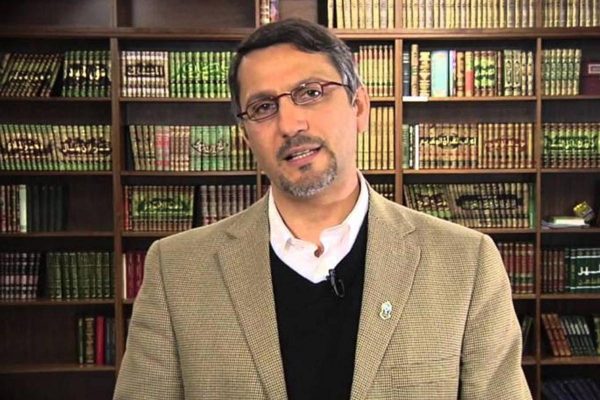
Palestinian academic Hatem Bazian says Arizona State University asked him to sign a contract in which he pledges not to criticise Israel at a university event [File photo]
MEMO | March 9, 2018
Arizona State University is reported to have asked Palestinian academic Hatem Bazian to sign a contract in which he pledges not to criticise Israel at an event organised by the Muslim Students’ Association next month.
Chair of American Muslims for Palestine and lecturer at the University of California at Berkeley, Bazian said Arizona State University asked him to sign the university’s speaker agreement which included a clause that prohibits criticising Israel or engaging with the BDS movement.
Bazian refused to sign the agreement, saying agents loyal to Israel, constitute a real obstacle to freedom of expression and academic freedom in American universities.
He added that asking him to sign an agreement which includes a clause that prevents criticism and boycott of Israel is to ignore the freedom of thought and academic autonomy.
“I think that Israel ignores international law and puts pressure on the Palestinian people,” he said, adding that there are many pro-Israel organisations throughout the United States which try to prevent programmes and events that are organised in favour of the Palestinian cause by putting pressure on university administrations.
Last week, the Council on American-Islamic Relations (CAIR) filed a lawsuit against Arizona State University on behalf of American Muslims for Palestine and Hatem Bazian.
Israeli soldiers pose as news crew to abduct student leader from West Bank university
RT | March 8, 2018
Disguised Israeli forces have stormed Birzeit University in the occupied West Bank and seized the head of the university’s student council. Two students were reportedly injured by gunfire during the raid.
Omar Kiswani was taken by soldiers who reportedly posed as journalists. The university posted footage of Wednesday’s raid online, showing a group of six men pinning Kiswani down and pointing their guns at onlookers.
According to the university, the attackers “carrying firearms in their backpacks, entered the campus during working hours and attacked the student in front of the Student Council Building.” It also called the operation a “barbaric intrusion” and said that two students were recovering in hospital after being injured when the Israeli forces fired into the campus.
Student council member Yahya Alawi, who witnessed the abduction, told the Palestinian Quds News Network that the Israelis “identified Omar and called over to him as if they wanted to interview him as journalists.” Alawi said they then “beat [Kiswani], pulled out their weapons, and a large group of occupation soldiers stormed through the main entrance of the university.”
The Union of Journalists in Israel issued a statement condemning the soldiers impersonation saying that they were “troubled” by “undercover forces impersonating a news crew at Bir Zeit University.” The union added: “Such behavior is likely to endanger real journalists doing their jobs and strikes a blow at freedom of the press. Journalistic work is important and journalists must not be endangered, even in order to conduct security operations.”
This is not the first time 24-year-old Kiswani has been arrested. He previously spent a year in prison for his participation in a group affiliated with Hamas on campus. Following his abduction on Wednesday, Israeli army troops covered the plainclothes operatives’ departure from the scene, firing shots at a group of students throwing stones.
“This is not the first violent intrusion by Israeli army forces, who systematically invade the university’s campus – even though it is specifically protected under international humanitarian law – and constantly harass students, faculty members, and staff at Birzeit University and other Palestinian educational institutions,” the university’s Right to Education Campaign wrote in a statement.
The Only Jewish Ghetto in the Middle East
By Gilad Atzmon | March 8, 2018
AlJazeera reported yesterday that the Israeli parliament has passed a law that allows the Minister of Interior to revoke the residency rights of any Palestinian in Jerusalem on grounds of a “breach of loyalty” to Israel.
Under the new measure, Israel’s Interior Minister, Aryeh Deri, leader of the ultra-Orthodox political party Shas and a convicted criminal , has the authority to revoke the residency documents of any Palestinian whom he deems a “threat.”
It doesn’t take a genius to grasp that this law is racially oriented: it only applies to non-Jews. This type of law follows from the fact that Israel defines itself as the ‘The Jewish State,’ and operates as a tyrannical Jewish shtetl in which the Palestinians are Goyim du jour –0n a daily basis they are confronted by the most extreme forms of Jewish exceptionalism (choseness).
Hanan Ashrawi, a senior member of the Palestine Liberation Organisation (PLO), described the law as “an extremely racist piece of legislation. By unethically stripping the residency of Palestinians from Jerusalem and depriving the rights of those Palestinians to remain in their own city, the Israeli government is acting in defiance of international law and is violating international human rights and humanitarian laws.”
Aljazeera points out that “despite Israel’s claims that occupied East Jerusalem is part of its ‘eternal, undivided’ capital, the Palestinians who are born and live there do not hold Israeli citizenship, unlike their Jewish counterparts.” Apparently the ‘un-dividedness’ of Jerusalem only applies to the members of one tribe and the land they manage to grab by force.
Palestinians in Jerusalem are granted “permanent residency” ID cards and temporary Jordanian passports that are only valid as travel documents. This leaves them stateless, stuck in legal limbo – they are not citizens of Israel, nor are they citizens of Jordan or Palestine.
Zionism vowed to fix diaspora Jews by means of a ‘homecoming.’ It promised to make the ‘new Hebrews’ into ‘people like all other people.’ The project has been a total failure. Israel is a humongous racist ghetto. It is a country like no other. It has managed to amplify every symptom Zionism was born to eliminate.
ACLU says revised anti-BDS bill remains unconstitutional, in blow to pro-Israel groups
MEMO | March 7, 2018
The American Civil Liberties Union (ACLU) has criticised a revised version of draft legislation intended to target the growing Boycott, Divestment, Sanctions (BDS) campaign, saying that the latest version of the bill remains unconstitutional.
The ACLU had voiced objections to the original bill in July 2017 on First Amendment grounds, and in response to such criticisms, Senators Ben Cardin (D-Md.) and Rob Portman (R-Ohio) released a revised version over the weekend.
But in a 6 March press release, the ACLU revealed that it had written to senators informing them of the veteran civil liberties group’s opposition to the revised bill, in what is a blow to pro-Israel groups who are hoping that the bill will become law (the letter can be viewed here).
“This bill is unconstitutional because it seeks to impose the government’s political views on Americans who choose to express themselves through boycotts,” said Ben Wizner, director of the ACLU Speech, Privacy, and Technology Project.
“The proposed changes are improvements, but the revised bill continues to penalize participants in political boycotts in violation of the First Amendment”, he added. “If it is enacted in this form and takes effect, we will strongly consider fighting it in court”.
ACLU noted that “the Supreme Court ruled decades ago that political boycotts are protected by the First Amendment, and the ACLU is currently fighting two lawsuits challenging Kansas and Arizona laws requiring state contractors to certify that they are not participating in boycotts of Israel”.
In the case of Kansas, “a federal judge issued a preliminary injunction in January blocking enforcement of the law while the case proceeds”.
The ACLU press release clarifies that the organisation “does not take a position on boycotts of foreign countries”, but “has long supported the right to participate in political boycotts and has voiced opposition to anti-boycott bills in multiple states as infringements on free speech”.
Read also:
Danish pension giant divests from Motorola over ties to Israeli settlements
MEMO | March 7, 2018
Danish pension fund giant Sampension has officially excluded Motorola over the latter’s ties to Israel’s illegal settlements in the occupied Palestinian territory (oPt).
Sampension, a DKK290 billion ($43.5 billion) Danish labour market pension fund, made the announcement in an update to its exclusion list, stating that Motorola’s provision of products to Israeli settlements is a violation of UN Guiding Principles on Business and Human Rights.
According to ActionAid Denmark (Mellemfolkeligt Samvirke), which welcomed the news, Sampension is withdrawing DKK15 million (some $2.5 million).
 Motorola has well documented links to the Israeli military occupation and settlement enterprise, and is widely believed to be one of the companies contacted by the UN Human Rights Office, in the context of the latter’s work to publish a database of settlements-complicit businesses.
The latest development follows on from Sampension’s exclusion last October of four companies – including two Israeli banks and telecommunications company Bezeq – for their ties to Israeli settlements in, and the extraction of natural resources from, the oPt.
The companies were excluded for violating Sampension’s guidelines for investments in occupied territories, and specifically, “due to the financing of settlements, and the extraction of natural resources and establishment of infrastructure for telecommunication on occupied territory”.
Read also:
ACLU says revised anti-BDS bill remains unconstitutional, in blow to pro-Israel groups
Israeli Forces Attack Students at Hebron Technical University

Palestine Chronicle | March 5, 2018
Clashes broke out on Sunday between Israeli forces and Palestinian students of Palestine Technical University in the West Bank district of Hebron, with no injuries reported until the moment, according to director of students’ affairs department, Issa al-Amla.
Israeli occupation forces reportedly fired rubber-coated steel bullets and tear gas canisters toward the students and the university’s campus; however, no injuries or arrests were reported.
The director said Israeli forces deliberately provoke students through their almost daily presence at the university’s entrance, where they often search and interrogate students on their way to or from campus.
Convention provokes rage against NDP machine
By Yves Engler · March 1, 2018
They came, mostly young people, to fight for justice. They came to support the rule of international law, to help solve a longstanding injustice through non-violent means; they came to tell an oppressed people you have not been forgotten; they came to do what is right for a left wing political party; they came to speak truth to power.
And how did the left wing party respond? By using the “machine” — orders from on high, backroom arm-twisting, opaque block voting and procedural manoeuvring — to prevent debate. Silence in class!
While NDP insiders probably feel they dodged the “Palestine Resolution” bullet at their recent convention, many party apparatchiks may come to regret their undemocratic moves. Their naked suppression of debate might stir rage against the machine they’ve proved to be. At a minimum it has provoked many to ask why.
Why, when the Palestine Resolution was endorsed unanimously by the NDP youth convention and by over 25 riding associations, did the powers that be not want it even discussed?
Given the resolution mostly restated official Canadian policy, except that it called for “banning settlement products from Canadian markets, and using other forms of diplomatic and economic pressure to end the occupation” one can only assume that the party machine either supports the indefinite Israeli occupation of Palestinian land or has some sort of problem with boycotts and economic sanctions. Clearly the NDP is not against boycotts and economic sanctions in principle since they’ve recently supported these measures against Russia, Venezuela and elsewhere.
If, after a half-century of illegal occupation, one can’t call for boycotting Israeli settlement goods, then when? After a century? Two?
Or is the problem the particular country to be boycotted? Does the NDP hierarchy believe that anti-Semitism can be the only possible motivation for putting economic pressure on Israel to accept a Palestinian state? Or perhaps it is simply a worry that the dominant media would attack the party?
Whatever the ideological reason the bottom line is the Palestine Resolution was buried to ensure it wouldn’t be discussed. When its proponents sought to push it up the priority list at an early morning session before the main plenary, the party hierarchy blocked it. In a poorly publicized side room meeting they succeeded 200 to 189. NDP House Leader Guy Caron mobilized an unprecedented number of current and former MPs, including Murray Rankin, Randall Garrison, Craig Scott, Tracey Ramsey, Alexandre Boulerice, Hélène Laverdière, Nathan Cullen and others, to vote against debating the most widely endorsed foreign policy resolution at the convention (Niki Ashton was the only MP to support re-prioritizing the Palestine Resolution.)
Apparently, the party leadership discussed how to counter the resolution at two meetings before the convention. In a comment on a Guardian story about the need for the NDP to move left, Tom Allen, a staffer for Windsor Tecumseth NDP MP Cheryl Hardcastle, describes “panicked” planning to defeat the resolution. “As for the part about the ‘party establishment (being) easily able to deflect challenges from the left.’ I would respectfully submit that this is wrong. As an NDP staffer I can tell you that it wasn’t easy at all this time and, especially with regards to the ‘Palestinian Resolution,’ which required a great deal of panicked last minute organizing to defeat (and only then by a close margin).”
Why would the party establishment risk turning off so many young activists, exactly the sort of member new leader Jagmeet Singh claims he wants to attract?
A quick look at some of the more prominent supporters of shutting down debate suggests an answer.
Victoria area MPs (defence critic) Randall Garrison and (justice critic) Murray Rankin who voted against debating the Palestine Resolution are members of the Canada Israel Inter-Parliamentary Group and took a Centre for Israel and Jewish Affairs paid trip to Israel in 2016. After the IDF slaughtered 2,200 Palestinians in Gaza in the summer of 2014, Rankin offered words of encouragement to an emergency fundraiser for Israel.
Party foreign critic Hélène Laverdière, who voted to suppress the Palestine Resolution, took a paid trip to the American Israel Public Affairs Committee’s conference in Washington in 2016 and participated in a Jewish National Fund event in Israel.
British Columbia liaison and critic for democratic institutions, Nathan Cullen also voted against debating the Palestine Resolution. “I am strongly in support of Israel”, Cullen bellowed in a 2016 statement about how people should be allowed to criticize that country. In 2014-15 Cullen’s office took in Daniel Gans through CIJA’s Parliamentary Internship Program, which pays pro-Israel university students $10,000 to work for parliamentarians (Gans then worked as parliamentary assistant to NDP MP Finn Donnelly). In 2014 Cullen met representatives of CIJA Pacific Region to talk about Israel, Iran and other subjects. According to CIJA’s summary of the meeting, “Mr. Cullen understood the importance of a close Canada-Israel relationship.”
Maybe the loudest anti-Palestinian at the convention was former president of the Ontario NDP and federal council member Janet Solberg. Unsatisfied as a settler in Toronto, Solberg pursued a more aggressive colonial experience when she moved to historic Palestine as a young adult.
Just before the convention the President of the Windsor-Tecumseh Federal NDP, Noah Tepperman, sent out an email to all riding associations calling on them to oppose Palestine resolutions. In it he claimed, “boycotts based on religion, nationality or place of origin directly contravene the spirit of inclusiveness to which we in the NDP are committed.” He further alluded to an anti-Jewish agenda by connecting the different solidarity resolutions to “a backdrop of already-high-and-rising antisemitism here in Canada as well as abroad.” But, Tepperman sits on the board of the Windsor Jewish National Fund, which is an openly racist organization.
The truth is pro-Israel-no-matter-what-it-does NDP members in positions of power within the party won a narrow battle. How the war goes will depend on the lessons learned by those seeking a party that’s an instrument of real change, that fights against all forms of racism and oppression.
Israeli Occupation Forces arrest former governor of al-Khalil
Palestine Information Center – February 28, 2018
 AL-KHALIL – The Israeli Occupation Forces arrested Tuesday evening former governor of al-Khalil city Abdel Halim Ja’bari after being summoned for investigation.
Local sources affirmed that Ja’bari, 70, was summoned Tuesday morning for investigation in Etzion investigation center where he was later detained.
Ja’bari was the head of al-Khalil University for Academic Affairs, al-Khalil’s governor between 2002 and 2007, and Jericho’s governor in 2008.
Featured Video

or go to
Aletho News Archives – Video-Images
From the Archives
A Lesser “Grade” of Human
By Michael Hoffman | Revelation of the Method | January 3, 2024
Will the more than 100 Iranians killed by terrorist bombs today be mourned in the West as victims of terrorism? Certainly not. Allied doctrine has it that the killing of Israeli or American civilians is a crime of cosmic proportions, while shedding the blood of “enemy” women and children is perfectly acceptable; indeed commendable.
The West does not memorialize the hundreds of thousands of civilians bombed by the U.S. in Serbia, Iraq, Afghanistan and every major German city 1943-1945. America’s fire-bombing of the city of Tokyo by General Curtis LeMay in March 1945 was followed by Harry Truman’s atomic incineration of Hiroshima and Nagasaki in August of that year. Truman never had a moment of doubt or regret over the murder of more than a 100,000 Asian children, mothers and non-combatant boys and men. It was business as usual for the “noble” Allies during the “Good War.”
In the West human rights signifies passionate concern only for civilians designated as truly human: Israelis first, then Americans and British, followed by their satraps.
This inhumanity is the legacy of Talmudic ideology, beginning with tractate Sanhedrin 57a from 400 A.D., concerning liability for capital punishment: “If a Jew murders a gentile, he is exempt.”
This teaching of contempt was reiterated in the dogma of Chabad Lubavitch founder Rabbi Shneur Zalman in the 18th century. … continue
Blog Roll
 Aletho News
- NATO’s top generals gather in Kiev
- EU’s continuing expansion – greater threat to Russia
- US Senator Murphy says Pentagon denied him entry to US base in Qatar
- Israel expands “incitement” charge to target Palestinian education and memory
- How Israel seeks to reshape Arab classrooms
- Paris bans pro-Palestinian demonstration planned for Oct. 7 over ‘risks of public disorder’
- In August Hanning Treason Case – All Signs Point To Tel Aviv.
- France cleared dozens of military sales to Israel between May and September: Report
- France projects nuclear power as Macron pushes arsenal expansion
- The fallacy of US delusions about Iran’s economic collapse
- If Americans Knew
- An error has occurred; the feed is probably down. Try again later.
- No Tricks Zone
- US September “Heat” Was No Record…Many Records Set Decades Ago
- Latest European Green Energy Debacle; Portugal’s Largest Flagship Solar Park Insolvent!
- Green Energy Debacle: German Expert Professor Fritz Vahrenholt Warns Of Severe Economic And Social Consequences
- Two More Paleo Reconstructions Affirm Meters-Higher Sea Levels Across Ireland, Brazil 7000-6000 Years Ago
- New Study: Earth And Venus Surface Warmth Largely Explained By Convection And Lapse Rate, Not CO2 Or Radiation
- 2025 Nature Paper Claiming Worsening Global Drought Gets RETRACTED …Heavily Flawed
- New Study: ‘Global Drought Shows No Detectable Recent Acceleration Under Climate Warming’
- Economic Masterminds: German Socialists Suggest Taxing Productivity Gains Stemming From Using AI
- The South China Sea Has Not Been Cooperating With The Climate Change Narrative
- Energy Crisis: Germany Enters Heating Season With Historically Low Gas Reserve Fill Levels

