Witness Out of Palestine
By David Swanson | World Beyond War | February 14, 2018
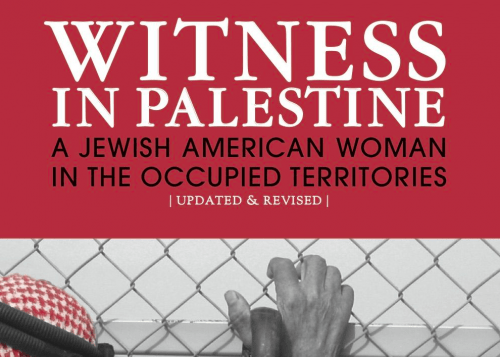
Anna Baltzer’s amazing book Witness in Palestine: A Jewish American Woman in the Occupied Territories has been updated over the years, and I’ve just read it for the first time. Rather unfairly, and — as it turns out — wrongly, my first response upon turning the initial pages was: Do we really need another one of these? Jewish person believes pile of myths. Jewish person confronts reality. Jewish person tries to open the eyes of others. It’s become as familiar as “Dog Bites Man.” Couldn’t we all just share one book around instead of everyone writing his or her own, and then pool our money until we can afford a television station so that people can be made to wake up in large numbers?
But here’s the thing. While I’ve grown accustomed to describing each such book as the best or one of the best, they are not all the same. One of the many merits of this one is that it would make — and I hope it does make if it isn’t already — an excellent text book in schools. And significant numbers of people are waking up, without television, and presumably in part because of all the books, plus the interviews and events that accompany the books. The movement in the U.S. against Israel’s wars (and occupations and apartheid) demonstrates to the movement against all wars, and that against U.S. wars, that such things are possible. It may also demonstrate to writers that their efforts are in fact worth a bit more than would be spending their time helping Fox News hosts spot hidden sperms in presidential portraits.
I recently debated a West Point professor on whether war can ever be justified, and I tried to get him to name some actual wars that have been justifiable (as opposed to theoretical wars). He claimed that Israel’s Six Days War was the “quintessentially” just war. So in our second debate, I read to him from a Los Angeles Times column by Miko Peled showing that those who launched that war did so because they saw an opportunity for aggression and conquest. The facts that Peled revealed would be spreading virally and becoming universally known if they proved that the United States was created by God to set an example for the dumber people of earth. Information becomes known if it is desirable. But why isn’t the fact that every single war ever has been unjustifiable very desirable news, as it allows the world to do something more useful with $2 trillion a year?
My debate partner was a man who took part in the U.S. wars on Iraq and Afghanistan but refused repeatedly to say whether they were just or unjust wars. During our second debate he said that only fresh recruits could be excused for refusing to participate in those wars, but that experienced trained soldiers should have known better. However, he said something seemingly at odds with that, when, after the debate, I asked him yet again whether Iraq 2003-on was a justifiable war, yes or no? He said that it was only unjustifiable after the fact because of new information. And yet he had publicly promoted and participated in that war long after any such supposedly new information (presumably meaning the absence of the WMDs) had become widely known and the fact that the lies had been intentional had been thoroughly documented, and those who had pointed out the blatant falsehoods beforehand had been proven right.
My confused debate partner much preferred talking about analogies to Good Samaritans and doctors and muggers than actual wars, so I pointed out to him that Israel’s concern in 1967 that in 18 months Egypt could be capable of attacking it actually bore no relevant similarity to the immediacy and the urgency of a victim of a mugging. In making this comment I also referred to “decades of genocidal occupation” that followed the war. Someone later accused me of misusing the term genocide. So I pointed out the open advocacy of genocide by top Israelis. Baltzer’s book points out the open advocacy of genocide by many (obviously not all) Israeli settlers and soldiers. But I was then told that the crime of “incitement of genocide” is not the same as genocide. So, apparently it is OK to accuse Israelis of “incitement of genocide” but not of doing anything genocidal. I have no idea Baltzer’s view and don’t want to overemphasize the silly question of the use of a particular word, but I recommend reading her book.
This book documents the normalization of a long-term gradual genocide, one that in its duration serves as a marketing device for generations of new military weaponry. Ambulances are stopped at checkpoints until the ailing person dies. Children are shot for straying too near a fence in pursuit of a soccer ball. Supplies are blocked. Malnutrition is intentionally and successfully imposed. Fishing is restricted. A village is flooded with raw sewage with five people drowning in it. These and hundreds of other techniques serve to reinforce the bigotry behind the apartheid, and to do something that is in a strange way worse than a faster genocide: the banalization of evil. Call it whatever the bloody hell you want to call it. But let’s not let the unpleasantness of it prevent us from working to make it stop.
NDP could break elite consensus against Palestinian rights
By Yves Engler · February 15, 2018
The anti-Palestinian consensus among Canada’s three main political parties is crumbling and NDP members could bury it this weekend.
After taking an all-expense paid trip to the American Israel Public Affairs Committee’s conference in Washington and participating in a Jewish National Fund event in Israel 14 months ago, the NDP’s foreign critic has begun challenging Canada’s contribution to Palestinian dispossession. Hélène Laverdière has repeatedly criticized the Trudeau government’s silence on Donald Trump’s decision to move the US Embassy to Jerusalem. In response she tweeted, “a devastating day for those who believe in peace, justice and security in the Middle East. Where is Canada’s voice in protest of Trump’s decision on #Jerusalem? I urge Canada to condemn this decision in the strongest of terms.”
The party’s foreign critic also asked the federal government to condemn Israel’s detention of 16-year-old Ahed Tamimi and hundreds of other Palestinian children who are usually tortured by Israeli forces. Similarly, Laverdière has pressed Ottawa to properly label products from illegal Israeli settlements and submitted a petition to Parliament calling “upon the Government of Canada to demand that Israel immediately and completely cease all settlement activities in the occupied Palestinian territory, including East Jerusalem.”
Two weeks ago I received an email on behalf of party leader Jagmeet Singh titled “all people deserve the same human rights”, which listed the party’s recent support for Palestinian rights. It noted, “the NDP shares your concerns about Palestine. NDP Leader Jagmeet Singh and his team of New Democrats have a consistent record of defending Palestinian rights as well as raising concerns over Islamophobia.”
A series of factors are likely driving Laverdière’s shift. She probably never backed former NDP leader Tom – “I am an ardent supporter of Israel in all situations and in all circumstances” – Mulcair’s position. Additionally, last year’s NDP leadership race unleashed ever bolder expressions of support for the Palestinian cause.
Amidst the campaign, Laverdière was criticized for speaking at AIPAC’s 2016 conference in Washington and participating in an event put on by the explicitly racist Jewish National Fund. In August the NDP Socialist Caucus called for her resignation as foreign critic and it has submitted a motion to this weekend’s convention calling for her to be removed from that position.
Ottawa’s high-profile abstention at the UN General Assembly after Donald Trump announced that he would move the US Embassy to Jerusalem has given the NDP an opportunity to distinguish itself from the Trudeau government. And media coverage of subsequent Palestinian resistance, most notably Ahed Tamimi’s courageous slaps, has provided additional opportunities to highlight the Liberal’s extreme anti-Palestinianism.
The NDP leadership is also trying to head off members’ calls to boycott Israel (according to a 2017 Ekos poll, 84% of NDP members were open to sanctioning Israel). At least five resolutions (among more than ten concerning Palestine/Israel) submitted to the convention call for some type of boycott of Israel. The NDP Socialist Caucus has called on the party to “actively campaign” in support of the (just nominated for the Nobel Peace Prize) Boycott, Divestment and Sanctions‘ movement’s demands.
With probably more backing than any of the 100+ resolutions submitted, 30 riding associations and youth committees endorsed “Palestine Resolution”, which calls for “banning settlement products from Canadian markets, and using other forms of diplomatic and economic pressure to end the occupation.” Of course, party leaders fear the media response to any type of boycott resolution being adopted.
Whatever the reason for Laverdière’s shift away from anti-Palestinianism, it remains insufficient. As I’ve detailed, the NDP continues to provide various forms of support to Israel and the party has an odious anti-Palestinian history. In the mid-1970s the party opposed Palestinian Liberation Organization participation in two UN conferences in Toronto and Vancouver and party leader Ed Broadbent called the PLO “terrorists and murderers whose aim is the destruction of the state of Israel.”
That year NDP icon Tommy Douglas also told the Histadrut labour federation: “The main enmity against Israel is that she has been an affront to those nations who do not treat their people and their workers as well as Israel has treated hers.” (Douglas’ 1975 speech was made while Israel occupied the West Bank, Gaza Strip, Golan Heights and Sinai, after it repeatedly invaded its neighbours and ethnically cleansed 750,000 Palestinians from their homeland.)
A progressive party worth its salt campaigns on an international issue in equal measure to its government/society’s contribution to that injustice.
Over the past century Canada has played no small part in Palestinians’ dispossession. Hundreds of Canadians provided military force to realize the crassly anti-Palestinian Balfour Declaration and this country’s diplomats played a central role in the UN’s decision to give the Zionist movement most of Palestine in 1947.
Today, Ottawa regularly votes against Palestinian rights at the UN and subsidizes dozens of charities that channel tens of millions of dollars to projects supporting Israel’s powerful military, racist institutions and illegal settlements. Additionally, Canada’s two-decade-old free trade agreement with Israel allows settlement products to enter Canada duty-free and over the past decade Ottawa has delivered over $100 million in aid to the Palestinian Authority in an explicit bid to advance Israel’s interests by building a security apparatus to protect the corrupt Palestinian Authority from popular disgust over its compliance in the face of ongoing Israeli settlement building.
Hopefully, in the years to come the NDP can help Canada make up for its sad anti-Palestinian history. Perhaps this weekend the party will finally bury official Canada’s anti-Palestinian consensus.
Journalist, activist Bushra al-Tawil ordered to another four months in prison without charge or trial
Samidoun Palestinian Prisoner Solidarity Network – February 14, 2108
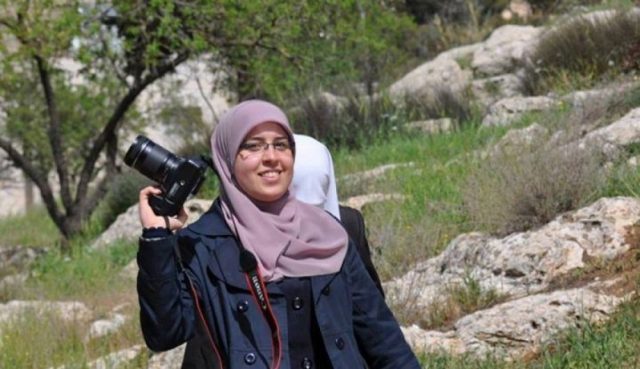
An Israeli occupation military court issued a renewed four-month administrative detention order against Palestinian journalist and prisoners’ rights advocate Bushra al-Tawil on 12 February 2017. Al-Tawil, 26, from el-Bireh, has been jailed by the Israeli occupation without charge or trial since 1 November 2017. Originally ordered to six months in administrative detention, her detention was reduced on appeal to four months; now, an additonal four-month order has been imposed upon her.
Al-Tawil has been detained on several occasions in the past; she is an active defender of Palestinian rights and works with Aneen al-Qaid, an organization that defends Palestinian prisoners. The new order was issued as a “final” order, which ostensibly means it will not be renewed. Administrative detention orders are usually indefinitely renewable, and Palestinians can spend years at a time in jail with no charge or trial under repeatedly renewed orders.
Al-Tawil’s mother said on Tuesday, 13 February, that local and international silence on the prisoners must end, urging unity in action to free the prisoners. Al-Tawil is one of approximately 450 Palestinians currently jailed without charge or trial under administrative detention, among a total of approximately 6,200 Palestinian political prisoners. Administrative detainees have announced that they will boycott Israeli military courts and administrative detention hearings beginning on 15 February.
Virgin pulls Palestinian salad name from in-flight menu after complaints from Israel supporters
RT | February 13, 2018
Virgin Atlantic faces an ongoing backlash over a salad on its in-flight menu after the meal’s ‘Palestinian’ name was shared on a pro-Israel Facebook page.
The ‘Palestinian couscous salad’ – which includes a mix of Maftoul and other couscous, along with tomatoes, cucumber, parsley, mint and lemon vinaigrette – sparked a backlash after passengers posted it on social media.
An image of the in-flight menu was posted on the Israel Advocacy Movement Facebook page by passenger David Garnelas, who said: “I thought this was an Israeli salad… obviously [airline founder Richard] Branson showing his true colours… Israelis must boycott Virgin and Israel must ask for an explanation. When I complained the stewardess tried to take back the menu from me.”
The negative reaction to the meal’s name saw it changed on the airline’s menu.
“We were aware that Maftoul is not a widely known ingredient – so the dish was listed as a ‘Palestinian couscous salad’, and later as a ‘Couscous salad’,” the airline said in a statement to RT.com.
“We’d like to reassure all customers that our sole intention was to bring new flavors onboard, and never to cause offense through the naming or renaming of the dish.”
However, despite the effort to appease passengers, changing the name of the meal sparked a counter backlash from pro-Palestine groups.
“After an orchestrated campaign by Zionist groups, Virgin Atlantic airlines decides that Palestinian food is offensive. Removes the word ‘Palestinian’, but keeps the food. Shameful,” the Ireland Palestine Solidarity Campaign said of the change.
Twitter user Bassam Mansour said that maftoul is the national dish of Palestine and Virgin should not have caved to the demands of “twisted and hate-filled passengers.”
US Lawmakers Pushing to Cancel Lorde’s Upcoming Florida Shows

Lorde in concert. (Photo: Lorde’s twitter account)
Palestine Chronicle | February 11, 2018
American Lawmakers in Florida are trying to cancel Lorde’s upcoming shows in the state after the Kiwi songstress and superstar called off her performance in Israel.
Lorde cancelled her Tel Aviv concert in December, following pressure from fans and activists in the Boycott, Divestment, Sanctions (BDS) movement, which is making a stand against Israel’s oppression of Palestinians.
The decision has seen Republican state Rep. Randy Fine this week pushing for Miami and Tampa to cancel Lorde’s April shows, the Orlando Weekly reported.
Fine based his actions on a Florida law which barred companies that received state funds from doing business over $1 million with organisations associated with BDS.
“When Lorde joined the boycott in December, she and her companies became subject to that statute,” Fine told Orlando Weekly.
“The taxpayers of Miami and Tampa should not have to facilitate bigotry and anti-Semitism, and I look forward to the Miami Sports and Exhibition Authority and the Tampa Sports Authority complying with the law and cancelling these concerts.
“Florida has no tolerance for anti-Semitism and boycotts intended to destroy the State of Israel.”
Florida is one of 20 states with a law in place to deal with businesses that boycott Israel.
In a statement released in December last year Lorde said that “the right decision at this time” was to cancel her June 2018 concert in Tel Aviv.
The Grammy-award winner said that after having “lots of discussions” about the matter, she was “not too proud to admit I didn’t make the right call on this one,” referring to her initial decision to hold the concert.
The cancellation was welcomed by members of the BDS movement.
The Palestinian Campaign for the Academic and Cultural Boycott of Israel posted a statement on Twitter thanking the artist for “heeding appeals from your fans against Israel’s art-washing of its brutal oppression of Palestinians.”
Other artists to have boycotted Israel over its treatment of the Palestinians included Roger Waters, Lauryn Hill and Elvis Costello.
At Canada’s New Democratic Party Convention, Palestine Is Set to Be Major Flashpoint
By Yves Engler | Palestine Chronicle | February 9, 2018
At next week’s New Democratic Party convention in Ottawa Palestinian rights are set to be a major flashpoint.
The NDP Socialist Caucus has submitted a resolution calling on the party to “actively campaign in support of the demand of Palestinian unions, civil society and unions across Canada and around the world which call for Boycott, Divestment and Sanctions against the Israeli state until it dismantles the apartheid wall, allows refugees to return home, ends its demolition of Palestinian homes and olive groves, lifts the siege of Gaza, ends its occupation of Palestinian lands, and terminates its apartheid practices.”
A more moderate “Palestine Resolution: renewing the NDP’s commitment to peace and justice” has been endorsed by two dozen riding associations. The motion mostly restates official Canadian policy, except that it calls for “banning settlement products from Canadian markets, and using other forms of diplomatic and economic pressure to end the occupation.”
Already the Canadian Jewish News, Electronic Intifada, National Post, Ottawa Jewish Bulletin, Toronto Star, Le Devoir, Mondoweiss, Canada Talks Israel Palestine and Rabble have published stories regarding the resolutions. The Centre for Israel and Jewish Affairs has called on the party leader to “push back against marginal elements within the party” promoting Palestinian rights while the more explicitly antidemocratic Canadian Friends of Simon Wiesenthal has “Urged NDP to Disallow Anti-Israel Resolution at Upcoming Convention”.
Unfortunately, corporate-media-focused party operatives may heed the CIJA/Wiesenthal call. Party insiders will no doubt do everything in their power to avoid discussing the Socialist Caucus BDS resolution and will probably seek to block the Palestine Resolution from being debated publicly on the convention floor. If their backroom procedural shenanigans fail to stop the resolutions from a public airing expect a great deal of concern about associating with the international BDS movement.
For NDPers scared of BDS here is an alternative resolution that places no demands on Israel:
1. The NDP will refrain from excluding electoral candidates who speak up for Palestinian rights.
(During the 2015 federal election the NDP responded to Conservative party pressure by ousting as many as eight individuals from running or contesting nominations to be candidates because they defended Palestinian rights on social media.)
2. NDP MPs will refrain from participating in any Israel parliamentary group until the party is represented on a Nigerian, Algerian or Spanish parliamentary group.
(Vancouver Island MPs Randall Garrison and Murray Rankin are currently members of the Canada Israel Inter-parliamentary Group.)
3. The NDP foreign critic will refuse requests to participate in all expense paid trips to the American Israel Public Affairs Committee’s annual conference.
(Hélène Laverdière spoke at the 2016 AIPAC conference in Washington DC.)
4. NDP MPs will participate in all expense paid lobbying trips to Israel at no greater rate than Paraguay, which is of similar size and distance from Ottawa.
(A 2014 calculation found that 20 NDP MPs had been to Israel with a Zionist lobby organization and 13 months ago recently elected party leader Jagmeet Singh went on an organized trip to the country.)
5. NDP officials will abstain from attending events put on by explicitly racist organizations.
(In 2016 Hélène Laverdière participated in an event in Jerusalem organized by the openly racist Jewish National Fund while NDP MP Pat Martin spoke at a JNF event in Ottawa to “recognize and thank the people that have helped to make JNF Canada what it is today.” Owner of 13 per cent of Israel’s land – which was mostly taken from Palestinians forced from their homes by Zionist forces in 1947-48 – the JNF openly discriminates against the 20% of Israelis who are not Jewish. Its website notes that “a survey commissioned by KKL-JNF reveals that over 70% of the Jewish population in Israel opposes allocating KKL-JNF land to non-Jews, while over 80% prefer the definition of Israel as a Jewish state, rather than as the state of all its citizens.”)
My alternative resolution makes no demands of Israel so it’s hard to link it to the BDS bogeyman. Best of all, the party has the power to immediately implement this small gesture of support for the long-suffering Palestinians.
I will be speaking about “What’s Wrong with NDP Foreign Policy?” on the sidelines of the convention.
– Yves Engler is the author of Canada and Israel: Building Apartheid and a number of other books.
Associated Press Double Standard in Israel-Palestine Reporting
By Kathryn Shihadah and Alison Weir | If Americans Knew | February 8, 2018
More than half the world’s population reads Associated Press content every day.
But a study of news reports so far in 2018 indicates that this trusted news source has been presenting the deaths of Israelis at the hands of Palestinians, and of Palestinians at the hands of Israelis, in two completely different ways.
This pattern may be a factor in how readers perceive the players in this decades-old issue. It is also, quite likely, a factor in how editors all over the U.S., who read AP stories daily, view the conflict.
So far in 2018, eleven Palestinians have been killed and two Israelis.
(Since December 4th, when President Trump announced that the US would recognize Israel as “the capital of Israel,” overturning decades of US policy, 27 Palestinians and 9 Israelis have died.)
In AP’s 2018 news reports, Palestinian deaths have been reported in far shorter news articles than Israeli deaths, averaging 181 words in length vs. 551.
In addition to the number of words, AP’s choice of words, context, and which facts to report and which to omit appears to tell two totally different kinds of stories for Israelis and Palestinians.
Reports on Israeli deaths included statements by high officials condemning the attacks. These were often strongly worded, politically charged statements that conveyed the Israeli narrative: “[Israel will] do everything possible in order to apprehend the despicable murderer”; “There is no justification for terror… This is not the path to peace!” “Hamas praises the killers and PA laws will provide them financial rewards. Look no further to why there is no peace.”
By contrast, these AP reports rarely included statements by Palestinian officials condemning the killing of Palestinians, which would have provided another perspective for readers. For example, Fatah spokesman Osama Qawassmeh released a statement that Israel was guilty of a long list of actions that “contravene international law.”
Another Palestinian official condemned Israel’s “extrajudicial killings” and warned of Israel’s tendency to turn the West Bank into a “scene for escalation and security tension so as to pressure our people and leaders, and divert attention from colonialist expansion in our state.”
Such Palestinian viewpoints, largely accurate and readily available, were never reported in the AP articles on deaths.

A Palestinian boy weeps during the funeral of Hani Wahdan, killed during “clashes.”
Israeli victims are human beings, Palestinian victims are “gunmen” or anonymous
Israeli victims were also personalized in AP reports: one was characterized as “a 29-year-old father of four”; the attempted rescue of another was described: “immense efforts were made to save the man’s life, but his wounds were too severe.”
On the other hand, AP reported Palestinian victims with impersonal, often negative descriptions: “armed protester,” “instigators,” and “protesters who were hurling massive amounts of rocks.”
Nowhere did AP describe efforts to save the victims’ lives, although certainly those efforts were made. Elsewhere there were reports of noteworthy turns of events from the scene. This is unfortunately a common occurrence at the scene of Palestinian injuries and deaths: “Eyewitnesses said Israeli soldiers …. fired gas bombs at the Palestinian ambulances and medics that arrived on the scene.” In another incident, “soldiers refused to allow ambulances and firefighters to enter the area.” These descriptions would have been valuable additions to the AP reports.

Palestinian relatives of 16-year-old Layth Abu Naeem weep during his funeral, Jan 31, 2018. The boy was killed by Israeli soldiers who had invaded his village. (EPA-EFE/ALAA BADARNEH)
To its credit, AP did identify the five Palestinian teenagers killed as “teens” – in the past this has not always been the case, where the youth of Palestinian victims has often not been mentioned.
The actual killings of the Palestinians were often reported passively, e.g. “shot in the head during a stone-throwing confrontation” or “died in the violence.”
In two of the Palestinian deaths, AP reported that the Israeli military “denied using live fire.” The men were still dead, and no questions were asked.
In fact, other sources paint entirely different pictures of the killing of the Palestinians. For example, one young man named Ali was only described by AP as “shot in the head” during a violent riot.
But according to eyewitnesses, as reported elsewhere, a number of armed Israeli settlers had infiltrated a Palestinian town, and Ali was part of a group that were forcing them out of town – at which time Israeli soldiers began firing at the group. Ali was reportedly killed by an army sharp-shooter.
In another incident, Israeli soldiers were searching for the man who had killed a settler a few days earlier. The AP article explains that they found and killed a suspect and then demolished three homes belonging to his extended family.
The article does not reveal that they killed the wrong man. It also does not mention that at least 30 vehicles participated in the invasion of the wrong home, and that soldiers confiscated surveillance videos from stores in the area.
AP headlines give Israeli spin
The headlines of the news reports are tellingly different as well.
In the cases of Israeli deaths, the headlines indicate one innocent party and one guilty party: “Israeli killed in West Bank shooting attack”; “Israeli killed by Palestinian in West Bank stabbing attack.”
On the other hand, most of the Palestinian death headlines suggest two equal parties in conflict: “Palestinian teen killed in clashes”; “2 teens killed in clashes with Israeli army”; “Troops kill Palestinian teen in West Bank clash.”
In one case, “Palestinians say Israeli army kills 19-year-old rock thrower,” the victim was at least acknowledged as an individual, but the situation in which Ahmad’s death occurred was misrepresented. The article claims that he was “shot in the head during a stone-throwing confrontation,” but there is much more to the story.

Israeli forces raid the village of Wadi Burqin. [Mohamad Torokman/Reuters]
According to IMEMC, Ahmad was killed
during a massive military invasion…carried out by twenty-two armored military vehicles, and two bulldozers…the soldiers also shot two other young Palestinian men with live rounds in their legs, and six with rubber-coated steel bullets, in addition to causing dozens to suffer the severe effects of teargas inhalation…soldiers broke into and searched many homes, and used K9 units in searching the properties, causing anxiety attacks among many Palestinians, especially children…
Some of the villagers protested this aggression, and it was in this context that an Israeli soldier shot Ahmad in the head.
In this incident, the Israeli army was searching for the killer of a settler named Rabbi Raziel Shevach, who had been killed three weeks earlier, and AP again recounted this older death. In fact, there was more about the settler’s death, which had already been reported on several times, than about the innocent man killed in the manhunt.
According to AP, “The Israeli military had no immediate comment about the casualty.”
AP stories about Shevach reported that he taught in a religious school in Yitzhar and lived in the outpost of Havat Gilad. None, however, bothered to mention that Yitzhar has long been known as “an extremist bastion” of settler violence against Palestinians, home of the notorious Yitzchak Ginsburgh, and that Havat Gilad is similarly notorious for violence against Palestinians.
The Israeli newspaper Ha’aretz reported in 2014, for example, that close to 100 people had been been involved in “a wave of hate crimes against Palestinians and Israeli Arabs. Most of the culprits are known as far-right activists from the Yitzhar settlement and hilltop outposts north of Ramallah and the south Hebron Hills in the West Bank.” This is just one of many such incidents (see video here).
Such context likely would have been included by AP if it had been about Palestinian violence.
AP omits essential context

Palestinian women attempt to pass the Israeli checkpoint in the West Bank town of Bethlehem, Aug. 12, 2011. (AP Photo/Bernat Armangue)
AP reports often leave out critical facts. For example, its news reports on a Palestinian girl imprisoned by Israel for slapping armed Israeli soldiers, almost always left out or minimized the fact that her anger was triggered by the fact that shortly before the incident, an Israeli soldier had shot her cousin in the face.
Perhaps more significant, essential facts about the greater issue are virtually never included.
Nowhere in these reports does AP tell readers that the U.S. gives Israel over $10 million per day. Without this information, American readers will incorrectly feel this is a foreign issue that has nothing to do with them.
Basic information that would give the reader an understanding of the context of the hostility is absent.
Nowhere in any of the articles does the word “occupation” occur, although the illegal Israeli occupation is a 50-year-old fact of life that affects every aspect of Palestinian life. Omitting the fact that Palestinians are living under Israeli military control leaves readers ignorant of one of the most significant aspects of the conflict.
Nowhere in these reports does AP note that many Palestinian families in the West Bank and Gaza were pushed out by Israel during the 1948 war that created the Jewish state, their properties confiscated by Israel. These refugees have not been allowed to return and reclaim their homes, a violation of international law. This, too, is essential information.

Israelis soldiers arrest Palestinian teen Fawzi Muhammad Al-Juneidi in Jerusalem, Dec. 8, 2017
Nowhere does AP use the word “resistance,” the usual term for people fighting against military occupation. Instead, Palestinians are always “militants,” “gunmen,” “stone throwers,” etc. Americans fighting against the British in the 18th century, French fighting against the German occupation in the 20th century, etc. were resistance forces. So are Palestinians.
The word “settlement” is used 19 times in the AP reports. According to international law these settlements are illegal. However, only once does AP mention this fact, and even here it does so in a somewhat diluted manner: “most of the international community considers settlements illegal.”
Nowhere in these reports does AP inform readers that Israel is steadily stealing Palestinian land and imprisoning Palestinians who object to this. Nowhere do these report that Palestinians have virtually no freedom of movement, that some 70 percent of Palestinian families have had one or more family members serve time in an Israeli prison, that hundreds of Palestinian children are in prison, and that Israel is known for its physical abuse of prisoners.

Maali, daughter of jailed Islamic Jihad spokesman Khader Adnan, stands next to a picture of her father outside Israel’s Ofer prison.
Without these and other critical details, it is impossible for readers to have a clear picture of the basis of the conflict and the context of the deaths.
At the end of one AP article is this statement:
Since 2015, Palestinians have killed over 50 Israelis, two visiting Americans and a British tourist in stabbings and other attacks. Over 260 Palestinians were killed by Israeli forces in that time. Israel says most were attackers and the others died in clashes.
To many editors and readers around the country, this means that 260 guilty Palestinians were killed. “Attackers” are guilty by default (“alleged attackers” might be innocent); people in “clashes” are reckless mobs, confronting soldiers and policemen allegedly working to keep the peace. Readers are left to glean on their own, with next to zero evidence, that these Israeli forces are one of the world’s most powerful militaries putting down protests by an occupied, unarmed population.
Astute, knowledgeable readers might wonder how many of those dead Palestinians were really attackers? How many were cases of mistaken identity? And what about those who actually were attacking heavily armed soldiers and settlers… why were they doing this? Could it be because Israel was stealing their land and had killed, injured, and/or imprisoned hundreds of Palestinian children?
And what about the unarmed protesters so often shot in the head by Israeli soldiers? Did they have families who grieve for them? Children who are now orphans? Widows who will weep and struggle? Parents who will forever miss them? We will never know.

A Palestinian boy in Gaza weeps for dead family members.
How many of those dead Palestinians were children themselves? Answer: Since January 2015, at least 100 Palestinian children and 1 Israeli child have been killed in the hostilities. (Between 2000 and 2014, 2,079 Palestinian children and 133 Israeli children lost their lives.)
In the time it has taken to write this article, sadly another Palestinian has been killed.
The headline for this death, “Israeli troops kill Palestinian suspect in settler’s killing,” refers to Rabbi Raziel Shevach’s death in early January. Apparently this time the Israeli military finally found the person they “suspected of being behind the killing” that they had been pursuing. They stormed the house where he was staying, and shot him dead (this may be referred to as “trial by assassination” or “extrajudicial killing”).
The AP article recalls that Israeli troops had already demolished the suspect’s residence (and those of his extended family), but somehow neglects to mention that they had also killed his cousin, who had done nothing wrong, as well as another innocent man, during the course of the aggressive manhunt.
And once again, the article mostly discusses the death of the Israeli settler (as well as repeating details about the other Israeli death that occurred in 2018), and mentions nothing about the Palestinian who had just been killed. Did he have children? Parents? A wife? And if he actually was “behind the killing,” what had motivated him?
In the very last paragraph of the article, AP finally mentions that “19 Palestinians have been killed in the violence since Trump’s announcement.” In reality, it was Israelis who killed these people, and it was actually 24 Palestinians at that time, seven of them teenagers, plus a small boy who died on the day of the announcement.
The Associated Press claims on its website:
For 170 years, we have been breaking news and covering the world’s biggest stories, always committed to the highest standards of objective, accurate journalism.
It is possible that the time has come for AP to take a good, hard look at its objectivity and accuracy when it comes to reporting in Israel-Palestine.
AP’s system of reporting

AP Bureau Chief Josef Federman speaking on C-Span.
AP’s main bureau for Israel-Palestine is in Israel. Reports from Gaza and the West Bank are phoned in to this bureau, where its editors choose and write the news stories that are sent out.
Many (possibly most) of the journalists in this main bureau are Israeli citizens or have partners who are. Some (possibly most) have served in the Israeli military and/or have relatives that have done so. While this doesn’t guarantee pro-Israel bias (some Israeli journalists for Ha’aretz, for example, are excellent, accurate writers on this issue) it does suggest the possibility of partiality influencing their work, either consciously or unconsciously.
It is essential that AP be transparent about its reporting on this extremely important issue.
Whatever the cause of the distortion that continuously characterizes its reporting on this region (see this 2005 report on AP reporting on deaths), it is critical that AP remedy it. Americans, who give Israel over $10 million per day, need full, accurate, unbiased reporting.
Last-minute updates: Two more Palestinians killed
Sadly, during the final edit of this piece, two more Palestinians were killed.
IMEMC, the International Middle East Media Center, has posted the following:
“Israeli soldiers killed, on Tuesday at night, a young Palestinian man, and injured 110, including 32 who were shot with live ammunition, in Nablus city, in the northern part of the occupied West Bank. The Palestinian Health Ministry has identified the Palestinian as Khaled Waleed Tayeh, 22, from Iraq-Tayeh village, east of Nablus. Khaled succumbed to his wounds, after being shot with a live round in the chest.”

Khaled Waleed Tayeh, 22
AP also reports the story: “Israeli guard kills Palestinian after West Bank stabbing” but fails to report the victim’s name, age, or anything else about him.
A few hours later Israeli guards in front of an Israeli outpost shot dead 19-year-old Hamza Yousef No’man Zama’ra, who had attacked one of the armed guards with a knife, cutting the man’s hand. AP reported the death but again failed to give Hamza’s name, age, or additional information about him.

Hamza Yousef No’man Zama’ra, 19
AP also fails to mention that Israel plans to level dozens of Palestinian schools in the West Bank, that Israeli forces have just detained a 52-year-old Palestinian mother and shot a teenager in the face, and that 54 Palestinian patients in critical need of specialized medical care patients died in 2017 when Israel wouldn’t let them leave Gaza.
Perhaps to to AP editors, these stories are of no importance.
However, for many Americans, most of whom believe in justice, fair play, and human rights, such information might diminish the willingness to give Israel massive amounts of their tax money.
* * *
For a list of all Palestinians and Israelis who have been killed by the other side since 2000, see this timeline.
For 2-minute videos of recent Palestinian victims, go here.
Featured Video

or go to
Aletho News Archives – Video-Images
From the Archives
A Lesser “Grade” of Human
By Michael Hoffman | Revelation of the Method | January 3, 2024
Will the more than 100 Iranians killed by terrorist bombs today be mourned in the West as victims of terrorism? Certainly not. Allied doctrine has it that the killing of Israeli or American civilians is a crime of cosmic proportions, while shedding the blood of “enemy” women and children is perfectly acceptable; indeed commendable.
The West does not memorialize the hundreds of thousands of civilians bombed by the U.S. in Serbia, Iraq, Afghanistan and every major German city 1943-1945. America’s fire-bombing of the city of Tokyo by General Curtis LeMay in March 1945 was followed by Harry Truman’s atomic incineration of Hiroshima and Nagasaki in August of that year. Truman never had a moment of doubt or regret over the murder of more than a 100,000 Asian children, mothers and non-combatant boys and men. It was business as usual for the “noble” Allies during the “Good War.”
In the West human rights signifies passionate concern only for civilians designated as truly human: Israelis first, then Americans and British, followed by their satraps.
This inhumanity is the legacy of Talmudic ideology, beginning with tractate Sanhedrin 57a from 400 A.D., concerning liability for capital punishment: “If a Jew murders a gentile, he is exempt.”
This teaching of contempt was reiterated in the dogma of Chabad Lubavitch founder Rabbi Shneur Zalman in the 18th century. … continue
Blog Roll
 Aletho News
- The Makkah Pact Enters Into Force: The End of American Dominance or Its New Form?
- NATO’s top generals gather in Kiev
- EU’s continuing expansion – greater threat to Russia
- US Senator Murphy says Pentagon denied him entry to US base in Qatar
- Israel expands “incitement” charge to target Palestinian education and memory
- How Israel seeks to reshape Arab classrooms
- Paris bans pro-Palestinian demonstration planned for Oct. 7 over ‘risks of public disorder’
- In August Hanning Treason Case – All Signs Point To Tel Aviv.
- France cleared dozens of military sales to Israel between May and September: Report
- France projects nuclear power as Macron pushes arsenal expansion
- If Americans Knew
- Israel’s flailing chatbot army
- Five Palestinians Killed, Others Injured by Israeli Fire in Gaza
- Israel is rewriting the Palestinian curriculum in East Jerusalem to erase Palestinian identity
- Three years of genocide: Israel turned prisons into killing grounds and torture sites
- Three years of genocide. Words fail. Daily Update
- ‘I’d rather die than go back’: A Palestinian teen’s 10-month nightmare in Israeli jail
- How Jared Kushner’s firm’s investment in an Israeli company could be a major conflict of interest
- Soldier testimony sheds light on how Israel wages information war
- CIA Report Warns Israel Could Head Toward Civil War, Total Collapse
- Banker Who Exposed Howard Lutnick’s Ties to Epstein Warned of ‘Retaliation’ and ‘Personal Consequences’ in Last Post Before Suicide
- No Tricks Zone
- US September “Heat” Was No Record…Many Records Set Decades Ago
- Latest European Green Energy Debacle; Portugal’s Largest Flagship Solar Park Insolvent!
- Green Energy Debacle: German Expert Professor Fritz Vahrenholt Warns Of Severe Economic And Social Consequences
- Two More Paleo Reconstructions Affirm Meters-Higher Sea Levels Across Ireland, Brazil 7000-6000 Years Ago
- New Study: Earth And Venus Surface Warmth Largely Explained By Convection And Lapse Rate, Not CO2 Or Radiation
- 2025 Nature Paper Claiming Worsening Global Drought Gets RETRACTED …Heavily Flawed
- New Study: ‘Global Drought Shows No Detectable Recent Acceleration Under Climate Warming’
- Economic Masterminds: German Socialists Suggest Taxing Productivity Gains Stemming From Using AI
- The South China Sea Has Not Been Cooperating With The Climate Change Narrative
- Energy Crisis: Germany Enters Heating Season With Historically Low Gas Reserve Fill Levels

