Remembering Ishaq Maragha: Martyr of the battle of empty stomachs
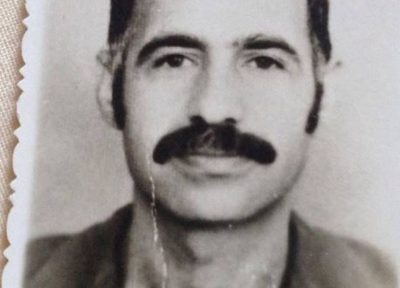
Ishaq Maragha
Samidoun Palestinian Prisoner Solidarity Network – November 19, 2107
16 November 2017 marks the 34th anniversary of the death of Palestinian prisoner Ishaq Maragha, one of four Palestinians whose lives were taken – three through forced-feeding – during a hunger strike for justice inside Israeli prisons. Maragha, who died in 1983, three years after he was grievously wounded by Israeli forced feeding, was not only a martyr but a longtime leader of the Palestinian prisoners’ movement and the Palestinian liberation struggle.
Along with Ali al-Jaafari and Rasim Halawa, he was martyred by Israeli force feeding aimed at breaking the hunger strike of Nafha prison in 1980. Fellow prisoner Anis al-Dawla also lost his life in 1980 from fatigue, malnutrition and disease caused by his solidarity strike in Ashkelon prison in support of the prisoners of Nafha.
Born in the town of Silwan near Jerusalem in 1942, he became a member of the Arab Nationalist Movement – the movement founded by George Habash, Wadie Haddad and other Arab and Palestinian young people looking towards liberation, unity and socialism – and was considered one of the first members of the movement in Palestine, joining in 1959 at the age of 17. He had four children, Jamal, Amal, Amina and Musa.
As a member of the ANM, he traveled to Egypt for military training in 1964. He joined the ranks of the Popular Front for the Liberation of Palestine from the very beginning of its foundation on December 11, 1967 from the Palestine Section of the ANM. Shortly over one year later, in February 1969, he was arrested by Israeli occupation forces on charges of being a leader in the PFLP in the Jerusalem area. After three years in Israeli prison including a period of intense torture under occupation, he was released from prison in August 1972.
As Abdel-Nasser Ferwana, Palestinian researcher on prisoners’ affairs notes, this was only a “fighter’s rest” for Maragha. In February 1975 he was once again seized by occupation forces and accused of participating in the resistance to occupation; he was sentenced to 20 years imprisonment.
Ferwana recalled meeting Maragha several times while visiting his imprisoned father, who would laer be released in the 1985 prisoner exchange with the Palestinian resistance. Maragha said to him as a young man, “The prisons will be destroyed and your father and I will be liberated.”
During his time in prison, he was transferred to Ramle, Beersheba and Nafha prisons; he was well-known among the prisoners as an example of a dedicated worker and a revolutionary leader. Ferwana caled him a “distinguished leader, loved by everyone, a brilliant instigator and a dedicated fighter…one of the pillars of the prisoners’ movement.” He became one of the leaders of the prison organization of the PFLP, responsible for international relations.
In 1980, Nafha prison was opened as an “exile and cemetery for the prisoners’ movement leaders;” Maragha was one of the first to be transferred there. The prisoners began their strike that year, on 14 July 1980. One of the hunger strikers, Abdel-Rahim al-Noubani, chronicled the development of the strike.
The prisoners demanded:
1. The prisoners demand the installation of beds
2. The prisoners demand access to a radio and television
3. The prisoners demand the improvement of the quality and quantity of food
4. The prisoners demand access to Arabic and Hebrew books and newspapers
5. The prisoners demand the expansion of windows, allowing more sun and air into the cell
6. The prisoners demand an end to the policy of collective and individual punishment, solitary confinement, depriving them food during their isolation, and only providing them with bread and water.
7. The prisoners demand the visiting allowance to be prolonged to one hour every two weeks
8. The prisoners demand access to winter and summer clothes, as well as blankets
9. The prisoners demand permission to buy food and vitamins from the prison canteen, which has been hitherto denied
10. The prisoners demand their walk allowance extend from 15 minutes to an hour
As Shahd Abusalama wrote chronicling her own father’s history in the Nafha strike, “Whenever Palestinian prisoners have gone on hunger strike, the Israeli authorities have responded by punishing them collectively. The Nafha hunger strike was no exception.”
After 10 days of hunger strike which drew growing international and Palestinian support, the Israeli occupation attempted a particularly cruel and dangerous form of force-feeding against 26 prisoners in which boiling water and salt were poured down tubes forced down the prisoners’ throats. In the case of Ishaq Maragha, Rasem Halawi and Ali al-Jaafari, the tube was not fully inserted and instead entered their lungs; the boiling water poured into the tube burned and destroyed their lungs. Halawi and Jaafari died almost immediately, killed by Israeli force feeding on their hunger strike.

Ishaq Maragha, Ali al-Jaafari, Rasem Halawa
Maragha later related the experience to al-Noubani:
“When we were put in the waiting room, the three of us collapsed onto a wooden bench, overcome with extreme exhaustion and fatigue. The pain was ripping our chest and gut apart. But it seemed that Ali Jaafari was the suffering the most; he grabbed the bars of the iron door, his drained voice shouting out to the section’s jailer and clinic doctor alternately, asking them to provide us with emergency assistance and treatment. He then turned to me suddenly and said, ‘Abu Jamal, I’m dying, I’m dying!’ I tried to calm him and raise his spirits, and boost his strength – for I had noticed something in him that I myself did not feel, despite the fact that we had both gone through the same torment.
Ali al-Jaafari started shouting again, ‘Abu Jamal, my legs have died, I can no longer feel them, they’re as cold as ice.’ I was helpless, and could do nothing but say to him, ‘Don’t be afraid, Ali, here comes the doctor, don’t worry.’ He suddenly shouted again, for the third and last time: ‘My arms have died, Abu Jamal.’ I was as drained as he was, and as he said this to me, my eyes filled with tears; I saw his last gasp escape from his deteriorated lung to his broken nose by the zonda hose; canals filled with blood and pain opened up inside him. His head was slightly bent over to his right shoulder and his cold hands were still holding onto the bar of that damned iron door. His gracious self slid away, and his pure soul left his body, and all the while he stood there, like a palm tree that had lasted a hundred years drying out. We rested the body of our martyr on the ground, shaking with sobs. In that moment, Rasem and I forgot we shared the same fate as he.”
Maragha also reported that the prison doctor swore that he would not let him die, not out of concern for his life, but because “I will not let them make you a national hero.”
The strike continued after the martyrdom of al-Jaafari and Halawa; Maragha became a key spokesperson for the strike to lawyers and before the world. After 33 days, the prisoners’ ended their strike with a victory in all of their demands.
Maragha was then transferred to Beersheba prison as his health deteriorated further and without the provision of any treatment until he died on 16 November 1983 of his ongoing injuries and wounds caused by his torture under forced feeding during the Nafha strike, leaving a legacy of struggle, sacrifice and commitment above all to the liberation of Palestine, his land and his people.
Ishaq Maragha was a beloved leader of the Palestinian prisoners’ movement and a symbol of the leading role of Palestinian prisoners in the struggle for the liberation of Palestine, whose bodies and lives are on the line on a daily basis in a direct confrontation with occupation. The hunger strikes of Palestinian prisoners are a collective means of struggle and immense self-sacrifice for dignity and freedom.
On the 34th anniversary of the passing of Ishaq Maragha, Samidoun Palestinian Prisoner Solidarity Network remembers him, Ali al-Jaafari, Rasim Halawa and the long legacy of the martyrs of the prisoners’ struggle – and their commitment to Palestinian and global liberation. Their deepest and most precious sacrifice must urge all of us around the world who stand with Palestinian rights, freedom and liberation to intensify and escalate our work for the freedom of the imprisoned leaders of the Palestinian people today. As plans for regional warfare and a so-called “deal of the century” promulgated by the United States and Israel with the backing of Saudi Arabia and reactionary forces threaten the Palestinian people, the people of the region and the world, the legacy of Ishaq Maragha and his fellow Palestinian prisoners can and must inspire us all to struggle at this critical moment to defend the Palestinian cause and struggle to achieve their goals of return and liberation.
Zionism’s Violent Legacy
By Donald Neff | Washington Report On Middle East Affairs | January 1996
On January 4, 1948, Jewish terrorists drove a truck loaded with explosives into the center of the all Arab city of Jaffa and detonated it, killing 26 and wounding around 100 Palestinian men, women and children.[1] The attack was the work of the Irgun Zvai Leumi – the “National Military Organization,” also known by the Hebrew letters Etzel – the largest Jewish terrorist group in Palestine. The Irgun was headed by Revisionist Zionist Menachem Begin and had been killing and maiming Arabs, Britons and even Jews for the previous ten years in its efforts to establish a Jewish state.
This terror campaign meant that at the core of Revisionist Zionism there existed a philosophical embrace of violence. It was this legacy of violence that contributed to the assassination of Israeli Prime Minister Yitzhak Rabin on November 4, 1995.
The Irgun was not the only Jewish terrorist group but it was the most active in causing indiscriminate terror in pre-Israel Palestine. Up to the time of the Jaffa attack, its most spectacular feat had been the July 22, 1946, blowing up of the King David Hotel in Jerusalem, with the killing of 91 people – 41 Arabs, 28 Britons and 17 Jews.[2]
The other major Jewish terrorist group operating in Palestine in the 1940s was the Lohamei Herut Israel – “Fighters for the Freedom of Israel,” Lehi in the Hebrew acronym – also known as the Stern Gang after its fanatical founder Avraham Stern. Two of its more spectacular outrages included the assassination of British Colonial Secretary Lord Moyne in Cairo on November 6, 1944, and the assassination of Count Folke Bernadotte of Sweden in Jerusalem on September 17, 1948.[3]
Both groups collaborated in the massacre at Deir Yassin, in which some 254 Palestinian men, women and children were slain on April 9, 1948. Palestinian survivors were driven like ancient slaves through the streets of Jerusalem by the celebrating terrorists.[4]
Yitzhak Shamir was one of the three leaders of Lehi who made the decision to assassinate Moyne and Bernadotte. Both he and Begin later became prime ministers and ruled Israel for a total of 13 years between 1977 and 1992. They were both leaders of Revisionist Zionism, that messianic group of ultranationalists founded by Vladimir Zeev Jabotinsky in the 1920s. He prophesied that it would take an “iron wall of Jewish bayonets” to gain a homeland among the Arabs in Palestine.[5] His followers took his slogan literally.
Begin and the Revisionists were heartily hated by the mainline Zionists led by David Ben-Gurion. He routinely referred to Begin as a Nazi and compared him to Hitler. In a famous letter to The New York Times in 1948, Albert Einstein called the Irgun “a terrorist, rightwing, chauvinist organization” that stood for “ultranationalism, religious mysticism and racial superiority.”[6] He opposed Begin’s visit to the United States in 1949 because Begin and his movement amounted to “a Fascist party for whom terrorism (against Jews, Arabs, and British alike), and misrepresentation are means, and a ‘leader state’ is the goal,” adding:
The IZL [Irgun] and Stern groups inaugurated a reign of terror in the Palestine Jewish community. Teachers were beaten up for speaking against them, adults were shot for not letting their children join them. By gangster methods, beatings, window smashing, and widespread robberies, the terrorists intimidated the population and exacted a heavy tribute.
Ben-Gurion considered the Revisionists so threatening that shortly after he proclaimed establishment of Israel on May 14, 1948, he demanded that the Jewish terrorist organizations disband. In defiance, Begin sought to import a huge shipment of weapons aboard a ship named Altalena, Jabotinsky’s nom de plume.[7]
The ship was a war surplus US tank landing craft and had been donated to the Irgun by Hillel Kook’s Hebrew Committee for National Liberation, an American organization made up of Jewish-American supporters of the Irgun.[8] Even in those days it was Jewish Americans who were the main source of funds for Zionism. While few of them emigrated to Israel, Jewish Americans were generous in financing the Zionist enterprise. As in Israel, they were split between mainstream Zionism and Revisionism. One of the best known Revisionists was Ben Hecht, the American newsman and playwright. After one of the Irgun’s terrorist acts, he wrote:[9]
The Jews of America are for you. You are their champions … Every time you blow up a British arsenal, or wreck a British jail, or send a British railroad train sky high, or rob a British bank, or let go with your guns and bombs at British betrayers and invaders of your homeland, the Jews of America make a little holiday in their hearts.
The Altalena was loaded with $5 million worth of arms, including 5,000 British Lee Enfield rifles, more than three million rounds of ammunition, 250 Bren guns, 250 Sten guns, 150 German Spandau machine guns, 50 mortars and 5,000 shells as well as 940 Jewish volunteers. Ben-Gurion reacted with fury, ordering the ship sunk in Tel Aviv harbor. Shell fire by the new nation’s armed forces set the Altalena afire, killing 14 Jews and wounding 69. Two regular army men were killed and six wounded during the fighting.[10] Begin had been aboard but escaped injury. Later that night he railed against Ben-Gurion as “a crazy dictator” and the cabinet as “a government of criminal tyrants, traitors and fratricides.”[11]
Ben-Gurion’s deputy commander in the Altalena affair was Yitzhak Rabin, the same man who as prime minister was assassinated by one of the spiritual heirs of Menachem Begin’s Irgun terrorist group. All his life, and especially in his last years, Rabin had opposed Jewish-Americans and their radical allies in Israel who continued to embrace the philosophy of the Irgun and who fought against the peace process, thereby earning their enduring hatred.
Thus at the heart of the Jewish state there has been a long and violent struggle between mainline Zionists and Revisionists that continues today. Despite cries after Rabin’s assassination that it was unknown for Jew to kill Jew, intramural hatred and occasional violence have marked relations between Zionism’s competing groups.
The core of that conflict, one that continues to divide Israel and its American supporters as well, lies in the different philosophies of David Ben-Gurion and Vladimir Jabotinsky. Both were from Eastern Europe, born in the 1880s, and both sought an exclusivist Jewish state. But while Ben-Gurion was pragmatic and secular, Jabotinsky was impatient and messianic, a leader who glorified in the heroic trappings of fascism. Ben-Gurion was usually willing to take less now to get more later, and thus he was content to accept partition of Palestine as a necessary stepping stone toward a larger Jewish state. Jabotinsky, on the other hand, impatiently preached the right of Jews not only to all of Palestine but to “both sides of the Jordan,” meaning the combined area of Jordan and Palestine, or as he called it, Eretz Yisrael, the ancient land of Israel.[12]
Ben-Gurion was a gruff realist who carefully calculated his moves with a wary eye toward the interests of the great European powers and the United States. Time magazine, in a profile of Ben-Gurion in August 1948, described him as “premier and defense minister, labor leader and philosopher, hardheaded, unsociable and abrupt politician, a prophet who carries a gun.[13] Wrote his biographer, Michael Bar-Zohar: “Obstinacy and total dedication to a single objective were the most characteristic traits of David Ben-Gurion.”[14]
Jabotinsky, by contrast, was flamboyant and a devoted admirer of Italy’s fascist leader Benito Mussolini. His disciple, Menachem Begin, described him as “a speaker, a writer, a philosopher, a statesman, a soldier, a linguist … But to those of us who were his pupils, he was not only their teacher, but also the bearer of their hope.” Begin’s biographer, Eric Silver, added: “There was a darker side to [Jabotinsky’s] philosophy: blood, fire and steel, the supremacy of the leader, discipline and ceremony, the manipulation of the masses, racial exclusivity as the heart of the nation.[15] One of Jabotinsky’s slogans was: “We shall create, with sweat and blood, a race of men, strong, brave and cruel.”[16]
Jabotinsky died in 1940, and it was Menachem Begin who refined his wild nationalism into practical political action. Begin concluded: “The world does not pity the slaughtered. It only respects those who fight.” He turned Descartes’ famous dictum around, saying: “We fight, therefore we exist.”[17] Central to Begin’s outlook was the concept of the “fighting Jew.” As he wrote:[18]
Out of blood and fire and tears and ashes, a new specimen of human being was born, a specimen completely unknown to the world for over 1,800 years, the “FIGHTING JEW.” It is axiomatic that those who fight have to hate …. We had to hate first and foremost, the horrifying, age-old, inexcusable utter defenselessness of our Jewish people, wandering through millennia, through a cruel world, to the majority of whose inhabitants the defenselessness of the Jews was a standing invitation to massacre them.
From these early leaders of Zionism (Ben-Gurion died in 1973 and Begin in 1992) have emerged their direct descendants in the Israeli political spectrum. Rabin and his successor, Shimon Peres, were both protégés of Ben-Gurion, and have carried on his mainstream secular Zionism. On Jabotinsky’s and Begin’s side, the followers have been Yitzhak Shamir, Ariel Sharon and, now, Benjamin Netanyahu, the current leader of the Likud.
Rabin’s Strategy
While the two major factions of Zionism disagree on tactics, their ultimate aim of maintaining a Jewish state free of non-Jews was the same. Rabin explained his strategy shortly before his death during an interview with Rowland Evans and Robert Novak:[19]
I believe that dreams of Jews for two thousand years to return to Zion were to build a Jewish state and not a binational state. Therefore I don’t want to annex the 2.2 million Palestinians who are a different entity from us – politically, religiously, nationally – against their will to become Israelis. Therefore I see peaceful coexistence between Israel as a Jewish state – not all over the land of Israel, on most of it, its capital the united Jerusalem, its security border the Jordan River – next to it a Palestinian entity, less than a state, that runs the life of the Palestinians. It is not ruled by Israel. It is ruled by the Palestinians. This is my goal not to return to the pre-Six-Day-War lines, but to create two entities. I want a separation between Israel and the Palestinians who reside in the West Bank and the Gaza Strip, and they will be a different entity that rules itself.
In the Revisionist’s vocabulary, the goal was the same, if more expansionist and expressed in more direct and pugnacious words. Former Defense Minister Ariel Sharon, a leading spokesman of Zionism’s right wing, commented in 1993: “Our forefathers did not come here in order to build a democracy but to build a Jewish state.”[20]
The occupation of all of Palestine, including Jerusalem, in the 1967 war and the coming to power a decade later of Menachem Begin gave a profound boost to Revisionism and its radical philosophy. During this period there arose the firebrand Meir Kahane, a Brooklyn-born rabbi who openly espoused the removal of the Palestinians from all of Palestine. Under the influence of his fiery rhetoric, thousands of Orthodox Jewish Americans were encouraged to emigrate to Israel as settlers on occupied Palestinian land, adding to the radicalization of Israeli politics. After Kahane’s assassination in New York in 1990 by an Arab, New York Times correspondent John Kifner reported that Kahane had been successful in the sense that many of his ideas “had crept into the mainstream” in Israel.
Dr. Ehud Sprinzak, an Israeli expert on the far right in Israel, observed: “Where [Kahane] has succeeded is in changing the thinking of many Israelis toward anti-Arab feelings and violence. He forced the more respectable parties to change. In the 1970s Kahane was in the political wilderness, but in the 1980s the center had moved toward Kahane.” Observed the Jewish Telegraph Agency : “Rabbi Kahane could die satisfied that his message has impacted deeply and widely throughout Israeli society.”[21]
By the mid-1990s, even Kahane’s violent ideas seemed somewhat mild in the context of the radicalized politics of Israel. A new strain of religious extremism has been added to the Revisionist ranks. This became obvious on February 25, 1994, when Brooklyn-born Dr. Baruch Goldstein, a Kahane disciple, walked into the Ibrahim mosque, called the Cave of Machpela by Jews, in Hebron and killed 29 and wounded upwards of 150 Palestinian worshippers.[22] While Rabin and labor Zionists condemned him, Goldstein became a hero for Revisionist Zionists. A shrine was made of his grave and a group of Revisionists grew up called “Goldsteiners.” They are dedicated to the “sublime ideals of Goldstein” and urge “all true Jews to follow his footsteps.”[23]

Baruch Goldstein wore a yellow Star of David with the German word for “Jew” to show his ardent concern for the “lessons of the Holocaust” and its meaning for all Jews. Today many hardline Zionists revere this mass murderer of Palestinians as a Jewish hero and martyr.
While the Revisionists had always had an element of religious messianism, the most radical of their current heirs come from ultrareligious Orthodox Jews who are less consumed by politics than religion.[24] They believe they are God’s messengers. Thus Rabin’s assassin, Yigal Amir, cited the authority of God to explain the murder.
This is a sea change in the mindset – if not the violence – of the traditional Revisionists. For instance, in 1943 Yitzhak Shamir ordered the assassination of one of his closest Sternist friends, but offered an entirely different rationale that had nothing to do with God. Mainly the motive stemmed from political and tactical reasons. Shamir wrote in his memoirs, In the Final Analysis, that Stern commander Eliyahu Giladi had become “strange and wild” and had wanted to shoot at crowds of Jews and urged the assassination of David Ben-Gurion, acts that would have been highly unpopular. Wrote Shamir: “I was afraid that he had gone completely crazy. I knew that I had to take a fateful decision, and I didn’t evade it.”[25] Giladi was fatally shot in the back on a beach south of Tel Aviv and his killer was never found.[26]
The new Revisionists have now expanded the right to kill claimed by the early Revisionists in the name of nationalism to include a divine right. In the end, they are less interested in foreign and domestic affairs than in justifying man’s acts to God. It is a powerful and inflammatory mix of nationalism and religion that is almost certain to lead to more violence unless Israel is able to look into its own soul.
Recommended Reading
- Bar-Zohar, Michael, Ben-Gurion: A Biography, New York: Delacorte, 1978. Begin, Menachem, The Revolt, Los Angeles: Nash, 1972. Bell, J. Bowyer, ‘/error Out of Zion, New York: St. Martin’s, 1977. Ben-Gurion, David, Israel: A Personal History, New York: Funk & Wagnalls, Inc., 1971.
- Bethell, Nicholas, The Palestine Triangle: The Struggle for the Holy Land, 1935-48, New York: G.P. Putnam’s Sons, 1979.
- Brenner, Lenni, Zionism in the Age of the Dictators, Westport, Conn.: Lawrence Hill, 1983.
- Brenner, Lenni, The Iron Wall: Zionist Revisionism from Jabotinsky to Shamir, London: Zed Books, 1984.
- Halsell, Grace, Prophesy and Politics: Militant Evangelists on the Road to Nuclear War, Westport, Conn.: Lawrence Hill, 1986.
- Khalidi, Walid (ed.), Before Their Diaspora: A Photographic History of the Palestinians 1876-1948, Washington, DC: Institute for Palestine Studies, 1984.
- Khalidi, Walid, From Haven to Conquest: Readings in Zionism and the Palestine Problem until 1948, Washington, DC: Institute for Palestine Studies, second printing, 1987.
- Marion, Kati, A Death in Jerusalem, New York: Pantheon, 1994.
- Nakhleh, Issa, Encyclopedia of the Palestine Problem (2 vols.), New York: Intercontinental, 1991.
- Palumbo, Michael, The Palestinian Catastrophe: The 1948 Expulsion of a People from their Homeland, Boston: Faber and Faber, 1987.
- Rubinstein, Ammon, The Zionist Dream Revisited, New York: Schocken, 1984.
- Sachar, Howard M., A History of Israel: From the Rise of Zionism to Our Time, Tel Aviv: Steimatzky’s Agency, 1976.
- Silver, Eric, Begin: The Haunted Prophet, New York: Random House, 1984.
- Tillman, Seth, The United States in the Middle East: Interests and Obstacles, Bloomington: Indiana Univ. Press, 1982.
Notes
[1] Sam Pope Brewer, New York Times, Jan. 5, 1948, and Khalidi, Before Their Diaspora, p. 316. Also see Palumbo, The Palestinian Catastrophe, pp. 83-4. Initial reports put the death toll at 34.
[2] Bethell, The Palestine Triangle, p. 263; Sachar, A History of Israel, p. 267. Details on the bombing and reaction of British officials are in Nakhleh, Encyclopedia of the Palestine Problem, pp. 269-70.
[3] Bethell, Palestine Triangle, pp. 181-87, 263; Sachar, A History of Israel, p. 267; Marion, A Death in Jerusalem, p. 208.
[4] Khalidi, From Haven to Conquest, pp. 761-78; Silver, Begin, pp. 88-96; Nakhleh, Encyclopedia of the Palestine Problem, pp. 271-72.
[5] Silver, Begin, p. 12.
[6] New York Times, Nov. 27, 1948.
[7] Bar-Zohar, Ben-Gurion, p. 175.
[8] Silver, Begin, p. 98.
[9] Bethell, The Palestine Triangle, pp. 308-9. An interview reflecting Hecht’s views appeared in The New York Times, May 28, 1947.
[10] Silver, Begin, p. 108.
[11] Silver, Begin, p. 108.
[12] In Hebrew, Eretz Yisrael means the “Land of Israel,” a phrase invested with strong nationalist feelings.
[13] Time, August 16, 1948.
[14] Bar-Zohar, Ben Gurian, pp. 77, xvii.
[15] Silver, Begin, p. 11.
[16] Elfi Pallis, “The Likud Party: A Primer,” Journal of Palestine Studies, Winter 1992, p. 45.
[17] Begin, The Revolt, pp. 36, 46. Also see Tillman, The United States in the Middle East, p. 20.
[18] Begin, The Revolt, pp. xi-xii. Also see Elfi Pallis, “The Likud Party: A Primer,” Journal of Palestine Studies, Winter 1992, p. 45.
[19] Evans and Novak, CNN, Oct. 1, 1995.
[20] Menachem Shalev, Forward, May 21, 1339.
[21] John Kifner, New York Times, Nov. 11, 1990.
[22] David Hoffman, Washington Post, Feb. 28, 1994.
[23] Khalid M. Amayreh, “Six Months On,” Middle East International, Sept. 9, 1994.
[24] Halsell, Prophecy and Politics, p. 75, provides an excellent analysis of the extremist beliefs of Jabotinsky and his followers and their alliance with American fundamentalist Christians such as Jerry Falwell, leader of the Moral Ml\iority.
[25] Clyde Haberman, New York Times, Jan. 15, 1994.
[26] Glenn Frankel, Washington Post, Nov. 6, 1995.
From The Journal of Historical Review, Jan.-Feb. 1996 (Vol. 16, No. 1), pages 42-45. This item is reprinted from the January 1996 issue of The Washington Report on Middle East Affairs (Washington, DC).
About the Author
Donald Neff is an American journalist and author. For 16 years he worked for Time magazine, including a period as its Bureau Chief in Israel. He also worked for the Washington Star daily newspaper. He is the author of Fallen Pillars: U.S. Policy Towards Palestine and Israel Since 1945 (1995), as well as of the 1988 trilogy, Warriors at Suez: Eisenhower Takes America Into the Middle East in 1956, Warriors for Jerusalem: The Six Days that Changed the Middle East, and Warriors Against Israel: America Comes to the Rescue.
With anti-BDS laws and a pro-Israel parliament, Zionist hasbara is winning in Italy
By Romana Rubeo and Ramzy Baroud | MEMO | November 15, 2107
A proposed law awaiting consideration by the Italian parliament is set to punish those calling for a boycott of Israel. In the past, such an initiative would have been unthinkable. Alas, Italy — a country with historic sympathies for the Palestinian cause — has shifted its politics in a dramatic way in recent years. Most surprisingly, though, is that the Left is as implicated as the Right in the rush to please Israel, at the expense of Palestinian rights.
The sad reality is that Italy is moving into the Israeli camp. This is not only pertinent to political alignment, but in the reconfiguration of discourse as well. Israeli priorities, as articulated in Zionist hasbara (official propaganda) have now become part of the everyday lexicon of Italian media and politics. As a result, the Zionist agenda is now Italy’s political agenda too.
Italy’s anti-Fascist, anti-military occupation and revolutionary past is being overlooked by self-serving politicians, who are susceptible ever more frequently to the pressures of a burgeoning pro-Israel lobby.
Re-writing history
During the so-called “First Republic” (1948 to 1992), Italy was considered to be the West European country most sympathetic to the Palestinian struggle, not only because of a widespread feeling of solidarity among Italians, but also because of the political environment at the time. Italian leaders were perfectly aware of the country’s unique position in the Mediterranean zone. While they were keen to display loyalty to the Atlantic Alliance, they also established good relations with the Arab world. Maintaining this balance was not always easy and led to what are being perceived as “radical choices”, which are now being disowned and criticised.
The pro-Israel trend has been in motion for years. In a famous interview with the Israeli newspaper Yedioth Ahronoth in 2008, former Italian President Francesco Cossiga declared, “Dear Italian Jews, we sold you out.”
Cossiga was referring to the so-called “Lodo Moro”, an unofficial agreement which was allegedly signed in the 1970s by the then Italian Prime Minister Aldo Moro and the leadership of the Popular Front for the Liberation of Palestine (PFLP). The deal supposedly allowed the Palestinian group to coordinate its actions throughout Italian territory, in exchange for it keeping Italy off its operational target list. The “Lodo Moro” is often used in Israeli hasbara to highlight Italy’s supposed failures in the past, and to continue associating Palestinians with terrorism.
In his interview, Cossiga went further, blaming the PFLP for the Bologna terrorist bombing and massacre, which devastated the city’s main railway station in 1980, killing 85 people. Cossiga’s words may have pleased Israel, but were baseless. The [false flag] attack was actually the work of an Italian neo-fascist organisation. Unfortunately, his nonsensical allegation was not an isolated example; it remains representative of the general change of attitude towards Palestine and Israel, one that is largely predicated on re-writing history.
Then and now
In 1974, the Italian government advocated for Palestinian leader Yasser Arafat’s participation in the UN General Assembly. In 1980, it committed to the EEC Declaration of Venice, which recognised the Palestinian “right to self-determination”. As expected, this was strongly opposed by Israel and the US.
Throughout the 1980s, the attitude of successive Italian governments was openly pro-Palestinian, which often led to foreign policy clashes with Israel and its American benefactors, especially during the so-called Crisis of Sigonella in 1985. During a speech at the Italian parliament, socialist Prime Minister Bettino Craxi went as far as defending the Palestinian right to armed struggle. In 1982, the Italian President Sandro Pertini used his traditional end of year address to the nation to talk at length about the horror of the Sabra and Shatilla massacre of Palestinian refugees.
While centre-left political forces supported Palestine to keep good relations with Arab countries, left-wing parties were mainly motivated by the anti-imperialist struggle, which then resonated within Italian intellectual circles. However, this has changed; Italy is now living in its “post-ideological age”, where morality and ideas are flexible, and can be reshaped as needed to conform with political interests.
Today, left-wing parties don’t feel the need to stand up for oppressed nations. They are too beholden to the diktats of globalisation, and are thus driven by selfish agendas which, naturally, brings them closer to the US and Israel.
While neo-liberal politics has ravaged much of Europe in recent years, Italy has proven that it is not the exception. In October 2016, Italy abstained from the vote on the UNESCO resolution condemning the Israeli occupation of Palestinian East Jerusalem. Even that half-hearted move angered Israel, prompting the Israeli ambassador in Rome to protest.
The Italian Prime Minister moved quickly to reassure Israel, speaking harshly about UNESCO’S proposal. “It is not possible to continue with these resolutions at the UN and UNESCO that aim to attack Israel,” insisted Matteo Renzi. One year earlier, Renzi had officially reaffirmed Italy’s commitment to Israel in the Israeli Knesset (parliament), when he declared, “Supporters of ‘stupid’ boycotts [of Israel] betray their own future.”
During his inaugural speech, Italy’s current President Sergio Mattarella addressed the “menace of international terrorism” by mentioning the 1982 attack in front of the Great Synagogue in Rome. His words “deeply touched Italian Jews,” according to the right-wing Jerusalem Post.
Rising Zionist influence
Zionist groups constantly try to sway Italian public opinion. Their strategy is predicated on two pillars: infusing Israel’s sense of victimhood (as in “poor little Israel fighting for survival among a sea of Arabs and Muslims”) and using the anti-Semitism card against anyone who challenges the Israeli narrative.
The hasbara weapons are working, as Italian politics and even culture (through the media) are increasingly identifying with Israel. Worse still, the pro-Israel feeling is now also completely acceptable among left-wing political parties.
According to Ugo Giannangeli, a prominent criminal lawyer who has devoted many years to defending Palestinian rights, the Italian parliament is working on several laws whose sole purpose is to win Israel’s approval. One of these initiatives is Draft law 2043 (Anti-discrimination Act). It ought to be called the Anti-Boycott, Divestment and Sanctions [BDS] Act. The signatories compare the boycott of Israel with “disguised anti-Semitism”. If approved, the legislation will sanction exemplary punishment for BDS campaigners in Italy.
Among the signatories of the draft law is Emma Fattorini, a member of the Italian Democratic Party as well as the “Committee for the protection and promotion of human rights”. Palestinian rights, of course, are of no concern to Fattorini at the moment; they are nowhere to be found in her “human rights” agenda.
Another signatory is Paolo Corsini, who abandoned the Democratic Party and moved to the left-wing MDP – Articolo 1. Corsini was also the rapporteur of the “Agreement between Italy and Israel on public safety”, already ratified by the Italian parliament. The agreement strengthens the relationship between the two countries in a more effective way, in exchange for Israel’s sharing of information on public order and how to control mass protests.
Only a few voices are being raised against Italy’s political and cultural subordination to Israel. Italian politician Massimo D’Alema, a former Foreign Minister, has criticised the change in Italian policies. In an interview with the Huffington Post, he was critical of Italy and Europe over their willingness to please Israeli leaders. He called on the left to reclaim its historic role in support of the Palestinian people.
Activists and progressive politicians can learn from the Italian experience: solidarity with Palestine begins at home. There is a need for strong opposition to any attempts to criminalise BDS, as well as strong countermeasures against pernicious Israeli hasbara that is penetrating every aspect of society on a daily basis.
Iran’s UN envoy slams Canada’s double standards on human rights

Canadians protest in support of indigenous women
Press TV – November 15, 2017
A senior Iranian diplomat has blasted Canada for proposing a “politically-motivated” UN resolution on the situation of human rights in Iran, while Ottawa, itself, has long been involved in a broad range of human rights abuses at home and elsewhere.
Iran’s Deputy Permanent Representative to the UN Es’haq Al-e Habib was reacting to a Canada-drafted human rights resolution, which was adopted Tuesday against Iran by the Third Committee of UN General Assembly with 83 votes in favor, 30 against and 68 abstentions.
Speaking during the session, Al-e Habib rejected the document as “politically-motivated” and said “double standards are an integral part of Canada’s foreign policy.”
“We regret that few unscrupulous Governments continue challenging integrity and credibility of the United Nations through pushing for this politically-motivated resolution that only underscores how selective, irrelevant and subjective UN decisions could sometimes become,” he added.
He pointed to some examples of Canada’s non-compliance by its international human rights obligations, including Ottawa’s discriminatory policies against indigenous people and its support for the Israeli regime.
“Ottawa along with very few others in the whole world have consistently and unconditionally supported Israel despite all the gross, abhorrent and systematic violations of human rights committed by that regime. This level of hypocrisy and double standard is mind-boggling,” the Iranian envoy pointed out.
Al-e Habib also referred to Canada’s discriminatory policies against its own indigenous people, adding, “While police brutality, forced disappearances and murder of the indigenous people are well documented, indigenous women and girls continue to suffer from the institutionalized discrimination and violence.”
“Canada should have realized thus far that such a pointless and futile exercise is a disservice to the human rights cause, a harmful measure against the UN human rights mechanisms and a disrespect to the wisdom of the people who closely monitor Canada’s selective stances on human rights situations,” the Iranian envoy said.
Saudi Arabia rights violations
During the session, Al-e Habib also lashed out at Saudi Arabia for supporting the Canada-drafted resolution against Iran, while Riyadh itself has been blatantly violating human rights both at home and in different parts of the world.
The Iranian envoy noted that Saudi Arabia kills more children in Yemen than al-Qaeda, Daesh and al-Nusra put together around the globe, adding, “Saudi regime being a partner in the global fight against terrorism and intolerance is blatant mockery of humanity, human rights, justice and peace.”
“Spending billions of dollars buying beautiful arms and Western public relation corporations cannot hide the real face of Saudi, whose money also fuels sectarianism in the Persian Gulf, Middle East and the world,” he said.
Al-e Habib went on to enumerate some instances of rights violations by Saudi Arabia, including Riyadh’s crackdown on all forms of dissent across the country, particularly in the eastern city of Awamiyah, mainly populated by minority Shia Muslims.
He highlighted the slavery of hundreds of thousands of female migrant workers inside Saudi Arabia, the systemic violation of human rights of minorities there.
The Iranian official also drew attention to the Saudi massacre of thousands of Yemeni civilians during its military campaign against the impoverished country as well as the number of the kingdom’s nationals, who have joined Takfiri terror outfits such as al-Qaeda, Daesh and al-Nusra Front.
AIPAC is grooming high school students
By Kathryn Shihadah | If Americans Knew | November 14, 2017
Washington D.C. was the site on October 29th – 31st for AIPAC’s annual matchmaking event, pairing up Israel and a fresh batch of American high school students.
The 2017 Schusterman High School Summit treated 400 high schoolers from all over the US to three days of training on AIPAC’s position on Iran, settlements, and other issues, plus kosher meals, fun activities, and a chance to lobby their congressmen. As an added bonus, students attended a college fair, in which they could see what pro-Israel kids do after high school, and talk to pro-Israel college students about pro-Israel universities.
One high school student, Nava, described her experience:
[We] spent three days learning about Israel’s relationship with the US and how Israel needs people to stand up for it. [We] were given tools on how to stand against issues such as Hezbollah, Iran, and BDS… and why it’s important to stand up against hate.
Kineret wrote in an online journal about her experiences at the 2011 Schusterman High School Summit:
We learned that it is not as simple as “Arabs hate Israel,” but that there are many underlying problems that cause the uneasy relationships in the Middle East and around the world.
Kineret also described an afternoon of inspirational speakers – an African American, a Catholic young woman, a Muslim young man who got involved in Hillel during college, and a Hispanic non-Jewish young woman. Clearly, anyone can be passionate about Israel, and everyone is welcome to join the party.
Summit attendees are expected to go back home and be “effective pro-Israel political activists on and beyond their school campus.”
The American Israel Political Action Committee is one of the most powerful lobbies in Washington, and it’s not by accident. AIPAC is highly organized with deep pockets and a dedicated army of workers. The organization’s revenue in 2014 was over $77 million with almost 400 paid employees. (A “sister organization,” the American Israel Education Foundation – which sponsors educational, non-lobbying activities, including trips to Israel for congressmen, had revenue of over $55 million).
The largest conference of the year, the AIPAC Policy Conference, had about 20,000 attendees last year. Significantly, 4,000 of them were students.
AIPAC makes a great effort to identify, woo, and win young advocates for Israel. Each year, several events are organized for high school and college students. The events are smallish, with about 400 slots each, and publicized among Jewish day schools, synagogues, youth groups and student leadership organizations. Competition is fierce to prove who loves Israel the most even before the events begin: applicants are asked to list involvement in AIPAC activities; one expectation is that candidates be “devoted to AIPAC’s mission.”
Once students arrive at the conferences, their experience is immersive: they interact with AIPAC senior staff, meet with AIPAC leadership development professionals, study the AIPAC legislative agenda, and learn AIPAC lobbying techniques.
Retired Jewish journalist Henry Norr likens these events to “child abuse,” pointing out that AIPAC has never been about truth, justice, or real education, but only Israel’s to-do list. Norr further states, “I can only hope that these kids will realize that they’re being used and check other sources… if they want to learn the truth about Israel and the Palestinians.”
You Never Told Me, If Not Now, and Breaking the Silence are a few places where young people can get started on learning facts instead of propaganda. Other useful sites, from a more general perspective, are If Americans Knew, the Washington Report on Middle East Affairs, and The Link.
The innocence of those who fear and the guilt of those who hate
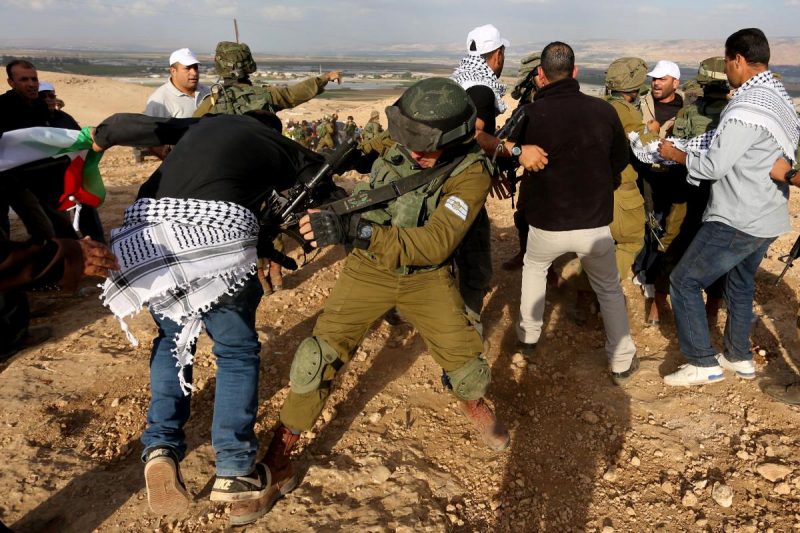
Israeli security forces brutally arrest Palestinian protesters in West Bank [Issam Rimawi – Anadolu Agency]
Dr Samah Jabr| MEMO | November 14, 2017
In our stressful state of occupation, there is, among other ills, an essentialist view of Israeli and Palestinian characteristics. In the many public talks that I have given to Westerners about the violation of the rights of Palestinians, one question almost invariably comes up: “What about the fears of the Israelis?” Similarly, how many times have we heard Western media and even the President of the United States speak of “Palestinian hatred”? These words take for granted the guilt of those who “hate” and the innocence of those who “fear”. However, the reality is that we cannot understand concerns regarding the fears of the Israelis without dissecting the accusations of “Palestinian hatred”.
One problem in this dichotomy is its assumption of a fixed, static state, as if the fears of the Israelis and the hatred of the Palestinians are inborn, permanent traits with no variation among group members. The presumption of eternal and unanimous characteristics serves to maintain the oppressive relationship between the occupier and the occupied and to obstruct political change. To find a way out, the essentialism must be contextualised and deconstructed.
Let us begin by clarifying the disproportionality of the fears of the Israelis with regard to the realistic harm that Palestinians have brought upon them. Israel has long had one of the most powerful armies in the world; it gives “lessons in security” to other nations and exports arms to them for the purpose of oppressing others. Moreover, in order to foster its violent occupation and suppress the natural reflexive resistance on the part of the natives of Palestine, Israel has caged unarmed Palestinians behind walls and appointed colluding Palestinians to maintain order and silence within these cages. By means of long-term and sophisticated strategies to damage Palestinian collective identity, Israel has infiltrated every Palestinian neighbourhood with spies and collaborators. In every previous confrontation, the number of Palestinian casualties has been 100 times the number of Israeli casualties. Thousands of Palestinians are in Israeli prisons, not the other way around; thousands of Palestinian, not Israeli, homes have been demolished by Israeli bulldozers; and yet it is the unarmed and stateless Palestinians who are asked to be considerate of Israeli fears.
In view of these facts, it is unjust and insulting when the question of “Israeli fears” is addressed to a Palestinian, insofar as the question itself reveals deep denial of the longstanding history of Israeli violence. The plea for empathy and understanding, when addressed to the victims of Israeli occupation, is absurd, yet the expectation is that Palestinians must demonstrate understanding and offer reassurance for their oppressors’ fears. The failure to do so is taken as further evidence of “Palestinian hatred” and confirmation that the Israelis are right to fear them.
I understand very well the traumatic fears caused by the history of the Jews in Europe during the 20th and previous centuries, but why should I, a Palestinian, be called upon to soothe these past fears when I am busy with the traumatic present of occupied Palestine? How can I experience deep empathy for this historical European tragedy when the Israeli threats to my existence and security continue to upstage past events in demanding my urgent attention?
Furthermore, the fear of the Israelis is not simply innocent traumatic heritage; it is a suspect political instrument; a wicked manipulation justifying their cruel treatment of the Palestinians. The invocation of Israeli fears silences protest against the occupation, insisting that all Israelis are implicated in the occupation regardless of their individual hesitations about it. And more evil yet is the fact that this manipulated fear cannot be soothed until the Palestinians disappear completely.
The pretence of fear provides an excuse for crime and absolves “frightened” criminals of responsibility; it falsely attributes the responsibility to the “frightening” victims of the crime instead. Is this not what is implied by the misnomer “Islamophobia?” Why is prejudice and crime directed at Jews called anti-Semitism when prejudice and crime against Muslims — many of whom are also Semites — is not called anti-Muslim hate and a crime? It is called instead the minimising term “Islamophobia”, implying that the hate, racism and criminality of the perpetrator is justified because he or she suffers from anxiety and irrational fears about Islam.
To be fair, a degree of fear on the part of Israelis is appropriate; it’s the fear that a tiny proportion of their violence might come back to haunt them, rarely as rockets or a bombing, more often as a Palestinian youth may attempt to punish the Israelis by throwing a stone or pursuing an Israeli soldier with a screwdriver. These things may happen as long as the United Nations and the Palestinian leadership fail to hold the Israelis to account for their crimes.
Attributing fear to the Israelis recruits empathic identification with them, whereas attributing the degrading trait of hatred to the Palestinians provokes repulsion and aversion to them. While there is hatred for the state of Israel among Palestinians, this does not go beyond the adaptive and inevitable hatred that any oppressed and colonised group holds for the collective group that has perpetrated endless crimes against them. Palestinians do not hate Israelis as Jews but as participants in the system responsible for their political oppression. Palestinians are not born with hate in their hearts; hate develops as an appropriate reaction to the totality of the heinous experiences of life under occupation. The people of Palestine are not known for their anti-Semitism; they have welcomed pilgrims from Africa and refugees from Armenia. Many Muslim and Christian Palestinians were married to Jews living in Palestine before the occupation. Like any nation, though, the people of Palestine hate the theft of their land, the pain and the humiliation that the occupation has inflicted upon them. This is, surely, legitimate hate, serving the function of distinguishing harm from safety and motivating resistance to oppression rather than submission to despair.
To expect Palestinians to be free of hate or other negative feelings towards Israel is like expecting a raped woman to have empathy towards her rapist. This would be an example of Stockholm syndrome — a dissociation at best — and more psychologically dangerous than hate itself. This syndrome will eventually result in an internalisation of that hate which would then express itself destructively within the oppressed community.
What Israel actually fears is its own dark “Shadow,” its enormous but disowned and projected violence and hatred for the Palestinians.
It was not fear, but hatred that permitted Israel to commit massacres which evacuated Palestinian villages and towns by force, and which motivates soldiers to kill handcuffed prisoners and unconscious, wounded Palestinians. It is hatred that incites Jewish settlers to burn Palestinians alive and uproot the ancient olive trees of Palestine. Hate speech is articulated by Israeli soldiers who call Palestinians, “beasts on two legs”, “drugged cockroaches” and “crocodiles who want more meat.” This is hate speech which not only encourages hateful acts committed in the name of the occupation but also legitimises ethnic cleansing. Isn’t that what we must do with cockroaches; get rid of them?
Instead of blaming the Palestinians for their hatred and excusing the Israelis for their fear, a constructive move forward would be to help Israel to distinguish reality from fantasy. This would mean admitting Israeli’s own hatred, as well as its greed, and acknowledging that ending the heinous occupation is the only remedy for its fears.
The resumption of PA security coordination with Israel is no surprise
By Ramona Wadi | MEMO | November 14, 2017
Palestinian Authority leader Mahmoud Abbas is not one to miss an opportunity to collaborate with Israel. At sporadic intervals, the suspension of security coordination with Israel was implemented temporarily only when Palestinians were protesting over Israeli violence or, for example, surveillance at Al-Aqsa Mosque. Despite congratulatory statements regarding Abbas’s decision to suspend what he has called “sacred” coordination with the occupation authorities, there was still doubt over its implementation; there were even occasional comments that security coordination had resumed even as the PA was still congratulating itself over the “suspension”.
Last week, all doubts were dissipated as the PA confirmed that it had resumed security coordination with Israel two weeks earlier. In terms of accuracy, the time frame can be contested, given that reports as early as August had already confirmed such collaboration. In light of the reconciliation agreement between the PA and Hamas, it is thus ever more pertinent to question the underlying motives behind such a deal, which has the potential to open up Gaza to Israel.
According to comments on Press TV, Hamas spokesman Fawzi Barhoum declared the movement’s “surprise” at the announcement. Security coordination “is the equivalent of the greatest danger to the Palestinian people, its unity and its legitimate rights, including the right to resist the occupation,” he said. Barhoum also described the move as distorting “the reputation” of the Palestinian people, their struggles and history.
While Barhoum’s comments show an understanding of the implications, claiming to be surprised was surely an exaggeration. Had Gaza not been forced to seek a compromise with Fatah, it is possible that the current political scenario would not be defined by a reconciliation agreement, particularly one which so far is seeking to overturn the resistance with which Hamas has been identified and which sets the movement apart from other political factions due to being forced into situations necessitating defence in the enclave.
Within the same time frame of the security coordination announcement, senior Hamas official Mousa Abu Marzook also stated that responsibility for Palestinians in Gaza now rests entirely with the PA as a sign of credibility to eliminate internal division. The problem is that the emphasis on internal division is being isolated from the repercussions upon Palestinians. If the current trend continues, Palestinian leaders will be making the same mistakes as the international community by separating the political from the humanitarian, thus creating different levels of responsibility, visibility and accountability.
If the PA determines the course of the reconciliation agreement, security coordination will ultimately provide Israel with access to the Gaza Strip unless Hamas decides on an alternative course of action, which is to refute the entire facade of “unity” that has been shaped by Mahmoud Abbas. Coercion has been a primary factor influencing the reconciliation agreement, compounded with the international isolation of Gaza, its people and Hamas. Security coordination is another form of coercion which will determine additional levels of oppression for Palestinians, including those in Gaza.
For many years, Abbas has sought to maintain different forms of violence in Gaza and the occupied West Bank, using deprivation and security coordination respectively. Under such circumstances, Hamas will be in dire need of further evaluation and a different strategy.
Read Also: What prisoners mean to the Palestinian Authority
PA’s security coordination with Israel greatest threat to unity
Israeli occupation forces seize former prisoner, raid village

Samidoun Palestinian Prisoner Solidarity Network – November 14, 2107
Israeli occupation forces seized at least 14 Palestinians throughout occupied Palestine in pre-dawn raids on Monday, 13 November, including former prisoner and long-term hunger striker Tareq Qa’adan, a prominent leader of the Palestinian Islamic Jihad Movement.
Qa’adan, 45, was seized after a 1:30 am raid on his home in the town of Arrabeh, south of Jenin. Occupation forces ransacked his home and interrogated him on the spot before seizing him. He has spent over 10 years in Israeli prions in previous detentions – mostly imprisoned without charge or trial – and is related to many other current and former prisoners; his sister, Mona Qa’adan, is also a freed prisoner and prominent activist.
Khader Adnan, prominent former prisoner and long-term hunger striker, said that evidence indicates that the Israeli occupation intends to transfer Qa’adan to administrative detention, imprisonment without charge or trial. He said that he is confident that imprisonment will not break Qa’adan’s will, and that “he adheres firmly to the defense of the Palestinian cause and homeland, even when the price is his freedom.”
The Islamic Jihad movement issued a statement on the detention of Qa’adan, saying that “this unjust detention…comes amid a wave of targeting and escalation by the occupation against the movement and our steadfast people…Our people have known him as a solid national leader who defends the rights of his people and the fundamentals of his cause. He is known for his positive and strong relationships with all political and national forces and their leaders, who has spent long years in detention in the occupation prisons and a hero of the battles of the open hunger strike.”
This was followed on Tuesday morning, 14 November, by raids across the occupied Palestinian West Bank in which Israeli occupation forces seized 18 Palestinians. In Deir Abu Mashaal village west of Ramallah, occupation fores once again engaged in collective punishment of Palestinian families. They stormed the home of the family of Baraa Saleh Atta, killed by occupation forces after he participated in an armed action in which several Israeli police were killed. They confiscated tens of thousands of shekels from the village and arrested Baraa’s brother Nidal. The stolen funds are those that were raised to help support the families of the three young men, whose homes were sealed off and demolished by occupation forces; the Israeli occupation accused that these funds were “supporting terrorism.”
They also raided the towns of Qabatiya, Zababdeh and Maysaloon near Jenin, while in Tulkarem, they seized former prisoner Muath Jaroun, ransacking his home. They also stationed themselves once again at Kadoorie University, where the presence of armed Israeli occupation forces has become a regular threat and barrier to education for Palestinian students.
Congressional Progressive Caucus Seeks Ban On US Financing Child Torture By Israel
U.S. lawmakers seek to prohibit taxpayer funds from supporting human rights violations against Palestinian minors in Israeli military detention system
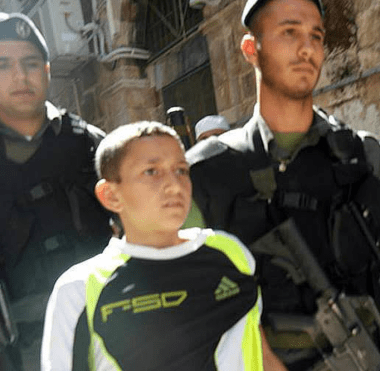
No Way to Treat a Child campaign – November 14, 2017
Washington, D.C. – Members of Congress on Tuesday introduced a bill prohibiting U.S. financial support of abuses against Palestinian children in the Israeli military detention system, putting violations under the magnifying glass of U.S. taxpayers.
The Promoting Human Rights by Ending Israeli Military Detention of Palestinian Children Act requires the Secretary of State to certify annually that no funds obligated or expended in the previous year by the United States for assistance to Israel have been used to support the ill-treatment of Palestinian children detained by Israeli forces from the occupied West Bank.
Rep. Betty McCollum (D-MN) brought the bill to the floor, with eight original co-sponsors, including Rep. Raúl Grijalva (D-AZ) and Rep. Mark Pocan (D-WI), co-chairs of the Congressional Progressive Caucus.
An estimated 10,000 Palestinians between the ages of 12 and 17 in the West Bank have been subject to arrest, detention, interrogation, and/or imprisonment under the jurisdiction of Israeli military courts since 2000. This bill was drafted in response to widely documented rights violations carried out by Israeli military and police against children within the military detention system, including torture or cruel, inhumane, or degrading treatment.
“Despite ongoing engagement with UN bodies and repeated calls to abide by international law, Israeli military and police continue night arrests, physical violence, coercion, and threats against Palestinian children,” said Khaled Quzmar, general director of Defense for Children International – Palestine. “These practices remain institutionalized and systemic rather than last resort measures, and we call on the U.S. to halt its support of these violations.”
The bill aims to establish, as a minimum safeguard, a U.S. demand for basic due process rights for and an absolute prohibition against torture and ill-treatment of Palestinian children arrested and prosecuted within the Israeli military court system.
Israel has the dubious distinction of being the only country in the world that systematically prosecutes an estimated 500 to 700 children each year in military courts that lack fundamental fair trial rights and protections.
In every annual report on Israel and the occupied territories released since 2007, U.S. authorities have openly acknowledged the prevalence of torture and ill-treatment of Palestinian children and the denial of fair trials rights in the Israeli military detention system.
In 2013, UNICEF released a report titled Children in Israeli Military Detention: Observations and Recommendations. The report concluded that “ill-treatment of children who come in contact with the military detention system appears to be widespread, systematic and institutionalized throughout the process.”
Despite sustained engagement by UNICEF and repeated calls to end night arrests and ill-treatment of Palestinian children in Israeli military detention, Israeli authorities have persistently failed to implement substantive reforms to end violence against child detainees.
Featured Video

Houthis Don’t Have to Conquer Saudi Arabia to Make It Pay
or go to
Aletho News Archives – Video-Images
From the Archives
A Lesser “Grade” of Human
By Michael Hoffman | Revelation of the Method | January 3, 2024
Will the more than 100 Iranians killed by terrorist bombs today be mourned in the West as victims of terrorism? Certainly not. Allied doctrine has it that the killing of Israeli or American civilians is a crime of cosmic proportions, while shedding the blood of “enemy” women and children is perfectly acceptable; indeed commendable.
The West does not memorialize the hundreds of thousands of civilians bombed by the U.S. in Serbia, Iraq, Afghanistan and every major German city 1943-1945. America’s fire-bombing of the city of Tokyo by General Curtis LeMay in March 1945 was followed by Harry Truman’s atomic incineration of Hiroshima and Nagasaki in August of that year. Truman never had a moment of doubt or regret over the murder of more than a 100,000 Asian children, mothers and non-combatant boys and men. It was business as usual for the “noble” Allies during the “Good War.”
In the West human rights signifies passionate concern only for civilians designated as truly human: Israelis first, then Americans and British, followed by their satraps.
This inhumanity is the legacy of Talmudic ideology, beginning with tractate Sanhedrin 57a from 400 A.D., concerning liability for capital punishment: “If a Jew murders a gentile, he is exempt.”
This teaching of contempt was reiterated in the dogma of Chabad Lubavitch founder Rabbi Shneur Zalman in the 18th century. … continue
Blog Roll
 Aletho News
- Houthis Don’t Have to Conquer Saudi Arabia to Make It Pay
- MOE: Nearly 22,000 Students and Education Workers Killed
- Guterres in Islamabad: Genocide, cowardice, and the cage of Imran Khan
- Johnson, Marandi say Yemen holds upper hand over Saudi Arabia
- False flags won’t save aggressors, Iran FM spokesman says
- The Makkah Pact Enters Into Force: The End of American Dominance or Its New Form?
- NATO’s top generals gather in Kiev
- EU’s continuing expansion – greater threat to Russia
- US Senator Murphy says Pentagon denied him entry to US base in Qatar
- Israel expands “incitement” charge to target Palestinian education and memory
- If Americans Knew
- Three Years of Genocide: How America’s Israel-First Media Filtered Out the Truth
- Israeli war chief briefs ministers on potential war against Palestinian Authority
- New Report: Israel Killed nearly 21,000 Palestinian Students and Education Workers in Past Three Years
- Israel’s flailing chatbot army
- Five Palestinians Killed, Others Injured by Israeli Fire in Gaza
- Israel is rewriting the Palestinian curriculum in East Jerusalem to erase Palestinian identity
- Three years of genocide: Israel turned prisons into killing grounds and torture sites
- Three years of genocide. Words fail. Daily Update
- ‘I’d rather die than go back’: A Palestinian teen’s 10-month nightmare in Israeli jail
- How Jared Kushner’s firm’s investment in an Israeli company could be a major conflict of interest
- No Tricks Zone
- US September “Heat” Was No Record…Many Records Set Decades Ago
- Latest European Green Energy Debacle; Portugal’s Largest Flagship Solar Park Insolvent!
- Green Energy Debacle: German Expert Professor Fritz Vahrenholt Warns Of Severe Economic And Social Consequences
- Two More Paleo Reconstructions Affirm Meters-Higher Sea Levels Across Ireland, Brazil 7000-6000 Years Ago
- New Study: Earth And Venus Surface Warmth Largely Explained By Convection And Lapse Rate, Not CO2 Or Radiation
- 2025 Nature Paper Claiming Worsening Global Drought Gets RETRACTED …Heavily Flawed
- New Study: ‘Global Drought Shows No Detectable Recent Acceleration Under Climate Warming’
- Economic Masterminds: German Socialists Suggest Taxing Productivity Gains Stemming From Using AI
- The South China Sea Has Not Been Cooperating With The Climate Change Narrative
- Energy Crisis: Germany Enters Heating Season With Historically Low Gas Reserve Fill Levels

