Israel offers privileges to settlement companies affected by Boycott
Palestine Information Center – October 2, 2017
NAZARETH – Israeli Economy Minister Eli Cohen decided to offer special privileges to Israeli companies working in settlements in defiance to international boycott resolutions.
Israeli newspaper Israel Hayom reported that the decision stipulates offering aid in form of tax privileges in the exportation field for the factories affected by the boycott in order to guarantee continuing work in settlements.
The UN Human Rights Council decided to publish a blacklist including the names of factories and companies working in settlements in order to support the boycott and pressure these firms to stop working in the settlements as well as to urge international companies to stop dealing with Israel.
Erasing academic freedom in America by Congressional legislation
By William Cook | MEMO | October 1, 2017
Senator Chuck Schumer’s plaintive lament before the US Senate decrying the supposedly despicable practice of criticising Israel under the guise of anti-Zionism moves inexorably closer to fulfilment. The Anti-Semitism Awareness Act has passed through the Senate unanimously. Shumer’s presentation of his case is classic Hasbara; propaganda disguised as empathy. His emotional appeal casts the Jews as victims of anti-Semitism even when critics of Israel target Zionism and not Jews per se. “Anti-Semitism… has been used throughout history when Jewish people are judged and measured by one standard and the rest by another,” he explains.
As an example of historic anti-Semitism, Schumer claims that Jews could not farm “when everyone else was allowed to.” When, though, were the Jews not allowed to farm? According to Steven Landsburg, “… for well over a millennium … Jews had not been farmers – not in Palestine, not in the Muslim empire, not in Western Europe, not in Eastern Europe, not anywhere in the world.” Indeed, the economist pointed out in a 2003 article (“Why Jews don’t farm”) that you have to go back almost 2,000 years to find a time when Jews, like virtually every other identifiable group, were primarily an agricultural people. “Around AD 200, Jews began to quit the land. By the seventh century, Jews had left their farms in large numbers to become craftsmen, artisans, merchants and moneylenders—the only group to have given up on agriculture. Jewish participation in farming fell to about 10 per cent through most of the world; even in Palestine it was only about 25 per cent. Everyone else stayed on the farms.”
That Jews don’t farm has nothing to do with anti-Semitism yet it becomes an emotionally charged condemnation of those who criticise the state of Israel by citing the truth about its founding ideology, Zionism. From its founding in the late 1800s to the present day, political Zionism has been an ideology determined to bring into existence a nation state for the Jewish people. Prior to World War One, the Zionists argued their right to a homeland, but until the opportunity arose to edge their way into an agreement with a failing Britain for fiscal support through the Balfour Declaration, the possibility of creating that state in Palestine did not exist. (See The Balfour Declaration 1917—2017: 100 years of Deceit, Devastation and Genocide, AHT, 30 March 2017, William A. Cook)
Ralph Schoenman provides a detailed analysis of Zionism in his classic work The Four Myths. Chapter 2 outlines the Zionist Objectives. Nothing so epitomises the reality of Zionism as Vladimir Jabotinsky’s writings on what it asserts and how it must achieve its goals. “We cannot give any compensation for Palestine, neither to the Palestinians nor to other Arabs,” insisted the revisionist Zionist leader. “Therefore, a voluntary agreement is inconceivable. All colonisation, even the most restricted, must continue in defiance of the will of the native population. Therefore it can continue and develop only under the shield of force which comprises an Iron Wall through which the local population can never break through. This is our Arab policy. To formulate it any other way would be hypocrisy… To the hackneyed reproach that this point of view is unethical, I answer, absolutely untrue. This is our ethic. There is no other ethic.”
This is Zionism, raw and vicious. Today, Zionism is still racist, militaristic and unethical. It is inherently anti-democratic yet proclaims to be democratic; it proclaims victimhood yet it is merciless in its occupation and oppression of the Palestinians; and it proclaims friendship with the people of the United States yet continues to take billions of dollars from its ally caring nothing for the people of America who must shoulder $20 trillion of debt, even though Israel is one of the wealthiest nations in the world.
How can the US Congress justify protecting Israel and Zionism by erasing the first amendment to the Constitution regarding freedom of speech, with the “Anti-Semitism Awareness Act”? How can Senators justify silencing critics of this racist, Zionist state when it is clear to the people of the world at large that its ideology openly defies international law, damns as irrelevant the Universal Declaration of Human Rights, and claims an ethical code that supersedes the law? That is what Senators are about to do by “criminalising critics of Israel”. (see “Congress Considers Sweeping Bills to Fine and Jail Backers of BDS”. Democracy Now!, July 17, 2017).
Since the US Congress and Israel have been unable to find a solution, it seems logical to look elsewhere. Consider this fifteen-month collaborative study from South Africa which set out to examine legally the following question: Do Israel’s practices in occupied Palestinian territory, namely the West Bank, East Jerusalem and Gaza, amount to the crimes of colonialism and apartheid under international law?
Apartheid is defined as an institutionalised form of racism in which states enact laws which function as the apparatus to commit inhuman acts for the purpose of establishing and maintaining domination by one racial group of persons over any other racial group of persons and systematically oppressing them. Apartheid regimes rely on three “Pillars of Apartheid” to maintain their domination:
- The state codifies into law a preferred identity: (See full report for evidence)
- The state segregates the population into geographic areas based on their identity.
- The state establishes security laws and policies designed to suppress any opposition to the regime.
Using these criteria, the May 2009 South African study found that, “Israel, since 1967, is the belligerent Occupying Power in occupied Palestinian territory, and that its occupation of these territories has become a colonial enterprise which implements a system of apartheid.”
Despite claims to being a democracy, in practice, Israel’s preferred identity is Jewish, and its separate system gives Jews privileges over non-Jewish citizens. Israel’s domestic law establishes that collective rights extend to Jews only. All other people lack the right to a national life anywhere in Israel proper or in occupied Palestinian territory.
For example, Israel’s state resources, including land in occupied Palestinian territory which Israel has declared “state land”, are specified as being for the exclusive benefit of Jews, administered under the World Zionist Organisation, Jewish Agency and Jewish National Fund. Since 1967, when Israel completed its occupation of historical Palestine, it supplanted existing laws governing Palestinian territory with two separate sets of law: Israeli domestic law applies to Jewish settlers and Israeli military law applies to Palestinians.
Israel denies Palestinians the right to an education through indirect measures such as creating obstacles to movement so Palestinian students cannot get to their schools and universities; repeated closure of Palestinian schools; military attacks on schools and students; destroying educational infrastructure; and denying Palestinian students exit permits preventing them from studying abroad.
What Israel does to the Palestinians in the occupied and besieged Gaza Strip is cruel and inhumane. From 2000 to 2004, Israel demolished over 2,500 homes in the Gaza Strip leaving 16,000 Palestinians homeless. According to the Israeli Committee against House Demolitions (ICAHD), an estimated 24,813 “Palestinian structures” have been demolished in the occupied territories since 1967. This excludes the destruction caused by Israel’s frequent military offensives.
Under international law, the State of Israel has the duty to:
- Cease its unlawful activity.
- Dismantle the structures of colonialism and apartheid.
- Promote full rights and expression of the Palestinian people.
- Pay reparations and damages to the Palestinians people.
Furthermore, third party states are obligated to:
- Not recognise the illegal situation as lawful.
- Not render aid or assistance in maintaining the situation.
- Cooperate to bring the illegal situation to an end.
- Not become complicit in the crimes by failing to fulfil the first three obligations.
As a next step the report recommends that states take action to meet their legal obligations under international law and urgently request the International Court of Justice to issue an advisory opinion on the question of Israel’s practices in occupied Palestinian territory.
I am a Professor Emeritus at an American university; a scholar and researcher; a mentor of a Fulbright Scholar from Morocco; a professional academic administrator at four institutions in four different states, public and private; and a full-time tenured professor at a private university for the past 14 years. I also have an aggregate of 52 years of experience from Instructor to Vice President for Academic Affairs. I believe, therefore, that I can speak with some authority relative to academic freedom, tenure, ethics and values appropriate to this profession.
The action threatened by Representatives Peter Roskam and Dan Lipinski through their HR 4009 proposal seeks to curtail not only freedom of expression voiced against a political entity, the state of Israel, for perceived crimes against humanity in its destructive actions against Palestinian educational institutions and their students, but also presents the American people, most particularly the faculty and administrators at American institutions, with obligations to support a state that has been found guilty of apartheid actions that require international legal action. This could, at some time in the future, result in a finding that convicts this nation and its people themselves of crimes against humanity. The evidence presented in truncated form in this article damns the state of Israel for crimes that are intolerable by any intellectual measure, crimes that cannot be supported by those committed to justice, human dignity and respect for the rights inherent in all humans under the UN’s Universal Declaration of Human Rights and the Geneva Accords, most especially the definition of genocide as expressed in the UN charter.
![Israeli forces brutally arresting a Palestinian youth [File photo]](https://i1.wp.com/www.middleeastmonitor.com/wp-content/uploads/images/article_images/middle-east/Palestinian-youth-arrested-by-Israeli-soldiers.jpg?resize=933.5%2C622&quality=75&strip=all&ssl=1)
Israeli forces brutally arresting a Palestinian youth [File photo]
It would be better for these two Congressmen and their peers to offer the American people a gift of peace. They could begin with the withholding of the $8 million per day provided to Israel so that it can maintain the horrendous conditions it imposes on those living under its military occupation. They could also suggest that Israel’s institutions of higher learning demand of their government a commitment to open the gates of the walled-in State of Israel to all people of goodwill, beginning with an interscholastic dialogue on equity for all – the citizens of Israel as well as the citizens entrusted to their care under international law as occupiers – that all may share the gifts of thoughtful interchange as citizens of the world.
After all, the purpose of higher education is to enhance the intellect and promote the expansion of its capabilities; to recognise that all things, both living and non-living, infuse the possibilities of life by providing richness in artistic expression; to nurture compassion in the understanding of differences and creativity in technical advancement for the benefit of all; to seek, in the realm of the unknown, what enriches us and lifts us beyond our limited selves, because we see the joy of fulfilment in the multitude of faces among whom we live, play, work and pray. The great wonder of higher education is in its freedom of thought and expression; its openness to ideas and explorations of the mind; its quest to know, to seek answers, to thrive on speculation, to entertain paradoxes, mystery, fantasy and intuition, and yet know that all accept that journey of the mind and do so without threat to another, without fear of another, without anxiety or anger or hate.
There is no place in that purpose to criticise with vitriol; to lash out at perceived ignorance; to mock others; to devise weapons of destruction whether of the military kind or mental; or to hate and create “exceptionalism” which blossoms against and excludes others to enhance a few. All of these are anathema to learning. We must all learn from this exercise that the criminals in the US Congress should not be the ones responsible for dictating how academia responds to its purpose.
Read also: Opposing Zionism is not racism
‘Collective punishment’ enacted on West Bank Palestinians for 6th day running

Ma’an – October 1, 2017
RAMALLAH – Israeli forces imposed a general closure on a cluster of villages in the central occupied West Bank northwest of Jerusalem for the sixth consecutive day on Sunday, in what Israeli human rights group B’Tselem denounced as an act of “collective punishment” on tens of thousands of innocent Palestinians.
Locals have been largely trapped inside the villages as a result of military roadblocks and strict security checks, since Sept. 26, when 37-year-old Nimr Jamal from Beit Surik carried out a shooting attack outside of the adjacent illegal Har Adar settlement, leaving an Israeli border police officer and two Israeli security guards killed.
The Israeli army said only “humanitarian cases” would be allowed passage in and out of Beit Surik, Biddu, and up to nine other neighboring localities.
On Sunday, locals told Ma’an that the area had been turned into an “open-air prison,” and “threatened to trigger a humanitarian catastrophe” as the entry of food supplies to these villages has been impeded.
B’Tselem emphasized that the Israeli military sealed off all entries and exits in Beit Surik itself, where soldiers have also taken over seven rooftops, kicking residents out. In Biddu, Israeli forces took over eight rooftops having turned out the residents. Several other homes have been raided and in some cases property has been destroyed.
Raids in Beit Surik and Bidda have sparked clashes, with Israeli forces violently suppressing protesters with live bullets, rubber-coated steel bullets, and tear gas, forcing schools in both villages to shut down, according to B’Tselem.
The siege has also caused severe gridlock in the area, as long lines of cars pile up behind checkpoints and crowd through detour routes.
At at least one roadblock near Biddu and another at the entrance to Beit Anan, Israeli soldiers started denying passage to anyone under 40 years old, and anyone who is not a resident.
Israeli forces have taken measurements of Jamal’s family’s house in preparation to punitively demolish it, interrogated and detained several members of his family including two of his brothers, and revoked revoked all of his family members’ permits to enter Israel for work.
According to B’Tselem, five demolition orders and 15 stop-work orders have also been issued in Beit Surik, all under the pretext of “illegal construction,” and where some 30 cars have also been confiscated. In Biddu, 25 cars have been confiscated.
B’Tselem estimated that some 40,000 Palestinians were being collectively punished as a result of the ongoing security measures.
“Disrupting the lives of tens of thousands of people, who have done nothing wrong and are not suspected of any wronging in such a severe manner is completely unjustifiable. This violence against the population is an exploitation of the military’s power and authority in aid of wanton abuse of civilians without any accountability,” “B’Tselem said.
British Labour is also a victim of the Zionist lobby
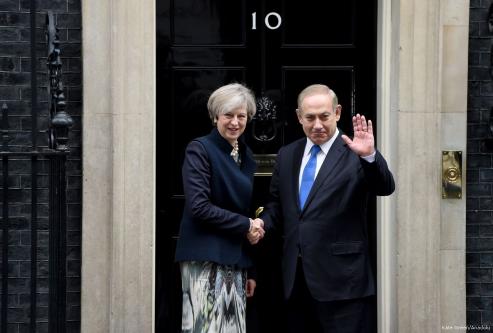
British Prime minister Theresa May (L) and Israeli Prime Minister Benjamin Netanyahu (R) on the steps of No.10 Downing street, London, UK on Feb. 6, 2017. ( Kate Green – Anadolu )
By Hanin Zoabi | Arab48 | September 29, 2017
It seems that the international meetings I am participating in for the 30th time and the ninth series of lectures in Britain specifically are taking up the lion’s share of my visits. This is due to the fact that solidarity campaigns with the Palestinian people in Britain are considered to be the strongest and most active in the world. Time after time, we try to expand the discourse related to solidarity with the Palestinians in order for it to go beyond confronting the occupation and blockade, i.e. “bad Israel” and to including the concept of “good Israel” that Israel is trying to convince the world exists. Does “good Israel” really exist? Could the “Zionist dream” with its ideal conditions and without being subject to resistance from the victim or any international opposition, constitute a normal human life?
The answer to this question is not derived from the reality of the conflict, but the reality of the state, i.e. the routine practices of the Zionist project, not only from its bloody crimes. The basic routine produced by this project is the Jewish State itself, as well as its institutions, its legal system, and the values it produces and raises its generations with on a daily basis. This is the routine that embodies the “Zionist dream”, and this routine is what produces one violation after another and one crime after another.
This is the main claim we can present to the international solidarity movements, and by doing so we can confirm that the problem is with the dream (the Jewish state) and that the crimes committed by this state are the same tools it uses to define itself as a Jewish state. This also confirms that the state cannot exist, even within its basic daily routine, without committing ethnic cleansing, uprooting and the physical and symbolic liquidation of the Palestinian presence, i.e. the crimes are not outside of the Israeli routine, but rather are what form the routing within the system itself. It translates the plans for uprooting, liquidation and ethnic cleansing into legal tools and local administration systems.
We cannot continue to talk about a solution that is merely a “Palestinian state alongside the State of Israel”, a motto even some of our own central political forces still promote. Those who want to combat Israel’s crimes cannot be satisfied with removing Israel from the West Bank and Gaza Strip alone. They must remove Zionism from the legal and political system of the state, because the plans for uprooting, displacement and liquidation are plans that govern Israel’s relationship with the Palestinian presence in all its forms. Citizenship was never protection for the Palestinians from Zionism and its plans, but it has always been a tool of control and a means to implement its plans against us.
As for the “diplomatic” significance of this claim, along with its political significance, it refutes Israel’s defence discourse to the Europeans, which is based on Israel’s spilt personality. There is good/real Israel, which, if left alone by the world, would prove its moral superiority, and there is Israel that is dragged into war, which if forced, possibly, may commit some unintentional or forced violations but only in self-defence.
The importance of stating that liquidations, displacement and cleansing are crimes established in Israel’s routine and are at the core of the Zionist project, is that it refutes Israel’s claims of moral superiority and legitimacy which it is trying to rely on.
If Israel can silence the world with claims of “Islamic terrorism” in Gaza or “defence of its democracy” in the West Bank, then what will its answer be if asked about the reason for prohibiting Arabs from living in over 500 towns, the law of Jewish neighbourhoods receiving larger budgets, the Prawer Plan, the citizenship law, the law to withdraw parliamentary representation, the law prohibiting the commemoration of the Nakba, the law to reduce the sound of the call to prayer, or the law restricting participation in political parties? What will Israel say about physical, political and symbolic liquidation laws? Especially since its typical answer of “self-defence” won’t hold up here. What will it say if the claims of “some violations it was forced to commit” in the West Bank and Gaza Strip were legitimate in order to protect Israel, the democratic state that promotes the West’s democratic values are not accepted?
What would happen if we reveal that the “good” that Israel willingly chooses is no less evil than the evil that it is forced to commit in the West Bank and Gaza?
Such exposure is exactly what Israel fears. It is afraid that the world will discover that the “perfect” Jewish state has committed crimes that are no less of a crime than the war crimes it “forcibly” committed because people have not yet understood the pureness and morality of what Israel wants. They fear that the world will realise the problem isn’t only the brutal crimes but also lies in the daily routine. They are afraid the world will realise that the main problem is not in the missiles and siege that will end if the Palestinians surrender, nor is it in the confiscation of the land, which will stop if the Palestinians voluntarily surrender their land, but the problem is what Israel wants, even if we do not resist. The problem is the laws, culture and intellect that considers your existence terrorism.
Perhaps it is because of Israel’s fear of this that the Zionist lobby is forced to tighten its control in order keep up with the growing solidarity with the Palestinians that not only stems from the ugliness of Israel’s crimes but from a deeper understanding of the concept of the Jewish state itself.
Confronting the nature of the Jewish state requires the Europeans to first liberate themselves from the continuous oppression and extortion that they are constantly subjected to, that undeniably succeeds in controlling the political scene they are living in. It isn’t only the Palestinians who have lost control of their reality, but the Brits as well, or more accurately, those who want to express their views on the Palestinian cause freely. Although they are in remission, their inability to express their opinions freely enough regarding the Palestinian cause indicates their sense of losing control or helplessness. If an embassy and lobby are controlling the freedom of thousands in a certain country, it is not a typical scene and cause for surprise, followed by resentment and anger.
Perhaps the anger felt by dozens of these activists at the fact that a foreign lobby is controlling them is greater than the anger provoked by the violation of Palestinians’ freedom and dignity by the Zionist project, not because the latter’s suffering is less, as the suffering of Palestinians is too deep to compare, but because of Zionism’s success in oppressing British citizens. This gives it more confidence and reassurance in oppressing the Palestinians; is it possible for Israel to succeed in Britain but fail with the Palestinians?
The answer is yes, it is possible for Israel to succeed in suppressing the freedom of expression of activists in solidarity with Palestine who are from strong and sovereign nations and fail with the victim. This is because it has already taken over all means of its victims’ material and symbolic life, leaving them with very little to lose. Sometimes, strength is one’s weakness, while confinement within narrow limits means you will only lose narrowness.
In the past two years, the British have voiced their resentment, their fear of the Zionist lobby and, most importantly, its success in silencing them more than ever. The Zionist lobby has intensified its campaigns, relations and means of pressure, this time in coordination with the Israeli Foreign Ministry and the Israeli ambassador in London. Everyone will attest to his unprecedented means of intimidation, which no other ambassador has ever used. This is despite the fact that the British, and other countries’ laws do not permit local lobbies to receive guidance, instructions or funding from any foreign embassy in the country in which it operates, as this constitutes an interference in the internal affairs of the state, which is prohibited by the norms and rules of international diplomacy.
Al Jazeera’s investigation revealed how the Zionist lobby infiltrated and penetrated not only the corridors of British politics, but also the corridors of the personal life of British officials. They even went as far as trying fabricate a scandal for one of the conservative ministers as punishment for his rejection of settlements. Despite the discovery of such actions and plots, no punishment or measure have been taken in accordance with the diplomatic standards.
The peak Zionist lobby’s success is embodied by the British government’s adoption of the new definition of anti-Semitism, which considers any unconventional criticism against Israel anti-Semitic. This new change must not be underestimated. This change occurred in late 2016 when British Prime Minister Theresa May promised to issue a government resolution to adopt a definition recently formulated by the International Holocaust Remembrance Alliance, known as the IHRA, which stated that “anti-Semitism could include criticism of Israel as a Jewish state”. This means anyone who dares to criticise Israel will “put themselves at risk” of being labelled as anti-Semitic.
Not only did the Zionist lobby succeed in making Theresa May adopt this definition, but the harshest blow came in the form of Labour party leader Jeremy Corbyn, known for his unprecedented support in the British political arena for the legitimate rights of the Palestinians and his full awareness of the essence of the Zionist project, agreeing to adopt this new definition of anti-Semitism.
Hence, it seems that the Zionist lobby in Britain pre-empted the “benefits” the Palestinians would gain from electing their “friend” Corbyn as head of the Labour party by adding new restrictions to the British political scene. They have made the Zionist definition of anti-Semitism most in control of the limits of what is permissible and prohibited in terms of supporting Palestinians and opposing colonialism, settlement, apartheid and Israeli oppression in the British political scene.
This may suggest that supporting Zionism is a condition for the freedom of expression in Britain (similar procedures and laws were approved recently in other European countries including France and Spain), in a clear example of McCarthyism that puts anyone who criticises Israel on a blacklist.
Dozens of members of the Labour party have revealed their membership has been frozen for months after the Zionist lobby filed complaints against them, accusing them of anti-Semitism. They all noted that the number of those who believe they were punished for this accusation by freezing their membership reached thousands, while others said the number is tens of thousands of people. In some cases, people’s memberships were frozen without their knowledge, and without any formal procedure or without allowing them to air their side of the story.
Some of us overlook the fact that the efforts to eliminate thousands of Labour party activists is not only a personal attack on these individuals, but also reflect attempts by the Zionist lobby to manipulate the internal influence of the Labour party, known for its member’s support for Corbyn’s left-wing pro-Palestinian positions, but not known to support the official bodies in the party and the senior officials who are known for their hostility toward Corbyn and their relentless fight against his influence. This indicates some mechanisms of the Zionist lobby in combatting Corbyn and influencing the internal elections of the British parties.
These new developments are what allow us to confirm that there are motives for the Brits’ solidarity with the Palestinian that go beyond their support for their just cause. They are also standing in solidarity against the Zionist lobby’s attempts at political intimidation and with their right to think, express and speak freely in their country. The Zionist lobby’s success in oppressing the freedom of expression of other nations would be the greatest indicator of the credibility of the Palestinians’ claims, not to mention the fact that the Zionist lobby is forced to exaggerate its means of pressure and repression in an attempt to keep up with the increased solidarity with the Palestinians.
In the past two years, Britain has been criticising the Zionist lobby, not in defence of the Palestinians’ rights but in defence of the British people’s rights. Petitions signed by 200 lawyers and academics confirmed that the restrictions imposed by British policy against the international boycott of Israel, in addition to the government’s adoption of the Zionist definition of anti-Semitism are a violation of human rights in Britain.
The suppression against British citizens by foreign parties in their own country does not stop at the suppression of freedom of expression. Just as the Palestinians experience this, the Zionist lobby in all European countries threaten those who rent out their halls for conferences and forums organised by solidarity campaigns. The surrender of many is not because they are afraid of punishment, but most of the time it is to reduce harassment and headache they are subjected to. Other fears faced by the British people causing them to surrender to the pressure of the lobby are related to their fear of losing sources of funding or defamation in the media and social networking sites under the control and influence of the Zionist lobby.
Despite all this, I must note that although the Palestinian cause has lost some of its international political presence due to the Arab revolutions and their consequences, as well as the fact that the cause has been liquidated as a liberation cause and is being dealt with as a diplomatic issue by the PA, it has not lost its moral presence globally, and is still a symbol of justice and the fight against domination.
The Palestinians still do not require much effort to convince any European of the justice of their cause, and the Zionist lobby is still forced to redouble its efforts, funds and intimidation to keep pace with the popular support given instinctively to the Palestinians without much effort. However, this requires us to focus our efforts and to emphasise that the definition, principles and laws of the Jewish state itself eliminate any possibility of the existence of an “innocent Israel” and that Israel’s daily practices represented by its legal, political and educational system should be subject to international scrutiny and accountability, and not only its crimes in the West Bank and Gaza. The former carries as much crime as the latter. The second thing we must emphasise is the extent to which Zionism has become an international movement against freedom in the world.
Translation by MEMO
Israeli embassy accused of pressuring UK university to censor free speech
MEMO | September 29, 2017
A UK university has been accused by students of bowing to Israeli pressure and censoring free speech following revelations of a meeting between university officials and the Israeli ambassador days before an event during Israel Apartheid Week.
Email correspondence obtained through a freedom of information request, seen by MEMO, reveals details of a meeting between Israeli Ambassador Mark Regev and senior staff at the University of Manchester (UoM) prior to an event during Israel Apartheid Week last March.
The documents were obtained from UoM after the Information Commissioner’s Office (ICO) – the body regulating data protection in the UK – found UoM to be in breach of the Freedom of Information Act (FOIA) by not disclosing information requested by a student activist over its relations with controversial Israeli institutions.
Manchester University student, Huda Ammori, lodged the complaint against UoM after an unsuccessful bid to obtain details about the nature of the university’s relations with Israeli organisations. In August, the ICO stepped in and instructed UoM to provide a response to the request within 35 days, in accordance with its obligations under the FOIA.
In one correspondence obtained by Ammori, the Israeli embassy thanked Dr Tim Westlake, director of student experience at UoM, for “hosting” the Israeli ambassador and “discussing openly some of the difficult issues that [we] face”. The embassy also discussed ways to “increase take up of the Erasmus Programme”, which is a European Union student exchange programme.
The email correspondence includes details of the meeting between UoM and the Israeli embassy, in particular, their concerns over two events organised by the university’s Action Palestine and BDS societies, during Israeli Apartheid Week. In its email the embassy said: “These are just two events of many that they are running in their so called and offensively titled ‘Israeli Apartheid Week’.”
Israeli embassy staff accused the speakers, including Holocaust survivor and historian Marika Sherwood, of anti-Semitism. They said that the speakers had “cross[ed] the line into hate speech” and that their talk was not “legitimate criticism” of Israel. The officials were especially keen to stress their disapproval of the talk by Sherwood, which was going to compare her experience as a child surviving Nazi brutality and the injustices committed by the Israelis against the Palestinians.
In her response to the accusations, Sherwood told MEMO:
I am not an anti-Semitic Jew! I am an anti-Israeli Jew! The two are not the same. And yes, to me the way Israelis behave towards the Palestinians, whose land/property they have claimed/confiscated/overtaken is as the Nazis behaved towards me and my fellow Jews in Hungary WWII.
“We cant all go back to where our ancestors lived thousands, even hundreds, of years ago,” Sherwood reasoned. “Can you imagine all the Brits who settled in the Americas, in Australia, NZ, South Africa, coming back to claim the UK?”
Organisers, unaware that senior UoM officials had met with the Israeli embassy days before the event, were pressured to meet a number of demands before the university granted permission to hold the event: Academics chosen to chair the meetings were replaced by university appointees, publicity was limited to students and staff, the organisers were told talks would be recorded and the title of Sherwood’s talk had to be changed because “of its unduly provocative nature”.
MEMO contacted UoM over the allegation that they censored free speech, their reasons for putting pressure on the students and if it was in the habit of senior staff to host foreign embassy delegations to discuss internal university matters.
In response, UoM spokesperson said: “Events held on campus are reviewed under the University’s Code of Practice on Freedom of Speech if they concern potentially controversial topics and whenever they involve external speakers. This includes events organised through and in the University of Manchester Students’ Union. In deciding whether or not an event should go ahead, the University pays due regard to all relevant legislation, including the Equality Act 2010.”
“However, such legislation does not act to prohibit completely the expression of controversial views. In this case the University allowed the events to proceed in line with the requirements of the Act and our commitment to principles of freedom of speech and expression.”
While the university refuses to admit any outside coercion, the Israeli embassy has previously been found to have exerted undue influence on British institutions. Earlier this year an Al Jazeera documentary made the sensational revelation concerning a senior Israeli diplomat, Shai Masot, who was captured on video conspiring to “take down” certain UK government ministers such as Sir Alan Duncan for speaking out against Israeli policy and sympathising with the plight of the Palestinians.
The scoop also revealed that the Israeli embassy was providing covert assistance to supposedly independent groups within the Labour party; jobs at the embassy were being offered to groom young Labour activists; and how concerned the embassy was with removing not just Foreign Office Minister Sir Alan Duncan, but also Crispin Blunt MP, the chair of the Foreign Affairs Select Committee (both of whom are Conservative MPs), as well as Jeremy Corbyn MP, the leader of the Labour party.
Read also: Manchester University must reveal its relations with Israeli institutions
Palestinian youth activist ordered to six months in administrative detention; Israeli occupation terror continues in Dheisheh

Photo: Saleh al-Jaidi
Samidoun Palestinian Prisoner Solidarity Network | September 28, 2017
Palestinian youth activist Saleh al-Jaidi, from the Dheisheh refugee camp near Bethlehem, was ordered on Thursday, 28 September to six months’ imprisonment without charge or trial under an administrative detention order.
He was seized on Friday, 22 September by Israeli occupation forces who invaded and ransacked his family home in a pre-dawn raid. He was previously imprisoned three times, twice before in administrative detention in 2010 and 2015. He was jailed for three years after another arrest by occupation forces in 2011.
Al-Jaidi is a well-known youth activist in the camp; his brother, Yazan, is also imprisoned by Israeli occupation forces.
Meanwhile, the infamous “Captain Nidal,” the pseudonym used by an as-yet-unnamed Israeli occupation military commander, has continued to be the name under which the Israeli occupation carries out its ongoing campaign of terror and destruction in Dheisheh.
“Nidal” is known for calling multiple youth in Dheisheh and threatening to make “all of you disabled” – followed by repeated serious injuries caused by Israeli occupation forces shooting camp youth in the legs during protests or night-time “arrest raids.” He also threatened Raed al-Salhi to “shoot him in front of [his] mother,” shortly before al-Salhi was shot by occupation forces in Dheisheh camp on 9 August. Salhi, 22, an active youth in the camp known for both his political dedication to the leftist Popular Front for the Liberation of Palestine and his community-minded volunteer spirit, died from his injuries on 3 September.
“Nidal” is now calling the family members of Akram al-Atrash, a youth from the camp who was shot in the arm and the chest with live fire by Israeli occupation forces when they invaded the camp on 4 April. He remains injured and currently faces several dangerous operations that imperil his life. “Nidal’s” phone calls are threatening his family members that if they allow Akram in their homes, the occupation will attack them, kill him and demolish their homes. The family issued an appeal through the Dheisheh al-Hadath facebook page urging international attention to the ongoing occupation reign of terror in Dheisheh. While the pseudonym is used to deliver these threats, they are not an individual effort; instead, they reflect an institutionalized campaign of the Israeli military to suppress the active youth of the camp through killing, maiming, imprisonment and threats.

Photo: Akram Al-Atrash, via Dheisheh al-Hadath
These threatening phone calls came two days after occupation forces attacked several homes of the al-Atrash family in the camp’s al-Walaja neighborhood and held his cousin, Rami, for several hours. So-called “Captain Nidal” threatened to hold him as a hostage until Akram surrendered; however, Rami was released several hours later and the attacks on the al-Atrash family are continuing.
Samidoun Palestinian Prisoner Solidarity Network reiterates its demand for the immediate release of Saleh al-Jaidi, demands an end to the attacks on the al-Atrash family and Palestinian youth in Dheisheh, and urges greater international mobilization against the ongoing invasions, attacks and arrests directed at Palestinian youth. We urge the freedom of all 6,200 Palestinian prisoners in Israeli jails and we demand that “Captain Nidal,” as well as the Israeli occupation commanders and officials that authorize his threats and terror against the youth of Dheisheh be held accountable and prosecuted for his crimes.
Goods from Israel settlements granted preferential EU trade deals
MEMO | September 28, 2017
Goods from illegal Israeli settlements in the occupied West Bank have been bypassing European Union (EU) laws and profiting from the preferential trade tariffs with the EU, MEMO has learnt.
The EU has admitted that it has become “impossible” to monitor the source of goods imported to Europe from Israel despite a legal obligation to implement a policy of differentiating between Israel and settlement activities within its multibillion dollar bilateral trade relations.
Documents obtained under EU freedom of information rules seen by MEMO revealed that it has become “impossible” for the EU to differentiate between Israel and the Green Line following the introduction of a “new 7 digit zip code system”.
Notes from a meeting in June between Israeli Minister of Economy, Eli Cohen, and Lars Faaborg-Andersen, then the EU’s ambassador in Tel Aviv, state that the new zip code is “impossible for the delegation to follow” and the “EU requested Israel’s input to address the issue”.
The EU delegation confirmed that the European side suggested using a different method to ensure that settlement products are not granted the same preferential treatment Israel gets under existing trade rules, but the reply from the Israeli side was that “the current system is very effective and that the arrangement operates in a very satisfactory manner”.
It’s unclear if the new zip code system introduced four years ago was intended to circumvent tariff rules that differentiate between Israel and the occupied territories. However “despite having rather fewer people than China” said the Israel’s Haaretz newspaper, “Israel [is] switching to a rather more complicated 7-digit postal code system”.
The EU delegation repeated its stance on the differentiation rules but the admission by the EU Ambassador Faaborg-Andersen indicates that under his term, EU trade rules have been flouted for four years.
The influential European Council on Foreign Relations (ECFR) explained to MEMO details of the trade agreement between the EU and Israel. The EU and its member states, like the rest of the international community, do not recognise any legal or de facto Israeli sovereignty over the Occupied Palestinian Territories. This duty of non-recognition is based on international law, resulting in a legal obligation to clearly differentiate between Israel and its activities beyond the Green Line within their bilateral relations.
Asked how far the EU could go to uphold its own trade rules, ECFR representative said that the EU will not be able to completely terminate its trade agreement with Tel Aviv but if it really insisted on being faithful to its rules, then Brussels could cancel all its preferential trade deals with Israel until it clearly distinguishes between itself and the territory beyond the Green Line. In the meantime the EU and Israel could maintain a non-preferential trade agreement.
Read also: UN warns companies about doing business in Israeli settlements
UN warns to blacklist firms working in lands occupied by Israel: Report
Press TV – September 28, 2017
The United Nations human rights office has reportedly threatened to blacklist nearly 150 Israeli and international companies for operating in the Israeli occupied territories, including the West Bank, East Jerusalem al-Quds and Golan Heights.
Israeli daily Haaretz cited anonymous Israeli officials as saying on Wednesday that UN High Commissioner for Human Rights chief Zeid Ra’ad al-Hussein notified the companies through letters two weeks ago.
In response, several of the companies assured Hussein that they do not plan to renew their current contracts or to enter into new ones.
The letter said that due to the companies’ activities in the occupied Palestinian territories, they may be added to the blacklist being compiled by the UN of companies “that operate in opposition to international law and in opposition of UN resolutions.”
According to an unnamed western diplomat, over half of the companies that received the letter were Israeli, nearly 30 were American and the rest were mainly from Germany, Norway and South Korea.
The copies of Hussein’s letter have reportedly been sent to the respective countries of the firms and seen by the Israeli cabinet.
The companies include giant international corporations such as Coca-Cola, TripAdvisor, Airbnb and Caterpillar as well as major Israeli firms, including pharmaceutical giant Teva, the national phone company Bezeq, bus company Egged, the national water company Mekorot and the regime’s two largest banks, Hapoalim and Leumi.
In 2016, the UN Human Rights Council voted, with 32 nations in favor and 15 abstentions, to a proposal by the Palestinian Authority and Arab states to compile a database of all businesses enabling or profiting from development of Israeli settlements in the occupied Palestinian territories.
The proposal also condemned Israeli settlement construction and urged companies not to do business with Israeli settlements.
In June, US Ambassador to the UN Nikki Haley slammed the blacklist as “the latest in this long line of shameful actions” adopted by the UNHRC, warning that the US may withdraw from the 47-member UN body unless it is reformed, end condemnation of Israel and cancel the membership of what she called notorious human rights violators from the council.
Since 2007, Israel has been the only entity whose human rights violations have been regularly discussed in the framework of a single permanent item on the Human Rights Council’s agenda.
Since the inauguration of US President Donald Trump in January, the regime in Tel Aviv has stepped up its construction of settler units on occupied Palestinian land in a blatant violation of international law.
Less than a month before Trump took office, the United Nations Security Council had adopted Resolution 2334, calling on Israel to “immediately and completely cease all settlement activities in the occupied Palestinian territories, including East Jerusalem” al-Quds.
About 600,000 Israelis live in over 230 illegal settlements built since the 1967 Israeli occupation of the Palestinian territories of the West Bank and East Jerusalem al-Quds.
Israel also seized the Golan Heights from Syria after the 1967 Six-Day War and later occupied it in a move that has never been recognized by the international community. The regime has built dozens of settlements in the area ever since and has used the region to carry out a number of military operations against the Syrian government.
Abbas Is No Arafat. He Must Go.

By Stuart Littlewood | American Herald Tribune | September 27, 2017
I’ve been writing about the plight of the amiable Palestinian people under Israel’s jackboot for the same length of time that Mahmoud Abbas has been Palestinian president. And that’s far too long. Abbas has also been chairman of the PLO (Palestine Liberation Organisation, which describes itself as the sole representative of the Palestinian people) for even longer.
A recent poll by the Palestinian Centre for Policy and Survey Research showed that the Palestinians have had enough. Two-thirds want Abbas out.
A majority are also dissatisfied with the decision at Fatah’s latest Convention to keep Abbas as head of Fatah for another 5 years. The poll found that most view the Palestinian Authority, which is also headed by Abbas, as a burden to the Palestinian people rather than an asset. An even larger majority feel they cannot criticise the PA without fear. Perception of corruption in the PA now stands at 76%.
What’s more, two-thirds of Palestinians believe a two-state solution is no longer possible due to Israel’s relentless expansion of illegal settlement and 53% support a return to an armed intifada.
And if presidential elections were held now, Hamas’s Ismail Haniyeh would probably win.
“As naked as the day that he was born”
Abbas has been a big noise in Palestinian affairs for decades. In 2003 Arafat appointed him prime minister of the Palestinian National Authority. Some say the West foisted Abbas on Arafat. A power struggle ensued, and after Arafat’s suspicious death in 2004 Abbas was seen as a natural successor. Hamas boycotted the presidential election of January 2005 and Israel arrested or restricted the movement of other candidates. So Abbas won easily in dubious circumstances.
Abbas’s term as President officially ended more than 8 years ago. It is long past clear-your-desk time. The Basic Law allowed him an extension of one year but he still clings to power. Increasingly he’s seen as the king with no clothes and, in the words of the Danny Kaye song, “altogether as naked as the day that he was born”.
The trouble with Abbas is that he’s always ‘behind the curve’. Illegal settlement building under the Allon Plan, effectively annexing Palestinian territory, began in 1967 and the Israelis’ dash to create as many irreversible ‘facts on the ground’ as possible in order to make their occupation permanent was clear from the start.
Abbas claims to be one of the architects of the Oslo Interim Agreement, which was supposed to ensure a start to negotiations on permanent status by 1996 and lead to the implementation of Security Council Resolutions 242 and 338 and the settling of all main issues. But ever since the beginning of the Oslo process back in 1993 the rights of the Palestinian people have been sacrificed on the altar of so-called political progress, the glittering prize being ‘peace and security’.
That was all smoke ‘n’ mirrors, of course. What we’ve seen is a continuous slide downhill for the Palestinians while the Israeli colonisation and expansion programme goes from strength to strength. Justice has never been allowed to play a part. Furthermore Abbas has repeatedly given the Israelis time to cement their ill-gotten gains, readily agreeing to more bogus negotiations arranged by the same dishonest brokers.
And he inexplicably dragged his feet over joining the International Criminal Court.
During his over-long tenure Abbas has failed to unite the Palestinians under a single purposeful voice with a clear mission. He has driven the factions further apart by letting rip the old Fatah-Hamas rivalry. His regime fails to keep the world informed or make proper use of media opportunities and behaves as if gagged.
He is not noted for tactical brilliance and his embassies in the West are lazy, uncommunicative and uncooperative towards journalists and writers, and probably under orders not to ‘make waves’. I myself have been branded an enemy of Palestine by Abbas’s London embassy, an insult I wear as a badge of honour.
The Palestinian Authority under Abbas is frequently accused of collaborating with Israel in its brutal oppression. Abbas seems to be the darling of the West and of Israel, and the Israelis are said to regard him as a strategic asset. They’d hate to lose him.
Hamas is usually blamed for any whiff of corruption but the PA is bursting with it. In 2015 a report by The Coalition for Accountability and Integrity (AMAN) titled Absolute Power, Total Corruption hit the headlines. AMAN was established by a number of Palestinian civil society organizations to combat corruption and enhance integrity, transparency and accountability in Palestinian society.
According to the Commissioner-General, Azmi Shuaibi, “the cancellation of elections and the absence of the Legislative Council led to the president’s monopolizing the three powers — legislative, judicial, executive — which has served as fertile soil for some cases of corruption.” Certain non-ministerial government institutions were still outside the scope of official accountability and had awarded salaries and privileges to officials that were inconsistent with financial reality.
But even this catalogue of misbehaviour didn’t hammer the final nail into Abbas’s political coffin. Today he’s increasingly busy cracking down on dissenters within his own Fatah party and outside organisations.
Peace process “a deceptive farce”
The confidential Palestinian Papers, leaked by Al-Jazeera in 2011, revealed the shambolic conduct of the so-called peace process and how the Palestinian team allowed the Israelis to walk all over them, with US help.
One of the leak’s sources, a French-Palestinian lawyer and former adviser to the PLO, Ziyad Clot, said in an article in The Guardian that the peace process was “an inequitable and destructive political process which had been based on the assumption that the Palestinians could in effect negotiate their rights and achieve self-determination while enduring the hardship of the Israeli occupation”. They were “a deceptive farce whereby biased terms were unilaterally imposed by Israel and systematically endorsed by the US and EU”. They “excluded for the most part the great majority of the Palestinian people: the seven million Palestinian refugees”. And, he said, “the PLO, given its structure, was not in a position to represent all Palestinian rights and interests”.
So why did the Palestinians’ chief negotiator since 1995, Saeb Erekat, still engage in it? Erekat was educated in political science in the US and conflict studies in England, so should have been savvy enough to see through it. Will no-one steer the Palestinians into a sane justice process and away from the ‘kangaroo’ peace negotiations that Erekat and Abbas seem addicted to?
Not long ago, in an interview, I asked law professor and former UN special rapporteur Richard Falk: “How acceptable is it for a weak, demoralized and captive people like the Palestinians to be forced into negotiating with their brutal occupier under the auspices of a US administration seen by many people as too dishonest to play the part of peace broker?
He replied: “Even if the United States was acting in good faith, for which there is no evidence, its dual role as Israel’s unconditional ally and as intermediary would subvert the credibility of a negotiating process. In fact, the US Government signals its partisanship by White House appointments of individuals overtly associated with the AIPAC lobbying group as Special Envoys to oversee the negotiations such as Dennis Ross and Martin Indyk… The unsatisfactory nature of the current framework of negotiations is further flawed by weighting the process in favor of Israel, which enjoys a position of hard power dominance.”
That the UK Government will shortly be celebrating 100 years of the infamous Balfour Declaration, and continuing to endorse its cruel legacy while refusing to support Palestinian statehood, is an indictment of Abbas’s dismal performance.
Face it, the guy is no Arafat. On Abbas’s watch the high hopes of ordinary Palestinians have turned to dust. As Oliver Cromwell told the English Parliament in 1653: “You have sat too long for any good you have been doing lately… Depart, I say; and let us have done with you. In the name of God, go!” Those same words are applicable also to Abbas, and indeed the entire PLO and Palestinian Authority.
What Palestinians need, but probably will never get, is leadership with style, wisdom and the will to make friends with the West. Their case is still not widely understood and any new leader must have the ability to outwit Israel’s absurdly successful propaganda. Yes, the Zionists may have a stranglehold on Western opinion, but the Palestinians possess a superior two-edged weapon which they have never used effectively: truth and a just cause.
*(Mahmoud Abbas. Image credit: Kremkin.ru)
Corbyn criticizes UK foreign policy, Israel oppression, Trump

Press TV – September 27, 2017
British Labour Party Leader Jeremy Corbyn has slammed London’s foreign policy, asserting that “terrorism is thriving in a world our governments have helped to shape.”
“The targeting of our democracy, of teenage girls at a pop concert, of people enjoying a night out, worshipers outside a mosque, commuters going to work — all of these are horrific crimes…But we also know that terrorism is thriving in a world our governments have helped to shape, with its failed states, military interventions and occupations where millions are forced to flee conflict or hunger,” Corbyn said at the party’s annual conference in Brighton on Wednesday.
Military solutions to the threats of terrorism in Europe were another area of Corbyn’s speech.
“We have to do better and swap the knee-jerk response of another bombing campaign for long-term help to solve conflicts rather than fuel them,” Corbyn said.
Corbyn also hinted at the double standards of British foreign policy in the Middle East region, criticizing arms sales to Saudi Arabia.
“Democracy and human rights are not an optional extra to be deployed selectively. So we cannot be silent at the cruel Saudi war in Yemen while continuing to supply arms to Saudi Arabia, or the crushing of democracy in Egypt or Bahrain, or the tragic loss of life in Congo.”
The Labour leader addressed the brutal suppression of Rohingya Muslims in Myanmar and demanded that Aung San Suu Kyi end the violence against the Rohingya and allow the UN and international aid agencies into Rakhine state. “The Rohingya have suffered for too long,” Corbyn emphasized.
Corbyn criticized Israel’s 50-year oppression of Palestinians and called for an end to the “oppression of the Palestinian people, the 50-year occupation and illegal settlement expansion.”
On Donald Trump
US President Donald Trump’s speech at the UN and his policies were another area that Corbyn critically addressed.
Corbyn said Trump’s UN speech was “devoid of concern for human rights or universal values” and “was not the speech of a world leader.”
Pointing to the historical relationship between the UK and the US, Corbyn said, “If the special relationship means anything, it must mean that we can say to Washington: that way is the wrong way.”
As a veteran peace activist, Corbyn has long been critical of London’s involvement in US-led wars across the world its support of Israel in its unending oppression against Palestinians.
Corbyn has stood up for Palestine and Palestinian rights and has been a strong advocate against Britain’s foreign wars in the Middle East.
Israel To Commit War Crime Against West Bank Villagers

“No sanctimonious language… can erase the disgrace or hide the facts: the destruction of Khan al-Ahmar means the forcible transfer of protected persons,
and forcible transfer is a war crime.”
[If Americans Knew notes: Twelve Palestinian communities in an area near Jerusalem are at risk of expulsion. These villages have been living for years without basic health, education, and welfare services, and without proper electricity or sewage systems. They are under constant surveillance for “illegal” construction—structures built without a permit from the Israeli government (permits are impossible to obtain in this region). These structures, many built of necessity to house growing families, are then quickly demolished by Israel’s Civil Administration.
Israel makes life almost unbearable for these Palestinians. Demolishing homes is just the beginning: grazing and farming land is confiscated, making it harder and harder for the residents to feed themselves and make a living; roads are nearly impassable; settlers and Israeli authorities harass them daily.
This is taking place not in Israel, but in the West Bank, on Palestinian land under full control of Israel.
One community that is at risk of imminent expulsion is Khan al-Ahmar. The Bedouin tribe has already been expelled twice since the 1950s.]
IMEMC News | September 26, 2017
Israeli rights group B’Tselem said, on Monday afternoon, that Israeli government is to commit war crimes against Palestinian villagers in Khan al-Ahmar.
B’Tselem Executive Director Hagai el-Ad said, according to Days of Palestine: “Following the state’s response submitted earlier today to the [Israeli] High Court of Justice, that the state was asking the court to authorize a war crime.”
He explained: “No sanctimonious language about a ‘planning, proprietary and realistic’ alternate, or ‘time to prepare’ can erase the disgrace or hide the facts: the destruction of Khan al-Ahmar means the forcible transfer of protected persons, and forcible transfer is a war crime.”
El-Ad added: “Those responsible for it will bear personal criminal liability – exactly as B’Tselem stated two weeks ago, in a letter addressed to the prime minister, defence minister, justice minister, chief of staff and the head of the Civil Administration.”
According to updated data, Khan al-Ahmar community, which lives on land Israel has earmarked for settlement expansion in the area, is home to 32 families numbering 173 persons, including 92 minors.
It has a mosque and a school, which was established in 2009 and serves more than 150 children between the ages of six and fifteen – some of them from neighbouring communities.
Khan al-Ahmar is located around the illegal Israeli settlement of Ma’aleh Adumim, in the occupied Palestinian West Bank.
The Israeli occupation considers it strategic for building and expanding illegal settlements and establishing a territorial link between Ma’aleh Adumim and Jerusalem.
More background on Khan al-Ahmar and the other communities can be found here.
Featured Video

Houthis Don’t Have to Conquer Saudi Arabia to Make It Pay
or go to
Aletho News Archives – Video-Images
From the Archives
A Lesser “Grade” of Human
By Michael Hoffman | Revelation of the Method | January 3, 2024
Will the more than 100 Iranians killed by terrorist bombs today be mourned in the West as victims of terrorism? Certainly not. Allied doctrine has it that the killing of Israeli or American civilians is a crime of cosmic proportions, while shedding the blood of “enemy” women and children is perfectly acceptable; indeed commendable.
The West does not memorialize the hundreds of thousands of civilians bombed by the U.S. in Serbia, Iraq, Afghanistan and every major German city 1943-1945. America’s fire-bombing of the city of Tokyo by General Curtis LeMay in March 1945 was followed by Harry Truman’s atomic incineration of Hiroshima and Nagasaki in August of that year. Truman never had a moment of doubt or regret over the murder of more than a 100,000 Asian children, mothers and non-combatant boys and men. It was business as usual for the “noble” Allies during the “Good War.”
In the West human rights signifies passionate concern only for civilians designated as truly human: Israelis first, then Americans and British, followed by their satraps.
This inhumanity is the legacy of Talmudic ideology, beginning with tractate Sanhedrin 57a from 400 A.D., concerning liability for capital punishment: “If a Jew murders a gentile, he is exempt.”
This teaching of contempt was reiterated in the dogma of Chabad Lubavitch founder Rabbi Shneur Zalman in the 18th century. … continue
Blog Roll
 Aletho News
- Houthis Don’t Have to Conquer Saudi Arabia to Make It Pay
- MOE: Nearly 22,000 Students and Education Workers Killed
- Guterres in Islamabad: Genocide, cowardice, and the cage of Imran Khan
- Johnson, Marandi say Yemen holds upper hand over Saudi Arabia
- False flags won’t save aggressors, Iran FM spokesman says
- The Makkah Pact Enters Into Force: The End of American Dominance or Its New Form?
- NATO’s top generals gather in Kiev
- EU’s continuing expansion – greater threat to Russia
- US Senator Murphy says Pentagon denied him entry to US base in Qatar
- Israel expands “incitement” charge to target Palestinian education and memory
- If Americans Knew
- Three Years of Genocide: How America’s Israel-First Media Filtered Out the Truth
- Israeli war chief briefs ministers on potential war against Palestinian Authority
- New Report: Israel Killed nearly 21,000 Palestinian Students and Education Workers in Past Three Years
- Israel’s flailing chatbot army
- Five Palestinians Killed, Others Injured by Israeli Fire in Gaza
- Israel is rewriting the Palestinian curriculum in East Jerusalem to erase Palestinian identity
- Three years of genocide: Israel turned prisons into killing grounds and torture sites
- Three years of genocide. Words fail. Daily Update
- ‘I’d rather die than go back’: A Palestinian teen’s 10-month nightmare in Israeli jail
- How Jared Kushner’s firm’s investment in an Israeli company could be a major conflict of interest
- No Tricks Zone
- New Study: 50 Years Of The Most Aggressive ‘Net Zero’ Policies Can Only Affect The Global Climate By 0.03°C
- US September “Heat” Was No Record…Many Records Set Decades Ago
- Latest European Green Energy Debacle; Portugal’s Largest Flagship Solar Park Insolvent!
- Green Energy Debacle: German Expert Professor Fritz Vahrenholt Warns Of Severe Economic And Social Consequences
- Two More Paleo Reconstructions Affirm Meters-Higher Sea Levels Across Ireland, Brazil 7000-6000 Years Ago
- New Study: Earth And Venus Surface Warmth Largely Explained By Convection And Lapse Rate, Not CO2 Or Radiation
- 2025 Nature Paper Claiming Worsening Global Drought Gets RETRACTED …Heavily Flawed
- New Study: ‘Global Drought Shows No Detectable Recent Acceleration Under Climate Warming’
- Economic Masterminds: German Socialists Suggest Taxing Productivity Gains Stemming From Using AI
- The South China Sea Has Not Been Cooperating With The Climate Change Narrative

