Last month, Egged Bus Systems (EBS), a subsidiary of Egged Israel Transport Cooperative Society, Israel’s largest public transportation operator, lost a bid for a decade-long contract to run public transportation in the North-Holland region of the Netherlands, which includes the country’s capital, Amsterdam. This contract was valued at 19.1 million euros a year, with a total worth of 190.1 million euros.
Egged Bus Systems lost this lucrative bid after Dutch BDS activists launched a campaign charging its Israeli parent company with facilitating grave violations of Palestinian human rights and international humanitarian law.
Specifically, Egged Cooperative operates Jewish-only buses to and between almost all of Israel’s illegal settlements built on stolen Palestinian land in the militarily occupied West Bank, including remote outposts and East Jerusalem.
Egged buses traveling on Israeli settlement bus routes bar access to Palestinians. They use an extensive network of roads built to seamlessly connect illegal settlements on both sides of the illegal Israeli separation Wall to cities within present-day Israel.
The company thus supports and profits from a racist, segregated bus system that actively facilitates the maintenance and expansion of Israel’s illegal settlements, which are themselves considered war crimes under international law.
A spokesperson for DocP, a coalition of Dutch BDS activists for Palestinian rights, said,
We are very happy with this result, with the fact that our regional government rejected Egged’s bid to run North-Holland’s public transportation system.
People can now step into a bus in Amsterdam without helping pay for Israeli apartheid buses that discriminate against Palestinians. Without helping normalize coming and going from Tel Aviv to illegal Jewish-only settlements built on stolen Palestinian land.
There is nothing normal about the daily oppression faced by Palestinians, and I’m heartened that our Dutch BDS campaigns are growing in popular support and showing results.
Riya Hassan, Europe’s campaigns officer for the Palestinian Boycott, Divestment and Sanctions National Committee (BNC) said:
Congratulations to all the activists, organizations and collectives in the Netherlands who successfully built on their earlier BDS campaigns to exclude from their communities a powerful Israeli transportation company that profits from segregated busing, segregated roads and segregated Israeli settlements illegally built on stolen Palestinian land.
You have helped ensure that the regional council of North-Holland adheres to its own obligations under international law by not aiding and abetting Israel’s serious violations of Palestinian rights.
Egged Cooperative has also been accused of putting its Palestinian drivers in harm’s way, and not doing enough to protect them from violent Israeli extremists. In 2014, 100 Palestinian Egged bus drivers resigned fearing attacks by Israeli settlers and after Palestinian Jerusalem-line bus driver Yusuf Hassan al-Ramouni was found dead and hanging in an Egged bus.
Egged Bus Systems was one of four companies bidding for the lucrative public transportation contract in the Netherlands. The winning company Connexxion, a Dutch public transportation company, will provide buses and run public transportation in North-Holland for the next 10-years, beginning in July 2018.
Connexxion is itself owned by Veolia, a French corporate giant which was complicit in the Israeli occupation until an extensive BDS campaign cost it tenders around the world estimated to be worth over $20 billion, causing it to exit the Israeli market. Veolia and Connexxion have ended their complicity with Israel’s violations of Palestinian human rights, but have yet to pay reparations to the Palestinian communities they harmed, and campaigners are still demanding that they do so.
June 23, 2017
Posted by aletho |
Ethnic Cleansing, Racism, Zionism, Solidarity and Activism | Human rights, Israel, Palestine, Zionism |
Leave a comment
BETHLEHEM – On the anniversary of World Refugee Day, and one month after the 69th anniversary of the Palestinian Nakba, or “catastrophe,” it is estimated that 66 percent of Palestinians who were living in British-Mandate Palestine in 1948 were expelled from historic Palestine and displaced, according to the Palestinian Central Bureau of Statistics (PCBS).
“The human plight and tragedy that has befallen on the Palestinian people” resulted in approximately 957,000 Palestinian refugees — 66 percent of the total population of Palestinian who were living in historic Palestine on the eve of the war in 1948, PCBS said in a statement Tuesday.
Today, the United Nations Relief and Works Agency for Palestine Refugees in the Near East (UNRWA), the UN agency responsible for providing services to millions of Palestinian refugees, estimates that the number of registered Palestinian refugees in 2016 amounted to about 5.9 million, PCBS noted, highlighting that this figure was representative of a minimum number.
Palestinian legal NGO BADIL has previously estimated the number to be around 7.2 million.
As of 2016, Palestinian refugees in the West Bank registered with UNRWA accounted for 17 percent of the total refugees registered with the organization, while refugees in Gaza accounted for 24.5 percent.
According to UNRWA, 42 percent of the total population of the occupied West Bank and besieged Gaza Strip are internally displaced refugees from historic Palestine, with data indicated that Palestinian refugees living in the occupied territory and Gaza have an overall unemployment rate of 33.3 percent in 2016, compared to 22.3 percent among non-refugees.
Meanwhile, Gaza, which has often been compared to an “open air prison” for its 1.9 million inhabitants crowded into 365 square kilometers, has suffered from a decade of isolation and deprivation, made all the worse by three devastating Israeli military operations, and persistent intra-Palestinian political strife.
Touting one of the world’s highest unemployment rates at 44 percent, an estimated 80 percent of Gaza’s population is dependent on humanitarian assistance.
Across the diaspora, the percentage of Palestinian refugees registered with UNRWA in Jordan amounted to 39.1 percent of the total refugees registered, while the percentage of Palestinian refugees registered in Lebanon and Syria numbered at 8.8 percent and 10.6 percent, respectively.
According to UNRWA, while Palestinian refugees in Lebanon represent an estimated 10 percent of the population of Lebanon, they lack many basic rights, as they are not formally citizens of another state and are unable to claim the same rights as other foreigners living in Lebanon. Palestinian refugees in Lebanon, for example, are prevented from working in up to 20 highly-skilled professions.
As a result, “among the five UNRWA fields, Lebanon has the highest percentage of Palestine refugees living in abject poverty,” the group said, adding that around 53 percent of the Palestinian refugees in Lebanon live in 12 recognized refugee camps, “all of which suffer from serious problems, including poverty, overcrowding, unemployment, poor housing conditions and lack of infrastructure.”
Meanwhile, the ongoing conflict in Syria has forced hundreds of thousands of Palestinian refugees from the country, including men, women and children, to flee to surrounding countries and other areas in Syria in search of safety.
The Hamas movement’s Office for Refugees’ Affairs in Lebanon released a statement Tuesday, saying that the “Right to Return is a basic human right issue stated by international resolutions and guaranteed by heavenly laws.”
The office lauded UNRWA for its work with Palestinian refugees across the Middle East, but highlighted the dire and deteriorating humanitarian conditions of Palestinian refugees grows as UNRWA cannot adequately service nearly all 5.9 million registered refugees.
In the statement, the group called upon the international community to “uphold its responsibilities towards the refugees’ cause” and called upon the hosting Arab countries, especially Lebanon, “to provide decent living to Palestinian refugees by giving them their civil, social and humanitarian rights without connecting those to localization.”
Last week, Israeli Prime Minister Benjamin Netanyahu called for the dismantlement of UNRWA, saying “UNRWA, to a large degree, by its very existence, perpetuates — and does not solve — the Palestinian refugee problem.”
Palestine Liberation Organization (PLO) Executive Committee Member Dr. Hanan Ashrawi condemned Netanyahu, saying his statements were “the epitome of arrogance, particularly since Israel itself is responsible for creating the Palestinian refugee problem.”
“Israel should not be allowed to dictate how to change the legal system and to persist with its unlawful unilateralism,” Ashrawi said, adding that the Israeli government “bears a moral and legal responsibility for Palestinian refugees and the serious injustices of the past.”
UNRWA spokesman Chris Gunness responded to Netanyahu’s comments at the time, saying that the issue of Palestinian refugees could only be resolved through a negotiated end to the Israeli-Palestinian refugee conflict, instead of shuttering an aid agency catering to their humanitarian needs.
While UNRWA has been the target of Palestinian criticism on a number of occasions, Palestinian refugees, notably in the occupied Palestinian territory, see the preservation of their status as refugees as maintaining their claim to their right of return to the villages in historic Palestine from which their ancestors fled during the creation of the state of Israel.
June 20, 2017
Posted by aletho |
Ethnic Cleansing, Racism, Zionism, Timeless or most popular | Gaza, Palestine, UNRWA, West Bank, Zionism |
Leave a comment
Iranian Parliament Speaker Ali Larijani has slammed Saudi Arabia for working covertly with Israel, saying all Riyadh’s actions in the region serve the Tel Aviv regime’s interests and are to the detriment of Muslim nations.
Larijani made the remarks in a meeting with ambassadors of Muslim countries to Tehran on Monday.
“We have tried hard to make the Saudis understand that their measures are to the detriment of the Muslim Ummah, but they only make harsher remarks every day and engage Muslim countries,” he said.
Larijani further pointed to Saudi Arabia’s “very unpleasant” policies in dealing with regional countries, saying the Saudis exert force in Syria, attack Yemen to make it their own backyard, fuel tensions in Bahrain, and have now targeted Qatar.
“Eventually, all Saudi moves are in favor of Israel,” said Larijani, adding that they want to keep terrorists on their feet and even provide support to some terror groups such as al-Nusra Front.
The top Iranian parliamentarian further warned Muslims “not to be trapped in a bigger plot.”
Iran had obtained documents showing that the Saudis provided Israel with intelligence during the 33-day war on Lebanon in the summer of 2006, he added.
“The dependence of some Muslim countries on Israel is catastrophic and a stain of shame, while the Muslim Ummah should be sensitive to the fate of Palestine,” Larijani said.
As a result, he said, International Quds Day is of great importance, expressing hope that Muslims would demonstrate their unity on this day.
The late founder of the Islamic Republic of Iran, Imam Khomeini, named the last Friday of the lunar fasting month of Ramadan as the International Quds Day, which falls on June 23 this year.
The day is commemorated each year by worldwide rallies, with participants voicing their support for the Palestinian nation and calling for an end to the Tel Aviv regime’s atrocities and its occupation of Palestinian lands.
Elsewhere in his remarks, the Iranian parliament speaker stressed that the Islamic Republic pursues the policy of creating consensus and unity.
He further thanked the Muslim ambassadors for expressing sympathy over the twin terrorist attacks in the Iranian capital, which killed 17 people and injured over 50 others.
On June 7, gunmen mounted almost simultaneous assaults on Iran’s Parliament and the Mausoleum of Imam Khomeini. The Daesh Takfiri terrorist group claimed responsibility for the assaults.
Additionally, Larijani said that the Islamic Republic has been grappling with terrorism for years and in recent years the scourge has affected the Muslim world.
June 20, 2017
Posted by aletho |
Ethnic Cleansing, Racism, Zionism, Timeless or most popular, Wars for Israel | Israel, Middle East, Palestine, Qatar, Saudi Arabia, Syria, Yemen, Zionism |
Leave a comment

JTA reports on what would seem to be a no-brainer: a bill requiring that aid money to the PA be withheld if the PA continues its Martyrs Fund or “pay to slay” policy. Of course nothing is quite as simple as meets the eye.
WASHINGTON (JTA) — Top Senate Democrats said they were closer to signing on to a Republican-backed bill that would slash aid to the Palestinian Authority if it did not stop subsidizing Palestinians jailed for attacks on Israel. [Ed. note: Info on bill is here]
Senate Minority Leader Charles Schumer told attendants at the Orthodox Union’s annual Washington action day on Thursday that he would support the Taylor Force Act or legislation similar to it if the Trump administration is unable to get the Palestinian Authority to stop the payments. [Ed. note: Senator Schumer is a major advocate for Israel; see video.]
“Abbas has to stop making payments to terrorists and their families, and all elected officials should call them out,” Schumer said.
Also edging closer to endorsing the legislation was Senator Ben Cardin, top Democrat on the Senate Foreign Relations Committee.
The United States now gives the Palestinian Authority about $500 million in annual aid. The bill, which was introduced by Republican Senators Ted Cruz and Lindsey Graham, would only leave the portion for security assistance — about $60 million in 2013. Cruz also attended the Orthodox Union event.
“We’re going to find a way to pass the Taylor Force Act,” Senator Cardin said, suggesting that he wanted changes to the bill before he could fully endorse it. The measure was named for the American killed in a 2016 stabbing attack in Tel Aviv.
The Taylor Force Bill “prohibits certain assistance…from being made available for the West Bank and Gaza” unless the State Department is satisfied that the PA is working to end violence against US and Israeli citizens, is publicly condemning such acts and cooperating in investigating them, and has “terminated payments for acts of terrorism.” (Here is a list of cosponsors of the bill.)
If the bill becomes law, the US may withhold 88% of aid to the Palestinian Authority until it complies.
Economics of occupation
Israel has also withheld money from the PA in the past—tax revenues that are collected by Israel but that actually belong to the Palestinians, about $125 million per month. For example, funds were held back by Israel in November 2012 as a punishment for the UN vote which brought de facto recognition of Palestine’s statehood, and again in January 2015 as a penalty for Palestine’s application to join the ICC.
The transfers are an important revenue source for the cash-strapped Palestinian government.
Palestinians already suffer economically from the hardship of a brutal fifty-year occupation. According to a study by the UN Conference on Trade and Development, agriculture and industry have suffered huge losses. One reason is the inaccessibility of “Area C,” which accounts for over 60% of West Bank land (66% of its grazing land) and is off-limits to Palestinians. The report estimates that “the occupation of Area C costs the Palestinian economy the equivalent of 35% OF GDP.”
Gaza is also barred from half of its farmland and 85% of its fishery resources. Over 2.5 million productive trees have been vandalized or uprooted since 1967; 82% of Palestinian groundwater has been confiscated by Israel, and must be bought back by Palestinians at inflated prices.
Even tourism has been “annexed”: Israel has “rebranded” popular West Bank sites as being in the “Holy Land,” obscuring their Palestinian identity. Israeli tour guides control most visitors, making it easy to take a day trip to Bethlehem, but then stay in an Israeli hotel.
Adding to its many economic advantages, Israel garners $10 million a day in aid from the United States, compared to the $500 million per year that Palestine receives now and is in danger of losing.
Israel uses its huge aid budget to finance the occupation and fight wars with Gaza—both of which are illegal according to international law and condemned by almost every country in the world. Its assaults on women and children, as well as noncombatant men, is well documented. For example, the Middle East Children’s Alliance reported that “1,518 Palestinian children were killed by Israel’s occupation forces from the outbreak of the second Intifada in September 2000 up to April 2013… meanwhile the number of children injured by the Israelis since the start of the Second Intifada against Israel’s occupation has now reached 6,000. That number means that one Palestinian child was killed by Israel every 3 days for almost 13 years.”
However, Israeli leaders argue that the “hate-filled climate” against Israel was created not by occupation and war, but by “fiery speeches” by Palestinian leaders and “venomous” Facebook posts.
Compensation in the event of death or injury
Payment to the family of a service member killed or injured in the line of duty is a common practice. In America, for example, families receive a one-time payment to help surviving members deal with financial hardships connected with the loss of their loved one. This “death gratuity” is currently $100K.
Israel too has a compensation program for families of IDF soldiers killed or injured in the line of duty.
Because the Palestinian Territories are forbidden from having armed forces, their resistance against the occupation is carried out by civilians. In the event of their death, injury, or imprisonment their families face the same type of struggles that any service member’s family would face, and the Palestinian Authority provides for them through the so-called “Martyrs Fund.”
Prime Minister Benjamin Netanyahu plans to withhold revenue from the PA until the fund is dismantled, as he considers these payments “an incentive for murder.”
Republican Senator Lindsey Graham, leading sponsor of the Taylor Force bill, fails to make the connection between the US and Israeli compensation programs and the Palestinian Martyrs Fund, declaring that “the practice is inconsistent with American values, inconsistent with peace, and inconsistent with decency.”
Not a reward for violence
Nasser Tarayreh, whose son was killed after stabbing an Israeli girl, explains, “I don’t think anyone is willing to sacrifice his life for money. And for us as a family, all the money in the world won’t replace my son.” In fact, the money would be needed to provide shelter soon, as their home was scheduled for demolition—an Israeli practice in retribution against the families of attackers. Nasser will receive $350 a month from the Martyr’s Fund.
Many “martyrs” were not killers or attackers, but were themselves killed while walking to school, participating in a peaceful demonstration, or sleeping in their beds. If they died as a result of Israel’s brutality, they bear the title of martyr.
The fund also compensates families of prisoners and detainees. Samidoun Palestinian Prisoner Solidarity Network reported that “the Israeli occupation arrested 6,440 Palestinians in 2016, including 1,332 children and 164 women,” in addition to members of the Palestinian Legislative Council and journalists.
The fund had a budget of $170 million in 2016 and makes monthly payments to about 35,000 Palestinian families. Qadora Fares, who works with the system, explains, “This is a kind of social protection for the family. The children of the prisoners and martyrs and wounded have the right to go to schools, hospitals and get food.”
Fox News reported that the Washington Post strongly condemned the support of victims’ families in the Palestinian resistance. Fox quoted the WP as saying, “The PA is running a bounty system. Payments to terrorists and their families are enshrined in Palestinian law, provided for in the PA budget, and indirectly supported by foreign aid…incentivizing the murder of civilians is barbarism…”
It should be noted that this quote is not from a WP journalist, but part of an opinion piece by Israel partisan Thane Rosenbaum. Ironically, Rosenbaum authored Payback: The Case for Revenge, a book presenting the theory that “if the law won’t set things right, which it so often fails to do, then it’s ok, indeed moral, for us to do so ourselves”—a theory with which many Palestinians would, to Rosenbaum’s dismay, agree. Rosenbaum has elsewhere implied that a child whose father works for Hamas is actually a target by association, and that therefore it is morally acceptable to kill children.
Daniel Larison of the American Conservative said in his review of Payback, “Rosenbaum’s argument is extremely similar to the justifications that terrorist groups use when they target civilians in their own attacks…It is very important to reject this logic no matter where it comes from or whose cause in a conflict it is being used to advance, because this is the logic that has been used to justify countless atrocities down through the years.”
Origin of violence
In an interview for the Institute for Palestine Studies, Palestinian psychiatrist Eyad al Sarraj explained that many Palestinians who turn to violence have themselves witnessed great violence perpetrated on their families. “During the first intifada, studies showed that 55 percent of the children had witnessed their fathers being humiliated or beaten by Israeli soldiers.
“The psychological impact of this is stunning. The father, normally the authority figure, comes to be seen as somebody who is helpless, who can’t even protect himself–let alone his children. So children became more militant, more violent… The militant ones believe that if they die as suicide fighters in the struggle for justice, they are conquering defeat and death itself.” Sarraj continued, “they wouldn’t turn their bodies into bombs if they had F-16s, Apache helicopters, tanks, or a tiny fraction of the weapons Israel gets from the United States.”
Sarraj describes violence as a manifestation of a deep-seated issue: “Suicide bombings and all these forms of violence–I’m talking as a doctor here–are only the symptoms, the reaction to this chronic and systematic process of humiliating people in effort to destroy their hope and dignity. That is the illness, and unless it is resolved and treated, there will be more and more symptoms of the pathology.”
Sarraj expressed deep opposition to Palestinian violence, but distinguished between the martyrs and their families: “As a Palestinian, as an Arab, as a Muslim, and as a human being, I feel obliged to support them. I cannot leave their children in poverty–I have to do what I can to leave them some hope and dignity.”
The face of the Fund
One story that illustrates both the tragedy that qualifies Palestinians for the Martyrs Fund and the experience that produces even more martyrs, is that of Abu Jameh. At dinnertime on July 20th 2014, Israeli planes bombed an apartment building in Gaza, killing 24 members of a family—a woman, her son, four of her daughters-in-law, and 18 of her grandchildren. One member of Hamas was also present for the meal. Abu Jameh who survived but was injured, lost his pregnant wife and six of his seven children. He reflected, “there is nothing left. It is the end for us,” and added later, “I will marry again four times, and I will have 10 sons with each wife, and they will all be in the resistance.”
Emmanuel Nahshon, Israeli Foreign Ministry spokesman got it wrong when he stated, “Terror has become a comfortable business for families.”
June 19, 2017
Posted by aletho |
Ethnic Cleansing, Racism, Zionism, Subjugation - Torture, Timeless or most popular | Human rights, Israel, Palestine, United States, Zionism |
Leave a comment

Image of an Israeli military bulldozer demolishing a Palestinian home in Qalqilya, West Bank [Apaimages]
Israel’s Channel 2 said the Israeli government will reconsider a previous decision to allow the expansion of the occupied Palestinian city of Qalqilya in the north of the West Bank.
The plan would see 14,000 new apartments built on 2,500 dunams (2.5 square kilometres) in Israeli-controlled Area C surrounding the city and would potentially double the city’s population from 50,000 to 110,000.
The Israeli Prime Minister’s Office said the plan was proposed during the visit of US President Donald Trump to the region in May.
Qalqilya, which is surrounded by illegal Israeli settlements, is overcrowded.
Channel 2 reported that the plan has stirred widespread controversy in Tel Aviv, especially among settlers who claimed it would “harm the settlers’ quality of life and security”.
The area owned by the people of Qalqilya is classified as Area C under the Oslo agreement signed between Israel and the PLO in 1992. Under this classification, the land is under Israeli security and administrative control.
Read: Israel to approve 2,500 new settlement units in occupied West Bank
June 19, 2017
Posted by aletho |
Ethnic Cleansing, Racism, Zionism | Human rights, Israel, Palestine, Qalqilya, United States, West Bank, Zionism |
Leave a comment
GAZA – Head of the Palestine Scholars Association, Dr Marwan Abu Ras, lauded Qatar’s pro-Palestine position and stressed Palestinians’ support for the government and people of Qatar.
“We are here today, in the blockaded Gaza Strip, to tell the world that our sole enemies are the Israeli colonizers who forced us out of our own and only lands,” said Abu Ras. “It is high time Arabs and Muslims combined forces in the face of the Israeli occupation.”
“We, Palestine Scholars, hail all those who have rallied round the Palestinian people and Gaza. We are most grateful to Qatar which has left its stamp in every street and at every home in besieged Gaza,” he said.
“Our homes have been lit, infrastructure rehabilitated, and hospitals equipped thanks to Qatar,” added Abu Ras as he paid tribute to the Qatari government and NGOs.
He slammed the Israeli occupation and all the other parties who have been involved in underway schemes to tighten grip around Gazans’ neck and famish the Palestinians.
June 18, 2017
Posted by aletho |
Ethnic Cleansing, Racism, Zionism, Solidarity and Activism | Gaza, Hamas, Palestine, Qatar, Zionism |
Leave a comment
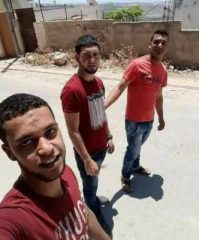 GAZA – The Popular Front for the Liberation of Palestine (PFLP) has mourned the three Palestinian young men who were killed by Israeli soldiers after they carried out a commando operation in Occupied Jerusalem on Friday.
In a statement, the PFLP affirmed that two of those young men were its members, describing them as ex-detainees Baraa Ibrahim Atta, 18, and Osama Ahmed Atta, 19.
The PFLP said the operation was in retaliation to Israel’s crimes and its practices against the Islamic holy sites.
In a related context, senior Hamas official Ezzat al-Resheq categorically denied any ties between the three young men who carried out the Jerusalem operation and the ISIS, affirming that two of them were from the PFLP and one from Hamas.
Resheq accused the Israeli intelligence of being behind the fabricated news saying that the ISIS claimed responsibility for the operation.
He stressed that the Jerusalem operation was one of the individual initiatives made by the Palestinian people in their intifada (uprising) against Israel’s assaults on the holy sites, especially the Aqsa Mosque.
IMEMC News – June 17, 2017
 Three Palestinians were shot dead, on Friday evening, after stabbing and opening fire on Israeli soldiers, killing one and mildly wounding another, in Sultan Suleiman Street, near Bab al-Amoud (Damascus Gate), in occupied Jerusalem.
Israeli daily Haaretz said two Palestinians were shot and killed after attacking Police officers with knives and guns, and that a third Palestinian was shot and killed after stabbing an Israeli border policewoman, causing critical wounds that led to her death. Another Israeli officer was wounded in the attack.
The slain Israeli officer has been identified as Hadas Malka, 23; Israeli daily Haaretz said the officer was stabbed while trying to reach for her gun.
The police and the soldiers fired many live rounds, killing the three Palestinians, and wounding two Palestinian bystanders; one suffered a moderate injury, and the other was mildly wounded.
The three slain Palestinians have been identified as Bara’ Ibrahim Saleh, 18, Adel Hasan Ankoush, 18, and Osama Ahmad Ata, 19, all from Deir Abu Mashal village, west of Ramallah, in central West Bank.
Following the incident dozens of Israeli soldiers and officers were deployed in the area, closed all the gates leading to Jerusalem’s Old City, and assaulted many Palestinians, especially in the areas leading to the Al-Aqsa Mosque.
Update: The soldiers also assaulted many Palestinains, and clashed with local youths, wounding many with live fire and rubber-coated steel bullets.
One of the wounded Palestinians was shot with a live round in his spine, and another round in his kidney, while the soldiers chased the ambulance to the Al-Makassed Hospital in Jerusalem, but were unable to invade it, after dozens of Palestinians clashed with them, and prevented them from entering the hospital.
——–
In addition, dozens of soldiers surrounded and completely isolated Deir Abu Mashal village. Local sources said the soldiers imposed a strict siege on the village.
The soldiers warned that they will shoot and kill any Palestinian who is seen walking outside at night, and that the siege will continue until further notice.
June 17, 2017
Posted by aletho |
Ethnic Cleansing, Racism, Zionism | Hamas, Israel, Jerusalem, Palestine, Zionism |
Leave a comment
Israeli officials must have been tripping over each other in their rush to endorse the Saudi-led blockade on Qatar. “The Sunni Arab countries, apart from Qatar, are largely in the same boat with us since we all see a nuclear Iran as the number one threat against all of us,” said Israel’s former defence minister Moshe Ya’alon. The blockade represented a “new line drawn in the Middle Eastern sand,” tweeted US-born former Israeli ambassador Michael Oren, while revelling in the regional turmoil. “No longer [is it] Israel against Arabs but Israel and Arabs against Qatar-financed terror,” he added.
Defence minister Avigdor Lieberman described the crises as an opportunity for Israel and “certain” Gulf states. “It is clear to everyone, even in the Arab countries, that the real danger to the entire region is terrorism,” he insisted. The extreme right-winger added that the Saudi-led bloc had cut ties with Qatar “not because of Israel, not because of the Jews, not because of Zionism,” but “rather from fears of terrorism.”
Rejoicing over the punishment of a country which Israeli officials describe as a “pain in the ass” raises all sorts of questions, not least the connection between the siege imposed on Qatar and US legislation introduced by Republican Congressman Brian Mast to impose sanctions with respect to foreign support for “Palestinian terrorism”, and other purposes.
Introducing the bipartisan Bill (H.R. 2712 Palestinian International Terrorism Support Prevention Act of 2017) Representative Joshua Gottheimer said, “I’m proud to lead on this effort to weaken Hamas, a heinous terrorist network responsible for the death of far too many innocent civilians, both Israeli and American”. According to him, “Our bipartisan bill will ensure that anyone who provides assistance to this enemy of the United States and our vital ally Israel will face the strength and determination of our country.”
In their findings, the sponsors mentioned that Hamas had received significant financial and military support from Qatar. The sponsors cited the press conference at the Sheraton Doha in Qatar, where Hamas launched its new Document of General Principles and Policies, dubbed the movement’s new charter. “While this document was meant to convey a more moderate face to the world by referencing the 1967 borders,” the bill alleges that the “Hamas’ document, [which] neither abrogates nor replaces the founding charter… still calls for a continuation of terrorism to destroy Israel.”
The bill, which sets out to authorise sanctions on any foreign entity or government that provides support to Hamas, goes on to say that, “It shall be the policy of the United States to prevent Hamas, the Palestinian Islamic Jihad (PIJ), or any affiliate or successor thereof from accessing its international support networks.”
While noting the implications of the legislation, it is worth remembering that most of the proposals in this new bill are actually redundant, except for the section on Qatar. As the Arab Centre Washington DC – a research organisation furthering political, economic and social understanding between Arabs and the US — points out, the proposed law introduces sanctions already covered under existing legislation. Hamas and the PIJ are both designated as Foreign Terrorist Organisations (FTOs) and Specially Designated Global Terrorist entities (SDGTs) by the US State and Treasury Departments respectively. With that in mind, it is already illegal for US entities or institutions to support such groups. Thus, the sanctions proposed in this bill that pertain to US jurisdiction are superfluous.
Furthermore, the Arab Centre points out, formally targeting Iran is also unnecessary because Tehran has already been declared a state sponsor of terror by the State Department and prohibitions against arms export, financial and technical services and US aid to Iran are already in place. This only leaves Qatar, which would be the only new target under this legislation. The stealthy manner of the attack on Qatar did not hide the true intention of supporters of the Bill. “I am proud” said Gottheimer, “to support the Palestinian International Terrorism Support Prevention Act that will make countries like Qatar pay a price for their support for terrorism. In the fight against terrorists there is no middle ground. If you support terrorism, justice will eventually be served.”
So what has that got to do with Israel? While Israel has been unable to join the Saudi-led move to impose a blockade on Qatar directly, it hasn’t stopped it from taking part in substantial lobbying behind the scenes, with the UAE, to get what in reality is an anti-Qatar piece of legislation passed and carry out the necessary groundwork for a blockade of this magnitude.
It is alleged that the bill’s sponsors in the House include a number of lawmakers who have received substantial donations from pro-Israeli lobbyists as well as from those advocating on behalf of Saudi Arabia. Indeed, it is reported that ten US legislators sponsoring the anti-Qatar Bill have received more than $1m over the last 18 months from lobbyists and groups linked to Israel, Saudi Arabia and the United Arab Emirates.
Author and commentator Trita Parsi believes that the similarities between the US-allied Arab nations’ “terror list” and the H.R. 2712 bill show growing cooperation between Gulf Arab states and Israel. “The coordination between hawkish pro-Israel groups and the UAE and Saudi Arabia has been going on for quite some time,” Parsi told Al-Jazeera. What is new, he continued, is seeing pro-Israel groups such as the Foundation for Defence of Democracies “coming out with pro-Saudi [articles] and lobbying for them [the Saudis] on Capitol Hill.”
The cultivation of a political narrative to support the siege was also reported earlier this month by The Intercept. It said that emails released by a group called “Global Leaks” had shown that the UAE ambassador to the US, Yousef Al-Otaiba, and the foundation — a pro-Israel neoconservative think tank — have been working together on demonising Qatar. The emails obtained by The Intercept show FDD and UAE collaboration with journalists who published articles accusing Qatar and Kuwait of supporting “terrorism”.
It is no surprise then that the main reason given for this blockade makes little sense. For Saudi Arabia and the UAE to accuse Qatar of supporting terrorism is like the pot calling the kettle black. If there was any substance to the allegation, then the US would not have endorsed a recent arms deal with Qatar and nor would Washington maintain a major military base there. The stated reasons for the blockade have no merit whatsoever. Moreover, the blockade of Qatar cannot be examined in isolation from efforts that have been underway in the US to suppress Palestinian resistance in the name of fighting terrorism. Neither Qatar nor any of the Gulf countries benefit from this standoff whatsoever; for the main beneficiary, we must look to Israel.
June 16, 2017
Posted by aletho |
Ethnic Cleansing, Racism, Zionism, Wars for Israel | Hamas, Israel, Palestine, Qatar, Saudi Arabia, United States |
Leave a comment
The website of the Forward newspaper recently published an opinion piece by political hitman Spencer Sunshine, in which he slammed the American Left and specific individuals for alleged antisemitism, including Alison Weir.
Sunshine is a writer/activist who focuses on antisemitism, and specifically on seeking it out — or inventing it — among leftists and supporters of Palestinian rights. (More on Sunshine below.)
While slurring those he disagrees with is Sunshine’s modus operandi (he throws around accusations of bigotry with the abandon of a spoiled schoolboy), we expect better of the Forward. Journalistic ethics require that media allow people to respond when they’ve been criticized, yet the Forward has failed to publish Weir’s response. (More on the Forward below.)
(The right of response is affirmed by the Society of Professional Journalists, the International Principles of Professional Ethics in Journalism, the BBC, MediaWise, the National Conference of Editorial Writers, and many, many others. The American Society of Newspaper Editors states: “Persons publicly accused should be given the earliest opportunity to respond.”)
Below is Weir’s letter responding to Sunshine’s piece:
To the Editor,
I was disappointed to see the Forward chose to publish Spencer Sunshine’s recent reactionary screed “The Left Must Root Out Anti-Semitism In Its Ranks.” However, that Sunshine should attempt to dismiss me as an “anti-Semitic conspiracy theorist” did not surprise me, as Sunshine has a long history of working to silence criticism of Israel and Zionism. At a talk in Portland, Oregon he described virtually every form of Palestine solidarity as anti-Semitic.
Accusations of “left anti-Semitism” have long been used to undermine solidarity with marginalized people, a population Sunshine often seems to ignore. His article about the history of anti-racism in the United States, for example, almost entirely omitted the efforts of communities of color, focusing instead on mostly-white “antifascist” groups.
Of Sunshine’s work, the pieces I’m familiar with are hatchet jobs, misrepresenting his subjects to suit his goals and exploit his audience’s fears and gullibility.
Sunshine seems to operate according to an all-too-often successful principle: if you accuse someone of something bad enough, it doesn’t matter how wrong, sloppy, or biased you are. Certain accusations tend to be show-stoppers, tainting by default–and he employs these with shameless abandon.
Sunshine clearly hopes that simply saying the magic words “conspiracy theory” will prevent others from listening to me directly or examining my work. In fact, my book and multitude of articles and speeches are exhaustively researched and based on serious sources. All of my work is transparent, with sources clearly cited or linked, so others can read more and decide for themselves. While I’m only human and certainly not infallible, I strive to use reliable sources and be as transparent as possible about my sources and the evidence supporting my work.
Sunshine refers to a JVP statement critical of me, but fails to mention that the statement does not claim that I am anti-Semitic. More important, he fails to make any reference to two open letters rejecting the criticism of me, signed by some incredibly prominent and principled academics, humanitarians, and thousands of activists, including many members of JVP itself. Indeed, I continue to work with many JVP chapters and individuals, who have brought me to speak in their areas and who are accomplishing important work.
Sunshine operates as a hitman for the reactionary forces who would have us never stand up against oppression for fear of not speaking carefully enough and unintentionally giving unfair offense. It is important to try to speak accurately and fairly, but when people are dying and the prospect of peace is rapidly receding for two populations (and everyone else affected by the violence and instability that radiate from the conflict), perfection is no longer the enemy of good but the enemy of peace and life itself.
Let us act, debate and try to solve this tragedy, not police each other’s words to the point of utter inaction. And let us not attack those working for justice, peace and human rights with false and malicious accusations.
If Sunshine showed half the enthusiasm for opposing atrocities and championing human rights for all humans–even Muslims, Palestinians, and people of color–that he shows for thought policing activists, he could make a positive difference In our shared world.
Sincerely,
Alison Weir
More information:
Spencer Sunshine is an early instigator and enthusiastic champion of the campaign to silence Weir, which has been roundly rejected by numerous prominent humanitarians, academics and activists in two open letters (here and here; see also this article on CounterPunch ). He identifies himself as an “anti-fascist writer” and is close to antifa groups, a movement known for celebrating and perpetrating violence (he was apparently unfazed when violence occurred a few months ago at a protest he organized).
The Forward is a venerable newspaper founded towards the end of the 19th Century. It is a leading, or perhaps the leading, publication serving the American Jewish community. It operates as a nonprofit and appears to have assets of over $50 million. The paper leans heavily towards an Israel-centric viewpoint when reporting on Palestine and Israel. Nevertheless, it is a professional publication which should hold itself to the highest journalistic standards.
June 15, 2017
Posted by aletho |
Ethnic Cleansing, Racism, Zionism, Fake News, Mainstream Media, Warmongering | Israel, Palestine, Spencer Sunshine, United States, Zionism |
Leave a comment
Having succeeded in blocking a recent UN report that accused Israel of maintaining a system of apartheid, Israeli officials are now attempting to remove another UN report, which has charged Tel Aviv with carrying out extrajudicial executions along with a list of other human rights violations.
The report by the United Nations Economic and Social Commission for Western Asia (ESCWA), which previously accused Israel of apartheid, has come under fire from Israel’s Ambassador to the United Nations, Danny Danon, because it states that in the period from 1 April 2016 to 31 March 2017 Israeli security forces killed 63 Palestinians, including 19 children, and wounded an additional 2,276 Palestinians including 562 children.
The previous ESCWA report, which had accused Israel of apartheid, was removed by the UN following protests by Danon and US Ambassador to the UN, Nikki Haley, who this week described the UN report of “reeking with anti-Israel bias”.
The new report accuses Israeli security forces of using disproportionate force against Palestinians and in some cases of “extrajudicial executions”. The report cites the UN Committee Against Torture and its concern about “Israeli practices towards Palestinian detainees”.
The list of human rights violations included in the report were also “torture or ill-treatment of Palestinian children” and “deprivation of basic legal safeguards for administrative detainees, isolation and solitary confinement of detainees, including minors, punishment and ill-treatment of hunger strikers.” The report also claimed that “no criminal investigation was opened into more than 1,000 complaints of torture or ill-treatment filed since 2001.”
Israeli sources have reported that Danon will work to have this report removed. “This is yet another blood libel against the State of Israel,” Arutz Sheva reported Israel’s envoy to the UN saying. “Just as we succeeded in having the previous preposterous report removed, we will fight relentlessly against this blatantly false distortion of the truth as well.”
Read: The ESCWA Report
June 15, 2017
Posted by aletho |
Ethnic Cleansing, Racism, Zionism, Subjugation - Torture | Human rights, Israel, Palestine, United Nations, Zionism |
Leave a comment
The Jewish Telegraphic Agency (JTA) reports that Michael Steinhardt, an atheist, billionaire, and “mega-philanthropist,” has poured millions into projects for American Jews. He is best known as the founder of Birthright Israel, a free, ten-day trip to Israel that is enjoyed by a large percentage of Jewish young adults. He also facilitates programming after the Birthright experience in order to maintain participants’ loyalty to Israel and Jewish culture.
Steinhardt believes that American Jewish education needs to change, and consequently has founded a network of Hebrew-language charter schools.
In these schools, Steinhardt explains, “Jewish kids… will learn a great deal about Israel… and there’s a great deal of emphasis on Israel, Zionism, stuff like that.” He adds that “Jews have accomplished so much, so inexplicably out of proportion to their numbers, in [the last] 300 years, and it’s one of the great failures of Jewish education that that’s not focused on at all.”
When pressed to explain why he, as an atheist, supports a Jewish education, he explained, “The modern state of Israel is the Jewish miracle of the 20th century, but it’s the secular part of Israel that’s the miracle… the development of a society out of nothing using Zionist ideals… Israel has become, for me, the substitute for religion.”
Steinhardt continued, “Israel is a complicated place in a strange part of the world… There are a substantial number of Jews who believe that Israel should leave the settlements, leave the West Bank… The more one understands about Israel, the more comfortable one becomes with the politics of the Israeli government.”
He went on to claim that “Israel is to me the most moral state on this planet, [even] with the occupation.”
If Americans Knew details the effects of the occupation to which Steinhardt refers: “In violation of international law, Israel has confiscated over 52 percent of the land in the West Bank and 30 percent of the Gaza Strip for military use or for settlement by Jewish civilians… From 1967 to 1982, Israel’s military government demolished 1,338 Palestinian homes on the West Bank. Over this period, more than 300,000 Palestinians were detained without trial for various periods by Israeli security forces.”
The occupation itself is illegal according to international law, as are Israeli settlements and their over 500,000 Jewish settlers, the separation wall, restriction of movement, detention without charge—including detention of minors, collective punishment, ethnic cleansing (through forced depopulation and other means), home demolition (close to 50,000 structures have been demolished since 1967), and human rights violations.
American Friends Service Committee (AFSC) reports on damaging effects of occupation on the Gaza Strip, including a ten-year, ongoing siege and numerous military attacks, leaving more than 80 percent of the population dependent on international assistance for survival.
AFSC emphasizes that “the situation in Gaza should not be viewed as a humanitarian crisis… [but as a] political crisis that can only be resolved through… ending the blockade and Israel’s continued occupation of the Palestinian territory, which are at the root of the crisis.”
June 15, 2017
Posted by aletho |
Ethnic Cleansing, Racism, Zionism | Israel, Palestine, United States, Zionism |
Leave a comment
Nazareth – Israeli and US officials are in the process of jointly pre-empting Donald Trump’s supposed “ultimate deal” to end the Israeli-Palestinian conflict. They hope to demote the Palestinian issue to a footnote in international diplomacy.
The conspiracy – a real one – was much in evidence last week during a visit to the region by Nikki Haley, Washington’s envoy to the United Nations. Her escort was Danny Danon, her Israeli counterpart and a fervent opponent of Palestinian statehood.
Danon makes Israeli prime minister Benjamin Netanyahu look moderate. He has backed Israel annexing the West Bank and ruling over Palestinians apatheid-style. Haley appears unperturbed. During a meeting with Netanyahu, she told him that the UN was “a bully to Israel”. She has warned the powerful Security Council to focus on Iran, Syria, Hamas and Hizbollah, instead of Israel.
To protect its tiny ally, Washington is threatening to cut billions in US funding to the world body, plunging it into crisis and jeopardising peacekeeping and humanitarian operations.
On the way to Israel, Haley stopped at the UN’s Human Rights Council in Geneva, demanding it end its “pathological” opposition to Israel’s decades of occupation and human rights violations – or the US would pull out of the agency.
Washington has long pampered Israel, giving it millions of dollars each year to buy weapons to oppress Palestinians, and using its veto to block UN resolutions enforcing international law. Expert UN reports such as a recent one on Israel’s apartheid rule over Palestinians have been buried.
But worse is to come. Now the framework of international laws and institutions established after the Second World War is at risk of being dismembered.
That danger was highlighted on Sunday, when it emerged that Netanyahu had urged Haley to dismantle another UN agency much loathed by Israel. UNRWA cares for more than five million Palestinian refugees across the region.
Since the 1948 war, Israel has refused to allow these refugees to return to their lands, now in Israel, forcing them to live in miserable and overcrowded camps awaiting a peace deal that never arrives. These dispossessed Palestinians still depend on UNRWA for education, health care and social services.
UNRWA, Netanyahu says, “perpetuates” rather than solves their problems. He prefers that they become the responsibility of the UN High Commissioner for Refugees (UNHCR), which looks after all other refugee populations.
His demand is a monumental U-turn, 70 years in the making. In fact, it was Israel that in 1948 insisted on a separate UN refugee agency for the Palestinians.
UNRWA was created to prevent the Palestinians falling under the charge of UNHCR’s forerunner, the International Refugee Organisation. Israel was afraid that the IRO, formed in the immediate wake of the Second World War, would give Palestinian refugees the same prominence as European Jews fleeing Nazi atrocities.
Israel did not want the two cases compared, especially as they were so intimately connected. It was the rise of Nazism that bolstered the Zionist case for a Jewish state in Palestine and Jewish refugees who were settled on lands from which Palestinians had just been expelled by Israel.
Also, Israel was concerned that the IRO’s commitment to the principle of repatriation might force it to accept back the Palestinian refugees.
Israel’s hope then was precisely that UNRWA would not solve the Palestinian refugee problem; rather, it would resolve itself. The idea was encapsulated in a Zionist adage: “The old will die and the young forget.”
But millions of Palestinian descendants still clamour for a right of return. If they cannot forget, Netanyahu prefers that the world forget them.
As bloody wars grip the Middle East, the best way to achieve that aim is to submerge the Palestinians among the world’s 65 million other refugees. Why worry about the Palestinian case when there are millions of Syrians newly displaced by war?
But UNRWA poses a challenge, because it is so deeply entrenched in the region and insists on a just solution for Palestinian refugees.
UNRWA’s huge staff includes 32,000 Palestinian administrators, teachers and doctors, many living in camps in the West Bank – Palestinian territory Netanyahu and Danon hunger for. The UN’s presence there is an impediment to annexation.
On Monday Netanyahu announced his determination to block Europe from funding Israeli human rights organisations, the main watchdogs in the West Bank and a key data source for UN agencies. He now refuses to meet any world leader who talks to these rights groups.
With Trump in the White House, a crisis-plagued Europe ever-more toothless and the Arab world in disarray, Netanyahu wants to seize this chance to clear the UN out of the way too.
Global institutions such as the UN and the international law it upholds were created after the Second World War to protect the weakest and prevent a recurrence of the Holocaust’s horrors.
Today, Netanyahu is prepared to risk it all, tearing down the post-war international order, if this act of colossal vandalism will finally rid him of the Palestinians.
June 15, 2017
Posted by aletho |
Ethnic Cleansing, Racism, Zionism, Timeless or most popular | Israel, Palestine, United Nations, UNRWA, Zionism |
Leave a comment