Wasfi Qabha, former Palestinian minister of detainees and ex-detainees in the government of Ismail Haniyeh, was sentenced to twelve months in Israeli prison by a military court on Wednesday, 28 September. Qabha, a prominent leader in Hamas, has been repeatedly arrested by Israeli occupation forces and has spent a total of 12 years in Israeli prisons.
Qabha was arrested from his family home in Jenin by Israeli occupation forces in May; his wife stated that he was charged with a number of charges in the military courts related to his public activities in campaigns supporting Palestinian prisoners in Israeli jails. His sentence was accompanied with an 18-month suspended sentence and a 2,000 NIS (approximately $500) fine.
Also on Wednesday, member of the Palestinian Legislative CouncilMohammed Jamal Natsheh was arrested among 43 others in pre-dawn arrest raids carried out by Israeli occupation forces throughout the West Bank. Natsheh was released from Israeli prisons after his previous arrest less than seven months ago. He was previously imprisoned without charge or trial under administrative detention. A member of the PLC representing the Change and Reform bloc associated with Hamas, Natsheh has repeatedly been arrested since his election in 2006, usually ordered to administrative detention without charge or trial.
Among the pre-dawn raids included the seventh day in a row of violent occupation military raids on Shuafat refugee camp and nearby Beit Hanina in Jerusalem, where 13 Palestinians were detained by occupation forces as over 20 homes were invaded and ransacked. The Palestinians arrested were Bilal Eid, Ahmad Imran Muhammad Ali, Mohammed Maher al-Mimi, Muhannad Bilal Anati, Bilal Awwad Anati, Ahmad Tartir, Fadi Eid, Ahmad Bilal Eid, Muayyad Jaber Muheisen, Hamoudeh Jamal Abdel-Qader, Adham al-Sharqawi, Saddam Joudeh and Hamoudeh al-Kirri.
Also arrested in Jerusalem area were Areen Za’anin, Fathi Nasser, Hussam Jamzawi, Ahmad Sajidiya, Fares Aslan, Khalil Qureia and Medhat Khalil, the last a guard of the Al-Aqsa Mosque. Bilal Eid is only 16 while Ahmad Ali is only 15 years old; they are among over 370 Palestinian children held in Israeli jails.
In al-Khalil, alongside Natsheh, also arrested were Mohammed Imam, Mohammed al-Durra, Said Zughayyer, Alaa Abu Ajamieh, Abdel-Rahim Fatafta and Abdul-Qader al-Titi, as well as Abdel-Nasser Abu Maria, 17 years old.
Five Palestinians from Budrus, near Ramallah, were arrested: Malek Marrar, Mohammed Hasan, Hosni Khalifa, Mahmoud Khalifa and Yahya Salama. Wissam Ali, Mohammed Jaber, 17, and Oday Jaber were arrested from the Nur Shams refugee camp near Tulkarem. In Jericho, three Palestinians were seized by occupation forces, including 15-year-old Mohammed Shalalfa, alongside Haitham Shalalfa and Shtayyen Shalalfa; in Qabatiyeh, two Palestinians, Mohammed Assaf and Suheib Abu al-Rub, were arrested. Occupation forces seized Mahmoud Qashmar in Qalqilya and Rashad Issa from al-Khader, near Bethlehem.
On Thursday morning, at least 10 more Palestinians were reported arrested in violent raids by occupation forces, including former prisoners Amin Hamed, 60, and his son Abdelhadi Hamed, 30, arrested in Silwad east of Ramallah in a violent raid on their home, including the explosion of the door of their homes. Abdulhadi’s brother, Abdullah’s, home was raided as well by occupation forces. Their brother Akram is serving a 17-year sentence in Israeli prisons.
The world saw him as a friendly diplomat who called for peace and talked about the importance of future generations in his speeches, using phrases such as “the future of our children and their children”. Well, Shimon Peres went AWOL and we can all see what became of the political “peace” project, which reinforced the dominance of the Israeli occupation over the land and destroyed the chances of the Palestinians ever having a bright future, or even a viable state.
The truth is that Israel’s occupation could not have done without a politician like Peres, who climbed the ladder to a civil role that is usually reserved for retired generals holding leadership positions. He was forced, in the autumn of his life, to take a lead on Israeli diplomacy, even when a vengeful, racist and arrogant man – Avigdor Lieberman – was the foreign minister.
Peres was keen on being seen in the corridors of power in the guise of a peacemaker and he seemed to be a political visionary who spoke about the future in the way of a dreamer. He spoke tirelessly about the culture of forgiveness and he wanted his name to be associated with peace by means of multiple acts, including an eponymous centre dedicated to peace.
However, the reality speaks another language. Shimon Peres was always an example of those Israeli officials who ignore throughout their decades in prominent positions the rights of the Palestinian people, international humanitarian law and UN resolutions. He completely disregarded the Geneva Conventions and continuously and repeatedly violated them at the cost of innocent lives and human rights.
Peres was Israel’s president – head of state – during successive military offensives against the Palestinian people, such as the so-called Operation Cast Lead (2008-2009) against the civilians of Gaza. He never shied away from the atrocities committed by the Israel Defence Forces (IDF). Indeed, he often publicised them, even at the World Economic Forum in Davos. He gave his backing to the appalling attacks on civilians, and always sought to justify them. In this, he played a part in Israel’s propaganda machine; you will not find a single example of him being critical of the violations committed by the IDF.
As prime minister, Peres ordered the invasion of Lebanon in spring 1996, which was known as Operation Grapes of Wrath, during which Israeli troops shelled a UN base at which refugees were sheltering. The bloody massacre killed 106 civilians and UN peacekeepers from Fiji, and wounded many more. Peres remained as prime minister even after the massacre for which he was ultimately responsible. This set a precedent for him to act with impunity, as was the case with his predecessors and successors. The same base was attacked by Israel a decade later.
Two years before the Qana massacre, Peres was awarded the Nobel Peace Prize, but for what exactly? For his role in reaching the Oslo Accords with a weakened and exhausted Palestinian leadership. The agreement promoted slogans of peace and security, but it lacked important terms such as human rights, fairness and justice for the Palestinian people. There is no need for me to explain, today, what Israel meant by peace in this agreement, because the reality on the ground is enough to explain what ultimately resulted from the implementation of the agreement. The occupation has been entrenched even further, with ongoing settlement expansion under an Apartheid-style government. The Palestinians, meanwhile, fell for it and were trapped; Israel restrains them with Oslo’s unfair clauses.
Peres was hailed as a visionary in his view of “The New Middle East”, which was the title of his 1995 book. The idea around which his theory revolved was that the volatile region should allow Israel to act as the intelligent brain with the others following its instructions. This is basically what one can conclude given the overtones of superiority that are consistent with the logic upon which the Israeli state was founded.
After that, Peres remained an implicit partner of the extreme right-wing Israeli governments made up of ministers who adopted neo-fascist policies and positions; he acted in his capacity as Israeli president in a manner that reinforced the programmes of such governments. The “patron of peace” did not object to the expansion of illegal Israeli settlements in East Jerusalem and the West Bank, despite international condemnation, including that from the “Quartet” – the UN, EU, US and Russian Federation.
Similarly, Peres colluded with the construction of the Apartheid Wall built by Israel on Palestinian land in the occupied West Bank and East Jerusalem, despite the 2004 advisory opinion of the International Court of Justice in The Hague and the decision of the UN General Assembly (2005) against the construction of the structure. Peres also played a part in the suffocating siege, collective punishment and closure imposed on Palestinians in the Gaza Strip, despite the fact that this entails serious violations of international human rights law, the UN Charter and the logic of peace itself. All of this is just the tip of the iceberg of his support for the ethnic cleansing of Palestine throughout his long political career.
Within Israel he made no objections known to the series of racist laws introduced by the Israeli government or passed by the Knesset (parliament) since 2009. Nor did he oppose the measures to restrict independent human rights organisations and gag civil society organisations that are opposed to occupation policies and record and document Israeli government violations.
Despite all of this, Peres will be honoured after his death and will be glorified as a patron of peace. However, before believing what you see, hear or read about him in the mainstream, why not ask the Palestinians what they think about him, or the people of Lebanon? He may have been awarded the Nobel Peace Prize, but Shimon Peres was far from peaceful.
The holocaust cartoon contest in Iran was attacked in the West, but immensely popular throughout the non-Western world
“East is East and West is West and never the twain shall meet.”
– Kipling’s famous lines certainly apply to “the Holocaust.”
In the West – Europe and the temperate lands it genocidally colonized and settled – most people believe that six million Jews, and uncounted others, were systematically exterminated, mostly in hydrogen cyanide gas chambers, by the government of Nazi Germany between 1942 and 1945.
In the East and South – those lands victimized by European imperialism and colonialism where the victims survived in considerable numbers – the great majority does not believe in “the Holocaust.”
The above figures from the ADL’s Global 100 survey show that only about one in five Asians – and one in ten Middle Easterners and Africans – knows of and believes in “the Holocaust.”
I first became aware of this “Holocaust gap” when I lived in Morocco doing Ph.D. research on a Fulbright scholarship in 1999-2000. My Moroccan colleagues, whether professors or graduate students, sometimes brought up questions like: “What do you think of Robert Faurisson?” I soon learned that Faurisson, who is reviled as a “Holocaust denier” by mainstream Western institutions of power, is an intellectual hero in Morocco – and, as I later learned, the rest of the Islamic world.
No matter how strongly you may disagree with Faurisson and his vast following of North African and Middle Eastern admirers, you must admit that we live in a wildly diverse world in which conflicting beliefs and historical interpretations must coexist, at least until free and open debate leads to consensus.
If Moroccan universities made agreement with Faurisson a litmus test for admission and employment, we North Americans would rightly complain. Yet we are blind to the disgust we evoke in the vast majority of MENA intellectuals by our own refusal to allow Faurisson and those who agree with him to state their actual beliefs, and present their cases, in the North American and European academies.
As I write this, Professor Tony Hall of the University of Lethbridge is under attack by a criminal conspiracy of slanderers and false-evidence-planters who have absurdly framed him as a “holocaust denier.” These individuals appear to have manufactured a hideous “kill all Jews” image, then arranged to have it planted, unbeknownst to Professor Hall, as an obscure comment on his Facebook page. After manufacturing and planting the offensive image, they appear to have conspired with Facebook to have FB blatantly violate its own guidelines by initially refusing to take down the image – a refusal that allowed B’nai Brith to manufacture a scandal.
Since it has emerged that Professor Hall’s detractors, rather than Professor Hall, appear to have manufactured and disseminated the offensive image, they have had to resort to a fallback attack. B’nai Brith Canada, the leaders of the anti-Hall lynch mob, just published an article headlined “Academic Freedom Does Not Include Holocaust Denial.” They label/libel Hall as a “holocaust denier” because, they say, he is “a staunch advocate of launching an ‘open debate on the Holocaust’.”
How is being an advocate of “debating” an issue equivalent to “denying” it?! The claim is self-evidently absurd. The obvious implication is that it is B’nai Brith, not Tony Hall, that doesn’t believe in the holocaust, since they apparently believe the official Western version of the story will implode if debate on it is ever allowed.
B’nai Brith mouthpiece Bernie Farber, in an outrageously libelous article smearing Hall, charges:
In commenting on Menuhin’s Holocaust-denial book Tell The Truth And Shame The Devil, Hall explained, “So, I’m reading that text and having to reassess a lot of ideas.” He went on to say that the book is a “very dramatic re-looking at what happened in Europe in World War Two.”
How is “reassessing ideas” equivalent to “denial” of anything?! Farber, like B’nai Brith, seems to believe that anyone who reads Menuhin’s arguments, and is open to “re-assessing ideas” when exposed to new evidence, will automatically become a “holocaust denier.” So ironically, it seems that the defenders of holocaust orthodoxy are actually closet holocaust deniers! They appear to be terrified that the official Western narrative is so flimsy that it cannot stand even the merest hint of critical scrutiny. What else could possibly explain their behavior?
These Zionist lobbyists are apparently so convinced that the holocaust narrative is fraudulent that they not only feel the need to destroy the reputations and careers of anyone who questions it, but actually make such questioning illegal – and send revisionist historians to prison!
According to Nick Kollerstrom, thousands of people have been prosecuted for “holocaust thoughtcrimes” in Germany alone. The first people who should be imprisoned, I submit, are the Zionists who pushed through these laws – because the fact that they feel the need for these laws proves they do not actually believe in the historicity of the holocaust, and are therefore “holocaust deniers” themselves. If they actually believed what they say they believe, they would obviously be eager to clobber their opponents in a free and fair debate… not with criminal charges and imprisonment.
In fact, I would go one step farther, and assert that anyone who charges anyone else with “holocaust denial” must themselves be a “holocaust denier.” If they actually believed in their version of the holocaust, they would not feel the need to resort to name-calling. Instead, they would muster empirical arguments and evidence.
Read these five books, and you will understand how “the holocaust” looks to a non-Westerner.
No wonder they don’t believe Western mainstream “victors’ history.” The West cranks out outrageous lies to disguise its own crimes. Why should World War II historiography be different?
Because they start out as natural skeptics, approaching the holocaust debates with a jaundiced eye, non-Westerners are likely to avoid being swept away by mass-media-orchestrated Hollywood-style emotions and the Western mainstream narrative. Because they have so much emotional distance from the Western history of persecutions between Christians and Jews, non-Westerners can think dispassionately about such things. And because they have seen the outrageous lies the Zionists have used to construct “Israel” (a euphemism for “genocide in Palestine”) they are naturally skeptical about any and all self-serving Zionist assertions.
If the University of Lethbridge expels Professor Tony Hall, it will either have to (1) ban all students and professors from non-Western nations and/or backgrounds, especially the MENA region and the rest of Africa, or (2) force all people from non-Western backgrounds to sign a statement that they will never express their true beliefs about “the holocaust” while they are working or studying at the University.
One month into his stint as New York Times Jerusalem bureau chief, Peter Baker has struck a world-weary tone: In his telling, the turmoil of Palestine-Israel is nothing more than an ancient feud, and the United Nations has grown tired of hearing about it from two intransigent leaders.
The effect of this jaded stance is to leave readers with the impression that Palestinians and Israelis face off over a level playing field and they have been doing so for millennia, two notions that serve to benefit Israel above all.
In a piece about Israeli Prime Minister Benjamin Netanyahu and Palestinian leader Mahmoud Abbas addressing the United Nations General Assembly, Baker juxtaposes their comments as if they were two contenders facing off in a boxing ring, hurling invectives at each other. Where Abbas speaks of “heinous crimes” and an “historic catastrophe,” he says, Netanyahu lashes out with charges of “fanaticism” and “inhumanity.”
The two men, Baker writes, are “guilt-tripping” the international community; they are “filled with grievance and bristling with resentment;” and they “summon the ghosts of history from hundreds and even thousands of years ago to make their cases.” But, he states, “the world has begun to move on” as other crises, such as the war in Syria, take center stage.
The tenor is one of fatigue and cynicism, which does a disservice to readers and to the cause of honest journalism. Baker makes no attempt to discern the truth or falsity of any of the statements, dismissing them all as nothing more than rivalry.
When he says that the world has moved on, this implies that the United Nations itself has grown weary of the conflict, but late in his piece Baker quotes Netanyahu on the world body, providing readers with clear evidence that the organization is still very much engaged in the issue.
Baker tells us that the Israeli prime minister bitterly attacked the General Assembly, the Human Rights Council and the UN cultural agency, and knowledgeable readers will find the reasons for Netanyahu’s resentment obvious: UN agencies frequently report on Israeli violations of international and humanitarian law, and the UN has granted membership status to Palestine, over the objections of Israel.
Nevertheless, the Times article would have us believe that the Israel-Palestinian conflict has become passé, that the world is tired of these two bitter rivals who refuse to make up.
In presenting the issue in this light, Baker hides the terrible disparity between the two sides and ignores the urgent issues of injustice and international law.
He writes in this vein knowing that Abbas and Netanyahu represent two very different political and military realities. The United States, as the Times has recently reported, provides massive amounts of military aid to Israel each year, but it provides absolutely none to Palestinians. It also supports Israel at the United Nations, wielding its veto power to block resolutions critical of Israel, even those that echo its own policy statements.
Moreover, Baker and Times editors certainly know that Palestinians have no army, air force or navy; no tanks, warships, drones or nuclear arms; and that Israel has all this and more. They also have UN data for 2016, which show that, as of Sept. 19, 89 Palestinians had been killed by Israelis, while 10 Israelis had died at the hands of Palestinians.
Moreover, they know the shocking Gaza death toll from the summer of 2014, in which, according to the Israeli organization B’Tselem, Israeli forces killed 2,202 Palestinians, two-thirds of them civilians and 526 of them children. By contrast, Gaza fighters and rockets killed 72 Israelis, including 62 soldiers and one child.
The disparity is enormous, yet Baker has chosen to present the situation as a conflict between two equal sides. He has also adopted the “ancient hatreds” line that ignores the reality of Palestinian dispossession since 1947 and the present brutality inflicted on an occupied people by the powerful Israeli state.
Two days after his Abbas vs. Netanyahu story appeared, Baker published a piece on soccer in the West Bank, writing in the lead that “the latest battleground in the age-old struggle” between Israelis and Palestinians” was a dispute over whether FIFA rules allow Israeli soccer teams to play in West Bank settlements.
He thus manages to distort history, trivialize Palestinian resistance and maintain the false impression of parity between the two sides, ignoring evidence that pre-Zionist Palestine saw peaceful coexistence between Jews, Christians and Muslims. The “age-old struggle” is actually a recent one.
When Baker suggests that the conflict is fueled by ancient and intractable animosities, that only the two sides take any real interest in its outcome and that it involves petty disputes and little more than a war of words, this serves the Israeli agenda. He is directing our attention away from the core issues, allowing Israel to carry out its brutal regime of dispossession and oppression well under the radar.
Contrary to the incessant grandstanding by US and British politicians that they are committed to promoting freedom, democracy and peace around the world, the evidence proves that the Anglo-American establishment is in the business of war, destabilization and conflict creation. On top of the numerous imperial wars in the Middle East and North Africa that the Anglo-American establishment has spearheaded, the true nature of these two powers is further confirmed by the fact that Britain is now officially the second biggest arms dealer on the planet, second only to the US.
On average over the last decade, Britain has sold more weapons than Russia, China and France, according to the UK Trade and Investment department. Two-thirds of the weapons have been sold to Middle Eastern countries since 2010, fuelling many of the deadly conflicts in the region. Recipients of British weapons include 22 of the 30 countries on the UK governments own human rights watch list, further illustrating the complete hypocrisy of British politicians.
Britain has supplied an array of deplorable powers with military hardware, many of which are involved in committing atrocities with those weapons: including illegally supplying Saudi Arabia with Eurofighter Typhoon jets and missiles that have been used in the abhorrent war on Yemen; supplying Israel with arms that have been used in the IDF’s frequent massacres of Palestinians; in addition to selling shotguns, stun grenades and teargas, to the regime in Bahrain – which have been used to suppress protests in the country.
When the US and Britain are not busy killing Syrian soldiers who are fighting against ISIS, they are flooding the most war-torn region on earth (thanks to Western wars) with weapons. The likes of Raytheon, Lockheed Martin, Northrop Grumman, Boeing and BAE Systems, have been making a killing off the perennial wars we have seen in the 21st century. The new Western-manufactured Cold War 2.0 has also proved to be beneficial for the war giants, as this is used to justify exorbitant defense/war budgets.
The power and influence of war contractors is nothing new in the West however. In his farewell address to the nation in 1961, the 34th President of the US, Dwight D. Eisenhower, warned the American people of the dangers of this insidious “military-industrial complex:”
“This conjunction, of an immense military establishment and a large arms industry, is new in the American experience. The total influence – economic, political, even spiritual – is felt in every city, every state house, every office of the federal government. We recognise the imperative need for this development, yet we must not fail to comprehend its grave implications… In the councils of government, we must guard against the acquisition of unwarranted influence, whether sought or unsought, by the military-industrial complex. The potential for the disastrous rise of misplaced power exists, and will persist. We must never let the weight of this combination endanger our liberties or democratic processes.”
It is clear that Eisenhower’s warning fell on deaf ears, as the nefarious influence of the military-industrial complex has only grown since he made his historic speech. The amount of money the US spends on defence is staggering comparative to the rest of the world, with the 2015 US defense budget more than three times the size of China’s, and more than nine times the size of Russia’s. The American taxpayer has been filling the pockets of the CEOs of the war giants for too long now, with the decade-and-a-half since 9/11 proving to be an immensely profitable period for these immoral contractors.
Russia Now Earns More from Agriculture than Arms
Whilst the US and Britain are leading the world in arms sales, Russia is now earning more from agricultural exports than arms sales. Last year, Russia replaced the US as the largest producer and exporter of wheat, with grain production increasing in Russia over the past six years. Russia has also established herself as one of the main leaders of the organic revolution that we have seen sweep the world in recent years, as the toxicity of GMO becomes blatantly evident for all to see.
Western aggression is, and will continue to be, the most destructive force on earth. The wars in Afghanistan, Iraq and Libya, have brought nothing but misery and devastation to these countries. The West’s proxy war in Syria brought further destabilization and chaos to the region, as well causing the refugee and migrant crisis that has gripped Europe. The 2013-14 colour revolution in Ukraine and the subsequent war in the country serves as yet another example of the pernicious fruits of Western imperialism. If we add on top of all this carnage, the US-led drone wars and the Anglo-American dominated arms industry, there is no question that the Anglo-American war machine is the greatest impediment to global stability today.
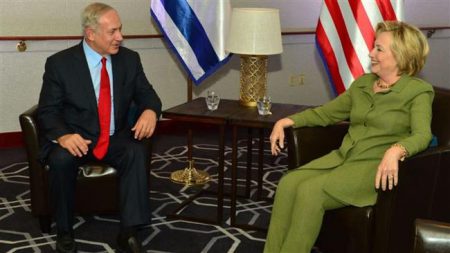
US Democratic presidential nominee Hillary Clinton has told Israel’s Prime Minister Benjamin Netanyahu that she opposes a UN-brokered solution to the Israeli-Palestinian conflict, pledging to fight efforts to “delegitimize” the Tel Aviv regime.
The former US secretary of state and Netanyahu met at a hotel in Manhattan, New York, on Sunday evening, hours after the Israeli PM’s meeting with Clinton’s Republican rival, Donald Trump.
During the meeting, Clinton endorsed the two-state solution for the ongoing conflict in Palestine, but also expressed “her opposition to any attempt by outside parties to impose a solution,” including the UN Security Council, her campaign said in a statement.
Clinton doubled down on “her commitment to countering attempts to delegitimize Israel, including through the BDS (Boycott, Divestment and Sanctions) movement,” the statement further read.
The BDS movement was initiated in 2005 by over 170 Palestinian organizations that were pushing for “various forms of boycott against Israel until it meets its obligations under international law.”
Since then, thousands of volunteers worldwide have joined the BDS to help promote the Palestinian cause.
The former first lady also backed Washington’s military support for Tel Aviv, saying that a “strong and secure Israel” was vital to the US.
Washington has been providing the Israeli regime with $3.1 billion annually since 2007, under a 10-year agreement with the administration of former president George W. Bush. The figure was recently raised to $3.8 billion for the next decade.
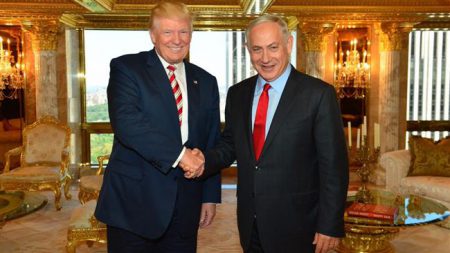
Earlier in the day, Netanyahu went to the Trump Tower in New York City to meet with the billionaire businessman.
During the 90-minute meeting, Trump promised Netanyahu that he will “recognize Jerusalem as the undivided capital of the state of Israel,” the candidate’s campaign said in a statement.
He described East Jerusalem al-Quds, occupied by Israel since 1967, as “the eternal capital of the Jewish people.”
Like Clinton, Trump backed America’s military support for Israel, hailing it as an “excellent investment for America.”
Netanyahu, who was being accompanied by Israeli ambassador to Washington Ron Dermer during the meetings, thanked both candidates for their “friendship and support for Israel.”
Tel Aviv has urged the National Theatre of Norway to deny links to and remove a video in which a fake theater official called for a boycott of Israel and its HaBima Theater. The Norwegian theater denied its part but stopped short of criticizing the clip.
While the theater apparently had no role in producing the video, the Israeli Foreign Ministry demanded that it should “clearly and immediately repudiate” the clip, as well as take “necessary measures to have the video removed from every site.”
It went on to compare the video to “the works of the Reich Minister of Propaganda, Joseph Goebbels, or the Nazi filmmaker Leni Riefenstahl,” adding that it is “actively pursuing the matter with all involved parties.”
In response, the National Theater of Norway wrote in a statement published on its website that it was in no way part of making the video, and does not engage in boycotts.
“The article and video are not made by The National Theater of Norway – and do not represent The National Theater of Norway’s attitude – they are an expression of artistic freedom. The National Theater of Norway still has greater faith in collaboration with artists across national borders and from regimes we are critical to, than boycotts and silence,” it wrote.
Although the six-minute video claims to be from the National Theater of Norway, it was actually created by a group of actors from the art project “Monsters of Reality,” which is part of the 2016 International Ibsen Festival.
In the video, a person claiming to be a spokesperson for the theater lashes out against Israel and its occupation of Palestinian territories. She apologizes on behalf of the playhouse, for collaborating with Israel’s HaBima Theater between 2013 and 2015.
“This is a great day for the National Theater of Norway. It is the day when we publicly apologize for our shameful collaboration with HaBima, the national theater of Israel…” the spokesperson says.
She goes on to state that when the theatre agreed to collaborate with Israel, it did not know “what a powerful role HaBima and other Israeli art institutions play in normalizing the Israeli occupation,” calling Israeli art a “tool” for building an image of “a humanistic nation” instead of an “apartheid state.”
She claims the two theatres were collaborating as Israel “executed its horrific bombing over the Gaza strip,” and that the Norwegian one was unaware of HaBima’s alleged role because it did not do “one single piece of research…we didn’t bother to find out.”
“Five-hundred Palestinian children lost their lives while HaBima was busy entertaining Israeli soldiers,” she says.
In conclusion, the woman posing as spokesperson makes three promises on behalf of the theatre. The first is that it will fully support the Palestinian call for boycott, divestment, and sanctions (BDS) of Israel, and cancel its membership with the “politically irresponsible” European Theatre Union.
Next, the spokesperson claims the theatre will dedicate all means of production to “work with the situation in the Middle East” from 2017 to 2019. She even promises that the facility’s director will give 50 percent of her salary to Palestinian theatre in the West Bank and Gaza.
The Boycott, Divestment, Sanctions (BDS) movement works to “end international support for Israel’s oppression of Palestinians and pressure Israel to comply with international law,” according to the Palestinian BDS National Committee’s website.
Human Rights Watch (HRW) accused world football’s governing body FIFA of “tarnishing the beautiful game” by allowing “games on stolen land”.
In a report published on Sunday, HRW said that FIFA was legitimizing the building of Israeli settlements in the West Bank—considered illegal under international law—and was sponsoring business activity that supports the settlements.
The New York-based body urged FIFA to force six Israeli football clubs based in settlements in the West Bank to relocate from occupied territories or be banned from competitions recognized by football’s governing body.
The six clubs in question are located in the West Bank and play in the lower Israeli leagues—Beitar Givat Ze’ev, Beitar Ironi Ariel, Ironi Yehuda, Beitar Ironi Maale Adumim and Hapoel Bik’at Hayarden.
The report follows an online petition that has gained more than 150,000 signatures, calling for FIFA official Tokyo Sexwale—who is heading up FIFA’s investigation into the issue—to ban settlement clubs from FIFA-recognized competitions.
More than 60 members of the European Parliament (MEPs) also sent an open letter to FIFA President Gianni Infantino earlier in September, calling for the settlement clubs to be relocated or excluded from the Israeli Football Association (IFA).
FIFA’s rulebook states that football clubs that are a member of one football association may not play on the territory of another football association without the other association’s permission. The Palestinian Football Association has been recognized by FIFA since 1998.
“By holding games on stolen land, FIFA is tarnishing the beautiful game of football,” said Sari Bashi, ‘Israel’ and Palestine country director at HRW.
A 13-year-old girl who was shot five times by Israeli soldiers has told RT she is still haunted by the incident, and hopes that soldiers will restrain themselves from shooting other “innocent children.” Her father says he wants Israel to compensate his family.
Speaking to RT, 13-year-old Bara’a Owaisi said she had traveled to a West Bank checkpoint after dreaming about her aunt, who had been killed there.
“She called to me saying, ‘I want to see you.’ So I went to the checkpoint to see where my aunt died, because I miss her,” Owaisi explained.
“The Israeli soldiers spoke to me, but I couldn’t understand them, so some Arab workers explained. They asked me to take my bag off my back and put it down. I removed my bag. I said I wanted to see where my aunt died. They asked for my aunt’s name and I answered… then they opened fire on me. The two soldiers said, ‘This one is a terrorist,’ and ordered the others to open fire,” she said.
Owaisi went on to say that she constantly replays the incident in her mind.
“I have nightmares. I was terrified of [the soldiers], and I see them in my dreams. They shoot at me all the time. I hope the soldiers don’t shoot at any more innocent children,” she said.
Her father spoke of how incomprehensible it was to shoot his daughter so many times.
“They wanted to kill her. They shot her five times. One bullet is enough to take someone down, not five. They shot her in cold blood. She wasn’t doing anything. The Israeli soldiers were shouting at her without any reason. My daughter can’t do anything.”
He went on to state that his wife must now carry the young girl to the bathroom, and that he hopes his daughter will walk again. He said he wants Israel to pay compensation for the incident.
“I want Israel to pay compensation. It is not the first time this has happened. The Israelis try to kill many Palestinian children, and I want the world to know about this.”
RT reached out to the Israeli Defense Ministry, but received no response. A statement from the ministry following the shooting said the girl told interrogators that she went to the checkpoint “to die.”
Israeli Prime Minister Benjamin Netanyahu (R) and Republican nominee Donald Trump during a meeting in New York on September 25, 2016. (photo via @IsraeliPM)
Republican nominee Donald Trump promises Israeli Prime Minister Benjamin Netanyahu to “recognize Jerusalem as the undivided capital of the state of Israel” if he emerges victor in the US 2016 presidential election.
The meeting at the Trump Tower in Manhattan, New York, on Sunday took nearly 90 minutes as Trump’s son-in-law and a close adviser, Jared Kushner, was on hand for the meeting along with Israeli ambassador to the US Ron Dermer.
“A Trump administration would finally accept the long-standing Congressional mandate to recognize Jerusalem as the undivided capital of the state of Israel,” the Trump campaign said in a press release.
The two talked about “the special relationship between America and Israel and the unbreakable bond between the two countries.”
Trump asserted that the US military aid to Israeli missile system is “an excellent investment for America,” further calling Tel Aviv a “vital partner” in the war against “Islamic terrorism,” from which the Israelis have “suffered far too long.”
On the agenda at the meeting was also the nuclear deal between Iran and the world powers, including the United States.
Trump described East Jerusalem al-Quds, occupied by Israel since 1967, as “the eternal capital of the Jewish people.”
Trump’s statement was devoid of any reference to Israel’s heavy-handed crackdown in Palestine or even the so-called two –state solution, pursued in the foreign policy of the administration of President Barack Obama.
“The meeting concluded with both leaders promising the highest level of mutual support and cooperation should Mr. Trump have the honor and privilege of being elected president of the United States,” concluded the statement.
East Jerusalem al-Quds was occupied in 1967 and Israel later annexed it heedless of international condemnations.
The Palestinian Authority, which administers the occupied West Bank, views the city as the capital of its future state. Palestinians have also resisted numerous Israeli plans for exerting full control over the territory.
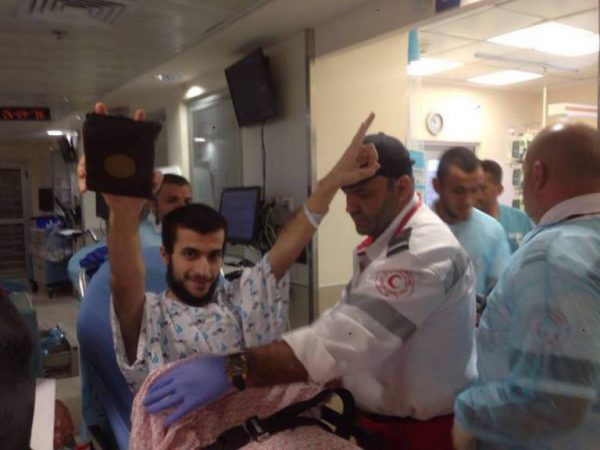
JERUSALEM – Israeli authorities released former hunger-striking prisoner Malik al-Qadi to Palestinian medics on Saturday to transfer him to a hospital in the occupied West Bank.
The Palestinian Red Crescent said on Saturday morning that its staff was transferring al-Qadi from the Israeli Wolfson Medical Center to the Istishari Arab Hospital in the city of Ramallah.
Al-Qadi is in a dire health condition after going without food for 68 days to protest being held in administrative detention — internment without trial or charges — by Israel.
Al-Qadi ended his hunger strike on Wednesday, along with fellow prisoners Muhammad and Mahmoud al-Balboul, after an agreement with the Israeli prisons services not to renew their administrative detentions.
Muhammad Balboul, 26, had refused food for 77 days since July 7, while his 23-year-old brother Mahmoud had been on hunger strike 79 days since July 5, and al-Qadi, 25, declared his hunger strike on July 16.
Qaraqe said in a statement on Wednesday that Muhammad and Mahmoud al-Balboul were set to be released on Dec. 8, while Malik al-Qadi would be released on Sep. 22, and that all three of their administrative detentions would not be renewed.
The three had initially launched their hunger strikes amid a mass movement across Israeli prisons in solidarity with hunger-striking prisoner Bilal Kayid, who after 71 days suspended his hunger strike after striking a deal with Israel to end his administrative detention sentence. He was reportedly set to be released on Dec. 12.
Kayid was one of the most high-profile hunger strikers since Palestinian journalist Muhammad al-Qiq came near death during a 94-day hunger strike protesting his administrative detention order, before he was finally released in May.
Rights groups have claimed that Israel’s administrative detention policy, which allows detention for three- to six-month renewable intervals based on undisclosed evidence, has been used as an attempt to disrupt Palestinian political processes, notably targeting Palestinian politicians, activists, students, and journalists.
Although Israeli authorities claim the withholding of evidence during administrative detention is essential for state security concerns, rights groups have instead claimed the policy allows Israeli authorities to hold Palestinians for an indefinite period of time without showing any evidence that could justify their detentions.
According to Addameer, as of August, 7,000 Palestinians were being held in Israeli prisons, 700 of whom were being held under administrative detention.
British Labour Party leader Jeremy Corbyn has retained the leadership of the opposition political party after a bruising campaign.
Corbyn, who was initially elected last year, took 62 percent of the vote, beating challenger Owen Smith on Saturday.
Surveys had indicated that Corbyn would easily defeat his challenger as he maintained widespread support of party members attracted by his socialist anti-austerity policies and “authentic” image.
On Wednesday, Corbyn urged for the party to unite behind his leadership. He reminded lawmakers that he has the support of rank-and-file members of the party and warned them not to challenge him again.
“We owe it to the millions of people Labour exists to represent to end the sniping and personal attacks, and work together for all those who depend on the election of a Labour government. Anything else would be destructive self-indulgence,” Corbyn said in a statement.
“All Labour Party members and MPs have a responsibility to work within the democracy of our party and respect the leadership of whoever is elected.”
The 67-year-old socialist and peace campaigner has shown little interest for Britain’s special relationship with the US and is opposed to nuclear weapons, including the costly Trident nuclear missile system that is maintained by the US.
Corbyn also is a critic of Israel and NATO. As member of the Palestine Solidarity Campaign, he invited members of the Hezbollah and Hamas resistance movements in 2009 to parliament where he called them “friends.”
By Jon Vale | The Independent | September 23, 2016
The Campaign Against Anti-semitism (CAA) has filed a formal complaint against Labour leader Jeremy Corbyn.
The group has taken action over a video posted on Mr Corbyn’s official Facebook and Twitter accounts.
In the video, Mr Corbyn’s supporters answer questions on topics they are “tired of hearing” about, which includes whether they promote anti-semitism.
The video has subsequently been deleted from social media.
The CAA said this is the latest in a long of line of incidents where Mr Corbyn and his supporters have failed to address anti-semitism. […]
The letter accuses Mr Corbyn of “committing acts that are grossly detrimental to the party, namely characterising Jewish people as dissembling and dishonest in their reporting of anti-semitism, and by using the influence and prestige of his office to disseminate and normalise that lie”.
It continues: “The allegation that Jews lie and deceive in order to further hidden agendas is an age-old anti-semitic trope.
“It has now been manifestly deployed by Mr Corbyn in his leadership campaign video.” … Full article
By Ali Salaam | American Herald Tribune | July 31, 2017
The New York Times, owned by the Zionist Jewish supremacist Ochs-Sulzberger family, has no problem with Iraqi suffering as long as Iran is not the one behind it.
The Iraq War was a genocide of the Iraqi people by Zionist supremacists in the Bush administration. Over 1 million innocent people were killed based on a lie. American soldiers died in an Israeli war and now an average of 22 soldiers commit suicide every day because their consciences cannot cope with the fact they committed crimes in an illegal war that served no purpose other than to benefit Israel, not America.
Benjamin Netanyahu, Prime Minister of the Zionist regime, once said “We are benefiting from one thing, and that is the attack on the Twin Towers and Pentagon, and the American struggle in Iraq.”
Paul Wolfowitz had his sights on Iraq since his time in the first Bush administration. Former Israeli official and Bush administration official Richard Perle had his eyes on Iraq since at least his authorship of the Clean Break white paper. The Zionist regime had their eyes on Iraq since the 1980s when strategist Oded Yinon wrote his white paper in support of dividing the Arab-Muslim world along ethnic and sectarian lines. The global Zionist lobby has had their eyes on Iraq since Theodor Herzl stated that Eretz Israel’s true borders go from the Nile River in Egypt to the Euphrates River in Iraq. … continue
This site is provided as a research and reference tool. Although we make every reasonable effort to ensure that the information and data provided at this site are useful, accurate, and current, we cannot guarantee that the information and data provided here will be error-free. By using this site, you assume all responsibility for and risk arising from your use of and reliance upon the contents of this site.
This site and the information available through it do not, and are not intended to constitute legal advice. Should you require legal advice, you should consult your own attorney.
Nothing within this site or linked to by this site constitutes investment advice or medical advice.
Materials accessible from or added to this site by third parties, such as comments posted, are strictly the responsibility of the third party who added such materials or made them accessible and we neither endorse nor undertake to control, monitor, edit or assume responsibility for any such third-party material.
The posting of stories, commentaries, reports, documents and links (embedded or otherwise) on this site does not in any way, shape or form, implied or otherwise, necessarily express or suggest endorsement or support of any of such posted material or parts therein.
The word “alleged” is deemed to occur before the word “fraud.” Since the rule of law still applies. To peasants, at least.
Fair Use
This site contains copyrighted material the use of which has not always been specifically authorized by the copyright owner. We are making such material available in our efforts to advance understanding of environmental, political, human rights, economic, democracy, scientific, and social justice issues, etc. We believe this constitutes a ‘fair use’ of any such copyrighted material as provided for in section 107 of the US Copyright Law. In accordance with Title 17 U.S.C. Section 107, the material on this site is distributed without profit to those who have expressed a prior interest in receiving the included information for research and educational purposes. For more info go to: http://www.law.cornell.edu/uscode/17/107.shtml. If you wish to use copyrighted material from this site for purposes of your own that go beyond ‘fair use’, you must obtain permission from the copyright owner.
DMCA Contact
This is information for anyone that wishes to challenge our “fair use” of copyrighted material.
If you are a legal copyright holder or a designated agent for such and you believe that content residing on or accessible through our website infringes a copyright and falls outside the boundaries of “Fair Use”, please send a notice of infringement by contacting atheonews@gmail.com.
We will respond and take necessary action immediately.
If notice is given of an alleged copyright violation we will act expeditiously to remove or disable access to the material(s) in question.
All 3rd party material posted on this website is copyright the respective owners / authors. Aletho News makes no claim of copyright on such material.