Facebook, Israel Seal Deal to Crack Down on Palestinians Online

teleSUR – September 12, 2016
Facebook and the Israeli government agreed to set up joint teams in order to fight what they call “incitement” posts on the social media website which officials said were meant to target Palestinians and Arab-Israelis, local media reported Monday.
“The meeting took place under the assumption that Facebook has the capability, the responsibility and the willingness to help mitigate incitement and terror from the network,” said a joint statement issued by Justice Minister Ayelet Shaked and Interior Minister Gilad Erdan.
The Israeli ministers, who belong to the most conservative right-wing government in the history of the country, further argued that criticism and response to Israeli operations, extrajudicial killings and targeting of anti-occupation protests is “incitement and terror.”
“In the recent spate of terror it was proven that the internet has become a home to incubate terrorists and we must fight together to prevent this. The companies must and can do much more,” the statement added according to the local Times of Israel.
“Facebook and internet companies have a responsibility regarding the content they allow on their sites that encourages incitement and terror, and they should actively operate to monitor it,” Erdan said.
Justice Minister Shaked, who has previously called all Palestinians, including women and children “the enemy,” further used the anniversary of the 9/11 attacks in the U.S. to call for a crackdown on Palestinian “terror.”
“Particularly in the week in which we remember 9/11, an event that changed the face of the U.S., it is clear that there is a joint interest among all parties that are in a position to fight terror.”
Such a crackdown on incitement by Facebook would never be used against Israelis who suggest killing Arabs and Palestinians, according to the Intercept.
During the 2014 war on Gaza, many Israelis took to social media platforms to call for more killing of Palestinians.
Last year when an Israeli soldier was arrested for shooting and killing a wounded Palestinian point blank in the head, his fellow troops used Facebook to praise the killing, while Israeli extremists justified the killing and called for his release.
The same Shaked who is worried about online incitement, used Facebook to post the text of an article by the late Israeli writer Uri Elitzur that referred to Palestinian children as “little snakes.”
In a another example, the justice minister posted on Facebook that Palestinians are all “the enemy” and therefore all legitimate targets.
“This is a war between two people. Who is the enemy? The Palestinian people,” she said in a Facebook post in 2015. “Every war is between two peoples, and in every war the people who started the war, that whole people, is the enemy.”
Both of those posts were deleted upon her appointment to the justice ministry.
Facebook and Israel have been developing an intimate relationship over the past few years. In June, Mondoweiss reported that Jordana Cutler, current chief of staff at the Israeli Embassy in Washington, D.C. was hired as head of policy and communications at Facebook’s Israel office.
Facebook has also been very responsive when asked by Israel to delete posts it deems as inciting terror over the past year.
Israeli defense minister compares illegal Israeli outpost with native Palestinian villages
Ma’an – September 13, 2016
BETHLEHEM – Israeli Defense Minister Avigdor Lieberman compared the illegal Israeli Amona outpost to the indigenous Palestinian Bedouin village of Susiya and Palestinian land in Jerusalem on Monday in a speech at Ariel University in the occupied West Bank, according to Israeli media.
The Amona outpost was slated for demolition following a 2008 Israeli Supreme Court decision after eight Palestinians from neighboring villages — with the support of Israeli human rights organization Yesh Din — successfully petitioned the court to remove the outpost on grounds that the construction was carried out on privately-owned Palestinian land.
“There is no way that Amona can be left as it is built today, because most of the houses are built on private Palestinian land,” Lieberman reportedly said on Monday, referring to Amona, which was built in 1996.
After years of appeals from right-wing Israeli government officials, and attempts by Amona settlers to prove they had legally purchased the land, an Israeli police investigation in May 2014 found the entirety of the outpost to have been built on Private Palestinian lands, and that the documents used by Amona residents to try claim their “purchases” were in fact forged.
In December 2014, the Israeli Supreme Court ordered again that the outpost be demolished by December 2016.
According to Haaretz, Lieberman followed up on his comments about Amona on Monday with the stipulation that “all the rules that apply to Amona apply to every other place as well.”
Claiming that “there is only one law for both Israelis and Palestinians,” Lieberman reportedly told the audience that it was unacceptable that such rulings — as in the case of Amona, which along with every other settlement and outpost in the occupied West Bank is internationally recognized as being illegal — are unfairly enforced against Israelis but not against “other trespassers.”
The “trespassers” Lieberman was referring to were the Palestinian residents of Susiya in the southern West Bank, and the Palestinians of the area known as the “E1 corridor,” a contentious zone that the Israeli government has set up to link annexed East Jerusalem with the mega settlement of Maale Adumim, which would virtually cut the occupied West Bank in half, making the creation of a contiguous Palestinian State impossible.
“We are a nation based on law and we will honor court decisions in all circumstances,” Lieberman said, saying that “when it comes to enforcing rulings against other trespassers everyone stands up on their hind legs,” seemingly complaining about the international community’s harsh reactions to Israeli government attempts to demolish Susiya and replace it with an illegal Jewish settlement of the exact same name.
Susiya’s residents have been embroiled in a decades-long legal battle to legalize the village and have endured multiple demolitions enforced by Israeli authorities over the years, who say Palestinians lack the proper building permits to live on the land that lies between an Israeli settlement and Israel-controlled archaeological site.
The privately owned Palestinian land is located in Area C — the more than 60 percent of the occupied West Bank under full Israeli control — where building permits for Palestinians are nearly impossible to obtain.
Many of the villagers have ties to the land that predate the creation of the state of Israel, and Ottoman-era land documents to prove it.
Most recently, in mid-July, authorities from Israel’s Civil Administration abruptly halted months of dialog with Susiya’s residents over the possibility of legalizing the village, telling them that a future agreement on the village would now be the responsibility of Lieberman.
Lieberman postponed the announcement of his decision twice, first until November 2016, and then until December.
According to spokesperson for Rabbis for Human Rights (RHR) Yariv Mohar, who is assisting in Susiya’s legal battle, Lieberman’s decision on whether or not to continue the dialogue between the residents of Susiya and the Civil Administration is set to be announced on December 15, 2016.
Lieberman will be responsible for deciding whether to accept the state of Israel’s request to immediately and without prior notice demolish some 40 percent of the southern occupied West Bank village, where half of the some 200 village residents live according to RHR.
The lawyers of RHR have affirmed that there is no question as to whether the residents own the land they are on, also noting that “basic (Jewish) morality dictates it is wrong to demolish part of a village which has previously demolished without any plan or solution for the residents, while international law prohibits the forcible transfer of populations,” Mohar told Ma’an in August.
Though Lieberman has yet to formally announce a decision, his comments on Monday indicate that in his opinion, the residents of Susiya should be subject to the same treatment as the illegal settlers occupying privately owned Palestinian land in Amona.
Lieberman has previously advocated policies ranging from the overthrow of the Palestinian Authority to the deportation of Palestinian citizens of Israel into the occupied Palestinian territory, while promoting the transfer of towns in Israel that are heavily populated by Palestinians to a future Palestinian state in exchange for illegal Israeli settlements in the occupied West Bank.
Lieberman himself lives in the southern occupied West Bank Israeli settlement of Nokdim, in contravention of international law.
Since appointed as defense minister by Israeli Prime Minister Benjamin Netanyahu in May, the two have teamed up to approve hundreds of new housing units in illegal settlements in the West Bank and East Jerusalem.
Is Bibi A Lizard?
By Gilad Atzmon | September 12, 2016
Netanyahu’s recent ethnic-cleansing video offers us a spectacular glimpse into Jewish identity politics and the ease with which the Jews morph between ideology and political stance. In the video below, PM Netanyahu accuses the Palestinians and their supporters, by making it a condition of peace that Israel withdraws its illegal settlement, of leanings towards ethnic cleansing.
I am not here going to argue with Netanyahu’s ridiculous idea. I am obviously in total agreement with Gideon Levy and others who have taken the trouble, time and again, to prove that Israel is the only ethnic cleanser between the river and the sea.
But if Israel is the only ethnic cleanser in Palestine, then all Bibi is doing is simply projecting i.e. attributing his own racist symptoms onto the Palestinians and their supporters. Now, I’m no great fan of Freud and even less enthusiastic about his terminology, but he sure did help us understand the Jew or, shall we say, the Jewish psychological nature. Seemingly, projection is at the core of the Jewish psyche. Jews see racism everywhere, simply because they attribute their own racism to others. So, Netanyahu, in accusing others of ethnic cleansing, is simply projecting his own symptoms onto the Palestinians.
But it goes further. The concern with people being ethnically cleansed is a humanist, empathic position, traditionally associated within Left and progressive thought. It is in fact totally foreign to the Lebensraum, racist ideology that drives the Zionist precept of which PM Netanyahu is a devout follower.
So one may wonder how Bibi managed to transcend himself from oppressor to victim? How does he manage to so abruptly switch sides from being a practitioner of Lebensraum into a ‘progressive voice’? The answer is devastatingly simple. For a Jew to switch sides, to move from the hard right into the poetic left and vice versa is a mere verbal exercise. This capacity of metamorphosis is embedded within Jewish identity politics and I guess that Kafka was the first to point us towards it.
So, with a little help from Binyamin Netanyahu, Israelis mange to simultaneously be oppressors as well as victims. But are the anti Zionists that different?
How long did it take Max Blumenthal to morph from being an enthusiastic Zionist Nazi Hunter into a pro- Palestinian who only occasionally hates Germans for being White. The same can be said about pretty much every Jewish Left and anti-Zionist organisation. They preach anti-racism in the name of the most enlightened liberal and progressive ideologies but at the same time, they themselves operate within racially inclusive political cells.
The so-called ‘antisemites – those who hate Jews for being Jews, used to refer to Jews as chameleons. They simply could not understand the lack of integrity at the heart of Jewish politics. They could not grasp how Jews switch allies so rapidly.
Netanyahu’s video this morning certainly made me wonder at how comfortable he seems lying compulsively in front of the camera. But what, I wonder, happens to Bibi when he faces himself, alone in the morning in front of the mirror? Who (or what) does he see in front of him? Is it the head of the Likud party? Is it a progressive humanist? Or is it simply a lizard, a chameleon who morphs constantly as it moves along.
I guess David Icke has, more than once, attempted to address this question…
Demonize and Distract: Sanitizing Syria for the Masses
By Jason Hirthler | CounterPunch | September 9, 2016
Summoning the Humanitarian Pretext
The arch pragmatist Machiavelli once wrote that, “If you watch the ways of men, you will see that those who obtain great wealth and power do so either by force or fraud, and having got them they conceal under some honest name the foulness of their deeds.” You couldn’t pen a better description of the relationship between the imperial corporate state and its supplicant media. Once the coffers of vulnerable nations are ransacked by American wars of aggression, it is the media that sweeps the crimes of state beneath a carpet of piety. The truth may come out in due time, although it is always ex post facto. Thanks to the the coordination between the corporate sector, the state, and the media, the American doctrinal system is largely a self-contained narrative. It comes complete with a smooth internal logic. Corporations set priorities, the state produces a storyline that rationalizes the pursuit of those priorities, and the media distributes and reifies the storyline until it is gospel. This is no surprise, since the corporations own the politicians and the presses. Yet one way to examine the functioning of this kind of systemic propaganda is by looking at some of the keywords on which the stories hinge.
The foul deeds Machiavelli mentioned now principally occur in the Middle East, where vast resources lie and where power may be usefully projected deep into Eurasia. The Syrian proxy war between forces east and west is a nice example of how the dissimulations initiated in Washington are disseminated through the MSM. For instance, The New York Times, and its deputies in the vast clearinghouses of state propaganda, would have us believe that the White House is supporting freedom-loving rebels in Syria who are politically moderate and fighting for their lives in a civil war against a despotic regime led by an evil optometrist, Bashar al-Assad.
But we know that the entire Syrian fiasco was engineered by the CIA with cash, guns, and training, and unceasing support from the Gulf Cooperation Council (GCC) at our behest. It is a long-standing neoconservative plan to break the so-called Shia Crescent that runs from Lebanon through Syria to Iran. These are, of course, the independent-minded states that have thus far refused to accept either Israeli colonization of Palestinian land or permit Western-backed energy projects to take shape on their territory. Hence the need to dismember them into tiny, feckless statelets that pose no challenge to either Tel Aviv or Washington.
But this is hidden behind the fog of war and a domestic haze of media nuance. This entire conflict could reasonably be said to hinge on a single phrase: “moderate rebels.” The words “moderate” and “rebel” make all the difference in the telling of this fable. The truth is that we have hijacked Arab Spring discontent and festooned it with brigades of terrorist mercenaries procured from around the Middle East and Asia, all with the singular mandate to take down the Assad government. Tens of thousands of jihadists have been injected by NATO into a multi-confessional state governed by an elected leader who won a larger percentage of the electorate than our liberal messiah Barack Obama.
But this more truthful interpretation of events is unacceptable. To concede that the White House is now backing al-Qaeda terrorists in an effort to capsize a Middle Eastern democracy would implode the religion of American exceptionalism on which elite power depends. Thus the media cannot point out that the Pentagon’s recent admission of having troops in Syria violates the Nuremberg Principles on wars of aggression as well as the United Nations Charter. Omissions of this kind are what prevent average Americans from a) knowing what we’re really doing; and b) resisting it.
Demonize and Distract
But it isn’t enough to simply cloak our own crimes in the holy cloth of exceptionalism. We must defame our enemies. We must plant false flags in their soil now so that we can bury bombs in them later. It happens the same way every time. ‘Shocking’ discoveries are made about one of our most reviled enemies, usually provided by a defector with a farcical alias (think “Curveball”). Instantaneous mainstream reports issue a coordinated condemnation of the country in question. Each media outlet chooses a particular keyword to drive home the horror. Popular terms include “crimes against humanity”, “war crimes”, the words “industrial scale” in front of any noun or verb, the word “mass” in front of any noun or verb, “brutal crackdown”, “regime”, and so on. Grisly images are plastered across the front pages of the MSM. Often the images are fakes or are from unrelated incidents.
Once the reader has been stupefied, at least one columnist or politician will draw a deep breath, and then ‘draw comparisons’ to either Hitler and Auschwitz or Slobodan Milosevic and mass graves. (Recently Milosevic was declared innocent of all genocidal charges by the International Criminal Tribunal on Yugoslavia, albeit years after he died in prison after being denied medical treatment by his civilized captors. This process of posthumous exoneration is now practiced on an “industrial scale” by Obama’s drone assassination when various innocents are discovered to have been innocent after they’ve been “terminated”.)
Not only is the supposedly noble Syrian uprising a fraud, but so is our equally principled goal of wiping ISIS from the face of the earth, if the facts on the ground are of any import. Washington has gone after ISIS in a strangely half-hearted way. Why hasn’t it provided air cover for Syrian Arab Army when its helicopters were rendered useless by terrorist TOW missiles? Missiles sold by the United States to Saudi Arabia, likely for the express purpose of funneling them to al Nusrah and other rogue bandits in Syria. Why did the U.S. not immediately attack ISIS-controlled oil wells and oil trading routes–ISIS’ chief source of funding–as Russia did on its entry into the conflict? Why did the Obama administration produce a record-setting arms deal with the Saudis, the leading proselytizer of Wahhabism in the world? Why do we refuse to work with Moscow or the SAA or Iran? Why do we not share grids and intelligence and join their joint operations room in Baghdad?
Isn’t it obvious? We have different goals. We want Assad out and a daft, pliant puppet in charge, presiding over a vast arsenal of domestic police, ready to crush resistance on contact. Of course, any such resisters would be legitimate freedom fighters, as are the Palestinians. But the media takes care to call Palestinians “terrorists” and called citizens resisting the Iraqi occupation “insurgents”. Words matter. They shade the story and bring neutral readers over to the side of empire. They blame the victim for the violence that victimized them.
The dissimulation becomes even clearer when you realize that ISIS emerged from an American interrogation camp in Iraq, in a way that suggests CentCom was more than happy to release radicalized Islamists into the wild. To what purpose? The failed state in Libya and the collapsing scenery of the Syrian state provide plenty of fodder for speculation.
The Wages of Propaganda
Thanks to years of conditioning by the media, the population will do little to resist the escalation to come. Eventually the Syrian “regime” to be eventually overthrown by relentless American-backed violence. Hillary Clinton will win the election and gain control of the Oval Office. As Glen Ford wrote at Black Agenda Report, Clinton will “… ride into the White House on a warhorse”. She is the thinking man’s neocon, unlike President Bush, who represented the anti-intellectual strain of the American character, and Barack Obama, whose reluctance to pour troops into Arab prairie fires was widely predictably condemned as a sign of weakness.
Hillary is neither stupid nor soft. She will doubtless find a useful pretext by which to declare a no-fly zone in Syria, which would inhibit the efficacy of Russia’s campaign against various terrorist clans. (A House resolution is already afoot to lay the groundwork.) She will move more troops into the polder of northern Syria, violating all kinds of charters and conventions and declarations with an icy mixture of contempt and indifference. (See the UN Charter, Geneva Conventions, and the Universal Declaration of Human Rights for the bootless scraps of paper she will trample.) Perhaps most importantly, she will green light the transport of more arms, ammunition, and psychopaths into Syria to make a push for Damascus in the hopes of repeating the Libyan calamity.
Should that project succeed, Hillary will quite possibly ‘discover’ that Iran has been violating its bogus nuclear agreement with the P5 +1. Anonymous administration sources will be “troubled” by the development. This isn’t idle speculation. For lack of a better title, the long-term strategy for the “new world order,” as George H.W. Bush put it, is contingent on splitting the Shia Crescent, removing Iran as a regional antagonist, then moving farther into Eurasia to control Sino-Russian development. And we know how a confrontation with Tehran would play out. With rabid spittle cresting his white beard, Wolf Blitzer will escort numberless brigadier generals through The Situation Room to reassure Americans that the bearded mullahs in Qom are indeed a fearsome clan. Hillary will threaten, and perhaps use, tactical nuclear weapons (B-61s) on Iranian nuclear sites, backed by either a UN Security Council resolution of dubious authority or a coalition of the bullied, bought, and willing. As the mushroom cloud envelops the region in radioactive waste, Israel will be seen fastidiously colonizing more West Bank land, Benjamin Netanyahu rubbing his hands in frenzied anticipation, a dogeared copy of the Yinon plan stuffed in his jacket pocket. Saudi Arabia’s Deputy and Crown Princes will celebrate the fall of their hated rivals. Laconic onlookers in Washington and Europe will shrug and say nothing. CIA plants in D.C. will fastidiously distance Hillary’s bombs from Hiroshima’s, and Tel Aviv will move against Hezbollah in a final confrontation, since the Shia Crescent will by then be nothing more than a few shards of Mesopotamian culture atop a flaming midden.
With the Middle East finally brought “to heel,” as Hillary once proposed doing to young black boys, the ground will have been cleared for the pulse-racing showdown with Russia itself, the greatest thorn in Washington’s side. With Assad out of the way and Tehran chastened, the Kremlinologists and conspiracy theorists can be set loose to harrow the public into a state of high anxiety about the “expansionist” state to the East. NATO will inch closer to Russian borders and shout that Russia is moving closer to NATO. Destabilization will proceed apace. It will be called “democracy promotion” and will be paid for by fronts called “endowments”. Sanctions will tighten the economic screws. Verbal salvos will hit targets on either side of the water. New proxy wars will be touched off. Only a giant peace movement or stray asteroid could prevent something like this from happening. Perhaps the BRICS will halt the spread of empire with a collective stance, but Washington is agile if not artful at executing its core strategy to destabilize, divide, and rule its rivals. Until then, if you want to know what contempt looks like, look at this picture of Barack Obama and Vladimir Putin meeting at the G20 in China last week. The tenor of tomorrow is written all over their faces.
Jason Hirthler is a veteran of the communications industry and author of The Sins of Empire: Unmasking American Imperialism. He lives in New York City and can be reached at jasonhirthler@gmail.com.
Netanyahu’s Ethnic Cleansing Blood Libel
By Richard Silverstein | Tikun Olam | September 10, 2016
The pro-Israel crowd love to trot out anti-Semitic memes to smear their opponents. One of them, used widely by Alan Dershowitz and the like is the term “blood libel.” Accuse Israelis of killing Palestinians indiscriminately and it’s a blood libel because, of course, a Jew shedding non-Jewish blood is the same as Jews murdering Christian babies to use their blood in making matzah for Passover. Got that?
Bibi Netanyahu’s latest outrage is this video in which he ever so innocently professes bafflement that Palestinians would oppose Israeli settlements. Why, he asks, if 2-million “Arabs” (the actual number is 1.8-million) live in Israel proper, can’t Jews live in Palestine?
There is a wee-small problem with this analogy: approximately 600,000 Israeli Jews live in settlements. But they have lived in them for at best a generation, while Palestinians have lived in Israel for centuries. The vast bulk of settlers moved to Palestine since 1967, while Palestinians have lived in Israel over a vastly longer span. Nor have Palestinians displaced anyone over this period. While Israeli settlers have literally stolen the land out from under the Palestinian natives.

Ethnic cleansing Israel-style: yet another Palestinian home bulldozed
Bibi’s general argument is not new. He and his supporters have advanced it for years. But he added a new and even more outrageous twist this time: Palestinian opposition to Israeli settlements was akin to ethnic cleansing because it meant no Palestinian would ever accept any Jew living anywhere on Palestinian land.
There are numerous outrageous elements to this charge worth parsing. The first, and most obvious is that it’s Israel, rather than Palestine, that’s engaged in ethnic cleansing. Israel has destroyed a record number of Palestinian homes over the past year, leaving their inhabitants homeless. It has enacted draconian definitions of Palestinian residency which render tens of thousands of Palestinians stateless if they live outside areas like East Jerusalem for any length of time. Israel also depopulates Palestinian neighborhoods of East Jerusalem through forcible eviction and theft of homes. Israel maintains a stranglehold over the West Bank economy so that stifles innovation, independence and development that might sustain the population. The final coup de grâce is the siege of Gaza, which has forced thousands of Gazans to flee their imprisonment by any means possible.
So which Israeli Jew has ever been ethnically cleansed from Palestine? None. Further, the claim that Palestinians will never accept Jews living in Palestine is a hoax perpetrated by none other than Netanyahu himself and his followers. In fact, those like Rabbi Menachem Froman, who lived in the Tekoah settlement before his untimely death, denounced the idea of Israeli national sovereignty in the West Bank. He argued that he would happily live under Palestinian jurisdiction. What was important to him was not which nation owned the land on which he lived. Rather, he believed God owned the land and his allegiance was to Him and not to any particular nation.
Such an approach offered a way for Jews to remain in Palestine after a peace agreement was signed. Undoubtedly, the lion’s share of settlers would return to Israel, rather than remain under Palestinian sovereignty. But to those who really sought to uphold the vision of Abraham and the Bible to live in this Holy land, they could live there as Palestinian (or Israeli) citizens.
The final hypocrisy of Bibi’s video is his refusal to reciprocate with Palestinians regarding Jewish settlers in Palestine. If you truly believe that Jews must live there, then it’s self-evident that Palestinians should be permitted to return to their homes in pre-48 Israel. Jewish settlers see their return to their ancestral homeland as a fulfillment of sacred Biblical texts and a divine promise. The Palestinian return to their homelands from which they were expelled by Israel in 1948 is no less compelling to them. It is, to them, reparation for the Original Sin committed against them by Ben Gurion in the establishment of the State.
So if Bibi wants to argue that Jews who returned to ancient sites like Hebron or Tekoah or Bethlehem must be permitted to remain there, I say fine: then let’s talk about the return of the original refugees expelled in the Nakba and their direct descendants.
The U.S. government was none to happy with Bibi’s incitement against Palestinians. The State Department, in its typical milquetoast fashion, called the comments “inappropriate and unhelpful.” This sort of language is akin to taking a pebble to a gunfight. It’s one thing when David faces off against Goliath with a slingshot. But this is like David blowing bubbles at his well-armed nemesis. Indeed, the motto for U.S. policy toward Israel should be an inversion of the famous military slogan: “always outnumbered, always outgunned.”
NOTE: I’ve just published a new piece at Mint Press News, Israel Ramps Up Its War on BDS. It exposes an official Israeli campaign of death threats and intimidation against Palestinian activists and NGOs.
Increased Israeli attacks on civilians in Gaza endanger two-year-old ceasefire
MEMO | September 8, 2016
Israeli forces markedly increased their attacks on Palestinian civilians in the Gaza Strip during the second quarter of 2016, United Nations (UN) data has revealed, with concerns that such violence endangers the viability of the ceasefire that ended ‘Operation Protective Edge’ in 2014.
During the period April-June, there were an average of more than 90 shooting incidents per month by Israeli forces in Gaza’s so-called access restricted areas (ARA) – some 60 on land, and 30 at sea. This is more than double the equivalent average figures for the last six months of 2015.
Israeli forces have long attacked farmers, fishermen and other civilians in Gaza’s ARA. As the UN described in July, Israel’s unilaterally-imposed access restrictions are “enforced by firing direct or warning live ammunition, the destruction of property, arrests and the confiscation of equipment.”
Presenting the latest figures in a quarterly update published last month, the UN’s Office for the Coordination of Humanitarian Affairs (OCHA) in the Occupied Palestinian Territory (OPT) described “the use of force by Israel” in the ARA as a “particular cause for concern.”
According to James Heenan, head of office at the Office of the United Nations High Commissioner for Human Rights in the occupied Palestinian territory, “there are almost daily shooting incidents by Israeli forces into Gaza, often resulting in injury and even death as well as destruction of property.”
In most cases, Heenan told Middle East Monitor, “there are no indications that Israeli forces were in any imminent threat to have justified the level of force employed, including use of firearms. Often victims are farmers, fishermen, children, and demonstrators.”
On April 3, the Israeli authorities announced an expansion of the permitted fishing zone off the southern Gaza coast from six to nine miles (note that the Oslo Accords stipulate a 20-mile limit). However, on June 26, less than three months later, the six-mile limit was re-imposed.
By July, according to OCHA, more than 90 fishermen had been arrested and detained, “the highest figure in any year since records began in 2009.” Over nine days in August, for example, Israeli forces attacked Palestinian fishermen on six different occasions (Aug. 21, 23, 25, 27, 28, 29).
In May, meanwhile, it was reported that the Israeli army would allow farmers to access land close to the border fence, under the supervision of the International Committee of the Red Cross (ICRC). Since 2014, the ICRC has been helping Gaza’s farmers to rehabilitate land and secure access.
While some farmers have clearly benefited, a Jerusalem-based ICRC spokesperson declined to comment on Israeli forces’ continued attacks in the ARA, saying that “any issues of concern are addressed as part of our confidential and bilateral dialogue with all parties to the conflict.”
As one farmer told activists recently: “My lands are relatively close to the fence, so I cannot set foot in them between 6pm and 6am without getting shot at. What can I do if the electricity does not come before 6pm? I have to leave my land without watering, risking the loss of the crop.”
The violence used by Israeli forces against Palestinian civilians in the Gaza Strip is vastly under-reported in the English-language Western media. The majority of attacks on fishermen, farmers, and demonstrators do not even get a mention.
Such attacks, however, cannot be divorced from the bigger picture in the Gaza Strip, including the ‘security’ dimension that is typically understood by journalists, analysts, and policy-makers in terms of projectile fire and Israeli military responses.
According to Fawzi Barhoum, a Gaza-based Hamas spokesperson, Hamas views Israeli forces’ routine use of violence against Palestinians in the ARA as a violation of the 2014 ceasefire. “Hamas records all the violations, and updates the regional sponsors of the ceasefire accordingly”, he said.
Furthermore, Barhoum added, such attacks by Israeli forces “endanger the status quo.”
Each time, Hamas discusses what happens with the other Palestinian factions, who evaluate together what is the best response to the Israeli violation in question; whether it is silence, condemnation, warnings, firing short-range rockets, unleashing snipers on the borders, etc.
Thus, aside from the cost for farmers and fishermen of Israel’s policy of violently enforcing a ‘no-go zone’ inside Gaza, such attacks, clearly on the rise, also risk further undermining a ceasefire agreement that brought ‘calm’ for Israel, but nothing like it for Palestinians.
Call to action: Olive Harvest 2016
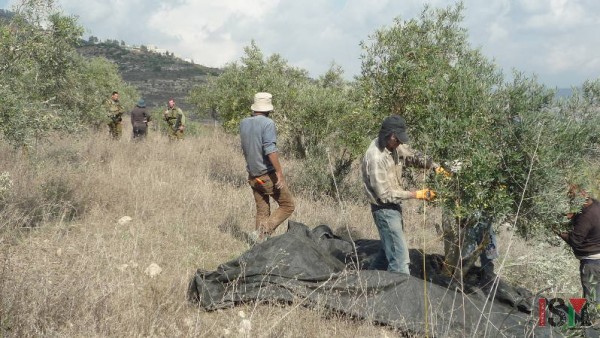
Palestinian farmer and internationals discussing picking permit with Israeli forces.

Nablus: Olive tree cut down by settlers
Starbucks CEO declares support for Hillary Clinton

Starbucks “proudly serving” the occupation of Afghanistan
Press TV – September 8, 2016
Howard Schultz, the founder and CEO of Starbucks, announces support for US Democratic presidential nominee Hillary Clinton.
In an interview with CNN, Schultz let slip which way he was voting, saying, “I’m hopeful that after the election – and hopefully Hillary Clinton will be elected president – that we will begin to see a level of unity and people coming together.”
When asked if he had officially backed Clinton with that statement, the CEO responded “I guess I just did. I think it’s obvious Hillary Clinton needs to be the next president.”
Starbucks, which has over 22,500 coffee stores, is one of the companies anti-Israel activists boycott.
Throughout her campaign for the 2016 US presidential race, Clinton has advocated herself as a champion for Israel. Zionist voters have in turn showed their support to her.
According to inminds.co.uk research:
Howard Shultz, the chairman of Starbucks is an active Zionist.
In 1998 he was honoured by the Jerusalem Fund of Aish HaTorah with “The Israel 50th Anniversary Friend of Zion Tribute Award” for his services to the zionist state in “playing a key role in promoting close alliance between the United States and Israel”. The Jerusalem Fund of Aish HaTorah funds Israeli arms fairs chaired by the butcher of Jenin – General Shaul Mofaz, and the Zionist propaganda website honestreporting.com.[1]
His work as a propagandist for Israel has been praised by the Israeli Foreign Ministry as being key to Israel’s long-term PR success [2].
Recently whilst the Israeli army was slaughtering Palestinians in Jenin, Nabulus and Bethlehem he made a provocative speech blaming the Palestinians of terrorism, suggesting the intifada was a manifestation of anti- Semitism, and asked people to unite behind Israel [3].
At a time when other businesses were desperately pulling out of Israel, Starbucks decided to help Israel’s floundering economy and invest in Israel – a joint venture with Israeli conglomerate Delek Group for Starbucks outlets in Israel (Shalom Coffee Co).[4][5][6]. A bad business decision – Starbucks had heavy losses and in April 2003 Starbucks were forced to announced that all 6 Starbucks cafes in Israel will be shut down and its partnership with Delek end.[14]
It has been revealed that Starbucks still continues to support Israel by sponsoring fundraisers for Israel.[15]
See [11] for suggested action against Starbucks.
Oxfam has misguidedly partnered with Starbucks in return for £100,000 – please support our “Campaign Against Oxfam Agreement with Starbucks“.
Starbucks fully supports Bush’s war of terror and has opened a Starbucks in Afghanistan for the US invaders – they like to do their bit to help the occupation.[17]
ADDITIONAL INFO & REFs :
| [1] | Israel 50th Anniversary Friend of Zion Tribute Award
Howard Schultz was presented with “The Israel 50th Anniversary Friend of Zion Tribute Award” by the The Jerusalem Fund of Aish HaTorah in August 27, 1998. [a][e] According to the Jerusalem Fund of Aish HaTorah “The Friends of Zion award salutes leaders who have played key roles in promoting close alliance between the United States and Israel”[e] Awards Page Mystery
Its interesting that the Israel 50th Anniversary Award given to Howard Schultz was once displayed with pride on the Starbucks website on the company’s “Awards and Accolades” page but since the boycott started biting it has mysteriously disappeared from the page![a]
The Jerusalem Fund of Aish HaTorah 1. The Jerusalem Fund of Aish HaTorah sponsors Israeli military arms fairs chaired by the butcher of Jenin – General Shaul Mofaz, Israel’s Minister of Defense. It aims to “strengthen the special connection between the American, European and Israeli defense industries” and “to showcase the newest Israeli innovations in defense”.[f] 2. The Jerusalem Fund of Aish HaTorah also sponsors the Zionist propaganda website “honestreporting.com“.[g] 3. The Aish HaTorah, the main beneficiary of The Jerusalem Fund of Aish HaTorah, whilst described as an apolitical international network of Jewish education centres, produces propaganda material for Israel. One video they produce by Rabbi Ken Spiro titled “The Islamic Connection to Jerusalem” starts “The Islamic connection begins in the 7th century, thousands of years after the original Jewish connection.” and continues to belittle Jerusalem’s Islamic heritage – propaganda to justify Israeli occupation of Jerusalem.[b] Also featured on their site is “The Occupied Territories – A Primer” which denies the status of the West Bank and Gaza as “occupied” and argues that they be called “disputed territories”.[c] No wonder they were praised by Israeli Prime Minister Binyamin Netanyahu: “I congratulate Aish HaTorah for what they’re doing, where they’re doing it, and for whom they’re doing it.”[d] [a] http://www.starbucks.com/aboutus/recognition.asp |
||
| [2] | Jerusalem Report
Losing the Media Battle (April 22, 2002) “… The key to Israel’s long-term PR success, Meir(*) believes, is on the campuses of North America and Europe. Wealthy Jews like Howard Schultz, the owner of the Starbucks chain, are helping with student projects, including seminars held in both Israel and North America, in which students hear Israeli presentations on the crisis…” (*) Gideon Meir, the official in charge of the Israeli Foreign Ministry’s PR effort. |
||
| [3] | Starbucks CEO says anti-Semitism on the rise
Howard Shultz warns American Jews against complacency 04/04/2002 Reported by Elisa Hahn, KING 5 SEATTLE – Divisions within the Jewish community were on display Thursday in Seattle as Starbucks CEO Howard Schultz criticized Palestinian inaction in the Middle East while others protested the Israeli occupation of Palestinian lands. “If you leave this synagogue tonight and go back to your home and ignore this, then shame on us,” Howard Schultz told a crowded temple of Jewish Americans on Seattle’s Capitol Hill. Schultz warned other Jews against sitting back and doing nothing. “What is going on in the Middle East is not an isolated part of the world. The rise of anti-Semitism is at an all time high since the 1930’s,” he said. “The Palestinians aren’t doing their job they’re not stopping terrorism.” While reaction inside the temple to Schultz’s remarks grew from a warm reception to a standing ovation, the mood outside the temple was different. A handful of Jews gathered there to protest the Israeli government’s actions of late and their occupation of Palestinian lands. There were similar sentiments Thursday at Seattle’s Westlake center. “We only get the side that talks about Palestinians as terrorists. As if all the civilians right now living in a state of siege and terror are terrorists and they’re not,” said protestor Alethea Mundy, whose younger brother is in Bethlehem doing relief work for Palestinian refugees. She’s worried about her brother, but realizes that everything is relative. “This is what the Palestinians live with every day, two weeks is nothing for my brother,” |
||
| [4] | American-Israel Chamber of Commerce, Southeast Region e-Newsletter
JULY-AUGUST-SEPTEMBER 2001 Starbucks will open its first two cafes in Tel Aviv during the first week of September and plans to open another three branches in the area by the end of the year with 15 more throughout Israel by the end of 2002. Israel-based Delek, which recently purchased a chain of US convenience stores and established its US headquarters in Nashville, Tennessee, will be the majority shareholder in Starbucks Israel. see [13] for more on Delek’s US connection. |
||
| [5] | Starbucks next market: Israel
Starbucks Coffee Co. chairman Howard Schultz loves a challenge. He opened the Japanese market during the depths of that country’s spectacular recession, and now he’s set his sights on conflict-ridden Israel. The stores will be built through a joint venture company, Shalom Coffee Co., which will be owned by publicly traded Israeli conglomerate Delek Group and Starbucks Coffee International, Starbucks’ internationally focused wholly-owned subsidiary. No word yet on how many Starbucks stores are planned for the tiny Middle Eastern nation, which has been plagued by escalating violence between Palestinians and the Israeli military since last fall. … http://seattle.bizjournals.com/seattle/stories/2001/04/16/daily31.html |
||
| [6] | Jerusalem Post, Sunday, April 22 2001
Starbucks to open here later in year According to the agreement, which is expected to be signed in the next few weeks, Delek will hold 80.5 percent of the coffee chain, while Starbucks Coffee International will hold the remaining 19.5%. Starbucks will have the option to increase its share to 50% at a later date. Originally Delek and Burger King co-owner Yair Hason were negotiating for a 40% share each in a venture with Starbucks, but a few months ago the deal was cancelled. The announcement that Starbucks will be coming is expected to be welcomed by local coffee lovers who have long been awaiting the rumored arrival of the chain which has with 3,600 stores in the US. According to the Delek Group the plan is “to open dozens of stores.” The first stores are expected to open late this year. “We expect Israel to be an excellent market for Starbucks, with great growth opportunities,” said Peter Masien, president of Starbucks Coffee International. Delek’s investment in the coffee chain is part of its strategy to expand into new areas, said Giora Sarig, president of Delek’s Israel Fuel Corporation, one of the three subsidiaries of the Delek Group. “We are delighted to become partners with such a world-class brand as Starbucks,” he said. The coffee shops will not be connected to the Delek gas stations. The local competition is not overly concerned about the entrance of the well known chain. Aroma’s operating manager Ben Balbinder told The Jerusalem Post that “more coffee stores will raise the awareness of coffee drinking.” He added that according to his personal experience in the US, Starbucks coffee is not on the same level as that of Aroma. Aroma, which sells one and half tonnes of coffee a month, currently has eight cafes with another three are to be opened in the next two months. Balbinder said that the local coffee market is continuing to grow and has contributed to a decision to expand aggressively in the next year and a half. Starbucks , which has been traded on Nasdaq since 1992, has a current market capitalization of $7.8 billion, with more than 4,500 retail locations in the US, Europe, the Middle East, and the Pacific Rim. It is well represented in the Middle East with stores in Bahrain, Saudi Arabia, Kuwait, Lebanon, Qatar, and the United Arab Emirates. The company was founded in 1971 and also sells tea, pastries, ice creams, other food and beverages, and coffee accessories. The company also has an on-line store as well as selling directly to restaurants, businesses, airlines, and hotels. The Delek Group, which was founded in 1951, has three major subsidiaries: Israel Fuel Corporation, Delek Real Estate, and Delek Investments & Properties, a holding company for activities in automotive distribution and retailing, oil and gas exploration, biochemical manufacturing, convenience stores, and other retail operations. Delek is traded on the Tel Aviv Stock Exchange at a value of NIS 2.8b. |
||
| [7] | Two “Standard replies” activists are receiving from Starbucks when they complaint about the recent speech Howard Schultz made:
First:
Second:
|
||
| [8] | Starbucks Coffee have partnerships with:
Source: http://www.starbucks.com/aboutus/friends.asp |
||
| [9] | Starbucks Coffee has 4,709 locations around the world in the following countries (Mulsim countries are shown in bold)
Australia Source: |
||
| [10] | To locate your nearest Starbucks (internationally) see: | ||
| [11] |
|
||
| [12] | According to Yahoo Finance :
Howard Shultz’s annual pay as Chairman of Starbucks is $2.2 Million, and last year he received an additional $22.6 Million from the value on options excercised in the fiscal year.[a] Howard Shultz also has interests in the following companies:
[a] http://biz.yahoo.com/p/S/SBUX.html |
||
| [13] | Boycott Mapco Express & East Coast store-gas stations
An activist has pointed out that Delek (Starbucks Israeli partners) owns Mapco Express filling stations and convenience stores in Tennessee (198 stores) and East Coast convenience store-gas stations in Virginia (36 stores). These should be boycotted. Source: Alexander’s Gas and Oil Connections Company News, Delek completes acquisition of Mepco Express filling stations [31-05-01] Delek Group said that it has completed its acquisition of 234 gas stations and convenience stores in the US for $ 234.5 mm. The acquisition consists of 198 Mapco Express filling stations and convenience stores in Tennessee in consideration for $ 147 mm and 36 East Coast convenience store-gas stations in Virginia for $ 36.5 mm The concerns will continue to carry their respective brands names following the transaction. Delek also announced that it is in the process of establishing Delek USA, a wholly owned US-based subsidiary which will conduct the company’s American operations. The investment marks the Netanya-based company’s first entrance into the overseas retail gasoline markets. Company president Avinoam Finkelman said that the decision to enter international markets is mostly due to eroding returns in the domestic market, a product, he believes of increased competition and government regulatory activity. |
||
| [14] | Starbucks Exits Israel
April 2, 2003 All six Starbucks cafes in Israel will be shut down at the end of the week, Starbucks Coffee International and the Delek Group said as they announced the end of their brief partnership. All 120 of the coffee chain’s employees in Israel will be laid off. According to Israel’s Haaretz, poor sales and Delek’s failure to find an investor to bail it out of a losing venture caused the decision to shut down the expensive coffeehouses. Starbucks Corp., the parent of Starbucks Coffee International, told Haaretz that its decision to dissolve the joint venture was driven by “market challenges,” an allusion, the newspaper said, to “Israel’s severe recession and security problems.” |
||
| [15] | Starbucks Sponsers Israel Fundraiser
Bowl 4 Israel Starbucks sponsors “bowl 4 Israel”, one of the fund raisers for Israel organised by Elie Haller. Her last fund raiser was a barbecue that “raised $15,000 for a paratrooper unit in the Israel Defense Forces”.[a] This time the money raised – some $50,000 was to be distributed to families of “Israeli terror victims” by the Israel Emergency Solidarity Fund (OneFamily).[a] [d] Innocent enough you may think, but you’d be wrong – apparently their definition of “terror victim” includes Israeli soldiers who were killed whilst they were butchering Palestinian women and children during the Jenin massacre (April 2002). For April 2002, their spending record includes the following entry:
So the fund rewards the families of war criminals for a job well done!
No wonder the page on the web-site for bowl4israel which showed Starbucks as the sole sponsor is now mysteriously showing a blank space where Starbucks appeared.[b] A peek at the html code for the page reveals that Starbucks name and logo are still there but have been hidden – commented out – no doubt to protect it from the boycott.
[a] http://www.bowl4israel.org/article_heilman.jsp [b] http://www.bowl4israel.org/sponsors.jsp [c] http://www.onefamilyfund.org/OF_Right_2.asp?ID=377 [d] Israel Emergency Solidarity Fund(IESF) raises money in the US and its Israeli counterpart OneFamily spends it in Israel, the two organisations have officially merged together. |
||
| [16] | ADL vouches for Starbucks Zionist credentials
After Starbucks closed down its cafes in Israel[14], many Zionists were upset and accused Starbucks of succumbing to the boycott. Some even suggested boycotting Starbucks:
Its interesting to observe that it was the ultra-Zionist Anti-Defamation League (ADL) that came to Starbucks rescue[b] and put down the Zionist backlash against it. (For those unaware of the activities of the ADL see http://www.inminds.co.uk/boycott-news-0313.html ). As the New York Times put it:
It also quoted Starbucks chairman Howard Shultz, describing him as “a Jewish American who has long been supportive of Jewish organizations and causes in the United States and in Israel”, saying that the company will return to Israel in due course.[a] See also [17] for another Zionist defence of Starbucks. Many other Zionist groups also came to Starbucks defence including the Jewish Council for Public Affairs whose alert[d] states:
[a] http://urbanlegends.about.com/library/bl-starbucks_israel.htm [b] http://www.adl.org/rumors/starbucks_rumors.asp [c] New York Times, “New Economy” by Sherri Day Monday, June 2, 2003 [d] http://www.e-guana.net/organizations.php3?action=printContentItem&orgid=54& |
||
| [17] | Starbucks support War of Terror
Starbucks has donated a store to the US army to help in the occupation of Afghanistan. See photos below from Afghanistan of US troops thanking Starbucks for their donation:
Source: NB: Boycott Watch is a Zionist organisation[a] which provides the above photos as part of their campaign to support Starbucks from any possible Zionist boycott for closing its stores in Israel. [a] “Boycott Watch and the Zionist Organization of America (ZOA) are Source: http://www.boycottwatch.org/abi/divest001.htm Also according to the American Forces Press Service Nov.9 2004:
Source: Starbucks, Red Cross ‘Bring a Bit of Home’ to Overseas Troops, by Gerry J. Gilmore, American Forces Press Service, Nov. 9, 2004 |
||
| [18] | Starbucks Leaflet
One of our readers has designed a leaflet on Starbucks: Please note that we cannot take responsibility for the contents of the leaflet as we did not produce it, it does however seem to be based on the research above (thanks NEdo Sul) |


Moscow Talks Called Off as Israel Says Peace ‘Isn’t Priority’
teleSUR | September 6, 2016
Holding peace talks is “not one of the priorities” of Israeli Prime Minister Benjamin Netanyahu, Russia’s peace envoy to the Middle East Mikhail Bogdanov told a Palestinian official Tuesday, adding that the Russian-proposed talks on the Israeli-Palestinian conflict have been called off, the Middle East Eye reported.
“Bogdanov told us frankly that Netanyahu not only rejected the Palestinian demands for the meeting—such as a settlements freeze and the release of the pre-Oslo prisoners—but also that a meeting with (President Mahmoud) Abbas is no longer one of his priorities,” the Palestinian official told Middle East Eye on condition of anonymity.
Bogdanov held a meeting with Netanyahu Monday where the prime minister told him he was not interested in peace talks with Palestinians because Abbas had preconditions, the Russian deputy foreign minister told the Palestinian official.
“Netanyahu said his priority now is two things: fighting terrorism and making peace with Arab countries,” he said and added that the Russian envoy quoted Netanyahu as saying, “When I make peace with the Arabs, Abbas will join us—so let him stand alone.”
However, Abbas had agreed to President Vladimir Putin’s offer for talks Monday, while Netanyahu’s aide had said the he was still considering the offer.
Despite the behind closed doors confirmation that the Russian talks have collapsed before they even started, Bogdanov told reporters that work continues on “the date, form and content of the meeting” after his meeting with the Palestinian delegation Tuesday.
But Netanyahu publicly used the same words he has been using for the past few years regarding any peace talks with the Palestinians.
“If Abu Mazen (Abbas) wants to meet without preconditions for direct talks, I’m ready at all times. I’ve been calling on him to [do] so for seven years already, and if he agrees to do so there’ll [sic] be a meeting,” Haaretz quoted Netanyahu as saying Tuesday.
But Abbas aides told reporters that the meeting was unlikely to happen. “When are we going to agree with Netanyahu on the content of the meeting? It’s very difficult,” Jibril Rajoub, an aide to the Palestinian Authority leader, said following the meeting with the Russian delegation.
The current U.S. administration of Barack Obama has given up on attempting to broker any peace talks between Palestinians and Israel after Secretary of State John Kerry threw in the towel in 2014 after nine months of talks ended in failure.
While Russia’s efforts might end before they even get wings, over the years Washington has demonstrated that despite the billions of dollars in aid it provides to Israel every year, successive administrations have failed to use their leverage on Israel to achieve any steps forward on peace.
Without Israeli occupation, Palestinian economy would double – UN report
RT | September 7, 2016
In a damning report, the UN development body (UNCTAD) described the ways Israeli occupation of Gaza and West Bank has been preventing the Palestinian economy from recovery and getting twice as big as it is now.
The document detailing the “staggering economic cost” of Israeli occupation was released on Tuesday by the United Nations Conference on Trade and Development (UNCTAD).
“The Palestinian economy would be at least twice as large without Israeli occupation,” the findings reveal.
Among the key reasons for the high unemployment and staggering poverty the agency cites “confiscation of Palestinian land, water and other natural resources.” It adds that “restrictions on the movement of people and goods; destruction of assets and the productive base;” also played a major role here.
According to the latest estimations by the Palestinian Central Bureau of Statistics nearly 27 percent of people of the autonomy are currently without job. Meanwhile UNCTAD has revealed that over 66 percent of the Palestinians were food-insecure last year.
“The continuous process of de-agriculturalization and de-industrialization” has contributed to a severe degradation of Palestinian economy, according to the UN report. The paper states that in Gaza “producers are denied access to half of the cultivable area and 85 per cent of fishery resources.”
The West Bank area is facing a similar problem, according to the UN. In the so-called area C, which constitutes over 60 percent of West Bank “more than 66 per cent of its grazing land, is not accessible to Palestinian producers”.
The figures published in the report say that the Israeli occupation of the Area C “costs the Palestinian economy the equivalent of 35 per cent of GDP ($4.4 billion in 2015).”
The Israeli military campaign in 2014 whose proclaimed goal, was to prevent rocket attacks on its territories from the Palestinian areas delivered another blow to the financial recovery of the Palestinians.
The following tightening of the Gaza blockade, in place since 2007, made the things even worse, the report states. It resulted in additional civilian items being banned after labeled “dual-use”, meaning they can be also implemented for causing harm.
The crisis resulted in additional severe shortages of medical equipment as well as serious reduction in water supplies in the occupied territories, the UN finds. The problem also contributed to the rising infant mortality of almost 20 out of 1,000 live births. The trend is labeled “unprecedented” and found only in countries “affected by HIV epidemics”
In addition UNCTAD points out that the expanding settlement policies by the Israeli authorities are contributing to the Palestinian plight.
“There are now 142 settlements in the West Bank, bringing the number of Israeli settlers to over one fifth of the Palestinian population. This expansion undermines the prospects for a two-State solution,” UNCTAD claims.
The so-called two-state solution, proposed by the UN would see an establishment of an independent state of Palestine alongside Israel, west of the Jordan River. The potential boundaries however remain one of the key stumbling blocks here.
In the latest development, Israeli PM Benjamin Netanyahu’s press service has issued a statement saying he is considering Russia’s offer to host Israeli-Palestinian talks in Moscow
“[Netanyahu] presented Israel’s position whereby he is always ready to meet [Abbas] without preconditions and is therefore considering the Russian president’s proposal and the timing for a possible meeting,” the statement said.
Palestinian President Mahmoud Abbas has already accepted the offer to meet with Netanyahu, although the date for the talks has not been yet set.
Featured Video

When Israel Is Mighty
or go to
Aletho News Archives – Video-Images
From the Archives
US murdering 1 million Iraqis is democracy, Iran giving yogurt to Iraq is “domination”
By Ali Salaam | American Herald Tribune | July 31, 2017
The New York Times, owned by the Zionist Jewish supremacist Ochs-Sulzberger family, has no problem with Iraqi suffering as long as Iran is not the one behind it.
The Iraq War was a genocide of the Iraqi people by Zionist supremacists in the Bush administration. Over 1 million innocent people were killed based on a lie. American soldiers died in an Israeli war and now an average of 22 soldiers commit suicide every day because their consciences cannot cope with the fact they committed crimes in an illegal war that served no purpose other than to benefit Israel, not America.
Benjamin Netanyahu, Prime Minister of the Zionist regime, once said “We are benefiting from one thing, and that is the attack on the Twin Towers and Pentagon, and the American struggle in Iraq.”
Paul Wolfowitz had his sights on Iraq since his time in the first Bush administration. Former Israeli official and Bush administration official Richard Perle had his eyes on Iraq since at least his authorship of the Clean Break white paper. The Zionist regime had their eyes on Iraq since the 1980s when strategist Oded Yinon wrote his white paper in support of dividing the Arab-Muslim world along ethnic and sectarian lines. The global Zionist lobby has had their eyes on Iraq since Theodor Herzl stated that Eretz Israel’s true borders go from the Nile River in Egypt to the Euphrates River in Iraq. … continue
Blog Roll
 Aletho News
- MEP blasts ‘Euro-Gestapo’ for lecturing Russia on democracy
- Syria May Send Troops to Saudi Arabia Amid War with Ansar Allah
- UK whines about losing billions to ‘Putin tax’
- Baghaei to Rubio: Distorted narratives cannot erase US record of broken commitments
- Houthis Don’t Have to Conquer Saudi Arabia to Make It Pay
- MOE: Nearly 22,000 Students and Education Workers Killed
- Guterres in Islamabad: Genocide, cowardice, and the cage of Imran Khan
- Johnson, Marandi say Yemen holds upper hand over Saudi Arabia
- False flags won’t save aggressors, Iran FM spokesman says
- The Makkah Pact Enters Into Force: The End of American Dominance or Its New Form?
- If Americans Knew
- Report claimed Mark Levin used by Israeli government to influence Trump
- Over 2,000 Gazans have died awaiting medical evacuation amid Israel’s continued siege
- How a U.S. Diplomat Suppressed and Altered Reports Critical of Israel
- 5 Palestinians Die from Israeli Strikes in Gaza as Relentless Attacks Continue
- Report: Ceasefire Slows Killing but Leaves Devastation Intact
- Country Music Singer Zach Bryan Breaks Attendance Record at Robert Kraft’s Gillette Stadium While Wearing ‘Free Palestine’ Shirt for Second Night in a Row
- Three years of death and devastation: Israel’s war on Gaza in pictures
- Why Hamas believed the status quo was more dangerous than its 7 October gamble
- Debunking Israel’s latest list of ‘terrorist’ journalists in Gaza
- In Gaza, focus is on survival, “every step is a struggle” – Daily Update
- No Tricks Zone
- New Study: 50 Years Of The Most Aggressive ‘Net Zero’ Policies Can Only Affect The Global Climate By 0.03°C
- US September “Heat” Was No Record…Many Records Set Decades Ago
- Latest European Green Energy Debacle; Portugal’s Largest Flagship Solar Park Insolvent!
- Green Energy Debacle: German Expert Professor Fritz Vahrenholt Warns Of Severe Economic And Social Consequences
- Two More Paleo Reconstructions Affirm Meters-Higher Sea Levels Across Ireland, Brazil 7000-6000 Years Ago
- New Study: Earth And Venus Surface Warmth Largely Explained By Convection And Lapse Rate, Not CO2 Or Radiation
- 2025 Nature Paper Claiming Worsening Global Drought Gets RETRACTED …Heavily Flawed
- New Study: ‘Global Drought Shows No Detectable Recent Acceleration Under Climate Warming’
- Economic Masterminds: German Socialists Suggest Taxing Productivity Gains Stemming From Using AI
- The South China Sea Has Not Been Cooperating With The Climate Change Narrative

