UK Jewish lobby calls on Labour to expel Livingstone
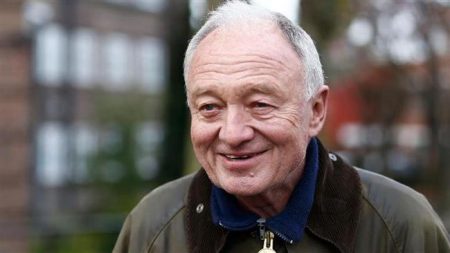
Former London mayor Ken Livingstone
Press TV – September 6, 2016
Britain’s Labour Party has come under pressure from a powerful Jewish lobby to expel former London mayor and MP Ken Livingstone, who says Adolf Hitler supported Zionism.
The British Jews organization made the call on Monday, shortly after Livingstone’s interview with the BBC, where he doubled down on his remarks about Hitler’s support for Zionism.
“During the 1930s, Hitler collaborated with the Zionists and supported them because he believed that a solution to his problem — the Jews — was that they should all move to Palestine,” the veteran MP told BBC radio.
Livingstone told the radio show that expelling him would be “very difficult” as he has the evidence needed to back the statement.
The comments revived a controversy from April, where he made the same remarks on the same radio show and was subsequently suspended by party leader Jeremy Corbyn.
“After I did the interview with you and I got suspended, I couldn’t walk down the street for people stopping me and saying ‘we know what you said is true – don’t give in to them,'” Livingstone said. “It’s going to be very difficult for them to expel me from the Labour Party when I’ve got this whole sheaf of documents and papers which shows that what I said was true.”
In its Monday statement, the British Jews blasted Livingstone for attempting to “rewrite history.”
“Every day that Labour does not expel him is a stain on the party,” the lobby’s Board of Deputies Vice President Marie van der Zyl said.
The Israeli regime was illegally established in 1948, when it occupied Palestinian land along with expanses of other Arab territories during full-fledged military operations. The occupied lands also include Lebanon’s Shebaa Farms and Syria’s Golan Heights.
In 1967, it occupied the Palestinian territories of the West Bank, including East Jerusalem al-Quds, and the Gaza Strip. It later annexed the West Bank and East al-Quds in a move never recognized by the international community.
“The creation of the state of Israel was fundamentally wrong, because there had been a Palestinian community there for 2,000 years,” Livingstone told Arabic TV station al-Ghad al-Arabi in May.
The Labour Party has suspended as many as 50 members over allegations of “anti-Semitism” and racism over the past months.
Palestinian forces stop vehicle of undercover Israeli forces, get arrested at gunpoint
Ma’an – September 6, 2016
TULKAREM – Undercover Israeli special forces reportedly arrested four Palestinian customs forces before dawn on Tuesday morning near the Nur Shams refugee camp in the northern occupied West Bank district of Tulkarem.
The Palestinian customs forces were reportedly conducting a surveillance operation surrounding “smuggled goods” in the Tulkarem area, when they spotted a Mercedes commercial vehicle driving in the nearby village of Anabta.
When the Palestinian officers attempted to stop the vehicle, it reportedly evaded them and fled in the direction of the Nur Shams refugee camp, at which time the Palestinian forces began to chase down the vehicle.
Palestinian sources told Ma’an that the customs officers managed to stop the vehicle, but when they attempted to search it, they discovered that the vehicle was being driven by undercover Israeli special forces.
The Israeli forces then reportedly pulled their guns on the four Palestinian officers, and detained them for “obstructing a secret mission” they were conducting in the nearby village of Bizzariya.
The detained Palestinian officers were released by 8 a.m. Tuesday, after the Palestinian Authority reportedly intervened on their behalf.
Israel detained 30 Palestinian teens in August, majority report being tortured

Ma’an – September 5, 2016
RAMALLAH – Israeli forces imprisoned 30 teenage Palestinians over the month of August and collected 65,000 shekels ($17,270) from their families as fines, the Palestinian Committee of Prisoners’ Affairs said Monday, with the majority of the detainees saying they were beaten and tortured during their detention, interrogation, and transport from one detention center to another.
A statement released Monday quoted the committee’s lawyer Luay Akka as saying that among the detainees were minors as young as 13 years old.
Akka added that 17 of the detainees were taken from their homes during military raids, five were detained from off the street, four at military checkpoints, and four arrived voluntarily to detention centers after they received summons from Israeli authorities.
Three of the 30 detainees were held without being charged or standing trial in administrative detention, and the rest were sentenced after court hearings to periods ranging from one month to 45 months.
Mousa Khanafsa, a 14-year-old boy from Abu Dis in the Jerusalem district of the occupied West Bank told Akka that he was violently beaten when he was detained from a street near his house.
A group of undercover Israeli officers, he said, chased him in the street and when they caught him they “assaulted him with the butts of their rifles, stomped on him with military boots, and was left bleeding from his nose.”
It was the latest report to emerge recently from the committee and other rights groups, amid years of well-documented abuse and mistreatment of Palestinian children by Israeli forces.
Akka reported last month on the cases of two Palestinian minors who were tortured, abused, and medically neglected in Israeli custody, one of which after being shot at point-blank range when Israeli forces detained them for rock throwing in the occupied West Bank district of Ramallah.
Locals in the occupied East Jerusalem neighborhood of al-Tur reported Saturday that Israeli police detained and assaulted 16-year-old Jamal al-Zaatari. During his detention, Jamal was pepper sprayed and beaten, resulting in injuries to his face, back, and feet, in addition to several bruises.
A report released recently by BADIL, a Palestinian NGO, warned of an increasing trend of Israeli forces shooting and injuring Palestinian youth — particularly in the knees and legs — during the near-nightly detention raids carried across the occupied West Bank.
Defense for Children International – Palestine (DCIP) has also extensively documented the abuse of Palestinians children in East Jerusalem by Israeli forces and the harsh interrogation practices used to force their confessions.
Despite “on paper” having more rights than Palestinian children in the occupied West Bank who are subject to a draconian military detention system, in practice, Jerusalem minors “do not enjoy their enshrined rights” under the Israeli civilian court system, according to DCIP.
Out of 65 cases documented by DCIP in 2015, “more than a third of Jerusalem youth were arrested at night (38.5 percent), the vast majority (87.7 percent) were restrained during arrest, and only a slim minority of children (10.8 percent) had a parent or lawyer present during interrogation.”
Interrogations of Palestinian children can last up to 90 days according to prisoners’ rights group Addameer, during which in addition to being beaten and threatened, cases of sexual assault, and placement in solitary confinement to elicit confessions are also often reported, while confession documents they are forced to sign are in Hebrew — a language most Palestinian children do not speak.
According to the Palestinian Committee of Prisoners’ Affairs, as of mid August, Israeli forces detained 560 children from occupied East Jerusalem alone since the beginning of 2016, and 110 minors were still being held in Israeli prisons, including four girls and 10 boys in juvenile detention centers.
According to Addameer, of the 7,000 Palestinians being held in Israeli custody, 250 were minors as of July.
51 Israeli Violations against Journalists in August
IMEMC News & Agencies – September 2, 2016
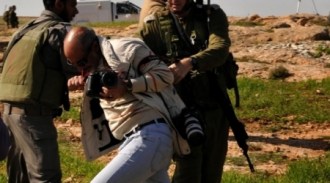 Israeli occupation forces reportedly committed 51 violations against Palestinian journalists during August of 2016, the government media office stated.
According to Al Ray Palestinian Media Agency, a report published by the office revealed that Israeli forces detained eight journalists, holding four in custody, and served a summons notice to one journalist.
Israeli authorities recently renewed the administrative detention of four journalists and the actual prison sentence of two journalists. It also documented five cases of abuses committed against detained journalists.
Additionally, it documented seven cases of injury, regarding four female journalists, involving gas grenades and fire.
Israeli forces also banned five journalists from covering events and travelling, one of them from Gaza.
The report also documented the closing of one local radio in the occupied West Bank, the raiding of two media institutions and the storming of nine houses where Palestinian journalists resided. It also reportedly seized media staff equipment.
Palestinian Photojournalist injured in Kafr Qaddum protest, forces raid East Jerusalem neighborhoods
Ma’an – September 2, 2016
QALQILIYA – A Palestinian photojournalist was injured by Israeli forces Firday afternoon, as dozens others suffered from tear gas inhalation during the weekly protest in the norther occupied West bank village of Kafr Qaddum.
Popular resistance coordinator in Kafr Qaddum Murad Shtewei told Ma’an that Israeli forces “assaulted” participants in the protest minutes after it began.
The soldiers injured photojournalist Nidal Shtayyah after hitting him with a tear gas canister in the back of his head. He was taken to Rafidia hospital for treatment.
Shtewei added that Israeli forces fired a barrage of tear gas, which landed mostly in surrounding homes, causing a family of five to suffer from tear gas inhalation, in addition to others participating in the protest, who were treated on the scene.
Residents of Kafr Qaddum began staging weekly protests in 2011 against land confiscations, as well as the closure of the village’s southern road by Israeli forces. The road, which has been closed 13 years, is the main route to the nearby city of Nablus, the nearest economic center.
Following similar clashes that broke out last month, Shtewei told Ma’an that more than 330 protests have been held over that period, during which time 84 protesters have been injured by live fire, including 12 children.
Some 120 others have been detained at protests and were subsequently held in Israeli custody for periods ranging between four and 24 months, Shtewei said, adding that they have paid fines totaling some 25,000 shekels (approximately $6,488).
Over the course of five years, an elderly protester was killed after suffering from excessive tear gas inhalation, one youth lost his eyesight, and another his ability to speak, he added.
Meanwhile, along with armed Israeli forces, Israeli Jerusalem municipality crews reportedly raided the occupied East Jerusalem villages of al-Isawyia and Silwan, where they delivered demolition orders and summons to local residents.
According to the Wadi Hilwah Information Center, Israeli forces accompanied municipality crews who raided the al-Bustan neighborhood in Silwan, where they hung demolition orders and warnings telling residents to “follow-up with the municipality on several buildings in the area.”
The forces reportedly took pictures of neighborhoos buildings and entrances of the neighborhood, and wrote tickets for parked cars.
Muhammad Abu al-Homos,a member of the al-Isawiya monitoring committee, said Israeli forces raided the village, searched a house, and patrolled the street ‘provocatively’. He added that the forces detained a teenager who was present in the area.
An Israeli army spokesperson said they were looking into reports of all three incidents in Kafr Qaddum, al-Isawiya and Silwan.
Israel to deploy machine gun-equipped autonomous vehicles along Gaza border
MEMO | September 2, 2016
Israel is set to use fully autonomous unmanned vehicles along the border with the Gaza Strip, according to a report published by FoxNews.com.
While currently unarmed, the Israeli military plans to add machine guns to the so-called Border Protector Unmanned Ground Vehicles (UGVs) by “the beginning of next year”.
An unnamed Israeli military official told the website: “This is the future – the border is a very dangerous place… Sending unmanned vehicles to do these patrols means that troops’ lives are not at risk.”
According to the report, the Israeli army has worked with defence giant Elbit Systems to convert Ford pick-up trucks into UGVs by adding “specialised remote driving technology”, along with “four driving cameras and a 360-degree observation camera.”
UGV testing reportedly began in July 2015 and the trucks “became operational in February [2016].”
While each vehicle is currently “driven by an operator in a remote control room using a steering wheel, joystick and pedals”, an army official told FoxNews.com that “in the future, we will have the capability of fully autonomous driving.” The machine gun “will be operated from a control room.”
Ben Gurion’s Plan for Regional Conquest and Israeli Empire
By Richard Silverstein | Tikun Olam | September 1, 2016

Ben Gurion’s 1948 vision of Israeli empire
Odeh Bisharat, one of Haaretz’s few Israeli-Palestinian columnists (Sayeh Kashua is another), published an incisive article on what he calls “the end of the road” for Zionism. But the first paragraph, which comprised a quotation from David Ben Gurion (the full archival passage in Hebrew is here), really opened my eyes. At the first meeting of the Haganah military command after statehood was declared on May 15, 1948, he told the assembled leadership his strategic goals for the coming war. This grandiose vision dispels a long-standing claim by proponents of the Israel-as-victim view, who argue that Israel’s enemies have commenced all the wars against it and that the “Jewish state” has only acted in self-defense:
“We must immediately destroy Ramle and Lod. … We must organize Eliyahu’s brigade to direct it against Jenin in preparation for [conquering] the Jordan Valley. … Maklef needs to receive reinforcements and his role is the conquest of southern Lebanon, through bombing-support against Tyre, Sidon and Beirut. … Yigal Allon must strike Syria from the east and from the north. … We must establish a Christian state whose southern border will be the Litani [River]. We will forge an alliance with it. When we break the strength of the [Jordanian] Legion and bomb Amman we will eliminate Transjordan too, and then Syria falls. And if Egypt still dares to fight, we will bomb Port Said, Alexandria and Cairo.
… That is how we will end the war – and make a reckoning on our forefathers behalf with Egypt, Assyria and Aramea.”
Pro-Israel advocates will chalk this up to the braggadocio of a national leader preparing the troops for battle. He offers them a vision full of victories and maximalist territorial gain. It cheers them for the difficult battle ahead. Defenders may argue that Ben Gurion had to have been realistic enough to know that the new state had little chance of achieving such objectives.
But in my reading of Ben Gurion, there are two separate personalities: one of the pragmatist who accepts half a loaf instead of the whole; the other the ambitious politico-military strategist harboring imperial visions of Israel’s future (including the ethnic cleansing of the Palestinian inhabitants of the new state). But even the pragmatist is only pragmatic in the moment. Ben Gurion makes clear that his pragmatism is only temporary until Israel is in a position to realize its maximalist goals.
The irony here is that it is Israeli advocates who continually claim that conspiring Palestinian militants only accept Israel on an interim basis until they are powerful enough to eradicate it. Therefore, Israel may never trust such enemies and never make peace with them; because a knife in the back is the only future Israel can expect from them. We can see that it is Israel that the Arab states had reason to distrust.
Another bitter irony is the claim by Israel and anti-Iran forces in the U.S. and elsewhere, that Iran has a nefarious plan to spread Shia hegemony throughout the Middle East to Iraq, Syria, Lebanon, and the Gulf region. In truth, Ben Gurion shows that Iran is a piker by comparison. He envisioned a Greater Israel not just from the river (Jordan) to the sea (Mediterranean), but a Davidic imperium spreading its influence from Syria to Egypt. Even those Arab states Israel permitted to remain would be little more than vassals of this new regional Goliath.
Just think how Ben Gurion’s successors implemented most of the strategic vision he proclaimed that day: a Christian state in southern Lebanon; the fall of Syria; Israeli bombardment of Arab capitals in Beirut, Damascus and elsewhere. The only elements of his plan that were unrealized (conquest of Jordan and the pacification of Egypt) weren’t necessary because both states sued for peace.
Today’s radical settlers, with their considerably ‘pared-down’ vision of a pure, racialist Judean state, rid of Palestinians, from the Jordan to the sea are inheritors of Ben Gurion’s legacy.
Bisharat quotes another telling statement from a pre-State Zionist leader who could be describing current Israeli strategy of sabotaging peace negotiations with the Palestinians. This was written in 1937:
“It turns out that we have put out our hand for peace, but took it back right away, when the other side expressed its interest in accepting it. This dangerous game did not help to raise our honor in their eyes as honest people, and the accusation that they blame us for, that we are conducting two-faced politics: On one hand we pretend as if we are asking for an agreement, and on the other hand we only want to gain time – is not baseless.”
This clearly explains Netanyahu’s Bar Ilan speech of 2009 in which he pretends to embrace a two-state solution (under severe pressure from the Bush administration to do so). The few times since when the Israeli leader has trotted out his affirmation of a two-state solution were times when he was under great duress and had to throw a sop to foreign interlocutors like the Obama administration. Clearly, Bibi’s heart is not in it, nor does he believe it.
California Lawmakers OK Bill Penalizing Companies Boycotting Israel
teleSUR – September 1, 2016
Both houses of California’s legislature have now approved a bill to ban state government agencies from awarding contracts to companies that choose to join the international boycott against Israel’s continued occupation of Palestine.
The bill, AB 2844, if passed, would be a serious attack on the worldwide Boycott, Divestment and Sanctions movement against Israeli apartheid and its treatment of Palestinians.
Companies who choose to boycott Israel, would be accused of being in violation of the state’s civil rights law and would not be permitted to accept a California government contract of $US100,000 or more.
The bill, which has eight different amendments, was eventually passed 60 to 0 in the assembly, and will now go to Governor Jerry Brown for has to decide whether to veto or sign the bill into law by the end of September.
BDS and civil rights advocates have urged Brown to veto the bill, while supporters of the bill have made much of the trade ties between the U.S. and Israel, as well as Israel’s positive treatment of LGBTQ persons as a reason for supporting AB 2844 – ignoring Israel’s long history of oppressing and collectively punishing Palestinians.
“AB 2844 is both an attack on the constitutional rights of Californians and a waste of taxpayer money, estimated to cost upwards of $140 million annually, according to the California Department of Finance, which opposes it,” read a statement from the Coalition to Stop AB 2844, which includes over 100 civil society organizations.
“Government should not be in the business of punishing supporters of BDS, whether corporations, universities, organizations or individuals, by denying them contracts,” said Nasser Barghouti from the U.S. Campaign to End The Israeli Occupation.
A number of other states, including New York and New Jersey, have passed similar laws to outlaw the boycott of Israel.
Israel shuts down Palestinian radio station amid escalation in press violations
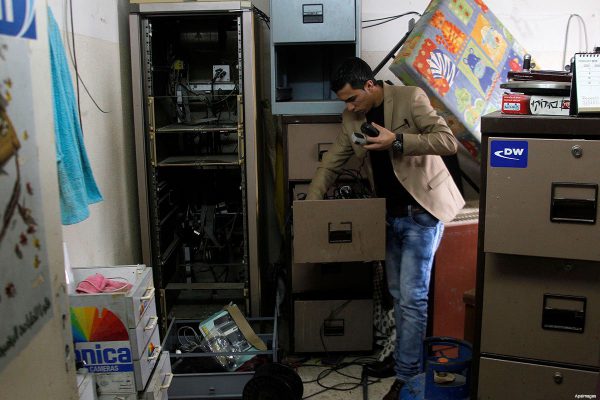
A Palestinian journalist checks damages after Israeli forces raided offices of local Palestinian Al-Khalil radio overnight in Hebron on November 21, 2015
Ma’an – August 31, 2016
HEBRON – Israeli forces raided and ransacked a Palestinian radio station early Wednesday morning in Dura City in the southern occupied West Bank district of Hebron, detained five of the station’s employees, and ordered it closed for three months, amid a documented escalation of violations against media freedoms by Israeli forces in the occupied Palestinian territory.
Locals told Ma’an that Israeli forces raided al-Sanabel radio station, destroyed its contents, and confiscated transmission and broadcast equipment.
Israeli forces left a closure order on the door of the radio station.
Locals added that Israeli forces detained head of the radio station Ahmad al-Darawish, as well as radio employees Muhammad al-Sus, Nidal Amro, Muntaser Nassar, and Hamed al-Nammura after raiding their homes.
Spokesperson for the Israeli army Avichay Adraee said in a statement in Arabic that Israeli forces, police, and civil administration authorities closed al-Sanabel upon a military order that claimed that the radio station broadcast programs inciting against Israel.
Adraee added that the five detainees were transferred for interrogation.
News of the closure came after Palestinian press freedoms watchdog MADA released a report on Saturday saying Israeli violations against media freedoms in the occupied Palestinian territory increased by 17 percent during the first half of 2016.
MADA General Director Moussa Rimawi said in the semi-annual report that while the total number of violations by both Israeli and Palestinian authorities declined from 224 cases in the first half of 2015 to 198 in the first half of this year — a rate of 12 percent — Israeli violations continued to climb, as Palestinian authorities committed 41 percent less violations during the same period.
A total of 133 violations committed by Israel were recorded during the period.
The most common types of violations committed by Israel were physical attacks, arrests, confiscation of equipment, prevention of coverage, and detentions.
The report highlighted that Israeli authorities in March closed two media institutions — Falastin al-Yawm and TransMedia Production Company — after ransacking and confiscated equipment from their offices.
Meanwhile, some 23 journalists and media workers were detained between January and June of 2016.
The report also noted an escalation of the Israeli practice of detaining Palestinians for social media activity, with Israeli authorities alleging that a wave of unrest that swept the occupied Palestinian territory last October was encouraged largely by “incitement.”
Palestinians have instead pointed chiefly to the frustration and despair brought on by Israel’s nearly 50-year military occupation of the Palestinian territory and the absence of a political horizon.
MADA said in the report that they were “gravely concerned regarding all systematic attacks and violence against journalists and media workers by the Israeli occupation, and urges state members to do their utmost to prevent violence against journalists, to ensure accountability, and bring to justice perpetrators of crimes against media freedoms.”
Israeli army continue to flout regulations on child detainees
MEMO | August 29, 2016
Following numerous complaints and legal action concerning pain and injury caused by the use of single plastic hand ties by the Israeli military on detainees, including children, the office of the Military Advocate General announced the introduction of new procedures for the use of restraints in 2010. The nature of the complaints prior to the introduction of the new procedures relating to the use of plastic ties included swelling, ties cutting into wrists and severe pain.
Under the new procedures introduced in 2010, hands should be tied from the front, unless security considerations require tying from behind. Three plastic ties should be used; one around each wrist and one connecting the two; there should be the space of a finger between the ties and the wrist; and the restraints should avoid causing suffering as much as possible. The officer in charge is responsible for ensuring compliance.
According to international juvenile justice standards restraints should only be used if the child poses an imminent threat to him or herself, or to others and all other means have been exhausted. Restraints may be used as a precaution against escape during transfer but only for as long as is strictly necessary and must not cause unnecessary pain or suffering. According to UNICEF and a UK report, single plastic hand ties should be prohibited in all circumstances, as should blindfolds.
Approximately three years after the introduction of the new procedures, UNICEF reported that “the ill-treatment of children who come in contact with the military detention system appears to be widespread, systematic and institutionalized throughout the process”. In reaching this conclusion UNICEF found that children continued to be painfully hand tied and blindfolded on a routine basis contrary to international standards and Israeli military regulations.
In May 2013, the military authorities responded to UNICEF’s findings by issuing a letter to the heads of all Brigades, Divisions, Police and Military Police operating in the West Bank reminding all units of existing standard operating procedures and policies in relation to the arrest of minors. Existing standard operating procedures stipulate that: hand-tying should be done at the discretion of the head of forces and always with three plastic ties in accordance with the 2010 regulations.
According to evidence collected by Military Court watch (MCW) in 2016, 90 percent of children continue to be restrained upon arrest, generally with plastic hand ties, and 85 percent report being blindfolded. In situations where plastic hand ties are used, many children continue to report experiencing pain. In 67 percent of cases where restraints are used, the military regulations for their use continue to be disregarded.
Although UNICEF and the UK reports also recommended that children should never be restrained while attending court except in extreme and unusual circumstances, children continue to be shackled by the ankles during their appearances in the military courts. … Full article
If Israel wants to be treated like a normal state, it should act like one

By Professor Kamel Hawwash | MEMO | August 29, 2016
Israel is not a normal state, but has craved to be treated as such ever since its creation in historic Palestine, against the will of the indigenous Palestinian people, in 1948. It sometimes claims its legitimacy from the UN partition plan, the terms of which bear no resemblance to the area currently controlled by the state; at other times Israelis refer to Biblical connections, which they claim to extend over the whole of Palestine. Exceptionally, proponents of Israel claim that only the followers of Judaism and no other faith are entitled to a state or homeland in the land of their choosing, regardless of who inhabited that land when they claimed it.
To this day, Israel remains a state without declared borders; it is the illegal occupier of another people’s land, whose rights under occupation it has flouted for the past 49 years. Israel claims to be a Western-style “democratic” state but only certain inhabitants of the land it has controlled since 1967 – basically all of historic Palestine – have a right to vote in its elections. It claims to want peace based on a two-state solution but has been implementing policies to ensure that there will only ever be one state, Israel, the borders of which are those of historic Palestine, and where people are defined by a sophisticated system of identity cards, driving cars with differently coloured number plates. It operates different laws for different people; civil law for Israelis but military law for Palestinians in the occupied territories. The law applied to Israeli citizens discriminates between Jews and non-Jews. This discrimination extends to land purchase, which gives Jews rights over non-Jews.
So Israel is clearly not a normal state, because a normal state does not build homes and towns for one ethnic group, to the exclusion of others. Israel does this by building illegally Jewish-only settlements on occupied Palestinian land. Further, in some towns within its nominal border, it allows “admissions committees” to decide whether residents will allow other citizens to live there; it is usually Jewish citizens who make these decisions and non-Jewish citizens who are excluded.
A normal state does not regularly demolish the homes of the people it occupies, or evict their occupants so that it can move its ethnically-chosen citizens into them. Israel does this.
A normal state does not besiege an occupied area for over ten years. Israel has done this with Gaza, the most densely populated place on earth. It controls the entry and exit of goods and people.
A normal state does not then attack the people living under siege repeatedly with the most destructive weapons on earth, short of nuclear warheads. Israel does.
A normal state does not repeatedly attack neighbouring states with impunity. Israel has done this to Iraq, Syria and Lebanon.
A normal state does not exist in one continent but play its sport in another. Israel does; it is in Asia but plays football in Europe.
A normal state does not violate agreements it signs, as Israel has done with the Oslo agreement and repeated ceasefire agreements with the Palestinians in Gaza.
A normal state does not carry out extrajudicial killings against the people living under its military occupation. Again, Israel does this with impunity.
A normal state does not treat children in the territory it occupies with the cruelty that Israel displays; it abducts children in the night and takes them before military courts in shackles.
The list of abnormal acts that Israel carries out is endless and developing on an almost daily basis. It is therefore hypocritical of it and its leaders to claim that it should be treated as a normal state.
This expectation was tested recently in incidents at the Rio Olympic Games involving the Lebanese team and an Egyptian judo player. The games had not even started when what turned out to be a misguided decision by the organisers became a major incident as teams were making their way to the Maracanã Stadium for the opening ceremony. In this now well-documented incident the Lebanese team refused to share a bus with their Israeli counterparts. Israel saw this as discrimination. “How could they let something like this happen on the eve of the Olympic opening ceremony?” complained one Israeli official. “Isn’t this contrary to what the Olympics stand for? … I’m in shock from the incident.” Those not familiar with the Arab-Israeli conflict would see no problem in any two teams from either end of the globe, let alone neighbours, sharing a bus.
However, this almost paled into insignificance compared to the now famous shunning by Egyptian Judoka Islam El-Shehabi of the extended hand of his Israeli opponent Or Sasson, after his defeat in the qualifying rounds of the 100 kg competition. El-Shehabi himself, who had come under pressure at home not to compete, said: “I have no problem with Jewish people or any other religions or different beliefs but for personal reasons you can’t ask me to shake the hand of anyone from this state, especially in front of the world.” Although the Egyptian’s appearance for the bout was seen as progress by many, this was not the official line. The International Olympic Committee (IOC) said El-Shehabi’s action was “contrary to the rules of fair play” and against the spirit of friendship exemplified by the games. He was reprimanded by the IOC and sent home by his team.
However, a normal state would not withhold the Olympic kit of the representatives of the people it occupies and ban their officials from travel, as Israel did. Furthermore, it would not restrict the movement of its sporting teams both within the occupied territories and to the outside world. Israel does this all the time. Its soldiers recently fired tear gas into a stadium where a Palestinian football match was taking place.
Away from the sporting arena, Israel claims that it faces discrimination in many ways, particularly from UN bodies. It insists that the UN Human Rights Council singles it out for special and disproportionate treatment. However, which other state violates so many aspects of international law and international humanitarian law, and has done so since its creation? The answer is simple: not one.
Israel is currently facing a campaign by the Boycott, Divestment and Sanctions (BDS) movement, which was called for by Palestinian civil society to place pressure on the state to behave in a “normal” way by adhering to international law. The BDS campaign was launched because of the failure of the international community to pressure Israel to conform to “normal” behaviour. Its call for an end to the occupation, equal rights for all citizens and the right of return for Palestinian refugees is peaceful, legal and highly moral. However, Israel has once again cried wolf and claims that BDS is not only discriminatory but also “anti-Semitic” because it targets “the only Jewish state” in the world. The fact is that there would be no need for a BDS movement if Israel behaved like a “normal” state.
Hence, if Israel really does want to be treated like a normal state it must first behave like one. It is currently so far away from such a designation that it merits being seen as the pariah, the rogue state that it is. Its leaders choose this status by their decisions to act in the ways that it does, not its critics. Israel should begin the process of change or risk further isolation and condemnation as even its most loyal allies begin to see what an embarrassment it is to them.
Featured Video

When Israel Is Mighty
or go to
Aletho News Archives – Video-Images
From the Archives
US murdering 1 million Iraqis is democracy, Iran giving yogurt to Iraq is “domination”
By Ali Salaam | American Herald Tribune | July 31, 2017
The New York Times, owned by the Zionist Jewish supremacist Ochs-Sulzberger family, has no problem with Iraqi suffering as long as Iran is not the one behind it.
The Iraq War was a genocide of the Iraqi people by Zionist supremacists in the Bush administration. Over 1 million innocent people were killed based on a lie. American soldiers died in an Israeli war and now an average of 22 soldiers commit suicide every day because their consciences cannot cope with the fact they committed crimes in an illegal war that served no purpose other than to benefit Israel, not America.
Benjamin Netanyahu, Prime Minister of the Zionist regime, once said “We are benefiting from one thing, and that is the attack on the Twin Towers and Pentagon, and the American struggle in Iraq.”
Paul Wolfowitz had his sights on Iraq since his time in the first Bush administration. Former Israeli official and Bush administration official Richard Perle had his eyes on Iraq since at least his authorship of the Clean Break white paper. The Zionist regime had their eyes on Iraq since the 1980s when strategist Oded Yinon wrote his white paper in support of dividing the Arab-Muslim world along ethnic and sectarian lines. The global Zionist lobby has had their eyes on Iraq since Theodor Herzl stated that Eretz Israel’s true borders go from the Nile River in Egypt to the Euphrates River in Iraq. … continue
Blog Roll
 Aletho News
- MEP blasts ‘Euro-Gestapo’ for lecturing Russia on democracy
- Syria May Send Troops to Saudi Arabia Amid War with Ansar Allah
- UK whines about losing billions to ‘Putin tax’
- Baghaei to Rubio: Distorted narratives cannot erase US record of broken commitments
- Houthis Don’t Have to Conquer Saudi Arabia to Make It Pay
- MOE: Nearly 22,000 Students and Education Workers Killed
- Guterres in Islamabad: Genocide, cowardice, and the cage of Imran Khan
- Johnson, Marandi say Yemen holds upper hand over Saudi Arabia
- False flags won’t save aggressors, Iran FM spokesman says
- The Makkah Pact Enters Into Force: The End of American Dominance or Its New Form?
- If Americans Knew
- Report claimed Mark Levin used by Israeli government to influence Trump
- Over 2,000 Gazans have died awaiting medical evacuation amid Israel’s continued siege
- How a U.S. Diplomat Suppressed and Altered Reports Critical of Israel
- 5 Palestinians Die from Israeli Strikes in Gaza as Relentless Attacks Continue
- Report: Ceasefire Slows Killing but Leaves Devastation Intact
- Country Music Singer Zach Bryan Breaks Attendance Record at Robert Kraft’s Gillette Stadium While Wearing ‘Free Palestine’ Shirt for Second Night in a Row
- Three years of death and devastation: Israel’s war on Gaza in pictures
- Why Hamas believed the status quo was more dangerous than its 7 October gamble
- Debunking Israel’s latest list of ‘terrorist’ journalists in Gaza
- In Gaza, focus is on survival, “every step is a struggle” – Daily Update
- No Tricks Zone
- New Study: 50 Years Of The Most Aggressive ‘Net Zero’ Policies Can Only Affect The Global Climate By 0.03°C
- US September “Heat” Was No Record…Many Records Set Decades Ago
- Latest European Green Energy Debacle; Portugal’s Largest Flagship Solar Park Insolvent!
- Green Energy Debacle: German Expert Professor Fritz Vahrenholt Warns Of Severe Economic And Social Consequences
- Two More Paleo Reconstructions Affirm Meters-Higher Sea Levels Across Ireland, Brazil 7000-6000 Years Ago
- New Study: Earth And Venus Surface Warmth Largely Explained By Convection And Lapse Rate, Not CO2 Or Radiation
- 2025 Nature Paper Claiming Worsening Global Drought Gets RETRACTED …Heavily Flawed
- New Study: ‘Global Drought Shows No Detectable Recent Acceleration Under Climate Warming’
- Economic Masterminds: German Socialists Suggest Taxing Productivity Gains Stemming From Using AI
- The South China Sea Has Not Been Cooperating With The Climate Change Narrative

