Whitewashing Israeli War Crimes, the NYT Turns its Back on Survivors and Critics
By Barbara Erickson | TimesWarp | August 26, 2016
So it’s settled, according to The New York Times: Israel was not at fault in a strike that killed 10 civilians near a United Nations school in the 2014 assault on Gaza, nor was it guilty of breaking the law in other instances that left innocent victims dead during that conflict.
This, at least, is what the Israeli military claims, and in a one-sided story in the Times this week, Isabel Kershner takes the Israeli military findings at face value, never questioning its conclusions or seeking commentary from outside sources.
She opens her piece with a summary of the military’s own account of the strike on the school, recounting it as established fact without attribution. Kershner goes on to say that the army also declared itself innocent of deliberately causing civilian deaths in two other attacks during the 51-day offensive: a strike on the Bureij refugee camp and the death of 12 members of one family in Rafah. The three cases were among seven closed without charges this week.
The school was hit, according to the army account, because militants targeted by an air-to-ground missile happened to pass by the site too late for the Israeli army to correct its aim; the Bureij bombing was “justified and legal” because the building hit was being used by Hamas as a control center; and the Rafah deaths were caused by “errant mortar fire” from Gaza militants.
Her story makes no mention of other instances that raised international outrage, such as the mortar attack that killed four boys playing soccer on a beach, the massacre in the Shujaiya neighborhood of Gaza City and the excessive and deadly bombardment of eastern Rafah after Palestinians captured an Israeli soldier.
The article likewise fails to include any comments by outsiders on the military decision to close seven cases. Kershner did not seek responses from Gaza residents or from human rights groups that have also investigated and documented the Israeli attacks.
Other media outlets, however, included these outside perspectives: The Guardian, for instance, sought reactions from Gaza residents affected by the strikes, and the International Business Times quoted extensively from an Amnesty International staff person.
But the Times finds no reason to look for sources beyond the Israeli military, which happens to be the entity under investigation. At the same time, it shows little concern for what the people of Gaza experience.
This week’s story, for example, concludes with two paragraphs about Israeli air and tank strikes on the beleaguered strip this week. A total of 50 bombardments hit the enclave after militants fired a single rocket toward the town of Sderot.
Kershner’s story tells us only what “Israeli analysts” have to say about the strikes. The targeted sites were “empty,” she reports, and “no deaths were reported.” Other news sources, however, state that four people were injured.
The Times insists that it provides full and fair accounts, that it is neutral and balanced, but its editors and reporters fail to follow even minimal journalistic standards in reporting on Israel. Those accused of war crimes are allowed to speak for themselves without the annoyance of outside observers to challenge any aspect of their claims. Those who bear the brunt of these alleged crimes have no voice at all.
Follow @TimesWarp on Twitter
Israeli commander threatens to ‘disable all youth in the camp’ as 2 Palestinians shot in Duheisha
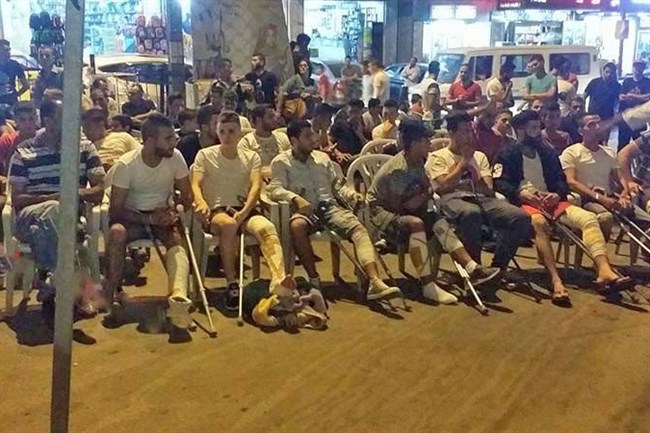
A file photo of a group of Palestinian youth after being treated for gunshot injuries by Israeli forces (Photo: BADIL)
Ma’an – August 26, 2016
BETHLEHEM – Two Palestinian youths were injured with live fire during clashes with Israeli soldiers in al-Duheisha refugee camp in southern Bethlehem early Friday morning, as reports emerged of an Israeli army commander making repeated threats in recent weeks to make “all youth in the camp disabled.”
Local sources said that two youths were shot and injured in the legs during clashes that erupted after Israeli forces raided the camp in Friday’s predawn hours.
Sources added that Israeli soldiers raided and searched the house of the incarcerated Palestinian Muhammad al-Seifi, detaining his mother and sister by locking them inside their home to pressure Muhammad’s younger brother Naba to turn himself into Israeli authorities.
Israeli forces also blew off the door of the Ibdaa Cultural Center near the entrance to the camp and occupied the rooftop of the building, from where Israeli snipers fired live ammunition and tear-gas canisters at local youth.
Violent clashes in al-Duheisha are common and break out nearly every time Israeli army forces enter the camp, which is located in Area A and should be under full Palestinian Authority control according to the Oslo agreements.
In a response to a request for comment, an Israeli army spokesperson told Ma’an that the Israeli army was not involved, and claimed Israeli border police were behind it, despite the area being located outside of police jurisdiction in Area A of the occupied West Bank.
When contacted by Ma’an, Israeli police spokesperson Micky Rosenfeld said he was not aware of the raid, saying it “made no sense” that police would be involved, and confirmed that al-Duheisha fell under the Israeli army’s jurisdiction in terms of raids. When contacted a second time, an Israeli army spokesperson insisted again that the army was not behind the raid and could not say who had been.
‘I will make all the youth of the camp disabled’
The clashes come in the wake of reports documented by BADIL, the Resource Center for Palestinian Residency and Refugee Rights, of an Israeli army commander making repeated threats during and after raids, and during interrogations, to disable all Palestinian youth in al-Duheisha.
The commander is reportedly responsible for the al-Duheisha area, and known to locals as “Captain Nidal.”
Local youth in al-Duheisha told BADIL that Captain Nidal has made statements such as: “I will make all the youth of the camp disabled,” “I will have all of you walking with crutches and in wheelchairs,” “I will make half of you disabled, and let the other half push the wheelchairs,” and “I will make all of you stand in line at the ATM waiting for your disability subsidies and assistance.”
One of the injured youth told BADIL that Captain Nidal told him to tell his friends that “Nidal will make all of you disabled.”
According to BADIL, which is based in Bethlehem, 30 Palestinians have been shot with live ammunition in the camp since the beginning of the year, the majority in their legs and knees.
They added that al-Duheisha had been raided at least three times by Israeli forces between the end of July and mid-August, during which time 18 Palestinian youth between 14 and 27 years old were shot in their legs — eight of which shot directly in the knee and several more in both legs — causing both permanent and temporary disabilities.
An Israeli army spokesperson could not immediately be reached for comment on the reports of the threats made by the commander.
“These threats indicate that these actions are not accidental or isolated incidents, but rather result from a systematic Israeli military policy aimed at suppressing resistance, terrorizing Palestinian youth, and permanently injuring them and/or causing significant damage to their physical and mental well-being,” BADIL said in their statement.
The reported threats come amid what BADIL called an intensification of the “systematic targeting” of Palestinian youth in the occupied Palestinian territory — particularly in refugee camps — since the beginning of 2016.
“This targeting has taken the form of injuries and arbitrary killings by the use of live ammunition by the Israeli army in the context of arrest campaigns, military raids, and random wide searches which usually trigger clashes,” the statement said.
BADIL’s statement also highlight a recent Israeli military incursion in the Hebron-area refugee camp al-Fawwar that lasted some 20-hours, during which an unarmed Palestinian teen was shot dead and dozens others were hospitalized.
“These cases of intentional wounding, when added to the comparable actions happening in refugee camps such as Aida, al-Arroub, Qalandia, Amari, and the West Bank at large, prove that these incidents amount to a systematic policy and an implementation of Captain Nidal’s threats.”
“These willful and grave breaches of international law trigger the obligations of third party states and other mandated agencies to put an end to this climate of impunity under which Israeli forces and its officials operate.”
BADIL’s collection of testimonies came as the latest report amid years of well documented cases of abuse and mistreatment of Palestinian children by Israeli forces in the occupied territory, including in East Jerusalem, which is under Israeli police jurisdiction.
On ceasefire anniversary, UN agencies urge end to Gaza’s ‘de-development spiral’
MEMO | August 26, 2016
UN agencies have urged an end to what they describe as the Gaza Strip’s “de-development spiral”, in a report marking the two-year anniversary of the ceasefire that ended ‘Operation Protective Edge’.
In a statement released Friday, 16 heads of United Nations agencies in Palestine call for the “uninterrupted and predictable flow of material and increased funding to address humanitarian needs and boost economic prospects for Gaza’s 1.9 million residents.”
In the report, UN agencies “document collective progress made in the last two years, as well as some of the remaining challenges in the recovery and reconstruction effort.” To date, “half of the homes which suffered partial damages and a third of destroyed homes have been rebuilt.”
Robert Piper, the UN Coordinator for Humanitarian Aid and Development Activities, warned that “repairing the damages from the 51-day hostilities cannot be our only measure of success, given that humanitarian and socio-economic indicators were already so dire before 2014.”
Piper added: “We must reverse Gaza’s de-development trajectory and address the needs of a population that has gone through three rounds of conflict, nine years of an Israeli blockade and the consequences of the Palestinian internal divide.”
The senior UN official emphasised that “addressing economic recovery requires much greater financial investments and serious policy changes, including a lifting of [Israeli-imposed] restrictions on both imports and exports.”
On October 2014, donors pledged US$ 3.5 billion to support Gaza. According to the World Bank, only an estimated 40 percent had been disbursed by April this year.
Bilal Kayed’s strike ends with agreement for his freedom; continued mobilization critical for fellow prisoners

Samidoun Palestinian Prisoner Solidarity Network – August 26, 2016
In a press conference held on Thursday morning, 25 August, Sahar Francis, the executive director of Addameer, confirmed that Bilal Kayed had ended his hunger strike after 71 days following the conclusion of an agreement with Israeli occupation prison administration that he will be released in December 2016, with no renewal of administrative detention.
In the press conference, joined by Kayed’s brother Mahmoud Kayed, as well as Prisoners’ Affairs Committee chair Issa Qaraqe and Osama al-Saadi of the Joint List, Francis noted that occupation security officials had earlier stated that they demanded Kayed be deported to Jordan for four years and noted their intention of keeping him in administrative detention for years. Kayed is held in the intensive care unit at Barzilai hospital and was moved there on 19 August as he refused to consume sugar or vitamin B1. He suffers from blurred vision, difficulty breathing and severe pain throughout his body. He will receive treatment until his condition improves considerably and he is returned to health.
Samidoun Palestinian Prisoner Solidarity Network salutes Bilal Kayed for his victory and achievement in the defense of Palestinian rights from the constant attempts of the Israeli occupation to expand, enlarge and intensify the scope of the imprisonment of Palestinian leaders and struggles. We extend our warmest congratulations to Bilal, his struggling family who were at the forefront of his support campaign, his lawyers and advocates with Addameer Prisoner Support and Human Rights Association and his fellow Palestinian prisoners who engaged in a series of collective hunger strikes within Israeli prisons. Kayed’s fellow prisoners of the Popular Front for the Liberation of Palestine were subject to isolation, the targeting of leaders Ahmad Sa’adat, Ahed Abu Ghoulmeh, Wael Jaghoub and Kamil Abu Hanish among others, excessive daily fines, harassment and assaults, and denial of family and legal visits. We salute the Palestinian people throughout occupied Palestine and in exile, including in the refugee camps of Lebanon, who repeatedly took the streets and mobilized in support of Kayed’s battle for freedom, directly confronting the occupation as well as the international institutions and states that refused to stand for justice for Palestinian prisoners.
Furthermore, Samidoun salutes all of the international activists, organizations and movements that came together to stand beside Bilal Kayed and beside the Palestinian people in this battle of freedom. From the outstanding efforts of the Irish movement for freedom for Bilal Kayed, to the ongoing and constant actions in New York City and Berlin, to the honorary citizenship granted to Bilal in Naples, to the organizers of the Black liberation movement who expressed their solidarity, to the organizers in the United States, Canada, Mexico, Venezuela, Brazil, Ecuador, Turkey, the UK, Ireland, Scotland, France, Belgium, the Netherlands, Germany, Switzerland, Italy, Spain, Greece, Portugal, Iceland, the Czech Republic, Finland, Austria, Norway, Sweden, Denmark, South Africa, Jordan, Lebanon, Tunisia, Algeria, Morocco, Bahrain and elsewhere who have mobilized in support of Bilal Kayed, international mobilization has escalated to new heights in support of the Palestinian prisoners in this struggle.
We urge the importance of continued mobilization and action in support of Palestinian prisoners, particularly the current hunger strikers, Mahmoud al-Balboul, on strike since 1 July; Mohammed al-Balboul, his brother, on strike since 4 July; and Ayed al-Herama and Malik al-Qadi, on strike since 14 July, all protesting administrative detention without charge or trial – and for continued mobilization in support of the action of all of the Palestinian prisoners, struggling for freedom from Israeli imprisonment, and for freedom and liberation for the Palestinian people throughout Palestine.
Defiant Celtic fans’ game changer for Palestine
By Yvonne Ridley | MEMO | August 23, 2016
Glasgow Celtic Football Club is arguably Scotland’s most famous and successful team, but rarely does it make headlines beyond the sports pages; until now. Celtic’s fans have demonstrated an unprecedented act of solidarity with the people of Palestine, and it is going viral.
What have the generous folk in Scotland done? Quite simply, in terms of peaceful civil rights movements, they have produced a “game changer” which will go on to have a profound effect on the future of the already powerful global Boycott, Divestment and Sanctions (BDS) campaign.
Thousands of ordinary Celtic fans picked up and waved Palestinian flags at their Celtic Park Stadium during a match against an Israeli team, as reported here in MEMO ; the flag-waving demonstration flew in the face of police advice. This simple but powerful act of mass defiance created a storm of media attention across the Middle East, which has now propelled Celtic alongside the likes of Real Madrid, Barcelona and Manchester United in terms of stature and popularity in the region.
Football’s European governing body, UEFA, warned that it would fine Celtic for its fans actions, but the fans retorted that they would match any fine imposed on the club, pound for pound, in donations to Palestinian causes. True to their word, the Green Brigade has raised nearly £100,000 in a crowdfunding appeal for Palestinian charities; the total continues to rise.
By way of showing their appreciation, Palestinians have come together to produce video messages like this one on social networks declaring, “We are all Celtic.”
In a statement, the Green Brigade explained that Celtic fans waved Palestinian flags at the Champions League match with Hapoel Beer Sheva on 17 August in an act of solidarity which “has earned our club respect and acclaim throughout the world. It has also attracted a disciplinary charge from UEFA, which deems the Palestinian flag to be an ‘illicit banner’.”
In response to what the group calls a “petty and politically partisan act” by UEFA, Celtic fans remain determined to make a positive contribution to the game. “We are today launching a campaign to #matchthefineforpalestine. We aim to raise £75,000 which will be split equally between Medical Aid for Palestinians (MAP) and the Lajee Centre, a Palestinian cultural centre in Aida Refugee Camp on the outskirts of Bethlehem. From our members’ experiences as volunteers in Palestine we know the huge importance of both organisations’ work and have developed close contacts with them.”
MAP has thanked the Celtic fans publicly on its website here and confirms that all funds will go to mending broken limbs in Gaza and other vitally important projects in the Occupied Palestinian Territories and refugee camps. Aida is one of 19 refugee camps in the occupied West Bank; it has for 66 years played temporary home to Palestinians expelled forcibly by Israel from their homes in Hebron and Jerusalem.
Aida’s residents live in the shadow of Israel’s apartheid wall, cut off from social and economic opportunities by the concrete monstrosity, neighbouring illegal Jewish settlements and military checkpoints. For the young people of the camp, the Lajee Centre at its heart offers hope and an escape from the realities of life under Israeli occupation. Its programme of arts, culture and sporting activities are a lifeline for its impoverished and oppressed people.
Last year, the centre built Aida’s only football pitch; previously, residents played on a recreation ground that has now been stolen by the snaking wall. Within months of opening, the new pitch was severely damaged by tear gas canisters fired onto it by Israeli soldiers. It is now protected by metal netting.
It is this sort of action by the Zionist State which football fans say should be tackled by the likes of UEFA and FIFA, football’s world governing body, by threatening Israel with expulsion from international football tournaments. Undeterred, however, and inspired by the fundraising actions of the Green Brigade, the centre says that it is going to form the camp’s first ever football club and name it Aida Celtic. The team will play in the Bethlehem Youth League at the start of 2017 and will host a tournament for teams from all of the West Bank’s refugee camps in spring next year. The donation from Glasgow Celtic fans will enable the Lajee management to buy a minibus for transporting players to matches and its other activities around Palestine.
“It will mean so much to our young people to be part of an official team, to have boots and strips and to represent the camp wearing the colours of our friends,” said Salah Ajarma, the Lajee Centre’s Coordinator. “Aida Celtic will be a source of pride for all in the camp.”
The crowdfunding target was originally £15,000, which was the amount of a previous fine imposed by UEFA on Celtic for a similar action by fans. That penalty did not deter the Celtic faithful. “If we were to allow an Israeli team to come to Celtic without any challenge to Israeli policies then that normalises Israel’s war crimes,” said a Green Brigade spokesperson.
Celtic Football Club insists that it will not comment on recent events until UEFA has concluded its disciplinary proceedings. In the meantime, Israeli police have warned that Palestinian flag-waving at the return leg of the match, at which 250 Celtic fans are expected to attend, “will not be tolerated” according to a Guardian newspaper report.
“This was very much home grown and very deep and very profound,” said Mick Napier, a co-founder of the Scottish Palestine Solidarity Campaign. “There are moments in a campaign where something burst outs into the public domain that was never imagined and has a huge effect. It was a mass public declaration that the injustices of the brutal Palestinian occupation will not be tolerated.” He described the protest at Celtic Park Stadium as hugely significant. “There aren’t very many democratic avenues for ordinary people to demonstrate this sort of huge public outpouring. What happened in the stadium that night cannot be ignored and will alarm the Israeli authorities and send out a clear message of support for the BDS movement.”
Napier pointed out that the primary task of protesting through BDS is to send a message to the beleaguered people of Palestine that they’re not alone. “You can put up with being in a prison if you know there’s real solidarity out there for you. This gesture from Celtic Park also shows Palestinians that there’s a huge gulf between our rulers and the ordinary people.” The actions of the Celtic fans, he added, will encourage and give support to the BDS movement at a time when supporters of Israel are trying to criminalise the entirely peaceful campaign. The generosity and solidarity of Glasgow Celtic fans is a game changer indeed.
“The Awful Clarity” of Israeli Oppression Becomes Murky Spin in the NYT

By Barbara Erickson | TimesWarp | August 22, 2016
When writer Michael Chabon visited the West Bank city of Hebron earlier this year, the brutal reality of the Israeli occupation hit him with force. During an interview with the Forward, he appeared “visibly jarred,” and he pulled no punches in describing his reaction.
“Once you see for yourself,” he said, “it is pretty obvious, I think, to any human being with a heart and a mind, it is pretty clear what to feel about it. It is the most grievous injustice I have ever seen in my life.”
His reaction echoes in the words of another author, Ben Ehrenreich, who recently published a book about the occupation, “The Way to the Spring: Life and Death in Palestine.” In his introduction Ehrenreich refers to “the awful clarity of the injustice,” and his book portrays Palestinian resistance under Israel’s state-sponsored system of oppression.
Both these American writers are saying that the suffering of Palestinians under Israeli rule is clear to see, an obvious truth to anyone who witnesses the situation firsthand.
Now, as Peter Baker, the latest New York Times Jerusalem bureau chief, takes up his post, we can ask whether the newspaper will begin to convey this reality to its readers. Will Baker, a fresh new witness with full access to the sites under occupation, give voice to the oppression seen with such clarity by Ehrenreich and Chabon?
Baker’s predecessor, Jodi Rudoren, who left Jerusalem late last year, filed hundreds of stories over nearly four years at the post and managed not to clarify but to obscure the reality of occupation and dispossession. Her stories promoted a narrative of Israeli victimhood and Palestinian violence and deflected Israeli culpability. (See TimesWarp 12-22-15.)
Many voices vied for attention during her stint, but Rudoren turned a deaf ear to some of the most respected sources of information, not only the United Nations and human rights organizations such as Amnesty International and Human Rights Watch but also Israeli monitoring groups and courageous Israeli journalists. These groups and individuals were constantly documenting and reporting abuses by the Israeli forces, but the news they bore rarely found even brief mention in the Times.
When a series of stabbing and vehicular attacks on Israelis began last fall, several monitoring groups issued alerts, charging that Israeli forces were using the situation to conduct “street executions” of Palestinians who actually posed no threat.
These accusations were bolstered by video and eyewitness evidence and came from groups such as the Israeli human rights organization B’Tselem, Amnesty International and Euro-Med Monitor. To give even more weight to their claims, a group of nine Israeli organizations, including Physicians for Human Rights and the Public Committee Against Torture, issued a joint statement saying Israeli officials were responsible for the climate that fostered these executions.
The Times took little notice. The newspaper’s headlines remained focused on Palestinian attacks, and any quotes about extrajudicial executions were attributed to Palestinian officials, as if these charges were nothing more than the opinions of partisans taking one side in a bitter exchange.
Anticipating Baker’s arrival in Jerusalem, the Times produced a video featuring him in conversation with Rudoren and another former Jerusalem bureau chief, James Bennet. The trio made many references to “the conflict” (with only a single mention of the occupation), and they insisted that Times reporting strives to be balanced and neutral.
If reporters were sincerely looking for balance, however, it would seem that truly neutral parties, such as the United Nations and human rights organizations, would provide an essential antidote to the partisan claims of two adversaries. Yet the Times turns a deaf ear to these sources, no matter how fully documented their findings are, and relies heavily on Israeli officials.
Thus, Times readers are left in ignorance, hearing almost nothing about urgent and repeated appeals from these non-partisan groups. Beyond the latest accusations of extrajudicial killings, for instance, rights organizations have consistently highlighted the mistreatment of Palestinian children held in Israeli custody and the demolition of Palestinian structures, including everything from homes and workshops to cisterns and animal shelters.
Organizations such as UNICEF, Defence for Children International, Save the Children, B’Tselem, Human Rights Watch, the UN Committee for the Rights of the Child and the Committee Against Torture in Israel have tried over several years to publicize the abuse of Palestinian children (See TW 1-13-14.), but the Times has rarely mentioned these reports and then only in stories aimed to spin the information in favor of Israel.
Throughout 2015 some of these groups continued to issue frequent reports and news releases with headlines such as “Rising physical violence against Palestinian child detainees,” “UNICEF report confirms ill-treatment of Palestinian child detainees remains systematic,” and “New U.S. government report highlights violations against Palestinian kids,” but the Times showed no interest in exploring the problem.
Likewise, Israel’s rampage of demolitions in the West Bank is never brought to the attention of Times readers although the United Nations, B’Tselem, Human Rights Watch and other groups have issued frequent statements and demands, urging Israel to end its policy of destruction.
While the Times has remained silent, Gideon Levy and Amira Hass, columnists for the Israeli newspaper Haaretz, have often written about the terrible toll demolitions have exacted from some of the most vulnerable Palestinian communities.
Rudoren wrote occasionally about punitive demolitions, the Israeli policy of destroying the family homes of attackers, but her stories omitted any mention of the much more common demolition of structures because they lack building permits, which are rarely issued.
The policy is a constant threat to Palestinians in a large part of the West Bank, and over the decades of occupation, the state has demolished more than 48,000 Palestinian homes and other structures.
According to the UN Office for the Coordination of Humanitarian Affairs, Israel has destroyed 726 Palestinian structures so far this year, displacing 1,020 people. In a recent report, OCHA noted that during one week this month, 42 structures were demolished or confiscated. The report stated, “Twelve of the targeted structures had been previously provided as humanitarian assistance, including emergency shelters, animal sheds, latrines, a community centre, and a water connection; the confiscation of the latter means that nearly 1,000 Palestinians in five herding communities in the Jordan Valley will continue to suffer water scarcity.”
The OCHA report continued, “This brings the number of assistance items destroyed or confiscated since the start of 2016 to 200, almost double the figure for the entire 2015 (108).” In other words, donors such as the European Union and International Committee of the Red Cross have stepped in to provide tents and other items when Israel has destroyed Palestinian homes, schools, playgrounds, water wells and other structures, but the Israeli authorities have demolished even this humanitarian aid.
In this brief report from OCHA “the awful clarity of the injustice” is evident, as it has been evident in hundreds of other reports issued over the years. The rising tide of demolitions, with all its human-interest value, is most certainly newsworthy, but will the Jerusalem bureau of The New York Times report it?
So far the Times seems determined to muddy the waters, avoiding a clear exposition of Israeli brutality, but with a new bureau chief now on board, some readers may hold out a faint hope for change, for an honest and full accounting at last.
Unfortunately, here at TimesWarp, the expectation is for more of the same. It seems unlikely that the Times would allow any straightforward reporting on Israeli oppression to appear in its pages. This would destroy its carefully fostered narrative of Israeli victimhood, “ancient hatreds” and the need to place Israeli security needs above all.
Samidoun international coordinator denied entry to Palestine, interrogated about BDS and prisoner solidarity
Samidoun Palestinian Prisoner Solidarity Network – August 22, 2016
Samidoun Palestinian Prisoner Solidarity Network international coordinator Charlotte Kates was denied entry to Palestine at the King Hussein Bridge crossing from Jordan to occupied Palestine on Monday, 15 August, as she attempted to join a delegation of European parliamentarians and lawyers in support of Bilal Kayed and the Palestinian prisoners. Kayed, 34, has been on hunger strike for 69 days against his administrative detention without charge or trial; nearly 100 fellow prisoners have joined his strike against his imprisonment, imposed upon him immediately following his completion of a 14.5-year sentence in Israeli prisons.
When Kates presented her U.S. passport at the passport control line, it was taken from her and she was told to wait for further questioning. Along with multiple other travelers to Palestine and, especially, Palestinians holding international passports as well as those holding PA passports, she waited for hours at the bridge for a period interspersed with interrogations about her purpose in the country and participation in Palestine prisoner solidarity and BDS activism.
“I was asked about the websites I maintain, asked to allow the interrogator to access my email conversation with others, and asked to write up lists of names of people I know in Lebanon and in Palestine and lists of organizations with which I work. The interrogator attempted to look through my phone to find my contacts and to seek out WhatsApp chats and repeatedly demanded that I log in to my email or social media accounts and allow her access. As my phone was completely clear of any contact information and I refused to access any accounts or provide lists of names, this became a ‘reason’ to deny me entry. However, other travelers at the bridge were also subject to these searches and questioned about their personal photos and WhatsApp chats. In particular, people were questioned about wearing hijab in photos or being in contact with visibly Arab or Muslim friends,” said Kates.
“I was interrogated about my involvement with Samidoun and organizing around Palestinian political prisoners, and whether my visit to Palestine had anything to do with Bilal Kayed in particular, clearly a matter of concern to the Israeli interrogator,” said Kates. “Furthermore, in light of the recent announcements regarding ‘crackdowns’ on BDS activists entering Palestine, I was specifically interrogated regarding speeches and lectures I have given regarding boycott, divestment and sanctions against Israel, support for the BDS call and involvement with Israeli Apartheid Week.”
“This was not about personally targeting me; it was an attempt to target the growing international solidarity movement to support Palestinian prisoners and the Palestinian people’s liberation struggle, and an attempt to further isolate Palestinian prisoners from the people of the world,” Kates said. “Furthermore, my experience of prolonged interrogation and being held for hours at the bridge pales next to the experience of Palestinians being denied their basic right to enter their own homeland – part and parcel of the denial of the fundamental right of return – and subject to harsh interrogation, being deported for carrying international passports, and being subjected to cruel and degrading treatment at the border.”
“During just my own time at the bridge, I encountered numerous Palestinians facing enormous delays and aggressive interrogation, Palestinians denied entry to their own homeland, and Palestinians presented with ‘limited-access’ entry permits prohibiting them from visiting Jerusalem. I encountered a family from Gaza who had one of the rare permits to exit via Erez/Beit Hanoun and then the bridge to Jordan to see family members. As they had studied in the US and UK, they were questioned by border guards as to why they wished to return to Gaza at all, rather than staying in another country. Border control and interrogation is part and parcel of the system of Israeli colonization and dispossession separating Palestinians from their land and seeking to force even more Palestinians outside their homeland. It is part of the same system that denies millions of Palestinians their right to return and attempts to continue the Nakba on an ongoing basis,” said Kates.
“At the same time, I also witnessed numerous holders of international passports singled out for their names, visibly Muslim or Arab appearance, or travels to Arab countries, and subject to degrading and offensive interrogations regarding their religion and personal relationships,” Kates noted. … Full article
Casuistry
By Thomas S. Harrington | CounterPunch | August 19, 2016
Casuistry, which one dictionary defines as “specious, deceptive, or oversubtle reasoning, especially in questions of morality” is, rightly or wrongly, inextricably linked to the history of Jesuit order of the Catholic Church. And the rise of the Jesuit order is deeply enmeshed with the Counter-Reformation, a set of measures designed to roll back the spread of Protestantism in Europe during the late 16th and early 17th centuries. The control center of the movement was Spain, the world-striding superpower of that historical moment.
Rightfully fearful that Protestantism’s rejection of long-standing modes of clerical privilege and the Church’s “right” to collect vast sums of money from parishioners would undermine their ability to bully and bribe Italian, French, Dutch and German potentates into compliance with their political demands, the Spanish Monarchy undertook an endless series of military adventures against “heretics” across the Continent in the years between 1530 and 1648. This military thrust was accompanied by a well-organized propaganda campaign in which the highly educated Jesuits priests played a crucial role.
Appearing morally and intellectually reasonable while serving as a convinced advocate for the systematic subjugation of other people and their animating ideals is not a simple task. In the long run it is, in fact, an impossible one. No amount of argument can convince a person or group of persons who see them selves as suffering under the boot of another that their bondage is a good and necessary thing. What such a rhetorical posture can do, for a time at least, is convince the subjects of the hegemonic country of, if not the inherent nobility of their bloody mission, its generally benign nature.
A key, if generally unstated, goal of the 16th and 17th century Jesuits was to insure that the highly problematic matter of Rome’s corruption, and the brutal Imperial designs of the Spanish monarchy that lay behind it, never be allowed to occupy the center zone of what then passed for “public” discourse.
When confronted by the emergent Protestant movements about the clear violations of Christian morality practiced by the Church of Rome, they responded with complex disquisitions on the largely circumstantial nature of all moral reasoning. By constantly parsing the intricacies of how overarching moral rules should, or should not, be applied in each particular circumstance (and teaching others to do the same), they very effectively prevented the emergence within the Church, and by extension in the leadership class of the Spanish Empire, of a frank discussion of the quite real and deeply-felt grievances of their many enemies.
I am reminded of all this when I read or watch the news after every so-called “terrorist” attack against a US or European target. Within minutes of the violence, mainstream journalists, begin intense speculation about what particular ethnic group the assailant came from, how he or she became “radicalized” (as if the desire to kill was akin to some sort of contagious moral flu) and whether the “West’s” latest stand-in for PURE EVIL™ (e.g. Al-Qaeda, ISIS, ISIL) was behind the act.
What will almost never be talked about are the many very good reasons a person from the vast region stretching from Morrocco in the west, to Pakistan in the east, have to be very angry at, and to feel highly vengeful toward, the US, its strategic puppeteer Israel, and their slavishly loyal European compadres like France, Germany and Great Britain.
There is never any talk of that group of august “democracies” long-standing penchant for implanting, then staunchly supporting, ruthless and deeply corrupt regimes in that region.
No talk of the very long Algerian experience of French colonialism, nor the US and French- backed coup of that country’s government in 1992 which led to a civil war that left 200,000 people dead.
No talk of the coup against the legally elected president of Egypt in 2013, nor the cold-blooded massacres carried out by his US-backed successor upon hundreds of that same president’s followers.
No talk of the decision of the US to back elements of ISIS in order to cynically extend a Syrian Civil War that was on its way to peace—albeit an imperfect one—by means of a Syrian government victory by late 2013.
No talk of the planned destruction of Libya in 2011 and its enormous effects on the stability of life in that once wealthy country as well as all of northern Africa.
No talk of the US-Israeli nullification of the results of the Palestinian elections of 2006, Israel’s coldly planned siege of Gaza nor the “shoot-fish-in-a barrel” assaults on that benighted enclave by Israel in 2006, 2008, 2012 and 2014.
No talk of the ongoing Saudi—and therefore US-approved—war on Yemen, nor the ruthless Saudi march on Bahrain in 2011 in which several dozen people died and thousands of democracy activists were tortured and/or carted off to prison.
No talk of the 18-year Israeli—and therefore, US-backed—occupation of Southern Lebanon nor Israel’s 1993, 1996 and 2006 assaults upon that same country.
Oops, I almost forgot. There is no talk of the small matter the calculated US destruction of Iraq, pre-invasion Libya’s rival as the Arab world’s most wealthy and socially progressive state.
But hey, why talk about all that off-putting stuff when you can boil it all down to neat tales of personal ideological contamination, Svengali-like recruiters lurking in mosques, and that old standby, the development of an urgent need to bang virgins in the hereafter.
It seems the media believes that the delicate imperial mind must be left free from understanding the effects of the actions for which it regularly cheers and prays.
The best way to insure this? Casuistry, as the old saying goes, “Pure casuistry”.
Thomas S. Harrington is a professor of Iberian Studies at Trinity College in Hartford, Connecticut and the author of the recently released Livin’ la Vida Barroca: American Culture in a Time of Imperial Orthodoxies.
Palestinian women prisoners to launch protests against mistreatment of family visitors

Samidoun Palestinian Prisoner Solidarity Network – August 20, 2016
Palestinian women prisoners are declaring their intention to launch a series of protests over mistreatment of their relatives during family visits, Ma’an News reported on Thursday. In particular, Riyad al-Ashqar of the Palestinian Prisoners’ Center for Studies noted that family visits are frequently denied, cut short or delayed and visitors forced to undergo strip searches.
Lena Jarbouni, the elected representative of the 42 women held in HaSharon prison, stated that the women will protest so long as their families continue to experience lengthy waits in the sun, humiliating strip searches, repeatedly altered visitation schedules and prohibition of clothing for the prisoners and other necessary items. Several women prisoners, including Ansam Shawahneh, 19, have been completely denied family visits. There are currently approximately 60 Palestinian women held in HaSharon and Damon prisons.
On Thursday, Ofer Military Court ordered Taghreed al-Faqih, 44, from Dura near al-Khalil, imprisoned for two months and fined 5000 NIS (approximately $1100 USD) for “incitement.” Al-Faqih, the sister of Mohammed al-Faqih, extrajudicially executed by Israeli forces who bulldozed and fired a missile into his home, was arrested after her brother’s killing on 12 July 2016.
On Monday, 15 August, Randa Ahati of al-Khalil was released on bail to house imprisonment in her home in Yatta until her next court date. A former prisoner held for nearly four years in Israeli prison, she was arrested by occupation forces while traveling between Bethlehem and al-Khalil.
Sana Abdelrahman Nayef Abu Sneineh, 24, from Dura near al-Khalil, was released on 15 August after six months in administrative detention. She was arrested on 17 February by Israeli occupation soldiers invading her home in a pre-dawn raid, accusing her of posting “inciting” material on Facebook. She was ordered to three months’ administrative detention without charge or trial, which was then renewed for an additional three months.
Two women remain in administrative detention without charge or trial, among nearly 750 Palestinians in total: Sabah Feroun, imprisoned since 19 June after an invasion of her Jerusalem home by Israeli occupation forces and ordered to six months in administrative detention, and Haneen Abdelqader Amer, 39, from Tulkarem, imprisoned since 27 March and accused of “incitement” on social media but ordered imprisoned without charge or trial.
Featured Video

When Israel Is Mighty
or go to
Aletho News Archives – Video-Images
From the Archives
US murdering 1 million Iraqis is democracy, Iran giving yogurt to Iraq is “domination”
By Ali Salaam | American Herald Tribune | July 31, 2017
The New York Times, owned by the Zionist Jewish supremacist Ochs-Sulzberger family, has no problem with Iraqi suffering as long as Iran is not the one behind it.
The Iraq War was a genocide of the Iraqi people by Zionist supremacists in the Bush administration. Over 1 million innocent people were killed based on a lie. American soldiers died in an Israeli war and now an average of 22 soldiers commit suicide every day because their consciences cannot cope with the fact they committed crimes in an illegal war that served no purpose other than to benefit Israel, not America.
Benjamin Netanyahu, Prime Minister of the Zionist regime, once said “We are benefiting from one thing, and that is the attack on the Twin Towers and Pentagon, and the American struggle in Iraq.”
Paul Wolfowitz had his sights on Iraq since his time in the first Bush administration. Former Israeli official and Bush administration official Richard Perle had his eyes on Iraq since at least his authorship of the Clean Break white paper. The Zionist regime had their eyes on Iraq since the 1980s when strategist Oded Yinon wrote his white paper in support of dividing the Arab-Muslim world along ethnic and sectarian lines. The global Zionist lobby has had their eyes on Iraq since Theodor Herzl stated that Eretz Israel’s true borders go from the Nile River in Egypt to the Euphrates River in Iraq. … continue
Blog Roll
 Aletho News
- MEP blasts ‘Euro-Gestapo’ for lecturing Russia on democracy
- Syria May Send Troops to Saudi Arabia Amid War with Ansar Allah
- UK whines about losing billions to ‘Putin tax’
- Baghaei to Rubio: Distorted narratives cannot erase US record of broken commitments
- Houthis Don’t Have to Conquer Saudi Arabia to Make It Pay
- MOE: Nearly 22,000 Students and Education Workers Killed
- Guterres in Islamabad: Genocide, cowardice, and the cage of Imran Khan
- Johnson, Marandi say Yemen holds upper hand over Saudi Arabia
- False flags won’t save aggressors, Iran FM spokesman says
- The Makkah Pact Enters Into Force: The End of American Dominance or Its New Form?
- If Americans Knew
- Israel puts Gaza’s sick, injured, newborn in peril – Daily Update
- Report claimed Mark Levin used by Israeli government to influence Trump
- Over 2,000 Gazans have died awaiting medical evacuation amid Israel’s continued siege
- How a U.S. Diplomat Suppressed and Altered Reports Critical of Israel
- 5 Palestinians Die from Israeli Strikes in Gaza as Relentless Attacks Continue
- Report: Ceasefire Slows Killing but Leaves Devastation Intact
- Country Music Singer Zach Bryan Breaks Attendance Record at Robert Kraft’s Gillette Stadium While Wearing ‘Free Palestine’ Shirt for Second Night in a Row
- Three years of death and devastation: Israel’s war on Gaza in pictures
- Why Hamas believed the status quo was more dangerous than its 7 October gamble
- Debunking Israel’s latest list of ‘terrorist’ journalists in Gaza
- No Tricks Zone
- New Study: 50 Years Of The Most Aggressive ‘Net Zero’ Policies Can Only Affect The Global Climate By 0.03°C
- US September “Heat” Was No Record…Many Records Set Decades Ago
- Latest European Green Energy Debacle; Portugal’s Largest Flagship Solar Park Insolvent!
- Green Energy Debacle: German Expert Professor Fritz Vahrenholt Warns Of Severe Economic And Social Consequences
- Two More Paleo Reconstructions Affirm Meters-Higher Sea Levels Across Ireland, Brazil 7000-6000 Years Ago
- New Study: Earth And Venus Surface Warmth Largely Explained By Convection And Lapse Rate, Not CO2 Or Radiation
- 2025 Nature Paper Claiming Worsening Global Drought Gets RETRACTED …Heavily Flawed
- New Study: ‘Global Drought Shows No Detectable Recent Acceleration Under Climate Warming’
- Economic Masterminds: German Socialists Suggest Taxing Productivity Gains Stemming From Using AI
- The South China Sea Has Not Been Cooperating With The Climate Change Narrative

