Israeli Media: 20% of Russian Jews left Israel for Canada
Palestinian Information Center – April 19, 2016
OCCUPIED JERUSALEM – Israeli TV Channel Ten revealed that the emigration rate of Jews who came from Russia to Israel in the 1990s has recently escalated.
The Israeli channel also revealed that one fifth of an estimated one million Russian Jews have migrated to Canada because they felt that they did not belong in Israel.
The channel pointed out that 15% of total migrants to Israel in the 1990s had actually left it for the same reasons and used TV interviews with some cases as evidence.
Hebrew reports further revealed that Jewish migrants from the former Soviet Union suffered from discrimination policy by the western Jews and their successive governments.
Israeli court sentences Sheikh Raed Salah to nine months in prison
MEMO | April 19, 2016
 The Israeli Supreme Court has sentenced Sheikh Raed Salah, head of the Northern Branch of the Islamic Movement, to nine months in prison over charges of “inciting violence” in a religious sermon dating back to 2007, Anadolu reported on Monday.
The Israeli District Court in Jerusalem sentenced Sheikh Salah to 11 months in prison, giving him permission to appeal to the Supreme Court, which reduced the sentence to nine months.
Deputy Head of the Islamic Movement in Israel, which was banned in November last year, Sheikh Kamal al-Khatib condemned the ruling against Sheikh Salah, describing it as “absolutely political” and aimed at keeping him far from Jerusalem and Al-Aqsa Mosque.
On 16 February 2007, Salah delivered a sermon in Wadi al-Juz in the Old City of Jerusalem. Over remarks in that sermon, the Israeli court charged him with “inciting violence” and “inciting hatred”.
In March 2014, the Magistrate Court charged Sheikh Salah with “inciting violence” over this sermon, but acquitted him of “inciting hatred” and sentenced him to eight months.
Then, the District Court called for charging him with “inciting hatred” and to sentence him to 18 to 40 months. In October 2015, it sentenced him to 11 months, giving him the permission to appeal to the Supreme Court.
Palestinian youth and students among 11 raided and arrested by Israeli occupation forces
Samidoun Palestinian Prisoners Solidarity Network | April 19, 2016
 Israeli occupation soldiers arrested 11 Palestinians in dawn raids on Tuesday, 19 April, focusing on students and youth. Three students at Al-Quds University’s Abu Dis campus – Noor al-Islam Darwish, Hala Beitar and Salam Abu Sharar, all women – were raided and arrested in Ramallah.
Majd Yousef Atwan, 22, from al-Khader near Bethlehem, a recent beauty school graduate, was arrested in a 2:00 am army raid on her home; her father said that she was being accused of “incitement for Facebook postings.”
Many students and youth have been arrested by Israeli occupation forces in the run-up to Palestinian campus elections; while many Palestinians are being persecuted for Facebook posts, including poetry.
Murad Mohammed Taqatqa and Walid Issa Taqatqa of Beit Fajar near Bethlehem were also arrested by occupation forces, as was Abdel-Rahim Mahmoud Awad from Beit Awwa near al-Khalil. Ahmed Nidal Awel, 20, and Ayman Farouk Barham, 35, were arrested by Israeli occupation forces in Kufr Qaddoum.
In Al-Ram, north of Jerusalem, the Israeli forces shot a 15-year-old boy in the leg at the entrance to the village as they invaded it; Palestinian Red Crescent medics reported they were prevented from accessing the boy to provide medical care and that he was then arrested by the occupation forces. Another al-Ram resident was also arrested.
‘Fake Jewish graves in Muslim cemeteries’: UNESCO slams Israeli occupation of Palestinian sites
RT | April 18, 2016
The Israeli authorities are furious after a UNESCO resolution stated that the Temple Mount and holy sites in Hebron and Bethlehem are an “integral part of Palestine.” The organization also criticized Israel, “the occupying power,” for planting fake graves in Muslim cemeteries.
Two tourist destinations, the Cave of the Patriarchs in the heart of the old city of Hebron and Rachel’s Tomb in Bethlehem, are named in the paper as “Palestinian sites.” The draft decision by the UNESCO executive board on occupied Palestine was released April 11.
UNESCO “reaffirms that the two concerned sites located in… Hebron and in Bethlehem are an integral part of Palestine” and “disapproves the ongoing Israeli illegal excavations, works, construction of private roads for settlers and a separation wall inside the Old City of… Hebron, that harmfully affect the integrity of the site,” the statement says.
UNESCO slammed Israeli attacks on Muslims in the Temple Mount, which it only refers to by its Arabic name, Al-Haram Al-Sharif, and its holy site, Al-Aqsa Mosque.
The organization “strongly condemns the Israeli aggressions and illegal measures against the freedom of worship and Muslims’ access to their Holy Site Al-Aqsa Mosque/Al-Haram Al Sharif, and requests Israel, the Occupying Power, to respect the historic Status Quo and to immediately stop these measures,” the statement says.
Al-Aqsa Mosque became the flashpoint for bloodshed in 2015, amid mounting tensions over the holy site, sacred to both Muslims and Jews.
UNESCO called on Israel to stop “banning Muslims from burying their dead in some spaces and by planting Jewish fake graves in other spaces of the Muslim cemeteries.”
The group also criticized “the continuous Israeli blockade of the Gaza Strip,” which causes an “intolerable number of casualties among Palestinian children,” as well as “the attacks on schools and other educational and cultural facilities and the denial of access to education.”
Israeli authorities have reacted with anger to the UNESCO document.
“This is yet another absurd UN decision,” Prime Minister Benjamin Netanyahu said, as cited by Israeli media.
“UNESCO ignores the unique historic connection of Judaism to the Temple Mount, where the two temples stood for a thousand years and to which every Jew in the world has prayed for thousands of years. The UN is rewriting a basic part of human history and has again proven that there is no low to which it will not stoop,” he added.
This is not the first UNESCO resolution that condemns Israel for aggression at holy sites in Jerusalem and the West Bank. In October 2015 the group issued a document which censured Israel for limiting Muslim access to Jerusalem’s Al-Aqsa Mosque compound and reaffirmed that the Cave of the Patriarchs in Hebron and Rachel’s Tomb in Bethlehem are Palestinian sites.
The document was passed by 26 votes to six – those against being the US, the UK, Germany, the Netherlands, the Czech Republic and Estonia.
Palestinian Prisoners Day Statement: In Struggle, Towards Liberation
Samidoun Palestinian Prisoner Solidarity Network – April 17, 2016

On 17 April, Palestinian Prisoners’ Day, Samidoun Palestinian Prisoner Solidarity Network salutes the struggle of 7,000 Palestinian prisoners inside Israeli jails: struggling for not only their own freedom, but for the freedom of the land and people of Palestine. Palestinian prisoners struggle through torture, solitary confinement, abuse, repression, denial of family visits, arbitrary imprisonment and brutal racism on a daily basis. Yet they not only persist and exemplify “samidoun” – those who are steadfast – the Palestinian prisoners are leaders of the Palestinian liberation movement, and of the global struggle for justice and liberation.
Each year, on 17 April, in Palestine and around the world, Palestinians and supporters of justice in Palestine come together to review the situation of Palestinian prisoners and demand their freedom. It is an opportunity to renew our work and our activity to free Palestinian prisoners, and to examine the last year of struggle, inside and outside the prison walls.
Imprisonment has always been a weapon of colonialism in Palestine. From the British colonizers who suppressed Palestinian revolts through mass imprisonment, home demolitions, and execution – and who first imposed the “emergency law” of administrative detention used against Palestinians today – to the Zionist colonizers who for 68 years have imposed a system of occupation, apartheid, criminalization, racism and dispossession upon the Palestinian people, the colonizers of Palestine have imprisoned strugglers, leaders, fighters, and visionaries. Imprisonment targets all sectors of the Palestinian people: workers, strugglers, teachers, journalists, doctors and health workers, farmers, fishers; from Jerusalem, the West Bank, the Gaza Strip, Occupied Palestine ’48; refugees in the camps inside Palestine and around the world – millions denied their right to return and yet pursued and imprisoned in international jails.
In the past year, as throughout this history of struggle, we have witnessed time and again the resilience, resistance and struggle of Palestinian prisoners. It is not only the case that thousands of Palestinians have been jailed since October 2015 in an attempt to stop the rising intifada in the streets and villages of Palestine; it is also the case that Palestinian prisoners are engaged in daily intifada, daily resistance, behind the prison walls. They are part of the struggle – indeed, leaders in the struggle – confronting occupation, colonialism, settlements, home demolition, land confiscation and extrajudicial executions.
From Palestinian lawyer Muhammad Allan, to Palestinian journalist Mohammed al-Qeeq, to baker and resistor Khader Adnan, to the strugglers of the “Battle of Breaking the Chains” – Nidal Abu Aker, Ghassan Zawahreh, Shadi Ma’ali, Munir Abu Sharar and Badr al-Ruzza – Palestinian prisoners have put their bodies on the line in hunger strikes, demanding not only their own freedom but an end to the system of administrative detention without charge or trial that currently holds approximately 700 Palestinians in Israeli prisons. Today, Sami Janazrah, Fouad Assi, and Adib Mafarjah are on hunger strike against administrative detention. Eyad Fawaghra is refusing food, demanding an end to the denial of family visits. Shukri Khawaja is demanding an end to solitary confinement, joined by up to 88 other Palestinian prisoners expressing their solidarity in daily hunger strikes.
Today, 17 April, thousands of Palestinian prisoners are refusing food in a one-day hunger strike in support of prisoners in Nafha subject to violent attacks by Israeli occupation prison guards and special forces on 14 April. Throughout the prisons of the south, prisoners have joined across political lines in rejection of the violent raids that are a constant of Palestinian prisoner life in Israeli jails.
Statistics: Israeli jails hold approximately 7,000 Palestinian prisoners. These include over 400 children and 70 women prisoners, held in 22 prisons and interrogation centers. There have been 4,800 arrests since October 2015, including 1,400 children and minor teens. Approximately 700 Palestinians are held in administrative detention without charge or trial.
Women Prisoners: The number of women prisoners is now 68, including 17 girls under 18. Imprisoned in Hasharon and Damon prisons, injured women prisoners are being denied access to needed medical services and are instead supported by their fellow prisoners. The longest-serving woman prisoner, Lena Jarbouni, has been imprisoned since 2001. The youngest girl prisoner, Dima al-Wawi, is 12 years old. Khalida Jarrar. Palestinian parliamentarian, leftist and prisoner advocate, serving a 15-month sentence, is also among the women prisoners at Hasharon.
Administrative Detainees: Approximately 700 Palestinians are imprisoned without charge or trial under administrative detention by Israeli military order. Administrative detention orders are issued on the basis of secret evidence hidden from both the detainee and their lawyer. These orders are indefinitely renewable and are often renewed repeatedly over years.
Sick and ill prisoners: Over 1,700 sick prisoners inside Israeli jails suffer from various diseases, worsened by ill treatment, delay and denial of medical care, and dismissal of medical issues. Dozens of Palestinian prisoners suffer from serious diseases, including cancer, heart disease, kidney disease, rheumatoid arthritis, stomach ulcers and high blood pressure. There are 24 prisoners with cancer in Israeli prisons, and 23 Palestinians permanently confined in the Ramle Prison Clinic, infamous among Palestinian prisoners for its poor treatment. Some of them are unable to move from their hospital beds. Despite severe illness, they are consistently denied medical release or access to private physicians.
Child Prisoners: Over 400 Palestinians under 18 are imprisoned. Many are arrested in traumatic and violent night-time military raids on their homes, and Palestinian child detainees report very high levels of physical and psychological abuse and torture. Six children are held in administrative detention. Several Palestinian children between the ages of 12 and 14 are imprisoned in Israeli jails. Recent reports from Defence for Children International Palestine and Human Rights Watch highlight the abuse of Palestinian children in Israeli detention, interrogation and imprisonment.
Former Prisoners, Re-Arrests and Pursuit: Former prisoners, including over 70 released in the 2011 Wafa al-Ahrar prisoner exchange for captured Israeli soldier Gilad Shalit, are pursued for renewed arrest and imprisonment. Under Israeli Military Order 1651, released prisoners in an exchange face the reimposition of their original sentence at any time on the basis of “secret evidence.” As in administrative detention cases, Palestinian prisoners and their lawyers are denied access to this evidence, which can include allegations such as “association” or “support” for a “prohibited organization,” a category which includes all major Palestinian political parties. 47 former prisoners have seen their sentences reimposed under this order. The targeting of former prisoners does not only happen inside Palestine. The pursuit, attempt to extradite, and killing of Omar Nayef Zayed in the Palestinian Embassy in Sofia, Bulgaria emphasizes the global nature of this targeting. Rasmea Odeh, Palestinian community leader in the United States, is threatened with imprisonment and deportation on the basis of her imprisonment – and torture – by Israeli forces in the 1960s and 1970s.
Torture is a constant reality of Israeli occupation arrest, detention and interrogation of Palestinians, including beatings, psychological torture, threats and insults, including threats of sexual abuse and violence and threats to family members; forced stress positions and shackling; sleep deprivation; long-term solitary confinement and isolation.
Palestinians are facing ongoing and increasing attacks. The extrajudicial execution of Palestinians under the control of Israeli occupation soldiers – including but not limited to the filmed and photographed executions of Abdelfattah Al Sharif and Hadeel al Hashlamoun – are a new attack on Palestinians that is part and parcel of the same system of terror and repression that carries out mass arrests and violent dawn raids on Palestinian homes. This comes alongside the ongoing imprisonment of the bodies of Palestinians killed by Israeli occupation soldiers. Some Palestinian corpses have been held for over 30 years. Today, the Israeli occupation forces continue to withhold 15 bodies of Palestinians. Nearly every week brings news of a new racist and repressive law being considered or enacted by the Israeli occupation: the “Law to Prevent Harm Caused by Hunger Strikers” permitting forced feeding; lengthy sentences for stone throwing; the imprisonment of 12-year-old Palestinians; threats to execute Palestinian prisoners.
The imprisonment of Palestinians is a collective attack on the Palestinian people and their struggle for liberation. These are not individual cases, but part of the comprehensive attempt of a colonial power to erase and suppress the indigenous Palestinian people and their collective struggle. We see this in the criminalization of Palestinian political parties, all declared “prohibited” by military order, and the military courts and trials that convict Palestinians at a rate of over 99% on the basis of these military orders that govern occupied Palestine. We see this in the targeting of Palestinian student organizers and leaders like Abdullah Ramadan, Asmaa Qadah and Donya Musleh, the ransacking of student blocs’ offices and the attempt to disrupt the vibrant political life of Palestinian students on campuses. We see this in the increased threats of arrests or denial of residence made against Palestinian BDS organizers and activists building the international movement for boycott, divestment and sanctions against Israel. And we see this, of course, in the imprisonment of Palestinian political leaders like Ahmad Sa’adat, General Secretary of the Popular Front for the Liberation of Palestine; Marwan Barghouthi, Fateh leader; Khalida Jarrar, Palestinian parliamentarian and prisoners’ advocate; Hassan Yousef, Hamas leader and Palestinian Legislative Council member; and the countless local leaders targeted for administrative detention and military trials.
We see this in the imprisonment of over 18 Palestinian journalists – 43 in the past six months – and the forced closure of Palestinian TV and radio stations, and in the targeting of Palestinian researchers and human rights defenders like Eteraf Rimawi of Bisan Center, and also in the administrative detention of teachers like circus trainer Mohammed Abu Sakha, 24, who combined Palestinian identity with circus performance as he taught numerous Palestinian children.
We also see the targeting and imprisonment of Palestinians and strugglers for Palestine in international courts and prisons. Georges Ibrahim Abdallah, Lebanese Arab communist struggler for Palestine, has been imprisoned in French jails for 32 years, despite being eligible for release for 16 years. Hillary Clinton – today a US presidential candidate – personally intervened to pressure the French state to overturn its own judiciary to keep him imprisoned. The interior minister who agreed to do so, Manuel Valls, today threatens and supports the prosecution of dozens of Palestine solidarity activists across France for calling for boycott, divestment and sanctions against the Israeli state for its ongoing crimes against Palestinians. In the United States, the Holy Land Five are serving lengthy sentences for fundraising for charity for Palestinians among the Palestinian community. Rasmea Odeh, torture survivor and community leader, is facing imprisonment and deportation because of her time in Israeli prisons. Omar Nayef Zayed was pursued in Bulgaria for extradition and renewed imprisonment over 25 years after he escaped Israeli prisons, only to be found dead inside the Palestinian Embassy in Sofia, where he had taken refuge, on 26 February.
Towards Liberation
Just as imprisonment is a collective experience, the resistance struggle for the liberation of the prisoners is also collective. As the Palestinian Human Rights Organizations Council noted in their statement for Palestinian Prisoners’ Day, “The issues of prisoners transcends one of individual human rights; it is also one of collective rights of an entire people – the Palestinian people, who continue to be deprived of the right to self-determination and sovereignty.”
And so the struggle to liberate Palestinian prisoners – and all political prisoners – is not simply a struggle for an individual human right, but for collective liberation from occupation, apartheid and settler colonialism. This is one reason why this struggle finds such resonance with other struggles for justice and liberation, linked in collective confrontation of oppression, imperialism, settler colonialism, Zionism and racism.
The movement to boycott G4S, the British-Danish security conglomerate that provides security systems, equipment and control rooms for Israeli prisons, checkpoints and police training centers – and youth imprisonment, migrant detention and deportation contracts in the US, UK and Australia – has grown even more in the past year. Palestinian prisoners and Palestinian civil society organizations joined with hundreds of international organizations to demand the UN stop doing business with G4S, a demand that has achieved clear victories in Jordan and elsewhere. In the United States, prison divestment movements challenging the mass incarceration of Black youth and other oppressed communities in the US have won divestment from G4S and the cancellation of its contracts at multiple universities. Indeed, the collective movements against G4S have garnered so much strength that the corporation announced that it would be selling off its Israeli subsidiary and exiting other “reputationally damaging” industries like youth incarceration in the US and UK within the next one to two years. At the same time, on a daily basis, G4S and its “security” technology continue to contribute to the insecurity and oppression of Palestinians and other oppressed people. The struggle to boycott G4S must continue until it is out of occupied Palestine and the prison business.
Palestinian prisoners called for “the inclusion of our cause, as prisoners of freedom and fighters for the freedom of our people, human dignity, and the right to a dignified life, within the program of the boycott movement as a major issue of paramount importance.” The struggle of Palestinian prisoners is an essential and powerful part of BDS and boycott struggles, and builds our solidarity and our responsibility to act in support of other oppressed peoples and communities.
As the Black4Palestine statement highlighted, “Israel’s widespread use of detention and imprisonment against Palestinians evokes the mass incarceration of Black people in the US, including the political imprisonment of our own revolutionaries. Soldiers, police, and courts justify lethal force against us and our children who pose no imminent threat. And while the US and Israel would continue to oppress us without collaborating with each other, we have witnessed police and soldiers from the two countries train side-by-side.”
The United States, European Union and Canada are complicit in the imprisonment of Palestinians, funding Israel and its military, supporting its military research and development and defending it in international bodies from prosecution or condemnation for its oppression of Palestinians. At the same time, these states are responsible for the detention and incarceration of migrants, the mass targeting, criminalization and oppression of Black communities, police repression, racist incarceration in countries throughout Europe, and the colonial repression of Indigenous people and communities. These policies represent one logic, that of imperialism.
At the same time, these forces are confronted by a growing movement of joint struggle against racist imprisonment and mass incarceration, in North America and around the world. Black communities, migrant justice movements, Indigenous movements and others have been leading powerful upsurges against the state repression, violence and incarceration targeting entire communities and oppressed peoples. Palestinian and pro-Palestinian activists and organizations are involved – and must be more deeply so – in all of these critical struggles.
These powerful grassroots movements – including the movement for justice in Palestine – are witnessing breakthroughs on a popular level, witnessing real, mass public demand for an end to the policies of mass incarceration and the state violence of imprisonment and police repression. Prison divestment and abolition movements and demands are growing, gathering allies and support.
The movement to free Palestinian political prisoners – and to free Palestine – is a movement to confront settler colonialism, Zionism and imperialism. It is connected deeply to movements to free international political prisoners imprisoned by the same forces: Mumia Abu-Jamal, Leonard Peltier, Oscar Lopez Rivera, Ricardo Palmera, the political prisoners of the Philippines, of the Black Liberation Movement, and all prisoners jailed for their struggle for justice.
On 17 April 2016, Palestinian Prisoners’ Day, it is critical to escalate the struggle; to consolidate and build on the victories achieved in the G4S campaign; to deepen our collective movements against mass incarceration, racism, police repression and state violence; to raise high the voices, ideas and visions of imprisoned Palestinians, leaders in the struggle for a free and liberated Palestine; and to do everything we can, at grassroots, popular and official levels, to support the demands of the Palestinian prisoners, to seek the freedom of the Palestinian people, and to hold accountable and prosecute the Israeli officials responsible for their oppression and torture in all international arenas, from prosecutions in the International Criminal Court to the international grassroots isolation of settler-colonial Israel through BDS campaigns.
We invite activists and organizations to build on and intensify their work on Palestinian prisoners in the coming year, as we seek to do this in our own organizing. We invite organizers to form Samidoun chapters in your own cities and areas, or to form Samidoun committees and subcommittees to work on Palestinian prisoners in your existing organizations. To join us, please email us at samidoun@samidoun.net.
Why was the Nakba Tour Canceled at Stanford?
Palestinian Refugee: Stanford students censored me over condemnation of Israel
Free Palestine Movement | April 11, 2016
In an interview, Amena El-Ashkar, a Palestinian refugee from Lebanon, states that she refused to speak at Stanford University after students told her she could not express her views about Israel.
I’m coming here to say that Israel has no right to exist. [The students] said we could discuss this kind of thing with each other, but not in front of American people…
Ms. Ashkar’s talk is one of several on a national “North America Nakba Tour,” a tour designed to educate Americans about the enduring effects Israel’s mass expulsion of Palestinians from their homeland in 1948. Ms. Ashkar and Mariam “Umm Akram” Fathallah, an 86-year-old survivor of the expulsion, had planned to speak at Stanford University on 6 April 2016. Ms. Ashkar was born and raised in a Palestinian refugee camp in Lebanon, where her ancestors were banished during the expulsion, or Nakba, of 1948.
Stanford Students for Justice in Palestine (SJP), which was hosting the talk at Stanford, told Ms. Ashkar that their existence as a campus organization depends on not challenging Israel’s “right to exist,” and told her not to address the topic. Ms. Ashkar refused to censor herself and was shocked that an organization named “Students for Justice in Palestine” would insist on such a requirement. Although some of the students admitted to sharing Ms. Ashkar’s views, the students cited the hostile administrative climate at Stanford to justify censoring their guest.
I told them, it is a fight, and any fight is going to have sacrifices. In Lebanon, we have Palestinian clubs… which do not take funds from the University. We pay it ourselves.
Stanford SJP released a false statement attributing the cancellation to concerns about Alison Weir, a pro-Palestinian commentator who was in the audience. Ms. Weir was subject to widely disputed — and widely rejected — accusations of anti-Semitism by other Palestinian rights organizers last summer, revealing deep-seated divisions within the Palestinian rights movement. Although Tour organizers had informally asked Ms. Weir to give Ms. Ashkar public speaking advice, and Ms. Weir had offered the Tour some generic informational materials — none of which are authored by Weir — Ms. Weir is not one of the national organizers of the North America Nakba Tour and was not a planned speaker. Weir offered to sell copies of her own writings at the event to raise money for the Tour, but complied when Stanford students asked her not to sell them. The statement alleges that Ms. Weir refused to leave when asked, which Weir and Tour organizers deny. No security personnel were called to remove Weir or anyone else from the audience; instead, the speaker herself felt alienated and called off the event.
Ms. Ashkar explains that disagreements about who was in the audience were not why the talk was canceled. Instead, Ms. Ashkar says that she herself called off the talk when the organizers demanded that she censor herself.
The existence of Israel, as I told the SJP, means that I have no right to exist. Because I am a refugee in a Palestinian camp inside Lebanon. The Lebanese government doesn’t want me, and we cannot return. So what are we? Are we going to stay stateless refugees generation after generation?
One of the informational flyers provided by Weir, but authored by former PLO legal advisor John V. Whitbeck apparently sparked the feud with similar arguments. The flyer states, in part,
To demand that Palestinians recognize “Israel’s right to exist” is to demand that a people who have been treated as subhumans unworthy of basic human rights publicly proclaim that they are subhumans. It would imply Palestinians’ acceptance that they deserve what has been done and continues to be done to them. Even 19th-century US governments did not require the surviving native Americans to publicly proclaim the “rightness” of their ethnic cleansing by European colonists…
North America Nakba Tour organizers call on Stanford SJP to retract its false explanation and issue a public apology for their behavior to Ms. Ashkar. They have also asked concerned citizens to consider donating to the Tour and attending Tour events in lieu of the cancellation. Paul Larudee, a Tour organizer, and Ms. Weir have separately authored their own accounts of the incident.
Paul Larudee | April 7, 2016
Last night, Mariam Fathalla and Amena Elashkar were scheduled to speak at Stanford University, sponsored by Students for Justice in Palestine. The previous day, I had asked Alison Weir, who has been giving talks on Palestine for 15 years all over the country, to meet with Amena and give her advice on reaching American audiences since this is Amena’s first trip to the U.S. It was an excellent, fruitful meeting.
I then said it would be valuable if Alison could hear Amena’s presentation to see if she would have any suggestions. Alison is extremely busy but agreed to come down to Stanford with us for that purpose.
When Alison learned we did not yet have any written materials along to provide the audience, she brought some along with her for us to use and also gave us some of her books that we could sell to help raise money for the tour. We had already discussed that IAK would supply their excellent written materials for the tour.
We had no idea that Alison would turn out to be an issue, or that the Stanford SJP would object to what Amena might wish to say.
Alison is an extremely committed and popular antiracist writer, speaker, and activist, and people even follow her work in refugee camps in Lebanon. While some groups oppose her and If Americans Knew, most people working for justice in Palestine feel she is one of the top writers and speakers on this issue.
In any case this should not be an issue for the Nakba Tour; Alison is not one of the national organizers of the tour, and she was not intended to be one of the speakers or to have any role in the presentation at Stanford. She was simply there as a favor to us, as described above.
However, some members of the SJP immediately objected to Alison’s presence, perhaps assuming she was going to speak, and also to the presence of her book and the If Americans Knew materials. We immediately explained that Alison was not to be a speaker and was just there to sit in the audience, and that we had invited her to come with us. We also agreed to remove the books, but said we were disturbed that they also wished to censor the materials we could make available on our own tour. In all my years of activism, I’ve never heard of such a thing.
Amena then began discussing the situation with the students, and was extremely upset when they told her that she could not speak truthfully about her feelings and the feelings of the thousands of dispossessed Palestinian refugees living in camps about their situation, about the Nakba, and about whether or not Israel has “the right to exist” that Israel partisans claim. This was not an issue at the two previous talks.
When it became clear that they wished Amena to censor her excellent talk, she refused to do so and the event was canceled.
We think it is extremely important that people hear from Amena and Mariam. They represent millions of Palestinian refugees whose rights and views have been trampled upon and who are often ignored. Thank you for helping us bring their voice to the discussion. It is long past time that they are heard.
If you have any questions, please feel free to contact me.
– Paul Larudee, Tour Coordinator
European parliamentarians urge release, EU action on case of Khalida Jarrar

samidoun – Palestinian Prisoner Solidarity Network | April 12, 2016
23 Members of European Parliament directed a letter today, 12 April, to Federica Mogherini, High Representative of the European Union for Foreign Affairs, expressing their “great concern with the arrest, detention and sentencing of the Palestinian Legislative Council member Khalida Jarrar.” Jarrar, a prominent Palestinian leftist, feminist and advocate for political prisoners, is serving a 15-month term in Israeli prison; she was arrested on 2 April 2015.
The MEPs called on Mogherini to raise Jarrar’s case with the Israeli government and demand her immediate release, that the issue of Palestinian political prisoners is raised and investigated, and that the EU mission in Israel and future EU delegations visit Jarrar and fellow Palestinian prisoners.
Further, they raised the overall situation of Israeli military courts, which convict Palestinians at a rate of over 99%, the transfer of Palestinian prisoners inside Israel, and new legislation threatening heavy sentences for children and stone-throwers, as well as the legislation allowing force-feeding of hunger strikers.
The letter, signed by members of the Socialists & Democrats (S&D), European United Left/Nordic Green Left (GUE/NGL), Alliance of Liberals and Democrats for Europe (ALDE), Greens/European Free Alliance (Greens/EFA), and Europe for Freedom and Direct Democracy (EFDD) groups in the Parliament, highlighted the injustice of Israeli military courts and the nature of “prohibited organization” charges which deny Palestinian freedom of association and criminalize Palestinian politics. The letter discussed the nature of the charges against Jarrar, which focused on public political activity and speeches, and the use of alleged secret evidence to jail Jarrar and deny her bail.
Download letter here: Letter on Khalida Jarrar’s situation
Israel On a Rampage of Destruction In the West Bank
By Barbara Erickson | TimesWarp | April 12, 2016
Israeli bulldozers are tearing up Palestinian structures at a rapid pace this year, destroying more than 500 houses and other buildings and displacing more than 650 men, women and children in three short months. The demolition spree is outpacing last year’s rate by more than three to one, and monitoring groups are raising the alarm.
Representatives of the European Parliament have spoken out against the destruction, saying Israel is violating international law. The United Nations and the Israeli human rights group B’Tselem have issued several reports and called for a halt to the demolitions; even the U.S. state department has expressed “concern” over the campaign.
The New York Times, however, has given short shrift to this story, relegating it to wire service reports, which appear neither in print nor in the featured headlines of Middle East news on the website. Only readers who search the site for specific news about demolitions can read about the recent rampage of destruction taking place in the West Bank.
No Times reporter has found it worthwhile to visit Khirbet Tana, for instance, a herding community near Nablus. The Israeli army has carried out demolitions there four times since February of this year, most recently just this past week, when they destroyed tents, houses and animal shelters and confiscated a car, a tractor and a water tank.
Earlier, on March 2 the authorities demolished a two-room schoolhouse with its playground equipment and toilets (as well as nine homes, two tents, 16 animal shelters and one solar panel).
The Khirbet Tana school had been built in 2011 with funds donated by an Italian aid organization. According to the United Nations Office of Humanitarian Affairs, it was one of more than 100 structures “provided as humanitarian assistance to families in need,” which have been destroyed so far this year.
This has become a heated issue with many donor groups, including members of the European Parliament. After a recent EP delegation to Palestine, Irish parliamentarian Martina Anderson stated, “We are incensed by Israel’s increasing number of demolitions of humanitarian structures funded by EU taxpayers. People are losing their homes in the cold and the rain. Israeli policies violate international law and show disrespect for the EU, Israel’s biggest trade partner.”
Her words had no effect on Israeli authorities, who went on to bulldoze the school at Khirbet Tana two weeks later and then spent the next two days destroying structures in eight other communities.
Writer Amira Hass described this follow-up operation in the Israeli newspaper Haaretz: “The Israelis destroyed tents people were living in, huts, pens, herd enclosures, an access road (which makes it very hard to deliver humanitarian aid to the families), a two-kilometer pipe meant to provide water to 50 families in the area, storage facilities and a dairy. Some of the tents and the pipe were donated by international organizations. Fifty-nine people, including 28 minors, were left without a roof over their heads.”
As of April 4, according to the UN, Israel had destroyed 500 Palestinian structures and displaced 657 individuals this year, compared with 521 structures and 663 persons in all of 2015. As B’Tselem has noted, this is “an unusually massive demolition campaign.”
All this is disturbing enough, but the news that Israeli politicians are shamelessly pushing for continued destruction of the vulnerable herding communities is even more appalling. As Hass reports in Haaretz, Knesset members “have openly pressured Civil Administration officials to step up the demolitions and evict Palestinian communities from Area C.” They have also “demanded that the authorities destroy buildings that international organizations, particularly European ones, have donated.”
The Times, however, has little interest in exposing the illegal and inhumane actions of Israeli officials and the consequent suffering (and stubborn resilience) of vulnerable Palestinian families clinging to their land and livelihoods. To do so would expose the lie at the heart of the Israeli narrative—the claim that Israelis are the innocent victims of Palestinian terrorism.
The demolition campaign, however, reveals the helplessness of Palestinian communities, the cruelty of the occupation forces and the criminal actions of government officials. From the Times’ point of view it is all best left unsaid.
Boycott campaign launched against Dutch delivery service TNT
Ma’an – April 12, 2016
HEBRON – Activists called for a boycott campaign against Dutch international courier company TNT Express after its staff reportedly refused to deliver parcels to Palestinian recipients, allegations the company denied.
Boycott campaign co-organizer Suhaib Zahdah told Ma’an on Monday that “the issue surfaced after TNT employees refused to deliver mail parcels to their Palestinian recipients.”
The recipients contacted the company, which reportedly said company policy doesn’t allow work with the Palestinians, and suggested the recipients “use addresses in Jerusalem or Nazareth [in Israel] instead,” Zahdah said, referring to the reply of TNT’s headquarters in the Netherlands as “negative.”
“This is a violation of international law as the company discriminates by employing people refusing to work with Palestinians while they work with the illegal Israeli settlements,” he said.
The boycott campaign was launched under the slogan “TNT, the people discrimination,” a play on the company’s slogan “the people network.”
In response to the allegations, the company told Ma’an that TNT makes regular deliveries to Palestine, “including Ramallah, Gaza, East Jerusalem, Hebron, and the West Bank.”
While the company said TNT’s Israel branch “delivers shipments to Israeli towns, including those in the West Bank,” referring to Israeli settlements, shipments to Palestinians in the occupied Palestinian territory are handled through TNT’s Jordan branch, and delivered by a subcontractor once “for the final delivery.”
TNT in response to the case brought up by the campaign said: “We’ve had email exchanges with a customer who was disappointed because TNT Israel wasn’t able to make a delivery at the address he specified.”
“Security restrictions may at times limit our ability to serve certain destinations or addresses. This is what we explained to one of our customers today,” TNT said, emphasizing the company did not have a political agenda.
The boycott, divestment, and sanctions (BDS) movement against Israel has gained momentum over the past year, with activists increasingly targeting companies that act in compliance with Israel’s illegal occupation of East Jerusalem and the West Bank.
Israeli settlements in East Jerusalem and the West Bank are considered illegal by the majority of the international community, and companies who either operate out of settlements or in cooperation with settlement-based companies are seen by the BDS movement as supporting illegal Israeli policies.
Two Smooth Faces of Evil
By Craig Murray | April 12, 2016
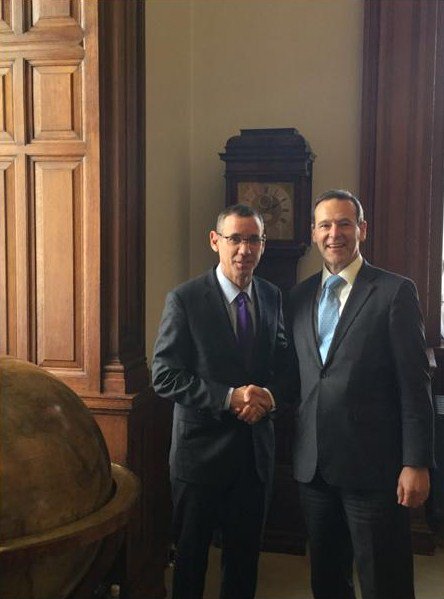
Many of you will recognise one of the faces in this photograph, Mark Regev. He is Israel’s new Ambassador to London and of course was the Israeli government spokesman who justified the massacre of more than 600 women and children in Gaza, and the murder of peace activists aboard the Mavi Marmara.
The other face of evil is Simon McDonald, head of the UK Diplomatic Service. You probably now think I am indulging in hyperbole. But no, I am not.
Simon McDonald was the Foreign Secretary Jack Straw’s Private Secretary at the time of the implementation of the British government’s extraordinary rendition and intelligence from torture programmes. When I became the only member of the UK’s senior civil service to make formal objection to these programmes, it was Simon McDonald who managed Jack Straw’s response in continuing to use torture.
I have indisputable documentary evidence of this, plain despite redactions by the British government censors (redactions which primarily remove all references to the CIA).
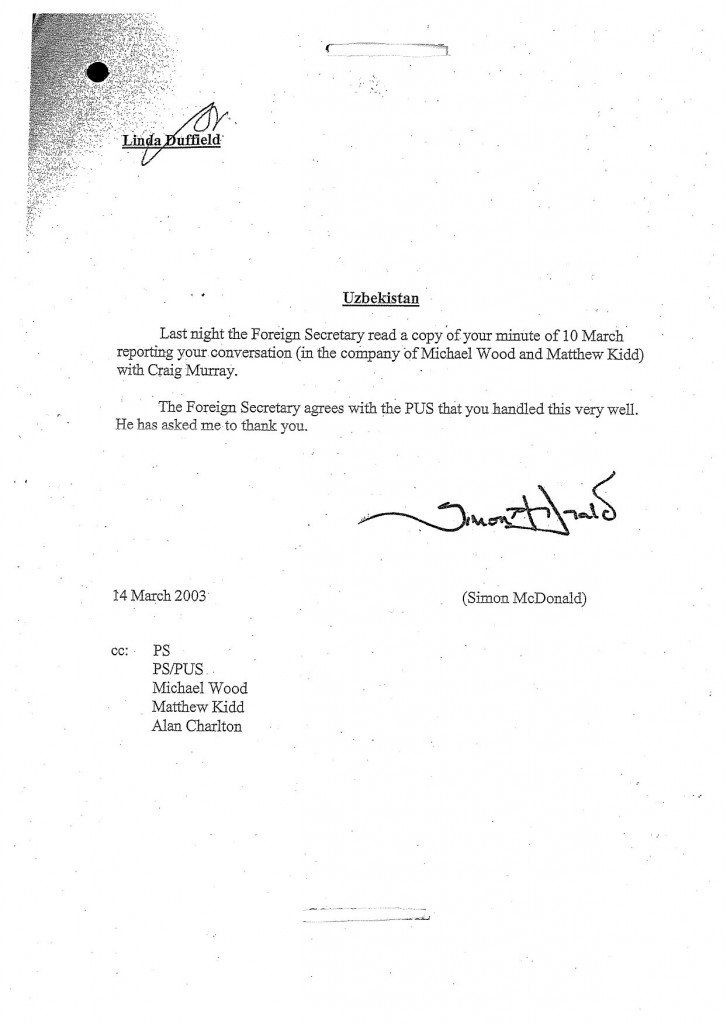
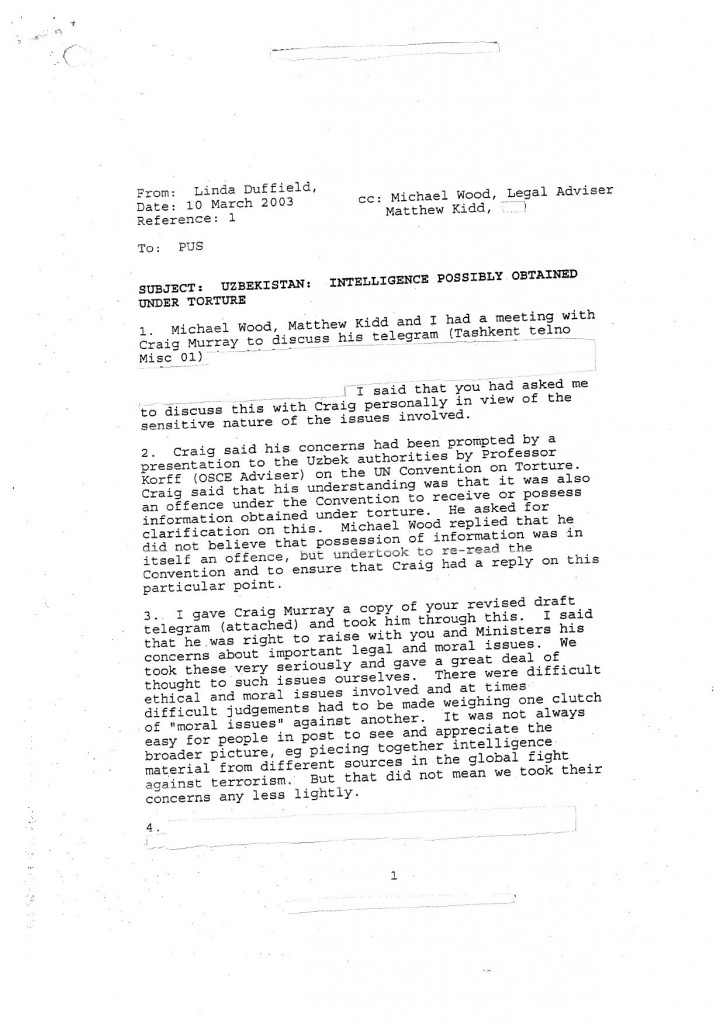
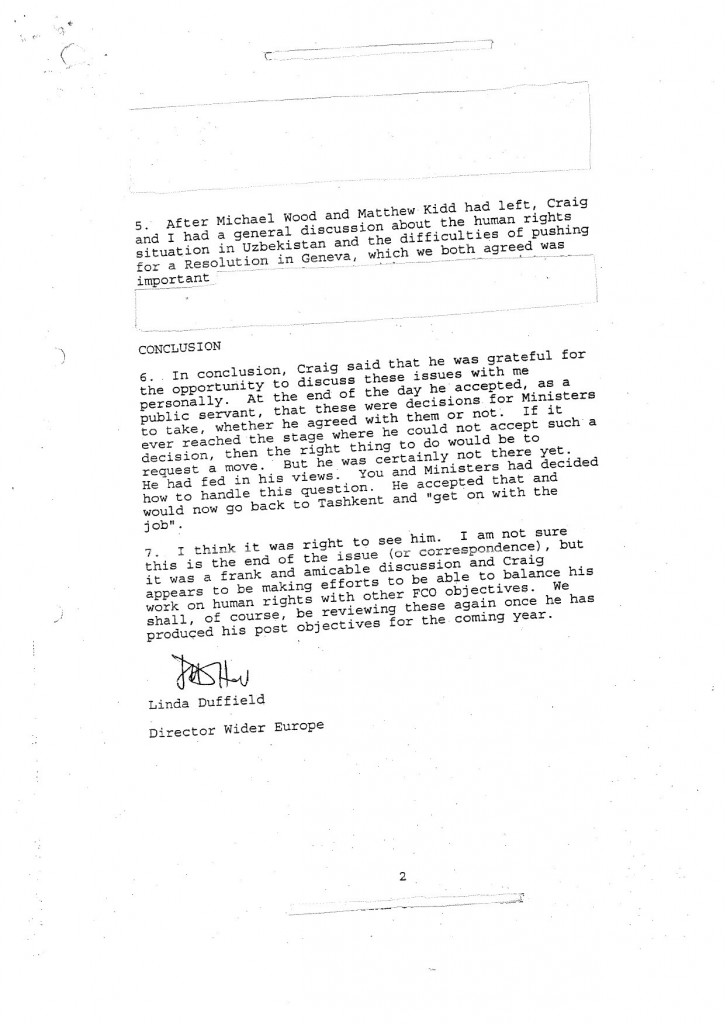
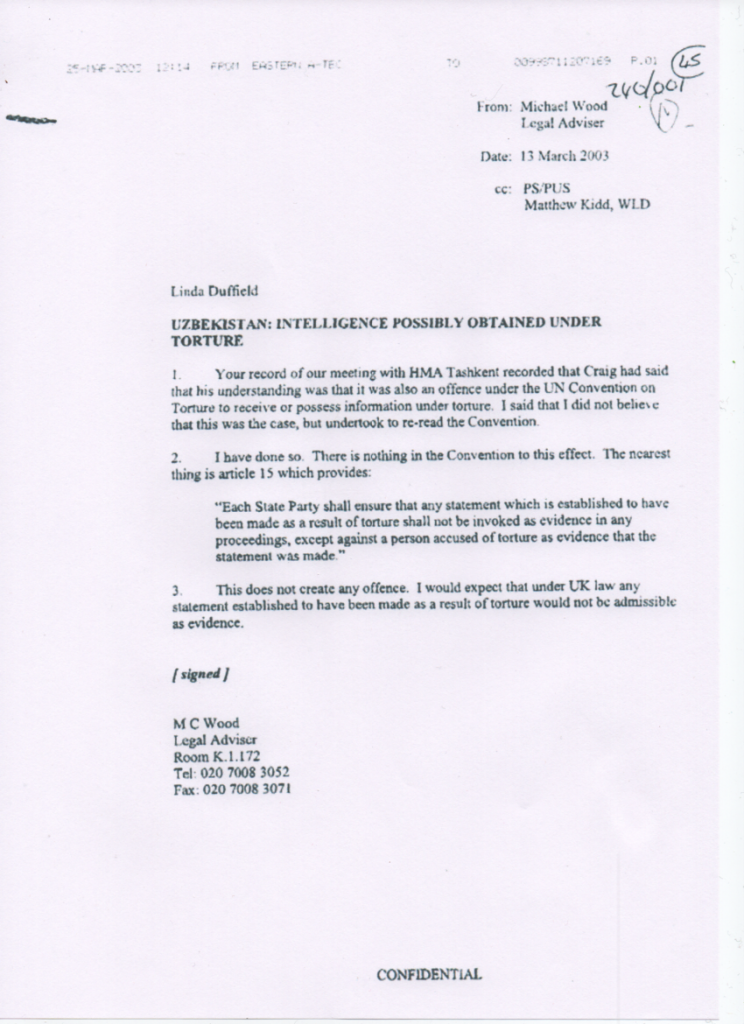
It is put to me frequently that people like McDonald, who were merely implementing a policy of torture, are not evil. That of course is the age old “only doing my job” defence. As somebody who was sacked for refusing to go along with torture, I think I have walked the walk and can describe him as evil. It is also worth noting that, while McDonald meets all new Ambassadors to London, he went far further with Regev than with anybody else. He tweeted out their photo with the message “Happy to see Mark Regev newly arrived Israeli Ambassador, an old friend from Tel Aviv ten years ago.”
Ten years ago, when they were friends in Tel Aviv, was of course the year in which Israel invaded Lebanon and Mark Regev was the chief Israeli spokesman justifying that attack, with its mass civilian casualties. Regev also defended the bombing by Israel of a United Nations observation post.
It is hardly surprising McDonald and Regev became friends at this time, as Gordon Brown’s government were doing everything possible behind the scenes to assist the Israeli invasion. As I wrote at that time
I have just watched on television sixty bodies being buried in a mass grave in Tyre, victims of Israeli bombing. At the same time I saw the odious Kim Howells, Foreign Office minister, arguing that a ceasefire would not solve the problem.
British diplomats at the UK Mission to the United Nations in New York – people I know personally – are putting massive effort into working against a ceasefire. They have the ultimate weapon that they and the US can veto any resolution at the Security Council, but are bending their backs into heading the subject off the agenda.
I hope they are proud of their succesful efforts. For every hour they prevent a ceasefire, on average two more Lebanese children are dying. Israel claims now to have killed 100 Hizbollah fighters. Even if true, that means they are killing two children to every fighter.
McDonald and Regev. Torture meets child-killing. Don’t they make a lovely couple?
Featured Video

The Search for Truth: Charlie Kirk’s Assassination One Year Later
or go to
Aletho News Archives – Video-Images
From the Archives
US murdering 1 million Iraqis is democracy, Iran giving yogurt to Iraq is “domination”
By Ali Salaam | American Herald Tribune | July 31, 2017
The New York Times, owned by the Zionist Jewish supremacist Ochs-Sulzberger family, has no problem with Iraqi suffering as long as Iran is not the one behind it.
The Iraq War was a genocide of the Iraqi people by Zionist supremacists in the Bush administration. Over 1 million innocent people were killed based on a lie. American soldiers died in an Israeli war and now an average of 22 soldiers commit suicide every day because their consciences cannot cope with the fact they committed crimes in an illegal war that served no purpose other than to benefit Israel, not America.
Benjamin Netanyahu, Prime Minister of the Zionist regime, once said “We are benefiting from one thing, and that is the attack on the Twin Towers and Pentagon, and the American struggle in Iraq.”
Paul Wolfowitz had his sights on Iraq since his time in the first Bush administration. Former Israeli official and Bush administration official Richard Perle had his eyes on Iraq since at least his authorship of the Clean Break white paper. The Zionist regime had their eyes on Iraq since the 1980s when strategist Oded Yinon wrote his white paper in support of dividing the Arab-Muslim world along ethnic and sectarian lines. The global Zionist lobby has had their eyes on Iraq since Theodor Herzl stated that Eretz Israel’s true borders go from the Nile River in Egypt to the Euphrates River in Iraq. … continue
Blog Roll
 Aletho News
- The Search for Truth: Charlie Kirk’s Assassination One Year Later
- ‘Harsh reality’: Iran says France seeks monopoly on power and intimidation, not peace for all
- When Will This White House Madness End?
- Huckabee aide goes to ‘unusual lengths’ to portray ‘Israel’ positively
- Trump Announces Diesel Supply Deal With Putin Following Phone Call
- MEP blasts ‘Euro-Gestapo’ for lecturing Russia on democracy
- Syria May Send Troops to Saudi Arabia Amid War with Ansar Allah
- UK whines about losing billions to ‘Putin tax’
- Baghaei to Rubio: Distorted narratives cannot erase US record of broken commitments
- Houthis Don’t Have to Conquer Saudi Arabia to Make It Pay
- If Americans Knew
- Gaza ceasefire exists in name only, say more than 100 organizations
- Nearly 2 Million in Gaza Need Urgent Shelter Assistance as Winter Looms: IOM Chief Warns
- Suppressing Palestinian resistance: US charity under fire for AI monitoring of Gaza classrooms
- Thousands Are Held in Israeli Torture Camps. This Is What Happens Inside
- Israel puts Gaza’s sick, injured, newborn in peril – Daily Update
- Report claimed Mark Levin used by Israeli government to influence Trump
- Over 2,000 Gazans have died awaiting medical evacuation amid Israel’s continued siege
- How a U.S. Diplomat Suppressed and Altered Reports Critical of Israel
- 5 Palestinians Die from Israeli Strikes in Gaza as Relentless Attacks Continue
- Report: Ceasefire Slows Killing but Leaves Devastation Intact
- No Tricks Zone
- New Study: 50 Years Of The Most Aggressive ‘Net Zero’ Policies Can Only Affect The Global Climate By 0.03°C
- US September “Heat” Was No Record…Many Records Set Decades Ago
- Latest European Green Energy Debacle; Portugal’s Largest Flagship Solar Park Insolvent!
- Green Energy Debacle: German Expert Professor Fritz Vahrenholt Warns Of Severe Economic And Social Consequences
- Two More Paleo Reconstructions Affirm Meters-Higher Sea Levels Across Ireland, Brazil 7000-6000 Years Ago
- New Study: Earth And Venus Surface Warmth Largely Explained By Convection And Lapse Rate, Not CO2 Or Radiation
- 2025 Nature Paper Claiming Worsening Global Drought Gets RETRACTED …Heavily Flawed
- New Study: ‘Global Drought Shows No Detectable Recent Acceleration Under Climate Warming’
- Economic Masterminds: German Socialists Suggest Taxing Productivity Gains Stemming From Using AI
- The South China Sea Has Not Been Cooperating With The Climate Change Narrative

