China Acquires Israeli Dead Sea Cosmetics Company for $77 Million
Sputnik – April 11, 2016
On Sunday, Vice President and CEO of Fosun Group, Liang Xinjun, signed an agreement to purchase Ahava with Executive Director of Gaon Holdings Guy Regev. The deal amounted to $77 million.
The ceremony took place in the presence of high-ranking Israeli officials at the David Citadel Hotel in Jerusalem and was witnessed by Israeli government officials and representatives of both companies.
Under the terms of the agreement, Fosun will acquire the holdings from all Ahava’s shareholders including Gaon Holdings, Shamrock Israel Growth Fund Advisors, Kibbutz Mitzpe Shalem, and Kibbutz Kalia.
Vice-President of Fosun, Liang Xinjun, said he was pleased with the results of agreement and hopes to bring Ahava into the Chinese market.
Chinese companies and corporations have been active in the Israeli market over the last few years. In 2011, China National Chemical Corporation acquired Adama, which produces pesticides, for a price of $2.4 billion and in 2015 the Chinese company Bright Food acquired a controlling stake in Israel’s largest producer Tnuva, which is heavily involved in dairy goods.
In addition, China is already the world’s largest importer of cosmetics and health products based on minerals from the Dead Sea.
Experts believe that China’s geopolitical presence in Israel will only continue to grow. In particular, due to the construction of the state-owned China Harbor seaport of Ashdod on the Mediterranean Sea.
The country’s first private port will not appear before 2021. The project cost is estimated at over one billion dollars. The purpose of the project is to connect Ashdod with the southern Israeli city of Eilat and transport goods to Europe, bypassing the Suez Canal.
Last day of demolition order leaves Palestinian family in fear of losing their home
International Solidarity Movement | April 10, 2016
Jerusalem, Occupied Palestine – The 10th of April is the last day of the demolition order on the home of the Totanji family. The family lives in the Sawaneh district in Wadi al-Joz, a village in East Jerusalem near the Old City, which Israel has declared as a ‘National Park’ area. This despite it having always been a residential area. The family received the demolition order over a year and a half years ago, but lost the appeal against the order last month. Today is the last day of the demolition order, which leaves the family fearing that their house maybe demolished tonight.
The house is single-story with 4 bedrooms. However, it is currently the home of 16 people including a 7 month old baby, the granddaughter of the owner of the house. As is the case with other Palestinian families in fear of house demolition, the family does not have any where else to go, and will leave their whole life behind if their house is demolished. Just seven months ago, one of Totanji sons had his house demolished in the same area. This fear of losing one’s home does not just apply to the Totanjis, but also to the rest of the residents in Palestine, due to the huge number of demolitions and demolition orders. In just the last week (31st March-6th April) 14 houses have been demolished in East Jerusalem and the West Bank by Israeli Forces.
Wadi al-Joz is located directly outside the Old City of Jerusalem in a vulnerable area. It is a neighbourhood that suffers from many demolition orders and subsequent demolitions. This is due to Israel declaring parts of the area around the Old City in Jerusalem as a ‘National Park’, to “protect the historical land.” The area covers a huge residential areas containing villages which are already overcrowded including Wadi al-Joz. In addition to the Totanjis, 13 other families in the Sawaneh district in Wadi al-Joz are also in danger of demolition. The information regarding the so called ‘National Park’ was only relayed to these families in the past two years. And whilst Israeli authorities claim that it was declared a park more than 4 decades ago, regardless, this declaration concerning annexed territory is in direct violation of international law.
The family is seeking an international presence to defer the demolition and deter the Israeli authorities. Internationals will be in the house from this evening and for the foreseeable future to prevent the demolition. There is a press conference planned tomorrow morning, 11am on the 11th of April 2016, to announce the opening of a protest tent outside the Totanji family house. The families and the community of Wadi al-Joz invites everyone to attend the protest and to lend coverage to this important event.
Address:
Wadi Al-Joz, neighbourhood of East Jerusalem
Across the Fire Station, behind the Central Market or “Hisbi”
Directions:
From Damascus Gate, follow the Old City Wall towards the Mount of Olives and continue down into Wadi Al-Joz. The home is on a dirt road on the right before you begin to go up the hill to the Mount of Olives. It is about 10-15 minute walk from Damascus Gate. Alternatively, you can drive down from the Mount of Olives past the Ibrahimiya School. The dirt road is on the left at the bottom of the hill just opposite the paved road that goes right into Wadi al-Joz.
Contacts:
Totanji family contact
Aref Tatanji: +972-(0)-508-133-590 (Arabic)
Press conference contact
Nureddin Amro: +972-(0)-525-271-587 (Arabic and English)
ISM media contact
Josephine: +972-(0)-59-740-6401(English)
Further reading:
Background about home demolitions:
House demolitions in International Humanitarian Law (Diakonia)
East Jerusalem: Key Humanitarian Concerns (UN OCHA, August 2014)
The Absentee Property Law in East Jerusalem and Its Implementation: A Legal Guide and Analysis (Norwegian Refugee Council, 2013)
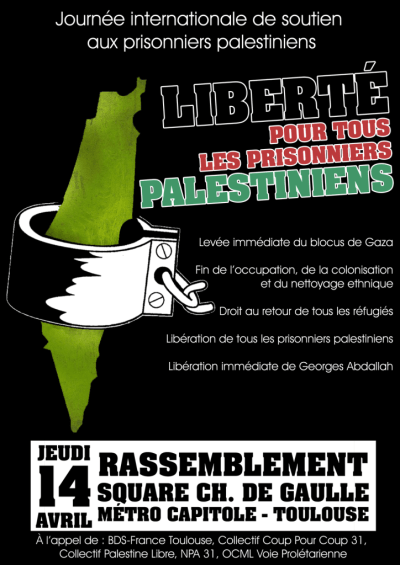
International Day of Solidarity for Palestinian Prisoners – Paris, London, NYC, Toulouse
BDS France Toulouse, Coup Pour Coup 31, NPA31, Collectif Palestine Libre
As of March 2016, there are over 7,000 Palestinians, including more than 100 children, in Israeli prisons, in violation of international law which prohibits an occupying power to imprison in its territory the people of occupied territories.
Since 1967, over 750,000 Palestinians (20% of the total population and 40% of the male population) have been imprisoned by the occupation army. There is no Palestinian family that has been untouched by imprisonment.
 99.74% of Palestinians are convicted by Israeli military courts, the majority of these resulting from forced “plea bargains” (the accused must plead guilty or face a much higher sentence, in a context that they will certainly be found guilty)
Nearly 700 Palestinian prisoners are held under administrative detention, an arbitrary and illegal procedure that allows the Israeli army to detain Palestinians for a period of six months, indefinitely renewable, without charge or trial.
Among the detainees are Palestinian parliamentarians, including Ahmad Sa’adat, General Secretary of the Popular Front for the Liberation of Palestine; Marwan Barghouti, Fateh leader; and several Hamas lawmakers. In April 2015, Khalida Jarrar, member of the Palestinian Legislative Council and advocate for prisoners’ rights, was arrested and sentenced to 15 months in prison. Lawyer and activist Shireen Issawi was convicted along with her brother Medhat Issawi, and sentenced to 4 and 8 years in prison respectively. Medhat Issawi was previosly imprisoned for 20 years!
Palestinian prisoners are subject to torture, sleep deprivation, lack of hygiene and medical care, confinement in tiny cells and sordid, humiliating treatment. A growing number are held in prolonged solitary confinement. Threats, intimidation and denial of family visits are all means of the Israeli occupation to silence the legitimate struggle of the Palestinian people for land and freedom.
Many prisoners went on hunger strike, risking their lives to confront inhumane treatment; for example, Mohammed al-Qeeq ordered to administrative detention in November 2015 and after 94 days of hunger strike, securing his release in May 2016.
As part of the International Day of Solidarity for Palestinian Prisoners, we salute the thousands of Palestinians imprisoned for struggling against the apartheid and ethnic cleansing of their people. We also salute Georges Abdallah, communist activist for the Palestinian cause, imprisoned in France since 1984 for resisting the Israeli invasion of his country, Lebanon.
Let us unite for their release, to end the oldest military occupation in the world, to develop the movement for boycott, divestment and sanctions against the criminal regime of Israel, to demonstrate and popularize the struggle of the Palestinian people.
We demand:
The release of all Palestinian prisoners
The immediate end of the blockade and siege of Gaza
The end of occupation, colonization, and ethnic cleansing of Palestine
The Right of return of all Palestinian refugees
The immediate release of Georges Abdallah
Palestine lives, Palestine will be victorious!
Rassemblement jeudi 14 avril 2016 à 17h30 Square Charles De Gaulle (Métro Capitole).
16 April, Paris: Rally in support of Palestinian Prisoners
Saturday, 16 April
3:00 pm
Place du Chatelet
Paris, France
Facebook: https://www.facebook.com/events/229128724111169/
March via the Boulevard Sebastopol to the Place de la Republique, where we will hold a mass rally to support the 7000 Palestinian political prisoners. We will not forget Georges Ibrahim Abdallah, the great defender of the Palestinian cause, held for 32 years in French prisons at the demand of Israel and the US!
Organizers: CAPJPO-EuroPalestine, Droits Devant, Children of Palestine, Palestine Nanterre, Saint-Ouen Palestine, Friends of Nablus, Collective for the Liberation of Georges Ibrahim Abdallah
16 April, London: Palestine Prisoners Parade
Saturday, 16 April
12:30 pm
Gower Street (Corner of Torrington Place)
London, UK
Facebook: https://www.facebook.com/events/600881743402205/
On the occasion of Prisoners’ Day, we invite you to join us in solidarity with all Palestinians currently languishing in Israeli jails. We will march from Gower street to Trafalgar square along with another march that is being held that day (people against austerity). In keeping with the circus theme that has been used to raise awareness about Abu Sakha, a Palestinian clown currently held in administrative detention, we encourage people to come dressed as colourfully and clowny as you dare! We also encourage as many specific performers as possible (circus artists, musicians, dancers etc). If you have a specific tallent to perform, please get in touch at info@freeabusakha.com or private messaging to www.facebook.com/freeabusakha so we can coordinate the acts.
15 April, NYC: Celebrate resistance before Palestinian Prisoners’ Day
Friday, 15 April
4:00 pm
G4S Office – NYC (19 W 44th St)
Facebook: https://www.facebook.com/events/1042793672451086/
On 17 April each year, Palestinian prisoners, the Palestinian people, and the world mark the International Day of Solidarity with Palestinian Prisoners.
Commemorated since 1974, when the first Palestinian prisoner, Mahmoud Hijazi, was freed in a prisoner exchange with the Palestinian Resistance, 17 April is a day of protests, rallies, marches, forums and more to commemorate the struggle of Palestinians imprisoned in Israeli occupation jails and demand their freedom.
We join with the Palestinian prisoners’ movement in calling on organizations and people of conscience around the world to take action to to express solidarity and call for freedom for Palestinian political prisoners.
Over 7,000 Palestinian prisoners are currently held in Israeli jails. More than 700 of them are held in administrative detention without charge or trial. The others face military courts which convict over 99% of the Palestinians that appear before them. Over 400 Palestinian children as young as 12 years old are held in Israeli prisons.
Every night, Israeli occupation forces conduct violent armed invasions of Palestinian villages, cities, refugee camps and homes, ransacking them and arresting dozens of Palestinians. This comes amid near-daily killings and extrajudicial execution of Palestinians by occupation forces, the demolition of the homes of the families of Palestinian prisoners, new racist laws targeting Palestinians who hold Israeli citizenship, and further escalating repression.
International action has seen some response: G4S, the British-Danish security corporation targeted for a global boycott because of its role in providing security systems, control rooms and equipment to Israeli prisons, has announced it is selling off its Israeli subsidiary and leaving the market entirely. However, it’s critical to keep the pressure on G4S until their equipment and security systems are no longer being used to imprison Palestinians, block their movement at checkpoints, or besiege Gaza.
G4S doesn’t only profit on the imprisonment of Palestinians, of course. Black student movements at Columbia University, the University of California and Cornell University have led in building campus boycotts and divestment against G4S because of its role in private imprisonment in the United States, especially of youth, and have won significant victories. Organizing with movements confronting imprisonment and racist oppression, including the Black movement and the prison divestment movement, is particularly crucial in confronting common oppressors.
Palestinian Prisoners’ Day this year also comes amid international repression of Palestinian organizing – for example, the attacks on BDS in France and the arrest and prosecution of BDS activists – and the imprisonment and persecution of Palestinians and fellow strugglers in international prisons, as in the cases of Georges Ibrahim Abdullah, the Holy Land Five, and Rasmea Odeh. Confronting racism and oppression of all forms comes hand in hand with confronting Zionist settler-colonial racism in Palestine.
After a regular, weekly protest of G4S on Friday, join Samidoun Palestinian Prisoner Solidarity Network as we rally with CUNY Prison Divest and NYC Students for Justice in Palestine on Sunday, 17 April to demand freedom for Palestinian political prisoners and an end to private, for-profit incarceration in the United States:
Israel connects BDS with terrorism while cracking down on German banks
RT | April 10, 2016
Israel’s Public Security Minister has linked the Boycott, Divestment and Sanctions (BDS) movement with terrorism and is threatening German banks using tactics previously employed against Al-Qaeda.
Netanyahu-appointee Gilad Erdan has threatened to coerce German banks to prohibit BDS activists from fundraising through their accounts, not through Israeli legislation, but the laws of other countries where Erdan has “increased awareness among decision-makers in Europe and North America of the anti-Semitic, anti-democratic, and discriminatory nature of the BDS movement, which seeks Israel’s destruction and often has ties to terror-supporting organizations.”
To bring about this “increased awareness,” a taskforce headed by Erdan was launched last year at the cost of 100 million Israeli shekels ($25.5 million) that has been successful in impacting the laws, policies, and enthusiasm for enforcement in a number of countries, particularly the US and UK, where a number of anti-BDS restrictions have employed “anti-democratic” and “discriminatory” methods to clamp down on the movement.
Erdan’s Friday statement in the Jerusalem Post urged the banks to “carefully consider the potential legal, reputational, and ethical consequences of facilitating the activities of BDS groups.”
In response, the bank’s spokesman said “We expressly point out again that Commerzbank adheres to the applicable compliance guidelines and regulations regarding the conduct of an account.”
Ironically, while Erdan is threatening BDS activists with one set of laws, the global grassroots movement is actually trying to pressure Israel to “comply with international law” through the boycott of products and companies that profit from the violation of the rights of Palestinians, particularly violent land grabs.
Inspired by the BDS movement that helped end South African apartheid, supporters of this campaign, which includes Jewish activists contrary to the accusations of anti-semitism, believe it is the only way to push for a solution to the Palestinian-Israeli conflict.
Here are the countries Erdan is counting on to be Israel’s enforcers in its global crackdown on the “terrorist” boycotters.
US
Legislation has been introduced at local, state, and federal levels targeting BDS movements.
At least 16 anti-BDS initiatives were introduced in the US in 2015, including the Trade Promotion Authority legislation that discourages European governments from taking part in BDS activities by threatening to cut off their ability to engage in free trade with the US.
Illinois passed an anti-BDS state law that created a blacklist of foreign companies from which the state pension must divest its funds. South Carolina bans state business with companies engaged in boycotts.
Other anti-BDS bills have been introduced in Congress, New York, New Jersey, and Pennsylvania. New York state currently has legislation on the table, just in time for the New York primary, that would ban state business with companies involved in boycotting Israel, including international banks.
Canada
Earlier this year, Canada passed a motion condemning “any and all attempts” to promote BDS. The country’s new leader Justin Trudeau said the movement had “no place on Canadian campuses” and fully supported Israel’s 2014 Operation Protective Edge against Gaza, despite his “liberal” outlook.
UK
The UK recently banned local authorities and public bodies from participating in BDS. This includes councils, universities, and student unions. The move was welcomed by Conservative MP Eric Pickles who said the BDS movement was an attempt “by the irresponsible left to demonize Israel.”
The UK has had its fair share of BDS victories in the past. Leicester City Council adopted the boycott policy in 2014 along with the National Union of Students the following year.
France
BDS is banned in France as part of a general law that classifies the boycott of a nation or its citizens as a hate crime. It is illegal for councils or legal bodies to boycott Israeli goods.
Last November, a small group of French activists were found guilty of provoking discrimination after holding a small rally calling for the boycott of Israeli goods. They were sentenced to pay €12,000 in damages to the plaintiffs, as well as legal fees.
Germany
While Germany doesn’t have a specific law banning the BDS movement, DAB Bank in Munich announced in February that it would cancel BDS-Kampagne’s account as of next week. DAB is owned by French BNP Paribas.
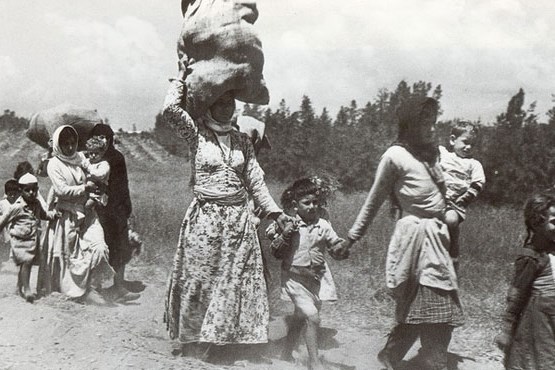
Palestinians mark 68th anniversary of Deir Yassin massacre
Ma’an – April 9, 2016
Palestinians on Saturday marked the 68th anniversary of the massacre of more than 100 Palestinians civilians carried out by Zionist paramilitary groups in the village of Deir Yassin in 1948 prior to the establishment of Israel.
Deir Yassin has long been a symbol of Israeli violence for Palestinians because of the particularly gruesome nature of the slaughter, which targeted men, women, children, and the elderly in the small village west of Jerusalem.
The number of victims is generally believed to be around 107, though figures given at the time reached up to 254, out of a village that numbered around 600 at the time.
The Deir Yassin massacre was led by the Irgun group, whose head was future Israeli Prime Minister Menachem Begin, with support from other paramilitary groups Haganah and Lehi whose primary aim was to push Palestinians out through force.
Records of the massacre describe Palestinian homes blown up with residents inside, and families shot down as they attempted to flee.
The massacre came in spite of Deir Yassin resident’s efforts to maintain positive relations with new Jewish neighbors, including the signing of pact that was approved by Haganah, a main Zionist paramilitary organization during the British Mandate of Palestine.
An Israeli psychiatric hospital now lies on the ruins of Deir Yassin, the remainder of which was reportedly bulldozed in the 1980s to make way for Jewish housing and incorporated as a neighborhood of Jerusalem. Streets of the neighborhood hold names of Irgun militiamen who carried out the massacre.
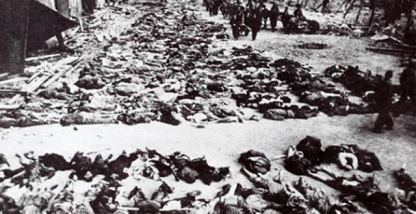
The massacre was one of the first in what would become a long line of attacks on countless Palestinian villages, part of a broader strategy called Plan Dalet by Zionist groups to strike fear into local Palestinians in hopes that the ensuing terror would lead to an Arab exodus, to ensure only Jews were left in the “Jewish state.”
Thus the attack on Deir Yassin took place a month before the UN Partition Plan was expected to be carried out, and was part of reasons later given by neighboring Arab states for their intervention in Palestine.
The combination of forced expulsion and flight that the massacres — what would later become known among Palestinians as the Nakba, or catastrophe — precipitated left around 750,000 Palestinians as refugees abroad. Today their descendants number more than five million, and their right to return to Palestine is a central political demand.
The anniversary of the deadly razing of the village comes as modern day Palestinians in occupied East Jerusalem and the West Bank continue to fight for their livelihood in the face of illegal Israeli settlement expansion, widespread detention campaigns, extrajudicial executions by Israeli forces, and a surge in housing demolitions — most recently leaving 124 Palestinians homeless in a single day.
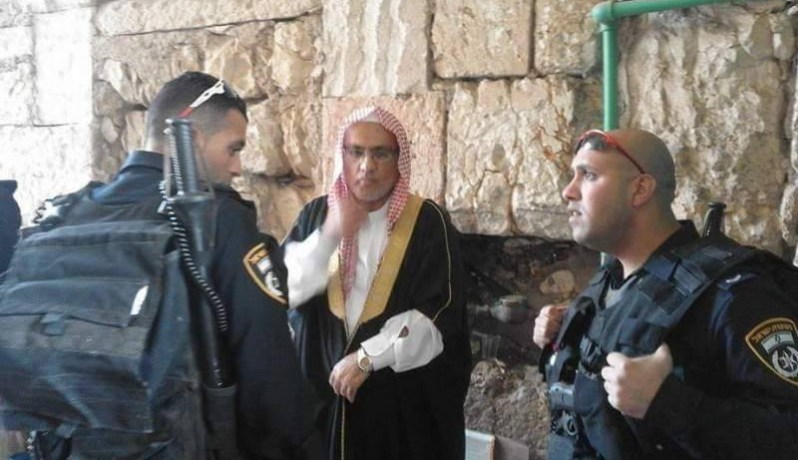
Al-Aqsa imam arrested by Israeli occupation forces after Friday prayers; 6 Jerusalemites arrested in Silwan
samidoun – Palestinian Prisoner Solidarity Network | April 8, 2016
Israeli occupation forces arrested imam Sheikh Mohammed Salim as he left the Al-Aqsa Mosque in Jerusalem on Friday, 8 April, accusing him of “incitement” in his speech delivered today at Friday prayers before 70,000 worshipers.
Feras al-Dabas, press spokesperson of the Islamic Waqf, was quoted in Al-Resalah as saying that despite the intervention of the director of the Waqf, Sheik Azzam al-Khatib, the occupation forces insisted on arresting Salim and had taken him to a detention center, without revealing his whereabouts.
This came as occupation forces arrested six Palestinian Jerusalemites from Silwan, confiscating a protest tent, in an attempt to stop a public Friday prayer in protest of ongoing Israeli occupation policies of repression against the people of Silwan, in particular a decision to demolish 50 homes in Silwan under the pretext of the construction of a garden. Occupation forces arrested Jalal Abbasi, Firas Abbasi, Musa Abbasi, Mohammed Abu Tayeh and Khaled Abu Tayeh and detained two vehicles, which were warned against delivering any plastic chairs to the protest tent.

Jawad Siyam, Director of the Wadi Hilweh Information Center was briefly arrested after attempting to stop the arrest of the five Palestinian youths, and later released. Despite the arrests and the confiscation of the protest tent, the public prayer in rejection of arrests, home demolitions and land confiscation went forward.
Israeli forces detain 4 Palestinian fishermen off Gazan coast
Ma’an – April 8, 2016
GAZA CITY – Israeli naval forces on Thursday detained four Palestinian fishermen off the coast of Rafah City in the southern Gaza Strip and seized their fishing boats.
Fishermen told Ma’an that Israeli forces opened fire on the fishing boats before detaining them, although no injuries were reported. They said the incident took place within the designated nine nautical mile fishing zone.
An official with the Agricultural Work Union, Zakariya Bakr, identified the detainees as brothers Iyad and Ahmad Omar al-Bardawil and brothers Bilal and Muhammad Jihad Musleh. He said two fishing boats were confiscated.
An Israeli army spokesperson told Ma’an they were looking into the reports.
On Thursday, another two Palestinian fishermen were detained off the coast of Khan Younis after they allegedly passed beyond the designated fishing zone.
As part of Israel’s near-decade long blockade of the coastal enclave since 2007, Palestinian fishermen have been required to work within a limited “designated fishing zone” off the coast, which was extended to nine nautical miles last week.
Israeli forces regularly detain Palestinian fisherman off the coast of Gaza working within the fishing zone, generally for alleged security reasons. According to the Palestinian Center for Human Rights, Israeli forces detained 71 fishermen and confiscated 22 fishing boats throughout 2015.
The center said that Israeli naval forces also opened fire on Palestinian fishermen at least 139 times over the course of the year, wounding 24 and damaging 16 fishing boats.
“These attacks occurred in a time where the fishers did not pose any threat to the Israeli naval troops, as they were doing their job to secure a living,” the center said.
DCI: “Israeli Soldiers Abuse Children During Home Invasions, Arrests”
By Saed Bannoura | IMEMC | April 7, 2016
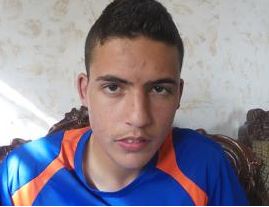 Defense for Child International – Palestine Branch has reported that Israeli soldiers are systematically abusing Palestinian children, especially during invasions of their homes and while abducting them.
DCI said it documented many cases of abuse targeting Palestinian children after the soldiers stormed their families’ homes without any cause or justification, for both the invasions and the excessive use of force.
One of the cases is that of Ahmad Tamimi, 16, from Betunia town west of Ramallah, who was repeatedly beaten and assaulted by the soldiers after they invaded his family’s home to kidnap his uncle.
In a sworn affidavit, Tamimi told DCI that, on March 17, he was awakened by the very loud noise, shortly after midnight, to find eight Israeli soldiers surrounding his bed, in his own bedroom.
“For the first few seconds, I thought I was dreaming, but reality started sinking in when a soldier stared violently pulling me out of my bed, to drop me on the ground,” Tamimi said, “The soldiers then started kicking and beating me, and hitting me with their weapons while shouting in Hebrew. I started screaming and calling for my dad, while also trying to fend for myself, using my arms in an attempt to block their kicks and punches.”
“They tied my arms behind my back using plastic cuffs, and ordered to me to stand up and walk with them,” the child added, “I said I was unable to do so, and that is when one of the soldiers pulled me from my hair to force me to stand, then two soldiers grabbed me and forced me out of the room.”
The child also stated that one of the soldiers hit him with his rifle on his left cheek; he started feeling dizzy when the soldiers dragged him through the bedroom’s door, and started suffering severe pain.
After invading the home, the soldiers held the entire family in one room, and later moved Ahmad to the same room while handcuffed and his legs shackled, then they left the property after abducting his uncle, 30 years of age.
The family then untied their child and directly headed to the Palestine Medical Center in Ramallah; after examination, the doctors found various cuts and bruises to his head, forehead, left shoulder and right arm.
Since that incident took place, Tamimi has been afraid to sleep in his room alone, and constantly feels that the soldiers will surround and attack him again. He is always thinking about what they did to him, and is terrified of leaving home after dark.
On March 3, at least fifteen Israeli soldiers invaded, approximately at 3 at dawn, a home in the northern West Bank city of Jenin after smashing the front door.
The soldiers the grabbed Ahmad ‘Arqawi, 17, and his brother, 21, and started repeatedly pushing their striking against the walls.
“A soldier asked me about my name, I said Ahmad,” he said, “The soldier then slammed my head against the wall. I was in severe pain, and the soldiers forced my eight family members in the bathroom.”
“The soldiers dragged me out of my bedroom, tied my hand behind my back using plastic cuffs, and I could hear sounds of furniture being broken and destroyed by other soldiers searching our home,” he added, “Then three soldiers started kicking and punching me, and hitting me with their rifles, mainly on my head, chest and back. I started feeling dizzy, but they continued to shout and scream at me in Hebrew.”
One of the soldiers also pushed Ahmad’s head against every mirror in the bedroom, causing various cuts, especially on the right side of his head in addition to severe pain.
“They dragged me out of my bedroom to the living room, there; I saw many masked soldiers, and one of them forced me against the wall while strangling me,” the child added, “Another soldier brought a cup filled with water, and started pouring it in my mouth while the second soldier continued to strangle me while punching me with his other hand.”
The soldiers later dragged the child to the bathroom, where his family was held, and told him “look how your family members are screaming and crying, look at what we did to your family and your home – we wrecked it!”
They then forced him into the bathroom, with his family, and kidnapped his brother while repeatedly kicking, punching and beating him.
After the soldiers left the family home, and withdrew, the family called for an ambulance that took Ahmad to the Jenin governmental hospital, where he was treated for serious cuts and bruises in various parts of his body, including his head, face, shoulders and back.
20 years since the Qana massacre and Naftali Benet is Education Minister

By Miko Peled | American Herald Tribune | April 7, 2016
Naftali Bennet, Israel’s minister of education was the first public official to come out in support of Elor Azaria, the Israeli soldier who executed Abdel Fatah Alsharif as he lay wounded in Hebron. Bennet was critical of the government of which he is a member for not standing up for the soldier. I was listening to the interview with Bennet on Israeli television where he made the argument that the government and the press judged the soldier harshly and prematurely. Then he said something I never thought I’d hear.
“Maybe the soldier did make a mistake; you know I also made a mistake. During Grapes of Wrath, Operation Grapes of Wrath I was apparently mistaken and a very difficult thing happened.” A very difficult thing happened. Interesting choice of words and interesting timing: It is exactly twenty-years since the massacre in Qana village in Southern Lebanon, a massacre for which Bennet was responsible. He then went on to explain that, “in my case, I received the full backing of the commanding general and the army chief of staff.” In fact he was backed by the entire chain of command going all the way up to the Prime Minister (and Nobel laureate), Shimon Peres.
Bennet was talking about the shelling by Israeli forces of the UN compound in the southern Lebanese village of Qana. It took place on April 18, 1996 when hundreds of local Lebanese were seeking shelter at the compound. Of the 800 Lebanese civilians who had taken refuge in the compound, a reported 106 were killed and 116 were injured. The attack occurred amid fighting between the Israeli army and Hezbollah during operation “Grapes of Wrath.” There was evidence that an Israeli drone was spying on the compound before the shelling, making the argument that this may have been an error, unlikely at best. Clearly all levels of the IDF command knew that the compound was there and that it served as shelter for refugees escaping the fighting. The building was clearly marked as a UN compound and was even marked on the Israeli maps. Bennet who was commander of an Israeli army reconnaissance unit called for massive artillery shelling of the site.

The BBC described the massacre as: “one of the deadliest single events of the whole Arab-Israeli conflict.” Robert Fisk who reported from the site wrote, “Not since Sabra and Chatila had I seen the innocent slaughtered like this.”
Fisk’s descriptions of what he saw are not for the weak at heart but must be read and remembered. Over and over we hear the phrase “never again,” yet Israel commits one heinous massacre after another and gets away with it, usually absolved by the US. In this case the main culprit is known, he admits his responsibility and yet not only did he go unpunished, he is unrepentant and is now in charge of the Israeli ministry of education. How ironic. Again Fisk’s description, “The Lebanese refugee women and children and men lay in heaps, their hands or arms or legs missing, beheaded or disemboweled. There were well over a hundred of them […] The Israeli shells had scythed through them as they lay in the United Nations shelter, believing that they were safe under the world’s protection. Like the Muslims of Srebrenica, the Muslims of Qana were wrong.” And Fisk continues, “Now the Israelis are stained again by the bloodbath at Qana, the scruffy little Lebanese hill town where the Lebanese believe Jesus turned water into wine.”
Naftali Bennet was quoted as saying that he had killed many Arabs in his time and feels no remorse, and in his view “a soldier in the battlefield can not commit murder.” In a speech in the Knesset Bennet said he killed many terrorists during his military service and he wishes he had killed more. Bennet never saw an Arab he did not consider to be a terrorist, and therefore fair game. “Arabs are murdering Jews every day,” he said as he defended the execution in Hebron. An important piece of information that is completely ignored is that another soldier shot Abdel Fatah first, even though he was unarmed and his hands were raised, and only later did Elor Azaria execute him. Bennet called the scene as a “battle ground” and the shooting perfectly legitimate because according to him “Viscous Palestinian terrorists are coming out every day to kill Jews.”
The result of Bennet’s call for the shelling in Qana, according to Fisk, was “The blood of all the refugees ran quite literally in streams from the shell-smashed UN compound […] in which the Shiite Muslims from the hill villages of southern Lebanon – who had heeded Israel’s order to leave their homes – had pathetically sought shelter.” Once the news of the shelling had got out, relatives started arriving from other parts of Lebanon to look for loved ones. Their grief and anger were forceful, “we had suddenly become not UN troops and journalists but Westerners, Israel’s allies” Fisk writes, and he continues, “one bearded man with fierce eyes stared at us, his face dark with fury: […] “I would like to be made into a bomb and blow myself up amid the Israelis” the man cried.
The story of the Qana massacre was brought up during the Israeli elections of 2015, because Bennet was the head of one of the parties running. Claims were made that the “incident” was evidence that he had “poor judgment.” Today, twenty years and countless massacres later a man who knowingly brought about the gruesome killing of countless innocents is in charge of educating Israeli children and is defending the execution of a young Palestinian. And yet, the one man that everyone is calling a terrorist is one who committed no act violence at all: the young Abdel Fatah Alsharif, may he rest in peace.
Literati want Israeli backing for New York festival dropped
Press TV – April 7, 2016
More than 100 prominent writers and literary figures have written a damning open letter to PEN American Center, urging it “to reject support from the Embassy of Israel” for the week-long World Voices Festival (PWVF) in New York at the end of this month.
“It is deeply regrettable that the festival has chosen to accept sponsorship from Israel, even as it intensifies its decades-long denial of basic rights to the Palestinian people, including the frequent targeting of Palestinian writers and journalists,” read the letter sent to PEN American Center and other festival participants in March, which was published online on Wednesday.
PEN American Center, based in New York, is the largest of the 144 centers that belong to PEN International, the worldwide association of prominent writers and editors that defends those who are harassed, imprisoned and killed for expressing their views.
The letter added that both Palestinian and international journalists and writers face heightened levels of repression by the Tel Aviv regime.
“In 2015, Israel denied Palestinian American novelist Susan Abulhawah entry into Palestine, and African American writer Kristian Davis Bailey was racially profiled, arrested and harassed by Israeli authorities, when he attempted to visit Palestine. All these incidents are part of a broader pattern of Israel’s systematic repression of Palestinian artists and cultural workers as well as the suppression of voices supportive of Palestinian rights,” it pointed out.
Among the writers who have signed onto the letter are Pulitzer Prize winners Alice Walker, Richard Ford and Junot Diaz, plus award-winning author Louise Erdrich.
Former president and vice president of English PEN, Gillian Slovo and Kamila Shamsie, poet Eileen Myles, authors Louise Erdrich and Ahdaf Soueif, and the Palestinian writer Ahmad Qatamesh, whose administrative detention by Israeli authorities was slammed by PEN International, also put their names on the letter.
The letter was sent to PEN American Center by Adalah, a non-profit group that supports the Boycott, Divestment and Sanctions movement against Israel.
“As a PEN member, I want this organization that is supposed to be a champion of writers’ rights to stand up for Palestinian writers, academics and students who are suffering under a repressive Israeli regime that denies their right to freedom of expression,” said American writer Alice Walker, author of the critically-acclaimed novel the Color Purple.
Marilyn Hacker, recipient of PEN Voelcker award for poetry and PEN award for poetry in translation, also stated that “PEN should have policies and ethical standards in place forbidding partnerships with significant human rights abusers. On that basis alone, PEN should rule out a partnership with Israel.”
Jewish settlers expropriate Palestinian garden as police stand by
International Solidarity Movement | April 4, 2016
Tel Rumeida, al Khalil, occupied Palestine – On Saturday 3rd of April 2016 settlers entered land belonging to Muhammad Abu Haikal in the Tel Rumeida area of Hebron on the occupied West Bank in Palestine. The settler children built a tent and then brought other settlers who prayed and ate there. It took more than four hours from when the police arrived until the settlers actually left, still claiming that it was their land and running around so that the police would not be able to evict them.
The first young settler kids arrived at the land at around 9 o’clock in the morning and started building a tent out of wood and sheets that they had found and playing on the land. They were actually playing in Muhammad Abu Haikal’s garden, but the end of the garden has been declared a closed military area by the Israeli Occupation Forces, who have made a military outpost in the garden and cut off the end of it of with barbed wire. The settler children entered the garden using the staircase that has been built for the soldiers to reach the outpost: they stamped down the barbed wire and covered it with a piece of wood to prevent themselves from getting injured.

Later on, while the family was trying to pick almonds from trees in the part of the garden that is not a closed military Area, the settler children returned with a number of adult settlers and more children. Muhammed Abu Haikal and the internationals present asked the settlers to leave the land, but they refused. He then contacted the police.
After the police arrived, the settlers once again claimed to be the owners of the land, with the right to remain there. The Palestinian family was asked to step back and had to stop harvesting their garden. Not until after the settlers had prayed on the land multiple times, brought food and played ball there, did the police finally try to get them to leave. The police asked all Palestinians and internationals to leave as well, as they said, “it is impossible to make Israelis leave, if there are Palestinians on the land”. It then took the police over two hours to evict the settlers. They then removed the materials that the children had left on the part of the land that is not a closed military area, but refused to pull down the tent, because, they said, it was not allowed on Shabbat.
Finally the soldiers closed off the closed military area with more barbed wire and allowed the family back into their garden. If Palestinians had been trespassing on settlers land, which is illegally occupied, they would probably have been arrested immediately, but when it is the other way around, which it usually is, the police do not use any kind of force.
Evangelical Investment in Israel
By Serge Halimi | CounterPunch | April 6, 2016
US-Israeli relations are a recurring issue in the Republican primaries, even in southern states where there are very few Jewish voters. For many years, the following ritual only affected Democratic primaries, especially in New York (notably in 1980, 1984, 1988). One candidate, or even several, would call for the US embassy in Israel to be relocated from Tel Aviv to Jerusalem, tantamount to recognising Israel’s sovereignty over the whole of the city. Then, when the New York primary was over, both Democratic and Republican presidents would leave the embassy where it was, until the next candidate repeated the performance four years later.
Now it’s the Republicans’ turn. A few days before the Iowa vote, Ted Cruz announced that, as president, he would relocate the embassy “on day one”. Why, when Iowa is 0.2% Jewish? The evangelical church is powerful — as it is in all the southern states.
Visiting the First Baptist Church in Opelika, Alabama, the importance of Israel, Jerusalem and Palestine is impossible to miss. Not that anyone there follows developments in the region closely. Neither recent history nor politics dictates judgments and votes, but faith. Sara-Jane Tatum, for one, takes part in a Bible discussion group, which has 40 members, two of whom are black. She belongs to the International Christian Embassy Jerusalem (ICEJ), an organisation whose mission is to “stand with Israel in the belief that Jerusalem is the eternal capital.” Tatum is just back from a “teaching tour” in Israel, recommended by her pastor. Her itinerary included a visit to the Knesset, a meeting with two members of Likud (prime minister Binyamin Netanyahu’s party), and a dinner for several hundred pro-Israel Christians at Jerusalem’s Waldorf Astoria hotel. “The American ambassador spoke, as did an Arab Christian standing with Israel.” Tatum also visited the Holocaust museum. But Jericho and Bethlehem, despite their importance to Christianity, were not on the tour, nor anywhere else under Palestinian Authority control.
Tatum’s organisation raises funds “for Jewish people to leave France, Ukraine, and go to Israel. […] I have heard that French Jews were persecuted.” Her study of the Bible has “taught [her] the importance of Israel to [her] faith and what will happen in the future.” Basing her views on scripture, especially the Old Testament, she believes that all of Palestine should be returned to Israel; therefore, she supports (and would expand on) Netanyahu’s settlement policy. “One day, we don’t know when, God will protect Israel. God has decided that Jerusalem will be the centre of the world […]. God made a covenant with the Jewish people. This covenant cannot be replaced, cannot be altered, cannot be changed. Because of their disobedience to the Lord, he exiled [the Jews] but the land is theirs.”
While waiting for Armageddon and the Messiah’s return, what fate does she envisage for the Palestinians, a minority of whom are Christian, if they don’t want to live in a Jewish state? “Other Arab countries should accept Palestinians into their countries. In 1967 God protected Israel. Israel won.” Issue settled. “Israel does everything to provide jobs to Palestinians, to make them live in peace. They are treated well. They want more. If they are not happy, they can go elsewhere.”
Deborah Jones, who leads the Bible study group, has been to Israel twice, last time eight years ago. She also thinks “the Israelis are trying so hard to help the Palestinians, but their hatred of the Jews is so strong that they resist their help.” She views Palestinian Christians’ demands for sovereignty as almost heretical: “They harbour this hate for Israel so much that they don’t really accept Christ as their lord. God made a covenant with the Jewish people. God will never allow Israel to be divided again.”
Both agree peace is desirable, but, says Jones, “the Palestinians don’t want peace, they want the land.” Tatum adds: “And they want the Jews dead.”
Serge Halimi is president of Le Monde diplomatique
Featured Video

The Search for Truth: Charlie Kirk’s Assassination One Year Later
or go to
Aletho News Archives – Video-Images
From the Archives
US murdering 1 million Iraqis is democracy, Iran giving yogurt to Iraq is “domination”
By Ali Salaam | American Herald Tribune | July 31, 2017
The New York Times, owned by the Zionist Jewish supremacist Ochs-Sulzberger family, has no problem with Iraqi suffering as long as Iran is not the one behind it.
The Iraq War was a genocide of the Iraqi people by Zionist supremacists in the Bush administration. Over 1 million innocent people were killed based on a lie. American soldiers died in an Israeli war and now an average of 22 soldiers commit suicide every day because their consciences cannot cope with the fact they committed crimes in an illegal war that served no purpose other than to benefit Israel, not America.
Benjamin Netanyahu, Prime Minister of the Zionist regime, once said “We are benefiting from one thing, and that is the attack on the Twin Towers and Pentagon, and the American struggle in Iraq.”
Paul Wolfowitz had his sights on Iraq since his time in the first Bush administration. Former Israeli official and Bush administration official Richard Perle had his eyes on Iraq since at least his authorship of the Clean Break white paper. The Zionist regime had their eyes on Iraq since the 1980s when strategist Oded Yinon wrote his white paper in support of dividing the Arab-Muslim world along ethnic and sectarian lines. The global Zionist lobby has had their eyes on Iraq since Theodor Herzl stated that Eretz Israel’s true borders go from the Nile River in Egypt to the Euphrates River in Iraq. … continue
Blog Roll
 Aletho News
- The Search for Truth: Charlie Kirk’s Assassination One Year Later
- ‘Harsh reality’: Iran says France seeks monopoly on power and intimidation, not peace for all
- When Will This White House Madness End?
- Huckabee aide goes to ‘unusual lengths’ to portray ‘Israel’ positively
- Trump Announces Diesel Supply Deal With Putin Following Phone Call
- MEP blasts ‘Euro-Gestapo’ for lecturing Russia on democracy
- Syria May Send Troops to Saudi Arabia Amid War with Ansar Allah
- UK whines about losing billions to ‘Putin tax’
- Baghaei to Rubio: Distorted narratives cannot erase US record of broken commitments
- Houthis Don’t Have to Conquer Saudi Arabia to Make It Pay
- If Americans Knew
- Gaza ceasefire exists in name only, say more than 100 organizations
- Nearly 2 Million in Gaza Need Urgent Shelter Assistance as Winter Looms: IOM Chief Warns
- Suppressing Palestinian resistance: US charity under fire for AI monitoring of Gaza classrooms
- Thousands Are Held in Israeli Torture Camps. This Is What Happens Inside
- Israel puts Gaza’s sick, injured, newborn in peril – Daily Update
- Report claimed Mark Levin used by Israeli government to influence Trump
- Over 2,000 Gazans have died awaiting medical evacuation amid Israel’s continued siege
- How a U.S. Diplomat Suppressed and Altered Reports Critical of Israel
- 5 Palestinians Die from Israeli Strikes in Gaza as Relentless Attacks Continue
- Report: Ceasefire Slows Killing but Leaves Devastation Intact
- No Tricks Zone
- New Study: 50 Years Of The Most Aggressive ‘Net Zero’ Policies Can Only Affect The Global Climate By 0.03°C
- US September “Heat” Was No Record…Many Records Set Decades Ago
- Latest European Green Energy Debacle; Portugal’s Largest Flagship Solar Park Insolvent!
- Green Energy Debacle: German Expert Professor Fritz Vahrenholt Warns Of Severe Economic And Social Consequences
- Two More Paleo Reconstructions Affirm Meters-Higher Sea Levels Across Ireland, Brazil 7000-6000 Years Ago
- New Study: Earth And Venus Surface Warmth Largely Explained By Convection And Lapse Rate, Not CO2 Or Radiation
- 2025 Nature Paper Claiming Worsening Global Drought Gets RETRACTED …Heavily Flawed
- New Study: ‘Global Drought Shows No Detectable Recent Acceleration Under Climate Warming’
- Economic Masterminds: German Socialists Suggest Taxing Productivity Gains Stemming From Using AI
- The South China Sea Has Not Been Cooperating With The Climate Change Narrative

