UNRWA Condemns Today’s Large Scale Home Demolitions in the West Bank
IMEMC News & Agencies – April 6, 2016
Statement by UNRWA West Bank Director, Lance Bartholomuesz
Jerusalem 6 April 2016
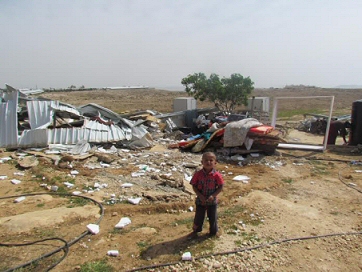 UNRWA condemns today’s large scale home demolitions by the Israeli Authorities in the Bedouin refugee community of Um al Khayr in the South Hebron Hills. As a result, 31 Palestine refugees, including 16 children, were made homeless.
This community has endured several rounds of demolitions and often faced harassment from the nearby illegal settlement of Karmel.
“I am appalled. Looking in the eyes of a young Bedouin boy in a red shirt standing amongst the crumpled ruins of his demolished home, how can anyone justify this? ” stated Lance Bartholomeusz, Director of UNRWA Operations in the West Bank.
Already this year, over 700 Palestinians have been displaced by Israeli demolitions in the West Bank.
This figure is approaching the total number of displaced for all of 2015.
UNRWA is gravely concerned about demolitions in violation of international law. Under the Fourth Geneva Convention destruction of private property is prohibited. As Occupying Power, Israel is obliged to administer the occupied territory for the welfare of the protected Palestinian population.
As the UN has said repeatedly, these demolitions must stop.
University rooms destroyed in early morning raid by Israeli forces
International Solidarity Movement | March 5, 2016
East Jerusalem, Occupied Palestine – In the early hours of Tuesday, 5th April, around 3am, an armed group of Israeli soldiers stormed the campus of Al Quds university in the area of Abu Dis, part of East Jerusalem. The soldiers terrorised security guards on duty and forcefully entered four rooms belonging to student political parties and confiscated equipment while completely destroying the rest of the rooms.

Destroyed items from the Tuesday morning raid gathered outside the rooms
During the early hours of the morning the only people present at the university campus were the campus security, they were rounded up and locked together in a room, they were given no reason from the soldiers as to why they were being locked in a room nor as to why the soldiers were entering the campus grounds. The soldiers proceeded to forcefully enter four rooms belonging to various political parties run by students of the university, cutting the locks and smashing their way in, completely destroying the doors. This is the fourth time in 2016 alone that soldiers have entered the campus, destroying and confiscating material while giving no reason for their actions.

One of the computers amongst other items destroyed in the raid
The rooms entered belong to varying student bodies who’s students work within the university and the local community. Among the varied groups they advocate student rights, create activities within the campus and surrounding neighbourhoods, hold discussions on the state of the middle east, volunteer within the community, offer services for students, hold workshops and meetings about young prisoners and host an array of solidarity activities for the Palestinian community.

Students cleaning up debris from Tuesday’s raid
During the raid the army took personal computers, laptops and cameras belonging to the Islamic party. Around one hundred and seventy flags were confiscated from the union party room and all of their stationary equipment for creative activities. Whatever was not taken was destroyed during the raid by the occupying forces.
The activities room for the ladies Islamic movement which works mainly with disadvantaged youths and students had the majority of their belongings destroyed, posters ripped from walls and electronic equipment confiscated.
The area of Abu Dis were the university is located was around thirty thousand hectares prior to 2002 and is now around four thousand hectares with 75% of the area now falling under area C and 25% under area B. This malicious land grab by the Israeli government has left students facing huge difficulties with their education. Many students within the faculty of medicine can’t reach Jerusalem where the main hospital for training is located and have been forced to go elsewhere for their practical while the media faculty faces new difficulties also. Since the beginning of what most would call the third intifada, checkpoints leading into the city of Ramallah, where the media students must go to complete their practical work have become extremely tightened and students are often denied access to the area or face long waits to enter.

The annexation wall surrounding the university
On the 2nd November, 2015, Israeli forces entered the campus around 4pm and began firing on students using tear gas, rubber coated steel bullets and even using live ammunition. Over two hundred students were injured and required medical care while two students were seriously injured, with access to Jerusalem hospital unavailable the students were forced to travel over an hour to the city of Ramallah for treatment.

One of the destroyed rooms
With the student elections to take place on April 19th, this attack falls into Israel’s wider policy of targeting political activity within student campuses and bodies as a means of repressing resistance to the occupation.
Four students of the university have been killed by Israeli forces since November, 2015.
The NY Times on Gaza: Israel Is Just Trying to Help
By Barbara Erickson | TimesWarp | April 5, 2016
Now, at last, The New York Times has turned its sights on Gaza fishermen, a much beleaguered group, which has persevered under constant harassment and crippling restrictions. It has long been well under the radar as far as the newspaper’s reporting is concerned.
This week, however, we have an above-the-fold story on page 5 accompanied by a color photo of two fishermen with their nets. What has prompted this long overdue attention? It is the opportunity to present Israel as the benevolent caretaker of the besieged Gaza Strip.
Thus we find a headline announcing the following: “Israel Expands Palestinians’ Fishing Zone Off Gaza.” The story below reports the decision to increase the allowed zone from 6 to 9 nautical miles and the relief and excitement of Gaza fishermen and officials.
The article ends with a quote from Israeli officials, saying that the expansion was part of an effort to “improve the economy and foster stability” in the West Bank and Gaza, and so the story is framed around Israeli efforts to help struggling fishermen and Palestinians in general.
Thanks no doubt to the efforts of Times stringer Majd Al Waheidi of Gaza, readers find hints of the grim reality that fishermen there have actually faced over several years. We learn that Israeli gunboats have been firing on fishermen as they go to sea, and we hear the story of Ismail al-Shrafi, 62, who lost his boat five months ago when Israeli sailors confiscated it, injuring his son with live fire in the process.
The story, however, provides no data to place the case of al-Shrafi in context. Readers do not learn that during 2015, the Israeli navy fired on Gaza fishermen at least 139 times, wounding 24 fishermen and damaging 16 boats. Another 22 boats were confiscated, and 71 fishermen were detained.
According to the Palestinian Center for Human Rights, all these incidents took place within the legal 6-mile zone, but the Times notes that an army spokesperson denied that the navy had fired on boats within the permitted area.
The article, by Al Waheidi and Isabel Kershner, also states that over the weekend the navy “sank a suspected smuggling boat,” but it fails to inform readers that witnesses have contradicted this account. According to Palestinian news sources, the navy fired on several boats near Rafah, setting fire to one fishing vessel and causing it to sink.
The Times is denying readers the complete story here, but its most egregious paragraph is the final one in which officials claim that the expansion of the fishing zone was “part of a policy of loosening restrictions” to help the Palestinian economy.
In fact, Israeli policy appears to be aimed at impeding, rather than bolstering, economic progress in Gaza and the West Bank. Here are just a few examples of how Israeli actions and regulations impact the Palestinian economy:
- The same day the fishing zone was expanded from 6 to 9 miles, four Israeli military bulldozers entered the Gaza strip to destroy farmland planted with wheat.
- According to the PCHR, 35 percent of Gaza’s agricultural land “can only be accessed under high personal risk” because Israeli troops frequently fire on laborers in the fields.
- Israeli policies have caused the Palestinian telecommunications sector to lose $1 billion over the past three years, according to a World Bank report.
- Through a regime of permits, licenses and visas, Israel has cut into the Palestinian tourism industry, deflecting jobs and income to Israel.
- Israel confiscates some 80 percent of the water in the West Bank for its own use and charges Palestinian residents for the water it sells back to them.
- A United Nations report stated that in spite of the occasional loosening of restrictions, Gaza’s economy will continue to deteriorate as long as Israel maintains its blockade of the territory.
Times readers, however, are told that Israel is trying to help, loosening restrictions to “improve the economy.” Thus we find the headline this week announcing a generous move to allow fishermen more access to their own Gaza Sea.
It seems that the newspaper’s editors are credulous consumers of Israeli spin, readily quoting the self-serving claims of officials and making no attempt to verify the facts. Readers—as well as the courageous fishermen of Gaza—deserve better.
Follow @TimesWarp on Twitter
Israeli occupation forces invade university, arrest 25 in night raids throughout occupied West Bank

samidoun – Palestinian Prisoner Solidarity Network | April 5, 2016
Israeli forces arrested 25 Palestinians in overnight raids by occupation forces, reported the Palestinian Prisoners’ Society on Tuesday morning, 5 April.
The mass arrests included storming the campus of Al-Quds Open University in Abu Dis, occupied Jerusalem, between 3 am and 5 am, according to Ma’an News. Campus security guards were locked in a room by the invading occupation forces, their radios broken. The soldiers stormed the offices of the Dean of Students and the Faculty of Islamic Studies, destroying an exhibition underway by students who are part of the Islamic Bloc, one of the student council blocs at the university. Israeli occupation officials claimed that they were stopping “incitement” by destroying student projects.

The attack on the university is one of several in recent months; Al-Quds University was attacked in January and the materials of the student union confiscated; Bir Zeit University was also invaded and its student union offices ransacked. In March, Khadoori University in Tulkarem was invaded twice in 18 hours, as was the Arab American University in Jenin. These attacks have focused especially on targeting student union offices and come alongside the arrest and imprisonment of student activists like Donya Musleh and Asmaa Qadah.
In Abu Dis, the occupation soldiers arrested Ahmad Jamil Dandan. In Deir Istiya, Salfit, Israeli occupation forces invaded and ransacked the home of Jihad Khalid, 30, arresting him. They also arrested Nazeeh Abu Oun of Jaba, Jenin; Adnan Khader al-Husari of Tulkarem refugee camp; Tamir Shawar Rimawi and Karim Rimawi of Beit Rima, and Ghassan Said Nasser of Bir Zeit, Ramallah; in al-Khalil area: Hossam Hureibat; Ali Abu Sel and Yazan Muqbil of al-Arroub refugee camp; Mahmoud Hmeidat of Surif; Mahmoud Fawzi Amr and Mahmoud Badwan Ibayush of Dura; and Wasim Jamal Bahar of Beit Umar; in Jerusalem: Iyad Atta Uweisat and Ahmad Azaz Uweisat of Jabal Mukabber; Abdel-Qader Dari and Mohammed Abu Riyala of Issawiya; Abdullah Abu Assab of the Old City; and Abdul Latif Awad, Adel Jumaa, Abed Rabbo Kanaan, Abed Faris Kanaan, Hamza Kanaan, Sufyan Kanaan and Odeh Abdullah Odeh of Hizma.
Photos: Al-Quds University
The NY Times Joins Israel in Whitewashing (Yet Another) Scandal
By Barbara Erickson | TimesWarp | April 4, 2016
A military scandal has rocked Israel, and The New York Times has been on hand to report developments: A soldier was arrested for killing a wounded and helpless Palestinian; the soldier was under investigation for murder, and some Israelis have protested, insisting that he is a hero.
These were the stories that made headlines in the Times after the murder was caught on video and spread through the Internet, provoking outrage worldwide. The newspaper, it seems, has been on this from the start.
But readers may not suspect that there is much more that the newspaper is withholding. After the early headlines, the Times has gone silent and has failed to report a number of developments connected with the story:
- The United Nations special rapporteur on summary executions said the video carried “all the signs of a clear case of an extrajudicial execution.”
- In spite of this assessment and the initial cries of outrage from the Israeli government and military, the charges against the soldier were reduced from murder to manslaughter.
- The accused man, Cpl. Elor Azarya, has been released from prison and allowed to move freely on base.
- Settlers have harassed and threatened to kill the Palestinian who videographed the killing.
- An Israeli rights organization has requested protection for the videographer.
- A survey of Israeli public opinion revealed that 57 percent opposed the arrest of the soldier and 68 percent thought the prime minister, defense minister and army chief of staff were wrong to condemn the killing.
- Prime Minister Benjamin Netanyahu, after first denouncing the murder, spoke with the soldier’s father and reassured him of army support.
- Senator Patrick Leahy (D-VT) and 10 other members of Congress have written to the state department, requesting an investigation into extrajudicial killings of Palestinians carried out by Israeli police and military.
All of these items appeared in media outlets, some of them disseminated widely, such as the downgrade from murder to manslaughter, which made headlines in Israel, the West and the Arab world. In the Times, however, this news became nothing but a whispered conjecture buried in an article last Thursday. Far into her piece, author Isabel Kershner briefly mentioned that prosecutors were “appearing to have backed off from the idea of a murder charge.”
Since then, the Times has had nothing more to say about the scandal, leaving readers with the impression that Israeli officials were swift and firm in their effort to bring justice to bear. As authorities backed off from the murder charge and let the soldier go free, the Times fell silent.
It seems that the newspaper has endeavored to whitewash Israeli actions—spotlighting the first cries of outrage when the video emerged, the arrest of the soldier and the talk of a murder investigation and ignoring news that might expose the reality: nearly unlimited impunity for crimes against Palestinians.
The paper had nothing to say, for instance, about Netanyahu’s change of tone. When the video first emerged, the prime minister said the killing “does not represent the values of the IDF.” Later he spoke to the accused man’s father, assuring him that he personally understood the man’s distress and saying that the family should trust the army to be “professional and fair in its investigation.”
This was reported extensively in Israel, as was the Leahy letter asking Secretary of State John Kerry to investigate a “disturbing number of reports of gross violations of human rights by security forces” in Israel and Egypt. The letter mentions several specific cases of alleged extrajudicial executions by Israeli forces.
Senator Leahy’s signature is of particular importance because his name is on a law that prohibits the United States from providing military aid to security forces that violate human rights with impunity.
Nevertheless, the Times has ignored the appeal by Leahy and 10 other members of Congress, even though the event is eminently newsworthy and the letter led to a sharp exchange between Netanyahu and Leahy.
The newspaper has also overlooked the effect of the incident on Palestinians: the threats against the videographer, the harassment of his family and initial refusals to allow Palestinian participation in conducting the autopsy.
It seems that much of the news touching on this latest Israeli scandal is unfit to print in the Times. Readers are not to see evidence that the first official reaction to the disturbing video was little more than damage control, an attempt to show the world that Israel does not condone such crimes. The Times, as usual, has fallen into line, a willing partner in the official effort to exonerate Israel of its crimes.
Execution of Palestinian Exposes Israel’s Military Culture
By Jonathan Cook | Palestine Chronicle | April 3, 2016
Nazareth – It might have been a moment that jolted Israelis to their senses. Instead the video of an Israeli soldier shooting dead a young Palestinian man as he lay wounded and barely able to move has only intensified the tribal war dance of the Israeli public.
Last week, as the soldier was brought before a military court for investigation, hundreds of supporters protested outside. He enjoys vocal support too from half a dozen cabinet ministers, former army generals, rabbis and – according to opinion polls – a significant majority of the Israeli Jewish public.
It is worth reflecting on this generous act of solidarity.
It is hard to dispute the main facts. On March 24 two Palestinians – Abdel Fattah Al Sharif and Ramzi Qasrawi, both aged 21 – were shot during an attack on soldiers manning a checkpoint in the occupied city of Hebron in the West Bank.
Ten minutes later, the 19-year-old soldier at the center of the investigation arrived. Qasrawi was dead and Al Sharif was lying in the road wounded. Other soldiers milled around, close by.
At that point, the soldier – who cannot be named because of a gag order – approached Al Sharif, aimed his gun at the young man’s head and pulled the trigger.
All of this was captured on video, as was a trail of blood that leaked from Al Sharif’s head seconds later.
This was not a killing in the fog of war; it was a cold-blooded execution. As Amnesty International noted, such an act constitutes a war crime.
And yet, for most Israelis the soldier is the victim of this story. Some 57 per cent oppose an investigation, let alone prosecuting or jailing him. Some 66 per cent describe his behavior in positive terms, and only 20 per cent think criticism is warranted. Only a tiny 5 per cent believe the killing should be judged “murder”.
Should this video and the aftermath serve just one purpose, it is to open a window on the rotten state of the Israeli body politic.
The incontestable evidence of Al Sharif’s execution is challenging Israeli Jews to maintain the deception, among themselves and to outsiders, that the institutions of their tribal, ethnic state have any abiding commitment to universal values and human rights.
For decades Israel has trumpeted its army as uniquely “moral”. The claim was always risible. But in an era of phone cameras, hiding the systematic crimes of a belligerent occupying power has proved ever harder.
The past six months has seen a wave of desperate attacks by Palestinians – mostly improvised, using knives and cars – to end the occupation. Some 190 Palestinians have been killed in this period.
A number of the incidents have been captured on film. In a shocking proportion, Palestinians – including children – have been shot dead even when they posed no threat to Israeli soldiers or civilians. In military parlance, this is called “confirming the kill”.
The latest video is distinctive not only because the evidence is so indisputable but because it exposes Israel’s wider military culture.
When the soldier took his shot, his comrades registered not the least surprise that their prisoner had just been executed. This looked suspiciously like an event that had played out many times before: standard operating procedure.
Back in December Sweden’s foreign minister, Margot Wallstrom, spoke out against the Israeli army’s trigger-happy attitude. She was lacerated by Israeli prime minister Benjamin Netanyahu and barred from entering Israel.
Last week a letter from 10 US senators – written before the Hebron killing – was made public, echoing Wallstrom’s concerns. Netanyahu was again indignant, saying his soldiers were not “murderers”.
Wallstrom was concerned that, by refusing to investigate or condemn obvious examples of summary executions, Israeli officials were sending a message to their soldiers and the wider Israeli public that they condoned such acts.
It is therefore hardly surprising that most Israelis feel this soldier is being singled out. His crime was not executing a Palestinian – that happens all the time – but being caught on film doing so. That was nothing more than bad luck.
The Israeli public did not reach this conclusion by accident. They have been schooled in a tribal idea of justice from a young age. Palestinians are not viewed as fully human or deserving of rights.
That attitude has only intensified of late. Politicians from across the ideological spectrum have urged soldiers, police and armed settlers to kill any Palestinian who raises a hand against a Jew. The incitement has grown intense, and no one – from Netanyahu down – has spoken against it.
In fact, quite the reverse. The few Israeli organisations trying to protect Palestinian rights have come under concerted assault.
Breaking the Silence, a group helping Israeli soldiers turn whistle-blowers, was recently accused by the defense minister of “treason”. Israel is busy bullying and silencing the messengers, whether foreign diplomats or its own soldiers.
Netanyahu has left no doubt where his sympathies lie. Last week his office issued a press release highlighting that he had called the father of the soldier to commiserate with him.
Rabbis too are contributing to the mood music of this war dance.
As supporters feted the Hebron soldier as a hero, one of the country’s two highest religious authorities, Yitzhak Yosef, the Sephardic chief rabbi, ruled that Israel’s non-Jews – some 2 million Palestinian citizens – should either agree to become servants to Jews or face expulsion to Saudi Arabia.
Two weeks earlier he told soldiers they were under a religious obligation to kill anyone who attacked them.
Note something else revealing about the Hebron soldier. He was serving in the medical corps. Although his job was to save lives, he believed his greater duty – in the case of Palestinians – was to terminate life.
He is no aberration. The other Israeli medics at the scene – including those affiliated with, and supposedly obligated by, the code of the Red Cross – can be seen ignoring al-Sharif, despite his life-threatening wounds, and clustering instead around a lightly injured Israeli soldier. Palestinian and Jewish life are patently not equal to these medics.
Many recent videos tell a similar story. In November an Israeli ambulance drove past 13-year-old Ahmed Manasra, leaving him untreated, as he lay bleeding from a serious head wound after his involvement in a stabbing attack in occupied East Jerusalem.
And then there are Israel’s legal authorities.
Israeli media reported last week that the justice ministry had failed even to open an investigation into a policeman suspected of executing a Palestinian man following an attack last month near Tel Aviv, even though the moment was caught on camera.
In the case of the Hebron soldier, the military court is already refashioning the soldier as the victim. In imposing a gag order preventing his identification, they have suggested to ordinary Israelis he is equivalent to a rape victim.
Last week the prosecutors showed the pressure was getting to them – as it doubtless will later to the military judge – when they downgraded their accusations from murder to manslaughter. The army officer who presided over the hearing has already effectively freed the soldier, restricting him to his unit’s base.
The Israeli public understand that this soldier is being investigated for appearance’s sake, only because the evidence is there for all the world to see.
He may not be a victim, but he is a scapegoat. He acted not just on his own initiative but in accordance with values shared by his unit, by the army command, by most Israeli politicians, by many senior rabbis, and by a significant majority of the Israeli public.
We should judge him harshly, but it is time to extend that censure beyond the lone soldier.
Those who over many decades sent him and hundreds of thousands of others to enforce an illegal, belligerent occupation and taught them to view Palestinians as lesser beings are at least as guilty.
– Jonathan Cook won the Martha Gellhorn Special Prize for Journalism. His latest books are “Israel and the Clash of Civilisations: Iraq, Iran and the Plan to Remake the Middle East” (Pluto Press) and “Disappearing Palestine: Israel’s Experiments in Human Despair” (Zed Books).
12-year-old Palestinian children imprisoned, pursued by Israeli occupation soldiers

samidoun – Palestinian Prisoners Solidarity Network | April 4, 2016
The family of 12-year-old Shadi Farrah, imprisoned in a detention center in Tamra, called for international attention and support from human rights organizations for the case of their son.
Farrah has been imprisoned, along with another Palestinian Jerusalemite child, Ahmad Zaatari, 13, since 30 December 2015. They were arrested by Israeli occupation forces and accused of being in possession of a knife and attempted murder based on possessing the knife.
Amjad Abu Asab, head of an East Jerusalem committee for prisoners’ families, said that both children were interrogated repeatedly without the presence of their parents or lawyers, in violation of law. Farrah’s parents noted that their son was in the seventh grade and an avid participant in dabkeh traditional dance.
Earlier, Ahmad’s mother had explained that he had been tortured and mistreated under interrogation, and that he had been threatened with harm to his family members.
 This comes amid the news of Ramzi Abu Ajamia, also 12 years old, a Palestinian refugee living in Dheisheh refugee camp near Bethlehem, currently in hiding from Israeli occupation forces. “I can’t explain why they want me, other than it’s my turn. Tomorrow it will be another kid’s [turn],” said Ramzi, in an interview with Middle East Eye. “Why should I give myself to someone who is going to hurt me. I know what they did to my brother and I won’t offer myself up for that,” he said. “I didn’t do anything, I don’t know what they want from me, and that means they will hurt me because I have nothing to tell them.”
A letter to her family from fellow 12-year-old Palestinian prisoner, Dima Wawi, 12-year-old Palestinian prisoner, was released on Sunday. Al-Wawi writes about the role of other Palestinian women prisoners in taking care of and supporting her. (Translation via Iris Bar.)
“Peace, mercy and blessings of God to you.
My beloved Mom, My dear Dad and brothers.
I miss you all. I want you to know that you are always with me. Do not worry about me, mother, I’m happy and don’t need anything except the knowledge that you are in good health.
Everybody here is taking care of me and helping me, I’m playing and studying, and the only thing I need from you is to know that you are OK.
I know that the prison gates can’t be closed forever
Mom — heart sticker — Dima
Say hello to Dad and my brothers, friends & relatives”
There are over 400 Palestinian children imprisoned in Israeli jails; Defence for Children International Palestine report that over 75% of them suffer mistreatment, torture and abuse under interrogation and imprisonment. The majority of Palestinian children are arrested in violent, late-night military raids that traumatize the targeted children and their entire families.
Seoul Human Rights Film Festival cancels Israeli participation
Palestinian Information Center | April 3, 2016
The Boycott, Divestment and Sanctions (BDS) Movement has achieved another success after it managed to convince organizers of the Seoul Human Rights Film Festival to reject the participation of an Israeli film in the event.
Organizers of the festival sent a message to the producer of the Israeli film, “Third Person,” affirming that it canceled the participation of the film and would send back the registration fee.
“We have met with Palestinian activists and BDS activists and we discussed the participation of your film in the Seoul Human Rights Film Festival, which is an organization active in the field of human rights,” the message read.
“The topic of the film is very important, but we are working with anti-war organizations and thus we have decided to adopt the viewpoint of BDS,” it added.
Third Person is a film produced by an Israeli channel and about people who are intersex and living in Israel.
Israeli military destroys agricultural lands in Gaza
International Solidarity Movement | April 3, 2016

Gaza Strip, Occupied Palestine – At around 9am on Thursday, the 31st March, four Israeli bulldozers entered the Gaza Strip at El Fakhuri. They came in order to destroy agricultural lands located near the border, once again violating the indefinite truce that ended the 2014 Israeli aggression against Gaza.

Meanwhile more than thirty tanks were located along the fence line, pointing at the Palestinian farmers who kept working on their lands despite the great risk that they face doing so.

In less than a month the wheat harvest season will start. The families who own land near the border don’t know what will happen then, as no one seems to do anything to stop the systematic aggression. The wheat harvest is vital for the families ability to feed their children.

Report: 647 Palestinians arrested in March; 750 now held in administrative detention

samidoun – Palestinian Prisoner Solidarity Network | April 1, 2016
Four prisoners’ advocacy organizations in Palestine (Palestinian Prisoners’ Society, Addameer Prisoner Support and Human Rights Association, Prisoners Affairs Commission and Al Mezan Center for Human Rights – Gaza) issued a report on Israeli occupation arrests and imprisonment of Palestinians in March 2016. The following is a translation of their report:
647 Palestinians were arrested in the West Bank and Gaza in March 2016, including 128 children and 16 women and girls. This raises the number of arrests since the beginning of the popular uprising in October 2015 to more than 4,767 Palestinians arrested.
The highest number of arrests was in Jerusalem area, with 149 arrests, followed by 110 in Al-Khalil, 88 in Jenin, 87 in Ramallah, 63 in Bethlehem, 62 in Nablus, 30 in Qalqilya, 24 in Tulkarem, 10 in Jericho, 10 in Tubas, 9 in Salfit and 5 from the Gaza Strip.
192 administrative detention orders were issued in March; 95 of those were new orders and 97 of them were renewals of previous administrative detention orders. There are now over 750 Palestinians held without charge or trial under administrative detention in Israeli jails.
There are 68 women and girls imprisoned in Israeli jails, 18 of whom are girls under 18, including the youngest prisoner, Dima Wawi, who is 12 years old. There are over 400 child prisoners in Israeli jails, and 700 ill prisoners.
Repression of Journalists
Over seven Palestinian journalists have been arrested since the beginning of 2016; the offices of satellite channel Palestine Today and Trans Media company were closed by occupation soldiers at dawn in Ramallah on Friday, 11 March. Their equipment was confiscated and bureau chief Farouk Elayyat and journalist Mohammed Amer and camera operator Shabib Shabib were arrested; Amer and Shabib were released after interrogation. On 13 March, journalist Ibrahim Jaradat, also with Palestine Today, was arrested at a mobile military checkpoint. After 20 days of imprisonment, Elayyat and Jaradat were released on 31 March on bail of 2,000 NIS each. Journalist Musab Kufaisheh, 24, was arrested in March as was Mohammed Zaghloul, radio presenter.
Under pressure from the Occupying Power, the French satellite, Eutelsat, removed Palestinian channel Al-Aqsa TV from its broadcast on charges of “incitement.” Palestinian journalists inside Palestine received threats stating that they are under surveillance and threats to “Israeli security.”
The Israeli occupation in November 2015 closed Radio Al-Khalil and Radio Dreams; these closures by occupation forces against media organizations and the ongoing harassment of Palestinian journalists is a continuation of the occupation policy of repressing Palestinians’ expression of their cause and the crimes of the occupation before the world. The occupation is persecuting Palestinian human rights defenders and journalists in an attempt to empty the media and human rights organizations of experienced voices and silence their work, obscure the reality of war crimes and crimes against humanity committed by occupation forces against Palestinian civilians.
Administrative and military actions by the occupation forces against Palestinian journalists and human rights defenders violate international humanitarian law and serve only the purpose of attempting to intimidate Palestinian civilians and pushing them to give up their rinalienable rights. The arrest of journalist violates the Universal Declaration of Human Rights and the International Declaration on Human Rights Defenders. The organizations call on the international community to work and take action to stop these violations.
There are currently 16 Palestinian journalists imprisoned; the longest imprisoned journalist is Mahmoud Issa, serving a life sentence, who was a reporter before his arrest in 1993.
Hunger Strikes in Israeli Prisons
During March a number of prisons engaged in open hunger strikes for various periods against administrative detention without charge or trial, and against solitary confinement, including Yazan Hanani of Beit Furik, Nablus; Daoud Habboub of Ramallah; Mahmoud Al-Fasfous; Alaa Rayyan; and Karam Amer.
Other prisoners are continuing their hunger strikes against administrative detention: Sami Janazrah, Imad Batran, Abdel-Rahim Sawayfeh and Abdul-Ghani Safadi.
Abdullah al-Mughrabi, Nahar al-Saadi, Issam Zeineddine are on hunger strike against solitary confinement, as was Zaid Bseisi. Mohammed Daoud of Dheisheh refugee camp near Bethlehem has launched a hunger strike against his re-imprisonment after his release in the Wafa al-Ahrar prisoner exchange.
Arrest and imprisonment for Facebook posts
The Israeli government has, in recent months, formed a so called “cyber unit” in order to surveil, investigate and prosecute Palestinian social media use, in particular focusing on Facebook. Since October 2015 through mid-March, 148 Palestinians have been arrested due to Facebook posts, with many charged with “incitement;” others have been ordered to administrative detention without charge.
These arrests have focused especially on Jerusalem, and in many cases come in response to written statements of solidarity or support for Palestinian martyrs or prisoners, including publishing their photos. This attempt to suppress Palestinian expression on social media has not only been carried out through arrests and imprisonment, but also official attempts to force Palestinian youth, especially in Jerusalem and Occupied Palestine ’48, to be fired from their jobs over Facebook posts, or forcible transfer them from their homes, especially in Jerusalem.
Donya Musleh, 19, a student at Palestine National University, was arrested on 15 November 2015. Her home in Dheisheh camp was invaded by occupation soldiers and ransacked. She is a student activist, but the military court indictment against her was composed of three items, all of which related to Facebook postings, including comments on photos of wounded and killed Palestinians.
The Israeli indictment in the military courts stated that Musleh published a photo of a Palestinian demonstrator throwing stones with lines of Palestinian poetry about stones; the same indictment said that she published a photo of Moataz Zawahreh, Palestinian youth activist shot dead in Dheisheh while attending a demonstration, again with lines of poetry.
She was also accused of membership in a prohibited organization for posting photos of Palestinian martyrs who were part of the same political party, and on the basis of these postings accused of membership in the organization. The indictment also noted that she received numerous “Likes” on Facebook. The military court held that she “encouraged Palestinians to carry out operations against the security of Israel” by these facebook postings which “disturb public order.”
192 administrative detention orders in March
192 administrative detention orders were issued in March by the Israeli military, including 95 new orders, including orders against two women, six children, two members of the Palestinian Legislative Council and a journalist.
Among the most prominent cases of administrative detention in March were those of Mohammed Amarneh, 17 of Jenin, and Hamza Hammad, 15 of Silwad near Ramallah, ordered imprisoned without charge or trial.
Amarneh was interrogated and denied all accusations, yet administrative detention was used to arbitrarily imprison him. On 16 March 2016 an administrative detention order against him for three months was imposed by the occupation military court, alleging that he is a danger to the security of the area. When inquired as to the specifics by Amarneh’s lawyer, references were made to his Facebook account despite the admission of the prosecution that there was no evidence of any particular Facebook post.
Hammad, 15, was ordered to administrative detention for six months. He was earlier arrested in August 2015 and interrogated for 23 days, during which he was interrogated for lengthy periods and beaten, and was released without indictment. When he was arrested, the soldier arresting him told his mother that he “should be in prison” because his father, Mo’ayyad Hammad is serving a life sentence in Israeli jails, accused of participating in the Palestinian resistance and killing soldiers.
Arrests of Palestinians from Gaza
In March 2016, five Palestinians from the Gaza Strip, including three ill patients seeking treatment, were arrested. One of these was Fadi Al-Sharif, 28, a Palestinian football player with the Al-Hilal Football Club in Gaza City, arrested at Beit Hanoun crossing; he had been issued a permit for treatment at Al-Makassed hospital in East Jerusalem. He was then arrested when attempting to return to Gaza. These arrests came as part of the continuing land and sea blockade on Gaza imposed by the occupation, and its absolute authority over borders and the waters of Gaza, depriving the population of basic human rights. The Beit Hanoun/Erez crossing is used as a trap to arrest Palestinians, especially those who are ill. Palestinians’ need to travel through the crossing is exploited, including being issued a permit to pass and then being detained when arriving at the crossing. In addition, ill people in Gaza are vulnerable to deteriorating health conditions caused by procrastination and delays by occupation forces in requests for permits.
Photo: Tal King (Archive photo)
American lawyers request investigation into the Jewish National Fund status

PNN/Bethlehem – March 31, 2016
The U.S. National Lawyers Guild (NLG) on Wednesday submitted a regulatory challenge to the Internal Revenue Service (IRS) requesting an investigation into the charitable status of the Jewish National Fund (JNF) on grounds of discrimination and contravention of U.S. policy.
According to the NLG, the JNF enjoys tax-exempt status as a charitable organization in the United States even though the reality of its work- supporting Israel’s ongoing ethnic cleansing of Palestine – is anything but charitable.
The JNF’s mandate is to promote racist and discriminatory policies such as forcibly displacing Palestinians from their lands to make way for Jewish-only housing developments, including inside Israel’s pre-1967 borders.
The JNF’s support for illegal settlement activity in the occupied West Bank and in occupied East Jerusalem also means its activities violate longstanding official U.S. policies against settlements, as well as international law.
“The IRS has an obligation to revoke the JNF’s status because of its involvement in displacing Palestinian Bedouins from the Negev Desert and elsewhere, and because of its support for illegal Israeli settlements in the West Bank,” said Andrew Dalack, one of the co-chairs of the NLGIC’s Palestine Subcommittee. “How can the IRS certify with a straight face that the JNF is organized for a charitable purpose when it engages in conduct that violates international law and well-established U.S. foreign policy?”
The regulatory challenge is part of a larger international Stop the JNF Campaign that seeks to end the JNF’s role in Israel’s continuing displacement of Palestinians.
Efforts targeting the JNF are part of a growing boycott, divestment, and sanctions (BDS) movement in support of the Palestinian struggle for freedom, justice, and equality.
The campaign is calling for people to take part in Days of Action from March 30-April 18 (Tax Day) to pressure the IRS to respond to the regulatory challenge and launch an investigation into the JNF.

“The JNF is complicit in Israel’s ethnic cleansing of Palestinians and it is completely unacceptable that an organization engaging in war crimes is considered to be a charity in the United States,“ said Ramah Kudaimi of the US Campaign to End the Israeli Occupation. “It is also confusing how U.S. policy is clear about settlements being a primary obstacle to peace but Americans are allowed to give money to an organization that supports these very same settlements.”
Founded in 1901, the JNF is a quasi-governmental Israeli agency that has played a major role in the dispossession of the Palestinians people, planting forests to help cover the reality of the more than 400 Palestinian towns and villages destroyed when Israel was created in 1948.
Today the JNF continues to play an important role in the dispossession of Palestinians in both in the 48 territories -Israel– and the in the occupied West Bank.
The complaint was filed on Land Day because on this day Palestinians commemorate the day in 1976 when the IOF killed six Palestinians who were peacefully protesting the appropriation of their land.
“For nearly 70 years Palestinians have been resisting Israel’s continued theft of our land,” said Nick Sous of the US Palestinian Community Network. “So many Palestinians have been directly impacted by Israel’s stealing their land with the support of the JNF and it is shameful that the IRS actually awards people who donate to support these illegal actions by allowing them to get a tax write-off.”
Hamas slams Twitter for closing of accounts
Press TV – April 1, 2016
Hamas has slammed Twitter for closing several accounts linked to the Palestinian resistance movement, saying the company is biased in favor of the Israeli regime.
The Hamas military wing, Ezzedine al-Qassam Brigades, said in a statement on Friday that its English- and Arabic-language accounts had been shut down for the third time in a fortnight.
Twitter is showing a “clear bias to the Israeli occupation where it should (adopt a) neutral position toward both sides,” the statement added.
It said that the closure comes while Twitter allows Israeli officials to encourage “racism, extremism and terrorism” on the social networking site.
Qassam also urged Twitter to reopen its accounts, saying one of those closed accounts had been followed by over 140,000 followers.
Twitter declined to comment, saying in a statement that the company does not comment on individual accounts citing “privacy and security reasons.”
Since its establishment in December 1987, Hamas has refused to recognize Israel and adopted resistance against the Israeli occupation, which it believes is the sole way of bringing about the liberation of occupied Palestinian territories. The movement says its goal is to liberate the entire Palestine.
The Palestinian resistance movement scored a landslide victory in Palestinian elections in 2006. Hamas has ruled the Israeli-blockaded Gaza Strip, while Fatah has set up headquarters in the occupied Palestinian territories in the West Bank.
Israel has waged three large-scale aerial and ground wars on Gaza in the past seven years. In its latest act of aggression in the summer of 2014, which lasted for 50 days, the regime killed about 2,200 Palestinians and inflicted heavy damage on Gaza’s infrastructure and economy. In that latest Israeli aggression, Twitter shut down most of Hamas’ accounts.
Featured Video

The Search for Truth: Charlie Kirk’s Assassination One Year Later
or go to
Aletho News Archives – Video-Images
From the Archives
US murdering 1 million Iraqis is democracy, Iran giving yogurt to Iraq is “domination”
By Ali Salaam | American Herald Tribune | July 31, 2017
The New York Times, owned by the Zionist Jewish supremacist Ochs-Sulzberger family, has no problem with Iraqi suffering as long as Iran is not the one behind it.
The Iraq War was a genocide of the Iraqi people by Zionist supremacists in the Bush administration. Over 1 million innocent people were killed based on a lie. American soldiers died in an Israeli war and now an average of 22 soldiers commit suicide every day because their consciences cannot cope with the fact they committed crimes in an illegal war that served no purpose other than to benefit Israel, not America.
Benjamin Netanyahu, Prime Minister of the Zionist regime, once said “We are benefiting from one thing, and that is the attack on the Twin Towers and Pentagon, and the American struggle in Iraq.”
Paul Wolfowitz had his sights on Iraq since his time in the first Bush administration. Former Israeli official and Bush administration official Richard Perle had his eyes on Iraq since at least his authorship of the Clean Break white paper. The Zionist regime had their eyes on Iraq since the 1980s when strategist Oded Yinon wrote his white paper in support of dividing the Arab-Muslim world along ethnic and sectarian lines. The global Zionist lobby has had their eyes on Iraq since Theodor Herzl stated that Eretz Israel’s true borders go from the Nile River in Egypt to the Euphrates River in Iraq. … continue
Blog Roll
 Aletho News
- The Search for Truth: Charlie Kirk’s Assassination One Year Later
- ‘Harsh reality’: Iran says France seeks monopoly on power and intimidation, not peace for all
- When Will This White House Madness End?
- Huckabee aide goes to ‘unusual lengths’ to portray ‘Israel’ positively
- Trump Announces Diesel Supply Deal With Putin Following Phone Call
- MEP blasts ‘Euro-Gestapo’ for lecturing Russia on democracy
- Syria May Send Troops to Saudi Arabia Amid War with Ansar Allah
- UK whines about losing billions to ‘Putin tax’
- Baghaei to Rubio: Distorted narratives cannot erase US record of broken commitments
- Houthis Don’t Have to Conquer Saudi Arabia to Make It Pay
- If Americans Knew
- Gaza ceasefire exists in name only, say more than 100 organizations
- Nearly 2 Million in Gaza Need Urgent Shelter Assistance as Winter Looms: IOM Chief Warns
- Suppressing Palestinian resistance: US charity under fire for AI monitoring of Gaza classrooms
- Thousands Are Held in Israeli Torture Camps. This Is What Happens Inside
- Israel puts Gaza’s sick, injured, newborn in peril – Daily Update
- Report claimed Mark Levin used by Israeli government to influence Trump
- Over 2,000 Gazans have died awaiting medical evacuation amid Israel’s continued siege
- How a U.S. Diplomat Suppressed and Altered Reports Critical of Israel
- 5 Palestinians Die from Israeli Strikes in Gaza as Relentless Attacks Continue
- Report: Ceasefire Slows Killing but Leaves Devastation Intact
- No Tricks Zone
- New Study: 50 Years Of The Most Aggressive ‘Net Zero’ Policies Can Only Affect The Global Climate By 0.03°C
- US September “Heat” Was No Record…Many Records Set Decades Ago
- Latest European Green Energy Debacle; Portugal’s Largest Flagship Solar Park Insolvent!
- Green Energy Debacle: German Expert Professor Fritz Vahrenholt Warns Of Severe Economic And Social Consequences
- Two More Paleo Reconstructions Affirm Meters-Higher Sea Levels Across Ireland, Brazil 7000-6000 Years Ago
- New Study: Earth And Venus Surface Warmth Largely Explained By Convection And Lapse Rate, Not CO2 Or Radiation
- 2025 Nature Paper Claiming Worsening Global Drought Gets RETRACTED …Heavily Flawed
- New Study: ‘Global Drought Shows No Detectable Recent Acceleration Under Climate Warming’
- Economic Masterminds: German Socialists Suggest Taxing Productivity Gains Stemming From Using AI
- The South China Sea Has Not Been Cooperating With The Climate Change Narrative

