Rights group urges end to Dutch sale of ‘attack dogs’ to Israel
Ma’an -December 13, 2015
BETHLEHEM – A Palestinian animal rights group has called on the international community to pressure the Dutch government to halt the sale of “attack dogs” to Israel.
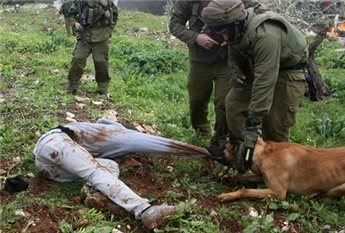 Said Ahmad Safi, Executive Director of the Palestinian Animal League, said in a statement that dogs exported by European countries — especially the Netherlands — have long been used by the Israeli military as “living, breathing weapons — leading to devastating injuries on many civilians.”
Palestinian human rights organization, Al Haq, has reportedly carried out attempts to sway the Dutch government to place a ban on the export of the dogs for such use.
“As a result of communication between Al Haq and the Dutch government, officials in the Netherlands have suggested that they will consider placing restrictions on the export of dogs to Israel, but no firm decision has been reached, nor has any action been taken to date,” PAL said in a statement.
The restrictions would join one of several placed by European countries on trade with Israel, the European Union most recently passing a decision to label products made in illegal Israeli settlements in the occupied West Bank.
Such measures are part of a boycott, divestment, and sanctions movement (BDS) pushed by activists and increasingly by politicians, in effort to place pressure on Israel to stop ongoing violations against Palestinians.
Street art campaign brightens Gaza refugee camp
30 artists attempt to lift spirits in Gaza Strip’s poverty-stricken, war-weary Al-Shati refugee camp
MEMO | December 13, 2015
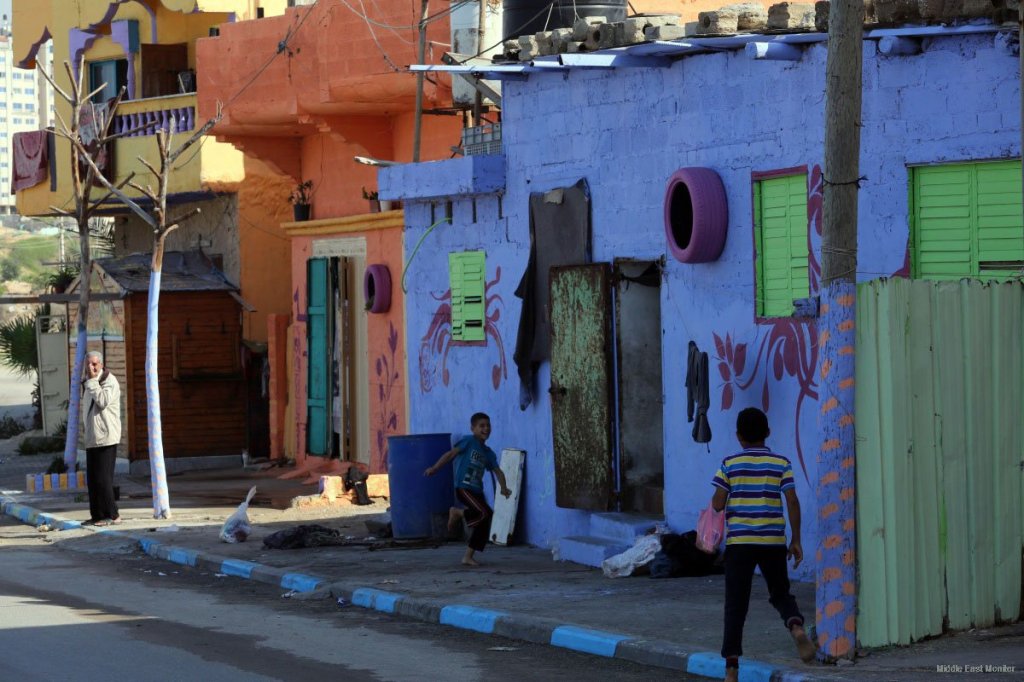
At the Al-Shati refugee camp in the northern Gaza Strip, the streets and walls of many of the homes have been splashed with color by 30 painters in an effort to bring some cheer to an area usually associated with war and poverty.
The “Better Gaza” campaign is aimed at giving the Al-Shati camp – home to some 82,000 Palestinian refugees – a new face by adorning its homes and public spaces with colourful images of trees, flowers and butterflies.
But while camp residents are pleased with the new, cheerful appearance of many of their homes, Al-Shati nevertheless remains haunted by the spectre of poverty and privation.
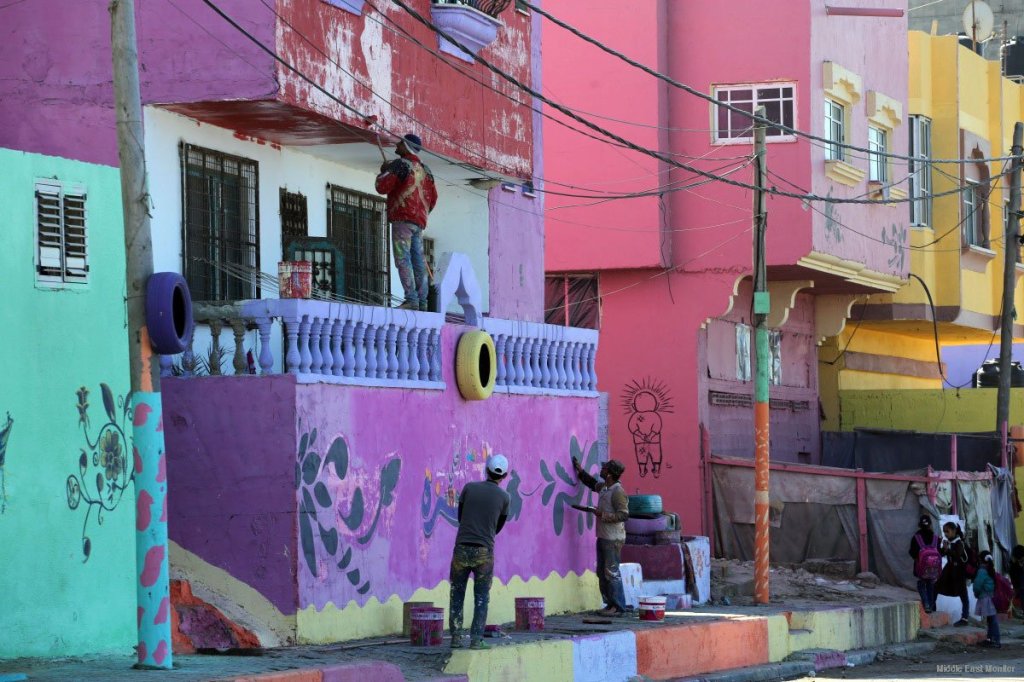
Bahgat Abu Hamad, the father of eight children, likes the cheerful images of orange and purple flowers that now adorn his once-gray home.
“But the pretty paintings will neither improve our deplorable living conditions nor provide me with a job or food for my family,” he laments.
“Our house is colourful on the outside but it remains dark on the inside as we continue to struggle with poverty and our chronically tough circumstances,” says Abu Hamad.
“Nevertheless,” he adds, “the bright and beautiful colours have made many of us happy, especially the children.”
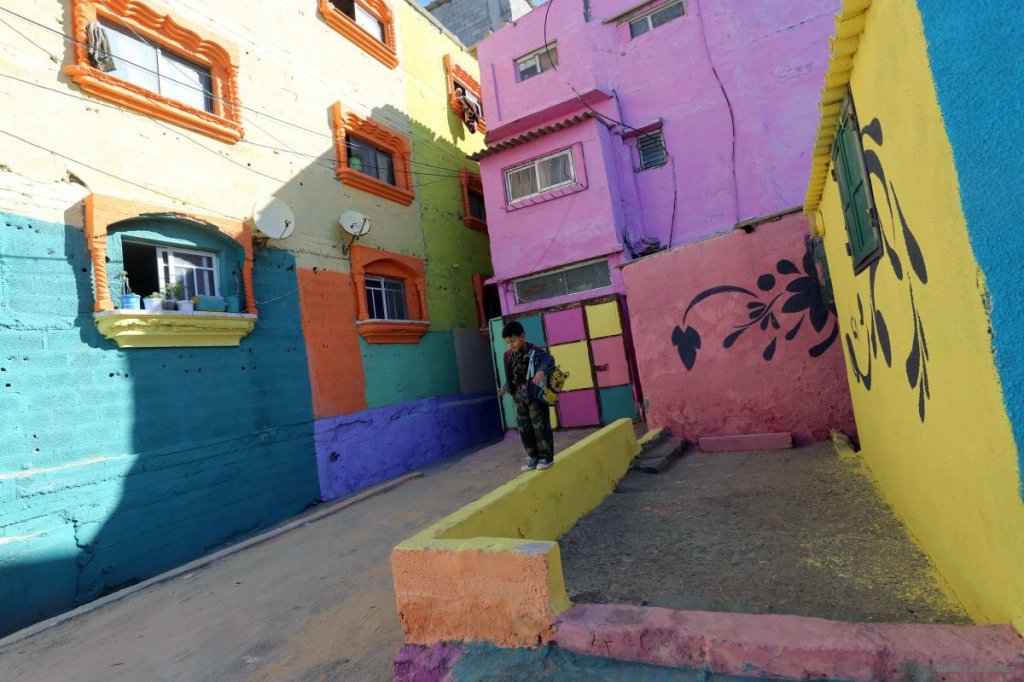
Eleven-year-old Nidal Semir, for one, loves the new paintings.
“I can’t believe how pretty they are,” she said when she first saw the bright flowers and butterflies on the wall of her family home.
Nine-year-old Raed Bekr also loves the new look of his home, but adds, “I wish they had painted the inside of the house as well.”
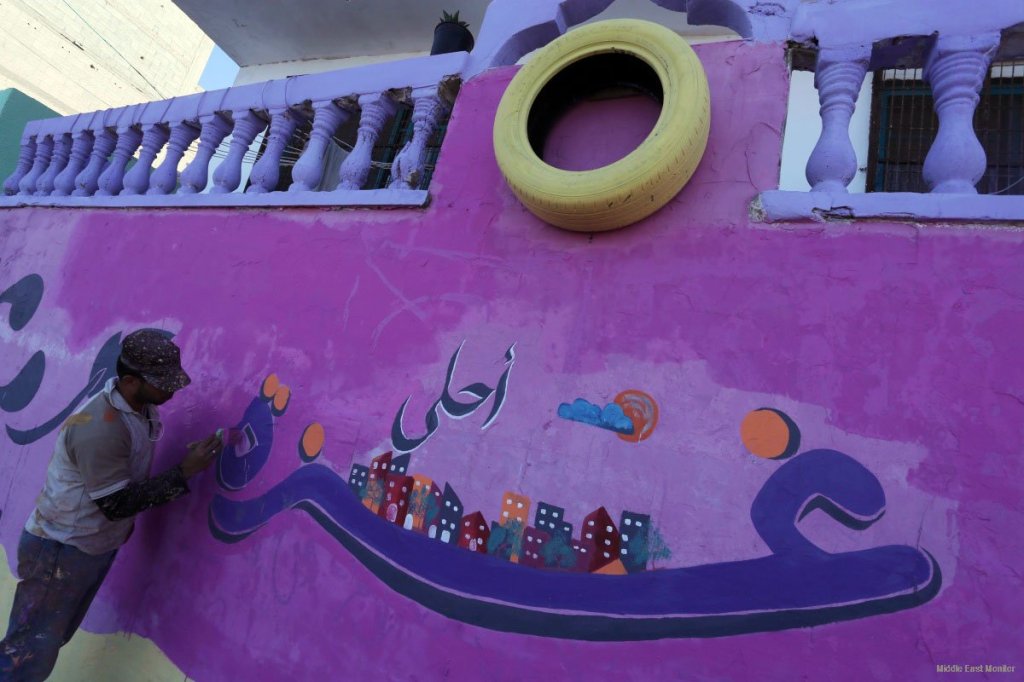
According to campaign coordinator Dalia Abdurrahman, “Better Gaza” aims to revive hope among struggling camp residents who in recent years have had little to smile about.
“The message we’re trying to deliver is that the Palestinians of the Gaza Strip still have a longing for life,” Abdurrahman said.
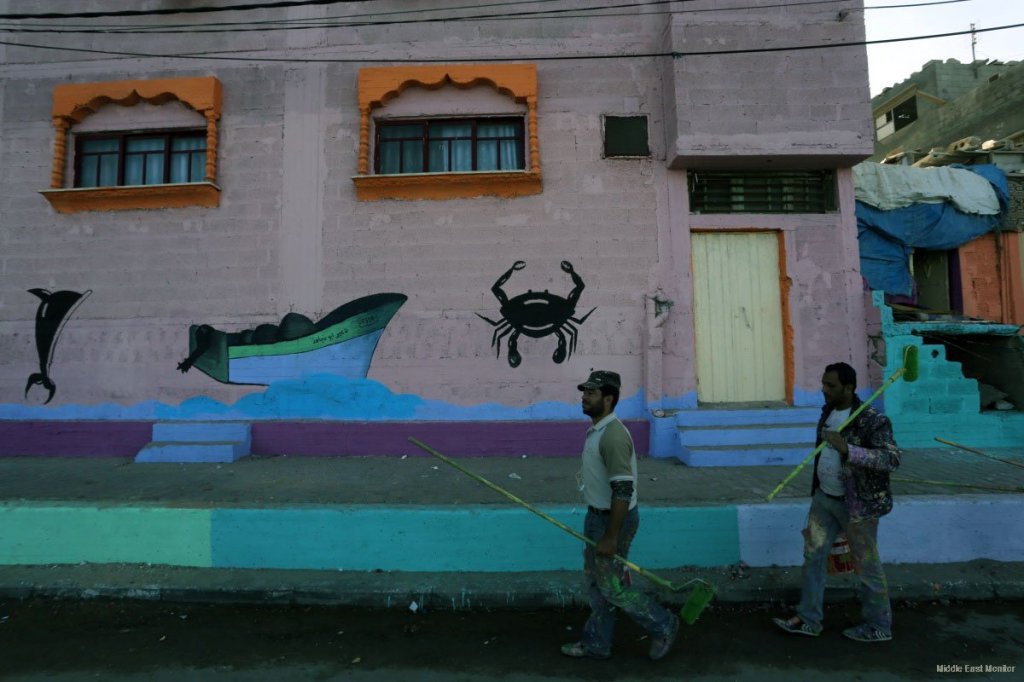
According to a September report issued by the UN Conference on Trade and Development (UNCTAD), the Gaza Strip could become uninhabitable by 2020 if current economic trends — and an ongoing blockade by Israel and Egypt – persist.
In May, the World Bank warned that the Gaza Strip’s unemployment rate had reached a whopping 43 percent – the highest in the world.
News from Anadolu Agency. Images by MEMO Photographer Mohammed Asad.
Israel prevents Tulkarem university from building protective wall
Ma’an – December 12, 2015
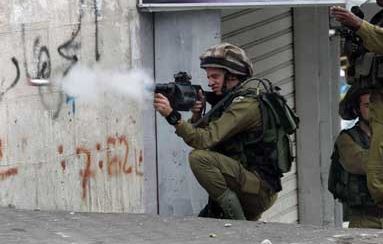 TULKAREM – Israeli forces prevented the administration of Tulkarem’s Palestine Technical University – Khadoorie from building a wall around the campus intended to both protect students and stop clashes, a university administrator said.
A head administrator of the university, Dirar Elayyan, told Ma’an Saturday that Israeli forces prevented the university from erecting the wall, which administrators hoped would prevent non-students from entering the campus.
Following student-organized marches that started in October to protest Israeli violations and raids onto the university campus, campus administrators reported that Israeli forces had positioned themselves at a temporary base on the university’s campus.
Non-students then began to enter the campus and throw stones at the Israeli base, prompting violent clashes that have severely interrupted normal campus life and left several students injured.
The university reportedly began preparations to build the wall to prevent the entrance of outsiders last month, however Israeli forces stopped the construction and confiscated a bulldozer, assaulting workers, Elayyan said.
Violence on the occupied West Bank campus has been near-daily over the past month, with nine students injured by live Israeli fire on Friday alone.
Israel releases Dawabsha arson suspect on house arrest
Ma’an – December 11, 2015
BETHLEHEM – Israel on Thursday released an Israeli settler arrested for suspected involvement in a fatal arson attack on a Palestinian family in July, Israeli media reported.
The settler, connected to a Jewish extremist organization, was arrested along with several others as a suspect in an arson that killed three members of the Dawabsha family in Duma village in the northern occupied West Bank district of Nablus.
The suspect was reportedly released and transferred to house arrest for five days at his home in the illegal Israeli settlement of Benyamin, east of Ramallah city.
The settler, whose name has not been released, is a married father of two.
The man was arrested 12 days ago by the Israeli intelligence and presented to an Israeli court on Wednesday, Israeli media reported. His detention was extended to Sunday, but was unexpectedly released on Friday.
On Dec. 3, Israeli forces announced that they had arrested several Israelis in connection to the Dawabsha arson. The information about the arrests was released after a weeks-long gag order was partially lifted on the investigation.
All other information regarding the investigation is still under a gag order requested by the Israeli police.
Suspects involved in the attack were identified by Israel’s defense establishment in September, but no charges were filed at the time, Israeli daily Haaretz reported.
On July 31, suspected Israeli settlers smashed the windows of the Dawabsha family home before throwing flammable liquids and Molotov cocktails inside.
The words “revenge” and “long live the Messiah” were sprayed in Hebrew outside of the house, immediately indicating that the arson was the work of Jewish extremists.
Ali Saad Dawabsha, one-and-a-half years old, was trapped in the house and burned alive. The infant’s mother and father, Riham and Saad, later died from severe burns.
Orphaned four-year-old, Ahmad Dawabsha, is the only remaining survivor of the attack and remains in the hospital receiving treatment.
The attack sparked criticism from the international community for Israel’s failure to hold Israeli settlers and Jewish extremists accountable for attacks on Palestinians, in effect being complicit in such attacks.
Israeli leadership at the time condemned the Dawabsha attack as “terrorism,” and pledged to bring the perpetrators to justice.
Israeli rights group B’Tselem slammed the reaction by Israeli officials as “empty rhetoric.”
“Official condemnations of this attack are empty rhetoric as long as politicians continue their policy of avoiding enforcement of the law on Israelis who harm Palestinians, and do not deal with the public climate and the incitement which serve as backdrop to these acts,” the group said at the time.
Thursday’s partial lift on the gag-order came one day after the United Nations Special Coordinator for the Middle East Peace Process, Nickolay Mladenov, criticized Israel for the “slow progress” in investigating the arson.
US university says sorry for Palestinian flag ultimatum
RT | December 11, 2015
George Washington University president Steven Knapp has issued an apology to a student who was told to take down his Palestinian flag.
A university campus police officer entered Ramie Abounaja’s room on October 26 and told him to take down the Palestinian flag that he had hanging from his window.
The officer said he had received multiple complaints and that the flag was in violation of the housing code.
Visitors to the university confirmed many other national flags hanging from dorm rooms without being taken down.
A week later, Ramie Abounaja received a warning letter from the university, threatening future disciplinary action, despite the fact he had removed the flag.
“As a member of the larger residential community we hope that you will be respectful of your peers and be aware of your behavior. The act of an individual has a profound impact on the community,” it read.
Unsure of what he was in violation of, Ramie wrote a letter back. In it, he explained his reason for hanging the Palestinian flag: “I was motivated to do this after I had seen dozens of different banners and flags hung outside other residential campus living spaces throughout my three years here at GW. I felt like I was being singled-out, because of my heritage and the viewpoint of my speech, for something I’ve seen dozens of students, fraternities and other student groups do in my three years at GW.”
Civil rights groups called the order a violation of free speech and said the actions pointed to anti-Palestinian sentiment.
Students for Justice in Palestine at GW said: “Flags of other countries hang out of dorm windows with no disciplinary consequence. Selective reinforcement of these rules is discrimination.”
Universities in the US stand accused of cracking down on pro-Palestinian speech, with a high profile example in the state of Illinois where professor Steven Salaita was dismissed after tweeting about Israel’s assault on Gaza in 2014.
The recent Palestinian Exception to Free Speech report revealed intensifying suppression Israeli criticism on campuses: “Israel’s fiercest defenders in the United States — a network of advocacy organizations, public relations firms, and think tanks — have intensified their efforts to stifle criticism of Israeli government policies. Rather than engage such criticism on its merits, these groups leverage their significant resources and lobbying power to pressure universities, government actors, and other institutions to censor or punish advocacy in support of Palestinian rights.”
Palestine Legal responded to 140 incidents and 33 requests for assistance in anticipation of potential suppression in the first 6 months of 2015. 80% of those were aimed at students and scholars.
The report highlights a number of tactics used to quash pro-Palestinian feeling in universities, including academic sanctions.
Northeastern University in Boston suspended a student group the spring of 2014 after members distributed flyers describing Israel’s policy of demolishing Palestinian homes.
Around the same time, San Francisco State University investigated Professor Rabab Abdulhadi for going on a research trip to Palestine after an Israel advocacy group accused her of meeting with terrorists.
Palestinian Legal wrote to George Washington University, demanding they withdraw its warning letter and threat to sanction the student.
University President Steven Knapp said he has apologized to Abounaja and that the student had been subjected to a flawed process: “I have instructed the relevant offices to end the practice of sending warning letters to students solely because of a reported violation of a university policy. I have also instructed them to ensure consistent enforcement of all university policies.”
Extremist Jewish group calls for demolition of Dome of the Rock
Ma’an – December 10, 2015
 BETHLEHEM – An extremist Jewish organization on Thursday invited Israeli right-wing activists to participate in a rally calling for the destruction of the Dome of the Rock, Hebrew-language Israeli news sites reported.
The Temple Institute — dedicated to building the Third Jewish Temple in the place of the Dome of the Rock — organized the rally in an effort to place pressure on the Israeli government to demolish Muslim facilities in the Al-Aqsa Mosque compound, according to the reports.
The rally is expected to start at Zion Square in West Jerusalem before heading to the Al-Aqsa compound where the right-wingers plan to light candles to commemorate the fifth night of Hanukah.
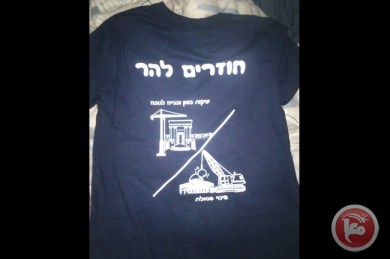
The Temple Institute reportedly distributed dozens of t-shirts calling for the destruction of the Dome of the Rock prior to the rally.
One of the t-shirts handed out displayed an image of a lift carrying the Dome of the Rock with a caption reading “waste removal.”
The Dome of the Rock — located in the Al-Aqsa Mosque compound — is the third holiest site in Islam, and is venerated as Judaism’s most holy place, as it sits where Jews believe the First and Second Temples once stood.
The Temple Institute is one of a handful of extremist Israeli organizations who critics say are gaining traction in Israeli Prime Minister Benjamin Netanyahu’s right-wing government.
Controversial Israeli right-winger Yehuda Glick is a major figure in the Temple Institute, which has reportedly received $600,000 shekels ($155,300) in monetary support over the past five years from Israel’s Ministry of Education.
The figure was released Thursday in an investigation conducted by Israeli daily Haaretz. The report also revealed that Netanyahu’s defense minister, Eli Ben-Dahan, personally donated thousands of dollars to the Temple Institute.
Such extremist groups have created a rift within Israeli society while triggering frustration from Palestinian groups.
Increased numbers of Jewish worshipers touring the compound in September — accompanied by restrictions on Palestinian worshipers — played a major role in triggering a wave of violence across occupied Palestinian territory at the beginning of October.
Many Palestinians fear that Israel is seeking to renege on a longstanding agreement preventing non-Muslim prayer in the compound, although Israeli leadership has denied that this is the case.
On Wednesday evening, a former member of the Jewish Underground — a right-wing group that also plotted for the destruction of the Dome of the Rock — was injured in a drive-by shooting in the occupied West Bank.
Israeli settlers prevent Hebron children from reaching primary school
Ma’an – December 10, 2015
HEBRON – A group of Israeli extremists prevented Palestinian children from going to school in the southern occupied West Bank’s Hebron city on Thursday, the director of the Palestinian Authority’s Ministry of Education Hebron office told Ma’an.
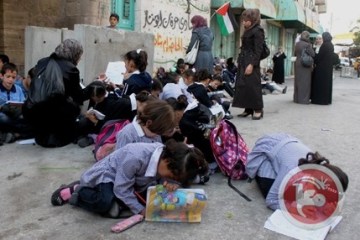 Bassam Tahboub said Anat Cohen, a well-known extremist who frequently harasses Palestinian residents in the area, first “attacked” the school children, “preventing” them from reaching Qurtuba middle school.
Following Cohen’s initial attack, other extremists reportedly joined in and began cursing and scaring the children. Instead of attempting to continue to school, the children decided to turn back and head home, Tahboub said.
Children who attend Qurtuba school, aged 7 to 16, are often harassed by settlers in area, as the school is adjacent to the illegal Israeli settlement of Beit Hadassah in the center of Hebron city.
According to Tahboub, Israeli settlers in the area have continuously attempted to have the school closed down.
Hebron has become the epicenter of recent violence over the last two months, as roughly 30 percent of the 115 Palestinians to be killed since Oct. 1 have been from the Hebron district.
Hebron’s city center is home to some 800 notoriously aggressive Israeli settlers, who live under the protection of thousands of Israeli forces, surrounded by more than 30,000 Palestinians.
Israeli soldiers occupy Palestinian house to set up military base
International Solidarity Movement | December 10, 2015
al Khalil, occupied Palestine – For the last 15 days the family of Abu Shykri Al-Atrarshi have had no access to the top two floors of their house, which was illegally taken over by the Israeli occupation forces and where they set up a military base.

Ten Israeli soldiers suddenly showed up at the house in the neighbourhood of Abu Sheineh, Al Khalil; they broke in by smashing a window in the door, took the key and demanded that the family vacate the third floor. The soldiers did not have any documentation to explain or justify the incursion nor did they give an explanation to the family why their house was being taken over. Any questions are ignored and the third floor as well as the roof top are now off limits.
Since the soldiers arrived they have broken the windows, and shot holes in the water tank which supplies clean water to the household. They then took all the blankets on the premises and used them to dry the water leaking from the tanks. The family also reported that once the water supply was fixed the soldiers contaminated the water and used the apartment and roof as a toilet.
The soldiers never leave the apartment empty, but a few times per day there is a shift change. This happens at different times every day so there is no knowing when, and the soldiers move in and out as they please anyway. This means there can be soldiers moving throughout the building at any time, terrifying the family- especially the young children who no longer dare to leave the house on their own. The soldiers use the roof as a lookout and also frequently fire weapons such as teargas, from there into the surrounding neighbourhood.
The three story house is home to 13 people, now crowded into two small floors- including a young disabled child. They have no idea how long the soldiers will stay, or if the family will get their house back at all. They contacted the local DCO (District coordination office) who advised them to get a lawyer, which they did. The lawyer has now started the process to take the case to an Israeli court in Haifa, Israel. However Abu Shykri Al-Atrarsh has had no information on when the case will be heard or when a judgement can be expected. This, as in many cases, can take months if not years and in the meanwhile the family is trapped. Abu Shakri believes the army is trying to make the family leave the building altogether, but they are resolutely staying put.
This family now has to try to live their life underneath the very people who have broken into, stolen and disrespected their home. The daily struggle of living under the occupation is hardship enough but having your own home taken from under your eyes, and not being able to do anything about it is absolutely heartbreaking.
ISM today took pictures of the soldiers in the building to help the family evidence their presence there, which is needed for the court case. Every time the family has tried to take pictures themselves the soldiers have taken their phones and deleted the pictures.
In The NY Times, Palestinian Dead Are Nameless Numbers (At Best)
By Barbara Erickson | TimesWarp | December 9, 2015
Since the beginning of December at least 10 Palestinians have died at the hands of Israeli security forces. Only one of these deaths has received brief mention in The New York Times; the rest have been deemed unfit to print.
During this same period, no Israelis died from Palestinian attacks, so we can assume this is the reason for the show of indifference at the Times. Israeli deaths in these circumstances usually make headlines.
The recent Palestinian victims ranged in age from 15 to 37. All but one were male, and it was the lone female, Maram Hasouna, who managed to make the news in a story about young women joining the ranks of would-be attackers during the current Palestinian uprising.
The victims include: Ma’moun Raed al-Khatib, 16; Maram Hasouna, 19; Taher Faisal Fannoun, 17; Mustafa Fadel Fannoun, 19; Abdul Rahman Wajeeh Barghouti, 27; Anas Bassam Hammad, 21; Mazin Hasan Ureiba, 37; Omar Yasser Skafi, 21; Malek Akram Shahin, 18, and Ihab Fathi Miswadi, 21.
Security forces claimed that nine of the victims had attempted to attack Israelis. Only one, Shahin, was killed in other circumstances—during clashes that took place when troops invaded Dheisheh refugee camp in Bethlehem.
All of the deaths are newsworthy, but some of the fatalities involved details that add particular news value: Ureiba was a Palestinian Authority intelligence officer; Barghouti was an American citizen; and doctors reported that Shahin was shot in the head with a hollow point bullet, a weapon held to be illegal under international law. None of these factors, however, was enough to rouse the interest of the Times.
Instead, since the first of this month the newspaper has provided us with stories about wine making in Israel, the discovery of a possible ancient model of the Temple of Herod, the arrest of suspects in a fatal arson attack, a look at the risks of banning an Israeli Islamic group, the conviction of two Israeli youths in the killing of a Palestinian teen last year, the conviction of a Palestinian lawmaker and Israel’s attempt to draw Russian tourists.
The 10 who died so far this month are likely to appear as nothing more than numbers in future Times reports. As of today they have brought the total dead since Oct. 1 to at least 113. This compares with 17 Israelis.
Even in reporting this kind of data, the Times makes an effort to obscure the fact that Palestinians are suffering disproportionately at the hands of their well-armed occupiers. In a formulaic explanation for the numbers gap, the Times nearly always blames the victims entirely, saying that Palestinians were killed when they tried to attack Israelis or during violent protests.
Little or nothing will be said of the doubtful cases, in which witnesses dispute the official accounts and video evidence shows that the victims were posing no danger to troops. We can also expect that the Times will fail to mention human rights groups’ charges that a number of the victims were assassinated in “extrajudicial executions.”
The Palestinian dead rarely get their due in the Times, which prefers to consign them to tally sheets. Were they to appear in full context, as human beings with histories and families, this might elicit sympathy for them and condemnation of Israel, and this cannot be allowed.
Follow @TimesWarp on Twitter
Medics: Bethlehem youth shot dead with illegal ammunition
Ma’an – December 8, 2015
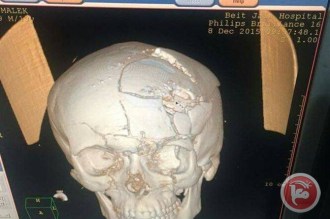 BETHLEHEM – Malik Akram Shahin, 19, who was shot dead by Israeli forces in Bethlehem overnight Monday, was killed by an explosive bullet fired at his head, medical sources at the Beit Jala Governmental Hospital told Ma’an.
Medics said the explosive bullet smashed Shahin’s skull, and exploded inside his head, with the bullet and skull fragments shattering into “hundreds of pieces.”
The sources said the positioning of the shot, as well as the type of bullet used, clearly indicates that Israeli forces shot at Shahin with every intention to kill.
The use of explosive bullets, also called expanding bullets or “dum dum” bullets, is illegal under international law, and considered a crime of war under the 1899 Hague Declaration and the International Criminal Court’s Rome Statute, among others.
The bullets are banned due to the brutal damage inflicted on the victim, as the bullets are made to splinter apart and become lodged, instead of making a clean exit through the body.
Israel has repeatedly denied claims that its forces use such bullets, though Palestinian medical examiners have on occasion documented their use.
Locals told Ma’an that after Shahin was shot, he was “left bleeding for a long time before he was evacuated to the public hospital in Beit Jala, where medics pronounced him dead.”
An Israeli army spokesperson had no information of his death, but said that Israeli soldiers had opened fire after Palestinians threw “pipe bombs and Molotov cocktails” at them.
The left-wing Popular Front for the Liberation of Palestine later said that Shahin had been one of its supporters. The group said in a statement that he fell “during fierce clashes with Israeli troops who raided the camp to detain young men affiliated to the PFLP.”
Following his death, a Bethlehem committee announced a halt to all business across the district and stores and government institutions were closed.
At least 114 Palestinians have now been killed in just over two months of unrest across the occupied Palestinian territory.
In Gaza, another farmer shot by a sniper for working his land
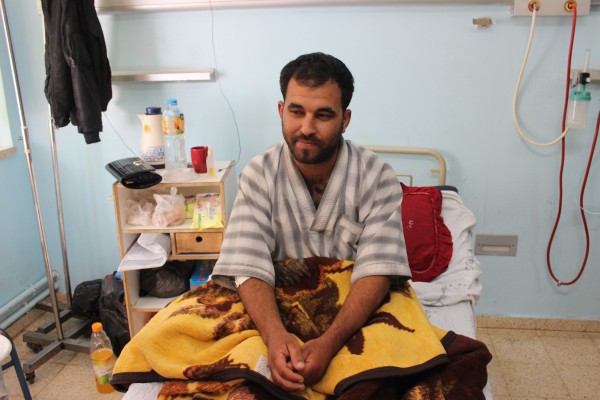
Mohamed Abu Taima, 29, had to undergo two surgeries
International Solidarity Movement | December 8, 2015
Khan Younis, Gaza strip, Occupied Palestine – A week ago Mohamed Abu Taima, 29 years-old and father of a small girl, was working his land 450m from the separation fence when an Israeli sniper shot him. At 4pm, he had arrived to his land in Al Faraheen, Khan Younees, South of the Gaza Strip. He was shot a few minutes after he started to work. The bullet passed through one of his legs and exploded inside the other one.
A few minutes after arriving in the hospital Mohamed underwent a first surgery, and days after a second one. Until now, the doctors don’t know if Mohamed will ever be able to walk properly again.
These kind of attacks have been frequent during the past two weeks. Several farmers were expelled from their lands by the Israeli snipers when they were working or intended to work their lands between 400 and 500m from the fence, meaning outside of the “buffer zone” imposed by the occupation.
Featured Video

The Search for Truth: Charlie Kirk’s Assassination One Year Later
or go to
Aletho News Archives – Video-Images
From the Archives
The 9/11 “Double-Cross” Conspiracy Theory
BY LAURENT GUYÉNOT • UNZ REVIEW • SEPTEMBER 6, 2022
Is it true that “9/11 was an inside job”? Yes, insofar as Israel is “inside” the U.S. But for the 9/11 truthers who have identified Israel as the main perpetrators, “9/11 was an inside job” is at best a half-truth, and at worst an integral part of the Zionist operation, like a secondary flag sewn as a lining under the false flag of Islamism. Victor Thorn (1963-2017) wrote in his book 9/11 made in Israel: The Plot Against America (2011): “In essence, the ‘9-11 truth movement’ was created prior to Sept. 11, 2001 as a means of suppressing news relating to Israeli complicity. . . . The slogan ‘9-11 was an inside job’ was quite possibly the greatest example of Israeli propaganda ever devised.” In milder terms, it is “controlled opposition”.
A genuine truth movement would have pointed to Israel as the prime suspect from the start. From day one, it was obvious who would benefit. … continue
Blog Roll
 Aletho News
- Europe’s mounting social chaos… chickens coming home to roost for proxy war against Russia
- US-Russia Diesel Deal Becomes Massive Defeat for Ukraine
- Hormuz and the Looming Economic Catastrophe
- Dhubab offensive, media blitz and the rapid unraveling of Saudi-backed coalition’s new gambit
- Putin Conveys to Trump Iran’s Vision on Possible Conflict Resolution – Kremlin
- The Search for Truth: Charlie Kirk’s Assassination One Year Later
- ‘Harsh reality’: Iran says France seeks monopoly on power and intimidation, not peace for all
- When Will This White House Madness End?
- Huckabee aide goes to ‘unusual lengths’ to portray ‘Israel’ positively
- Trump Announces Diesel Supply Deal With Putin Following Phone Call
- If Americans Knew
- Israeli forces kill another child in Gaza – Daily Update
- Gaza ceasefire exists in name only, say more than 100 organizations
- Nearly 2 Million in Gaza Need Urgent Shelter Assistance as Winter Looms: IOM Chief Warns
- Suppressing Palestinian resistance: US charity under fire for AI monitoring of Gaza classrooms
- Thousands Are Held in Israeli Torture Camps. This Is What Happens Inside
- Israel puts Gaza’s sick, injured, newborn in peril – Daily Update
- Report claimed Mark Levin used by Israeli government to influence Trump
- Over 2,000 Gazans have died awaiting medical evacuation amid Israel’s continued siege
- How a U.S. Diplomat Suppressed and Altered Reports Critical of Israel
- 5 Palestinians Die from Israeli Strikes in Gaza as Relentless Attacks Continue
- No Tricks Zone
- New Study: 50 Years Of The Most Aggressive ‘Net Zero’ Policies Can Only Affect The Global Climate By 0.03°C
- US September “Heat” Was No Record…Many Records Set Decades Ago
- Latest European Green Energy Debacle; Portugal’s Largest Flagship Solar Park Insolvent!
- Green Energy Debacle: German Expert Professor Fritz Vahrenholt Warns Of Severe Economic And Social Consequences
- Two More Paleo Reconstructions Affirm Meters-Higher Sea Levels Across Ireland, Brazil 7000-6000 Years Ago
- New Study: Earth And Venus Surface Warmth Largely Explained By Convection And Lapse Rate, Not CO2 Or Radiation
- 2025 Nature Paper Claiming Worsening Global Drought Gets RETRACTED …Heavily Flawed
- New Study: ‘Global Drought Shows No Detectable Recent Acceleration Under Climate Warming’
- Economic Masterminds: German Socialists Suggest Taxing Productivity Gains Stemming From Using AI
- The South China Sea Has Not Been Cooperating With The Climate Change Narrative

