Israeli forces evacuate Palestinian families for military drill
Ma’an – August 30, 2015
TUBAS – Israeli troops on Sunday morning evacuated 14 Palestinian families from their houses in the al-Ras al-Ahmar area of Khirbet Atuf village east of Tubas in the northern Jordan Valley area of the West Bank, local sources said.
Local sources reported that the “Israeli occupation” told the 14 families that Israeli forces will be carrying out military drills in the area for five days.
During the five days of military exercises, Palestinian residents in the area will be evacuated for six hours every day, local sources told Ma’an.
The evacuation was done under the argument that evacuating protects residents.
Earlier this year military drills in Tubas resulted in a fire that swept across some 3,000 to 4,000 dunams (750 to 1,000 acres) of Jordan Valley farmland.
The majority of the Jordan Valley is under full Israeli military control, despite being within the West Bank.The district of Tubas is one of the occupied West Bank’s most important agricultural centers.
According to the Applied Research Institute of Jerusalem, more than 15,000 dunams (3,700 acres) of land in the Tubas district have been confiscated by Israel for military bases with a further 8,000 dunams (2,000 acres) seized for illegal Israeli settlements.
Continual harrassment, threatening and intimidation of Palestinian family by settlers in Hebron
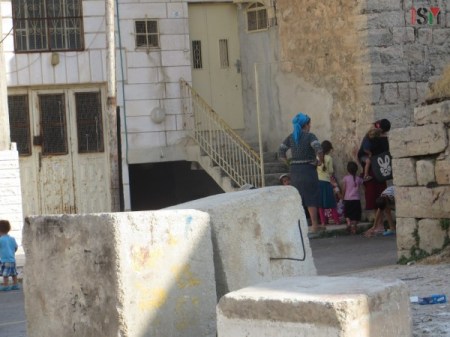
Settler women with their children blocking the stairs to the Abu Rajab house
International Solidarity Movement | August 30, 2015
Occupied Palestine – The Palestinian Abu Rajab family in the occupied West Bank city of al-Khalil (Hebron) is facing continual intimidation by groups of settlers and Israeli forces protecting these settlers in their attempts to take over the Abu Rajab family home.
In the last few weeks, settlers from the nearby illegal Israeli settlements on various occasions have camped outside the home under the protection of the Israeli forces, leaving the family confined to the house not able to leave fearing attacks by settlers as well as settlers taking over the rest of the house.
In March 2012, a group of settlers from illegal settlements within the city broke the gate of the house and occupied the two upper floors of the house at night-time during Passover. Afterwards the settlers claimed to have legally bought the house, a claim that until now could not be proven legit by an Israeli court. Until the final decision of the court, the Abu Rajab extended family is not permitted to use that part of their home. The same year, one of the sons, in his early twenties, was arrested and put in administrative detention (detention without charges or trial) for a year.
When in September 2013 an Israeli soldier was shot in the neighbourhood of the Abu Rajab house, the Israeli Prime Minister Benjamin Netanjahu promised the settler movement that they would be allowed to move back into the house.
Since the beginning of this year, the threats and attacks by settlers on the family have increased. A month ago, during Passover, settlers again tried to move into the house. Instead of protecting the family from these repeated and unlawful attacks, they threatened the family to leave the house. Since then, settlers again and again camp or even sleep outside the families’ home. On Monday and Tuesday, small groups of settler women with their children have been blocking the stairs to the house’s door all afternoon. The children, all under eight years old, were instrumentalised by their mothers as they are too young to understand what was going on. Palestinian children playing nearby the house were forced by soldiers to leave the area.
US passports scoffed at by Israel; US stands by
By James Zogby | The Hill | August 24, 2015
Last year, some members of Congress attempted to pass legislation that would admit Israel into the U.S. Visa Waiver Program. The State Department pushed back, noting that because of Israel’s long history of discrimination against Americans of Arab descent, they do not meet the program’s key requirement of reciprocity.
Congress relented and instead passed a Sense of Congress that stipulated that should Israel meet this requirement, they could be included in the Visa Waiver Program. In a sense, they were put on probation.
In the past year Israel has continued to demonstrate that it has no intention of ending their practice of discriminating against persons of Arab descent. My office has received new reports of shameful treatment meted out to Arab Americans on their arrival in Israel. Two cases, in particular, deserve to be noted.
After landing at Ben Gurion International airport, George Khoury, 70, and Habib Joudeh, 62, were detained for long hours, subjected to abusive interrogations, insulted by Israeli security personnel, and finally denied entry and forced to purchase, at their own expense, return tickets to the United States.
George is a professor and a deacon of his church from San Francisco. Habib is a pharmacist and respected community leader from Brooklyn. Both are American citizens of Palestinian descent. George was traveling to the Holy Land on a pilgrimage. Habib was on his way to attend a family wedding in the West Bank. Neither had been back to Israel/Palestine in more than 20 years. And neither was able to complete their journey.
While no American should be subjected to such treatment, the most disturbing element of these cases is the reason they were denied entry and deported. Because both men were of Palestinian descent, Israel would not honor their U.S. passports or recognize the men as American citizens. Both were told they had to acquire Palestinian IDs and then, as Palestinians, enter the West Bank through Jordan.
George’s case is especially instructive. When the Israeli border control agent told him that he could not enter Israel, George attempted to engage the agent saying, “I’m coming as an American citizen.” To which the agent replied “No, no, you belong with the Palestinian people. This is our Israel, this is for the Jews. No Palestinian should come to Israel. You should have gone through the Allenby Bridge.”
When George explained that “I am coming with an American passport and you should honor it,” the agent replied, “How do you want me to honor your American passport? Do you want me to kiss it, to hug it, or to worship it?”
What happened to Habib and George were not the actions of a few rogue agents. For more than three decades, the Arab American Institute has submitted to the State Department hundreds of instances where Arab Americans have been subjected to such treatment at Israel’s borders.
By so flagrantly disregarding the citizenship rights of Americans of Arab descent, Israel is in violation of its treaty obligations found in the “1951 US-Israel Treaty of Friendship, Commerce, and Navigation.” In the language of the treaty, Israel pledges to permit U.S. citizens the right to “travel freely, to reside at places of their choice, to enjoy liberty of conscience” and to guarantee them “the most constant protection and security.”
Not only has Israel consistently violated its treaty obligation, but our government has failed to live up to its commitment to protect the rights of its own citizens. The opening page of the U.S. passport states that “The Secretary of State of the United States of America hereby requests all whom it may concern to permit the citizen/national of the United States named herein to pass without delay or hindrance and in case of need to give all lawful aid and protection.”
The Department of State says that it does not condone Israel’s treatment of Arab Americans. In reality, despite denying Israel’s admission into the Visa Waiver Program, the State Department appears to acquiesce to Israel’s behavior.
When George Khoury’s daughter wrote a letter of complaint to the U.S. Embassy in Tel Aviv, she received a response saying “Unfortunately, the US government cannot assist US citizens in gaining entry into Israel… Should your father wish to travel again in the future, we advise him to contact the nearest Israeli Embassy or Consulate for guidance.”
The U.S. official then directed her to the Department of State “Travel Advisory” which states that “regardless of whether they hold US citizenship, Israeli authorities consider anyone who has parents or grandparents who were born or lived in the West Bank or Gaza to have a claim to a PA ID.” They will, therefore, be treated as Palestinians and not as Americans.
It is upsetting that both the Department of State “Travel Advisory” and the Consul’s letter acknowledge Israel’s disregard for our citizenship rights and claim to be powerless to hold them accountable for their actions. This acquiescence allows Israel to act with impunity. It also makes our government appear to be complicit in Israel’s behavior.
More must be done. Israel cannot be allowed to disregard the citizenship rights of Americans or to unilaterally define persons of Arab descent as second-class American citizens. The Department of State and our elected representatives should demand that the Israeli government fully live up to its treaty obligations to treat all Americans equally without regard to their religion or national origin.
This is not merely a matter of denying Israel Visa Waiver privileges, it is a question of whether or not our government will guarantee Arab Americans the equal protection to which they are entitled and which they deserve.
Zogby is president of the Arab American Institute.
Why We Should Be Concerned About Christian Zionism
Christian’s United For Peace:
This is a letter from a Palestinian Christian to the news director and lead anchor of EWTN News, the news division of the Eternal Word Television Network, a Catholic broadcast network with Zionist leanings.
Dear Raymond Arroyo,
I was watching your world over segment last night on EWTN and I had some concerns. My name is Mary. I’m a conservative Catholic from Bethlehem, Palestine.
I know you didn’t think we existed – don’t worry, you’re not the only one.
Besides, Israel propaganda does a great job making sure people think Palestinians only consist of mean crazy Muslims fighting the innocent virtuous God chosen people.
I couldn’t help but notice you were one of them, which struck me as very odd considering you work for a religious channel not political, and even if you yourself had your biases it should not be portrayed on your show.
Let me clarify some things if I may, sir. I have three cousins that are priests an uncle who is a Bishop look them up Bishop William Shomali, Fr. Ibrahim Shomali and Fr. Issa Shomali.
My mother lived in Rome for ten years, she almost got ordained to become a nun.
Yes we are pretty conservative and we are proud of our faith. Growing up in occupied Palestine just made our faith even stronger.
Watching on a daily basis Israeli jeeps with huge rifles sticking out from the back of the jeep threatening to shoot us at any moment just because we happened to live on the wrong side of town.
On the way to my St Joseph all-girls Catholic school I saw them making dirty comments, staring me in the face, mocking me.
I saw them shoot little children because they threw rocks at them, and sometimes for absolutely no reason.
In my peaceful town of Beit Sahour, mostly Christians, the first boy to get killed by Israelis was 16 years old.

He was walking home from the store when Israeli soldiers dropped a huge rock on his head from the top of a building and watched him crawl home bleeding until he died at the front steps of his home. He was Christian, he did nothing to them.
Yet you don’t feel any sympathy for him. The second boy was at home in the kitchen watching his mom making fries.
An Israeli settler — you know, those guys who built a home illegally on Palestinian land and are armed — shot him through the window and killed him in front of his mom.
His name was Salam, it means peace. He was a Christian, not involved in anything. Yet you wouldn’t feel any sympathy for him because he’s not Jewish.
I can go on and on and on about how Israel was created, the wars literally kicking people out of their homes and moving in them, the massacres.
The times when they would put the whole town on house arrest, which means we can’t leave the home or look out the window. It would take weeks sometimes.
We are Christians and yet you wouldn’t feel any sympathy for us. When they would set us free they would shout in the microphone in their jeeps “home arrest is off you dogs and cows and donkeys”. And yet it’s all justified.
One time a Christian nurse from my home town took home a young boy who was wounded by Israeli soldiers. He was involved in a protest against occupation and must have thrown a rock at one of the jeeps (oh the horror!)
The soldiers went to her home, and arrested and imprisoned her for years for treating a wounded boy; how dare she!!
And when the town had many protests to free her they released her to Jordan and she was never allowed back to her home. And yet we are the terrorists and you have no sympathy for us.
My ancestors come from that land back in the days when people lived in caves even.
What if we are the original Christians that followed Jesus 2000 years ago — wouldn’t we have the same right to live there in dignity and yet we have none.
And you don’t care. We will continue to carry the cross proudly on our shoulder and suffer, we will continue to pray for our enemy and for peace.
We will not hate, we will only tell the truth. This is what our Bible teaches; you should try doing the same. Peace be with you my friend.
Love, Mary Alshomaly from the Holy Land of Jesus
Two people violently arrested at peaceful demonstration in Nabi Saleh
International Solidarity Movement | August 28, 2015
Occupied Palestine – On Friday the 28th of August 2015, two peaceful demonstrators were violently arrested and a child viciously attacked by Israeli soldiers in the Palestinian village Nabi Saleh in occupied Palestine. Every Friday the people of Nabi Saleh protest against the illegal settlement build on the villages’ land.
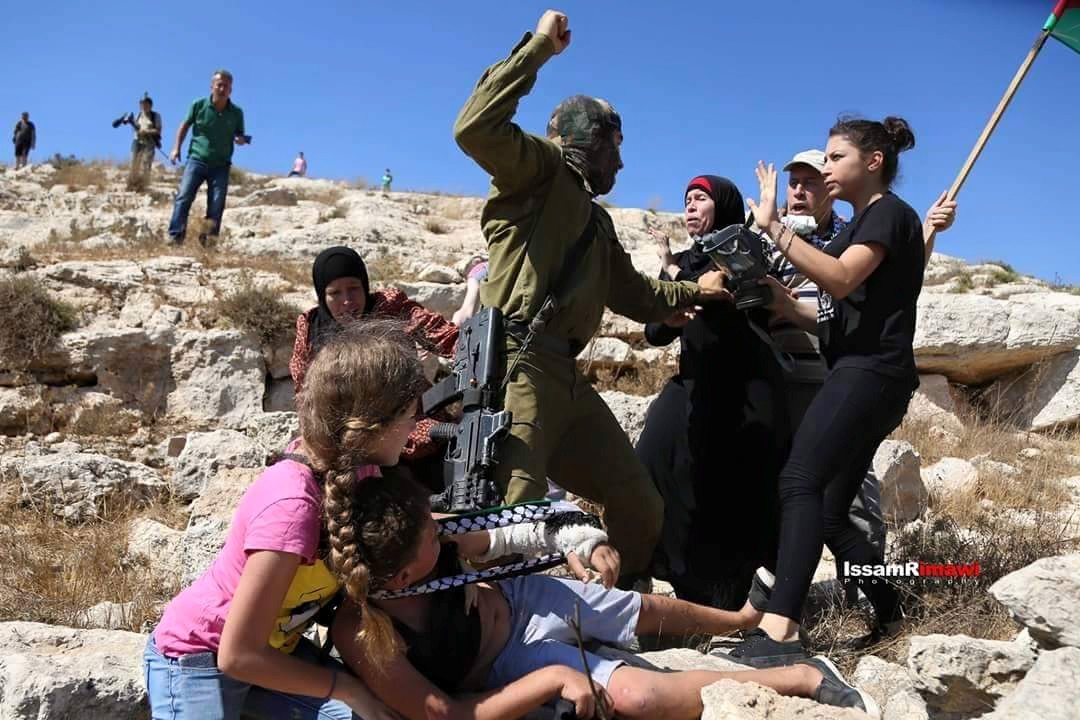
Israeli soldier threatening Palestinian women and children at non violent demonstration in Nabi Saleh. Photo credit: Karam
Today at around 3 pm one Palestinian male, Mahmoud Tamimi, and one international activist were arrested in the Palestinian village Nabi Saleh close to Ramallah. They were arrested during a Friday demonstration against the illegal settlements on the land belonging to the people of Nabi Saleh.
Only a few minutes after the protesters peacefully started their march towards the gate, which is regularly blocked by the military preventing any movement in- or outside of the village, the Israeli army began attacking the non-violent protesters with dozens of rounds of tear gas.
The soldiers then ambushed the demonstrators escaping the clouds of tear gas by surrounding them. They attacked and then arrested Mahmoud Tamimi, shoving him down the hill towards the illegal settlement, where he was forced to lie on the ground.

Israeli soldier strangling a Palestinian boy at non violent demonstration in Nabi Saleh. Photo credit: Karam
Around the same time, a Palestinian boy was violently attacked by a soldier throwing him to the ground, choking and almost suffocating him in the process. “While the boy was screaming in pain his family came to rescue him from the soldiers’ vicious assault”, Josephine, a Danish activist explains.
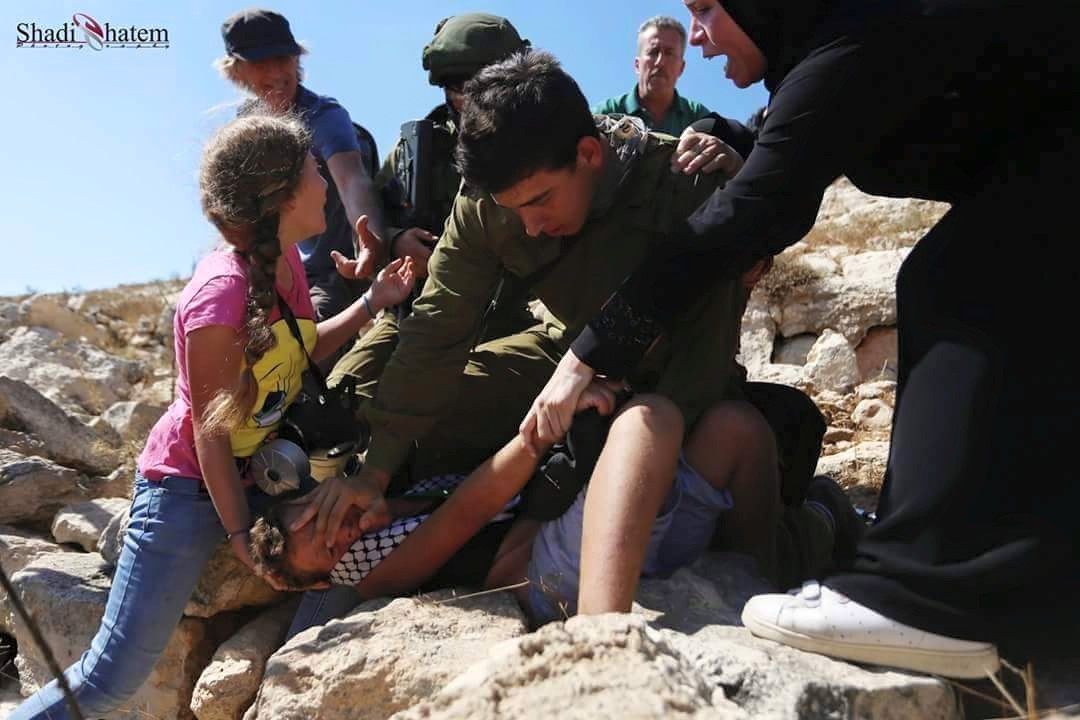
Israeli soldier attacking Palestinian boy at non violent demonstration in Nabi Saleh. Photo credit: Karam
A group of peaceful international demonstrators trying to document the attack on the boy, was ambushed by another group of soldiers, who violently pushed a 31-year old Italian man to the ground and proceeded to arrested him.
Both the Palestinian and the international were being held captive in a military jeep by the Israeli army for almost nine hours, before being brought to a police station.
Protesters march against Israeli takeover of Bedouin village
Ma’an – August 27, 2015
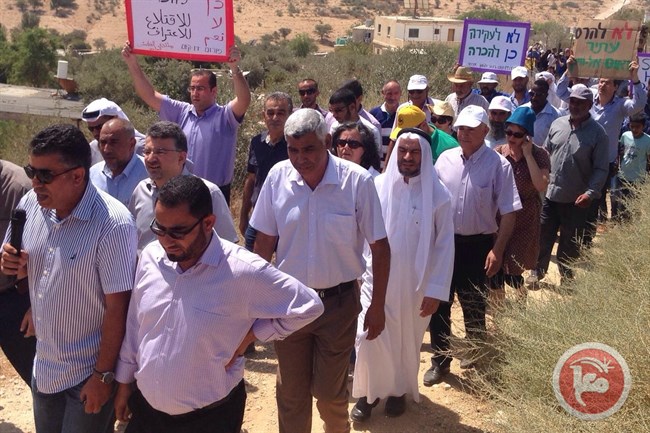 NEGEV – Dozens of Palestinians protested Thursday in the Bedouin village of Umm al-Hiran near the town of Hura in the Negev, as Israel’s construction of a Jewish town on the village’s land continues, local sources said.
The Umm al-Hiran community — around 700 strong — is unrecognized by the Israeli government and residents’ lands were claimed by the state in 2013 in order to make way for the expansion of the Beersheba metropolitan area.
As a march set off from the village and moved towards the site of construction, protesters said they were able to force Israeli police to remove the bulldozers from the area.
Leaders and members of national and Islamic parties, Palestinian members of the Knesset, members of committees for Palestinians in the Negev, and Jewish-Israelis took part in the march.
Sources told Ma’an that the contractor responsible for razing the village is a Palestinian citizen of Israel from the Negev, and locals have condemned the use of Palestinian contractors against their people by the Israeli authorities.
Participants of Thursday’s demonstration called for launching an international media campaign in support of Umm al-Hiran and other villages threatened with land confiscation in order to pressure Israeli authorities to stop longstanding policies to displace Palestinian Bedouins.
Umm al-Hiran residents are a fraction of the thousands of Bedouins living in villages that the Israeli government does not recognize and are at risk of displacement in the Negev due to Israeli policies that critics argue amount to ethnic cleansing.
The community’s residents appealed their displacement in court earlier this year on the grounds that the Israeli military administration ordered the community to be moved to the area in 1956, but the appeal was rejected.
On Sunday, Israeli excavators began work on infrastructure for the Jewish-only town in Umm al-Hiran, building a new road under heavy protection of Israeli forces, locals told Ma’an at the time.
Knesset Member Talab Abu Arar described the Israeli move as racist.
“Racism has become crystal clear in Umm al-Hiran as a Jewish settlement Hiran is being built on the ruins of the Arab Umm al-Hiran village,” Abu Arar told Ma’an on Sunday.
He added that Israeli courts and authorities ignored the rights of Palestinians and worked towards confining them to a few recognized towns and denying their rights.
Israel renews ’85 percent’ of administrative detention orders
Ma’an – August 28, 2015
JERUSALEM – Israeli authorities have renewed the administrative detention of 85 percent of Palestinians detainees held under the policy, a prisoner rights group said Friday.
The Prisoners’ Center for Studies said that at least 75 of the 480 Palestinians held under the detention without trial policy have had their sentences — which range from two to six months — renewed four times in a row.
The detention of 135 detainees has been renewed three times in a row while 190 Palestinians have had their sentences renewed twice, the center added.
Israeli military courts have issued 726 administrative detention orders in 2015 alone, including first time sentences and renewals, the group said, over 340 of which were issued to Palestinians from the Hebron district in the occupied West Bank.
Riyad al-Ashqar, a spokesperson of the Prisoners’ Center for Studies, said Israel is keeping Palestinians as political hostages through the policy of administrative detention.
Most detainees held under the policy, which dates back to the British Mandate, are held on secret evidence and are not aware of the reason for their detention, which can be renewed indefinitely in six-month periods.
In 2012, over 2,000 Palestinian prisoners went on hunger strike to protest administrative detention, one of the only means available to Palestinians to challenge the policy.
Last week, Palestinian detainee Muhammad Allan ended a two-month hunger strike which he began to protest his detention without trial. An Israeli court ruled to lift his administrative detention due to his deteriorating health.
While administrative detention is legal under international law in exceptional circumstances, the international community and rights organizations have condemned excessive use of the practice by Israel.
Bernie Sanders’ Conservative Foreign Policy

By Margaret Kimberley | Black Agenda Report | August 26, 2015
It is obvious that Bernie Sanders functions as the political “sheepdog” of the 2016 presidential election. The sheepdog makes certain that otherwise disillusioned Democrats are energized enough to stay in line and support the eventual candidate, in this case Hillary Clinton. That is reason enough to oppose his campaign but it isn’t the only one. A hard look at Sanders on foreign policy issues shows that he is a progressive poseur, a phony, a conservative Democrat, and not a socialist by any means.
The Sanders website looks like every other candidate’s with a bio, donation information and of course “Bernie on the issues.” But it seems that Bernie doesn’t have any opinions on foreign policy because they are nowhere to be found. How can he be a serious presidential contender if he doesn’t discuss foreign policy? How does he differentiate himself from Hillary Clinton or Republicans if he won’t state for the record how his foreign policy differs from theirs? The truth is obvious. He isn’t a serious contender and his foreign policy views are no different from those of the other candidates.
Sanders’ candidacy is as grave a danger to the rest of the world as that of his rivals. In no way does he challenge the belief that the United States has the right to determine the fates of millions of people without regard to their human rights. He doesn’t believe that other nations have the right to oppose what the United States chooses to impose upon them.
Sanders makes quite a big deal about voting against the invasion of Iraq in 2002 and says he wants United States troops to leave that nation for good. But he never says that this intervention was wrong. He never said that the United States had no right to destroy that country or kill its people. He never said that these interventions are war crimes and violations of international law. Instead he speaks of the efficacy of particular interventions and how they impact Americans.
A presidential campaign should be an opportune moment to say that the Islamic State, ISIS, is a creation of the United States. Instead Sanders repeats that the United States must defeat this force but he only differs slightly in saying that he wants the Saudis to spend their money doing it. “I’ll be damned if kids in the state of Vermont – or taxpayers in the state of Vermont – have to defend the royal Saudi family, which is worth hundreds of billions of dollars.” That mealy mouthed opinion does nothing to end the premise of an American right to do what it wants anywhere in the world. Imagine if Sanders was willing to talk about support for jihadists going back nearly forty years and how each one delivers a more terrifying result.
In 2011 Obama was bombing Libya and planning to kill its president but Sanders didn’t see it as being particularly problematic. He repeated almost verbatim the rationales that assassinated a president and destroyed a nation. “Look, everybody understands Gaddafi is a thug and murderer. We want to see him go, but I think in the midst of two wars, I’m not quite sure we need a third war, and I hope the president tells us that our troops will be leaving there, that our military action will be ending very, very shortly.” Libya’s obliteration was no problem for Sanders as long as the process didn’t take very long.
In 2015 the Bernie Sanders foreign policy still does not digress from American political orthodoxy. He doesn’t question American policy towards Russia. “Well you totally isolate him [Putin] politically. You totally isolate him economically.” “Freeze assets that the Russian government has all over the world.” At no time did Sanders oppose the American policy of intervening in Ukraine and expanding NATO in eastern Europe, the actions which created the current confrontation with Russia. He doesn’t question why the United States has the right to dictate policy to another nation or interfere in its sphere of influence.
Sanders supports the Iran nuclear energy agreement with the P5+1 nations, but issues the same dishonest rationales about it expressed by president Obama. Sanders doesn’t say that Iran was never a nuclear power, an easily provable fact. He doesn’t question the sanctions which forced Iran to the table or point out that the 25 years of inspections called for in the agreement are a violation of Iran’s sovereignty. Instead he repeats the discredited mantra that the United States must make war in order to prevent Iran from becoming a nuclear nation when even the CIA said that it never had that capability.
The big elephant in the room, Israel, gets the standard Bernie Sanders treatment. When Israel killed 2,000 people in Gaza in 2014 he would only say that Israel “over reacted.” He didn’t like being questioned about his stance either. When protesters interrupted a speech he told them to shut up and repeated nonsense about Hamas missiles that rarely hit their targets while Israel massacred a civilian population.
When Sanders speaks out against American interventions he couches his opposition in terms of spending money at home instead of abroad. That is somewhat admirable, but there is no reason to cut the defense budget as he says he wants to do, if there is no change in how this country attempts to dominate the rest of the world.
The Sanders campaign may be an interesting footnote, but it won’t bring about needed conversation about United States imperialism. The supposedly socialist senator never even uses that word. There is blatant dishonesty in claiming to want a changed domestic policy in the United States without also changing foreign policy. The two are linked, and American workers can’t have a living wage or health care as long as imperialism goes unchecked. Liberals can’t claim superiority to followers of Donald Trump if they consent to war crimes and human rights violations. Their only requirement seems to be that Democrats ought to be in charge of the carnage. Sanders wouldn’t be a very good sheepdog if there weren’t so many willing sheep.
Margaret Kimberley can be reached via e-Mail at Margaret.Kimberley(at)BlackAgendaReport.com.
Israeli troops ‘steal money, jewelry’ during detention raid
Ma’an – August 26, 2015
NABLUS – A Palestinian father said Wednesday that Israeli soldiers stole money and jewelry from his family home when they detained his son in a predawn raid in the the northern West Bank village of Salem east of Nablus.
Nasim Hilmi Karaki, a lieutenant colonel in the Palestinian Authority national security forces, told Ma’an that Israeli special forces stormed his house around 1:00 a.m. after blowing up the main door.
Large numbers of troops ransacked the house as they inspected rooms using metal detectors and police dogs, Karaki said, adding that they blew up the doors of three rooms inside the house.
He said that the operation lasted until around 5:00 a.m., during which Karaki was cuffed and forced to stay with the rest of the family in one of the rooms.
The soldiers then detained Karaki’s 18-year-old son, Hilmi.
Karaki said that the troops were searching for firearms but were unable to find any.
However, after they left, he said he discovered that they had stolen 21,000 shekels and his wife’s jewelry, worth around 2,000 Jordanian Dinars (about $2,820).
An Israeli army spokeswoman said she was looking into the incident.
Karaki’s son was one of 31 Palestinians detained by Israeli forces across the occupied West Bank overnight Tuesday.
Israeli forces routinely detain Palestinians throughout the occupied West Bank and East Jerusalem, often on the pretext of perceived security threats.
Palestinians often report theft by Israeli forces during such raids. During a detention campaign Operation Brother’s Keeper in the summer of 2014, Israeli forces confiscated an estimated $2.9 million worth of cash and property from Palestinian homes, charities, and businesses according to a report by Geneva-based human rights organization Euro-Mid Observer.
Spokespeople for the Israeli government justified confiscations during this time by claiming their planned use to fund or support terrorism.
The Euro-Mid Observer reported, however, that Israeli authorities neither provided evidence nor judicial permission for the confiscations.
As Gaza Lies in Ruins, The NY Times Blames the Victims
By Barbara Erickson | TimesWarp | August 24, 2015
Israel’s attacks on Gaza ended a year ago, but the strip remains an expanse of rubble and devastation. Who’s to blame for this outrage? The New York Times has an answer: everyone but Israel.
Jodi Rudoren comes up with this response in a story that aims to whitewash Israel’s brutal treatment of Gaza by blaming the Palestinian victims along with the international community for the lack of rebuilding. It is all summed up in the story’s subhead, “Political Infighting and Lack of Funds Stymie a Reconstruction Mechanism.”
Her article takes pains to present the process as a collaborative project between the Palestinian Authority, Israel and the United Nations, and she is hazy about Israel’s role, describing it as nothing more than “involvement in approving projects and participants.”
Rudoren furthers her efforts in a single paragraph that absolves Israel completely: “[The Palestinian minister of housing], other Palestinian leaders and United Nations representatives all said that Israel had done its part in reasonable time and allowed cement into Gaza. Empty coffers, they said, are the primary problem.”
Times readers, however, never learn the direct quotes or the names of the “leaders” and “representatives” that would help substantiate this claim, nor does Rudoren explain what “Israel’s part” actually refers to here.
In fact, Israel controls everything that goes into Gaza, from people to foodstuffs to building material, and the agreed-on process for rebuilding the strip—the “reconstruction mechanism” referred to in the subhead—is built solely on Israeli demands. (Israel also blocks Gaza traffic by sea and has the full cooperation of the Egyptian government on that border as well.)
Although the United Nations and the Palestinian Authority have roles in the process, Israel determines who gets building materials, what they get and in what amounts. As Harvard-based Gaza expert Sara Roy notes, the two major documents outlining the reconstruction process “read like security plans, carefully laying out Israeli concerns and the ways in which the United Nations will accommodate them.”
Roy adds, “Israel will have to approve all projects and their locations and will be able to veto any part of the process on security grounds.” Moreover, she writes, “No mechanism for accountability or transparency will apply to Israel.”
Without doubt, Palestinian bureaucracy, donor fears of yet another attack on Gaza and other factors come into play in reconstruction efforts, but Rudoren ignores the major element, which is the Israeli blockade.
Her story, in fact, never refers to the eight-year blockade of Gaza and makes only vague mention of Israeli “control” of the enclave. Readers are left without any relevant context.
Rudoren’s article also omits other details that would place Israel’s role in a different light: the fact that by July of this year it had allowed the passage less than 1 percent of the construction materials needed to adequately house Gaza residents or that as of May, a total of 20 schools (kindergarten to college level) completely destroyed by Israel had yet to be repaired.
Readers never learn, for instance, that aid agencies in Gaza were forced to rely on temporary building materials as the Israeli-mandated process kept concrete, cement and steel supplies to a trickle. They also never learn the sequel to this chapter: that Israel stepped in to squelch the effort just as it was gaining momentum.
The project was run by Catholic Relief Services, which began using lumber to build temporary homes for the displaced residents this year, and media reports in February and March stated that 70 had been built and 40 families had moved into the new houses. CRS had plans to construct more than 100 additional wooden homes, but in April the program came to an end when Israel suddenly banned all lumber for housing.
Here we can see how Israel actually operates in the opaque rebuilding process mentioned in Rudoren’s piece. Times readers, however, never learn of this sad narrative nor of many others that would reveal how Israeli actions are destroying the economy and depressing the living conditions in Gaza.
And yet, the Times story would have us believe that Israel has “done its part” in the reconstruction of Gaza, ignoring the obvious: that Israel alone has complete control of its borders with the strip, and if Israel so willed, Gaza residents would have moved out of the rubble long ago.
Lawsuit: US taxpayer dollars fund ‘Jewish terror’ against Palestinians
Press TV – August 25, 2015
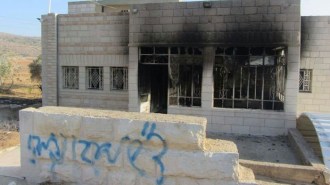 A rights organization has filed a complaint in the United States against an Israeli group for using US taxpayer money to sponsor “Jewish terrorism” against Palestinians.
In the lawsuit, T’ruah, The Rabbinic Call for Human Rights, asked the New York state Attorney General’s Office to investigate Honenu, a New York-based Israeli nonprofit organization that provides financial support to Jewish settlers convicted of or on trial for violence against Palestinians.
The complaint also names Honenu’s fiscal sponsor, the Central Fund of Israel, according to Israeli media.
Since 2003, Honenu has operated a fundraising program in the state of New York. The tax-exempt Israeli organization raised $233,700 in 2010, the last year for which official data is available, according to tax filings.
Israeli media say Honenu’s budget for 2013 was approximately $600,000.
In one instance in 2013, the organization provided funds to the family of an Israeli convicted of killing seven Palestinians in May 1990.
The lawsuit follows a recent expose by Israel’s Channel 10 about Israeli settlers’ crimes in the occupied Palestinian territory.
The television program was aired earlier this month in the aftermath of the July 31 firebombing of a Palestinian home in the West Bank by Israeli settlers in which a Palestinian baby and his father were burned to death.
In a statement issued hours after the incident, the Palestinian Liberation Organization (PLO) condemned the “brutal assassination” of the Palestinian infant, stressing that the regime in Tel Aviv bears “full responsibility” for the arson attack.
Earlier this month, Israel released all suspects held in connection with the arson attack in the village of Duma.
Featured Video

The Search for Truth: Charlie Kirk’s Assassination One Year Later
or go to
Aletho News Archives – Video-Images
From the Archives
The 9/11 “Double-Cross” Conspiracy Theory
BY LAURENT GUYÉNOT • UNZ REVIEW • SEPTEMBER 6, 2022
Is it true that “9/11 was an inside job”? Yes, insofar as Israel is “inside” the U.S. But for the 9/11 truthers who have identified Israel as the main perpetrators, “9/11 was an inside job” is at best a half-truth, and at worst an integral part of the Zionist operation, like a secondary flag sewn as a lining under the false flag of Islamism. Victor Thorn (1963-2017) wrote in his book 9/11 made in Israel: The Plot Against America (2011): “In essence, the ‘9-11 truth movement’ was created prior to Sept. 11, 2001 as a means of suppressing news relating to Israeli complicity. . . . The slogan ‘9-11 was an inside job’ was quite possibly the greatest example of Israeli propaganda ever devised.” In milder terms, it is “controlled opposition”.
A genuine truth movement would have pointed to Israel as the prime suspect from the start. From day one, it was obvious who would benefit. … continue
Blog Roll
 Aletho News
- Europe’s mounting social chaos… chickens coming home to roost for proxy war against Russia
- US-Russia Diesel Deal Becomes Massive Defeat for Ukraine
- Hormuz and the Looming Economic Catastrophe
- Dhubab offensive, media blitz and the rapid unraveling of Saudi-backed coalition’s new gambit
- Putin Conveys to Trump Iran’s Vision on Possible Conflict Resolution – Kremlin
- The Search for Truth: Charlie Kirk’s Assassination One Year Later
- ‘Harsh reality’: Iran says France seeks monopoly on power and intimidation, not peace for all
- When Will This White House Madness End?
- Huckabee aide goes to ‘unusual lengths’ to portray ‘Israel’ positively
- Trump Announces Diesel Supply Deal With Putin Following Phone Call
- If Americans Knew
- Israeli forces kill another child in Gaza – Daily Update
- Gaza ceasefire exists in name only, say more than 100 organizations
- Nearly 2 Million in Gaza Need Urgent Shelter Assistance as Winter Looms: IOM Chief Warns
- Suppressing Palestinian resistance: US charity under fire for AI monitoring of Gaza classrooms
- Thousands Are Held in Israeli Torture Camps. This Is What Happens Inside
- Israel puts Gaza’s sick, injured, newborn in peril – Daily Update
- Report claimed Mark Levin used by Israeli government to influence Trump
- Over 2,000 Gazans have died awaiting medical evacuation amid Israel’s continued siege
- How a U.S. Diplomat Suppressed and Altered Reports Critical of Israel
- 5 Palestinians Die from Israeli Strikes in Gaza as Relentless Attacks Continue
- No Tricks Zone
- New Study: 50 Years Of The Most Aggressive ‘Net Zero’ Policies Can Only Affect The Global Climate By 0.03°C
- US September “Heat” Was No Record…Many Records Set Decades Ago
- Latest European Green Energy Debacle; Portugal’s Largest Flagship Solar Park Insolvent!
- Green Energy Debacle: German Expert Professor Fritz Vahrenholt Warns Of Severe Economic And Social Consequences
- Two More Paleo Reconstructions Affirm Meters-Higher Sea Levels Across Ireland, Brazil 7000-6000 Years Ago
- New Study: Earth And Venus Surface Warmth Largely Explained By Convection And Lapse Rate, Not CO2 Or Radiation
- 2025 Nature Paper Claiming Worsening Global Drought Gets RETRACTED …Heavily Flawed
- New Study: ‘Global Drought Shows No Detectable Recent Acceleration Under Climate Warming’
- Economic Masterminds: German Socialists Suggest Taxing Productivity Gains Stemming From Using AI
- The South China Sea Has Not Been Cooperating With The Climate Change Narrative

