Iraqi PM Calls For Islamic Military Alliance Against Israel
Sputnik – 14.09.2025
Iraqi Prime Minister Mohammed Shia al-Sudani urged Arab and Muslim nations to form a joint security force in response to Israel’s recent strikes in Gaza and Qatar.
He said Tuesday’s Israeli attack on Doha, which killed Hamas members and a Qatari officer, was a “shocking breach of international law” and a threat to regional security.
Sudani stressed that the Islamic world has “numerous levers” to deter Israel, warning that aggression “will not stop at Qatar.”
His remarks came ahead of the Arab-Islamic emergency summit in Doha on Sept 15–16, amid Israeli strikes on Qatar, where leaders are expected to discuss activating the long-proposed joint Arab military force.
Iranian Supreme National Security Council chairman Ali Larijani has also called on Islamic nations to create a “joint operations room” against Israel.
Egypt, meanwhile, is pushing for a NATO-style Arab military force for rapid defense in case of attacks, with Cairo seeking regional backing for the plan ahead of the summit.
The Israeli strike on Doha hit a residential compound where Hamas politburo members were meeting to discuss a US proposal to end the Gaza war, which has already claimed more than 64,800 Palestinian lives since October 2023.
Israel’s strike on Qatar exposes the collapse of Arab security assumptions
By Dr Sania Faisal El-Husseini | MEMO | September 12, 2025
The thunder of Israeli warplanes over Doha this week was more than just a military operation, it was a shattering moment for the region. Missiles aimed at residential neighbourhoods in Qatar’s capital, as an attempt to assassinate Hamas leaders, sent a shockwave across the Gulf. The United States, caught between its alliance with Israel and its defence commitments to Qatar and other Arab Gulf states, sought refuge in manoeuvering, distancing itself from the strike while tacitly enabling it. For Arab national security, particularly in the Gulf, the implications are sobering.
The paradox is glaring, Qatar, host to the vast Al-Udeid Air Base, America’s forward headquarters in the region, and dependent on US military systems for its defence, finds itself exposed. The strike underscored what many Arab analysts have long warned, Washington’s strategic loyalty lies firmly with Israel, while Arab allies are seen as expendable partners.
This attack, the first of its kind on Qatari soil, is unlikely to be the last in the region. While framed as part of Israel’s campaign against Hamas, its significance extends far beyond Gaza.
For years, Qatar has hosted indirect negotiations between Hamas and Israel, offering itself as a diplomatic broker. But Israel, it now appears, used those talks as cover, buying time while pursuing unchanged objectives, the conquest of Gaza, the dismantling of Hamas, and the displacement of its population. As Israel intensified its push into Gaza City, it simultaneously targeted the Hamas delegation in Doha, an unmistakable signal that diplomacy was never the true endgame.
The operation reflects a broader Israeli strategy, expand military dominance step by step, strike beyond borders, and erase red lines that once constrained its reach.
Qatar’s own relationship with Israel has always been a delicate balance. From the opening of an Israeli trade office in Doha in 1996, to intelligence meetings hosted in recent years, to participation in joint air exercises in Greece, the two states have maintained limited yet functional ties. Still, Israel’s decision to strike inside Qatar amounts to a message to the entire Arab Gulf, no country is immune, and restraint will only embolden further violations.
This reality stretches well beyond the Palestinian question. Israel’s ambitions are no longer confined to blocking Palestinian statehood. The Netanyahu government, driven by the most hardline coalition in Israel’s history, has laid bare its intent, redraw the regional map through force, not diplomacy. Its declared expansion goals in the region, military reach backed by nuclear superiority, unmatched intelligence networks, and unwavering US support positions it as a major security threat to the regional countries. From assassinations in Iran to operations in Lebanon, Syria, Yemen, Iraq, and now Qatar, Israel acts with impunity. The Gulf, it seems, is simply no longer far from its attacks and ambitions.
The position of the American adminstration towrds the Israeli attack on Qatar has revealed a pivotal thorny issue. Qatar’s partnership with Washington was supposed to offer military and security safeguards. The two countries signed a Defence Cooperation Agreement in 1992, renewed in 2013, and Qatar was designated a Major Non-NATO Ally in 2022. Billions have been invested in Al-Udeid, now central to US operations across the region and Central Asia. Yet when Israel violated Qatari sovereignty, the US response revealed the harsh truth, strategic guarantees for Arab states collapse the moment they clash with Israel’s interests.
For Qatar and for every Arab state relying on US military systems, the lesson is stark. Dependence on Washington offers no shield when it matters most.
Many Arab states, particularly in the Gulf, have built their national defense almost entirely on Western military and security systems. In addition to Qatar, Saudi Arabia relies heavily on U.S. made F15 fighter jets and Patriot missile defence systems, the United Arab Emirates has invested billions in advanced American and French aircraft, as well as the THAAD missile shield, Bahrain hosts the US Fifth Fleet, and Kuwait depends on American logistical and intelligence support. These examples reflect a broader regional reality, the very foundations of Arab security are tied to Western supply chains, training, and decision making structures. Yet the Israeli strike on Qatar laid bare the danger of this dependency. When the interests of Washington and Tel Aviv converge, as they so often do, the security of Arab allies becomes secondary. Israel’s declared ambitions to project power beyond Palestine, coupled with the US’s unambiguous tilt toward Israel, mean that the entire architecture of Arab national security now stands on precarious ground.
Silence now would be perilous. If Arab governments allow this strike on Doha to pass without response, Israel will take it as a green light to extend its reach even further. The moment demands more than statements of concern. It requires a collective Arab reckoning, not only with Israel’s unchecked aggression, but with the illusion that the US security umbrella offers reliable protection.
The question is simple, if uncomfortable, will Arab states finally learn from experience, or will they continue to build their security on foundations that crumble when tested?
Geopolitical Ripple Effect: How Doha Attack Undermines US Credibility in the Gulf, Empowers BRICS
Sputnik – 12.09.2025
Israel’s aggression against one of America’s key allies in the oil-rich Persian Gulf is a wake-up call for the region’s nations about the hollowness of US security guarantees. The question now is whether they’ll answer, military and regional experts tell Sputnik.
Security
The failure of US and European-made equipment to stop Israel’s assault leaves only one option open: Russia, says defense analyst Igor Korotchenko.
Russian specialists could build Qatar a system that would give the emirate “the keys” to its skies, leaving “no country able to strike with impunity without the risk of losing both the carriers and strike systems” used in the aggression.
A pivot to Russia is fully realistic, given Moscow’s sale of Pantsir-S1s to the UAE, Qatar’s maritime neighbor.
To reliably close the skies to the enemy, Qatar could complement its defenses with Pantsirs, Buk-M3s, and Tor-M2s.
Commerce & Trade
“The Gulf is already engaged with the multipolar world” on economic matters, says Dr. Tamer Qarmout of the Doha Institute for Graduate Studies.
If the political will exists, not just Qatar but the region could “diversify their alliances and engage more with multipolarity.”
The UAE is already in BRICS, and Saudi Arabia has been invited. Gulf states also enjoy strong bilateral economic links with key BRICS powers including Russia (agriculture, IT), India (labor and trade) and China (trade and strategic initiatives like BRI).
Old Chains of Bondage Could Be Hard to Break
For most of their existence, Gulf powers “have never been truly sovereign,” says veteran Mideast expert Isa Blumi. “They’ve always been dependent on the British and the Americans,” and “internal struggles and rivalries” have made them ripe for manipulation.
That means “strategically and from a security and political perspective,” Gulf powers’ “interests are still largely embedded with, or aligned with, the US as a strategic partner,” Qarmout says.
Time for Strategic Self-Reflection
Israel’s attack “introduced significant uncertainties and major questions for Gulf nations regarding the future” of economic, political and military partnerships with the US.
The “difficult and existential” question is whether Gulf nations will “intensify” links to BRICS “to include new sectors like security and defense,” given the US’s abject failure to protect its “ally” “in such a blatant manner,” Qarmout summed up.
Qatar: an ambiguous agent in the Zionist architecture for the Middle East
By Lucas Leiroz | Strategic Culture Foundation | September 11, 2025
The recent Israeli attacks on Qatar have brought to public debate an issue long overlooked by analysts during the current Middle East conflict: Qatar’s ambiguous role in the regional security architecture.
In the geopolitical theater of the Middle East, Qatar has played a profoundly ambiguous role—at times portrayed as a regional mediator, at others as a strategic collaborator with the Washington-Tel Aviv axis. This ambivalence is neither accidental nor merely tactical. It is rooted in the very foundations of Gulf monarchies’ foreign policy, notoriously driven by a commercial mentality that prioritizes stability, survival, and diplomatic gains over any consistent ideological alignment. However, in light of the current stage of the Israeli-Palestinian conflict, this self-interested neutrality has increasingly morphed into active complicity with the Zionist occupation regime.
Despite hosting the political leadership of Hamas in Doha, Qatar does not finance its military wing—which, in fact, is supported by Iran. The hospitality extended to the political branch of the Palestinian movement serves, in reality, as a diplomatic tool to increase Qatari influence over the resistance and steer it toward behavior less hostile to Israeli and American interests. This strategy has been employed for years under the pretense of “mediation,” but in practice, it functions as a containment mechanism for the Palestinian national movement.
For years, the Al Jazeera network, controlled by Doha, had authorized access to the Gaza Strip, even under the strict control of Israeli security forces. This privilege was not granted out of goodwill by Tel Aviv but was the result of a strategic arrangement: Al Jazeera promoted anti-Iran rhetoric within the occupied territories, reinforcing the sectarian divide between Sunnis and Shiites and distracting Palestinians from their real source of military support. In return, Israel allowed the ideological diffusion of Wahhabism in Gaza, calculating that this doctrine would weaken Palestinian nationalism and inter-Muslim solidarity, replacing them with religious divisions and fractured loyalties.
This pact began to decline as Al Jazeera became a major outlet for exposing the brutal reality of the genocide in Gaza. Once Qatar’s media presence in occupied Palestine started to generate more costs than benefits for Israel, the Zionist regime enacted a censorship law banning Al Jazeera and assassinated several of its journalists during the criminal airstrikes on Gaza.
Qatar is also home to the largest U.S. military base in the Middle East—Al Udeid Air Base. This facility not only houses American equipment and troops but also serves as an operational platform for Israeli assets in joint missions against Gaza, Hezbollah, and potentially Iran. The Israeli presence on Qatari soil is an open secret and illustrates just how much Qatar has functioned as a logistical hub for the regional security architecture coordinated by Washington and Tel Aviv.
In June, Iran launched precision strikes against this base during its brief direct war with Israel. The message was unequivocal: by allowing its territory to be used by powers hostile to the Axis of Resistance, Qatar had crossed the limits of neutrality. Doha’s response, however, was to remain in a position of complicit silence, ignoring internal protests and maintaining its alignment with Western allies.
This posture exposes the fundamental paradox of Gulf foreign policy: even with populations broadly sympathetic to the Palestinian cause, the Wahhabi bloc has repeatedly chosen to accommodate Israeli and American projects, as long as doing so ensures dynastic survival and economic stability. This reflects a deeply rooted rationality in the political culture of desert nations—one shaped by centuries of pragmatic adaptation to scarcity and existential threats. In an environment where taking sides can mean ruin, ambiguity becomes a way of life.
However, in the current context of conflict radicalization, this ambiguity is no longer perceived as strategy but as betrayal. By refusing to break with the occupying powers, Qatar risks being dragged into an escalation it helped to ignite. The Israeli bombs falling on Gaza today do so, directly or indirectly, with American logistical support originating from Qatari territory. This undeniable fact—under any serious analysis—undermines Doha’s attempt to present itself as both bridge and wall, as arbiter and accomplice.
The recent Israeli strikes on Doha have made one thing painfully clear: befriending the Zionists is a deadly mistake.
Qatar under Fire: Israel’s Expanding War Threatens Regional Peace
By Abbas Hashemite – New Eastern Outlook – September 10, 2025
In a shocking and fanatic move, the Zionist state targeted Hamas’ top leadership in Doha to disrupt the ceasefire process once again.
Israeli Aggression Spreads Across MENA Amid Mounting Civilian Toll
The recent Israeli attack on Qatar’s capital, Doha, marks its fifth attack in the last two days. Israel has attacked Gaza, Syria, Lebanon, Qatar, and the Sumud Flotilla on the Tunisian coast, further destabilizing the MENA region. Israel’s attack on Lebanon is a sheer violation of its ongoing ceasefire with the country. For decades, the Zionist state has been violating international law by invading the sovereignty of different Middle Eastern states. The Israeli Defense Forces (IDF) has been unleashing unprecedented violence and atrocities in Gaza and the West Bank since October 7, 2023, under the veneer of its operation against Hamas. According to some conservative reports, the IDF has killed more than 80000 Palestinians, the majority of whom comprise children and women, between October 7, 2023, and January 5, 2025. The true death toll is significantly higher than the reported figures, as scores of bodies are buried under rubble.
Israel’s indiscriminate bombing and ground operations in the Gaza Enclave have flattened the entire neighborhoods, turning them into rubble and wreckage-strewn piles. As per the Gaza Government Media Office, 90 percent of the Strip’s infrastructure has been destroyed by the IDF, inflicting a loss of around $68 billion. In addition, the office stated that, 2700 families have been wiped from the official records. The IDF has also killed 1670 medical personnel, 139 civil defense members, 248 journalists, and over 170 municipal employees since October 7, 2023. The IDF also targeted numerous mosques, churches, hospitals, and educational institutions over the past two years. The Zionist state has also blocked humanitarian aid, pushing 2.4 million Gazans, including more than 1 million children, to starvation and famine. Incidents of shooting civilians after luring them for aid have also been widely reported.
Netanyahu’s Ambition and the Greater Israel Project
The Netanyahu administration has consistently sought to expand the war into the entire region to achieve its ambitions. The Israeli Prime Minister Netanyahu seeks to perpetuate his rule by expanding the war. He also seeks to materialize the historic Zionist ambition of establishing “Greater Israel” by invading the territory of different regional countries. In a recent statement, he stated, “So if you’re asking if I have a sense of mission, historically and spiritually, the answer is yes.” He further stated, “You know, I often mention my father. My parents’ generation had to establish the state. And our generation, my generation, has to guarantee its continued existence. And I see that as a great mission.” These statements speak volumes about the real intention of his ongoing so-called operations against Hamas.
The Israeli government has always sought to expand the war to the whole region and beyond. Just like its Western allies, it blamed its opponents for initiating and fueling the war. However, in reality, the Israeli government has repeatedly disrupted all the peace negotiations. Recently, the US President Donald Trump proposed a peace plan to establish a ceasefire in Palestine. He asked for the immediate release of all the Israeli hostages. After proposing the peace deal, he issued his own threats to the people of Gaza and Hamas if a deal is not reached between the warring parties, implying that they have always obstructed a ceasefire. However, history suggests the reality is quite the contrary. Israel has repeatedly rejected all the proposals and holds a record of violating ceasefires.
The Zionist state’s recent attack on the Hamas leadership in Doha, Qatar – a lead negotiator in the US-led ceasefire negotiations – was also against international norms. These leaders were in Doha to discuss Trump’s peace proposal. However, the Israeli forces targeted them, disrupting another peace process and exposing the region to further instability and chaos. According to Hamas, its leadership survived the attack. However, six people, including the son and one of the aides of Hamas’ leader, Khalil al-Hayya, have been killed in these strikes. Hamas stated, “This once again reveals the criminal nature of the occupation and its desire to undermine any chances of reaching an agreement.” It declared the attack as “a heinous crime, a blatant aggression, and a flagrant violation of all international norms and laws”.
Qatar, Regional States Condemn Strike; US Denies Complicity
The Qatari government has also condemned the attack. Qatar’s Emir Sheikh Tamim bin Hammad Al Thani described the attack as a “reckless criminal attack”. He also stated that the attack is “a flagrant violation of its sovereignty and security, and a clear violation of the rules and principles of international law”. All the regional states, along with several extra-regional countries, have condemned the Israeli strikes in Qatar. Reports suggest that the Israeli government took the US into confidence before conducting the strikes. In an official statement, Washington has denied all such claims. It also stated that the US had notified Qatar before the Israeli attack. However, Qatar’s government has refuted the claims by stating that they are “completely false”.
These attacks reflect that the Israeli government does not want the war to end. On the contrary, it seeks to expand it to the whole region. In addition, it shows that the silence of the Arab states has emboldened the Zionist regime to violate their sovereignty and attack any country in the region. The event further suggests that in the coming weeks or months, Israel would attack more regional countries to materialize the ambition of Greater Israel. Moreover, it also illustrates that the US and Israel do not recognize any friends in the region. The only thing that matters to them is their regional interest. Although the Qatari government has not mentioned anything about retaliation till now, it needs to respond to Israeli aggression prudently to ensure its sovereignty. OIC must also play its role to exert diplomatic pressure on Israel. Otherwise, the Zionist state will continue to spread violence, terror, and chaos in all the regional countries, threatening regional and global peace.
Аbbas Hashemite – is a political observer and research analyst for regional and global geopolitical issues. He is currently working as an independent researcher and journalist
Why Did Qatar’s Air Defenses Fail During Israel’s Attack?
By Ekaterina Blinova – Sputnik – 10.09.2025
The missiles fired by Israel could have been intercepted by Qatar’s US Patriot systems. Russian military expert Yuri Knutov weighs in: the Patriots were simply turned off by the US.
Patriots Offline
“The main feature of these systems is their close integration with airborne early warning and control aircraft (AWACS), satellites, and command centers that provide targeting data,” Knutov tells Sputnik. “In addition, they have a [remote] shutdown feature to prevent accidental friendly fire.”
This shutdown feature is problematic: Turkiye refused to purchase the Patriot specifically because the American side could disable these systems at any moment, and therefore preferred the S-400, according to the pundit.
US Didn’t Defend Qatar
Apart from using Patriots, Qatar hosts the US’ largest military base in the Middle East.
“According to the agreement between Qatar and the US, the Americans were, of course, supposed to defend Qatar’s airspace by opening fire on Israeli aircraft. However, this did not happen,” Knutov says.
The US military knew about the incoming Israeli aircraft yet took no action, effectively allowing them to operate freely against the Hamas delegation invited to Qatar for negotiations. The US was fully aware of this.
Arab countries — and not just them — should take note: wherever US Patriots are used, the US can disable them at any moment, leaving their skies completely defenseless.
US Always Sides With Israel
“This is undoubtedly a scandalous situation, given that Qatar is a close US ally and had promised to invest billions in the American economy,” Knutov says. “The Americans warned Qatar of the attack only ten minutes after it had taken place.”
Appeasing the US is futile — they always side with Israel.
Israel’s Doha Strike Burns Bridges for Peace, Marks Dangerous Strategic Overstretch – Experts
Sputnik – 10.09.2025
Israel expanded the geography of countries it has bombed on Tuesday, targeting a delegation of Hamas officials involved in peace negotiations in Qatar. Sputnik asked a pair of regional experts how the aggression will impact Israel’s position in the region in the long term.
Israeli military operations in Gaza, Lebanon, Syria and now the Gulf signal an “overstretch” that won’t be left without serious diplomatic repercussions, Ankara-based security analyst Dr. Hasan Selim Ozertem has told Sputnik.
“Looking at Europe, looking at the US, looking at the Gulf, these countries have started to articulate their concerns about Israeli aggression, which was not the case before because of the leverage of the Israeli lobby, especially in US politics,” Ozertem explained.
With Qatar serving as mediator in the Gaza war, the Doha attack “also undermines Israel’s credibility” among the Gulf powers Tel Aviv wants to forge ties with through the Abraham Accords.
Israel’s aggression may even result in the creation of new regional pacts, Ozertem says.
“The Saudi Crown Prince said [Riyadh] will be supporting Qatar. In the past, we know that Qatar and Saudi Arabia had political problems. They managed to solve them. Now we are talking about a military alliance…an anti-Israeli opinion or bloc in the region among local actors… increasing the probability of potential confrontation between Israel and others.”
Burning Bridges
“By attacking Doha as peace negotiations for ending the Gaza genocide were in progress, Netanyahu once again demonstrated his disdain for negotiations and his preference for brute force as the ultimate solution,” says Mehran Kamrava, a professor of government at Georgetown University in Qatar.
Netanyahu’s strategy of “managed chaos” threatens to spiral out of control, and further isolate Israel “by making it a rogue, pariah state,” Kamrava said.
Besides Israel’s reputation, the attack promises to “cost the US much of its already diminished credibility in the Arab world,” the scholar says, emphasizing that unconditional US support for Israel is proving “extremely costly” as the Israeli government takes actions that make it seem increasingly “unhinged” and “devoid of all rationality.”
Qatar Vows to Retaliate After Israel’s Unsuccessful ‘Operation Summit of Fire’ in Doha
21st Century Wire | September 10, 2025
After nearly two years of balancing diplomatic efforts, Qatar found itself at the centre of the very conflict it had sought to mediate. An Israeli airstrike on Doha on Tuesday, aimed at members of Hamas’s political bureau, disrupted months of negotiations aimed at resolving the conflict in Gaza and may hinder Qatar’s ability to facilitate a ceasefire between the opposing parties. Hamas stated that the strike conducted by Israel under the name “Operation Summit of Fire“, which took months of preparation according to Israeli media, did not take the lives of Khalil al-Hayya or other high-ranking officials; however, it did result in the deaths of his son, three bodyguards, and a Qatari security officer.
Earlier this week, Qatar’s prime minister, Sheikh Mohammed bin Abdulrahman Al Thani, had met with Hamas representatives to discuss a proposal that Trump envoy Steve Witkoff had presented the week before in Paris. The Hamas representatives, possibly including some who had just flown in from Turkey, opted to reconvene on Tuesday to discuss the proposal further. Israel, aware of the group’s assembly in Doha, seized this opportunity to launch its attack.
On Tuesday, Israel targeted Hamas leadership in the West Bay Lagoon area, close to the Qatari Defence Minister’s HQ, and in the vicinity of the central business district, home to many foreign embassies, wealthy residences, schools and supermarkets. The strike targeted high-ranking Hamas officials as part of the Hebrew State’s ongoing campaign against the resistance group. This strike — which Israel claimed was executed following an attack that left six dead at a bus stop in Jerusalem on Monday — struck residential buildings that housed several members of the Hamas Political Bureau, as the group’s key figures convened to deliberate on a US ceasefire proposal concerning the Gaza Strip.
Many believe that Israel, in partnership with the United States, might have lured Hamas into a trap, using a 100-word proposal, which is believed to have been crafted by Israel, aiming to bring Hamas’s leading political figures under one roof in Doha under the guise of negotiations, only to eliminate them. Hamas was expected to provide an answer on Tuesday evening to a US proposal for a ceasefire in Gaza. This clearly mirrors the approach taken by Trump earlier this year to soothe the Iranians through continuous nuclear talks while secretly planning the assassination of senior officials in Tehran.
Qatar had been apprehensive about a potential attack ever since Eyal Zamir, the chief of staff of the Israel Defense Forces, cautioned on August 31 that “most of the remaining Hamas leadership is abroad, and we will reach them as well.” In response, Qatar sought guarantees from the Israeli intelligence agency, Mossad, and the White House that such an assault would not take place on Qatari territory. Although these assurances were provided, Israel once again violated its commitment and went ahead with the air strike, breaking all sorts of international laws while directly challenging Qatar’s sovereignty.
Ahmed Hashim, professor of war studies at Deakin University, believes that “Israel used its modified Adir version of the US F-35 fighter jets, accompanied by its customised F-15I Ra’ams for ‘air cover’, to carry out this illegal operation. Professor Hashim explained that Israel usually keeps about 46 Adir F-35 jets at its Nevatim air base, which is 2,250 kilometres from Doha. Professor Hashim added that “The Adirs can be fitted with fuel tanks that allow them to fly about 2,200km, but they do not need to be flown all the way to a target.”
“I don’t think the planes were over the Doha district. They struck from a distance with precision. And I think they were guided there by intelligence provided by ground.”
Many questions have remained unanswered. For instance, how the Israeli jets could have flown undetected over Saudi Arabia, and most likely Jordan, to reach Qatar, or what projectile Israel used, and why Qatari Air Defenses were not activated? Israeli media are reporting that the strikes involved 15 Israeli fighter jets, firing 10 munitions against a single target, which implies the Israelis knew exactly where the Hamas officials were located. According to an ABC report, retired Lieutenant General Mark Schwartz, who served as US security coordinator for Israel and the Palestinian Authority, said the comments made by the White House indicated that the US leadership was notified of the attack as it was unfolding, “unfortunately, too late” to stop it.
Netanyahu, who has labelled the assault as “justified”, continues to pursue his vision of a Greater Israel along with his ethnic cleansing campaign in Gaza. Meanwhile, US President Donald Trump has openly condemned the Israeli actions and has cowardly distanced himself from the Hebrew state, which has taken full responsibility for the operation. Furthermore, flight trackers’ data suggest that the UK may have provided support for the operation.
The United States claimed it had issued a warning to Qatar prior to the strike.; however, Qatar contests this claim, stating that the Americans communicated with Doha only 10 minutes after the attacks, notifying them that Israel had carried out an airstrike against Hamas in Doha.
Nevertheless, Qatar has clearly affirmed its commitment to continue mediating in the Gaza conflict, even in light of Israel’s unprecedented assault on its territory. Qatari Prime Minister Sheikh Mohammed bin Abdulrahman al-Thani vowed on Tuesday to retaliate against Israel for its strike against Hamas’s political leadership in Doha. At a press conference, the Qatari prime minister stated:
“The State of Qatar is committed to acting in a decisive way against anything that would target its territories and will reserve the right to retaliate and will take all the needed measures to retaliate.”
VIDEO: Qatari PM calls the Israeli attack ‘state terrorism’ (Source: Al Jazeera English)
.
The Israeli strike on Hamas leaders in Qatar has unsettled Gulf allies and strained US relations, prompting concerns about sovereignty and the latitude afforded to Israel. While numerous Gulf nations have succumbed to the US security extortion model to safeguard their oil and gas assets, the dependability of the United States in the Middle East is expected to come under serious scrutiny.
Israel’s “Abraham Accords” now face uncertainty, as experts indicate that the topic of normalisation is currently at a halt in the Gulf Arab nations, at least for the time being…
Israeli occupation attacks Hamas negotiators in Qatar, bombs Doha
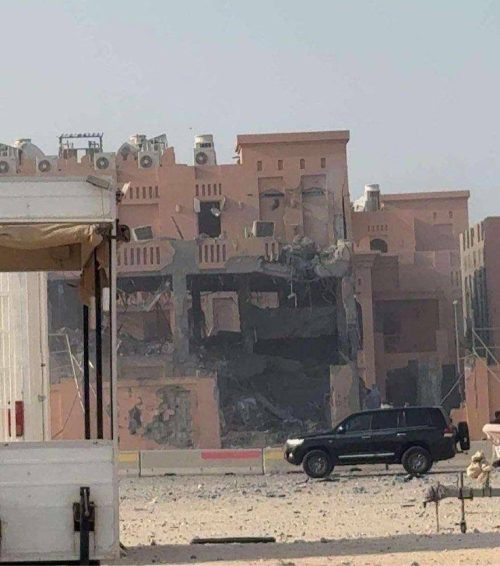
Al Mayadeen | September 9, 2025
In a statement, the Israeli occupation military, in coordination with its internal security agency, Shin Bet, claimed to have carried out an airstrike on the Qatari capital, Doha, claiming to target the senior leadership of the Palestinian resistance movement Hamas.
Israeli Channel 12, citing military sources, reported that the strikes targeted members of the Hamas negotiating delegation while they were discussing the latest US-mediated proposal in Doha.
Reuters correspondents confirmed hearing loud explosions in the Qatari capital, noting plumes of smoke rising over the Katara district.
This brazen Israeli strike on Hamas’ negotiating delegation in Doha exposes once again the pattern of aggression that has defined Israeli and American conduct, using violence at the very moment when talks for peace are on the table. Just as Washington and Tel Aviv undermined dialogue before they attacked Iran in June, they now repeat the same tactic against the Palestinian resistance, targeting representatives engaged in negotiations.
Far from seeking peace, such actions demonstrate a deliberate sabotage of negotiations and reveal that only Palestinians show a genuine commitment to ending the war, while the Israeli occupation regime and the US weaponize diplomacy as cover for escalation.
Hamas reaffirms commitment to ceasefire proposals
The development comes as Hamas reiterated its commitment, alongside other Palestinian factions, to the ceasefire framework put forward by mediators on August 18.
In a statement, Hamas emphasized its openness to “any ideas or proposals” that would secure a permanent ceasefire, guarantee the full withdrawal of occupation forces from Gaza, ensure the unconditional entry of humanitarian aid, and achieve a genuine prisoner exchange through serious negotiations brokered by mediators.
US President Donald Trump announced Sunday evening on his Truth Social account that “the Israelis have accepted my terms. It is time for Hamas to accept as well.”
In his post, Trump wrote: “Everyone wants the hostages home. Everyone wants this war to end! The Israelis have accepted my Terms. It is time for Hamas to accept as well. I have warned Hamas about the consequences of not accepting. This is my last warning, there will not be another one!”
According to Israeli Channel 12, Trump conveyed a new proposal through his envoy Steve Witkoff, bypassing the usual mediators Qatar and Egypt. The reported plan includes the release of all Israeli captives, both living and deceased, on the first day of the deal in exchange for the release of hundreds of Palestinian prisoners serving long sentences.
Hamas says received US proposal
The Islamic Resistance Movement in Palestine, Hamas, confirmed Sunday evening that it has received new American ideas through mediators aimed at reaching a ceasefire agreement in Gaza.
In a statement, Hamas said it welcomes any real initiative that contributes to ending the ongoing aggression against the Palestinian people.
Hamas expressed its readiness to immediately join negotiations to reach a comprehensive deal that would include:
- The release of all prisoners on both sides
- A clear declaration of an end to the war
- A complete Israeli withdrawal from the Gaza Strip
- The creation of a Palestinian independent committee to administer Gaza, to begin work immediately
The movement also demanded clear guarantees to ensure that “Israel” abides by any commitments, citing past agreements that were repudiated.
Hamas noted that it had already approved a mediator-brokered US proposal in Cairo on August 18, 2025, but “Israel” failed to respond and instead escalated its massacres and ethnic cleansing policy.
Qatar threatens to stop LNG exports to EU over climate rules: Reports
Al Mayadeen | July 26, 2025
Qatar has warned it may suspend liquefied natural gas (LNG) exports to the European Union in response to the bloc’s climate agenda, as outlined in the Corporate Sustainability Due Diligence Directive (CSDDD), Die Welt reported on Saturday.
The warning came in a letter from Qatari Energy Minister Saad Sherida Al-Kaabi to the Belgian government.
Al-Kaabi, who also heads QatarEnergy, cautioned that the company may seek alternative markets outside the EU if the directive’s regulations are not revised. The CSDDD mandates companies trading with the EU to scrutinize their supply chains for compliance with sustainable development goals.
“I strongly believe that companies should not be forced to choose between complying with the climate policies of their home jurisdictions and EU regulations,” the minister wrote, criticizing the directive for imposing requirements that, in some respects, exceed the objectives of the Paris Agreement, arguing that it infringes on national sovereignty and the right of states to set their own climate targets.
Al-Kaabi urged EU officials to remove the provision requiring non-EU companies to adopt climate transition plans.
According to Eurostat, Qatar was the EU’s third-largest LNG supplier in the first quarter of 2025, accounting for 10.8% of imports. The US ranked first with 50.7%, followed by Russia at 17%. A withdrawal of Qatari and Russian LNG would leave the EU scrambling to replace over a quarter of its current LNG supply.
Under the REPowerEU plan launched in 2022, the EU aims to phase out Russian pipeline gas by 2027–2028 and end all Russian energy imports by the end of 2027.
Meanwhile, Moscow has warned that the West’s pivot away from Russian hydrocarbons is a strategic error. Russian officials claim that European countries will ultimately face higher prices and increased dependency, buying Russian energy indirectly through intermediaries.
Riyadh realigns: Tehran over Tel Aviv
The Cradle | July 8, 2025
The recent confrontation between Iran and Israel marked a decisive shift in regional power equations, particularly in the Persian Gulf. Iran’s direct and calibrated military response – executed through the Islamic Revolutionary Guard Corps (IRGC) – exposed the strategic vulnerabilities of Tel Aviv and forced Gulf capitals, chiefly Riyadh, to reassess long-standing assumptions about regional security.
The Saudi-led recalibration did not emerge in isolation. Years of cumulative political, military, and diplomatic failures under the umbrella of US-Israeli tutelage have pushed Persian Gulf states to seek more viable, non-confrontational security arrangements. What we are witnessing is the slow dismantling of obsolete alliances and the opening of pragmatic, interest-driven channels with Tehran.
Iran’s war strategy resets Gulf expectations
Tehran’s handling of the latest military clash – with its reliance on precision strikes, regional alliances, and calibrated escalation – demonstrated a new level of deterrence. Using its regional networks, missile bases, and sophisticated drones, Tehran managed the confrontation very carefully, avoiding being drawn into all-out war, but at the same time sending clear messages to the enemy about its ability to deter and expand engagement if necessary.
The message to the Gulf was clear: Iran is neither isolated nor vulnerable. It is capable of shaping outcomes across multiple fronts without falling into full-scale war.
Speaking to The Cradle, a well-informed Arab diplomat says:
“This war was a turning point in the Saudi thinking. Riyadh now understands Iran is a mature military power, immune to coercion. Traditional pressure no longer works. Saudi security now depends on direct engagement with Iran – not on Israel, and certainly not under the receding American security umbrella.”
At the heart of Saudi discontent lies Tel Aviv’s escalating aggression against the Palestinians and its outright dismissal of Arab peace initiatives, including the Riyadh-led 2002 Arab Peace Initiative. Israeli Prime Minister Benjamin Netanyahu’s intransigence – particularly the aggressive expansion of settlements in Jerusalem and the occupied West Bank – has alarmed the Saudis.
These provocations not only sabotage diplomatic efforts but strike at the kingdom’s pan-Islamic legitimacy, forcing a reassessment of Israel’s utility as a strategic partner. As the diplomatic source notes:
“This Israeli political stalemate pushes Saudi Arabia to reconsider its regional bets and view Iran as a regional power factor that cannot be ignored.”
Riyadh turns to Tehran: containment over confrontation
Behind closed doors, Saudi Arabia is advancing a strategy of “positive containment” with Iran. This marks a clear departure from the era of proxy wars and ideological hostility. Riyadh is no longer seeking confrontation – it is seeking coordination, particularly on issues of regional security and energy.
Diplomatic sources inform The Cradle that the reopening of embassies and stepped-up security coordination are not mere side effects of Chinese mediation. They reflect a deeper Saudi conviction: that normalization with Israel yields no meaningful security dividends, especially after Tel Aviv’s exposed vulnerabilities in the last war.
Riyadh’s new path also signals its growing appetite for regional solutions away from Washington – a position increasingly shared by other Persian Gulf states.
For its part, the Islamic Republic is moving swiftly to convert military leverage into political capital. Beyond showcasing its missile and drone capabilities, Iran is now actively courting Arab states of the Persian Gulf with proposals for economic cooperation, regional integration, and the construction of an indigenous security architecture.
Informed sources reveal to The Cradle that Iran is pursuing comprehensive engagement with Saudi Arabia, the UAE, Qatar, and Oman. This includes economic partnerships and alignment on key regional files, from Yemen to Syria and Iraq.
Tehran’s position is consistent with its long-stated view: The Persian Gulf’s security must be decided by its littoral states and peoples – not by foreign agendas.
A new Gulf alliance is taking shape
This is no longer a Saudi story alone. The UAE is expanding economic cooperation with Tehran, while maintaining open security channels. Qatar sustains a solid diplomatic line with Iran, using its credibility to broker key regional talks. Oman remains the region’s trusted bridge and discreet mediator.
An Arab diplomat briefed on recent developments tells The Cradle :
“Upcoming Gulf–Iran meetings will address navigation in the Strait of Hormuz, energy coordination, and broader regional files. There is consensus building that understanding with Iran [will] open the door to a more stable phase in the Gulf.”
Amid these realignments, Israel finds itself regionally sidelined – its project to forge an anti-Iran axis has crumbled. The US-brokered Abraham Accords – once trumpeted as a strategic triumph – now elicit little more than polite disinterest across the Gulf, with even existing Arab signatories walking back their engagement.
Riyadh’s political elite now openly question the utility of normalization. As Tel Aviv continues its war on Gaza, Gulf populations grow more vocal and Saudi leaders more cautious.
The Saudi position is unspoken but unmistakable: Tel Aviv can no longer guarantee security, nor can it be viewed as the gatekeeper to regional stability any longer.
Pragmatism trumps ideology
This Saudi–Iranian thaw is not ideological – it is hard-nosed realpolitik. As another senior Arab diplomat tells The Cradle :
“Riyadh is discarding illusions. Dialogue with neighbors – not alliance with Washington and Tel Aviv – is now the route to safeguarding Saudi interests. This is now about facts, not old loyalties. Iran is now a fixed component of the Gulf’s security equation.”
The binary of “Gulf versus Iran” is fading. The last war accelerated a trend long in motion: the collapse of Pax Americana and the emergence of multipolar regionalism. The Gulf is charting a new course – one less beholden to US-Israeli diktats.
Today, Saudi Arabia sees Tehran not as a threat to be neutralized, but as a power to be engaged. Regional security frameworks are being built from within. Israel, meanwhile, despite its many pontifications about a Tel Aviv-led, Arab-aligned “Middle East,” is struggling to stay relevant.
If these dynamics hold, we are on the cusp of a historic transition – one that may finally allow the Persian Gulf to define its own security and sovereignty, on its own terms.
This is not an ideal future. But it is a strategic upgrade from decades of subservience. Saudi Arabia is turning toward Iran – not out of love, but out of logic.
Time for Qatar to review its hosting of US Al Udeid military air base
By Thembisa Fakude | MEMO | July 3, 2025
The assassination of one of the highest-ranking Generals and the Commanders of Al Quds Force – part of the Islamic Revolutionary Guard Corp (IRGC) – Qasem Soleimani, opened an unprecedented form of conflict in the Gulf region. Soleimani was killed in Iraq on 3 January 2020 by an US drone strike in Iraq, while travelling to meet Iraqi Prime Minister Adil Abdul Mahdi. Iran retaliated by targeting the US military facilities in Iraq, it fired more than a dozen ballistic missiles at two Iraqi air bases housing US forces days after the assassination. According to The Times of Israel, Israel helped the US in that operation.
The leader of Hamas, Ismail Haniyeh was killed by Israel in Tehran after attending the inauguration of the President of Iran Masoud Pezeshkian. Another pure violation of the sovereignty of Iran and international law. The killing of Haniyeh in July 2024 came on the heels of the attack and killing of a number of Iranian diplomats at the embassy of Iran in Damascus, Syria on 01 April 2024. Israel – with the support of the US – has continued to assassinate Iranian officials at will inside Iran.
Qatar had joint military operations with the US during the Operation Desert Storm in Iraq in 1991. After the operation, Qatar and the US signed a Defence Cooperation Agreement. The agreement was expanded in 1996 to include the building of Al Udeid Military Air Base at a cost of more than $1 billion. The Al Udeid Military Air Base is the largest US military base in the Middle East. Iran attacked Al Udeid in retaliation to the US’s attacks of Iranian nuclear sites in Fordo, Natanz and Esfahan in Iran in June 2025. Although the retaliation strikes were downplayed by the US and Qatar, the attacks seemed to have been carefully choreographed, exposing a new fault line in US-Qatar military cooperation.
The question in the minds of most Qataris is; what will happen next time when the US decides to attack Iran, will Iran retaliate by attacking Qatar again? Notwithstanding the repeated mantra of “a friendly, brotherly love and appreciation” between Qatar and Iran, the biggest threat to Qatar’s security and political stability now and in the near future is a possible war between Israel and the US against Iran. The targeting of Iran by Israel and the US presents a new security threat in the region.
Al Udeid has served as “a symbol of protection for the State of Qatar against potential attacks and other forms of hostilities”. However, when put to the test, Al Udeid has failed to meet those expectations. Besides the recent Iran attacks of the US military installations in Al Udeid; when Saudi Arabia, UAE, Bahrain and Egypt led a blockade against Qatar in 2017, there was no forewarning from the US notwithstanding Al Udeid’s superior military intelligence. According to the Qatari Defence Minister, Khalid al Attiyah, “Actually it was not a mere intention. There was a plan to invade Qatar”. The “plan was set into two phases, imposing the siege with the aim of creating an overall state of panic, which would have a direct impact on the Qatari street, then executing a military invasion”.
The possible future conflicts involving the US and Iran have raised serious concerns about the safety of US assets and personnel in the region. It has also triggered a debate, particularly within the US media, of the viability and rationale of the country’s continued involvement in Israel’s wars in the region. The Make America Great Again (MEGA) leading supporters such as the executive chairman of Breitbart News, Stephen Banon and right-wing journalist and social media influencer Tucker Carlson have questioned “the US continuing blind support Israel’s wars in the Middle East”. Tucker Carlson a known Trump supporter and a right-wing voice has been the loudest. He has been “urging the US to stay out of Israel’s war with Iran”. Bannon and Carlson are part of a broader effort to overturn the “GOP’s hawkish consensus on Israel”. Notwithstanding his unwavering support of Israel, Trump has been critical of Benjamin Netanyahu war mongering strategy in the region. Trump has entered into lucrative business relationships with countries in the Arab/Persian Gulf recently; Netanyahu stands to disturb that relationship. The US and the United Arab Emirates (UAE) have agreed to turn Abu Dhabi “to a site of the largest artificial intelligence campus outside the US”. The US will allow “the UAE to import half a million Nvidia semiconductor chips, considered the most advanced in the world in the artificial intelligence products”. According to The Guardian, Saudi Arabia struck a similar deal of semiconductors, obtaining the promise of the sale of hundreds of thousands of Nvidia Blackwell chips to Humain, an AI start-up owned by the Saudi Sovereign Wealth Fund. Indeed, given these interests and the strengthening relationship between the US and the Gulf countries, the US has much more to lose if it continues to blindly support Israel’s wars.
The relationship between Iran and the State of Qatar is very strong, both countries share gas exploration sites in the South Pars/North Dome. They are the gas condensate fields located in the Arabian/Persian Gulf. They are by far the world’s largest natural gas fields. There is also the people to people relationship between Qatar and Iran dating back to time immemorial. The next attack of Iran by the US or Israel could escalate and spread the war to Qatar. Although the US managed to move its assets from Al Udeid to other locations in Qatar before Iran’s attacks last month, the question remains. What guarantees do Qatar have that in future Iran would not target those locations? There is a possibility that if attacked Iran will once again retaliate. What will happen then? The retaliatory attacks could go beyond a mere violation of Qatar’s airspace and sovereignty; it could also cost Qatari lives. The State of Qatar has to take serious decisions regarding Al Udeid if it wants to maintain its future relationship with Iran and other countries in the region. It must close Al Udeid. It has more valid reasons to do that now. The threat has morphed in the region. Consequently, new defence infrastructure needs to be considered by Qatar. Al Udeid presents more political and diplomatic challenges than opportunities.
Featured Video

or go to
Aletho News Archives – Video-Images
From the Archives
Israel Would Have No Qualms About USS Liberty-Style FALSE FLAG If Iran Campaign Falters – Analysts
By Ilya Tsukanov – Sputnik – 18.06.2025
Donald Trump is mulling whether or not to join Israel’s aggression against Iran as Tel Aviv faces problems sustaining its defenses against growing counterstrikes, and apparently lacks a realistic game plan for an end to hostilities after failing to achieve its goals. Analysts told Sputnik how the US could be ‘nudged’ into the conflict.
“The US is already assisting Israel with supplies, intel, refueling support, etc. One of the many US posts in the region could be attacked for a casus belli,” former Pentagon analyst Karen Kwiatkowski explained.
“If Trump doesn’t comply with Israel’s demand” and join its aggression voluntarily, “a false flag may be needed” to drag the US in, Kwiatkowski, retired US Air Force Lt. Col.-turned Iraq War whistleblower, fears.
Netanyahu has a diverse array of options at his disposal, according to the observer, including:
- a false flag against US assets abroad blamed on Iran or one of its Axis of Resistance allies, like the Houthis
- a US domestic attack or assassination blamed on Iran
- Iranian air defenses ‘accidentally’ hitting a civilian jetliner carrying Americans
- use of a dirty bomb or nuclear contamination somewhere in the region blamed on Iran
- even blackmailing by threatening to use nukes against Iran if the US doesn’t join the fight
Kwiatkowski estimates that Israel probably has “enough blackmail power” against President Trump and Congress to avoid the necessity of a false flag operation, but a “USS Liberty-style” attack, targeting the soon-to-be-retired USS Nimitz supercarrier that’s heading to the Middle East, for example, nevertheless cannot be ruled out entirely, she says. … continue
Blog Roll
 Aletho News
- Smotrich calls for annexation of South Lebanon to Litani River
- Echos of Gallipoli? Hormuz and the Geography of Hubris
- Pakistan PM backs Iran’s right to self-defense amid tensions
- Hungary blasts ‘fake’ EU accusation
- SAFE Debt Trap: Poland’s €43.7 Billion Bet on Unipolar Illusion
- War on Iran threatens global Gulf capital flows: FT analysis
- Mossad De Facto Admits To Inciting Riots In Iran
- Tehran: World grown thoroughly exhausted with US-Israeli ‘false flag storylines’
- Trump ‘stuck between a rock and a hard place’, lacks Iran war strategy: Ex-CIA chief
- Trump’s bombardment of fake news so far is working quite well. But where is it heading?
- If Americans Knew
- From Sde Teiman, the truth about Israel’s military justice system has been set free
- Child denied life-saving bone marrow transplant by Israel ‘because he is from Gaza’
- Raffi Berg: BBC Middle East Editor Exposed as CIA, Mossad Collaborator
- Jerusalem Archbishop Rebukes Netanyahu’s Statements on Christianity
- US to embed Palantir AI across entire military: Report
- Israeli-US war on Iran to drag on “a few more weeks” – Not a ceasefire Day 164
- Lebanon deaths top 1,200; Palantir AI to be embedded across US military – Not a ceasefire Day 163
- Israel’s assassination game: Take all pragmatists off the board
- Food shortages return to Gaza as Israel tightens aid restrictions under the cover of its war on Iran
- Trump demands trillions in payments from Gulf countries, billions from Harvard – Not a ceasefire Day 162
- No Tricks Zone
- Devastating Assessment Of Comirnaty Vaccine By Former Senior Pfizer Europe Toxicologist
- New Study: CO2 Is ‘Effectively Negligible’ As An Explanatory Climate Change Factor Since 2000
- Former Pfizer Toxicologist Dr. Helmut Sterz Tells Bundestag Hearing Pfizer Vaccine Should Have Never Been Approved
- Energy Expert: Germany’s Nuclear Phaseout Was A “500 Billion Euro Mistake”
- New Research: South Australia’s Mid-Holocene Sea Surface Temperatures Were 4°C Warmer Than Today
- Storing Green Energy To Last Germany 10 Days Would Require A 60-Million Tonne Battery
- New Studies: UK Sea Levels Were 4 Meters Higher Than Today During The Mid-Holocene
- Destructive Green New Deal: German Energy And Metal Group Warns Of Drastic Crisis
- New Study Documents A 20-Year Pause In Arctic Sea Ice Decline – Driven By Internal Variability
- Wake-up Call: Survey Shows Majority Of Germans Now Favor Postponing Climate Targets!
 Aletho News