Sitting ducks: Why the US security umbrella no longer protects the Gulf?
By Dr Mustafa Fetouri| MEMO | July 16, 2026
In Kuwait alone—less than 150 kilometres across the Gulf from Iran—the United States maintains a major military hub of approximately 13,500 personnel spread across installations such as Camp Arifjan and Ali Al Salem Air Base. To its south, Saudi Arabia hosts roughly 2,700 U.S. troops, centered at Prince Sultan Air Base in Al Kharj. Elsewhere in the Gulf, every state hosts either a US military presence or provides access and defence cooperation under bilateral agreements: Qatar houses more than 10,000 personnel at CENTCOM’s sprawling forward headquarters at Al Udeid; Bahrain hosts around 9,000 personnel at the headquarters of the US Fifth Fleet; the UAE accommodates approximately 3,500 personnel at Al Dhafra while providing deep-water naval access at Jebel Ali; and Oman offers strategic port and airfield access under bilateral agreements, despite having no large permanent US troop presence.
Beyond the Gulf monarchies, Washington maintains approximately 2,500 troops in Iraq and around 900 in northeastern Syria under Operation Inherent Resolve. To Iran’s northwest, the US operates from Incirlik Air Base in Türkiye— a NATO logistics and intelligence hub too. Until its withdrawal from Afghanistan in 2021, American forces also maintained a major military presence along Iran’s eastern frontier, supported for two decades by extensive supply routes and intelligence cooperation through Pakistan. Although the US lies nearly 10,000 kilometres from Iran, it has constructed an unparalleled regional military architecture of permanent bases, rotational deployments, naval facilities, pre-positioned equipment, access agreements, and security partnerships that stretches from the Eastern Mediterranean across the Gulf to the western Indian Ocean. Combined with the military capabilities of close allies—including Britain, France, and Türkiye—this network almost literally surrounding Iran from all sides. The common thread underpinning this posture has long been the protection of regional partners, the safeguarding of global energy routes, and the defence of US strategic interests.
Yet, this foundational premise has collapsed under the weight of the US-Israeli war on Iran, which has fundamentally transformed the entire regional security landscape. This “war of choice” has exposed how a security arrangement once marketed as an ironclad insurance policy has devolved into a primary strategic liability.
Rather than serving as an effective deterrent, large and static American military installations now act as strategic liability—drawing Iranian retaliatory strikes while denying host states true autonomy or the promised protective shield.
The Gulf states have discovered, at a heavy price, that they are trapped in an impossible paradox: their sovereign territory serves as a staging ground for military operations they were never consulted about—at least that is what they say publically –instantly transforming their critical infrastructure, oil facilities, and urban centers into high-priority targets. Compounding this vulnerability is the stark geopolitical reality that while Washington may eventually pivot away or withdraw—much as it did from Afghanistan—Iran is a permanent neighbour that is going nowhere.
Beyond the immediate threat of missile strikes, the presence of these US installations directly undermines the core national strategies of the Gulf monarchies. Mega-development projects and economic diversification plans—from Saudi Arabia’s Vision 2030 to Dubai’s global trade hubs—rely entirely on an image of absolute regional stability, investor confidence, and open maritime transit. By hosting forward US bases, host nations inadvertently tie their economic futures to Washington’s military posture, creating an environment of perpetual crisis. Furthermore, defending these expansive American footprints forces host militaries to consume their own finite air-defense interceptors and defense budgets to guard US assets rather than securing their own national borders.
At the same time, while almost all Gulf States have, at least publicly, refrained from taking direct offensive action against Iran to avoid total escalation, they recognise that they are already viewed as passive participants in the wider conflict.
Maintaining this precarious balancing act is becoming increasingly difficult against rising domestic anti-war sentiment, as public anger over regional devastation steadily erodes the host governments’ domestic credibility.
For Washington, this massive network of forward-deployed bases has produced a profound strategic paradox. What was designed to project uninhibited American power now ties US freedom of action to the political consent of cautious host nations. When host governments impose strict sovereignty restrictions—refusing permission for US forces to launch offensive sorties or intelligence missions against regional adversaries from their soil—the Pentagon finds its multi-billion-dollar installations functionally sidelined during critical military surges. Instead of providing seamless operational flexibility, these fixed, highly vulnerable outposts transform into costly “imperial entrapment” liabilities: requiring thousands of US troops, high-end missile defense batteries, and constant naval escort deployments simply to protect the bases themselves, rather than executing broader strategic objectives or enabling Washington’s long-sought pivot to the Indo-Pacific. With the conflict between the US and Iran reigniting, Trump is demanding that the Gulf states pay once again to protect the Strait of Hormuz—a vital transit route that never closed until the war was started by Trump, not Iran.
This strategic calculus becomes infinitely more complex when factoring in Israel’s role in the regional security outlook. In recent years, certain Gulf states—most notably the UAE—operated under the premise that normalization and closer security alignment with Israel via the Abraham Accords would yield a net security dividend. Yet, this belief was never shared across the Gulf; nations like Kuwait, Oman, and Saudi Arabia maintained a far more cautious, sceptical stance toward Tel Aviv. The outbreak of the US-Israeli war on Tehran on February 28 utterly shattered any illusion that an Israeli-linked security architecture could bring regional stability. Instead, it exposed deep internal fault lines among the entire region. Reaching a collective, long-term security understanding with Iran was already a formidable challenge; doing so now, in the wake of a devastating conflict that forced Gulf States into the crossfire, is immensely more complicated. Moving forward, no regional framework can hold if it relies on a anti-Tehran pact anchored in Washington and Tel Aviv while ignoring the permanent reality of Iranian geographic power.
Ultimately, the fallout from the US-Israeli war on Iran exposes a fundamental reality that Washington and its regional allies can no longer ignore: the entire Middle Eastern security architecture must be fundamentally re-evaluated.
The core dilemma facing the region is that no collective security arrangement can ever be viable or effective if it seeks to exclude Iran—an indispensable, geographically permanent power armed with increasingly sophisticated offensive, defensive, and asymmetric capabilities.
Moving forward, any stable regional order must not only account for Tehran’s military leverage, but also accommodate its non-negotiable strategic demands. This includes addressing governance and transit rights over the vital Strait of Hormuz—through which one-fifth of global oil flows—and reaching a durable, pragmatic framework on its nuclear program. Regardless of the final outcome of ongoing US-Iran negotiations, the lesson for the Gulf is clear: true security cannot be built on an external garrison model that marginalizes the region’s principal indigenous power.
OSINT data, Sat images show damage at US bases after Iranian strikes
Al Mayadeen| July 12, 2026
Iran’s retaliatory operation against US military positions across the region has inflicted damage on several strategic facilities, with satellite imagery privately acquired and later published by multiple OSINT accounts on X showing impacts at major US bases in Qatar, Bahrain, and Jordan following a wave of ballistic missile and drone strikes.
The strikes, launched in response to renewed US aggression against Iran and escalating military activity in the region, targeted key nodes of the US military presence, including air bases, naval infrastructure, radar facilities, and drone operations centers.
Iranian missiles penetrate defenses, strike Al Udeid Air Base
Satellite imagery indicates that Iran’s missile and drone strikes reached Al Udeid Air Base in Qatar, one of the largest US military installations in West Asia and a central hub for American air operations.
According to the account, Egypt’s Intel Observer (@EGYOSINT), enhanced Sentinel-2 imagery shows damage to a hangar inside the base, with impact marks visible on the upper rear section of the structure. Additional ground disturbances and suspected burn scars were also identified across multiple areas of the facility.
Further imagery analysis revealed additional strike locations near US military accommodation buildings and other sections of the base, suggesting that the Iranian barrage reached multiple points within the installation.
The reported impacts highlight the ability of Iranian long-range strike systems to penetrate heavily protected military zones and reach critical US infrastructure despite the presence of advanced air defense systems in the region.
US Navy’s Bahrain headquarters struck
Iranian projectiles also reportedly struck a facility inside the US Navy’s 5th Fleet headquarters at Naval Support Activity Bahrain.
Satellite imagery identified damage to a warehouse located within the naval complex, marking a direct hit against a key command and logistics hub responsible for supporting US maritime operations throughout the Gulf.
The strike came amid heightened tensions surrounding naval movements in the Strait of Hormuz, where Iran has repeatedly warned against actions it views as threatening regional security.
MQ-9 drones in Jordan’s Prince Hassan Air Base targeted
Iran’s Islamic Revolution Guard Corps (IRGC) announced that its forces struck Jordan’s Prince Hassan Air Base with multiple ballistic missiles, targeting command-and-control infrastructure and facilities used to house US MQ-9 Reaper drones.
Satellite imagery from the base showed significant damage, including a destroyed hangar and widespread disturbances across the aircraft apron, where military assets are typically stored and maintained.
Imagery analysts also identified signs of burning and continued activity at the site following the strike, raising questions over the status of assets stationed at the facility.
The base has been associated with US unmanned aerial operations, including the deployment of advanced surveillance platforms, making it a key target in Iran’s strike campaign.
Possible MQ-4C destroyed in Jordan
A costly mystery is unfolding at Jordan’s Prince Hassan Air Base. After Iran targeted the base, analysts noticed that the facility is home to the US-made MQ-4C Triton, a $240 million high-altitude surveillance drone that had reportedly been moved there from Al Dhafra Air Base due to its proximity to Iran.
According to an OSINT X account, MenchOsint (@MenchOsint), the IRGC said it struck MQ-9 drone hangars, but satellite imagery later appeared to show damage to a drone facility, with smoke still visible after the strike. While there is no confirmation yet, speculation is growing that a rare MQ-4C Triton may have been destroyed, which would represent a significant loss.
For now, the fate of the Triton remains unconfirmed, but the strike has raised questions about whether Iran managed to hit one of the US military’s most advanced surveillance assets.
Volkswagen’s planned defence deal with Israel blocked by Qatari investors
MEMO | July 10, 2026
Volkswagen’s plans for a defence partnership with Israel’s Rafael have been vetoed by the German automaker’s Qatari investors, media reported Friday, Anadolu reports.
Qatar’s sovereign wealth fund, Volkswagen’s third-largest shareholder, rejected management’s proposal to manufacture missile components and military vehicles at the company’s Osnabruck plant, the Bild newspaper reported.
The move comes after Volkswagen CEO Oliver Blume said in March that the company will stop manufacturing Volkswagen Group vehicles at Osnabruck starting in 2027 and confirmed talks with several defence firms about shifting the plant for military vehicles production. Blume provided no further details at the time.
The proposal has sparked significant controversy within Germany. Volkswagen employees, peace activists and opposition politicians have criticised the plan, arguing the automaker should focus exclusively on civilian production. The Osnabruck Peace Initiative (OFRI) has organised multiple protests in recent months urging Volkswagen to abandon any defence contracts.
Germany’s opposition Left Party called Volkswagen’s planned cooperation with Israel’s state-owned Rafael Advanced Defence Systems “unacceptable,” citing the Netanyahu government’s ongoing military campaigns across the Middle East, accusing it of war crimes and genocide against Palestinians in Gaza.
Türkiye sells S-400 systems to undisclosed Gulf state
Al Mayadeen | July 10, 2026
Türkiye has sold its S-400 air defense systems to an unnamed Gulf country, with the announcement expected to be made on Friday.
Turkish newspaper, Hürriyet journalist Abdulkadir Selvi reported that an informed source told him Ankara finalized the sale of its S-400 systems after a deal was approved overnight on Friday.
He added that the speculated buyers are either the UAE or Qatar, noting that the information will remain unknown until an official statement is made.
Selvi noted that the US assets in the UAE being targeted by retaliatory Iranian strikes during the war on Iran were a cause for wanting an increased air defense presence. He added that the attacks “crippled the UAE’s tourism-based system,” adding that it “has been trying to acquire alternative defense systems” after the Iranian retaliation.
He also brought up the Israeli attack on Qatar last year as a significant reason why Doha may want new air defense systems, as Qatar’s Patriot missile system did not activate during the attack on the Hamas officials in the capital city due to “Israel” being coded as a friendly country.
“Qatar learned from this shock attack that it was unprotected against Israel,” Selvi said.
The Hürriyet journalist reported that regardless of which Gulf state the S-400 goes to, Türkiye seeks to gain freedom from US sanctions from the sale.
Ankara is currently a target of the American sanctions package, Countering America’s Adversaries Through Sanctions Act (CAATSA), which mandates penalties for entities that participate in “significant transactions” with the Russian defense or intelligence sectors.
The sale of the Russian-made S-400 systems could give Türkiye the break it needs to relieve itself of these sanctions that have barred it from the F-35 fighter jet program.
It is worth noting that US President Donald Trump signaled at returning Türkiye to the F-35 fighter jet program after a years-long ban, which caused tears in the relationship between Ankara and Washington.
Saudi, Qatari-flagged tankers damaged near Hormuz after US threatens Iran
The Cradle | July 7, 2026
A Saudi-flagged crude oil vessel and a Qatari tanker were damaged on 7 July after being struck by projectiles in the Strait of Hormuz, multiple reports have confirmed.
Qatari liquefied natural gas (LNG) tanker Al-Rekayyat was “struck overnight and its engine room set on fire,” maritime sources told Reuters, adding that “a Saudi crude oil tanker has also been damaged.”
“Mayday … This is vessel Al-Rekayyat, LNG vessel Al-Rekayyat. We are being hit by drone on port side, top of engine room. Status: engine room fire and full of smoke. Unable to assess further damage,” the ship’s captain said in a recorded radio call heard by Reuters.
The ship was disabled and called for help, but the crew was unharmed, according to the report.
Iranian state television reported that an LNG ship was hit off the coast of Oman after “ignoring warnings.” Responsibility has yet to be officially claimed by Tehran.
According to Reuters, the Saudi oil tanker Wedyan was damaged in the same area – near Oman’s coast, close to the Strait of Hormuz.
The Wedyan vessel’s last position was inside the Persian Gulf on 3 July. Riyadh has not commented.
“Iran’s military fired at least two missiles at commercial ships transiting the Strait of Hormuz,” US officials told Axios.
Nevertheless, the US government has not officially commented on the incident.
The latest escalation near the strategic waterway comes after Iranian officials responded to new threats from US President Donald Trump.
“Negotiations on final deal will not commence if threats continue. Honor your signature,” Iranian Foreign Minister Abbas Araghchi warned on Tuesday, coinciding with a massive funeral for the country’s late supreme leader Ali Khamenei.
A day earlier, Trump threatened to “finish the job” and “knock down” bridges and energy sites across Iran.
In recent days, Iran has doubled down on its right to jointly manage the strait with Oman. The waterway is effectively under Iranian control.
Last month, a shipping corridor connecting the US and Oman via the Strait of Hormuz was launched, prompting Tehran to call it a breach of Clause 5 of the MoU.
Tehran has since announced that it has reached a deal with Oman on the management of the strait.
Since the MoU was signed, the illegal US blockade has largely ceased, and the Strait of Hormuz has been partially reopened by Iran.
However, Washington has continued to violate the MoU through multiple attacks on Iran, and a failure to rein in Israel’s brutal campaign of ethnic cleansing and occupation in Lebanon.
Israel sold advanced defense systems to Qatar, Saudi Arabia: Report
The Cradle | June 28, 2026
Israel has sold advanced defense systems to Qatar and Saudi Arabia, including sophisticated missile defense systems to protect the Qatari royal family and components for advanced fighter jets, Haaretz reported on 28 June.
Citing documents and photographs, the left-liberal Israeli paper revealed that Israeli Elbit Systems and Israel Aerospace Industries have sold hundreds of millions of shekels’ worth of missile defense systems and helmets for advanced F-15 fighter jets to Saudi Arabia and Qatar.
The sales occurred even though both Gulf monarchies have refrained from joining the Abraham Accords and have no formal diplomatic relations with Tel Aviv.
Haaretz writes that when Qatari ruler Tamim bin Hamad Al-Thani flew to Iran last year, his private jet was equipped with an air defense system manufactured by Israel-based Elbit Systems.
A photograph of the Qatari emir’s arrival in Algeria in March 2024 clearly showed an Elbit defense system installed on the underside of his aircraft.
The Qatari royal fleet consists of 11 aircraft, including two Boeing 747s and an Airbus A340-500, all equipped with Elbit’s C-MUSIC system, known in Israel as Magen Rakia.
The C-MUSIC system detects the launch of a heat-seeking surface-to-air missile and emits an infrared beam that disrupts the missile’s ability to lock on to the aircraft.
It is especially effective against shoulder-fired missiles known as MANPADS.
The cost of the deal with Qatar is unknown. However, it likely exceeds $200 million, given the value of similar deals with European countries and NATO.
Elbit and other Israeli companies also produce parts for Qatar’s US-supplied F-15 fighter jets.
According to a US Defense Department contract with Boeing, Israeli companies were awarded subcontracts worth $150 million to $250 million to supply advanced parts and systems for the Qatari F-15s.
Elbit subsidiaries, Elbit America and Cyclone, were awarded contracts, along with Collins Elbit Vision Systems, a joint venture with RTX.
Among the items provided by the Israeli weapons firms to Doha is the advanced JHMCS combat helmet, which projects flight data onto the visor, allowing the pilots to visually lock on to a target and fire a missile at it.
Elbit also supplied AN/AVS-9 night-vision goggles for Qatar’s F-15 warplanes.
Additional contracts to provide equipment for the Qatari F-15 program were awarded to Israel Aerospace Industries, TAT Technologies, and Beth-El Industries.
Official State Department documents and photographs also reveal that Saudi Arabia received 462 advanced JHMCS combat helmets and 462 AN/AVS-9 night-vision goggles produced by Israeli firms for its own F-15 warplanes.
IRGC Navy rejects new Strait of Hormuz shipping routes
Al Mayadeen | June 25, 2026
Iran’s Islamic Revolution Guard Corps (IRGC) Navy has warned that safe passage through the Strait of Hormuz is only possible via routes announced by Iran, rejecting newly declared navigation lanes and insisting that vessels coordinate directly with Iranian naval authorities.
In a statement issued in the name of the IRGC Navy, Tehran said that “some authorities” had recently announced new shipping routes in the strategic waterway “without informing or coordinating with the Islamic Republic of Iran,” saying the move is “unacceptable and completely dangerous.”
The statement stressed that the only authorized passage routes through the Strait of Hormuz are those designated by Iran, warning that navigation outside these channels is “very dangerous and prohibited.”
“All vessels are warned to strictly avoid any navigation outside the notified routes,” the IRGC Navy said, adding that coordination via Channel 16 with Iranian naval forces is mandatory and that “violator vessels will be dealt with.”
The Strait of Hormuz, a narrow maritime chokepoint linking the Gulf to the Arabian Sea, remains one of the world’s most sensitive shipping corridors, with competing claims over navigation management and maritime safety procedures.
Regional diplomatic efforts underway
The warning comes amid renewed diplomatic activity involving Gulf states, Iran, and regional mediators aimed at reshaping maritime governance in the strait.
On Wednesday, Qatari Prime Minister Mohammed bin Abdulrahman al-Thani arrived in Muscat for talks with Omani officials on launching a new round of negotiations involving Iran, Iraq, and Gulf Arab states on the future management of the waterway, according to Reuters, citing a diplomat briefed on the discussions.
The proposed talks are reported to be separate from ongoing Iran-US negotiations and existing de-mining arrangements. According to the same source, Gulf states are expected to push for the removal of transit fees, while Iran may propose alternative charges linked to environmental, navigation, and security services.
The initiative is said to stem from a recent memorandum of understanding calling for structured discussions between Iran, Oman, Gulf states, and Iraq on maritime governance in the strait, with Pakistan floated as a potential mediator.
Separately, broader regional reconciliation talks are expected to be held in Riyadh involving Iran, Gulf Arab states, and other regional actors.
Oman announces new shipping lanes
Earlier on Wednesday, Oman announced the establishment of two temporary shipping routes in the Strait of Hormuz, positioned north and south of the existing lane, in coordination with the International Maritime Organization (IMO).
Under a phased operational plan, vessels will be grouped and contacted individually with navigation instructions, including designated routes and departure timings. Oman’s maritime authorities said shipmasters remain responsible for conducting independent risk assessments, and vessels are required to keep Automatic Identification Systems active while reporting hazards to the Oman Maritime Security Centre.
Oman also confirmed that no transit tolls would be imposed on ships passing through the strait, in line with understandings reached in recent Iran-US discussions.
Joint Iran-Oman framework
The developments follow earlier agreements between Iran and Oman to establish a joint committee tasked with discussing the future management of navigation in the Strait of Hormuz.
The committee is part of broader consultations between Tehran and Muscat aimed at enhancing maritime safety, coordinating navigation rules, and addressing associated services and costs in line with international law and sovereign rights of coastal states.
Both sides have previously reiterated their commitment to keeping the strait open for international navigation while maintaining sovereignty over territorial waters, underscoring the strategic importance of continued coordination to ensure stability in the waterway.
Iran, Saudi FMs hold phone talks as Persian Gulf states rethink US ties
Press TV – June 24, 2026
Iranian Foreign Minister Abbas Araghchi and Saudi counterpart Prince Faisal bin Farhan have held a phone call to discuss regional developments, as Persian Gulf Arab states recalibrate their approach toward Tehran in the wake of the US-Israeli war that exposed the limits of American power.
Araghchi on Wednesday briefed the Saudi minister on the latest progress in implementing bilateral agreements and the ongoing negotiations following the US-Iran memorandum of understanding (MoU) signed on June 18.
The two top diplomats underscored the importance of maintaining diplomatic channels, strengthening joint cooperation to support regional stability, and achieving positive and sustainable outcomes.
The call came as French news agency AFP said Saudi Arabia is expected to host talks aimed at repairing relations between Iran and Persian Gulf countries following the US-Israeli war on Iran.
It cited a diplomat familiar with the arrangements as saying Wednesday that a regional summit was being planned in Riyadh and could also include other neighboring countries, but no date had yet been set.
The meetings would be separate from the ongoing negotiations between Iran and the United States, the diplomat added.
CNN, citing a senior Persian Gulf diplomat, reported that leaders are increasingly contemplating a future in which the US plays a much smaller role in the regional security architecture, with a possible framework involving a regional non-aggression pact with Iran.
According to Hasan Alhasan, senior fellow at the International Institute for Strategic Studies, “From the Arab states’ perspective, the Iran war is a disastrous turning point for the regional security order.”
The war, which began on February 28, exposed vulnerabilities in the Persian Gulf states’ security model, which is heavily dependent on the nearly 40,000 US troops stationed in the region and American-made air defense systems.
“The US security guarantee is no longer reliable in the way they thought it was,” one analyst at Chatham House told The New York Times.
Washington’s approach is increasingly perceived as selective and heavily centered on Israel’s security interest.
A classified CIA analysis found that US allies in the Persian Gulf are divided over their approach to Iran. According to the assessment, the United Arab Emirates and Bahrain prefer continued pressure on Tehran, while Saudi Arabia, Qatar, and Kuwait now support negotiations.
Trita Parsi, executive vice president of the Quincy Institute, noted that the UAE and Bahrain “made themselves frontline states against Iran” through the Abraham Accords and “now they’re in too deep and cannot extract themselves out of it”.
The Saudis, Parsi added, “were at the highest levels pushing for this war. They have come to regret it”.
Adding another layer of complexity is a widening gap between Arab governments and Arab public opinion over Iran.
According to a report by The Economist cited by DID Press, growing anger toward Israel and dissatisfaction with US policies have fueled increasing sympathy for Tehran across parts of the Arab world.
Despite sustained efforts by several Arab governments to reinforce anti-Iran narratives, recent developments have altered perceptions among sections of Arab society.
The report identifies two major drivers behind this shift: anger toward Israel, as many Arabs increasingly view Iranian actions against Israel as a legitimate response to regional military operations, and religious and cultural ties, particularly among Shia communities across the Persian Gulf.
The report concludes that sectarian narratives no longer resonate as strongly as in previous years, and that many Arabs increasingly view Iran as more assertive and resilient than several Arab governments.
Qatari Prime Minister Sheikh Mohammed bin Abdulrahman Al Thani traveled to Muscat on Wednesday to initiate talks between Iran, Persian Gulf states, and Iraq on the future operation of the Strait of Hormuz.
The discussions aim to implement a provision of the MoU requiring Iran and Oman to hold talks with other Persian Gulf states on the future management of navigation and maritime services.
Earlier on Wednesday, Oman announced two temporary routes north and south of the existing shipping lane to facilitate safe passage of vessels departing the region, in coordination with the International Maritime Organization.
The Strait of Hormuz, through which roughly 20 percent of global oil and liquefied natural gas normally transits, was heavily disrupted after the United States and Israel launched their war on Iran on February 28.
Israel Brings The War Rhetoric Towards Türkiye
After Being Defeated In Iran, Israel Targets Türkiye.
By Justin K.P. – The Dissident – June 22, 2026
The idea of Israel going to war with Türkiye- a NATO member- potentially triggering World War III seems insane.
And yet Israel is using their war rhetoric towards Türkiye.
The Israeli Foreign Ministry put out a post seemingly laying the groundwork for an Israeli war, claiming that “Hamas terrorists based in Turkey are directing attacks against Israelis, funding terrorism, and recruiting operatives. The network is exposed. The facts are clear.”
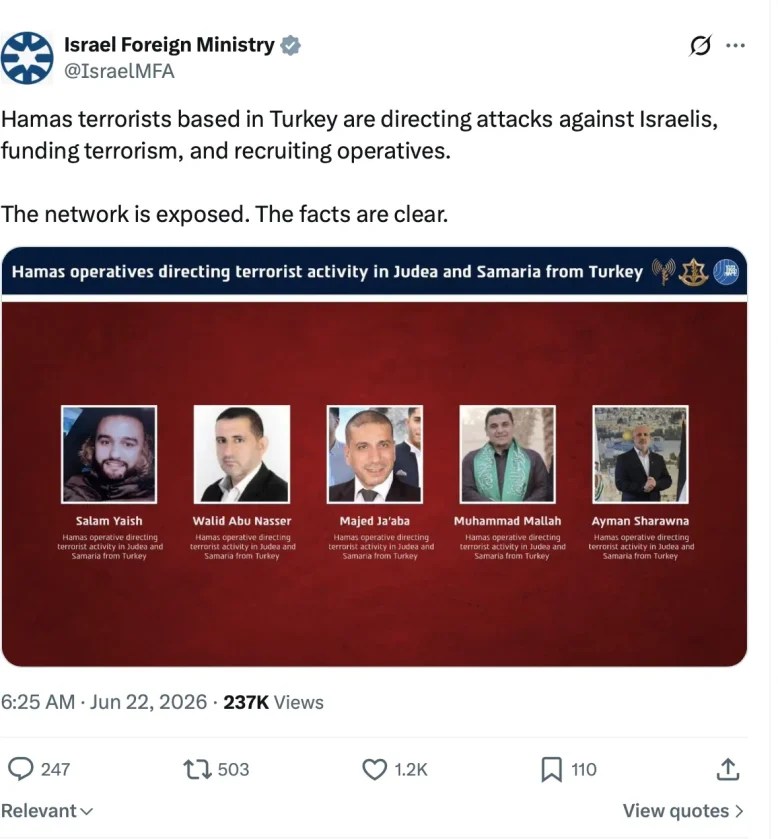
This is far from the first time Israel has used war rhetoric towards Türkiye.
Israel’s Minister of Diaspora Affairs Amichai Chikli recently said that Israel “will be at war with Syria sooner or later” in part because he called Syria “a Turkish protectorate”.
He also fabricated a new “radical Sunni axis of evil” which supposedly includes Pakistan, Turkey and Qatar.
Middle East Eye reported:
“What we are witnessing before our eyes is the rise of a new axis,” Chikli told 103FM radio on Wednesday, referring to Turkey, Qatar and Pakistan. He described this so-called alliance as “a radical Sunni axis of evil, more dangerous than anything we have seen before”.
While Chikli mentioned both Qatar and Pakistan in his interviews, he mainly focused on Turkey, branding Turkish President Recep Tayyip Erdogan’s vision “an extremely dangerous combination for us”.
Other members of the ruling Israeli Likud party have similarly been declaring Türkiye “an enemy state”.
Middle East Eye noted, “Last week, Israeli lawmaker Ariel Kellner, also of Likud, called Turkey an ‘enemy state’, while Culture and Sports Minister Miki Zohar said last month that Israel’“must begin to treat Turkey as an enemy state,’ suggesting that Turkey would suffer heavy blows in a possible conflict with Israel.”
It added that “In February, former prime minister Naftali Bennett indicated that he sees Turkey as an enemy, with the opposition figure stating: ‘Turkey is the new Iran.’”
Perhaps the most concerning development is the fact that the Foundation for The Defence of Democracies (FDD), an Israeli lobby cutout that played a large role in the U.S. war on Iran, has begun publishing articles using similar rhetoric towards Türkiye.
FDD put out an article titled , “Turkey the new Iran? Ankara’s growing challenge to Western interests”.
The article attempted to label Türkiye as the “new Iran”, writing:
As Iran and its proxies take a beating from American and Israeli forces, observers are questioning whether Turkey is waiting in the wings to emerge as the region’s next “bogeyman.” The answer is likely yes, albeit in its own form.
Turkey is not Iran, but depicting Turkey as a nuisance or simply “complicated” only emboldens a maturing adversarial regime with an established track record of undermining its Western allies.
The article attempted to ratchet up hostilities between Türkiye and the United States, writing, “The real question is whether Turkey is actively undermining US, NATO, and regional security interests. There is little doubt that Ankara is doing just that, and doing so more brazenly with the passage of time.”
It also lamented that Türkiye is too supportive of the Palestinian resistance, writing “Hamas, as an Iranian proxy, has served Ankara’s interests in undermining Israel’s security interests, something which Turkey would like to see intact after the end of the current war.”
FDD has similarly put out articles pushing for the U.S. to put sanctions on Türkiye, saying that “Washington should pursue Global Magnitsky sanctions against targets in Turkey” and that “the United States should utilize Global Magnitsky authorities to target Turkish individuals responsible for human rights violations”.
It also called for the U.S. to designate “government officials” in Türkiye as “terrorist organizations” and wrote that “The United States should protect the international financial sector by recommending added scrutiny and screening to transactions involving Turkish financial institutions” and that “Washington should coordinate with the G7 to return Turkey to the Financial Action Task Force (FATF) ‘grey list’ until further improvements are seen in combating terrorism financing.”
The Carnegie Endowment for Peace documented that “FDD was the brainchild of a New York Times journalist-turned-Republican operative, Clifford May,” adding that “it arose out of an organization committed to burnishing Israel’s reputation in the United States. On April 24, 2001, three major pro-Israel donors incorporated an organization called EMET (Hebrew for ‘truth’). In an application to the Internal Revenue Service for tax-exempt status, May explained that the group ‘was to provide education to enhance Israel’s image in North America and the public’s understanding of issues affecting Israeli-Arab relations.’ But in the wake of the Sept. 11 attacks, May broadened the group’s mission and changed its name to the Foundation for Defense of Democracies. As he explained in a supplement to the IRS, the group’s board of directors decided to focus on ‘develop[ing] educational materials on the eradication of terrorism everywhere in the world.’”
It added that, “FDD’s chief funders have been drawn almost entirely from American Jews who have a long history of funding pro-Israel organizations. They include Bernard Marcus, the co-founder of Home Depot, whiskey heirs Samuel and Edgar Bronfman, gambling mogul Sheldon Adelson, heiress Lynn Schusterman, Wall Street speculators Michael Steinhardt and Paul Singer, and Leonard Abramson, founder of U.S. Healthcare.”
Sima Vaknin-Gil, a former Israeli military intelligence officer, in the Al Jazeera documentary The Lobby, admitted that “We have FDD” and that “the foundation is ‘working on’ projects for Israel, including ‘data gathering, information analysis, working on activist organizations, money trail. This is something that only a country, with its resources, can do the best”.
FDD played a huge role in shaping American policy towards Iran at the behest of Israel.
Now, as Israel calls Türkiye an “enemy state”- the FDD has begun pushing Washington to place sanctions on the country and designate government officials as terrorists, laying the groundwork for a new Israeli war.
Iran announces plan to link electricity grid with Qatar, transfer up to 1,000 MW of power
The Cradle | June 17, 2026
Iran is planning to connect its electricity grid with Qatar and announced on 16 June that work on the matter is in its “final stage,” reviving a years-old agreement with the Gulf state in the aftermath of the brutal US-Israeli war against the Islamic Republic.
Iranian Energy Minister Abbas Aliabadi said on Tuesday that “the connection between Iran and Qatar will begin soon.”
He added that “studies are in the final stage, and we are beginning the implementation phase.”
Aliabadi also said Tehran was “studying” power grid connection with other Gulf countries, according to Tasnim News Agency.
The minister affirmed that this would happen “in the near future.” The deal will involve a transfer of up to 1,000 megawatts (MW) of electricity.
Talks on the matter had been taking place between Tehran and Doha in December 2023.
The two countries had previously signed an electricity memorandum of understanding (MoU) under the late Iranian president Ebrahim Raisi’s government.
The new announcement comes several days after Qatar denied a Washington Post report that said the Gulf state cut a “secret” deal with Iran to avoid further retaliatory strikes.
“Any suggestion that operational decisions relating to energy production were – or have ever been – made in coordination with Iran, for Iran’s benefit, or to influence the course of the conflict is entirely unfounded,” Qatar’s International Media Office said on 12 June.
The Washington Post had cited western and regional officials as saying that Qatar approached Iran at the start of the war, following Tehran’s major strike on the key Ras Laffan energy facility.
“Seeking to protect its economic crown jewel, Qatar approached Tehran … to present a mutually beneficial arrangement: Iran would refrain from hitting Ras Laffan, and Qatar would halt gas production unilaterally – a move that would send energy prices soaring and put economic pressure on the US and Israel to shorten the war,” the sources said.
After the Iranian strike on Ras Laffan, Doha said the attack caused $20 billion in losses and wiped out 17 percent of the Gulf state’s gas export capacity.
Iran largely refrained from attacking the country in the days that followed, although some drone attacks and explosions were reported.
Tehran said during the war that many attacks on the Gulf were actually Israeli “false-flags” aimed at inflaming tensions.
Political commentator Tucker Carlson also reported in early March that Qatar and Saudi Arabia detained Mossad agents who were planning bombings, implying that the foiled attacks were designed to be pinned on Iran.
Tehran’s announcement on the electricity agreement with Qatar coincided with a Bloomberg report that said Qatar is planning to rapidly increase liquefied natural gas (LNG) production once the Strait of Hormuz reopens, aiming to restore up to 80 percent of its export volume within two months.
Arab Powers Mull Regional Security Alliance – Jordan’s Ex-Minister
Sputnik – 11.06.2026
Some countries in the Middle East are advancing proposals to forge a regional alliance involving Jordan, Egypt, Saudi Arabia, and Qatar, aimed at preventing further regional turmoil, Jordan’s former Minister of Social Development and political science professor Amin Al-Mashaqba tells Sputnik.
The goal of such an alliance would be to strengthen collective security and increase the level of self-reliance among Arab states after “the failure of US security guarantees for the Gulf countries.”
Jordan maintains constant contacts with the US, continuing its effort to safeguard regional peace, he says.
“Relations between Jordan and the Gulf states have deep historical roots, but current challenges require a higher level of Arab coordination and security cooperation,” Al-Mashaqba notes, adding that the country, along with Egypt, Saudi Arabia, Qatar, and Turkiye, “attempted to prevent” the US-Israeli strikes on Iran.
The “key problem,” lies in Israel’s policy, which seeks to keep the region in a state of ongoing conflict and achieve its “expansionist and religious-ideological goals,” Al-Mashaqba says.
The continuation of current Israeli policies could jeopardize the future of peace agreements between Israel and Arab states, he concludes.
Featured Video

Racist Seinfeld Dances for Joy as Bibi Unveils His New Map
or go to
Aletho News Archives – Video-Images
TV Drama Review
Japanese drama projects Japan’s wartime atrocities onto Chinese characters

Global Times | October 25, 2026
By portraying Chinese characters as perpetrators of ruthless violence while casting Japanese Self-Defense Forces (SDF) intelligence operatives as defenders, the season 2 of the Japanese drama Vivant has recently drawn criticism from Chinese netizens, who argue that its depiction turns historical reality on its head while ignoring Japan’s wartime atrocities.
The TBS drama series – a spy suspense story in which an alleged unofficial intelligence unit of the SDF operates across the globe — has attracted a passionate fanbase. Its currently airing season 2 opened with a household rating of 18.8 percent, the highest for a TV drama this year, according toa commentary article by Japanese media Toyo Keizai.
What draws attention is the portrayal of the enemies in the series, the article noted. Scenes in which the Chinese organization subjects kidnapped members of the SDF unit to brutal torture are repeated with unrelenting intensity.
It is rare for Japanese TV dramas to explicitly portray a real-life country as the enemy, the article noted.
Japanese Prime Minister Sanae Takaichi also made a reference to the drama, saying that she has been recording Vivant and hopes to binge-watch it over the year-end and New Year holidays, according to Japanese media outlets.
China’s CCTV News report on Sunday revealed that the drama features scenes in which Chinese personnel cut off the fingers of and stab Japanese intelligence operatives in the abdomen. Such acts bear striking similarities to the torture inflicted on Chinese nationals by invading Japanese troops during the World War II.
The drama distorts the truth by attributing these atrocities to modern Chinese characters. Beneath the surface, it subtly glorifies Japan’s cross-border overseas operations, blurs the functional boundaries of the SDF and implicitly promotes an expansionist narrative, per CCTV News. … continue
Blog Roll
 Aletho News
- Up in arms… Koreans reject U.S. empire’s plan to make South Korea the next Ukraine
- Iran, Turkey, Pakistan, Saudi Arabia could advance region-led security framework in Tehran: FM spox
- Netizens condemn Japanese drama for projecting Japan’s wartime atrocities onto Chinese characters
- Racist Seinfeld Dances for Joy as Bibi Unveils His New Map
- A West Bank War for Netanyahu’s Election Campaign, Could It Backfire?
- Yemen denounces European Parliament’s ‘hypocritical’ push to blacklist Ansarullah
- Qalibaf: UAE’s UN bid aims to ‘clear the runway’ for ‘Greater Israel’, whitewash genocide
- Pakistan reopens Iran border after boosting security: Report
- Why are so many Brazilians voting for Flávio Bolsonaro?
- Democrats Put Anti-Russia Agenda Ahead of American Workers
- If Americans Knew
- An error has occurred; the feed is probably down. Try again later.
- No Tricks Zone
- Sudden Stratospheric Warming, Powerful El Niño Combination May Lead To Extreme Europe Cold, Energy Crisis!
- Two New Studies Find Thwaites Glacier Melt Cannot Be Driven By Human Activity Or A Warming Ocean
- E-Cars Reduce CO2 Emissions By Only 41% Compared To Internal Combustion Engine Vehicles
- Predictions Made By Renowned Climate Professor Over Past Decades Have Been Proven To Be Poor
- New Study Suggests Large Regions Of The Pacific Ocean Have Been Cooling For The Last 80 Years
- Germany’s Green Energy Debacle: High Energy Costs Force Kahla Porzellan to Close After 182 Years!
- New Study: 50 Years Of The Most Aggressive ‘Net Zero’ Policies Can Only Affect The Global Climate By 0.03°C
- US September “Heat” Was No Record…Many Records Set Decades Ago
- Latest European Green Energy Debacle; Portugal’s Largest Flagship Solar Park Insolvent!
- Green Energy Debacle: German Expert Professor Fritz Vahrenholt Warns Of Severe Economic And Social Consequences

