Victoria Nuland Counters Her Own State Propaganda

By James Wile | The Libertarian Institute | September 23, 2024
Former Under Secretary of State for Political Affairs Victoria Nuland gave an interview with exiled Russian journalist Mikhail Zygar that was published to YouTube on September 3 and the conversation deserves more attention than it received. While an interview from three weeks ago might seem like old news, it contained an astonishing admission from Nuland that seemed to slip under the radar of many listeners.
The part of the conversation that received the most coverage was Nuland saying the United States government persuaded Ukraine to walk away from peace negotiations with Russia in the early weeks of their war. People who get their news from sources outside the corporate media were already aware the West had almost certainly talked Ukraine out of accepting a peace deal, but it was still shocking to see a former U.S. State official smile as she acknowledged that her government had acted as an obstacle to peace.
But there was another part of the interview that was equally damning and of greater relevance to the current threat of global war.
Almost an hour into the interview, Nuland was describing the early days of the Russian invasion of Ukraine and said, “But it was also really interesting to see how bad the Russian military was. I mean in the United States it really completely dispelled this myth of this massive superpower military that could roll across Europe any time it felt like it.”
My eyes nearly popped out of my skull when I heard this statement. The fear that Russian President Vladimir Putin is hell-bent on conquering a new Russian Empire has been a constant justification for American support for this proxy war. But according to Nuland, the United States government has known Russia is not powerful enough to “roll across Europe” since early 2022. Nuland said this as if she were merely adding an interesting factoid to her interview, unaware that she was contradicting years of propaganda designed to keep the West afraid that the Soviet Union could rise from the dead at any moment.
This fear of a new Russian Empire has not been a secondary point in the pro-war position. It has been the cornerstone on which the entire argument is built. If the world does not unite to resist this Russian aggression against Ukraine, then it will only be a matter of time until Russia does the same to the rest of Eastern Europe. Nations will fall under the thumb of Putin one by one until half of Europe finds itself once again living behind an iron curtain of tyranny.
This new domino theory of Russian ambition has been the subject of countless headlines, articles, and interviews meant to keep the faucet of American support for Ukraine open and running.
In April, former U.S. Ambassador to NATO Kay Bailey Hutchison claimed that Putin’s “goal is to recreate the Soviet Union so that means he will have to go into NATO countries.”
Headlines in 2022 included “Restoration of empire is the endgame for Russia’s Vladimir Putin,” and “Putin’s dark designs: Restore the pre-1917 Russian empire.”
You can even find articles from ten years ago associating Putin with “The rebuilding of ‘Soviet’ Russia.”
But in twenty seconds of an interview, Victoria Nuland revealed that for over two years the United States government has known Russia is not powerful enough to recreate the Russian Empire. So, any corporate media outlet or government mouthpiece who used this threat as a legitimate reason to continue funding the proxy war was either lying or being a useful idiot.
Antiwar voices have been arguing for years that the fear of Putin reconstituting an empire from Siberia to Central Europe is ridiculous, but Nuland is not some antiwar dove. She has been among the most hawkish voices in the United States when it comes to the situation in Eastern Europe.
Nuland, of course, would describe herself differently. According to her, Putin has overstated the part she played in Ukraine. Despite being an assistant secretary of State, she was “a nobody,” and Putin’s exaggeration of her role was a “bizarre act of desperation” that demonstrated his “own insecurity about losing Ukraine,” but there is no doubt her fingerprints can be found all over the Russian-Ukrainian conflict.
The most infamous example is the phone call leaked in 2014 where Nuland can be heard talking openly about the United States meddling in the government of Ukraine. In the call, she said, “I don’t think Klitsch [Ukrainian politician Vitali Klitschko] should go into the government. I don’t think it’s necessary. I don’t think it’s a good idea.” She was talking about who should be a part of a foreign government as casually as she would discuss which intern in her department should be considered for a permanent position. You do not need to be an expert in Ukrainian politics to be taken aback by such shamelessness.
Nuland has also called for the continuation of U.S. support for the war. In February 2024 she gave a speech at the Center for Strategic & International Studies where she said, “With the sixty billion dollar supplemental that the administration has requested of Congress, we can ensure that Ukraine not only survives, but she thrives.” If she wants to ensure Ukraine continues to receive U.S. funding, she has no incentive to downplay the threat posed by the Russian military. This makes it even more unbelievable that she admitted the United States knows the threat of a new Russian Empire is nonexistent.
One of the U.S. regime’s chief actors has fact-checked her own regime’s propaganda. This would be like Colin Powell giving an interview in 2003 saying the United States knew that Iraqi President Saddam Hussein had no weapons of mass destruction (WMDs).
For readers who did not live through the deluge of propaganda leading up to the Iraq War, Colin Powell was the secretary of State under President George W. Bush from 2001 to 2005. He gave a speech at the United Nations on February 5, 2003 in which he used Hussien’s WMDs as justification for invading Iraq. The invasion uncovered no evidence of WMDs, but the threat of these weapons had been enough to get the U.S. government the invasion of Iraq that they were after.
If Powell had given an interview a few weeks later equivalent to Nuland’s, the entire pretext for war with Iraq would have evaporated.
It is difficult to believe a majority of the American public would have supported invading Iraq if Powell had made such an admission. Nuland’s concession should be equally impactful, but the world has continued moving forward as if the interview never happened. Kamala Harris and other war hawks continue to repeat the “myth” that Putin is going to march through Europe unless we stop him here and now.
Maybe Nuland’s shocking rebuttal of her own State Department’s propaganda was overshadowed by other stories. Maybe the corporate media was happy to keep the interview buried and out of the spotlight. One way or another, the American people need to wake up to the fact that the war in Ukraine is just another war sold on lies.
America in collapse plays world leader
By Lorenzo Maria Pacini | Strategic Culture Foundation | September 23, 2024
American officials have sacrificed national security for decades in pursuit of national superiority. Further arms supplies to Ukraine will not guarantee victory for Kiev, but will only lead to escalation. This is not in the interest of the U.S., which should first and foremost take care of its own population.
A generational political problem
Some might ask the American political leadership – of whatever faction it is – whether they have realised that the U.S. is no longer the boss of the world. If the answer is no, an extensive update dossier would be needed, to be delivered very quickly to the desk of the president on duty.
There is no more time. We repeat: there is no more time.
The United States is in the midst of a political crisis afflicting the entire West (which happens to be directly influenced by the USA) and has not yet managed to resolve it. This poses a major disadvantage internationally, because all around there is a world that is moving forward, in a multipolar key, with a large number of governments and peoples who no longer want to remain under the heel of the invader and who are rebelling, some through markets, some through partnerships, some through revolutions.
In all of this, the U.S. is in the midst of a social crisis that mirrors the unprecedented political one. The demise of the West, as Oswald Spengler put it, is louder than people think. Nobody cares about Americans any more, because there are basically no politicians who have America at heart any more, while they rather have their own interests at heart. This process of separation of governance-representation-people is one of the most delicate points of a transition phase that will lead the whole of humanity to have to rethink the political processes through which societies organise themselves. The problem is that the U.S. is still an imperialist political system with tentacles all over the world, and the dollar has been the main currency dominating the planet for almost a century, so the consequences of this debacle will be equally unprecedented. The final metastasis of a sick society cannot be avoided.
The American generational problem is very much reflected in the country’s foreign policy: while it is true that there is a masterful consistency with the long-term planning that was established at the beginning of the 20th century, it is equally true that things have not gone as strategists and analysts expected. Reality must now be reckoned with. The U.S. has a very exclusive, lobbying, elitist education system linked to a few power groups, whose dependence on the ‘matrices’ of London and Tel Aviv makes the success of candidates complex. Many are called but few are elected, to paraphrase the well-known gospel verse. Instead, the masses have been fed an education that has resulted in a general impoverishment, a sudden lowering of skills and irreparable cultural damage, starting a process that is self-perpetuating through its own successes (which are actually failures). Who will think about Americans in the future? Not even the current election candidates have managed to find the minimum number of successors.
While the belligerent rhetoric continues, the U.S. is being destabilised by an unprecedented illegal immigration, settling social protests with violence or a few doses of new cheap psychotropic drugs, producing some new mass entertainment to keep the protest within tolerable limits. Perhaps nobody really cares what will happen in the ‘New World’ across the Atlantic Ocean. Or perhaps they care enough to let the murderer die his own death.
Sacrifice must be worth the victory
From a strategic point of view, the situation is quite well-known. The Western Front, ça va sans dire, has never gained any real military advantage. An incalculable amount of money has been spent on supplying Ukraine with weapons of all kinds, from the older ones that were pulled out of the post-Soviet arsenals to the more recently manufactured ones, hand in hand with the (still ongoing) training of Ukrainian commanding officers and special units, which, let us remember, have not yet come into play in the conflict, where instead conscripts and reserves have been sent.
The countries that supported the conflict on the western side came to have to change their state budgets in order to meet Zelensky’s demands and turn their economies into war economies, where it was more or less possible and convenient. The whole of Europe, at the behest of the United States of America, entered a slow phase of rearmament such as has not happened since the Second World War.
The colourful industrial arms machine has given billions of dollars to arms companies. How many F-16s have been supplied to Ukraine? How many F-35s are being prepared? How many ATACMS are being discussed in Congress these days? And from the European Parliament, a perfect obedient vassal, which missile models are on the agenda? We have become accustomed to hearing about weapons as if we were talking about sporting matches with our favourite athletes, cheering and getting excited as we hear the cost of a device capable of killing thousands of people. But war is not a game, not a joke.
Although the possibility of striking further and harder in Russia may lift the morale of the Ukrainians, it is the battle on the ground that will determine the outcome of the conflict, and there Kiev is losing. Even in terms of info-warfare, there are no longer any special results, and by now even the mainstream media realise that something is wrong. The rhetoric of the ideal battle for Ukraine has been rehashed in all sorts of ways, without bringing any meaningful results other than to entice a few young men to go to the front to become cannon fodder.
Even if additional Western weapons would not lead to victory for Kiev, they could expand or intensify the war, and this is not in America’s interest. The allies’ sympathies are understandably with Ukraine, despite NATO’s ill-considered push towards the Russian border. However, their first responsibility is to their own nations, which is why they never kept their infamous 2008 promise to bring Ukraine and Georgia into the transatlantic alliance. No one was willing to go to war with Russia over either country.
The proxy war is blurring the delicate line between war and peace.
How much longer will the patience of other international actors who are watching have to be abused? The conflict will not remain only within the borders of Europe, and if it does, the Second World War and the subsequent Cold War taught us, decades ago, that no war is ‘national’ and confineable any more. European countries have relations with numerous other non-European states, which have every interest in protecting their own affairs and not losing out from an extended conflict at the behest of the overbearing U.S. Lady.
And how would the U.S. benefit from this? The prospect is that of a global escalation in which the majority is no longer on the side of the Americans, and this is now an indisputable fact.
The U.S. faces a number of very serious risks and if it does not take them into account, the damage will be irreparable.
A very serious question: what will be left afterwards?
While it is true that the armaments and manpower provided have managed to slow down, at least partially, the Russian reconquest, it is equally true that there has been no victory. This is understandable if one keeps in mind that the Special Military Operation is not a conventional war and that it was deliberately fought according to the strategic criteria of total hybrid warfare from the very beginning. The Americans never wanted to try to win the conflict immediately, otherwise they would have followed another strategy, more militarily aggressive and involving the European countries in a flash-war from the outset.
What has been done, instead, is a slow work of rearranging the entire West in an anti-multipolar key, going against the initiatives already advanced before February 2022 by Russia, China and other countries that were freeing themselves from Anglo-American hegemony. The U.S. has led Europe into an abyss, more so than before, after almost a century of military occupation, political subservience, economic enslavement and cultural devastation. Now there is no choice: either total revolution or participation in the last act of this macabre theatre, the direction of which will in any case make profits, no matter whether in the short or long term. A very important strategic principle is never to sacrifice something or someone unless you have something to gain from it. And the U.S. knows this very well.
At the time of the U.S. election campaign, we keep hearing about ‘diplomacy’ to try to resolve the conflict in Ukraine… or, perhaps, in truth it is to try to resolve the internal U.S. war? Because to be honest, without a stable nation, no diplomacy makes sense. Who would ever sit at the table with an enemy about to succumb to implosion? With what credibility does the U.S. still allow itself to raise its voice against the ‘rest of the world’?
The question then is: what will be left afterwards? It is a question we are perhaps asking ourselves too late.
Zelensky-led ‘peace summit’ a fraud – Moscow

Russian Foreign Ministry spokeswoman Maria Zakharova. © Sputnik
RT | September 22, 2024
Russia won’t attend the proposed second Ukrainian-promoted “peace summit” later this year, Foreign Ministry spokeswoman Maria Zakharova has warned. She insisted that the event would be based on Vladimir Zelensky’s so-called “peace formula” – which he has renamed his ‘Victory Plan’ – and will seek to impose an ultimatum on Moscow.
Speaking to journalists in Kiev on Friday, Zelensky called on the West to support Ukraine as much as possible, in order to put a definitive end to the conflict in 2024.
Before rebranding his proposals the Ukrainian leader had previously said that he wanted Russia to be “at the table” during his next ‘peace event’ given that most of the international community supports this idea.
Zakharova, however, rejected such an idea. “This process itself has nothing to do with the [conflict] settlement,” she said, calling it “a fraud by the Anglo-Saxons and their Ukrainian puppets,” she told reporters on Saturday.
“The so-called second summit has the same goal – to push through the absolutely unviable ‘Zelensky formula’ as an uncompromising basis for the settlement of the conflict, to get the global majority to support it, and in its name to present Russia with an ultimatum to capitulate. We will not participate in such ‘summits’.”
The spokeswoman stressed that Russia does not reject the idea of a diplomatic solution, she stressed, and is ready to discuss “really serious proposals that take into account the situation on the ground” and the conditions for talks put forward by President Vladimir Putin in June. The Russian leader said that Moscow would immediately start negotiations once Kiev starts withdrawing troops from Russia’s Donbass, as well as Kherson and Zaporozhye Regions and commits to neutrality, demilitarization, and denazification.
Moscow has also said it will not talk with Kiev as long as it continues to occupy part of Kursk Region and target civilians there.
Zakharova, however, remarked that Kiev and the West “do not think about peace… They need war. This is confirmed by the bandit invasion of the Ukrainian army into Kursk Region and Zelensky’s requests to be allowed to strike deep into Russia with NATO long-range weapons. This is a continuation of terror against the population of our country. We will not talk to terrorists.”
The first “peace summit” was held in Switzerland in June, to which Russia was not invited. The event revolved around several points of Zelensky’s supposed peace formula, but did not touch on some of Kiev’s key demands of Russia, including the withdrawal of the latter’s troops from territory Ukraine claims as its own.
Putin called the event a Western ploy to create the illusion of a global anti-Russian coalition and divert attention from the roots of the conflict.
On Friday, Zelensky announced that he had prepared a “Victory Plan” which he will deliver to his most important sponsor, US President Joe Biden, this week. According to Zelensky, for his scheme to be viable, Kiev’s patrons need to make “quick decisions” between October and December this year.
Russia publishes ‘destructive’ countries list
RT | September 20, 2024
Moscow has listed 47 countries whose “destructive attitudes” contradict Russian values, opening the path to their nationals to seek asylum in Russia if they so choose.
President Vladimir Putin signed a decree last month allowing foreigners who share Russia’s traditional values and disagree with the “neoliberal” agenda pushed by their own governments to apply for residency.
On Friday, Russian Prime Minister Mikhail Mishustin published the list of countries and territories that “implement policies that impose destructive neoliberal ideological attitudes contradicting traditional Russian spiritual and moral values.”
The list posted on the Russian government portal includes the following countries and territories: Australia, Austria, Albania, Andorra, the Bahamas, Belgium, Bulgaria, the UK, Germany, Greece, Denmark, Ireland, Iceland, Spain, Italy, Canada, Cyprus, Latvia, Lithuania, Lichtenstein, Luxembourg, Malta, Micronesia, Monaco, the Netherlands, New Zealand, Norway, Poland, Portugal, South Korea, Romania, San Marino, North Macedonia, Singapore, the US, Taiwan (territory of China), Ukraine, Finland, France, Croatia, Montenegro, the Czech Republic, Switzerland, Sweden, Estonia and Japan.
Notably absent from the list are EU and NATO members Slovakia and Hungary, as well as NATO member Türkiye.
Most of the designated countries previously made the register of “unfriendly” governments, first compiled in the spring of 2021 and updated in 2022. The states on that blacklist are subject to Russian diplomatic and economic countermeasures based on their hostile conduct.
Russia can “offer the world a safe haven for normalcy” by defending traditional values from the “wokeism catastrophe” that has come to dominate the collective West, RT Editor-in-Chief Margarita Simonyan said on Thursday at the Fourth Eurasian Women’s Forum in St. Petersburg.
According to Putin’s edict from August, nationals of “destructive neoliberal” countries are eligible to seek temporary residence in Russia without having to satisfy the standard immigration requirements, such as national quotas, Russian language proficiency, and knowledge of Russian history and laws.
The plan appears to have originated at a February symposium in Moscow, when Italian student Irene Cecchini presented the idea of “impatriation” to the Russian president. Cecchini urged Putin to streamline the immigration and naturalization process for foreigners who shared the “cultural, traditional and family values” of Russia, presenting it as a way to help the country overcome a demographic dip.
How Could Lebanon Blasts Affect Global Security and Attitude to Western Hi-Tech Producers?
By Ekaterina Blinova – Sputnik – 19.09.2024
A series of blasts reportedly involving Taiwanese, Japanese, American, and European-made devices in Lebanon on September 17 and 18 have prompted grave security concerns worldwide.
“Weaponizing mobile communications devices will fill many people with horror and fear,” Marc Ostwald, chief economist at ADM Investor Services International, told Sputnik. “It may, at the margin, dampen demand.”
The Lebanese government attributed the attack to Israel, accusing Tel Aviv of an outright act of terrorism.
Given almost “unconditional support” provided to Israel by some Western countries, some of them may have colluded with Tel-Aviv, said Hasan Abdullah, analyst and researcher at Global Security and Strategy Institute.
“The US is going to be the country that’s going to generate the greatest trust deficit with their customers, primarily because of its very close collaboration with Israel,” Abdullah told Sputnik.
The US has long been one of the largest suppliers of communication equipment, including for military needs, to the Global South, the pundit noted, adding that the recent blasts could alienate the developing world from Western producers.
Earlier, researcher Mehmet Rakipoglu and military analyst Alexei Leonkov told Sputnik they did not rule out US involvement in the Lebanon attack.
The Intercept reported on Wednesday that the US military had explored the possibility of planting remote-activated bombs in innocuous devices starting from the 1960s.
Middle East and other developing countries could eventually turn to Russian, Chinese or Turkish tech firms out of fear that the US involvement could compromise their security, Abdullah said.
Ostwald and Abdullah believe that several measures could be taken to stop the covert bombings, starting with investigations into manufacturing processes and ending with the deployment of international watchdogs to oversee production and supply.
Ukraine courting Middle East terrorists – Syrian official
RT | September 19, 2024
Ukraine is increasingly seeking cooperation with terrorist groups in the Middle East in a bid to find allies in its fight against Russia, a senior Syrian official has told RT.
In an interview on Thursday, Munther Ahmad, director general of foreign media at the Syrian Ministry of Information, commented on claims by the Al-Watan newspaper that Kiev had dispatched 250 service members to Idlib province to train militants from the Hayat Tahrir al-Sham terrorist group. In exchange, the group reportedly provided Kiev with a detachment of fighters.
Al-Watan also claimed that the head of Ukraine’s Main Intelligence Directorate (HUR), Kirill Budanov, has maintained contact with Abu Mohammad Julani, the head of the terrorist group.
According to Ahmad, “it seems that the reports are accurate” and that “the level of cooperation between Ukraine and these terrorist groups is increasing.” Kiev wants to convince terrorists “to carry out certain operations” against Russian forces both in Syria and beyond, he added.
The Syrian official also remarked that a report by Turkish newspaper Aydinlik, purporting to show a picture of a recent meeting between Ukrainians and terrorists, suggests that Kiev is indeed trying to forge such ties. The results of this endeavor, Ahmad added, “depends on how much money they [Ukraine] are willing to inject into these mercenaries.”
“Currently, this dirty money that Ukraine is offering these terrorist groups will be used for the dirty deeds Ukraine wants to carry out,” the official claimed, stating that the terrorists would cease their activities once the funding dries up.
Ahmad also suggested that Ukraine has plunged into “a state of confusion.” “Sometimes they claim they want to end the conflict. Other times, they say they will continue the war to the very end, especially when it comes to requesting aid from the US and European governments.”
Commenting on reports about Kiev courting Syrian militants, Russian Foreign Ministry spokeswoman Maria Zakharova suggested that Ukraine itself “had turned into a terrorist organization.”
Zelensky cancels meeting fearing PR disaster – media
RT | September 19, 2024
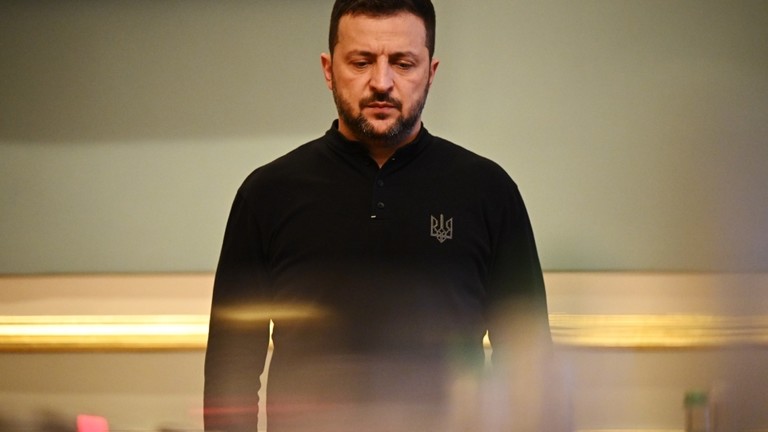
The Ukrainian government has canceled a meeting intended to involve Vladimir Zelensky and Latin American leaders out of fear it would become a PR disaster, Brazilian newspaper Folha de S.Paulo reported on Tuesday. Very few of the invitees confirmed that they would attend the event, the paper wrote.
Kiev initially planned to hold the talks on the sidelines of the UN General Assembly scheduled to convene on September 24. According to Folha, the idea behind the meeting was to demonstrate symbolic support for Ukraine in its conflict with Moscow.
Ukrainian officials reportedly said it would be “an appropriate platform” for Zelensky to present what they called “relevant and reliable information” about the conflict. Kiev also wanted to rally support for the so-called Zelensky ‘peace formula’ – a set of demands put forward by Ukraine as pre-conditions for peace talks. Moscow has rejected the demands, calling them unacceptable.
Kiev had to scrap the meeting after it received only a “few confirmations of attendance,” Folha reported, adding that the government decided it was “necessary to avoid a situation that could possibly be interpreted as a lack of support.”
The paper did not provide the number of confirmations or name the leaders who said they would attend, except for Guatemalan President Bernardo Arevalo.
Ukraine has received steady support from the West since the conflict with Russia broke out in February 2022, but has failed to gain much backing in other parts of the world. Many Asian, African, and South American countries, including China, India, and Brazil, have remained neutral and called for a diplomatic resolution.
Mexico’s president-elect, Claudia Sheinbaum, recently told journalists she would pursue a policy of non-intervention on the world stage and has no plans to make a state visit to Ukraine. “Searching for the peaceful resolution of conflicts is the cornerstone of our foreign policy. This is our policy, and it won’t change,” she said on Wednesday.
Kiev has dismissed any proposals that are not in line with the ‘Zelensky formula’, claiming they play into Moscow’s hands. Last week, Zelensky rejected a six-point roadmap proposed by China and Brazil. Brazilian President Luiz Inacio Lula da Silva responded by saying he would not allow his country to be dragged into the conflict.
The real reason US wants to silence RT
By Fyodor Lukyanov | RT | September 18, 2024
In late 1986 Yegor Ligachev, the secretary of the Soviet Communist Party’s Central Committee, and Viktor Chebrikov, then-head of the KGB, proposed that the country end the practice of jamming foreign radio stations. ‘Enemy voices’ was the popular term used at the time to describe these broadcasts from abroad.
Of course, the two prominent officials were not imbued with bourgeois ideas when seeking to end radio jamming. They were actually taking a businesslike approach. The pair explained to the Central Committee that blocking was expensive but not very effective, given the size of the country. So, it was suggested that signal-jamming be abandoned and that funds be diverted to counter-propaganda measures. This meant more active work with foreign audiences to communicate the Soviet Union’s own views on world events.
A few weeks later, at a meeting with US President Ronald Reagan in Iceland, USSR leader Mikhail Gorbachev raised the issue. He said “your radio station Voice of America broadcasts around the clock in many languages from stations you have in different countries in Europe and Asia, and we can’t present our point of view to the American people. So, for the sake of equality, we have to jam the Voice of America broadcasts.” Gorbachev offered to stop blocking ‘VOA’ if his counterpart agreed to let Moscow have a frequency to do the same in the US. Reagan evasively promised to consult when he returned home. In the end, the Soviets stopped jamming foreign radio stations unilaterally, without any deal.
The events of the last few days have echoes of this old story. US Secretary of State Anthony Blinken devoted an entire speech to RT, which is subject to ‘full-blocking’ (that’s a new formula!) sanctions for its supposedly destructive and subversive work around the world. According to Blinken and the American intelligence agencies he references, the threat posed by the Russian company is of the highest order and requires the most decisive measures from all of Washington’s allies.
Without irony or exaggeration, it can be said that RT could only dream of the global recognition that Blinken’s appeal has facilitated. The effectiveness of the media group was not so much confirmed as it was certified, and by prominent representatives of its rivals.
We could deplore infringements on freedom of expression and restrictions on pluralism of opinion, but there is little point in doing so. Such notions should only be promoted in relation to the internal information space of individual countries; at a national level, they are an indispensable prerequisite for normal development. As for foreign sources of information, people generally perceive them as instruments of influence. And it hardly depends on the type of socio-political system that exists in a given state. The more comprehensive the information and communication environment, the greater its impact on people’s behavior, and the more acute the desire of governments to tighten control over the flow of ideas and analysis. The international media sphere is deliberately ideological, electrified and conflictual. Hence Blinken’s, shall we say, uncharacteristic remarks that RT should be treated “like an intelligence agency.”
How effective are the tactics of restricting alternative views and jamming radio waves? Comrades Ligachev and Chebrikov rightly pointed out that the costly efforts to jam hostile broadcasters were, to put it mildly, not particularly effective. Worse, as the author well remembers, the very fact that the authorities were fighting foreign radio voices had the opposite effect to that desired – if they were silencing voices, it meant that they were afraid of the truth. And, by the end of the Soviet era this opinion was not only widespread among the frontline intelligentsia, many ‘ordinary people’ also didn’t give a damn about the official channels.
At their meeting in Iceland, Reagan countered Gorbachev’s appeal by saying that, unlike the Soviets, “we recognize freedom of the press and the right of people to listen to any point of view.” The US president had no doubts about the superiority of the American system in all respects. Accordingly, the demands for information pluralism, then and later, reflected the confidence of Washington that it would emerge victorious from any competition. And so, a few years later, the US achieved a de-facto monopoly on the interpretation of everything.
Washington’s current extreme reaction is due to the feeling that it’s losing this monopoly. Alternative interpretations of events now arouse public interest. In fact, the total resources of the Western, mainly English-language media are incomparably greater than what all the carriers of alternative points of view can offer, at this moment. But internal insecurity is growing all by itself, fueling the desire to fence off the information space. From the same playbook comes the US’ attempts to explain its internal strife and accumulated contradictions by pointing to a pernicious external influence. This was also the Soviet experience. However, the USSR didn’t solve its own issues by blaming them on external causes. In fact, as its problems grew, those same outside factors actually began to exacerbate them.
Targeted punitive actions can create obstacles for any organization, there is no doubt about that. Especially when they come from what is still the most powerful country on the planet. But American history teaches us that monopolies do not last forever. Sooner or later, a cartel becomes a brake on development, then it becomes the subject of measures to break it up.
Fyodor Lukyanov is the editor-in-chief of Russia in Global Affairs, chairman of the Presidium of the Council on Foreign and Defense Policy, and research director of the Valdai International Discussion Club.
Russia Slams NATO’s ‘Reckless’ Rejection of Putin’s Red Line on Ukraine Attacks
Sputnik – 18.09.2024
MOSCOW – Kremlin Spokesman Dmitry Peskov stated on Wednesday that dismissing Russian President Vladimir Putin’s warnings about the dangers of Ukraine using Western weapons to attack Russian territory is both provocative and perilous.
“Such a ostentatious desire not to take seriously the statements of the Russian president is an absolutely short-sighted and unprofessional step,” Peskov told reporters.
NATO Secretary General Jens Stoltenberg denied in an interview out on Tuesday that allowing Ukraine to use long-range Western weapons to strike deep into Russia would cross country’s “red line” despite warnings from Russian President Vladimir Putin.
“There have been many red lines declared by him [Putin] before, and he has not escalated, meaning also involving Nato allies directly in the conflict,” Stoltenberg told The Times newspaper.
Stoltenberg said that he supported the United Kingdom and France in their decision to lift restrictions on Kiev’s use of long-range weapons against Russia. He argued that their use by Ukraine would not draw the alliance into conflict with Russia.
Putin said that NATO countries were essentially deciding whether to get directly involved in the Ukrainian conflict. He warned that direct participation of Western countries in the conflict would change its nature, forcing Russia to respond to emerging threats.
Meanwhile, Hungarian Foreign Minister Peter Szijjarto stated on Wednesday that Hungary is concerned about the potential use of long-range arms to strike Russia, as this would contradict Europe’s security interests and heighten the risk of escalation. He emphasized that “Hungary is interested in peace, and every step that threatens escalation makes us concerned,” adding that the use of long-range missiles against targets deep in Russia would “increase the threat of escalation,” which runs counter to European security interests.
Lebanon pager attack ‘a monstrous act of terrorism’ – Moscow
RT | September 18, 2024
The mass detonation of pagers which killed several people and left thousands of others injured in Lebanon on Tuesday was an act of “monstrous terrorism,” Russian officials have said.
Beirut and the militant group Hezbollah, which was the apparent target of the attack, have blamed Israel for the incident. The Jewish state has neither confirmed nor denied responsibility. Media reports have claimed that the Israeli secret service, Mossad, rigged thousands of pager devices with small explosive charges, which were simultaneously triggered via a remote signal.
“This was a monstrous act of terrorism, monstrous in its cynicism and its scale, considering the large number of victims,” Russian Foreign Ministry spokeswoman Maria Zakharova said on Wednesday.
A separate statement by the ministry said that Moscow considers the mass detonations to be “the latest act of hybrid warfare against Lebanon,” adding that “the masterminds of this high-tech attack were seeking to ignite large-scale armed confrontation with the goal of triggering a major war in the Middle East.”
The ministry did not assign blame to any particular party, but called for a thorough investigation. “All people responsible… must be held accountable, so that this new act of terrorism is not ‘swept under the rug’ the way the Western nations want to steer the investigation of the explosions at the Nord Stream gas pipelines,” it added.
The ministry was referring to the sabotage in September 2022 of undersea routes built to deliver Russian natural gas to Germany. The perpetrators have yet to be formally identified, although leaks to the media have suggested the attack was a privately-funded Ukrainian operation.
Commenting on the Lebanon incident, the Kremlin expressed concern about its consequences.
“The region is already in an explosive state. Certainly, incidents like this one – any such incident – can trigger events that would spin the situation out of control,” spokesman Dmitry Peskov told the media.
NATO’s Destruction of Ukraine Under the Guise of “Helping”
Propaganda & Proxy Wars
By Glenn Diesen | September 17, 2024
In a recent public event, the heads of the CIA and the MI6 assessed developments in the Ukraine War. The head of the MI6 applauded the invasion of Kursk for having changed the “narrative” of the war, while the head of the CIA also outlined the objective to “put a dent” in the Kremlin’s narrative about the development of the war. There can be no doubt that the invasion of Kursk was an utter disaster for Ukraine and NATO. However, controlling the narrative is imperative as the Western public will support financing the war if they believe they are helping Ukraine and the war can be won.
During the 20-year-long NATO occupation of Afghanistan, public support was also maintained by constructing a narrative of progress and helping the people of Afghanistan. Every week the Western public was reassured by the media that the war effort in Afghanistan was making great progress, until NATO fled in a great hurry as people fell off planes. Much like how the Pentagon Papers exposed the deceit of the Vietnam War, the Afghanistan Papers exposed how the war was an unmitigated disaster. Yet, in both instances, a rosy picture was presented by the media.
A leaked CIA report outlined how they could increase public support for NATO’s occupation of Afghanistan by selling it to the public as helping women. The report revealed that “Afghan women could serve as ideal messengers in humanizing the ISAF role in combating the Taliban”, and framing NATO’s occupation as a crusade for women’s rights could “overcome pervasive scepticism among women in Western Europe towards the ISAF mission”.[1] NATO Secretary-General Jens Stoltenberg even co-authored an article with Hollywood star Angelina Jolie with the title: “Why NATO must defend women’s rights”.[2] Appealing to the best in human nature to mobilise public support for doing the worst in human nature is a good description of war propaganda.
Selling the Ukraine War
The Ukraine War is sold to the public as being merely selfless “help” from NATO for Ukraine to defend itself against an expansionist Russia, motivated solely by territorial acquisition and restoring the Soviet Union. Framing the war as a simple struggle between good and evil is why NATO cannot negotiate or even pursue basic diplomacy, and peace depends on good defeating evil. In what is close to a copyright infringement of “war is peace” in George Orwell’s 1984, NATO Secretary General Jens Stoltenberg asserts that “weapons are the way to peace”.
In political propaganda, it is common to frame a war through a concept that everyone agrees with, such as the need to “help” Ukraine. We all want to help Ukraine preserve its sovereignty, territory and the lives of its citizens. However, instead of discussing what would help Ukraine, such concepts are given a fixed meaning to shut down debates. Any argument can then be framed as either being pro-Ukrainian or pro-Russian. However, what is bad for Russia is not automatically good for Ukraine. Yet, people who can be taught to speak in clichés can be taught to think in clichés. Commentary on NATO policies toward Russia is similarly framed as being pro-Western or pro-Russian, which circumvents an actual discussion about whether these policies are in the West’s interests or not.
Concepts such as “helping Ukraine” can then be filled with any content that often contradicts what “helping” entails, but corresponds with proxy war. When we unpack what NATO frames as “helping Ukraine”, we find that it rarely has the support from the majority of Ukrainians and it almost always ends up with disastrous consequences. So how does NATO “help Ukraine”?
NATO Expansion
NATO dismisses any accusations of an expansionist agenda by presenting itself as a passive actor that merely responds to Ukraine’s desire to join NATO. This narrative conceals the reality that every poll between 1991 and 2014 demonstrates that only approximately 20% of Ukrainians wanted to join NATO. When NATO promised future membership to Ukraine in 2008, 43 percent of Ukrainians considered NATO a threat to Ukraine and merely 15 percent associated NATO with protection.[3] Forty-six percent of Ukrainians answered it was more important to have close relations with Russia, while only 10 percent of Ukrainians supported close relations with the US over Russia.[4] In 2011, a NATO document acknowledged: “The greatest challenge for Ukrainian-NATO relations lies in the perception of NATO among the Ukrainian people. NATO membership is not widely supported in the country, with some polls suggesting that popular support of it is less than 20%”.[5]
Even after Russia seized Crimea in response to the Western-backed coup in 2014, only a small minority of Ukrainians wanted integration with NATO (10.3% in the South and 13.1% in the East).[6] Nonetheless, Ukraine was still pulled toward NATO even though CIA Director Burns had warned already back in 2008 that it would likely trigger a civil war in Ukraine and “Russia would have to decide whether to intervene; a decision Russia does not want to have to face”.[7] In December 2020, former British ambassador to Russia Roderic Lyne similarly warned that attempting to push Ukraine into NATO “was stupid on every level at that time. If you want to start a war with Russia, that’s the best way of doing it. Moreover, any poll in Ukraine showed that two thirds of the Ukrainian public did not want NATO membership”.[8] If the Ukrainians did not want NATO membership and we knew it would trigger a war, why was it “pro-Ukrainian”?
Regime Change in Kiev
In February 2014, NATO countries toppled the government in Ukraine under the guise of supporting a “democratic revolution”. Yanukovich had been elected in what the OSCE had recognised to be a free and fair election, and there was no evidence that Yanukovich would not have stepped down if he had lost in the next election. The Maidan protests did not enjoy democratic majority support from the Ukrainians and even fewer supported a coup.[9] British Foreign Minister William Hague deceived the public by claiming that the toppling of President Yanukovich had been done in compliance with the constitution, contrary to the clear rules in the Ukrainian constitution that specified procedures for removing the head of state.[10] A phone call leaked two weeks before the coup, exposed how Washington was planning the coup and hand-picked the new government that would be installed.[11] NATO supported the toppling of the democratically elected government that attempted to bridge a divided society, and replaced it with a divisive pro-NATO/anti-Russian government. Yet criticise the Western-backed coup in Kiev and you will be branded to be “anti-Ukrainian” and “pro-Russian”. In contrast, the people who set Ukraine on a path to destruction against their will claim to “stand with Ukraine”.
Asserting Administrative Control over Ukraine
On the first day after the coup, the head of Ukraine’s intelligence services in the new government that the US had hand-picked, called the CIA and MI6 to start a partnership for a covert war against Russia.[12] This partnership was a key reason why Russia decided to intervene militarily eight years later in February 2022.[13] The Washington Post reported: “the CIA has spent tens of millions of dollars to transform Ukraine’s Soviet-formed services into potent allies against Moscow”.[14] The US then also strengthened the far-right fascist groups in Ukraine as they functioned as a veto power on any efforts to seek peace with Russia.
Several Westerners took key positions in the Ukrainian government. In 2014, Natalie Jaresko took the position of Finance Minister of Ukraine and received Ukrainian citizenship on the same day as she took the job. Jaresko was a former US State Department official and former Economic Section Chief of the US Embassy in Ukraine. She transitioned from representing American interests in Ukraine, to representing Ukraine. The general prosecutor of Ukraine, Viktor Shokin, complained that since 2014, “the most shocking thing is that all the [government] appointments were made in agreement with the United States”. According to Shokin, Washington’s behaviour indicated that they “believed that Ukraine was their fiefdom”.[15] Biden would later take credit for having fired Ukraine’s General Prosecutor, who had opened an investigation into the Ukrainian energy company Burisma. Three months after the coup in February 2014, Hunter Biden and a close family friend of US Secretary of State, John Kerry, became board members of Burisma.[16]
After Russia invaded in February 2022, the US further strengthened its grip over Ukraine. In 2023, an American transgender who argued that Russians are not human beings became the new spokesperson for Ukraine’s Territorial Defence Forces. As Ukraine’s situation became more precarious and dependence on the West increased, Kiev largely outsourced the post-war reconstruction process to BlackRock and J.P. Morgan to manage the Ukraine Development Fund. The US asserting administrative control over the Ukrainian government was depicted as helping Ukraine with democratic governance and fighting corruption.
De-Russifying Ukraine
Decoupling Ukraine from Russia was a key objective to permanently place Ukraine in NATO’s orbit. The US-orchestrated Orange Revolution in 2004 installed the Yushchenko government that distanced itself from Russia and pursued NATO membership, however, the public eventually reversed this trajectory by electing Yanukovich. At the end of Yushchenko’s presidential term, Newsweek labelled Yushchenko the world’s most unpopular leader with a 2.7 percent approval rating.[17]
US support for the de-Russification of Ukrainian society entailed purging the political opposition, arresting the main opposition leader, banning independent media, banning the Orthodox Church, and purging the Russian language and culture. The first decree by the new Ukrainian Parliament in 2014 was a call to repeal Russian as a regional language. By 2024, Ukraine even had language inspectors to counter the spread of the Russian language.[18] The BBC reported that after the coup, Kiev’s city council was covered with large neo-Nazi banners, the American confederate flag, and portraits of the fascist ally of Hitler, Stepan Bandera.[19] A new nationalist identity was supported based on the far-right in which street names with the shared Russian or Soviet history were replaced with fascists who collaborated with Hitler. To de-Russify a country that lived in the same state as Russia for centuries and shared language, culture and faith, could not possibly coexist with democracy, stability or basic human rights. Such policies caused a deep rift in the social cohesion of the country and caused misery for millions of Ukrainians who became second-rate citizens in their own country.
Yet, these developments could be supported under the guise of “helping Ukraine” to decouple from Russia as a condition for asserting its distinctive identity and sovereignty.
The War Against Donbas
After the coup in 2014, people in Donbas rejected the new government in Kiev that had seized power with the support of the West, as predicted by CIA Director Burns. The first instinct of the new authorities and their backers in Washington was to send the military to destroy the uprising. Yet, the Ukrainian army was weak and regular soldiers were not comfortable with turning their guns on their own population. This problem was overcome by recruiting fascist militias in Western Ukraine, such as Azov, who were happy to kill. Yevhan Karas, the leader of the fascist group C14, informed his audience that the West did not give weapons to help Ukrainians but did so because “we have started a war” that was fulfilling the goals of the West. The nationalists were supported by the West due to their resilience: “because we have fun, we have fun killing and we have fun fighting”.[20]
Kiev launched an “anti-terrorist operation” against Donbas, which killed more than 14.000 Ukrainians. Ignoring all evidence about the involvement of local Ukrainians in the uprising, the Western media largely denied any agency as all fighting was done by “pro-Russian” militias or Russians themselves. Thus, the war against Ukrainians in Donbas could be sold to the Western public as helping Ukraine fight Russian influence.
Sabotaging the Minsk-2 Peace Agreement
The fighting between Kiev and Donbas came to an end with the Minsk-2 peace agreement. Both Poroshenko and Zelensky attempted to implement the Minsk-2 agreement before being opposed by the US-backed far-right.
The BBC reported in August 2015 that a clear majority of 265 MPs out of 450 had supported the first reading of the decentralisation bill to grant more autonomy to Donbas. This sparked a violent veto by the far right, it then reported: ‘Protesters led by the populist Radical Party and the ultra-nationalist Svoboda (Freedom) party—who oppose any concession to the Russian-backed separatists’ clashed with riots police that resulted in the death of a national guard member and over 100 injured.[21] Poroshenko subsequently began to abandon his efforts to implement the Minsk-2 agreement.
Zelensky was therefore able to win a landslide election victory with 73% of the votes in 2019. He won over the Ukrainian public by running on a platform of peace by promising to implement the Minsk agreement to ensure peace After Zelensky became president, he was threatened by the US-backed far right and a protest was arranged in Kiev in which approximately 10,000 people rallied against President Zelensky’s plan to end the war, which was denounced as “capitulation”.[22] After failing to assert control over the far-right groups in the military, Zelensky had to align himself closer with the nationalists and thus rejected peace with Donbas.[23]
The US assisted its government in Ukraine to ignore the UN-approved Minsk-2 peace agreement by building an increasingly powerful Ukrainian army and tying it closer to NATO. Germany and France had negotiated the Minsk-2 peace agreement in 2015, although they later revealed this had been a deceit. Angela Merkel argued in an interview with both Bild and Spiegel that the Minsk Agreement enabled her to buy time for Ukraine to build itself into a powerful and well-fortified country.[24] When her French counterpart, former president François Hollande, was asked about Merkel’s statement that the Minsk-2 peace agreement was merely intended to buy time, he confirmed: “Yes, Angela Merkel is right on this point” and added that the conflict with Russia would be resolved on the battlefield: “There will only be a way out of the conflict when Russia fails on the ground”.[25] Retired German General Harald Kujat, the former head of the German Bundeswehr and former chairman of the NATO Military Committee, later argued that the West’s sabotage of the Minsk agreement was “a breach of international law… it turns out that we are the ones who do not comply with international agreements”.[26]
NATO countries had confirmed for 7 years that the Minsk-2 peace agreement was the only path to a peaceful settlement of the conflict in Ukraine, while concurrently sabotaging the only path to peace. This path to war was done against the overwhelming will of the Ukrainian population, as evidenced by their consistent voting for a peace platform. Why should NATO efforts to overturn the result of the Ukrainian elections to sabotage the peace agreement be considered “pro-Ukrainian” or “helping Ukraine”?
Refusing Russia’s Demand for Security Guarantees in 2021
Russia demanded in 2021 security guarantees to mitigate the threats from NATO’s growing footprint in Ukraine, otherwise, the escalating threat would be resolved by military means. President Biden warned Ukraine that Russia was preparing its military for an invasion, yet he did not want to offer any security guarantees to prevent an invasion.
Kurt Volker, the former US Ambassador to NATO and former US Special Representative for Ukraine Negotiations from 2017 to 2019, even argued that Biden should not make any agreements with Putin as “the best possible outcome is not one of modest agreements and a commitment to ‘predictability,’ but one of a lack of agreements altogether. Success is confrontation”.[27] NATO Secretary General Jens Stoltenberg also acknowledged that halting NATO expansion was required to prevent an invasion: “President Putin declared in the autumn of 2021, and actually sent a draft treaty that they wanted NATO to sign, to promise no more NATO enlargement. That was what he sent us. And [it] was a pre-condition for not invad[ing] Ukraine. Of course we didn’t sign that”.[28] Under a fierce security competition in which Russia feared for its security, “helping Ukraine” would certainly have involved mitigating some of Russia’s security concerns.
Sabotaging the Istanbul Peace Negotiations in 2022
After the Minsk agreement had been sabotaged for 7 years and no security guarantees were forthcoming, Russia decided in February 2022 to use military force to impose a political settlement. On the first day after the Russian invasion, Zelensky confirmed “Today we heard from Moscow that they still want to talk. They want to talk about Ukraine’s neutral status… We are not afraid to talk about neutral status”.[29] On the third day after the invasion, Moscow and Kiev announced they would hold peace talks “without preconditions” in Belarus.[30] Zelensky even suggested later a “collective security agreement” to ensure that the security concerns of both Russia and Ukraine would be met.[31]
The US had other objectives. On the first day after the Russian invasion, Washington rejected peace without preconditions as Russia first had to withdraw all its forces from Ukraine.[32] Washington even suggested that it would not support Ukraine’s effort to resolve the conflict through a compromise as “this is a war that is in many ways bigger than Russia, it’s bigger than Ukraine”.[33] In March 2022, Zelensky argued in an interview with the Economist that “There are those in the West who don’t mind a long war because it would mean exhausting Russia, even if this means the demise of Ukraine and comes at the cost of Ukrainian lives”.[34]
According to the leader of Zelensky’s political party and Zelensky’s advisor, Russia and Ukraine were close to an agreement. Ukrainian Ambassador Oleksandr Chalyi, who participated in peace talks with Russia, confirms Putin “tried everything” to reach a peace agreement and they were able “to find a very real compromise”.[35]
Retired German General Harald Kujat, the former head of the German Bundeswehr and former chairman of the NATO Military Committee, argued that NATO provoked the war and that the US and UK sabotaged the Istanbul peace negotiations as “the West was not ready for an end to the war”.[36] The Turkish mediators confirmed: “I had the impression that there are those within the NATO member states that want the war to continue—let the war continue and Russia gets weaker. They don’t care much about the situation in Ukraine”.[37] The Israeli mediators reached the same conclusion as former Israeli Prime Minister Naftali Bennett recognised “both sides very much wanted a ceasefire” but the West “blocked” the peace agreement as a “decision by the West to keep striking Putin” rather than pursuing peace.[38]
After interviews with American and British leaders, Niall Ferguson reported in Bloomberg that a decision had been made for “the conflict to be extended and thereby bleed Putin” as “the only end game now is the end of Putin regime”.[39] Over the next two and a half years, numerous American political and military leaders expressed their support for the war as it was a great opportunity to weaken Russia as a strategic rival without using and losing American troops. The decision to fight Russia with Ukrainians was nonetheless framed consistently in the media as “helping Ukraine”.
Keeping Ukraine in the War
As Zelensky had argued in March 2022, some of its Western partners preferred “long war because it would mean exhausting Russia, even if this means the demise of Ukraine and comes at the cost of Ukrainian lives”.[40] The Americans were pressuring Ukraine to launch the disastrous counter-offensive of 2023, as a “senior Ukrainian military official recalled, the Americans were nagging about a delayed start”.[41] The New York Times reported that “American officials say they fear that Ukraine has become casualty averse, one reason it has been cautious about pressing ahead with the counteroffensive”.[42]
However, despite the disastrous casualties among the Ukrainians and the failure of the counter-offensive, the Washington Post could report that “for the United States and its NATO allies, these 18 months of war have been a strategic windfall, at relatively low cost (other than for the Ukrainians). The West’s most reckless antagonist has been rocked. NATO has grown much stronger with the additions of Sweden and Finland. Germany has weaned itself from dependence on Russian energy and, in many ways, rediscovered its sense of values. NATO squabbles make headlines, but overall, this has been a triumphal summer for the alliance”.[43] As Ukraine continues to bleed dry in the war of attrition, there are more and more videos on Ukrainian Telegram channels of more aggressive “recruitment” tactics that involve grabbing Ukrainians off the street and throwing them into vans. Yet, the discussions in NATO countries revolve around lowering the conscription age in Ukraine or deporting Ukrainian refugees that can be used to refill the trenches.
If these were our own soldiers dying in the hundreds of thousands, would we not have begun negotiations a long time ago? The incoming EU foreign policy chief has rejected any diplomacy with Russia as Putin is a “war criminal”, while also punishing EU member states such as Hungary for attempting to restore diplomacy and negotiations between Ukraine and Russia. NATO could help Ukraine by using the promise to end expansion as a bargaining chip in negotiations with Russia. Instead, NATO continues to threaten further expansion after the war, which makes any peace agreement impossible. When Ukraine begins to collapse, the US and NATO will likely call for a ceasefire to freeze the frontlines to yet again buy some time to rebuild its Ukrainian army and fight another day.
As we reflect on NATO’s policies toward Ukraine, can we conclude that they have been in the interest of Ukraine or had the support of the Ukrainians? Has it been in the interest of the West? The ability to ask critical questions is prevented by presenting all policies as being either pro-Ukrainian or pro-Russian, in which dissent is effectively criminalised. It is a common phenomenon that when political leaders create propaganda, they often end up deceiving themselves.
…..
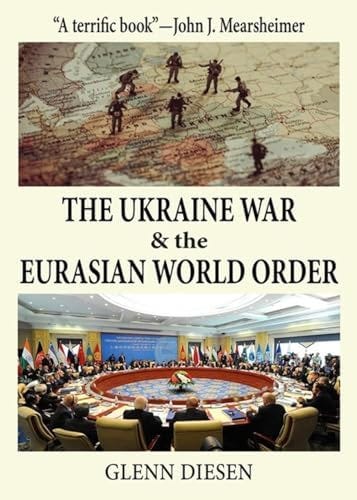
– The text includes excerpts from my book “The Ukraine War and the Eurasian World Order” https://www.claritypress.com/product/the-ukraine-war-the-eurasian-world-order/
[1] WIKILEAKS – – CIA Red Cell Special Memorandum; Afghanistan: Sustaining West European Support for the NATO-led Mission-Why Counting on Apathy Might Not Be Enough, March 11, 2010
[2] Why Nato must defend women’s rights | Jens Stoltenberg and Angelina Jolie | The Guardian
[3] J. Ray and N. Esipova, ‘Ukrainians Likely Support Move Away From NATO’, Gallup, 2 April 2010.
[4] C. English, ‘Ukrainians See More Value in Ties With Russia Than U.S.’, Gallup, 15 February 2008.
[5] 2011 – 172 CDSDG 11 E REV1 – UKRAINE – MALAN REPORT | NATO PA (nato-pa.int).
[6] GALLUP® CORP Template (usagm.gov)
[7] W.J. Burns, ‘Nyet means nyet: Russia’s NATO Enlargement Redlines’, Wikileaks, 1 February 2008.
[8] R. Lyne, ‘The UC Interview Series: Sir Roderic Lyne by Nikita Gryazin’, Oxford University Consortium, 18 December 2020.
[9] BBC, ‘Ukraine’s revolution and the far right, BBC, 7 March 2014.
[10] D. Morrison, ‘How William Hague Deceived the House of Commons on Ukraine’, Huffington Post, 10 March 2014.
[11] BBC, ‘Ukraine crisis: Transcript of leaked Nuland-Pyatt call’, BBC, 7 February 2014.
[12] The Spy War: How the C.I.A. Secretly Helps Ukraine Fight Putin – The New York Times (nytimes.com)
[13] The Spy War: How the C.I.A. Secretly Helps Ukraine Fight Putin – The New York Times (nytimes.com)
[14] G. Miller and I. Khurshudyan, ‘Ukrainian spies with deep ties to CIA wage shadow war against Russia’, The Washington Post’, 23 October 2023.
[15] M.M. Abrahms, ‘Does Ukraine Have Kompromat on Joe Biden?’, Newsweek, 8 August 2023.
[16] P. Sonne and J. Grimaldi, ‘Biden’s Son, Kerry Family Friend Join Ukrainian Gas Producer’s Board’, The Wall Street Journal, 13 May 2014.
[17] O. Matthews, ‘Viktor Yushchenko’s Star Has Fallen’, Newsweek, 13 March 2009.
[18] Language inspectors to start working in Frankivsk | УНН (unn.ua)
[19] BBC, ‘Ukraine’s Revolution and the Far Right’, BBC, 7 March 2014.
[20] A. Rubenstein and M. Blumenthal, ‘How Ukraine’s Jewish president Zelensky made peace with neo-Nazi paramilitaries on front lines of war with Russia’, The Grayzone, 4 March 2022.
[21] BBC, ‘Ukraine crisis: Deadly anti-autonomy protest outside parliament’, BBC, 31 August 2015.
[22] A. Korniienko, ‘Thousands rally in Kyiv against Zelensky’s plan to end war with Russia’, Kyiv Post, 6 October 2019.
[23] J. Melanovski, ‘Ukrainian President Zelensky deepens alliance with far right’, WSWS, 30 April 2021.
[24] A. Osang, ‘You’re Done with Power Politics’, Spiegel, 1 December 2022.
[25] T. Prouvost ‘Hollande: ‘There will only be a way out of the conflict when Russia fails on the ground’’, The Kyiv Independent, 28 December 2022.
[26] Emma, ‘Russland will verhandeln!’ [Russia wants to negotiate!], Emma, 4 March 2023.
[27] K. Volker, ‘What Does a Successful Biden-Putin Summit Look Like? Not What You Think’, CEPA, 2 June 2021.
[28] J. Stoltenberg, ‘Opening remarks’, NATO, 7 September 2023.
[29] V. Zelensky, ‘Address by the President to Ukrainians at the end of the first day of Russia’s attacks’, President of Ukraine: Official website, 25 February 2022.
[30] S. Raskin and L. Brown, ‘Ukraine and Russia to meet for peace talks ‘without preconditions,’ Zelensky says’, New York Post, 27 February 2022.
[31] M. Hirsh, ‘Hints of a Ukraine-Russia Deal?’, Foreign Policy, 8 March 2022.
[32] US Department of State, ‘Department Press Briefing’, US Department of State, 25 February 2022.
[33] US Department of State, ‘Department Press Briefing’, US Department of State, 21 March 2022.
[34] The Economist. ‘Volodymyr Zelensky on why Ukraine must defeat Putin’ The Economist, 27 March 2022.
[35] Breaking the Stalemate to Find Peace: The Russia-Ukraine War – A Geneva Security Debate (youtube.com)
[36] J. Helmer, ‘Whr. Gen. Kujat: Ukraine War is Lost, Germany Now Faces an Angry Russia… Alone’, Veterans Today, 25 January 2023.
[37] R. Semonsen, ‘Former Israeli PM: West Blocked Russo-Ukraine Peace Deal’, The European Conservative, 7 February 2023.
[38] N. Bennett, ‘Bennett speaks out’, YouTube Channel of Naftali Bennett, 4 February 2023.
[39] N. Ferguson, ‘Putin Misunderstands History. So, Unfortunately, Does the U.S.’, Bloomberg, 22 March 2022.
[40] The Economist. ‘Volodymyr Zelensky on why Ukraine must defeat Putin’ The Economist, 27 March 2022.
[41] ‘Miscalculations, divisions marked offensive planning by U.S., Ukraine’, The Washington Post, 4 December 2023.
[42] ‘Troop Deaths and Injuries in Ukraine War Near 500,000, U.S. Officials Say’, The New York Times, 18 August 2023.
[43] D. Ignatius, ‘The West feels gloomy about Ukraine. Here’s why it shouldn’t’, The Washington Post, 18 July 2023.
Featured Video

HE SAVED LIVES. NOW HE FACES PRISON.
or go to
Aletho News Archives – Video-Images
From the Archives
NATO Sanctions and the Coming Global Diesel Fuel Disaster
By F. William Engdahl – New Eastern Outlook – 11.04.2022
Amid the ongoing global inflation crisis, NATO heads of state and mainstream media repeat a mantra that high energy prices are a direct result of Putin’s actions in Ukraine since end of February. The reality is that it is the western sanctions that are responsible. Those sanctions including cutting SWIFT interbank access for key Russian banks and some of the most severe sanctions ever imposed, are hardly having an impact on the military actions in Ukraine. What many overlook is the fact that they are increasingly impacting the economies of the West, especially the EU and USA. A closer look at the state of the global supply of diesel fuel is alarming. But Western sanctions planners at the US Treasury and the EU know fully well what they are doing. And it bodes ill for the world economy.
While most of us rarely think about diesel fuel as anything other than a pollutant, in fact it is essential to the entire world economy in a way few energy sources are. The director general of Fuels Europe, part of the European Petroleum Refiners Association, stated recently, “… there is a clear link between diesel and GDP, because almost everything that goes into and out of a factory goes using diesel.” … continue
Blog Roll
 Aletho News
- Trita Parsi: Middle East Unraveling — Are We on the Path to World War?
- Iran FM meets with US envoy on UN meeting’s sidelines at American side’s insistence: Report
- Qatar PM calls for Gulf security framework with Iran, says war must be ‘wake-up call’
- China condemns US extortion of Iranian airlines, rejects Washington’s ‘illegal’ sanctions threats
- Italy to move military personnel from Taif base after missile strike
- Finland’s Stubb tells European leaders to calm down
- Defeating Russia on battlefield impossible – Fico
- Finland’s Gender Clinic Reversal
- Massachusetts Wants Mental Health Visits, Why Does Government Use ‘Health’ to Enter Our Homes & Families?
- US lawmaker admits American people footing bill for Trump’s failed aggression against Iran
- If Americans Knew
- Sanctions are collective punishment: immoral and self-defeating
- Phosphorus Munitions Fired by Israel Burn Groves, Orchards in Southern Lebanon
- Israel Carries Out New Ceasefire Violations Across Gaza
- AI – Emphasis on the ‘I’: Israel Is Funding AI Chatbot Propaganda
- Israel Blocking Hundreds of Wheelchairs for Injured Children From Entering Gaza
- Israel Is Expanding and Upgrading Compounds for Palestinian Militias in Gaza
- The Palestinian-American Residents of This West Bank Town Are Wondering: Where Is Trump?
- Gaza desperately needs tents, wheelchairs, fuel… and everything else (Israel blocks it all) – Daily Update
- Israeli Attacks in Gaza Kill at Least Seven Palestinians Over Three Days, including Woman and Child
- Trump’s militarization of Washington DC as he pursues Israel’s war against Iran
- No Tricks Zone
- New Study: Earth And Venus Surface Warmth Largely Explained By Convection And Lapse Rate, Not CO2 Or Radiation
- 2025 Nature Paper Claiming Worsening Global Drought Gets RETRACTED …Heavily Flawed
- New Study: ‘Global Drought Shows No Detectable Recent Acceleration Under Climate Warming’
- Economic Masterminds: German Socialists Suggest Taxing Productivity Gains Stemming From Using AI
- The South China Sea Has Not Been Cooperating With The Climate Change Narrative
- Energy Crisis: Germany Enters Heating Season With Historically Low Gas Reserve Fill Levels
- New Study: The Antarctic Ice Sheet Gained Mass From 2020-2024 Due To Staggering Snow And Ice Accumulation
- Study: Ocean Heating Rates From Thousands Of Years Ago ‘Dwarf’ Modern Ocean Heating Rates
- Climate Extremists Target, Attack Large-Scale Power Grid Infrastructure In Germany!
- New Study: Antarctic Ice Melt Has Contributed Less Than 1 Centimeter To Sea Level Rise In The Last 30 Years

