How Could Lebanon Blasts Affect Global Security and Attitude to Western Hi-Tech Producers?
By Ekaterina Blinova – Sputnik – 19.09.2024
A series of blasts reportedly involving Taiwanese, Japanese, American, and European-made devices in Lebanon on September 17 and 18 have prompted grave security concerns worldwide.
“Weaponizing mobile communications devices will fill many people with horror and fear,” Marc Ostwald, chief economist at ADM Investor Services International, told Sputnik. “It may, at the margin, dampen demand.”
The Lebanese government attributed the attack to Israel, accusing Tel Aviv of an outright act of terrorism.
Given almost “unconditional support” provided to Israel by some Western countries, some of them may have colluded with Tel-Aviv, said Hasan Abdullah, analyst and researcher at Global Security and Strategy Institute.
“The US is going to be the country that’s going to generate the greatest trust deficit with their customers, primarily because of its very close collaboration with Israel,” Abdullah told Sputnik.
The US has long been one of the largest suppliers of communication equipment, including for military needs, to the Global South, the pundit noted, adding that the recent blasts could alienate the developing world from Western producers.
Earlier, researcher Mehmet Rakipoglu and military analyst Alexei Leonkov told Sputnik they did not rule out US involvement in the Lebanon attack.
The Intercept reported on Wednesday that the US military had explored the possibility of planting remote-activated bombs in innocuous devices starting from the 1960s.
Middle East and other developing countries could eventually turn to Russian, Chinese or Turkish tech firms out of fear that the US involvement could compromise their security, Abdullah said.
Ostwald and Abdullah believe that several measures could be taken to stop the covert bombings, starting with investigations into manufacturing processes and ending with the deployment of international watchdogs to oversee production and supply.
Ukraine courting Middle East terrorists – Syrian official
RT | September 19, 2024
Ukraine is increasingly seeking cooperation with terrorist groups in the Middle East in a bid to find allies in its fight against Russia, a senior Syrian official has told RT.
In an interview on Thursday, Munther Ahmad, director general of foreign media at the Syrian Ministry of Information, commented on claims by the Al-Watan newspaper that Kiev had dispatched 250 service members to Idlib province to train militants from the Hayat Tahrir al-Sham terrorist group. In exchange, the group reportedly provided Kiev with a detachment of fighters.
Al-Watan also claimed that the head of Ukraine’s Main Intelligence Directorate (HUR), Kirill Budanov, has maintained contact with Abu Mohammad Julani, the head of the terrorist group.
According to Ahmad, “it seems that the reports are accurate” and that “the level of cooperation between Ukraine and these terrorist groups is increasing.” Kiev wants to convince terrorists “to carry out certain operations” against Russian forces both in Syria and beyond, he added.
The Syrian official also remarked that a report by Turkish newspaper Aydinlik, purporting to show a picture of a recent meeting between Ukrainians and terrorists, suggests that Kiev is indeed trying to forge such ties. The results of this endeavor, Ahmad added, “depends on how much money they [Ukraine] are willing to inject into these mercenaries.”
“Currently, this dirty money that Ukraine is offering these terrorist groups will be used for the dirty deeds Ukraine wants to carry out,” the official claimed, stating that the terrorists would cease their activities once the funding dries up.
Ahmad also suggested that Ukraine has plunged into “a state of confusion.” “Sometimes they claim they want to end the conflict. Other times, they say they will continue the war to the very end, especially when it comes to requesting aid from the US and European governments.”
Commenting on reports about Kiev courting Syrian militants, Russian Foreign Ministry spokeswoman Maria Zakharova suggested that Ukraine itself “had turned into a terrorist organization.”
Zelensky cancels meeting fearing PR disaster – media
RT | September 19, 2024
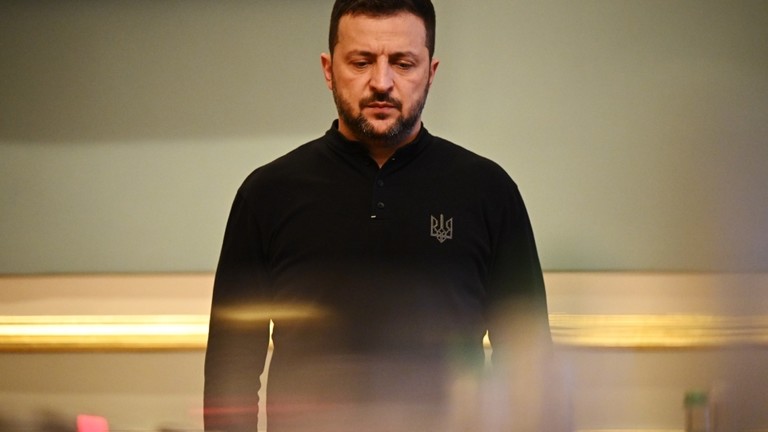
The Ukrainian government has canceled a meeting intended to involve Vladimir Zelensky and Latin American leaders out of fear it would become a PR disaster, Brazilian newspaper Folha de S.Paulo reported on Tuesday. Very few of the invitees confirmed that they would attend the event, the paper wrote.
Kiev initially planned to hold the talks on the sidelines of the UN General Assembly scheduled to convene on September 24. According to Folha, the idea behind the meeting was to demonstrate symbolic support for Ukraine in its conflict with Moscow.
Ukrainian officials reportedly said it would be “an appropriate platform” for Zelensky to present what they called “relevant and reliable information” about the conflict. Kiev also wanted to rally support for the so-called Zelensky ‘peace formula’ – a set of demands put forward by Ukraine as pre-conditions for peace talks. Moscow has rejected the demands, calling them unacceptable.
Kiev had to scrap the meeting after it received only a “few confirmations of attendance,” Folha reported, adding that the government decided it was “necessary to avoid a situation that could possibly be interpreted as a lack of support.”
The paper did not provide the number of confirmations or name the leaders who said they would attend, except for Guatemalan President Bernardo Arevalo.
Ukraine has received steady support from the West since the conflict with Russia broke out in February 2022, but has failed to gain much backing in other parts of the world. Many Asian, African, and South American countries, including China, India, and Brazil, have remained neutral and called for a diplomatic resolution.
Mexico’s president-elect, Claudia Sheinbaum, recently told journalists she would pursue a policy of non-intervention on the world stage and has no plans to make a state visit to Ukraine. “Searching for the peaceful resolution of conflicts is the cornerstone of our foreign policy. This is our policy, and it won’t change,” she said on Wednesday.
Kiev has dismissed any proposals that are not in line with the ‘Zelensky formula’, claiming they play into Moscow’s hands. Last week, Zelensky rejected a six-point roadmap proposed by China and Brazil. Brazilian President Luiz Inacio Lula da Silva responded by saying he would not allow his country to be dragged into the conflict.
The real reason US wants to silence RT
By Fyodor Lukyanov | RT | September 18, 2024
In late 1986 Yegor Ligachev, the secretary of the Soviet Communist Party’s Central Committee, and Viktor Chebrikov, then-head of the KGB, proposed that the country end the practice of jamming foreign radio stations. ‘Enemy voices’ was the popular term used at the time to describe these broadcasts from abroad.
Of course, the two prominent officials were not imbued with bourgeois ideas when seeking to end radio jamming. They were actually taking a businesslike approach. The pair explained to the Central Committee that blocking was expensive but not very effective, given the size of the country. So, it was suggested that signal-jamming be abandoned and that funds be diverted to counter-propaganda measures. This meant more active work with foreign audiences to communicate the Soviet Union’s own views on world events.
A few weeks later, at a meeting with US President Ronald Reagan in Iceland, USSR leader Mikhail Gorbachev raised the issue. He said “your radio station Voice of America broadcasts around the clock in many languages from stations you have in different countries in Europe and Asia, and we can’t present our point of view to the American people. So, for the sake of equality, we have to jam the Voice of America broadcasts.” Gorbachev offered to stop blocking ‘VOA’ if his counterpart agreed to let Moscow have a frequency to do the same in the US. Reagan evasively promised to consult when he returned home. In the end, the Soviets stopped jamming foreign radio stations unilaterally, without any deal.
The events of the last few days have echoes of this old story. US Secretary of State Anthony Blinken devoted an entire speech to RT, which is subject to ‘full-blocking’ (that’s a new formula!) sanctions for its supposedly destructive and subversive work around the world. According to Blinken and the American intelligence agencies he references, the threat posed by the Russian company is of the highest order and requires the most decisive measures from all of Washington’s allies.
Without irony or exaggeration, it can be said that RT could only dream of the global recognition that Blinken’s appeal has facilitated. The effectiveness of the media group was not so much confirmed as it was certified, and by prominent representatives of its rivals.
We could deplore infringements on freedom of expression and restrictions on pluralism of opinion, but there is little point in doing so. Such notions should only be promoted in relation to the internal information space of individual countries; at a national level, they are an indispensable prerequisite for normal development. As for foreign sources of information, people generally perceive them as instruments of influence. And it hardly depends on the type of socio-political system that exists in a given state. The more comprehensive the information and communication environment, the greater its impact on people’s behavior, and the more acute the desire of governments to tighten control over the flow of ideas and analysis. The international media sphere is deliberately ideological, electrified and conflictual. Hence Blinken’s, shall we say, uncharacteristic remarks that RT should be treated “like an intelligence agency.”
How effective are the tactics of restricting alternative views and jamming radio waves? Comrades Ligachev and Chebrikov rightly pointed out that the costly efforts to jam hostile broadcasters were, to put it mildly, not particularly effective. Worse, as the author well remembers, the very fact that the authorities were fighting foreign radio voices had the opposite effect to that desired – if they were silencing voices, it meant that they were afraid of the truth. And, by the end of the Soviet era this opinion was not only widespread among the frontline intelligentsia, many ‘ordinary people’ also didn’t give a damn about the official channels.
At their meeting in Iceland, Reagan countered Gorbachev’s appeal by saying that, unlike the Soviets, “we recognize freedom of the press and the right of people to listen to any point of view.” The US president had no doubts about the superiority of the American system in all respects. Accordingly, the demands for information pluralism, then and later, reflected the confidence of Washington that it would emerge victorious from any competition. And so, a few years later, the US achieved a de-facto monopoly on the interpretation of everything.
Washington’s current extreme reaction is due to the feeling that it’s losing this monopoly. Alternative interpretations of events now arouse public interest. In fact, the total resources of the Western, mainly English-language media are incomparably greater than what all the carriers of alternative points of view can offer, at this moment. But internal insecurity is growing all by itself, fueling the desire to fence off the information space. From the same playbook comes the US’ attempts to explain its internal strife and accumulated contradictions by pointing to a pernicious external influence. This was also the Soviet experience. However, the USSR didn’t solve its own issues by blaming them on external causes. In fact, as its problems grew, those same outside factors actually began to exacerbate them.
Targeted punitive actions can create obstacles for any organization, there is no doubt about that. Especially when they come from what is still the most powerful country on the planet. But American history teaches us that monopolies do not last forever. Sooner or later, a cartel becomes a brake on development, then it becomes the subject of measures to break it up.
Fyodor Lukyanov is the editor-in-chief of Russia in Global Affairs, chairman of the Presidium of the Council on Foreign and Defense Policy, and research director of the Valdai International Discussion Club.
Russia Slams NATO’s ‘Reckless’ Rejection of Putin’s Red Line on Ukraine Attacks
Sputnik – 18.09.2024
MOSCOW – Kremlin Spokesman Dmitry Peskov stated on Wednesday that dismissing Russian President Vladimir Putin’s warnings about the dangers of Ukraine using Western weapons to attack Russian territory is both provocative and perilous.
“Such a ostentatious desire not to take seriously the statements of the Russian president is an absolutely short-sighted and unprofessional step,” Peskov told reporters.
NATO Secretary General Jens Stoltenberg denied in an interview out on Tuesday that allowing Ukraine to use long-range Western weapons to strike deep into Russia would cross country’s “red line” despite warnings from Russian President Vladimir Putin.
“There have been many red lines declared by him [Putin] before, and he has not escalated, meaning also involving Nato allies directly in the conflict,” Stoltenberg told The Times newspaper.
Stoltenberg said that he supported the United Kingdom and France in their decision to lift restrictions on Kiev’s use of long-range weapons against Russia. He argued that their use by Ukraine would not draw the alliance into conflict with Russia.
Putin said that NATO countries were essentially deciding whether to get directly involved in the Ukrainian conflict. He warned that direct participation of Western countries in the conflict would change its nature, forcing Russia to respond to emerging threats.
Meanwhile, Hungarian Foreign Minister Peter Szijjarto stated on Wednesday that Hungary is concerned about the potential use of long-range arms to strike Russia, as this would contradict Europe’s security interests and heighten the risk of escalation. He emphasized that “Hungary is interested in peace, and every step that threatens escalation makes us concerned,” adding that the use of long-range missiles against targets deep in Russia would “increase the threat of escalation,” which runs counter to European security interests.
Lebanon pager attack ‘a monstrous act of terrorism’ – Moscow
RT | September 18, 2024
The mass detonation of pagers which killed several people and left thousands of others injured in Lebanon on Tuesday was an act of “monstrous terrorism,” Russian officials have said.
Beirut and the militant group Hezbollah, which was the apparent target of the attack, have blamed Israel for the incident. The Jewish state has neither confirmed nor denied responsibility. Media reports have claimed that the Israeli secret service, Mossad, rigged thousands of pager devices with small explosive charges, which were simultaneously triggered via a remote signal.
“This was a monstrous act of terrorism, monstrous in its cynicism and its scale, considering the large number of victims,” Russian Foreign Ministry spokeswoman Maria Zakharova said on Wednesday.
A separate statement by the ministry said that Moscow considers the mass detonations to be “the latest act of hybrid warfare against Lebanon,” adding that “the masterminds of this high-tech attack were seeking to ignite large-scale armed confrontation with the goal of triggering a major war in the Middle East.”
The ministry did not assign blame to any particular party, but called for a thorough investigation. “All people responsible… must be held accountable, so that this new act of terrorism is not ‘swept under the rug’ the way the Western nations want to steer the investigation of the explosions at the Nord Stream gas pipelines,” it added.
The ministry was referring to the sabotage in September 2022 of undersea routes built to deliver Russian natural gas to Germany. The perpetrators have yet to be formally identified, although leaks to the media have suggested the attack was a privately-funded Ukrainian operation.
Commenting on the Lebanon incident, the Kremlin expressed concern about its consequences.
“The region is already in an explosive state. Certainly, incidents like this one – any such incident – can trigger events that would spin the situation out of control,” spokesman Dmitry Peskov told the media.
NATO’s Destruction of Ukraine Under the Guise of “Helping”
Propaganda & Proxy Wars
By Glenn Diesen | September 17, 2024
In a recent public event, the heads of the CIA and the MI6 assessed developments in the Ukraine War. The head of the MI6 applauded the invasion of Kursk for having changed the “narrative” of the war, while the head of the CIA also outlined the objective to “put a dent” in the Kremlin’s narrative about the development of the war. There can be no doubt that the invasion of Kursk was an utter disaster for Ukraine and NATO. However, controlling the narrative is imperative as the Western public will support financing the war if they believe they are helping Ukraine and the war can be won.
During the 20-year-long NATO occupation of Afghanistan, public support was also maintained by constructing a narrative of progress and helping the people of Afghanistan. Every week the Western public was reassured by the media that the war effort in Afghanistan was making great progress, until NATO fled in a great hurry as people fell off planes. Much like how the Pentagon Papers exposed the deceit of the Vietnam War, the Afghanistan Papers exposed how the war was an unmitigated disaster. Yet, in both instances, a rosy picture was presented by the media.
A leaked CIA report outlined how they could increase public support for NATO’s occupation of Afghanistan by selling it to the public as helping women. The report revealed that “Afghan women could serve as ideal messengers in humanizing the ISAF role in combating the Taliban”, and framing NATO’s occupation as a crusade for women’s rights could “overcome pervasive scepticism among women in Western Europe towards the ISAF mission”.[1] NATO Secretary-General Jens Stoltenberg even co-authored an article with Hollywood star Angelina Jolie with the title: “Why NATO must defend women’s rights”.[2] Appealing to the best in human nature to mobilise public support for doing the worst in human nature is a good description of war propaganda.
Selling the Ukraine War
The Ukraine War is sold to the public as being merely selfless “help” from NATO for Ukraine to defend itself against an expansionist Russia, motivated solely by territorial acquisition and restoring the Soviet Union. Framing the war as a simple struggle between good and evil is why NATO cannot negotiate or even pursue basic diplomacy, and peace depends on good defeating evil. In what is close to a copyright infringement of “war is peace” in George Orwell’s 1984, NATO Secretary General Jens Stoltenberg asserts that “weapons are the way to peace”.
In political propaganda, it is common to frame a war through a concept that everyone agrees with, such as the need to “help” Ukraine. We all want to help Ukraine preserve its sovereignty, territory and the lives of its citizens. However, instead of discussing what would help Ukraine, such concepts are given a fixed meaning to shut down debates. Any argument can then be framed as either being pro-Ukrainian or pro-Russian. However, what is bad for Russia is not automatically good for Ukraine. Yet, people who can be taught to speak in clichés can be taught to think in clichés. Commentary on NATO policies toward Russia is similarly framed as being pro-Western or pro-Russian, which circumvents an actual discussion about whether these policies are in the West’s interests or not.
Concepts such as “helping Ukraine” can then be filled with any content that often contradicts what “helping” entails, but corresponds with proxy war. When we unpack what NATO frames as “helping Ukraine”, we find that it rarely has the support from the majority of Ukrainians and it almost always ends up with disastrous consequences. So how does NATO “help Ukraine”?
NATO Expansion
NATO dismisses any accusations of an expansionist agenda by presenting itself as a passive actor that merely responds to Ukraine’s desire to join NATO. This narrative conceals the reality that every poll between 1991 and 2014 demonstrates that only approximately 20% of Ukrainians wanted to join NATO. When NATO promised future membership to Ukraine in 2008, 43 percent of Ukrainians considered NATO a threat to Ukraine and merely 15 percent associated NATO with protection.[3] Forty-six percent of Ukrainians answered it was more important to have close relations with Russia, while only 10 percent of Ukrainians supported close relations with the US over Russia.[4] In 2011, a NATO document acknowledged: “The greatest challenge for Ukrainian-NATO relations lies in the perception of NATO among the Ukrainian people. NATO membership is not widely supported in the country, with some polls suggesting that popular support of it is less than 20%”.[5]
Even after Russia seized Crimea in response to the Western-backed coup in 2014, only a small minority of Ukrainians wanted integration with NATO (10.3% in the South and 13.1% in the East).[6] Nonetheless, Ukraine was still pulled toward NATO even though CIA Director Burns had warned already back in 2008 that it would likely trigger a civil war in Ukraine and “Russia would have to decide whether to intervene; a decision Russia does not want to have to face”.[7] In December 2020, former British ambassador to Russia Roderic Lyne similarly warned that attempting to push Ukraine into NATO “was stupid on every level at that time. If you want to start a war with Russia, that’s the best way of doing it. Moreover, any poll in Ukraine showed that two thirds of the Ukrainian public did not want NATO membership”.[8] If the Ukrainians did not want NATO membership and we knew it would trigger a war, why was it “pro-Ukrainian”?
Regime Change in Kiev
In February 2014, NATO countries toppled the government in Ukraine under the guise of supporting a “democratic revolution”. Yanukovich had been elected in what the OSCE had recognised to be a free and fair election, and there was no evidence that Yanukovich would not have stepped down if he had lost in the next election. The Maidan protests did not enjoy democratic majority support from the Ukrainians and even fewer supported a coup.[9] British Foreign Minister William Hague deceived the public by claiming that the toppling of President Yanukovich had been done in compliance with the constitution, contrary to the clear rules in the Ukrainian constitution that specified procedures for removing the head of state.[10] A phone call leaked two weeks before the coup, exposed how Washington was planning the coup and hand-picked the new government that would be installed.[11] NATO supported the toppling of the democratically elected government that attempted to bridge a divided society, and replaced it with a divisive pro-NATO/anti-Russian government. Yet criticise the Western-backed coup in Kiev and you will be branded to be “anti-Ukrainian” and “pro-Russian”. In contrast, the people who set Ukraine on a path to destruction against their will claim to “stand with Ukraine”.
Asserting Administrative Control over Ukraine
On the first day after the coup, the head of Ukraine’s intelligence services in the new government that the US had hand-picked, called the CIA and MI6 to start a partnership for a covert war against Russia.[12] This partnership was a key reason why Russia decided to intervene militarily eight years later in February 2022.[13] The Washington Post reported: “the CIA has spent tens of millions of dollars to transform Ukraine’s Soviet-formed services into potent allies against Moscow”.[14] The US then also strengthened the far-right fascist groups in Ukraine as they functioned as a veto power on any efforts to seek peace with Russia.
Several Westerners took key positions in the Ukrainian government. In 2014, Natalie Jaresko took the position of Finance Minister of Ukraine and received Ukrainian citizenship on the same day as she took the job. Jaresko was a former US State Department official and former Economic Section Chief of the US Embassy in Ukraine. She transitioned from representing American interests in Ukraine, to representing Ukraine. The general prosecutor of Ukraine, Viktor Shokin, complained that since 2014, “the most shocking thing is that all the [government] appointments were made in agreement with the United States”. According to Shokin, Washington’s behaviour indicated that they “believed that Ukraine was their fiefdom”.[15] Biden would later take credit for having fired Ukraine’s General Prosecutor, who had opened an investigation into the Ukrainian energy company Burisma. Three months after the coup in February 2014, Hunter Biden and a close family friend of US Secretary of State, John Kerry, became board members of Burisma.[16]
After Russia invaded in February 2022, the US further strengthened its grip over Ukraine. In 2023, an American transgender who argued that Russians are not human beings became the new spokesperson for Ukraine’s Territorial Defence Forces. As Ukraine’s situation became more precarious and dependence on the West increased, Kiev largely outsourced the post-war reconstruction process to BlackRock and J.P. Morgan to manage the Ukraine Development Fund. The US asserting administrative control over the Ukrainian government was depicted as helping Ukraine with democratic governance and fighting corruption.
De-Russifying Ukraine
Decoupling Ukraine from Russia was a key objective to permanently place Ukraine in NATO’s orbit. The US-orchestrated Orange Revolution in 2004 installed the Yushchenko government that distanced itself from Russia and pursued NATO membership, however, the public eventually reversed this trajectory by electing Yanukovich. At the end of Yushchenko’s presidential term, Newsweek labelled Yushchenko the world’s most unpopular leader with a 2.7 percent approval rating.[17]
US support for the de-Russification of Ukrainian society entailed purging the political opposition, arresting the main opposition leader, banning independent media, banning the Orthodox Church, and purging the Russian language and culture. The first decree by the new Ukrainian Parliament in 2014 was a call to repeal Russian as a regional language. By 2024, Ukraine even had language inspectors to counter the spread of the Russian language.[18] The BBC reported that after the coup, Kiev’s city council was covered with large neo-Nazi banners, the American confederate flag, and portraits of the fascist ally of Hitler, Stepan Bandera.[19] A new nationalist identity was supported based on the far-right in which street names with the shared Russian or Soviet history were replaced with fascists who collaborated with Hitler. To de-Russify a country that lived in the same state as Russia for centuries and shared language, culture and faith, could not possibly coexist with democracy, stability or basic human rights. Such policies caused a deep rift in the social cohesion of the country and caused misery for millions of Ukrainians who became second-rate citizens in their own country.
Yet, these developments could be supported under the guise of “helping Ukraine” to decouple from Russia as a condition for asserting its distinctive identity and sovereignty.
The War Against Donbas
After the coup in 2014, people in Donbas rejected the new government in Kiev that had seized power with the support of the West, as predicted by CIA Director Burns. The first instinct of the new authorities and their backers in Washington was to send the military to destroy the uprising. Yet, the Ukrainian army was weak and regular soldiers were not comfortable with turning their guns on their own population. This problem was overcome by recruiting fascist militias in Western Ukraine, such as Azov, who were happy to kill. Yevhan Karas, the leader of the fascist group C14, informed his audience that the West did not give weapons to help Ukrainians but did so because “we have started a war” that was fulfilling the goals of the West. The nationalists were supported by the West due to their resilience: “because we have fun, we have fun killing and we have fun fighting”.[20]
Kiev launched an “anti-terrorist operation” against Donbas, which killed more than 14.000 Ukrainians. Ignoring all evidence about the involvement of local Ukrainians in the uprising, the Western media largely denied any agency as all fighting was done by “pro-Russian” militias or Russians themselves. Thus, the war against Ukrainians in Donbas could be sold to the Western public as helping Ukraine fight Russian influence.
Sabotaging the Minsk-2 Peace Agreement
The fighting between Kiev and Donbas came to an end with the Minsk-2 peace agreement. Both Poroshenko and Zelensky attempted to implement the Minsk-2 agreement before being opposed by the US-backed far-right.
The BBC reported in August 2015 that a clear majority of 265 MPs out of 450 had supported the first reading of the decentralisation bill to grant more autonomy to Donbas. This sparked a violent veto by the far right, it then reported: ‘Protesters led by the populist Radical Party and the ultra-nationalist Svoboda (Freedom) party—who oppose any concession to the Russian-backed separatists’ clashed with riots police that resulted in the death of a national guard member and over 100 injured.[21] Poroshenko subsequently began to abandon his efforts to implement the Minsk-2 agreement.
Zelensky was therefore able to win a landslide election victory with 73% of the votes in 2019. He won over the Ukrainian public by running on a platform of peace by promising to implement the Minsk agreement to ensure peace After Zelensky became president, he was threatened by the US-backed far right and a protest was arranged in Kiev in which approximately 10,000 people rallied against President Zelensky’s plan to end the war, which was denounced as “capitulation”.[22] After failing to assert control over the far-right groups in the military, Zelensky had to align himself closer with the nationalists and thus rejected peace with Donbas.[23]
The US assisted its government in Ukraine to ignore the UN-approved Minsk-2 peace agreement by building an increasingly powerful Ukrainian army and tying it closer to NATO. Germany and France had negotiated the Minsk-2 peace agreement in 2015, although they later revealed this had been a deceit. Angela Merkel argued in an interview with both Bild and Spiegel that the Minsk Agreement enabled her to buy time for Ukraine to build itself into a powerful and well-fortified country.[24] When her French counterpart, former president François Hollande, was asked about Merkel’s statement that the Minsk-2 peace agreement was merely intended to buy time, he confirmed: “Yes, Angela Merkel is right on this point” and added that the conflict with Russia would be resolved on the battlefield: “There will only be a way out of the conflict when Russia fails on the ground”.[25] Retired German General Harald Kujat, the former head of the German Bundeswehr and former chairman of the NATO Military Committee, later argued that the West’s sabotage of the Minsk agreement was “a breach of international law… it turns out that we are the ones who do not comply with international agreements”.[26]
NATO countries had confirmed for 7 years that the Minsk-2 peace agreement was the only path to a peaceful settlement of the conflict in Ukraine, while concurrently sabotaging the only path to peace. This path to war was done against the overwhelming will of the Ukrainian population, as evidenced by their consistent voting for a peace platform. Why should NATO efforts to overturn the result of the Ukrainian elections to sabotage the peace agreement be considered “pro-Ukrainian” or “helping Ukraine”?
Refusing Russia’s Demand for Security Guarantees in 2021
Russia demanded in 2021 security guarantees to mitigate the threats from NATO’s growing footprint in Ukraine, otherwise, the escalating threat would be resolved by military means. President Biden warned Ukraine that Russia was preparing its military for an invasion, yet he did not want to offer any security guarantees to prevent an invasion.
Kurt Volker, the former US Ambassador to NATO and former US Special Representative for Ukraine Negotiations from 2017 to 2019, even argued that Biden should not make any agreements with Putin as “the best possible outcome is not one of modest agreements and a commitment to ‘predictability,’ but one of a lack of agreements altogether. Success is confrontation”.[27] NATO Secretary General Jens Stoltenberg also acknowledged that halting NATO expansion was required to prevent an invasion: “President Putin declared in the autumn of 2021, and actually sent a draft treaty that they wanted NATO to sign, to promise no more NATO enlargement. That was what he sent us. And [it] was a pre-condition for not invad[ing] Ukraine. Of course we didn’t sign that”.[28] Under a fierce security competition in which Russia feared for its security, “helping Ukraine” would certainly have involved mitigating some of Russia’s security concerns.
Sabotaging the Istanbul Peace Negotiations in 2022
After the Minsk agreement had been sabotaged for 7 years and no security guarantees were forthcoming, Russia decided in February 2022 to use military force to impose a political settlement. On the first day after the Russian invasion, Zelensky confirmed “Today we heard from Moscow that they still want to talk. They want to talk about Ukraine’s neutral status… We are not afraid to talk about neutral status”.[29] On the third day after the invasion, Moscow and Kiev announced they would hold peace talks “without preconditions” in Belarus.[30] Zelensky even suggested later a “collective security agreement” to ensure that the security concerns of both Russia and Ukraine would be met.[31]
The US had other objectives. On the first day after the Russian invasion, Washington rejected peace without preconditions as Russia first had to withdraw all its forces from Ukraine.[32] Washington even suggested that it would not support Ukraine’s effort to resolve the conflict through a compromise as “this is a war that is in many ways bigger than Russia, it’s bigger than Ukraine”.[33] In March 2022, Zelensky argued in an interview with the Economist that “There are those in the West who don’t mind a long war because it would mean exhausting Russia, even if this means the demise of Ukraine and comes at the cost of Ukrainian lives”.[34]
According to the leader of Zelensky’s political party and Zelensky’s advisor, Russia and Ukraine were close to an agreement. Ukrainian Ambassador Oleksandr Chalyi, who participated in peace talks with Russia, confirms Putin “tried everything” to reach a peace agreement and they were able “to find a very real compromise”.[35]
Retired German General Harald Kujat, the former head of the German Bundeswehr and former chairman of the NATO Military Committee, argued that NATO provoked the war and that the US and UK sabotaged the Istanbul peace negotiations as “the West was not ready for an end to the war”.[36] The Turkish mediators confirmed: “I had the impression that there are those within the NATO member states that want the war to continue—let the war continue and Russia gets weaker. They don’t care much about the situation in Ukraine”.[37] The Israeli mediators reached the same conclusion as former Israeli Prime Minister Naftali Bennett recognised “both sides very much wanted a ceasefire” but the West “blocked” the peace agreement as a “decision by the West to keep striking Putin” rather than pursuing peace.[38]
After interviews with American and British leaders, Niall Ferguson reported in Bloomberg that a decision had been made for “the conflict to be extended and thereby bleed Putin” as “the only end game now is the end of Putin regime”.[39] Over the next two and a half years, numerous American political and military leaders expressed their support for the war as it was a great opportunity to weaken Russia as a strategic rival without using and losing American troops. The decision to fight Russia with Ukrainians was nonetheless framed consistently in the media as “helping Ukraine”.
Keeping Ukraine in the War
As Zelensky had argued in March 2022, some of its Western partners preferred “long war because it would mean exhausting Russia, even if this means the demise of Ukraine and comes at the cost of Ukrainian lives”.[40] The Americans were pressuring Ukraine to launch the disastrous counter-offensive of 2023, as a “senior Ukrainian military official recalled, the Americans were nagging about a delayed start”.[41] The New York Times reported that “American officials say they fear that Ukraine has become casualty averse, one reason it has been cautious about pressing ahead with the counteroffensive”.[42]
However, despite the disastrous casualties among the Ukrainians and the failure of the counter-offensive, the Washington Post could report that “for the United States and its NATO allies, these 18 months of war have been a strategic windfall, at relatively low cost (other than for the Ukrainians). The West’s most reckless antagonist has been rocked. NATO has grown much stronger with the additions of Sweden and Finland. Germany has weaned itself from dependence on Russian energy and, in many ways, rediscovered its sense of values. NATO squabbles make headlines, but overall, this has been a triumphal summer for the alliance”.[43] As Ukraine continues to bleed dry in the war of attrition, there are more and more videos on Ukrainian Telegram channels of more aggressive “recruitment” tactics that involve grabbing Ukrainians off the street and throwing them into vans. Yet, the discussions in NATO countries revolve around lowering the conscription age in Ukraine or deporting Ukrainian refugees that can be used to refill the trenches.
If these were our own soldiers dying in the hundreds of thousands, would we not have begun negotiations a long time ago? The incoming EU foreign policy chief has rejected any diplomacy with Russia as Putin is a “war criminal”, while also punishing EU member states such as Hungary for attempting to restore diplomacy and negotiations between Ukraine and Russia. NATO could help Ukraine by using the promise to end expansion as a bargaining chip in negotiations with Russia. Instead, NATO continues to threaten further expansion after the war, which makes any peace agreement impossible. When Ukraine begins to collapse, the US and NATO will likely call for a ceasefire to freeze the frontlines to yet again buy some time to rebuild its Ukrainian army and fight another day.
As we reflect on NATO’s policies toward Ukraine, can we conclude that they have been in the interest of Ukraine or had the support of the Ukrainians? Has it been in the interest of the West? The ability to ask critical questions is prevented by presenting all policies as being either pro-Ukrainian or pro-Russian, in which dissent is effectively criminalised. It is a common phenomenon that when political leaders create propaganda, they often end up deceiving themselves.
…..
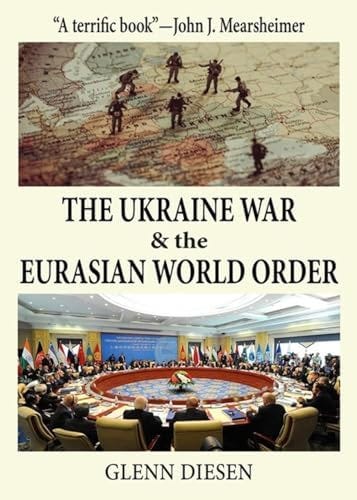
– The text includes excerpts from my book “The Ukraine War and the Eurasian World Order” https://www.claritypress.com/product/the-ukraine-war-the-eurasian-world-order/
[1] WIKILEAKS – – CIA Red Cell Special Memorandum; Afghanistan: Sustaining West European Support for the NATO-led Mission-Why Counting on Apathy Might Not Be Enough, March 11, 2010
[2] Why Nato must defend women’s rights | Jens Stoltenberg and Angelina Jolie | The Guardian
[3] J. Ray and N. Esipova, ‘Ukrainians Likely Support Move Away From NATO’, Gallup, 2 April 2010.
[4] C. English, ‘Ukrainians See More Value in Ties With Russia Than U.S.’, Gallup, 15 February 2008.
[5] 2011 – 172 CDSDG 11 E REV1 – UKRAINE – MALAN REPORT | NATO PA (nato-pa.int).
[6] GALLUP® CORP Template (usagm.gov)
[7] W.J. Burns, ‘Nyet means nyet: Russia’s NATO Enlargement Redlines’, Wikileaks, 1 February 2008.
[8] R. Lyne, ‘The UC Interview Series: Sir Roderic Lyne by Nikita Gryazin’, Oxford University Consortium, 18 December 2020.
[9] BBC, ‘Ukraine’s revolution and the far right, BBC, 7 March 2014.
[10] D. Morrison, ‘How William Hague Deceived the House of Commons on Ukraine’, Huffington Post, 10 March 2014.
[11] BBC, ‘Ukraine crisis: Transcript of leaked Nuland-Pyatt call’, BBC, 7 February 2014.
[12] The Spy War: How the C.I.A. Secretly Helps Ukraine Fight Putin – The New York Times (nytimes.com)
[13] The Spy War: How the C.I.A. Secretly Helps Ukraine Fight Putin – The New York Times (nytimes.com)
[14] G. Miller and I. Khurshudyan, ‘Ukrainian spies with deep ties to CIA wage shadow war against Russia’, The Washington Post’, 23 October 2023.
[15] M.M. Abrahms, ‘Does Ukraine Have Kompromat on Joe Biden?’, Newsweek, 8 August 2023.
[16] P. Sonne and J. Grimaldi, ‘Biden’s Son, Kerry Family Friend Join Ukrainian Gas Producer’s Board’, The Wall Street Journal, 13 May 2014.
[17] O. Matthews, ‘Viktor Yushchenko’s Star Has Fallen’, Newsweek, 13 March 2009.
[18] Language inspectors to start working in Frankivsk | УНН (unn.ua)
[19] BBC, ‘Ukraine’s Revolution and the Far Right’, BBC, 7 March 2014.
[20] A. Rubenstein and M. Blumenthal, ‘How Ukraine’s Jewish president Zelensky made peace with neo-Nazi paramilitaries on front lines of war with Russia’, The Grayzone, 4 March 2022.
[21] BBC, ‘Ukraine crisis: Deadly anti-autonomy protest outside parliament’, BBC, 31 August 2015.
[22] A. Korniienko, ‘Thousands rally in Kyiv against Zelensky’s plan to end war with Russia’, Kyiv Post, 6 October 2019.
[23] J. Melanovski, ‘Ukrainian President Zelensky deepens alliance with far right’, WSWS, 30 April 2021.
[24] A. Osang, ‘You’re Done with Power Politics’, Spiegel, 1 December 2022.
[25] T. Prouvost ‘Hollande: ‘There will only be a way out of the conflict when Russia fails on the ground’’, The Kyiv Independent, 28 December 2022.
[26] Emma, ‘Russland will verhandeln!’ [Russia wants to negotiate!], Emma, 4 March 2023.
[27] K. Volker, ‘What Does a Successful Biden-Putin Summit Look Like? Not What You Think’, CEPA, 2 June 2021.
[28] J. Stoltenberg, ‘Opening remarks’, NATO, 7 September 2023.
[29] V. Zelensky, ‘Address by the President to Ukrainians at the end of the first day of Russia’s attacks’, President of Ukraine: Official website, 25 February 2022.
[30] S. Raskin and L. Brown, ‘Ukraine and Russia to meet for peace talks ‘without preconditions,’ Zelensky says’, New York Post, 27 February 2022.
[31] M. Hirsh, ‘Hints of a Ukraine-Russia Deal?’, Foreign Policy, 8 March 2022.
[32] US Department of State, ‘Department Press Briefing’, US Department of State, 25 February 2022.
[33] US Department of State, ‘Department Press Briefing’, US Department of State, 21 March 2022.
[34] The Economist. ‘Volodymyr Zelensky on why Ukraine must defeat Putin’ The Economist, 27 March 2022.
[35] Breaking the Stalemate to Find Peace: The Russia-Ukraine War – A Geneva Security Debate (youtube.com)
[36] J. Helmer, ‘Whr. Gen. Kujat: Ukraine War is Lost, Germany Now Faces an Angry Russia… Alone’, Veterans Today, 25 January 2023.
[37] R. Semonsen, ‘Former Israeli PM: West Blocked Russo-Ukraine Peace Deal’, The European Conservative, 7 February 2023.
[38] N. Bennett, ‘Bennett speaks out’, YouTube Channel of Naftali Bennett, 4 February 2023.
[39] N. Ferguson, ‘Putin Misunderstands History. So, Unfortunately, Does the U.S.’, Bloomberg, 22 March 2022.
[40] The Economist. ‘Volodymyr Zelensky on why Ukraine must defeat Putin’ The Economist, 27 March 2022.
[41] ‘Miscalculations, divisions marked offensive planning by U.S., Ukraine’, The Washington Post, 4 December 2023.
[42] ‘Troop Deaths and Injuries in Ukraine War Near 500,000, U.S. Officials Say’, The New York Times, 18 August 2023.
[43] D. Ignatius, ‘The West feels gloomy about Ukraine. Here’s why it shouldn’t’, The Washington Post, 18 July 2023.
Russia Hits Energy Infrastructure Supporting Ukraine’s Military-Industrial Complex
Sputnik – 17.09.2024
Russian forces carried out strikes on Ukraine’s energy facilities that supply the military-industrial complex, the Ministry of Defense has reported. Weapons and ammunition depots were also hit.
“Operational-tactical aviation, unmanned aerial vehicles, missile forces, and artillery of the Russian Armed Forces have struck energy facilities that support the activities of Ukraine’s military-industrial complex, as well as weapons, ammunition, and logistics storage sites, along with concentrations of enemy personnel and military equipment in 145 areas,” reads the ministry’s report.
According to the Russian Defense Ministry, air defenses also shot down a US-made HIMARS rocket and 36 drones over the past day.
In June, Volodymyr Zelensky stated that nine gigawatts of energy generation capacity had been destroyed in Ukraine, which amounts to 80% of thermal power generation and a third of hydropower production.
In turn, Ukrainian Energy Minister Herman Galushchenko specified that the country has lost half of its generating capacity, which would not be enough to survive the winter, and that electricity imports would be insufficient to cover the deficit.
In early September, the Center for Countering Disinformation under the National Security and Defense Council published a forecast by Yuriy Korolchuk, an expert from the Ukrainian Institute of Energy Strategies. According to one scenario, Ukrainians could be left without heat and light for up to 20 hours a day during the upcoming winter. This could happen if strikes on energy infrastructure continue, combined with other conditions. In the expert’s optimistic forecast, power outages could last up to 12 hours per day.
Ukraine avoids using Western tanks on the battlefield fearing to lose them
By Ahmed Adel | September 17, 2024
The Wall Street Journal newspaper writes that the Ukrainian Armed Forces avoid using tanks supplied by NATO countries because they fear their destruction or capture. At the same time, the AP reports, citing US officials, that the US will lose the possibility of providing Ukraine with $5.8 billion in military aid at the end of September if Congress does not authorise the Pentagon to use funds from the PDA program.
“Tanks were once the king of the battlefield. But the proliferation of drones in Ukraine means the large, noisy vehicles can be spotted and targeted within minutes. That has seen dozens of cutting-edge Western tanks used only sparingly in the battle they were meant to shape, while others have been damaged, destroyed or captured,” the Wall Street Journal reports.
According to the newspaper, the armoured vehicles supplied to them are in the field many kilometres away from the front line, as there is a high risk of losing them in the Russian Army’s attacks.
Meanwhile, General James Rainey, who heads the US Army Futures Command and is responsible for modernisation projects, called for urgent modernisation of US armoured units.
“In the near term, we absolutely need to urgently make some adjustments to maintain the survivability of our armored formations,” Rainey told the newspaper.
In August, Military Watch magazine reported that Ukraine had lost about 20 M1A1 Abrams tanks out of 31 delivered by the US in the past six months.
“The latest loss brings the total losses of M1A1 Abrams tanks in Ukraine close to 20, out of just 31 of the vehicles delivered, with all losses occurring within the past six months. With unconfirmed reports indicating that the Abrams was destroyed using a handheld anti-tank missile system, likely a Kornet, the destruction of the latest vehicle stands out from all other recent kills which were all achieved by drone strikes or by precision guided artillery,” the magazine revealed.
Forbes magazine reported earlier this month that Kiev lacks modern military equipment to form new brigades to replace front-line units as part of the rotation.
“In practice, these brigades are desperately short of modern weaponry. And that could become a serious problem for the Ukrainians as the new but poorly equipped brigades replace older but better equipped brigades as the latter brigades finally rotate off the line of contact—after 18 months of non-stop fighting, in some cases,” the Forbes article said.
The Kremlin, for its part, has repeatedly said that arms supplies to Ukraine prevent the achievement of a peace agreement and directly involve NATO countries in hostilities. Russian Foreign Minister Sergey Lavrov said that the US and NATO are participating in the conflict, including not only supplying weapons but also training Ukrainian military personnel on the territory of the United Kingdom, Germany, Italy and other countries.
However, US supplies could begin drying up since Republicans and Democrats in Congress must agree on a new budget bill before September 30. If not, the federal government could suspend work in early October, meaning there will be a shutdown.
“About $5.8 billion in presidential drawdown authority (PDA) will expire,” the report said. However, officials cited by AP expressed hope that lawmakers would extend powers to fund their programs for a year.
“Delays in passing that $61 billion for Ukraine earlier this year triggered dire battlefield conditions as Ukrainian forces ran low on munitions and Russian forces were able to make gains. Officials have blamed the monthslong deadlocked Congress for Russia’s ability to take more territory,” the report added.
Yet, even if the funding is passed and Ukraine receives a new stream of weapons, they will make little difference to the outcome of the war. The Abrams was heralded as a game-changer that would overcome the power of Russia’s T-90M tanks, but this proved to be a false dawn, just like the F-16 fighter jets and Stryker armoured vehicles, among many other weapons that have failed to stop Russian forces from capturing more territory.
Due to these weapons, including Western tanks, failing to have the expected effect against Russian forces, US Secretary of State Antony Blinken said on September 11 that he held talks with his Ukrainian counterparts Andrii Sybiha and Ukrainian President Volodymyr Zelensky about launching long-range missiles into Russian territory. Several experts have warned that a direct clash between Russia and NATO, both of which have nuclear arsenals, would have unpredictable consequences for the world.
Russian President Vladimir Putin warned NATO the very next day that Ukrainian attacks with NATO weapons on Russian territory would mean that NATO countries were at war with Russia. Direct NATO involvement, Putin stressed, changes the very essence of the conflict.
Although Ukraine launching Western long-range missiles will certainly change the nature of the war, as already stressed, it just points to the utterly desperate situation the Kiev regime finds itself in. Yet, despite this evident desperation, there are still no legitimate signs that Zelensky is prepared to begin peace negotiations with Russia.
Ahmed Adel is a Cairo-based geopolitics and political economy researcher.
Ukraine war turns into Russian roulette
By M. K. BHADRAKUMAR | Indian Punchline | September 16, 2024
UK Prime Minister Keir Starmer met with the US President Joe Biden in the White House on Friday with the question of the use of long-range missiles by Ukraine to hit deep inside Russia on their agenda of conversation. But there were no announcements, nor was there any joint press conference.
Starmer later told the media that the talks were “productive” but concentrated on “strategy” rather than a “particular step or tactic”. He did not signal any decision on allowing Kiev to fire long-range missiles into Russia.
Starmer said no final decision had been taken on the Storm Shadow missiles and hinted that further developments may follow at the gathering of the UN General Assembly later this month. “We’ll obviously pick up again in UNGA in just a few days time with a wider group of individuals,” he said.
One reason for such extreme secrecy is that the US and UK are intensely conscious of the Russian President Vladimir Putin’s explicit warning on Thursday that any use of western long-range missiles to strike Russia “will mean that NATO countries, the United States, and European countries are parties to the war in Ukraine. This will mean their direct involvement in the conflict, and it will clearly change the very essence, the very nature of the conflict dramatically.”
Putin added in measured words: “This will mean that NATO countries – the United States and European countries –- are at war with Russia. And if this is the case, then, bearing in mind the change in the essence of the conflict, we will make appropriate decisions in response to the threats that will be posed to us.”
Admittedly, Putin has given similar warnings before also, but did not follow through even when western weaponry was used by Ukraine with impunity to invade Russia recently. So much so that Biden was plainly dismissive about the latest Kremlin warning, saying, “I don’t think much about Vladimir Putin.”
On its part, Moscow estimates that although no official decision on the matter has been announced, it has already been made and communicated to Kiev, and that Moscow would have to respond with actions of its own.
Deputy Foreign Minister Sergey Ryabkov, Moscow’s point person on the diplomatic track, was quoted as saying on Saturday, “The decision has been made, the carte blanche and all indulgences have been given (to Kiev), so we [Russia] are ready for everything. And we will react in a way that will not be pretty.”
Former Russian President Dmitry Medvedev, who now serves as deputy chairman of the country’s security council, went a step further saying that the West is testing Russia’s patience but it is not limitless. He said Ukraine’s invasion already gave Russia formal grounds to use its nuclear arsenal.
Medvedev warned that Moscow could either resort to nuclear weapons in the end, or use some of its non-nuclear but still deadly novel weapons for a large-scale attack. “And that would be it. A giant, grey, melted spot instead of ‘the mother of Russian cities’,” he wrote on the Telegram messaging app, referring to Kiev.
Putin, in his remark on Thursday once again rejected the Anglo-American sophistry that it is Ukraine that will be using any western long-range missiles and not NATO. He pointed out that the Ukrainian army “is not capable of using cutting-edge high-precision long-range systems supplied by the West. They cannot do that. These weapons are impossible to employ without intelligence data from satellites which Ukraine does not have. This can only be done using the European Union’s satellites, or US satellites – in general, NATO satellites…
“most important, the key point even – is that only NATO military personnel can assign flight missions to these missile systems. Ukrainian servicemen cannot do this. Therefore, it is not a question of allowing the Ukrainian regime to strike Russia with these weapons or not. It is about deciding whether NATO countries become directly involved in the military conflict or not.”
Interestingly, neither Washington nor London has so far refuted Putin’s above explanation and, curiously, it has been expunged altogether from British press reports — fearing, perhaps, that public opinion might militate against such direct involvement by the UK in a war against Russia in a combat role!
Moscow anticipates that the US-UK ploy may be to test the waters by first (openly) using Britain’s Storm Shadow long-range air-launched cruise missile, which has already been supplied to Ukraine. On Friday, Russia expelled six British diplomats assigned to the Moscow embassy in a clear warning that Uk-Russia ties will be affected. Russia has already warned the UK of severe consequences if the Storm Shadow were to be used to hit Russian territory.
What makes the developing situation extremely dangerous is that the cat-and-mouse game so far about NATO’s covert involvement in the Ukraine war is giving way to a game of Russian roulette that follows the laws of Probability Theory.
That is to say, although Russia cannot be defeated or evicted from the territories in eastern and southern Ukraine that it annexed, Washington and London regard that the final outcome of this random event cannot yet be determined before it occurs; it may even be any one of several possible outcomes, and the probability cannot be ruled out that the actual outcome might even be determined by chance.
Apparently, Biden believes that Russia’s current battlefield dominance is a random phenomenon and possible outcomes range from an annihilation of Russian military power to a large-scale disruption of life in Russia and a possible collapse of Russia — at a minimum, the weakening of the Russian hand in any future negotiations. Simply put, the war is now about Russia rather than Ukraine and long-range missiles can be a game changer.
Thus, Biden, with no political constraints working on him anymore, is escalating the war to create new facts on the ground before his presidency ends in January, which may create conditions for permanent NATO military presence on Ukrainian territory and present Russia with a fait accompli.
Such a strategy built on the quicksands of probability is akin to a game of Russian roulette — an act of bravado. Indeed, Biden’s options to support Ukraine are shrinking with each escalation, As the Wall Street Journal puts it, “With only four months left in the Biden administration and little hope of Congress approving additional funding for Ukraine no matter who wins the presidency, the White House is debating how best to help Kyiv given its limited toolbox.”
Equally, Europe’s interest in the war is also waning. European politics is becoming unpredictable with the ascendancy of the far-right in Germany, the crisis of leadership in French politics, the relative decline of EU’s economy vis-a-vis global rivals due to limited innovation, high energy prices and skills gaps, etc. and, of course, the overarching economic crisis in Europe with no end in sight, as brought out starkly in the recent report by Mario Draghi.
Basically, Biden is pre-setting the trajectory of the war beyond next January so that even after his retirement, his policy approach aimed at inflicting a strategic defeat on Russia remains on track. White House National Security Adviser Jake Sullivan said on Saturday that Washington is working on a “substantial” round of further assistance for Kiev. He confirmed a meeting this month between Biden and his Ukrainian counterpart Zelensky.
Sullivan noted that Biden is working to put Ukraine in the “best possible position to prevail” during his final months in office. The bottom line is that Biden’s war strategy is attenuating as “escalation management” while NATO transitions as a direct party to hostilities.
US has declared war on free speech – Russia

RT | September 15, 2024
The US crackdown on Russian media amounts to a declaration of war on free speech, Foreign Ministry spokeswoman Maria Zakharova said on Sunday. She described the new sanctions against RT and other news outlets as “repressions unprecedented in scale.”
US Secretary of State Antony Blinken announced new sanctions against RT on Friday, accusing it of engaging in “covert influence activities” and “functioning as a de facto arm of Russian intelligence.” Earlier in September, Washington imposed sanctions on RT Editor-in-Chief Margarita Simonyan and three other senior RT employees over alleged attempts to influence the 2024 US presidential election.
“The US has declared war on freedom of speech throughout the world, turning to open threats and blackmail against other states in an effort to set them against the domestic media and establish sole control over the global information space,” Zakharova said, promising that the punitive measures Washington was using to target Russian media would not go unanswered.
She added that accusations of attempts to influence the elections are a mere “witchhunt” and “spy-o-mania” done to manipulate public opinion and protect its citizens from any information that is inconvenient for them.
The head of the State Department’s Global Engagement Center (GEC), James Rubin, told reporters on Friday that the “broad scope and reach” of RT was one of the reasons many countries around the world did not support Ukraine. The GEC has funded propaganda games aimed at children and forced Twitter to censor pro-Russian content. Rubin admitted last year that he wanted to use the GEC to shut down Russian media outlets around the world.
“We are going to be talking… in Latin America, Africa and Asia… to try to show all of those countries that right now broadcast – with no restrictions or control – RT and allow them free access to their countries,” Rubin said, arguing that RT’s presence has “had a deleterious effect on the views of the rest of the world about a war that should be an open and shut case.”
Reacting to the new restrictions, Simonyan argued that Washington’s claims about RT collaborating with Russian intelligence are a “classic case of projection.”
“The idea that you can’t achieve results without being part of the intelligence service has exposed them for what they are,” she said.
An Act of War! Putin’s Final Warning as NATO Prepares to Attack Russia
By Glenn Diesen | September 14, 2024
President Putin has warned that the long-range precision missiles considered to be used against Russian territory will make NATO directly involved in the war. These missiles supplied by the US and UK can only be operated with the involvement of American and British soldiers, and the missiles will be guided by the satellites of NATO countries. The dishonest discussion in the West about NATO’s decision to escalate in such a reckless manner is deeply troubling given that nuclear war is at stake.
Incrementalism: From Proxy War to Direct War
These long-range missiles represent the end of the proxy war and the beginning of a direct NATO-Russia war. Since the Western-backed coup in 2014, NATO and Russia have been fighting a proxy war in Ukraine. On the first day after the coup, the new government in Kiev installed by Washington created a partnership with the CIA and MI6 for covert war against Russia.[1] By definition, a proxy war is when two or more powers do not fight directly in battle but fight through a third-party country. From 2014, the proxy war was defined as NATO supporting Kiev and Russia supporting the Donbas rebels who opposed the legitimacy of the post-coup government installed by Washington.[2] In the words of Ukraine’s General Prosecutor, who was eventually fired by Joe Biden, Washington was treating Ukraine as a colony and demanding the right to approve all new government appointments.[3]
When Russia became a direct participant in the conflict by invading Ukraine in February 2022, the proxy war became even more dangerous as NATO involved itself in the war planning and supplying the weapons, ammunition, training, mercenaries, intelligence and target selection for Ukraine to fight Russia. Yet, NATO was fighting Russia indirectly through a proxy. Over the next 2,5 years, the lines between proxy war and direct war became increasing blurred. This line will now be eliminated as NATO’s war against Russia becomes a direct war as the long-range missiles supplied by the US and UK are also operated by the US and UK.
How did we end up with the US and UK attacking Russian territory without any serious debate in the West? Incrementalism or salami tactics involve cutting off thin slices gradually. With small incremental steps, no one action appears to be so outrageous that it justifies a major response, yet over time the aggressor has pushed through all red lines with minimal opposition. The US used such tactics to mitigate Russian opposition and to alleviate concerns among European allies for NATO expansion, the missile defence system, and the proxy war in Ukraine. NATO incrementally sends more powerful weapons and become increasingly involved in the war. Any negative reactions from their own public or Russia are sought to be mitigated by imposing restrictions on the use of these weapons, but these restrictions are then incrementally removed.
In the beginning of the war, the US was apprehensive about sending tanks and Biden warned that sending F16s could trigger World War 3.[4] Where has the incrementalism taken us today? American illegal cluster ammunition is used to bomb civilian targets in the Russian city of Belgorod, and NATO has provided the intelligence and weapons for the invasion of the Russian region of Kursk where civilians are kidnapped and executed. German tanks manned by soldiers with fascist insignia on their uniforms are yet again fighting in Kursk, and the main objective was most likely to seize the Kursk Nuclear Power Plant. NATO does not criticize Ukraine when it attacks Russia’s early nuclear warning system or nuclear power plants, and instead praises the invasion of Kursk for having humiliated Putin.
NATO’s self-delusion: Ukraine’s “right to defend itself”
The argument that Ukraine has the right to defend itself is a very deceptive counterargument as nobody has disputed that Ukraine has this right. The question is how deeply NATO can be involved before the thin line between proxy war and direct war is crossed. The US is illegally occupying Syria, and nobody would disagree that Syria has the right to defend itself. But does Russia have the right to bomb American and British cities under the guise of helping Syria defend itself? What would the US have done if the situation was reversed, and Russia was attacking American cities through Mexico as a proxy?
British Prime Minister Keir Starmer argued: “We don’t seek any conflict with Russia. That’s not our intention in the slightest”.[5] This is probably true, Britain merely wants the right to strike Russia with missiles without Russia responding. When the US and UK sabotaged the Istanbul peace agreement in 2022, the Israeli and Turkish mediators explained that the Americans and British saw an opportunity to fight and bleed Russia as a strategic rival by fighting with Ukrainians. As American political and military leaders keep reminding us, this is a great war as NATO can weaken Russia without using its own troops. The question is how deeply involved NATO can become before we ask the very uncomfortable question: does Russia also has a right to defend itself?
Putin’s argument is reasonable and deserves to be discussed seriously, yet we no longer have reasonable discussions in the West as any empathy or understanding for the Russian position is castigated as treason. Every discussion is simplified and dumbed-down to either supporting “us” or “them”, and support for “us” entails repeating a ridiculous script that ignores reality and ends up with self-harm. If we want to avoid nuclear war, we should begin to take the security concerns of our adversary more seriously instead of shaming any effort to do so.
How will Russia Retaliate Against a NATO Attack?
Russia can pursue either horizontal or vertical escalation. Horizontal escalation is more restrained by retaliating in other areas by for example supplying air defences to Iran, making arms deals with North Korea, sending Russian warships to the Caribbean, sending advanced weaponry to NATO adversaries, or even providing intelligence for strikes on for example US occupation troops in Syria and Iraq.
However, a direct attack by NATO on Russia will likely pressure the Russians to respond directly with vertical escalation irrespective of the risk of a nuclear exchange. F16s and other weaponry that will be used against Russia have been placed in Poland and Romania as these are considered “safe spaces” as long as NATO is not directly involved in the war. NATO drones operating over the Black Sea and providing targeting data to Ukraine seem like an obvious target. NATO satellites that are used to guide missile attacks on Russia can also be destroyed. Attacks with tactical nuclear weapons in Western Ukraine would also be a powerful retaliation that send a strong message without attacking NATO directly.
It appears that NATO has deluded itself with incrementalism as it now plans to attack Russia without expecting any significant retaliation. Whenever Russia responds it is portrayed as occuring in a vacuum, thus Russia is presented as both weak for not responding to red lines and aggressive for acting unprovoked. Russia responded to the coup and covert war in 2014 by taking back Crimea; Russia responded to NATO’s sabotage of the Minsk peace agreement and the refusal to give security guarantees by invading in 2022; and Russia responded to the sabotage of the Istanbul agreement in favour of sending weapons by annexing Lugansk, Donetsk, Zaporizhya and Kherson.
What was previously recognised as possibly triggering World War 3 is now dismissed as Russian propaganda as NATO is merely helping Ukraine defend itself. The Western political-media elites continue to argue that Russia has threatened retaliations in the past that did not materialise. Russia’s restraint is thus interpreted as weakness, and NATO continues to escalate until Russia responds sufficiently.
The problem is that Russia has been restrained because any response could result in a rapid and uncontrolled race up the escalation ladder that results in a nuclear exchange. As NATO takes the world to the brink of world war, should we not at least have a sensible discussion about what is being done instead of hiding behind meaningless slogans such as “Ukraine has the right to defend itself”?
Featured Video

Racist Seinfeld Dances for Joy as Bibi Unveils His New Map
or go to
Aletho News Archives – Video-Images
TV Drama Review
Japanese drama projects Japan’s wartime atrocities onto Chinese characters

Global Times | October 25, 2026
By portraying Chinese characters as perpetrators of ruthless violence while casting Japanese Self-Defense Forces (SDF) intelligence operatives as defenders, the season 2 of the Japanese drama Vivant has recently drawn criticism from Chinese netizens, who argue that its depiction turns historical reality on its head while ignoring Japan’s wartime atrocities.
The TBS drama series – a spy suspense story in which an alleged unofficial intelligence unit of the SDF operates across the globe — has attracted a passionate fanbase. Its currently airing season 2 opened with a household rating of 18.8 percent, the highest for a TV drama this year, according toa commentary article by Japanese media Toyo Keizai.
What draws attention is the portrayal of the enemies in the series, the article noted. Scenes in which the Chinese organization subjects kidnapped members of the SDF unit to brutal torture are repeated with unrelenting intensity.
It is rare for Japanese TV dramas to explicitly portray a real-life country as the enemy, the article noted.
Japanese Prime Minister Sanae Takaichi also made a reference to the drama, saying that she has been recording Vivant and hopes to binge-watch it over the year-end and New Year holidays, according to Japanese media outlets.
China’s CCTV News report on Sunday revealed that the drama features scenes in which Chinese personnel cut off the fingers of and stab Japanese intelligence operatives in the abdomen. Such acts bear striking similarities to the torture inflicted on Chinese nationals by invading Japanese troops during the World War II.
The drama distorts the truth by attributing these atrocities to modern Chinese characters. Beneath the surface, it subtly glorifies Japan’s cross-border overseas operations, blurs the functional boundaries of the SDF and implicitly promotes an expansionist narrative, per CCTV News. … continue
Blog Roll
 Aletho News
- EU facing trillion-euro debt hole while seeking more cash for Kiev
- How US, Europe, Persian Gulf states exhausted missile stockpiles, splurged billions to defend Israel
- Up in arms… Koreans reject U.S. empire’s plan to make South Korea the next Ukraine
- Iran, Turkey, Pakistan, Saudi Arabia could advance region-led security framework in Tehran: FM spox
- Netizens condemn Japanese drama for projecting Japan’s wartime atrocities onto Chinese characters
- Racist Seinfeld Dances for Joy as Bibi Unveils His New Map
- A West Bank War for Netanyahu’s Election Campaign, Could It Backfire?
- Yemen denounces European Parliament’s ‘hypocritical’ push to blacklist Ansarullah
- Qalibaf: UAE’s UN bid aims to ‘clear the runway’ for ‘Greater Israel’, whitewash genocide
- Pakistan reopens Iran border after boosting security: Report
- If Americans Knew
- An error has occurred; the feed is probably down. Try again later.
- No Tricks Zone
- Sudden Stratospheric Warming, Powerful El Niño Combination May Lead To Extreme Europe Cold, Energy Crisis!
- Two New Studies Find Thwaites Glacier Melt Cannot Be Driven By Human Activity Or A Warming Ocean
- E-Cars Reduce CO2 Emissions By Only 41% Compared To Internal Combustion Engine Vehicles
- Predictions Made By Renowned Climate Professor Over Past Decades Have Been Proven To Be Poor
- New Study Suggests Large Regions Of The Pacific Ocean Have Been Cooling For The Last 80 Years
- Germany’s Green Energy Debacle: High Energy Costs Force Kahla Porzellan to Close After 182 Years!
- New Study: 50 Years Of The Most Aggressive ‘Net Zero’ Policies Can Only Affect The Global Climate By 0.03°C
- US September “Heat” Was No Record…Many Records Set Decades Ago
- Latest European Green Energy Debacle; Portugal’s Largest Flagship Solar Park Insolvent!
- Green Energy Debacle: German Expert Professor Fritz Vahrenholt Warns Of Severe Economic And Social Consequences

