Ukrainian cluster bomb attack on Belgorod kills five – governor
RT | August 30, 2024
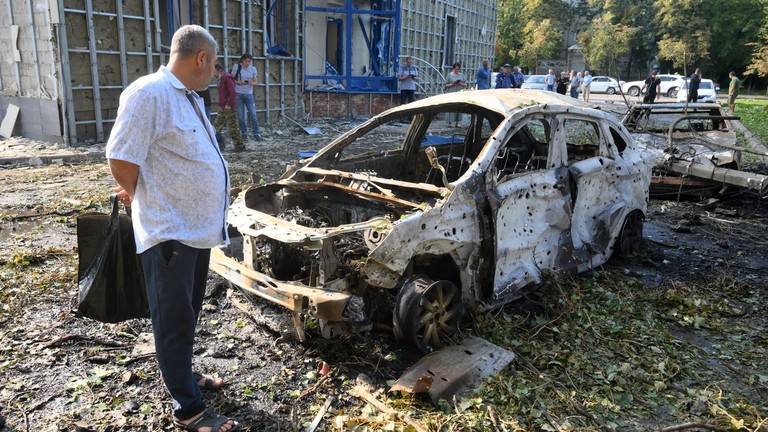
Five civilians have been killed and 37 wounded, including six children, in a Ukrainian missile attack on Russia’s Belgorod Region, regional governor Vyacheslav Gladkov has said.
Belgorod is north of Kharkov. Russia’s second city. It has endured frequent attacks by long-range Ukrainian artillery, which often fire projectiles supplied by NATO.
“Our air defense system worked over Belgorod and several targets were shot down as they approached the city,” Gladkov said on Telegram on Friday evening. “To our great sorrow, one person died as a result of a direct hit on a passenger car.”
In addition to the vehicle, an apartment building and several commercial buildings were struck, Gladkov said.
The governor later updated the death toll to five.
“One woman and four men died on the spot from their injuries before the ambulances arrived,” he said. Among the injured, seven adults and three children are in serious condition.
According to Gladkov, the attack was carried out with cluster munitions launched by the Vampire multiple-launch rocket system. The same weapon, provided to Ukraine by the Czech Republic, was used in the Christmas market massacre last December, when 25 Russian civilians were killed and 100 more wounded by Ukrainian cluster munitions.
The attack also caused property damage to three apartment buildings in the city, as well as two commercial buildings. Two houses in the nearby village of Dubovoye were set on fire by the incoming missiles, but it was quickly extinguished by emergency services.
Ukrainians torching empty homes in Kursk Region – senior Russian official
RT | August 30, 2024
Ukrainian troops are seemingly trying to inflict maximum damage on civilian property in the parts of Russia under their control, a senior Foreign Ministry official has said.
The Russian Foreign Ministry has tasked Rodion Miroshnik with collecting evidence of Ukrainian war crimes in the conflict. Last week, he visited Kursk Region, which Kiev targeted with a massive cross-border incursion earlier this month.
Evidence on the ground and interviews with dozens of eyewitnesses indicate that Ukrainian forces are deliberately trying to devastate settlements within their grasp, the official told RIA Novosti on Friday.
”There are a huge number of reports of burned out and looted private properties, of auxiliary buildings being destroyed with a purpose. I visited some of such homes literally hours after they got attacked. People were evacuated, but their homes were shot at and burned with a kind of malice,” he claimed.
In some instances Ukrainian troops used incendiary munitions, Miroshnik said. Local residents told him that they saw soldiers firing at homes point-blank from armored personnel carriers and cheering when they went up in flames.
Some properties were apparently hit with shrapnel rockets, the diplomat said. Some munitions are armed with thousands of BB pellet-sized metal balls designed to hit enemy manpower in the field with an airburst.
”I visited someone’s place, which was hit by such a rocket. There seemed to be not a thing that was not pierced by those balls,” the diplomat said. Such an attack “leaves not a single windowpane. A car was turned into a sieve. Walls around were all in holes, and even a gas pipeline forty meters away had 40 holes in it.”
Kiev has deployed thousands of troops into Kursk Region, seizing some border areas but failing to advance deeper into Russian territory. The Ukrainian leader, Vladimir Zelensky, has claimed that the operation was highly successful, citing the capture of Russian border guards, who could be exchanged for Ukrainian troops in Russian custody. His aide, Mikhail Podoliak, has claimed that the attack benefited Kiev by instilling fear into the Russian population and putting pressure on Moscow.
As of Friday, the Russian Defense Ministry estimated Ukrainian military losses in the Kursk operation at up to 7,800. Moscow has ruled out peace talks with Kiev following the attack, citing its targeting of Russian civilians.
No deal with Telegram founder – Kremlin
RT | August 30, 2024
Telegram CEO Pavel Durov did not strike any special arrangement with the Russian government, Kremlin spokesman Dmitry Peskov confirmed on Friday. The tech entrepreneur left Russia after a conflict with the authorities in 2014.
Durov, who is a citizen of four countries including France, was arrested in Paris last Saturday and accused of complicity in illicit activities by users of his messaging app. His supporters claim that Paris is trying to intimidate him into violating the privacy of Telegram clients and imposing stricter moderation of public content, which would align with French policies.
The billionaire, who is currently based in the UAE, left Russia in 2014, after law enforcement accused him of protecting terrorists by refusing to give Russian investigators access to suspects’ communications. He claimed that his platform was designed in a way that made such surveillance impossible.
The row effectively ended in 2020, when the Russian telecoms regulator announced that it no longer had any issues with Telegram. There were rumors at the time that company management and the Russian government had secretly come to an understanding.
”There was no deal between the Kremlin and Durov,” Peskov told journalists, when asked whether there was such a relationship.
Asked whether President Vladimir Putin met Durov in person, the presidential spokesman said to his knowledge no such encounter ever happened. Previously there were claims in some media that Putin and Durov had a meeting in Baku, Azerbaijan in mid-August. Peskov denied that earlier this week.
On Wednesday, Durov attended a court in Paris, which formally indicted him on a slate of charges and released him on a €5 million ($5.55 million) bond. He has been banned from leaving France while the case continues.
Durov faces a potentially lengthy prison term in France on charges of “administering an online platform” used by criminals and refusing to cooperate with authorities in their investigation. French President Emmanuel Macron has denied that the case against Durov is political in nature.
Hungary May Defect – Part Nineteen of The Anglo-American War on Russia
Tales of the American Empire | August 29, 2024
Most Europeans know the United States provoked the conflict in Ukraine, profits from banning Russian oil and gas, and remain uneasy about the mysterious destruction of the Nordstream pipelines. The American government promoted a mindless NATO expansion strategy that caused a disastrous war and weakened NATO nations, who were pressured to donate billions of dollars and much of their military equipment to Ukraine, even though it isn’t a member of the NATO alliance.
Eastern European states were excited to join NATO and the European Union economic block, called the EU, but were soon pressured to boost military spending to buy American weaponry, accept foreign migrants, host foreign troops, and donate money and arms to a lost cause in Ukraine. Profitable trade and tourism with Russia sharply declined while energy costs soared, causing economic decline.
The people of some European nations have already decided that joining NATO and the EU was a bad idea. Hungarian Prime Minister Viktor Orban openly states his dislike of EU mandates to allow mass immigration and continued trade sanctions on Russia. EU leaders denounce Orban and threaten sanctions because they can abuse Hungary since it is landlocked and surrounded by Ukraine and EU members.
But if Russian troops reach Ukraine’s western border, Hungary may defect. Conquered Ukraine would become a close Russian ally and allow access to energy pipelines to import cheap Russian oil and gas, and permit rail and road access to Russia and all of Asia. There are several neighboring nations who may also defect from the American empire. This explains why NATO is considering sending forces to secure western Ukraine to keep its vassal states captive.
________________________________
Related Tale: “The Destruction of Libya in 2011”;  • The Destruction of Libya in 2011
“Slovakia, Hungary say Ukraine has halted Lukoil’s Russian oil transit”; Jason Hovet; Reuters; July 18, 2024; https://www.reuters.com/business/ener…
“Kyiv Will Face Retaliation”; EU nation Slovakia has issued an open threat to Ukraine amid war with Russia. Slovakia said it would take retaliatory measures against Ukraine if Kyiv continues to stop Russian oil transiting via the Druzhba pipeline.; “Times of India”; July 25, 2024; • ‘Kyiv Will Face Retaliation…’: NATO…
“MEPs call to strip Hungary’s EU voting rights amid Orbán’s ‘peace missions’”; Steb Starcevic; Politico; July 16, 2024; https://www.politico.eu/article/lette…
Related Tale: “The Destruction of Yugoslavia”; • The Destruction of Yugoslavia
Related Tales: “The Anglo-American War on Russia”; • The Anglo-American War on Russia
US, Russian Deputy Envoys Have Heated Exchange at UN Security Council Over Gaza Ceasefire
Sputnik – 30.08.2024
UNITED NATIONS – The deputy representatives of the US and Russian missions to the United Nations engaged in an argument at the UN Security Council meeting over which of their countries is doing a better job at trying to resolve the conflict in Gaza, a Sputnik correspondent reported.
“I don’t need to sit here and explain to you why the US did what it did with regard to these resolutions. You know quite well and I think everybody in this room does,” US Deputy Envoy Robert Wood said in response to his Russian counterpart Dmitry Polyanskiy.
The Russian diplomat remarked earlier that the United States has been blocking a ceasefire in Gaza by supporting Israel and vetoing UN Security Council resolutions concerning the Palestinian enclave.
“One delegation, shielding their main Middle Eastern ally, as we are well aware, for ten months has been blocking any real steps to that end, essentially compelling all members of this council to become complicit in the collective punishment of Palestinians,” Polyanskiy said, adding that the US falsely claimed that Israel had agreed to a ceasefire deal.
“However, it turned out – and no one is surprised about this- that these calls were far from a reality as was the US so-called Biden-plan which was [adopted by the Security Council on June 10 as Resolution 2735],” Polyanskiy continued. “Israel did not agree to that deal then, nor has it agreed now to end its operations… [The US is] modifying the parameters for a ceasefire in Gaza for the benefit of Western Jerusalem. Let us recall that the Security Council did not consent to any reformatting of the parameters of agreements that were set out in Resolution 2735.”
Wood pointed out that the United States is now focusing on its efforts together with Egypt and Qatar to implement a framework that was agreed to by the Israeli government and Hamas.
Wood also emphasized that Hamas has been changing its position on the proposed ceasefire and hostage release deal.
“So my recommendations to you and your government would be, if you are going to contribute something positively, then contribute it. If not, you should be quiet,” Wood said.
Polyanskiy replied that that Wood should keep his recommendations about him or the Russian government to himself and the United States should stop getting in the way of the UN Security Council discussing the Palestinian dossier.
The United States bears the responsibility of what is happening now in Gaza, where more than 40,000 Palestinians have been killed since October 7, 2023. “If my other colleagues don’t have the courage to tell you this to your face, I have no problem doing so,” Polyanskiy said.
IAEA head confirms that Ukraine has struck Russian nuclear plant with drones
By Dénes Albert | Remix News | August 28, 2024
As the expanding frontline inches within just a few kilometers of the Kursk nuclear power plant in Russia, there are fears there could be a major nuclear disaster.
“There is a risk of a nuclear incident at the Kursk nuclear power plant,” said Rafael Grossi, Director General of the International Atomic Energy Agency (IAEA), after visiting the facility in Kurchatov, in the Kursk region bordering Ukraine, on Tuesday.
He added that he had seen evidence of drone strikes during his visit to the plant.
“I was told today that there have been several cases of drone attacks on the site (the site of the Kursk nuclear power plant), on the facilities. The fact that there is fighting a few kilometers away from the nuclear power plant raises great concerns and anxiety about the security system,” Grossi added.
He stressed that under no circumstances should a nuclear power plant be the target of military action, nor should it be used by either side for military purposes. The director general also said that the security systems of a plant must be fully operational under all circumstances.
Grossi noted that the IAEA delegation was shown the traces of the Ukrainian attack on the Kursk nuclear power plant. Based on the evidence his team gathered, he said there could be no doubt that Ukraine carried out these strikes and where they came from.
Putin also announced on Thursday that Ukraine had attempted a drone strike on the Kursk nuclear power plant.
Grossi, who said that he had visited the reactor hall, the engine room, and the control room of an operating power plant unit — as well as the spent nuclear fuel storage — found that the Kursk plant was operating at what is very close to “normal” mode.
He stressed that the IAEA is responsible for maintaining nuclear safety and security in nuclear installations worldwide. He said that he had accepted Russian President Vladimir Putin’s invitation to visit the Kursk nuclear power plant with his team to assess the situation personally and to find solutions together with his Russian counterparts. Earlier in the day, the IAEA director general was received by Russian Deputy Foreign Minister Sergei Ryabkov.
He said that he intends to meet Ukrainian President Volodymyr Zelensky next week to discuss, among other things, the situation at the Zaporizhzhya nuclear power plant and the IAEA’s intention to extend its observer presence to other nuclear facilities in Ukraine, as requested by Kyiv. … Full article
UK backs Ukraine’s use of long-range missiles inside Russia – media
RT | August 28, 2024
The UK is in favor of allowing Ukraine to use its Storm Shadow missiles for strikes deep inside Russia but is keeping its support out of the public eye so as not to cause a rift with the US, The Telegraph reported on Tuesday, citing sources.
Ukraine already has the greenlight from Britain to use Storm Shadows to strike Crimea and other areas claimed by Kiev, but not to target internationally recognized Russian territory. Amid Kiev’s ongoing incursion into Kursk Region, Vladimir Zelensky has stepped up his calls for the country’s Western backers to lift the restrictions on the use of their weapons for strikes in Russia. This is particularly the case for the British missiles, which can avoid enemy radar and hit targets up to 305km (190 miles) away.
However, according to The Telegraph, the decision on how Ukraine can use the missiles is not just up to London, as they are produced in close cooperation with France and the US, and are generally used alongside classified American systems.
While French President Emmanuel Macron previously said that Ukraine can use the missiles to strike sites in Russia from which the latter launches its own attacks, US officials have been reluctant to grant similar authorization. A White House source told the news outlet that the US administration is concerned that the use of long-range missiles, even without Washington’s outward approval, could escalate matters and lead to US troops being drawn into the conflict.
The UK has so far not made a formal request to Washington about Ukraine’s use of the missiles inside Russia, the news outlet claimed. British Prime Minister Keir Starmer is reportedly reluctant to provoke a dispute over the issue, despite his own earlier claim that Kiev was free to use UK-supplied weapons as it saw fit.
Starmer, who refused to comment on the missile issue at a briefing on Tuesday, now wants to try a “consultative approach” and discuss the matter with allies before he makes any decisions, sources told the news outlet.
“The US fear escalation more than we do because they have to deal with it. We don’t… They, after all, would have to pick up the pieces. Little Britain cannot fight Russia,” a senior military source told The Telegraph.
Moscow has long criticized the West for providing military aid to Ukraine, and warned against allowing it to strike targets deep inside Russia. Russian President Vladimir Putin previously said that such attacks would amount to direct Western participation in the conflict.
At a press conference on Tuesday, Foreign Minister Sergey Lavrov slammed discussions on the use of long-range missiles against Russia as “a ruse” to create the impression that the West wants to avoid excessive escalation, whereas the opposite is true.
Kiev failed to achieve its objectives with Kursk invasion
By Lucas Leiroz | August 28, 2024
Ukrainian authorities are admitting their failure in Kursk. Recently, the commander of Kiev’s armed forces stated that the operation’s objective was not achieved, acknowledging Russia’s success in preventing Ukraine from diverting Russian attention from other fronts. Such statements show how wrong the Western media are in trying to propagandize the Kursk case as a “Ukrainian victory.”
Colonel General Aleksandr Syrsky, Ukraine’s top military commander, stated that Kiev failed to achieve its objective in Kursk. According to him, the operation was mainly aimed at diverting Moscow’s attention, forcing the Russians to withdraw troops from Donbass and send them to the northern border. In this way, the Ukrainians hoped to make significant territorial gains in Donbass, facing unguarded Russian positions.
Syrsky acknowledges that the real result of the Kursk invasion was different: Russia further expanded its positions in Donbass, gaining new territories and deploying even more troops in the region. The Ukrainian commander believes that currently the main fronts in the Donbass are Pokrovsk and Kurakhovsk, in the west of the Donetsk People’s Republic. These cities have key strategic positions for the supply lines to Zaporozhye and Dnepropetrovsk. Since 2014, Kiev has been concerned about maintaining military fortifications in both cities, but constant Russian attacks threaten Ukrainian stability in the region.
“One of the tasks of conducting an offensive operation in the Kursk direction was to divert significant enemy forces from other directions, first and foremost the Pokrovsk and Kurakhovsk directions (…) Of course, the enemy understands this, so it continues to focus its main efforts on the Pokrovsk direction, where its most combat-ready units are concentrated (…) The enemy is trying to withdraw units from other directions, while in the Pokrovsk direction, on the contrary, it is increasing its efforts,” he said.
In other words, Kiev’s maneuver in Kursk was a desperate Ukrainian attempt to prevent – or at least delay – the inevitable Russian victory in Donbass. Kiev expected a Russian withdrawal from strategic cities in the disputed zone in order to strengthen the border positions in Kursk, which sounds like a serious strategic mistake on the part of the Ukrainians.
The calculation made by Kiev was based on a reality of military weakness, which corresponds to the current situation of the Ukrainian forces, but does not reflect the military conditions of Russia. If Ukraine is attacked on a different front, Kiev can only withdraw troops from other directions to protect this new area. Ukraine is operating in a regime of full mobilization, having already spent all its military resources and depending on strict management of what is left of its troops and equipment.
On the other hand, the Russians are still using a small percentage of their defense apparatus in the special military operation. There is no need for Russia to withdraw troops from one front to protect a new attacked region. Moscow can simply send troops from the rear to this new front, without disrupting the supply of the previous lines. Moreover, Russia can simultaneously increase its presence in both the new and old positions, since there is still a large army of reservists and volunteers ready to be mobilized if necessary.
In Kursk, Russia spared the troops already involved in the main fronts of the operation and, instead of redeploying them, simply used its rear forces to neutralize the invasion. The main contribution in Kursk came from the troops of the PMC Wagner Group that had been stationed in the Republic of Belarus since June last year. Meanwhile, seeing that the Ukrainians are desperate to protect Pokrovsk and Kurakhovsk, Moscow has sent even more troops to these fronts, which is why final victory in these directions is expected soon.
By admitting the failure and revealing Ukrainian plans in Kursk, Syrsky made clear the strategic inability and military inexperience of Ukrainian decision-makers. Kiev simply ignored the fact that Russia still has thousands of troops and equipment available to protect any point on its borders without having to withdraw any of its already mobilized soldiers.
It is also interesting to emphasize how the Western media was mistaken in hurriedly reporting the Kursk invasion as a “game changer.” According to Western “analysts”, Kiev had succeeded in “bringing the war into Russia,” but the commander of the Ukrainian army himself admits that this was never the real goal of the operation.
The cost of this mistake was massive for Kiev. In the end, the situation was reversed: it was Kiev’s troops who retreated from Donbass to invade Kursk, leaving key areas of the main conflict zone vulnerable and allowing Russia to advance further.
Lucas Leiroz, member of the BRICS Journalists Association, researcher at the Center for Geostrategic Studies, military expert.
You can follow Lucas on X (formerly Twitter) and Telegram.
Do We Finally Have a Peace Ticket?
By Ron Paul | August 26, 2024
Just as the Harris/Walz campaign was looking for a boost from the content-free Democratic National Convention last week, real drama broke out that pulled the country’s attention back toward Republican candidate Donald Trump. Rumors had been swirling for days that Robert F. Kennedy, Jr. might suspend his independent run for the White House and endorse Donald Trump and on Friday he did just that.
In his powerful speech explaining the decision, RFK, Jr. made it clear that suspending his run was difficult, as was leaving a Democratic Party that has been almost synonymous with the name “Kennedy” for many decades. On both issues RFK, Jr. explained that he was guided by principles and values over party orientation and the fluff that has increasingly come to characterize American electoral politics.
It seems the more “polarized” much of American society becomes over which political party they support, the more the rest of us continue to see less and less difference between the two when it comes to actual policy. Both parties support the warfare/welfare state. Both pursue policies leading to poverty and war instead of peace and prosperity. Both are deluded into believing that the Federal Reserve can effectively manage the economy while we amass unimaginable levels of debt.
Americans are seeking authenticity and politicians who put principles above political parties and that is exactly what RFK, Jr. did last Friday. In his speech at the Trump rally, RFK served up severe criticisms of the Democrats for their embrace of endless war.
He said: “Judging by the bellicose, belligerent speech last night in Chicago, we can assume that President Harris will be an enthusiastic advocate for this and other neocon military adventures. President Trump says he will reopen negotiations with President Putin and end the war overnight as soon as he becomes President. This alone would justify my support for his campaign.”
It was a well-aimed blow at the Biden/Harris Administration, which pretends to be seeking peace while pouring gasoline on the numerous conflicts overseas.
Alexandria Ocasio-Cortez claimed in her speech to the DNC that Vice President Harris is “working tirelessly” toward a ceasefire in Gaza literally as the Biden/Harris Administration announced another huge shipment of bombs to be used by the Israeli military to kill more Palestinians.
What can we hope for in RFK, Jr.’s bold move? For one, we should hope that coming out in favor of principles instead of hollow party identification can reduce the power of political parties altogether. Already in the Republican Party we are seeing a “new guard” emerge that is ready to break with the tired neocon stranglehold on the party.
So does RFK Jr.’s endorsement of Trump on principles rather than parties mean that we finally have a “peace ticket” to support? The short answer is “no,” we don’t have a peace ticket. Many of us who hoped that the first Trump presidency would be that peace ticket were disappointed to see the likes of John Bolton and Mike Pompeo litter the Administration. There is always the chance of a repeat of these mistakes. And neither Trump nor RFK seem reliably in favor of an end to the slaughter in Gaza.
So no, this is not a “peace ticket.” But at least with what we have seen this past week with RFK and Trump, we get the feeling that peace is on the menu. It’s a start.
Durov arrest exposes ‘tyrannical face’ of France – party leader
RT | August 25, 2024
Florian Philippot, the leader of France’s Patriots (Les Patriotes) party, has slammed the government of French President Emmanuel Macron as “lunatics” over the detention of Telegram founder and CEO Pavel Durov.
According to French media, the Russian entrepreneur, who also has French and UAE citizenship, was detained at Paris-Le Bourget Airport on Saturday and is set to appear in court on Sunday evening. The French authorities had reportedly issued an arrest warrant for Durov, arguing that insufficient moderation allows for Telegram to be widely used by criminals.
“France offers its tyrannical face to the world,” Philippot said of Durov’s arrest in a post on X (formerly Twitter) on Sunday. “We must free ourselves from these lunatics,” he added, referring to Macron’s government.
The politician also wondered if X owner and CEO of Tesla and SpaceX “Elon Musk is [also] thrown in jail if he sets foot in France, for disobeying the European DSA (Digital Services Act) censorship regulations.”
The head of Russia’s Safe Internet League, Ekaterina Mizulina, suggested earlier that the French authorities hadn’t acted independently in their decision to detain Durov. “It is obvious that the arrest is an attack on TON (a blockchain-based platform originally developed by Telegram’s creators) in which major Russian companies have invested. That is, in part, a continuation of the US sanctions policy” against Russia, she said.
Also on Sunday, the deputy speaker of the Russian parliament, Vladislav Davankov, called upon the French authorities to release Durov. The tech entrepreneur’s arrest “could be politically motivated and used to gain access to the personal information of Telegram users,” which Moscow cannot allow, he warned in a post on Telegram.
Distress and Confusion: What Does Ukraine Seek to Achieve by Attacking Russian Nuclear Plants?
Sputnik – 24.08.2024
Ukraine’s attacks on Russia’s Zaporozhye and Kursk Nuclear Power Plants are most likely an attempt to portray Moscow as unable to keep those facilities safe, Swedish Armed Forces veteran and political and military observer Mikael Valtersson told Sputnik.
“When it comes to the Zaporozhye power plant, I believe that Ukraine wants to create pressure from the international community towards Russia, that the power plant should be at least internationalized, so that Russia wouldn’t control it,” Valtersson explained. “They could say it’s neutral now, the international community takes care of it.”
“When it comes to Kursk, I believe they want to sow distress, and maybe even panic among some part of the Russian population, at least those living nearby,” he added.
He also suggested that Ukraine tries to sow confusion by denying responsibility for these attacks.
“They said Russia attacked its own power plant in Zaporozhye, and they will probably say that if there were any Ukrainian drones, they were just passing by nearby, and they will all the time try to claim that it’s a false flag operation from Russia,” Valtersson noted. “And in the West many will believe that.”
Even if Ukraine’s culpability is confirmed, there likely “won’t be very severe reaction in the West,” he remarked.
Top Russian MP urges France to release Telegram founder Durov
RT | August 24, 2024
Russia must demand the immediate release of Telegram founder Pavel Durov who has been reportedly detained in France, Deputy Speaker of the Russian State Duma Vladislav Davankov has said.
According to French media, the 39-year-old dual Russian-French national was detained on Saturday at the Paris-Le Bourget airport. The French authorities reportedly believe that the lax moderation rules and encryption technology had allowed the widespread use of the Telegram messager by criminals.
Writing on Telegram in the early hours of Sunday, Davankov defended Durov’s record. “Hardly anyone else has done more for the development of digital services in Russia and the world,” he argued.
“We need to get him out of there. I have urged Russian Foreign Minister Sergey Lavrov to appeal to the French authorities to release Pavel Durov from custody,” the politician wrote on Telegram. “His arrest could be politically motivated and used to gain access to personal information of Telegram users. We cannot allow this.”
In case Paris refuses to release Durov, “everything must be done to transport him to the UAE or Russia – if he agrees, of course,” the politician said.
He dismissed the allegations against Durov, saying that illicit activity can be found on all messaging platforms. “But nobody arrests or jails their owners. And it shouldn’t happen this time.”
Foreign Ministry spokeswoman Maria Zakharova said on Sunday that the Russian Embassy in Paris was working on a response to the situation with Durov.
Durov was born in St. Petersburg. In 2006, he founded the social media platform VK, often described as ‘Russia’s Facebook.’ In 2013, he launched Telegram, which currently has more than 950 million monthly active users.
Durov left Russia in the mid 2010s and has mostly lived in the UAE. He became a French national in 2021.
Featured Video

Racist Seinfeld Dances for Joy as Bibi Unveils His New Map
or go to
Aletho News Archives – Video-Images
TV Drama Review
Japanese drama projects Japan’s wartime atrocities onto Chinese characters

Global Times | October 25, 2026
By portraying Chinese characters as perpetrators of ruthless violence while casting Japanese Self-Defense Forces (SDF) intelligence operatives as defenders, the season 2 of the Japanese drama Vivant has recently drawn criticism from Chinese netizens, who argue that its depiction turns historical reality on its head while ignoring Japan’s wartime atrocities.
The TBS drama series – a spy suspense story in which an alleged unofficial intelligence unit of the SDF operates across the globe — has attracted a passionate fanbase. Its currently airing season 2 opened with a household rating of 18.8 percent, the highest for a TV drama this year, according toa commentary article by Japanese media Toyo Keizai.
What draws attention is the portrayal of the enemies in the series, the article noted. Scenes in which the Chinese organization subjects kidnapped members of the SDF unit to brutal torture are repeated with unrelenting intensity.
It is rare for Japanese TV dramas to explicitly portray a real-life country as the enemy, the article noted.
Japanese Prime Minister Sanae Takaichi also made a reference to the drama, saying that she has been recording Vivant and hopes to binge-watch it over the year-end and New Year holidays, according to Japanese media outlets.
China’s CCTV News report on Sunday revealed that the drama features scenes in which Chinese personnel cut off the fingers of and stab Japanese intelligence operatives in the abdomen. Such acts bear striking similarities to the torture inflicted on Chinese nationals by invading Japanese troops during the World War II.
The drama distorts the truth by attributing these atrocities to modern Chinese characters. Beneath the surface, it subtly glorifies Japan’s cross-border overseas operations, blurs the functional boundaries of the SDF and implicitly promotes an expansionist narrative, per CCTV News. … continue
Blog Roll
 Aletho News
- EU facing trillion-euro debt hole while seeking more cash for Kiev
- How US, Europe, Persian Gulf states exhausted missile stockpiles, splurged billions to defend Israel
- Up in arms… Koreans reject U.S. empire’s plan to make South Korea the next Ukraine
- Iran, Turkey, Pakistan, Saudi Arabia could advance region-led security framework in Tehran: FM spox
- Netizens condemn Japanese drama for projecting Japan’s wartime atrocities onto Chinese characters
- Racist Seinfeld Dances for Joy as Bibi Unveils His New Map
- A West Bank War for Netanyahu’s Election Campaign, Could It Backfire?
- Yemen denounces European Parliament’s ‘hypocritical’ push to blacklist Ansarullah
- Qalibaf: UAE’s UN bid aims to ‘clear the runway’ for ‘Greater Israel’, whitewash genocide
- Pakistan reopens Iran border after boosting security: Report
- If Americans Knew
- An error has occurred; the feed is probably down. Try again later.
- No Tricks Zone
- Sudden Stratospheric Warming, Powerful El Niño Combination May Lead To Extreme Europe Cold, Energy Crisis!
- Two New Studies Find Thwaites Glacier Melt Cannot Be Driven By Human Activity Or A Warming Ocean
- E-Cars Reduce CO2 Emissions By Only 41% Compared To Internal Combustion Engine Vehicles
- Predictions Made By Renowned Climate Professor Over Past Decades Have Been Proven To Be Poor
- New Study Suggests Large Regions Of The Pacific Ocean Have Been Cooling For The Last 80 Years
- Germany’s Green Energy Debacle: High Energy Costs Force Kahla Porzellan to Close After 182 Years!
- New Study: 50 Years Of The Most Aggressive ‘Net Zero’ Policies Can Only Affect The Global Climate By 0.03°C
- US September “Heat” Was No Record…Many Records Set Decades Ago
- Latest European Green Energy Debacle; Portugal’s Largest Flagship Solar Park Insolvent!
- Green Energy Debacle: German Expert Professor Fritz Vahrenholt Warns Of Severe Economic And Social Consequences

