US threatens to sanction countries which host Russian banks
RT | August 24, 2024
Nations which maintain economic ties with Russia risk secondary sanctions if they allow Russian banks to open local branches to facilitate bilateral trade, the US Treasury’s Office of Foreign Assets Control (OFAC) stated on Friday.
The measures are aimed at closing workarounds that Moscow is said to be using to circumvent the existing sanctions. The Treasury Department has claimed that the Russian authorities are utilizing vague schemes to pay for dual-use goods that are allegedly imported from the third states.
“Treasury is aware of Russian efforts to facilitate sanctions evasion by opening new overseas branches and subsidiaries of Russian financial institutions,” the statement reads.
The department urged foreign regulators and financial institutions to be “cautious about any dealings with overseas branches or subsidiaries” of Russian banks, including efforts to set up new branches or subsidiaries, having warned that it has a range of tools to target “the establishment of new evasion channels.” The measure is aimed at Russian banks that are not sanctioned yet.
Washington has introduced several rounds of sanctions which target the interaction of foreign banks with Russian companies and financial organizations since the escalation of the Ukrainian conflict in February 2022.
Last December, US President Joe Biden ordered the introduction of so-called secondary sanctions against financial institutions that allegedly support Russia’s defense sector.
At the time, the US administration blacklisted over 4,500 Russian entities in an effort to force foreign lenders not to work with them.
In June, the White House expanded the scope of the crackdown on foreign banks that do business in Russia, targeting any such institution that works with any sanctioned entity in the country with the updated policy. At the same time, the US imposed sanctions on the subsidiaries of VTB, Sberbank, Promsvyazbank and Vnesheconombank in China, Kyrgyzstan and India.
The US and its allies have introduced a record number of restrictions against Moscow since 2014, when Crimea rejoined Russia and a conflict between Ukraine and the Donbass republics broke out as the result of a Western-backed coup in Kiev. Last week, Washington announced additional restrictions against 400 individuals and companies in Russia, Asia, Europe and the Middle East, accusing them of supporting Moscow’s military-industrial supply chains.
Commenting on the move, Russia’s Ambassador to the US Anatoly Antonov said that the sanctions are fruitless and continue to harm US domestic consumers, as well as America’s partners in third countries. Moscow has repeatedly called the curbs illegitimate, and responded with travel bans on Western officials and other moves.
Tale of two pipelines… Europe loses, China gains from Russia’s strategic gas supply
Strategic Culture Foundation | August 23, 2024
The Power of Siberia pipelines transporting natural gas from Russia to China were back in the news this week, as was the ill-fated Nord Stream pipeline, the Russian-European counterpart.
First, it was announced the Power of Siberia 2 was on track for completion this year. When operational, the new pipeline will augment existing trans-Siberian delivery to China, bringing the total gas supply from Russia to 100 billion cubic meters per year.
That awesome gas supply figure is significant. For not too long ago it was projected that the Nord Stream 1 and 2 pipelines would have a combined capacity to deliver 100 bcm to Europe. Alas, that energy project was sabotaged in September 2022 when the gas pipes were blown up on the Baltic seabed. Veteran investigative reporter Seymour Hersh and other writers have provided the most compelling account of the sabotage. It was carried out by American military and CIA operatives with the approval of President Joe Biden. See our weekly editorial published on September 30, 2022, days after the incident in which we outlined strong evidence inculpating Washington.
It was an audacious act of international state terrorism carried out by the Americans to destroy the decades-old energy trade between Russia and Europe. In particular, Germany’s postwar economic prowess was powered by relatively cheap and abundant Russian hydrocarbons. Now, the United States has stepped in as a supplier of much more expensive Liquefied Natural Gas to Europe.
Incredibly, no serious investigation has been carried out by European states to find the culprit. Russia, which was the main owner of the multi-billion euro project, has offered to cooperate with European states to investigate the blast, but all of Moscow’s offers have been rebuffed.
You could hardly make this criminal farce up. For years, the Americans enviously griped about Russia being the strategic energy supplier to Europe. With the escalation of the proxy war against Russia in Ukraine in February 2022, the Americans and their European NATO lackeys had a convenient pretext for blowing up the Nord Stream pipes.
The net result is that Germany’s economy – once the powerhouse of the European Union – has been dragged to its knees from the loss of its vital energy input from Russia. Germany is teetering on recession and its famed export-led industries are no longer competitive.
Yet despite this blatant crime, the political establishments in Germany and other countries directly affected by the Nord Stream vandalism – Sweden and Denmark – remain pathetically beholden to Washington. Two years after a huge transgression against Europe and Russia by the obvious culprit, the European authorities have dissembled and procrastinated.
Last week, Germany issued an arrest warrant for a Ukrainian diver whom it claims was involved in the undersea attack. This is a variant of previous claims in the American media that the Nord Stream sabotage was carried out by Ukrainian operatives. This narrative is absurd and an obvious distraction from the real story. There is no way that such a difficult operation could have been achieved by a bunch of amateurs. The Nord Stream sabotage required state-level expertise. The Americans also had an imperative motive – to force their way into the lucrative European energy market.
All of this is a tragicomedy. Russia’s fair and advantageous services have been perversely spurned by Europeans under the malign spell of American overseers. The European governments and media can’t even muster the courage or independence to conduct a proper investigation into the wanton destruction of their economies.
However, Russia has not been deterred or undermined. Far from it, unlike Germany and other recession-hit European states, Russia is growing at a robust rate. A large part of the benefit stems from the Russian energy trade now being directed to Asia.
China is gaining where Europe lost. The expanding Power of Siberia projects represent the loss of Nord Stream.
The foolishness of the European political class is stunning. By slavishly following the self-serving American hegemonic policy, the Europeans have fueled a war in Ukraine, the biggest war on the continent since World War Two. This conflict threatens to devastate the European Union.
The stupid European leaders have shot their countries in the foot. Instead of embracing a mutual partnership with Russia, they have opted for the American agenda of confrontation for which they are paying dearly with economic and political ruination.
European citizens know that their interests have been betrayed by elitist leaders who are in hock to American overlords.
There is a tangible sense of poetic justice. Russia’s strategic energy resources – the most prodigious on Earth – are fueling the expansion of an Eurasian economic juggernaut and the multipolar paradigm. This is leading to the accelerated demise of Western unipolar dominance.
The Americans and Europeans fret about the rise of China and Eurasia and how they will not be able to compete economically. A large part of the Western demise is caused by its own foul play and duplicity.
The tale of two pipelines, the Power of Siberia and Nord Stream, speaks volumes.
Western sanctions have backfired — Russian tycoon
RT | August 24, 2024
Western sanctions against Russia have yielded results that are the opposite of their stated goal, metals tycoon Alisher Usmanov has said.
In an interview with the Italian newspaper Corriere Della Sera on Thursday, the Russian billionaire argued that the sanctions regime has so far done more harm to the European Union countries than to Russia.
“They wanted to harm the Russian economy, and here it is growing. They wanted to punish the business elite, and the Russians brought the money back home. The Russian economy is adapting to the sanctions, while neighboring markets are suffering. Europe rejects Russian energy resources and is forced to buy them at a much higher price,” Usmanov told the publication.
Russia’s economy expanded 3.6% in 2023 despite the economic sanctions imposed by the EU, the US and their allies since the start of the special operation in Ukraine in 2022. The EU’s economic powerhouse Germany went through a recession last year, while the bloc’s other large economies, France and Italy, posted growth of under 1%.
Following the sanctions and the sabotage of the Nord Stream pipeline in September 2022 that led to a dramatic drop in Russia’s gas supplies to the EU, the bloc started buying liquified natural gas (LNG) from the US. According to estimates published by Russia’s Energy Ministry, American LNG is 30-40% more expensive than Russian pipeline gas.
Usmanov also condemned the EU sanctions policy that targets individuals deemed close to the Russian leadership.
The West has made “a colossal mistake” by persecuting Russian businessmen for political reasons, because “they do not influence decision-making,” argued the tycoon.
The Uzbekistan-born businessman was added to the UK, EU, and US sanction lists shortly after the launch of Moscow’s military operation in Ukraine, along with several other prominent business figures.
The restrictions have made Russian investments abroad impossible, the billionaire lamented, adding that the businessmen from the sanctions-hit country now invest mainly at home.
Usmanov was awarded the title of Commander of the Order of Merit of the Italian Republic in 2017 for financing the restoration of a massive architectural complex – the Trajan’s Forum in Rome, which dates to the early 2nd century AD.
“Sanctions are a sign of impotence,” stated the businessman, adding that the peace in Ukraine can only be achieved through compromise and negotiations.
Usmanov holds a stake in the iron ore and steel giant Metalloinvest, as well as in the telecommunications company MegaFon. Usmanov’s net worth totals $13.8 billion, making him among the world’s 100 wealthiest people, according to Forbes.
Russia calls on UN Security Council to adopt a new decision on Gaza ceasefire
Palestinian Information Center – August 23, 2024
NEW YORK – Russia has called on the UN Security Council to adopt a new decision on ceasefire in Gaza, after failure to implement the decision proposed by the United States and approved by the Council last June.
Dmitry Polyanskiy, the deputy permanent representative of Russia at the United Nations, criticized the US efforts to impose a different agreement from Resolution No. 2735 that was approved by the Security Council on June 10.
“Israel is now insisting on keeping the idea of a military presence in Gaza, including its control of the crossing with Egypt and the Philadelphia axis, and as we note that such a change in the features of the agreement is something that is opposed by countries in the region,” he said.
Polyanskiy also accused Israel of obstructing the entry of humanitarian aid into the Gaza Strip, stressing that the current military operations of the Israeli army have caused an unprecedented level of killing and destruction among Palestinian civilians in a complete violation of the law.
NATO invades Russia?
Colonel Douglas Macgregor & Prof Glenn Diesen | August 22, 2024
Has the thin line between proxy war and direct war now been eliminated? I spoke with Colonel Douglas Macgregor as NATO’s direct involvement in the war is evident with its involvement in the invasion of Russia.
Russia has restrained itself to a large extent as retaliating against NATO could trigger another world war and possible nuclear exchange, although the failure to retaliate emboldens NATO and results in subsequent escalations. Even Zelensky referred to the failure of Russia to respond to the invasion of Kursk as a reason for why NATO should not fear stepping over more Russian red lines. Colonel Macgregor suggests that the assumption of the US and NATO being all-powerful will continue to contribute to reckless escalations in the war against Russia – but also in the Middle East, and against China.
Most Ukrainian, Western and Russian observers seemed to recognise during the first days of the invasion of Kursk that it was a mistake. Ukrainian troops emerged out of well-defended frontlines and could be easily targeted in the open and with poor supply lines. As this is a war of attrition, it is likely a huge mistake to throw away Ukraine’s best soldiers and NATO’s military equipment on territory that is not strategic and cannot be held. However, the propaganda machine has since been turned on and the war is now sold to the Western public as a great opportunity to improve negotiation power, to develop a buffer zone, and to humiliate Putin – although none of these arguments can stand up to scrutiny.
The Ukrainian and NATO invasion of Kursk has changed the war completely as the Ukrainian causalities have increased dramatically, the Ukrainian defensive lines in Donbas are now collapsing even faster, and NATO’s role in the war is no longer ambiguous. This is all happening as internal divisions in NATO are surfacing, and the US/Israel will likely trigger a regional war in the Middle East.
Ukrainian troops face defeat in Kursk – retired major
By Ahmed Adel | August 22, 2024
Retired Ukrainian Army Major Igor Lapin said in an interview with former Ukrainian parliament deputy Boryslav Bereza that the Ukrainian Armed Forces will be defeated in the Kursk region if they decide to hold their positions. Ukraine’s expected defeat comes despite the involvement of the intelligence services of the United States, the United Kingdom, and Poland in the invasion of the Kursk region.
“Some people thought that now we would get somewhere and start entrenching ourselves. Well, I have already said, from the point of view of a special forces officer, that as soon as the front becomes static, that will be the end of us,” Lapin said.
He noted that the Russian military has an advantage in terms of air force, artillery, and troop numbers. In his opinion, the commander-in-chief of the Ukrainian Armed Forces, Oleksandr Syrsky, is responsible for the attack on the Kursk region.
According to the retired major, Ukrainian troops cannot “add 300 km to the defence line and try to hold back the pressure of Russian troops,” thus, he believes that a static front line creates problems for Ukraine.
“There is the commander-in-chief’s intention. That is his responsibility. By the way, what is the strategic intention? Nobody knows,” the major added.
On August 6, Ukrainian troops launched an attack on the Kursk region of Russia. The invasion marked Ukraine’s most significant aggression against Russia since February 2022. Commenting on the attack, Russian President Vladimir Putin said Ukraine had carried out another large-scale provocation by indiscriminately firing at civilian targets, adding that the enemy would receive an adequate response.
Despite the rapid advancement of Ukrainian forces in the first days of the invasion, Chief of the General Staff of the Russian Armed Forces Valery Gerasimov said the advance had been halted. He stressed that the operation in the Kursk region would be completed with the defeat of the enemy and access to the state border.
However, the initial success of Ukrainian forces in the Kursk region is due to the involvement of the intelligence services of the US, the UK, and Poland.
“According to available data, the operation of the Armed Forces of Ukraine in the Kursk region was prepared with the participation of the intelligence services of the United States, the United Kingdom and Poland. The units involved underwent combat coordination at training centres in the United Kingdom and Germany. Military advisers from NATO states are providing assistance in managing the units of the Armed Forces of Ukraine that invaded Russian territory,” the Russian Intelligence Service said on August 20 to the Izvestia newspaper.
NATO countries also provided the Ukrainian military with satellite intelligence data on the deployment of Russian troops in the area of operation. The intelligence service further stated that due to the deterioration of Ukrainian troops’ situation in several sections of the combat contact line in the Northern Military District zone, the West has been pressuring Kiev to transfer military operations to Russian territory in the false belief that it will provoke the rise of anti-government sentiments and shaking up the internal political situation in Russia.
Washington’s involvement in Ukraine’s invasion of Kursk is not limited to the support from intelligence services. US private military group Forward Observations Group boasted about its involvement by posting a photo titled “The boys in Kursk” and geotagging Kursk. In response to the American mercenaries fighting in Kursk, the Russian Foreign Ministry summoned US Chargé d’Affaires Stephanie Holmes on August 20 to lodge a protest.
It is recalled that in March, the Russian Ministry of Defense said that 13,387 mercenaries had arrived in Ukraine since the start of the Russian special military operation. At that time, up to 5,962 mercenaries were reported to have been eliminated. It is only normal that this number will skyrocket since Ukrainian forces are not only relying on the Forward Observations Group but a host of other mercenary groups, including the Georgian Legion, to invade Russian territory.
Nonetheless, as supply lines become stretched and Ukraine struggles to rotate soldiers, it is expected that their advances will quickly stall, which will inevitably lead to a rapid collapse and Ukrainian soldiers being driven out of Russia, especially as Russian forces continue to close in on the key supply hub town of Pokrovsk in Donbass.
As expected, Western media is glorifying Ukraine’s assault in Kursk while ignoring that Ukrainian front lines in Donbass are collapsing, which will see even more territory fall into the hands of Russia. In effect, for Ukraine’s daring attack on Kursk to occur, troops had to be withdrawn from Donbass, which has only benefited Russia on the eastern front, and once the Ukrainian assault stalls, it can be expected that it will be Russian forces pouring into Ukraine’s Sumy Oblast in response.
Ahmed Adel is a Cairo-based geopolitics and political economy researcher.
The Cost of Kursk
By Ted Snider | The Libertarian Institute | August 20, 2024
The bold and surprising incursion across the border into the Kursk region of Russia has won Ukraine the temporary possession of several Russian villages and a few hundred square miles of Russian territory. But the strategically cheap Russian land may have been bought at a very costly price. The Ukrainian armed forces managed a lightning advance through largely undefended territory. But that territory is defended now, and the advance seems already to have been slowed. And though it seems to have lost momentum well short of its goals, Ukraine may still have to pay the full price.
Ukraine’s decision to take the war across the border may have been made out of the desperate realization that the war is lost. The Russian advance in Donbas is slow but inexorable. It moves forward at a horrible cost of Ukrainian lives, military equipment, and ammunition. It now threatens the city of Pokrovsk, a strategic location whose fall could cut off Ukraine’s ability to supply its forces in the east and facilitate Russia’s capture of Donbas.
Ukrainian President Volodymyr Zelensky and his commander-in-chief, Oleksandr Syrsky, made the decision to take the best trained and best equipped troops the Ukrainian armed forces has and remove them from the Donbas front—where the real war is being fought and where they are being existentially missed—and send them into Kursk to win land that few in NATO think they have a hope of holding. What calculation makes sense of that strategic decision, unless Zelensky and Syrsky know that the end is near?
Perhaps the calculation was that Ukraine’s best troops could be sent to the Donbas front to defend against the Russian invasion or they could be sent to Kursk to invade Russia. In the first case, they would inevitably fail to halt the overwhelming Russian advance; in the second case, they might change the facts on the ground. In either scenario, Ukraine’s best troops will be defeated and their Western equipment lost, but in the first they will be killed while achieving nothing but a short delay in defeat. In the second, they will be killed with the hope of assisting military and political objectives.
The military objective may have been to create a crisis in Kursk that would force Russia to divert troops from Ukrainian territory to Russian territory and relieve the pressure on the Donbas front. The political objective may have been to seize Russian territory that could be bargained back in exchange for occupied Ukrainian territory and improve Ukraine’s position at a negotiating table at which Ukraine now realizes it has to take a seat, since there is no longer a hope that their political objectives can be won militarily.
Though Ukraine considered several options for some time, the risky decision may have been catalyzed, not only by national desperation, but also by personal desperation by Ukraine’s commander-in-chief. Sources familiar with the decision-making by Syrsky told The Economist that the general “was under pressure.” Russia was irreversibly on the offensive, Ukraine was running out of weapons and, even more seriously, out of people. Avdiivka had fallen, the Russian front was advancing, the Ukrainian front was crumbling and the pivotal hub of Pokrovsk was in danger. He was even hearing rumours that he “was on the verge of being dismissed.”
So Syrsky secretly set his plan. Ukraine would invade Russia at a place that was little defended because it was of little value. Russia would not expect it. Highly trained and well equipped and supported Ukrainian troops would advance quickly, seize territory, and perhaps even capture the Kursk nuclear power plant. Russia would be forced to divert troops from Ukraine, relieving the desperate situation in Donbas, and Ukraine would hold a better hand at the negotiating table. Russia would have to negotiate land to secure the return of their land and, especially, of a nuclear plant that would be hazardous to win back militarily.
But the advance ran out of momentum well short of the nuclear plant. Russia has moved in defenses without moving significant forces out of Ukraine, and Ukraine is now losing troops and equipment in Russia the way it is in Ukraine. Exposed troops, tanks, mobile air defense missile launchers and supply lines have come under massive air strikes.
If the Ukrainian offensive fails, the spectacular ephemeral gains will have come at a great cost. Costs could include more rapid and painful losses in Donbas, loss of the opportunity to negotiate an end to the war, and loss of trust when those negotiations are forced upon Ukraine.
The most immediate cost of diverting elite troops and Western equipment from Donbas to Kursk is the further deterioration and weakening of Ukraine’s defences along the Donbas front. Russia’s military is taking advantage of that costly decision. Though Ukraine had counted on the invasion pulling Russian troops out of Donbas, so far, that does not seem to have happened. The Ukrainian armed forces say that the “relatively small” number of Russian forces that have been drawn out of Ukraine is “not…enough to indicate any differences or weakening in… hostilities.”
Russian President Vladimir Putin says both that, far from relieving pressure on the Donbas front, “on the contrary,” Russian offensive operations will increase and that, far from expediting negotiations, the incursion into Russia has made negotiations less likely.
Both claims appear to be true. The Ukrainian General Staff reports that the number of Russian assaults in the area of Pokrovsk have roughly doubled since the Kursk offensive and that they are increasing every day. On August 19, as Russian forces advanced to within six miles of Pokrovsk, Ukraine ordered the evacuation of families with children.
As for negotiations, there is not only the possibility that the Ukrainian offensive could derail future negotiations but the actuality that it already has. The Washington Post reports that Russia and Ukraine had both “signaled their readiness to accept the arrangement in [a] lead-up to the summit” in Qatar that would have seen both sides agree to cease strikes on the other’s energy and power infrastructure. The negotiations would have been the first since the peace talks and grain deal in Istanbul in the first months of the war. There were “just minor details left to be worked out” when the Qatar talks “were derailed by Ukraine’s surprise incursion into Russia’s western Kursk region.” Russia has not completely killed the talks but has put them on pause.
Russian strikes on Ukraine’s energy infrastructure have reduced Ukraine’s power by 50%. One Ukrainian official said that Ukraine has “one chance to get through this winter, and that’s if the Russians won’t launch any new attacks on the grid.” A very cold winter could be an additional painful cost of the Kursk offensive.
And, as if trust could be hurt any further, a final cost of the Kursk offensive could be the continued erosion of trust. Russia was already distrustful of talks of peace since the recent revelations that Germany, France, and Ukraine were just using the 2014-2015 Minsk process to lull Russia into a ceasefire with the promise of a peace settlement in order to buy time for the Ukrainian armed forces to build up for a military solution. That distrust has now been fed by the Kursk offensive. Recent statements by Zelensky about the preparedness of Ukraine to negotiate, and even to negotiate territory, may be seen by Russia, rightly or wrongly, as once again anesthetizing Russia with promises of peace while preparing for war. As The New York Times reports, “Even as Ukraine was signaling its readiness to talk, its military was preparing for one of its most daring attacks since Mr. Putin’s invasion began in February 2022.” The Times suggests that “[t]he flurry of Ukrainian talk about peace may have served in part as strategic deception, encouraging Russia’s leadership to see meekness and let down its guard.”
Barring a sudden reversal and a spectacular success, the Kursk offensive brings the risk of ephemeral gain at enormous cost. Those costs might include accelerated defeat in Donbas, a reduced likelihood of future negotiations, a lost opportunity for current negotiations, a very cold winter for Ukraine, and further loss of trust that erodes the chance for peace.
Russia Denies Germany Sharing Information on Nord Stream Attacks
Sputnik– 21.08.2024
MOSCOW – The German Foreign Ministry’s statements that Berlin is sharing information with Moscow on the Nord Stream terrorist attacks are a lie, Russian Foreign Ministry spokeswoman Maria Zakharova said on Wednesday.
Oleg Tyapkin, the director of the Russian Foreign Ministry’s Third European Department, said in an interview with Sputnik that Russia had officially filed a claim against Germany regarding the investigation into the Nord Stream bombing and is seeking to hold talks on Germany fulfilling its international obligations in the fight against terrorism. On Monday, German Foreign Ministry spokesperson Sebastian Fischer said that Berlin is exchanging data with Russia on the Nord Stream bombings, but is not providing information on the interim results of the investigation.
“They [the German authorities] do not provide the facts they have on this investigation to the Russian side, although they are obliged to do so. Russia insists on holding official bilateral consultations in accordance with the current regulations. They, by the way, are prescribed in the UN anti-terrorist conventions,” Zakharova told a briefing, adding that these statement on the exchange of information “are a lie.”
Germany responds to all Russia’s inquiries regarding the Nord Stream attacks with empty formal replies, the diplomat said, adding that not a single such document contains factual information.
Kursk: Fighting Russia to the Last Ukrainian
By Brian Berletic – New Eastern Outlook – 21.08.2024
In the lead up to the Ukrainian military’s incursion into Russia’s Kursk region, even Western headlines were dominated by reports of Ukraine’s gradual demise. Ukraine is admittedly suffering arms and ammunition shortages, as well as facing an unsolvable manpower crisis. Russia has been destroying Ukrainian military power faster than Ukraine and its Western sponsors can reconstitute it.
Western headlines have also been admitting the scale on which Russia is expanding its own military power as its Special Military Operation (SMO) continues into its third year.
While the launch of Ukraine’s incursion into Kursk has diverted attention away from Ukraine’s collapsing fighting capacity, the incursion itself has not only failed to address the factors leading to this collapse, it is already accelerating it.
Politico in an August 15, 2024 article titled, “As Kyiv makes gains in Kursk, Russia strikes back in Donetsk,” cites the spokesman of Ukraine’s 110th Mechanized Brigade who would admit, “since Ukraine launched the Kursk offensive I would say things have become worse in our part of the front. We have been getting even less ammo than before, and the Russians are pushing.”
The same article would also cite “Deep State,” a mapping project Politico claims is “close” to Ukraine Ministry of Defense, claiming, “over the past 24 hours, Russia occupied the villages of Zhelanne and Orlivka and made advances in New York, Krasnohorivka, Mykolaivka and Zhuravka in Donetsk.”
Thus, while Ukraine claims gains in Kursk, it comes at the expense of territory everywhere else along the line of contact.
Because of the nature of the fighting in Kursk where Ukrainian forces have come out from behind extensive defensive lines and are operating out in the open, they are suffering much greater losses than Ukrainian units being pushed back along the line of contact, according to even the Western media.
Superficial Success, Strategic Suicide
Despite this reality, the Western media has invested heavily in depicting Ukraine’s Kursk incursion as a turning point in the fighting.
CNN in its August 15, 2024 article, “Russia appears to have diverted several thousand troops from occupied Ukraine to counter Kursk offensive, US officials say,” attempts at first glance to portray the Ukrainian operation as having successfully diverted Russian forces from the front lines.
Buried deeper in the article, however, CNN reveals that whatever troops Russia is moving are relatively insignificant compared to the number of Russian forces still fighting along the line of contact primarily in Kherson, Zaporozhye, the Donbass, and Kharkov.
In the short-term, experienced forces utilized as a mobile reserve are likely being moved to Kursk until Russian reserves within Russia itself can be sufficiently mobilized and moved to the area of fighting. The vast majority of Russia’s forces not only remain along the actual line of contact, they continue making progress at an accelerated rate.
The same CNN article would quote US officials, saying:
Some officials also raised concerns that Ukraine, which one western official said has sent some of its more experienced forces into Kursk, may have created weaknesses along its own frontlines that Russia may be able to exploit to gain more ground inside Ukraine.
“It’s impressive from a military point of view,” the official said of the Kursk operation. But Ukraine is “committing pretty experienced troops to this, and they can’t afford to lose those troops.”
“And having diverted them from the front line creates opportunities for Russia to seize advantage and break through,” this person added.
Buried under optimistic headlines across the Western media regarding this latest incursion is an ominous truth – that an operation aimed at humiliating Russia, boosting morale, and raising the political, territorial, and military costs for Russia, has only brought Ukraine deeper into its growing arms, ammunition, and manpower crisis.
Toward what end does an incursion accelerating the collapse of Ukraine’s fighting capacity serve?
Washington’s, Not Kiev’s Ends
CNN would also attempt to convince readers that the Kursk incursion took the US itself entirely by surprise. This is untrue.
The United States, following its political capture of Ukraine in 2014, admittedly took over Ukraine’s intelligence networks. These are the same networks that would have been required to organize this most recent incursion.
A New York Times article, “The Spy War: How the C.I.A. Secretly Helps Ukraine Fight Putin,” not only admits to the CIA’s role in training, shaping, and directing Ukrainian intelligence operations, but also admits to a network of CIA bases along the Ukrainian-Russian border and the fact that the CIA stood up covert military units specifically for crossing over into Russian territory and conducting operations there.
The CIA and other US military and intelligence agencies have been involved in Ukrainian military operations leading up to and all throughout the duration of Russia’s SMO. The Washington Post admits that the US worked with Ukraine to “build a campaign plan” ahead of the failed 2023 Ukrainian offensive.
It is inconceivable Ukraine moved multiple brigades of manpower and equipment, including US-European trained soldiers and Western military equipment to Sumy where the Kursk incursion was launched without Washington’s involvement, let alone without Washington’s knowledge.
Why then did the US organize such an incursion, one admittedly overstretching Ukrainian forces already crumbling under the growing weight of Russian military power? Why, amid Russia’s strategy of attrition, have US planners decided to launch an incursion that will accelerate the loss of Ukrainian manpower, arms, and ammunition it does not have to spare?
In a much wider geopolitical context – Washington’s geopolitical context – the incursion helps raise the cost of victory for Russia in Ukraine as the US seeks to place pressure on and overextend Russia elsewhere within and along its borders.
Years before the SMO even began, as far back as at least 2019, US policymakers openly sought to draw Russia into a costly conflict in Ukraine, just one among many other proposals meant to overextend Russia.
The RAND Corporation in its 2019 paper “Extending Russia” would explain the benefits of “providing lethal aid to Ukraine,” stating:
Expanding U.S. assistance to Ukraine, including lethal military assistance, would likely increase the costs to Russia, in both blood and treasure, of holding the Donbass region. More Russian aid to the separatists and an additional Russian troop presence would likely be required, leading to larger expenditures, equipment losses, and Russian casualties. The latter could become quite controversial at home, as it did when the Soviets invaded Afghanistan.
Ukraine’s incursion into Kursk has – at a minimum – raised the political cost of Russia’s ongoing SMO. This most recent incursion into Kursk almost certainly had hoped to reach the Kursk Nuclear Power Plant, just 35 kilometers beyond the furthest extent the incursion has reached as of this writing. Had Ukrainian forces reached the power plant, the price would have been even higher.
In many ways, however, the Kursk incursion has created a much greater strategic dilemma for Ukraine than it has for Russia. While it has unfolded on the wrong side of the border, the outcome is the same as the Kharkov front Russia opened earlier this year.
Regarding the Kharkov front, the New York Times in its May 2024 article, “Facing Russian Advance, a Top Ukrainian General Paints a Bleak Picture,” would admit, “the Russian attacks in the northeast are intended to stretch Ukraine’s already thin reserves of soldiers and divert them from fighting elsewhere,” and that, “the Ukrainian army was trying to redirect troops from other front-line areas to shore up its defenses in the northeast, but that it had been difficult to find the personnel.”
By committing thousands of Ukrainian troops and large amounts of Ukraine’s best military equipment to an incursion into Kursk, it is creating the same overextension of its own forces Russia had created in Kharkov last May, but with the added complication of needing to extend logistics and other means of supporting Ukrainian operations beyond Ukrainian territory itself.
The same RAND Corporation paper proposing to draw Russia into a costly conflict with Ukraine would also discuss the consequences this conflict would have for Ukraine itself, explaining:
… such a move might also come at a significant cost to Ukraine and to U.S. prestige and credibility. This could produce disproportionately large Ukrainian casualties, territorial losses, and refugee flows. It might even lead Ukraine into a disadvantageous peace.
The plan from the very beginning was to lure Russia into a costly conflict in the hopes of precipitating a Soviet-style collapse, but at the expense of Ukraine’s own survival. Thus, what we see unfolding in Ukraine today is simply the consequences predicted by the RAND Corporation in 2019.
Dangerous Escalation and the Long Game
Perhaps most concerning of all is the looming prospect of the US intervening more directly, including in the form of a “buffer zone” similar to that created by the US and its Turkish allies in the east and north of Syria during Washington’s proxy war there.
For this intervention to succeed, Russia would have to be compelled to restrain itself from attacking Western forces arriving in Ukraine.
The possibility of this happening is difficult to predict.
On one hand, Russia has demonstrated immense patience amid other US proxy wars. Russian patience in Syria is finally paying off after almost a decade of enduring US provocations and the presence of US troops east of the Euphrates River. The US now finds itself isolated and vulnerable in Syria, its forces under regular attack there, and a disproportionate amount of US military hardware remains committed to both Syria and the surrounding region, limiting US combat power ahead of a potential conflict with Russia in Eastern Europe or China in the Asia-Pacific.
Moscow may determine that a Western intervention directly into Ukraine will, over time, collapse under its own weight in a similar manner. In the long term, the US is only going to grow weaker and more isolated as a result of its unsustainable, overreaching foreign policy. Initiating direct conflict with the US now, when it is inevitably going to be weaker later, would be permitting the US a potential and unnecessary advantage.
Instead, Russia and its allies may find an opportunity to exercise many of the means of escalation (short of direct conflict with the US itself) they have held in reserve throughout the duration of this conflict. This includes more open and direct military cooperation between Russia and China, including the arming of Russian forces with Chinese manufactured weapons and ammunition.
On the other hand, Russia may decide to restrain itself from attacking Western forces arriving in Ukraine’s westernmost regions, but continue military operations along the line of contact and obviously within Kursk itself to expel Ukrainian forces. The US would seek to test the limits of Russian resolve, seeking to constrain Russian operations as much as possible, just as the US did in Syria from 2015 onward.
Throughout this process, the potential for escalation and direct conflict between Russia and the US will grow.
Despite the continued collapse of Ukraine’s fighting capacity because Ukraine is ultimately a proxy of the United States, a difficult and dangerous transition period lies ahead dependent on the extent to which the US seeks to mitigate Ukraine’s subsequent political and territorial collapse.
Only time will tell whether the US cuts and runs as it did in Afghanistan, or doubles down as it did in Syria. It should be pointed out, however, that the US withdrew from Afghanistan in 2021 to redirect its resources ahead of Russia’s SMO in 2022. Were the US to cut Ukraine loose, it would only be because the US requires resources for a larger, more dangerous conflict elsewhere – namely in the Asia-Pacific region against China.
Either way, when Ukraine’s fighting capacity nears its end, it is likely only wider conflict awaits.
Britain’s Kursk Invasion Backfires?
By Kit Klarenberg | Global Delinquents | August 21, 2024
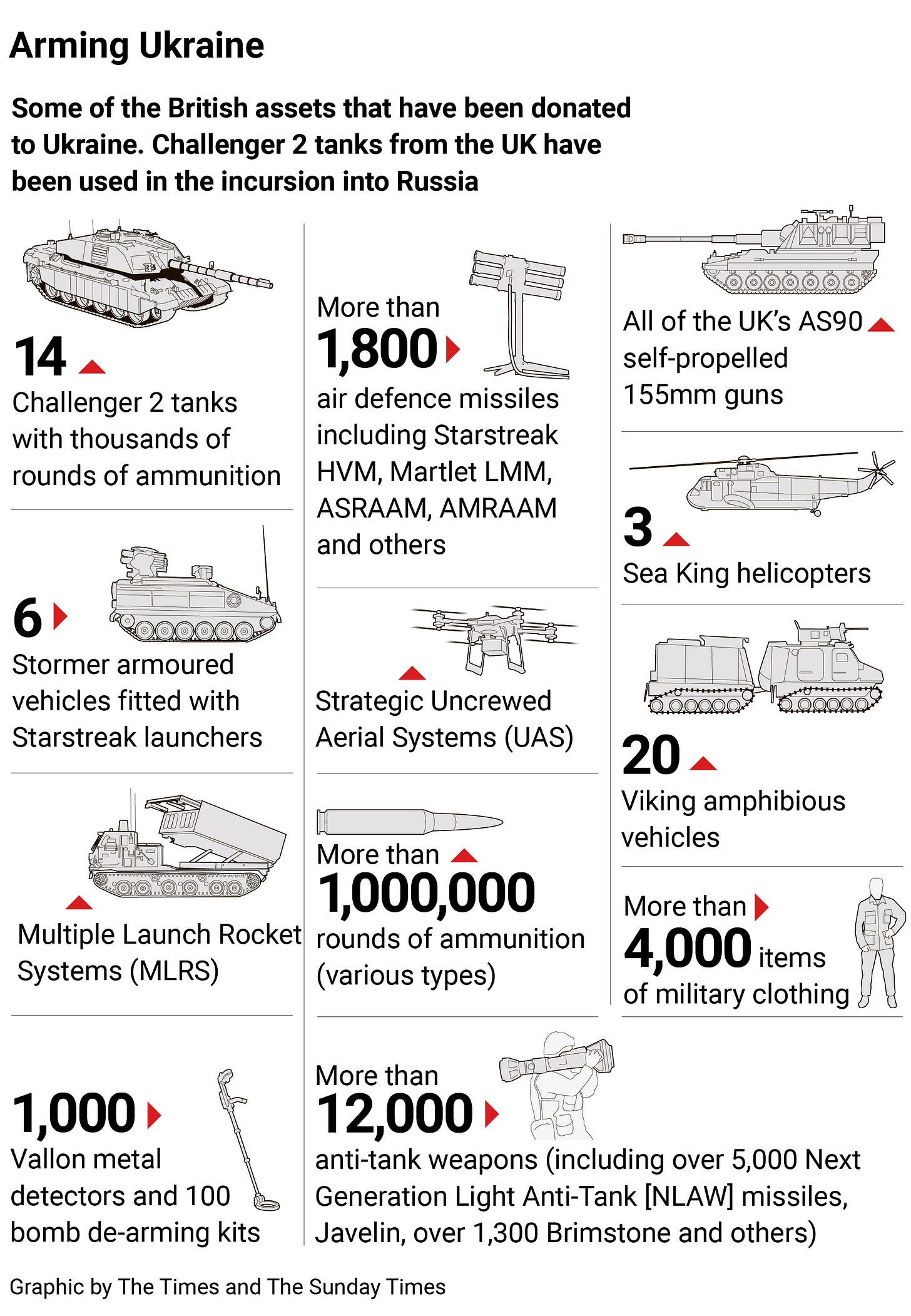
British Challenger 2 tanks reached Ukraine with enormous fanfare, ahead of Kiev’s long-delayed, ultimately catastrophic 2023 “counteroffensive”. On top of encouraging other proxy war sponsors to provide Ukraine with armoured fighting vehicles, Western audiences were widely told the tank – hitherto marketed to international buyers as “indestructible” – made Kiev’s ultimate victory a fait accompli. As it was, Challenger 2 tanks deployed to Robotnye in September were almost instantly incinerated by Russian fire, then very quietly withdrawn from combat altogether.
Hence, many online commentators were surprised when footage of the Challenger 2 in action in Kursk began to circulate widely on August 13th. Furthermore, numerous mainstream outlets dramatically drew attention to the tank’s deployment. Several were explicitly briefed by British military sources that it marked the first time in history London’s tanks “have been used in combat on Russian territory.” Disquietingly, The Times now reveals this was a deliberate propaganda and lobbying strategy, spearheaded by Prime Minister Keir Starmer.
Prior to the Challenger 2’s presence in Kursk breaking, Starmer and Defence Secretary John Healey had reportedly “been in talks about how far to go to confirm growing British involvement in the incursion towards Kursk.” Ultimately, they decided “to be more open about Britain’s role in a bid to persuade key allies to do more to help – and convince the public that Britain’s security and economic prosperity is affected by events on the fields of Ukraine.” A “senior Whitehall source” added:
“There won’t be shying away from the idea of British weapons being used in Russia as part of Ukraine’s defence. We don’t want any uncertainty or nervousness over Britain’s support at this critical moment and a half-hearted or uncertain response might have indicated that.”
In other words, London is taking the lead in marking itself out as a formal belligerent in the proxy war, in the hope other Western countries – particularly the US – will follow suit. What’s more The Times strongly hints that Kursk is to all intents and purposes a British invasion. The outlet records:
“Unseen by the world, British equipment, including drones, have played a central role in Ukraine’s new offensive and British personnel have been closely advising the Ukrainian military… on a scale matched by no other country.”
Britain’s grand plans don’t stop there. Healey and Foreign Secretary David Lammy “have set up a joint Ukraine unit,” divided between the Foreign Office and Ministry of Defence. The pair “held a joint briefing, with officials, for a cross-party group of 60 MPs on Ukraine,” while “Starmer has also asked the National Security Council to draw up plans to provide Ukraine with a broader range of support.” On top of military assistance, “industrial, economic, and diplomatic support” are also being explored.
The Times adds that in coming weeks, “Healey will attend a new meeting of the Ukraine Defence Coordination Group,” an international alliance of 57 countries overseeing the Western weaponry flooding into Kiev. There, “Britain will press European allies to send more equipment and give Kyiv more leeway to use them in Russia.” The British Defence Ministry also reportedly “spoke last week to Lloyd Austin, the US defence secretary, and has been wooing Boris Pistorius, his German opposite number.”
Evidently, the new Labour government has an ambitious vision for the proxy war’s continuation. Yet, if the “counterinvasion” is anything to go by, it’s already dead in the water. As The Times notes, the imbroglio is primarily “designed to boost morale at home and shore up Zelensky’s position,” while relieving pressure on the collapsing Donbass frontline by forcing Russia to redirect forces to Kursk. Instead, Moscow “has capitalised on the absence of four crack Ukrainian regiments to press their attacks around Pokrovsk and Chasiv Yar.”
Similarly, commenting on Starmer’s wideranging efforts to compel overt Western action against Russia, a “defence expert” told The Times: “if it looks as if the Brits [are] too far ahead of their NATO allies, it might be counterproductive.” This analysis is prescient, for there are ample indications London’s latest attempt to ratchet tensions and drag the US and Europe ever-deeper into the proxy war quagmire has already been highly “counterproductive”, and boomeranged quite spectacularly. Indeed, it appears Washington has finally had enough of London’s escalatory connivances.
In repeated press conferences and media briefings since August 6th, US officials have firmly distanced themselves from the Kursk incursion, denying any involvement in its planning or execution, or even being forewarned by Kiev. Empire house journal Foreign Policy has reported that Ukraine’s swoop caught the Pentagon, State Department, and White House off-guard. The Biden administration is purportedly not only enormously unhappy “to have been kept out of the loop,” but “skeptical of the military logic” behind the “counterinvasion”.
On top being a clear suicide mission, the eagerly advertised presence of Western weapons and vehicles on Russian soil “has put the Biden administration in an extremely awkward position.” Washington has since the proxy war erupted been wary of provoking retaliations against Western countries and their overseas assets, and the conflict spilling outside Ukraine’s borders. Adding to US irritations, the British-directed Kursk misadventure also torpedoed ongoing efforts to secure an agreement to halt “strikes on energy and power infrastructure on both sides.”
This comes as Kiev prepares for a harrowing winter without heat or light, due to devastating Russian attacks on its national energy grid. Putin has moreover made clear that Ukrainian actions in Kursk mean there is no longer scope for a wider negotiated settlement at all. Which is to say Moscow will now only accept unconditional surrender. The US has also seemingly changed course as a result of the “counterinvasion”.
On August 16th, it was reported that Washington had prohibited Ukraine’s use of British-made, long-range Storm Shadow missiles against Russian territory. Given securing wider Western acquiescence to such strikes is, per The Times, a core objective for Starmer, this can only be considered a harsh rebuke, before the Labour government’s escalatory lobbying efforts have even properly taken off. The Biden administration had in May granted permission for Kiev to conduct limited strikes in Russia, using guided munitions up to a 40-mile range.
Even that mild authorisation may be rescinded in due course. Berlin, which like Britain had initially proudly promoted the presence of its tanks in Kursk, is now decisively shifting away from the proxy war. On August 17th, German Finance Minister Christian Lindner announced a halt to any and all new military aid to Ukraine as part of a wider bid to slash federal government spending. The Wall Street Journal reporting three days earlier that Kiev was responsible for Nord Stream II’s destruction may be no coincidence.
The narrative of the Russo-German pipeline’s bombing detailed by the outlet was absurd in the extreme. Conveniently too, the WSJ acknowledged that admissions of “Ukrainian officials who participated in or are familiar with the plot” aside, “all arrangements” to strike Nord Stream “were made verbally, leaving no paper trail.” As such, the paper’s sources “believe it would be impossible to put any of the commanding officers on trial, because no evidence exists beyond conversations among top officials.”
Such an evidentiary deficit provides Berlin with an ideal pretext to step away from the proxy war, while insulating Kiev from any legal repercussions. The narrative of Ukraine’s unilateral culpability for the Nord Stream bombings also helpfully distracts from the attack’s most likely perpetrators. This journalist has exposed how a shadowy cabal of British intelligence operatives were the masterminds, and potential executors, of the October 2022 Kerch Bridge bombing.
That escalatory incident, like Nord Stream’s destruction, was known about in advance, and apparently opposed, by the CIA. Chris Donnelly, the British military intelligence veteran who orchestrated the Kerch Bridge attack, has privately condemned Washington’s reluctance to embroil itself further in the proxy war, declaring “this US position must be challenged, firmly and at once.” In December that year, the BBC confirmed that British officials were worried about the Biden administration’s “innate caution”, and had “stiffened the US resolve at all levels”, via “pressure.”
The determination of Washington’s self-appointed “junior partner” to escalate the proxy conflict into all-out hot war between Russia and the West has only intensified under Starmer’s new Labour government. Yet, the Empire gives every appearance of refusing to take the bait, while seeking to curb London’s belligerent fantasies. This may be an encouraging sign that the proxy war is at last reaching its end. But we must remain vigilant. British intelligence is unlikely to allow the US to withdraw without a fight.
US, UK, Poland Took Part in Preparing Ukraine’s Operation in Kursk – Russian Foreign Intel
Sputnik – 21.08.2024
On August 6, Ukrainian forces launched an incursion into Russia’s Kursk region, which was slammed by President Vladimir Putin as a large-scale provocation. The Kiev regime planned the attack with the participation of the US and NATO, Russian presidential aide Nikolai Patrushev earlier said.
Ukraine’s operation in Russia’s Kursk region was prepared with the participation of the US, UK, and Polish intelligence services, the Russian Foreign Intelligence Service (SVR) said.
“According to available information, the operation of the Ukrainian Armed Forces in the Kursk region was prepared with the participation of the US, British, and Polish intelligence services. The units involved in it underwent combat coordination in training centers in the UK and Germany. Military advisers from NATO countries are providing assistance in managing Ukraine’s units that have invaded Russian territory, and in using Western weapons and military equipment,” the agency told Russian media.
NATO countries are also providing the Ukrainian military with satellite reconnaissance data on the deployment of Russian troops in the area of the operation, the SVR added.
As the situation on the front deteriorates for Ukrainian troops, Kiev’s Western handlers have been pushing it to move combat operations deep into Russian territory in recent months, Russia’s Foreign Intelligence Service said. One of the goals was to provoke an upsurge in anti-government sentiment and influence domestic policy in the country.
US PMC involved in Kursk invasion
By Lucas Leiroz | August 21, 2024
The US is directly involved in the Ukrainian invasion of Kursk – not only at the strategic level, but also at the tactical and operational sphere. Recent data confirm the participation of at least one US private military company (PMC), meaning that US troops are illegally operating within the 1991 Russian borders. This is likely to lead to a serious escalation of tensions between Moscow and Washington, with the Russian side already demanding formal explanations from US diplomats.
The presence of foreign mercenaries in Kursk is not new. The occurrence of foreigners among Ukrainian troops has been commonly reported, mainly Georgian, Polish and French citizens. However, so far, all reported mercenaries had been members of the Ukrainian Army’s “Foreign Legion”. It is now known that in addition to these individuals who have joined Kiev’s armed forces, there are also mercenary troops from at least one American PMC in Kursk, which represents a higher level of international aggression against Russia.
The American PMC Forward Observation Group (FOG) posted photos and videos on its Instagram showing some of its soldiers fighting on the Kursk front lines. In the photos, it is possible to see not only ordinary PMC members alongside Ukrainian soldiers, but also the founder of FOG himself, Derrick Bales – a well-known American mercenary who has participated in several conflicts. Bales is known for always using an M4A1 rifle in his operations, as well as for having a skull tattoo on his right arm. He has been in Ukraine since 2022, as FOG has been directly involved in training Ukrainian troops. However, this is the first time that a Western PMC has been reported inside the undisputed territory of Russia.
In fact, Western PMCs work together with Ukrainian troops quite often. However, the number of these groups has been decreasing over time. According to experts, Ukraine does not present desirable conditions for PMCs to accept contracts. Being a high-intensity conflict with a very high lethality rate, the Ukrainian scenario seems terrible for professional mercenaries, who see that it is clearly not worth fighting there.
Currently, most PMCs operating in Ukraine work only in activities that do not involve direct combat. Services such as logistics, intelligence, facility security and personnel training are some of their main activities. The fact that an American PMC is directly fighting on a highly lethal flank like the “Battle for Kursk” indicates that there may be direct intervention by the American state in the case – with Washington forcing the mercenaries to fight in Kursk, even though it does not seem like a profitable or interesting scenario.
Unlike classic mercenaries, who fought only for money and without any institutional loyalty, PMCs are a post-Cold War military phenomenon, formed from the reduction of personnel in regular armies’ special forces units. Despite fighting “for money”, these companies have the same mentality and ethics as the regular armed forces, since most of their members came from the ranks of state armies. These groups are loyal to their states and obey direct orders from their countries, being a kind of “semi-state force”. So, it is possible that FOG is following orders from the US state to fight in Kursk, even though the local military conditions did not make it worth the risk.
This possibility of direct American involvement at an institutional level has prompted the Russian Federation to ask Washington for clarification. The Ministry of Foreign Affairs has summoned Washington’s charge d’affaires in Moscow to ask some questions about the direct involvement of American citizens in the hostilities in Kursk. The American responses are not yet clear, but an official statement on the matter is expected to be released soon.
Summoning diplomats for clarification is one of the most serious steps a country can take in the diplomatic sphere. This type of action usually precedes more serious moves, such as imposing sanctions, taking military action or cutting off diplomatic relations. It is unlikely that the Russians will take escalatory measures in retaliation against the US, since avoiding the escalation of tensions has been one of Moscow’s top priorities since the beginning of the special military operation. However, there will certainly be some effective response, despite the concern to avoid escalation.
Regardless of what is done in the diplomatic sphere, it is expected that the Russians will increase military action in Kursk, eliminating all foreigners involved. Mercenaries and PMCs are not protected by international law, which is why any military effort against these groups is absolutely legal.
Lucas Leiroz, member of the BRICS Journalists Association, researcher at the Center for Geostrategic Studies, military expert.
You can follow Lucas on X (formerly Twitter) and Telegram.
Featured Video

Racist Seinfeld Dances for Joy as Bibi Unveils His New Map
or go to
Aletho News Archives – Video-Images
TV Drama Review
Japanese drama projects Japan’s wartime atrocities onto Chinese characters

Global Times | October 25, 2026
By portraying Chinese characters as perpetrators of ruthless violence while casting Japanese Self-Defense Forces (SDF) intelligence operatives as defenders, the season 2 of the Japanese drama Vivant has recently drawn criticism from Chinese netizens, who argue that its depiction turns historical reality on its head while ignoring Japan’s wartime atrocities.
The TBS drama series – a spy suspense story in which an alleged unofficial intelligence unit of the SDF operates across the globe — has attracted a passionate fanbase. Its currently airing season 2 opened with a household rating of 18.8 percent, the highest for a TV drama this year, according toa commentary article by Japanese media Toyo Keizai.
What draws attention is the portrayal of the enemies in the series, the article noted. Scenes in which the Chinese organization subjects kidnapped members of the SDF unit to brutal torture are repeated with unrelenting intensity.
It is rare for Japanese TV dramas to explicitly portray a real-life country as the enemy, the article noted.
Japanese Prime Minister Sanae Takaichi also made a reference to the drama, saying that she has been recording Vivant and hopes to binge-watch it over the year-end and New Year holidays, according to Japanese media outlets.
China’s CCTV News report on Sunday revealed that the drama features scenes in which Chinese personnel cut off the fingers of and stab Japanese intelligence operatives in the abdomen. Such acts bear striking similarities to the torture inflicted on Chinese nationals by invading Japanese troops during the World War II.
The drama distorts the truth by attributing these atrocities to modern Chinese characters. Beneath the surface, it subtly glorifies Japan’s cross-border overseas operations, blurs the functional boundaries of the SDF and implicitly promotes an expansionist narrative, per CCTV News. … continue
Blog Roll
 Aletho News
- EU facing trillion-euro debt hole while seeking more cash for Kiev
- How US, Europe, Persian Gulf states exhausted missile stockpiles, splurged billions to defend Israel
- Up in arms… Koreans reject U.S. empire’s plan to make South Korea the next Ukraine
- Iran, Turkey, Pakistan, Saudi Arabia could advance region-led security framework in Tehran: FM spox
- Netizens condemn Japanese drama for projecting Japan’s wartime atrocities onto Chinese characters
- Racist Seinfeld Dances for Joy as Bibi Unveils His New Map
- A West Bank War for Netanyahu’s Election Campaign, Could It Backfire?
- Yemen denounces European Parliament’s ‘hypocritical’ push to blacklist Ansarullah
- Qalibaf: UAE’s UN bid aims to ‘clear the runway’ for ‘Greater Israel’, whitewash genocide
- Pakistan reopens Iran border after boosting security: Report
- If Americans Knew
- An error has occurred; the feed is probably down. Try again later.
- No Tricks Zone
- Sudden Stratospheric Warming, Powerful El Niño Combination May Lead To Extreme Europe Cold, Energy Crisis!
- Two New Studies Find Thwaites Glacier Melt Cannot Be Driven By Human Activity Or A Warming Ocean
- E-Cars Reduce CO2 Emissions By Only 41% Compared To Internal Combustion Engine Vehicles
- Predictions Made By Renowned Climate Professor Over Past Decades Have Been Proven To Be Poor
- New Study Suggests Large Regions Of The Pacific Ocean Have Been Cooling For The Last 80 Years
- Germany’s Green Energy Debacle: High Energy Costs Force Kahla Porzellan to Close After 182 Years!
- New Study: 50 Years Of The Most Aggressive ‘Net Zero’ Policies Can Only Affect The Global Climate By 0.03°C
- US September “Heat” Was No Record…Many Records Set Decades Ago
- Latest European Green Energy Debacle; Portugal’s Largest Flagship Solar Park Insolvent!
- Green Energy Debacle: German Expert Professor Fritz Vahrenholt Warns Of Severe Economic And Social Consequences

