NATO’s Steadfast Defender Exercises Threaten Europe’s Security
Sputnik – 22.01.2024
Rather than try to de-escalate the already high tensions in Europe, the Western military bloc NATO proudly announced its intent to launch massive military exercises in the region involving around 90,000 troops.
Dubbed Steadfast Defender 2024, the exercises are going to be held as NATO becomes increasingly involved in the Ukrainian conflict, providing the regime in Kiev with weapons, mercenaries and intelligence to attack Russian territories and people.
As Russian Deputy Foreign Minister Alexander Grushko has explained, these military exercises are “another element of the hybrid war unleashed by the West against Russia,” with any event of such magnitude increasing the risk of “military incidents” and further destabilizing security in the region.
There appear to be several goals that NATO seeks to accomplish through Steadfast Defender 2024, explained Mikael Valtersson, a former Swedish Armed Forces officer, defense politician and chief of staff with the Sweden Democrats party.
One of these goals is training NATO soldiers to “fight Russian forces,” Valtersson said, noting that while the exercises’ official narrative is about repelling an invasion, it seems more like preparation “for the eventuality of military missions into Ukraine, Belarus or Moldova.”
“Another purpose is to send a psychological message to assure the eastern NATO countries that NATO takes their security seriously,” he continued. “A third purpose is to tell Russia that NATO is ready and capable to act if they must.”
According to Valtersson, a lot of people in the West actually believe in a “possible Russian attack towards European NATO countries in a couple of years,” with this fear being further reinforced by “alarmist statements from leading Western politicians and military leaders.”
“This creates a Russophobic war mentality that easily might lead to escalation and the conflict they have predicted,” he remarked.
Valtersson also pointed out that, while usually conducting military exercises poses no security risks as such events are a “normal part of military life,” holding large-scale drills “near the borders of countries you perceive as enemies” may result in dangerous mistakes being made.
“When both sides are high-strung and look for potential aggressive behavior from the other side, one mistake could quickly lead to escalation. If you really want to de-escalate tensions, you should avoid large-scale exercises near the borders of your adversaries,” he said. “These kind of exercises do nothing to dampen tension between Russia and NATO. It is, in fact, rather a part of an ongoing escalation process, which is bad for the security of Europe.”
The emerging new Cold War “between the West and mainly China and Russia” and the West alienating many countries of the Global South by trying to force them to oppose Russia over the Ukrainian crisis may ultimately divide the world into two competing blocs, “the West and the rest,” Valtersson warned.
“The difference with the first Cold War will be that the non-Western bloc will be incredibly stronger in size, economy, population and even diversity than during the first Cold War,” Valtersson added. “This conflict could be easily avoided if the West had accepted that they can’t dominate the entire globe and that other major powers have their own spheres of interest.”
‘Barbaric attack using Western arms’ – Moscow decries Ukrainian shelling of Donetsk
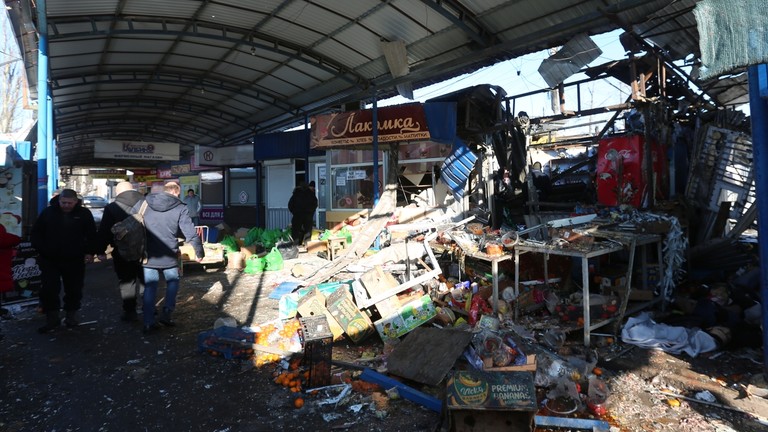
A market destroyed in the Ukrainian shelling of the Russian city of Donetsk. © Sputnik / Viktoria Velenskaya
RT | January 21, 2024
The shelling of the Russian city of Donetsk, which has claimed the lives of at least 25 civilians and wounded 20 others, is “a barbaric terrorist act” carried out by Ukraine with the support of the West, Russia’s Foreign Ministry has said.
It has been established that Sunday’s bombardment of a busy market in the capital of Russia’s Donetsk People’s Republic was inflicted with weapons supplied to Kiev by the US and its allies, the ministry said in a statement.
“This again confirms [the West’s] direct involvement in the conflict and makes it complicit in the criminal acts of the Zelensky regime, which has once again displayed its inhumanity and hatred towards innocent people,” it said.
“The West’s unrestrained desire to inflict a ‘strategic defeat’ on Russia through the hands of their Ukrainian puppets, whom it is eager to support mindlessly and without limit, is pushing the Kiev regime to increasingly reckless steps, including acts of terrorism, massive violations of international humanitarian law, and war crimes,” the ministry added.
Russia is calling on governments and international bodies to condemn this “treacherous attack on the civilian population,” it stated. Failure to do so would be a sign of “silent approval of the murders of civilians” that would only encourage Kiev “to commit even more bloody atrocities,” it also pointed out.
All those involved in the shelling of Donetsk and in other “terrorist attacks” on Russia will face “an inevitable punishment,” the ministry warned.
The desperate strikes clearly demonstrate the lack of political will on the part of the Ukrainian authorities to search for peace and a settlement of the conflict with Russia through diplomatic means, the statement continued.
“The need to achieve all of the goals and objectives of Russia’s military operation is obvious. Security threats and acts of terrorism shouldn’t be committed from the territory of Ukraine,” it said.
Russia’s First Deputy Permanent Representative at the UN, Dmitry Polyansky, wrote on Telegram that the attack on Donetsk, which he described as “another heinous crime” by Ukraine, will “undoubtedly” become one of the main topics of discussion during the UN Security Council meeting on Monday. Russia had requested the UNSC meeting several days ago, to discuss deliveries of Western weapons to the Kiev government.
Russia responds to IAEA nuclear plant ‘mines’ claim
RT | January 21, 2024
Senior Russian diplomat Mikhail Ulyanov has argued that there is nothing “sensational” or new about the presence of landmines in the buffer zone on the periphery of the Zaporozhye nuclear power plant, which was highlighted by the International Atomic Energy Agency earlier this week.
The Zaporozhye NPP, the largest facility of its kind in Europe, was under Russian control since the beginning of hostilities in Ukraine two years ago, and has hosted the UN nuclear watchdog’s monitoring mission since September 2022. On Friday, the IAEA noted in a statement that “mines along the perimeter of the ZNPP… are now back in place.”
“The mines are located between the outer and inner fences of the station. This is a closed ‘buffer’ zone. Mines pose a threat only to rats, crows and potential saboteurs,” Ulyanov, who represents Moscow at several Vienna-based international organizations, wrote in a Telegram post on Saturday.
The UN watchdog repeatedly declined to assess who was responsible for sporadic drone attacks, shellings and other security incidents involving the facility. Ukraine and its backers kept accusing Russia of undermining nuclear safety, even as Kiev’s top military spy Kirill Budanov admitted to at least three botched Ukrainian assaults to retake ZNPP.
None of Kiev’s commando operations managed to establish a Ukrainian foothold in the nuclear city of Energodar, located in the Zaporozhye region, which joined Russia following a referendum in 2022. However, Ukrainian officials claimed the expeditions gave them valuable experience and contributed to a larger goal of preventing Russia from using the plant to provide electricity to the region. The Zaporozhye station is in a state of partial shutdown, with a single reactor providing power for its own consumption.
Ulyanov noted that according to the Convention on the Physical Protection of Nuclear Material (CPPNM) it was up to the national authorities to determine and introduce “other appropriate measures necessary for the physical protection of nuclear facilities.” Even the IAEA chief Rafael Grossi himself admitted last June that “while the presence of any explosive device is not in line with safety standards, the main safety functions of the facility would not be significantly affected.”
The IAEA was fully aware about the mines and its removal last November, Ulyanov said, arguing that if now they have “reappeared” it only means that the Russian authorities deemed it a “necessary” security measure.
An Epoch of Great Changes Is upon Us
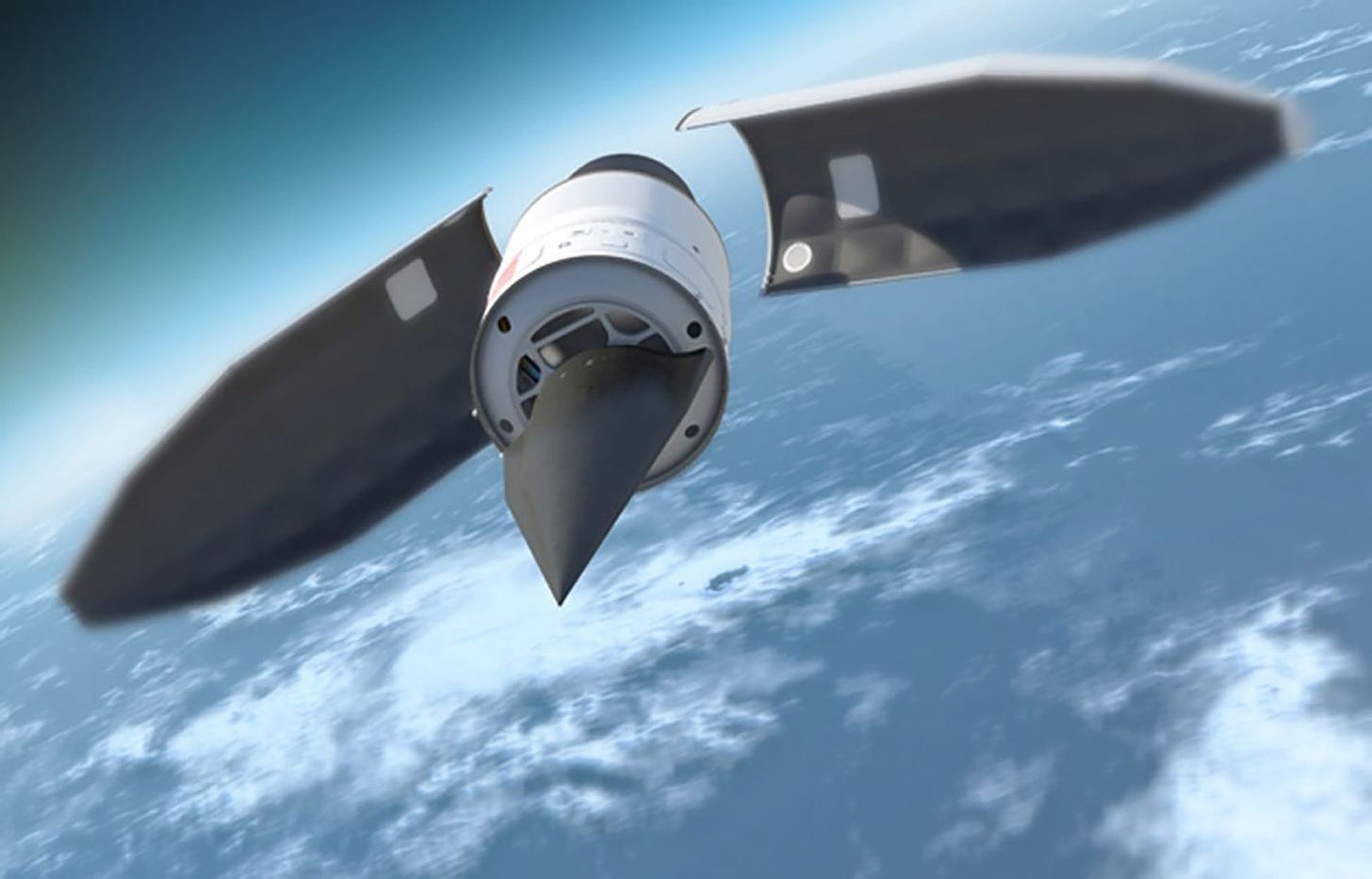
Russian Avangard Hypersonic Missile
By William Schryver | imetatronink | January 19, 2024
One of my current X followers posted earlier today:
“I am against the Ukraine war from the very beginning (mainly because for the first time a foreign war can actually get ME killed with Russia’s missiles), but at this point I also think we can’t just let Russia win which means we lose and that would mean a lot of negative things.”
I will not speak to his fears of “Russia’s missiles”, except to say I am convinced Russia will not strike anyone that hasn’t done something to provoke it in a manner that warrants such a response — at least not so long as the Putin regime remains in charge.
In any case, Russia WILL win this war. Decisively. She will dictate the terms of its cessation. Russia will emerge from this war significantly more powerful than she was just two years ago, and on a trajectory to become even more powerful in coming years.
As I wrote in a recent article:
“… the Russian armed forces, fighting on their own ground, on and under their adjacent seas, and in the air above their spheres of control, constitute the most potent and battle-hardened military force on the planet.”
As for the US empire’s European vassals: at no point in the last 500 years has Europe been more militarily, politically, socially, and spiritually debilitated. If the entire current military capacity of Europe were combined, it would not stand a chance of defeating Russia in a war. Rather, it would be systematically and comprehensively slaughtered.
And, as I have argued in crescendo over the past several years, the long-pervasive belief in American military supremacy is a myth; a mirage; a fallacious narrative fashioned from fables and Hollywood films.
The US military has not won a war since WW2. They have mercilessly bombed the crap out of many smaller, weaker countries, killed millions of people, and yet never once achieved strategic victory.
Not since WW2 have they faced anything even faintly approximating high-intensity warfare.
Indeed, never at any time in history has the US military fought against a great power adversary at the height of its strength.
And now, here in 2024, the US military has never been in a more weakened state relative to any of its potential great power adversaries — namely, Russia, China, and Iran.
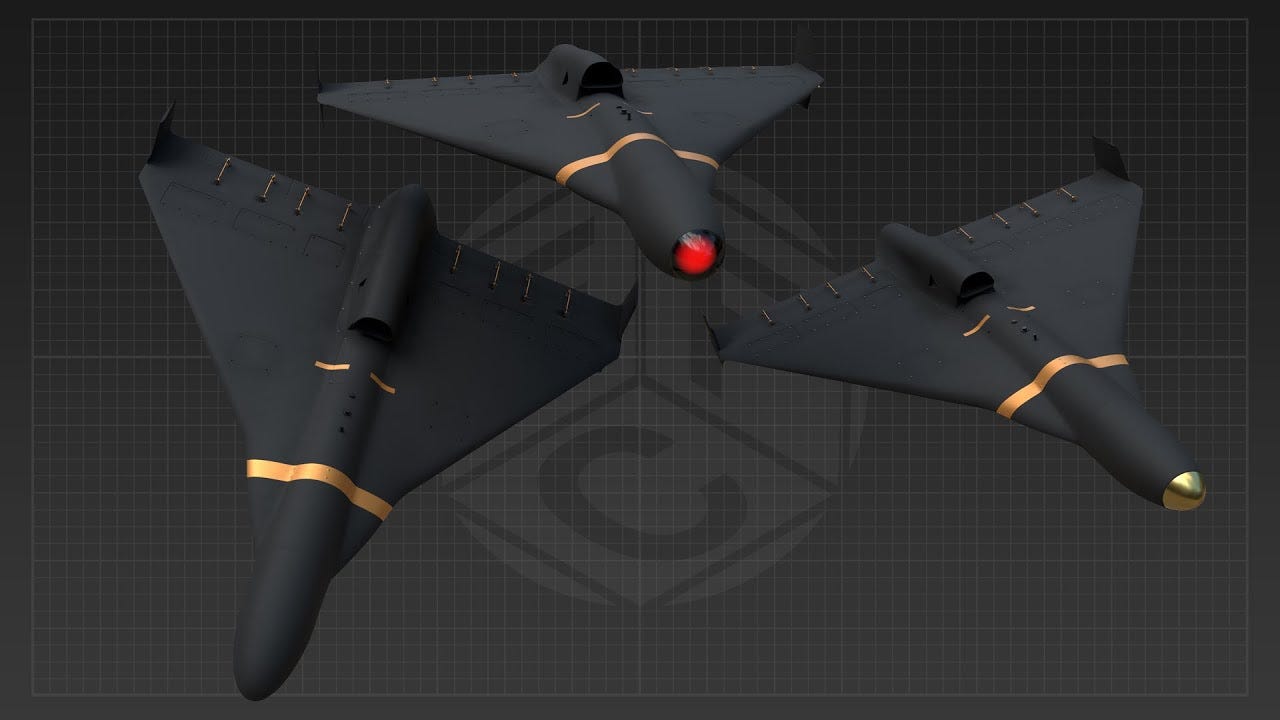
Iranian Shahed-238 loitering cruise missiles, three variants.
As I repeat often, I am convinced the failed US/NATO proxy war against Russia in Ukraine will produce the following results:
— It will greatly accelerate the decline of the American Empire.
— NATO will cease to be a credible military/political alliance.
— The EU will cease to be a credible monetary/political alliance.
And, as the broken hegemon rapidly recedes, political, economic, and social chaos is certain to engulf much of the world as the major and minor players on the planet scramble to secure their respective spheres of influence and establish new centers of global and regional power.
An epoch of great changes is upon us.
Fact Check: Is Russia Really Getting Ready to Invade NATO?
By Ilya Tsukanov – Sputnik – 15.01.2024
NATO is getting ready for Russian aggression against the alliance’s eastern flank, Bild says, citing a “secret Bundeswehr document” about preparations for the possible flashpoint. But what’s the actual chance of a Russian attack on NATO, and which side, historically, has dreamt about and planned for a World War III scenario in Eastern Europe?
The German military is reportedly getting ready for a hot war between Russia and NATO, with a conflict scenario imagined in a classified Bundeswehr document envisioning a gradual escalation of tensions from February onwards, culminating in the buildup of hundreds of thousands of Russian and NATO troops around the Baltics and potential clashes by the summer of 2025.
The document lays out a scenario in which Russia, emboldened by Ukraine fatigue among NATO countries, kicks off a successful spring offensive over the coming months, chipping away at the Ukrainian army, and then – for reasons known apparently only to Bundeswehr planners, starting a campaign of “cyber attacks and other forms of hybrid warfare” against the Baltic states to stir up unrest among the ethnic Russian minority there.
The so-called ‘Suwalki Gap’ – the 100 km long Polish strip of land separating Belarus and the Russian exclave of Kaliningrad, is deemed by the Bundeswehr to be the focal point of a possible Russia-NATO clash, with the scenario envisioning the transfer of some 300,000 NATO troops to Eastern Europe to “deter” Moscow from aggression. The scenario ends ambiguously, with its authors leaving open whether the tensions and troop buildup ends in a potentially world-ending shooting war.
Russian officials scoffed at Bundeswehr planners’ rich imagination, with Foreign Ministry spokeswoman Maria Zakharova comparing the leaked plan to a “powerful horoscope” on Monday and saying she wouldn’t be surprised if the scenario was provided to the German military by the Foreign Ministry and its notoriously Russophobic chief, Annalena Baerbock.
The German Defense Ministry attempted to walk back the report, with a spokesperson assuring Bild that “considering various scenarios, even if they are extremely unlikely, is part of everyday military practice, especially during army training” while nevertheless emphasizing that it takes “threats” from Russia seriously.
‘Various Scenarios’
The German MoD wasn’t wrong in mentioning the military’s propensity to plan for “various scenarios” when it comes to the idea of an all-out conflagration between Russia and NATO. What it left out, however, is that historically, many of the most outlandish declassified conflict scenarios seem to involve the idea of a preemptive attack against Russia by Western powers, not the other way around.
In the spring of 1945, for example, just weeks after the end of WWII in Europe, and while the war against Japan was still raging, British Prime Minister Winston Churchill commissioned a secret plan for an invasion of the Soviet Union by the Western Allies, including the combined forces of the US and the UK, plus 10-12 German divisions created from the remnants of the Wehrmacht – the same force tens of thousands of American and British troops died fighting to liberate Western Europe from the Nazis.
The plan, dubbed “Operation Unthinkable,” had the objective of imposing “upon Russia the will of the United States and the British Empire,” and included “the occupation of such areas of metropolitan Russia” to “render further resistance impossible.” Fortunately, the contingency was never realized, with its existence revealed to the public in 1998 after many decades under wraps. Some historians believe the Soviet leadership learned about the plan ahead of time, with Red Army forces in Eastern Europe inexplicably reorganizing in late June of 1945, just before the July 1 hypothetical attack date.
From 1945 until 1949, the US enjoyed a global monopoly in the possession of nuclear weapons as Soviet scientists scrambled to catch up. During this brief window of time, the Pentagon developed at least nine separate plans to target its erstwhile WWII Soviet allies using nukes. Most famous among them was Operation Dropshot – a 1949 proposal calling for the bombardment of some 100 Soviet cities with 300 nuclear bombs and 250,000 tons of conventional munitions, plus chemical and bacteriological weapons, followed by a ground campaign to ensure “complete victory” over the USSR and its allies across Eurasia. The plan, which signed off on by the Joint Chiefs of Staff on December 19, 1949, was declassified in 1977, sparking disbelief among many ordinary Americans owing to its brutality.
In 1988, at the twilight of the Cold War, while President Reagan was visiting Moscow to schmooze with General Secretary Gorbachev and to announce that he no longer saw the USSR as an “evil empire,” the US Naval War College was playing out a strategic wargame modeling surprise offensive operations against Soviet air defenses, military-industrial complex, and naval assets in Asia.
After the Cold War ended and the USSR broke apart, the Pentagon continued to plan for scenarios of unprovoked aggression against Moscow – even as US leaders spoke of Russia as their ‘partners’ in the “new world order” announced by President George H.W. Bush in his State of the Union address in January 1991. In the early 2000s, while Bush’s son George W. Bush gushed about looking into President Putin’s eyes to “get a sense of his soul,” Pentagon planners were busy coming up with Prompt Global Strike – a scenario proposing the massed launch of precision-guided conventional missiles to decapitate the Russian leadership and declaw its nuclear forces.
The concept, still around and now called ‘Conventional Prompt Strike’, proposes the use of thousands of conventional ballistic and cruise missiles, as well as air and space assets, either in place of or in coordination with nuclear weapons. The US began to develop the Prompt Global Strike idea at the same time that the US withdrew from the Anti-Ballistic Missile Treaty with Russia in 2002, with that move, combined with NATO encroachment on Russia’s western borders from 1999 onward, forcing Moscow to invest significant resources into the development of fundamentally new strategic weapons, including hypersonic missiles.
The above examples serve to demonstrate that whatever the geopolitical climate at the time – and whether Moscow is an erstwhile ally in the fight against German Nazism and Japanese militarism, an adversary at the start of the Cold War, a newfound friend at its end, or a trusted ‘partner’ at the dawn of the 21st century, US and allied military planners will find cause to come up with scenarios for a war of aggression against Russia. The historical detour adds a dose of context to reporting on purported Russian plans to attack NATO without provocation, with such plans seemingly being more the alliance’s forte.
Tactical Blindspots
The Bundeswehr’s fearmongering about the potential for “Russian aggression against NATO” in the Suwalki Gap isn’t new. In fact, Sputnik has been reporting on and poking holes in similar claims since at least 2015, when Pentagon officials first began warning that Russia might attempt to close the gap, thus cutting off the Baltics from Poland and the West. Then, as now, the US and its allies never bothered to explain what on Earth would motivate Russia to attack NATO.
In 2017, following another dose of fearmongering related to Russia and the Suwalki Gap in the Wall Street Journal, political observer Yevgeny Krutikov said that NATO’s fears were nothing short of “stupidity,” pointing out that most of the Suwalki Gap area consists of woodland, lakes and swamps, including a national park, and that the region lacks any major roads. “It does not even cross anyone’s mind that tanks can’t pass through the Suwalki woods,” Krutikov stressed at the time.
Strategic Fallacies in Logic
Seven years later, the Suwalki Gap has reemerged in the minds of Western military planners as the place where Russia-NATO tensions could go hot. Leaving aside tactical considerations, the question Sputnik and others have asked, and which NATO have never been able to answer, is why Moscow would launch what amounts to an unprovoked invasion of Poland – a NATO member, and proceed to attack three more NATO allies (Lithuania, Latvia and Estonia), thus triggering World War III in the process.
Russia’s military demonstrated its capabilities against Ukraine in the proxy war with NATO in Ukraine, with the country’s troops, equipment and military production capabilities more than a match for an army trained, armed and funded by the Western bloc, and even earning the ranking of number one in the world militarily – above the United States, in a recent US report.
That said, a direct confrontation with NATO could very quickly turn against Russia’s favor, with the alliance having more than four times the total military personnel and active duty troops, three times the number of paramilitary reserves, nearly five times as many aircraft, six times as many armored vehicles, 3.5 times more warships, and over six times the population.
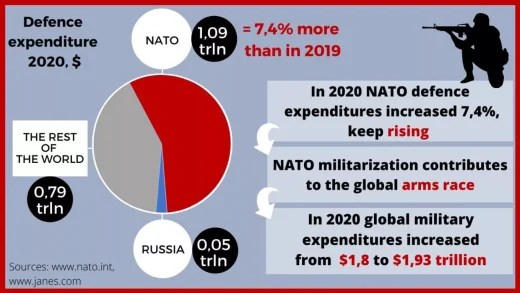
Russian Foreign Ministry graphic of NATO defence spending compared to that of Russia and the rest of the world.
Under Article 5 of the NATO Treaty, members are required to come to the defense of members in the event of enemy aggression, and at least in theory, are under obligation to deploy weapons up to and including nuclear weapons, if necessary. That, combined with Washington’s carefree approach to nukes (including allowing their use on a first strike basis and even against non-nuclear-armed adversaries), means a Russian attack on the Baltics would very likely put the planet on a rapid ride to a world-ending World War – something Russian political and military leaders have repeatedly demonstrated they are not interested in.
“The whole of NATO cannot fail to understand that Russia no reason, no interest – neither geopolitical interest, nor economic, nor political, nor military – to fight with NATO countries,” President Vladimir Putin said in an interview with Russian media last month. Moscow and the bloc “have no territorial claims against each other,” Putin stressed, adding that Moscow would prefer peaceful coexistence to confrontation with bloc members.
Perhaps if the alliance spent more time listening to what the Russian president has been saying and living up to decades-old promises to Moscow not to expand eastward instead of antagonizing the country by fueling a proxy war against it in Ukraine, Bundeswehr planners wouldn’t have to worry about paranoid scenarios involving having to fight the Russian army hundreds of kilometers east of Germany.
More Disregard for International Law: Moscow Hits Out at US-UK Attack on Yemen

Sputnik – 12.01.2024
MOSCOW – Strikes by the US and the UK on Yemen are another example of the distortion of UN Security Council resolutions and complete disregard for international law in the name of escalation in the region, Russian Foreign Ministry spokeswoman Maria Zakharova said on Friday.
The US and the UK carried out overnight airstrikes against Houthi positions in four governorates of Yemen, including the capital Sanaa and the cities of Al Hudaydah, Saada and Taiz, provincial government officials told Sputnik. The US and UK officials confirmed the airstrikes, saying these were targeting Houthi military facilities and positions in Yemen in response to attacks on commercial ships in the Red Sea and not civilian population centers.
“US airstrikes on Yemen are another example of the Anglo-Saxons’ distortion of UN Security Council resolutions and complete disregard for international law in the name of escalating the situation in the region for their own destructive purposes,” Zakharova wrote on Telegram.
Moscow mocks US claims it used North Korean missiles
RT | January 11, 2024
The US is peddling false information when claiming that Russia used North Korean missiles to attack Ukrainian targets, Russian envoy to the UN Vassily Nebenzia told a Security Council meeting on Wednesday.
Washington has accused Russia of buying North Korean ballistic missiles and using them during mass strikes on Ukrainian targets on December 13, and also last week. US national security spokesperson John Kirby described it as “significant and concerning escalation” in remarks last Thursday. Washington’s allies brought up the issue at the UNSC briefing on Ukraine.
Nebenzia brushed off the allegations, citing statements by a Ukrainian official. Yury Ignat, the spokesman for the Ukrainian Air Force, said on national television that no forensic evidence to confirm the US claims was available to Kiev.
“It turns out that the United States replicates deliberately false information without even bothering to give a heads-up to its direct subjects,” the Russian diplomat remarked during the briefing.
North Korea is under UN sanctions, which include an arms embargo, for developing nuclear weapons and ICBMs. Moscow and Pyongyang have stated that while the two have a good relationship, their cooperation does not violate this restriction, contrary to Western claims.
South Korean ambassador Hwang Joon-kook accused Russia of testing North Korean weapons as part of its military action against Ukraine, and providing “valuable technical and military insights” to the producer nation. He cited unspecified experts as identifying the weapons as KN-23s, which North Korea claims to be nuclear-capable.
Ignat, the military spokesman, said that positively identifying a ballistic missile as North Korean would be challenging due to their similarity to Russian equivalents, and significant fragmentation on impact. Both nations’ designs stem from Soviet technology.
Another Ukrainian official, Oleg Sinegubov, head of the administration of Kharkov Region, claimed that some of the fragments recovered from Russian missile strike sites had had their markings erased, which he suggested indicated their foreign origin.
Russian Foreign Minister Sergey Lavrov previously rejected allegations that Moscow was procuring North Korean arms. In an interview in October, he said he does not comment on “rumors”, adding that “the Americans are always accusing everyone of all sorts of things”.
Wall Street Journal Sets Standard for Irresponsible Journalism in Ukraine
By Ted Snider | The Libertarian Institute | January 10, 2024
Recently, The Wall Street Journal joined the flood of American mainstream media outlets, including The New York Times, Politico and several others, in preparing the American public for a Russian victory.
After nearly two years, over $113 billion of U.S. taxpayers’ money spent at horrendous cost in life and limb has put Ukraine in a worse bargaining position than they were at the start of the war. As many as 50,000 Ukrainians are now amputees. And though statistics on Ukrainian casualties are a tightly sealed state secret, the most plausible sources suggest casualties and fatalities as staggering as 400,000-500,000. These numbers fit with internal Ukrainian communications that suggest that maintaining their numbers on the field would require replacing 20,000 soldiers a month. The same figure has been given in a New York Times article that quoted a former battalion commander who “estimated that Ukraine will need to enlist 20,000 soldiers a month through next year to sustain its army, both replacing the dead and wounded.” 20,000 over an approximately two year war puts the figure well over 400,000. Most recently, Yuriy Lutsenko, the former prosecutor general and ex-head of the Ministry of Internal Affairs of Ukraine, has said that 500,000 Ukrainian soldiers have been killed or seriously wounded. Interestingly, it is Moscow that provides the most conservative figures. Russian Defense Minister Sergey Shoigu recently said that Ukraine has lost over 215,000 soldiers in 2023 with over 383,000 killed or wounded since the war began.
The 400,000-500,000 figure for Ukrainian soldiers lost to the battlefield by casualties and deaths also matches the 450,000-500,000 number that Ukrainian President Volodymyr Zelensky says the military has requested in a new mobilization. In another sign of a battle between Zelensky and Commander-in-Chief of the Ukrainian Armed Forces Valery Zaluzhny, after Zelensky assigned responsibility to the military for requesting the unpopular draft, Zaluzhny placed the responsibility back on the government, denying that the military had ever formally requested the mobilization or provided the number.
The Wall Street Journal laid the psychological groundwork preparing the American public for defeat in Ukraine, despite the loss of Ukrainian lives and American dollars, with the line “Even if aid for Ukraine is renewed, it is essential to consider a realistic ending for the war.” It goes on to say that, though “Ukraine’s insistence on regaining all the territory Russia has seized since 2014 is understandable…events over the past year have made it clear that this goal can’t be achieved anytime soon.” The article concludes with the prescription that “Western leaders should explore” negotiations to end the fighting, calling it “a bitter pill” but “the only realistic path to a lasting peace in Europe.”
But it is in two short paragraphs near the end of the article that The Wall Street Journal does its readers a disservice by leaving out more information than it gives them, challenging the standards for responsible journalism.
The first of the two paragraphs state, “Recent reports, which Mr. Putin hasn’t denied, suggest that he is ready to agree to a cease-fire along the current battle lines. Although he is unwilling to retreat, these reports indicate that he had shelved his aim to dominate all of Ukraine.”
Though The Wall Street Journal is free to speculate that Vladimir Putin aimed to “dominate all of Ukraine,” it is also obliged to clarify that there is nothing on the documented historical record to indicate that Putin ever had dominating all of Ukraine as an objective. Scholar John Mearsheimer has pointed out, “There is no evidence in the public record that Putin was contemplating, much less intending to put an end to Ukraine as an independent state and make it part of greater Russia when he sent his troops into Ukraine on February 24th.” That has also never been one of Putin’s stated goals of the military operation. His list of goals has consistently been that Ukraine cannot join NATO, that NATO won’t turn Ukraine into a heavily armed anti-Russian country on its border, and that the rights of ethnic Russian Ukrainians be protected. Russia has clearly stated that it “support[s] Ukraine’s territorial integrity” if Ukraine returns to the promise of permanent neutrality upon which Russia first recognized Ukrainian independence in 1991.
In the next paragraph, the article insists that “there are good reasons to be skeptical” that Putin is serious about negotiating a peace that would abandon his ambition to dominate Ukraine. But, though the author has the right to be skeptical, he needs to set out what those “good reasons” are because, once again, they ignore the historical record.
An overwhelming host of people who were present at the Istanbul talks have testified to just how close Russia and Ukraine came to a negotiated peace in the early days of the war. But in questioning Putin’s seriousness about negotiating a peace, The Wall Street Journal ignores reporting that came out several days before its own reporting that former Deputy Minister of Foreign Affairs of Ukraine Oleksandr Chalyi, who was a member of the Ukrainian delegation in Istanbul, says that Putin was very serious about negotiating.
After reminding his audience at a debate in Geneva that he was actually there, Chalyi says that during the Istanbul talks “in March and April,” they “concluded [the] so called Istanbul Communique. And we were very close in the middle of April, in the end of April to finalize our war with some peaceful settlement.” Chalyi reports that Putin personally decided to accept the text of the Communique and that Putin “demonstrated a genuine effort to find a realistic compromise and achieve peace.”
The Journal article then goes to claim that Putin’s Ukraine ambitions are merely part of a larger “plan to reconstitute the Soviet empire.” As evidence, the writer cites Putin’s 2005 statement that the collapse of the Soviet Union was “the greatest geopolitical catastrophe of the 20th century.”
Putin did say that. But like other quotations made by Putin, it is employed misleadingly by omitting its context. First of all, he did not call it “the greatest” catastrophe but “a major” disaster. But the catastrophe after the fall he is referring to is not the absence of the Soviet Union but, primarily, the economic hardship that followed in the wake of its break up. He bemoaned that “individual savings were depreciated” and oligarchs “served exclusively their own corporate interests.” He remembered that “mass poverty began to be seen as the norm.”
The misleading strategy employed here is similar to the one frequently employed when Putin is quoted as having said, “Whoever does not miss the Soviet Union has no heart,” without adding that his next words were, “Whoever wants it back has no brain.” The first part refers to the same events Putin bemoans in the statement quoted in the Journal article; the second part entirely changes the claimed meaning by restoring the first to its context.
The Wall Street Journal article seems to be part of a media psychological campaign to prepare Americans for a Russian victory in Ukraine despite the massive expense in American aid, American weapons, and Ukrainian lives. But it could better prepare them for the inevitable negotiations that it predicts by honestly preparing them with the truth about the causes of the war and about the demonstrated possibility of negotiations, an understanding of which will be necessary if those negotiations are to succeed.
DPR Head Explains Why Russia Only Hits Military Targets in Ukraine
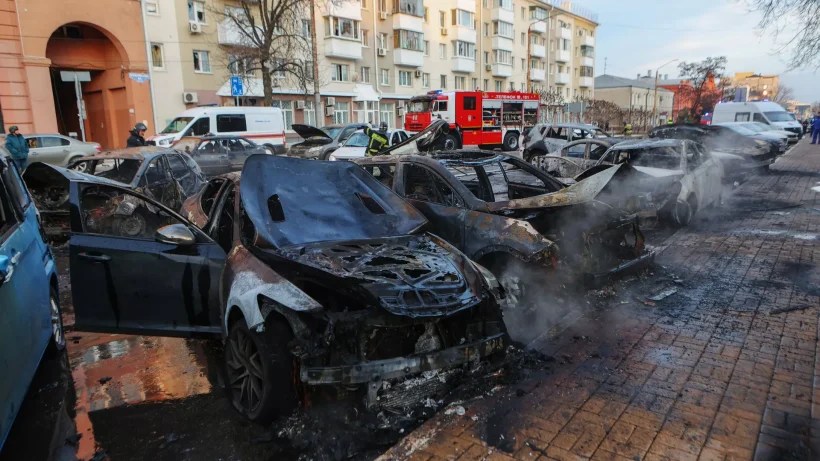
By Svetlana Ekimenko – Sputnik – 07.01.2024
The Ukrainian military has been launching daily attacks on Donetsk throughout the winter holidays. Three hospital patients were wounded during shelling of the city on Orthodox Christmas Eve. Before that, a Ukrainian attack on New Year’s Eve left four dead and 13 more injured.
Russia’s Armed Forces hit only military targets in Ukraine as part of the ongoing special operation, Denis Pushilin, the head of the Donetsk People’s Republic (DPR) told Sputnik.
This is what sets Russia apart from the regime in Kiev that targets civilians in Belgorod and Donetsk during its recent attacks, Pushilin said.
“We, like no one else since 2014, have a certain moral right to act emotionally and deal straight from the shoulder, but that is not who we are. And this is what sets us apart. If we were to employ the methods used by our enemy, how would we then be any better than our enemy, what are we fighting against then?” Pushilin asked rhetorically.
The so-called Euromaidan protests in Ukraine’s capital culminated in the February 2014 coup d’etat that brought radical pro-EU and pro-NATO politicians to power and plunged Ukraine into crisis, leading to the current conflagration.
The DPR head emphasized that Moscow would never stoop to attacks targeting the civilian population – an approach that has become a trademark of the regime led by President Volodymyr Zelensky.
“We would never be able to forgive ourselves if at some point we were able to speed up victory by resorting to carpet bombing and shelling the civilian population,” Pushilin said.
Dwelling on Moscow’s response to the constant shelling of Russian frontline towns by Ukraine’s Armed Forces, the DPR head emphasized: “Gritting our teeth and losing loved ones, we have been dealing with this since 2014, but it has not eroded our humanity. Losing humanity here could have much more serious consequences for our country. This is exactly what our president is talking about – the need to remain human.”
Britain’s Neocolonial Actions Must End – Russian Foreign Ministry

Sputnik – 06.01.2024
MOSCOW – London, which accuses Moscow of violating UN Security Council resolutions, should remember its neocolonial actions, including aggression against the population of Yugoslavia, Iraq, Libya, Afghanistan, Syria, and military aid to Ukraine, Russian Foreign Ministry spokeswoman Maria Zakharova stressed.
The official made a statement commenting on British Defense Minister Grant Shapps’ assertions that “the world has turned its back on Russia.”
The British minister made the remarks in connection to unsubstantiated allegations regarding the use of “DPRK missiles.” Shapps also accused Russia of violating multiple UN Security Council resolutions, despite Moscow’s stern denial of such innuendos.
“Here is just a short list of London’s neocolonial actions of recent times: the participation of British land and air forces together with the Americans in the aggression against Yugoslavia, in the destruction of Iraq and its population, Libya, Afghanistan, the bombing of Syria, and now – supporting the Kiev regime, which in violation of all resolutions on non-delivery of weapons to conflict zones the Anglo-Saxons are supplying with lethal weapons. But Shapps is right about one thing: ‘This must end,'” Zakharova wrote on her Telegram channel.
Earlier, Pyotr Ilyichev, the director of the Department of International Organizations of the Russian Foreign Ministry told Sputnik that UN experts monitoring possible violations of Security Council sanctions refute the allegation that Moscow is violating these restrictions.
According to Ilyichev, Russia treats its international obligations responsibly, while accusations are being made by those who are fixated on the task of discrediting Russia.
Russia launched its special military operation in Ukraine in February 2022, with Russian President Vladimir Putin noting the goal is to ensure “the protection of people who have been subjected to bullying and genocide by the Kiev regime for eight years.”
According to the Russian president, the “demilitarization and denazification of Ukraine” is of utmost importance in order to bring to justice all war criminals responsible for “bloody crimes against civilians” in the Donbass.
Ukraine De Facto Became NATO’s Testing Ground for Digital Warfare Against Russia – Moscow
Sputnik – 05.01.2024
MOSCOW – Artur Lyukmanov, the director of the Department of International Information Security of the Russian Foreign Ministry shared with Sputnik key insights into the US-backed cyber war against Russia being waged from Ukrainian territory.
Ukraine has de facto become a NATO ground for testing methods of fighting Russia in the digital space, Artur Lyukmanov, the director of the Department of International Information Security of the Russian Foreign Ministry, has told Sputnik.
“Indeed, in the past two years, the domestic information infrastructure has become the target of regular computer attacks. Most of them are carried out from the territory [of Ukraine] or in the interests of [Ukrainian President] Volodymyr Zelensky’s regime,” Lyukmanov said.
He added that “the Kiev authorities, who in the West pose themselves as victims of ‘Russian cyber aggression,’ boast of sabotage against Russia using information and communication technologies.”
In November 2023 alone, the Main Directorate of Intelligence of the Ukrainian Defense Ministry claimed responsibility for several cyberattacks on Russian information resources, Lyukmanov said.
“This country has de facto become a NATO testing ground for the methods of warfare in the digital space,” Lyukmanov said, adding that “the entire information security sector of Ukraine has been handed over to the external management of Western curators.”
Ukrainian “Army” of IT-Scammers Threatens Europe
Russia has repeatedly warned Western countries that Ukraine’s US-backed “IT army” would become a problem for Europeans, and this is what exactly has happened as there are more than 1,000 “call centers” in Ukraine that are engaged in the extortion of money, Artur Lyukmanov, the director of the Department of International Information Security of the Russian Foreign Ministry, has told Sputnik.
“As for the ‘IT army,’ we are talking, in fact, about a bunch of hackers and telephone fraud, who are mainly engaged in trivial theft. According to our data, there are more than 1,000 ‘call centers’ on the territory of Ukraine engaged in the extortion of money. We have repeatedly warned Western countries that the “IT army” created in spite of Russia and supported by the United States would sooner or later become a problem for ordinary Europeans. After all, this is what exactly has happened,” Lyukmanov said.
The Russian official recalled that Hungarian authorities said in November 2023 that most of the funds stolen in Hungary “as a result of crimes using information and communication technologies and telephone fraud end up in Ukraine,” adding that “the geography and scale of criminal activity of these ‘fighters for independence’ is much wider and is not limited to Europe.”
Western Information Security Funds Embezzled
Anglo-Saxon countries send their special services’ cyber units to Ukraine to train their hackers engaged in activities against Russia, and the majority of Western funds provided to Ukraine for information security are being embezzled, Artur Lyukmanov, the director of the Department of International Information Security of the Russian Foreign Ministry, has told Sputnik.
Lyukmanov said Ukraine’s entire information security sector has been handed over to the external management of Western curators.
“Cyber units of special services and armed forces of Anglo-Saxon countries are sent there [to Ukraine] to train and coordinate hackers engaged in activities against Russia. Substantial technical and financial assistance is provided for this, which, of course, is mostly embezzled. We have no doubts that a significant portion of the budget of the US Cyber Command, which has bloated to a record $13.5 billion, will be spent at the Ukraine direction,” Lyukmanov said.
Featured Video

Iran FM Araghchi: “Hormuz Will No Longer Be the Same”
or go to
Aletho News Archives – Video-Images
From the Archives
Sam Husseini: The entire US establishment helped lie their way into the Iraq war
By Slava Zilber | American Herald Tribune | October 14, 2019
Sam Husseini is a senior analyst with the Institute for Public Accuracy, independent journalist and contributor to The Nation and FAIR.
Slava Zilber: Sam, three years ago, you appeared on Talk Nation Radio with David Swanson and spoke about the case of the GCHQ whistleblower Katharine Gun. You pointed out that the people involved in the spying on the UN and the people authorizing the Iraq War were not held accountable:
“Virtually everybody who went along with the war, whether it is Kerry or Clinton, of course, the Bush administration themselves has falsified their own records in terms of why, what they did, when they did, why they did it, to the extent that they’ve been scrutinised at all.”
You also address it in a recent article. And recently, Joe Biden has been lying about his position on the Iraq War. How can such an important issue escape meaningful scrutiny? … continue
Blog Roll
 Aletho News
- Barghouti: ‘Netanyahu has fallen,’ era of Smotrich, Ben-Gvir over
- China slams US policy on Iran as Russia rejects legality of nuclear meeting at UN
- The Mecca Pact Courts Iran: Containment Comes Full Circle
- Oman FM: Persian Gulf states, Iran, Iraq should form security pact excluding US
- Trump peddles fresh falsehoods, claims Iran ‘started the war’ as US aggression drags on
- Ukraine quagmire? Yes, but it’s for NATO, not Russia
- US intelligence hypes Chinese, Russian space threats while accelerating its own military buildup in orbit
- Iran FM Araghchi: “Hormuz Will No Longer Be the Same”
- EU facing trillion-euro debt hole while seeking more cash for Kiev
- How US, Europe, Persian Gulf states exhausted missile stockpiles, splurged billions to defend Israel
- If Americans Knew
- An error has occurred; the feed is probably down. Try again later.
- No Tricks Zone
- Sudden Stratospheric Warming, Powerful El Niño Combination May Lead To Extreme Europe Cold, Energy Crisis!
- Two New Studies Find Thwaites Glacier Melt Cannot Be Driven By Human Activity Or A Warming Ocean
- E-Cars Reduce CO2 Emissions By Only 41% Compared To Internal Combustion Engine Vehicles
- Predictions Made By Renowned Climate Professor Over Past Decades Have Been Proven To Be Poor
- New Study Suggests Large Regions Of The Pacific Ocean Have Been Cooling For The Last 80 Years
- Germany’s Green Energy Debacle: High Energy Costs Force Kahla Porzellan to Close After 182 Years!
- New Study: 50 Years Of The Most Aggressive ‘Net Zero’ Policies Can Only Affect The Global Climate By 0.03°C
- US September “Heat” Was No Record…Many Records Set Decades Ago
- Latest European Green Energy Debacle; Portugal’s Largest Flagship Solar Park Insolvent!
- Green Energy Debacle: German Expert Professor Fritz Vahrenholt Warns Of Severe Economic And Social Consequences

