THE PLANNING OF THE UKRAINE INVASION FROM THE RUSSIAN POINT OF VIEW (MAYBE)
By Gaius Baltar | SONAR | April 19, 2023
Recently I heard an “expert” offer the opinion that Putin and the Russian Army had made a serious mistake when they organized the “special military operation” (SMO) in the Ukraine the way they did. It would have been far better to just send the army into Lugansk and Donetsk to defend them rather than make an ill-advised dash toward Kiev.
Instead of following this belated advice from that expert, the Russians chose to move fast into northern and southern Ukraine. Why did they do that? There are many theories; some good, some illogical, and some completely incoherent. I thought it might be a good idea to step back and look at the situation before the SMO from the Russian point of view. Russians tend to be practical and logical people and the General Staff of the Russian Armed Forces probably more so than most. Their plan must have had logical reasons based on what they saw at the time. So, how did the Russians see the situation before the SMO, at the end of 2021? Let’s put ourselves in their shoes and come up with a theory. Note that this is not a theory of what did happen, only of what the Russians may have thought that might happen when they planned their SMO.
The defensive lines and the siege of the Donbass
The first thing the Russians must have noticed was the construction of the massive Ukrainian defensive lines around the Lugansk and Donetsk republics. The Ukraine Government had made no secret of their plan to capture the republics and the Ukrainian Army should have had an “offensive posture” rather than defensive. It makes perfect sense to construct defensive lines while planning an attack to prevent disruptive counterattacks, but the Ukrainian defenses went far beyond that. They were truly massive and built over a period of 8 years. We know how strong they were because it has taken the Russians more than a year to break through them.
The Russians must have taken a look at those defenses and reached the following conclusion: Their purpose is to contain the Russian Army if necessary – even if a large part of the Russian Army is used against them.
The second thing the Russians must have noticed was the absolute determination of the Ukrainians to attack the republics, even if this ensured a Russian response. We saw that determination when the Russian Government recognized their independence just before the war started. According to the OCSE artillery monitoring map, Ukrainian artillery attacks on the republics decreased right after the recognition of independence, but then increased again – most likely after having received orders from Kiev to keep going. At that point in time Russian involvement was ensured, but the Ukrainians still kept attacking the republics.
The Russians would have connected those two things; the determination to attack and the massive defenses. They must have come to the following conclusion: “They want us to attack through the Donbass, and then they are going to use those defensive lines to contain us. Why?”
The trap
Having observed all this the Russians must have started to think about the Ukrainian plans. They would have assumed that those plans were not just Ukrainian plans, but NATO plans as well. So, what were the Ukrainians and NATO planning?
The Russians must have made the following deduction: “The Ukrainians and NATO want us to attack through the Donbass and clash against those lines. Why would they want that? It must be because it is a precondition for some kind of plan on their part – some kind of larger plan. What is that larger plan?”
Then they must have thought about what it would take to confront the Ukrainian army in the Donbass and take on the defensive lines. What would that require? It would require a large force and a lot of time. That would mean that a considerable part of the Russian Army would be tied down there for quite some time. Was that perhaps the precondition for the larger Ukrainian/NATO plan? Was the whole thing perhaps about forcing the Russian Army to attack through the Donbass and taking on the defensive lines – specifically to tie it down – to keep it busy while the Ukrainians and NATO carried out the rest of their plan?
After having considered this, the Russians must have asked themselves the following question: “What do the Ukrainians and NATO want more than anything?” And since it’s actually the Americans and the British running the show: “What do the Americans and the British want more than anything?” The question isn’t hard to answer. What the Americans, the British, and the Ukrainians want more than anything is Crimea. Crimea is the key to “dominating” the Black Sea, and capturing it would be a dagger into the belly of Russia.
After having run through this logic, the Russians would have come to the conclusion that the Ukrainian attack on the Donbass republics and the defensive lines was a trap to tie them down. Then they started planning countermoves.
The Russian plan
The first thing the Russians may have thought about when planning the countermove was timing. How long after the war started would the Ukrainians move on the Crimean peninsula? They wouldn’t do it right away because they would want the Russian Army to be well and truly engaged in the Donbass before making a move. They would also not want to tip the Russians off by assembling a big force near Crimea before the Russians engaged the defensive lines in the Donbass. This would mean that the area north of Crimea, i.e. Kherson and Zaporizhzhia oblasts, would be lightly defended for a while.
After having reached this conclusion, the Russians put together a plan to preempt the Ukrainian/NATO plan. The plan had one main objective and two secondary objectives.
Objective 1 (main objective): To capture Kherson and Zaporizhzhia oblasts to create a buffer zone between Crimea and the rest of Ukraine. This objective had to be reached extremely fast while the area was still lightly defended. This operation was all-important at that point in time, far more important than anything happening in the Donbass or the Kiev area. Capturing Kherson was not enough to create the buffer zone because the Ukrainians had to be prevented from attacking the Crimean Bridge. The Zaporizhzhia coast line is only 150 kilometers from the bridge so Zaporizhzhia oblast had to be taken immediately as well.
Objective 2 (secondary objective): While a large part of the Ukrainian Army was positioned in the Donbass, there was still a large force kept back, possibly for the Crimean operation. This part of the Ukrainian army would have to be kept from engaging the Russian forces going after Kherson and Zaporizhzhia. The only way to do that was to threaten something that had to be defended at all cost, even at the cost of the Crimea plan. There was only one location the Ukrainians would defend at all cost outside the Donbass – Kiev itself. The Russians therefore decided to advance on Kiev in an extremely threatening manner. The forces they used were not sufficient to take Kiev outright but enough to hold the area north of the city and seriously threaten it. The Ukrainians would have no choice but to take the threat seriously and move forces toward Kiev, including the forces intended for the Crimean operation. This would prevent the Ukrainians from responding to the Russian occupation of Kherson and Zaporizhzhia oblasts.
Objective 3 (secondary objective): To force Ukraine to negotiate peace on Russian terms. The Russians most likely assumed that if the Kherson/ Zaporizhzhia buffer operation was successful the Ukrainians might want to negotiate. They would want to negotiate not only because Kiev was threatened, but primarily because their main objective, the capture of Crimea, had been thwarted. This part of the plan was partly successful because the Ukrainians were ready to sign a treaty before the Americans and the British intervened.
The conclusion from this (perhaps dubious) mind-reading of the Russian General Staff is that the main objectives of the initial Russian operation were Kherson and Zaporizhzhia, not Donbass, Kiev, or a treaty with the Ukrainians. When the negotiations fell through, the Russians moved back to their contingency plan with the main objective of destroying the Ukrainian Army.
It is important to keep in mind that this is not a theory intended to explain what happened. It is only a theory to explain the Russian plan based on what the Russians may have been thinking at the time. It’s highly speculative and perhaps wrong, but it explains a lot nevertheless – including Ukrainian and Western reactions to the Russian operation.
The Ukrainian plan
Let’s describe the theoretical Ukrainian/NATO plan before moving on. The plan, according to this hypothetical Russian pre-war theory, had three main objectives:
- To tie down the Russian Army in the Donbass using the massive defensive lines and a good part of the well-trained and well-equipped Ukrainian Army.
- To carry out a surprise attack on the Crimean peninsula, occupy it and turn the Black Sea into a NATO-controlled area – and putting massive pressure on Putin as a bonus. For this a significant part of the Ukrainian army was held back from the Donbass.
- To bog down and bleed the Russian Army in the Donbass with the goal of engineering a regime change in Russia. The sanctions blitz was planned as an integral part of that goal.
It’s April 2023 and so far none of these objectives have been achieved. Let’s assume that this theory is correct and this was actually the plan – and let’s look at what the Ukrainians and the West have been up to since it failed. Again, this is highly speculative.
The obsession with the plan
If we look at what the Ukrainians and the West have been doing in this war, a pattern seems to emerge: They still seem to be carrying out the initial plan, even though it failed. Almost every decision they make seems to be in accordance with the plan, or more specifically, in accordance with a pathological denial of the failure of the plan. Let’s look at a few examples:
The obsession with Crimea: The Ukrainians and the West are still planning to take Crimea, even though it is impossible. Still, the capture of Crimea is alive in their minds and a realistic option. Zelensky even at one point said that the Ukraine had started the liberation of Crimea … “in their minds.” Occupying Crimea was a part of the plan and abandoning Crimea means that the plan has failed.
The attack on the Crimean Bridge: Destroying the bridge was a part of the plan, and even after the Crimea was out of Ukraine’s grasp and the Russians had secured a land corridor to Crimea, the bridge was still a priority. It had to be attacked because that was a part of the plan. Now that itch has been scratched and they have, so far, not had the need to try again.
The obsession with Bakhmut: The Ukrainian Army has probably lost close to 40,000 soldiers defending Soledar and Bakhmut. The enclosed area is a kill zone for Russian artillery which the Ukrainians supply with endless cannon fodder. Even the Americans have doubts that hanging on to the city is the right option and the Ukrainians may even be willing to sacrifice their spring offensive to hold on to it just a little bit longer. More and more military experts are shaking their heads and talk about Bakhmut as a Ukrainian obsession, which it is. Holding Bakhmut prevents the last part of the plan from failing, i.e. to hold the Russian army on the other side of the defensive lines. If the Russians break through, the plan will have failed completely. Therefore Bakhmut must be defended.
The obsession with the sanctions: One of the biggest shocks of the war was the failure of the Western economic sanctions. The response of the West to the failure has been interesting. They didn’t cancel the sanctions or freeze them or rethink them. Instead they keep on sanctioning everyone and everything even though it is clearly pointless and even counterproductive. The situation is becoming increasingly surreal but they can’t stop. If they stop, the plan will have failed.
The initial panic
There is one other issue which the failure of the Ukrainian/NATO plan may explain. Every significant person in the West expected the Russians to invade the Ukraine before it happened. This was, in fact, what many of them wanted. One would have expected them to show indignation, to condemn the brutish Russians, and so on and so forth. The initial reaction in the West went far beyond that. There was extreme anger, panic and hysteria. There were even threats of using nuclear weapons. I always thought these reactions were far more extreme than the Russian invasion warranted. Why completely lose your mind over something you knew was going to happen? I suspect all the anger, the panic and the threats were because the Russians thwarted the Western Crimea plan. They were going to trick the Russians but the Russians tricked them instead. The Westerners were humiliated and nothing motivates anger and threats of nukes more than humiliation.
The anger and obsession with the failed plan in the Ukraine and the West are without doubt the result of the psychology and personality of the incredibly uniform Western and Ukrainian leadership class. They don’t accept personal failure easily, or the intrusion of reality into their plans. But that is a matter for another essay, and a long one at that.
Finally, remember that this is all speculation – a thought exercise if you will – but who knows…
Via col Vento in the United States of Amnesia: Whistleblowers, Leaks and Fratricide
Michael Hoffman’s Revelation of the Method | April 19, 2023
Fratricide is Satanism
Satanic activities are not the domain of one political wing. One of the most wicked black magic sacrifices occurred in the early 20th century, in a mass immolation known as the First World War, a useless fratricide, tantamount to an open air Satanic ritual, placating the devil with human sacrifices and approved by the churches.
Each church hierarchy among the belligerents declared that God was on the side of their army, and then dispatched young men in the flower of youth to cross oceans and trenches and butcher other young men in the flower of youth.
World War I was fought between traditional monarchies and conservative governments deeply entrenched in Christendom and nonetheless behaving diabolically. It was Churchianity in charge, not Christianity, and it reflected a self-deception that is quintessentially demonic.
In Ukraine at this moment another fratricide is underway—a civil war between Slavic people. It would be an understatement to say that the Cryptocracy is not generally fond of Slavs. The Cryptocracy’s aversion to Slavic people is one of the destabilizing facts that remans secret in what is otherwise the age of the Making Manifest of All that is Hidden (Revelation of the Method).
In 1941 Adolf Hitler stated, “The Slavs are a mass of born slaves who feel the need for a master” (cf. Manfred Henningsen, “The Politics of Purity and Exclusion” in Björn H. Jernudd (ed.), The Politics of Language Purism, [1989], p. 48). Hitler proceeded to kill millions of Slavs in combat in the course of his invasions of Slavic nations (Poland and later Russia).
Hitler’s occult beliefs (documented in our book, Adolf Hitler: Enemy of the German People) were partly the result of his initiation into “Theosophy,” an occult system that taught a “root races” ideology in which the “Aryan race” was held to be superior.
There are exceptions to Nazi racial animus toward Slavs. Hitler was an admirer of Józef Pilsudski (1867-1935), the Polish leader who vanquished the Bolshevik army in 1920. These individual cases do not however, nullify the fact that Hitler killed more Slavic people than any other leader of the 20th century, an act whose theurgic dimension is overlooked.
The Nazis’ post-war plans for Eastern Europe entailed deportations to gain “living space” for German settlers, with Poles, Russians and “western” Ukrainians targeted for mass extrusion to Siberia (cf. Czeslaw Madajczyk, “Vom ‘Generalplan Ost’ zum ‘Generalsiedlungsplan,” in Rössler, Der “Generalplan Ost”: Hauptlinien der nationalsozialistischen Planungsund Vernichtungspolitik [1993], p. 13).
As Hitler was useful, so too are Putin, Zelensky and Biden. The current fratricide in Ukraine is exceedingly pleasing to hidden forces beholden to esoteric doctrines and the very public Neocon element in the United States which, in spite of being wrong about every war the U.S. has fought in the 21st century, continues to drive foreign policy in Washington, under both Democrats and Republicans, feeding cash and war materiel to Zelensky’s regime in pursuit of maximum carnage between the Ukrainians and the Russians.
NATO’s Unsung Crimes
Prior to the anti-Slav abattoir in Ukraine, beginning with the Clinton administration, US General Wesley Kanne Clark commanded NATO forces in Slavic Serbia, bombing trains, buses and civilian centers in cities and killing thousands of civilians. Forces under his command also destroyed ancient Serbian churches and monasteries. There was no war crime trial because Clark attributed the killing and destruction to “collateral damage.” That’s the magic wand our government waves to dispense with prosecution by the International Court of Justice where the US is determined to prosecute Putin and absolve Zelesnsky.
On April 23, 1999 Clark’s NATO forces intentionally bombed a Serbian radio and TV station in Belgrade, killing 16 reporters and staff members. NATO excused the attack by asserting the barbaric doctrine that killing journalists is justified if they engage in propaganda: “NATO defended the air strike by saying the TV station was a legitimate target because of its role in what NATO called ‘Belgrade’s campaign of propaganda” (BBC, October 24, 2001).
These facts are down the Memory Hole’s greased chute. The New York Times and the corporate media generally don’t report crimes like those of NATO as part of any annual “This Day in History” memorial. To learn about them the enterprising researcher has to dig, and the American people are too distracted by digital and televised phantasmagoria to take up the spade.
Jack Teixeira’s Intel Leak and the Disclosure of Ukraine War Secrets
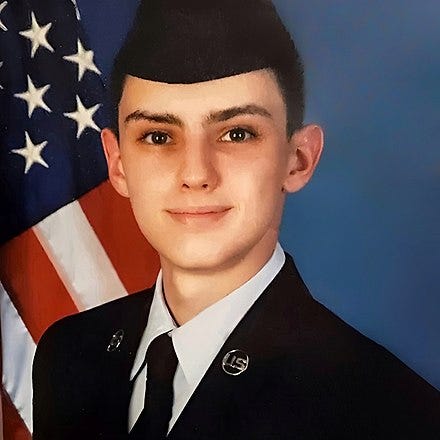
The recent disclosure of secret U.S. government files has resulted in reporting almost exclusively confined to the question of how the government’s security was breached. The secrets themselves contained have been mostly ignored or underplayed. The two most substantive revelations are the fact that US combat troops are stationed in Ukraine and the US intends to ensure that the fratricidal slaughter continues throughout 2023.
Glenn Greenwald: “There will be no negotiations, there will be no diplomatic settlement, there will be nothing but ongoing grinding, endless war that you will pay for beyond the $100 billion already authorized.”
The leak of NSA and CIA secrets has been treated as a grave criminal act by the media who were chiefly responsible for the apprehension of 21-year-old Massachusetts Air National Guardsman Jack Teixeira, as the result of a report published in the Washington Post of April 12, which led the FBI directly to the leaker.
The New York Times in an April 16 article, “Finding the Pentagon Leak Suspect,” also boastes of its role in assisting law enforcement in apprehending the whistleblower.
These facts should in the future dissuade any whistleblower gullible enough to trust that the Post and the Times will keep secret their revelations of government-perpetrated felonies.
“Why… would self-proclaimed journalism outlets do the job of the FBI and hunt down the leaker and boast of the fact that they were the ones who found him even before the FBI did?…
“There aren’t many ways to define the function of a free press and what journalism is without referencing the way in which journalists are supposed to bring transparency to the most powerful institutions… The idea of journalism, ostensibly, in theory, is to bring transparency to what the most secretive and powerful institutions are doing in the dark. Exactly what this leak did…
“One of the ways, arguably the only real way, that we, as journalists, now have to show the public what these institutions of power are doing in the dark is through leaks. Leaks of the things that they don’t want you to see, oftentimes being classified information.
“Classified information is not some sacred text. Classified information is nothing more than a document or a piece of information that the government has stamped on that word “classified” or “top-secret,” because they want to make it illegal for you to learn about it. That’s the effect of calling a document classified or top secret. And one of the things I learned in working with many large archives of government secrets and classified material is that, more often than not, when the government calls something classified or top secret, it’s not because they’re trying to protect you. It’s because they’re trying to protect themselves.
“They’re trying to make it illegal for anybody to show what it is that they’re saying and doing in the dark because what they’re saying and doing in the dark is composed of deceit, corruption, or illegality. And that’s why the most important journalism over the last 50 years…the Pentagon Papers, through the WikiLeaks reporting, the Snowden reporting… have taken place when people have been able to show you, the public, documents and other information that people inside the government wanted you not to see and made it illegal for anyone to show it to you”.
The spin-doctoring about leaks and the “need” for the Deep State to keep the truth about their treacherous machinations from the public, is an exercise in the artifice of political theater. The media, when it suits their purposes, appropriate to themselves the illustrious appellation of “patriot.” With the Federal government in the hands of tyrannical social engineers who keep the Cryptocracy’s esoteric grand design for the subjugation of our nation on schedule, leaking government secrets is now derided as unconditionally iniquitous—almost—though not quite.
We qualify our observation due to the fact that the media routinely leak the secrets the Deep States wants revealed. They pretended that an “unauthorized” CIA leaker revealed that Hunter Biden’s laptop was “Russian disinformation,” when in fact the CIA ordered CNN to make the information public, disguised as an unauthorized leak. There are good leaks and bad leaks. The ethical metric is decided by determining whether the leak favors the Deep State or undermines it. The contents of Hunter’s laptop was anathema to the ruling class so their intelligence arm ordered the media to brand it a fake conjured by Putin. The media can’t confess that they take orders from government intelligence agents hence, their subservience is disguised as a report about a clandestine fact disclosed without permission; in other words a “good” leak. There were many of those while Trump was president.
Young Jack Teixeira is a whistleblower who sounded an alarm about the propagators of World War III who occupy the US government, which seems somewhat newsworthy apart from the debate about leaks, yet it is not. Furthermore, to anticipate a criticism, the documents he released do not endanger our men and women in uniform. No sensitive intelligence on personnel in harm’s way was disclosed.
The facts about the gradual introduction of US special forces into Ukraine are incendiary; so too the knowledge that the Biden administration has no peace plan or ceasefire in mind, only more slaughter in the Slavic civil war’s ever larger butcher’s bill.
“Land of Felony”
If the American people were not so distracted and alchemically processed the revelation that Under Secretary of State Victoria Nuland and President Biden both declared the Nordstream Pipeline would be destroyed as indeed it was, by US agents, as well as the secrets contained in Mr. Teixeira’s leak, would awaken them and cause them to rise and work for the prosecution of the criminals in the District of Corruption.
Yet, as we take the occult pulse of programmed Americans we discover that they are exhausted rather than energized by the steady stream of shocking revelations of crime and corruption that flood our TVs and computer screens in this era.
Nineteen children were killed in Uvalde, Texas while the cops stood around and let it happen a few yards from where they stood.
Ho-hum.
Then there’s the Nashville massacre. It’s been nearly a month since a trans-gender individual shot to death three children and three adults at a Christian school in that city. Prior to the massacre the perpetrator reportedly issued a manifesto which we the people have not been allowed to see. Notice that not one sentence of that document has been leaked. It’s locked down tighter than Joe Biden’s soul.
It has in the interim however, been dismissed as a nothingburger by David B. Rausch, Tennessee’s top cop. Rausch, director of the Tennessee Bureau of Investigation, said that what police found isn’t so much a manifesto spelling out a target, as a series of rambling writings indicating no “clear” motive.
Nothing to see here folks, you can go back to sleep.
Sooner or later the manifesto will be released, possibly in redacted form, at some point in time sufficiently distant from the March 27 killings to dull the edge of public outrage.
Moreover, the delay of the release may itself be a psychological warfare ruse to discredit conspiracy theorists—and anyone else who is skeptical toward government. If the manifesto really is a “nothingburger,” why wouldn’t the authorities release it within a few days after the shootings? By suppressing it they build tension among the masses over the suspicion that some substantial secret is being withheld. If, when it is released, it is found to be a tissue of trivia, every skeptic from Elon Musk to Tucker Carlson will be made to look overwrought and foolish.
Tennessee news media have added the following concerning the alleged analysis and investigation of the manifesto: “The writings remain under careful review not only by Metro police, but also by the FBI’s Behavioral Analysis Unit based in Quantico, Virginia.”
The FBI’s “Behavioral Analysis Unit” has legendary status for discovering the mental secrets of monstrous murderers. This detail of their “crime-fighting” expertise exerts as much star power as did J. Edgar Hoover’s one-time polished image as a nemesis of the Mafia. Both are myths. The “Behavioral Unit” is a reference to miscreants inside the FBI who manipulate the behavior of Americans by directing, as we document in Twilight Language, ritual and mass murders subsequently blamed on the “lone nut” patsies who people “Arlington Road.”
One historical datum that is via col vento in the United States of Amnesia is the truth that the FBI was a participant in the terrorism it grouped under the title it concocted, “University and Airline Bomber” (“Unabomber”), crimes which were wholly attributed to LSD-experiment victim and scapegoat Ted Kaczynski. The details are in our book, Secret Societies and Psychological Warfare.
Ambrose Bierce, a Union veteran of the Civil War battles of Shiloh and Kennesaw Mountain, was a columnist for the San Francisco Examiner, renowned for his caustic wit. In Mexico to cover Pancho Villa’s rebel army he wrote home, “If you hear of my being stood up against a Mexican stone wall and shot to rags, please know that I think it is a pretty good way to depart this life. It beats old age, disease, or falling down the cellar stairs.” He disappeared in Mexico in 1914.
It would take a wordsmith of the caliber of Bierce to adequately account for the criminal politics in which our nation is at present sunk, and which would probably not have surprised the man who wrote, “My country ’tis of thee, sweet land of felony.”
Copyright ©2023 by Independent History and Research
China, Russia circle wagons in Asia-Pacific
BY M. K. BHADRAKUMAR | INDIAN PUNCHLINE | APRIL 19, 2023
The official visit by Chinese State Councilor and Defence Minister General Li Shangfu to Russia on April 16-19 prima facie underscored the two countries’ emergent need to deepen their military trust and close coordination against the backdrop of worsening geopolitical tensions and the imperative to maintain the global strategic balance.
The visit carries forward the pivotal decisions taken at the intensive one-on-one talks between Russian President Vladimir Putin and Chinese President Xi Jinping in Moscow through March 20-21. In a break with protocol, Gen. Li’s 4-day visit was front-loaded with a “working meeting” with Putin — to quote Kremlin spokesman Dmitry Peskov. (here and here)
Li is no stranger to Moscow, having previously held charge of Equipment Development Department of the Central Military Commission who was sanctioned by the US in 2018 for purchasing Russian weapons, including Su-35 combat aircraft and S-400 surface-to-air missile systems.
Song Zhongping, prominent Chinese military expert and TV commentator, forecast that Li’s trip would signal the high level of bilateral military ties with Russia, and lead to “more mutually beneficial exchanges in many fields, including defence technologies and military exercises.”
Last Wednesday, US Commerce Department announced the imposition of export controls on a dozen Chinese companies for “supporting Russia’s military and defence industries.” The Global Times hit back defiantly that “as China is an independent major power, so is Russia. It’s our right to decide with whom we will carry out normal economic and trade cooperation. We cannot accept the US’ finger-pointing or even economic coercion.”
Putin said at the meeting with Li on Easter Sunday that military cooperation plays an important role in Russia-China relations. Chinese analysts said Li’s visit is also a signal jointly sent by China and Russia that their military cooperation will not be impacted by the US pressure.
Putin had disclosed in October 2019 that Russia was helping China to create an early missile warning system that would drastically enhance the defensive capacity of China. Chinese observers noted that Russia was more experienced in developing and operating such a system, which is capable of identifying and sending warnings immediately after intercontinental ballistic missiles are launched.
Such cooperation demonstrate a high level of trust and require a possible integration of Russian and Chinese systems. The system integration will be mutually beneficial; stations located in the North and West of Russia could provide China with warning data and, in turn, China could provide Russia with data collected at their Eastern and Southern stations. That is to say, the two countries could create their own global missile defence network.
These systems are among the most sophisticated and sensitive areas of defence technology. The US and Russia are the only countries which have been able to develop, build and maintain such systems. Certainly, close coordination and cooperation between Russia and China, two nuclear-armed powers, will profoundly contribute to world peace in the present circumstances by containing and deterring US hegemony.
It cannot be a coincidence that Moscow ordered a sudden check of the forces of its Pacific Fleet on April 14-18, which overlapped Li’s visit. The inspection took place against the background of the aggravation of the situation around Taiwan.
Indeed, in early April, it became known that the American aircraft carrier USS Nimitz approached Taiwan; on April 11, the US began a 17-day military exercise in the Philippines involving over 12,000 troops; on April 17, news appeared about the dispatch of 200 American military advisers to Taiwan.
The US Global Thunder 23 strategic exercises at Minot Air Base in North Dakota, (which is the US Air Force Global Strikes Command) began last week where a training was conducted to load cruise missiles with nuclear warheads on bombers. The images showed B-52H Stratofortress strategic bombers being equipped by the flight technical personnel of the base with AGM-86B cruise missiles capable of carrying nuclear warheads on the underwing pylons!
Again, exercises of US aviation and fleet forces have been increasingly noticed in the immediate vicinity of Russian borders or in regions where Russia has geopolitical interests. On April 5, B-52 Stratofortress circled over the Korean Peninsula allegedly “in response to nuclear and missile threats from North Korea.” At the same time, South Korea, the US and Japan conducted trilateral naval exercises in the waters of the Sea of Japan with the participation of aircraft carrier USS Nimitz.
Russian Security Council Secretary Nikolai Patrushev recently drew attention to Japan’s growing capability to conduct offensive operations, which, he said, constituted “a gross violation of one of the most important outcomes of the Second World War.” Japan plans to purchase around 500 Tomahawk cruise missiles from the US, which can directly threaten most of the territory of the Russian Far East. The Mitsubishi Heavy Industries is working on developing Type 12 land-based anti-ship missiles “in order to protect the remote islands of Japan.”
Japan is also developing hypersonic weapons designed to conduct combat operations “on remote islands,” which Russians see as options for Japan’s possible seizure of the Southern Kuriles. In 2023, Japan will have a military budget exceeding $51 billion (on par with Russia’s), which is slated to increase to $73 billion.
Actually, during the latest surprise inspection, the ships and submarines of Russia’s Pacific Fleet made the transition from their bases to the Japanese, Okhotsk and Bering Seas. Defense Minister Sergei Shoigu said, “in practice, it is necessary to work out ways to prevent the deployment of enemy forces to the operationally important area of the Pacific Ocean – the southern part of the Sea of Okhotsk and to repel its landing on the Southern Kuril Islands and Sakhalin Island.”
‘Loudly on the quiet…
Surveying the regional alignments, Yuri Lyamin, Russian military expert and Senior Fellow at the Centre for Analysis of Strategies and Technologies, a leading think tank of the military-industrial complex, told Izvestia :
“Considering that we have not settled the territorial issue, Japan lays claim to our South Kuriles. In this regard, checks are very necessary. It is necessary to increase the readiness of our forces in the Far East…
“In the context of the current situation, we need to further strengthen defence cooperation with China. In fact, an axis is being formed against Russia, North Korea and China: the USA, Japan, South Korea, Taiwan, and then it goes to Australia. Great Britain is also actively trying to participate… All this must be taken into account and cooperation should be established with China and North Korea, which are, one might say, our natural allies.”
In highly significant remarks at a Kremlin meeting with Shoigu on April 17 — while Li was in Moscow — Putin noted that the current priorities of Russia’s armed forces are “primarily focusing on the Ukrainian track… (but) the Pacific theatre of operations remains relevant” and it must be borne in mind that “the forces of the (Pacific) fleet in its individual components can certainly be used in conflicts in any direction.”
The next day, Shoigu told Gen. Li, “In the spirit of unbreakable friendship between the nations, peoples, and the armed forces of China and Russia, I look forward to the closest and most successful cooperation with you…” The Russian MOD readout said:
“Sergei Shoigu stressed that Russia and China could stabilise the global situation and lessen the potential for conflict by coordinating their actions on the global stage. ‘It is important that our countries share the same view on the ongoing transformation of the global geopolitical landscape… The meeting we have today will, in my opinion, help to further solidify the Russia-China strategic partnership in the defence sphere and enable an open discussion of regional and global security issues.”
Beijing and Moscow visualise that the US, having failed to “erase” Russia, is turning attention to the Asia-Pacific theatre. Suffice to say, Li’s visit shows that the reality of Russia–China defence cooperation is complicated. Russia–China military-technical cooperation has always been rather secretive, and the level of secrecy has increased as both countries engage in more direct confrontation with the US.
The political meaning of Putin’s 2019 statement on jointly developing a ballistic missile early warning system extended far beyond its technical and military significance. It demonstrated to the world that Russia and China were on the brink of a formal military alliance, which could be triggered if US pressure went too far.
In October 2020, Putin suggested the possibility of a military alliance with China. The Chinese Ministry of Foreign Affairs’ reaction was positive, although Beijing refrained from using the word “alliance”.
A working and effective military alliance can be formed quickly if the need arises but their respective foreign policy strategies rendered such a move unlikely. However, real and imminent danger of military conflict with the US can trigger a paradigm shift.
The Slow Art of Whole-of-Government ‘Warfare’
By Alastair Crooke | Strategic Culture Foundation | April 17, 2023
The Washington Post tells us that President Macron’s China jaunt has created an European ‘uproar’. So it seems. Though on the face of it, his geo-strategic recommendation that Europe should keep equidistant from both the U.S. behemoth and the China colossus, is scarcely so very radical. Yet, whatever Macron’s underlying motivations, his comments seem to have touched raw nerves. He is accused of something approaching ‘betrayal’. The betrayal of America curiously – rather than a betrayal of ordinary Europeans.
Perhaps the irritation reflects our habitual love of comfort, normalcy, and a desire to ‘not rock the boat’. This normalcy bias keeps people frozen in a state of status quo, as if some inner voice intrudes to say: ‘things will be somehow ok. This will pass, and things will again be as they were. “Everything must change, for everything to remain the same”, in the famous quotation pronounced by Tancredi, Prince Fabrizio Salina’s beloved nephew in The Leopard.
On the other hand, Malcom Kyeyune, writing from Sweden, detects a more profound shift under way – an agony writhing within European Atlanticism:
“The war fever that swept Europe in the summer of 2022 made discussion impossible. Ritual denunciations of “Putinists” and even supposed Russian spies became commonplace on social media, and chest-thumping about the immense power of the West and NATO became obligatory. Again, there was a huge pressure not to notice things:
“The only acceptable position was maximalist: Suggesting that a peace deal would likely involve coming to some sort of compromise marked you out as a “Putin loyalist” and “Russian agent.”
“But once again, the fever is starting to break. Few still post about Ukraine on social media; people by and large prefer to pretend it isn’t happening. The chest-thumping has gone away, replaced with a sullen, bitter silence. People aren’t quite ready to admit that the sanctions were a failure and that the West overplayed its hand, but many know these things are true, and that the economic and political consequences of these failures are only really beginning to be felt.”
Is Macron picking up on these ‘vibes’? That is to say, the self-deception, by which we feel the illogicality of going about our daily lives with ‘darkening clouds’ looming ever closer, yet never questioning why Europe is being de-industrialised; why its industry is relocating to the U.S. or China; or why Europeans have to import Liquid Natural Gas at three or four times its going price.
Are Europeans then beginning to notice things again? Are they asking ‘how come’ the economic paradigm has been so drastically eclipsed, or ‘how come’ the fall into mad fervour for incipient wars with China and Russia?
Macron’s equidistant prescription is entirely aspirational. He gives it no substance; he gives no explanation of how strategic autonomy would be achieved, nor does he address the issue of ‘the empty stable’. There is no point in shutting the stable door now after the autonomy horse’ has long fled; It ‘fled’ with the war fever of 2022. We are therefore, where we are. Can the autonomy horse still be led home? That seems improbable.
So much of the ‘uproar’ no doubt reflects the warding-off of uncomfortable admissions, as things begin to be noticed again. Macron at least has opened the issue (however sensitive it may be); He is an outlier for the moment, but is not alone.
EU Council chief, Michel, in an interview, said: “Some European leaders wouldn’t say things the same way that Emmanuel Macron did”, adding: “I think quite a few really think like Macron.” And SPD chair in the Bundestag, Rolf Mützenich, said “Macron is right” and “we must be careful not to become party to a major conflict between the U.S. and China.”
There are multiple revolutions afoot everywhere across the globe. And Macron asks where does the EU fit in, which is fine. But he doesn’t give the answer. To be fair, though, at this point, maybe there isn’t one, for now.
Equidistant from the U.S.? Does Macron mean equidistant from specifically the Neo-con strategy of maintaining U.S. global hegemony through aggressive projections of military and sanctions power? If so, this needs to be made explicit.
For America, too, is undergoing a quiet revolution, and the Macron prescription could need nuancing in the case that the Ukraine war marks the final collapse of the Neo-cons’ short-lived ‘American Century’. There has been a noticeable tone of desperation to western MSM reportage this past week. Ever since the Intelligence leaks, it’s been doom, gloom and panic. The leaks have made uncomfortable truths unmissable (even to those who preferred not to notice) – that the vast ‘optics’ construct that is the Ukraine project is slowly coming undone.
The ‘Saving Ukraine for Democracy’ project was supposed to underwrite the legitimacy of the U.S.-led World Order. In reality, Ukraine has become the “harbinger of terminal crisis”, Kyeyune suggests.
The political path likely to be followed in America however, is far from straight-forward. It is possible though that today’s ‘Other Project’, the ‘western class war’ inversion ‘project’ may similarly collapse in the crisis (in this case) of U.S. societal schism. The Woke ‘project’ is an unlikely one – a strange neo-Marxist construct, in which an ‘oppressed class’ actually is composed of élite affirmative-action intellectuals (who lay claim to the mantle of being redeemed oppressors), whilst Americans, working in industry and in the low-paid service industry, are conversely denigrated as racist supremacist, anti-diversity, white oppressors.
China, too, is undergoing transformation: It is preparing for the war which the American ‘uniparty’ China hawks increasingly clamour. Meanwhile, its ‘political warfare’ strategy is to use geo-political mediation, underpinned by a powerful economy, as the non-intrusive means by which to pursue the Chinese operational art. This project already has re-shaped the Middle East –and its geo-strategic appeal is spanning the globe.
President Putin’s slow, long-term practice of political warfare (as opposed to China’s operational ‘art’) is clearly conceived with an understanding that the slowly-building disillusionment in the West with woke-liberalism – requires time in the chrysalis. In the Russian perspective, this Sun Tzu approach (overcoming the western paradigm, without militarily fighting it) calls for the ‘economy of military application’ within an all-of-system, holistic political ‘war’.
Russia’s is perhaps then, the more complex and more revolutionary: Embracing reform and efficiencies in all areas (cultural, economic, and political) of Russian society too.
China disavows the explicit aim to force a change of behaviour on the West, but for Russia its security is contingent on the U.S. fundamentally changing its military posture in Europe and Asia. This objective requires both patience and employing all complementary means at Russia’s command, (i.e. effectively ‘weaponising’ non-military tools such as financial ‘warfare’ and energy) to overcome the enemy – yet staying at some threshold, just short of all-out war.
The West, by contrast, conceptually separates the military from the political means, which perhaps explains why western analysts misconceive Russian ‘switching’ between military procedures to diplomatic or financial pressures as reflecting some deficiency or stumble in the Russian military machine. It is not. Sometimes the violins play; other times the cellos. And sometimes it is the moment for the big bass drums to sound; It is up to the conductor.
Julian Macfarlane has commented that Russia has started a veritable ‘revolution’, with China now joining in. To make his point, Macfarlane adapts Thomas Jefferson’s “we hold these truths to be self-evident …” speech and glosses it to say “… that all States are equally entitled to sovereignty, undivided security and full respect”. He contextualises this in terms of a Jefferson focus on the tyranny of the British Crown, whereas Putin formulates his multi-polar order doctrine, as versus U.S. hegemonic ‘Rules’ tyranny.
Xi Jinping says it straight: “All countries, irrespective of size, strength and wealth, are equal. The right of the people to independently chose their development paths should be respected, interference in the affairs of other countries opposed – and international fairness and justice maintained. Only the wearer of the shoes knows if they fit or not”.
It is a doctrine winning support across the globe. The EU would be unwise to discount its appeal.
So, back to Macron and the equidistant concept for European Union ‘strategic autonomy’: It is hard to see what space might comprise a median ground between homogenous, ‘Rules Hegemony’ and the Sino-Russian declaration of heterogenic ‘National Rights’. It will have to be one or the other (with perhaps a little ‘betweenness’ just possible, should the U.S. drop its “with us; or against us” dogma).
Equally, Macron warns the EU against the extra-territorial reach of the U.S. dollar (and therefore of sanctions and Third Country sanctions).
Yet, the EU cannot escape the U.S. dollar. The Euro is its’ derivative.
Europe has little autonomous defence manufacturing infrastructure. NATO is the political, as well as the military, framework in which the EU operates. How does it escape from a NATO framework that is so closely meshed in with the EU political one?
The EU is deeply divided on its future path: Macron wants more strategic autonomy for Europe (and Charles Michel says this is supported by not a few member-states), whereas Poland, the Baltic States and certain others want more America and more NATO and a continuing war to destroy Russia. Poland has proved to be a vociferous critic of Western Europe’s perceived softness toward the Kremlin.
Indeed, the war in Ukraine has ushered in a kind of geopolitical shift in Europe, Ishaan Tharoor writes, moving “NATO’s centre of gravity” – as Chels Michta, a U.S. military intelligence officer, recently put it – away from its traditional anchors in France and Germany, and eastward to countries such as Poland, its Baltic neighbours and other former Soviet Republics. In Central and Eastern Europe, wrote Le Monde columnist Sylvie Kauffmann, “the weight of history is stronger … than in the West, the traumas are fresher and the return of tragedy is felt more keenly”.
The EU is deeply divided on structure as well: Warsaw, nervous about a general election due this autumn, is encouraging anti-German paranoia. Its propaganda suggests that Polish opposition politicians are secret agents in a German plot to take control of the EU, and to force degenerate western permissiveness on heterosexual Catholic Poland – a ‘bastion of western Christian civilisation’ – unlike Brussels, which is viewed as a as a “Germanised” conspiracy to overrule the right of independent nations to make their own laws.
Jarosaw Kaczyski, leader of the PiS party, plays with an alternative future for Europe. This would be a Europe des patries, almost on de Gaulle’s model: an alliance of fully sovereign nation states, within NATO but independent of Brussels, which would include post-Brexit Britain, rather than just the EU’s present members. (No EU Third ‘Empire’ there).
In a major speech, the Polish Prime Minister has emphasised that now is the moment to shake up the status quo further West and dissuade those in Brussels who would “create a super-state government by a narrow elite. In Europe nothing can safeguard the nations, their culture, their social, economic, political and military security better than nation states”, Morawiecki said. “Other systems are illusory or utopian”.
Elections are due this autumn in Poland, and polls suggest that the outcome will be close.
It seems that Macron has opened a veritable can of worms. Possibly, this was his intent; or maybe he just didn’t care – his objective being primarily domestic: i.e. to shape a new image in the context of a changing, and turbulent, French electoral landscape.
But in any event, the EU is caught in the midst of a maelstrom of geopolitical change at a moment when it faces the possibility of a banking crisis, high inflation and economic contraction. Simple survival may become more pressing than addressing Macron’s speculative musings about the EU becoming a Third Force.
Russia, China Believe US, Allies Responsible for Escalation on Korean Peninsula
Sputnik – 17.04.2023
MOSCOW – Russian Deputy Foreign Minister Andrey Rudenko discussed the situation around the Korean peninsula with Chinese special envoy on North Korea Liu Xiaoming in Moscow, and the parties agreed that Washington and its allies bear responsibility for the escalation of the situation around the peninsula.
“The parties discussed in detail the current situation around the Korean Peninsula. The parties agreed that Washington and its allies are responsible for the current escalation and contrary to their own obligations, refuse to conduct a dialogue with North Korea on providing it with security guarantees and take practical confidence–building measures, on the contrary, they are increasing large-scale military exercises in the region that are provocative,” the ministry said in a statement following the meeting of Rudenko and Liu.
The diplomats emphasized the need to focus the efforts of the parties involved on finding a political and diplomatic solution to the problems of Northeast Asia, taking into account the legitimate security concerns of all states in the region. China and Russia agreed to maintain close coordination on the matter, according to the ministry.
Last week, the North Korean state-run news agency reported that the new-type Hwansong-18 intercontinental ballistic missile was tested under supervision of North Korean leader Kim Jong Un. Earlier on Monday, United States and South Korea started large-scale combined air drills involving over 100 aircraft — the Korea Flying Training (KFT).
Taliban: Territory Will Not Be Used Against Russia, Central Asia
Sputnik – 16.04.2023
MOSCOW – A delegation of the Russian Foundation for Islamic Culture, Sciences and Education has received assurances from a senior Taliban official that the movement will not let Afghan territory to be used against Russia, a member of the delegation, Magomedbashir Albogachiev, told Sputnik.
“On Sunday, our delegation in Kabul held a meeting with Maulavi Abdul Kabir, Afghanistan’s deputy prime minister for political affairs. He asked us to tell the Russian leadership that the Taliban movement will not let use its territory against Russia or the countries of Central Asia,” Albogachiev said.
According to Albogachiev, the Afghan deputy prime minister said that Afghanistan was “extremely interested” in building comprehensive trade and economic ties with Russia, which is an issue currently complicated by the absence of a clear logistical route.
Earlier in the week, Russian Foreign Minister Sergey Lavrov took part in the fourth meeting of the foreign ministers of Afghanistan’s neighboring countries in the Uzbek city of Samarkand, with the officials discussing the situation in Afghanistan and ways to develop a common regional approach to improving it. Lavrov said at a press conference after the meeting that practically all of the participating countries agreed on the necessity to maintain and develop contacts with the Taliban movement.
America faces a two-front war: Russia-China alliance moving ahead at great speed
By Gilbert Doctorow | April 14, 2023
Today China officially announced the visit of their Minister of Defense Li Shangfu to Russia on Sunday for three days of consultations with his Russian counterpart Sergei Shoigu and also with Russia’s senior military command in charge of the war operations in Ukraine.
Li Shangfu took his present post a little over a month ago following the re-election of Xi Jinping to the presidency and a reshuffling of ministerial portfolios. It was particularly noteworthy that Li has been on the U.S. sanctions list since 2018 for alleged cooperation with Russia.
The sense of this visit was interpreted by expert panelists on the news and analysis program Sixty Minutes earlier today as follows: to inform the Chinese leadership of what has been learned by the Russian command from the 14 months of war in Ukraine.
What is the relevance of Russia’s on the ground experience? Although armchair generals in the West were very quick to fault Russia with making serious mistakes and showing unpreparedness in the first phase of the war, the reality is that since WWII no major power has been engaged in a peer-to-peer war entailing vicious fighting on the ground without enjoying command of the skies. That is what we see in Ukraine today. The United States has had no such experience. Nor has China.
The Russians now have a lot to tell their Chinese friends about the latest NATO military tactics and about the U.S. and European hardware that is being given its baptism by fire in direct engagement with themselves. The capture of a German Leopard tank in battle near Kherson yesterday is just one of many war trophies that the Russians can lend out.
Will such sharing of information critically important to China as it examines the possibility of a similar armed conflict with the United States and its proxies over Taiwan be cost free? Of course not. We may take it as a given that during the visit of Li to Russia, he and the Russians will be planning further steps to turn their strategic partnership into something more closely resembling a full-blown military alliance with mutual security obligations.
Meanwhile the Russian Pacific fleet is now on full alert and performing exercises to repel an unidentified potential aggressor. A gentle hint as to who this aggressor might be is the fact that particular attention is being given to maneuvers around the Kurile Islands, over which Japan has territorial claims. Though the subject is not much discussed in our mainstream media, the Russians consider the Japanese navy to be a formidable force. Japan is one of the key allies in the “Pacific NATO” that the U.S. is currently building to contain China and, as needed, to fight a big war against Beijing.
Also worth noting is that last week the Chinese military response to the meetings in California by Taiwan president Tsai Ing-wen with Speaker of the House Kevin McCarthy was to simulate an air and sea blockade of Taiwan. This in turn elicited a call by the ever inflammatory Senator Lindsey Graham (R – South Carolina) for the U.S. to disrupt the flow of oil from the Middle East to China in the event of a blockade being imposed on Taiwan. If anything can hasten the signing of a full military alliance between Russia and China, it is precisely that threat.
All of the foregoing latest developments necessarily raise a question that was not discussed on Russian television but which is highly timely for Americans to deal with on their own: whether the Biden Administration, by its ongoing reckless foreign and military policy that is headed towards an unwinnable two-front war, is not betraying the security interests of the United States. I leave it to legal experts whether that would constitute an impeachable offense.
©Gilbert Doctorow, 2023
China reiterates Ukraine stance
RT | April 14, 2023
Beijing will continue promoting peace talks to settle the conflict between Russia and Ukraine, Chinese Foreign Minister Qin Gang said during a joint press conference with his German counterpart Annalena Baerbock on Friday.
“One point I want to emphasize is that China’s role in the Ukraine issue, our proposition, boils down to one point, that is, to persuade and promote talks,” Qin told journalists in Beijing on Friday.
All sides involved in the conflict should remain “objective and calm” in order to find a solution to the crisis, he added. According to the minister, the Chinese authorities “won’t do anything to add fuel to the fire” in Ukraine.
Qin also rejected Western claims that Beijing is supplying or planning to supply arms to Russia amid the fighting.
“Regarding the export of military items, China adopts a prudent and responsible attitude,” he insisted, adding that the country “will not provide weapons to relevant parties of the conflict, and manage and control the exports of dual-use items in accordance with laws and regulations.”
Baerbock, for her part, stuck to the Western line that Beijing should put pressure on Moscow to bring the fighting in Ukraine to an end.
“It’s good that China has signaled its commitment to a solution, but I have to say frankly that I wonder why the Chinese position so far does not include a call on the aggressor Russia to stop the war,” she said.
Russian President Vladimir Putin “would have the opportunity to do so at any time, and the people in Ukraine would like nothing more than to finally be able to live in peace again,” the German foreign minister said.
Chinese Foreign Ministry spokesperson Wang Wenbin also said on Friday that Qin made it clear to Baerbock during their talks “that the only way to resolve the Ukrainian crisis is to promote the peace process and negotiations.”
Since the outbreak of the conflict in Ukraine last February, Beijing has been reluctant to give in to Western pressure to condemn Russia or join the international sanctions against it. Instead, the neighbors have boosted political and economic cooperation, which they both now describe as “strategic.” Moscow and Beijing signed dozens of deals in various areas when Chinese President Xi Jinping visited Russia last month.
What are the Russians saying about the intelligence leak in the USA?
By Gilbert Doctorow | April 13, 2023
The Russians took an immediate interest in the intelligence leak scandal in the USA because so many of the documents deal with the readiness of their own and Ukrainian military forces for the long awaited “counterattack” by Kiev which may be decisive in the outcome of the war. They were instantly asking whether there was not some intrigue here, an attempt to loll them into overconfidence given that the situation of the Ukrainian side was portrayed in these documents as unpromising to dire, especially as regards air defense and supply of munitions. However, on close examination, the intelligence experts who have appeared on Russian state television now are saying they have no doubt the documents are genuine and there was no reason to believe they were issued as disinformation for Moscow. Now they have redirected their attention to other aspects of the leak.
The first among these questions being asked in Moscow is: what was the intent of the leakers who are assumed by consensus to be Americans from within the 1,000 or so persons who had access to these top secret documents online, on specially programmed computers. In this matter, I was particularly impressed by one explanation that was set out at length by a panelist on yesterday’s Evening with Vladimir Solovyov show. The leak is viewed as an attempt to discredit Joe Biden. To discredit the biological Joe Biden and also what the Russians are calling the “collective Joe Biden,” meaning the team of assistants who do the thinking for Joe and feed him his lines to read.
The documents leaked show that the Biden Administration, through Lloyd Austin, through Antony Blinken is lying day after day about the real situation of the Ukrainian military. Even yesterday Austin spoke on camera after talking to his Ukrainian counterpart Reznikov and insisted that everything is just fine in Ukraine, that they have received the assistance they need and are ready to proceed with the counter-offensive.
The next level of analysis of the documents that I hear from the Russian intelligence experts and also from their counterpart in Israel Yakov Kedmi, who appears regularly on the Solovyov show, is that the documents demonstrate the vast flow of information coming in to the CIA every day from their illegal espionage, wiretapping and the like. They also demonstrate the low level of analytical competence of the CIA and other US intelligence analysts who are poring over this information flow. This comes out from the uncritical acceptance by the American intelligence reports of casualty figures and other highly relevant statistics they are receiving solely from one source, Kiev, and are passing on to the top leadership at face value.
The normal, historical and universal problem with intelligence is that the sources and summaries are good but they are wasted on incompetent political leaders who pay no attention or do not comprehend what they are being told by their subordinates responsible for intelligence. The American situation seems still more damaging: not only are the political bosses who are receiving the intelligence dimwits but the information being handed to them is of poor quality.
The Russians are not at all pleased with this situation. It strengthens the argument on their side by those who say that insanity rules in the USA, that you have to be prepared for every eventuality in escalation of the war.
©Gilbert Doctorow, 2023
Chinese Foreign Ministry Calls on US to Explain Military-Biological Activities Abroad

Sputnik – 12.04.2023
BEIJING – China has called on the United States to explain its military-biological activities abroad and observe its international obligations, Chinese Foreign Ministry spokesman Wang Wenbin said on Wednesday.
Earlier in the day, Russia’s upper house approved the final report of a parliamentary commission on the US biological program in Ukraine. The lower house approved the document on Tuesday. The paper is a result of the commission’s one-year investigation.
“We reiterate our calls on the United States to faithfully observe their international obligations and provide comprehensive explanations on its military-biological activity within the country and abroad,” Wang told a press conference.
According to Konstantin Kosachev, deputy speaker of Russia’s upper house of parliament, there are at least 30 US biological laboratories in Ukraine. The official also said that that the Pentagon was the main commissioner of studies at such laboratories, which may be used for military purposes, including against Russia.
The war, the separation of the world, or the end of an Empire?
By Thierry Meyssan | Voltaire Network | April 11, 2023
Many are those who predict a World War. Indeed, some groups are preparing for it. But the States are reasonable and, in fact, consider rather an amicable separation, a division of the world into two different worlds, one unipolar and the other multipolar. Perhaps we are actually witnessing a third scenario: the “American Empire” is not struggling in the trap of Thucydides; it is collapsing like its former Soviet rival died.
The American “Straussians,” the Ukrainian “integral nationalists,” the Israeli “revisionist Zionists” and the Japanese “militarists” are calling for a generalized war. They are alone and they are not mass movements. No state has yet committed itself to this course.
Germany with 100 billion euros and Poland with much less money are rearming massively. But neither of them seems eager to take on Russia.
Australia and Japan are also investing in armaments, but neither of them has an autonomous army.
The United States is no longer able to replenish its military and is no longer able to create new weapons. They are content to reproduce the weapons of the 1980s in an assembly line fashion. However, they maintain their nuclear weapons.
Russia has already modernized its armies and is organizing itself to renew the ammunition it uses in Ukraine and to mass produce its new weapons, which no one can compete with. China, for its part, is rearming to control the Far East and, in the long term, to protect its trade routes. India thinks of itself as a maritime power.
It is therefore difficult to see who would and could start a World War.
Contrary to their speeches, French leaders are not at all preparing for a high-intensity war [1]. The military programming law, established for ten years, plans to build a nuclear aircraft carrier, but reduces the size of the army. It is a question of giving ourselves the means of projection, but not of defending our territory. Paris continues to reason as a colonial power while the world is becoming multipolar. It is a classic: the generals prepare for the previous war and ignore the reality of tomorrow.
The European Union is implementing its “Strategic Compass”. The Commission coordinates the military investments of its member states. In practice, they all play the game, but pursue different goals. The Commission, on the other hand, is trying to take control of decisions on the financing of armies, which until now have depended on their national parliaments. This would make it possible to build an empire, but not to declare a generalized war.
Clearly everyone is playing a game, but apart from Russia and China, none is preparing for a high-intensity war. Rather, we are witnessing a redistribution of the cards. This month, Washington is sending Liz Rosenberg and Brian Nelson, two specialists in unilateral coercive measures [2], to Europe with the mission of forcing the Allies to comply. In the words of former President George Bush Jr. during the war “against terrorism”: “Whoever is not with us is against us”.
Liz Rosenberg is efficient and unscrupulous. She is the one who brought the Syrian economy to its knees, condemning millions of people to poverty because they dared to resist and defeat the Empire’s surrogates.
The Hollywood western discourse a la George Bush Jr. of good guys and bad guys has failed with Türkiye, which has already experienced the 2016 coup attempt and the 2023 earthquake. Ankara knows that it has nothing good to expect from Washington and is already looking to the Shanghai Cooperation Organization. Yet the same discourse should succeed with the Europeans, who remain fascinated by the power of the United States. Of course this power is in decline, but so are the Europeans. No one has learned any lessons from the sabotage of the Russian-German-French-Dutch gas pipelines, North Stream. Not only did the victims take the blame without saying anything, but they are about to receive further punishment for crimes they did not commit.
The world should therefore be divided into two blocs, on the one hand the US hyperpower and its vassals, on the other the multipolar world. In terms of the number of states, this should be half and half, but in terms of population, only 13% for the Western bloc against 87% for the multipolar world.
The international institutions can no longer function. They should either fall into lethargy or be dissolved. The first examples that come to mind are the effective exit of Russia from the Council of Europe and the empty seats of Western Europeans in the Arctic Council during the year of the Russian presidency. Other institutions are no longer relevant, such as the Organization for Security and Cooperation in Europe (OSCE), which was supposed to organize East-West dialogue. Only the attachment of Russia and China to the United Nations should preserve them in the short term, as the United States is already thinking of transforming the Organization into a structure reserved exclusively for the Allied Nations.
The Western bloc should also reorganize itself. Until now, the European continent was dominated economically by Germany. In order to be certain that Germany would never get closer to Russia, the United States wanted Berlin to be content with the western part of the continent and leave the center in the hands of Warsaw. So Germany and Poland armed themselves to impose themselves in their respective zones of influence, but when the American star faded, they would fight against each other.
When the Soviet Empire fell, it abandoned its allies and vassals. Having seen its inability to solve the problems, the USSR first stopped supporting Cuba economically, then dropped its vassals of the Warsaw Pact, and finally collapsed on itself. The same process is beginning today.
The first U.S. Gulf War, the 9/11 attacks and their host of wars in the broader Middle East, the expansion of Nato and the Ukrainian conflict will have offered only three decades of survival to the American Empire. It was backed by its former Soviet rival. It has lost its raison d’être with its dissolution. It is time for it to disappear too.
Translation: Roger Lagassé
Featured Video

EUROPE FEARS RUSSIA’S NEXT MOVE / Ian Proud
or go to
Aletho News Archives – Video-Images
New Book
New Book: No Autoimmunity The Body Doesn’t Attack Itself
Lies are Unbekoming | September 24, 2026
 The label for Humira, once the best-selling drug in the world, lists its risks in plain print. One of them, in the label’s own words, is new “autoimmune” disease.
A drug prescribed for a condition labelled autoimmune carries a warning that it can cause a condition labelled autoimmune. That contradiction sits in every box, on a folded paper almost nobody reads.
My new book starts there.
No Autoimmunity: The Body Doesn’t Attack Itself
For seventy years, “your body is attacking itself, and we don’t know why” has ended the conversation for people diagnosed with multiple sclerosis, lupus, rheumatoid arthritis, Hashimoto’s, Type 1 diabetes, Crohn’s and psoriasis. More than eighty conditions now carry the autoimmune label. The diagnosis comes with a prescription for life. It almost never comes with a question about cause.
This book asks the question and answers it from the framework’s own records: its drug labels, its journals, its regulatory filings, and its own experiments. … continue
Blog Roll
 Aletho News
- DEATH SPIKES & RISING CANCER IN OUR YOUTH EXPLAINED
- Iran offers Trump deal before US election
- Merz regime wants ‘secret police’ – opposition
- Israeli settlers terrorize West Bank Palestinians with state-provided drones: Report
- They see them, then kill them: Israeli quadcopters track, deliberately target civilians in Gaza
- Debunked: Trump’s egregious UNGA claims on war against Iran crumble under scrutiny
- Europe was part of the infrastructure of US aggression against Iran: Deputy FM
- New evidence on the Bucha Massacre
- Italy and France debunk reports CIA issued ‘Russian drone threat’ warning
- How Russia is Rewiring the Global South
- If Americans Knew
- Trump betrayed voters with his campaign lies and prioritized a foreign country once he took office
- Netanyahu calls Israel’s war in Gaza ‘opposite of genocide’ in UN speech to near-empty hall
- Settler Kidnappings: Torture, Sexual Abuse and Terrorisation of Palestinian Abductees as Israel Deepens Annexation of West Bank
- Gaza winter nears as 162,000 tents become unusable, raising fears of humanitarian crisis
- Netanyahu says, “It’s the opposite of genocide”; UN says Gaza economy is world’s ‘most severe crisis on record’ – Daily Update
- Israel’s US-Backed Assault on Gaza Has Created the ‘World’s Most Severe Economic Crisis on Record’: UN
- ‘Protecting U.S. Citizens’… From Israel
- ‘This is where I live now, the back of a truck’: a day in the life of a grandmother in Gaza
- In UN Speech, Iran’s President Displays Pictures of Children Killed by US, Brings Attention to Israel’s Nuclear Arsenal
- Israel displaces hundreds of Palestinians amid wave of demolitions in West Bank
- No Tricks Zone
- New Study: Earth And Venus Surface Warmth Largely Explained By Convection And Lapse Rate, Not CO2 Or Radiation
- 2025 Nature Paper Claiming Worsening Global Drought Gets RETRACTED …Heavily Flawed
- New Study: ‘Global Drought Shows No Detectable Recent Acceleration Under Climate Warming’
- Economic Masterminds: German Socialists Suggest Taxing Productivity Gains Stemming From Using AI
- The South China Sea Has Not Been Cooperating With The Climate Change Narrative
- Energy Crisis: Germany Enters Heating Season With Historically Low Gas Reserve Fill Levels
- New Study: The Antarctic Ice Sheet Gained Mass From 2020-2024 Due To Staggering Snow And Ice Accumulation
- Study: Ocean Heating Rates From Thousands Of Years Ago ‘Dwarf’ Modern Ocean Heating Rates
- Climate Extremists Target, Attack Large-Scale Power Grid Infrastructure In Germany!
- New Study: Antarctic Ice Melt Has Contributed Less Than 1 Centimeter To Sea Level Rise In The Last 30 Years

