UK newspaper removes interview with Russian ambassador
RT | April 13, 2023
Russian Ambassador to the UK Andrey Kelin has accused The Times of “caving in” to outside forces after it removed an interview with the diplomat from its website. Kelin warned that the move does not bode well for the newspaper’s readers.
The story in question was published last Sunday, but as of Thursday it was no longer available on The Times’ web page. Instead, readers receive a notice that the article “has been removed.” An online service that records the content of popular internet links dates Tuesday morning as the latest snapshot of the article.
The Russian Embassy released a statement from Kelin on Thursday condemning the removal of the interview. The message, which was addressed to Times Chief Editor Tony Gallagher, described the decision as “deeply revealing” and suggested that the newspaper had taken the step after “[coming] under fire from the influential local anti-Russian troupe.”
“Your newspaper has sadly caved in to outside pressure or, highly likely, instructions from the authorities,” Kelin argued.
“Hardly the hallmark of a courageous independent editorial policy. And bad news for your readers, who have been deprived of a balanced hearing of viewpoints and, consequently, the ability to make their own judgment about the crisis in Ukraine.”
The original article in The Times, titled ‘Russia is ready for ceasefire but not defeat, says ambassador to UK’, explained Moscow’s stance on the conflict with Ukraine, as well as the possibility of peace talks.
The ambassador commented on Ukrainian domestic issues, such as the poor economic situation and the crackdown on the Ukrainian Orthodox Church by President Vladimir Zelensky. The discussion also covered Russia’s relations with China.
The Russian Embassy has published a copy of the article in full, in protest against its removal by the newspaper.
Zelensky’s Senior Advisor Brazenly Admitted To Kiev’s Genocidal Intentions
By Andrew Korybko | April 7, 2023
Senior Ukrainian presidential advisor Mikhail Podolyak brazenly admitted to Kiev’s genocidal intentions in the NATO-Russian proxy war that’s presently being fought in his former Soviet Republic during an interview with US Government-controlled “Radio Free Europe/Radio Liberty” (RFERL). The relevant excerpt will now be shared in order to raise awareness of his words, which can be read in their original Ukrainian at that outlet’s website here for those skeptics who doubt that he truly said them:
“We have to completely close everything related to the Russian cultural space [in Crimea after its reconquest]. We have to eradicate everything Russian. There should be only Ukrainian cultural space or global cultural space. We should not have a dialogue about whether a person has the right to use the Russian language or not. At home, please use it, but it is not a tool of pressure, it is not a tool of protest, it is not a tool of blackmail.”
Podolyak admitted to precisely what Moscow has always accused Kiev of intending since the Western-backed fascist coup of early 2014 popularly known as “EuroMaidan”, namely the ethnic cleansing and genocide of Crimea’s indigenous Russian population. He therefore inadvertently justified its democratic reunification with Russia that was carried out for the purpose of defending its people’s UN-enshrined human rights, thus discrediting his side’s and its foreign patrons’ moral stance in this conflict.
Not only that, but the so-called “rules-based order” that’s aggressively being promoted by the US-led West’s Golden Billion was exposed as a hypocritical sham. That de facto New Cold War bloc isn’t waging their proxy war against Russia in order to defend “democracy” and “human rights” like its propagandists claim, but to advance Kiev’s publicly confirmed goals that stand in direct contradiction to those two concepts.
Any political force in the West that agitates for literally eradicating another culture and prohibiting its people from speaking their native language outside of their homes would rightly be condemned by society as fascist, yet there’s no chance that the US or EU will ever normalize describing Kiev in that way. These double standards speak to the ulterior motives connected to the previously mentioned “rules-based order”, which has always been about advancing American hegemony on any given pretext.
Returning to Podolyak’s candid admission, nobody can credibly claim that funding Kiev isn’t equivalent to funding fascism. There’s no other way to describe that side’s intention to eradicate Russian culture in its entirety and prohibit its people from speaking their native language in public. This bonafide fascism is being funded by the West in violation of its own self-proclaimed “values”, which reveals that everything it’s claimed about wanting to defend “democracy” and “human rights” across the world was simply a lie.
The ‘Holy Trinity’ behind Russian military dominance in Ukraine
By Drago Bosnic | April 7, 2023
If we were to believe a single word uttered by the mainstream propaganda machine about the performance of the Russian military, we’d be convinced that Moscow is using WWII-era equipment begrudgingly manned by conscripts armed with shovels. Not to mention that, according to CNN’s “well-informed” (and yet, anonymous) sources, the morale of the Russian military is supposedly plummeting due to heavy casualties inflicted by the victorious AFU. On the other hand, those interested in Russia’s top-of-the-line weapons will often (over)focus on its truly world-class hypersonic missiles, directed-energy systems, superfast high-flying interceptors, next-generation fighter jets, etc.
However, what both ends of these two extremes ignore either completely (in the first case) or overlook for the most part (in the second case) are Russia’s bread-and-butter weapons that are inflicting the vast majority of casualties suffered by the embattled Kiev regime forces. Distinguished Serbian defense expert Slobodan Djukic recently identified three such weapons – Krasnopol/Krasnopol-M precision-guided artillery shells, MPK kits for turning freefall gravity bombs into high-precision glide bombs and Lancet kamikaze drones. All three are being used by the Russian military, to devastating effect on hostile troops, while significantly reducing Russian casualties.
Krasnopol/Krasnopol-M precision-guided artillery shells
Owing to its stellar performance during ground operations against foreign-backed terrorist forces in Syria, the Krasnopol series of high-precision artillery munitions was mass-produced and more widely adopted by the Russian military in recent years. Krasnopol was developed by the Tula-based KBP. There are several basic and improved variants used by 152 mm howitzers such as the towed D-20 or 2A65 Msta-B and self-propelled 2S3 Akatsiya or 2S19 Msta-S. It uses inertial guidance at mid-course and semi-active laser homing at the terminal phase. The target is illuminated by an external laser designator and once the laser signal is detected, the onboard guidance system will maneuver the shell to the target. This allows frontline troops to call in fire missions on specific high-priority targets for almost immediate destruction by a single shell.
The baseline version’s hit probability of 70-80% was improved to over 90% in newer variants. Such advanced munitions have a devastating effect on Kiev regime forces, while drastically reducing the probability of damage to friendly forces and civilian infrastructure. Krasnopol is effective in destroying weapons and ammunition depots, entrenched enemy positions, dug-in artillery pieces, etc. Thanks to its enhanced accuracy, it can be used even against moving targets such as tanks and armored vehicles. Most importantly, it’s getting incremental upgrades as the designers are working closely with the Russian military on improving its performance, even extending the maximum firing range up to 25 km. The estimated price for a single Krasnopol-M is $35,000, less than half the price of NATO’s M982 Excalibur.
MPK smart bomb kits, aka “Russian JDAM”
Ukraine inherited approximately 30% of the enormous Soviet military, including its massive integrated air defense network with thousands of launchers, radars and missiles of all ranges. Although much of this was severely worn out and suffered due to virtually nonexistent funding, the systems’ functionality was largely restored with endless subsidies from the political West. This made it significantly more challenging for the Russian Aerospace Forces (VKS), as it initially had a relatively limited amount of high-precision air-to-ground weapons, particularly smart bombs. The Russian military has a plethora of high-precision munitions, especially air-launched cruise missiles and new glide bombs. However, these are prohibitively expensive for use on the scale needed in Ukraine, limiting strikes to high-profile targets only.
The issue was resolved through a relatively inexpensive modification that turned Russia’s enormous stockpile of freefall gravity bombs into smart munitions. This enabled tactical strike aircraft to use the bombs beyond the range of Kiev regime air defenses. Folding wings are mounted on the body of the bomb via a steel rail, expanding after release and effectively turning the previously unguided weapon into a glide bomb capable of hitting targets at relatively long ranges. The MPK, short for Russian “модул планирования и корекреции”, literally “planning and correction module”, although perhaps better described as “gliding and correction module”, was developed by NPO Bazalt. It’s an upgrade kit for converting so-called “dumb” freefall bombs (in particular, FAB-500 M-62) into extended-range high-precision glide bombs.
The concept was inspired by a similar US program called Joint Direct Attack Munition (JDAM – hence the unofficial nickname for MPK being “Russian JDAM”) which NATO also recently transferred to Kiev. MPK’s effective range depends on the altitude from which the bomb is released, so estimates vary, but it’s generally expected that a bomb dropped from an altitude of 12-13 km can hit targets at distances of up to 50 km. Guidance is provided by Russian GLONASS. The Russian military has already upgraded a large portion of its massive Soviet-era stocks to MPK standard and is rapidly converting the rest of it, resulting in a virtually new weapon of extraordinary capabilities, all for a fraction of the cost needed to produce completely new bombs.
Lancet kamikaze drones/loitering munitions
Last but certainly not least – drones. These pesky little things have proven so deadly and effective that it would be ludicrous not to use them en masse. And this is precisely what the Russian military is doing, making it one of the first militaries around the globe to use loitering munitions on such a grand scale. Needless to say, to an absolutely devastating effect on the Kiev regime forces. There are several types of such drones, with perhaps the most (in)famous being the ZALA Lancet. Intended for the destruction of a wide range of ground targets, including APCs (armored personnel carriers), SAM (surface-to-air missile) systems, artillery weapons (towed/self-propelled), etc. its effectiveness is wholly undeniable, as evidenced by hundreds of hours of battlefield footage.
Deployed in several variants, Lancet possesses a highly advanced seeker and a stable video link up until the moment it hits the target. This is primarily thanks to its state-of-the-art comms channel that has proven to be highly resistant to jamming and other forms of electronic warfare. Usually paired with the Fortuna tactical ISR (intelligence, surveillance, reconnaissance) drones, Lancet can effectively identify even heavily camouflaged targets, including small groups of infantry from high altitude. Kiev regime forces are doing everything they can to hide or at least minimize the Lancet’s devastating effect by establishing additional firing positions, enclosing them with wire barriers and extra camouflage nets. And yet, even these countermeasures have had a limited effect.
All of the aforementioned weapons might not seem as important as Russia’s hypersonic missiles or its doomsday strategic arsenal, but they are no less valuable on a tactical level. Thousands of towed/self-propelled howitzers, MLRS, tanks, air defense systems, command posts, weapons production facilities, ammunition, etc. have been destroyed by these extremely cost-effective weapons. Russian Defense Minister Sergei Shoigu pointed out that one of the main goals is destroying enemy military-industrial capacity, while increasing pressure on logistics and supply lines. According to Shoigu, by the end of March this year, 14 HIMARS systems, 59 M777, 12 Paladin and over 30 other howitzers of various types delivered by the US, UK, Poland, Germany, France and Czechia were destroyed. These weapons were all neutralized by Russian systems priced at less than 1% of the combined cost of the aforementioned Western systems.
Drago Bosnic is an independent geopolitical and military analyst.
Saudi Arabia welcomes Russian Navy frigate
RT | April 5, 2023
Russian Navy ships have paid a visit to Saudi Arabia for the first time in around a decade, the Russian military said on Wednesday. In late March, the detachment, which consists of the frigate Admiral Gorshkov and the medium sea tanker Kama, dropped anchor off the coast of the East African nation of Djibouti.
According to a statement released by Russia’s Western Military District, the two vessels “made a working visit to the port of Jeddah in Saudi Arabia.”
During their stay, the ships will replenish their fuel, drinking water, and food supplies, Russian military officials added.
The frigate, which can carry state-of-the-art Zircon hypersonic cruise missiles, and the accompanying medium sea tanker began their voyage in January of this year, departing from the main base of Russia’s Northern Fleet, Severomorsk.
The detachment has since participated in two international naval exercises in the Indian Ocean, as well as the Arabian Sea, crossing the equator twice, the statement read.
From March 26 to 28, the two vessels were moored at the international seaport of Djibouti, with the aim of enhancing military cooperation between the two countries.
Djibouti and Moscow discussed, among other things, “issues related to ensuring safe navigation” off the coast of Africa and in the Red Sea region.
China is the Rock Upon Which the U.S. World Order Breaks
By Ted Snider | The Libertarian Institute | April 4, 2023
In March, Chinese President Xi Jinping visited Russian President Vladimir Putin in Moscow, where they not only “reaffirm[ed] the special nature of the Russia-China partnership,” but “signed a statement on deepening the strategic partnership and bilateral ties which are entering a new era.” As Xi was leaving the Kremlin, he told Putin that “Together, we should push forward these changes that have not happened for 100 years.” That goodbye was Xi’s not so coded call for the end of the American century.
In his February 7 State of the Union Address, U.S. President Joe Biden got carried away by his excitement and arrogantly and ineptly went off script and called out, “Name me a world leader who’d change places with Xi Jinping. Name me one. Name me one.”
But the deflating truth is that the world is lining up behind China and Russia’s vision of a multipolar world no longer exclusively led by the United States. From Africa and its unanimous attendance at the recent Russia-Africa in a Multipolar World conference, to the Middle East and its long list of countries lining up to join the Chinese and Russian led multipolar organizations BRICS and the SCO, to Latin America and most of Eurasia and Asia, including India, the weight of the world is going to Xi’s place to balance American hegemony and support a multipolar world.
Biden’s outburst was an insult and confrontation that was a personal microcosm of U.S. provocation and confrontation of China on a global level. And it has had a corrosive and dangerous effect. An angry China is not answering America’s phone calls. Biden had hoped to talk to Xi on the phone in mid-March, but Chinese officials are not responding to U.S. requests to arrange the call. Defense Secretary Lloyd Austin’s calls to set up talks with his Chinese counterpart have also not been answered.
China is emerging as the rock upon which the U.S.-led alliance breaks.
China’s growing economic, diplomatic, and political influence is beginning to be more powerfully felt on the world stage. The rapid growth of international organizations that support China and Russia’s multipolar world vision is just one piece of evidence. China’s emergence as an influential broker is another.
Beijing has become a power that can shape the world, leaving Washington out of the process. They shocked the world in March by brokering a region transforming agreement between archrivals Saudi Arabia and Iran. And they upset the U.S. in February by initiating a peace process for the war in Ukraine. Both initiatives left the U.S. out in the cold.
The world is no longer unipolar: a world with multiple poles of power is emerging. China’s foreign policy seeks economic growth that demands the fostering of stability in the world; U.S. foreign policy seeks hegemony that demands hostility and schisms that punish and isolate resisters. The problem with China’s emergence as a broker is that it breaks U.S. hegemony. But it is also that China’s peace plans get in the way of America’s war plans.
The U.S. is not ready for peace in the Russo-Ukrainian War. Though peace plans may serve a devastated Ukraine, they do not serve the larger U.S. goals being served by the devastated Ukraine. The United States is not ready for Ukraine to go to the table and end the war before their larger goals are accomplished. As State Department spokesperson Ned Price said in March 2022, “This is a war that is in many ways bigger than Russia, it’s bigger than Ukraine.”
Biden rejected China’s potential role as a broker in the war, insisting that “the idea that China is going to be negotiating the outcome of a war that’s a totally unjust war for Ukraine is just not rational.” National Security Council spokesman John Kirby said that the U.S. does not believe that a Chinese peace proposal “is a step towards a just and durable peace.” He claims that “We all want to see the war end… And a ceasefire, at this time, while that may sound good, we do not believe would have that effect.” Kirby then added that “we don’t support calls for a ceasefire right now. We certainly don’t support calls for a ceasefire that would be called for by the [People’s Republic of China] in a meeting in Moscow that would simply benefit Russia.”
The U.S. has long insisted that no decisions will be made without Ukraine. But if a Chinese-brokered peace were to succeed, it would be because Ukraine has agreed to it. It is remarkable that it is up to Ukraine to continue the war but not up to Ukraine to end it.
China’s peace plans for the Middle East also get in the way of America’s war plans. A U.S.-led unipolar world demands the isolation of Iran. A key piece of that plan is the establishment and maintenance of a regional coalition against Iran. At the heart of that coalition is Saudi Arabia firmly in the anti-Iran camp. The recent Chinese brokered Saudi-Iran agreement breaks that coalition and mends that schism.
The Saudi-Iran agreement has had immediate effects in the region that further challenge American efforts to shape it in their own way. Fast in the wake of the agreement, Saudi Arabia and Iranian ally Syria agreed to reopen their embassies. And the shift in shape is not just bilateral, but regional. Saudi Arabia’s foreign minister is reported to be on his way to Damascus to formally invite Syrian President Bashar al-Assad to this May’s Arab League summit in Riyadh. The invitation, Syria’s first since 2011, would “formally end Syria’s regional isolation.” On April 1, Syria’s foreign minister went to Cairo for the first official visit in twelve years to begin the process of reinstating Syria in the Arab League.
That “leap forward in Damascus’s return to the Arab fold” frustrates U.S. plans to continue the isolation of Assad and Syria. The U.S. has opposed normalization of relations with Syria by countries in the Middle East. The State Department says their “stance on normalization remains unchanged” despite Saudi Arabia’s new stance and the changes in the region.
China has emerged as a diplomatic force that can broker agreements and shape the world in a way that shatters U.S. hegemony in a unipolar world. Some countries are willing to break with the United States and work with China.
France has communicated to China its “appreciation for China’s positive role in promoting peace talks.” Macron’s Diplomatic Advisor, Emmanuel Bonne, told Wang Yi, China’s Director of the Office of the Central Commission for Foreign Affairs, that “France is ready to make joint efforts with China to facilitate cessation of hostilities and seek a peaceful solution.”
France is a major European NATO ally. China’s emergence as a diplomatic superpower has created a crack in the structure of the U.S.-led alliance.
France is not alone in its willingness to work with China. Where France’s independent position reveals a rift within the U.S.-led alliance, Brazil’s independent position reveals the emergence of other poles in the newly emergent multipolar world.
The independent course charted by Brazil and its willingness to work with America’s rival reveals, not only the loss of U.S. hegemony in its own hemisphere, but the loss of U.S. hegemony globally because partnering with China is partnering with BRICS, the large international organization whose goal is to balance U.S. hegemony of a unipolar world.
Brazilian President Luiz Inácio Lula da Silva has supported China’s efforts at negotiating a peace proposal and criticized the United States for speaking “very few words about peace.” But he has also proposed a joint effort, or a “peace club” that could include BRICS members China, India and Brazil and possibly Indonesia. Indonesia has been a leader in the nonaligned world and was recently welcomed as a guest at the BRICS Foreign Ministers’ Meeting.
China’s diplomatic entry into the war in Ukraine highlights a multipolar world that could shape a post world war and sideline the United States.
As China’s economy and the gravitational pull of its multipolar world grow, and as its force is further felt, not only economically but politically and diplomatically, the U.S. stance may stiffen, and Washington may more solidly confront China, not only by increasing sanctions, but by calling on its allies to do the same.
That call could be a challenging one for America’s European allies to answer. If Seymour Hersh’s reporting is correct, it took cutting Germany off from their Russian oil supply by a historic act of sabotage—an act of war—to keep Germany fully on board in America’s sanction regime on Russia. China has been Germany’s most important trading partner for seven consecutive years. Since the Russian invasion of Ukraine, Germany has only increased its investments in and economic dependence on China. It will be more difficult to pressure Germany to cut economic ties with China than it was to pressure it to cut ties with Russia. And it will be asking a lot of Germany to ask it to cut ties with both.
Dr. Suzanne Loftus, Research Fellow at the Quincy Institute Eurasia Program, told me that, “China is Germany’s most important trading partner. Having to sanction China would put Germany in a very difficult position seeing as how it has already had to sanction another one of its significant trading partners (Russia) and is also struggling with U.S. protectionist policies (Inflation Reduction Act).” Loftus continued “[f]acing difficulties at home, Germany will most likely opt out of having to sanction China if the U.S. started to put pressure on Germany to do so. It would otherwise face too much of an economic shock and increased domestic turmoil as a result.”
A hint of that potential split with the United States was provided in November when German Chancellor Olaf Scholz’s defied Washington by going to Beijing, accompanied by the CEOs of Volkswagen, BMW, BASF, Bayer and Deutsche Bank, in part to discuss trade.
On the eve of his trip, Scholz wrote that “new centers of power are emerging in a multipolar world, and we aim to establish and expand partnerships with all of them.” He said that, though China is an economic power that will “play a key role on the world stage in the future,” this does not “justif[y]… calls by some to isolate China.” Scholz then wrote clearly that “even in changed circumstances, China remains an important business and trading partner for Germany and Europe—we don’t want to decouple from it.”
Future American calls to sanction China could force Europe into a choice between solidity with the U.S.-led alliance and continued economic partnership with China. For the U.S., there is a hazardous forecast that that choice could weaken that solidity.
The growing reality of China’s multipolar world vision, China’s emergence as a broker of peace plans that interfere with American war plans, the world’s shifting of shape that sees important countries willing to work with China, and the need for countries to strengthen trade ties with Beijing all suggest that China could be the rock upon which the U.S.-led alliance breaks.
NATO expansionism in Scandinavia helps America, but puts Finland in line of fire
By Drago Bosnic | April 5, 2023
It’s quite obvious that NATO has always been an auxiliary extension of the United States. This has been the case since the unfortunate inception of the belligerent alliance 74 years ago. Thus, NATO’s crawling aggression should always be observed from the perspective of US expansionism, as the bellicose thalassocracy keeps moving its military infrastructure ever closer to the borders of its geopolitical adversaries. This has been the case in the (First) Cold War and it’s no different nowadays when the US is pushing one European country after another into a broader anti-Russian coalition that now includes the entire European Union. Washington DC is attempting to do the same by constituting a near carbon copy of NATO in the Pacific in a virtually identical step, only aimed against China.
US State Secretary Antony Blinken and NATO Secretary General Jens Stoltenberg attended the admission ceremony with Finnish Foreign Minister Pekka Haavisto. The Office of the President of Finland said in a statement: “Finland has today become a member of the defense alliance NATO. The era of military non-alignment in our history has come to an end. A new era begins. Each country maximizes its own security. So does Finland. At the same time, NATO membership strengthens our international position and room for maneuver. As a partner, we have long actively participated in NATO activities. In the future, Finland will make a contribution to NATO’s collective deterrence and defense.”
The formal admission of Finland is the latest move in the process of “globalizing” NATO. The buzzword in this particular case is “formal”, not “(NATO) admission” and the reason is quite simple. Finland was never truly neutral, not even during the (First) Cold War and particularly not since it entered the EU. It has always been packed with US/NATO intelligence assets, although this has escalated significantly in the last several decades. Since then, the country has essentially become a NATO member in all but name. Yesterday, this was merely formalized. Although NATO Secretary General Jens Stoltenberg dubbed it “a historic event”, this was just PR and optics aimed to “coincide” with NATO’s 74th anniversary. As for Sweden, it will probably have to wait another year, since publicity is everything for NATO.
Although Stoltenberg told reporters on Monday he was hopeful that Sweden would be joining in the following months, this is highly unlikely if Stockholm keeps meddling in Ankara’s internal affairs. Still, he insisted that Finland’s NATO membership “will be good for [its] security, for Nordic security, and for NATO as a whole.” How exactly this is “good for Finland’s security” is yet to be explained by either Brussels or Helsinki. Russia and Finland share a very long border (over 1,300 km), meaning the move has nearly tripled the line of direct contact between NATO and Russia, as the combined border between them has previously been approximately 700 km. Now being well over 2,000 km long, the border could be a major source of tensions.
Considering that Moscow previously never saw Finland as a potential threat, its membership in NATO, a hostile and extremely aggressive military alliance that openly declared and targeted Russia as its primary enemy, Helsinki has unilaterally changed this, prompting Moscow to completely revamp its strategic posturing towards Helsinki. In an interview with RIA Novosti, Russian Deputy Foreign Minister Alexander Grushko stated that “[Russia] will strengthen [its] military potential in the western and northwestern direction” and that “[Moscow] will take additional steps to reliably ensure Russia’s military security in the event that the forces and resources of other NATO members are deployed in Finland”.
During a briefing at the Kremlin, presidential spokesman Dmitry Peskov dubbed the move “an aggravation of the situation” and reiterated Grushko’s warning that Russia will be forced to take countermeasures to maintain its security. “The Kremlin believes that this is another aggravation of the situation. The expansion of NATO is an infringement on our security and Russia’s national interests,” he stated. However, Peskov did acknowledge that the situation certainly wasn’t as bad as with the Kiev regime, which the West has long tried to turn into a springboard for active aggression against Russia.
“The situation with Finland, of course, is radically different from the situation with Ukraine, because, firstly, Finland has never had anti-Russian rhetoric, and we have had no disputes with Finland. With Ukraine, the situation is the opposite and potentially much more dangerous,” Peskov added.
Still, from a military standpoint, the situation can hardly be considered optimistic. Finland directly broke from its neutrality when it decided to acquire F-35 fighter jets from the US in late 2021. The Pentagon has direct access to everything the F-35’s sensors can detect, meaning that Finland would be sharing key military data with the US regardless of whether it was a NATO member or not. On the other hand, being a member also means that it’s more likely to see the deployment of US offensive weapons in close proximity to St. Petersburg, Russia’s second most important city.
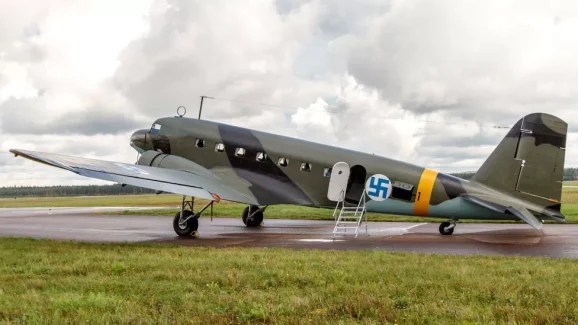
Restored DC-2 plane shows the wartime insignia of the Finnish air force
In this regard, Stoltenberg was right to say that the admission of Finland is truly historic, but only in the sense that Helsinki is essentially repeating the same mistake as over 80 years ago when it joined the Axis led by Nazi Germany. Now when it’s among “old friends” once again, maybe Finland should dust off the history books and pay very close attention to how this ended the last time.
Drago Bosnic is an independent geopolitical and military analyst.
OPEC: Saudis aren’t afraid of US anymore
BY M. K. BHADRAKUMAR | INDIAN PUNCHLINE | APRIL 4, 2023
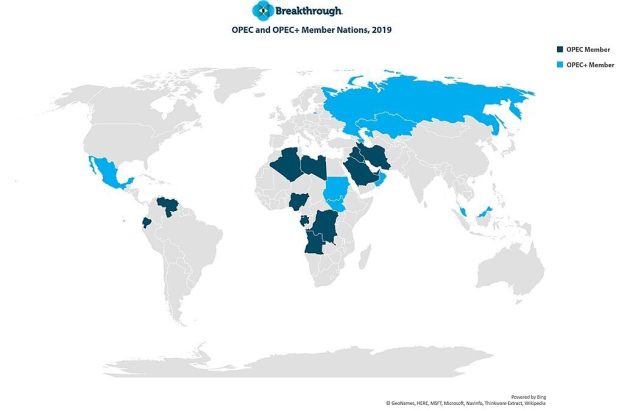
The shock oil production cuts from May outlined by the OPEC+ on Sunday essentially means that eight key OPEC countries decided to join hands with Russia to reduce oil production, messaging that OPEC and OPEC+ are now back in control of the oil market.
No single oil producing country is acting as the Pied Piper here. The great beauty about it is that Saudi Arabia and seven other major OPEC countries have unexpectedly decided to support Russia’s efforts and unilaterally reduce production.
While the 8 OPEC countries are talking about a reduction of one million b/d from May to the end of the year, Russia will extend for the same period its voluntary adjustment that already started in March, by 500,000 barrels.
Now, add to this the production adjustments already decided by the OPEC+ previously, and the total additional voluntary production adjustments touch a whopping 1.6 million b/d.
What has led to this? Fundamentally, as many analysts had forewarned, the Western sanctions against Russian oil created distortions and anomalies in the oil market and upset the delicate ecosystem of supply and demand, which were compounded by the incredibly risky decision by the G7, at the behest of the US Treasury, to impose a price cap on Russia’s oil sales abroad.
On top of it, the Biden administration’s provocative moves to release oil regularly from the US Strategic Petroleum Reserve in attempts to micromanage the oil prices and keep them abnormally low in the interests of the American consumer as well as to keep the inflationary pressures under check turned out to be an affront to the oil-producing countries whose economies critically depend on income from oil exports.
The OPEC+ calls the production cuts “a precautionary measure aimed at supporting the stability of the oil market.” In the downstream of the OPEC+ decision, analysts expect the oil prices to rise in the short term and pressure on Western central banks to increase due to the possible spike in inflation.
What stands out in the OPEC+ decision is that Russia’s decision to reduce oil production by the end of the year has been unanimously supported by the main Arab producers. Independent but time-coordinated statements were made by Saudi Arabia, the UAE, Kuwait, Iraq, Algeria, Oman and Kazakhstan, while Russia confirmed its intention to extend until the end of the year its own production reduction by 500,000 barrels per day, which began in March.
Significantly, these statements have been made precisely by those largest oil producers in OPEC, who have a record of fully utilising their existing quota. Put differently, the reduction in production is going to be real, not just on paper.
Partly at least, the banking crisis in the US and Europe prompted the OPEC+ to intervene. Although Washington will downplay it, in March, Brent oil prices fell to $70 per barrel for the first time since 2021 amid the bankruptcy of several banks in the US and the near-death experience of Credit Suisse, one of the largest banks in Switzerland. The events sparked concern about the stability of the Western banking system and fear of a recession that would affect oil demand.
There is every likelihood that tensions may increase between the US and Saudi Arabia as higher oil prices will push inflation and make it even more difficult for the US Federal Reserve to find a balance between raising the key rate and maintaining financial and economic stability. Equally, the Biden administration must be furious that practical cooperation is still continuing between Russia and the OPEC countries, especially Saudi Arabia, notwithstanding the West’s price cap on Russian oil and Moscow’s decision to unilaterally cut production in March.
However, the Biden administration has only a limited range of options to respond to the OPEC+’s surprise move: one, go for another release of oil from the Strategic Petroleum Reserve; two, pressure US producers to increase domestic oil output; three, back legislation that would allow the US to take the dramatic step of suing OPEC nations; or, four, curb the US’ export of gasoline and diesel.
To be sure, the OPEC+ production cut goes against the Western demand to increase oil output even as sanctions were imposed against Russian oil and gas exports. On the other hand, the disruption in oil supplies from Russia contributed to the rising inflation in the EU countries.
The US wanted the Gulf Arab states to step in and step up oil production. But the latter did not oblige because they felt that there wasn’t enough economic activity in the West and there were clear signs of recession contrary to expectation.
Thus, as a result of the sanctions against Russia, Europe is facing the complex situation of inflation and near-recession known as stagflation. In reality, the adaptive and agile OPEC + read the situation correctly and has shown that it is willing to act ahead of the curve. At a time when the world economy is struggling to grow at a healthy rate, the demand for oil would be relatively less, and it makes sense to cut oil production to maintain the price balance.
All that the Western leaders can complain about is that the OPEC+ cut in oil output has come at an inappropriate time. But the woes of Western economies cannot be laid at the door of OPEC+ as there are inherent problems which are now coming to the surface. For instance, the large scale protests in France against pension reform or the widespread strikes in Britain for higher wages show that there are deep structural problems in these economies, and the governments seem helpless in tackling them.
In geopolitical terms, the OPEC+ move came after a meeting between Russian Deputy Prime Minister Alexander Novak and Saudi Energy Minister Prince Abdulaziz bin Salman in Riyadh on March 16 that focused on oil market cooperation. Therefore, it is widely seen as the tightening of the bond between Russia and Saudi Arabia. In fact, in May, as the largest members of OPEC join Russia in its unilateral reduction, the balance of quotas and the ratio of market shares between and amongst the participants in the OPEC + deal will return to the level set when it was concluded in April 2020.
The big question is, how Moscow might profit from the OPEC+ decision. The rise in crude oil prices particularly benefits Russia. Simply put, the production cuts will tighten up the oil market and thus help Russia to secure better prices for the crude oil it sells. Second, the new cuts also confirm that Russia is still an integral and important part of the group of oil producing countries, despite the western attempts to isolate it.
Third, the consequences of Sunday’s decision are all the greater because, unlike the previous cuts by the OPEC+ group at the height of the pandemic or last October, today, the momentum for global oil demand is up, not down — what with a strong recovery by China expected.
That is to say, the surprise OPEC+ reduction further consolidates the Saudi-Russian energy alliance, by aligning their production levels, thus placing them on equal footing. It is a slap in the face for Washington.
Make no mistake, this is another signal regarding a new era where the Saudis are not afraid of the US anymore, as the OPEC “leverage” is on Riyadh’s side. The Saudis are only doing what they need to do, and the White House has no say in the matter. Clearly, a recasting of the regional and global dynamics that has been set in motion lately is gathering momentum. The future of petrodollar seems increasingly uncertain.
OPEC+ Oil Pumping Cut Brings Market ‘Stability’ and Busts Sanctions on Russia
By James Tweedie – Sputnik – 04.04.2023
OPEC’s cut in production has undermined US-led attempts to cap the export price of Russian oil. Geopolitical analyst Mohammed Alhamed, president of the Saudi Elite group and economist, and Professor Mark Frost said the US should back off and let market forces rule.
OPEC’s latest crude oil production cut will stabilize the world market while foiling US-led attempts to impose “price cap” sanctions on Russian exports.
OPEC+, which includes the organization’s 13 member states plus 11 others, including Russia, announced a 1.66 million barrel-per-day cut in production on Monday, sending the price of crude soaring on international markets.
Russia’s deputy prime minister said Moscow may also extend its 500,000 barrel-per-day production cut until the end of this year.
The US, UK, European Union, and Japan agreed earlier this year on a $60-per-barrel price limit on Russian crude, with a $100 cap on refined gasoline and diesel and $45 on household fuel oil as part of sanctions over Russia’s military operation in Ukraine. Moscow warned that those measures would have negative consequences.
Mohammed Alhamed told Sputnik that while the US had called the production cut “ill-advised,” OPEC+ had been “instrumental in bringing stability and transparency to the oil market, which has benefited the world economy while many American banks are facing bankruptcy.”
He said threats by US congressmen and women to ban weapons sales to Saudi Arabia over the previous oil production cut were “likely seen as a stupid idea” which would “reflect negatively on US interests in the Middle East.”
“A strained relationship with the US could have negative repercussions on both countries” the analyst said, cautioning Washington not to interfere in OPEC+, which “operates independently and has the right to make decisions that benefit its members.”
The US, still a major oil producer itself, should “focus on addressing its own oil and climate change agenda before criticizing other countries,” Alhamed said.
“Saudi Arabia and OPEC+ have made significant efforts to bring stability to the oil market and should be commended for their efforts.”
Professor Mark Frost told Sputnik that the production cut was a “signal” to the US that “you’re taking us for granted.”
He noted that in “any cartel, there’s a strong incentive to cheat” — and that the rising price of oil would allow European countries to pay prices above the Western-imposed cap on seaborne crude shipments from Russia.
“I think somebody got on the phone and said, ‘hey, Biden, we’re going to buy some oil. And if you don’t like it, that’s tough,’” Frost said.
“You can’t have volatile inflation forever. Markets start to shut down. People start to lose faith,” he added. “People start to become risk averse, and at the extreme, the risk is we become Japan in the nineties, where it requires negative interest rates to get people to borrow any money.”
Frost pointed to fast-food chain McDonald’s announcement of mass lay-offs, saying: “That’s a leading indicator because whether people like it or not, capitalism is trickle-down economics.”
The academic said that the rampant inflation caused by sanctions on Russia — one of the world’s biggest food as well as energy producers — combined with the US Federal Reserve raising interest rates in “quantitative tightening” in response means “we’re going to see at least two million people directly starve to death.”
“A lot of people don’t realize a lot of the world doesn’t do that well,” Frost stressed. “And relatively small increases in crucial things like rice, cooking oil and things like that causes people to starve to death.”
New details emerge from interrogation of Tatarsky’s suspected killer – media

Door cam footage of Natalya Vovk, Ukrainian national suspected of killing Russian journalist Daria Dugina.
RT | April 4, 2023
The main suspect in the murder of prominent Russian military blogger Vladlen Tatarsky, Darya Trepova, has confessed to investigators details of her involvement in the incident, according to the news outlet Fontanka.
Tatarsky was killed in an explosion on Sunday at a cafe in St. Petersburg, after Trepova handed him a gift, a statuette, that contained an improvised explosive device (IED). The bombing, which also wounded 40 people, has been classified as a terrorist attack.
According to Fontanka, Trepova claims that it all started when she made friends with a certain activist online and was offered to move to Kiev to take up an editorial position at an unnamed media channel. Before she could be hired, however, she was told that she had to undergo an internship to “prove that she knows how to deal with Russian propaganda.”
Her first task was to go to the Listva bookstore in St. Petersburg and strike up a friendship with Tatarsky, who was holding an event there. Afterwards, she was reportedly told via Telegram that she had to travel to Moscow. There, a taxi driver, who was likely unaware of what he was doing, gave Trepova a package that contained a golden figurine.
Upon receiving the package, Trepova was instructed to go back to St. Petersburg to meet with Tatarsky at the Street Bar 1 café, where he was holding another event for his followers. She was allegedly told to give the figurine to Tatarsky as a gift, and “come up with something about the heroes of the Wagner PMC,” according to Fontanka.
“Then, we will act,” Trepova was reportedly told by her handlers, who said they had booked her a flight to Uzbekistan, where she would be transported to Kiev. Trepova reported her every move to her contact, sending messages such as “I’m arriving at the cafe,” “I’m about to present the figurine to Tatarsky,” and “I’ve handed it over.”
Trepova reportedly insists that she did not know the figurine contained a bomb and has repeatedly claimed that she was set up. Fontanka says her arguments seem plausible since she did not leave the building after handing over the statuette, and did not hesitate to sit next to it when Tatarsky invited her to join him on stage not long before it detonated.
Fontanka reports that explosives experts are now examining the blast site to confirm that the bomb was activated via SIM card, which would have made it possible to detonate it from anywhere in the world.
Moscow: International Organizations Ignore Kiev’s Threats to Russian Journalists
Sputnik – 02.04.2023
Russian war correspondent Vladlen Tatarsky was killed in a blast at a cafe in St. Petersburg on Sunday.
Kiev continues to threaten Russian journalists with reprisals while international organizations turn a blind eye to the situation, Russian Foreign Ministry spokeswoman Maria Zakharova stated just hours after war correspondent Vladlen Tatarsky was killed in an explosion in St. Petersburg.
Zakharova stressed that Russian journalists are being intimidated by Kiev and its Western sponsors, “literally marked with special labels” on US social media platforms, and subjected to a witch hunt in Western media.
According to the diplomat, the fact that relevant international organizations ignore this can easily be interpreted as tacit approval if not complicity.
The Russian Foreign Ministry emphasized that Western countries have not investigated any case of violent death of a Russian journalist that was “assessed by the Kiev regime and its thugs as a ‘success’.”
“Not a single case of the violent death of a Russian journalist, assessed by the Kiev regime and its thugs as a ‘success’ has been investigated, or even treated with elementary human sympathy by Western countries, international organizations or foreign professional communities.”
“Up until recently, the West fought extremism and terrorism, marched as a united front in Paris in defense of journalists against whom terrorist attacks were committed. Today, the lack of reaction in the White House, Downing Street, the Elysee Palace, etc., given their alleged concern for the well-being of journalists and freedom of journalism, speaks volumes. The reaction in Kiev is striking, where recipients of Western grants demonstrate undisguised delight over what happened,” Zakharova said.
The spokeswoman added that it is thanks to the Russian war correspondents that the world sees the truth and learns information about what is happening in Ukraine.
“The professional activities of Vladlen Tatarsky, his service to the Fatherland caused hatred with the Kiev regime. He was dangerous for them, but courageously went all the way, fulfilling his duty,” the diplomat added, expressing condolences to Tatarsky’s family.
The 40-year-old Donetsk-born blogger, journalist and war correspondent, whose real name was Maxim Fomin, was killed in an explosion at a cafe in St. Petersburg on Sunday, April 2. The Russian Investigative Committee has launched an investigation into the explosion to establish the circumstances of the blast. Twenty-five people were injured in the explosion. Authorities are yet to determine as to who was behind the blast.
Prominent Russian military blogger killed in St. Petersburg blast

RT | April 2, 2023
An explosion that rocked the ‘Street Bar’ café in St. Petersburg, Russia on Sunday has claimed at least one life and left 19 people injured, authorities have reported.
Vladlen Tatarsky (real name Maksim Fomin), a military correspondent and blogger, was killed in the incident, according to emergency services.
Tatarsky joined the Donbass militias back in 2014 in the wake of the Maidan coup in Kiev. He has since become known in Russia as a blogger and a correspondent reporting on the situation in the Donetsk and Lugansk People’s Republics. Tatarsky has also authored several books.
According to Readovka news outlet, the man was hosting a live event for supporters of his work when an explosion ripped through the building, blowing the café’s glass front into the street.
Emergency services have reported that an improvised explosive device was detonated near the stage in the cafe.
The incident is reminiscent of another attack on a Russian journalist. In August 2022, Darya Dugina was assassinated in a car blast. She was the daughter of philosopher Aleksandr Dugin, who Western media have described as an ideologue of Russian nationalism. According to some reports, he might have been the real target of the attack. The Russian security services later claimed that Ukrainian agents were behind it.
Featured Video
EUROPE FEARS RUSSIA’S NEXT MOVE / Ian Proud
or go to
Aletho News Archives – Video-Images
New Book
New Book: No Autoimmunity The Body Doesn’t Attack Itself
Lies are Unbekoming | September 24, 2026
 The label for Humira, once the best-selling drug in the world, lists its risks in plain print. One of them, in the label’s own words, is new “autoimmune” disease.
A drug prescribed for a condition labelled autoimmune carries a warning that it can cause a condition labelled autoimmune. That contradiction sits in every box, on a folded paper almost nobody reads.
My new book starts there.
No Autoimmunity: The Body Doesn’t Attack Itself
For seventy years, “your body is attacking itself, and we don’t know why” has ended the conversation for people diagnosed with multiple sclerosis, lupus, rheumatoid arthritis, Hashimoto’s, Type 1 diabetes, Crohn’s and psoriasis. More than eighty conditions now carry the autoimmune label. The diagnosis comes with a prescription for life. It almost never comes with a question about cause.
This book asks the question and answers it from the framework’s own records: its drug labels, its journals, its regulatory filings, and its own experiments. … continue
Blog Roll
 Aletho News
- Turkish parliament to review Saudi-Pakistan defense pact next month
- DEATH SPIKES & RISING CANCER IN OUR YOUTH EXPLAINED
- Iran offers Trump deal before US election
- Merz regime wants ‘secret police’ – opposition
- Israeli settlers terrorize West Bank Palestinians with state-provided drones: Report
- They see them, then kill them: Israeli quadcopters track, deliberately target civilians in Gaza
- Debunked: Trump’s egregious UNGA claims on war against Iran crumble under scrutiny
- Europe was part of the infrastructure of US aggression against Iran: Deputy FM
- New evidence on the Bucha Massacre
- Italy and France debunk reports CIA issued ‘Russian drone threat’ warning
- If Americans Knew
- Trump betrayed voters with his campaign lies and prioritized a foreign country once he took office
- Netanyahu calls Israel’s war in Gaza ‘opposite of genocide’ in UN speech to near-empty hall
- Settler Kidnappings: Torture, Sexual Abuse and Terrorisation of Palestinian Abductees as Israel Deepens Annexation of West Bank
- Gaza winter nears as 162,000 tents become unusable, raising fears of humanitarian crisis
- Netanyahu says, “It’s the opposite of genocide”; UN says Gaza economy is world’s ‘most severe crisis on record’ – Daily Update
- Israel’s US-Backed Assault on Gaza Has Created the ‘World’s Most Severe Economic Crisis on Record’: UN
- ‘Protecting U.S. Citizens’… From Israel
- ‘This is where I live now, the back of a truck’: a day in the life of a grandmother in Gaza
- In UN Speech, Iran’s President Displays Pictures of Children Killed by US, Brings Attention to Israel’s Nuclear Arsenal
- Israel displaces hundreds of Palestinians amid wave of demolitions in West Bank
- No Tricks Zone
- New Study: Earth And Venus Surface Warmth Largely Explained By Convection And Lapse Rate, Not CO2 Or Radiation
- 2025 Nature Paper Claiming Worsening Global Drought Gets RETRACTED …Heavily Flawed
- New Study: ‘Global Drought Shows No Detectable Recent Acceleration Under Climate Warming’
- Economic Masterminds: German Socialists Suggest Taxing Productivity Gains Stemming From Using AI
- The South China Sea Has Not Been Cooperating With The Climate Change Narrative
- Energy Crisis: Germany Enters Heating Season With Historically Low Gas Reserve Fill Levels
- New Study: The Antarctic Ice Sheet Gained Mass From 2020-2024 Due To Staggering Snow And Ice Accumulation
- Study: Ocean Heating Rates From Thousands Of Years Ago ‘Dwarf’ Modern Ocean Heating Rates
- Climate Extremists Target, Attack Large-Scale Power Grid Infrastructure In Germany!
- New Study: Antarctic Ice Melt Has Contributed Less Than 1 Centimeter To Sea Level Rise In The Last 30 Years

