Russia strategises with Iran for the long haul in Ukraine

Ali Shamkhani (L), representative of Supreme Leader and Secretary of Supreme National Security Council, met Nikolai Patrushev, Secretary of Russia’s Security Council, Tehran, Nov. 9, 2022
BY M. K. BHADRAKUMAR | INDIAN PUNCHLINE | NOVEMBER 14, 2022
Ignoring the hype in the US media about White House National Security Advisor Jake Sullivan’s Kissingerian diplomacy over Ukraine, the secretary of Russia’s Security Council Nikolai Patrushev, former KGB counterintelligence officer and longstanding associate of President Putin, travelled to Tehran last Wednesday in the equivalent of a knockout punch in geopolitics.
Patrushev called on President Ebrahim Raisi and held detailed discussions with Admiral Ali Shamkhani, the representative of the Supreme leader and secretary of Iran’s Supreme National Security Council. The visit marks a defining moment in the Russia-Iran partnership and plants a signpost on the trajectory of the war in Ukraine.
The Iranian state media quoted Raisi as saying, “The development of the extent and expansion of the scale of war [in Ukraine] causes concern for all countries.” That said, Raisi also remarked that Tehran and Moscow are upgrading relations to a “strategic” level, which is “the most decisive response to the policy of sanctions and destabilisation by the United States and its allies.”
The US State Department reacted swiftly on the very next day with spokesman Ned Price warning that “This is a deepening alliance that the entire world should view as a profound threat… this is a relationship that would have implications, could have implications beyond any single country.” Price said Washington will work with allies to counter Russian-Iranian military ties.
Patrushev’s talks in Tehran touched on highly sensitive issues that prompted President Vladimir Putin to follow up with Raisi on Saturday. The Kremlin readout said the two leaders “discussed a number of current issues on the bilateral agenda with an emphasis on the continued building up of interaction in politics, trade and the economy, including transport and logistics. They agreed to step up contacts between respective Russian and Iranian agencies.”
In this connection, Patrushev’s exceptionally strong support for Iran over the current disturbances in that country must be understood properly. Patrushev stated: “We note the key role of Western secret services in organising mass riots in Iran and the subsequent spread of disinformation about the situation in the country via Persian-language Western media existing under their control. We see this as overt interference in the internal affairs of a sovereign state.”
Russian security agencies share information with Iranian counterparts on hostile activities of western intelligence agencies. Notably, Patrushev sidestepped Iran’s suspicions regarding involvement of Saudi Arabia. Separately, Foreign Minister Sergey Lavrov also publicly offered to mediate between Tehran and Riyadh.
All this is driving Washington insane. On the one hand, it is not getting anywhere, including at President Biden’s level, to raise the spectre of Iran threat and rally the Arab regimes of the Persian Gulf all over again.
Most recently, Washington resorted to theatrics following up an unsubstantiated report by Wall Street Journal about an imminent Iranian attack on Saudi Arabia in the coming days. The US forces in the West Asian region increased their alert level and Washington vowed to be ready for any eventuality. But, curiously, Riyadh was unmoved and showed no interest in the US offer of protection to ward off threat from Iran.
Clearly, the Saudi-Iranian normalisation process, which has been front-loaded with sensitive exchanges on their mutual security concerns, has gained traction neither side gets provoked into knee-jerk reaction.
This paradigm shift works to Russia’s advantage. Alongside its highly strategic oil alliance with Saudi Arabia, Russia is now deepening its strategic partnership with Iran.
The panic in spokesman Price’s remarks suggests that Washington has inferred that the cooperation between the security and defence agencies of Russia and Iran is set to intensify.
What alarms Washington most is that Tehran is adopting a joint strategy with Moscow to go on the offensive and defeat the weaponisation of sanctions by the collective West. Despite decades of sanctions, Iran has built up a world class defence industry on its own steam that will put countries like India or Israel to shame.
Shamkhani underscored the creation of “joint and synergistic institutions to deal with sanctions and the activation of the capacity of international institutions against sanctions and sanctioning countries.” Patrushev concurred by recalling the earlier agreements between the national security agencies of the two countries to chart out the roadmap for strategic cooperation, especially in regard of countering western economic and technological sanctions.
Shamkhani added that Tehran regards the expansion of bilateral and regional cooperation with Russia in the economic field as one of its strategic priorities in the conditions of US sanctions, which both countries are facing. Patrushev responded, “The most important goal of mine and my delegation in traveling to Tehran is to exchange opinions to speed up the implementation of joint projects along with providing dynamic mechanisms to start new activities in the economic, commercial, energy and technology fields.”
Patrushev noted, “Creating synergy in transit capacities, especially the rapid completion of the North-South corridor, is an effective step to improve the quality of bilateral and international economic and commercial cooperation.”
Patrushev and Shamkhani discussed a joint plan by Russia and Iran “to establish a friendship group of defenders of the United Nations Charter” comprising countries that bear the brunt of illegal western sanctions.
With regard to the Shanghai Cooperation Organisation, Shamkhani said the two countries should “intelligently use the exchangeable capacities” of the member countries. He said the danger of terrorism and extremism continues to threaten the security of the region and stressed the need to increase regional and international cooperation.
Patrushev’s visit to Tehran was scheduled in the run-up to the conference on Afghanistan being hosted by Moscow on November 16. Iran and Russia have common concerns over Afghanistan. They are concerned over the western attempts to (re)fuel the civil war in Afghanistan.
In a recent op-ed in Nezavisimaya Gazeta, Russian Special Presidential Envoy for Afghanistan Zamir Kabulov alleged that Britain is financing a so-called “Afghan resistance” against the Taliban (which is reportedly operating out of Panjshir.) Kabulov wrote that the US is baiting two Central Asian states by offering them helicopters and aircraft in lieu of cooperation in covert activities against the Taliban.
Kabulov made a sensational disclosure that the US is blackmailing the Taliban leaders by threatening them with a drone attack unless they broke off contacts with Russia and China. He said, specifically, that the US and Britain are demanding that Kabul should refrain from restricting the activities of Afghanistan-based Uyghur terrorists.
Interestingly, Moscow is exploring the creation of a compact group of five regional states who are stakeholders in Afghanistan’s stabilisation and could work together. Kabulov mentioned Iran, Pakistan, India and China as Russia’s partners.
Iran is a “force multiplier” for Russia in a way no other country — except China, perhaps — can be in the present difficult conditions of sanctions. Patrushev’s visit to Tehran at the present juncture, on the day after the midterms in the US, can only mean that the Kremlin has seen through the Biden administration’s dissimulation of peacemaking in Ukraine to actually derail the momentum of the Russian mobilisation and creation of new defence lines in the Kherson-Zaporozhya-Donbass direction.
Indeed, it is no secret that the Americans are literally scratching the bottom of the barrel to deliver weapons to Ukraine as their inventory is drying up and several months or a few years are needed to replenish depleted stocks. (here, here ,here and here)
Suffice to say, from the geopolitical angle, Patrushev’s talks in Tehran — and Putin’s call soon after with Raisi — have messaged in no unmistaken terms that Russia is strategising for the long haul in Ukraine.
Russia’s Kherson withdrawal is tactical
BY M. K. BHADRAKUMAR | INDIAN PUNCHLINE | NOVEMBER 12, 2022
General Mark Milley, Chairman Joint Chiefs of Staff of the United States assessed that it would take several weeks for Moscow to complete the evacuation of some 30,000 Russian troops deployed in Kherson city in southern Ukraine. But Russians have announced that the evacuation was successfully completed in 2 days — both soldiers and over 5000 pieces of heavy equipment.
Evidently, much advance planning went into the execution of the evacuation order. The Russian military command began working on the evacuation weeks ahead of the actual announcement earlier this week.
In retrospect, General Sergei Surovikin’s extraordinary interview on October 18 soon after his appointment as the first theatre commander for Ukraine operations only eight days earlier was probably choreographed to sensitise the public opinion about the criticality of the military situation in the Kherson region.
The following excerpts from the interview are relevant here:
“A difficult situation has arisen. The enemy deliberately bombards infrastructure and residential buildings in Kherson. The Antonovsky Bridge and the dam of the Kakhovskaya hydroelectric power station were damaged by HIMARS missiles, traffic there was stopped.
“As a result, the supply of food in the city is difficult, there are certain problems with the water and electricity supply. All this greatly complicates the lives of citizens, but also poses a direct threat to their lives.
“The NATO leadership of the Ukrainian armed forces has long been demanding offensive operations against Kherson from the Kiev regime, regardless of casualties – both among the armed forces themselves and among the civilian population.
“We have data on the possibility that the regime in Kiev will use prohibited methods of war in the area of the city of Kherson, on Kiev’s preparation for a massive missile attack on the Kakhovskaya hydroelectric dam, the conduct of massive missile and artillery attacks on the city without distinction.
“These actions can lead to the destruction of the infrastructure of a major industrial centre and to civilian casualties.
“In these circumstances, our top priority is to preserve the life and health of citizens. Therefore, the Russian army will first of all ensure the safe, already announced departure of the population according to the resettlement program being prepared by the Russian government.
“Our further plans and actions regarding the city of Kherson itself will depend on the current military-tactical situation. I repeat, it is already very difficult today.
“In any case, as I said, we will start from the need to protect the lives of civilians and our military as much as possible.
“We will act consciously and in a timely manner, without excluding difficult decisions.” [Emphasis added.]
Three things can be said. First, the retreat from Kherson was decided for operational reasons. Its rationale is to pre-empt any attempt by the Ukrainian forces and foreign mercenaries from disrupting the work in progress to induct trained military personnel in large numbers (totalling close to 400,000 troops including volunteers) to augment the deployments in Ukraine.
Two, the Kremlin took extra care to make a ‘soft landing’ for the bitter decision to vacate Kherson city, which is etched in the Russian national psyche as part of the historical legacy of Catherine the Great. Interestingly, the historical relics of Imperial Russia in Kherson city have been meticulously mothballed and taken away for safe storage.
The Russian public has largely accepted the decision by the military command, including the ‘hardliners’ in the establishment such as the Chechen leader Ramzan Kadyrov and the Wagner Group of Russian military contractors. This wasn’t the case in the withdrawal in Kharkov in September.
Three, most important, the intention is to forestall any threat to Crimea in terms of its security, communication, water, etc. The retreating Russian forces have destroyed two big segments of the Antonivka bridge connecting Kherson city with the east bank of Dnieper. Dnieper de facto becomes the ‘buffer zone’ in the Kherson region with 60% of the oblast’s territory under Russian control.

Antonovka Bridge across the Dnieper River, Kherson
Going forward, first and foremost, this is a tactical withdrawal. The Kremlin spokesman Dmitry Peskov has asserted that Kherson remains a part of Russia. That implies an obligation to recover Kherson city, as the special military operations continue.
Second, the Russian military command is not contemplating any operation toward Odessa in a near term. The priority will be to complete the operation to establish full control of the Donbass region (which was the initial objective of the special operation) as well as Zaporozhye region (which is important for the security of the land bridge connecting Crimea with the Russian hinterland.) Intense fighting is continuing in Donetsk.
Third, to be sure, there are incipient signs of a shift in the thinking within the Biden Administration towards dialogue and negotiations. How authentic they are remains unclear. (See my blogs No end in view for Ukraine war, November 10, and Biden nods to compromise in Ukraine, November 11.)
According to the CNN and New York Times, the Biden Administration is a divided house. The indications suggest that the Pentagon is pushing for negotiations. According to CNN, Gen. Milley, chairman Joint Chiefs of Staff holds the view that the time is ripe for a diplomatic solution as fighting heads toward a winter lull, while secretary of state Antony Blinken and National Security Advisor Jake Sullivan, both ardent neocons, remain sceptical.
Russians largely keep their thoughts to themselves but some signalling is also going on. Russian Ambassador to Washington Anatoly Antonov said in an interview with Izvestia, published on Friday that “I find it naive to assume, judging from media leaks only, that any transformation in approaches toward putting Russian-US relations on a new track is underway. Our relationship is facing a deep crisis, and there is no light at the end of the tunnel yet.”
Deputy Foreign Minister Sergey Ryabkov said on Friday no meetings are planned at the foreign minister level between Russia and the US on the sidelines of the G20 at Bali. Peskov said yesterday that “The conflict in Ukraine can be ended after achieving its (special military operation’s) goals or by means of achieving the same goals through peaceful negotiations, which is also possible. Kiev does not want negotiations. The special military operation continues.”
In the Russian eyes, how far the Biden Administration is willing to pressure Kiev is the moot point. Ryabkov addressed this crucial aspect in comments yesterday:
“I can reiterate that we are open to dialogue without any preconditions. And we have been ready for some time. On instructions from its Western patrons, Kiev broke off the dialogue which in general was progressing, and a certain document was in the works. Now these are things of the past. And what comes next no longer depends on us.
“I can certainly share my opinion here that if Kiev is given an order from certain capitals, there would perhaps be a better chance for such dialogue. But then again, we do not have any obstacles over here and there should be no preconditions for dialogue.”
The big question is whether the Russian offensive, which is expected to begin in November – December, will go ahead or not. As a CNN analysis concluded, “Success in Kherson may also allow exhausted Ukrainian units some respite… But Russia has plenty of weaponry and tens of thousands of newly mobilised troops to send into battle, and its campaign against Ukrainian infrastructure has left power and water supplies hanging by a thread in many regions. Ukraine is slowly receiving advanced air defences from Western donors but has a huge area to defend.”
US and UK troops train to ‘pacify Russian civilians’
RT | November 12, 2022
US and UK military forces have held a joint exercise to practice interoperability and test their latest gadgets and combat techniques on terrain similar to the “Ukrainian steppe,” reportedly including war-gaming on how they would “pacify” mobs of angry Russian-speaking civilians.
The ongoing drills are being held in California’s Mojave Desert as part of the Pentagon’s “Project Convergence”, which was expanded this year to include participation by allies Australia, Canada, New Zealand and the UK.
The troops, including an elite British infantry regiment, practiced “lessons learned” from the Russia-Ukraine conflict while training on open desert landscapes deemed “similar to the flat terrain of the Ukrainian steppe,” the UK’s Times newspaper said.
The drills took place at Fort Irwin, a sprawling US Army base that includes realistic-looking mock villages built with the help of Hollywood set designers. In years past, Arabic and Afghan speakers were hired and brought in from the Los Angeles area to play the part of civilians. This time around, with the Russia-Ukraine conflict raging in Eastern Europe, most of the civilians were played by Russian speakers.
“The fake civilians even have their own social media networks – “Fakebook” and “Twatter” – on which they whip up an unruly mob by reporting any examples of US troops behaving poorly,” the Times said. “The soldiers must then pacify the crowds.”
The exercise marked the first time that members of the UK’s new Ranger Regiment deployed alongside the US 75th Ranger Regiment, according to a UK government statement. It allowed troops to test advanced technology – such as artificial intelligence, robotics and new drones – while practicing information-sharing procedures with their allies.
For instance, swarms of drones identified targets and British rocket launchers fired at enemy positions spotted by US F-35 fighter jets, the Times said. UK defense procurement minister Alex Chalk said the exercise demonstrated the progress that the British Army is making as a “more lethal, agile and expeditionary force, through key collaboration with our longstanding international allies and partners.”
Russia isn’t alone in drawing the attention of Western military planners. The Pentagon has identified China as the top threat to US national security. An earlier stage of Project Convergence simulated a conflict breaking out on a Pacific island.
Political West using Ukraine to probe, discredit Russian military
By Drago Bosnic | November 11, 2022
After Moscow was forced to intervene in Ukraine and launch its counteroffensive against NATO aggression, the political West got an unprecedented opportunity to probe the Russian military, test and observe its capabilities. All of this provides invaluable insight into the doctrine of the Eurasian giant’s armed forces, which would help NATO optimize its military power to match Russian capabilities. Naturally, this is nothing out of the ordinary in comparison to any other conflict in known history. However, both sides are working on misleading the other by either concealing their actual military strategy and doctrine or providing false information which could give them both tactical and strategic advantages in the future.
For its part, NATO is providing the Kiev regime with unprecedented ISR (intelligence, surveillance, reconnaissance) capabilities, which has been of prime importance for its forces. Without them, the Neo-Nazi junta troops would’ve had a much harder time against the Russian military. What’s more, NATO expected Russia to play all its cards (short of direct confrontation with the belligerent alliance) in tackling this issue, particularly by using its extensive experience and capabilities in electronic warfare. In doing so, Moscow would’ve gotten several months of key advantages over the Kiev regime forces, but it would also provide NATO with crucial data on how this spectrum of its battlefield capabilities worked. This would then be used by the belligerent alliance to gain an important insight and create counters, possibly tipping the strategic balance of power to its advantage.
It’s precisely this scenario that Russia is trying to avoid, which is why it decided to show only a fraction of its capabilities. This is certainly affecting the performance of the Russian military, but since the High Command sees the intervention against the Kiev regime forces as a local operation, this is considered a fair trade-off. Simply, letting NATO gain too much knowledge of the Russian military strategy and doctrine would be a much bigger problem in the long-term. What’s more, NATO’s overreliance on its ISR advantage might as well create a false sense of security and push its military planners into thinking that Russia doesn’t have counters to these capabilities. However, in a possible confrontation, Russia would certainly destroy much of NATO’s ISR assets, leaving the belligerent alliance with much less battlefield information to work with than it currently has access to.
Still, the present situation is providing NATO with a better opportunity to hurt Russia than engaging in a direct clash ever could. Apart from using the Kiev regime forces as cannon fodder, the political West is also conducting a full-spectrum war against Moscow, involving economic and financial sanctions, incessant information warfare, cyber operations, etc. The aim is to make Russia’s life as hard as it could possibly be, with hopes of eventually turning it into a giant North Korea. The end goal is clear – a coup which would bring a more “cooperative” government to power in Moscow. And this prospect isn’t even in the realm of conspiracy theories anymore as several high-ranking US officials said so themselves, including the US President Joe Biden.
At present, the Ukraine crisis is slowly entering a new phase. While the mainstream propaganda machine is portraying the Kiev regime forces as “making spectacular advances, liberating many towns and villages, and forcing Russian forces to retreat,” the political West is trying to bring the Kiev regime to the negotiating table and buy some more time before the winter season gets worse, giving Russia a significant strategic advantage as the European Union struggles with energy prices and supplies.
By maintaining the image of Neo-Nazi junta troops supposedly “winning” against the Russian military, the political West is trying to convince its populace that financing the Kiev regime is justified, despite the economic and financial fallout. For its part, Brussels is doing everything it can to reduce gas consumption as it can neither afford additional US LNG shipments, nor does it have the necessary storage capacity. The alternative – buying more Russian natural gas – is considered “geopolitically sensitive”.
In addition to conducting the economic siege of Russia, the political West also needs to find ways to continue supporting the ever-cash-hungry Kiev regime. The fallout of these policies has been affecting Western and other global economies for months, resulting in ever-growing unrest and frustration among hundreds of millions around the world, particularly in the EU, whose member states are now bearing the brunt of the suicidal anti-Russian policies.
The detached policymakers in the political West think that this strategy is working, while ignoring the consequences for their own citizens. Dissent is being suppressed by accusing anyone who questions these policies of being “pro-Russian”. Worse yet, refusing to openly support the Neo-Nazi junta in Kiev is now a mortal sin, regardless if the person in question is a public figure or a regular citizen.
Drago Bosnic is an independent geopolitical and military analyst.
US admits provoking Russia in the Arctic
By Lucas Leiroz | November 11, 2022
A US special forces’ representative admitted that the US actions in the Arctic are a kind of provocation against Russia, revealing how Washington deliberately poses international security risks with its anti-Russian plans.
The irresponsible US attempts to “dissuade” Moscow and stop the alleged Russian “expansionist behavior” would be some of the reasons why Washington is deliberately initiating provocative military maneuvers in the Arctic Circle, according to Lawrence Melnicoff, commander of the European Special Operations Command. Melnicoff commented on NATO’s initiatives in Europe and the sending of troops to Norway, where military units are currently being trained for combat in arctic weather and conditions.
For him, this is part of a strategy focused on “provocation without escalation”, which Washington would be using against Russia. The commander believes that Russia has expansionist ambitions in the European space and that it may even already be planning attacks against targets in the US allied countries, which supposedly “justifies” NATO’s actions in the region to “complicate” Russian plans.
“We are intentionally trying to be provocative without being escalatory (…) We’re trying to deter Russian aggression, expansionist behavior, by showing enhanced capabilities of the allies (…) It complicates Russian decision-making because we know that they’re targeting very, very large specific aggregations of allied power, [such as] Ramstein Air Base, RAF Lakenheath, things like that (…) If worse comes to worst and somebody takes out these power hubs, we can forward-project precision artillery fire across the alliance with our partners”, he said during a recent interview to US media.
As expected, the officer did not mention any evidence of his claims about such Russian “expansionist” intentions. Arguing the existence of Russian plans to hit European targets is something particularly serious and that could never be said in the absence of clear and concrete evidence. In fact, Melnicoff’s statements appear to be just an attempt to make the destabilizing American action “acceptable” in the eyes of the public opinion, considering that the aggressiveness of NATO’s maneuvers has significantly intensified.
On 9 November, NATO forces carried out a military drill in northern Norway about 500km from Russia’s Murmansk region. A long-range missile was launched in mid-air from a C-130 strategic transport aircraft. The test was the first successful one of the so-called “Rapid Dragon”, a modern weapons system developed for C-130 and C-17 aircraft, making them capable of launching Lockheed Martin AGM-158 JASSM cruise missiles against targets in long distance.
Apparently, this new missile system is NATO’s current bet to improve its tactical capability in Arctic warfare. In recent years, the US intensification of activities in the North Pole has taken place alongside a real race by the military industrial complex to modernize US forces in that region. Historically, Russia is the military power with the greatest presence in the Arctic. China has also shown growing interest in the zone and has developed special forces to operate there. And it is precisely in this scenario that NATO tries at all costs to enhance its maneuvers.
In this regard, in October, the US government published its “National Strategy for the Arctic Region”, which sets out the terms for the next 10 years of US military policy for the North Pole. The document urges an even more significant boost in US maneuvers in the Arctic, with Washington definitely seeking a position of military dominance in the Arctic similar to that of Russia and China. For this, the US counts on the strong support of NATO partners – and it is precisely to encourage these partners to support US plans that it is “interesting” to spread unfounded alarmist narratives about the “Russian threat”, as Melnicoff is doing.
In fact, acting provocatively against Moscow only tends to make the American plans more difficult. In the midst of the global security crisis, Russia is unwilling to tolerate more threats in its strategic surroundings. If American provocations increase, the Russians, who already have military hegemony in the Arctic, will respond by intensifying activities in the north, which will make the American plans to elevate its relevance in the Arctic more complicated, leading the recently announced National Strategy to failure.
Lucas Leiroz is a researcher in social sciences at the Rural Federal University of Rio de Janeiro; geopolitical consultant.
Russia brands US weapons claim ‘a lie’
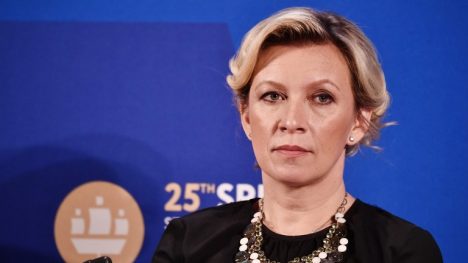
RT | November 9, 2022
US accusations that North Korea was supplying Russia with ammunition are lies, the spokeswoman for the Russian Foreign Ministry, Maria Zakharova, said on Wednesday. She added that Washington was just looking for a pretext to impose new sanctions on North Korea and made up the ammunition claim for that purpose.
“There was no clear explanation for these statements, nor could there be, because everything said by American representatives is a lie from the beginning to the end,” Zakharova said in a daily briefing, further describing the claim as “another example of [fake news] and speculations spread by the West about Russia.”
On November 2, the US National Security Council spokesman, John Kirby, announced that North Korea had sent a “significant” number of artillery shells for resupplying the military effort in Ukraine. CNN also reported the claim, citing US intelligence assessments.
North Korea denied the accusations on Tuesday. “We once again make clear that we have never had ‘arms dealings’ with Russia and that we have no plan to do so in the future,” said the Defense Ministry in Pyongyang, accusing the US of “persistently spreading a groundless rumor.”
US claims about North Korean ammunition supplies to Russia date back to September. In response, Russia’s ambassador to the UN, Vassily Nebenzia, demanded in the Security Council that the US and UK provide evidence of their claims, or be considered peddlers of fake news.
Meanwhile, the US has supplied Ukraine with weapons, ammunition, and assorted military equipment valued at over $54 billion since the hostilities escalated in February. Most of its NATO allies have followed suit, all the while insisting they were not a party to the conflict.
Last month, Czech media reported that Washington was looking to buy $3 billion worth of anti-aircraft missiles and artillery ammunition from South Korea. When Russian President Vladimir Putin mentioned that report at the Valdai Discussion Club, South Korea denied it.
“We’ve provided humanitarian and peaceful assistance to Ukraine but never lethal weapons,” said South Korean President Yoon Suk-yeol, adding that his country is “trying to maintain peaceful relations with all countries around the world, including Russia.”
Western Intelligence Services Played Key Role in Staging Mass Riots in Iran: Moscow
Samizdat – 09.11.2022
MOSCOW – Western intelligence services played a key role in organizing mass riots in Iran and spreading further disinformation about the situation in the country, Russian Security Council Secretary Nikolai Patrushev said on Wednesday.
“We note the key role of Western intelligence services in organizing mass riots in Iran and the subsequent dissemination of misinformation about the situation in the country through the Persian-speaking Western media controlled by them. We perceive this as blatant interference in the internal affairs of a sovereign state,” Patrushev said at a meeting with Supreme National Security Council (SNSC) of Iran Ali Shamkhani in Tehran, as cited by the Rossiyskaya Gazeta newspaper.
On September 16, a series of protests against the current political regime of Iran broke out throughout the country. Riots were ignited by the reports of the death of a 22-year-old Mahsa Amini, who had been arrested by morality police for wearing a hijab improperly.
Amini was detained by Iran’s morality police in Tehran on September 13 for wearing an “improper” hijab, an offense punishable by prison. The woman was sent to one of the FARAJA centers belonging to the police department and military intelligence for an explanatory conversation. In the center, Amini reportedly had a heart attack, after which she was immediately taken to hospital where the young woman passed away on September 16.
Tehran said that the weeks-long mass riots were planned from abroad and summoned the ambassadors of the United Kingdom, Norway, and the charges d’affaires of France in Iran in late September. The European diplomats were given a note of protest in connection with anti-Iranian media reports and calls to overthrow the Iranian government.
The West bullies Iran, again
BY M. K. BHADRAKUMAR | INDIAN PUNCHLINE | NOVEMBER 7, 2022
The manner in which Tehran handled its drone deal with Russia has been somewhat clumsy. The fact that the first ‘leak’ on this topic originated from none other than President Biden’s National Security Advisor Jake Sullivan should have alerted Tehran that something sinister was afoot.
Instead, for whatever reasons, Tehran went into a flat denial mode. And now in a turnaround, we are given to understand that Iran’s denial was factually correct, albeit not wholly true in content. Foreign Minister Hossein Amirabdollahian has acknowledged that the “drone part is true, and we provided Russia with a small number of drones months before the Ukraine war.”
The minister added the caveat that “This fuss made by some Western countries, that Iran has provided missiles and drones to Russia to help the war in Ukraine — the missile part is completely wrong.”
Howsoever good Iran’s drone technology might be, it has not been a game changer for Russia in the war in Ukraine. Russia’s own missile capability is surprising even the western experts who had predicted months ago that it was “running out” of its inventory. In fact, the missile strikes may continue until Ukraine collapses and the West has no meaningful interlocutor left in Kiev’s rubble.
Russia and Iran seem to have got mired in a controversy unnecessarily. What seems to have happened is that just as Iran did reverse engineering on US’ drone technology, Russians also did a good job to remake the Iranian kamikaze drones that were in its inventory prior to the special military operation in Ukraine. Kiev now says, after examining the debris of the Russian drones that it shot down, that they had Ukrainian parts, too!
It stand to reason that the Russian defence industry picked something from Iran’s technology, something else from Ukraine’s, and came up with a startling “Russian model”. That probably explains the sophistry in Moscow’ consistent stance that it didn’t use Iranian drones.
Amirabdollahian revealed that Iran offered to explain the situation to Ukrainian authorities and a meeting was even set up in Poland to clear the misunderstanding and restore Iran’s diplomatic ties with Kiev, but the Americans got it scuttled. Evidently, the US is not interested in a normalisation of Ukraine-Iran relations. Israel too would have an interest in keeping Iran at arm’s length from Kiev. The US and Israel would apprehend that a strong Iranian diplomatic presence in Kiev might work to Russia’s advantage.
Be that as it may, Amirabdollahian’s candid admission will have consequences. Iran possibly got carried away by the exhilarating feeling that a superpower stooped to source its military technology, and furthermore, relished the high publicity its drones received — not to mention the embarrassment caused to Ukraine’s western patrons who watched helplessly when the Russian drones created panic on such a scale.
However, belatedly, Iran realised the potential political and diplomatic fallout. In reality, all this “fuss,” as Amirabdollahian put it, stems from Tehran’s refusal to sign the EU draft nuclear agreement at Vienna, which infuriated Brussels and Washington, dashing their hopes that Iranian oil would come to the rescue of Europe by replacing the Russian oil imports that are being terminated w.e.f December 5.
Again, Iran’s increased oil production was what the US was counting on to introduce tensions within the OPEC and split the cartel.
According to a Spiegel report, Germany and eight other EU states have put together a new package of sanctions against Iran in Brussels on Wednesday, which contains 31 proposals targeting officials and entities in Iran connected with security affairs as well as companies, for their alleged “violence and repressions” in Iran. The alibi is human rights violations.
Evidently, the West has reverted to its bullying tactic. President Biden has pledged to “free Iran” from its present political system — although the Americans know from past experience that public protests are nothing unusual for Iran but regime change remains a pipe dream.
Why is the West resuscitating the “Iran question” at this point? There are two underlying reasons — perhaps, three. One is, Benjamin Netanyahu’s victory in the Israeli election last Sunday virtually guarantees that Israel’s existential rivalry with Iran is once again in the centre stage of West Asian politics. Without that happening, Netanyahu will come under pressure to address the core issue in West Asia, namely, the Palestinian problem.
As things stand, the “Iran question” will return to the centre stage of West Asian politics. There is a congruence of interests between Tel Aviv and Washington on that score at a time when there is going to be some friction inevitably in US-Israel relations, as the racist anti-Arab Religious Zionism alliance, Netanyahu’s latest coalition parters, contains elements that the US once regarded as terrorists. Whipping up a frenzy over Iran comes in handy for both Israel and the US.
But on the other hand, Netanyahu is realistic enough to know that it will be suicidal for Israel to attack Iran militarily without American support and second, that the Biden Administration has not yet entirely given up hope on a nuclear deal with Iran.
Therefore, in the event of the midterms radically changing the profile of Congress to the detriment of the Biden Administration, trust Netanyahu to insert the Iran nuclear issue as a key template of US domestic politics and the US-Israel relations.
A second factor is the trajectory of the war in Ukraine. Although the proxy war is in the home stretch and the US and NATO are staring at the defeat and destruction of Ukraine, the Biden Administration cannot simply walk away in humiliation, since this is Europe and not the Hindu Kush, and the fate of the western alliance system is at a crossroads.
Most certainly, US troops have appeared on Ukrainian soil and they can only be regarded as an “advance party.” Will Ukraine turn out to be another Syria, with the regions to the west of the Dnieper River — “the Rump” denuded of natural resources — coming under US occupation so that its NATO allies in the periphery do not jump into the fray of dormant ethnic tensions inherited from history to carve out their pieces out of the carcass? Or, will a US-led “coalition of the willing” be preparing to actually fight the Russian forces in eastern and southern Ukraine?
Either way, the point is, the strategic ties developing between Iran and Russia will remain a focal point for the West, Amirabdollahian’s “clarification” notwithstanding. It is only natural that in the conditions under sanctions, Russia’s external relations are in the cross-hairs of the US. Iran has a stellar record of rubbishing the “maximum pressure” strategy.
Put differently, having Iran as an ally will be a strategic asset for Russia in a multipolar setting. Iran and the Eurasian Economic Union have decided to negotiate a Free Trade Agreement while Tehran is also working out swap deals involving Russian oil. Simply put, Europeans can keep their SWIFT for whatever it is worth and that is not going to make any difference to Russia or Iran — and the rest of the world is watching this happening in real time, especially in Iran’s neighbourhood where oil is traded in dollars.
By now it is also clear to the US and its allies that JCPOA or no JCPOA, the overarching tilt toward Russia and China is Tehran’s version of the Israeli Iron Dome, in diplomacy. The bottom line is that Iran is becoming a role model for the Persian Gulf region, as is evident from the queue lengthening for membership of the Shanghai Cooperation Organisation, even as the parallel track of the Abraham Accords has disappeared in the endorheic basin of the Arabian Peninsula.
Research: Countries That Sought ‘Zero-COVID’ Lockdowns Have The Least Immunity

Kevin Frayer/Getty Images
By Steve Watson | Summit News | November 4, 2022
New research has revealed the countries that implemented the harshest lockdowns as part of ‘zero-COVID’ policies now have the least immunity from the virus itself.
The analysis by The Institute of Health Metrics and Evaluation (IHME) at the University of Washington’s School of Medicine estimates that China, which still has multiple lockdowns in place, has the lowest level of immunity to COVID-19 on the planet.
Other nations that didn’t institute harsh lockdowns, including Russia, Singapore and Brazil are thought to have the highest immunity levels, according to the research.
The research estimates immunity rates according to infection numbers, vaccination rates and how much time has passed in the interim.
The analysis posits that as of the end of October 2022, just 17.2% of the Chinese population have immunity from the virus, while Russia on the other hand is estimated to have an immunity rating of 74.5% with everyone in the country having contracted the virus.
While Singapore’s immunity rating is thought to be around 70%, and Brazil’s 68%, Japan, another country that put into place harsh restrictions is believed to have just 38.9% immunity.
The U.S. is believed to have 60.5% immunity at this time, according to the analysis.
Ironically, given the IHME’s COVID model being used to laud strict restrictions, the analysis again highlights the futility of lockdowns in preventing the spread of the virus in the longterm.
Johns Hopkins University previously concluded that lockdowns have had a much more detrimental impact on society than they have produced any benefit, with researchers urging that they “are ill-founded and should be rejected as a pandemic policy instrument.”
A Centers for Disease Control and Prevention report released last month highlighted how a record number of children in the U.S. are now being hospitalised with common colds due to weakened immune systems.
The CDC data is consistent with research by scientists at Yale who warned that it is not normal to see children with combinations of seven common viruses, including adenovirus, rhinovirus, respiratory syncytial virus (RSV), human metapneumovirus, influenza and parainfluenza, as well as COVID-19.
As we previously highlighted, there has also been a global outbreak of hepatitis cases in children, with the media asserting the cause is “unknown.”
Biden administration officials have continuously pushed for children to keep wearing masks in schools, and there are still hordes of hypochondriacs forcing their children to do so, despite COVID posing virtually no risk to the health of children in normal circumstances.
The European Medicines Agency’s (EMA), Europe’s equivalent of the FDA, has also warned that relying on endless rounds of booster shots to fight COVID-19 could end up causing “immune response” problems.
Russia Says “Top Priority” Is To Avoid Nuclear Clash, Reiterates Purely Defensive Use
By Tyler Durden | Zero Hedge | November 2, 2022
Russia on Wednesday warned that the world’s “top priority” should be the nuclear-armed super powers avoiding confrontation at all costs or else this would lead to “catastrophic consequences.”
“We are firmly convinced that in the current difficult and turbulent situation — a consequence of irresponsible and shameless actions aimed at undermining our national security — the top priority is to prevent any military clash of nuclear powers,” a Foreign Ministry statement said.
While not naming its chief nuclear-armed rivals the United States or the United Kingdom specifically, the Kremlin called on all other nuclear states to “abandon dangerous attempts to infringe on each other’s vital interests.”
The statement reiterated a key tenet of Russia’s official nuclear doctrine, saying, “Russia is strictly and consistently guided by the tenet that a nuclear war cannot be won and must never be fought.” It reemphasized a nuclear doctrine that is “purely defensive in nature” – which only allows deployment of nuclear arms “when the very existence of our state is threatened.”
In a statement early last month, President Joe Biden expressed that he doesn’t think Russia’s Vladimir Putin will use nuclear weapons in Ukraine. “Well, I don’t think he will,” Biden previously said in a CNN interview. “But I think that it’s irresponsible for him to talk about it.”
Also on Wednesday The New York Times has published some hugely significant claims…
Senior Russian military leaders recently had conversations to discuss when and how Moscow might use a tactical nuclear weapon in Ukraine, contributing to heightened concern in Washington and allied capitals, according to multiple senior American officials.
President Vladimir V. Putin was not a part of the conversations, which were held against the backdrop of Russia’s intensifying nuclear rhetoric and battlefield setbacks.
But the fact that senior Russian military leaders were even having the discussions alarmed the Biden administration because it showed how frustrated Russian generals were about their failures on the ground, and suggests that Mr. Putin’s veiled threats to use nuclear weapons might not just be words.
According to follow-up reporting in CNN, the alleged Kremlin discussion among top officials of using tactical nukes against Ukraine is based on a US intelligence assessment.
But importantly, CNN cites that there remain dissenting opinions within the US intelligence community. CNN’s reporting begins, “Russian military officials have discussed how and under what conditions Russia would use a tactical nuclear weapon on the battlefield in Ukraine, according to a US intelligence assessment described to CNN by multiple sources who have read it.”
“The assessment, drafted by the National Intelligence Council, is not a high confidence product and is not raw intelligence but rather analysis, multiple people who have read it told CNN,” the report continues, before emphasizing: “For that reason, some officials believe the conversations reflected in the document may have been taken out of context, and do not necessarily indicate that Russia is preparing to use a nuclear weapon.”
It is a significant and eye-brow raising moment when CNN spotlights the likelihood of intelligence ‘cherry picking’ in a story which relates to Russia, which indeed casts serious doubt on the original NYT Times reporting and claims by unnamed US intelligence officials.
UN Security Council votes against probe into US biolabs
Samizdat – November 3, 2022
The UN Security Council has rejected Russia’s call for an international investigation into claims that the US used laboratories in Ukraine to develop biological weapons.
While China backed Russia’s proposal, the US, Britain, and France voted against it, and the ten rotating council members abstained.
Russia insists that the US and Ukraine have been violating the 1972 international convention that bans the development, production, and stockpiling of biological weapons. According to Moscow, several laboratories in Ukraine were working on a secret “military-biological” program, which involved studies and the stockpiling of samples of anthrax, cholera, and other infectious diseases.
Washington and Kiev both deny developing biological weapons. Ukrainian President Vladimir Zelensky said in March that the laboratories were conducting “ordinary scientific research.”
During the vote in the Security Council on Wednesday, US envoy, Linda Thomas-Greenfield, argued that the Russian proposal for a probe is “based on disinformation, dishonesty, bad faith, and a total lack of respect for this body.”
Thomas-Greenfield reiterated that the activities under the Pentagon’s Cooperative Threat Reduction (CTR) program in Ukraine and other former Soviet states “are not for military purposes.”
The US Mission to International Organizations in Geneva, Switzerland said in April that the CTR’s goal in Ukraine was to help the country “consolidate and secure pathogens and to continue to ensure Ukraine can detect and report disease outbreaks before they pose security or stability threats.”
Dmitry Polyansky, Russia’s deputy envoy to the UN, meanwhile, said he was “deeply disappointed” by the vote. He said “the Western countries are simply afraid” of an international investigation into the issue.
Moscow Has Info on UK’s Transfer of Unmanned Underwater Drones to Kiev Ahead of Sevastopol Attack
Samizdat – 03.11.2022
The Foreign Ministry summoned Britain’s ambassador to Russia on Thursday in connection with last week’s Ukrainian attack targeting Russian military and civilian vessels in Sevastopol. The act of terrorism prompted Moscow to temporarily freeze its participation in the Black Sea grain export deal with Kiev.
Moscow summoned British Ambassador to Russia Deborah Bronnert in connection with London’s suspected involvement in the October 29 attack on the Russian Black Sea Fleet, the Foreign Ministry has revealed.
In a statement, the Ministry indicated that it had information that London transferred a number of unmanned underwater drones to Kiev, and that British specialists have been actively involved in the training and supply of Ukrainian special operations forces, including those involved in sabotage operations at sea.
Moscow warned that Britain’s actions threaten to escalate the security crisis and lead to “unpredictable and dangerous consequences,” and that such “hostile provocations” on London’s part were “inadmissible” and must be stopped immediately.
“If such acts of aggression, fraught with [the UK’s] direct involvement in the conflict, continue, the entire responsibility for their disastrous consequences and the growth of tensions in relations between our states will lie entirely on the British side,” the Foreign Ministry said.
The Russian Black Sea Fleet port of Sevastopol repelled a massive drone attack on October 29, shooting down multiple UAVs and remote-controlled surface vessels in Sevastopol Bay. According to Russia’s Defense Ministry, the warships attacked included ships providing security for the so-called ‘grain corridor’ – the secure maritime route agreed by Moscow and Kiev this summer through which cargo vessels carrying grain from Ukrainian ports through the Black Sea for export abroad.
The Russian military later retrieved drone wreckage from the sea floor to examine the remains, finding Canadian-made navigation modules installed on the maritime drones. Preparations for the drone attack were carried out under the guidance of British specialists in the Ukrainian port city of Ochakov, according to the Russian MoD. Russia destroyed a multi-million pound British-built and financed military base in Ochakov in a missile strike in February during the opening stages of its military operation in Ukraine.
The Sevastopol attack is the second time in weeks that Moscow has called out London on terrorism-related charges. Last week, Russia’s Defense Ministry concluded that the Royal Navy took part in the planning, organization and execution of the late September attacks on the Nord Stream natural gas pipeline network.
On Tuesday, Russian Foreign Ministry spokeswoman Maria Zakharova asked London to explain the mysterious “It’s done” iPhone text message reportedly sent by now former Prime Minister Liz Truss to US Secretary of State Antony Blinken just moments after Nord Stream was struck.
Earlier this year, Ukrainian and Western media reported that Moscow and Kiev appeared to be on the brink of a peace agreement this spring, but that (now former) British Prime Minister Boris Johnson was quickly dispatched to the Ukrainian capital to scuttle any potential agreement.
Featured Video

Death Spikes & Rising Cancer In Our Youth Explained
or go to
Aletho News Archives – Video-Images
From the Archives
Politicians lie
By Mazin Qumsiyeh | Popular Resistance | August 18, 2013
There is no way to say this truth nicely: Politicians lie. That includes Japanese, American, Egyptian, Israeli, and Palestinian politicians! Is there something more common sense than that? Yet, so many citizens around the world believe their own politicians or wistfully acknowledge lies but think it is part of the job needed to run things. They believe even when politicians contradict themselves blatantly. This phenomenon is rather remarkable. It is a dissonance and disconnect from reality that many seem oblivious to. It is very dangerous because it can lead to accepting rationales for going to war. These can be deadly wars that lead to millions of lives lost as happened in what was called World War 1 and WW2. Even when incredible and declassified evidence abound, politicians continue to lie and old mythologies refuse to die. Here are just a few of the countless lies told to us over the past few decades… continue
Blog Roll
 Aletho News
- RSF military group defects, joins Sudanese army: State media
- Ireland goalkeeper refuses to play ‘Israel’ as squad weighs boycott
- China pushes back against US on Cuba, Iran
- Ukrainian Soldiers, Potential Mercenaries: Have Gun, Will Travel!
- Burnham’s UN debut… A masterclass in British disinformation
- Iran flights continue despite US aviation sanctions
- Global Tipping Points Lead the World Into a State of Entropy
- The day-after at the White House: USA and Xi Jinping
- The Geopolitical Balance in the Red Sea: The UAE Being Displaced by New Players
- Iraqi resistance group vows to stage airport sit-ins over Iran aerial blockade
- If Americans Knew
- Deconstructing Netanyahu’s pants-on-fire UN rant – Daily Update
- Trump betrayed voters with his campaign lies and prioritized a foreign country once he took office
- Netanyahu calls Israel’s war in Gaza ‘opposite of genocide’ in UN speech to near-empty hall
- Settler Kidnappings: Torture, Sexual Abuse and Terrorisation of Palestinian Abductees as Israel Deepens Annexation of West Bank
- Gaza winter nears as 162,000 tents become unusable, raising fears of humanitarian crisis
- Netanyahu says, “It’s the opposite of genocide”; UN says Gaza economy is world’s ‘most severe crisis on record’ – Daily Update
- Israel’s US-Backed Assault on Gaza Has Created the ‘World’s Most Severe Economic Crisis on Record’: UN
- ‘Protecting U.S. Citizens’… From Israel
- ‘This is where I live now, the back of a truck’: a day in the life of a grandmother in Gaza
- In UN Speech, Iran’s President Displays Pictures of Children Killed by US, Brings Attention to Israel’s Nuclear Arsenal
- No Tricks Zone
- New Study: Earth And Venus Surface Warmth Largely Explained By Convection And Lapse Rate, Not CO2 Or Radiation
- 2025 Nature Paper Claiming Worsening Global Drought Gets RETRACTED …Heavily Flawed
- New Study: ‘Global Drought Shows No Detectable Recent Acceleration Under Climate Warming’
- Economic Masterminds: German Socialists Suggest Taxing Productivity Gains Stemming From Using AI
- The South China Sea Has Not Been Cooperating With The Climate Change Narrative
- Energy Crisis: Germany Enters Heating Season With Historically Low Gas Reserve Fill Levels
- New Study: The Antarctic Ice Sheet Gained Mass From 2020-2024 Due To Staggering Snow And Ice Accumulation
- Study: Ocean Heating Rates From Thousands Of Years Ago ‘Dwarf’ Modern Ocean Heating Rates
- Climate Extremists Target, Attack Large-Scale Power Grid Infrastructure In Germany!
- New Study: Antarctic Ice Melt Has Contributed Less Than 1 Centimeter To Sea Level Rise In The Last 30 Years

