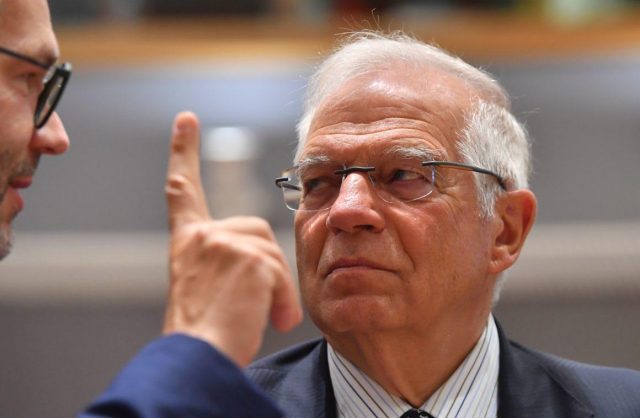
For Josep Borrell, Russia will remain a ‘mystery inside an enigma’
By Johanna Ross | February 9, 2021
It’s been a quotation cited repeatedly to describe the difficulties faced by western policy-makers towards Russia. Winston Churchill famously said the country was ‘a riddle wrapped in a mystery inside an enigma’. Back in 1939, when he broadcast this speech, just as Britain had declared war on Germany, Churchill said that he thought he had the ‘key’ to unlocking the secret of Russian foreign policy and that was, he said, ‘Russian national interest’.
I assume that Josep Borrell, the EU’s high representative for foreign affairs and security policy, who visited Moscow last Friday, is familiar with this quotation. And it seems that for him, Russia has remained something of a mystery. For upon his return to Brussels, after what his European colleagues have termed a ‘humiliating’ trip (they are now demanding his resignation), Borrell wrote a blog post outlining what was essentially his complete failure to engage with his Russian counterpart. “My meeting with Minister Lavrov highlighted that Europe and Russia are drifting apart”, he wrote in a piece published on Sunday evening. “It seems that Russia is progressively disconnecting itself from Europe.”
What is surprising for the Russians, is the absolute inability of these European policy-makers to read and comprehend the Russian position. Western diplomats in this regard seem to be diplomatically autistic. And far from taking tips from Russian political analysts and think-tanks, they turn to the same pseudo ‘Russia-experts’ and western academics, the majority of whom churn out age-old anti-Russian rhetoric like a broken record. As Professor Stephen Cohen once told me:
‘The idea that we have to fight Russian disinformation is now very profitable in the US; everybody will give you money. And if you don’t have a particularly big brain, it’s a good way to pretend you’re an intellectual and get paid for it.’
As a consequence, we are sadly no further in unravelling the ‘mystery inside the enigma’.
Churchill was close to the truth when he said that ‘Russian national interest’ was a key factor in understanding Russia – but that’s hardly a secret. Every country acts according to its national interest. What is lacking, particularly at the moment from western policy makers, is the ability to treat Russia according to how they themselves expect to be treated. Like a naughty schoolboy, Russia and its leader are constantly being lectured on how to behave. The problem is, the ‘adults’ – in this case the West – are guilty of the same offences that Russia is being accused of. As Vladimir Putin noted during his speech at the Munich security conference in 2007:
‘Incidentally, Russia – we – are constantly being taught about democracy. But for some reason those who teach us do not want to learn themselves.’
Unfortunately, nothing has changed, and the hypocrisy still stinks.
Borrell’s visit is also a classic example of Europeans saying one thing to Russia’s face and another behind its back. For the statements Borrell made after his return to Brussels, as Russian Foreign spokesperson Maria Zakharova remarked on Monday, do not correspond with comments he made when in Moscow. Zakharova expressed surprise at the diplomat’s negative summary of the trip and suggested that his colleagues had influenced him on arrival. But I would add that it is a regular occurrence that western politicians are two-faced when it comes to dialogue with Russia, and that they often place less emphasis on the value of verbal agreements. Take for example the promise of US Secretary of State James Baker to Soviet leader Mikhail Gorbachev back in the 1980s that NATO would not expand eastward. For the Russians that assurance meant something, as it is frequently quoted by them to this day; for the Americans it clearly didn’t. Since then NATO has proceeded to encircle Russia to the east.
The reality is that Russia is not going to be dictated to on human rights and freedoms when they are currently being curtailed in the West. It’s not going to be told that opposition protesters are being mal-treated when demonstrators in the US and Europe are regularly manhandled by police. It’s not going to be bullied into releasing Alexei Navalny – a politician with a criminal conviction – when the US and Europe have their own political prisoners, the most famous being Julian Assange. And it’s not going to be harassed about press freedoms when the majority of the western mainstream corporate media play the role of government mouthpieces. Russia is a sovereign nation and won’t be told what to do.
For Borrell et al. this is a problem. Therefore a stalemate has been reached in EU-Russian relations. Borrell seems resigned to the fact that there will be little improvement in relations in the near future. This is unfortunate, because it is not something that Russia has wanted. Even as recently as last month, when speaking at the Davos Economic Forum, Vladimir Putin said that Europe and Russia were ‘practically one civilisation’. And yet there is a fundamental difference in mentality which proves impossible to overcome.
It is in Europe’s and the West’s interest, however, to try better to engage with Russia on a level playing field, without taking the moral high ground. Global security and stability are at stake. In addition, Europe currently depends on Russian gas, and will likely always be reliant to some degree on Russia’s vast expanse of natural resources. As renowned academic Andrei Tsygankov has aptly summarised in his book ‘Russia’s Foreign Policy’:
‘Russia is sufficiently big and powerful, and that limits Western ability to influence its developments. Vast territory, enormous natural resources and military capabilities, and a significant political and diplomatic weight in the world have allowed and will continue to allow Russians considerable room for foreign policy maneuvering. It is hard to believe that the West will ever possess enough power to fully determine the shape and direction of Russia’s developments.’
If only Josep Borrell had read this book before he went to Moscow…
Johanna Ross is a journalist based in Edinburgh, Scotland.
India needs course correction on Myanmar
By M. K. BHADRAKUMAR | Indian Punchline | February 7, 2021
The Modi government made a strident call on February 1 that the “rule of law and the democratic process must be upheld” in Myanmar. The statement, following a prodding from Washington, was unabashedly intrusive, and, ironically, completely overlooking that human rights, rule of law, democratic pluralism, etc. are universal values that India also can (and should) be held accountable for. Lapping up the neocon prescriptions from Washington may not serve India’s interests, in general, and they are very specific to Myanmar.
The government failed to fathom the US’ motivations in riding the high horse of democracy so soon after the Capitol Riots in Washington, DC. Human rights issues come handy for Washington to rally allies at a juncture when its leadership of the transatlantic alliance is in drift and major European powers do not see eye to eye with its global strategies on Russia and China and mock at its nostalgia-laden slogan that “America is back.”
Alas, the government failed to consult the ASEAN despite Delhi’s refrain that it attributes “centrality” to that grouping.
The ASEAN Chair’s statement of Feb, 1 recalled the “purposes and the principles enshrined in the ASEAN Charter” which include respecting the principles of sovereignty, equality, territorial integrity, non-interference, consensus and unity in diversity.”
The ASEAN Chair’s statement of Feb, 1 recalled the “purposes and the principles enshrined in the ASEAN Charter.” Simply put, India chose to bandwagon with the US, Japan and Australia while the ASEAN and China took a differentiated stance. Geopolitics crept in. But the US has since realised the folly and National Security Advisor Jake Sullivan scrambled to contact the ASEAN ambassadors in Washington.
How come Delhi goofed up? Primarily, it is due to a flawed understanding of the Myanmar situation. The Indian analysts increasingly view world developments through their China prism and began fancying that with the massive victory of Aung San Suu Kyi in the November election provided an opportunity for India to “gear up to implement a major strategy with Myanmar under its ‘Neighbourhood First’ policy… to bring Myanmar under the Indo-Pacific construct” so as to align that country “more with ‘like-minded’ countries… to stand firm against China… to make Myanmar a part of the Indo-Pacific policy… (and) steer Myanmar away from the Chinese grip.”
Such views betray a zero sum mindset borne out of blind Sinophobia. Whereas, the ground realities are much more complex. The point is, Beijing brilliantly succeeded over the years in building a close relationship of mutual trust and mutual respect with Suu Kyi, parallel to the nurture of links between the Chinese Communist Party and her party National League for Democracy.
Unlike the western narrative of Aung Suu Kyi as Myanmar’s democracy icon, Beijing regarded her as a pragmatic politician who never uttered remarks to the detriment of China-Myanmar ties, was manifestly eager to maintain good relations and consistently adopted a soft stance on the South China Sea issue.
Beijing was greatly impressed that although Suu Kyi wanted Western support, she was adamant about national sovereignty. Arguably, it was in sync with what China would like its neighbours to practice. Chinese President Xi Jinping received Suu Kyi seven times since 2015.
State Counselor Wang Yi visited Myanmar recently on Jan. 12, met Suu Kyi and expressed strong support for her government and conveyed a strong commitment that China wants to work with her during the second term. And they agreed to push ahead with Belt and Road projects and lock in a five-year pact on trade and economic cooperation. Clearly, the prospect for the China-Myanmar Economic Corridor under Belt and Road Initiative has become uncertain now, as compared to a month ago.
In fact, the Chinese media reports already sound a word of caution that “Chinese companies operating in Myanmar need to watch out for contractual and default risks amid the current political upheaval… Government default is a major risk, especially for major and strategic projects in sectors including transportation and energy… But Chinese companies can seek international arbitration if they face illegal confiscation of their property.”
It is no secret that the Myanmar army marks a certain distance from China. Suffice to say, Myanmar developments present an extraordinary case study where Beijing silently feels distressed over the sudden eclipse of western style democracy in a neighbouring country. (See the Reuters analysis Myanmar coup does China more harm than good.)
Surely, the coup creates political baggage for China insofar as it cannot (and will not) take a position against the military, but also comes under compulsion to cover or provide protection for the military internationally. On the whole, this situation poses a major political and diplomatic liability for Beijing and cannot bring good news. Therefore, China prioritises that the concerned parties to solve their differences mutually, according to the constitution and within the legal framework, while maintaining peace and stability. Chinese expert opinion is that Suu Kyi’s political career is in jeopardy.
Of course, Suu Kyi made some serious errors, too. She heavily depended on people loyal to her personally, without bothering about their competence or integrity. It not only spawned corruption but also led to government failure to deliver, especially in job creation. Her leadership style was often dictatorial. She resorted to draconian laws to muzzle or jail critics. (See the Singapore-based Channel News Asia video titled Aung San Suu Kyi: A Fading Legacy dated October 22, 2020 on the eve of the November elections.)
Suu Kyi had no control over some major sectors of the national economy through two entities, Myanmar Economic Holdings Limited and Myanmar Economic Corporation as well as a network of domestic private business enterprises, known as “crony companies,” which generate revenue for the military and strengthen its autonomy.
Suu Kyi’s biggest mistake was in believing that she could, through her brand of nationalism, dismiss accusations of genocide directed against the Rohingya. In the process, Suu Kyi lost western support. From that point, she has been on borrowed time and the military barely hid its distaste for Suu Kyi.
To be sure, the military anticipated the impact and the reaction from the international community and took into consideration the Biden administration’s preoccupations with domestic issues. Myanmar doesn’t even figure in the top 10 priorities of Biden’s foreign policy. But the US Congress is not going to tolerate a coup in Myanmar and will mount pressure on the Biden administration to punish the military by imposing sanctions, cutting aid or targeting the generals and their companies.
However, a reversal of the military takeover is not to be expected and the probability is that Washington may lose whatever little leverage it would have had in Naypyidaw. Washington is mulling over policy options.
But there may be a Plan B. Indeed, the former US Ambassador to the United Nations Bill Richardson, who is no stranger to Myanmar, voiced the opinion last week that the time has come for the West to look beyond Suu Kyi for new faces among the opposition. One way is to mould a leadership that will be friendly to the US. There are signs that the western agencies are inciting the youth in Myanmar to stage protests, as had happened in Hong Kong and Thailand. The military has clamped down on Facebook and internet. Shades of colour revolution?
This is where Russia’s role merits attention. The struggle for influence in Myanmar has a geopolitical dimension, for obvious reasons. Since 2015, following the signing of a military cooperation agreement, Russian presence has increased, and, importantly, it coincides with the lengthening shadows of Russian presence in the Indian Ocean.
Russia has emerged as a major military partner for Myanmar. Russia operates a servicing centre in Myanmar. The Russian Deputy Defense Minister Alexander Fomin told the media last month that Myanmar plays “a key role in maintaining peace and security in the region.”
It is entirely conceivable that Russia, which has great expertise in countering colour revolutions, shares intelligence with the Myanmar military. Over six hundred military officers from Myanmar are studying in the Russian military academies presently. Myanmar’s military chief Min Aung Hlaing visited Russia six times in the recent years, more than to any other country.
During the visit of Defence Minister Sergei Shoigu to Naypyidaw last month, the Russian media quoted Gen. Hlaing as saying, “Just like a loyal friend, Russia has always supported Myanmar in difficult moments, especially in the last four years.” An agreement was signed for supply of a batch of Russian missile and artillery air defense systems Pantsir-S1.
Tass reported that the “command of Myanmar’s armed forces has shown interest in other advanced weapon systems of Russian manufacture.” Shoigu has reportedly expressed interest to establish visits of Russian warships to Myanmar’s ports.
All things taken into consideration, we may expect China and Russia to provide a firewall for Myanmar to ward off western penetration, as is happening in Central Asia. (The UN Security Council statement avoids any reference to the military or a coup as such in Myanmar and lays emphasis on national reconciliation, with pointed reference to Suu Kyi’s release.) Russia shares China’s perception of Quad as a destabilising factor in regional security.
Clearly, India needs to keep the “big picture” in view. It will not be to India’s advantage to create misperceptions that it is bandwagoning with some neocon Anglo-American project for regime change in Myanmar. In regard of Myanmar’s stability, India too is a stakeholder and would have a convergence of interests with Russia and China.
Western pundits believed post-Maidan Ukraine would serve as an ‘example’ for Russia – in reality, it’s become a cautionary tale
By Paul Robinson | RT | February 6, 2021
Many Russian liberals and foreign pundits saw Ukraine’s 2014 ‘Maidan’ as an event that would inspire change in Moscow. Today, as an increasingly dysfunctional Kiev clamps down on free speech, it looks more like a cautionary tale.
In May 2014, newly elected Ukrainian President Petro Poroshenko promised that he would rapidly bring peace to his country. “The anti-terrorist operation cannot and should not last two or three months. It should and will last hours,” he said.
Nearly 60,000 hours later, the war into which the badly named “anti-terrorist operation” morphed is still going on. Poroshenko’s successor Volodymyr Zelensky similarly promised to bring the fighting to an end. “My main goal… is that I want to end the war. This is my mission within these five years,” he told journalists. But he has been equally unsuccessful.
Zelensky resoundingly defeated Poroshenko in the 2019 presidential election, in which the incumbent won a plurality of votes only in the far west of the country. By portraying himself as a candidate not only of peace, but also of national unity, Zelensky was able to attract the votes of a large number of Russian-speaking Ukrainians in the south and east of the country who had been alienated by Poroshenko’s increasingly nationalistic tone.
Unfortunately, since then Zelensky has betrayed those voters time after time.
Not only has he failed to take any of the steps required to bring the war to an end – most notably, the concessions demanded in the 2015 Minsk II agreements – but his government has also further suppressed the language rights of Ukrainians and is now clamping down on the opposition media.
In January 2020, liberal Russian pundits lined up to praise Zelensky’s new year’s speech. Zelensky was said to have promoted an image of national unity, seeking to overcome linguistic and other differences which had been accentuated by his predecessor’s nationalist policies. “It doesn’t matter what your street is called as long as it is clean and asphalted,” said Zelensky, in a line which seemed to suggest that his government would bring an end to the habit of changing street names from those of communist heroes to those of nationalist icons like Stepan Bandera.
In fact, it hasn’t. Not only has Zelensky failed to provide clean and asphalted streets, but it’s since become clear that what he really meant was not that he would bring an end to forcible Ukrainization, but that Russian speakers should just shut up and stop complaining about it, since, after all, none of that stuff actually “matters.”
Thus, Zelensky has done nothing to reverse the 2019 law on official languages, which sharply restricts the use of Russian. Most notably, on January 16 a new rule came into effect which obliges all service providers (shops, restaurants, etc.) to offer their services in Ukrainian by default. Meanwhile, censorship in Ukraine has reached new levels of silliness, prohibiting for instance a book about the Vikings by an American author because it referred to ancient Kievan Rus’ as “Russia.”
Now Zelensky has gone even further, banning three television stations owned by opposition politician Taras Kozak, on the grounds that they are spreading Russian disinformation. Zelensky claims that he supports freedom of speech but not “propaganda financed by the aggressors.” “These media have become one of the tools in the war against Ukraine, so they are blocked in order to protect national security,” said Zelensky’s spokesperson Yuliia Mendel.
The fact that the ban comes at a moment when Zelensky’s popularity is plummeting, and when Kozak’s party Opposition Platform – For Life is leading in national opinion polls may be entirely coincidental. But then again it may not. The move smacks of political desperation.
It is also, of course, deeply undemocratic in character. Had former president Viktor Yanukovich, who was overthrown in the February 2014 Maidan revolution, ever attempted such a thing, Ukrainian liberals and their Western allies would have cried huge screams of outrage. Now, however, they are silent, or even supportive. The US Embassy in Kiev, for instance, issued a statement that it backed the measure as designed “to counter Russia’s malign influence.”
The US response reveals the shallowness of Western assertions that in backing the Maidan revolution and subsequent governments they are supporting democracy, human rights, and a liberal order. In reality, geopolitics seems to be the primary concern. As long as Ukraine remains resolutely anti-Russia, a blind eye will be turned to nearly any and all abuses of democratic principles.
And here’s where the situation becomes rather sad. In the immediate aftermath of the Maidan revolution, it was said that Vladimir Putin’s response was driven by fears that Western-style democracy in Ukraine would provide a positive model which would incite a similar revolution in Russia.
A typical analysis was that of Paul D’Anieri, professor of public policy at the University of California, Riverside, who wrote in 2015 that “the prospect was that Ukraine would, with the aid of the EU, begin turning itself around. If so, it could become an attractive model for Russians, and a very different model than the one Putin has been insisting is the only one available.”
This line continues to find supporters. For instance, in a gushing article for Al Jazeera, journalist Leonid Ragozin remarked that Zelensky’s 2020 new year’s speech showed that “Ukraine may finally be moving towards fulfilling the Kremlin‘s biggest nightmare – becoming a role model for progressive politics and democracy for Russians to look up to.”
Ragozin has it back to front, for the very opposite would appear to be the case. Commenting on recent protests in Moscow, Ollie Carroll, Moscow correspondent of the British newspaper, the Independent, asked why Russians weren’t reacting with the same sense of indignation as Ukrainians had when Yanukovich’s police attacked demonstrators in Kiev six-and-a-half years ago. Carroll implied that this meant that there was something defective about Russians’ moral values.
In reality, the answer could simply be that they’ve looked at Ukraine and decided that it isn’t a good example to follow.
Paul Robinson is a professor at the University of Ottawa. He writes about Russian and Soviet history, military history, and military ethics, and is author of the Irrussianality blog.
Russian Foreign Ministry Is Concerned About Political Persecution in the United States
The Saker | February 4, 2021
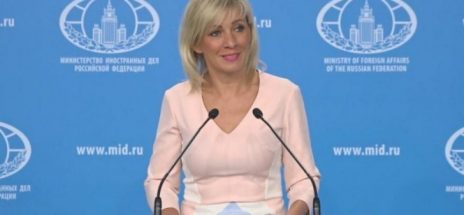
Moscow intends to hold a ‘serious conversation’ with Washington about the stars and stripes allegations of unauthorized actions in Russia.
The official representative of the Russian Foreign Ministry Maria Zakharova spoke about this at a briefing.
The American authorities, according to their words, will not be able to “divert public views, public opinion from their own problems” with their unbridled attacks on the Russian Federation: “We mean to keep this topic in sight and have a serious conversation with Washington. I assure you, the news won’t keep you waiting.”
“I would like to appeal to Washington. I predict: their protest will not dissipate by itself. Discontent will not work under the carpet. the authorities and the media obedient to them declare, a direct quote: ‘domestic terrorists.’ Doubts about the objectivity of the US law enforcement agencies are also raised by the fact that they are essentially acting in accordance with the political order and guidelines of the current administration, which declared the events of January 6 as a mutiny, and all who were near the congress that day are almost depicted as marauders. However, most of them are ordinary US citizens who are worried about the situation in their own country. And you know how many there are? 74 million voters. They voted for their president, as they believed necessary, they defended their beliefs,” – Zakharova emphasized.
“The United States has already announced so much lately that I want to remind them of what is happening in their country … An endless, unceasing increase in the degree of violence. This is what our partners need to pay attention to, the situation in their own countries, and not try to help rock the situation in our country,” she added.
An official representative of the Russian Foreign Ministry stated that human rights with the United States “are constantly and very hypocritically taken care of in relation to other countries, but they do not hesitate to ignore them at home.”
Zakharova is sure the United States will continue at attempts to interfere in the affairs of Russia. “But if the United States of America chooses the tactics of constant intervention in our internal affairs, which we are talking about and bringing facts, and these facts are not hard to find, they are on the surface, – we will be interested to see how they end up doing.”
Maria Zakharova – on the criminal prosecution of participants in the storming of the Capitol:
“It is of serious concern of the ongoing campaign in the United States of persecution of the participants in the so-called storming of the Capitol on January 6 and, in general, all those who disagree with the results of the last presidential elections, which the authorities and the media obedient to them, have declared ‘domestic terrorists.’
According to available informaiton, the FBI has opened over 400 criminal cases, requested more than 500 permits in the courts to search and summon suspects, and also brought charges and has already arrested about 200 people. Severe pressure is carried out, including the treatment of relatives, acquaintances, coercion to give the necessary testimony. Moreover, people who have not even been formally charged are fired from their jobs, expelled from social networks, blocked or harassed.”
Kremlin Expresses Regret Over Biden’s Aggressive Statements on Russia
By Evgeny Mikhaylov – Sputnik – 05.02.2021
Russian presidential spokesman Dmitry Peskov has slammed [proclaimed] US President Joe Biden’s demand to free Russian opposition figure Alexei Navalny, saying that some kind of ultimatums are unacceptable.
“This is very aggressive and unconstructive rhetoric, to our regret… We have already said that we will not heed such statements, which are some kind of mentoring lectures”, he said
The official also expressed hope that the US has enough “political willpower” to continue constructive interaction with Moscow.
The American president previously declared that the US “will not hesitate to raise the cost on Russia”, saying the days of “the United States rolling over in the face of Russia’s aggressive actions are over”.
After Biden’s inauguration, the new US president had a phone call with President Vladimir Putin. According to the White House, Biden raised problematic issues between the two countries, such as recent cyberattacks against American companies and government bodies (which Washington still blames on Russia despite a lack of evidence), Moscow’s purported election meddling, the arrest of Navalny, and many others.
At the same time, the presidents managed to find common ground on New START (Strategic Arms Reduction Treaty) that resulted in the accord being extended.
Navalny will remain the West’s darling, but not Russia’s

By Johanna Ross | February 4, 2021
In case you missed it, Russian blogger/politician/investigative journalist Alexei Navalny was sentenced on Tuesday in a Moscow court to 2 years 8 months in prison for breaking the terms of a suspended sentence.
The western media is, of course, outraged. The leaders of the US, UK and France have all joined in unison to demand his release. Michael McFaul continues with his Navalny/Mandela comparisons on Twitter until we finally accept it. He’s clearly following the old adage of ‘if you say something often enough, it becomes the truth’.
What seemed like overnight, Alexei Navalny has gone from being an obscure opposition activist to the saviour of Russia and the human race itself (or as the western media would have us believe). Opposition journalists, of whom several are not even based in Russia, but prefer to egg-on their activist colleagues from the safety of the US and Europe, have been tweeting their profanities and scolding the Russian authorities for not immediately releasing their media darling.
While the western world has become caught up in the drama of this ‘one man against the world story’, few are able to scratch beneath the surface, to see past the golden gates of ‘Putin’s palace’ and the condemned man kissing his wife goodbye in the airport as he meets his fate. Navalny is an expert in PR, something which his opponents are only just catching up with.
Alexei Navalny has quite deliberately set about becoming a political martyr. His very existence depends on the mythology surrounding his plight. His existence, his financial support (which I shall touch on later) depends on him being a ‘victim’ of the Russian state. He has to continue his anti-Putin programme to sustain himself and his family. For what other job/career does he have? No other would pay as well.
How many of those protestors who responded to his ‘call to arms’ in January and ventured out into the bitter cold to demonstrate, could actually name any of his policies? Could they even say what he stood for? Navalny himself isn’t sure. He has flipped and flopped between right-wing nationalism and left-wing policies for the last two decades. The only consistent policy is he wants to bring down Putin and replace him (if you can call that a policy).
As renowned academic Anatol Lieven has noted, we have to put aside the emotion in this case and deal primarily with the facts. Navalny has played with our emotions as much as possible; emphasising the romantic attachment to his wife with footage of him signing love hearts on the glass box in the courtroom; and performing the role of the underdog in the case to the letter. But over the last few months, the world, including the Kremlin, has been dancing to his tune, not the other way around.
In Germany Navalny was treated like a diplomat, escorted around by the security services, visited by Chancellor Merkel. He decided when he would arrive back to Russia, and knew he would be arrested. The release of his ‘Putin’s Palace’ video, which he clearly worked on in collaboration with German intelligence while he stayed there, was perfectly timed to be published just after his arrest, and it was hoped this would trigger mass protests, which in turn would pressurise the authorities to let him go. Protests certainly took place, but much to his supporters’ dismay, the authorities had no plans to override the law and release him.
And it’s worth here touching on that infamous palace video – which we now know, thanks to a video produced by ‘Mash’ – to be a complete misrepresentation of the truth. There are no golden gates. There is no baroque furniture. The ‘palace’ at the moment is a concrete shell, and there is no direct evidence linking it to the Russian President – instead it has been claimed by businessman Arkady Rotenberg as an aparthotel complex. That in itself is offensive, that Navalny would have the Russian people believe that there is a luxurious ‘dvorets’ on their doorstep, photoshopping the whole building to dupe people into buying his ‘golden toilet brush’ story. It shows extreme contempt for the general public he is addressing.
Indeed, Navalny would have us believe that he is acting on behalf of the Russian people. From his prison cell, he is demanding people go out on the streets in the middle of the Russian winter, during a pandemic, to take part in unsanctioned demonstrations, for which they are likely to be arrested, and as is often the case during such mass protests, injured. Is this thinking about the Russian people? Of course not. Navalny is thinking about Navalny.
Returning to the subject of who finances him, there have been suspicions for some time as to the extent to which he is being subsidised by western governments. Then, earlier this week, an explosive FSB video was released detailing a conversation between Navalny’s ally Vladimir Ashurkov and a British embassy official back in 2012. Unbelievably candid, Ashurkov asks the diplomat for ‘millions of dollars a year’ to help Navalny with his campaign, reminding him that foreign businesses have ‘billions at stake’. Literally asking a foreign power to meddle in the affairs of a sovereign state with a view to toppling the current government. If that doesn’t constitute treason, I don’t know what does.
For his part, we know that Ashurkov, who remains the Executive Director of Navalny’s Anti-Corruption Fund, has links to UK intelligence operations. Granted political asylum in the UK in 2015 after being wanted on embezzlement charges in Russia, Ashurkov was named in the documents of the Integrity Initiative – the UK’s covert anti-Russia propaganda campaign funded by the Foreign Office – leaked back in 2019. All this simply confirms the Kremlin’s assertions that Navalny is being aided and abetted by countries that have declared Russia their sworn enemy.
The western involvement in and support for Navalny’s campaign vastly reduces his chances of being taken seriously in Russia. For the vast majority of Russians he is the anti-hero, not Russia’s saviour as he is being portrayed in the West. Therefore while he may remain the West’s darling, he won’t be Russia’s.
Johanna Ross is a journalist based in Edinburgh, Scotland.
Top Navalny aide asked alleged British spy for millions in funding: intelligence video released by Russia’s FSB
RT | February 1, 2021
Surveillance footage, recorded in the early 2010s, appears to show a close associate of Alexey Navalny seeking cash and intelligence from an alleged British spy and suggesting his anti-corruption work may benefit firms in London.
The tape, which was first reported by RT television on Monday, is said to have been filmed by the Federal Security Service (FSB) sometime in 2012 and allegedly shows a meeting between Vladimir Ashurkov and an employee of the British Embassy in Moscow. Ashurkov is the executive director of the FBK, Alexey Navalny’s anti-corruption organization.
The person he met at a Moscow cafe was identified as James William Thomas Ford, then Second Secretary for political affairs of the UK embassy in Russia. The FSB suspected he was an MI6 agent working under diplomatic cover. The discussion presents problematic optics for Navalny and the FBK team, and appears to support the Russian government’s claim that they deserve to be considered foreign agents.
Part of Ashurkov’s pitch, recorded secretly by the security service, was dedicated to fundraising.
“If we had more money, we would expand our team, of course,” he said, adding that his goal of obtaining “a little money” like “10, 20 million dollars a year” would make a huge difference. “And this is not a big amount of money for people who have billions at stake. And that’s the message I am trying to project in my fundraising efforts and talking to people in the business community,” he said.
The FBK’s stated goal is to expose alleged cases of corruption in Russia. While it is essentially a type of journalistic organisation, its work is ultimately tied to Navalny’s aims of gaining political power. Ashurkov outlined the organization’s activities as “mass protests, civil initiatives, propaganda, establishing contacts with the elite and explain to them that we are reasonable people and we are not going to demolish everything and take away their assets.”
At the time of the meeting, Vladimir Putin had just returned to the Kremlin, and was taking a tougher line on foreign meddling in Russia’s domestic affairs. His predecessor, Dmitry Medvedev, had been more liberal and Western-leaning and Putin’s comeback was greeted negatively in the US and Britain.
In addition to explaining the FBK’s financial needs, Ashurkov said it could use information provided by the British government, particularly the Serious Fraud Office, for its exposés. The agency “has access to a lot of information that would not be available to us, from British sources” on certain Russian people. He named businessmen Roman Abramovich and Alisher Usmanov, who both have assets in United Kingdom, as examples.
Other UK government agencies could have helped as well, the activist suggested, while London, in general, was “already taking a tougher stance towards Russia.”
The FBK’s activities would have benefited British business too, the activist said. “We will release a report on VTB bank [a major financial institution in Russia] in association with Henry Jackson society [a neo-conservative lobby group with an avowed anti-Russian agenda] in London,” he said. Allegations of corruption involving one of the largest Russian banks would “make the case that it represents a threat to European financial markets and their integrity because it is a significant player in Europe.”
“And they make it more difficult for British firms like Lloyds or RBS or other big banks like Barclays to compete.”
The British diplomat did not commit to helping FBK during the conversation, citing the Russian legislation on foreign agents that was primed to come into force in November 2012. But he suggested turning to Transparency International for grants. Ashurkov said he doubted working with Transparency “would be effective.”
Ashurkov is currently residing in the UK, having left Russia in 2014. In his home country, he is wanted on allegations of committing fraud to finance Navalny’s 2013 campaign for the office of the mayor of Moscow.
He was one of the witnesses invited by the British Parliament for its 2018 inquiry into alleged corruption in Russia. His name was also listed in the leaked documents of the Integrity Initiative, an apparent British state-run clandestine information warfare operation linking public figures to coordinate them in supporting London’s preferred narratives and political goals.
The year the tape was allegedly filmed is incidentally the same as when a British government official finally acknowledged that an infamous fake rock espionage incident in Russia was genuine. The scandal broke in 2006 and involved British diplomats using a WiFi device disguised as a rock to collect intelligence from sources in Russia.
“The spy rock was embarrassing,” Tony Blair’s chief of staff, Jonathan Powell, told the BBC at the time, adding that Moscow made its allegations public for political reasons. The purpose, the broadcaster suggested, was to justify the passage of the foreign agents law.
RT has reached out to Mr Ford, Mr Ashurkov, as well as the UK Foreign Office and UK Embassy in Moscow for their comment on the story, but has yet to hear back from any of them.
Russia ramps up natural gas supplies to China via Power of Siberia mega-pipeline
RT | February 1, 2021
Russian energy major Gazprom pumped more gas to China in January via the Power of Siberia pipeline than it had initially planned, boosting daily supplies by as much as 2.5 percent.
“The export of gas to China through the Power of Siberia gas pipeline continues to grow. Supplies regularly exceed Gazprom’s daily contractual obligations,” the company said in a statement, adding that the volume of gas delivery last month “was 2.9 times higher than in January 2020.”
The 3,000km (1864 mile) cross-border pipeline started official deliveries of Russian natural gas to China in 2019. The so-called eastern route’s capacity is 61 billion cubic meters of gas per year, including 38 billion cubic meters for export.
The agreement on gas supplies via the Power of Siberia pipeline was reached in 2014, with Russia’s energy giant Gazprom and the China National Petroleum Corporation (CNPC) inking a 30-year contract. It is Gazprom’s biggest-ever agreement and the first natural gas pipeline between Russia and China.
Gazprom exported some 2.3 billion cubic meters of gas along the route during the first eight months of 2020. It plans to boost exports by an additional six billion cubic meters.
Russia is set to further increase supplies of piped gas to China, including via the Power of Siberia 2 project. The latter pipeline entered the design stage last year, and will be capable of delivering as much as 50 billion cubic meters of gas once finished.
Gazprom intends to become China’s biggest supplier, making up more than 25 percent of gas imports by 2035.
Azerbaijan won the war in Nagorno-Karabakh but reduced its sovereignty
By Paul Antonopoulos | February 1, 2021
Although Azerbaijan won the war against Armenia, both countries have in fact lost part of their sovereignty.
Azerbaijan won the war and expanded territorially after it captured or received the districts surrounding Nagorno-Karabakh proper that Armenian forces captured in the first war (1988-1994). The status of Nagorno-Karabakh proper remains undetermined but is protected by Russian peacekeepers and is still governed by Armenians.
Despite this territorial expansion, Azerbaijan has in fact partly lost its sovereignty. During the war, reports began emerging that Azerbaijani military leaders were becoming increasingly frustrated with the level of control that Turkey had over their fighting forces. These reports were quickly dismissed and denied by Azerbaijan as Armenian attempts to create division through misinformation. But if this was just misinformation, then there would be no risk of division to begin with, meaning it would not be worth giving attention to, suggesting there was certainly an element of truth to it.
Azerbaijan’s military success lays with two key factors: the Armenian political and military incompetency and lack of will, and Turkey’s contribution with drones, special forces, intelligence and transfer of Syrian jihadists.
Armenian Prime Minister Nikol Pashinyan never truly committed to the war effort as Armenian forces were never fully mobilized, powerful Iskander missiles infrequently used, the Armenian Air Force mostly grounded, Armenian diaspora and foreign volunteers rejected from fighting, and local Armenian militias not equipped with enough ammunition, maps and communication devices, nor were the militias assigned commanders – yet this was supposedly a “war for survival,” as Pashinyan termed it.
None-the-less, despite the incompetency of the Armenian leadership, Azerbaijan’s rapid success in Nagorno-Karabakh would not have been possible without significant Turkish support. Even Azerbaijan’s success is limited as it did not achieve its main war aim – the capture of Nagorno-Karabakh.
More importantly, Ankara’s footprint in the country massively expanded through the deployment of more Turkish troops to Azerbaijan, control of more military bases, and the establishment of a joint observation center with Russia in the Agdam region.
As said, reports circulated during the war that divisions in the Azerbaijani military and political circles were emerging between a pro-Turkish faction and another faction in opposition to Turkey’s dominant role in the war effort. These reports have only intensified in recent days as Turkish troops are now deployed in Azerbaijan. Azerbaijani politicians and military leaders are beginning to worry about Ankara’s strong influence in the country, with critics commenting that Azerbaijan has become the 82nd province of Turkey. Although Azerbaijan now controls most of the formerly Armenian-held territory, it cannot exercise control over it without Turkish and Russian oversight.
In fact, even Iran has greater opportunities to influence Azerbaijan that it was not able to do before the war. Azerbaijan’s capture of the districts to the south of Nagorno-Karabakh proper means that it shares external borders with only Armenia and Iran. Effectively Iran has great opportunities to be one of the leading foreign investors in the region as Armenia and Azerbaijan have not normalized their relations. Iranian Foreign Minister Mohammad Javad Zarif visited the Nakhichevan exclave of Azerbaijan, the region wedged between Armenia, Turkey and Iran, to boost regional cooperation through new railroad and transportation routes.
In turn, it will be inevitable that Iran will attempt to gain influence through pan-Shi’ism, but this may prove difficult to gain a foothold as pan-Turkism has become the dominant ideology of Azerbaijan because of Turkey’s own soft power manoeuvers. Russia will utilize its influence through its peacekeepers in the region, and also soft power through economic exchanges.
Although Azerbaijani President Ilham Aliyev will relish his country’s long-awaited victory after his father Heydar Aliyev signed a humiliating ceasefire in May 1994 to conclude the First Nagorno-Karabakh War, the long-term repercussion means that Turkey dominates the Azerbaijani military and wields great political influence over Baku. Also, there is limited Azerbaijani governance in the territories it controls because of Russia’s watchful eye through the deployment of peacekeepers. And finally, we can see much stronger Iranian influence as it aims to penetrate the region through economic and religious means.
Azerbaijani flags may be flying over the captured territories, but it certainly has come at the price of reduced sovereignty – militarily, economically, politically, and perhaps even religiously and culturally.
Paul Antonopoulos is an independent geopolitical analyst.
Biden’s Interventionist Agenda
By Stephen Lendman | January 26, 2021
Biden/Harris regime interventionist dirty tricks began straightaway in office.
Russia was targeted last weekend by made-in-the-USA rent-a-mobs in Moscow, St. Petersburg and other cities — more of the same likely ahead.
Instead of extending an olive branch for improved bilateral relation, dirty business as usual took precedence.
Much the same in various forms is likely against China, Iran, Venezuela, and other nations free from US control.
That’s how the scourge of US imperialism operates. No one is safe from its war on humanity anywhere worldwide.
Days before Biden/Harris replaced Trump, a large US military convoy entered Syria from Iraq.
Reportedly, it was to reinforce illegally established Pentagon bases east of the Euphrates River.
Instead of withdrawing US forces from the country as Trump once promised but never followed through on, is the Pentagon’s presence in Syria being expanded?
On day one of Biden’s term in office began, another large-scale US military convoy entered Syria from Iraq.
Syrian state media reported that a major Pentagon buildup is underway, adding:
“(A) convoy… of 40 trucks loaded with weapons and logistical materials, affiliated to the so-called international coalition have entered in Hasaka countryside via al-Walid illegitimate border crossing with north of Iraq, to reinforce illegitimate bases in the area.”
“Over the past few days, helicopters affiliated to the so-called international coalition have transported logistical equipment and heavy military vehicles to Conoco oil field in northeastern Deir Ezzor countryside, after turning it into military base to reinforce its presence and loot the Syrian resources.”
The Biden/Harris regime is infested with some of the same hawks responsible for launching aggression against Syria and Libya in 2011.
Is what’s ongoing prelude for escalating war in Syria instead of ending what’s gone on for the past decade that’s been responsible for mass slaughter and destruction?
At a Security Council Session last week, Syria’s UN envoy Bashar al-Jaafari said the following:
“The new US (regime) must stop acts of aggression and occupation, plundering the wealth of my country, (and) withdraw its occupying forces, and stop supporting (ISIS and other jihadists), illegal entities, and attempts to threaten Syria’s sovereignty, unity and territorial integrity.”
“The American occupation forces continue to plunder Syria’s wealth of oil, gas and agricultural crops, burning and destroying what it cannot steal.”
The above remarks and similar ones when made fall on deaf ears in Washington.
US aggression in Syria continues with no end of it in prospect, the same true for Afghanistan, Yemen, and numerous other nations by illegal sanctions and other dirty tricks.
Since the US launched war on Syria a decade ago, Biden falsely blamed President Assad for US high crimes committed against the country and its people, along with illegitimately calling for him to step down.
It remains to be seen how Biden’s agenda toward Syria unfolds ahead.
According to his campaign’s foreign policy statement:
“Biden would recommit to standing with civil society and pro-democracy partners on the ground (sic).”
“He will ensure the US is leading the global coalition to defeat ISIS (sic) and use what leverage we have in the region to help shape a political settlement to give more Syrians a voice (sic).”
The US is committed to eliminating democracy wherever it exists, prohibiting it at home.
Instead of waging peace, it prioritizes endless wars of aggression in multiple theaters
ISIS, al-Qaeda, and likeminded terrorists groups were created by the US for use as proxy fighters in Syria, Iraq and elsewhere.
In December, the UN accused the US of obstructing Syria’s ability to rebuild, along with enforcing illegal sanctions to suffocate its people into submission to Washington’s will.
According to the UN, the US is running “roughshod over human rights, including the Syrian people’s rights to housing, health, and an adequate standard of living and development.”
What Obama/Biden began and Trump continued, Biden/Harris are likely to pursue — an agenda of endless US war on Syria and its long-suffering people, perhaps intending to escalate things ahead.
In response to Biden/Harris interventionism in Russian cities last weekend, China’s Global Times accused the US of “hyping up the protests,” adding:
“Just as global analysts have predicted, the (Dems) now in majority political power (are) not a good thing for Russia” or any other nations free from US control.
What happened last weekend shows that Biden/Harris are committed to “interventionism.”
Dems “will not miss the opportunity to interfere in the internal affairs of Eurasia, or anywhere in the world.”
On Monday, China’s Foreign Ministry spokesman Zhao Lijian stressed Beijing’s “oppos(ition) (to) external interference in the internal affairs of a sovereign country.”
Biden’s press secretary Jennifer Psaki expressed support for unlawful interventionism against Russia, China, and other nations, saying:
“He’s committed to stopping… abuses on many fronts (sic), and the most effective way to do that is through working in concert with our allies and partners to do exactly that (sic).”
Under both wings of its war party, the US is committed to seek regime change in all nations unwilling to sell their souls to Washington.
Biden’s entire public career included pursuit of this diabolical agenda.
He and dark forces in charge of directing his domestic and geopolitical policies are virtually certain to continue US war on humanity without letup ahead.
Russia rejects any closed-door discussion of Syrian chemical case at UN Security Council
Press TV – January 25, 2021
Russia’s permanent ambassador to the United Nations says Moscow will oppose any attempt to return to closed-door discussions on the purported use of chemical arms in Syria at the UN Security Council.
Vassily Nebenzia, the permanent representative of the Russian Federation to the UN, said on Monday that the United Kingdom, which will become the head of the Council for the month of February, has proposed to return to discussing Syria’s chemical case behind closed doors.
He added, in an interview with TASS news agency, that such discussions would be held “without video conference and also without the participation of the representative of Syria, but we’ll oppose that.”
“With our initiative, these sessions have become open, and we do not see why they should hide from the public community,” Nebenzia further said, as cited by Syria’s official SANA news agency.
The Russian envoy said the international community must be aware of what is going on about the chemical file in Syria, “so we would insist that the meeting be open.”
The Syrian government surrendered its stockpiles of chemical weapons in 2013 to a joint mission led by the UN and the Organization for the Prohibition of Chemical Weapons (OPCW), which oversaw the destruction of the weaponry.
However, Western governments and their allies have never stopped pointing the finger at Damascus whenever an apparent chemical attack has taken place.
Damascus has time and again strongly denied any use of chemical weapons, saying it is not in possession of such weapons and remains committed to cooperating with OPCW.
On January 5, Syria lambasted Western pressure aimed at forcing the OPCW and its member states to adopt a French-Western draft resolution that falsely claimed its “Syria’s non-abidance” by the obligations according to the Chemical Weapons Convention.
Damascus further stressed that any resolution that would be released by the Executive Council based on the fabrications of the OPCW Investigation and Identification Team (IIT) was a politicized resolution with the aim of accusing the Syrian government of using chemical weapons and acquitting the terrorists and their sponsors.
Back in December, Syria also emphasized the necessity of closing its chemical file for good after it fulfilled all the obligations entailed by its accession to the Chemical Weapons Convention 2013.
German opposition MPs bash Merkel government over refusal to disclose information on Navalny case
By Jonny Tickle – RT – January 21, 2021
MPs from Germany’s left-wing Die Linke party have accused the country’s government of acting suspiciously after it refused to answer most of their questions about legal assistance requested by Russia over the Navalny case.
In recent months, on multiple occasions, the Kremlin has demanded information from Germany about the alleged poisoning of Alexey Navalny. The opposition figure arrived in Berlin in a coma on August 22 and spent the next five months convalescing in the city. According to Moscow, its requests for details have been rejected, preventing a thorough investigation into the events surrounding the alleged attack.
A letter, written by parliamentarians Amira Mohamed Ali and Dr. Dietmar Bartsch on behalf of the party’s entire Bundestag representation, asked the federal authorities for information on what exactly Russia had asked for and how Berlin had responded. The questions came after Moscow accused the Germans of failing to fulfill their obligations under the 1959 European Convention on Mutual Assistance in Criminal Matters.
The government revealed that Russia had requested legal assistance on four separate occasions, but “essentially did not reply,” according to MPs Gregor Gysi and Alexander Neu. Ten out of a total of 16 questions were answered with “no comment.”
The answer received by the left-wing politicians cited the need to protect “state secrets” and “cooperation with foreign partners,” noting that these aspects are more important than keeping elected officials in the loop.
“Disclosure of the information requested would be particularly detrimental to the welfare of the state because there is a risk that details will become known that are particularly worthy of protection in the context of cooperation with foreign partners,” the government noted, pointing to the fact that the MPs’ right to ask questions is limited by interests deemed to be constitutionally protected.
“[By refusing to answer], the federal government exposes itself to suspicion,” Gysi and Neu wrote, highlighting that the government has no obligation to protect Russian state secrets. “What are Germany’s state secrets regarding the government’s handling of Russia’s requests for legal assistance? … The failure of the Federal Government to answer these questions is neither constitutional nor democratic.”
On Monday, Gysi condemned the imprisonment of Navalny, noting his hope that the anti-corruption activist would be released.
Featured Video
New positive ivermectin evidence
or go to
Aletho News Archives – Video-Images
From the Archives
Fanatical Followers of the Covid Regime: A Jim Jones-Style Cult?
By Professor Roger Watson and Dr. Niall McCrae | The Daily Sceptic | November 15, 2021
As scholars at leading British universities over recent decades, we witnessed the replacement of critical thinking and debate by narrative: facts are discrimination and scientific method is imperialism; truth, instead, is derived from ‘progressive’ values. This educational trend may be a major contributory factor to the ease in which society has been inculcated to the Covid ‘new normal’ of masking, testing, and repeated doses of vaccines for a disease of similar risk to severe influenza.
One doesn’t need much critical reasoning to observe the flawed logic of some vaccination enthusiasts, such as people who respond to experiencing any side effects, however debilitating, by saying “at least I know it’s working”, or, after contracting the disease despite their promised inoculation (over 90% effective, according to initial drug company claims), “I’d have been worse off without the jab.” … continue
Blog Roll
 Aletho News
- The Coming GOP Bloodbath?
- Arctic Scare Stories Melt Away
- Wrong, Euronews: Climate Change Has Not Created a Food, Energy, and Economic “Meta-Crisis”
- New positive ivermectin evidence
- Met Office Caught Fabricating Daily Temperature Record Claims
- Merck Virologists Admitted to Falsely Certifying Vaccine Efficacy
- Mandatory Folic Acid for every man, woman & child
- Pro-Palestine protesters arrested outside UK’s ruling Labour Conference in Liverpool
- Mauritius denies landing permit to flight from Israel, forcing cancellation: Tour operator
- Israeli finance minister calls for genocidal war on West Bank, annexation of south Lebanon
- If Americans Knew
- CNN Chief Int’l Correspondent Clarissa Ward on Journalists in Gaza
- Democratic Party Consultants Surround Troy Jackson with Pro-Israel Donors
- Christian Leader Responds To Netanyahu’s Claims Regarding Palestinian Christians
- In Gaza, ‘Whoever Survives the Bombing Won’t Survive the Rubble’
- Israel kills more Palestinians, amid push to resettle Gaza – Daily Update
- Israel forces Gazans to live in constant peril – Daily Update
- Deconstructing Netanyahu’s pants-on-fire UN rant – Daily Update
- Trump betrayed voters with his campaign lies and prioritized a foreign country once he took office
- Netanyahu calls Israel’s war in Gaza ‘opposite of genocide’ in UN speech to near-empty hall
- Settler Kidnappings: Torture, Sexual Abuse and Terrorisation of Palestinian Abductees as Israel Deepens Annexation of West Bank
- No Tricks Zone
- New Study: Earth And Venus Surface Warmth Largely Explained By Convection And Lapse Rate, Not CO2 Or Radiation
- 2025 Nature Paper Claiming Worsening Global Drought Gets RETRACTED …Heavily Flawed
- New Study: ‘Global Drought Shows No Detectable Recent Acceleration Under Climate Warming’
- Economic Masterminds: German Socialists Suggest Taxing Productivity Gains Stemming From Using AI
- The South China Sea Has Not Been Cooperating With The Climate Change Narrative
- Energy Crisis: Germany Enters Heating Season With Historically Low Gas Reserve Fill Levels
- New Study: The Antarctic Ice Sheet Gained Mass From 2020-2024 Due To Staggering Snow And Ice Accumulation
- Study: Ocean Heating Rates From Thousands Of Years Ago ‘Dwarf’ Modern Ocean Heating Rates
- Climate Extremists Target, Attack Large-Scale Power Grid Infrastructure In Germany!
- New Study: Antarctic Ice Melt Has Contributed Less Than 1 Centimeter To Sea Level Rise In The Last 30 Years

