‘Caught in the act of spying’: US citizen detained in Moscow ahead of New Year’s Eve celebrations
RT | December 31, 2018
An American citizen was apprehended during a “spying action” in Moscow, the Federal Security Service (FSB) said. He is currently being detained on suspicion of espionage.
FSB agents detained a US national named Paul Whelan on Friday during “a spying action,” the agency’s press office told TASS.
Criminal proceedings were launched against the man under Article 276 of the Russian Criminal Code, which covers the crime of espionage.
No details of the suspect’s identity or facts surrounding the operation were immediately disclosed.
The Russian Foreign Ministry said that the US Embassy in Moscow was notified of Whelan’s detention.
News of the American citizen’s arrest comes at a time of heightened tensions between the US and Russia. Washington has accused Moscow of meddling in its domestic affairs and of various spy activities.
In October, the US Ministry of Justice accused seven Russians of being GRU military intelligence officers, and charged them with hacking and committing wire fraud.
Four men belonging to that group were expelled from the Netherlands in April for allegedly attempting to hack the Organization for the Prohibition of Chemical Weapons (OPCW). Moscow denied all allegations, dismissing them as “spy mania.”
Earlier this month, a Moscow court sentenced former police officer Aleksey Zhitnyuk to 13 years in prison for providing classified data to a foreign national. The trial took place behind closed doors, and the details of the case remain unknown. However, according to media reports, he was suspected of being in contact with the CIA.
Is there an Upside to the US Military Presence in the Southeast Asia?

By Jean Perier – New Eastern Outlook – 30.12.2018
As of today the Southeast Asian and Asia-Pacific region have found themselves at the center of a complex international process of establishing a new regional architecture. As states carry on fighting for control over strategic sea routes that run across the region, numerous security and transitional threats would appear seemingly out of the blue.
Unsurprisingly, the United States is trying to exercise as much influence over the region as it possibly can, even in spite of the fact that over the past decades the influence that Washington exercises in Southeast Asia has significantly diminished. Speaking about the evolution of the US approach to Southeast Asia in the post-bipolar period of global composition, it should be noted that the initial goal of containing the spread of communism that Washington used to pursue has evolved into attempts of ensuring American military and economic dominance in this part of the world. These days the US couldn’t care less about communism, as it’s dead set on opposing the rise of China and Russia and their regional allies. Washington’s new approach to its global strategy became evident after the release of America’s National Defense Strategy and the Nuclear Posture Review, in which China and Russia were designated as primary geopolitical opponents of the US.
To achieve these goals, the Trump administration would concentrate its efforts on creating a 400,000 man strong force in the Asia-Pacific region to ensure that at least 50 large military bases across the region remain fully operational at all times. It goes without saying that the absolute majority of those are located in Japan.
Among the tools that allow Washington to advance its agenda in the Asia-Pacific region are large carrier strike groups. For the first time since the days of WWII, the Pentagon keeps a total of two carrier groups stationed in the Western Pacific. Additionally, the US Air Force would use strategic bombers on patrol duty over the Pacific, as Washington believes this practice to be a good demonstration of force.
The Pentagon is also actively deploying its anti-air capabilities in the Asia-Pacific region, thus provoking an arms race across the region. At present, it has 20 ships capable of bringing down both missiles and aircraft, two THAAD batteries, three PAC-3 missile battalions along with five mobile radars stationed in the region.
To ensure its primacy in the region, Washington would place a particular emphasis on expanding its cooperation with Japan and South Korea. This results in those states holding an ever increasing number of joint military exercises, with their total exceeding 30 large military games over the last 18 months.
However, as inter-Korean relations begin reaping results of goodwill shown by both Pyongyang and Seoul, along with the progress that Russia and Japan have made in resolving their territorial disputes, Southeast Asian political analysts have begun discussing the issue of Washington maintaining such a leviathanian scale of American military presence in the region and the rationale behind it.
As for the prospects of a continuous US military presence on the Korean peninsula, it’s being addressed by China that which recently began insisting on the complete withdrawal of US armed forces from South Korea as a precondition for the complete denuclearization of the DPRK. Chinese authorities are persistent in convincing Pyongyang that this should be the first demand made, since there will be no way to force Washington into leaving once a peace treaty is signed. In turn, Washington is pursuing the goal of maintaining as many troops in South Korea as possible, as those remain an important element of its China containment plan.
As for the US military presence in Japan, the public pressure applied by various civil activist groups on Japanese authorities is almost palpable. Although Tokyo hasn’t faced a massive public uproar demanding the complete withdrawal of all American servicemen from the country, the number of civil protests demanding this course of action is increasing annually. In addition, the advances that Japan and Russia made in resolving their differences on questions over the Kuril Islands may vanish overnight, should it be announced that American servicemen are here to stay in Japan. As a matter of fact, this presence contradicts the terms of the 1956 agreement between the USSR and Japan, and ever since the day it was signed any further progress has been derailed by the presence of foreign servicemen in Japanese territory. Back in the day, this fact resulted in the USSR abandoning any discussions with Tokyo over the possibility of transferring a part of the Kuril Islands to Japan, as Tokyo signed the Treaty of Mutual Cooperation and Security with Washington back in 1960. After all, in accordance with this treaty, the Pentagon is allowed to build its naval bases all across the territory of Japan. Should it decide to build one on the Kuril Islands once they are handed over to Japan, it will trap the Russian navy in its harbors. It is quite understandable that Moscow will never allow this scenario to occur.
To get a better understanding of this deadlock, it is enough to recall the Caribbean crisis of 1962 and the deployment of Soviet ballistic missiles in Cuba. Back then, Washington reacted vigorously to Moscow’s attempt to create a direct military threat to the United States in the immediate vicinity of its borders, which brought the world toward the brink of WWIII. So what reaction should we expect from Moscow should Washington build a naval base on the Kuril Islands? Therefore, without Tokyo demanding the Pentagon to pack up and leave, no further progress in the disputes that exist between Russia and Japan can be achieved.
Of course, both Moscow and Beijing in their approach to the question of the lingering US military presence in the immediate vicinity of their shores are driven by their strategic interests. This means that Beijing is going to use any leverage it has to persuade North Korea to abandon its nuclear program in exchange for a US withdrawal, while Russia would never go as far as to consider handing over the Kuril Islands without Japan sending American servicemen home.
As for the position of today’s political elite of South Korea and Japan on this issue, it is clear that they follow the instruction of their overseas masters in addressing these issues, as both of these states have launched massive media campaigns to persuade their population that the presence of US forces is somehow not a bad thing. Washington has even given them cues as to what their media should advertise. In particular, they try to convince the world that:
- a certain part of the population of South Korea and Japan is still supporting the strengthening of military cooperation with the United States.
- the withdrawal of American troops will be accompanied by a substantial increase in defense spending. In particular, it is said that in South Korea in order to prevent the weakening of its combat potential, Seoul will be bound to spend no less than 30-35 billion dollars.
- both Japan and South Korea will lose jobs should they decide to close US military bases. It’s stated that South Korea will lose more than 10,000 jobs that were created by the fact that American soldiers needed services that the Pentagon was willing to pay for. It’s estimated that Washington would spend 800 million dollars on those and thus the withdrawal of American troops is going to somehow affect the overall economic growth rates of South Korea. Should those media sources be believed, Japan with its massive industrial potential is going to suffer even greater financial losses due to the withdrawal of US forces from Japan.
Under these circumstances, the ruling political circles of South Korea and Japan have to decide whether the costs and the lost income associated with persistent tensions those two states have with their neighbors are worth the pay Washington is providing them with. It goes without saying that neither nation can hope to secure full political independence without sending American troops home. Moreover, the signing of peace treaties with their neighbors will eliminate the need to carry on the arms race that Washington initiated, as both Japan and South Korea are bound to buy expensive outdated weapons produced by the United States to the detriment of their national interests. For sure, the final word on this matter should not be left to the political elites of South Korea and Japan who are closely tied to Washington, but to the population of these countries, since they are being described as democracies by the Western media.
Syrian Kurds throw Americans under the bus
By M. K. BHADRAKUMAR | Indian Punchline | December 28, 2018
The Syrian government forces have entered the northern town of Manbij on the Turkish border earlier today. The Syrian military command announced in Damascus that the operation stemmed from the commitment to “impose sovereignty to each inch of Syrian territories and in response to calls of locals of Manbij city.”
The announcement reiterated Damascus’ twin objective of “smashing terrorism and expelling the invaders and occupiers out of Syrian soil.” The government troops have hoisted the Syrian Arab flag in Manbij.
In a highly significant move, Kremlin Spokesman Dmitry Peskov promptly welcomed the development. “No doubt, this is a positive step towards stabilizing the situation,” the spokesman said. He added that the expansion of the zone of the Syrian government troops’ control “is a positive trend.”
It stands to reason that Moscow mediated between the Syrian Kurdish leadership and Damascus. There have been reports that Syrian Kurdish delegations visited Moscow this week as well as the Russian military base at Hmeimim in Syria. A senior Kurdish leader in Manbij told Reuters, “We want Russia to play an important role to achieve stability.”
Indeed, Moscow needs no prompting from anyone in this regard. The Russian Foreign Ministry spokesperson Maria Zakharova said on Wednesday, “The question of fundamental importance is who will assume control of the regions the Americans will vacate. It should be the Syrian government… We believe that the Syrian government is equipped to maintain stability through dialogue and interaction with all the national patriotic forces. This dialogue in the interests of all Syrians can help complete the routing of the terrorists and preclude their reappearance in Syria. It is important not to interfere with the Syrian society’s efforts on the political track.”
The fact of the matter is that while Russia welcomes Trump’s decision to withdraw US troops from Syria and regards it as “important in that it can promote a comprehensive settlement of the situation” Moscow remains extremely wary of what it entails. So far, even a week after Trump’s announcement, Washington has not contacted Moscow to explain its decision.
Foreign Minister Sergey Lavrov drew attention to this while talking to the media in Moscow today: “To the best of my knowledge… Washington wants its coalition partners to assume responsibility. French, British and German service personnel are also illegally deployed on the ground. Of course, there are also the coalition’s air forces on whom they want to shift an extra financial burden. We hope to receive specific explanations… on the assumption that the end goal of all counter-terrorist operations in Syria is to restore Syria’s sovereignty and territorial integrity.”
The known unknown will be the terms of any Faustian deal between Washington and Ankara with regard to the future of the Syrian territories under American control. A US military delegation is expected in Ankara. Moscow and Damascus (and Syrian Kurds) would not rule out the possibility that Pentagon commanders would work on the “neo-Ottoman” and secretly encourage Turkish revanchism. Meanwhile there are also reports that Turkish forces are moving toward the frontlines facing Manbij in “full readiness… to start military operations to liberate the town, according to Reuters.
Suffice to say, Damascus and Moscow have pre-empted Ankara in the race for Manbij. Put differently, they have created a new fact on the ground, which either Ankara has to learn to live with or use military force to change. The latter course is fraught with immense risk, apart from severely jolting the Turkish-Russian political understanding over Syria. It is unlikely that Turkey will push the envelope.
However, to my mind, Turkish President Recep Erdogan is unlikely to cross lines with the Kremlin. A high-powered Turkish delegation comprising Foreign Minister Mevlut Cavusoglu, Defence Minister Hulusi Akar, Turkish intelligence chief Hakan Fidan and the presidential spokesman Ibrahim Kalin is expected to travel to Moscow on Saturday. No doubt, Moscow hopes to engage Ankara constructively.
Interestingly, amidst the dramatic developments concerning Manbij today, Russian President’s Special Representative for the Middle East and African Countries, Deputy Foreign Minister Mikhail Bogdanov disclosed in Moscow today that the Guarantor States of Astana Process (Russia, Turkey and Iran) may hold a summit in Russia next week, depending on the schedule of the three presidents.
Curiously, there has been no reaction from Washington to today’s developments in Manbij. American troops have been patrolling in Manbij town and the tense front line between Manbij and adjacent towns where fighters backed by Turkey were based. Having received the orders from Washington to withdraw from Syria, the local US commanders in northeast Syria will be in a quandary.
Nonetheless, it will be a bitter pill for the Pentagon commanders to swallow that the Syrian Kurds are overnight reconciling with Damascus. This will become additional fodder for Trump’s detractors in the US, too. In fact, sniping has already begun in Washington.
On the other hand, the Syrian Kurds, who have been the US’ main allies in Syria up until recently, have openly declared that they have invited the government forces to enter Manbij. They said in a statement today, “Due to the invading Turkish state’s threats to invade northern Syria and displace its people similarly to al-Bab, Jarablus and Afrin, we as the People’s Protection Units, following the withdrawal of our forces from Manbij, announce that our forces will be focusing on the fight against ISIS on all the fronts east of the Euphrates.”
The statement added that the Syrian government forces are ”obliged to protect the same country, nation and borders” and also protect Manbij from Turkish threats. It leaves the door wide open for the Syrian government forces to eventually regain control of the entire territory vacated by the US.
Assad has offered the integration of the Kurdish fighters into the Syrian Army under separate regiments. The prospects are that Assad’s offer will find acceptance among the Kurds at some point soon. There has all along been a tacit co-habitation between the Syrian Kurdish fighters and the government forces operating in northern regions bordering Turkey. It will be recalled that Assad quietly went to the aid of the Kurdish fighters in February when the Turkish army attacked Afrin region in the northwest in February.
Clearly, it is nonsense to say that the Kurds have been “thrown under the bus”, as Trump’s critics in the US are alleging. The plain truth is that the US created the illusion in the Kurdish mind that the creation of another Kurdistan on Syrian territory, similar to the one in Iraq, could become a possibility. But, fundamentally, Kurds will reconcile with Damascus. The comfort level between the Kurds and the Russians is also appreciable, historically. Moscow has consistently held the view that the Kurds must be represented at the negotiating table in any intra-Syrian peace process. The speed with which Kurds began mending fences with Damascus only underscores that they never quite trusted the Americans and all along had kept their options open.
Thoughts on Putin, Economic Downturns and Democracy
By Dean Baker | Beat The Press | December 26, 2018
A friend called my attention to this Project Syndicate piece by Kenneth Rogoff, a Harvard economics professor and former chief economist at the I.M.F. Rogoff argues that Russia will need major economic reform and political reform in order for its economy to get back on a healthy growth path.
In the course of making his argument, Rogoff makes a quick and dirty case that the fact Putin was able to win re-election despite the economic downturn in 2015-2016 resulting from the collapse of world oil prices, shows that the country is not a western democracy.
“The shock to the real economy has been severe, with Russia suffering a decline in output in 2015 and 2016 comparable to what the United States experienced during its 2008-2009 financial crisis, with the contraction in GDP totalling about 4%. …..
“In a western democracy, an economic collapse on the scale experienced by Russia would have been extremely difficult to digest politically, as the global surge in populism demonstrates. Yet Putin has been able to remain firmly in control and, in all likelihood, will easily be able to engineer another landslide victory in the presidential election due in March 2018.”
First, the I.M.F. data to which Rogoff links, does not support his story of an economic collapse in Russia. The reported decline in GDP is 2.7 percent, not the 4.0 percent claimed by Rogoff. And, it is more than reversed by the growth in 2017 and projected growth in 2018. In other words, there does not seem to be much of a story of economic collapse here.
But the idea that a Russian government could not stay in power through an economic downturn, if it were democratic, is an interesting one. According to the I.M.F., Russia’s economy shrank by more than 25 percent from 1992 to 1996 under Boris Yeltsin, a close U.S. ally. Yet, he managed to be re-elected in 1996 despite an economic decline that was an order of magnitude larger than the one under Putin from 2014 to 2016. By the Rogoff theory, we can infer that Yeltsin should not have been able to win re-election through democratic means.
US offered my family green card if I accused Kremlin of corruption – jailed Russian businessman
RT | December 27, 2018
Russian businessman Viktor Bout, jailed in the US on accusations of being an international arms dealer, said he won’t smear Russia’s honor in exchange for any type of deal with the American justice system.
There was talk about me telling the US authorities about corruption in the Kremlin. I replied: ‘What do I have to do with it at all and how am I supposed to speak about something that doesn’t exist?’
Such offers were made to him “on numerous occasions” by lawyers aligned with the US side, Bout said in a public telephone conversation with TASS.
The legal eagles also “loved talking about this with the family; with my wife, proposing different options, including a green card,” he added.
However, the entrepreneur said that exchanging him for any of the US citizens accused of crimes in Russia was never on the table.
Bout has been in custody for a decade now, after being arrested in 2008 in Thailand during an American sting operation. He was eventually convicted in the US in 2012 on a charge of conspiring to kill American citizens, by allegedly selling weapons to the Revolutionary Armed Forces of Colombia (FARC), and was handed 25 years in prison.
As for any deals with the American justice system and what it really is – the American justice system isn’t just deaf and blind, but, apparently, out of its mind.
Before hanging up, Bout expressed “full confidence” that someday he’ll be back in Russia. The 51-year-old has always maintained his innocence and insisted that he has only been involved in legitimate cargo business.
States that stood up for INF Treaty have now ‘de facto blessed’ US for scrapping it – Moscow
RT | December 22, 2018
The very same nations that blasted the White House for deciding to pull out of the landmark 1987 INF Treaty have now helped to defeat the UN resolution calling for its support, the Russian Foreign Ministry pointed out.
Russia expressed “disappointment” as a resolution in support of the Intermediate-Range Nuclear Forces Treaty was voted down by a narrow margin in the UN General Assembly on Friday.
Forty-three states, including China and South American countries, voted for the document drafted by Russia.
Forty-six voted against the resolution, with 78 abstaining. The US’ allies in NATO and the EU voted ‘No’ despite previously speaking in favor of keeping the arms agreement intact, the Russian Foreign Ministry noted.
These countries, especially the NATO members – contrary to their own statements about the importance of the INF Treaty – acted as its opponents.
Friday’s vote shows how the US’ allies “de facto blessed” Washington for violating the INF deal, the foreign ministry stressed.
Moscow’s envoy to the UN, Vasily Nebenzya told Rossiya 1 TV channel that prior to the vote his American counterpart, Nikki Haley, sent out a letter urging everyone to vote down the Russian draft.
As the US announced its willingness to ditch the landmark INF Treaty back in October, many European politicians defended the need to keep the existing agreement and hailed its role in nuclear disarmament. German Foreign Minister Heiko Maas called Washington’s decision “regrettable” as the treaty is “hugely important” to the European continent.
EU foreign affairs chief, Federica Mogherini referred to the embattled treaty as the “key” and “a fundamental pillar” to European security architecture and urged for it to be “preserved and fully implemented.”
The INF Treaty bans Moscow and Washington from developing and deploying ground-based missiles with ranges from 500 to 5,500 kilometers. Both sides accuse each other of violating its terms, and likewise deny any wrongdoing.
Two weeks ago, US Secretary of State Mike Pompeo threatened to pull the US from the deal in 60 days “unless Russia returns to compliance.”
Russia, in turn, warned that the US withdrawal from the INF Treaty will trigger an arms race across the globe.
US leaves trail of bitterness in Syria
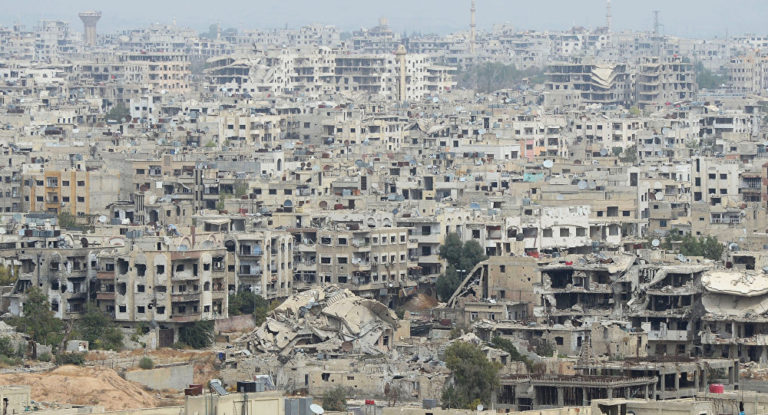
Stalingrad of Syrian war: ancient Syrian city of Raqqa after US bombing
By M. K. BHADRAKUMAR | Indian Punchline | December 21, 2018
On December 17, Ankara was notified of President Trump’s decision on troop withdrawal from Syria. During an earlier phone conversation between him and President Recep Erdogan on Dec 14, Trump had pointedly asked and elicited a positive response from the Turkish leader as to whether Turkey would have the capability to eliminate the remnants of the ISIS in the Syrian tract east of the Euphrates in the event of a US withdrawal from Syria. Erdogan reportedly “reaffirmed” Turkey’s commitment to fight the ISIS.
Ankara likely shared this information with Moscow and Tehran. The three foreign ministers met in Geneva on Dec 19 for a trilateral meeting as guarantors of the Astana format on Syria. The joint statement issued after the meeting, therefore, can be seen as indicative of Turkey’s resolve to give primacy to the trilateral format with Russia and Iran on issues concerning Syria.
To be sure, Turkey will have issues to take up with the Trump administration in the coming days and weeks. As one commentator put it, “For example, will the U.S. collect the weapons provided to the YPG? What measures will the U.S. take for preventing a chaos in the region after the withdrawal? All these require more military and political talks between Turkey and the U.S. Turkey will continue to cautiously follow the situation in Syria.”
However, senior Turkish officials have made it clear that the planned military operations against Syrian Kurds will continue to unfold. Defence Minister Hulusi Akar has been quoted by the state news agency Anadolu as saying, “Now we have Manbij and the east of the Euphrates in front of us. We are working intensively on this subject. Right now it is being said that some ditches, tunnels were dug in Manbij and to the east of the Euphrates. They (Kurds) can dig tunnels or ditches if they want, they can go underground if they want, when the time and place comes they will buried in the ditches they dug. No one should doubt this.”
Yesterday, Erdogan told the visiting Iranian president Hassan Rouhani that Ankara hopes to work closer with Tehran to end the fighting in Syria. Erdogan said at a joint press conference with Rouhani, “There are many steps that Turkey and Iran can take together to stop the fighting in the region and to establish peace. Syria’s territorial integrity must be respected by all sides. Both countries are of the same opinion regarding this.” Significantly, Erdogan also voiced Turkey’s support for Iran (“brotherly nation”) against the US sanctions.
However, Ankara is yet to make an official statement regarding Trump’s Syrian pullout plan. All three countries – Turkey, Russia and Iran – seem skeptical about Trump’s clout to enforce his decision overcoming resistance from the Pentagon. From such a perspective, the resignation of Defence Secretary James Mattis on December 20 will come as confirmation that Trump is indeed forcing his political will, exercising his presidential prerogative to take foreign policy decisions as well as insisting on his supreme authority as commander-in-chief to decide on issues of war involving the US armed forces.
Unlike Turkey and Iran, Russia has voiced opinions on Trump’s withdrawal plans. President Vladimir Putin stated at a press conference in Moscow on Dec 20:
“As concerns the defeat of ISIS, overall I agree with the President of the United States. I already said that we achieved significant progress in the fight against terrorism… There is a risk of these and similar groups migrating to neighbouring regions… We know that, we understand the risk fully. Donald is right about that, and I agree with him.”
“As concerns the withdrawal of American troops, I do not know what that is. The United States have been present in, say, Afghanistan, for how long? Seventeen years, and every year they talk about withdrawing the troops. But they are still there. This is my second point.”
“Third… The current issue on the agenda is building a constitutional committee… We submitted the list to the UN… Maybe not by the end of this year but in the beginning of the next the list will be agreed and this will open the next stage of the settlement, which will be political settlement.”
“Is the presence of American troops required there? I do not think it is. However, let us not forget that their presence… is illegitimate… The military contingent can only be there under a resolution of the UN Security Council or at the invitation of the legitimate Syrian Government…. So, if they decide to withdraw their troops, it is the right decision.”
Overall, Putin commended Trump’s decision, while keeping fingers crossed that as the focus is shifting to the political process will gain traction. Putin didn’t mince words in calling the US intervention in Syria as a violation of international law and UN Charter. The Kremlin spokesman Dmitry Peskov who spoke later in a TV interview was also quite upfront: “The American presence on the Syrian soil is not conductive to attaining the goals of a political and diplomatic solution.” (TASS )
Neither Russia nor Turkey and Iran would expect a cooperative attitude from the American side in a near term over Syria. The US has a stony heart when it comes to Syria’s reconstruction – although it caused immense destruction in that country during its occupation. The US military will be leaving behind a trail of bitterness in Syria. The three other protagonists understood perfectly well that Pentagon commanders were fighting a secretive geopolitical war against each of them. “Good riddance” – that must be the refrain in Ankara, Moscow and Tehran.
Ukraine plans another incursion into Kerch Strait, hopes NATO ships will join in – top official
RT | December 20, 2018
Kiev is considering sending its Navy ships through the Kerch Strait again, a high-ranked official said weeks after a tense standoff between Russian and Ukrainian vessels in the area.
Another passage by Ukrainian Navy ships through the Kerch Strait which connects Black and Azov Seas might take place very soon, according to Alexander Turchinov, head of Ukraine’s National Security and Defense Council. “I think that this issue cannot be delayed,” he told BBC News Ukraine on Wednesday.
Turchinov, who briefly served as interim president after the Western-backed 2014 Euromaidan coup in Kiev, didn’t mince his words while explaining the rationale between the action. To him, Russia is after “seizing the Azov Sea,” install new maritime borders and “legitimize the occupation of Crimea.”
The only antidote to the plan is “to show to the entire world that Ukraine has not lost its position in the Azov Sea.” Turchinov was speaking several weeks after three Ukrainian ships attempted to break through the strait which Russia had closed on safety reasons.
On November 25, three Ukrainian Navy vessels, including two combat-ready gunboats, entered the Kerch Strait without getting proper clearance first, according to Moscow. After ignoring multiple warnings and demands to stop, they were fired upon and seized by the Russian coast guard, while the sailors were taken to custody.
This time, the official said he hopes Ukraine will not be left alone in the next endeavor. “It would be very logical if NATO ships which we invited [to visit] the Azov Sea ports make sure that Russia complies with international law,” he said, lamenting the military bloc provided no response yet.
Nevertheless, Turchinov hopes that “during the next passage of Ukrainian warships through the Kerch Strait they will at least send their observers to us.” Kiev had also invited officials from OSCE and other international bodies to be on board Ukrainian ships to prove “that Ukraine and its sailors do not violate any laws and international rules.”
The latter phrase sounds odd given that Moscow had accused Ukrainian sailors of deliberately violating Russia’s maritime borders in the Kerch Strait and breaking specific rules of passing through the narrow, complex water area. Top Russian officials maintained that this was a premeditated and provocative act plotted by the Ukrainian government.
Turchinov’s BBC interview was predictably met with little praise in Moscow. “This was just an announcement of another provocation,” Foreign Ministry spokeswoman Maria Zakharova said on Wednesday, calling it “utterly irresponsible.” She noted the inflammatory remark came at the time when “many Ukraine’s partners try to defuse tensions in this situation and seek ways of de-escalation.”
It also comes several days after the UN General Assembly passed a Ukrainian resolution, condemning the presence of the Russian military in the Crimean Peninsula and the surrounding waters of the Black Sea and the Azov Sea. 66 countries supported the non-binding resolution but 72 abstained from voting altogether.
Putin warns US against misadventures
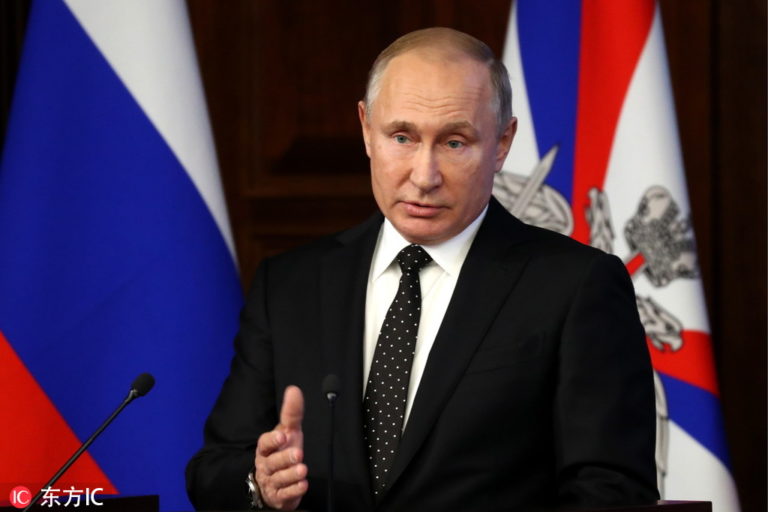
(Russia’s President Vladimir Putin addresses an extended meeting of the Russian Defence Ministry Board in the National Defence Management Centre in Moscow, Dec 18, 2018)
By M. K. BHADRAKUMAR | Indian Punchline | December 19, 2018
The Russian President Vladimir Putin’s address to an expanded meeting of the Defence Ministry Board in Moscow on December 18 stands out as a tour d’horizon of the global strategic balance. The speech must be seen against the backdrop of the free fall in US-Russia relations, build-up of NATO infrastructure on Russia’s western borders and, in particular, the Trump administration’s statements about the US withdrawing from the Intermediate-Range Nuclear Forces (INF) Treaty of 1987.
Broadly, Putin’s message is in three directions:
The modernization of Russian armed forces has been most successful and the combat readiness of Russian military is at an all-time high level;
Russia has developed new hypersonic weapons of immense destructive power, which are going into serial production for deployment with the strategic nuclear forces to which the US simply has no answer;
Russia is determined to ensure that any US attempts to tilt the strategic balance in its favor will be effectively countered.
Putin disclosed that the share of modern arms in Russia’s “nuclear triad” (air, navy and ground forces) is already at an impressive level of 82 percent. He implied that all in all, the US is punching above its weight: “These weapons (unique state-of-the-art weapons such as the Avangard missile system, Sarmat missile, Kinzhal hypersonic air-launched ballistic missile, Peresvet combat laser weapons, etc.) will multiply the potential of our army and navy, thus reliably and absolutely ensuring Russia’s security for decades ahead. These weapons are consolidating the balance of forces and, thus, international stability. I hope our new systems will provide food for thought to those who are used to militaristic and aggressive rhetoric.”
The main thrust of Putin’s speech was on the US plans to withdraw from the INF Treaty. He warmed, “Such a step will have the most negative consequences and will noticeably weaken regional and global security. In fact, in the long term, it may result in the degradation and even collapse of the entire architecture of arms control and non-proliferation of weapons of mass destruction… In the event the United States breaks the treaty – I have already mentioned this publicly and I believe it is important to state it once again directly for this audience – we will be forced to take additional measures to strengthen our security.”
Putin starkly forewarned that Russia’s newly developed Kinzhal hypersonic missiles (at a speed in excess of Mach 10 with an intermediate range of 2000 kilometers) which are presently deployed on Mig-31 aircraft can as well be modified “and put… on the ground, if need be.”
In geopolitical terms, Putin drew the bottom line that Moscow will not blink and Russian military prowess is indomitable. Quite obviously, the stern Russian warning comes at a time when the US is pushing the European allies to impose more sanctions against Russia and is threatening to increase its military presence in the Black Sea following the Kerch Strait incident last month. Tensions are rising over Ukraine, which lies historically in the First Circle of Russian national defence. Russia has reportedly deployed Sukhoi Su-27 and SU-30 fighter jets to the Belbek air base in Crimea. Foreign Minister Sergey Lavrov said on Monday, presumably on the basis of intelligence inputs available with Moscow, that Ukraine may stage provocative moves militarily on the border of Crimea later this month and that the Ukrainian Armed Forces have amassed around 12,000 troops and a great amount of equipment on the contact line with the insurgent region of Donbass.
Lavrov disclosed that instructors from the US, Britain and other countries are actively helping the Ukrainian build-up, while a US drone is constantly flying over the region. (Xinhua ) With a near-certainty that the chances of pro-American Petro Poroshenko winning a renewed mandate in the March presidential elections being virtually zero, a casus belli would suit the US to prepare the ground for Ukraine’s post-haste induction into the NATO and the EU. Putin only briefly touched on Ukraine, saying the conflict in the southeastern region “continued unabated.”
Significantly, in his address on Wednesday, Putin made a pointed reference to China while commending the Vostok-2018 military exercises. He said the maneuvers contributed to the “substantial upgrades” in the level of operational and combat training of Russian armed forces and in displaying their ability to “promptly move forces and equipment” over 7000 kms “and to quickly reinforce units in major strategic areas wherever necessary.” Putin then added that it was “important” to note that units from China “also acted under the general plan, in single formation with our troops.” He came close to taking note of what western analysts call the “functional military alliance” between Russia and China.
Russia’s defence budget of $46 billion compares with the Pentagon’s $725 billion budget. What emerges is that instead of getting drawn into a debilitating arms race that will be a strain on resources, Russia will focus on developing the strategic capability to inflict such colossal losses and destruction on the West, including the US, which will deter the latter from launching militaristic adventures targeting Russia. Thus, Putin gave topmost priority to “further strengthen the combat potential of the strategic nuclear forces.” He stressed the importance of quickly transitioning to weapons with enhanced capabilities that overcome US’ missile defence systems and, in particular, the production and supply of the Avangard global range missile systems to the armed forces.
The commander of Russia’s Strategic Missile Force Commander Colonel-General Sergei Karakayev said in an interview with Krasnaya Zvezda newspaper on Monday that the first Avangard hypersonic missile systems will enter combat duty in 2019 at the Dombarovsky missile division based in the Orenburg Region in the south Urals. According to a TASS report, the Avangard is a strategic intercontinental ballistic missile system equipped with a hypersonic glide vehicle capable of flying at hypersonic speed in the dense layers of the atmosphere, maneuvering by its flight path and its altitude and breaching any anti-missile defense.
Turkey and Russia Push Towards a Resolution in Syria
By Tom LUONGO | Strategic Culture Foundation | 19.12.2018
Turkish-US relations are terrible and deteriorating by the day despite bromides to the contrary. Actions speak louder than words. And that has been all President Trump seems capable of anymore, words not actions.
Since the beginning of l’affair Khashoggi Turkey has been extracting concession after concession from the US as the Trump administration tries to salvage its soon-to-be-unveiled Middle East peace plan.
The latest concession may be the biggest. There’s a report out now that the Trump administration is readying the extradition of cleric Fethulah Gulen, who President Erdogan believes was behind the coup attempt against him in July of 2016.
The US has protected Gulen well beyond any reasonable measure for someone not in their pay so Erdogan’s claims ring true enough. I’ve always thought he was a US intelligence asset and that the US were the ones truly behind the coup attempt.
And since the Trump administration has been desperate to get the Turks to stop leaking details of the Khashoggi murder, Erdogan has pretty much had a free hand to conduct business as he’s seen fit for the past two-plus months.
Whether the US ever returns Gulen to Ankara or not is actually irrelevant; keeping it a sore spot open is its biggest value while Turkey prepares an assault against US-backed YPG forces in Manbij, Syria.
It helps raise Turkey’s position with the other countries involved in the Astana peace process for Syria while keeping Trump, his foreign policy mental midgets and Saudi Arabia on their collective back foot.
Turkey has grown increasingly restless about the US’s lack of movement in turning Manbij over to them. And have now unleashed attacks on Kurdish forces in Northern Iraq to hamper them further.
All of this is making the US presence in eastern Syria more untenable over time while the Saudis struggle with falling oil prices and no longer want to pay the bill for the US’s proxy war.
Don’t kid yourself, the US is struggling to keep its financial pressure up on Iran.
If these things weren’t enough Turkish Prime Minister Mevlut Cavusoglu said recently that Ankara was now willing to work with Syrian President Bashar al-Assad if he survives “democratic and credible” elections. This is rich coming from Turkey, but whatever.
The importance of this statement, however, cannot be overstated. Turkey was one of the major partners in the mission to destroy Syria. And now they have joined with Russia, Iran and China in negotiating the peace process.
They have gone from “Assad must go!” to “Assad can stay.” It is an admission that the US plan for balkanization of Syria will eventually fail and that their best bet is putting maximum pressure on the US to give up its regional plans.
Russia, of course, stands behind Turkey in this and they themselves are now upping the costs on the US and the Israelis. Because, it is now Russian policy to assist Syrian Arab Army forces in proportional retaliation against Israeli aggression in Syrian territory, according to Elijah Magnier.
No longer will the Russians stand aside and allow Israel a free hand over bombing what it says are Hezbollah and Iranian targets within Syria. The SAA will now strike back with a proportional response.
An airport for an airport, as it were.
What started as a State Department operation to install a puppet government and sow chaos in Syria under Hillary Clinton then became one to drain Russian and Iranian resources by wasting their time under John Kerry.
Today, that US/Israeli/Saudi strategy has been turned on its head.
It is now the US and the Saudis that are feeling the pinch of yet another quagmire without end. Moreover, the Israeli security situation is now worse than it was before all of this started in the first place. This necessitates an even more unhinged response from Washington which it cannot defend to the American people as to why we need to stay in Syria forever.
None of this is what President Trump campaigned on. None of this is what candidate and citizen Trump argued for.
The real war of attrition was never about physical resources and money. It was always about time. The Iranians and Russians have played for time. Time brought out the truth about the Syrian invasion. It exposed the real causes of the conflict.
The hope now for the US is that financial pressure will get Iran to knuckle under. But, look at what is happening. Oil prices are in freefall as the global economy slows down thanks to debt saturation, a rising dollar and increasing opposition in the West to neoliberalism and globalism.
Trump whines about this because it upsets his mercantilist plans to corner the energy markets while weaponizing the use of the dollar.
EU technocrats who fancy themselves the inheritors of a waning US empire, bristle under Trump’s plans. They will build an alternative payment vehicle to buy goods and services from sanctioned entities. This is about much more than Iranian oil.
So, while Trump, Bolton, Mnuchin and Pompeo, the Four Horsemen of the Foreign Policy Apocalypse, think they are winning this war on commerce, all they are doing is falling into the very trap Putin, Xi and Rouhani have set for them.
Again, they playing for time. The dollar is the US’s strength and also its Achilles’ heel. And if you are playing for time it is to build alternative channels for trade, oil, gas and whatever else the US deems against its interests without need for dollars.
Trump’s energy dominance plan is as transparent as his narcissism. More likely the sanctions exemptions for buying Iranian oil will be extended in May because he can’t have a global crisis be his fault as he prepares for re-election in 2020.
But, that’s exactly what he’s setting up.
So, now back to Syria.
Those who were set up to be scapegoats – namely Qatar and Turkey – washed their hands of the operation quickly, made deals with Russian President Vladimir Putin and charted their own independent paths. By the time the truth about US involvement in Syria was exposed they were long gone and only the real perpetrators left holding onto poor positions and worse arguments.
All Trump can do now is openly admit that we’re there on behalf of Israel and Saudi Arabia to get Iran. That’s it. He can sell that to part of his base. But, not enough of them to win re-election.
His peace plan is DOA. It died along with the 15 Russian airmen on that IL-20 back in August. I’ll be surprised if it is ever actually announced. That one event set us on this path. It permanently poisoned Russian/Israeli relations as Netanyahu overplayed his hand assisting NATO in a needless provocation which nearly sparked a wider war.
Reports are that Putin doesn’t return his phone calls and now dictates to Bibi what happens next. This also tells me Putin now has control over his Israeli fifth columnists within the Kremlin otherwise this order would never have been issued and made public.
Now Netanyahu is hemmed in on all sides and the Saudis are political pawns between the warring factions of the US government – Trump who wants an Arab NATO and the Deep State that wants him on a platter. Their benefactor, Trump, is in an increasingly untenable position who will soon be forced to choose between hot war and impeachment.
Meanwhile, Iran, Turkey and Russia will continue to bleed out the US forces in Syria while sanctions prove to be increasingly less effective. Simultaneously, the Astana process moves forward with all groups trying to reach out to each other around the sclerotic reach of the US and put an end to this shameful period of US foreign policy insanity.
Moscow Rejects Israeli Complaint over Haniyeh Invitation: You’re Also Talking to Hamas
Al-Manar | December 19, 2018
Israeli ambassador to Moscow Gary Koren recently sent a sharp protest to Russian officials over the invitation the Russian Foreign Ministry sent to the Head of Hamas political bureau, Ismail Haniyeh in Moscow, Israeli Channel 10 reported.
Senior Israeli officials were quoted as confirming that a similar protest was also transferred to the Russian Embassy in the Zionist entity.
Moscow sent the invitation to Haniyeh at the end of November, just two weeks after the end of the round of fighting in Gaza.
Hamas delegation is expected to arrive at the end of the month to Moscow after the arrival of Palestinian Foreign Minister Riad al-Maliki.
Senior Russian officials say they rejected Israeli criticism of the invitation of the Hamas delegation and replied to the Israeli diplomats: “Why do you come to us with complaints – you’re talking to Hamas yourself,” according to Israeli Channel 10.
Two weeks ago, Russia voted against the US proposal to denounce Hamas at the UN General Assembly. Tel Aviv responded yesterday when it voted for a US condemnation of the Russian annexation of the Crimea.
Featured Video

Dan Dicks with James Corbett on Solutions Watch
or go to
Aletho News Archives – Video-Images
From the Archives
MMR (Measles, Mumps and Rubella) – Vaccine Risk Statement
MMR Vaccine (Measles, Mumps, and Rubella) Is It Safer Than Measles, Mumps and Rubella?
Physicians for Informed Consent | December 2024
… It has not been proven that the MMR vaccine is safer than measles, mumps, and rubella. The vaccine package insert raises questions about safety testing for cancer, genetic mutations, and impaired fertility. Although VAERS tracks some adverse events, it is too inaccurate to measure against the risk of measles, mumps, and rubella. Clinical trials do not have the ability to detect less common adverse reactions, and epidemiological studies are limited by the effects of chance and possible confounders. Safety studies of the MMR vaccine are particularly lacking in statistical power. A review of more than 60 MMR vaccine studies conducted for the Cochrane Library states, “The design and reporting of safety outcomes in MMR vaccine studies, both pre- and post-marketing, are largely inadequate.”19 Because permanent sequelae (aftereffects) from measles, mumps, and rubella are so rare (especially in children with normal levels of vitamin A and infected after birth),6,15-17 the level of accuracy of the research studies available is insufficient to rule out the possibility that the MMR vaccine causes greater death or permanent disability than measles, mumps, and rubella. – Read full article
Blog Roll
 Aletho News
- Moscow issues warning to NATO over Russian exclave
- Yes, the Iran war has destroyed Trump’s presidency
- The fallacy of US delusions about Iran’s economic collapse
- Hezbollah denies Syria cell link, warns of Israeli plan to sow discord
- The legacy of US sanctions, war, and occupation in Iraq
- Iraqi resistance group rejects disarmament, vows to maintain support for Lebanon
- Sheikh al-Asadi warns of Iraqi government compliance with US demands
- How to MAKE THE CONSPIRATORS PAY for their crimes! Dan Dicks with James Corbett on Solutions Watch
- There’s a drought in academia: A drought in honest research on the subject of drought and other weather extremes
- Department of War Awards $20.7 Billion Contract to Raytheon for Air-to-Air Missiles
- If Americans Knew
- Israeli Attacks Kill Ten Palestinians in Gaza
- Massacre at Minab: The School That Became a Grave
- Israeli media: The IDF Shows It Doesn’t Turn a Blind Eye; It Actively Emboldens Settler Havoc
- As settlers ravage West Bank, Israeli forces kill 10 in Gaza – Daily Update
- New Report: “Scholasticide and Genocide in Gaza: Assessment, Testimonies and Legal Analysis”
- Ex-Biden officials are desperate for a Gaza scapegoat
- Israeli “settlers” Invade Al-Aqsa; Pour Boiling Water on 75-Year-Old
- Israel Has Kidnapped Another American Teenager
- US arms sales to Israel worth $21.6 billion in 20 months
- Three Palestinians Killed in Israeli Attacks on Gaza
- No Tricks Zone
- Green Energy Debacle: German Expert Professor Fritz Vahrenholt Warns Of Severe Economic And Social Consequences
- Two More Paleo Reconstructions Affirm Meters-Higher Sea Levels Across Ireland, Brazil 7000-6000 Years Ago
- New Study: Earth And Venus Surface Warmth Largely Explained By Convection And Lapse Rate, Not CO2 Or Radiation
- 2025 Nature Paper Claiming Worsening Global Drought Gets RETRACTED …Heavily Flawed
- New Study: ‘Global Drought Shows No Detectable Recent Acceleration Under Climate Warming’
- Economic Masterminds: German Socialists Suggest Taxing Productivity Gains Stemming From Using AI
- The South China Sea Has Not Been Cooperating With The Climate Change Narrative
- Energy Crisis: Germany Enters Heating Season With Historically Low Gas Reserve Fill Levels
- New Study: The Antarctic Ice Sheet Gained Mass From 2020-2024 Due To Staggering Snow And Ice Accumulation
- Study: Ocean Heating Rates From Thousands Of Years Ago ‘Dwarf’ Modern Ocean Heating Rates

