US to Impose Sanctions on Russia ‘Every Month or Two’ – Volker
Sputnik – 18.10.2018
Russia has faced several rounds of sanctions from the United States and the European Union over its alleged meddling in the 2016 US presidential elections, and alleged involvement in the poisoning of former Russian spy Sergei Skripal and his daughter Yulia in the UK city of Salisbury in early March.
US Special Representative for Ukraine Kurt Volker has stated that the Trump administration will impose sanctions on Russia “every month or two.”
“The second thing we’ve done is we’ve tried to increase the pressure we are putting on Russia in order to get them to negotiate toward a solution. That includes keeping sanctions in place in the United States and increasing those sanctions periodically over time, and that’s the track that we have been on during the course of the Trump administration, and we’ll continue to be on,” Volker said. “You’ll see additional sanctions come into play every month or two months or so as we’ve seen.”
Volker noted that the United States is “working very closely with European allies” on the issue of anti-Russian sanctions.
In August, a group of US senators introduced a bill envisaging the imposition of new sanctions against Moscow, including those targeting the country’s oil industry and transactions with Russian sovereign debt.
In recent years, Russia has repeatedly been accused of carrying out cyberattacks against other countries, including the United States, France, the United Kingdom and Germany, and attempting, in particular, to influence the results of elections.
Moscow has repeatedly denied all the accusations also emphasizing its desire to see convincing evidence of Russian nationals’ involvement in the incidents.
Ukraine Military Sales
US officials will meet with their Ukrainian counterparts to discuss potential foreign military sales since Washington has already approved a new package of security assistance for Ukraine, US Special Representative for Ukraine Negotiations Kurt Volker announced.
“We have, working through the Congress, a new package of foreign military financing, and we’ll be sitting down with Ukrainians to talk possibly about foreign military sales and what would make sense for them,” Volker said.
In September, President Donald Trump and the Congress boosted US military aid to Ukraine, allocating $250 million in security assistance to the country under the 2019 Department of Defense Appropriations Act.
The US Meddles In Syria’s Constitutional Reform Process By Threatening Sanctions
By Andrew KORYBKO – Oriental Review – 18/10/2018
The US is threatening to further sanction Syria if Damascus doesn’t make progress in America’s preferred direction during the ongoing constitutional reform process.
The US special representative for Syria James Jeffrey conveyed this intention on the sidelines of the UN General Assembly after his country and a handful of others called upon Staffan de Mistura to report back to them by the end of this month about which of the 50 people he’s supposed to select to participate in Syria’s constitutional committee.
Prior agreements on the creation of this important political mechanism stipulate that the delegates will be chosen from members of the pro-government, domestic opposition, and external opposition factions, and while this is admittedly an ultra-sensitive process, the US and its allies feel that Syria has been dragging its heels on it for far too long and that’s why they want to crank up the pressure on Damascus by threatening more sanctions against it.
The elephant in the room is the issue of so-called “decentralization”, which appears to be the only pragmatic political solution for dealing with the Kurdish-controlled agriculturally and energy-rich northeastern third of the country that’s reported to host around 20 American bases but which President Assad has sworn will return to the central fold by one way or another.
This is becoming ever less realistic to achieve as Russia signaled that it won’t engage in the nuclear brinkmanship that would be needed for supporting Syria’s otherwise futile efforts to evict the US and make this happen, hence why a “compromise” is the only peaceful way for resolving this issue. The US also knows that its Russian, Chinese, and Iranian rivals lack the money needed for rebuilding the liberated areas of Syria, which is why it’s weaponizing reconstruction aid for political purposes.
Pressing home the point of what he wants to see achieved, Jeffrey also hinted at imposing a “no-fly zone” over the Kurdish-controlled northeast and replicating the state of affairs that prevailed in Iraqi Kurdistan from 1991-2003 during which time the US carried out occasional airstrikes to prevent the central government from reasserting its sovereignty in this region. Since the de-facto “partition” of Syria is already a fait accompli at this point, the next goal of the US and its allies is to compete with its rivals over the reconstruction of their respective “spheres of influence” in the country.
Despite it being comparatively easier for the geographically smaller, less populated, and more resource-rich northeast to recover a lot quicker than the rest of Syria, the US hopes that this can serve as a “demonstration effect” for the rest of the country and subsequently be manipulated through infowars and perception management tactics to somehow “delegitimize” the predictably slower efforts of Damascus and its allies in this regard.
The post presented is the partial transcript of the CONTEXT COUNTDOWN radio program on Sputnik News, aired on Friday Oct 12, 2018
US-Saudi alliance in twilight zone
By M. K. BHADRAKUMAR | Indian Punchline | October 15, 2018
President Donald Trump’s remarks about the Jamal Khashoggi affair in the interview with CBS 60 Minutes turned out to be nothing earthshaking. Basically, he said three things: a) Son-in-law Jared Kushner spoke to Crown Prince but latter denied; b) Saudi culpability is yet to be established and if it gets proven, US will be “very upset and angry” and “there will be severe punishment”; and, c) Sanctioning Saudi Arabia is problematic, given deep business interests and “There are other ways of punishing” Saudi Arabia – if it indeed comes to that.
Trump didn’t elaborate what could be the “other ways”. But Saudi Arabia has posted the warning that there will be dire consequences – “any action against the kingdom will be responded to with greater reaction” – if the US dared to proceed on any such track of “economic sanctions, using political pressure or repeating false accusations.” Interestingly, Saudis alluded to “the support of allies” in countering the “organized campaign” against it.
An influential Saudi establishment figure subsequently dilated on the likely retaliation in the event of US sanctions, claiming Riyadh has drawn up a list of 30 “potential measures”:
- Saudis will not accede to Trump’s requests to boost oil production (to make up for shortfall due to Iran sanction) and instead let oil prices rise to “$100, or $200, or even double that figure.”
- Saudis will stop using dollars for oil trade and may instead switch to a “different currency, Chinese yuan, perhaps.”
- Saudi-Iranian rapprochement may ensue, with Russian help.
- Saudis may end intelligence cooperation over terrorist threat to western countries.
- Saudis may turn to Russia and China to source weapons.
- Saudis may allow a Russian base in the northwestern province of Tabuk situated “in the heated four corners of Syria, Israel, Lebanon and Iraq.”
- Saudis will revive links with Hamas and Hezbollah.
- Saudi will pull out of investments in the US, estimated at $800 billion.
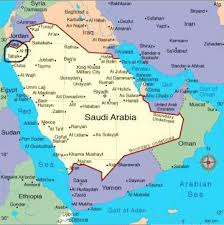
In sum, Saudi Arabia will make a strategic shift toward the Russia-China-Iran axis. In immediate terms, Saudis can hit the US hard by leveraging its status as energy superpower. A dramatic jump in oil prices will boost Saudi income but create difficulties for oil consuming countries, especially EU, China or India. It will boost Russia’s income and make western sanctions even more ineffectual. Again, it will undermine the US’ game plan to bring down Iranian economy to its knees.
On the other hand, any Saudi move to dump dollar in oil trade may significantly galvanise the nascent moves to dethrone dollar as world currency, but its impact can only be in a medium-term scenario.
In geopolitical terms, Saudi Arabia has been a pivotal ally of the US during the past 7 decades. A breakdown in the US-Saudi alliance will unravel the entire American strategy in the Middle East. A US retrenchment from the region may become inevitable.
On the other hand, the ascendancy of Russian and Chinese influence will hurt western interests. Indeed, Israel’s overall security position gets weakened, too.
The bottom line, of course, is that Iran’s rise as regional power will become irreversible – although Iran-Saudi rapprochement is easier said than done. Interestingly, the Iranian reaction to the Khashoggi affair echoes how Tehran took advantage of the overthrow of Saddam Hussein in Iraq.
How far will Russia (and China) want to get entangled in the Saudi standoff with the US? Moscow and Beijing are seeking better relations with the US and may hope that a chastened America would make a more reasonable interlocutor. After all, they’d assess that a US retrenchment in the Middle East will inexorably bring the curtain down on America’s global hegemony. Which in turn will accelerate the trends toward multipolarity. It is improbable that Russia or China will join hands with Saudi Arabia to destabilize the world economy.
The Saudi prognosis that the “if Washington imposes sanctions on Riyadh, it will stab its own economy to death” is plain hyperbole. Then, there is a fundamental contradiction insofar as the survival of the archaic Saudi regime is critically dependent on American support. Trump wasn’t exaggerating when he recently said that if the US support is withdrawn, Saudi regime would pack up in two weeks. There are historical forces swirling around Saudi Arabia, which have been kept at bay due to the sheer US presence. For example, the eastern Shi’te provinces of Saudi Arabia are restive; the Houthis of Yemen will seek revenge.
Above all, the Saudi regime has been exporting radical forces as geopolitical tool for the Americans. These forces may come to haunt Saudi internal security. The Muslim Brotherhood, al-Qaeda, etc. are waiting in the wings. Islamism, paradoxically, poses an existential threat to the Saudi regime.
Succinctly put, the sins of the past will come to wreak vengeance on the Saudi regime with a demonic fury sooner than one may think once America’s protective shield is withdrawn. In fact, the possibility of the disintegration of the Kingdom of Saudi Arabia, which is after all an arbitrary creation of British imperialism in the early 20th century, is very real.
What complicates the situation today is that the US is a badly divided house and the Saudis are used to dealing with the Washington establishment in an idiom that is no longer in vogue. Left to himself, Trump would have handled the Khashoggi affair much as his predecessors in the White House might have done. But that is not going to be possible with the Deep State and the US Congress arm-twisting him. On the other hand, Crown Prince Mohammed bin Salman represents a new type of Saudi leadership that is not shy of a faceoff and seeks a reset of the relationship with the US.
Britain on the Leash with the United States – but at Which End?
By James George JATRAS | Strategic Culture Foundation | 13.10.2018
The “special relationship” between the United States and the United Kingdom is often assumed to be one where the once-great, sophisticated Brits are subordinate to the upstart, uncouth Yanks.
Iconic of this assumption is the mocking of former prime minister Tony Blair as George W. Bush’s “poodle” for his riding shotgun on the ill-advised American stagecoach blundering into Iraq in 2003. Blair was in good practice, having served as Bill Clinton’s dogsbody in the no less criminal NATO aggression against Serbia over Kosovo in 1999.
On the surface, the UK may seem just one more vassal state on par with Germany, Japan, South Korea, and so many other useless so-called allies. We control their intelligence services, their military commands, their think tanks, and much of their media. We can sink their financial systems and economies at will. Emblematic is German Chancellor Angela Merkel’s impotent ire at discovering the Obama administration had listened in on her cell phone, about which she – did precisely nothing. Global hegemony means never having to say you’re sorry.
These countries know on which end of the leash they are: the one attached to the collar around their necks. The hand unmistakably is in Washington. These semi-sovereign countries answer to the US with the same servility as member states of the Warsaw Pact once heeded the USSR’s Politburo. (Sometimes more. Communist Romania, though then a member of the Warsaw Pact refused to participate in the 1968 invasion of Czechoslovakia or even allow Soviet or other Pact forces to cross its territory. By contrast, during NATO’s 1999 assault on Serbia, Bucharest allowed NATO military aircraft access to its airspace, even though not yet a member of that alliance and despite most Romanians’ opposition to the campaign.)
But the widespread perception of Britain as just another satellite may be misleading.
To start with, there are some relationships where it seems the US is the vassal dancing to the tune of the foreign capital, not the other way around. Israel is the unchallenged champion in this weight class, with Saudi Arabia a runner up. The alliance between Prime Minister Bibi Netanyahu and Saudi Crown Prince Mohammad bin Salman (MbS) – the ultimate Washington “power couple” – to get the Trump administration to destroy Iran for them has American politicos listening for instructions with all the rapt attention of the terrier Nipper on the RCA Victor logo. (Or did, until the recent disappearance of Saudi journalist Jamal Khashoggi. Whether this portends a real shift in American attitudes toward Riyadh remains questionable. Saudi cash still speaks loudly and will continue to do so whether or not MbS stays in charge.)
Specifics of the peculiar US-UK relationship stem from the period of flux at the end of World War II. The United States emerged from the war in a commanding position economically and financially, eclipsing Britannia’s declining empire that simply no longer had the resources to play the leading role. That didn’t mean, however, that London trusted the Americans’ ability to manage things without their astute guidance. As Tony Judt describes in Postwar, the British attitude of “superiority towards the country that had displaced them at the imperial apex” was “nicely captured” in a scribble during negotiations regarding the UK’s postwar loan:
In Washington Lord HalifaxOnce whispered to Lord Keynes:“It’s true they have the moneybagsBut we have all the brains.”
Even in its diminished condition London found it could punch well above its weight by exerting its influence on its stronger but (it was confident) dumber cousins across the Pond. It helped that as the Cold War unfolded following former Prime Minister Winston Churchill’s 1946 Iron Curtain speech there were very close ties between sister agencies like MI6 (founded 1909) and the newer wartime OSS (1942), then the CIA (1947); likewise the Government Communications Headquarters (GCHQ, 1919) and the National Security Administration (NSA, 1952). Comparable sister agencies – perhaps more properly termed daughters of their UK mothers – were set up in Canada, Australia, and New Zealand. This became the so-called “Five Eyes” of the tight Anglosphere spook community,infamous for spying on each others’ citizens to avoid pesky legal prohibitions on domestic surveillance.
Despite not having two farthings to rub together, impoverished Britain – where wartime rationing wasn’t fully ended until 1954 – had a prime seat at the table fashioning the world’s postwar financial structure. The 1944 Bretton Woods conference was largely an Anglo-American affair, of which the aforementioned Lord John Maynard Keynes was a prominent architect along with Harry Dexter White, Special Assistant to the US Secretary of the Treasury and Soviet agent.
American and British agendas also dovetailed in the Middle East. While the US didn’t have much of a presence in the region before the 1945 meeting between US President Franklin Delano Roosevelt and Saudi King ibn Saud, founder of the third and current (and hopefully last) Saudi state – and didn’t assume a dominant role until the humiliation inflicted on Britain, France, and Israel by President Dwight Eisenhower during the 1956 Suez Crisis – London has long considered much of the region within its sphere of influence. After World War I under the Sykes-Picot agreement with France, the UK had expanded her holdings on the ruins of the Ottoman Empire, including taking a decisive role in consolidating Saudi Arabia under ibn Saud. While in the 1950s the US largely stepped into Britain’s role managing the “East of Suez,” the former suzerain was by no means dealt out. The UK was a founding member with the US of the now-defunct Central Treaty Organization (CENTO) in 1955.
CENTO – like NATO and their one-time eastern counterpart, the Southeast Asia Treaty Organization (SEATO) – was designed as a counter to the USSR. But in the case of Britain, the history of hostility to Russia under tsar or commissar alike has much deeper and longer roots, going back at least to the Crimean War in the 1850s. The reasons for the longstanding British vendetta against Russia are not entirely clear and seem to have disparate roots: the desire to ensure that no one power is dominant on the European mainland (directed first against France, then Russia, then Germany, then the USSR and again Russia); maintaining supremacy on the seas by denying Russia warm-waters ports, above all the Dardanelles; and making sure territories of a dissolving Ottoman empire would be taken under the wing of London, not Saint Petersburg. As described by Andrew Lambert, professor of naval history at King’s College London, the Crimean War still echoes today:
“In the 1840s, 1850s, Britain and America are not the chief rivals; it’s Britain and Russia. Britain and Russia are rivals for world power, and Turkey, the Ottoman Empire, which is much larger than modern Turkey — it includes modern Romania, Bulgaria, parts of Serbia, and also Egypt and Arabia — is a declining empire. But it’s the bulwark between Russia, which is advancing south and west, and Britain, which is advancing east and is looking to open its connections up through the Mediterranean into its empire in India and the Pacific. And it’s really about who is running Turkey. Is it going to be a Russian satellite, a bit like the Eastern Bloc was in the Cold War, or is it going to be a British satellite, really run by British capital, a market for British goods? And the Crimean War is going to be the fulcrum for this cold war to actually go hot for a couple of years, and Sevastopol is going to be the fulcrum for that fighting.”
Control of the Middle East – and opposing the Russians – became a British obsession, first to sustain the lifeline to India, the Jewel in the Crown of the empire, then for control of petroleum, the life’s blood of modern economies. In the context of the 19th and early 20th century Great Game of empire, that was understandable. Much later, similar considerations might even support Jimmy Carter’s taking up much the same position, declaring in 1980 that “outside force to gain control of the Persian Gulf region will be regarded as an assault on the vital interests of the United States of America, and such an assault will be repelled by any means necessary, including military force.” The USSR was then a superpower and we were dependent on energy from the Gulf region.
But what’s our reason for maintaining that posture almost four decades later when the Soviet Union is gone and the US doesn’t need Middle Eastern oil? There are no reasonable national interests, only corporate interests and those of the Arab monarchies we laughably claim as allies. Add to that the bureaucracies and habits of mind that link the US and UK establishments, including their intelligence and financial components.
In view of all the foregoing, what then would policymakers in the United Kingdom think about an aspirant to the American presidency who not only disparages the value of existing alliances – without which Britain is a bit player – but openly pledges to improve relations with Moscow? To what lengths would they go to stop him?
Say ‘hello’ to Russiagate!
One can argue whether or not the phony claim of the Trump campaign’s “collusion” with Moscow was hatched in London or whether the British just lent some “hands across the water” to an effort concocted by the Democratic National Committee, the Hillary Clinton presidential campaign, the Clinton Foundation, and their collaborators at Fusion GPS and inside the Obama administration. Either way, it’s clear that while evidence of Russian connection is nonexistent that of British agencies is unmistakable, as is the UK’s hand in a sustained campaign of demonization and isolation to sink any possible rapprochement between the US and Russia.
As for Russiagate itself, just try to find anyone involved who’s actually Russian. The only basis for the widespread assumption that any material in the Dirty Dossier that underlies the whole operationoriginated with Russia is the claim of Christopher Steele, the British “ex” spy who wrote it, evidently in collaboration with people at the US State Department and Fusion GPS. (The notion that Steele, who hadn’t been in Russia for years, would have Kremlin personal contacts is absurd. How chummy are the heads of the American section of Chinese or Russian intelligence with White House staff?)
While there are no obvious Russians in Russiagate there’s no shortage of Brits. These include (details at the link):
- Stefan Halper, a dual US-UK citizen.
- Ex-MI6 Director Richard Dearlove.
- Robert Hannigan, former director of GCHQ; there is reason to think surveillance of Trump was conducted by GCHQ as well as by US agencies under FISA warrants. Hannigan abruptly resigned from GCHQ soon after the British government denied the agency had engaged in such spying.
- Alexander Downer, Australian diplomat (well, not British but remember the Five Eyes!).
- Joseph Mifsud, Maltese academic and suspected British agent.
At present, the full role played by those listed above is not known. Release of unredacted FISA warrant requests by the Justice Department, which President Trump ordered weeks ago, would shed light on a number of details. Implementation of that order was derailed after a request by – no surprise – British Prime Minister Theresa May. Was she seeking to conceal Russian perfidy, or her own underlings’?
It would be bad enough if Russiagate were the sum of British meddling in American affairs with the aim of torpedoing relations with Moscow. (And to be fair, it wasn’t just the UK and Australia. Also implicated are Estonia, Israel, and Ukraine.) But there is also reason to suspect the same motive in false accusations against Russia with respect to the supposed Novichok poisonings in England has a connection to Russiagate via a business associate of Steele’s, one Pablo Miller, Sergei Skripal’s MI6 recruiter. (So if it turns out there is any Russian connection to the dossier, it could be from Skripal or another dubious expat source, not from the Russian government.) Skripal and his daughter Yulia have disappeared in British custody. Moscow flatly accuses MI6 of poisoning them as a false flag to blame it on Russia.
A similar pattern can be seen with claims of chemical weapons use in Syria: “We have irrefutable evidence that the special services of a state which is in the forefront of the Russophobic campaign had a hand in the staging” of a faked chemical weapons attack in Douma in April 2018. Ambassador Aleksandr Yakovenko pointed to the so-called White Helmets, which is closely associated with al-Qaeda elements and considered by some their PR arm: “I am naming them because they have done things like this before. They are famous for staging attacks in Syria and they receive UK money.” Moscow warned for weeks before the now-postponed Syrian government offensive in Idlib that the same ruse was being prepared again with direct British intelligence involvement, even having prepared in advance a video showing victims of an attack that had not yet occurred.
The campaign to demonize Russia shifted into high gear recently with the UK, together with the US and the Netherlands, accusing Russian military intelligence of a smorgasbord of cyberattacks against the World Anti Doping Agency (WADA) and other sports organizations, the Organization for the Prohibition of Chemical Weapons (OPCW), the Dutch investigation into the downing of MH-17 over Ukraine, and a Swiss lab involved with the Skripal case, plus assorted election interference. In case anyone didn’t get the point, British Defense Secretary Gavin Williamson declared: “This is not the actions of a great power. This is the actions of a pariah state, and we will continue working with allies to isolate them.”
To the extent that the goal of Williamson and his ilk is to ensure isolation and further threats against Russia, it’s been a smashing success. More sanctions are on the way. The UK is sending additional troops to the Arctic to counter Russian “aggression.” The US threatens to use naval power to block Russian energy exports and to strike Russian weapons disputed under a treaty governing intermediate range nuclear forces. What could possibly go wrong?
In sum, we are seeing a massive, coordinated hybrid campaign of psy-ops and political warfare conducted not by Russia but against Russia, concocted by the UK and its Deep State collaborators in the United States. But it’s not only aimed at Russia, it’s an attack on the United States by the government of a foreign country that’s supposed to be one of our closest allies, a country with which we share many venerable traditions of language, law, and culture.
But for far too long, largely for reasons of historical inertia and elite corruption, we’ve allowed that government to exercise undue influence on our global policies in a manner not conducive to our own national interests. Now that government, employing every foul deception that earned it the moniker Perfidious Albion, seeks to embroil us in a quarrel with the only country on the planet that can destroy us if things get out of control.
This must stop. A thorough reappraisal of our “special relationship” with the United Kingdom and exposure of its activities to the detriment of the US is imperative.
Russia says Iran’s presence in Syria none of Israel’s business
Press TV – October 12, 2018
A senior Russian official has dismissed the Israeli regime’s demand that Iran be forced out of Syria, saying that the issue is none of Tel Aviv’s business as it is Syria’s sovereign right to authorize Iranian forces on its soil.
“Syria is a member of the United Nations,” Russian Deputy Foreign Minister Mikhail Bogdanov said, adding that the Arab country “has equal rights” over its self-determination with Russia, the US and any other member of the UN.
“This is a sovereign country led by a legitimate government. It can agree on cooperation with any other country, including Iran, Russia, Israel,” he noted in an interview with the Israeli TV channel i24NEWS released Thursday night.
“That’s Syria’s sovereign right, and it’s not the business of a third party to intervene in these subjects of politics or policy of a sovereign country,” said Bogdanov, who is also President Vladimir Putin’s special envoy for the Middle East.
He went on to say that Moscow had already explained to Israel and the US that “this is a sovereign decision for Syria who should be on their territory.”
“They asked us and the Iranians to be there. The Iranians have said repeatedly on many levels that Syria asked them to help them in the fight against terrorists, and when Mr. Assad tells them that their mission is accomplished and they are no longer needed, they will leave Syria, just like us.”
Iran has been offering military advisory support to Syria at the request of the Damascus government, enabling its army to speed up its gains on various fronts against terror outfits.
However, over the past few years, Israel has frequently attacked military targets inside Syria in an attempt to prop up terrorist groups that have been suffering defeats at the hands of Syrian government forces.
In the latest Israeli airstrikes on Syria a few weeks ago, a Russian Il-20 plane was mistakenly shot down by Syrian air defenses in Latakia Province, northwestern Syria. The Syrian S-200 missile defense system was responding to a wave of strikes by four Israeli warplanes.
Moscow blamed Tel Aviv for the incident, which killed all 15 people on board, saying the Israeli warplanes had deliberately “created a dangerous situation” that led to the crash.
Shortly after the attack, Russia delivered a modern version of its S-300 missile defense system to Syria in a bid to prevent similar incidents in the future.
Plane crash changed rules of the game
In his interview with i24NEWS, Bogdanov underlined that the Israeli pilots’ fault in that incident totally changed the rules of the game.
“The rules of the game were violated when Israeli pilots used a Russian aircraft for cover, knowing how it threatened the Russian crew,” he noted.
“You can imagine what would have happened if 15 Israeli officers had been killed through our fault,” he said.
Netanyahu’s UN theatricals on Iran nuclear site
Elsewhere in his remarks, Bogdanov mocked Israeli Prime Minister Benjamin Netanyahu’s theatrical performance at the United Nations, in which he used placards with satellite pictures to make claims about a secret atomic warehouse in Tehran.
“It’s naive to think that only one country and only one secret service knows something that nobody else knows,” Bogdanov told i24NEWS, refuting allegations leveled by the Israeli PM about an atomic warehouse in Turquzabad, a village close to Tehran.
“It’s the work of the International Atomic Energy Agency (IAEA), which is supposed to check this. It is a professional and serious organisation. It has authority and legitimacy,” he said, adding that the IAEA can inspect any site at any time under the agreement it has with Iran.
“To tell the whole world they have something, and show pictures, maybe some people like this and it helps him, maybe it’s intended to score points and for internal consumption,” Bogdanov noted.
“Speaking seriously… Israel should have taken a different approach and not worked with journalists and with what we call ‘megaphone diplomacy’,” he noted.
US Mk-41 Systems Deployment in Romania, Poland Contradicts INF Treaty – Moscow
Sputnik – October 10, 2018
The United States started deploying Aegis Ashore missile defense systems, as well as MK-41 Vertical Launching Systems tubes that could be used to launch intermediate-range cruise missiles in Europe in June, according to the Russian Foreign Ministry.
Deployment of the US Mk-41 launching systems in Romania and Poland contradicts the Intermediate-Range Nuclear Forces (INF) Treaty, Vladimir Ermakov, the head of the Russian Foreign Ministry’s Department for Nonproliferation and Arms Control, stated.
“There are also serious questions regarding the actions of our American colleagues that are contrary to the INF Treaty, including the ground-based deployment of universal Mk-41 launchers in Romania and Poland,” said Head of the Russian Foreign Ministry’s Department for Nonproliferation and Arms Control Vladimir Ermakov during a general debate in the First Committee of the UN General Assembly.
He noted that Russia as a responsible and consistent supporter of the nuclear disarmament process for over 50 years has made a large-scale contribution to the reduction of strategic offensive weapons, and on February 5, 2018, Russia reached the maximum levels of carriers and warheads under the Russian-American START Treaty, as a result of which Russia’s nuclear arsenal has been reduced by more than 85% compared to the peak of the Cold War.
In May, US President Donald Trump accused Russia of allegedly violating the INF Treaty and ordered US Secretary of State Mike Pompeo to propose new sanctions against Russia in connection with these breaches. The Kremlin responded by saying that Russia had never violated the agreement.
The INF Treaty, which the Soviet Union and the United States signed in December 1987, requires the parties to eliminate all of their nuclear and conventional missiles and their launchers with ranges of 500 to 5,500 kilometers (311 to 3,417 miles). Russia and the United States have repeatedly accused each other of violating the INF Treaty.
READ MORE:
‘Most Plausible Conclusion’: NATO Sec Gen Alleges Russia Breached INF Treaty
S-300 vs. F-35: Stealth and Invincible Are Not Exactly Synonyms
By Andrei AKULOV | Strategic Culture Foundation | 10.10.2018
How effective is the S-300 PMU-2 “Favorit” that Russia has just delivered to Syria? Especially when employed against the F-35 stealth fighters that Israel intends to make more use of when attacking targets in Syria? Who has the edge? This is truly a hot topic for the press right now. It would be better, of course, to avoid the military hostilities and leave this as a theoretical, unanswered question, because no definite answer is possible until a real shootout takes place. Stealth technology includes both active and passive measures that reduce visibility and the chance of detection. Some of those are classified, as are the specifications and capabilities of the S-300. This makes it much more complicated to offer predictions or conclusions. But the known facts can be considered impartially and objectively.
Israeli officials play down the significance of the shipment of the S-300 to Syrian government forces. “The operational abilities of the air force are such that those (S-300) batteries really do not constrain the air force’s abilities to act,” said Tzachi Hanegbi, Israel’s regional cooperation minister. “You know that we have stealth fighters, the best planes in the world. These batteries are not even able to detect them.” Defense Minister Avigdor Lieberman said in April that “if anyone attacks us, we will retaliate, regardless of S-300, S-700 or any anything else’s presence there”. The Pentagon has also cast doubt on the S-300’s effectiveness.
Let’s give the devil his due. The F-35 is a fine example of low observable aircraft with extraordinary capabilities. It’s a formidable weapon, but so is the S-300. If the worst happens, Israel’s high-end F-35I Adir aircraft will be checkmated by this Russian-made, state-of-the-art air-defense system.
A stealth aircraft is not invincible. It has its strengths and weaknesses. In Syria, Israeli F-35s will be up against a tight, integrated air-defense network with multiple radars trying to detect and track the target from different directions.
Excessive use of stealth technology restricts the combat capabilities of an aircraft like the F-35. A plane based on stealth technology does not perform exceptionally well in combat. It cannot carry many weapons because everything is hidden inside the body. Its ability to remain invisible is reduced as soon as the radar is turned on. Low frequencies can detect a stealth aircraft. A bomb bay that has been opened to launch weapons will also give the plane away.
The S-300’s 48N6E2 missiles boast single-shot kill probability of 80% to 93% for an aerial target, 40% to 85% for cruise missiles. and 50% to 77% for theater ballistic missiles. The Russian system uses the 96L6 all-altitude detector and acquisition radar, which works in L-band. It has a 300 km range and enhanced resolution. The S-300 PMU-2 version can detect and track 100 targets. The radar is said to be able to detect stealth targets.
Large wavelength radiations are reflected by “invisible” aircraft. Radar that operates in the VHF, UHF, L and S bands can detect and even track the F-35 without transmitting weapons-quality track. It is true that no accurate targeting is possible, but at least you can tell where the plane is.
The S-300’s vertically launched missiles can be re-targeted during flight. The explosion is so powerful that no kinetic kill is needed. Multiple killing elements will strike targets throughout the vicinity.
The IAF F-35s still need to be integrated with other assets in order to enhance their chances of carrying out missions. Just to be on the safe side, they will probably be escorted by electronic warfare aircraft, which are not stealth, thus giving away their position and providing the enemy with enough time to take countermeasures. Israel has only 12 F-35s, with 50 more arriving by 2024. The price tag for each is about $100 million. It’ll be a long time before they are in place and integrated into the Air Force. And twelve are simply not enough.
Besides, the aircraft still needs to be upgraded with the full operational capability of Block 3F and subsequent Block 4 software and hardware configurations.
Once the S-300s are operational, all other Israeli non-stealth planes will face huge risks any time they fly an offensive mission into Syria. It should also be taken into account that Russia will jam the radar, navigation, and communications systems on any aircraft attacking targets in Syria via the Mediterranean Sea, as Russian Defense Minister Sergei Shoigu warned on Sept. 24, 2018.
Israel boasts a broad repertoire of standoff weapons, along with highly advanced electronic warfare systems and enhanced cyber capabilities. It also has very experienced and well trained personnel. Nevertheless, the S-300 in Syria is a deterrent to be reckoned with. Hopefully, the peace process in that war-torn country will move forward and there will be no escalation to provoke an S-300 vs. F-35 fight.
Netanyahu wants to redraw map in the Golan, Russia says – go to the UNSC
RT | October 10, 2018
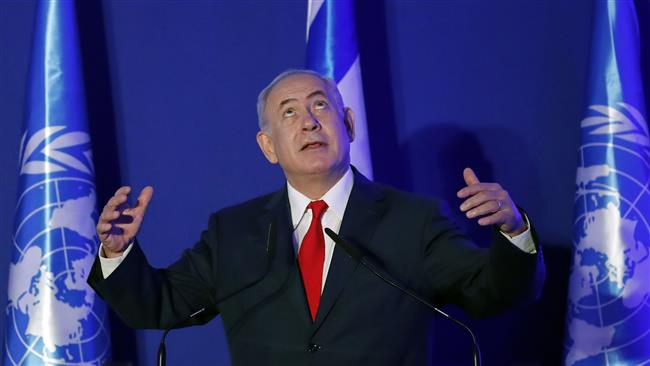
Recognizing the illegally-annexed Golan Heights as part of Israel would be a violation of UN Security Council resolutions, Russia’s foreign minister has said, in an apparent rebuke to an appeal made by Israel’s prime minister.
Changing the status of the Golan Heights would be a “direct violation” of United Nations Security Council resolutions which dictate the international community’s stance on the disputed territory, Russian Foreign Minister Sergei Lavrov noted.
On Monday, Benjamin Netanyahu called on the international community to recognize Israel’s annexation of the Golan, Syrian territory seized by Israel fifty-one years ago.
“Israel on the Golan Heights is a fact that the international community must recognize and as long as it depends on me, the Golan Heights will always remain under Israeli sovereignty,” Netanyahu said during an inauguration of a synagogue in the Golan Heights.
In August, Netanyahu expressed hope that Washington would recognize Israel’s claim to the territory, but US National Security Advisor John Bolton insisted that “there’s no discussion of it, no decision within the US government.”
Israel seized part of the Golan Heights during the Six Day War of 1967. In 1981, Israel’s parliament, the Knesset, unilaterally proclaimed the occupied land to be part of the Jewish state. The declaration was swiftly declared illegal by the UN Security Council.
India-Russia relations go way beyond defence deals
By M. K. BHADRAKUMAR | Indian Punchline | October 9, 2018
Amidst the welter of commentaries on the Indian-Russian annual summit last week in New Delhi, what stands out is that the government has outstripped our strategic analysts. The latter viewed the Russian summit last week exclusively through the prism of the $6 billion S-400 missile defence deal. Now, that turned out to be like missing the wood for the trees.
The United States’ Countering America’s Adversaries Through Sanctions Act (CAATSA) stipulates secondary sanctions against countries that enter into “significant transactions” with the Russian defence industry. Our S-400 deal became a celebrated test case. So, when in the face of threats held out by the American side relentlessly, when PM Modi went ahead with the S-400 deal, it stunned onlookers.
The ensuing confusion will take time to wither away. It will take time before it sinks in that US bluster aside, there is no way US will sanction India. The CAATSA is a legislation that the US Congress imposed on a reluctant president in the civil war conditions in US politics to stop him from improving relations with Russia (on which there is bipartisan consensus.) True, secondary sanctions have been imposed on China, but US does not intend to export arms to that country anyway!
But that is not the case with India or Turkey. Despite Turkey’s decision to not only fast track its S-400 deal with Russia and to make advance payments to the Russian manufacturer, US still intends to go ahead with its sale of F-35 stealth fighters. Turks nonchalantly told Washington that if the latter wanted to impose sanctions and annul the F-35 business deal, that’s fine with them, and they’d simply source stealth aircraft from some other country (read Russia). But, no, US still wants the F-35 deal to go through, because F-35 is a highly lucrative super business deal for Lockheed Martin, which hopes to sell to Turkey 100-120 aircraft at over $80 million per piece! In effect, Turkey called the American bluff.
Americans have keen business acumen and will not let go a honeypot like the Indian market. In fact, Modi has taken an even tougher decision to go ahead with oil imports from Iran and to sign up contracts for the month of November, although Trump warned that November 4 would be the cutoff date.
Alas, there is a lack of awareness as to what is happening. Our think tankers weaned on American folklore have been programmed to estimate that Russia is a spent force in global politics. They don’t realize that Americans themselves had no doubts already by the start of the millennium that Russia was on the comeback trail. The high oil prices in 2010-2011 proved a game changer for Russia. It was no coincidence that the first American sanctions against Russia was imposed in 2012 – Magnitsky Act – on human rights issues!
The knowledge of Russian politics and the raison d’etre of India-Russia relations is abysmally poor among Indian analysts. Modi’s strategic decision to revive India-Russia relationship as an anchor sheet of foreign policy is yet to sink in. What Americans know and Modi knows but our think tankers do not yet know is that Russia has not only returned to the global stage as a great power but with renewed capabilities in military technology and with an economy that has survived the western sanctions. The high oil prices in the period ahead will only add to Russia’s income significantly.
If the Americans sanction against India’s use of dollars for its transactions with Russia, make no mistake, Indian and Russian ingenuity will find a way to put in place a clearing system that altogether obviates the use of dollar. Arguably, it will be a blessing in disguise if the US forces India and Russia to revive their old Cold War era payment system, because if that happens, the economic content of the relationship will increase exponentially. Will the US want a major global economy like India to jettison the use of dollar and get accustomed to local currency payments?
Again, the US-Russia-China triangle is today splendidly working for Moscow and Beijing to counter the US, while both capitals retain strategic autonomy and neither seeks a military alliance. India can also be a beneficiary here if the available platforms are optimally used – BRICS, RIC and SCO, in particular. Modi made it clear at last week’s summit that India stands with Russia in strengthening multipolarity. It is a clear rejection of the US’ characterization of Russia as a “revisionist power.” Earlier, at the Shangri La Dialogue in Singapore in June, Modi underscored that India does not regard Indo-Pacific to be a strategy. The import of all this should be very clear except if one insists on holding the American brief on Russia and China. Simply put, India has a lot in common with Russia and China in regard of the emerging world order. Modi’s Wuhan initiative and his visit to Sochi soon afterward suggest that he is open to the idea of India’s Eurasian integration.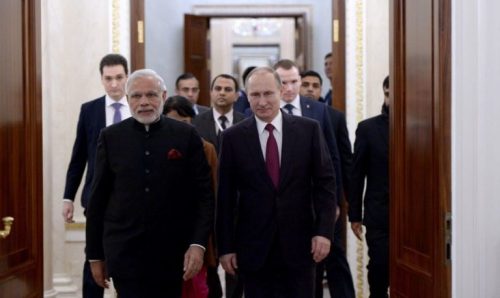
Things are looking up for India-Russia relations after the long winter of the UPA rule. For the first time in the post-Cold war era, there are signs that trade and investment between India and Russia is gaining traction. Energy sector is poised to generate massive business volume in a conceivable future. The defence cooperation still remains appreciable – at 62% of India’s arms procurement – despite the atrophy during the UPA rule.
It is sound realism that in a multipolar world, India strengthens relationships with Russia with whom it has common interests in regard of the emerging world order. The army chief Gen. Bipin Rawat’s remarks in the weekend asserting that the S-400 deal is a manifestation of India’s independent foreign policy must be viewed in that light. Last week’s summit averted a real risk of India ending up in America’s “Indo-Pacific” stable as a domesticated milch cow.
Featured Video

Dan Dicks with James Corbett on Solutions Watch
or go to
Aletho News Archives – Video-Images
From the Archives
$1.5bn up in smoke: US THAAD missile stockpile dries up defending Israel against Iran
By Ivan Kesic | Press TV | July 2, 2025
According to American media, defense news outlets, and independent analysts, the 12-day Israeli military aggression against Iran significantly depleted the US stockpile of THAAD (Terminal High Altitude Area Defense) interceptor missiles.
Citing official sources, American magazine Newsweek reported on Friday that the US transferred a substantial portion of its advanced missile defense capabilities to support the Israeli regime, an effort with questionable results and a critical impact on US strategic reserves.
THAAD, developed by Lockheed Martin arms manufacturing company, is a key component of Israel’s multi-layered air defense architecture. It is designed to intercept medium-range ballistic missiles, including those launched from Iran and Yemen.
The US-made system is capable of targeting short-, medium-, and intermediate-range ballistic missiles during their terminal phase, whether inside or outside Earth’s atmosphere.
THAAD uses a “hit-to-kill” method, relying on kinetic energy rather than explosive warheads to destroy incoming threats, intercepting at altitudes of up to 150 km and ranges between 150-200 km.
Operated exclusively by American personnel, the US military maintains eight THAAD batteries with an estimated 350–400 interceptors in total. The eighth battery was activated during the June 20 Israeli aggression against Iran and is capable of intercepting hypersonic missiles. … continue
Blog Roll
 Aletho News
- While Gaza dominates the UN, these are the people keeping it alive
- New Report: “Scholasticide and Genocide in Gaza: Assessment, Testimonies and Legal Analysis”
- ‘THAAD Delusion’: Iran war exposes US missile shield limits – The Atlantic
- Moscow issues warning to NATO over Russian exclave
- Yes, the Iran war has destroyed Trump’s presidency
- The fallacy of US delusions about Iran’s economic collapse
- Hezbollah denies Syria cell link, warns of Israeli plan to sow discord
- The legacy of US sanctions, war, and occupation in Iraq
- Iraqi resistance group rejects disarmament, vows to maintain support for Lebanon
- Sheikh al-Asadi warns of Iraqi government compliance with US demands
- If Americans Knew
- Iran’s Revolutionary Guards Publish Letter to the American People
- DMFI launches $1 million ad campaign supporting Virginia’s Elaine Luria
- US Senate blocks resolution seeking report on Americans killed by Israel
- Israeli Attacks Kill Ten Palestinians in Gaza
- Massacre at Minab: The School That Became a Grave
- Israeli media: The IDF Shows It Doesn’t Turn a Blind Eye; It Actively Emboldens Settler Havoc
- As settlers ravage West Bank, Israeli forces kill 10 in Gaza – Daily Update
- New Report: “Scholasticide and Genocide in Gaza: Assessment, Testimonies and Legal Analysis”
- Ex-Biden officials are desperate for a Gaza scapegoat
- Israeli “settlers” Invade Al-Aqsa; Pour Boiling Water on 75-Year-Old
- No Tricks Zone
- Green Energy Debacle: German Expert Professor Fritz Vahrenholt Warns Of Severe Economic And Social Consequences
- Two More Paleo Reconstructions Affirm Meters-Higher Sea Levels Across Ireland, Brazil 7000-6000 Years Ago
- New Study: Earth And Venus Surface Warmth Largely Explained By Convection And Lapse Rate, Not CO2 Or Radiation
- 2025 Nature Paper Claiming Worsening Global Drought Gets RETRACTED …Heavily Flawed
- New Study: ‘Global Drought Shows No Detectable Recent Acceleration Under Climate Warming’
- Economic Masterminds: German Socialists Suggest Taxing Productivity Gains Stemming From Using AI
- The South China Sea Has Not Been Cooperating With The Climate Change Narrative
- Energy Crisis: Germany Enters Heating Season With Historically Low Gas Reserve Fill Levels
- New Study: The Antarctic Ice Sheet Gained Mass From 2020-2024 Due To Staggering Snow And Ice Accumulation
- Study: Ocean Heating Rates From Thousands Of Years Ago ‘Dwarf’ Modern Ocean Heating Rates

