Russia is Wary of Borrowing Abroad but Has Increased Foreign Debt by 10% in 2018 Anyway
Sputnik – 12.06.2018
Worried by Russia’s small foreign debt, international creditors are advising it to borrow more, but Russia’s Central Bank believes that investments, not loans, are the way to go.
Russia’s $525-billion foreign debt is dwarfed by $7.5 trillion in Britain, $5 trillion in France, $4.8 trillion in Germany and a whopping $21 trillion in the US.
This tell-tale ratio was not lost on IMF Managing Director Christine Lagarde who, when speaking at the recent St. Petersburg International Economic Forum, described Russia’s foreign debt as “considerably small” and said that it should borrow more.
The Russian Central Bank disagrees, arguing that “investments, not debt capital” should be the main source for financing the country’s economic growth.
Big Debt – Big Problems
Foreign debt may become a major problem if market conditions suddenly change for the worse. The smaller the debt, the lesser the chances of a default. Economists say that with Russia’s foreign debt accounting for just 33 percent of GDP, this is a fairly moderate debt burden.
Russia’s entire foreign debt is commensurate with the country’s gold and currency reserves of $450 billion. This means that Russia’s financial system can simply buy it back from foreign holders at any time.
Risk Minimization
Experts also say that Russia’s small foreign debt and its ability to pay it back fast makes it less dependent on foreign financing.
“The developing markets have found themselves in a bad fix with money going out and high dollar-denominated debt negatively impacting the national economies. In Russia this risk is virtually nonexistent,” TeleTrade currency strategist Alexander Yegorov told Sputnik.
A balanced budget is another reason why Russia does not need to borrow abroad.
This year Russia will have a budget surplus – the first in seven years with the Finance Ministry expecting state revenues to exceed outlays by more than half a trillion rubles ($16 billion).
A small foreign debt is also an indicator that the economy is performing well and the country is paying less interest on borrowed money.
There is one downside here, though, as this leads to a shortage of funds needed for economic growth. Russia is ready to borrow, provided that the money goes into useful and profitable projects that allow the country to easily meet its financial obligations to its foreign partners
In the first quarter of 2018, foreign sources lent Russia an estimated $17 billion in the form of sovereign Eurobonds. Another $2.3 trillion rubles ($36 billion) came from foreign investors buying federal loan bonds.
Russia’s Central Bank governor, Elvira Nabiullina, believes that Russia could borrow more abroad and use part of the money to finance various infrastructure projects inside the country.
Is Putin Really Ready to “Ditch” Iran?
The Saker • Unz Review • June 7, 2018
The topic of Russian actions in Syria still continues to fascinate and provoke numerous polemics. This makes sense – the issue is exceedingly important on many levels, including pragmatic and moral ones, and today I want to stick strictly to the pragmatic level and set aside, just for a while, moral/ethical/spiritual considerations. Furthermore, I will also pretend, for argument’s sake, that the Kremlin is acting in unison, that there are no Atlantic Integrationists in the Russian government, no 5th column in the Kremlin and that there is no Zionist lobby exerting a great deal of influence in Russia. I will deal with these issues in the future as there is no doubt in my mind that time and events will prove how unfounded and politically-motivated these denials are in reality. But for the purpose of this analysis, we can pretend that all is well in the Kremlin and assume that Russia is fully sovereign and freely protecting her national interests.
So what do we know about what is going on in Syria?
I submit that it is obvious that Russia and Israel have made some kind of deal. That there is an understanding of some kind is admitted by both sides, but there is also clearly more happening here which is not spelled out in full. The Israelis, as always, are bragging about their total victory and posting articles like this one: “In Syria, Putin and Netanyahu Were on the Same Side All Along” with the subheading reading “Putin is ready to ditch Iran to keep Israel happy and save Assad’s victory.” Really?
The chaotic world of contradictory declarations and statements
Let’s look at that thesis from a purely logical point of view. First, what were the Israeli goals initially? As I have explained elsewhere, initially the Israelis had the following goals:
- Bring down a strong secular Arab state along with its political structure, armed forces, and security services.
- Create total chaos and horror in Syria justifying the creation of a “security zone” by Israel not only in the Golan but further north.
- Trigger a civil war in Lebanon by unleashing the Takfiri crazies against Hezbollah.
- Let the Takfiris and Hezbollah bleed each other to death, then create a “security zone”, but this time in Lebanon.
- Prevent the creation of a Shia axis Iran-Iraq-Syria-Lebanon.
- Break up Syria along ethnic and religious lines.
- Create a Kurdistan which could then be used against Turkey, Syria, Iraq, and Iran.
- Make it possible for Israel to become the uncontested power broker in the Middle-East and force the KSA, Qatar, Oman, Kuwait and all others to have to go to Israel for any gas or oil pipeline project.
- Gradually isolate, threaten, subvert and eventually attack Iran with a wide regional coalition of forces.
- Eliminate all centers of Shia power in the Middle-East.
Now let’s stop right here and ask a very simple question: if Putin and Netanyahu were on the same side all along, what should Putin have done to aid the Israelis? I submit that the obvious and indisputable answer is: absolutely nothing. By the time the Russians initiated their (very limited but also very effective) intervention in Syria those plans were well under way towards full realization!
The undeniable truth is that Putin foiled the initial Israel plan for Syria.
In fact, Hezbollah and Iran had already intervened in Syria and were desperately “plugging holes” in a collapsing Syrian front. So, if anything, Putin has to be the one to be credited for forcing the Israelis to give up on their “plan A” and go to plan “B” which I described here and which can be summarized as follows:
Step one, use your propaganda machine and infiltrated agents to re-start the myth about an Iranian military nuclear program. (…) If Trump says that the JCPOA is a terrible deal, then this is so. Hey, we are living in the “post-Skripal” and “post-Douma” era – if some Anglo (or Jewish) leaders say “highly likely” then it behooves everybody to show instant “solidarity” lest they are accused of “anti-Semitism” or “fringe conspiracy theories” (you know the drill). So step one is the re-ignition ex nihilo of the Iranian military nuclear program canard. Step two is to declare that Israel is “existentially threatened” and (…) and let the dumb Americans fight the Iranians.
As I have explained it in great detail here, Russia does not have any moral obligation to protect anybody anywhere, not in the Middle-East and most definitely not Syria and/or Iran. I have also explained in great detail here why Putin also has a lot of pragmatic internal reasons for not getting Russia involved in a major war in the Middle-East.
Finally, as I have explained here, the Israelis are clearly baiting Iran by striking Iranian (or, more accurately, Iranian-linked or Iranian-supported) targets in Syria. They hope that Iran’s patience will come to an end and that the Iranians will retaliate with enough firepower to justify not only an attack on (relatively low value) Iranian-linked targets in Syria but on Iran proper, thus leading to a guaranteed Iranian retaliation on Israel and The Big Prize: a massive US attack on Iran.
Now let’s look at Russian actions once again. If Putin was “on the same side with Netanyahu all along”, he would be helping the Israelis do what they are doing, that is baiting the Iranians, right? But what did Putin really do?
It all began with a statement by Foreign Minister Lavrov who declared that all foreign forces must leave Syria. It is my understanding that no direct quote exists from Lavrov’s initial statement, only interpreted paraphrases. Lavrov also made some clarifying comments later, like this one. But let’s not get bogged down in trying to decide which was an off-the-cuff comment and which one was “official”, let us begin by noticing this: even before Lavrov’s comment on “all foreign forces” the same Lavrov also said that “all US forces must leave Syria after the defeat of the terrorist forces.“ May I also remind everybody here that Israel has been illegally occupying the Syrian Golan for years and that the IDF exactly fits into the definition of “foreign force in Syria”? It gets better, according to the Syrians and, frankly according to common sense and international law, the Syrians say that all foreign forces must leave Syria except those legally requested to stay by the Syrian government. So when the Russians say that all foreign forces including Iranians (assuming Lavrov really said that) must leave Syria they have absolutely no legal or other authority to impose that, short of a UNSC Resolution endorsing that demand. Considering that the Israelis and the USA don’t give a damn about international law or the UNSC, we might even see a day when such a resolution is passed, enforced on the Iranians only, and ignored by the Israelis. The trick here is that in reality there are rather few Iranian “forces” in Syria. There are many more “advisors” (which would not be considered a “force”) and many more pro-Iranian forces which are not really “Iranian” at all. There is also Hezbollah, but Hezbollah is not going nowhere, and they are Lebanese, not Iranian anyway. No doubt the Israelis would claim that Hezbollah is an “Iranian force” but that is basically nonsense. And just to add to the confusion, the Russians are now being cute and saying: “of course, the withdrawal of all non-Syrian forces must be carried out on a mutual basis, this should be a two-way street.“ I suggest that we can stop listing all the possible paraphrases and interpretations and agree that the Russians have created a holy (or unholy) mess with their statements. In fact, I would even submit that, what appears to be a holy (or unholy) mess, is a very deliberate and crafty ambiguity.
According to numerous Russian sources, all this rhetoric is about the southern part of Syria and the line of contact (it ain’t a border legally speaking) between Syria and Israel. The deals seem to be this: the pro-Iranian forces and Hezbollah get out of the south, and in exchange, the Israelis let the Syrians, backed by Russian airpower and “advisors” regain control of southern Syria but without any attempts to push the Israelis out of the Golan which they illegally occupy. Needless to say, the Syrians are also insisting that as part of the deal, US forces in southern Syria must pack and leave. But, frankly, unless the US plans to have tiny (and useless) US enclaves inside Syrian controlled territory I don’t see the point of them staying. Not only that, but the Jordanians seem to be part of this deal too. And here is the best part: there is some pretty good evidence that Hezbollah and Iran also are part of the deal. And, guess what? So are the Turks.
This sure looks like some kind of major regional deal has been hammered out by the Russians. And if that is really the case, then that would also explain the tense denials in Israel and Iran, followed by more confirmations (also here) And, just to make things even more confused, we now have Stoltenberg (of all people!) saying that NATO would not assist Israel in case of an Iranian attack which, considering that the NATO Secretary General has no power, that NATO is about 80%+ made up of the USA and that the US now has a permanent “tripwire” force inside Israel and could claim to be under attack, is utter nonsense, but still amusing to note as “adding to the chaos”.
And then there is the apparent Syrian plan to kick out the US from northern Syria which, predictably, Uncle Sam doesn’t like too much. So the two sides are talking again.
If all this looks to you like evidence for the thesis that “Putin and Netanyahu were on the same side all along”, then I wonder what it would take to convince you otherwise because to me this looks like one of three things:
- some kind of major regional deal has been made or
- some kind of major regional deal is in the process of being hammered out or
- some kind of major regional deal has been made but nobody trusts anybody else and everybody wants to make that deal better for itself
and, of course, everybody wants to save face by either denying it all or declaring victory, especially the AngloZionists.
So let’s ask the key question: is there any evidence at all that Putin and/or Assad is/are “ditching Iran”?
Away from the realm of declarations and statements and back to the world
Let’s begin with a simple question: What does Iran want above all else?
I submit that the overwhelming number one priority of Iran is to avoid a massive US attack on Iran.
Conversely, triggering such an attack on Iran is the number one objective of the Israelis. They are rather open about that too. The latest idea is to create a “military coalition against Iran” while trying to please NATO by joining anti-Russian exercises in Europe.
Not because of a non-existing Iranian nuclear program threatening Israel, but because Iran offers a most successful, and therefore dangerously competing, alternative civilizational model to both the AngloZionist Empire and the Saudi-Wahabi version of Islam. Furthermore, unlike (alas!) Russia, Iran dares to openly commit the “crime of crimes”, that is, to publicly denounce Israel as a genocidal, racist state whose policies are an affront to all of civilized mankind. Finally, Iran (again unlike Russia, alas!) is a truly sovereign state which has successfully dealt with its 5th columnists and which is not in the iron claws of IMF/WB/WTO/etc types (I wrote about that last week so I won’t repeat it here).
I also submit that Iran also has as a top priority to support all the oppressed people of the Middle-East. Resisting oppression and injustice is a Quranic imperative and I believe that in its Iranian interpretation this also extends to non-Shia Sunnis and even Christians and Jews, but since I know that this will trigger all sorts of angry accusations of being naive (or even a Shia propagandist) I will concede that helping the oppressed Shia in the region is probably more important to the Iranian leaders than helping all the other oppressed. In secular terms, this means that Iran will try to protect and assist the Shia in Iraq, Syria, and Lebanon and I see absolutely nothing wrong with that at all. In fact, considering the amazing mercy shown by Hezbollah to the SLA in southern Lebanon in 2000, and the fact that currently, the Syrian security forces are acting with utmost restraint in the parts of Syria which have accepted the Russian deal (this even has some Russian analysts outright worried) I think that Iranian-backed forces liberating Syria from Daesh are the best thing which anybody could hope for.
Furthermore, the truth is that for all its other faults, the Ba’athist regime in Syria was tolerant of minorities and that Hezbollah has always been protective of absolutely all the Lebanese people regardless of confession or ethnicity (others might disagree with me, but having studied Hezbollah and Iran for several decades now I come to the conclusion that they, unlike most other political actors, are actually truthful when they state their intentions).
So who is the biggest threat to the Shia and, I would argue, to all the people of the Middle-East? The Takfiris of Daesh of course.
And what do all the variants of the possible “big regional deal” have in common? The elimination of Daesh & Co. from Syria.
So how is that against the Iranian interests?!
It isn’t, of course.
The truth is that I see absolutely no evidence at all for “Putin and Netanyahu working together all along”. What I do see is that some kind of deal is being worked out between numerous parties in which everybody is probably trying hard to cheat everybody else, Realpolitik at its worst and most cynical – yes. But hardly a betrayal of Iran by Russia.
What everybody seems to be doing is what blacksmith Vakula did in Gogol’s Christmas Story “The Night Before Christmas“: to trick the devil. In Russia, the devil is known as “лукавый” which does not just mean “evil” but also sly/wily/deceitful/wickedly clever. To try to trick the devil is a very, very dangerous and difficult task and I also find it morally very questionable. But in keeping up with our modern value-neutral “realistic” Zeitgeist, we can also debunk the “Putin betrays Iran” on purely cynical and “pragmatic” reasons with no need to appeal to any higher values at all.
For those who have not seen it yet, I highly recommend this (English subtitled) video of Ruslan Ostashko discussing what Israel can, or cannot, offer Russia and Putin:
Ostashko is absolutely right. The truth is that Israel, unlike Iran, has very little to offer Putin or Russia. This does not mean that Israel does not have influence over the Kremlin, it most definitely does, but that influence is all “stick”, no “carrot” (which is one of the conceptual flaws in the position of those who deny the existence of a Zionist 5th column in Russia – they are denying the existence of the “stick” while producing no “carrot” thus making Russian policies appear both contradictory and inexplicable: hence a need for all sorts of mental contortions to try to explain them).
But Israel’s “stick”, while undeniably big, is dwarfed by Iran’s “carrot”: not only immense resources and billions of Dollars/Rubles/Rials/Euros to be made in energy and weapons and also many sectors of the economy. There is also the fact that Iran is truly the number one regional power in the entire Middle-East: maybe not big enough to impose its will on all others, but definitely big enough to bring down any major plan or policy it does not approve of. Furthermore, now that the international sanctions against Iran have been officially lifted (the USA’s reneging on its signature notwithstanding), Iran can join and become an influential member of the Shanghai Cooperation Organization (along with, possibly, other Middle-Eastern countries). All this makes the Iranian “carrot” very attractive to Russia. There is also a conceptual Iranian “stick”: if Israel gets its way and Iran is massively and viciously attacked by the AngloZionist Empire, and either chaos or a severe crisis result, what would be the impact on Russia and her allies? And, while I don’t think for a second that this is possible, let’s say the Empire overthrows the Islamic Republic and puts a pro-AngloZionist regime in power in Tehran – what would that do to Russian national security? It would be an absolute nightmare, wouldn’t it?
Look at the relationship between Russia and Turkey before the coup attempt against Erdogan. Surely that relationship was much worse than the relationship currently enjoyed between the Islamic Republic and Russia, right? And yet, when the US attempted to topple Erdogan, what did Russia do? Russia gave Erdogan her fullest support and even, according to some rumors, physical protection during a few key hours. If Russia sided with Erdogan against the Empire, why would Russia not side with the Islamic Republic, even if we consider only arguments of Russian self-interest?
For an excellent Iranian analysis of the Russia-Iran alliance, check out this article by Aram Mirzaei.
Conclusion
The simple truth is that regardless of declarations and political statements, China, Russia, Iran, Syria and Hezbollah are all dependent on each other and cannot afford to truly betray anybody lest the Empire take them out one by one. To use Franklin’s expression – they all must hang (i.e. stand) together or most assuredly they will all “hang separately”? That does not mean that they all love each other, or always share the same goals? They might also play against each other to some degree, and even try to get some sweet deal “on the side” with the AngloZionists (remember, Assad used to torture for the CIA!), but the facts on the ground and the correlation of forces in the Middle-East will limit the scope of such “mini-betrayals”, at least for the foreseeable future.
True, there is the Saudi factor to take into account. Unlike the Israelis, the Saudis are offering a lot of “carrot”. But the Saudis are way too arrogant, they are already messing with Russian interests not only in Syria, but also in Qatar, and their brand of Islam is truly a mortal danger for Russia. Right now the Atlantic Integrationists and Eurasian Sovereignists have achieved somewhat of an equilibrium in the Kremlin. One is trying to split the EU from the USA and make lots of money, while the other is left in charge of national security issues, especially towards the South, but this equilibrium is inherently unstable and would be immediately threatened by any meaningful AngloZionist attack. So yes, there is a Zionist Lobby in Russia and yes, it does act as a 5th column, but not, most emphatically no, it is not strong enough to completely disregard the financial interests of the Russian business elites or, even less so, fundamental Russian national security interests. That is the biggest difference between the USA and Russia: Russia, while only partially sovereign, is far from being an Israeli protectorate or colony. And as long as Russia retains her even partial sovereignty she will not “ditch” Iran, regardless of Israeli whining and threats.
My personal evaluation is that Putin is playing a very complex and potentially dangerous game. He is trying to trick not one, but many “devils,” all at the same time. Furthermore, if the US Americans have been недоговороспособны (“not agreement capable”) already since Obama, Trump and his Neocon masters have made that even worse. As for the Israelis, they would make Satan himself look honest and are ideologically incapable of honesty (or even decency). Frankly, I don’t trust Erdogan one bit and I don’t think that the Russians will ever trust him either. Call me naive, but I think that Assad has been changed by this war and even if he did, indeed, collaborate with the CIA in the past, I think that he will be a pretty good ally for Russia in the future. As for Ayatollah Ali Khamenei and Hassan Nasrallah, I see them both as men of honor who will uphold any alliance they formally enter into (informal understandings and temporary mutual interests are a different deal). I also see them as brilliant and wise geostrategists: they fully realize that Iran and Hezbollah need Russia to survive. So Putin’s policy, while dangerous, is not doomed to failure at all: he is trying to save Syria from the AngloZionsts while avoiding a regional war. Time is on his side as Trump’s erratic (and that is putting it mildly) policies (or, really, lack thereof) are inflicting tremendous damage on the Empire on a daily basis (see Dmitri Orlov’s excellent analysis here).
I honestly don’t know if Putin’s dangerous strategy will work or not. I don’t think anybody else does either (except ignorant cheerleaders, of course). But I do know that even if the sight of Bibi Netanyahu in Moscow with a Saint George ribbon was nauseating to my conscience, this absolutely does not indicate that Netanyahu and Putin are working together or that Russia is “ditching Iran”. As always, the Israelis feel almighty and brazenly display their arrogance. Let them. Just remember the inevitable outcome from that kind of Zionist hubris in the past and wait for the inevitable “oy vey!“.
Finally, there is the single most important fact: the AngloZionist Empire and Russia remain at war, and have been so for at least four years or more. That war is still about 80% informational, 15% economic and 5% kinetic, but it is a very real war nonetheless, and it is escalating. As long as Russia will retain even partial sovereignty and as long as she will offer an alternative civilizational model, even an imperfect one, she will remain an existential threat to the Empire and the Empire will remain an existential threat for the entire Russian civilizational realm. While hugely important to Israel, the entire Iranian issue is just a sideshow to the transnational leaders of the Empire who see Russia and China as the real main competitors, especially when joined in a symbiotic relationship as they are today. Hence the crises in the Ukraine and on the Korean Peninsula, hence the constant warnings of a possible full-scale nuclear war (see Eric Zuesse latest article here or Paul Craig Roberts numerous article on his website; also check out Dan Glazebrook’s excellent analysis of Trump’s attempt to repeat the “Rambouillet ruse” in Korea here). Even if Putin succeeds in moving the EU closer to Russia and away from a (clearly insane) USA, and even if he succeeds in preventing the AngloZionists from directly attacking Iran, this will only further convince the AngloZionist leaders of the Empire that he, Putin, and Russia, are the ultimate evil which must be eliminated. Those who hope for some kind of modus vivendi between the Empire and Russia are kidding themselves, because the very nature of the Empire makes this impossible. Besides, as Orlov correctly pointed out – the Empire’s hegemony is collapsing, fast. The Empire’s propaganda machine denies and obfuscates this, and those who believe it don’t see it – but the leaders of the Empire all understand this, hence the escalation on all fronts which we have seen since the Neocons re-took power in the White House. If the Neocons continue on their current course, and I don’t see any indication whatsoever that they are reconsidering it, then the question is only when/where this will lead to a full-scale war first. Your guess is as good as mine.
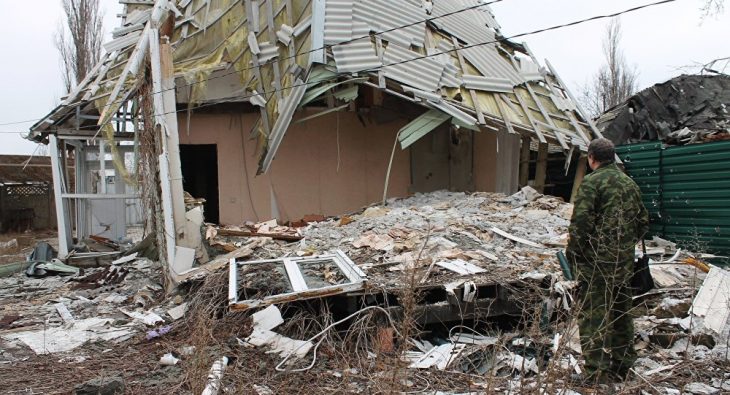
Putin pledges help to unrecognized Donbass republics, warns Ukraine against attack
RT | June 7, 2018
Vladimir Putin has said that any aggravation of the military conflict in Ukraine would “inflict a tremendous damage” to the country’s statehood and added that Russian support for the Donbass republics will continue.
During the Thursday televised Q&A session Putin faced a question from Russian journalist and writer Zakhar Prilepin, who is currently a voluntary advisor to the head of the Donetsk People’s Republic, the DNR.
Prilepin asked the president if he considered it possible that pro-Kiev forces would launch a major offensive operation in the war-ridden south-east of Ukraine during the 2018 World Cup in Russia which begins in one week.
Putin said that he personally hoped that such thing would not happen and noted that such a development would “inflict a tremendous damage to the Ukrainian statehood” adding that he personally believed that it was impossible to intimidate the people from the self-proclaimed republics of Donetsk and Lugansk.
“It is impossible to intimidate the Donbass people. We see how they endure all these hardships, we send them help and we will continue doing this,” Putin stated.
Putin also asked a rhetorical question – how was it possible that Kiev authorities attempt to solve the problems of Donbass and consider this region Ukrainian territory while at the same time destroying the republics’ economies with blockades and openly robbing their residents. The Russian leader added that Ukrainian officials kept their personal fortunes in offshore bank accounts.
Earlier this week the head of the self-proclaimed Donetsk People’s Republic, Aleksandr Zakharchenko, said that he personally participated in reconnaissance missions on the frontline and got an impression that the Ukrainian side was preparing for a major offensive. “This is connected with the football World Cup, Ukraine will attempt to use this event. There is such a threat I would not conceal this fact. Ukraine cannot wage a full-pledged war, but they can launch several major armed provocations in three parts of the frontline maximum,” he said.
A few days ago, Putin said in an interview with Austrian television that, in order to stop internal conflict in Ukraine, Kiev authorities could grant special status with broader powers to the republics of Donbass, just as Russia had done with Chechnya.
“Russia had to make a very complicated decision and grant the Chechen Republic and many other federation subjects such status that gave them a great degree of independence within the Russian Federation … the same thing could be done in Ukraine in regards of the Donbass republics and I wonder, why have not they done it yet?
“Under such scenario there is no necessity to restrict the usage of ethnic minorities’ languages in Ukraine, I mean not only Russian but also Romanian, Hungarian and Polish. There is little talk about it in Europe but these are the today’s realities,” the Russian president said.
In September 2017, Putin called for a UN peacekeeping mission to be sent to the war-torn eastern regions of Ukraine. The mission would have been deployed to the line of demarcation to protect the OSCE mission, which monitors the ceasefire.
Moscow’s initiative was welcomed by German Foreign Minister Sigmar Gabriel and Chancellor Angela Merkel, but the US and Ukrainian delegations refused to discuss it at the UN Security Council, bringing about a stalemate.
Iraq receives dozens of advanced T-90 battle tanks from Russia
Press TV – Jun 7, 2018
The Iraqi military has received dozens of more advanced T-90 battle tanks from Russia under a major deal struck between Moscow and Baghdad last year.
The Iraqi Defense Ministry, in a statement released on Thursday, announced that it had taken delivery of 39 tanks, adding that the armored fighting vehicles had been distributed between two battalions of an army brigade.
The statement said that Iraqi military personnel had already been trained by Russian experts on how to operate the battle tanks.
Iraqi Army Chief of Staff General Othman al-Ghanimi said on February 19 that his country’s army had received 36 Russian-made T-90 battle tanks.
The T-90 is a third-generation Russian battle tank built upon the time-proven Soviet T-72 design.
It is among the best-selling tanks in the world, and known for its firepower, enhanced protection and mobility.
The T-90 features a smoothbore 2A46M 125mm main gun, which can fire both armor-piercing shells and anti-tank missiles.
The advanced tank also features sophisticated armor, ensuring all-round protection of the crew and critical systems, including explosive reactive armor and active infrared jammers to defend it from inbound rocket-propelled grenades, anti-tank missiles and other projectiles.
Indian, Algerian and Azerbaijani militaries have purchased hundreds of T-90 battle tanks in past years. Kuwait, Vietnam and Egypt have also expressed strong interest in buying the tank.
The Iraqi military plans to reinforce its fleet of M1A1 Abrams main battle tanks with T-90s. A large number of American M1A1 Abrams tanks have been damaged in the fight against Daesh Takfiri terrorists.
Top Russian pundit calls for Palestine talks in Moscow
By M.K. Bhadrakumar | Asia Times | June 6, 2018
In an interview with the influential Russian daily Izvestiya, the well-known “Orientalist” scholar and establishment figure, Vitaly Naumkin, has floated the startling idea that Moscow must play a role in resolving the Palestinian problem. He said, “Moscow has long urged for [organizing] a top-level meeting between Palestinians and Israelis in Russia, on a Moscow platform. It is necessary to turn Moscow into a venue for such talks.”
Naumkin explains that Moscow has unique credentials to kickstart peace talks, since it is a veto-holding member of the UN Security Council with an obligation to pursue the implementation of relevant UN resolutions on Palestine and is also a member of the Middle East Quartet. Alas, US obduracy has stalled the Quartet, while Washington is stonewalling by casting its veto in the Security Council. He lamented that the US is hobnobbing with extreme right-wing elements in Israel who are not even representative of Israeli opinion.
The idea of Russia acting as a mediator in talks on the Palestinian problem dates back to the Soviet era. It’s been a non-starter due to the West’s dogged determination to keep the Soviets out of the strategic Middle East region. But although Cold War has ended, any Russian attempt to highlight the Palestine problem as the core issue in the Middle East will run into strong headwinds from Tel Aviv and Washington.
So, why is Naumkin, a top establishment pundit (who heads the Russian Academy of Science’s hallowed Institute of Oriental Studies), wading into the whirlpool? In a manner of speaking, he is actually using an “objective co-relative” to clarify the real state of play in the Russian-Israeli ties.
In the interview, Naumkin dispels any notion that Russia and Israel are in any “strategic alliance.” He prefers to call it a “normal trust-based relationship,” which enables the two countries to “fight terror together” and maintain excellent economic ties. Period. Quintessentially, as he puts it, the two countries “no longer see each other as enemies.”
Naumkin points out that Israel’s stance on Ukraine is helpful insofar as it refuses to join western sanctions against Russia, and, secondly, Israel is in harmony with Russia as regards attitudes toward World War II and fascism. But does it mean that Moscow and Tel Aviv have identical stance on everything under the sun? For heaven’s sake, no!
What makes Naumkin’s remarks very interesting is not only his subtlety of mind but that he belongs to the great Soviet tradition of scholar-diplomats who are on the frontline of Russian foreign policy. Quite obviously, Naumkin has marked some distance between Russia and Israel at a complicated juncture when the self-serving western narrative would be that the two countries have struck a deal at the highest level of leadership regarding the future of Syria, leaving Iran out in the cold.
Moscow feels that poison is being injected into Russia’s complex equations with Tehran and Damascus. Who else but Naumkin could provide the perfect antidote? The heart of the matter is that Russia has substantially improved relations with most countries in the Middle East in recent years after a decade of limited cooperation through the first decade following the collapse of the Soviet Union.
Russian diplomacy has shaken off the Soviet-era ideological baggage and is highly pragmatic. Thus, although Saudi Arabia and the UAE significantly contributed to the bleeding of the Red Army in Afghanistan in the 1980s and had covertly fostered “jihadism” in Chechnya in the 1990s, the Kremlin today is eager to build relations with them. In fact, Saudi Arabia is Moscow’s strategic partner in the so-called “OPEC+ deal” aimed at stabilizing the world oil market.
Again, Qatar, which has been called the “Club Med for terrorists” and was a latent ally of Chechen rebels, is currently negotiating the purchase of Russia’s advanced S-400 missile defence system.
Moscow’s diplomacy aims to convey the impression to its Middle Eastern interlocutors – be it Israel, Jordan, Iran or Saudi Arabia – that Russia keeps its end of a mutually beneficial bargain. But if anyone adds mystique to the bargain and elevates it to a Faustian deal, Moscow may be left with no option but to bring it down to terra firma.
Plainly put, Naumkin, (who, interestingly enough, also happens to be Russia’s advisor to the UN Special Envoy for Syria Steffan de Mistura) knows perfectly well what Russia is attempting in southern Syria – namely, to eliminate the remaining strongholds of terrorist groups ensconced in that region bordering Jordan and Israel. Indeed, if Israel could persuade Washington to shut down the base in Al-Tanf (which makes no sense from a military point of view anyway), it will help the overall Russian efforts. On the other hand, Israel has no reason to worry, because Iran does not intend to participate in the liberation of the provinces of Daara and Quneitra that straddle the Golan Heights.
Besides, it is no secret that Russia has nothing to do with Iran’s policy of resistance against Israel. But then, to put two and two together to shout and dance in jubilation that Russia is muzzling Iran is completely unnecessary – and can turn out to be counterproductive. Of course, if anyone tries to create confusion, Moscow will clarify. That is what Naumkin has ably done.
Russia pushes back at US on North Korea
By M.K. Bhadrakumar | Asia Times | June 4, 2018
The visit by the Russian Foreign Minister Sergey Lavrov to Pyongyang on May 31 was a poignant moment for both countries. This was a rare meeting between a senior Russian official and a member of the Kim dynasty. Yet, Russia has been the oldest friend and mentor of the ruling family in Pyongyang.
Kim’s family escaped from Japanese-occupied Korea to the Soviet Union in 1920 when the revered founder of North Korea, Kim Il Sung, was only eight years old. He grew up in Russia, joined the Red Army and fought the Japanese in Manchuria. When World War II ended, Kim returned to his country and with some Soviet backing, went on to lead North Korea’s Communist Party and lay the foundations of the new state north of the 38th parallel.
Make no mistake, it was not a coincidence that Kim received Lavrov on the same day his deputy Vice-Chairman Kim Yong-chol met US President Donald Trump at the White House. Kim told Lavrov in front of TV cameras: “I highly value the fact that Putin’s administration strictly opposes the US’ hegemony. You strictly oppose, and we are always ready to conduct negotiations and a profound exchange of opinions with the Russian side on this issue.” Russia’s Cold War ally is picking up the threads with ease.
Unsurprisingly, Lavrov gave whole-hearted backing for the North Korean stance on the vexatious issue of denuclearization. In Lavrov’s words: “We assume that a complete resolution cannot be achieved until all the sanctions are lifted. It is up to the negotiators to make this happen, but in any case, it would be impossible to achieve this in a single round. The same applies to denuclearization. For this reason, this should be a step-by-step process with reciprocal moves at each of the stages.”
Denuclearization not a stand-alone issue
Lavrov called for a “judicious approach” not to rush things and cautioned against any “rash actions”, bearing in mind the need for “careful consideration and coordination of all elements of a package decision.” The carefully-chosen expression “package decision” implies that denuclearization is not a stand-alone issue.
He underscored: “Russia and North Korea hold a common view… We know that this is an extremely complicated problem and that the goal of denuclearization is inseparably connected with the eventual restoration of peace, stability and a system of interaction, cooperation and equal and indivisible security in Northeast Asia.” Simply put, Lavrov asserted Russia’s role in the current process as a stakeholder in the stability and security of its region. Interestingly, Lavrov flagged the need at some point to revive the format of six-party talks (involving the two Koreas, US, China, Japan and Russia.)
The Russian Foreign Minister also discussed substantive issues of bilateral cooperation in the economic sphere in anticipation of a post-sanctions future. In particular, he brought up the languishing 10-year-old idea of linking the Trans-Siberian and Trans-Korean railway systems to connect Moscow with Seoul via Pyongyang and to build a parallel gas pipeline.
Meeting between Putin and Kim soon?
Meanwhile, the speaker of the upper house of the Russian parliament, Valentina Matviyenko, is expected to visit North Korea soon. Most importantly, a meeting between Putin and Kim is on the cards. Reports speculate that the meeting may take place as early as next week during Putin’s state visit to China following the Shanghai Cooperation Organization summit in Qingdao (June 9-10).
The Russian Deputy Foreign Minister Igor Morgulov who accompanied Lavrov to Pyongyang was in Beijing on May 29 and would have discussed the forthcoming trip with Chinese officials. While in Beijing, Morgulov made some highly critical remarks about US policies in the Asia-Pacific, which reflected the thrust of Lavrov’s mission:
“I am referring… to the idea of the Indo-Pacific region, which the United States and Japan are actively advocating. Essentially, it is designed to divide the regional countries into friends and foes… Both Russia and China hold a diametrically opposite view. They are against creating blocs and believe that an effective and system-wide response to security challenges in the Asia Pacific must include a comprehensive military and political détente and uniform rules of the game… This architecture must be based on the universal principles of indivisible security and the supremacy of international law, as well as non-use of force or threat of force.”
Beijing has welcomed “Russia’s positive role” and said high-level exchanges between Russia and North Korea are “conducive to promoting the political settlement process of Korean Peninsula issue and upholding the peace and stability of the peninsula and Northeast Asia.” Russia is airing opinions supportive of North Korean concerns and vital interests, which Beijing shares but for obvious reasons is not in a position to voice openly.
Process will be a long haul
Clearly, Lavrov’s mission is making it more difficult for Washington to pressure the North Korean leadership or dictate the dynamics of the current process. Moscow is signaling that it will not remain a passive bystander (as in the negotiations over the Iran nuclear issue). And, it has taken a common position with Beijing that the denuclearization of North Korea impacts on the regional security matrix in Northeast Asia. Given this developing situation, the final outcome is almost certainly going to be a long haul.
Simply put, the US’ containment strategy against Russia and China has created a complex regional security environment in Northeast Asia. On one side there is talk of a new US military base in Poland and additional deployment of 30,000 NATO troops to Central Europe on Russia’s western fringe, while on the other side US Secretary of Defence James Mattis promised at the Shangri-La Dialogue in Singapore on the weekend to step up military pressure on China in the South China Sea, and Trump is beating the drums of a trade war with Beijing.
However, somewhat incredibly, in this milieu of growing big-power tensions, Washington still expects Moscow and Beijing to remain docile as Trump and his team go about denuclearizing North Korea and reset the regional security calculus. This expectation is plainly unrealistic. Moscow has signaled that as a stakeholder, it will push back and will not allow a replay of what happened over the Iran nuclear deal.
Significantly, Lavrov disclosed that the North Korean leadership is “fully aware” of developments relating to the US’ exit from the Iran nuclear deal, and “will determine its position taking into consideration all these factors.”
Russia censures Iran, expects Israel to help restore ties with US
Vladimir Putin surprised many at the event known as Russia’s Davos with his comments on the Iran nuclear deal and Russia’s relations with the US
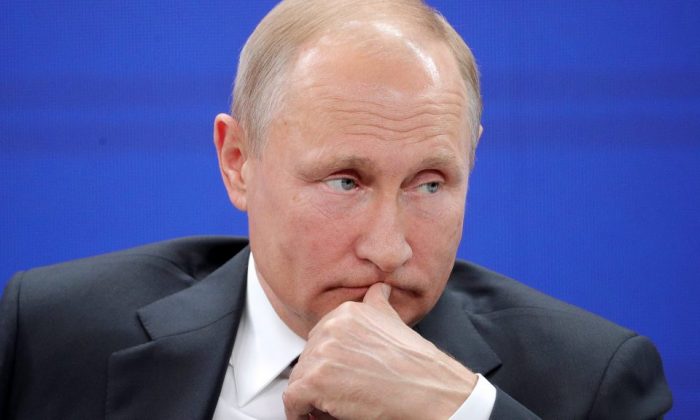
Russian President Vladimir Putin at the St Petersburg International Economic Forum on May 25, 2018. Photo: Reuters/Sergei Bobylev/TASS
By M.K. Bhadrakumar | Asian Times | June 1, 2018
The annual meeting of the St Petersburg International Economic Forum – dubbed as “Russia’s Davos” – on May 25, which traditionally promotes foreign investment in the Russian economy, ended this time around as a major political event signaling a renewed bid by President Vladimir Putin for détente with the West.
In wide-ranging remarks at the forum, Putin made an explicit overture to Washington for dialogue. The US decision to quit the Iran nuclear deal was the leitmotif of the Q&A at St Petersburg – which are generally choreographed by the Kremlin in advance – and Putin seized the opportunity to articulate a highly nuanced position on the topic with an eye on the overall Russian-American relationship.
Unsurprisingly, Putin criticized the US’ rejection of the Iran nuclear deal as a unilateralist move which would have negative consequences. But then, Putin also expressed understanding for President Donald Trump’s domestic compulsion in taking such a decision.
Putin also proposed that the US and Iran, which had negotiated the 2015 pact directly, could resume their negotiations to settle the differences: “Even now, the US President is not closing the door on talks. He is saying that he is not happy about many of the terms of the deal. But in general, he is not ruling out an agreement with Iran. But it can only be a two-way street. Therefore, there is no need for unnecessary pressure if we want to preserve something. Doors must be left open for negotiation and for the final outcome. I think there are still grounds for hope.”
Putin probably sees Russia as a facilitator-cum-moderator between the US and Iran, but at any rate, he has deflected the focus from the EU’s approach, which single-mindedly focuses on the downstream impact of US sanctions against Iran. It is smart thinking on Putin’s part to signal that Moscow does not propose to wade into any transatlantic rift over the Iran issue. He probably doubts if the rift is real enough for outsiders to exploit.
Putin and the Iran nuclear deal
But the really intriguing part was that Putin also brought into the matrix the “good, trust-based relations between us (Russia and Israel).” Significantly, the interpolation occurred while Putin was arguing that the preservation of the Iran nuclear deal was also in Israel’s interests.
Neither Moscow nor Tel Aviv has divulged the details of the recent meeting between Putin and Israeli Prime Minister Netanyahu in Moscow in early May. But Israeli sources have since divulged in bits and pieces that a major understanding might have been reached as regards the imperative need for an holistic approach toward the whole situation surrounding the “Iran question,” including Iran’s presence in Syria, which Israel indeed sees as existential threat.
Interestingly, three days after Putin spoke at St Petersburg, an influential Moscow think tank came up with a commentary regarding the emergent trends in the Syrian situation. Basically, the commentary stressed that Russian policy was switching tack and giving primacy to the search for political settlement and reconstruction of Syria. But it went on to discuss the rising tensions between Iran and Israel in Syria and blamed Iran for using Syria for the “export” of its policy of Resistance against Israel.
Hinting at growing resentment within the Sunni majority in Syria against Iran’s activities, the commentary contextualized Putin’s recent call for the withdrawal of all foreign forces from Syrian soil. It openly rapped the Iranians on the knuckle: “Iran’s operations in Syria go far beyond fighting terrorists and are hardly welcomed by anyone within the region and beyond. This heightens tensions in Israel’s relations with its bitter rivals … Serving as a platform for fighting the ‘Zionist’ enemy is something Syria needs the least.”
Indeed, these are extraordinary statements for an establishment think tank known to be close to the Kremlin. The key elements were: a) Russia holds Iran as responsible for ratcheting up tensions with Israel; b) Russia thoroughly disapproves of Syria being turned into a turf for Iran’s policy of “Resistance” against Israel; and, c) Moscow expects the Assad regime to distance itself from Iran’s anti-Israeli activities.
The patent shift in the Russian stance implies Moscow’s acknowledgment that the fate of the Iran nuclear deal is also linked to Iran’s regional policies. Arguably, this Russian stance harmonizes with what Trump and Netanyahu have been saying all along. Perhaps, Russia hopes to cajole Tehran to walk toward the negotiating table where Trump is waiting. Perhaps, Putin also calculates that such a helpful stance cannot but have positive fallout on US-Russia relations as a whole. Time will tell.
The bottom line is that the close ties between Russia and Israel are sailing into full view. Interestingly, Israel just obliged a famous Russian oligarch who is perceived as close to Putin, by granting him citizenship, which would enable him to visit Britain – although London refuses to renew his residence permit. The influential Kremlin-linked Russian oligarch now de facto becomes the wealthiest Israeli citizen, too.
Suffice to say, it all does seem a cozy condominium between Putin and Netanyahu. The big question will be how far Netanyahu can help Putin to bring about a Russian-American “thaw” under this complex set of circumstances.
US ‘losing its cards’ in Syria: Highlights of RT’s interview with Bashar Assad
RT | May 31, 2018
Washington and its “puppets” tried, and failed, to destroy Syria – and the US military will eventually be forced out of the country: These are a few of the highlights from RT’s exclusive interview with President Bashar Assad.
Speaking with RT’s Murad Gazdiev in Damascus, Assad commented on a range of topics, from the threat of direct conflict between the US and Russia, to why he doesn’t fear Israeli assassination threats.
On Victory: ‘It’s self-evident’ that Syria is ‘moving closer to the end of the conflict’
Assad noted that the “majority” of Syria is now under government control, but said that continued provocations and escalations by the United States and its allies have needlessly prolonged the seven-year conflict. With each Syrian military victory or successful reconciliation effort, the US and its partners have attempted to counteract these gains by “supporting more terrorism, bringing more terrorists to Syria, or by hindering the political process,” Assad said.
However, he stated that it was “self-evident” that “we are moving closer to the end of the conflict,” adding that “without external interference it won’t take more than a year to settle the situation in Syria.”
The Syrian leader said that whenever possible, his government has chosen negotiations and reconciliation over use of force.
“War is the worst choice but sometimes you only have this choice,” Assad told RT. “Factions like Al-Qaeda, like ISIS, like Al-Nusra, and the like-minded groups, they’re not ready for any dialogue… So, the only option to deal with those factions is force.”
He defended the government’s use of ceasefires and allowing extremists to withdraw to Idlib province, describing the agreements as strategically advantageous for the Syrian army. “If you have two or three frontiers, that’s better than having 10, maybe more than 100 at the time.”
On the US: Washington ‘losing its cards’ in Syria
Although the US forces continue to operate illegally in Syria, they will eventually be forced out of the country, Assad told RT.
“The United States is losing its cards. The main card was Al-Nusra, that was called ‘moderate,’ but when scandals started leaking that they’re not moderate, that they’re Al-Qaeda, which is supposed to be fought by the United States, they started looking for another card. This card is the SDF [Syrian Democratic Forces] now,” he said, referring to the US-backed militia group. According to Assad, once Islamic State (IS, formerly ISIS) and Al-Nusra are exterminated, the Syrian military will turn its attention on the SDF.
“We’re going to use two methods to deal with the SDF: The first one, we started opening doors for negotiations – because the majority of them are Syrians. And supposedly they like their country, they don’t like being puppets to any foreigners – that’s what we suppose.” Assad said that these commonly-shared values could allow reconciliation with the government. “We all don’t trust the Americans, [so] the one option is to live with each other as Syrians.” However, if negotiations fail, the Syrian army will be forced to liberate areas occupied by the SDF, with the Americans, or without the Americans.”
On this point Assad was adamant: “This is our land, it’s our right, it’s our duty. To liberate [these areas], and the Americans should leave. Somehow, they’re going to leave. They came to Iraq with no legal basis. And look what happened to them. They have to learn their lesson.”
On Russia: Moscow’s leadership prevented ‘direct conflict’ with US military
Syria’s president heaped praise on Moscow, claiming that Russian “wisdom” had prevented a direct conflict between Russian and American forces in Syria. “We were close to having direct conflict between the Russian forces and the American forces, and fortunately, it has been avoided, not by the wisdom of the American leadership, but by the wisdom of the Russian leadership.”
While Assad reiterated that the United States military was not welcome in Syria, he said that avoiding escalation was the key to restoring Syria’s territorial integrity. “We need the Russian support, but we need, at the same time to avoid the American foolishness in order to be able to stabilize our country.”
He emphasized that Russia has shown restraint – not weakness – in Syria, noting how Russian warnings had likely dissuaded Trump from launching a full-scale attack against Damascus.
“The Russians announced publicly that they are going to destroy the bases that are going to be used to launch missiles, and our information – we don’t have evidence, we only have information, and that information is credible information – that they were thinking about a comprehensive attack all over Syria, and that’s why the threat pushed the West to make it on a much smaller scale,” the Syrian president said.
On Israel: No longer phased by ‘threat of Israeli aggression,’ Tel Aviv in ‘panic’
Assad shrugged off Israeli threats against his own life, telling Gazdiev that “my generation – and most of the generations in Syria now – has lived under the threat of Israeli aggression. This is something in our unconscious feeling. So to say that you are afraid while living with the same threat for decades – this is nonsense.” He said that the fact that Tel Aviv has resorted to threats suggests that the Israelis are panicking.
“The Israelis have been assassinating, killing, occupying for decades now, for around seven decades, in this region, but usually they do all this without threatening. Now, why do they threaten in this way? This is panic, this is a kind of hysterical feeling because they are losing the ‘dear ones,’ the dear ones Al-Nusra and ISIS, that’s why Israel is panicking recently, and we understand their feeling.”
He said reports that Syria was helpless to stop Israeli airstrikes were inaccurate. “Our air defense is much stronger than before, thanks to the Russian support and the recent attacks by the Israelis and by the Americans and British and French proved that we are in a better situation” than at the start of the conflict seven years ago, he said. However, Assad noted that when foreign-backed fighters first poured into Syria, the first thing they did was target air defense systems – suggesting a “direct link” between the terrorists groups and Israel.
On chemical attacks: ‘Is it in our interest? Why? And why now?’
Syria’s president described the string of alleged chemical attacks as provocations that have ultimately failed to persuade the international community to give the US and its allies a military mandate in Syria.
Washington and its allies blamed the last such attack, in April, on Damascus, but Assad insisted that the Western narrative makes no sense.
“The timing of this alleged strike was after the victory of the Syrian troops in Ghouta. Let alone the fact that we don’t have chemical weapons anyway,” he told RT. Pointing to multiple reports of civilians and medical workers in the area having no knowledge of a chemical attack – with some even appearing in the Western press – Assad concluded that the alleged incident was a last-ditch Western attempt to sway international opinion – one that failed.
“They told a story, they told a lie, and the public opinion around the world and in the West didn’t buy their story, but they couldn’t withdraw. So, they had to do something, even on a smaller scale,” Assad said, referring to the joint airstrikes against purported Syrian chemical weapons facilities, carried out on April 14 by the US, UK, and France.
However, Assad acknowledged that nothing was stopping Washington from attempting similar provocations in the future. The US has “trampled on international law,” and “there’s no guarantee that it won’t happen [again].”
Assad asked: “What was the legal basis of [the April missile] attack? [Or] the so-called anti-terrorist alliance, which supports the terrorists, actually? What is the legal basis of their attack on Yemen, Afghanistan? There’s no legal basis.”
On Trump: ‘What you say is what you are’
Asked if he had a nickname for US President Donald Trump, who had previously called Assad an “animal,” Syria’s leader admitted that he wasn’t in the business of name-calling.
“This is not my language, so, I cannot use similar language. This is his language. It represents him,” he said. “I think there is a very well known principle, that what you say is what you are. So, he wanted to represent what he is, and that’s normal,” Assad added.
“The only thing that moves you is what people that you trust, people who are level-headed, people who are thoughtful, people who are moral, ethical, that’s what should move anything inside you, whether positive or negative. Somebody like Trump will move nothing for me,” he said.
On the myth of Syria’s ‘civil’ war: It was foreign-backed regime change
Assad disputed claims that the seven-year conflict has been a “civil war,” pointing out that there is no sectarian or ethnic conflicts in the areas currently controlled by the government. “Now in Damascus, in Aleppo, in Homs, in every area under Syrian government control, you will see [the whole] spectrum of Syrian society. With no exceptions.”
He noted that the term ‘civil war’ had been used widely since the beginning of the conflict in Syria – but it does not correctly characterize the conflict.
“A Syrian civil war means there are lines based either on ethnicities or sects or religion. Or maybe political opinion. In reality, in the areas in direct control by the government, which is now the majority of Syria, you have all this diversity,” Assad said. “So the word civil war is not correct. What we have actually, from the very beginning – mercenaries, Syrians and foreigners being paid by the West in order to topple the government. This is the mere reality. Everything else is just a mask to cover the real intentions.”
Featured Video
No Vote, No Representation, No State: Democracy, Israeli Style
or go to
Aletho News Archives – Video-Images
From the Archives
Sanctions, War and the Policy of Dual Containment
By SASAN FAYAZMANESH | March 17, 2008
It is now nearly three decades since the Unites States adopted the policy of dual containment of Iran and Iraq. While much has been written about the containment of Iraq, there has been very little in-depth analysis of this policy when it comes to Iran. In a book that is going to be released on March 31, 2008, entitled The United States and Iran: Sanctions, Wars and the Policy of Dual Containment (Routledge), I attempt to address this shortcoming by investigating when and why the US policy of containment of Iran came about, how it evolved, and where it stands today.[1] To the extent that Israel has been involved in US policy making, the study will also include the role that Israel has played in the containment of Iran. Also, since the fate of Iran has been inextricably linked to that of Iraq, occasionally the investigation will overlap with the containment of Iraq.
The policy of dual containment of Iran and Iraq originated during the Carter Administration, but it was not until the Clinton Administration that the expression “dual containment” became popular. … continue
Blog Roll
 Aletho News
- No Vote, No Representation, No State: Democracy, Israeli Style
- Zionist Bought Senate Blocks Information About American Citizens Killed By Israel
- While Gaza dominates the UN, these are the people keeping it alive
- New Report: “Scholasticide and Genocide in Gaza: Assessment, Testimonies and Legal Analysis”
- ‘THAAD Delusion’: Iran war exposes US missile shield limits – The Atlantic
- Moscow issues warning to NATO over Russian exclave
- Yes, the Iran war has destroyed Trump’s presidency
- The fallacy of US delusions about Iran’s economic collapse
- Hezbollah denies Syria cell link, warns of Israeli plan to sow discord
- The legacy of US sanctions, war, and occupation in Iraq
- If Americans Knew
- Mamdani releases plan to combat antisemitism and hate crimes in New York City
- Iran’s Revolutionary Guards Publish Letter to the American People
- DMFI launches $1 million ad campaign supporting Virginia’s Elaine Luria
- US Senate blocks resolution seeking report on Americans killed by Israel
- Israeli Attacks Kill Ten Palestinians in Gaza
- Massacre at Minab: The School That Became a Grave
- Israeli media: The IDF Shows It Doesn’t Turn a Blind Eye; It Actively Emboldens Settler Havoc
- As settlers ravage West Bank, Israeli forces kill 10 in Gaza – Daily Update
- New Report: “Scholasticide and Genocide in Gaza: Assessment, Testimonies and Legal Analysis”
- Ex-Biden officials are desperate for a Gaza scapegoat
- No Tricks Zone
- Green Energy Debacle: German Expert Professor Fritz Vahrenholt Warns Of Severe Economic And Social Consequences
- Two More Paleo Reconstructions Affirm Meters-Higher Sea Levels Across Ireland, Brazil 7000-6000 Years Ago
- New Study: Earth And Venus Surface Warmth Largely Explained By Convection And Lapse Rate, Not CO2 Or Radiation
- 2025 Nature Paper Claiming Worsening Global Drought Gets RETRACTED …Heavily Flawed
- New Study: ‘Global Drought Shows No Detectable Recent Acceleration Under Climate Warming’
- Economic Masterminds: German Socialists Suggest Taxing Productivity Gains Stemming From Using AI
- The South China Sea Has Not Been Cooperating With The Climate Change Narrative
- Energy Crisis: Germany Enters Heating Season With Historically Low Gas Reserve Fill Levels
- New Study: The Antarctic Ice Sheet Gained Mass From 2020-2024 Due To Staggering Snow And Ice Accumulation
- Study: Ocean Heating Rates From Thousands Of Years Ago ‘Dwarf’ Modern Ocean Heating Rates

