Lebanon launches search for first oil & gas reserves despite Israeli threats
RT | May 30, 2018
Beirut has announced the start of its oil and gas exploration for offshore energy reserves in the Mediterranean after approving a plan submitted by a consortium of France’s Total, Italy’s Eni and Russia’s Novatek.
Energy and Water Minister Cesar Abi Khalil said Lebanon plans to launch a second offshore licensing round by the end of 2018 or early 2019.
In February, the country signed its first offshore oil and gas exploration and production agreements with the Total-Eni-Novatek consortium for offshore Blocks 4 and 9.
Part of Block 9 contains waters disputed with neighboring Israel but the consortium said it had no plans to drill in that area. Lebanese authorities gave the go-ahead this week for exploration of the two blocks to begin, said Khalil.
The exploration period can last up to three years and the first well is expected to be drilled in 2019, providing all government departments grant necessary licenses and permissions “on time and without delay”, he added.
The minister explained that drilling would determine whether Lebanon had commercial reserves and, if so, their scale. Lebanon shares the Levant Basin in the eastern Mediterranean with Israel, Cyprus, and Syria. A range of big sub-sea gas fields have been discovered in the area since 2009.
However, the country was far behind Israel and Cyprus in exploring and developing its share of resources as a result of political issues over the past few years, and a dispute with Israel over Lebanon’s southern maritime border.
Israel had earlier threatened Lebanon over drilling in areas which it considers to be disputed. It warned Lebanon that it would pay a “full price” if another war breaks out between the two countries.
Three months ago, Lebanese President Michel Aoun appealed to US Secretary of State Rex Tillerson, asking for Washington’s “effective role” in settling the dispute with Israel over offshore oil drilling areas. After the US proposed sharing the offshore blocks, Lebanon rejected its offer to “help.”
The US proposal reportedly specified that the Lebanese would take up 65 percent of the disputed sections of the shelf. Commenting on the proposal Aoun said Lebanon will not give Israel a “millimeter.” He underlined that the offshore energy blocks are located in Lebanon’s waters and thus are within Beirut’s exclusive economic zone.
Lebanon and Israel’s dispute runs over a triangular area of around 860 square kilometers (332 square miles) of waters, which could contain huge reserves of natural gas and maybe even crude oil.
Western leaders back in Russia as tensions appear to ease
East-West relations seem to have changed over past 10 days, as three major Western leaders attend St Petersburg forum
By M.K. Bhadrakumar | Asia Times | May 28, 2018
East-West relations have transformed over the past 10-day period. Russia’s isolation from the West after the Maidan coup in Kiev appears to have warmed as abruptly as it began.
Three major Western leaders – German Chancellor Angela Merkel, French President Emmanuel Macron and Japanese Prime Minister Shinzo Abe – visited Russia during the period since May 18, mainly to attend the St Petersburg Economic Forum. But they had one mantra to chant: Russia is an indispensable partner – and one offer to make – despite sanctions, economic and political ties with Russia are possible and necessary.
On the other hand, US President Donald Trump’s critics, who accuse him of causing a trans-Atlantic rift, have had a rethink, since he may have instead triggered an overall easing of East-West tensions, as America’s European partners dust off their “Ostpolitik” to seek an apparent rapprochement with Russia.
Of course, the three Western leaders who traveled to Russia were not acting in concert. Merkel, Macron, Abe – each had a specific agenda with Russia’s Vladimir Putin. They were not interested in taking advantage of Russia’s tense relations with the US. Their intuition probably told them that things have come to such a pass in world politics that high-level contact between Russia and America might now be only a matter of time.
Equally, Putin was not inclined to turn the visits of three top Western leaders into an “anti-American” platform to exploit the current trans-Atlantic rift. Putin’s focus was on what these leaders could bring to the Russian economy by way of trade and investment. But in political terms, as much as Russia sizes up Germany, France and Japan as partners, the US still remains the partner of its heart’s desire.
Suffice to say, Russia grapples with the geopolitical reality that while the trans-Atlantic rift could become the “new normal,” an outright rupture between the US and its European allies or an unraveling of the Western alliance is not in the cards. Again, in the final analysis, without the United States’ participation, it is impractical to address issues such as Syria, the Iran nuclear problem, Ukraine, etc.
Macron audacious, Merkel wary
Between Merkel and Macron, the latter seemed far more eager and audacious to turn a new leaf in relations with Russia. France’s Total has taken US$2.5 billion in equity in Russian major Novatek’s Yamal LNG 2 project in the Siberian Arctic (with an option to double it). Macron promised to overtake German investments in Russia ($18 billion). He sought a new “mechanism” to solve the Syrian crisis; he stated France’s intention to protect its companies operating in Iran; and he even harked back to the defeat of Nazism to invoke France’s and Russia’s common destiny as United Nations veto powers and world leaders.
Nonetheless, Moscow is yet to figure out the potential of Macron, who began one year ago as the alpha male vis-à-vis Trump but went on to invite the latter as guest of honor on Bastille Day and become his best friend in the Western world, and is now presenting himself as an incorrigible Gaullist. Putin wore a quizzical look as Macron plunged gustily into an extraordinary speech lasting half an hour at the improbable forum of their joint press conference in St Petersburg on May 25.
The point is, Gaullism didn’t survive Charles de Gaulle. Will Gaullism-2 survive the second year of Macron’s seven-year presidency? Time only can tell. How far will Macron go out on a limb to drop the European Union’s hostile sanctions against Russia or to break loose from the West’s strategy to provoke Russia? Actually, he didn’t forget to add that France remains all the while a US ally.
As for Germany, Russia has always viewed it as the pace-setter in the EU. But there is a catch here too, since Merkel was also a midwife to the Maidan in Kiev (where it all began) and worked shoulder to shoulder with Barack Obama to erect a harsh sanctions regime against Russia. Those were halcyon days when Merkel was de facto leader of the EU and the champion of the liberal international order – “The Iron Frau” who doubled up as the “Matti” – Otto von Bismarck and Mother Teresa at the same time.
Things have changed since then. Obama has left the stage; the migrant problem became controversial and eventually diminished Merkel politically (despite the brilliant performance of the German economy); and she is besieged today by several negative factors. Brexit came out of the blue; the Franco-German axis that was integral to her pet project of European integration lost verve; and America First began incessantly battering Germany (and Merkel personally). To borrow a poignant metaphor from Mikhail Gorbachev over the sad plight of managers of Soviet state enterprises in the era of perestroika, Merkel is afraid to leave the open cage and take wing and fly into the firmament.
Perhaps her timidity is due to the fear that assertiveness may provoke accusations of Germany’s inordinate geopolitical ambitions triggering another tragic cycle of history (“German Question”), and due to a genuine distrust of Russia among Germany’s political class, which is weaned on Euro-Atlanticism. But it is there. As top Moscow pundit Fyodor Lukyanov wrote recently, in Berlin “change is feared.”
Within earshot of the visiting Western leaders, Putin again signaled his interest in a full-bodied Russian-American dialogue. But alas, Washington speaks in multiple voices. Meanwhile, bad tidings have arrived from Syria – an attempted drone attack on Hmeimim air base; a US threat to take “firm and appropriate measures” against any Syrian operations against extremist groups ensconced in southwest Syria; and the killing of four Russian military personnel in Dier ez-Zor on Sunday.
If only Russian wishes had wings, Americans should have been better soccer players. That might have just about brought them into the finale of the FIFA World Cup – and Trump to Moscow’s Luzhniki stadium on July 15 in front of a capacity crowd of 87,000 fans in one of the most picturesque districts of the Russian capital with the Moskva River flowing gently alongside the stadium, and Putin sitting beside him, with no aides present, for a full 90 minutes.
Russia ‘absolutely’ rejects Dutch & Aussie accusations it’s responsible for MH17 downing
RT | May 25, 2018
Moscow has rejected any involvement in the crash of flight MH17 in Ukraine after the Netherlands and Australia declared Russia “responsible” for the deployment of a BUK missile system that downed the jet in 2014.
Moscow neither accepts nor trusts the results of an international investigation into the MH17 crash as it was not allowed to take part in it, according to the Russian president’s spokesman Dmitry Peskov.
“Of course, without being able to be a full participant, Russia does not know to what extent the results of this work can be trusted,” he said.
Peskov echoed the position of the Russian president Vladimir Putin who earlier said that, although Ukraine was included in the probe, Russia was barred from participating in establishing the truth.
Asked if he can confirm that Russia vehemently denies any involvement in the MH17 downing, Peskov replied “absolutely.”
Earlier on Friday, Amsterdam and Canberra said Russia is “responsible for its part in the downing of flight MH17” following a Thursday press conference of the Dutch-led International Investigation Team (JIT). The latter concluded that a BUK missile system from a Russian 53rd brigade was transported to eastern Ukraine and used to down the passenger plane with more than 300 people onboard. The system was then said to have returned to Russia.
“The [Dutch] government is now taking the next step by formally holding Russia accountable,” Dutch Minister of Foreign Affairs Stef Blok said in a statement. However, the Russian military earlier said that not a single weapons system crossed the border.
MH17 tragedy may be used to achieve political goals – Lavrov
The country’s Foreign Minister Sergey Lavrov stressed that Moscow would not reject closer cooperation on the MH17 probe, but only if the data it provides is included as well. He also compared the case with the Skripal scandal, in which London made groundless allegations and pinned the blame on Moscow, but failed to provide any proof.
“If our partners have decided to speculate on this case, when it comes to the most serious human tragedy, the death of hundreds of people, to achieve their political goals, I leave it on their conscience,” Lavrov said.
Despite the JIT claiming that it conducted a separate probe, it did not move any further than the British investigative group Bellingcat – some reports of which came under fire and were refuted by Russian activists. Among other flaws in the earlier Bellingcat claims was the assertion that the Ukrainian Army had no Buk systems in the conflict area. However, in a countering statement, Russian activists presented reports from the Ukrainian media itself showing Buk missiles in the area prior to the downing of the plane.
Bellingcat’s online investigations have previously raised questions regarding their accuracy. After the group’s founder, Eliot Higgins, published one of his reports on Syria, he was asked to discuss his findings with prominent MIT physicist Theodore Postol. However, the blogger declined the debate and insulted the scientist, triggering an avalanche of criticism on Twitter.
The allegation that the missile belonged to the Russian military had earlier been debunked by the Buk manufacturer, Almaz-Antey. Its real-time experiment showed that the projectile which hit MH17 (Boeing 777) was from an earlier generation and is no longer in service with the Russian military. It was found that the plane was likely shot down using an old 9M38 missile, not the newer type 9M38M1 with distinct butterfly-shaped metal fragments, which were allegedly recovered by the Dutch Safety Board.
Moreover, Almaz-Antey’s findings, which analyzed the angle from which the projectiles entered the cockpit of the ill-fated flight, showed that the most probable location of the launch site could be only on Kiev-controlled territory. Untampered Russian radar data provided by Moscow led to similar conclusions.
Since the collapse of the Soviet Union in 1991 Ukrainian forces kept around 20 Buk systems, according to the Russian Defense Ministry. The military also stressed that Moscow has not supplied any new missiles to Ukraine since then.
Read more:
Time for UK to Apologize to Moscow for Accusations Over Skripal Case – Embassy
Sputnik – 25.05.2018
The Russian Embassy in the United Kingdom said on Friday it was time for the UK side to apologize to Russia for accusations over the poisoning of Sergei and Yulia Skripal, as no evidence was provided by London to substantiate its claims of Moscow’s involvement during the three months which passed since the incident.
“Time has come for British authorities to apologize to Russia for the hollow accusations accompanied by an unprecedented anti-Russian campaign, to give answers to all the questions and requests officially sent to the British side on this matter, to engage with Russian law enforcement agencies that have opened the criminal case regarding the attempted murder of Yulia Skripal, and to stop isolating the two Russian citizens,” the embassy’s press release read.
Meanwhile, Russian President Vladimir Putin urged to stop speculations on the so-called Skripal case and conduct a joint objective investigation instead.
“We need to either carry out a joint objective and thorough investigation, or simply stop talking on this topic, because it does not lead to anything but a deterioration of relations,” he said.
Putin also questioned the alleged fact of poisoning of ex-spy Sergei Skripal and his daughter by a military-grade nerve agent.
“I’m not a specialist in chemical warfare agents, but as far as I can imagine, if a warfare agent is used, the victims of this attack die on the spot, almost immediately. But nothing happened in this case. Skripal himself and his daughter are alive, and have been discharged from the hospital. His daughter looks quite alright, everyone is alive and well,” the president stressed.
On May 1, UK National Security Adviser Mark Sedwill told the UK lower house defense committee that no suspects had been identified in the March’s attack on the former Russian intelligence officer Sergei Skripal and his daughter in Salisbury.
Analysis by the Organization for the Prohibition of Chemical Weapons (OPCW) of the Salisbury incident confirmed the UK findings related to the nature of the chemical used in the poisoning, but did not include any information that would help the UK government substantiate claims about Russian involvement in the incident.
The United Kingdom and its allies have blamed Russia for an alleged role in the poisoning despite presenting no proof. Over a hundred Russian diplomats have since been expelled from these countries in solidarity with London and to put pressure on Moscow, which denies any involvement.
Russia Says US Demands Unacceptable for Iran, Vows to Help Maintain JCPOA
Al-Manar | May 23, 2018
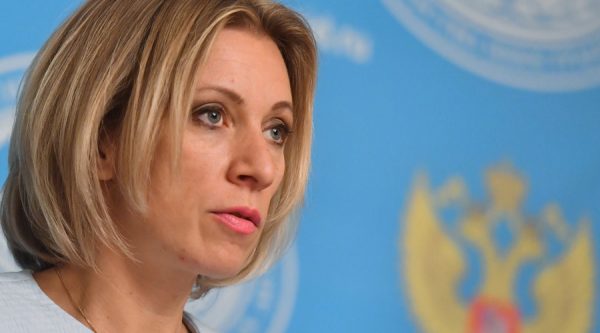
The Russian Foreign Ministry spokeswoman says new US demands from Iran are totally unacceptable, vowing that Moscow will continue to work towards maintaining the Iran nuclear deal, officially known as the Joint Comprehensive Plan of Action (JCPOA).
“We are concerned about the fact that the anti-Iranian campaign is on the rise in Washington. It seems that the United States has made a final decision to use the tactics of ultimatums and threats in respect to Iran. It contradicts the spirit of the JCPOA and does not fall within the normal inter-state relations,” Russian Foreign Ministry spokeswoman Maria Zakharova told a briefing on Wednesday.
“Not only did the US administration withdraw from the agreement in violation of international norms, it is putting forward demands that are a priori unacceptable for Tehran,” she added.
In his first major foreign policy address since moving to the State Department from the CIA, Secretary of State Mike Pompeo said Washington would increase the financial pressure on Iran by imposing the “strongest sanctions in history” on the Islamic Republic if Tehran refused to change the course of its foreign and domestic policy.
Pompeo also outlined 12 US tough demands for Iran, including halting its uranium enrichment and closing its heavy water reactor, for any “new deal” with Tehran.
The Russian spokesperson said that while the US pulled out of the JCPOA, “other participants in the deal are determined to maintain the agreement, adding, “We will continue working to that end. The important thing is that Tehran also abides by its obligations, as confirmed by the IAEA (International Atomic Energy Agency).”
Zakharova said the fate of the Iran deal would be decoded at a new meeting of the Joint Commission monitoring the implementation of the agreement in Vienna on May 25, which will not include the US for the first time.
The Russian official also once again expressed Moscow’s opposition to unilateral sanctions.
‘Cheap political ritual’: Trump orders sanctions against Russia over alleged INF treaty violation
RT | May 17, 2018
President Donald Trump ordered his Cabinet to work on sanctions targeting Russian officials for what the US claims is a violation of a key arms control treaty. The action is perceived as a ‘cheap political ritual’ in Moscow.
The Intermediate-Range Nuclear Forces (INF) Treaty bans the US and Russia from developing and deploying land-based missiles with ranges between 500 and 1,000km. Signed by Mikhail Gorbachev and Ronald Reagan, it helped reverse the nuclearization of Europe and deflate Cold War tension. Washington and Moscow have since accused each other of violating the key arms control agreement, but neither went as far as withdrawing from it.
The National Defense Authorization Act for Fiscal Year 2018 in US has a section that requires the White House to prepare a list of senior Russian officials responsible for violating the INF, who could be slapped with personal sanctions for it. Those include property freezes, travel bans and whatever Trump deems appropriate.
A memorandum by Trump, which was published on Wednesday, instructs several Cabinet members, including the State Secretary, the Director of National Security and the Secretary of the Treasury, to carry out the work.
The development was dismissed in Moscow as largely insignificant. “I have three words to describe it: cheap political ritual,” said Deputy Foreign Minister Sergey Ryabkov on Thursday.
The US falsely believes that “Russia may be pressured by sanctions into offering unilateral concessions and actions pleasing Washington,” he said. “It’s obvious that this does not promote normal dialogue on strategic stability and on the contrary hurts it.”
The US accuses Russia of secretly developing two rockets with intermediary range, which can be fired by a standard launcher of the tactical missile system Iskander-M. Russia denies that the rocket’s range falls within the restrictions.
Moscow in turn accuses the US of having developed banned missiles under the guise of target projectiles for anti-missile systems. It also says the US adopted naval vertical launch systems, which can fire Tomahawk missiles, to land deployment as part of AEGIS Ashore program, effectively making the cruise missiles land-based.
Iran Signs Free Trade Agreement With Eurasian Economic Union
By Adam Garrie | EurasiaFuture | May 17, 2018
Iran has just signed an agreement to enter a three year provisional free trade agreement with the Eurasian Economic Union (EAEU). According to EAEU official Tigran Sargsyan,
“The temporary agreement stipulates an effective dispute settlement mechanism, including arbitration… It also creates a joint committee of high-ranking officials and establishes a business dialogue”.
The EAEU’s current members are Russia, Belarus, Armenia, Kazakhstan and Kyrgyzstan, while the bloc has existing free trade agreements with Vietnam, Uzbekistan and Moldova. Aside from Vietnam other ASEAN states including Indonesia and Thailand have been in early level discussions about the possibility of a free trade arrangement with the EAEU, while Serbia and Turkey have also considered joining. Russian Energy Minister Aleksandr Novak has said that Iran could become the sixth full member in the future. Today’s Iran-EAEU free trade agreement will function as a test to determine the viability of long term Iranian membership of the trading bloc. Novak stated,
“The move to enter into a temporary agreement making for a free trade zone to be set up between Iran and the Eurasian Economic Union, which is currently at an advanced stage, will obviously trigger further development of our bilateral trade and expansion of investment cooperation”.
While many will see EAEU membership as a further means for Iran to create new economic partnerships away from regions whose financial and commercial structures are subservient to a hostile United States, in the long term, it means far more to Iran than a means of skirting increasingly ridiculous sanctions from Washington in the light of the US withdrawal from the JCPOA.
For Iran, EAEU membership represents a new opportunity to expand its economic horizons beyond its current Middle Eastern partners. In this sense, just as Iran has a long history of ‘thinking east’ in terms of economic connectivity and cultural exchange, today’s EAEU presents Tehran with a modern cooperative model to expand its peaceful economic interactions to greater Eurasia. Beyond this, with proposals to integrate Pakistan into the North-South Economic Corridor, Pakistan and Iran could cooperate in order to form two unique and mutually complimentary road corridors.
The North-South Transport Corridor is a joint initiative of nations who have built and continue to expand shipping and road links between South Asia, Northern Eurasia and Europe. The map below shows the basic route which begins with a shipping lane between India and Iran’s Chabahar Port on the Gulf of Oman, before travelling north through Iran to the Caucasus and into Russia, while also linking up with existing rail routes from Iran into Central Asia and west into Europe via Turkey.
While countries as diverse as Russia, Iran and Azerbaijan have embraced the North-South Corridor as a means of creating greater opportunities for economic enrichment through joint cooperative efforts, in India, the project has been sold as a rival to China’a One Belt–One Road. This has been the case even though the North-South Corridor is vastly more limited in its geographical expanse vis-a-vis the global Chinese project and perhaps even more crucially, the other partners in the North-South Transport Corridor do not share India’s zero-sum vision of the project.
In particular, India is keen to present the North-South Transport Corridor as a rival to the China-Pakistan Economic Corridor linking China to the Indian ocean via a large road and rail network whose western terminus is Pakistan’s Gwadar port.
Pakistan’s Ambassador to Azerbaijan recently announced that his country is interested in linking up with existing routes along the North-South Transport Corridor. This gives Pakistan the opportunity to link the China-Pakistan Economic Corridor (CPEC) with the North-South Transport Corridor, which would serve the long term strategic interests of the wider region, in terms of linking Pakistan’s Gwadar Port on the Arabian Sea with Iran’s Chabahar Port on the Gulf of Oman.
Under such a scenario, goods from China would enter Pakistan via newly built road and rail routes and could then travel in one of two directions. First of all, goods could travel south through Pakistan to Gwadar where from there they could go in multiple directions including into Africa, Europe via the Suez Canal, or the wider Middle East via the Gulf of Oman/Chabahar and the Persian Gulf. Alternatively, goods could travel north into Central Asia and ultimately into Russia via Pakistan. This second option was proposed by geopolitical expert Andrew Korybko in early 2017 when he wrote,
“The enhanced trade relations that were mentioned above [see full piece] can only occur if Russia and Pakistan are connected to one another through CPEC, no matter how indirectly due to the geographic distance between them and Moscow’s reluctance to officially endorse this trade route in order to preserve its strategic “balancing act” with India. The second part of this conditional implies that the private sector needs to drive these two countries’ CPEC connectivity since the Russian state isn’t going to do so because of delicate political reasons, which thus allows one to envision three possible solutions, all of which are inclusive of one another and could in theory exist concurrently.
The most probable of the three is that Russia could connect to CPEC via the Central Asian state of Kazakhstan, which is already a member of the Moscow-led Eurasian Economic Union and through which a lot of bilateral trade already traverses. Furthermore, the Eurasian Land Bridge between East Asia and Western Europe is expected to pass through this international corridor as well, so it’ll probably be easiest for Russia and Pakistan to trade across this route by linking up at CPEC’s Urumqi hub in China’s Autonomous Region of Xinjiang.
Considering that Xinjiang’s capital city is located closer to Russia’s southern Siberian border than to CPEC’s terminal Arabian Sea port of Gwadar, there’s also the chance that a more direct north-south trade route could be established between Russia and Pakistan via this avenue. After all, Russia’s “Pivot to Asia” (which is officially referred to as “rebalancing” in Moscow’s political parlance) isn’t just international but also internal, and it aspires to develop resource-rich Siberia just as much as it aims to chart new international partnerships. With this in mind, there’s no reason why southern Siberia couldn’t one day be connected to CPEC via the nearby Urumqi juncture.
Lastly, Russia’s already building a North-South Transport Corridor (NSTC) through Azerbaijan and Iran in order to facilitate trade with India, so the opportunity exists for it to simply use this route’s overland transport infrastructure to reach Pakistan in the event that the Iranian terminal port of Chabahar is ultimately linked with nearby Gwadar. Even if that doesn’t happen, then there’s still nothing preventing private Russian businessman from using Chabahar or even the more developed port of Bandar Abbas as their base of operations for conducting maritime trade with Gwadar or Karachi. This would in effect make India’s “brainchild” the ironic basis for Russian-Pakistani economic relations”.
Both Pakistan’s willingness to embrace the North-South Corridor, thereby integrating it into CPEC which itself forms a crucial artery of One Belt–One Road and Iran’s eagerness to become a member of the EAEU, could help to speed up the process of wider inter-connectivity between China’s Pacific Coast, the Middle East and Russia’s wider economic sphere in northern Eurasia.
If all of these existing links became inter-connected, one would see Gwadar taking on the adding function of becoming Central Asia and Russia’s gateway to the wider shipping routes of the Indian Ocean, while Chabahar would act as a parallel route for goods from both CPEC and the wider Indian Ocean, into the Caucasus, Russia or the Middle East.
Iran’s membership in the EAEU would help to expedite this process as the routes from Iran into Armenia and finally, into Russia would all constitute a single market. Were Turkey to join the EAEU, this would make transcaucasian trade into Turkey and the wider Mediterranean region all the more simple, as it would also allow Iran to act as a conduit between the Caucasus and Turkey, thus avoiding the politically prickly issue of direct trade from Armenia into Turkey. Turkey and Armenia’s mutually healthy relations with Iran, means that Tehran could be a physical arbiter of trade between two nations with historically (and currently) poor relations.
Over all, a strong and southward looking EAEU will help to strengthen both Iran-Pakistan relations through enhanced South Asian-Northern Eurasian trading networks, while also helping to facilitate the smooth transport of goods along One Belt–One Road from the Pacific into the Middle East, western Eurasia and further south into Africa along Indian Ocean maritime belts.
Russia welcomes Egypt’s refusal to send troops to Syria on US proposal
Al-Masdar News – 14/05/2018
Russia views positively Egypt’s decision against sending its troops to Syria as was proposed by Washington, Russia’s Foreign Minister Sergey Lavrov said after negotiations between Russian and Egyptian foreign and defense ministers in the 2+2 format on Monday.
“We touched upon this issue in the context of discussing the Syria situation, in the context of discussing actions of the so-called foreign players, including, of course, the United States, because it is precisely its idea to invite Arab countries to send their contingents to the Syrian Arab Republic,” the Russian foreign minister said.
“As I understand, this is done for the dual purpose: on the one hand, to share responsibility for the direct and gross violation of the sovereignty and the territorial integrity of Syria, which did not invite the United States and other participants of the US-led coalition to its territory, and the second goal is to share the financial burden,” Russia’s top diplomat said.
“Washington is talking directly and openly about this. I believe everyone understands what stands behind this invitation and we appreciate the position assumed by Egypt,” Lavrov said.
“We discussed this issue as part of the general discussion. Egypt has numerously stressed that it will not send its troops outside its territory as the Egyptian military doctrine stipulates that Egypt’s armed forces must defend only the borders. We discuss such issues only from the theoretical point of view as possible steps,” Egyptian Foreign Minister Sameh Shoukry said.
Some Western media outlets earlier reported about a possible dispatch of Arab armed forces, including from Egypt, to Syrian districts controlled by the United States instead of the US military contingent present there for the purpose of assisting stabilization in the country’s northern part after the defeat of the Islamic State terrorist organization (outlawed in Russia).
ALSO READ Syrian Army on the verge of liberating all of Hajar Al-Aswad from ISIS
Commenting on this information, Shoukry stated that Egypt did not consider sending a military contingent to Syria as part of the US initiative.
Israel Now Faces New Rules Of Engagement In Syria
By Tyler Durden | Zero Hedge | May 11, 2018
Even as CNN is out with a new report condemning Iran for denying any responsibility or role in the latest massive exchange of fire between Israel and Syria, The New York Times has admitted (albeit buried deep in the story) that Israel was the actual aggressor and initiator of hostilities which threatened to spiral out of control overnight Wednesday and into Thursday morning.
While CNN and most Israeli and mainstream media sources blame Iran for initiating an attack on Israel, on the very day of the early morning strikes (Thursday), the Times acknowledged, “The barrage [of Syria/Iran missiles] came after an apparent Israeli missile strike against a village in the Syrian Golan Heights late Wednesday.”
This is significant as Israel is seeking to cast Iran as an aggressor on its border which must be dealt with preemptively; however Syria’s response—which involved between 20 and 50 missiles launched in return fire—imposed new rules of engagement on a situation in which Israel previously acted with impunity.
And though multiple international reports have pointed to strikes landing on the Israeli side, Israel has apparently been extremely careful in preventing photographs or video of any potential damage to see the light of day. According to professor of Middle East history Asad AbuKhalil, “Israel censor still hasn’t allowed any reports about casualties or damage.”
Up until recently, Assad had not taken the bait of Israeli provocation for years now in what we previously described as a kind of “waiting game” of survival now, retaliation later. But with the Syrian Army now victorious around the Damascus suburbs and countryside, and with much of Syria’s most populous regions back under government control, it appears that Assad’s belated yet firm response to the Israeli large scale attack has changed the calculus.
Even NYT admits towards end of the article that Israel initiated the exchange of fire:
“The barrage came after an apparent Israeli missile strike against a village in the Syrian Golan Heights late Wednesday.”
So why isn’t this the lead or headline??? https://t.co/P0Nw9AqkXz
— Trita Parsi (@tparsi) May 10, 2018
Damascus has now signaled to Israel that its acts of aggression will be costly as Syrian leadership has shown a willingness to escalate. But how did this new and increasingly dangerous situation come about, and which side actually has the upper hand?
* * *
Below is a dispatch authored and submitted by Elijah Magnier, Middle East based chief international war correspondent for Al Rai Media, who is currently on the ground in the region and has interviewed multiple officials involved in the conflict.
Israel hits Syrian and Iranian objectives and weapons warehouses again (evacuated weeks before) for the fourth time in a month. 28 Israeli jets participated in the biggest attack since 1974. Tel Aviv informed the Russian leadership of its intentions without succeeding in stopping the Syrian leadership from responding. Actually, what is new is the location where Damascus decided to hit back: the occupied Golan Heights (20 rockets were fired at Israeli military positions).
Syria, in coordination with its Iranian allies (without taking into consideration Russian wishes) took a very audacious decision to fire back against Israeli targets in the Golan. This indicates that Damascus and its allies are ready to widen the battle, in response to continual Israeli provocations.
But what is the reason why new Rules of Engagement (ROE) were imposed in Syria recently?
For decades there was a non-declared ROE between Hezbollah and Israel, where both sides were aware of the consequences. Usually, Israel prepares a bank of target objectives with Hezbollah offices, military objectives and warehouses and also specific commanders with key positions within the organization. Israel hits these targets, updated in every war. However, the Israelis react immediately against Hezbollah commanders, who have the task of supporting, instructing and financing Palestinians in Palestine, and above all the Palestinians of 1948 living in Israel. This has happened on many occasions where Hezbollah commanders related to the Palestinian dossier were assassinated in Lebanon.
Last month, Israel discovered that Iran was sending advanced low observable drones dropping electronic and special warfare equipment to Palestinians. The Israeli radars didn’t see these drones going backward and forward with their traditional radars, but were finally able to identify one drone using thermal detection and acoustic deterrence, to down it on its last journey.
In response to this, Israel targeted the Syrian military airport T-4 used by Iran as a base for these drones. But Israel was not satisfied and wanted to take further revenge, hitting several Iranian and Syrian targets during the following weeks.
Tel Aviv believed it could get away with repetitively hitting Iranian objectives without triggering a military response. Perhaps Israel really believed that Iran was afraid of becoming engaged in a war with Israel, with the US ready to take part in any war against the Islamic Republic from its military bases spread around Syria, in close vicinity to the Iranian forces deployed in Syria. Obviously, Iran has a different view from the Israelis, the Americans and even the Russians, who like to avoid any contact at all cost.
‘Israel retaliates’
The ridiculous trope that sums up ‘mainstream’ reporting on the Middle East. Israel: so often the victim, rather than the aggressor. Fake news. pic.twitter.com/bOfP0ANJmu
— Media Lens (@medialens) May 10, 2018
Regardless of how many Israeli jets took part in the latest attack against Iranian and Syrian objectives and how many missiles were launched or intercepted, a serious development has occurred: the Syrian high command broke all pre-existing rules and found no obstacle to bombing Israel in the occupied Golan Heights.
Again, the type of missiles or rockets fired by Syria against Israeli military objectives it is not important or whether these fell into an open space or hit their targets. What is important is the fact that a new ROE is now in place in Syria, similar to the one established by Hezbollah over Kiryat Shmona near the Lebanese border, when militants fired anti-aircraft cannons every time Israel violated Lebanese airspace in the 2000.
Basically Israel wanted to hit objectives in Syria but claims not to be looking for confrontation. Israel would have liked to continue provoking Syria and Iran in the Levant, but claims to be unwilling to head towards war or a battle. Israel would like to continue hitting any target it chooses in Syria without suffering retaliation.
But with its latest attack, Israel’s “unintended consequences” or provocation has forced the Syrian government to consider the occupied Golan Heights as the next battlefield. If Israel continues and hits beyond the border area, Syria will think of sending its missiles or rockets way beyond the Golan Heights to reach Israeli territory.
NEW MAP: #Israel strikes multiple targets in #Syria following rocket barrage pic.twitter.com/I3af5NzVO1
— Le Beck Int’l (@LeBeckInt) May 10, 2018
Actually, Hezbollah’s secretary general Sayyed Hasan Nasrallah said a few years back: “Leave Lebanon outside the conflict. Come to Syria where we can settle our differences.” Syria, logically, has become the battlefield for all countries and parties to settle their differences, the platform where the silent war between Israel and Iran and its allies is finding its voice.
In Damascus, sources close to the leadership believe Israel will continue attacking targets. However, Israel knows now where Syria’s response will be.This is what Israel has triggered but didn’t expect. Now it has become a rule.
The Israeli Iron Dome is inefficient and unable to protect Israel from rockets and missiles launched simultaneously. Now the battle has moved into Syrian territory occupied by Israel to the reluctance of Tel Aviv, and Russia. Iran and Syria are not taking into consideration Russia’s concern to keep the level of tension low if Israel is not controlling itself. Syria recognizes the importance of Russia and its efficient role in stopping the war in Syria and all the military and political support Moscow is offering.
However, Damascus and Tehran have other considerations, especially the goal of containing Israel. They have trained over 16 local Syrian groups ready to liberate the Golan Heights or to clash with any possible Israeli advance into Syrian territory.
Israel triggered what it has always feared and has managed to get a new battlefield, the Golan heights. It is true that Israel limited itself to bombing weapons warehouses never hit before. It has bombed bases where Iranian advisors are based along with Syrian officers (Russia cleared most positions to avoid the embarrassment of being hit by Israel). It is also true that Israel didn’t regularly bomb Iranian military and transport aircraft carrying weapons to Syria, or the main Iranian center of control and command at Damascus airport. This means that not all parties are pushing for a wider escalation, so far.
Can the situation get out of control? Of course it can, the question is when?!?
Israel Took out a Syrian Pantsir Air Defense Unit, S-200 Radars. Russia: ‘No S-300 Transfer, Syria Has All It Needs’
By Marko Marjanović | Checkpoint Asia | May 12, 2018
Rather than admit it has its own reasons why it is unwilling to boost Syrian air defenses Russia plays up their effectiveness and pretends these are perfectly adequate — when in 7 years they haven’t been able to deter Israel from nearly weekly attacks.
On May 10th Israeli strikes on Syrian army positions across southern Syria Israel fired at least 60 cruise missiles. The Russians say that Syrian air defenses destroyed nearly half of these before impact. That would be quite the accomplishment indeed.
However there is another side to the story. Israel has released footage from one of the missiles as it hits a Syrian Russian-made Pantsir-S1 short-range air defense units. This is highly embarrassing for Russians and Syrians both as Pantsir with its fast-firing cannons and missiles of its own was designed to defend key positions from precisely these sort of threats — yet it could not defend even itself. Now, the unit was not camouflaged or dug in. It was sitting out in the open on airbase tarmac. That is extremely reckless and amateurish. Most likely the unit wasn’t even switched on, or was waiting for an ammunition refill (why out in the open??).
However, the Pantsir wasn’t the only kill. The Israelis also destroyed a number of S-200 radars. The S-200 system comes with a heavier missile for long-range air defense. It is positively ancient having entered service in the 1960s and is no longer in use by Russia. Yet it is the best that Syria has.
#Syria: Air Defense equipment (incl. S-200 radars) destroyed by #Israel 2 days ago near #Damascus Intl Airport. pic.twitter.com/Kl9pCjF0lA
— Qalaat Al Mudiq (@QalaatAlMudiq) May 11, 2018
#Syria: military fatalities due to yesterday’s #Israel|i bombardment rose to 6. 2nd one was a Captain from #Masyaf area. pic.twitter.com/0yqWsQcp6H
— Qalaat Al Mudiq (@QalaatAlMudiq) May 10, 2018
At the same time Russia has stated the transfer of the newer S-300 systems to Syria is not in the cards right now. The very Russian official in charge of military assistance to other nations has stated that “Syria has all it needs”. This strikes me as a very weird thing to say at a moment when its S-200s are getting blown up.
The Israeli media is tying the Russian statement to Netanyahu lobbying against the transfer on his May 9th Moscow visit, but Russia claims the two are not linked. I am actually willing to buy the latter just not the Kremlin’s explanation of it.
There are valid reasons why Russia would balk at giving Syria the S-300. Firstly there are political and optical problems involved. The Israelis are now firing off their missiles from Israeli (Palestinian) and Lebanese airspace. Defending against them would entail downing Israeli jets over Israel. Now, if that is accomplished by Russian military aid (Syria can’t realistically pay for the S-300s) you start to see my point… If thanks to Putin Israeli jets start falling down from the sky in Israel the US elites can fan the flames of Russophobia in the famously pro-Israeli Middle America all the more easily.
Also it is entirely possible that Russia doesn’t fancy having to foot the bill. The Israeli air force is a large one and highly technically sophisticated. There is no guarantee that it can be deterred or defended against by just a battery or two of S-300s. Quite possibly it would take a much larger buildup of Syrian air defenses, a buildup which Russia perhaps doesn’t want to finance. Especially at a time when it is reducing even its own defense spending.
In the 1970s Israel and Egypt fought an air war of attrition. Egypt’s Soviet-trained and Soviet-supplied air defenses inflicted unacceptable losses on the Israeli air force, but Moscow ended up footing the bill. Putin, who commands a smaller country than Brezhnev and a far, far less ambitious one, is probably not too keen on walking in the Soviets’ path.
That’s quite understandable and probably wise, but to say that Syria has all the air defenses it needs right now — when Israel has been striking it with virtual impunity now for almost seven years is patently untrue and a very bizarre thing to say.
The real explanation is that Russia is unwilling to assume the risks and the burdens of the kind of buildup of Syria’s military that would actually take to check the Israelis if the latter decide to be really stubborn about it.
It would provoke the pro-Israeli Washington elites and burden Russia financially and politically for little gain given that Netanyahu keeps reassuring Putin that Israel does not seek to alter the outcome of the Syrian civil war, but is merely pushing back against Iranian influence in Syria.
As long as Moscow buys that it won’t react. Russian anger rises only when Israel acts in such a way as to set up a war between the US and Assad as was the case last month. This gave rise to the Russian threat they may supply Syria with improved air defenses but the threat now appears to be empty.
Featured Video
No Vote, No Representation, No State: Democracy, Israeli Style
or go to
Aletho News Archives – Video-Images
From the Archives
Sanctions, War and the Policy of Dual Containment
By SASAN FAYAZMANESH | March 17, 2008
It is now nearly three decades since the Unites States adopted the policy of dual containment of Iran and Iraq. While much has been written about the containment of Iraq, there has been very little in-depth analysis of this policy when it comes to Iran. In a book that is going to be released on March 31, 2008, entitled The United States and Iran: Sanctions, Wars and the Policy of Dual Containment (Routledge), I attempt to address this shortcoming by investigating when and why the US policy of containment of Iran came about, how it evolved, and where it stands today.[1] To the extent that Israel has been involved in US policy making, the study will also include the role that Israel has played in the containment of Iran. Also, since the fate of Iran has been inextricably linked to that of Iraq, occasionally the investigation will overlap with the containment of Iraq.
The policy of dual containment of Iran and Iraq originated during the Carter Administration, but it was not until the Clinton Administration that the expression “dual containment” became popular. … continue
Blog Roll
 Aletho News
- No Vote, No Representation, No State: Democracy, Israeli Style
- Zionist Bought Senate Blocks Information About American Citizens Killed By Israel
- While Gaza dominates the UN, these are the people keeping it alive
- New Report: “Scholasticide and Genocide in Gaza: Assessment, Testimonies and Legal Analysis”
- ‘THAAD Delusion’: Iran war exposes US missile shield limits – The Atlantic
- Moscow issues warning to NATO over Russian exclave
- Yes, the Iran war has destroyed Trump’s presidency
- The fallacy of US delusions about Iran’s economic collapse
- Hezbollah denies Syria cell link, warns of Israeli plan to sow discord
- The legacy of US sanctions, war, and occupation in Iraq
- If Americans Knew
- Mamdani releases plan to combat antisemitism and hate crimes in New York City
- Iran’s Revolutionary Guards Publish Letter to the American People
- DMFI launches $1 million ad campaign supporting Virginia’s Elaine Luria
- US Senate blocks resolution seeking report on Americans killed by Israel
- Israeli Attacks Kill Ten Palestinians in Gaza
- Massacre at Minab: The School That Became a Grave
- Israeli media: The IDF Shows It Doesn’t Turn a Blind Eye; It Actively Emboldens Settler Havoc
- As settlers ravage West Bank, Israeli forces kill 10 in Gaza – Daily Update
- New Report: “Scholasticide and Genocide in Gaza: Assessment, Testimonies and Legal Analysis”
- Ex-Biden officials are desperate for a Gaza scapegoat
- No Tricks Zone
- Green Energy Debacle: German Expert Professor Fritz Vahrenholt Warns Of Severe Economic And Social Consequences
- Two More Paleo Reconstructions Affirm Meters-Higher Sea Levels Across Ireland, Brazil 7000-6000 Years Ago
- New Study: Earth And Venus Surface Warmth Largely Explained By Convection And Lapse Rate, Not CO2 Or Radiation
- 2025 Nature Paper Claiming Worsening Global Drought Gets RETRACTED …Heavily Flawed
- New Study: ‘Global Drought Shows No Detectable Recent Acceleration Under Climate Warming’
- Economic Masterminds: German Socialists Suggest Taxing Productivity Gains Stemming From Using AI
- The South China Sea Has Not Been Cooperating With The Climate Change Narrative
- Energy Crisis: Germany Enters Heating Season With Historically Low Gas Reserve Fill Levels
- New Study: The Antarctic Ice Sheet Gained Mass From 2020-2024 Due To Staggering Snow And Ice Accumulation
- Study: Ocean Heating Rates From Thousands Of Years Ago ‘Dwarf’ Modern Ocean Heating Rates

