Obama’s Ukraine legacy is in dangerous drift

By M K Bhadrakumar | Indian Punchline | February 28, 2017
Moscow refused to join issue with the US State Department’s strident statement on Sunday blaming Russia for the renewed violence in the Donbass region of eastern Ukraine. Washington had stressed that it was “imperative” that the “combined-Russian separatist forces” in Donbass halted their attacks and “immediately” observe the ceasefire.
The Russian reaction came on Monday at the level of the presidential spokesman Dmitry Peskov who was dismissive of the US allegation but wouldn’t be drawn into the blame game, either, and instead would call on Washington to be “more attentive in judging the situation.” Peskov said he’s reiterating for “a hundredth time” that Russia is not party to the conflict in Ukraine. It was a restrained reaction, albeit a rebuttal of the US charge – and just stopped short of offering Russia’s helping hand.
This puts Washington in a quandary: What next? The point is, the Donald Trump administration is still to put on track a Russia policy. Ukraine is a potential crisis on Europe’s doorstep which demands that Trump has a one-on-one with President Vladimir Putin as early as possible. But then, the Trump administration must also know what to discuss with Moscow.
Meanwhile, the Donbass situation is developing in a way that Washington needs to contend with newer and newer facts on the ground. Moscow announced a week ago its “humanitarian” move to recognize identity documents issued in the separatist-held areas of eastern Ukraine. This followed a blunt statement by Moscow that “We’re not returning our territory, Crimea is part of Russian Federation” (which in turn was provoked by a remark by the White House press secretary that Trump had been taking a tough line on Russia and that he expected Moscow to withdraw from Crimea, which it occupied after a “full-scale invasion” in 2014.)
Putin ordered last week that the Russian government will temporarily recognize identification, education and qualification documents and other certificates as well as car licence plates issued in the self-declared “people’s republics”, ie., parts of the Donetsk and Lugansk regions that are not under the control of Kiev.
Europe is unsure whether or not see the Russian move as a warning shot by the Kremlin – although it will be a rush to judgment that Moscow is heading in the direction of granting recognition to the self-declared “people’s republics” in Donbass. Moscow maintains with a straight face that the move aims at facilitating travel and allowing Donbass residents to work and study in Russia and that it has a “strict temporary limit – until the implementation of the Minsk agreements.”
On Monday, Russian media reported that another new fact on the ground is struggling to be born in Donbass. This time around, the Lugansk “People’s Republic” has reportedly announced that from March 1, Russian Ruble will become the region’s official currency. Now, things are becoming serious, aren’t they?
And all this is unfolding against the backdrop of the far-right Ukrainian nationalist groups imposing a blockade for the past month on the movement of coal from Donbass to western Ukraine, which threatens serious economic dislocation. These “neo-Nazi” elements also captured a water purification plant with the intent to cut off water supplies to the Donetsk region under separatist control. The authorities in Kiev cannot or will not crack down on the far-right groups.
Pressure is mounting on Kiev from multiple sides. Importantly, President Petro Poroshenko doesn’t know where exactly he stands in the US foreign policy calculus in the Trump era. The popular mood in Ukraine is increasingly disenchanted with all that happened in the country through the 3-year period since the regime change following the ouster of the elected president Viktor Yanukovych in a “colour revolution” in February 2014.
A recent poll by the Kiev International Sociology Institute shows that in retrospect, a majority of people now see the 2014 “colour revolution” as more of a western coup d’etat and blame Kiev (rather than Moscow) for the lackadaisical implementation of the Minsk agreements. Evidently, the ground is shifting beneath the feet of the “pro-US” set-up installed in power in Kiev by the Barack Obama administration. Popular discontent is cascading with three-quarters Ukrainians estimating that living conditions have only worsened. The most worrisome factor is of course the ascendancy of the far-right groups – and they happen to be well-armed and include ex-servicemen.
With Europe preoccupied with own problems and the US caught up in a civil war – Trump told Fox News last night that he saw Obama’s hidden hand behind the media leaks and protests against him – the West is not paying attention to the dangerous drift in Ukraine. The point is, the Ukrainian political process is steadily becoming violent, threatening the country’s stability. Russia’s cooperation becomes a must to salvage the situation.
However, engagement with Russia is possible only if the Trump administration musters the steam to override the formidable resistance from the US foreign-policy and security establishment (and the US Congress), which is not going to be easy. What Obama visualized as his finest foreign-policy legacy in “post-Soviet” Eurasia is turning out to be a can of worms for the West. Read an overview of the developing crisis featured in The Duran.
US Navy’s Own Report Indicates Washington is Looking for a Pacific Fight
By Ulson Gunnar – New Eastern Outlook – February 27, 2017
The Pacific Ocean is large. Since World War II, weapon systems operating in this theater have required special provisions regarding extensive range, long duration performance and relative self-sufficiency during operations.
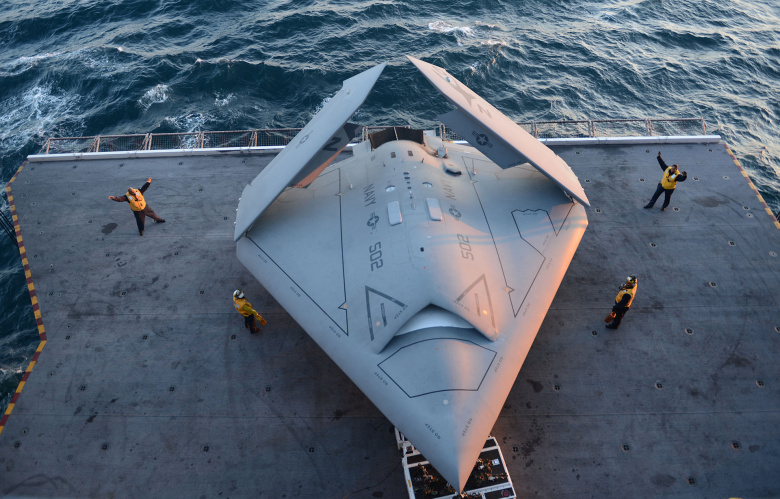
From America’s Gato-class submarines and PBY Catalina flying boats used to fight the Japanese and reassert American hegemony across Asia-Pacific during WWII, to America’s continued presence in Japan, South Korea and islands throughout the region, it is clear the lengths the US has gone through then and now to remain “engaged” in the Pacific.
More recently, a report by the Center for Strategic and Budgetary Assessments (CSBA), commissioned by the US Navy titled, “Restoring American Seapower: A New Fleet Architecture for the United States Navy,” obsesses over not how to defend American shores, but how to remain involved in Asia-Pacific despite the immense distances between there, and America.
The report’s introduction includes:
Great power competitors such as China and Russia increased their military capabilities over the last two decades and now appear willing to challenge the international order.
However, the report never addresses Chinese or Russian forces landing on American shores, or even threatening to do so. Rather, the report revolves around maintaining hegemony within spheres of influence much more appropriately (and likely inevitably) Chinese or Russian.
The report coins a term, “deny-and-punish” to describe the use of US power abroad to “stop aggression,” not in defense of America itself, but in “adjacent theaters.” Ironically, the report cites Iraq as an example, a nation the US, not China nor Russia, invaded, occupied and destroyed with considerable, unchallenged “aggression.”
A more specific point in the 162-page report picked out by The National Interest in an article titled, “How to Guarantee America’s Aircraft Carriers Can Fight China in a War,” involves long-range air sorties of up to 2,000 miles.
The article elaborates:
…a 2000-mile mission would strain human endurance and an unrefueled range of more than 10 hours would require an enormous aircraft that might not fit on a carrier flight deck. Thus, the CSBA proposal calls for a smaller aircraft that would be supported by a tanker.
In other words, in order for the US to project considerable force beyond its own borders, across the Pacific Ocean, and within China’s logical, proximal sphere of influence, it needs not only drone aircraft capable of 10 hour sorties, it needs drone tankers to refuel them.

Defense contractors surely welcome the report’s findings, since it will require the development of not one new aircraft carrier-based vehicle, but two, including the tanker.
The CSBA report concludes by stating:
To be deterred in the 2030s, aggressors must be presented with the possibility that their goals will be denied or that the immediate costs to pursue them will be prohibitively high.
In reality, the “aggression” the United States fears is not the unjust encroachment on other, innocent nations, but rather the undoing of every aspect of its own global order, put together piece by piece through just such aggression. It is an order constructed not within any rational US sphere of influence, rather, one spanning the globe, so far from American shores combat pilots lack the endurance to fly the sorties required to “deter” other nations from reversing America’s grip upon it.
The US seeks to “deter aggression” that may potentially diminish or extinguish entirely America’s systematic and decades-spanning violation of Beijing’s “One China” policy regarding Hong Kong and Taiwan, China’s claims in the South China Sea or regimes the US puts into power along China’s peripheries to admittedly confound regional stability at Beijing’s expense,
Students of history will recognize much of this as a modern-day continuation of European colonization throughout Asia, where sophisticated and overbearing military might was used to corner China and its neighbors across the region, divide and conquer them, as well as prevent them from ever rolling back any of the gains colonial expansion gifted Europe and eventually America in the late 19th century.
The CSBA report is just one of many US policy papers that openly and repeatedly admits that China is not a threat to the United States as a nation, but a threat to the hegemonic order that nation attempts to maintain globally well into the 21st century.
And while the US seeks drone forces to bridge the vast distances between American territory and the territory it seeks to continue dominating, China and Russia are likewise developing weapons systems to make those vast distances greater still. While the CSBA report places urgent imperative in preventing China or Russia from exerting influence within their own territory or along their immediate peripheries, the final conclusion of this new arms race in long-range weapons systems may force the US to accept a reality in which the only region it dominates is the US itself. But the obvious question remains, why isn’t that already the case?
Germany to help Baltic states establish Russian-language media
Press TV – February 28, 2017
Germany plans to help Estonia, Latvia, and Lithuania establish Russian-language media outlets to counter the “disinformation” allegedly being spread by Russian channels broadcasting in the region.
The plan was announced by German Foreign Ministry spokesman Martin Schaefer, RT reported on Tuesday.
The announcement came ahead of German Foreign Minister Sigmar Gabriel’s trip to the Baltic states and Sweden, which is due to take place this week.
“During his trip, Mr. Gabriel will also employ what we already started last year in the Baltic states, which is — as we say in new German — handling Russian ‘fake news’ together with appropriate partners,” Schaefer said on Monday.
He added that the main goal of the initiative was to launch Russian-language radio and TV channels, which will be “attractive to Russian speakers living in the three Baltic states” in order to produce news “in a different way” from the Russian media.
The United States, too, recently announced plans to launch a Russian-language television news channel. The US has long accused Russian media of propagating “fake news.” Such allegations have also been leveled by European governments, which are concerned about alleged Russian attempts to influence their elections in much the same way as the US has said Moscow influenced its recent presidential vote.
Western ties with Russia have plummeted significantly in recent years, particularly following Crimea’s separation from Ukraine and reunification with the Russian Federation after a referendum not authorized by Kiev.
Military build-ups close to the Russian borders, including in the Baltic countries, have also been a major source of tension.
US in Deep Turmoil as Trump Confronts the Establishment
By Salman Rafi Sheikh | New Eastern Outlook | 28.02.2017
With the departure of the Trump’s national security adviser, political crisis in the US has only depended and is likely to exacerbate into a full-fledged struggle for power and control between Trump and what some call ‘deep-state.’ While Donald Trump is an elected president of the United States of America, he doesn’t seem to be able to exercise power in actual terms. This is evident from the way a so-called ‘pro-Russian’ adviser has been forced to resign. Following this resignation an intense debate has emerged in the US, leading a considerable number of people, 48 per cent according to a recent poll, to reject the way Trump has performed in the first month of his presidency. Already Trump has retracted on Crimea. Accordingly, he is in no hurry to engage Russia in Syria nor does he consider NATO to be “obsolete.” In the same vain, his U-turn towards China is something that nobody could foresee during his election campaign. As of now, a great deal of Trump’s election rhetoric is dead and lies buried deep inside the rubric of deep structures of power, marking the very first instance of its sort when an American president has found himself deeply at odds with the system. And, there is no certainty that he can or may overcome this tussle and emerge as the American ‘knight in shining armour.’
While this may or may not happen, a lot of questions about Trump’s ability to steer the course of American foreign and domestic policies have emerged following Flynn’s resignation and with it the so-called crisis of legitimacy has deepened, leaving minimum to no space for Trump to freely determine the course of American policy making.
The crisis, or the power struggle, has deepened to an extent where an American elected president has been forced to publicly blame American intelligence agencies for feeding the media with information against him and claimed that today’s America was `just like Russia’.
The Russophobia campaign is, indeed, being fed to the American public and the declining support for Trump is more a direct result of this spread of false information than an outcome of actual ‘bad performance.’
The media leaks have already led to Michael Flynn’s resignation. The Washington Post has recently reported that Flynn had “discussed sanctions” with a Russian official during the transition period, although Flynn had assured Vice President Mike Pence that this did not happen.
In turn, The New York Times noted on February 14, 2017, that other officials of the Trump administration and his election campaign have had contacts with Russian intelligence agents as well.
Flynn’s departure just three weeks after Trump’s inauguration as president has allowed the media to claim that the White House was in total disarray.
The media’s propagandist claim has certainly irked Trump who went to his favourite medium of communication, Twitter, to fire off a series of tweets, attacking the media as well as the intelligence agencies. In at least two tweets, Trump named the agencies the Federal Bureau of Investigations (FBI) and National Security Agency (NSA) that he said were `running a campaign against him’.
`The real scandal here is that classified information is illegally given out by `intelligence’ like candy. ‘Very un-American’, he tweeted. `Information is being illegally given to the failing New York Times and Washington Post by the intelligence community.
The crisis that has thus ensued and which is being fanned out by the mainstream US media is asking for changes in the policies, particularly towards Russia about Crimea and co-operation in Syria, that Trump had advocated during his election campaign.
We have already seen that some of it has already changed. What this retraction implies, in political terms, is that the establishment has also shown that it has the ability and the grit to undermine Trump if he were to deviate from their script—a script that is premised on the existence of an enemy (Russia) and which the establishment and the deep-state can use to protect, enhance and materialize its own political and economic interests in both domestic and global political and economic arenas.
The “Russophobia” based containment of Donald Trump is, however, not going to remain exclusive to the US’ domestic political circles. On the contrary, it is likely to, and already has, expanded into international political arena and is going to define and shape Trump’s relations with the US’ European allies, who in turn are neither comfortable with Trump’s foreign policy nor are going to allow him to retract the US-NATO security system (read: NATO is no longer “obsolete”).
Interestingly enough, this ‘trans-Atlantic Russophobia’ is being transformed into a new Cold War. The NATO defence ministers have been recently been discussing the presence of their fleets in the Black Sea in a closed summit in Brusells. Clearly, the western bloc on the whole loathes Trump, creating an unprecedented disequilibrium within the Western alliance wherein Trump leads the alliance, but the partners do not know how far he is to be taken seriously due to his inability to control things (read: establishment’s course of action is more appealing to the NATO allies for its anti-Russia, pro-sanctions commitments).
The Trump administration has lost, by losing Flynn, its authority and the ability to guide the American public to its vision. On the contrary, the media-establishment nexus has hijacked Donald Trump’s own vision, forcing him to forget his election rhetoric promises and come out in the open to fight for his political survival through social media.
Just as Trump’s confrontation with the American establishment is causing unease in the domestic and European political arena, Trump’s fight with the establishment is being equally fought in both domestic and European arenas. Whereas Trump has resorted to twitter to fight back against a sustained media campaign, in the European arena he has hit back by re-casting doubts over the US’ commitment to NATO.
That is to say, while he no doubt has willy-nilly accepted NATO as the “bedrock” of American security, Mattis’ remarks at NATO defence ministers’ meeting show that the crisis is not yet over and that it will remain unsettled unless the dust of the tussle between Trump and American establishment remains in the air—something that may not happen overnight—and unless the all-powerful American establishment succeeds in modifying Trump into a typical Neo-Con hawk.
Salman Rafi Sheikh, research-analyst of International Relations and Pakistan’s foreign and domestic affairs.
Double Standards over ‘Russian Interference’ in Western Elections
By Finian CUNNINGHAM | Strategic Culture Foundation | 23.02.2017
Just as polls show Marine Le Pen of the Front National taking a decisive lead over her two main rivals, Francois Fillon of the Republicans, and Emmanuel Macron of the newly formed En Marche, the latter gets a high-profile reception in Downing Street with British prime minister Theresa May.
Fillon has no plans to make a similar visit to Britain, while Downing Street officially announced that it would not be receiving Le Pen, reported the Independent.
With only weeks to go to the first round of the French presidential elections in April, the British government’s hosting of Macron this week can be seen as an extraordinary endorsement of his candidacy.
One could express it even more strongly and say that Britain is evidently interfering in the French democratic process by elevating one candidate over another.
A spokesman for premier May said that Macron had requested the meeting at Downing Street and «we were able to accommodate».
A smiling Macron photographed on the doorsteps of Number 10 clearly showed him relishing the singular honor bestowed by the British prime minister.
One can imagine the media hullabaloo if Marine Le Pen were greeted in Moscow by Russian President Vladimir Putin, and the Kremlin to then pointedly announce that her rival Macron would not be receiving a similar invitation. There would be howls of «Russian interference» in the French election.
Indeed, Russia is being accused of doing just that already on the basis of scant allegations. Emmanuel Macron has recently claimed that his campaign is being targeted by Russian hackers and «fake news». Macron’s campaign team is alleging – without providing any evidence – that its computers are being attacked by «Russian hackers».
The liberal pro-EU candidate is also claiming that «Kremlin-run news media» are mounting a fake news «influence campaign» to damage his credibility.
This follows the publication of a news article by the Sputnik outlet earlier this month which quoted French political rivals accusing Macron of being supported by global banking interests and a wealthy gay rights lobby.
Russian government-owned Sputnik has denied that it is trying to damage Macron’s candidacy, and that it was merely giving coverage to criticisms aired by French political rivals.
Based on such flimsy, partisan claims of political interference, the French Foreign Minister Jean-Marc Ayrault earlier this week issued a warning to Russia to «stop meddling in the French presidential election».
Thus, a one-sided overblown claim by one of the presidential candidates is raised to a state level as if it is an established fact of Russian subversion of French sovereignty.
This narrative of Russian interference in foreign elections has evidently become contagious. Ever since American intelligence agencies, amplified by US media, began accusing Russia of hacking into the presidential elections to favor Donald Trump, the narrative has become a staple in other Western states.
Last week, German news outlet Deutsche Welle published this headline: «Is Moscow meddling in everything?» The article goes on to ask with insinuating tone: «Does Putin decide who wins elections in the West? Many believe that he cost Clinton the US presidency; now Macron is next France, and then Merkel will be in the line of fire».
The Russian government is legitimately entitled, as are other governments, to hold views on the outcome of foreign elections. After all, many European governments, including those of Germany and France, were adamantly opposed to Trump winning the US election, instead preferring his Democratic rival Hillary Clinton. But they weren’t subjected to criticism that they were interfering in the American election.
Regarding France, Russian state interests might be best served by Marine Le Pen taking the presidency. She has expressed a desire to restore friendlier relations with Moscow and to jettison the NATO agenda of hostility towards Russia. Her anti-EU views would also help to undermine the Washington-led atlanticist axis which has driven enmity between Europe and Russia.
The Kremlin has been careful to not make any public statements on the outcome of the French election, nor of any other foreign election, maintaining that it does not interfere. Nevertheless, Moscow is entitled to have its own private assessment on what would serve its own national interests. There’s nothing untoward about that. It seems almost bizarre to have to explain that.
But such is the fever-pitch and hysteria about alleged Russian malfeasance that the slightest sign, such as a random news article airing critical comments as in the Macron example, is taken as «proof» of Kremlin interference.
This is in spite of the fact that no evidence is presented. German state intelligence, for instance, recently concluded that there was no evidence to support allegations that Russia was running a Trump-like influence campaign against Chancellor Merkel ahead of her country’s elections being held in September.
Perhaps the most egregious expression to date of the Russian interference narrative were claims made this week by Britain’s Telegraph newspaper that the Kremlin had sponsored a coup attempt against the government of Montenegro last October.
Russian foreign minister Sergey Lavrov lambasted the evidence-free claims as «absurd». Lavrov said it «is just another one in a series of groundless assertions blaming our country for carrying out cyberattacks against the entire West, interfering in election campaigns in the bulk of Western countries as well as allegations pointing to the Trump administration’s ties with Russian secret services, among other things».
The height of absurdity is Britain this week hosting Emmanuel Macron at the Downing Street residence of Prime Minister Theresa May.
May’s intervention is a full-on endorsement of this one candidate at a crucial time in the French election which sees his main rival Marine Le Pen taking a decisive lead in the polls.
But where are the headlines denouncing «British interference» in French democracy?
Western media are too preoccupied digging up far-fetched stories claiming Russian interference based on the flimsiest speculation.
That double standard is clear evidence of the irrational Russophobia that is gripping Western governments and news media. Russophobia that has become a psychosis.
NYT’s Fake News about Fake News
By Robert Parry | Consortium News | February 22, 2017
A grave danger from the Western mainstream media’s current hysteria about “fake news” is that the definition gets broadened from the few made-up stories that are demonstrably false – often fabricated by kids to get more clicks – to include reasonable disputes about the facts of a complex controversy.
This danger has grown worse because The New York Times, The Washington Post and other major Western news organizations have merged their outrage over “fake news” with the West’s propaganda campaign against Russia by claiming without evidence that the Russian government is somehow putting out false stories to undermine Western democracy.
However, when news organizations actually track down “fake news” outlets, they are usually run by some young entrepreneurs from outside Russia who saw made-up stories as a way to increase revenue by luring in more readers eager for “information” that supports their prejudices.
Yet, a front-page Times article on Tuesday, citing “fake news” as a threat to Europe, contains what arguably is “fake news” itself by claiming that many of the purported 2,500 stories “discredited” by the European Union’s East Stratcom operation have “links to Russia” although the Times doesn’t identify those links.
The article by Mark Scott and Melissa Eddy then goes on to blur these two separate concepts: “In a year when the French, Germans and Dutch will elect leaders, the European authorities are scrambling to counter a rising tide of fake news and anti-European Union propaganda aimed at destabilizing people’s trust in institutions.”
But it is this mushing together of “fake news” and what the Times describes as “anti-European Union propaganda” that is so insidious. The first relates to consciously fabricated stories; the second involves criticism of a political institution, the E.U., which is viewed by many Europeans as elitist, remote and disdainful of the needs, interests and attitudes of average citizens.
Whether you call such criticism “propaganda” or “dissent,” it is absurd to blame it all on Russia. When it comes to “destabilizing people’s trust in institutions,” the E.U. — especially with its inept handling of the Great Recession and its clumsy response to the Syrian refugee crisis — is doing a bang-up job on its own without Russian help.
Yet, rather than face up to legitimate concerns of citizens, the E.U. and U.S. governments have found a convenient scapegoat, Russia. To hammer home this point — to make it the new “groupthink” — E.U. and U.S. leaders have financed propaganda specialists to disparage political criticism by linking it to Russia.
Even worse, in the United States, the Times and other mainstream publications – reflecting the views of the political establishment – have editorialized to get giant technology companies, like Facebook and Google, to marginalize independent news sites that don’t accept the prevailing conventional wisdom.
There is an Orwellian quality to these schemes — a plan for a kind of Ministry of Truth enforced by algorithms to weed out deviant ideas — but almost no one whose voice is allowed in the mass media gets to make that observation. Even now, there is a chilling uniformity in the endless denunciations of Russia as the root of all evil.
Though the Times’ article treats the E.U.’s East Stratcom operatives as 11 beleaguered public servants sticking their fingers in the dike to protect the citizenry from a flood of Russian disinformation, “stratcom” actually is a euphemism for psychological operations, i.e., the strategic use of communications to influence the thinking of a target population.
In this case, the target populations are the European public and – to an ancillary degree – the American people who get to absorb the same propaganda from The New York Times. The real goal of stratcom is not to combat a few sleazy entrepreneurs generating consciously false stories for profit but to silence or “discredit” sources of information that question the E.U. and U.S. propaganda.
More Stratcom
NATO has its own Stratcom command based in Latvia that also is assigned to swat down information that doesn’t conform to Western propaganda narratives. The U.S. Agency for International Development and the U.S.-funded National Endowment for Democracy also pour tens of millions of dollars into media operations with similar goals as do major Western foundations, such as currency speculator George Soros’s Open Society. Last December, the U.S. Congress approved and President Obama signed legislation to create an additional $160 million bureaucracy to combat “Russian propaganda.”
In other words, the West’s stratcom and “psychological operations” are swimming in dough despite the Times’ representation that these “anti-disinformation” projects are unfairly outgunned by sinister forces daring to challenge what everyone-in-the-know knows to be true.
If these “stratcom” operations were around in 2002-2003, they would have been accusing the few people questioning the Iraq-has-WMD certainty of putting out “fake news” to benefit Saddam Hussein. Now, journalists and citizens who don’t buy the full-Monte demonization of Russia and its President Vladimir Putin are put into a similar category.
Instead of trusting in the free exchange of ideas, the new attitude at the Times, the Post and other Western news outlets is to short-circuit the process by smearing anyone who questions the official narratives as a “Putin apologist” or a “Moscow stooge.”
Beyond being anti-democratic, this anti-intellectual approach has prevented serious examination of the facts behind the West’s war or words against Russia. To shut down that debate, all you need to do is to say that any fact cited at a Russian news outlet must be false or “fake news.” Any Westerner who notes the same fact must be a “Putin puppet.”
Western “stratcom” doesn’t even want to allow Russian media to criticize politicians who are criticizing Russia. The Times article lamented that “Many false claims target politicians who present the biggest obstacles to Moscow’s goal of undermining the European Union.” The Times, however, doesn’t offer any examples of such “false claims.”
Instead, the Times writes that Russian news channels had “targeted the [French] presidential candidate Emmanuel Macron, who belongs to the party and is running on a pro-European Union platform.”
But what does that mean? Is it now an act of aggression when newscasts in one country criticize a leader of another country? If so, are the European news channels that have “targeted” U.S. President Donald Trump somehow deserving of U.S. government retaliation? Doesn’t the E.U. – and by extension The New York Times – accept the idea of political disagreement and debate?
This closed-mindedness is especially dangerous – indeed existentially risky – when applied to a confrontation between nuclear-armed powers. In such a case, the maximum amount of debate should be encouraged, instead of what amounts to blacklisting dissidents in the West who won’t toe the official propaganda lines.
Media Censors
Disturbingly, the leading forces in this suppression of skepticism are the most prestigious newspapers in the United States and Europe. Even after the disastrous experience with the Iraq War and the bogus WMD groupthink, Western news outlets that were party to that fiasco have virtually excluded well-reported articles and documentaries that question the U.S. and E.U. narratives of the New Cold War.
For instance, there has been almost no presentation in the mainstream Western media of an alternative – and I would argue more complete and accurate – narrative of the Ukraine conflict, taking into account the country’s complex history and deep ethnic divisions.
It is essentially forbidden to refer to the violent overthrow of elected President Viktor Yanukovych three years ago as a “coup” or a “putsch” or to cite evidence of a U.S.-backed “regime change,” such as an intercepted phone call between U.S. Assistant Secretary of State Victoria Nuland and U.S. Ambassador to Ukraine Geoffrey Pyatt in which they discussed how to “glue” and how to “midwife” the installation of a new leadership in Kiev.
In the supposedly “free” West, you can only refer to the post-coup events in Crimea, in which the people of the largely ethnic Russia area voted overwhelmingly to secede from Ukraine and rejoin Russia, as a “Russian invasion.” No skepticism is allowed even though there were no images of Russian troops wading ashore on Crimea’s beaches or Russian tanks crashing across borders. The “invasion” supposedly happened even though no invasion was necessary because Russian troops were already in Crimea under the naval basing agreement at Sevastopol.
Amid the West’s current hysteria about “Russian propaganda,” U.S. and E.U. citizens are not even given the opportunity to watch well-reported documentaries about key moments in the New Cold War, including an eye-opening investigative report debunking the Western propaganda myth constructed around the death of Russian accountant Sergei Magnitsky or a well-produced historical account of the Ukraine crisis.
Western news outlets and governments even take pride in blocking such dissenting views and contrary information from reaching the American and European publics. Like East Stratcom — the E.U.’s Brussels-based 11-member team of diplomats, bureaucrats and former journalists — establishment institutions see themselves bravely battling “Russian disinformation.” They see it as their duty not to let their people hear this other side of the story.
If that is what the West’s institutions have come to — dismissing reasonable criticism and thoughtful dissent as “Russian disinformation” — is it any wonder that they are losing the confidence of their people?
Investigative reporter Robert Parry broke many of the Iran-Contra stories for The Associated Press and Newsweek in the 1980s.
Philip Giraldi: Trump Security Adviser Wants to Deter Russia
Sputnik – 22.02.2017
WASHINGTON – US President Donald Trump’s new national security adviser is on the record as wanting to deter Russia in Europe but is also capable of moderation and original thought, former CIA officer Philip Giraldi told Sputnik.
On Monday, Trump announced his selection of US Lieutenant-General Herbert R. McMaster to become National Security Advisor. His first choice, Lieutenant General Michael Flynn was forced to resign after only two weeks, allegedly for giving misleading accounts of a conversation on raising economic sanctions with Russian Ambassador to the United States Sergey Kislyak.
“He [McMaster] regards Russia as ‘the enemy’ and apparently believes falsely that Moscow has been the aggressor in Georgia and Ukraine,” Giraldi said. “He wants to forward deploy more US forces to Europe to deter Russia.”
However, McMaster may prove to be more moderate on the issue of confronting Iran and accepting the 2015 nuclear agreement with Tehran than his predecessor Flynn would have been, Giraldi added.
“While [McMaster] is hostile to Iran he does not share the intense hatred of that country exhibited by Flynn,” he said.
However, McMaster had the reputation of being capable of moderation and of original thought rather than accepting superficial judgments on issues, Giraldi noted.
“On the plus side, some retired senior officers that I respect greatly have told me that he is pragmatic and quite capable of thinking outside the box,” Giraldi claimed.
McMaster’s field experience as a combat soldier would also make him more reluctant to advocate charging into conflicts that could cost lives, he suggested.
“He has actual combat experience so he is not likely to act like an armchair warrior (Flynn) and will not be inclined to waste the lives of soldiers to make a political point. Whether Trump will listen to him is, of course, an unknown at this point,” the former CIA officer explained.
McMaster enjoys the strong support of arch Republican hawk Senator John McCain and US neoconservatives, Giraldi pointed out.
“He is much loved by the neoconservatives with Bill Kristol and John McCain gushing over the appointment, which should give one pause,” he stated.
McMaster’s entire career had been in the US armed forces but now he will have to factor in political and diplomatic considerations to the advice he would be asked to give, Giraldi observed.
“As national security adviser McMaster will have to consider military power as one aspect of national security rather than the be-and-end-all which is how he had to think as a general,” he said.
Philip Giraldi is executive director of the Council for the National Interest, a group that advocates more even-handed US government policies in the Middle East.
President’s Quest for Détente with Russia Continues Despite Fierce Opposition
By John V. Walsh | Dissident Voice | February 21, 2017
President Trump rose from the ashes of Mike Flynn at his press conference last Thursday. In a bravura performance, defiant and funny at times, the President took on the corporate media en masse.
It is a performance that should not be missed. You can savor both video and transcript at your leisure here.
The press
Trump: “Unfortunately, much of the media in Washington, D.C., along with New York, Los Angeles in particular, speaks not for the people, but for the special interests and for those profiting off a very, very obviously broken system. The press has become so dishonest that if we don’t talk about it, we are doing a tremendous disservice to the American people. Tremendous disservice. We have to talk to find out what’s going on, because the press honestly is out of control. The level of dishonesty is out of control.”
Sounds like what many “progressives” have been saying for a mighty long time, and it deserves resounding applause from them.
Trump: “And I’ll tell you what else I see. I see tone. You know the word ‘tone.’ The tone is such hatred. I’m really not a bad person, by the way. No, but the tone is such — I do get good ratings, you have to admit that — the tone is such hatred.”
And: “Now, I will say this. I watch it. I see it. I’m amazed by it. The public gets it, you know. Look, when I go to rallies, they turn around, they start screaming at CNN. They want to throw their placards at CNN. You know.”
The bias of the press against Trump is so obvious and heavy handed that no one can miss it. I asked one friend who is an avid and careful reader of the NYT whether he could name a single pro-Trump article over the last year. He could not. Does the press believe that the public are such fools that they cannot see this tone? This is but one more sign of the contempt that the clueless Elite have for the working stiff.
Russia and Putin
The most important point of the press conference was undoubtedly Trump’s refusal to back off one inch from his desire to “get along with Russia,” what some call New Détente or Détente 2.0. It is the most important, because tension between the two nuclear powers could well lead to war and nuclear exchange. For anti-warriors of every stripe Trump’s steadfastness was good news. The Flynn episode has not changed Trump’s resolve one iota.
Trump continued. Were he to denounce Russia and Putin, he instructed the press, it would be much easier for him politically. He would be hailed by the corporate press, the elitists of both Parties, the neocons, the Hillarycons and the entire foreign policy establishment, all of whom are itching for a fight, heedless that it might lead to a nuclear exchange. So Trump’s willingness to hold to this position is hardly opportunistic.
But he went farther. Trump let the press know that the atmosphere they are creating would make it difficult to negotiate with Putin, to defeat ISIS, or to bring an end to the crises in Ukraine or Syria nurtured by the US over the last six plus years. Why? Because he would have difficulty making concessions, giving as well as taking which any negotiation or deal demands. Any concession would trigger the charge that Trump is Putin’s puppet, the crazed mantra with which we are harangued daily and for which after all these many months there is not a shred of evidence. This is the very same point that Stephen F. Cohen, Emeritus Professor of Russian History at Princeton and NYU, often makes in his weekly discussions (Jan.25 episode especially) of U.S., Russia relations with John Batchelor on WABC.
Trump: “But I want to just tell you, the false reporting by the media, by you people, the false, horrible, fake reporting makes it much harder to make a deal with Russia. And probably Putin said ‘you know.’ He’s sitting behind his desk and he’s saying ‘you know, I see what’s going on in the United States, I follow it closely. It’s going to be impossible for President Trump to ever get along with Russia because of all the pressure he’s got with this fake story.’ OK? And that’s a shame because if we could get along with Russia — and by the way, China and Japan and everyone. If we could get along, it would be a positive thing, not a negative thing.” (Emphasis, jw).
And later, Trump: “But you know what? I want to do the right thing for the American people. And to be honest, secondarily, I want to do the right thing for the world.
If Russia and the United States actually got together and got along — and don’t forget, we’re a very powerful nuclear country and so are they. There’s no upside. We’re a very powerful nuclear country and so are they. I have been briefed. And I can tell you one thing about a briefing that we’re allowed to say because anybody that ever read the most basic book can say it, nuclear holocaust would be like no other. (Emphasis, jw)… They’re a very powerful nuclear country and so are we. If we have a good relationship with Russia, believe me, that’s a good thing, not a bad thing.”
The idea of “getting along” with other nations, even as we compete with them economically, is of course the way to peace and the very antithesis of the path the neocons and liberalcons from the Clintons to Bush to Obama have set us on these past thirty plus years of killing and destruction. And yet the “peace movement” expresses nothing but hatred for Trump and pushes for his impeachment. Some “peace” movement, that.
Back to l’affaire Flynn for a moment. Permit this writer to make a surmise, scarcely a ripple on the sea of surmises these days about the Deep State, Trump etc. Flynn did nothing illegal. Trump did not have to let him go, and it can easily be argued that Trump may have kept blood out of the water by sticking by Flynn and keeping him on. Flynn has been an asset. He is a champion of Détente 2.0 with Russia. He knows the national “intelligence” apparatus and where all its skeletons are closeted. He seems to know the deep story of the support that the Obama and Hillary forces gave to ISIS – certainly indirectly through US allies and probably also directly through the CIA, Mossad etc. But Flynn is also a man near crazed with an irrational bellicosity to Iran. That would have thrown a monkey wrench into Détente 2.0 since Russia and Iran have close ties especially in the fight against Sunni fundamentalist terrorism. So sooner or later Flynn had to go to preserve Détente 2.0. Did Trump take this opportunity to do so? And did Tillerson also crave this? It is a suspicion worth pondering. Trump has shown a cold-blooded capacity to say “you’re fired” when someone’s liabilities outweigh their assets. This writer suspects that Flynn’s time had come.
John V. Walsh can be reached at john.endwar@gmail.com.
Ambassador Nikki Haley is Completely Clueless
By Daniel McAdams | Ron Paul Institute | February 21, 2017
Just when we thought the great national embarrassment of a UN Ambassador Samantha Power was over, we are suddenly faced with a new US Ambassador to the United Nations, Nikki Haley, who almost makes Ms. Power look like a giant in world affairs and diplomacy.
Addressing the UN Security Council Open Debate on Conflicts in Europe today, Ambassador Haley managed to get nearly every single point spectacularly wrong while mixing in the most banal of platitudes to further deaden the delivery.
Said Haley:
It can be tempting to take Europe’s peace and security for granted. Europe is a continent of strong, stable democracies. And Europe is a continent of flourishing economies that benefit from close cooperation.
But Europe faces serious challenges – most acutely, Russia’s attempts to destabilize Ukraine and infringe upon Ukraine’s sovereignty and territorial integrity.
How exactly is Russia attempting to destabilize Ukraine? It was Russia, after all, and not the US, which called together the opposing sides two years ago to hammer out the “Minsk II” ceasefire and reconciliation agreement. Was not that in fact a stabilizing move rather than a destabilizing move?
Haley continues:
More than three years ago, the Ukrainian people took to the streets to speak out against political oppression and corruption. These protesters demanded freedom, democracy, and respect for the rule of law, and they succeeded in creating a new Ukraine.
That is not all what happened. It was the “protestors” who started the killing. They targeted police officers to provoke a response and thus add fuel to the simmering flame of months long protests in 2014. Russian propaganda, you say? Not at all. The killers went on television to brag about it!
Here is the story of one of the cop killers, Ivan Bubenchik, as reported in Foreign Policy magazine (hardly a pro-Russia outlet) and told on camera to Ukraine’s Hromadske TV station:
To create a word of mouth effect, you have to shoot two or three [police] commanders I only picked two. And after that, there was no need to kill anyone else, so I aimed at the legs.
Does Nikki Haley support killing police officers?
Another report — this time in the BBC — told the same story. It was Nikki Haley’s peaceful protestors who started the violence by shooting at police:
The protest leaders, some of whom now hold positions of power in the new Ukraine, insist full responsibility for the shootings lies with the security forces, acting on behalf of the previous government.
But one year on, some witnesses are beginning to paint a different picture.
‘I was shooting downwards at their feet,’ says a man we will call Sergei, who tells me he took up position in the Kiev Conservatory, a music academy on the south-west corner of the square.
‘Of course, I could have hit them in the arm or anywhere. But I didn’t shoot to kill.’
Sergei says he had been a regular protester on the Maidan for more than a month, and that his shots at police on the square and on the roof of an underground shopping mall, caused them to retreat.
Does Nikki Haley believe shooting police officers is justified as long as you’re demanding “respect for the rule of law”?
In fact, the overthrow of the government in Ukraine was not at all set in motion by the Ukrainian people. It was planned in Washington and executed in the streets of Kiev, where US policymakers openly urged an overthrow of the elected Ukrainian government.
It is established fact that US Assistant Secretary of State Victoria Nuland was on the streets of Kiev with US Ambassador to Ukraine Geoffrey Pyatt meeting with the protesters, encouraging them, and handing out food. Later she was caught in a phone call with the US Ambassador plotting in detail the overthrow of the government and how to replace it with Washington’s picks.
Senator John McCain (R-AZ) was also on the streets of Kiev during the early stages of the coup. He was actively supporting the overthrow of Ukraine’s legal government. Said McCain:
We are here to support your just cause, the sovereign right of Ukraine to determine its own destiny freely and independently. And the destiny you seek lies in Europe…
Later on CNN, McCain admitted his role in the coup, stating:
What we’re trying to do is try to bring about a peaceful transition here…
How would Senator McCain react were a Russian member of parliament appear in the midst of a Washington, D.C. riot urging “a peaceful transition here”?
Trump’s Ambassador to the UN continued:
But Russia has tried to prevent the change that the Ukrainian people demanded. Russia occupied Crimea and attempted to annex this piece of Ukrainian territory – an act the United States does not recognize.
That is also demonstrably false. Russia did not “occupy” Crimea because the Russian military was already in Crimea! Russia had leased the naval base in Crimea from the Ukrainian government until 2042. The troops were already there. Russia did not attempt to annex Crimea, but rather a referendum was held in which, according to the BBC, 90 percent of the residents voted to rejoin Russia (of which they had been a part since the 18th century).
Surely this is fake news! Why would Crimeans vote to leave Ukraine and join Russia? In fact Russians make up more than 65 percent of the population of Crimea and when the US-backed coup brought to power a vehemently anti-Russian government in Kiev was it really so surprising that the people would look for the exit signs?
Haley continues:
Russia then armed, financed, and organized separatist forces in eastern Ukraine, leading to a devastating and senseless conflict that has cost more than 10,000 lives.
Again untrue. The rebellion in eastern Ukraine was fueled by the US-backed coup in Kiev. Eastern Ukraine is predominantly Russian-speaking and in some parts of the region 96 percent voted for the president ousted with US support. As one might expect, unrest follows when one’s president is overthrown with assistance from an outside power. And it was the US who did the arming, financing, and organizing the unelected coup forces who took power in Kiev.
More Haley:
The scenes of destruction from the town of Avdiivka in recent weeks show the consequences of Russia’s ongoing interference in Ukraine.
Avdiivka fell under attack after the Kiev forces advanced into the no-man’s land separating the opposing sides. Ukrainian deputy defense minister Pavlovaky admitted that “meter by meter, step by step, whenever possible our boys have been advancing.”
You get the point. US Ambassador to the UN Nikki Haley has no clue what is happening in eastern Ukraine and so has just dusted off the dusty old talking points of the Obama Administration.
While on the campaign trail last year, Donald Trump sharply (and correctly) criticized the Obama Administration’s militaristic foreign policy. At the time Trump said:
…unlike other candidates for the presidency, war and aggression will not be my first instinct. You cannot have a foreign policy without diplomacy. A superpower understands that caution and restraint are really truly signs of strength.
He continued by calling for new people and new approaches to foreign policy:
My goal is to establish a foreign policy that will endure for several generations. That’s why I also look and have to look for talented experts with approaches and practical ideas, rather than surrounding myself with those who have perfect résumés but very little to brag about except responsibility for a long history of failed policies and continued losses at war. We have to look to new people.
Well, Mr. President, I am sorry to have to inform you of this, but when it comes to Ambassador Nikki Haley, you may technically have “new people” in positions but you most certainly do not have new ideas. You have failed former ambassador Samantha Power’s stale, regurgitated talking points. Enough!
All aboard reckless bandwagon blaming Russian subversion
By Finian Cunningham | RT | February 21, 2017
Russia is being blamed for interfering in elections across the globe, from the US, Britain, Germany to Estonia and others. Now the tiny Balkan state of Montenegro has jumped on the bandwagon, with an even more reckless version of the ‘Russia-did-it’ trope.
This week Montenegro’s state prosecutor concluded Russian state agents were not only trying to subvert elections, but the alleged plot also involved the attempted assassination of the former prime minister, to prevent it becoming a member of NATO.
With suspiciously good timing, the far-fetched story was given dubious credibility by Britain’s Telegraph newspaper. The day before the Montenegrin prosecutor made the announcement, the Telegraph published an article in which anonymous “Whitehall sources” issued the same claims of a Russian-sponsored coup attempt in Montenegro during the country’s parliamentary elections last October.
The fact the Telegraph is a well-worn conduit for British military intelligence disinformation is relevant.
Moscow lambasted the accusations as “absurd.” Kremlin spokesman Dmitry Peskov said the claims were “irresponsible,” having been leveled without any supporting evidence.
Russian Foreign Minister Sergey Lavrov noted the Montenegro scenario of alleged Russian interference “is just another one in a series of groundless assertions blaming our country for carrying out cyberattacks against the entire West, interfering in election campaigns in the bulk of Western countries, as well as allegations pointing to the Trump administration’s ties with Russian secret services, among other things”.
“Not one iota of evidence has been brought forward about these groundless accusations,” added Lavrov.
The Montenegrin authorities are indeed just the latest to finger Russia as a convenient scapegoat to distract from what appears to be their own internal political problems.
The canard was perhaps given away when Montenegro’s Foreign Minister Srdjan Darmanovic commented this week: “In today’s world, such interference is not specific only for Montenegro.” The minister is clearly trying to wrap Montenegro up in the same cloth of victimhood claimed by others who are impugning Russian malfeasance.
More plausibly, the real story here is Montenegro’s controversial plans to join the US-led NATO military alliance. NATO’s civilian chief Jens Stoltenberg formally invited the country to become the 29th member of the Alliance last May.
However, that move which has been pushed by former premier Milo Djukanovic and his ruling party is widely opposed among Montenegro’s population of 620,000, with polls showing public opinion edging against membership. This public opposition partly stems from the recent history of NATO bombing former Yugoslavia and the subsequent break-up of the state which led to Montenegro’s independence in 2006.
To be sure, Russia is staunchly against Montenegro joining NATO, viewing it as another provocative eastward expansion of the military pact toward its borders. Moscow is supportive of Montenegrin political parties opposed to NATO membership but denies any underhand interference in the country’s internal affairs.
The supposed plot by Moscow to overthrow the Montenegrin government in last year’s parliamentary elections to scuttle plans to join NATO is much more likely to be a ruse by the authorities to drum up anti-Russian public sentiment – with the aim of promoting its pro-NATO cause.
What Russia is accused of hatching in Montenegro – an armed takeover of parliament and trying to assassinate the premier – is so outlandish it can hardly be taken seriously. But the far-fetched allegations are being swept along in the slipstream of a much bigger propaganda drive in the West to blame Russia for everything.
German news outlet Deutsche Welle published an article last week with the headline: “Is Moscow meddling in everything?” It goes on to ask with insinuating tone: “Does Putin decide who wins elections in the West? Many believe that he cost Clinton the US presidency; now Macron is next [in] France, and then Merkel will be in the line of fire.”
In the US, the Senate Intelligence Committee is stepping up its probe into allegations Russian cyber hackers helped Donald Trump win the presidential election on November 8. No evidence has ever been provided by US intelligence agencies to support these claims. But the allegations have taken on a life of their own, becoming coined as “fact” in the media and among Republican and Democratic politicians alike.
In Britain, parliamentarians have retrospectively cited the unproven Russian “influence campaign” for Trump to claim that Russian interference was a factor in why Britons voted unexpectedly in the referendum last June to leave the European Union.
According to American intelligence claims reported last month, Russia has interfered in the electoral process of several other European countries, including Austria, Germany, France, Bulgaria, Estonia, and Poland, as well as Ukraine.
This is in spite of the findings by German intelligence which concluded that there was no evidence that Russia hackers had targeted the country.
In the torrid climate of fake news and “fact-free” narratives, arguably the most egregious exemplar of this are the repeated claims of Russian interference in other nations’ elections. Western news media and governments have abdicated any modicum of responsible conduct to push this inflammatory narrative.
In recent days, French Foreign Minister Jean-Marc Ayrault issued a warning to Russia after he accused Moscow of interfering in the country’s forthcoming presidential elections. France’s top diplomat apparently based his condemnation against Russia on partisan claims made by presidential contender Emmanuel Macron that his campaign was being targeted by Russia. Macron claims his team’s computers were being attacked by hackers. Again, no evidence was provided. He also pointed to an unfavorable article in Russian news outlet Sputnik as grounds for claiming the Kremlin was out to spoil his campaign.
As in the heyday of the Cold War, and its countless Red Scare stories to keep Western populations cowering in fear, Russia has again emerged as the ultimate scapegoat.
Western states are wobbling from a lack of authority perceived by the public in governing institutions. Decades of economic and social inequality and overseas illegal wars have eroded the legitimacy of established political parties and mechanisms of governance. Western countries are groaning from discontent toward elitist, effete rulers.
The rise of populist figures, including Donald Trump in the US and anti-EU, anti-NATO parties in Europe, is symptomatic of this historical movement of mass protest.
Rather than the establishment parties and institutions, including the mainstream media, accepting that there is a popular revolt underway against a corrupt system, the convenient “explanation” is to blame the decline on Russia. The old Western order is falling apart it seems, from its own internal decay and misrule. But unable to face the truth, the ruling parties and system are desperately looking for a culprit. Russia and its alleged fiendish designs to destroy the Western order is the convenient scapegoat.
The propaganda delirium of blaming Russia for everything has become so fevered that even Montenegro’s ruling clique is emboldened to come up with the preposterous claim that Moscow is trying to assassinate its leaders.
This bandwagon of blaming Russia is prone to its wheels coming off – so ridiculous is it. But there’s also a danger that the anti-Russia vehicle pushed too far could explode into a full-scale war between NATO powers and Russia.
READ MORE:
‘Fake news recycling’: Russian Embassy calls out UK media over ‘Montenegro coup plot’ report
4 dead Russian Diplomats in 3 months
By Adam Garrie | The Duran | February 20, 2017
Vitaly Churkin was one of the wisest voices in international diplomacy. His voice will no longer echo in the halls of the United Nations. Articulate, polite yet commanding, wise yet affable, he oversaw some of Russia’s and the world’s most important events in a position he occupied since 2006.
Churkin had to face a great deal of hostile criticism from both the Bush and Obama administrations during his time at the UN, but he always did so with grace. He never failed to explain the Russian position with the utmost clarity.
Standing next to some of his colleagues, he often looked like a titan in a room full of school children.
His death, a day before his 65th birthday, is a tragedy first and foremost for his family, friends and colleagues. It is also a deeply sad day for the cause of justice, international law and all of the principles of the UN Charter which Churkin admirably upheld in the face of great obstacles.
His death however raises many uncomfortable questions…
Here are 5 things that must be considered:
1. A Macabre Pattern Has Emerged
Beginning in 2015, there were several deaths within the Russian Diplomatic corps and a special Russian Presidential adviser.
–LESIN
First there was Russia’s RT founder and special adviser to President Putin, Mikhail Lesin. He died in November of 2015 in his hotel room. Reports said that he appeared discombobulated during his last sighting before he died. Later it emerged that he died of a blunt head trauma. Drinking was blamed, but many questions were left unanswered.
–MALANIN
Earlier last month, Andrei Malanin, a Senior Russian Diplomat to Greece was found dead in his bathroom. The causes of death remain unknown.
–KADAKIN
Just last month, Russia’s Ambassador to India, Alexander Kadakin, an always prestigious role, died of a heart attack, although no one was aware of any previous health issues.
–KARLOV
In December of last year Russia’s Ambassador to Turkey was assassinated by a lone jihadi gunmen in an art gallery. There was no effective security as the killer simply walked up to Ambassador Andrei Karlov and shot him multiple times in the back.
–CHURKIN
Vitaly Chirkin is the highest profile member of Russia’s diplomatic corps to die in recent years.
2. A Motive For Foul Play?
Each of the recently deceased Russian Ambassadors were high profile targets for miscreants and criminals, whether state actors, mercenaries or fanatics.
Lesin was instrumental in the creation of RT, a news outlet which has come under constant attack from the western establishment.
Malanin had overseen a period of warming fraternal relations between Greece and Russia at a time when Greece is feeling increasingly alienated from both the EU and NATO.
Karlov is said to be responsible for helping to facilitate the rapprochement between Presidents Erdogan and Putin.
Kadakin oversaw a period of renewed tensions between India and Pakistan at a time when Russia was trying to continue its good relations with India whilst building good relations with Pakistan.
On the 31st of December, 2016, Churkin’s resolution on a ceasefire in Syria passed in the UN Security Council after months of deadlock. The resolution is still in force.
Anyone who wanted to derail the diplomatic successes that the aforementioned men achieved for Russia would have a clear motive to extract vengeance.
3. Who Stands To Gain?
In the matter of Karlov, any derailment of restored Russo-Turkish relations would be good for those happy for Turkey to continue her support of jihadists in Syria rather than moving towards accepting a Russian and indeed Iranian brokered peace process which respects the sovereignty of Syria as Russia and Iran always have, but Turkey has not.
In the case of Lesin, anyone wanting ‘vengeance’ for RT’s popularity would be able to say that a kind of former media boss was taken down.
For Malanin, many fear that if ‘Grexit’ happens, Russia will become an increasingly important partner for Greece. The EU would not like one of its vassal states enjoying fruitful relations with Russia, a country still under sanctions from Brussels.
For Kadakin, it is a matter of interest for those wanting Pakistan to continue favouring western powers and not wanting Russia to be able to mediate in conflict resolutions between New Delhi and Islamabad.
Churkin had come to dominate the UN in ways that his counterparts on the Security Council simply could not. No one really stood a chance in a debate with Churkin. His absence leaves open the possibility for a power vacuum that would makes other peoples’ jobs easier.
4. Where The Deaths Took Place
Each death took place on foreign soil. Mr. Karlov’s killing in particular, exposed the weakness of his security contingent. If security was that weak in a comparatively volatile place like Turkey, it goes without saying that security in states considered more politically stable would be even more lax.
Again it must be said that a non-biased detective might say that the only pattern which has emerged is that many people in the Russian diplomatic corps and related institutions have heart attacks. Maybe they eat fatty foods every day and drink and smoke too much. But if this was this case, why are the heart attacks all on foreign soil?
If all of the former Ambassadors except Karlov were really in bad health, is it really just a coincidence that none of these men had a health scare on Russian soil? Again, a pattern has emerged.
5. The Ethics of Speculation?
Many will say that it is too early to suspect foul play. Indeed, I must make it clear that this is simply speculation based on a pattern of tragic and at times unexplained events, combined with the objective reality that because of Russia’s recently elevated profile as a born-again geopolitical superpower, Russia is a bigger target for international criminals than it was in the broken 1990s or the more quiet early 2000s.
When such events happen, one’s duty is to speculate so that better health and safety precautions are taken to ensure the well-being of Russia’s important diplomats. Furthermore, if foul play is a factor, it means that such seemingly unrelated events must be investigated more thoroughly.
Russia has historically suffered from invasion, revolution and more recently from immense international pressure. The Russian people, like Russia’s ambassadors are entitled to the peace and long lives deserved by any member of a country that has suffered for too long.
Featured Video
Can the U.S. Afford to Annihilate Iran?
or go to
Aletho News Archives – Video-Images
From the Archives
Sanctions, War and the Policy of Dual Containment
By SASAN FAYAZMANESH | March 17, 2008
It is now nearly three decades since the Unites States adopted the policy of dual containment of Iran and Iraq. While much has been written about the containment of Iraq, there has been very little in-depth analysis of this policy when it comes to Iran. In a book that is going to be released on March 31, 2008, entitled The United States and Iran: Sanctions, Wars and the Policy of Dual Containment (Routledge), I attempt to address this shortcoming by investigating when and why the US policy of containment of Iran came about, how it evolved, and where it stands today.[1] To the extent that Israel has been involved in US policy making, the study will also include the role that Israel has played in the containment of Iran. Also, since the fate of Iran has been inextricably linked to that of Iraq, occasionally the investigation will overlap with the containment of Iraq.
The policy of dual containment of Iran and Iraq originated during the Carter Administration, but it was not until the Clinton Administration that the expression “dual containment” became popular. … continue
Blog Roll
 Aletho News
- Can the U.S. Afford to Annihilate Iran? /Seyed M. Marandi
- Elmo Sold mRNA Jabs to Your Toddler. Now They Are “Off-Label.”
- British state targets Palestine Action with yet another crooked trial
- Americans are paying the price to preserve Israel’s nuclear hegemony
- Resistance factions are necessary to ensure a permanent US Iraq withdrawal
- How Israel destabilizes the Middle East: Denying sovereignty and the right to exist
- Europe’s Establishment Is Embracing War – and Losing Voters
- NATO chief advocates war of aggression
- No Vote, No Representation, No State: Democracy, Israeli Style
- Zionist Bought Senate Blocks Information About American Citizens Killed By Israel
- If Americans Knew
- Israeli Soldiers Abduct At Least 22 Across Occupied West Bank
- Eight Palestinians Killed in Israeli Attacks on Gaza
- Israeli former leaders and security chiefs threaten legal action over ‘Jewish terrorism’
- Israel map in LA Times ad includes all land from the river to the sea
- Inside Lebanon’s 200-page dossier on Israeli war crimes
- Flydubai, genocide, settler violence, Trump abuse of power to deport – Daily Update
- Counting Antisemitic Incidents: What the ADL Audit Reveals — and Obscures
- Mamdani releases plan to combat antisemitism and hate crimes in New York City
- Iran’s Revolutionary Guards Publish Letter to the American People
- DMFI launches $1 million ad campaign supporting Virginia’s Elaine Luria
- No Tricks Zone
- Green Energy Debacle: German Expert Professor Fritz Vahrenholt Warns Of Severe Economic And Social Consequences
- Two More Paleo Reconstructions Affirm Meters-Higher Sea Levels Across Ireland, Brazil 7000-6000 Years Ago
- New Study: Earth And Venus Surface Warmth Largely Explained By Convection And Lapse Rate, Not CO2 Or Radiation
- 2025 Nature Paper Claiming Worsening Global Drought Gets RETRACTED …Heavily Flawed
- New Study: ‘Global Drought Shows No Detectable Recent Acceleration Under Climate Warming’
- Economic Masterminds: German Socialists Suggest Taxing Productivity Gains Stemming From Using AI
- The South China Sea Has Not Been Cooperating With The Climate Change Narrative
- Energy Crisis: Germany Enters Heating Season With Historically Low Gas Reserve Fill Levels
- New Study: The Antarctic Ice Sheet Gained Mass From 2020-2024 Due To Staggering Snow And Ice Accumulation
- Study: Ocean Heating Rates From Thousands Of Years Ago ‘Dwarf’ Modern Ocean Heating Rates

