‘No new military base in Palmyra’ – Russian Defense Ministry refutes AP report
RT | May 17, 2016
The Russian Defense Ministry has denied allegations reported by the AP that Russia is constructing an army base in the ancient city of Palmyra, which has recently been freed from Islamic State.
“There are no ‘new army bases’ on the territory of the Syrian town of Palmyra and there will never be,” Defense Ministry spokesman Major-General Igor Konashenkov said in an official statement on Tuesday.
Earlier in the day, the AP news agency came out with a report stating that the Russian military is building an army base in Palmyra within the zone listed by UNESCO as a world heritage site, and without permission from authorities. The agency cited an “American heritage organization” and a “top Syrian archaeologist” as its sources, as well as satellite images that appear to show some construction on the edge of the ancient site.
Yet, as General Konashenkov states, the pictures show something else entirely.
“The satellite pictures of this area posted by UNESCO, which were mentioned by AP, show the temporary camp of the International Demining Center of Russia’s Defense Forces, which were demining the archaeological monument of Palmyra, and now the broader area of Tadmor city.”
The installation of this temporary camp until the area is cleared of explosives has been approved at the Ministry of Culture and other official departments of the Syrian State,” Konashenkov pointed out.
Furthermore, Maamoun Abdulkarim, head of the Antiquities and Museums Department in Damascus, who the AP cited as its source, told the agency himself “that IS [Islamic State, formerly ISIS/ISIL] is close to the town and the presence of Russian and Syrian troops is important to ensure that the site remains in government hands.”
Palmyra was captured by jihadist in May of 2015. The Syrian Army backed by Russian forces managed to recapture the city on March 27th of this year, an event largely viewed as a victory and turning point in the war against the terrorists in Syria.
During 10 months of brigandry, executions, and other types of savagery, many ancient monuments were damaged to a worse extent than during all of the centuries they had stood there. A number of remarkable monuments, including the Arch of Triumph, the Temple of Baalshamin, and the iconic 2,000-year-old Bel Temple, are now in ruins.
Moreover, the city and adjacent territories were left ridden with explosive devices, which have now been largely demined by Russian sappers. A Russian-drafted resolution on the role of UNESCO in restoring the devastated ancient city of Palmyra back to its former glory was unanimously approved by the organization in April, with restoration work set to begin when the area is fully cleared of mines.
Read more:
US reporters ignore first journalist tour of liberated Palmyra organized by Russian military – MoD
Peace, Not Russia, Is Real Threat to US Power
By Finian CUNNINGHAM | Strategic Culture Foundation | 16.05.2016
 The monstrous US military budget is a classic illustration of the proverb about not seeing the wood for the trees. It is such an overwhelming outgrowth, all too often it is misperceived.
In recent years, Washington’s military expenditure averages around $600 billion a year. That’s over half of the total discretionary spending by the US government, exceeding budgets for education, health and social security. It’s well over a third of the total world military annual spend of $1.7 trillion.
The incipient military-industrial complex that President Dwight Eisenhower warned of in his farewell speech in 1961 has indeed become a central, defining feature of American society and economy. To talk of «American free-market capitalism» is a staggering oxymoron when so much of the country’s economy is wholly dependent on government-funded militarism.
Or put it another way: if the US military budget were somehow drastically reduced in line with other nations, the all-powerful military-industrial complex and the American state as we know it would collapse. No doubt something better would evolve in time, but the impact on established power interests would be calamitous and therefore is trenchantly resisted.
This is the context for the escalation in Cold War tensions with Russia this week, with the deployment of the US missile system in Romania. The $800 million so-called missile shield is set to expand to Poland over the next two years and eventually will cover all of Europe from Greenland to southern Spain.
Washington and NATO officials maintain that the Aegis anti-missile network is not targeted at Russia. Unconvincingly, the US-led military alliance claims that the system is to defend against Iranian ballistic missiles or from other unspecified «rogue states». Given that Europe is well beyond the range of any Iranian ballistic capability and in light of the international nuclear accord signed last year between Tehran and the P5+1 powers, the rationale of «defense against Iranian rockets» beggars belief.
The Russian government is not buying American and NATO denials that the new missile system is not directed at Russia. The Kremlin reproached the latest deployment as a threat to its security, adding that it would be taking appropriate counter-measures to restore the strategic nuclear balance. That’s because the US Aegis system can be reasonably construed as giving NATO forces a «first-strike option» against Russia.
A couple of things need to be clarified before addressing the main point here. First, European states are chasing Iranian business investments and markets following the breakthrough P5+1 accord signed last July. Germany, France, Italy, Britain and Austria are among the Europeans who have been vying to tap Iran’s huge economic potential. The notion that Iran is harboring a military threat to such prospective partners is ludicrous, as Russian officials have pointed out.
Secondly, the US protestations of innocent intentions towards Russia are a contemptible insult to common sense. They contradict countless statements by Washington, including President Obama and his Pentagon top brass, which have nominated Russia as an aggressive threat to Europe. Washington is quadrupling its military spending in Europe, increasing its troops, tanks, fighter jets, warships and war exercises on Russia’s borders on the explicit basis of «deterring Russian aggression».
In other words, Russia is viewed as a top global enemy – an existential threat – according to Washington. So, the deployment of the US Aegis missile system this week in Eastern Europe is fully consistent with Washington’s bellicose policies towards Russia. It would thus be irrational and foolishly naive to somehow conclude otherwise, that the US and its NATO allies are not on an offensive march towards Russia.
The depiction of Russia as a global security threat is of course absurd. We can also include similar US claims against China, Iran and North Korea. All such US-designated «enemies» are wildly overblown.
Western claims – amplified relentlessly in the Western news media – of Russia «annexing» Crimea and «invading» eastern Ukraine can be easily contested with facts and indeed counterpoised more accurately as belying Washington’s covert regime change in Kiev.
Nevertheless, Western fear-mongering supported by unremitting media propaganda has to a degree succeeded in conflating these dubious claims into a bigger specter of Russia menacing all of Europe with hybrid warfare. It is, to be sure, a preposterous scare story of a Russian bogeyman which has racist undertones and antecedents in Nazi ideology of demonizing Slavic barbarians.
But this demonizing of Russia, as with other global enemies, is a necessary prop for the American military-industrial complex and its essential functioning for the US economy.
The $600 billion-a-year military spend by Washington is roughly tenfold what Russia spends. And yet, inverting reality, Russia is presented as the threat!
The US military budget is greater than the combined budgets of the world’s next nine big military spenders: China, Saudi Arabia, Russia, Britain, France, Germany, India, Japan and South Korea, according to the Stockholm International Peace Research Institute.
Arguably, the US economy as we know it – dominated by Pentagon, corporate, Wall Street and congressional interests – would cease to exist were it not for the gargantuan government-subsidized military budget.
Structurally, the US economy has ossified into a war economy and the only way for this to be maintained is for the US to be continually placed on a war footing, either in the form of a Cold or Hot conflict. Historians will note that out of its 240 years of existence as a modern state, the US has been in war or overseas conflict for more than 95 per cent of its history.
During the former Cold War with the Soviet Union, a recurring theme in Washington was the alleged «missile gap» which purported to portray the US as losing its military edge. This resulted in relentless military expenditure and an arms race that in part led to the collapse of the Soviet Union.
Washington’s self-ordained privilege to run up endless debt (currently nearly $20 trillion) because of its dollar dominance as the world’s reserve currency has permitted the US to escape a day of reckoning for its ruinous military profligacy.
This madcap situation continues to prevail. A quarter of a century after the official end of the old Cold War, US military spending continues at the same profligate, unsustainable pace.
What Washington needs in order to keep the fiasco going is to whip the rest of the world into a frenzy of fear and loathing. That’s why the Cold War with Russia and China has had to be rehabilitated in recent years. Swords cannot be turned into plowshares because the US power interests that command its economy have no use for plowshares.
Russian President Vladimir Putin has on several occasions invited global cooperation on security matters, and with the US in particular. Moscow has also recently said that it does not want to embark on a new arms race. The latter wariness is understandable given the deleterious experience for the Soviet Union from runaway military spending.
However, that is precisely what the US wants and needs to induce: a global arms race which it can then invoke as justification for its own monstrous military.
According to SIPRI, both China and Russia have significantly increased their military budgets, by about 7.5 per cent each in 2015.
Russia may not want to engage in an arms race, mindful of the warping pressure that can inflict on its national resources and development.
But when the US installs a new missile system on Russia’s doorstep, the impetus for Russia to likewise scale up military commitments is onerous.
And that is what Washington is driving at. It is not that Russia is an objective security threat to Washington or its allies. The real threat to Washington is peaceful international relations which would make its military-industrial complex redundant.
It is a disturbing reality that world peace is antithetical to the very foundation of America’s corporate capitalist power.
Shamefully, the world is subjected to the risk of war and even annihilation all for the purpose of maintaining elite American power privileges. And among those who suffer this diabolical injustice are none other than the majority of American citizens, who have to endure poverty and misery while their corporate elite siphon off $600 billion a-year in military obscenity.
Turkish MP tweets of ‘downing another Russian plane’ over basketball match outcome
RT | May 16, 2016
An MP in the Turkish ruling AKP party has tweeted about ‘downing another Russian plane.’ It was his reaction to a Turkish basketball team losing to a Russian outfit in a major game. The politician later said the tweet was a joke.
Islanbul’s Fenerbahce basketball team lost to Moscow’s CSKA 101-96 in overtime in the Euroleague final on Sunday.
“Another Russian jet should be dropped,” Samil Tayyar, MP from Turkey’s ruling AKP party, tweeted following the match.
The phrase was retweeted more than 8,000 times and garnered more than 9,000 ‘likes’. However, not all the retweets were an endorsement, as quite a number of negative and even insulting comments ensued.
On Monday, Tayyar took to Twitter again, explaining that his words were a joke made to “take the heat off.”
In the MP’s opinion refereeing at the CSKA-Fenerbahce match was warped, which influenced the outcome of the game.
Russian-Turkish relation have been frosty since November 24, 2015, when a Turkish F-16 fighter ambushed and downed a Russian Su-24 bomber taking part in anti-terrorist operations in Syrian airspace. One of the pilots was shot dead from the ground after he ejected, allegedly by Turkmen militants fighting Syrian troops.
The operation to rescue the other pilot was successful, but a marine from the rescue party was killed by the militants, who also damaged and later destroyed a Russian Mi-8 transport helicopter on the ground.
Turkey has never apologized for the incident, insisting that the Su-24 violated its airspace. Ankara has recently released the alleged killer of the Russian pilot from custody.
After the attack, Russia introduced a set of economic measures against Turkey, restricted Turkish business activities in Russia, banned employment of Turkish citizens, and canceled all charter flights to Turkey. This move has decreased the flow of Russian tourists to Turkey 10 times. A ban on practically all Turkish food imports was also put in place.
Russia’s agriculture watchdog Rosselkhoznadzor announced plans to halt imports of fruit and vegetables from Turkey this week.
The “basketball incident” is the second of its kind lately. A Russia-Turkey women’s volleyball match in Istanbul in March saw a display of hatred from Turkish fans, who showered the guest team with rubbish. The host team’s coach went as far as flipping the bird to the Russian girls and staff.
5 reasons why US antimissiles in Europe threaten Russia
RT | May 12, 2016
Russia has opposed America’s plans to deploy antimissile systems close to its borders for decades. Washington says the system would not compromise Russia’s security, but Moscow sees a number of reasons why it does.
ABM sites in Romania and Poland could be converted to fire Tomahawks
The system deployed in Europe is called Aegis Ashore and is derived from a naval antiballistic missile system. The Standard Missile 3 interceptors are launched by a variant of Mk 41 VLS. The same vertical launch system is used by the US Navy to launch Tomahawk cruise missiles. Russian defense experts believe the launchers in Romania and Poland can be secretly converted to enable firing cruise missiles at targets in Russia. The US is banned from deploying Tomahawk missiles in Europe by the Intermediate-Range Nuclear Forces Treaty (INF), which Moscow and Washington signed in 1987.
ABM sites will constantly monitor Russian airspace
To fire interceptors at ballistic missiles they must be targeted by a powerful radar station, and US sites in Europe have those. They can be used to monitor a large part of Russian airspace. The Russian military are not happy that NATO would get additional intelligence on movements of aircraft and missile tests. A similar concern is voiced by China, when it criticizes US plans to deploy the THAAD long-range antimissile system in South Korea to counter threats from Pyongyang.
ABM sites would counter Russian capabilities in a potential small-scale conflict
While the US is right in saying that the few interceptors placed in Europe would not stop a full-scale strategic nuclear missile attack by Russia, in a smaller-scale conventional conflict the European sites would undermine Russia’s ability to use warplanes and tactical missiles.
US-developed target missiles for ABM shield violate missile treaty, Russia says
The US has developed several rockets to serve as targets during tests of its national antiballistic missile technologies, including Hera, LRALT and MRT. Russia believes those missiles violate the spirit of the INF treaty, because if they had warheads, they would have been banned. The reasoning is not unlike the one the US uses, when it says that North Korea’s satellite launches are actually disguised tests of long-range ballistic missiles for Pyongyang’s military.
The US rejected all Russian suggestions to address Russia’s concerns
Over the decades Russia suggested a number of ways, which would have reduced the tension over American antimissile deployments. It offered alternative radar, which would monitor Iran, but not Russia. It suggested inspection mechanisms, which would allow the Russian military to ensure that no foul play was happening on the ABM sites. It suggested a new treaty, which would legally bind the US not to use the system against Russia. Washington rejected them all and said that verbal assurances were enough. Considering that Moscow was verbally assured that NATO would not expand eastwards after withdrawal from Eastern Germany and how things actually turned out, Russia’s skepticism is well-grounded.
Privacy bogeyman: Putin’s face invades London in campaign against controversial UK spy bill
RT | May 12, 2016
Warning Brits about the dangers of a new surveillance bill, UK campaigners have flooded London with sinister captioned portraits of Vladimir Putin. The choice of bogeyman however could be better, given the notoriety of Western global spying operations.
The posters and billboards which have been recently appearing all across the British capital, and also in newspapers, including the Guardian and The Telegraph, feature a very distinctive face with a caption that reads: “A government that spies on its citizens. What’s not to like?”
The Don’t Spy On Us Campaign, which is behind the billboards, is trying to warn British citizens about the danger of the UK governments’ Surveillance Bill currently going through parliament. If passed, it would give “government, intelligence agencies and police the kind of powers you would expect in an authoritarian regime,” the campaign said on its website.
The state will “snoop on our private communications and internet use,” collect and store “data about your emails, phone calls, texts and internet use,” while security agencies will be allowed to hack people’s computers and phones, campaigners stressed.
The Don’t Spy On Us Campaign, a coalition of several pro-privacy organizations, also launched an online petition urging the reformation of the surveillance bill. Photographs of Chinese and North Korean leaders were also used by campaigners, but drew less attention, RT’s Harry Fear reported from London.
“Of course, Putin’s face and the Russian brand, if you will, have resonance here in the UK given all of the demonizing in politics and the media,” Fear said. He noted however that “the British public on average knows a great deal about the American surveillance program, not the Russian or Chinese.”
Indeed many on the internet are puzzled by the choice of the Russian president as the face for the campaign, calling the whole affair “a bit peculiar.”
In particular, some mocked the campaigners’ choice of images, saying that faces of other leaders, such as US President Baraсk Obama or UK Prime Minister David Cameron would have been more suitable.
Mass surveillance practices by the US national Security Agency made headlines worldwide after they were unmasked by whistleblower, Edward Snowden, with the help of the Guardian, back in 2013.
“Some are saying that comparing the UK, perhaps, uncertain security state future to the American’s campaign and having Obama’s face instead of Putin’s face here may have been a more appropriate marketing and campaigning choice,” Fear said.
READ MORE:
Brits blindly walking into Orwellian surveillance state, survey suggests
‘Privacy is not a privilege, it’s a fundamental human right,’ top privacy expert tells RT
Good chance spies are hoovering up your personal data in bulk, documents show
Moscow voices alarm as NATO Romanian missile defense base goes live
RT | May 11, 2016
As a new Romanian interceptor missile base prepares to go live Thursday, Moscow has slammed NATO’s expanding defense shield, calling it a threat to security, and a violation of a key international treaty.
“The creation of a European and global missile defense shield has an adverse effect on strategic stability,” Mikhail Ulyanov, head of the Russian foreign ministry’s department for proliferation and arms control issues, said on Wednesday.
NATO will formally declare its missile defense base in the remote location of Deveselu, Romania, operational on Thursday, bringing to fruition a plan to construct a shield in eastern Europe that was first announced by George W. Bush as far back as 2007.
“Our direct interests, the interests of our national security are affected by the decision,” said Ulyanov.
The Russian official said that not only was the missile defense aimed at neutralizing Russia’s offensive capability – an accusation the Pentagon has repeatedly rejected – but that Deveselu’s MK 41 launching systems it uses could be re-equipped with offensive cruise missiles.
Ulyanov said that Washington was acting in breach of the 1987 INF treaty, under which Mikhail Gorbachev and Ronald Reagan signed their respective countries up to obligations “not to possess, produce, or flight-test a ground-launched cruise missile (GLCM) with a range capability of 500 km to 5,500 km, or to possess or produce launchers of such missiles.”
The US embassy in Moscow produced a counter-statement, condemning Moscow’s allegations as “unacceptable and irresponsible.”
“The missile defense system is not aimed at Russia, or undermining its strategic potential. From the point of view of geography and physics, it is impossible to shoot down Russian inter-continental missiles from Romania or Poland,” said the document, penned by embassy spokesman William Stephens, and obtained by RIA news agency.
Washington says that the eastern European missile defense segment is meant to thwart a potential threat from Iran, but in a separate statement on Wednesday evening, Russia’s foreign ministry said that worries that Tehran posed a threat to NATO were “unfounded.”
The missile shield uses a network of radars that track potential threats in the atmosphere, before launching an interceptor missile from a stationary base, or a fleet.
Simultaneously with Romania coming online, construction work is beginning on a complementary base in Poland, which will complete the eastern European segment of the shield in 2018.
US Military Supports Trump: New Poll
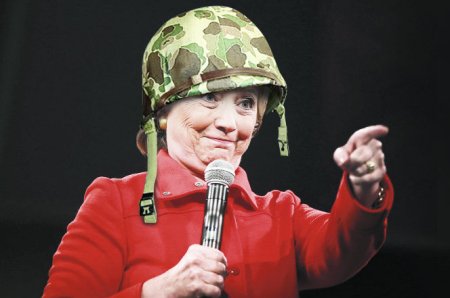
Sputnik | May 11, 2016
A new survey of US military personnel finds presumptive Republican nominee Donald Trump leading his Democratic opponent Hillary Clinton by over a 2-to-1 margin. […]
In polling of 951 verified active-duty troops, reservists and National Guardsmen, The Military Times found that in a match-up between Trump and Clinton, 54% of respondents said they would support the business mogul-turned-candidate, compared to 25% who chose the former secretary of state (the remaining 21% said they would not vote). At the same time, when the match-up was switched to Trump vs. Senator Bernie Sanders, Trump got 51% support, compared to 38% for the Vermont senator. […]
With Russian analysts and much of the public watching the US presidential campaign almost as closely as Americans themselves, independent online newspaper Svobodnaya Pressa attempted to explain the landslide in Trump’s favor, turning to Sergei Bespalov, a senior researcher at the Russian Presidential Academy of National Economy and Public Administration, for possible answers.
The biggest reason for the military’s support for Trump, Bespalov suggested, is Trump’s rhetoric on foreign policy.
“Trump’s promises to significantly temper the military activity of the United States around the globe very likely brings forth a positive reaction from the military. They are, in general, not too thrilled about the idea of their country being dragged into new armed conflicts, since they are the ones who take most of the risks” when this happens.
“At the same time,” the analyst says, “Clinton has a reputation for being a supporter of a very aggressive foreign policy, connected to the continuation of the current policy of the forced expansion of ‘Western-style democracy’ throughout the world, and for active intervention in the internal affairs of a host of countries and regimes which Washington finds undesirable. This, of course, is fraught with the danger of the intensification of the use of the US armed forces abroad, and for new military conflicts.”
Asked by the newspaper why the Pentagon would prefer Trump and his non-interventionism, Bespalov corrected his interviewer. “It’s not the Pentagon that prefers Trump, and not the military elite, but the majority of ordinary servicemen and women. The Pentagon supports Clinton. But those soldiers who, in the case of a Clinton victory, will be drawn into new conflicts, and will have to risk their lives, clearly aren’t thrilled about this prospect. And therefore among ordinary soldiers and officers Trump has proven to be more popular.”
Mikhail Alexandrov, a senior expert at the Center for Military-Political Studies at the Moscow State Institute of International Relations, suggests that other reasons may be at play.
“Trump shows resolve in the use of force. He demands that Obama use force, including in Syria. He is prepared to aggravate relations with Iran. He says that dialogue with Russia can come only ‘from a position of strength’. And recently he said that it would be necessary to shoot down Russian planes, referring to the recent incident involving the American destroyer Donald cook and our fighters.””Trump, in his rhetoric at least, is creating an image of an aggressive macho, who is willing to use force when, in his view, American interests are threatened. This approach appeals to the military.”
In other words, Alexandrov suggests, Trump “is a supporter of a more open policy of the use of force, unlike Clinton, who prefers methods of hybrid warfare, including ‘soft power’ and special operations. Trump is ready to use [military] force directly, decisively, and on a large scale.”
Which approach is preferable for Russia, and for other countries looking to escape US hegemony and create a multipolar world, remains to be seen. Moscow has already had a taste of the approach proposed by Mrs. Clinton, which includes more color revolutions on Russia’s borders, and endless wars in the Middle East. Trump, at the very least, has talked about negotiating with Moscow, and has criticized Clinton, Obama and George W. Bush for the disastrous military interventions over the last fifteen years which cost thousands of American servicemen and women, along with hundreds of thousands of people in the Middle East their lives.
Read more:
Clinton’s Neocon Ties Could Mean More Regime Change on the Menu
Clinton Receives More Wall Street Donations Than Republican Rivals
Moscow Slams US Concerns About Russian, Chinese Military Space Activities
Sputnik — 11.05.2016
Moscow does not take seriously US concerns regarding Russia’s and China’s activities in space, the head of the Russian Foreign Ministry’s Department for Non-Proliferation and Arms Control said Wednesday.
The Washington Post reported earlier in the week that Frank Rose, Assistant Secretary of State for Arms Control, had expressed concern over “the continued development by Russia and China of anti-satellite weapons.”
“Indeed, such statements have been made recently by official representatives of the US administration, fairly regularly. Taking them literally and seriously is impossible. After all, any country, including the United States, has the opportunity to address real concerns, if they arise, through established political and diplomatic means,” Mikhail Ulyanov told RIA Novosti.
“Not only will Washington not use [diplomatic channels], but it actively tries to avoid them,” he added.
Ulyanov noted that the United States itself has been blocking a 2008 proposal by Russia and China on preventing the deployment of weapons in outer space, which would “effectively solve the problem of anti-satellite weapons.”
“The Russian-Chinese proposal has gained broad support on the international arena, but its practical implementation is categorically blocked by the United States,” he said.
Erdogan calls for greater NATO presence in Black Sea
RT | May 11, 2016
NATO is not deploying enough assets to the Black Sea and cannot counter the Russian military presence there, Turkish President Recep Tayyip Erdogan has argued. He said he would ask the alliance to address the issue during an upcoming summit in Warsaw.
“I told him [NATO Secretary General Jens Stoltenberg]: ‘You are absent from the Black Sea. The Black Sea has almost become a Russian lake,’” Erdogan said at a meeting of heads of general staff of Balkan nations in Istanbul on Wednesday. “If we don’t take action, history will not forgive us.”
He added that Bosnia and Herzegovina and Macedonia should join the alliance soon to make it stronger.
A NATO summit will be held in the Polish capital in July. The meeting is expected to strengthen the alliance’s stance on countering what its new top military commander, US General Curtis Scaparrotti, called a resurgent Russia in his inauguration ceremony last week. Moscow sees NATO’s military buildup near its border as offensive and threatening.
“We should enhance our coordination and cooperation in the Black Sea. We hope for concrete results from the NATO summit in Warsaw on July 8 and 9… The Black Sea should be turned into the sea of stability,” Erdogan said, as quoted by Sputnik.
Military access to the Black Sea is limited for nations not bordering it, as Russia does. The US regularly sends its warships into the Black Sea for rotations.
The tension between Russia and the US over the strategic body of water was highlighted last year when Russian warplanes passed by the USS Ross, an American guided-missile destroyer. The Pentagon accused the Russian military of acting aggressively, while Moscow said the warship was approaching Russian territorial waters, which prompted the response.
Turkey, previously a strong trade partner of Russia, has become a bitter foe after downing a Russian bomber near the Syrian border back in November. The Turkish president said the downing of the plane – which resulted in the death of one of its pilots, who was killed by a Turkey-supported rebel group – was a proper response to a seconds-long violation of Turkish airspace. Moscow denied that such a violation happened and accused Ankara of stabbing Russia in the back.
Turkey’s immediate move after the incident was to call an emergency NATO meeting.
US Claims Anti-Missile Site in Poland There to Prevent Middle East Threats
Sputnik — 11.05.2016
The US anti-missile base due to be built in the Polish town of Redzikowo does not threaten Russia’s security, as the base is aimed at preventing missile threats from the Middle East, US Ambassador to Poland Paul Jones said Wednesday.
The start of construction of the military base in Poland, which is part of an US-designed ballistic missile defense system in Europe, is scheduled for May 13. The construction of the base is expected to be completed by 2018.
Speaking with the Polish Radio broadcaster, Jones assured that this defensive facility was designed to prevent the threats from the Middle East and not to threaten Russia’s security and that Moscow was aware of that. However, the United States is fully ready for different scenarios, the ambassador noted.
Russia has repeatedly expressed concern over the creation of the ballistic missile defense system in Europe, approved in 2010 during a NATO summit in Lisbon. A group of European countries, including Poland, Romania, Spain and Turkey, agreed to deploy elements of the system on their territories.
The United States and NATO continue to claim that the ballistic missile defense system is aimed primarily at countering threats from Iran and North Korea.
Russia slams Turkey’s ‘unconstructive role’ in latest round of Syria talks
Press TV – May 10, 2016
Russia’s Deputy Foreign Minister Gennady Gatilov has slammed Turkey’s “unconstructive role” in the latest round of indirect talks between the warring sides to the crisis in Syria.
He said Ankara influenced the main opposition group to withdraw from the negotiations.
Gatilov made the remarks in an interview with the Russian Izvestia daily published on Tuesday.
“It is a pity that the foreign players, and important regional [players such] as Turkey, continue to play an unconstructive role in this process,” Gatilov stated.
The Russian official said Turkey made the foreign-backed High Negotiations Committee (HNC) to suspend participation in the UN-brokered discussions.
Gatilov expressed Moscow’s opposition to the Saudi-backed HNC’s withdrawal from the Geneva talks. “We condemn their action and do not support.”
The peace talks, which began in Geneva, Switzerland, on April 13, were brought to a halt after the HNC walked out of the discussions in protest at what it called the Syrian government’s violation of a ceasefire in the Arab country.
Damascus dismissed the accusation, saying the truce was violated by foreign-backed militants.
The nation-wide cessation of hostilities, brokered by Moscow and Washington, was introduced in February in a bid to facilitate dialogue between rival parties in Syria.
However, renewed violence in recent weeks in some parts of Syria, especially the northwestern city of Aleppo, has left the ceasefire in tatters and torpedoed the peace talks.
Elsewhere in his remarks, the Russian deputy foreign minister highlighted a shift in Washington’s stance on the future of Syrian President Bashar al-Assad, saying the issue is no longer a prerequisite for the peace negotiations.
Gatilov said it is up to the Syrian nation to decide the fate of President Assad.
On Monday, Russian Foreign Minister Sergei Lavrov and US Secretary of State John Kerry held a phone conversation, during which they underlined the need for the continuation of discussions between the Syrian authorities and the opposition.
“Lavrov again pointed to the need for the anti-government formations oriented at Washington to separate from the terrorist groups as soon as possible and to thwart the replenishments to extremists through the territory of Turkey,” the Russian Foreign Ministry said in a statement.
Featured Video

Diplomacy is Now a Crime in Britain / Ian Proud
or go to
Aletho News Archives – Video-Images
From the Archives
Genetic baloney in thick slices
MAYBE COULD BE INC.
By Jon Rappoport | No More Fake News | July 8, 2021
Gene research companies tend to come and go. They start out banging and popping like fireworks in the sky, and then they fade out—selling themselves to larger outfits who’ve hired better liars…
Once upon a time, it sounded easy. Start with a disease, find the gene responsible for the disease, and correct the problem.
Then, researchers wondered, was disease the result of one gene or a group of genes acting together?
Either way, the proof would be in devising cures for diseases using gene therapy. “Not yet, but soon…”
And regardless, the major need was: money. Lots and lots of money.
This need required good PR people. “We have to pump up the idea that we’re on the edge of tremendous breakthroughs. We’re always on that edge…”
This hype also needed to obscure the fact that there wasn’t (and isn’t) ANY gene cure for ANY disease. … continue
Blog Roll
 Aletho News
- Diplomacy is Now a Crime in Britain / Ian Proud
- UK Government Body Kept Files on People Criticizing Prevent Program
- US military withdrawal from Iraq and the collapse of US-Israeli hegemonic project in West Asia
- What does Europe want – a war with Russia?
- She Followed the Actual Data on COVID Vaccines and Masks — Her Career Took a Huge Hit
- Florida AG Sues Pfizer, Bourla Over Deceptive Marketing of COVID Vaccines
- Von der Leyen gifts her spin doctor a job for life
- 10K More U.S. Troops Deploy as Trump Weighs New Iran Strikes /Suliaman Ahmed
- Iranian crew declared Dena training vessel ‘unarmed’ to US warship before deadly torpedo strike: Report
- Iran’s NPT debate moves beyond parliament
- If Americans Knew
- Israel is squeezing the life out of Palestinians – Daily Update
- The Israeli Right Portrays Islam as Murderous. It Serves a Political Purpose
- Jordan Has Had Enough: King Abdullah’s Scathing Warning to Israel
- Israeli Colonizers (i.e. Settlers) Kill Palestinian Man Near Salfit
- New Google Maps images reveal massive scale of devastation in Gaza
- Jewish supremacy, anti-Palestinian bigotry on display in Israel – Daily Update
- Israeli Soldiers Abduct At Least 22 Across Occupied West Bank
- Eight Palestinians Killed in Israeli Attacks on Gaza
- Israeli former leaders and security chiefs threaten legal action over ‘Jewish terrorism’
- Israel map in LA Times ad includes all land from the river to the sea
- No Tricks Zone
- Green Energy Debacle: German Expert Professor Fritz Vahrenholt Warns Of Severe Economic And Social Consequences
- Two More Paleo Reconstructions Affirm Meters-Higher Sea Levels Across Ireland, Brazil 7000-6000 Years Ago
- New Study: Earth And Venus Surface Warmth Largely Explained By Convection And Lapse Rate, Not CO2 Or Radiation
- 2025 Nature Paper Claiming Worsening Global Drought Gets RETRACTED …Heavily Flawed
- New Study: ‘Global Drought Shows No Detectable Recent Acceleration Under Climate Warming’
- Economic Masterminds: German Socialists Suggest Taxing Productivity Gains Stemming From Using AI
- The South China Sea Has Not Been Cooperating With The Climate Change Narrative
- Energy Crisis: Germany Enters Heating Season With Historically Low Gas Reserve Fill Levels
- New Study: The Antarctic Ice Sheet Gained Mass From 2020-2024 Due To Staggering Snow And Ice Accumulation
- Study: Ocean Heating Rates From Thousands Of Years Ago ‘Dwarf’ Modern Ocean Heating Rates

