The Donald’s Foreign Policy
It sure trumps Hillary
By Philip Giraldi • Unz Review • May 10, 2016
Coming off a string of victories in the so-called Acela state primaries two weeks ago, GOP presidential candidate presumptive Donald J. Trump made what he described as a major foreign policy speech. Critics have blasted the effort as being short on details and long on generalities but, as ever, one’s perspective pretty much depends on what one expects or wants to hear. I admire Trump for two reasons. First is his uncompromising stance on illegal immigrants, which I fully support, and second is his willingness to challenge Republican orthodoxy on foreign policy by condemning the Iraq War and opposing nation building and military intervention overseas.
I wanted to hear two things on foreign policy: that Donald Trump is indeed committed to military non-intervention in other countries except in those rare instances where vital national interests are at stake and also that the United States would pursue a course of positive engagement with Vladimir Putin and Russia. I was not disappointed.
Trump actually used the words “peace” and “peaceful” a number of times, something that has been missing from GOP rhetoric for many years. He said that he would “view the world through the clear lens of American interests,” something that he went on to describe as “America First,” adding “Our goal is peace and prosperity, not war and destruction… war and aggression will not be my first instinct.” Paraphrasing John Quincy Adams, Trump concluded that “The world must know that we do not go abroad in search of enemies, that we are always happy when old enemies become friends, and when old friends become allies.”
Trump observed that there has been a fixation with policies that are both “foolish and arrogant” that have “led to one foreign policy disaster after another” in places like Iraq, Syria, and Egypt. “It all began with the dangerous idea that we could make western democracies out of countries that had no experience or interest in becoming a western democracy. We tore up what institutions they had and then were surprised at what we unleashed: civil war.”
This is all good common sense, lambasting the twin plagues of military intervention and democracy promotion, the two false idols that have respectively driven the foreign policies of the GOP and the Democrats. Trump’s comments in those specific areas could have been made by Ron Paul.
Trump went on to observe that “our actions in Iraq, Libya and Syria have helped unleash ISIS.” I would have added that the power vacuums that we have created actually gave birth to ISIS. Regarding Russia and China, he said “We desire to live peacefully and in friendship with Russia and China. We have serious differences with these two nations and must regard them with open eyes. But we are not bound to be adversaries. We should seek common ground based on shared interests…I believe an easing of tensions and improved relations with Russia…is possible.”
On the negative side, Trump took obligatory swipes at Iran and the nuclear agreement negotiated by the Obama Administration, but he did not say that he would seek to terminate the arrangement and the only line he drew was that “Iran cannot be allowed to have a nuclear weapon,” far less vitriolic than the neocon and conventional Republican demand that Tehran not have the “capability” to do so, which is a threshold that has already been passed and which many have viewed as a carte blanche justification of an immediate attack by the U.S.
Regarding Israel, Trump engaged in the usual American politician speak regarding “the one true democracy in the Middle East” that also serves as a “force for justice and peace.” He also has stated that he would be “neutral” in negotiating peace between the Israelis and Palestinians and turned around to endorse continued expansion of Israeli settlements on Arab land. Hopefully he knows better about what is going on in the Middle East or will have advisers who know better and are not afraid to speak the truth. At least he didn’t invite Israeli Prime Minister Benjamin Netanyahu to move in down the hall in the White House on Inauguration Day, which Hillary Clinton has de facto done.
And speaking of Hillary, comparing her record and promises with the Trump speech demonstrates the differences between the two. David Stockman has noted that Hillary “wants to use government to make government great again” while The Donald wants “to use government to make America great again.” Hillary is indeed the favorite candidate of the Welfare-Warfare State Leviathan, a monster that seeks to dominate overseas while simultaneously stripping Americans of their liberties at home.
Hillary’s record is one of unmitigated belligerency. She enthusiastically supported her President-husband’s devastation of the Balkans in the 1990s, a “police action” in which she repeatedly lied about being “under fire” when she arrived on a visit. And she also signed on to the invasions of Afghanistan in 2001 and Iraq in 2003 carried out by the George W. Bush Administration.
As Secretary of State, Hillary was the driving force behind “surges” of U.S. forces in Afghanistan, in demanding the attacks on Libya and the overthrow of its leader and in the arming of jihadis in Syria to bring about regime change. Bombing Libya was indeed a Hillary project, initiated at her insistence in spite of misgivings by President Barack Obama. The Libyan fiasco led to government arsenals being looted with the weapons making their way to arm local militias and also to Islamic militants in Central Africa. It is widely believed that the four Americans killed in Benghazi in 2012 were killed while arranging for weapons transfers to the “moderate rebels” in Syria. If success as a diplomat is measured by the ability to destabilize entire regions, Hillary certainly takes center stage as the finest Secretary of State since Madeleine Albright, who famously declared that killing half a million Iraqi children through sanctions was “worth it.” Albright is currently regarded as Hillary’s closest foreign policy adviser.
Like several of the other women who have surrounded the president as top level advisers, Hillary is an enthusiastic advocate of the “R2P” doctrine, “responsibility to protect.” That means that the Washington can intervene in a foreign country even if that nation’s government in no way threatens the United States. The intervention is based on humanitarian grounds, allegedly to protect the local citizens against their own leaders, but it ironically and inevitably winds up killing mostly civilians in far greater numbers than would have otherwise been the case if there had been no military action. Libya and Syria are perfect examples of R2P on steroids.
Hillary has a team of strongly pro-Israel foreign policy advisers and she has frequently expressed her hostility towards Iran, which she has threatened to “obliterate.” One of her campaign videos includes “Iran seeks the destruction of Israel, Iran is a leading sponsor of terror in the region, Iran is flouting international law with its ballistic missile tests and its threats against our allies and partners.” None of the assertions are actually true.
Regarding the threat from Russia, Hillary has inevitably likened President Vladimir Putin to Adolph Hitler. She and her neocon acolyte Victoria Nuland were the driving forces behind cranking up the unrest in Ukraine, which eventually exploded into yet another pastel revolution that quickly became mired in corruption before dissolving into something approaching anarchy, which prevails to this day. She nevertheless wants to provide lethal arms to Kiev and also wants to expedite both Ukraine and Georgia joining NATO, even though it is a given that such action would provoke a major crisis with a nuclear armed and militarily quite capable Russia.
Hillary sees the conflict in Syria as an additional opportunity to confront Moscow, just like in the heady days of the Cold War, so she advocates a no-fly zone as a way for American and Russian flyboys to go head to head and is firm in her demand to replace Bashar al-Assad no matter what. She is one tough lady and she wants to make sure than everyone knows it. And of course her role model is Benjamin Netanyahu, who, she has promised, will be invited to join her in Washington as soon as her administration begins work in January.
So if one is concerned with foreign policy the choice between Donald and Hillary is no choice at all. Hillary may have the resume but it is essentially a bad one. If Trump does even a little of what he pledges to do he is a much better deal for the American people, as well as for most of the world, than is Hillary Clinton.
America’s Two-Faced Policy on Iran
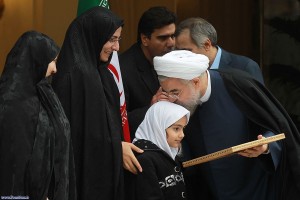
Iran’s President Hassan Rouhani celebrates the completion of an interim deal on Iran’s nuclear program by kissing the head of the daughter of an assassinated Iranian nuclear engineer
By Alastair Crooke | Consortium News | May 9, 2016
In an article entitled “Why America needs Iran in Iraq,” former U.S. Ambassador to Iraq Zalmay Khalilzad argues that “the chaos in Baghdad, culminating in the temporary occupation of the parliament by followers of Shiite Islamist cleric Muqtada al-Sadr, is undermining the war against the Islamic State; weakening Iraq’s economy; and accelerating the country’s disintegration.
“Without cooperation between the United States, Iran and Iraq’s top Shiite cleric, Ayatollah Sistani, the crisis could very well lead to the collapse of the entire political system set up in Iraq during the temporary U.S. occupation … To prevent this, Washington needs Tehran’s help. And Iran should be as motivated to seek stability [in Iraq] as much as Washington, because” Khalilzad asserts, “Iran, currently is losing favour in Iraq.”
Putting aside the questionable implication that Iran might somehow, through co-operation with America, raise its standing amongst Iraqis, Khalilzad’s presumption that Iran should now attend to America’s needs in Iraq, coupled with Secretary of State John Kerry’s insistence that Iran should help America to end the conflict in Syria too, throw into sharp relief the paradox inherent at the heart of U.S. diplomacy towards Iran, Russia (and China also).
This approach has been dubbed the “middle way” by former special adviser to the Assistant Secretary of State, Jeremy Shapiro: the U.S. Administration has no desire for an all-out confrontation with these three states. They are militarily hard nuts, and there is not much appetite for yet more military confrontation amongst a weary and wary American public (to the continuing frustration of the neocons).
More prosaically, the global financial system is now so brittle, so delicately poised, that it is not at all certain that the prospect of conflict would give the lift to America’s flagging economy that war generally is supposed to give. It might just snap the financial system, instead — hence the Middle Way.
Shapiro points out the obvious contradiction to this two-track approach: the U.S. no longer can ignore such powerful states. Its window of absolute, unchallenged, uni-polar power has passed. America needs the help of these states, but at the same time, it seeks precisely to counter these states’ potential to rival or limit American power in any way.
And America simply ignores the core complaints that fuel the tensions between itself and these states. It simply declines to address them. Shapiro concludes that this foreign policy approach is unsustainable, and bound to fail: “This dual-track approach, condemning Russia [or Iran] as an aggressor one day, [whilst] seeking to work with Moscow [or Tehran] the next … would [ultimately] force ever-greater confrontation.”
The ‘Middle Way’
In a sense, the U.S. approach towards Iran seems to be mirroring the so-called “middle way” policy which the U.S. Administration pursues towards Russia, whereby the putative “reset” with Russia was set aside (when President Vladimir Putin assumed the Presidency for the second time), and Obama – rather than seek outright confrontation with Russia – ruled that America however, would only co-operate with Russia when it suited it, but the U.S. would not deign to address Russia’s core issues of its “outsider” status in Europe, or its containment in Asia — or its concerns about a global order that was being used to corner Russia and to crush dissenter states who refused to enter the global order on America’s terms alone.
And Obama did little to drawback the NATO missile-march towards Russia’s borders (ostensibly, it may be recalled, to save Europe from Iranian missiles).
Ostensibly, too, the JCPOA (Joint Comprehensive Plan of Action) could have been America’s “reset” with Iran. Some, including a number of prominent Iranian politicians, thought it was.
But National Security Advisor Susan Rice was very explicit to Jeffrey Goldberg in The Atlantic that this was never intended: “It is assumed, at least among his critics, that Obama sought the Iran deal because he has a vision of a historic American-Persian rapprochement. But his desire for the nuclear agreement was born of pessimism as much as it was of optimism.
“The Iran deal was never primarily about trying to open a new era of relations between the U.S. and Iran,” Susan Rice told [Goldberg]. “It was far more pragmatic and minimalist. The aim was very simply to make a dangerous country substantially less dangerous. No one had any expectation that Iran would be a more benign actor.”
And so, we see a similar pattern, the possibility of a real “reset’ with Iran is pre-meditatively set aside (as per Rice), whilst the dual-track approach of condemning Iran for its ballistic missile tests (which have nothing to do with JCPOA), and its support for Hizbullah, are condemned one day, whilst Iran’s help in Iraq and Syria is being demanded on the next day.
At the same time, Iran’s core dispute with the U.S. – its complaints that exclusion from the international financial system is not being ameliorated as JCPOA was supposed so to do – are not being addressed. Rather they are being met with a shrug that implies “did they really expect anything else?”
Well, some (but by no means all) Iranian politicians had done just that: they had raised the Iranian public’s expectations that all sanctions – other than specific U.S. sanctions – would be lifted. They rather bet their credibility on it, as it were, and may pay a political price eventually.
And as NATO deploys a further 4,000 troops in the Baltic states and Poland, on Russia’s border, so too the U.S. Congress continues its figurative advance on Iran’s frontiers.
Here is Iran’s (conservative) Keyhan newspaper: “The draft of a new resolution has been presented to the US Congress in which Iran is accused of creating tension in the Persian Gulf, and the US Government has been urged to confront Iran and impose new sanctions against our country. Randy Forbes, a Republican member of the US House of Representatives, has drafted a resolution, which if passed by the Congress, condemns Iran’s military presence in the Persian Gulf as a provocation” (emphasis added)
Shapiro’s specific warning about the “middle way” approach was that “political and bureaucratic factors on both sides would force ever-greater confrontation.” But this is not the only risk, nor does it even constitute being the biggest risk (besides that of having undermined those in Iran and Russia who had put their “hat in the ring” of contemplating Entente with the United State).
America’s Bad Faith
Rather, it is by making this policy approach quite general to those states which have taken on themselves the burden of being the symbol for a non-Western, alternative vision (Russia, Iran and China, inter alia), that a perceived breach of the spirit of the JCPOA (at the least), will have wider repercussions.
Russia and China both spent political capital in order to help persuade Iran to sign up to the JCPOA: Will they not wonder whether America is to be trusted? China has complicated negotiations in hand with America on trade and financial issues, whilst Russia has been trying to resolve ballistic missile, as well as Ukraine sanctions issues, with America.
Is it not a straw in the wind for the consequences to this policy when a prominent Russian commentator, Fyodor Lukyanov, who is not at all hostile to rapprochement with the West, writes in End of the G8 Era that using Russia’s prospective inclusion in the G8 as an instrument of pressure on Russia is pointless?:
“The G8 reflected a certain period of history when Russia really wanted to be integrated into the so-called Extended West. Why it did not happen? Something went wrong? This is another topic. The most important thing is that it did not happen at all … it seemed (in the 1990s) that this membership would not mean just participation in yet another club, but a strategic decision aimed at the future.
“However, the desirable future did not come, and probably won’t come. It is obvious now, that the world does not develop in the direction of the Western model. So, now we have what we have, and there is no reason to restore the G8.”
May this general sentiment come to be reflected in Iran too, as the sanctions-lifting issue drags on? Did the U.S. then “win one over Iran” through the JCPOA accord – as the shrugs of U.S. shoulders at Iranian complaints, might imply? Was Iran just naïve? Did they really think that the U.S. was simply going to empower Iran financially?
It is pretty clear that the Supreme Leader understood the situation precisely — he had, after all some experience of U.S. non-compliance with agreements from the Lebanese hostage negotiations of the 1980s.
But what has Iran lost by the JCPOA? A few Iranians may have had their fingers burned in the process, but Iran achieved three important things: the world now knows that it was not Iran that was the impediment to a nuclear deal; the deal has transformed Iran’s public image – and created an opening – with the rest of the world (including Europe); and it has, in the process, constructed and strengthened strategic political and economic ties with Russia and China.
But most important of all, the rift within Iran that stemmed from the sense amongst some Iranian orientations, that President Ahmadinejad’s rhetoric was a principal obstacle to normalizing with the West, has been addressed: an Iranian government, with a Western-friendly face, has been given, and seen to have been given, the full chance to negotiate a solution to the nuclear issue. Whatever the final outcome, that boil has been lanced.
No, the Iranian leadership has not been naïve.
Alastair Crooke is a British diplomat who was a senior figure in British intelligence and in European Union diplomacy. He is the founder and director of the Conflicts Forum, which advocates for engagement between political Islam and the West.
US Ambassador to Hungary: Overthrow Assad, Let in Refugees, and Fight Russia… or Else!

US Ambassador to Hungary, Coleen Bell
By Daniel McAdams | Ron Paul Institute | May 6, 2016
If anyone wants a short course on what’s wrong with US diplomacy look no further than US Ambassador to Hungary Coleen Bell’s speech Friday to the Foreign Affairs Committee of the Hungarian Parliament. In typical diplo-speak there was plenty of flowery language about shared values, fish swimming together in the same water (?), sappy poetics like “together, out of that winter, we would force the spring,” and talk of together being “part of the world’s greatest military and political alliance.”
But make no mistake: Inside Ambassador Bell’s velvet glove is an iron fist, poised to strike should Washington’s annoyingly independent-minded Fidesz-led government step out of line on the big issues. And by “big” issues it should be understood that the US means the issues it considers in the interests of its own foreign policy, not those in Hungary’s interest.
Message to Hungary: do as we say or you will be sorry.
Ambassador Bell’s previous job was as a television soap opera producer, but raising more than two million dollars for the election of Barack Obama “earned” her the position of top US diplomat in Hungary.
The former television producer does know how to deliver her lines, though. She lectured the Hungarians about Syria, explaining to them that ISIS and Assad are both equally evil and both equally to blame for the disaster that is Syria.
ISIS has flourished in Syria, she told the Hungarians, because it “exploits the chaos of civil war in Syria, a conflict that has now claimed more than 250,000 lives.” But she does not mention that it was US backing for “regime change” in Syria — beginning at least in 2006, as we learn from a critical Wikileaks-released US Embassy Damascus memo — that created that very chaos she blames for the rise of ISIS.
In fact it is propaganda to call what is happening in Syria a “civil war,” as the forces battling the Syrian government are all sponsored by foreign powers like Saudi Arabia, Turkey, and the US. It is a proxy war against the Syrian government, not a civil war.
She then tells the Hungarians ISIS will never be defeated in Syria until Assad is overthrown:
[W]e know we won’t be able to defeat Daesh in Syria unless we also deal with the civil war and particularly with Assad. Because as long as Assad is there, he remains the most powerful magnet for foreign fighters and recruits to Daesh.
Does she assume Hungarians are so stupid that they believe that by attacking and beating ISIS back nearly to Raqqa (with Russian assistance), the Syrian government of Assad is actually benefitting ISIS? Attacking ISIS means Assad is on the side of ISIS?
“Since February, the cessation of hostilities reduced the violence in Syria, allowing millions of Syrian civilians to take the first steps toward reclaiming a normal life,” says the Ambassador, without even mentioning what brought the ceasefire about in the first place: Russian participation along with the Syrian army in the decimation of al-Qaeda and ISIS positions in northwest and central Syria. In fact it is absolutely bizarre that in the world of Ambassador Bell (and the State Department hacks who drafted her speech), the Russian intervention against al-Qaeda and ISIS simply never took place or was too inconsequential to mention.
Is any Hungarian so ill-informed that he would believe such nonsense?
Bell used the tragedy in Syria to pressure Hungary on the (largely American-made) refugee crisis. Hungary’s firebrand prime minister, Viktor Orban, has, along with several of his central European counterparts, stood up to Brussels’ (and Washington’s) demands that Hungary take in tens of thousands of migrants who heeded German Chancellor Angela Merkel’s call to come to Europe and enjoy lots of free stuff.
Last month Orban told Hungarian Radio that if he accepts the EU migrant resettlement plan, “it would be determined not in Hungary but in Brussels who we have to live together with, and how the ethnic composition of the country will look in future.” He has rejected such a notion.
“Every sovereign nation has the right and an obligation to protect its borders,” Bell told the Hungarian Parliament, “But every nation, as a part of the international community, also has a fundamental obligation to help refugee populations seeking safety.”
Translation: your sovereignty is not determined by you, but rather by us. It is a practice articulated by Orwell in 1984 whereby a person can think two completely contradictory thoughts at the same time seemingly without any mental conflict.
But here is where the iron fist inside Bell’s velvet glove glints in the sun. She pointedly condemned the Hungarian government position by praising those in Hungary who hold the opposite view, i.e. the Hungarian opposition:
We commend the humanitarian spirit of Hungarian leaders, law enforcement and military personnel, and ordinary citizens who are responding to this crisis with generosity and compassion.
Then she gives Hungary Washington’s marching orders:
We continue to stress that any solution to these migration challenges should focus on saving and protecting lives, ensuring the human rights of all migrants are respected, and promoting orderly and humane migration policies. That includes the support of all Member State governments for the refugee agreement forged between the EU and Turkey.
Translation: Hungary must support the EU agreement with Turkey which would see tens of thousands of migrants settled in EU member countries, including Hungary itself. The problem is that the Hungarian parliament explicitly rejected Brussels’ forced migrant settlement plans for Hungary and plans to hold a nationwide referendum on the subject. Bell is saying here that Hungary’s elected representatives and even the Hungarian voter must be ignored and Brussels’ dictate obeyed.
When it comes to Russia, Ambassador Bell also has some instructions for Budapest: Moscow is your enemy and don’t you forget it.
She told Hungarian parliamentarians:
As many Hungarians have reminded me, you need no introduction to the nature of Russian aggression. Your response has always been to show resolve. Our best weapons, in fact, are resolve and solidarity.
Weapons? Quite a loaded word.
Orban has been seen in Washington as insufficiently enthused about sanctions on Russia, which hurt Hungarian trade and business interests. Ambassador Bell makes it clear that Hungary must adhere to US demands of Russia, even if they are completely incoherent:
As the United States and Hungary have both stated many times, Russia has a simple choice: fully implement Minsk or continue to face sanctions. Russia must withdraw weapons and troops from the Donbas; Russia must ensure that all Ukrainian hostages are returned; Russia must allow full humanitarian access to occupied territories; Russia must support free, fair, and internationally-monitored elections in the Donbas under Ukrainian law; and most important, Russia must restore Ukraine’s sovereignty.
That last point should be taken to mean that Russia must ignore the will of the people of Crimea who voted in overwhelming numbers to re-join Russia after just 25 years as part of independent Ukraine.
Not to worry, Ambassador Bell is confident that Budapest will do everything Washington tells it to do:
More than this, Hungary is equal to the great challenges of our times, and the United States is counting on you.
To stiffen their spine, US Ambassador Bell reminds the Hungarians that they are part of “our global order” and touts the great examples set by the US, including:
Our system of international economic, political, and social norms and institutions have kept the peace and fostered prosperity for decades. Whether it is international law, environmental protection, trade regulations, anticorruption laws, child labor laws, human rights safeguards, the nonproliferation regime, public health systems, international financial institutions, UN peacekeeping, or a robust civil society – these norms and institutions give life and stability to our global order.
In the era of NSA spying on innocent Americans, Guantanamo, CIA torture, weapons sales to the world’s worst dictators (Saudi Arabia for one), destruction of the environment by the US war machine, “regime change” operations that violate the sovereignty of other states, and outright aggression in opposition to US and international law (Libya, etc.), Bell’s suggestion that “our global order” is the pinnacle of civilization should get a laugh out of most Hungarians. In fact, from Libya to Syria to Ukriane to Pakistan and Afghanistan, the US interventionist attempt to forge a global order with blood and bullets will go down in history along with the authoritarianisms of the 20th century as one of humanity’s darkest chapters.
Here is the short version of Ambassador Bell to Budapest: “to be our partner means you do what we say whether or not it is in your interest.”
Funny, that was Moscow’s message to Budapest from 1948 to 1989.
If Russia Had ‘Freed’ Canada
By Joe Lauria | Consortium News | May 5, 2016
As the United States plans to move thousands of NATO troops to Russia’s borders and continues to bolster a fiercely anti-Russian regime in neighboring Ukraine, the official line in Washington and its subservient corporate media is that beneficent America is simply seeking to curtail Moscow’s “aggression.” But the U.S. government and media might look at things quite differently if the shoe were on the other foot.
What, for instance, would the U.S. reaction be if Russia instead had supported the violent overthrow of, say, Canada’s government and assisted the new Ottawa regime’s “anti-terrorist operations” against a few rebellious “pro-American” provinces, including one that voted 96 percent in a referendum to reject the new Russian-backed authorities and attach itself to the U.S.?
If the U.S. government tried to help these embattled “pro-American” Canadians – and protect the breakaway province against the Russian-installed regime – would Washington see itself as the “aggressor” or as simply helping people resist anti-democratic repression? Would it view Russian troop movements to the U.S. border as a way to stop an American “invasion” or rather an act of “aggression” and provocation by Russia against the United States?
The Ukraine Reality
Before playing out this hypothetical scenario, let’s look at the actual scene in Ukraine today as opposed to the gross distortion of reality fed the American people by the U.S. mainstream media the past two years. The reality is not the State Department’s fable of a pro-democracy “revolution” cleaning up corruption and putting Ukrainian people first.
In the real world instead, extreme right-wing nationalists took control of a popular protest by mostly western Ukrainians to spearhead a violent coup that succeeded on Feb. 22, 2014, in overthrowing President Viktor Yanukovych, a man whom I interviewed in 2013 after he had been democratically chosen in an election certified by the Organization for Security and Cooperation in Europe.
Proof of the U.S. role in the coup came in a leaked telephone conversation several weeks earlier between U.S. Assistant Secretary of State for European and Eurasian Affairs Victoria Nuland, and Geoffrey Pyatt, the U.S. ambassador to Ukraine. In the conversation, Nuland and Pyatt discussed how the U.S. could “midwife” the unconstitutional change of government and they rated which Ukrainian politicians should be put in charge, with Nuland declaring “Yats is the guy,” a reference to Arseniy Yatsenyuk.
As for the European Union’s less aggressive approach to the Ukraine situation, Nuland declared: “Fuck the E.U.”
Nevertheless, after the coup, Western governments denied there ever was a coup, peddling the line that Yanukovych simply “ran away,” as though he woke up one morning and decided he didn’t want to be president anymore.
In fact, on Feb. 21, to contain the mounting violence, Yanukovych signed a European-brokered deal to reduce his powers and to hold early elections. But the next day, as right-wing street-fighters overran government buildings, Yanukovych fled for his life – and the West moved quickly to consolidate a new government under anti-Russian politicians, including Nuland’s choice—Yats as prime minister. (Yatsenyuk remained prime minister until last month when he resigned amid complaints that his stewardship had been disastrous for the Ukrainian people.)
A Resistance Emerges
Since the vast majority of Yanukovych’s support came from the ethnically Russian eastern half of the country, some Yanukovych backers rose up to challenge the legitimacy of the coup regime and to defend Ukraine’s democratic process.
Instead the West portrayed this resistance as a Russian-instigated rebellion against the newly minted and U.S.-certified “legitimate” government that then launched a violent repression of eastern Ukrainians who were deemed “terrorists.”
When Russia supported the resisters with weapons, money and some volunteers, the West accused Russia of an “invasion” and “aggression” in the east. But there has never been satellite imagery or other proof of this alleged full-scale Russian “invasion.”
In the midst of the Kiev “anti-terrorist” offensive in the east, on July 17, 2014, a Malaysian commercial airliner, Flight MH-17, was shot out of the sky, killing all 298 people on board. The United States, again offering no proof, immediately blamed Russia.
Over the past year, the fighting has been largely contained after Russian, Ukrainian and European leaders negotiated the Minsk Accords, though they are far from being implemented and widespread violence could break out again at any time.
Throughout the entire crisis the United States has insisted its motives are pure, including its new plans for deploying some 4,000 NATO troops, including about half American, on Russia’s Eastern European borders north of Ukraine.
President Barack Obama told the U.N. General Assembly last year that the U.S. had no economic interests in Ukraine. But former State Department official Natalie Jaresko served as Ukraine’s finance minister until recently and Vice President Joe Biden’s son sits on the board of a major Ukrainian company. U.S. investment also has increased since the coup.
Yanukovych’s overthrow occurred after he chose a Russian economic plan rather than sign an association agreement with the European Union, which Ukrainian economic analysts warned would cost the country $160 billion in lost trade with Russia.
The E.U. plan would also have opened Ukraine to Western neoliberal economic strategies designed to exploit the country for the benefit of Western capital and local oligarchs (one of whom, Petro Poroshenko, emerged as the new president).
Turning the Tables
To help American readers better understand what has transpired in Ukraine, it may be useful to see what it would be like if the tables were turned. What would the story be like if Russia played the role of the U.S. and Canada the role of Ukraine? Most Americans would not be pleased.
In this reverse scenario, the world’s mainstream media would follow Moscow’s line and present the story as a U.S. “invasion” of Canada. The media would explain the movement of Russian troops to the U.S. border as nothing more than a peaceful step to deter U.S. “aggression.”
But Americans might see matters differently, siding with the breakaway Maritime provinces resisting the Moscow-engineered violent coup d’etat in Ottawa. In this scenario, Prince Edwards Islanders would have voted by over 90 percent to secede from the pro-Russian regime in Ottawa and join the United States, as Crimea did in the case of Ukraine. People in Nova Scotia and New Brunswick – stressing their close historic ties to America – also would make clear their desire not to be violently absorbed by the Ottawa coup regime.
In this alternative scenario, Moscow would condemn Prince Edwards Island’s referendum as a “sham” and vow never to accept its “illegal” secession. The popular resistance in Nova Scotia and New Brunswick would be denounced as “terrorism” justifying a brutal military crackdown by Russian-backed Canadian federal troops dispatched to crush the dissent. In this “anti-terrorist operation” against the breakaway region, residential areas would be shelled killing thousands of civilians and devastating towns and cities.
In this endeavor, the Canadian army would be joined by Russian-supported neo-fascist battalions that had played a crucial role in the overthrow of the Canadian government. In the Maritime city of Halifax, these extremists would burn alive at least 40 pro-U.S. civilians who took refugee in a trade union building. The new government in Ottawa would make no effort to protect the victims, nor conduct a serious investigation to punish the perpetrators.
Ignoring a Leak
Meanwhile, proof that Russia was behind the overthrow of the elected Canadian prime minister would be revealed in a leaked conversation between Moscow’s foreign ministry chief of the North America department and the Russian ambassador to Canada.
According to a transcript of the leaked conversation, the Moscow-based official would discuss who the new Canadian leaders should be several weeks before the coup took place. Russia would launch the coup when Canada decided to take a loan package from the U.S.-based International Monetary Fund that had fewer strings attached than a loan from Russia.
Russia’s ally in Beijing would be reluctant to back the coup. But this would seem to be of little concern to Moscow’s man who is heard on the tape saying, “Fuck China.” Although this conversation would be posted on YouTube, its contents and import would be largely ignored by the global mainstream media, which would insist there was no coup in Ottawa.
Yet, weeks before the coup, the Russian foreign ministry official would be filmed visiting protesters camped out in Parliament Square in Ottawa demanding the ouster of the prime minister. The Russian official would give out cakes to the demonstrators.
The foreign ministers of Russian-allied Belarus and Cuba would also march with the protesters through the streets of Ottawa against the government. The world’s mainstream media would portray these demands for an unconstitutional change of government as an act of “democracy” and a desire to end “corruption.”
In a speech, the Russian foreign ministry official would remind Canadian businessmen that Russia had spent $5 billion over the past decade to “bring democracy” to Canada, much of that money spent training “civil society” activists and funding anti-government “journalists.” The use of these non-governmental organizations to overthrow foreign governments that stand in the way of Russia’s economic and geo-strategic interests would have been well documented but largely ignored by the global mainstream media.
But recognizing the danger from these “color revolution” strategies, the United States would move to ban Russian NGOs from operating in the U.S., a tactic that would be denounced by Russia as America’s rejection of “democracy.”
The Coup Succeeds
The Canadian coup would take place as protesters violently clashed with police, breaking through barricades and killing a number of police officers. Snipers would fire on the police and the crowd from a nearby Parliament Square building under the control of hardline pro-Russian extremists. But the Russian government and the mainstream media would blame the killings on the embattled Canadian prime minister.
To stem the violence, the prime minister would offer to call early elections but instead would be driven from office violently by the pro-Russian street gangs. Russia and the global mainstream news media would praise the overthrow as a great step for democracy and would hail the pro-Russian street fighters who had died in the coup as the “Heavenly Hundred.”
Following the coup, Russian lawmakers would compare President Barack Obama to Adolf Hitler for allegedly sending U.S. troops into the breakaway provinces to protect the populations from violent repression, and for accepting the pleas of the people of Prince Edward Island to secede from this new Canada.
Obama would be widely accused of ordering an “American invasion” and committing an act of “American aggression” in violation of international law. But the Maritimes would note that they had long ties to the U.S. dating back to the American Revolution and didn’t want to live under a new regime imposed by a faraway foreign power.
Russia would claim intelligence proving that U.S. tanks crossed the Maine border into New Brunswick, but would fail to make the evidence public. Russia would also refuse to reveal satellite imagery supporting the charge. But the claims would still be widely accepted by the world’s mainstream news media.
For its part, Washington would deny it invaded but say some American volunteers had entered the Canadian province to join the fight, a claim met with widespread media derision. Russia’s puppet prime minister in Ottawa would offer as proof of an American invasion just six passports of U.S. soldiers found in New Brunswick.
Taking Aim at Washington
When – during one of the new regime’s “anti-terrorist” offensives – a passenger jet would be shot down over Nova Scotia killing all on board, Russia would accuse President Obama of being behind the outrage, charging that the U.S. had provided the powerful anti-aircraft missile needed to reach a plane flying at 33,000 feet.
But Moscow would refuse to release any intelligence to support its claim, which would nevertheless be accepted by the world’s mainstream media.
The plane’s shoot-down would enable Russia to rally China and other international allies into imposing a harsh economic boycott of America to punish it for its “aggression.”
To bring “good government” to Canada and to deal with its collapsing economy, a former Russian foreign ministry official would be installed as Canada’s finance minister, receiving Canadian citizenship on her first day on the job.
Of course, Russia would deny that it had economic interests in Canada, simply wanting to help the country free itself from oppressive American domination. But Russian agribusiness companies would take stakes in Albertan wheat fields and the son of Russia’s prime minister as well as other well-connected Russians would join the board of Canada’s largest oil company just weeks after the coup.
Russia’s ultimate aim, beginning with the imposition of the sanctions on the U.S. economy, would appear to be a “color revolution” in Washington, to overthrow the U.S. government and install a Russia-friendly American president.
This goal would become clear from numerous statements by Russian officials and academics. A former Russian national security adviser would say that the United States should be broken up into three countries and write that Canada would be the stepping stone to this U.S. regime change. If the U.S. loses Canada, he would declare, it would fail to control North America.
But the world’s mainstream media would continue to frame the Canadian crisis as a simple case of “American aggression.”
This fictional scenario perhaps lays bare the absurdity of the U.S. version of events in Ukraine.
Joe Lauria is a veteran foreign-affairs journalist based at the U.N. since 1990. He can be reached at joelauria@gmail.com and followed on Twitter at @unjoe.
South China Sea Dispute: How Russia Could Help China Win in The Hague

© Sputnik/ Ramil Sitdikov
Sputnik | May 4, 2016
The Kremlin could one day regret any US detachment from the South China Sea, American geopolitical analyst Tim Daiss insists. Are Washington’s efforts truly aimed at maintaining the freedom of navigation in the region or is it part of Obama’s plan to write the rules and call the shots in the Asia Pacific region?
Russia’s opposition to internationalizing the South China Sea dispute and the US deployment of the Terminal High-Altitude Area Defense (THAAD) system in South Korea has promted deep concerns among American geopolitical analysts.
Moscow’s support for Beijing has put the US plan to pressure China into making concessions on the maritime dispute in the South China Sea at risk. On the other hand, India’s decision to side with China on the issue has caught Western observers by surprise.
“China and Russia have agreed on the need to limit US influence in the Asia Pacific Region. On Friday, following bilateral talks in Beijing Russia’s foreign minister Sergey Lavrov and his Chinese counterpart Wang Yi expressed opposition to the US deployment of an anti-missile system in South Korea and also said that non-claimants should not take sides in the dispute over maritime territorial claims in the South China Sea,” American geopolitical analyst Tim Daiss wrote in his Op-Ed for Forbes.
Russian Foreign Minister Lavrov has repeatedly stated that the South China Sea dispute should be resolved by the parties directly concerned, while outside powers should refrain from interfering.
A joint communiqué of the 14th Meeting of the Foreign Ministers of the Russian Federation, the Republic of India and the People’s Republic of China singed on April 18, 2016, reads:
“Russia, India and China are committed to maintaining a legal order for the seas and oceans based on the principles of international law, as reflected notably in the UN Convention on the Law of Sea (UNCLOS). All related disputes should be addressed through negotiations and agreements between the parties concerned. In this regard the Ministers called for full respect of all provisions of UNCLOS, as well as the Declaration on the Conduct of Parties in the South China Sea (DOC) and the Guidelines for the implementation of the DOC.”

South China Sea claims map (© Photo: Wikipedia/Voice of America)
The statement coincided with reports that Beijing is seeking Moscow’s support over the South China Sea court battle with the Philippines in the Hague.
Nearly three years ago, the Philippines, backed by America, filed a lawsuit against China in the Hague International Tribunal Court. In October 2015 the Permanent Court of Arbitration in The Hague confirmed that it would hold a hearing on the matter. The hearing is expected to take place in May or June 2016.
“China is lobbying Russia for support in opposing international court proceedings launched by the Philippines over the disputed South China Sea,” South China Morning Post reported April 20.
Beijing has reason to believe that Moscow can provide it with juridical assistance to solve the problem, Alexander Shpunt of Russia’s Regnum media outlet suggested.
Shpunt called attention to the fact that on April 20 Moscow won the Yukos case in the District Court in the Hague; a Dutch court overturned an award of $50 billion to former shareholders of the now defunct Yukos oil company that Russia had been ordered to pay by the Permanent Court of Arbitration in 2014.
The journalist continued that Lavrov’s notion about “outside parties” in the South China Sea dispute is a direct reference to the Permanent Court of Arbitration in the Hague that will soon hold hearing on the Philippines’ complaint against China.
This is the issue of utmost importance for Beijing that Moscow has outplayed the Permanent Court of Arbitration, Shpunt emphasized.
However, according to Daiss, Beijing is the major troublemaker in the region that plans to outwit its “much smaller Asian neighbors.”
“Who knows what the future holds geopoliticaly?” he wrote, adding that “the Kremlin could one day regret any US detachment from the South China Sea.”
Like many other Western observers Daiss remained silent about the fact that China’s Asian neighbors are also involved in controversial building activities in the South China Sea region, while, for example, Taiwan’s constructions in the Spratlys are located outside any claimed Taiwanese exclusive economic zone.”Of the six countries claiming an interest in the Spratlys, only Brunei has failed to construct structures, mostly on stilts, on more than 40 of these islets and reefs. Yet the western media again focuses exclusively on [China’s] ‘aggressive’ reclamation and building activities,” Australian lawyer James O’Neill wrote in his article for New Eastern Outlook.
What lies at the root of this double-standard approach? And is Washington really “trying to keep the sea lanes open in the name of freedom of navigation for any and all countries” as Daiss claims?
Apparently, US President Barack Obama’s latest Op-Ed in the Washington Post could shed some light on the matter.
“Today, some of our greatest economic opportunities abroad are in the Asia-Pacific region, which is on its way to becoming the most populous and lucrative market on the planet,” Obama wrote.
“Of course, China’s greatest economic opportunities also lie in its own neighborhood, which is why China is not wasting any time,” he noted referring to Beijing’s New Silk Road initiative.
“Instead, America should write the rules. America should call the shots. Other countries should play by the rules that America and our partners set, and not the other way around,” Obama stressed.
Given this, it becomes clear that what Washington is truly interested in is not the freedom of navigation “for any and all countries,” but its dominance in the region.
Read more:
All for One: How Russia, China, India Will Solve South China Sea Dispute
‘They Said No’: China Denies US Aircraft Carrier Entry to Hong Kong
What is Really Going on Behind the Curtains in South China Sea?
Obama’s Last Gasp Imperialism

By Margaret Kimberley | Black Agenda Report | May 4, 2016
With only eight more months in office, Barack Obama shows no signs of giving up his role as the most aggressively imperialist American president in modern history. Liberal Democrats rightly point fingers at Hillary Clinton’s bellicosity, yet they say nothing about Obama as he continues on a path of destruction around the world.
Nations on every continent are victims either of outright American military violence or of war waged by other means. Venezuela sinks further into despair as a result of American manipulations of oil prices and sanctions that cripple its economy. Millions of people have had their homes destroyed by United States interventions in Somalia and Libya and Syria and are forced to make dangerous treks in hopes of finding safety.
While the American instigated war goes on in Syria, that country’s government and its Russian ally make gains against terrorists. Because they are winning the United States continues to make bizarre demands that “Assad must go.” Obama has to turn over the keys in January 2017 but Assad may sit in his presidential office watching as his enemy rides off into the sunset.
The least reported and yet biggest danger is taking place in Europe. The United States and NATO continue to provoke Russia in what could be a deadly game that spins out of their control.
In recent weeks the Russians have made clear that they won’t take the provocation lying down. While the corporate media follow the president blindly, they won’t tell viewers and listeners that Russia has territory on the Baltic sea coast. Kaliningrad is Russia, just as Hawaii and Alaska are America. Of course there are Russian planes and submarines in the Baltic. They belong there while American vessels do not. Russia has every right to “buzz” United States ships and escort spy planes out of its airspace.
These very simple facts are rarely presented to Americans who have no idea that 200 of their troops will perform exercises in Moldova, a small country located between Ukraine and Romania. It is an example of how American presidents from Bush to Clinton to Bush to Obama made a mockery of a promise not to encircle Russia.
Instead they do just that and keep adding to the NATO arsenal. Nations like Sweden, traditionally neutral, are being lured into that organization’s grasp. In the absence of the old Soviet block there is no use for NATO except to act as the foot soldiers for American dirty work.
It seems that the end of his presidency has made Obama more anxious and therefore more dangerous. There are now “boots on the ground” in Syria, so far just 300 Special Forces, but even that small number is too high and represents the extent to which the United States is committed to maintaining the imperialist project.
Only the now inevitable Republican nominee, Donald Trump, questions this premise of American foreign policy. Hillary Clinton assisted Obama in his designs and the supposedly left wing Bernie Sanders warns of non-existent Russian aggression, supports presidential “kill lists” and thinks that having U.S. troops in Syria is a fine idea.
While the United States threatens to start World War III, the corporate media go into overdrive in their determination to distract us from the dangers our government poses to the world. They turn trivialities into major controversy but rarely report anything we ought to know. For example, Larry Wilmore saluted the president as “my nigga” during the last Obama era White House Correspondents Dinner. There was much arguing back and forth about the propriety of the words but no one spoke of the impropriety of the event itself.
The media ought to have an adversarial relationship with presidents. At the very least they should be somewhat distant and skeptical. Instead they are very cozy and quite publicly too. They even celebrate their collusion at this love fest as a president makes jokes with television comedians who compete for the chance to be sidekick for an evening.
There is no longer any pretense of impartiality. The media want access so they play along and tell lies of commission and omission with every presidential administration. They tell jokes at Russia’s expense but won’t tell readers and viewers that it is the United States who is provoking Russia in its sphere of influence.
Obama apparently wants to commit more destruction than he has already. Turning Libya into an utterly failed state was not enough. That act unleashed ISIS and Boko Haram and a wave of refugees. The coup in Ukraine ignited a civil war. The Syrian government hangs on but at a terrible price. Russia answered the call to help but America doesn’t want that war to end and will continue to use its allies to prevent a cease fire or an end to the conflict altogether.
A lot of damage can be done between now and January 20, 2009. There is no reason to mourn or rejoice Obama’s departure because he will be followed by someone who likes his foreign policy as it is. That person will also like Americans as they are: mostly intelligent but uninformed even if they wish to know what is happening around the world. The expression to do something “like there’s no tomorrow” is poignant. If Obama and company continue down this path, we shall all find out what those words mean.
Margaret Kimberley can be reached via e-Mail at Margaret.Kimberley(at)BlackAgendaReport.com.
Turkish ground op in Syria unlikely due to presence of Russian air force – Lavrov
RT | May 5, 2016
A foreign military is unlikely to launch a ground operation in Syria due to the Russian Airspace Forces there, Russian Foreign Minister Sergey Lavrov said in commenting on the readiness Turkey has expressed to send troops to Syria “if necessary.”
“I do not think that anyone will decide to play dangerous games and carry out any provocations due to the fact that there are Russian Aerospace Forces stationed [in Syria],” Lavrov said when asked about the possibility of a Turkish or Saudi Arabian incursion.
The Foreign Minister stressed that “it’s necessary to educate, those who are trying to advocate” a military invasion because it “would be a direct aggression,” according to Sputnik.
“But I don’t think that they have any justification, at least some excuse [for a military invasion], because the ceasefire [in Syria] is strengthening after all,” he added.
Earlier on Wednesday, Turkish Prime Minister Ahmet Davutoglu told Al-Jazeera that Ankara is ready to send ground troops to Syria “if it becomes necessary… to provide for our own security.”
Lavrov said that a third party had tried to manipulate the US into shielding terrorists from the Al-Nusra Front group in Syria.
“During the negotiations, our US partners actually tried to draw the borders of this ‘zone of silence’ to include a significant portion of positions occupied by Al-Nusra [Front]. We managed to exclude this as absolutely unacceptable,” he said.
“This indicates that someone wants to use the Americans. I do not believe that it is in their interest to shield Al-Nusra [Front],” the FM stressed.
Lavrov pointed to evidence linking the Turkish government with Islamic State (IS, formerly ISIS/ISIL) and Al-Nusra Front, which were excluded from the Syrian ceasefire deal brokered by Russia and the US in February.
Turkey is believed to be trading oil and artifacts with the jihadists, allowing them to cross the border freely and supplying them with arms.
Ankara has been pushing for the removal of Syrian President Bashar Assad since the beginning of the conflict in Syria, which it views among its prime geopolitical rivals. According to Lavrov, the nature of Ankara’s relations with Washington is different from Moscow’s cooperation with Assad’s government in Syria.
“Assad is not our ally, by the way. Yes, we support him in the fight against terrorism and preserving the state of Syria. But he is not an ally in the sense that Turkey is the ally of the United States,” Lavrov told Sputnik.
The Russian FM blamed Ankara for pressuring the EU to accept the idea of “safe zones” to host refugees on the Turkish-Syrian border, despite the idea being rejected by the US.
“They are still talking about safety zones. Unfortunately, the European Union is also starting to take the concept of security zones as a given under blackmail from Turkey,” he said.
“At least, when [US President Barack] Obama was in Hannover, [German Chancellor Angela] Merkel said at a press conference that ‘we support the idea of security zones,’ which Obama immediately publicly disowned, but it sounded symptomatic,” the FM said.
The minister also returned to the topic of Russia’s Su-24 jet that was downed on an anti-terrorist mission in Syria by the Turkish Air Force in November of last year.
“Our assessment is absolutely clear: the Turkish leadership has committed a crime and an error,” he said in describing the tragedy that President Putin has called “a stab in the back” and led to Moscow imposing a series of sanctions on Ankara.
Lavrov was confident that similar incidents were “no longer possible because all measures have been taken to avoid any accidents, and the Turks are aware of this.”
‘Ankara shows imperialistic behavior’
Moscow has noticed “neo-Ottoman” tendencies in Turkey’s international stances, and not just when it comes to the situation in Syria, Lavrov said, referring to the country’s historical predecessor, the Ottoman Empire.
Turkey is behind all of the talk about “safe zones” and a “Plan B” for Syria, which reveals its “expansionist aspirations,” Lavrov noted, adding that Ankara still maintains a military presence in Iraq despite the express wishes of the Iraqi government, which never authorized Turkish forces to enter and has repeatedly demanded that they leave.
Turkey appears motivated to “extend its influence and expand its territory,” he explained. As an example, Lavrov noted that Turkey had violated Greek airspace 1,800 times last year, while NATO remained tight-lipped.
“This kind of explicitly expansionist behavior, can’t lead to anything good,” the Russian FM stressed.
NATO to Form Allied Fleet in the Black Sea: Plans Fraught with Great Risks
By Dmitriy SEDOV | Strategic Culture Foundation | 04.05.2016
Finally, it has become clear what the world has been set to expect from the NATO summit to be held in Warsaw on July 8-9. Summing things up, it is clear that the Alliance is moving to the east. It plans to create a Black Sea «allied fleet». It should be done quickly – the standing force should be formed by July.
The idea has been put forward by Romanian President Klaus Iohannis who probably wants to leave a historic legacy. The «allied fleet» is to comprise the warships from Germany, Italy, Turkey and the United States. At present, non-Black Sea NATO vessels visit the Black Sea only during exercises. The ships from Romania, Bulgaria, Ukraine and Georgia may join the force on permanent basis.
The 1936 Montreux Convention regulates the transit of naval warships. The document restricts outside navies’ access to the Turkish Straits and the Black Sea to 21 straight days per warship, and a maximum aggregate tonnage of 45,000 tons, with any one vessel no heavier than 15,000 tons.
Non-Black Sea states must also give Turkey a 15-day notice before sending warships through the straits.
International law is not strictly observed nowadays, so this problem could be solved. But what mission the new NATO standing force in the Black Sea is destined for?
A bit more than a couple of years ago Washington and Brussels had plans to make Sevastopol a NATO naval base. For many centuries the city has served as an outpost to protect the peninsula. After Crimea was reunited with Russia, Sevastopol became a fortified area with integrated command and control, intelligence and reconnaissance, anti-air, anti-surface ship and anti-submarine warfare capabilities.
Sevastopol’s reunification with Russia was a great frustration for NATO planners. Now they start to mull retaliatory measures. The «allied fleet» is an element of broader strategic plans. A few ships cannot tip the balance of forces in the Black Sea. Neither US, nor Romanian surface ships, nor the Ukrainian frigate Hetman Sahaydachniy escorted by rubber boats, or German conventional submarines pose any threat to Sevastopol. But it may change in the future. The Montreux convention can be changed (or violated), public opinion can be influenced and democratic parliaments can be convinced to approve allocations for creating a really strong maritime force in the Black Sea with Odessa as its home base. The port could be upgraded to host a large naval force.
Then the situation will be escalated to the days of the Cold War. The status of Ukraine led by Petro Poroshenko will change, if the president still remains in power and the Hetman Sahaydachniy still keeps afloat. Poroshenko is happy. He is impatiently waiting for the July NATO summit. The event can ultimately do away with whatever is left of «détente», «reset» etc. and bring the world back to the days of uncompromised mutual assured destruction.
NATO Prepares Four Battalions for Russian Border
By Daniel McAdams | Ron Paul Institute | April 29, 2016
The Wall Street Journal is reporting today that NATO is preparing to deploy four battalions — approximately 4,000 troops — to Russia’s western border. US Deputy Secretary of Defense Robert Work was in Brussels today to announce the Western military escalation on Russia’s border, which he claimed was in response to Russian military exercises near the Baltic countries of Estonia, Latvia, and Lithuania.
According to Deputy Secretary of Defense Work, two of the battalions would come from the United States, with one each coming from the UK and Germany. This announcement might come as news to German lawmakers, as such a significant German military presence on Russia’s borders has not been approved by Berlin. Although German Chancellor Angela Merkel has given Washington reason to believe that Germany would join the escalation, the move is considered highly controversial in a Germany growing weary of following US foreign policy dictates. In fact, according to recent polling, only one in three Germans supports the idea of the German military defending the Baltics even if there were a Russian attack. A clear majority of Germans oppose NATO military bases on Russia’s border.
According to the Wall Street Journal, the UK government has not agreed to send the troops either, despite the claims of unnamed “Western officials.”
The US deputy secretary of defense explained in Brussels that the US must send these thousands of troops thousands of miles from the US because Russia is conducting military exercises on its own soil and the US finds that intolerable.
Said Deputy Secretary Work:
The Russians have been doing a lot of snap exercises right up against the borders, with a lot of troops. From our perspective, we could argue this is extraordinarily provocative behavior.
What is not made clear in the article but should not be lost on readers is that “right up against the borders” is still Russian territory. But “right up against the borders” on the other side — where the US military is to be deployed and to conduct exercises — is most definitely not US territory. In other words, the US is traveling thousands of miles to place its troops on Russia’s border in response to Russian troops inside its border.
Here is Washington logic: Russian military exercises inside Russia are “extraordinarily provocative” but somehow stationing thousands of US troops on the border with Russia is not at all provocative. Just like US military exercises in the Baltic sea some 50 miles from Russian soil is not at all provocative, but Russian military plane fly-overs in response to these US military exercises is “reckless and provocative.” And just like the US flying a spy plane over highly-secret Russian military facilities on the Kamchatka peninsula is not at all provocative, but when the spy plane is buzzed by another Russian fighter, US Defense Secretary Ashton Carter warns, “This is unprofessional. This is dangerous. This could lead somewhere.”
It’s never provocative when Washington’s interventionists do it.
ALEPPO, SYRIA: Remember Benghazi Before You Buy the Latest Propaganda…

The Burning Blogger of Bedlam | May 1, 2016
Aleppo now continues to be the focus of a renewed and nasty propaganda war, with US and Western officials claiming the Syrian regime has been bombing civilian or moderate opposition targets in breach of the ceasefire. Both points – firstly that these are ‘moderate’ opposition targets, and secondly that the Syrian regime has been breaching the cease fire agreement – are refuted, meaning essentially that there’s no real way to know the truth of the matter.
More than 200 civilians, including 35 children, are reported to have been killed as violence erupted again this week, apparently leaving the ceasefire agreement in doubt.
We all know the drill by now, however. When Western officials and corporate media report that an MSF hospital has been destroyed by unknown aircraft, this is basically code for ‘We Did It – But We’re Going to Blame Assad’. We’ve seen all of this strategy before, with the Houla massacre or with the chemical attacks in 2013.
The hospital bombing in recent days, which has sparked outrage, has been blamed on the Syrian government by most Western media, including the comedy act of the US State Department. Both Russian and Syrian officials have refuted this accusation, which in fact is a sequel to the bombing of hospitals that occurred in February, which Washington blamed on Russia, but which Russia accused the US of having carried out.
Just as previous instances, most Western media has fallen into line with the US State Department, running the by-now-familiar stories of ‘Assad, the Butcher’, etc. Even The Guardian, I am disappointed to see, has followed this line, providing a one-sided story and portraying events in Aleppo purely as a regime massacre. It’s worth nothing, however, that their main source appears to be the ‘White Helmets’ (see Vanessa Beeley’s analysis of White Helmets and war propaganda here).
What isn’t highlighted, however, is that for the last several days the government-held parts of Aleppo (and the 2,000,000 inhabitants and refugees there) seem to have been under bombardment with improvised gas-canister mortars and rockets from the al-Nusra (Al-Qaeda) side.
The idea that Aleppo is filled with ‘moderate’ opposition is generally refuted. And if you’re experiencing deja vu, it’s probably because you remember that the US, Britain, France, Saudi Arabia, Qatar and co have played this game before, like when they insisted the Libyan government forces under Gaddafi were carrying out ‘massacres’ in Tripoli and Benghazi when in fact they were simply attempting to retake territories that had been seized by Al-Qaeda and other foreign-backed jihadists/mercenaries.
And just as the much-referenced Benghazi massacre was in fact a Western government/media fiction, we would do well to question the Aleppo narrative now.
According to Russian officials on April 12th, some 10,000 al-Nusra militants were surrounding Aleppo, planning to blockade the city. Russian officials have confirmed that the rebels in Aleppo are primarily al-Nusra (Al-Qaeda – and exempt from the ceasefire) and have asked the United States to prove otherwise. Far from proving otherwise, even US government officials appear to have been acknowledging in recent days that Syrian Army targets in Aleppo are primarily Al-Qaeda – and therefore exempt from the ceasefire agreement.
A week and a half ago, Col. Steve Warren, the US military spokesman in Baghdad, told reporters at the Pentagon that it was “primarily al-Nusra who holds Aleppo, and of course, al-Nusra is not part of the cessation of hostilities”. This implied fairly clearly that the Syrian government would not be breaching the ceasefire agreement if it tried to attack them.
In February, the Apostolic Vicar of Aleppo, had confirmed that “foreign terrorists” and not Syrians were trying to prolong the conflict, saying that “foreign jihadists have been given the green light to intensify the bombing of civilians.”
Mons. Georges Abou Khazen, reported “We have been under continuous bombardment in Aleppo with civilian deaths, injuries and destruction… and these attacks are being carried out by the so-called ‘moderate opposition groups’.” The prelate crucially pointed the finger at the front defended by Saudi Arabia, Turkey and the West. Crucially, he also suggested that the escalation represented the desire to “derail the peace negotiations” by “regional forces” that he believed were trying to prevent Aleppo being liberated from terrorist control.
In all likelihood, it has been al-Nusra escalating the fighting, quite likely encouraged by their foreign backers, in the full expectation that government forces would have to retaliate – and that this retaliation could then be spun into a ‘vicious regime attack’ narrative.
This latest round of propaganda is presumably attempting to derail the peace initiative, so that the much-talked-about ‘Plan B’ can be initiated – ‘Plan B’ (which is essentially ‘Plan A, Part 2’) is basically to resume arming and backing rebel groups. Which seems to have been going on anyway – even during the ceasefire – with the US recently allegedly delivering 3,000 tons of weapons and ammunition to anti-regime fighters (including al-Nusra/Al-Qaeda), most of who aren’t Syrians anyway.
And so on it goes.
Strengthening Biological Weapons Convention requires constructive approach
Dr Alexander Yakovenko | RT | April 30, 2016
Recently, the US Department of State has submitted to Congress its annual Report on Adherence to and Compliance with Arms Control, Nonproliferation and Disarmament Agreements and Commitments.
Among other things, Washington has chosen Moscow as the target for unsubstantiated insinuations and lies on the issue of Russia’s compliance with the Convention on the Prohibition of the Development, Production and Stockpiling of Bacteriological (Biological) and Toxin Weapons and on their Destruction (BWC). It is becoming ever more obvious that regular verbal attacks against Russia are used to distract attention from the unseemly role that the US plays within the BWC context.
The reality is that it is the US who seriously damaged the BWC regime by single-handedly ruining the long-lasting multilateral talks on the supplementary BWC protocol that were about to come to an end. The microbiological activity of the member states under the developed protocol would have been subject to on-site inspections by an independent authority. Having derailed the protocol, the US now complains of having no possibility to verify compliance with the BWC.
However, it has nobody to blame but itself for this, including the fact that it has blocked any constructive attempts to step up specific work within the framework of the BWC since 2001.
Against this background, the international community witnesses the Pentagon’s dangerous microbiological activities.
The US Department of Defense has been mailing live anthrax spores all over the world for years. Far from being accidental, this occurred on 195 occasions and reached 12 different countries. As a result, not only US citizens but also populations in other countries were exposed to lethal danger. Until now, the scale of these violations has not been revealed or explained, including the real purpose of the Defense Department’s spore-producing “industrial facilities” and the reason for distributing them to US military bases overseas.
For a further example, the Defense Department has been continuously expanding worldwide its military biological infrastructure. These facilities have sprung up in many countries, and in recent years they are being created increasingly closer to Russian borders. For instance, a high-level bio-safety laboratory was built in Georgia, with Washington and Tbilisi making efforts to conceal the true content and focus of this military unit’s activities. The Pentagon is also trying to introduce similar undercover military medical-biological facilities to other CIS countries.
While accusing developing countries of a lack of progress in implementing the BWC at the national level, the US has consistently kept intact its own laws, which run counter to its international commitments. These include, in particular, reserving the right, in the 1925 Geneva Protocol, to retaliate with chemical or toxin weapons and presidential Executive Order 11850 enabling US armed forces to use “nonlethal” chemical or toxin weapons as warfare agents. Particularly flagrant is applying the 2001 Patriot Act to actually endorse the development of biological weapons with governmental assent.
In the meantime, Russia, along with a few other states, is busy trying to launch multilateral negotiations aimed at strengthening the Biological Weapons Convention as a tool of mutual security. Our US partners should constructively engage in these efforts, instead of judging others and making unsubstantiated allegations.
Dr Alexander Yakovenko is Russia’s Ambassador to the United Kingdom of Great Britain and Northern Ireland, Deputy foreign minister (2005-2011). Follow him on Twitter @Amb_Yakovenko
Featured Video

Diplomacy is Now a Crime in Britain / Ian Proud
or go to
Aletho News Archives – Video-Images
From the Archives
Genetic baloney in thick slices
MAYBE COULD BE INC.
By Jon Rappoport | No More Fake News | July 8, 2021
Gene research companies tend to come and go. They start out banging and popping like fireworks in the sky, and then they fade out—selling themselves to larger outfits who’ve hired better liars…
Once upon a time, it sounded easy. Start with a disease, find the gene responsible for the disease, and correct the problem.
Then, researchers wondered, was disease the result of one gene or a group of genes acting together?
Either way, the proof would be in devising cures for diseases using gene therapy. “Not yet, but soon…”
And regardless, the major need was: money. Lots and lots of money.
This need required good PR people. “We have to pump up the idea that we’re on the edge of tremendous breakthroughs. We’re always on that edge…”
This hype also needed to obscure the fact that there wasn’t (and isn’t) ANY gene cure for ANY disease. … continue
Blog Roll
 Aletho News
- Diplomacy is Now a Crime in Britain / Ian Proud
- UK Government Body Kept Files on People Criticizing Prevent Program
- US military withdrawal from Iraq and the collapse of US-Israeli hegemonic project in West Asia
- What does Europe want – a war with Russia?
- She Followed the Actual Data on COVID Vaccines and Masks — Her Career Took a Huge Hit
- Florida AG Sues Pfizer, Bourla Over Deceptive Marketing of COVID Vaccines
- Von der Leyen gifts her spin doctor a job for life
- 10K More U.S. Troops Deploy as Trump Weighs New Iran Strikes /Suliaman Ahmed
- Iranian crew declared Dena training vessel ‘unarmed’ to US warship before deadly torpedo strike: Report
- Iran’s NPT debate moves beyond parliament
- If Americans Knew
- Israel is squeezing the life out of Palestinians – Daily Update
- The Israeli Right Portrays Islam as Murderous. It Serves a Political Purpose
- Jordan Has Had Enough: King Abdullah’s Scathing Warning to Israel
- Israeli Colonizers (i.e. Settlers) Kill Palestinian Man Near Salfit
- New Google Maps images reveal massive scale of devastation in Gaza
- Jewish supremacy, anti-Palestinian bigotry on display in Israel – Daily Update
- Israeli Soldiers Abduct At Least 22 Across Occupied West Bank
- Eight Palestinians Killed in Israeli Attacks on Gaza
- Israeli former leaders and security chiefs threaten legal action over ‘Jewish terrorism’
- Israel map in LA Times ad includes all land from the river to the sea
- No Tricks Zone
- Green Energy Debacle: German Expert Professor Fritz Vahrenholt Warns Of Severe Economic And Social Consequences
- Two More Paleo Reconstructions Affirm Meters-Higher Sea Levels Across Ireland, Brazil 7000-6000 Years Ago
- New Study: Earth And Venus Surface Warmth Largely Explained By Convection And Lapse Rate, Not CO2 Or Radiation
- 2025 Nature Paper Claiming Worsening Global Drought Gets RETRACTED …Heavily Flawed
- New Study: ‘Global Drought Shows No Detectable Recent Acceleration Under Climate Warming’
- Economic Masterminds: German Socialists Suggest Taxing Productivity Gains Stemming From Using AI
- The South China Sea Has Not Been Cooperating With The Climate Change Narrative
- Energy Crisis: Germany Enters Heating Season With Historically Low Gas Reserve Fill Levels
- New Study: The Antarctic Ice Sheet Gained Mass From 2020-2024 Due To Staggering Snow And Ice Accumulation
- Study: Ocean Heating Rates From Thousands Of Years Ago ‘Dwarf’ Modern Ocean Heating Rates

