Turkey’s shooting down of a Russian jet today shows the utter desperation currently sweeping through the regime change camp as Russia closes in on the death squads in Syria – and does so with massive international support.
At 9.30am on Tuesday morning, a Russian SU-24 jet was shot down by Turkish fighter planes. Its pilots were then allegedly killed by Syrian Turkmen anti-government militias, with the body of one paraded on camera in a video that was immediately posted on youtube. Turkey claimed the jet had encroached on Turkish airspace, but Russia maintains the plane was shot down well inside Syrian territory, 4km from the Turkish border. Rather than calling Russia to defuse any tension arising from the attack, Turkey then immediately called an emergency NATO meeting to ramp it up – “as if we shot down their plane”, Putin commented, “and not they ours”.
To make sense of this apparently senseless provocation, it is necessary to cut through the multiple layers of obfuscation which surround Western narratives around Syria and ISIS. The reality is that the forces essentially line up today just as they did at the outbreak of this crisis in 2011: with the West, Turkey and the gulf monarchies sponsoring an array of death squads bent on bringing down the Syrian government; and Russia, Iran, Iraq, Syria (obviously) and Hezbollah resisting this project; the rise of ISIS has not fundamentally changed this underlying dynamic. Indeed, the next-to-useless impact of the West’s year-long phony war against ISIS – alongside its relentless funneling of weaponry to militias with an, at best, ambiguous relationship with Al Qaeda and ISIS – has demonstrated that the Syrian state (or “Assad” to use the West’s puerile personalization) remains the ultimate target of the West’s Syria policy. As Obama himself put it, the goal is not to eliminate ISIS, but rather to “contain” them – that is, keep them focused on weakening Syria and Iraq, and not US allies like Jordan, Turkey or the US’s favoured Kurdish factions. In civil wars, there are only ever really two sides: those who want the insurgency to overthrow the government, and those who want the government to defeat the insurgency. In the Syrian civil war, NATO remains on the same side as ISIS. In this sense, Putin is entirely correct when he commented on the Turkish attack it was a “stab in the back, carried out by the accomplices of terrorists” and asked: “do they want to make NATO serve ISIS?”
Russia’s direct entry into the Syrian conflict two months ago, however, has caused utter panic in the ‘regime change’ camp. Belying all their ‘anti-ISIS’ rhetoric, the US and Britain were openly horrified that Russia might actually be putting up an effective fight against the group and restoring governmental authority to the ungoverned spaces in which it thrives. Immediately, the West began warning of ‘blowback’ to Russia, and ramping up advanced arms shipments to the insurgency. Within a month, a Russian passenger plane was blown up, with ISIS claiming responsibility and British Foreign Minister Philip Hammond calling the attack a “warning shot”. It was a “shot” alright, aimed not only at Russia, but also at her allies; the downing of the plane on Egyptian soil was a deliberate act of economic war against the Egyptian tourist industry, a punishment for Egypt’s support for Russia and Syria and its choking off of fighters to Syria since Sisi came to power. Then, two weeks later, came the attack on Paris. White supremacist niceties prevented Hammond calling that a “warning shot”, but that is precisely what it was, this time at those within the regime change/ anti-Russia camp who were showing signs of ‘wobbling’. Hollande had suggested back in January that sanctions on Russia should be lifted asap, and more recently had showed a willingness to cooperate with Russia militarily over Syria: a ‘red line’ for France’s ‘Atlantic partners’. This is what France was being punished for.
Nevertheless, the net continues to close on the West’s death squad project in Syria. From the start the key to ISIS success has been, firstly, the porous Syria-Turkey border, through which Turkey has allowed a free flow of fighters and weapons back and forth for the past four years, and secondly, the massive amounts of finance ISIS receives both from oil sales and from donors in countries prepared to turn a blind eye to terror financing. In recent weeks, all of this has been threatened by the Russian-led alliance (of which France is increasingly willing to be a part).
The past week has seen a large scale Syrian ground offensive, supported with Russian air cover, in precisely the Syrian-Turkish border region which is the death squads’ lifeline: a move which prompted the Turkish foreign ministry to warn of “serious consequences” if the Russian airstrikes continued. Simultaneously, Russia has embarked on a major campaign against ISIS’ reportedly 1,000-strong oil tanker fleet which is so crucial to the group’s financial success. As the Institute for the Study of War reported, “Russian military chief of staff Col. Gen. Andrey Kartapolov announced on November 18 “Russian warplanes are now flying on a free hunt” against ISIS-operated oil tanker trucks traveling back and forth from Syria and Iraq, claiming that Russian strikes had destroyed over 500 ISIS-operated oil trucks in the past “several days.”” This massive dent in the group’s oil transporting capacity even shamed the US into belatedly and somewhat half-heartedly launching similar attacks of their own. The smashing of ISIS’ oil industry will not only be a blow to the entire death squad project, but will directly affect Turkey, widely thought to be involved in the transportation of ISIS-produced oil, and even Erdogan’s family itself, as it is the company run by his son Bilal that is believed to be running the illicit trade.
Finally, France yesterday announced a crackdown on ISIS’ financiers, and demanded other countries do the same. French Finance Minister Michel Sapin implied that the report to the G20 on the issue last month was a whitewash, and demanded that the international Financial Action Task Force be much more explicit in its report to the next G20 finance meeting in February about which countries are lax in terms of terror financing. The move is very likely to expose not only Turkey and Saudi Arabia but also, given HSBC’s links to Al Qaeda, the City of London. Indeed, as the Politico website noted, Sapin specifically “said that considering the reputation of the City of London, he would be “vigilant” on the U.K.’s implementation of EU-agreed measures to clamp down on money laundering and exchange financial information on shady transactions or individuals”.The reactions to his demands that implementation of tougher EU regulations be moved forward will also be instructive (in another move exposing the total lack of urgency in the West’s supposed ‘war on ISIS’, they are currently not due to be implemented for another two years).
And on top of all this, the UN Security Council finally passed a resolution authorizing ‘all necessary measures’ to be used against ISIS, Al Qaeda and other terrorist groups in Syria, effectively granting UN approval to Russia’s intervention. As Pepe Escobar has pointed out, French support for the resolution rendered it politically impossible for the US or UK to use their veto – although US ambassador Samantha Power, an extreme Russophobe and ‘regime changer’, registered her disapproval by failing to turn up for the vote and sending a junior official along instead.
In other words, on all sides the net is closing in on the West’s death squad project in Syria. Turkey’s actions today have merely demonstrated, again, the impotent rage of those who have thrown in their chips with a disastrous and bloody attempt to remake the Middle East. Syria is indeed becoming the Stalingrad of the regime changers – the rock on which the imperial folly of the West and it’s regional imitators may finally be broken.
The NATO attack on a Russian military jet on Tuesday November 24, using the Turkish air force to do its dirty work, is a dangerous act of war against Russia with very dangerous consequences for the world. The murder of one of the pilots, shot by ISIS terrorists while parachuting to the ground, is a war crime for which Turkey and the NATO countries are collectively responsible. President Putin has rightly called it a stab in the back by Turkey, a betrayal that cannot be forgiven and will forever be remembered.
If anyone ever doubted that the joint criminal enterprise called NATO was supporting and directing the terrorist groups in Syria, the same groups, they claim, that conducted the attacks in Paris and on the Russian airliner over Sinai, they now have the proof. Can there be any doubt that this attack on Russian forces in Syria is intended to disrupt the Russian-Syrian campaign against those NATO supported terrorist groups? Can there be any doubt that if they are willing to shoot down one Russian aircraft they are willing to shoot down more? Can there be any doubt that this attack is intended to push Russia to react with counter force against Turkey resulting in a claim by NATO that it is under attack, resulting in a general war?
This attack is intended to both test Russian resolve in Syria and to provoke it into a reaction that will be used to justify further military actions by the Turkish and US military forces against the Russian forces. It was preceded by hysterical claims by NATO leaders that Russia and the Syrian government are the reasons ISIS exists and calling for action against both. It was preceded by the sudden appearance of the refugee crisis in Europe and then the attacks in Sinai and Paris and the constant fear raising alerts in Belgium, Germany, Britain and the United States.
Just days before this attack, Russia was subjected to the sabotage of the electric power lines connecting Crimea with the Ukraine electricity grid that the Kiev regime has not attempted to repair, cutting off power to Crimea at the same time as shelling of the Donbass republics increased, accompanied by a build up of Kiev forces in the region. Who would be surprised if Crimea also found itself subject to further sabotage and then shelling by the Kiev forces pushing Russia on this front as well, to react to defend its territory, again testing its resolve?
The only reaction from the NATO countries on Tuesday was to call an emergency meeting and it has to be asked if they knew this attack was coming since none of the NATO leaders has so far condemned Turkey’s action and it is logical to assume that the order for the attack came from Washington, desperate to save its terrorist proxy forces in Syria from being annihilated by the joint Syrian-Russian campaign against ISIS. No doubt the order was to seek a target of opportunity, bring it down, and see what happens, what Russia will do in response.
Whatever Russia does it will be serious but necessarily measured in order to avoid a general war in the Middle East. But act it will.
The New York Times, the journal that speaks for the American ruling class and intelligence services, on the same day as the shoot down, ran an opinion piece by former U.S. ambassador to the United Nations, the aggressive John Bolton, who clearly defined the American strategy in Syria and Iraq. He wrote:
“Today’s reality is that Iraq and Syria as we have known them are gone. The Islamic State has carved out a new entity from the post-Ottoman Empire settlement, mobilizing Sunni opposition to the regime of President Bashar al-Assad and the Iran-dominated government of Iraq. Also emerging, after years of effort, is a de facto independent Kurdistan. If, in this context, defeating the Islamic State means restoring to power Mr. Assad in Syria and Iran’s puppets in Iraq, that outcome is neither feasible nor desirable. Rather than striving to recreate the post-World War I map, Washington should recognize the new geopolitics. The best alternative to the Islamic State in northeastern Syria and western Iraq is a new, independent Sunni state.”
And,
“Creating an American-led anti-Islamic State alliance instead of Moscow’s proposed coalition will require considerable diplomatic and political effort. American ground combat forces will have to be deployed to provide cohesion and leadership. But this would be necessary to defeat the Islamic State even if the objective were simply to recreate the status quo ante.”
And,
“This Sunni state proposal differs sharply from the vision of the Russian-Iranian axis and its proxies (Hezbollah, Mr. Assad and Tehran-backed Baghdad). Their aim of restoring Iraqi and Syrian governments to their former borders is a goal fundamentally contrary to American, Israeli and friendly Arab state interests. Notions, therefore, of an American-Russian coalition against the Islamic State are as undesirable as they are glib.
In Syria, Moscow wants to dominate the regime (with or without Mr. Assad) and safeguard Russia’s Tartus naval base and its new Latakia air base. Tehran wants a continuing Alawite supremacy, with full protection for Hezbollah in Lebanon and Syria.
As for Iraq, Russia and Iran want the Sunni territories returned to Baghdad’s control, reinforcing Iran’s regional influence. They may wish for the same in Kurdistan, but they lack the capability there. Sunnis today support the Islamic State for many of the same reasons they once supported Al Qaeda in Iraq — as a bulwark against being ruled by Tehran via Baghdad. Telling these Sunni people that their reward for rising against the Islamic State in Syria and Iraq will be to put them back in thrall to Mr. Assad and his ilk, or to Shiite-dominated Baghdad, will simply intensify their support for the jihadists. Why would they switch sides? This is why, after destroying the Islamic State, America should pursue the far-reaching goal of creating a new Sunni state. Though difficult in the near term, over time this is more conducive to regional order and stability.”
So there we have it, the plan by Washington and its dependencies to continue their aggression against Syria and Iraq in order to create a new state serving its interests and wrecking the strategic interests of Russia and Iran. This is a statement of intent to carry out a war of aggression against sovereign states, members of the United Nations, in complete defiance of and contempt for the United Nations Charter, and all international law and humanity. It matters not to them how many innocents are slaughtered in the process. They know no morality, have no conscience.
The shooting down of the Russian jet, the murder of its officers is in the logic of this madness. And how long will it be before a French fighter jet shoots down a Russian jet as well, claiming it was too close to them and further escalating the situation?
Can Russia trust the French after the Mistral Affair, the refusal by the French, to deliver two naval ships bought and paid for by Russia in order to sabotage Russian strategic interests, and after they learned that the French aircraft carrier was already on its way to the region before the Paris attack; giving credence to the strong possibility that the attack in Paris, and the bombing of the Russian airliner, were Gladio style NATO operations with the blame shifted to their assets in ISIS? No one in NATO can be trusted except to commit every crime and to cut every thread that weaves civilization together.
The world watches and waits for the next phase of this war, a war which is developing with breathtaking rapidity into a world war in which all of us will suffer. Hopes for peace in our time have vanished along with the humanity required to achieve it. The anti-NATO, anti-war movement has not developed as we hoped and those who are engaged in the effort now risk arrest and worse as accomplices of ‘terrorism.’ All I can say is prepare yourselves as best you can for what is coming, and try to resist, try to speak out, and try to hold the flame of civilization aloft as long as you can.
Christopher Black is an international criminal lawyer based in Toronto, he is a member of the Law Society of Upper Canada and he is known for a number of high-profile cases involving human rights and war crimes.
The war drums are getting louder in the aftermath of ISIS attacks in Paris, as Western countries gear up to launch further airstrikes in Syria. But obscured in the fine print of countless resolutions and media headlines is this: the West has no legal basis for military intervention. Their strikes are illegal.
“It is always preferable in these circumstances to have the full backing of the United Nations Security Council (UNSC) but I have to say what matters most of all is that any actions we would take would… be legal,” explained UK Prime Minister David Cameron to the House of Commons last Wednesday.
Legal? No, there’s not a scrap of evidence that UK airstrikes would be lawful in their current incarnation.
Then just two days later, on Friday, the UN Security Council unanimously adopted Resolution 2249, aimed at rallying the world behind the fairly obvious notion that ISIS is an “unprecedented threat to international peace and security.”
“It’s a call to action to member states that have the capacity to do so to take all necessary measures against (ISIS) and other terrorist groups,” British UN Ambassador Matthew Rycroft told reporters.
The phrase “all necessary measures” was broadly interpreted – if not explicitly sanctioning the “use of force” in Syria, then as a wink to it.
Let’s examine the pertinent language of UNSCR 2249:
The resolution “calls upon Member States that have the capacity to do so to take all necessary measures, in compliance with international law, in particular with the United Nations Charter…on the territory under the control of ISIL also known as Da’esh, in Syria and Iraq.”
Note that the resolution demands “compliance with international law, in particular with the UN Charter.” This is probably the most significant explainer to the “all necessary measures” phrase. Use of force is one of the most difficult things for the UNSC to sanction – it is a last resort measure, and a rare one. The lack of Chapter 7 language in the resolution pretty much means that ‘use of force’ is not on the menu unless states have other means to wrangle “compliance with international law.”
What you need to know about international law
It is important to understand that the United Nations was set up in the aftermath of World War 2 expressly to prevent war and to regulate and inhibit the use of force in settling disputes among its member states. This is the UN’s big function – to “maintain international peace and security,” as enshrined in the UN Charter’s very first article.
There are a lot of laws that seek to govern and prevent wars, but the Western nations looking to launch airstrikes in Syria have made things easy for us – they have cited the law that they believe justifies their military intervention: specifically, Article 51 of the UN Charter. It reads, in part:
“Nothing in the present Charter shall impair the inherent right of individual or collective self-defense if an armed attack occurs against a Member of the United Nations, until the Security Council has taken measures necessary to maintain international peace and security.”
So doesn’t France, for instance, enjoy the inherent right to bomb ISIS targets in Syria as an act of self-defense – in order to prevent further attacks?
And don’t members of the US-led coalition, who cite the “collective self-defense” of Iraq (the Iraqi government has formally made this request), have the right to prevent further ISIS attacks from Syrian territory into Iraqi areas?
Well, no. Article 51, as conceived in the UN Charter, refers to attacks between territorial states, not with non-state actors like ISIS or Al-Qaeda. Syria, after all, did not attack France or Iraq – or Turkey, Australia, Jordan or Saudi Arabia.
And here’s where it gets interesting.
Western leaders are employing two distinct strategies to obfuscate the lack of legal justification for intervention in Syria. The first is the use of propaganda to build narratives about Syria that support their legal argumentation. The second is a shrewd effort to cite legal “theory” as a means to ‘stretch’ existing law into a shape that supports their objectives.
The “Unwilling and Unable” Theory – the “Unable” argument
The unwilling and unable theory – as related to the Syria/ISIS situation – essentially argues that the Syrian state is both unwilling and unable to target the non-state actor based within its territory (ISIS, in this case) that poses a threat to another state.
Let’s break this down further.
Ostensibly, Syria is ‘unable’ to sufficiently degrade or destroy ISIS because, as we can clearly see, ISIS controls a significant amount of territory within Syria’s borders that its national army has not been able to reclaim.
This made some sense – until September 30 when Russia entered the Syrian military theater and began to launch widespread airstrikes against terrorist targets inside Syria.
As a major global military power, Russia is clearly ‘able’ to thwart ISIS –certainly just as well as most of the Western NATO states participating in airstrikes already. Moreover, as Russia is operating there due to a direct Syrian government appeal for assistance, the Russian military role in Syria is perfectly legal.
This development struck a blow at the US-led coalition’s legal justification for strikes in Syria. Not that the coalition’s actions were ever legal – “unwilling and unable” is merely a theory and has no basis in customary international law.
About this new Russian role, Major Patrick Walsh, associate professor in the International and Operational Law Department at the US Army’s Judge Advocate General’s Legal Center and School in Virginia, says:
“The United States and others who are acting in collective defense of Iraq and Turkey are in a precarious position. The international community is calling on Russia to stop attacking rebel groups and start attacking ISIS. But if Russia does, and if the Assad government commits to preventing ISIS from attacking Syria’s neighbors and delivers on that commitment, then the unwilling or unable theory for intervention in Syria would no longer apply. Nations would be unable to legally intervene inside Syria against ISIS without the Assad government’s consent.”
In recent weeks, the Russians have made ISIS the target of many of its airstrikes, and are day by day improving coordination efficiency with the ground troops and air force of the Syrian Arab Army (SAA) and its allies -Iran, Hezbollah and other foreign groups who are also in Syria legally, at the invitation of the Syrian state.
Certainly, the balance of power on the ground in Syria has started to shift away from militants and terrorist groups since Russia launched its campaign seven weeks ago – much more than we have seen in a year of coalition strikes.
The “Unwilling and Unable” Theory – the “Unwilling” argument
Now for the ‘unwilling’ part of the theory. And this is where the role of Western governments in seeding ‘propaganda’ comes into play.
The US and its allies have been arguing for the past few years that the Syrian government is either in cahoots with ISIS, benefits from ISIS’ existence, or is a major recruiting magnet for the terror group.
Western media, in particular, has made a point of underplaying the SAA’s military confrontations with ISIS, often suggesting that the government actively avoids ISIS-controlled areas.
The net result of this narrative has been to convey the message that the Syrian government has been ‘unwilling’ to diminish the terror group’s base within the country.
But is this true?
ISIS was born from the Islamic State of Iraq (ISI) in April, 2013 when the group’s leader Abu Bakr al-Baghdadi declared a short-lived union of ISI and Syria’s Al-Qaeda branch, Jabhat al-Nusra. Armed militants in Syria have switched around their militia allegiances many times throughout this conflict, so it would be disingenuous to suggest the Syrian army has not fought each and every one of these groups at some point since early 2011.
If ISIS was viewed as a ‘neglected’ target at any juncture, it has been mainly because the terror group was focused on land grabs for its “Caliphate” in the largely barren north-east areas of the country – away from the congested urban centers and infrastructure hubs that have defined the SAA’s military priorities.
But ISIS has always remained a fixture in the SAA’s sights. The Syrian army has fought or targeted ISIS, specifically, in dozens of battlefields since the organization’s inception, and continues to do so. In Deir Hafer Plains, Mennagh, Kuweires, Tal Arn, al-Safira, Tal Hasel and the Aleppo Industrial District. In the suburbs and countryside of Damascus – most famously in Yarmouk this year – where the SAA and its allies thwarted ISIS’ advance into the capital city. In the Qalamun mountains, in Christian Qara and Faleeta. In Deir Ezzor, where ISIS would join forces with the US-backed Free Syrian Army (FSA): al-Husseiniyeh, Hatla, Sakr Island, al-Hamadiyah, al-Rashidiyah, al-Jubeileh, Sheikh Yasseen, Mohassan, al-Kanamat, al-Sina’a, al-Amal, al-Haweeqa, al-Ayyash, the Ghassan Aboud neighborhood, al-Tayyim Oil Fields and the Deir ez-Zor military airport. In Hasakah Province – Hasakah city itself, al-Qamishli, Regiment 121 and its environs, the Kawkab and Abdel-Aziz Mountains. In Raqqa, the Islamic State’s capital in Syria, the SAA combatted ISIS in Division 17, Brigade 93 and Tabaqa Airbase. In Hama Province, the entire al-Salamiyah District – Ithriyah, Sheikh Hajar, Khanasser. In the province of Homs, the eastern countryside: Palmyra, Sukaneh, Quraytayn, Mahin, Sadad, Jubb al-Ahmar, the T-4 Airbase and the Iraqi border crossing. In Suweida, the northern countryside.
If anything, the Russian intervention has assisted the Syrian state in going on the offensive against ISIS and other like-minded terror groups. Before Russia moved in, the SAA was hunkering down in and around key strategic areas to protect these hubs. Today, Syria and its allies are hitting targets by land and air in the kinds of coordinated offensives we have not seen before.
Seeding ‘propaganda’
The role of propaganda and carefully manipulated narratives should not be underestimated in laying the groundwork for foreign military intervention in Syria.
From “the dictator is killing his own people” to the “regime is using chemical weapons” to the need to establish “No Fly Zones” to safeguard “refugees fleeing Assad”… propaganda has been liberally used to build the justification for foreign military intervention.
Article 2 of the UN Charter states, in part:
“All Members shall refrain in their international relations from the threat or use of force against the territorial integrity or political independence of any state, or in any other manner inconsistent with the purposes of the United Nations.”
It’s hard to see how Syria’s sovereignty and territorial integrity has not been systematically violated throughout the nearly five years of this conflict, by the very states that make up the US-led coalition. The US, UK, France, Saudi Arabia, Turkey, Qatar, the UAE and other nations have poured weapons, funds, troops and assistance into undermining a UN member state at every turn.
“Legitimacy” is the essential foundation upon which governance rests. Vilify a sitting government, shut down multiple embassies, isolate a regime in international forums, and you can destroy the fragile veneer of legitimacy of a king, president or prime minister.
But efforts to delegitimize the government of Syrian President Bashar al-Assad have also served to lay the groundwork for coalition airstrikes in Syria.
If Assad is viewed to lack “legitimacy,” the coalition creates the impression that there is no real government from which it can gain the necessary authority to launch its airstrikes.
This mere ‘impression’ provided the pretext for Washington to announce it was sending 50 Special Forces troops into Syria, as though the US wasn’t violating every tenet of international law in doing so. “It’s okay – there’s no real government there,” we are convinced.
Media reports repeatedly highlight the ‘percentages’ of territory outside the grasp of Syrian government forces – this too serves a purpose. One of the essentials of a state is that it consists of territory over which it governs.
If only 50 percent of Syria is under government control, the argument goes, “then surely we can just walk into the other ‘ungoverned’ parts” – as when US Ambassador to Syria Robert Ford and US Senator John McCain just strolled illegally across the border of the sovereign Syrian state.
Sweep aside these ‘impressions’ and bury them well. The Syrian government of Bashar al-Assad is viewed by the United Nations as the only legitimate government in Syria. Every official UN interaction with the state is directed at this government. The Syrian seat at the UN is occupied by Ambassador Bashar al-Jaafari, a representative of Assad’s government. It doesn’t matter how many Syrian embassies in how many capitals are shut down – or how many governments-in-exile are established. The UN only recognizes one.
As one UN official told me in private: “Control of surface territory doesn’t count. The government of Kuwait when its entire territory was occupied by Iraq – and it was in exile – was still the legitimate government of Kuwait. The Syrian government could have 10 percent of its surface left – the decision of the UN Security Council is all that matters from the perspective of international law, even if other governments recognize a new Syrian government.”
Countdown to more illegal airstrikes?
If there was any lingering doubt about the illegality of coalition activities in Syria, the Syrian government put these to rest in September, in two letters to the UNSC that denounced foreign airstrikes as unlawful:
“If any State invokes the excuse of counter-terrorism in order to be present on Syrian territory without the consent of the Syrian Government whether on the country’s land or in its airspace or territorial waters, its action shall be considered a violation of Syrian sovereignty.”
Yet still, upon the adoption of UNSC Resolution 2249 last Friday, US Deputy Representative to the United Nations Michele Sison insisted that “in accordance with the UN Charter and its recognition of the inherent right of individual and collective self-defense,” the US would use “necessary and proportionate military action” in Syria.
The website for the European Journal of International Law (EJIL) promptly pointed out the obvious:
“The resolution is worded so as to suggest there is Security Council support for the use of force against IS. However, though the resolution, and the unanimity with which it was adopted, might confer a degree of legitimacy on actions against IS, the resolution does not actually authorize any actions against IS, nor does it provide a legal basis for the use of force against IS either in Syria or in Iraq.”
On Thursday, UK Prime Minister David Cameron plans to unveil his new “comprehensive strategy” to tackle ISIS, which we are told will include launching airstrikes in Syria.
We already know the legal pretext he will spin – “unwilling and unable,” Article 51, UN Charter, individual and collective self-defense, and so forth.
But if Cameron’s September 7 comments at the House of Commons are any indication, he will use the following logic to argue that the UK has no other choice than to resort to ‘use of force’ in Syria. In response to questions about two illegal drone attacks targeting British nationals in Syria, the prime minister emphasized:
“These people were in a part of Syria where there was no government, no one to work with, and no other way of addressing this threat… When we are dealing with people in ISIL-dominated Syria—there is no government, there are no troops on the ground—there is no other way of dealing with them than the route that we took.”
But Cameron does have another route available to him – and it is the only ‘legal’ option for military involvement in Syria.
If the UK’s intention is solely to degrade and destroy ISIS, then it must request authorization from the Syrian government to participate in a coordinated military campaign that could help speed up the task.
If Western (and allied Arab) leaders can’t stomach dealing with the Assad government on this issue, then by all means work through an intermediary – like the Russians – who can coordinate and authorize military operations on behalf of their Syrian ally.
The Syrian government has said on multiple occasions that it welcomes sincere international efforts to fight terrorism inside its territory. But these efforts must come under the direction of a central legal authority that can lead a broad campaign on the ground and in the air.
The West argues that, unlike in Iraq, it seeks to maintain the institutions of the Syrian state if Assad were to step down. The SAA is one of these ‘institutions’ – why not coordinate with it now?
But after seven weeks of Russian airstrikes coordinated with extensive ground troops (which the coalition lacks), none of these scenarios may even be warranted. ISIS and other extremist groups have lost ground in recent weeks, and if this trend continues, coalition states should fall back and focus on other key ISIS-busting activities referenced in UNSCR 2249 – squeezing terror financing, locking down key borders, sharing intelligence…”all necessary measures” to destroy this group.
If the ‘international community’ wants to return ‘peace and stability’ to the Syrian state, it seems prudent to point out that its very first course of action should be to stop breaking international law in Syria.
Sharmine Narwani is a commentator and analyst of Middle East geopolitics. She is a former senior associate at St. Antony’s College, Oxford University and has a master’s degree in International Relations from Columbia University. Sharmine has written commentary for a wide array of publications, including Al Akhbar English, the New York Times, the Guardian, Asia Times Online, Salon.com, USA Today, the Huffington Post, Al Jazeera English, BRICS Post and others. You can follow her on Twitter at @snarwani
President Barack Obama – always sensitive to neocon criticism that he’s “weak” – continues to edge the world closer to a nuclear confrontation with Russia as he talks tough and tolerates more provocations against Moscow, now including Turkey’s intentional shoot-down of a Russian warplane along the Turkish-Syrian border.
Rather than rebuke Turkey, a NATO member, for its reckless behavior – or express sympathy to the Russians – Obama instead asserted that “Turkey, like every country, has a right to defend its territory and its airspace.”
It was another one of Obama’s breathtaking moments of hypocrisy, since he has repeatedly violated the territorial integrity of various countries, including in Syria where he has authorized bombing without the government’s permission and has armed rebels fighting to overthrow Syria’s secular regime.
Obama’s comment on Turkey’s right to shoot down planes — made during a joint press conference with French President Francois Hollande on Tuesday — was jarring, too, because there was no suggestion that even if the SU-24 jetfighter had strayed briefly into Turkish territory, which the Russians deny, that it was threatening Turkish targets.
Russian President Vladimir Putin angrily called the Turkish attack a “stab in the back delivered by the accomplices of terrorists.” He warned of “serious consequences for Russian-Turkish relations.”
Further provoking the Russians, Turkish-backed Syrian rebels then killed the Russian pilot riddling his body with bullets as he and the navigator parachuted from the doomed plane and were floating toward the ground. (Update: On Wednesday, the Russian defense minister said the navigator was alive and was rescued by Syrian and Russian special forces.)
Another Russian soldier was killed when a U.S.-supplied TOW missile brought down a Russian helicopter on a search-and-rescue mission, according to reports.
But Obama, during the news conference, seemed more interested in demonstrating his disdain for Putin, referring to him at one point by his last name only, without the usual use of a courtesy title, and demeaning the size of Putin’s coalition in helping Syria battle the jihadist rebels.
“We’ve got a coalition of 65 countries who have been active in pushing back against ISIL for quite some time,” Obama said, citing the involvement of countries around the world. “Russia right now is a coalition of two, Iran and Russia, supporting [Syrian President Bashar al-] Assad.”
However, there have been doubts about the seriousness of Obama’s coalition, which includes Sunni countries, such as Saudi Arabia and Turkey, which have been covertly supporting some of the jihadist elements, including Al Qaeda’s Nusra Front and its ally, Ahrar al-Sham.
Syrian rebels, including jihadists fighting with Ahrar al-Sham, have received hundreds of U.S. TOW anti-tank missiles, apparently through Sunni regional powers with what I’ve been told was Obama’s direct approval. The jihadists have celebrated their use of TOWs to kill tank crews of the Syrian army. Yet Obama talks about every country’s right to defend its territory.
Obama and the U.S. mainstream media also have pretended that the only terrorists that need to be fought in Syria are those belonging to the Islamic State (also known as ISIS, ISIL or Daesh), but Al Qaeda’s Nusra Front and its ally, Ahrar al-Sham, which was founded in part by Al Qaeda veterans, make up the bulk of the Turkish-and-Saudi-backed Army of Conquest which was gaining ground – with the help of those American TOW missiles – until Russia intervened with air power at the request of Syrian President Assad in late September.
The SU-24 Shoot-down
As for the circumstances surrounding the Turkish shoot-down of the Russian SU-24, Turkey claimed to have radioed ten warnings over five minutes to the Russian pilots but without getting a response. However, the New York Timesreported that a diplomat who attended a NATO meeting in which Turkey laid out its account said “the Russian SU-24 plane was over the Hatay region of Turkey for about 17 seconds when it was struck.”
How those two contradictory time frames matched up was not explained. However, if the 17-second time frame is correct, it appears that Turkey intended to shoot down a Russian plane – whether over its territory or not – to send a message that it would not permit Russia to continue attacking Turkish-backed rebels in Syria.
After shooting down the plane, Turkey sought an emergency NATO meeting to support its attack. Though some NATO members reportedly consider Turkish President Recep Tayyip Erdogan a loose cannon, NATO Secretary General Jens Stoltenberg declared that the allies “stand in solidarity with Turkey.”
Further increasing the prospect of a dangerous escalation, NATO has been conducting large-scale military exercises near the Russian border in response to the Ukraine crisis.
Erdogan’s government also appears to have dabbled in dangerous provocations before, including the alleged role of Turkish intelligence in helping jihadist rebels stage a lethal sarin gas attack outside Damascus on Aug. 21, 2013, with the goal of blaming Assad’s military and tricking Obama into launching punitive airstrikes that would have helped clear the way for a jihadist victory.
Obama only pulled back at the last minute amid doubts among U.S. intelligence analysts about who was responsible for the sarin attack. Later evidence pointed to a jihadist provocation with possible Turkish assistance, but the Obama administration has never formally retracted its allegations blaming Assad’s forces.
One motive for Erdogan to go along with the sarin “false flag” attack in 2013 would have been that his two-year campaign to overthrow the Assad government was sputtering, a situation similar to today with the Russian military intervention hammering jihadist positions and putting the Syrian army back on the offensive.
By shooting down a Russian plane and then rushing to NATO with demands for retaliation against Russia, Erdogan is arguably playing a similar game, trying to push the United States and European countries into a direct confrontation with Russia while also sabotaging Syrian peace talks in Vienna – all the better to advance his goal of violently ousting Assad from power.
The Neocon Agenda
Escalating tensions with Russia also plays into the hands of America’s neoconservatives who have viewed past cooperation between Putin and Obama as a threat to the neocon agenda of “regime change,” which began in Iraq in 2003 and was supposed to continue into Syria and Iran with the goal of removing governments deemed hostile to Israel.
After the sarin gas attack in 2013, the prospect for the U.S. bombing Syria and paving the way for Assad’s military defeat looked bright, but Putin and Obama cooperated to defuse the sarin gas crisis. The two teamed up again to advance negotiations to constrain Iran’s nuclear program – an impediment to neocon hopes for bombing Iran, too.
However, in late 2013 and early 2014, that promising Putin-Obama collaboration was blasted apart in Ukraine with American neocons playing key roles, including National Endowment for Democracy president Carl Gershman, Sen. John McCain and Assistant Secretary of State for European Affairs Victoria Nuland.
The neocons targeted the elected government of President Viktor Yanukovych, recognizing how sensitive Ukraine was to Russia. The Feb. 22, 2014 coup, which was spearheaded by neo-Nazis and other extreme Ukrainian nationalists, established a fiercely anti-Russian regime in Kiev and provoked what quickly took on the look of a new Cold War.
When the heavily ethnic Russian population of Crimea, which had voted overwhelmingly for Yanukovych, reacted to the coup by voting 96 percent to leave Ukraine and rejoin Russia, the neocon-dominated U.S. mainstream media pronounced the referendum a “sham” and the secession a Russian “invasion.” Cold War hysteria followed.
However, in the nearly two years since the Ukraine coup, it has become increasingly clear that the new regime in Kiev is not the shining light that the neocons and the mainstream media pretended it was. It appears to be as corrupt as the old one, if not more so. Plus, living standards of average Ukrainians have plunged.
The recent flooding of Europe with Syrian refugees over the summer and this month’s Paris terror attacks by Islamic State jihadists also have forced European officials to take events in Syria more seriously, prompting a growing interest in a renewed cooperation with Russia’s Putin.
That did not sit well with ultranationalist Ukrainians angered at the reduced interest in the Ukraine crisis. These activists have forced their dispute with Russia back into the newspapers by destroying power lines supplying electricity to Crimea, throwing much of the peninsula into darkness. Their goal seems to be to ratchet up tensions again between Russia and the West.
Now, Turkey’s shoot-down of the SU-24 and the deliberate murder of the two Russian pilots (Update: Russia says one airman saved.) have driven another wedge between NATO countries and Russia, especially if President Obama and other NATO leaders continue taking Turkey’s side in the incident.
But the larger question – indeed the existential question – is whether Obama will continue bowing to neocon demands for tough talk against Putin even if doing so risks pushing tensions to a level that could spill over into a nuclear confrontation.
Investigative reporter Robert Parry broke many of the Iran-Contra stories for The Associated Press and Newsweek in the 1980s. You can buy his latest book, America’s Stolen Narrative, either in print here or as an e-book (from Amazon and barnesandnoble.com).
Russia will be deploying S-400 missile defense systems to Syria, the Russian defense minister says.
“The S-400 anti-aircraft missile system will be deployed to the Hmeimim airbase,” Sergei Shoigu said on Wednesday, referring to the Russian airbase outside the port city of Latakia in western Syria.
The system is the most advanced one owned by Russia in the field of air defense. The missile system, an upgrade of the S-300 family, is capable of intercepting and destroying airborne targets such as aircraft and ballistic and cruise missiles at distances of up to 400 kilometers (250 miles).
The official’s remarks came a day after the Turkish Air Force shot down a Sukhoi Su-24M Fencer, which they had accused of having violated Turkish airspace. Russia denies the allegation.
Russian presidential press officer Dmitry Peskov also said Russian President Vladimir Putin had agreed with the proposal made by the Defense Ministry to transfer the missile systems to Hmeimim.
Also on Tuesday, Russian media reported that Russian missile cruiser Moskva equipped with the Fort air defense system, similar to S-300, will be stationed off the coast of Syria’s Latakia province.
Since September 30, Russia has been conducting aerial operations against Daesh, al-Nusra Front, and the other terrorist groups that have been sowing fear and destruction among the Syrian country’s civilian population.
Damascus has hailed the Russian military engagement, which came upon the Syrian government’s request saying that since the beginning of the campaign, terrorists had begun to retreat and flee in thousands.
The foreign-sponsored conflict in Syria has thus far claimed the lives of more than 250,000 people and left over one million injured, according to the United Nations.
A US-led coalition has also been pounding purported Daesh positions inside Syria without any authorization from Damascus or a United Nations mandate since last September. The mission has fallen severely short of dislodging the terrorists.
The navigator of the Russian Su-24 shot down by a Turkish fighter jet on Tuesday insists that his plane did not cross into Turkey’s airspace, and says he was given no visual or radio warning before being fired at.
“It’s impossible that we violated their airspace even for a second,” Konstantin Murakhtin told Russia’s Rossiya 1 channel. “We were flying at an altitude of 6,000 meters in completely clear weather, and I had total control of our flight path throughout.”
As well as denying Ankara’s assertions that the plane was in Turkey’s airspace, Murakhtin also refuted Turkish officials’ claims that the pilots were warned repeatedly.
“In actual fact there were no warnings at all. Neither through the radio, nor visually, so we did not at any point adjust our course. You need to understand the difference in speed between a tactical bomber like a Su-24, and that of the F16. If they wanted to warn us, they could have sat on our wing,” said Murakhtin, who is currently recuperating at Russia’s airbase in Latakia, northern Syria.
“As it was, the missile hit the back of our plane out of nowhere. We didn’t even have time to make an evasive maneuver.”
Russian Foreign Minister Sergei Lavrov has addressed journalists following the downing of the Russian Su-24 jet by an air-to-air missile launched from a Turkish F-16.
The Russian minister held a phone conversation with his Turkish counterpart Mevlut Cavusoglu earlier in the day.
“Moscow is not avoiding contacts with Ankara — my phone conversation with the Turkish FM is proof,” Lavrov said.
Turkey’s foreign minister expressed his sincere condolences to Sergei Lavrov, the Russian Foreign Minister said. But the Turkish minister tried to excuse the incident, Lavrov added.
The Turkish minister said that Turkey did not know it was a Russian jet.
“We have serious doubts it was an accident and prepared footage of the jet downing suggests it wasn’t,” Sergei Lavrov said. “It all looks like a planned provocation”.
The incident occurred following the airstrikes by Russian aviation on ISIL oil trucks.
At NATO’s meeting yesterday, strange words concerning Russia’s Su-24 jet tragedy were said. We received no condolences from NATO or the European Union, Sergei Lavrov said.
Let me remind you, Russian warplanes were in Syrian airspace. But even if a Russian jet crosses into Turkish airspace serious questions arise as to why Turkey did not use the emergency communication line with Russia before or after downing the Su-24 bomber jet, the Russian Foreign Minister added.
“I reminded him [Turkish foreign minister] that on Russia’s initiative a hotline between the Russian National Defense Control Center and the Turkish Defense Ministry was established. The line was established at the beginning of the Russian Aerospace Forces operation in Syria, and was used neither yesterday nor before that, which provokes serious questions,” Lavrov told the press.
Ankara has stated it was unaware that the aircraft belonged to Russia.Lavrov also said he recalled a 2012 statement by Turkish President Recep Tayyip Erdogan during the phone talk with Cavusoglu. The Turkish leader said back then that a short violation of airspace was not a pretext to use force.
“I reminded my Turkish colleague of this statement and he could not reply to this either, just repeating that they did not know what kind of aircraft this was,” the Russian minister said.
The minister also wondered if Turkey has coordinated its actions with the United States.
“I wonder whether Turkey consulted the US before downing any jet in the Syrian airspace,” he said.
Russia is still expecting apology from Turkey over the downing of the Russian Su-24 bomber jet over Syria.
“We’re not going to wage a war against Turkey,” Sergei Lavrov said answering a question from a journalist.
According to the Russian foreign minister, “the attitude toward Turkish people has not changed.”
“We have questions only to the current Turkish government,” Lavrov noted.
But Russia will seriously reassess all agreements with Turkey, he added. As for specific measures, we’ve recommended our citizens not to travel to Turkey, Lavrov said.
“In regard to the current level of our relations and agreements that we have concluded with the Turkish government currently in force in Ankara, as the [Russian] president has said, we will seriously reassess and review everything that is going on in our relations taking into count the attack that was delivered against our airplane,” Lavrov said at a press conference.
Too many indicators showing terrorist threats have appeared on Turkish soil, Russian Foreign Minister Sergei Lavrov said Wednesday.
“We cannot leave everything that has happened without a reaction not because we have to respond somehow, that’s not it. Actually there have been too many indicators on Turkish soil that show a direct terrorist threat to our citizens,” Lavrov said at a press conference.
Russia may raise the issue in the UN Security Council of developing an overall understanding on the fight against channels of equipping and financing militants in Syria, Russian Foreign Minister Sergei Lavrov said Wednesday.
“I think that now we will insist on not just a list of members of this group, but also agree on the overall understanding of the channels the terrorists use to get their feedlines and support,” Lavrov said during a press conference.
“We will somehow probably have to deal with certain countries so that this support ends,” Lavrov added.
Russia tried to persuade Turkey to take a more balanced position on the Syrian crisis, Russian Foreign Minister Sergei Lavrov said in an interview with Russian and foreign media.
According to Lavrov, Moscow “did not try to turn a blind eye” to the fact that Islamists are using Turkey as a platform to prepare terrorist acts in Syria and other countries.”We tried to take into account the interests of our Turkish neighbors and tried to explain our positions in a dialogue,” the Foreign Minister said.
“We tried to persuade them to conduct a more balanced policy not aimed only at getting rid of Assad at any cost and thus cooperating with all kinds of extremist groups,” the foreign minister stressed.
Moscow backs the proposal of French President Francois Hollande to close the Turkish-Syrian border, Sergei Lavrov said.
“I think this is the right decision. I hope President Hollande will tell us more about the issue tomorrow. We would be ready to consider all measures that needed for this [closing the border]. By closing the border we will basically thwart the terrorist threat in Syria,” the minister said.
Earlier Russia’s top diplomat cancelled his visit to Turkey after a Russian Su-24 jet was downed over Syria.
“The president clearly stated that this could not but affect Russian-Turkish relations. In this context, it was decided to cancel the meeting between Russia’s and Turkey’s ministers of foreign affairs, which was planned for tomorrow [November 25] in Istanbul,” Sergei Lavrov told journalists on Tuesday.
On Tuesday, a Russian Su-24 jet crashed in Syria. Russian President Vladimir Putin said that the plane was downed over Syrian territory by an air-to-air missile launched by a Turkish F-16 jet, and fell 4 kilometers (2.5 miles) from the Turkish border. Putin described the Turkish attack as a “stab in the back” carried out by “accomplices of terrorists.”
The Su-24 tragedy also claimed the life of a naval infantry soldier, who was killed in the rescue operation, according to the Russian General Staff.
Moscow plans to suspend military cooperation with Ankara after the downing of a Russian bomber by Turkish air forces, Russian General Staff representatives said on Tuesday. Further measures to beef up Russian air base security in Syria will also be taken.
Sergey Rudskoy, a top official with the Russian General Staff, condemned the attack on the Russian bomber in Syrian airspace by a Turkish fighter jet as “a severe violation of international law”. He stressed that the Su-24 was downed over the Syrian territory. The crash site was four kilometers away from the Turkish border, he said.
Rudskoy said the Russian warplane did not violate Turkish airspace. Additionally, according to the Hmeymim airfield radar, it was the Turkish fighter jet that actually entered Syrian airspace as it attacked the Russian bomber.
The Turkish fighter jet made no attempts to contact Russian pilots before attacking the bomber, Rudskoy added.
A Russian Mi-8 helicopter came under attack while conducting a search and rescue operation, searching for the crew of the downed Su-24 in Syria. One naval infantry soldier was reported killed, the helicopter destroyed by mortar fire.
The Russian General Staff said that two Mi-8s were involved in the operation to save the crew of the downed Su-24.
One helicopter has been shot down, its crew evacuated to the Russian base at Hmeymim.
“A search and rescue operation involving two Mi-8 helicopters was carried out, charged with evacuating the pilots from the landing site. During the operation, as a result of small-arms fire, one of the helicopters was damaged, and forced to make a landing on neutral territory. One naval infantry soldier was killed,” Lieutenant-General Sergei Rudskoi, the head of the Main Operations Directorate of the General Staff of the Russian Armed Forces, told reporters on Tuesday.
The officer noted that the “personnel from the search and rescue team and the helicopter’s crew have been evacuated and are now located at the Hmeymim air base. The downed helicopter was destroyed by mortar fire from territory controlled by armed gangs.”
“The search and rescue operation tasked with finding the crew of the downed Russian bomber continues,” Rudskoi added, emphasizing that the territories in which the operation was conducted is believed to be controlled by radical rebel groups.
A Russian Su-24 Fencer jet crashed in Syria earlier in the day with two people aboard. Ankara claims that its F-16s shot down the plane because it violated the country’s airspace. Russia has countered Turkey’s accusations, President Vladimir Putin saying that the aircraft was 0.6 miles away from the Turkish border when it was shot down.
According to the Russian leader, the crashed aircraft was not posing any threat to Turkey when it was struck by an air-to-air missile from the Turkish jet.
The Al-Nusra Front, Al-Qaeda’s affiliate in Syria, has released a grateful video, where they openly thank the Free Syrian Army (FSA), which the US has touted as a “moderate opposition group”, for supplying them with US-made anti-tank TOW missiles (“Tube-launched, Optically tracked, Wire-guided”).
A recently released video shows an Al-Nusra Front field commander thanking the FSA commanders for giving his forces TOW missiles, according to a report released by the Iranian news agency FARS.
The agency reminds readers that the two groups, the Al-Nusra and the FSA, formed an alliance in March, the Army of Conquest, or Jaish al-Fatah in Arabic, to fight against the forces of President Assad.
Since then, they have fought together “at almost every single battle in Aleppo, Lattakia, Hama, and Idlib Governorates of Syria.”
Through this alliance several militant groups like the Al-Nusra Front and the Ahrar al-Sham movement have been given access to FSA’s US-made heavy weaponry, which has been supplied to the militant group by the US, Saudi Arabia and Qatar.
According to the agency’s estimates, Saudi Arabia sent 500 TOW missiles to Al-Nusra directly last month.
The US, however, claims that it is just supplying aid and weapons to FSA or the so-called moderate militant groups in Syria.
The BGM-71 TOW is one of the most widely-used guided anti-tank missiles. The weapon is used in anti-armor, anti-bunker, anti-fortification and anti-amphibious landing roles.
TOW missiles are used by the armed forces of more than 40 countries and are integrated in over 15,000 ground, vehicle and helicopter platforms worldwide.
In shooting down a Russian jet operating over Syria, Turkey’s nefarious role in the Syrian conflict has intensified. It also presents a damning indictment of the West’s seriousness in confronting extremism and terrorism.
In the aftermath of the spate of ISIS atrocities – first the downing of the Russian passenger plane, Metrojet Flight 7K9268 over the Sinai at the end of October, killing all 224 on board, followed by the killing of 43 civilians in Beirut in a suicide bomb attack, and most recently the slaughter of 130 people in Paris in multiple suicide bombings and shootings – we now know who is serious about confronting this medieval death cult and who is not.
More, we are starting to uncover those who speak the language of anti-terrorism while in practice working to facilitate and support it.
Turkey is a key culprit in this regard. A murky relationship has long existed between Ankara, ISIS, al Nusra, and other jihadi groups operating in Syria. Indeed, on the most basic level, without their ability to pass back and forth across the Turkish border at will, those groups could not have operated as easily and effectively as they had until Russia intervened.
However, according to a report by David L Phillips of Columbia University, Turkey’s support for extremist groups operating in Syria, including ISIS has been even more extensive than previously thought. Drawing on a wide variety of sources, Phillips reveals that the Turkish government, a member of NATO and a key Western ally, has been involved in helping ISIS with recruitment, training, and has provided it with intelligence and safe havens and sanctuary. Most recently it has been exposed as a major customer for stolen Syrian oil, supplied by the terrorist group.
Perhaps the most damning evidence contained in the report when it comes to Turkey’s role, is in relation to its actions and inaction when it came to the siege of the Kurdish town of Kobani on the Syrian-Turkish border in September and October of 2014.
As Phillips reveals: “Anwar Moslem, Mayor of Kobani, said on September 19, 2014: ‘Based on the intelligence we got two days before the breakout of the current war, trains full of forces and ammunition, which were passing by north of Kobani, had an-hour-and-ten-to-twenty-minute-long stops in these villages: Salib Qaran, Gire Sor, Moshrefat Ezzo. There is evidence, witnesses, and videos about this. Why is ISIS strong only in Kobani’s east? Why is it not strong either in its south or west? Since these trains stopped in villages located in the east of Kobani, we guess they had brought ammunition and additional force for the ISIS.’ In the second article on September 30, 2014, a CHP delegation visited Kobani, where locals claimed that everything from the clothes ISIS militants wear to their guns comes from Turkey.”
The world will never forget how, during the siege of Kobani, as its Kurdish defenders mounted a heroic defense of the town against thousands of ISIS fighters, armed with tanks and artillery, Turkish tanks and troops sat just over the border and did nothing to intervene.
Likewise, no one will forget that earlier this year Turkey carried out airstrikes against those same Kurdish volunteers of the PKK/YPG within Syria, while depicting them as terrorists. Turkey’s oppression of its Kurdish minority going back many years is of course a matter of record.
President Erdogan and his government has undeniably been a key in the destabilization of Syria, doing its utmost to foment regime change. As with the Saudis and other Gulf monarchies, before Russia’s intervention Turkey was hovering over Syria as a vulture hovers over a dying animal, waiting for it to perish before descending to feed on its carcass.
The fact that Turkey remains a key Western ally exposes the moral high ground from which Washington and its allies have lectured Russia over its role in Syria as nothing more than a dung-heap of hypocrisy.
If the West was serious about confronting terrorism, was serious about returning stability to a region it has helped to set on fire, it would reconsider its close ties to both Turkey and the Saudis, whose governments between them have been wading in the river of blood they have helped shed these past four years. Turkey’s claim that the Russian military aircraft it shot down had encroached on its airspace and ignored multiple warnings should be treated with the credibility it deserves, especially when we recall that prior to Russia’s participation in the conflict, Turkey’s violation of Syrian airspace and the Syrian border was happening on a regular basis.
With Russia’s presence in Syria having put paid to Erdogan’s objective of toppling the Syrian government, we begin to discern its efforts to enlist the support of NATO in putting pressure on Russia to desist. It also helps to explain why the West continues to refuse President Putin’s call for cooperation and unity in the effort to eradicate ISIS and other extremist groups massacring and slaughtering their way across the country, with the intention of turning it into a mass grave.
In the wake of the recent spate of ISIS atrocities unleashed against Russian, Lebanese, and French civilians, the grounds for refusing to enter such an alliance are as indefensible as Turkey’s role in the conflict and its most recent action in shooting down a Russian aircraft.
As the man said: “Those who sow the wind shall reap the whirlwind.”
John Wight has written for newspapers and websites across the world, including the Independent, Morning Star, Huffington Post, Counterpunch, London Progressive Journal, and Foreign Policy Journal. He is also a regular commentator on RT and BBC Radio. He wrote a memoir of the five years he spent in Hollywood, where he worked in the movie industry prior to becoming a full time and activist and organizer with the US antiwar movement post-9/11. The book is titled “Dreams That Die” and is published by Zero Books. John is currently working on a book exploring the role of the West in the Arab Spring. You can follow him on Twitter @JohnWight1
The problem with America’s “anti-ISIS coalition” is not a matter of poor planning or a lack of resources. It is not a matter of lacking leadership or military might. The problem with America’s “anti-ISIS coalition” is that it never existed in the first place. There is no US-led war on ISIS, and what’s worse, it appears that the US, through all of its allies, from across the Persian Gulf to Eastern Europe and even within Washington itself, are involved in feeding ISIS, not fighting it.
Going from Syria itself, outward according to geographical proximity, we can trace ISIS’ support all the way back to Washington itself. And as we do, efforts like the “talks” in Vienna, and all the non-solutions proposed by the US and its allies, appear ever more absurd while the US itself is revealed not as a stabilizing force in a chaotic world, but rather the very source of that chaos.
In Syria
Within Syria itself, it is no secret that the US CIA is arming, training, funding and equipping militant groups, groups the US now claims Russia is bombing instead of “ISIS.” However, upon reading carefully any report out of newspapers in the US or its allies it becomes clear that these “rebels” always seem to be within arms reach of listed terrorist organizations, including Jabhat al Nusra.
Al Nusra is literally Al Qaeda in Syria. Not only that, it is the terrorist organization from which ISIS allegedly split from. And while the US has tried to add in a layer of extra plausible deniability to its story by claiming Nusra and ISIS are at odds with one another, the fact is Nusra and ISIS still fight together on the same battlefield toward the same objectives.
And while we’ll get to who is propping up these two terrorist groups beyond Syria’s borders, it should be noted that the US and European media itself has reported a steady flow of weapons and fighters out from its own backed “rebel” groups and into the ranks of Nusra and ISIS.
Syrian rebels trained by the United States gave some of their equipment to the al Qaeda-linked Nusra Front in exchange for safe passage, a U.S. military spokesman said on Friday, the latest blow to a troubled U.S. effort to train local partners to fight Islamic State militants.
The rebels surrendered six pick-up trucks and some ammunition, or about one-quarter of their issued equipment, to a suspected Nusra intermediary on Sept. 21-22 in exchange for safe passage, said Colonel Patrick Ryder, a spokesman for U.S. Central Command, in a statement.
Abu Ahmed and others say the FSA has lost fighters to al-Nusra in Aleppo, Hama, Idlib and Deir al-Zor and the Damascus region. Ala’a al-Basha, commander of the Sayyida Aisha brigade, warned the FSA chief of staff, General Salim Idriss, about the issue last month. Basha said 3,000 FSA men have joined al-Nusra in the last few months, mainly because of a lack of weapons and ammunition. FSA fighters in the Banias area were threatening to leave because they did not have the firepower to stop the massacre in Bayda, he said. Advertisement
The FSA’s Ahrar al-Shimal brigade joined al-Nusra en masse while the Sufiyan al-Thawri brigade in Idlib lost 65 of its fighters to al-Nusra a few months ago for lack of weapons. According to one estimate the FSA has lost a quarter of all its fighters.
Al-Nusra has members serving undercover with FSA units so they can spot potential recruits, according to Abu Hassan of the FSA’s al-Tawhid Lions brigade.
Taken together, it is clear to anyone that even at face value the US strategy of arming “moderate rebels” is a complete failure and that to continue proposing such a failed strategy is basically an admission that (in fact) the US seeks to put weapons and trained fighters directly into the ranks of Al Nusra and other hardcore terrorist groups. Of course, in reality, that was the plan all along. So even before our journey leaves Syria, we see how the US is feeding, not fighting terrorism, completely and intentionally.
Turkey
And of course, before many of the fighters even reach the battlefield in Syria, they have spent time training, arming up and staging in Turkey and Jordan. There has been a lot of talk in Washington, London and Brussels about establishing safe havens in Syria itself for this army of rebel-terrorists, but in reality, Turkey and Jordan have served this purpose since the war began in 2011. All the US and its allies want to do now is extend these safe havens deeper into Syrian territory.
But before that, a steady stream of supplies, weapons and fighters have been pouring over the border, provided by the Persian Gulf monarchies (Saudi Arabia and Qatar in particular) and with the explicit complicity of the Turkish government.
German broadcaster Deutsche Welle videotaped hundreds of trucks pouring over the Turkish border, bound for ISIS in Syria as part of its story, “ISIS and Turkey’s porous borders” (video here). It was not a scene one would describe as “smuggling” behind the back of Turkish authorities, but rather a scene reminiscent of the Iraq War where fleets of trucks openly supported the full-scale invasion of Iraq by America’s military.
Turkey’s borders aren’t merely porous, they are wide open, with the Turkish government itself clearly involved in filling up the fleets of supply trucks bound for ISIS on a daily basis.
In recent days, as Russia has begun decimating fleets of these trucks, and in particular, oil tankers that, instead of bringing supplies into Syria, are stealing oil for export beyond Syria’s borders, there has been talk about just who this oil is being sold to. Turkey’s name comes up yet again.
Most of the oil is bought by local traders and covers the domestic needs of rebel-held areas in northern Syria. But some low-quality crude has been smuggled to Turkey where prices of over $350 a barrel, three times the local rate, have nurtured a lucrative cross-border trade.
And if some readers don’t find the argument that ISIS sustains itself from within Turkish territory entirely convincing, perhaps a direct admission from the US State Department itself might help. Its Voice of America media network recently reported in an article titled “US, Turkey Poised for Joint Anti-ISIS Operation, Despite Differences” that:
Some have even suspected the Turkish government of cooperating with IS, making allegations that range from weapons transfers to logistical support to financial assistance and the provision of medical services. The Cumhuriyet daily this week published stories that alleged Turkish Intelligence was working hand-in-hand with IS. A former IS spy chief told the paper that during the siege of the Syrian city of Kobani last year, Turkish Intelligence served McDonald’s hamburgers to IS fighters brought in from Turkey.
Some analysts say the pending border operation could help silence some of the criticism.
That the US is still working openly with Turkey despite increasing evidence that Turkey itself is sustaining ISIS in Syria, indicates that the US itself is also interested in perpetuating the terrorist group’s activities for as long as possible/plausible.Eastern Europe
Those nations in Eastern Europe who have either joined NATO or now aspire to, also appear to be directly involved. The large torrent of weapons needed to sustain ISIS’ terrorism within Syria cannot, as a matter of managing public perception, appear to be coming entirely from US arsenals themselves (though hundreds of TOW missile systems and M16s do regularly show up in the hands of Nusra, ISIS and other terrorists organizations). Instead, Soviet bloc weapons are needed and to get them, the US has tapped NATO members like Croatia and aspiring NATO member Ukraine to help arm its ISIS legions.
Although rebel commanders and the data indicate that Qatar and Saudi Arabia had been shipping military materials via Turkey to the opposition since early and late 2012, respectively, a major hurdle was removed late last fall after the Turkish government agreed to allow the pace of air shipments to accelerate, officials said.
Simultaneously, arms and equipment were being purchased by Saudi Arabia in Croatia and flown to Jordan on Jordanian cargo planes for rebels working in southern Syria and for retransfer to Turkey for rebels groups operating from there, several officials said.
One wonders how many of these weapons “coincidentally” ended up in Nusra or ISIS’ hands.
More recently, the NATO-installed junta in Ukraine has been implicated not in supplying weapons to ISIS by proxy, but supplying them to ISIS much more directly after a high-profile bust was made in Kuwait implicating Kiev.
The Ukrainian military has denied knowledge of how its weapons made it into the hands of Islamic State group terrorists. Lebanese citizen Osama Khayat, who was arrested this week in Kuwait with other suspects, said he purchased arms in Ukraine that were meant to be delivered to the militant group in Syria via smuggling routes in Turkey.
Perhaps readers notice a pattern. Washington is using its vast global network and allies to arm and fund terrorists in Syria, supported by massive logistical networks flowing through Turkey and to a lesser extent, Jordan. Everyone from America’s allies in Kiev and Zagreb, to Riyad and Doha, to Ankara and Amman are involved which goes far in explaining just how ISIS got so powerful, and why it still remains so powerful despite its widening war on what appears to be the entire world.
The United States
And all of this brings us back to Washington itself. Surely Washington notices that each and every single one of its allies is involved in feeding, not fighting ISIS. When each and every one of its allies from Kiev to Ankara are involved in arming and supplying ISIS, Washington not only knows, it is likely orchestrating it all to begin with.
If the situation unravels there is the possibility of establishing a declared or undeclared Salafist principality in eastern Syria (Hasaka and Der Zor), and this is exactly what the supporting powers to the opposition want, in order to isolate the Syrian regime, which is considered the strategic depth of the Shia expansion (Iraq and Iran).
If, at this point, one is unclear on just who these “supporting powers to the opposition” are, the DIA report itself reveals it is the West, NATO (including Turkey) and its allies in the Persian Gulf.
This Salafist (Islamic) principality (state), or ISIS for short, was not an indirect consequence of US foreign policy, it was (and still very much is) a concerted conspiracy involving multiple states spanning North America, Europe, and the Middle East. It could not exist otherwise.
While Russia attempts to reach westward to piece together an inclusive coalition to finally put an end to ISIS, it is clear that it does so in vain. Washington, Brussels and their regional allies in the Middle East have no intention of putting an end to ISIS. Even today, this very moment, the US and its allies are doing everything within their power to ensure the survival of their terrorist armies inside of Syria for as long as possible before any ceasefire is agreed to. And even if a peace settlement of some sort is struck, all it will do is buy Syria time. No matter how much damage Russia and its genuine coalition consisting of Iran, Iraq and Lebanon deal ISIS within Syria, the networks that fed it from Turkey, Jordan, the Persian Gulf, Eastern Europe and Washington itself remain intact.
One hopes that these networks can be diminished through the principles of multipolarism within the time being bought for Syria through the blood, sacrifice and efforts of Syrian soldiers and Russian airmen.
Ulson Gunnar is a New York-based geopolitical analyst and writer.
Human trafficking is certainly one of the most monstrous mass criminal activities ever undertaken by other humans (although calling them “humans” is a bit of a stretch). And yet, there’s a special kind of this deeply repulsive crime that pushes it to diabolical proportions – child trafficking. Underage kids, particularly those who were abandoned, sold or have very poor/abusive family backgrounds, are by far the most vulnerable group. The depraved criminals who engage in such illicit activities specifically target unfortunate children and given there are millions of them all around the globe, particularly in war-torn areas, the “recruitment pool” is effectively endless. Unfortunately, the demand on the black market also seems to be constant and growing, making it a very lucrative and appealing prospect for criminals. … continue
This site is provided as a research and reference tool. Although we make every reasonable effort to ensure that the information and data provided at this site are useful, accurate, and current, we cannot guarantee that the information and data provided here will be error-free. By using this site, you assume all responsibility for and risk arising from your use of and reliance upon the contents of this site.
This site and the information available through it do not, and are not intended to constitute legal advice. Should you require legal advice, you should consult your own attorney.
Nothing within this site or linked to by this site constitutes investment advice or medical advice.
Materials accessible from or added to this site by third parties, such as comments posted, are strictly the responsibility of the third party who added such materials or made them accessible and we neither endorse nor undertake to control, monitor, edit or assume responsibility for any such third-party material.
The posting of stories, commentaries, reports, documents and links (embedded or otherwise) on this site does not in any way, shape or form, implied or otherwise, necessarily express or suggest endorsement or support of any of such posted material or parts therein.
The word “alleged” is deemed to occur before the word “fraud.” Since the rule of law still applies. To peasants, at least.
Fair Use
This site contains copyrighted material the use of which has not always been specifically authorized by the copyright owner. We are making such material available in our efforts to advance understanding of environmental, political, human rights, economic, democracy, scientific, and social justice issues, etc. We believe this constitutes a ‘fair use’ of any such copyrighted material as provided for in section 107 of the US Copyright Law. In accordance with Title 17 U.S.C. Section 107, the material on this site is distributed without profit to those who have expressed a prior interest in receiving the included information for research and educational purposes. For more info go to: http://www.law.cornell.edu/uscode/17/107.shtml. If you wish to use copyrighted material from this site for purposes of your own that go beyond ‘fair use’, you must obtain permission from the copyright owner.
DMCA Contact
This is information for anyone that wishes to challenge our “fair use” of copyrighted material.
If you are a legal copyright holder or a designated agent for such and you believe that content residing on or accessible through our website infringes a copyright and falls outside the boundaries of “Fair Use”, please send a notice of infringement by contacting atheonews@gmail.com.
We will respond and take necessary action immediately.
If notice is given of an alleged copyright violation we will act expeditiously to remove or disable access to the material(s) in question.
All 3rd party material posted on this website is copyright the respective owners / authors. Aletho News makes no claim of copyright on such material.

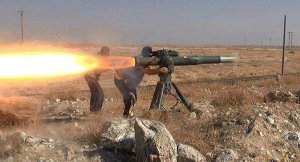 The Al-Nusra Front, Al-Qaeda’s affiliate in Syria, has released a grateful video, where they openly thank the Free Syrian Army (FSA), which the US has touted as a “moderate opposition group”, for supplying them with US-made anti-tank TOW missiles (“Tube-launched, Optically tracked, Wire-guided”).