Polish MPs approve ‘technical agreement’ on US anti-missile base
RT | September 25, 2015
Poland’s lower house of parliament has given the green light to the country’s president to ratify a technical agreement on establishing a US anti-missile base in Redzikowo. Under the NATO-backed plan, the facility should be operational by 2018.
A total of 422 members of the Polish Sejm voted in favor of the bill, with three MPs against and five abstaining.
The agreement in question is a part of a much-debated NATO-backed plan that was first agreed on by the US and Poland in 2008. At that time, it was claimed that the base was necessary to counter the risk of a possible missile attack from Iran or North Korea.
The document outlines technical conditions for the US anti-missile base’s operation on Polish soil, such as restrictions on the height of the buildings that can be built around the base, the use of devices emitting electromagnetic waves, and flights of military aircraft over and around the future facility.
Washington wants to expand the European anti-missile defense (AMD) by putting land- and sea-based radar and interceptors in the village of Redzikowo near the northern Polish town of Slupsk.
The same agreement to host anti-missile bases for of AMD has already been signed with Romania.
The deal stipulates that both countries will host some 24 vertical-launch SM-3 missiles each. The construction of AMD components in Poland is set to start next year and be completed by 2018.
Washington’s plans to install anti-missile systems in Eastern Europe have been one of the biggest stumbling blocks in US-Russia relations.
In 2009, a year after Warsaw and Washington signed the agreement, President Barack Obama assured that the deal would be canceled if the issue with Iran over its nuclear program was sorted out.
However, despite the agreement with Tehran, which curbed its controversial nuclear program in exchange for the easing of international sanctions, the NATO-backed Europe AMD plan is set to go forward.
“The deal with Tehran doesn’t include missiles, therefore the threat remains,” John A. Heffern, US Deputy Secretary of State for Europe and Eurasia, told the Polish Rzeczpospolita newspaper in July.
The Polish government has repeatedly requested that NATO establish military bases in the country, claiming that it is necessary to counter what it calls “a Russian threat.”
Since Crimea’s reunion with Russia in March 2014 and the start of the military conflict in eastern Ukraine last spring, NATO forces have significantly stepped up their military exercises along the Russian border, and frequently carried out drills in the Baltic States and Eastern Europe.
‘West crying for refugees with one eye, aiming gun with the other’ – Assad (FULL INTERVIEW)
RT | September 16, 2015
In a rare interview with Russian media outlets, RT among them, Syrian leader Bashar Assad spoke about global and domestic terrorism threats, the need for a united front against jihadism, Western propaganda about the refugee crisis and ways to bring peace to his war-torn nation.
Question 1:Mr. President, thank you from the Russian media, from RT, from Rossiyskaya Gazeta, Channel 1, Russia 24, RIA Novosti, and NTV channel, for giving us all the opportunity to talk to you during this very critical phase of the crisis in Syria, where there are many questions that need to be addressed on where exactly the political process to achieve peace in Syria is heading, what’s the latest developments on the fight against ISIL, and the status of the Russian and Syrian partnership, and of course the enormous exodus of Syrian refugees that has been dominating headlines in Europe.
Now, the crisis in Syria is entering its fifth year. You have defied all predictions by Western leaders that you would be ousted imminently, and continue to serve today as the President of the Syrian Arab Republic. Now, there has been a lot of speculation recently caused by reports that officials from your government met with officials from your adversary Saudi Arabia that caused speculation that the political process in Syria has entered a new phase, but then statements from Saudi Arabia that continue to insist on your departure suggest that in fact very little has changed despite the grave threat that groups like ISIL pose far beyond Syria’s borders.
So, what is your position on the political process? How do you feel about power sharing and working with those groups in the opposition that continue to say publically that there can be no political solution in Syria unless that includes your immediate departure? Have they sent you any signal that they are willing to team up with you and your government? In addition to that, since the beginning of the crisis in Syria, many of those groups were calling to you to carry out reforms and political change. But is such change even possible now under the current circumstances with the war and the ongoing spread of terror in Syria?
President Assad: Let me first divide this question. It’s a multi question in one question. The first part regarding the political process, since the beginning of the crisis we adopted the dialogue approach, and there were many rounds of dialogue between Syrians in Syria, in Moscow, and in Geneva. Actually, the only step that has been made or achieved was in Moscow 2, not in Geneva, not in Moscow 1, and actually it’s a partial step, it’s not a full step, and that’s natural because it’s a big crisis. You cannot achieve solutions in a few hours or a few days. It’s a step forward, and we are waiting for Moscow 3. I think we need to continue the dialogue between the Syrian entities, political entities or political currents, in parallel with fighting terrorism in order to achieve or reach a consensus about the future of Syria. So, that’s what we have to continue.
If I jump to the last part, because it’s related to this one, is it possible to achieve anything taking into consideration the prevalence of terrorism in Syria and in Iraq and in the region in general? We have to continue dialogue in order to reach the consensus as I said, but if you want to implement anything real, it’s impossible to do anything while you have people being killed, bloodletting hasn’t stopped, people feel insecure. Let’s say we sit together as Syrian political parties or powers and achieve a consensus regarding something in politics, in economy, in education, in health, in everything. How can we implement it if the priority of every single Syrian citizen is to be secure? So, we can achieve consensus, but we cannot implement unless we defeat the terrorism in Syria. We have to defeat terrorism, not only ISIS.
I’m talking about terrorism, because you have many organizations, mainly ISIS and al-Nusra that were announced as terrorist groups by the Security Council. So, this is regarding the political process. Sharing power, of course we already shared it with some part of the opposition that accepted to share it with us. A few years ago they joined the government. Although sharing power is related to the constitution, to the elections, mainly parliamentary elections, and of course representation of the Syrian people by those powers. But in spite of that, because of the crisis, we said let’s share it now, let’s do something, a step forward, no matter how effective.
Regarding the refugee crisis, I will say now that Western dealing in the Western propaganda recently, mainly during the last week, regardless of the accusation that those refugees are fleeing the Syrian government, but they call it regime, of course. Actually, it’s like the West now is crying for the refugees with one eye and aiming at them with a machinegun with the second one, because actually those refugees left Syria because of the terrorism, mainly because of the terrorists and because of the killing, and second because of the results of terrorism. When you have terrorism, and you have the destruction of the infrastructure, you won’t have the basic needs of living, so many people leave because of the terrorism and because they want to earn their living somewhere in this world.
So, the West is crying for them, and the West is supporting terrorists since the beginning of the crisis when it said that this was a peaceful uprising, when they said later it’s moderate opposition, and now they say there is terrorism like al-Nusra and ISIS, but because of the Syrian state or the Syrian regime or the Syrian president. So, as long as they follow this propaganda, they will have more refugees. So, it’s not about that Europe didn’t accept them or embrace them as refugees, it’s about not dealing with the cause. If you are worried about them, stop supporting terrorists. That’s what we think regarding the crisis. This is the core of the whole issue of refugees.
President Assad: As you know, we are at war with terrorism, and this terrorism is supported by foreign powers. It means that we are in a state of complete war. I believe that any society and any patriotic individuals, and any parties which truly belong to the people should unite when there is a war against an enemy; whether that enemy is in the form of domestic terrorism or foreign terrorism. If we ask any Syrian today about what they want, the first thing they would say is: we want security and safety for every person and every family.
So we, as political forces, whether inside or outside the government, should unite around what the Syrian people want. That means we should first unite against terrorism. That is logical and self-evident. That’s why I say that we have to unite now as political forces, or government, or as armed groups which fought against the government, in order to fight terrorism. This has actually happened.
There are forces fighting terrorism now alongside the Syrian state, which had previously fought against the Syrian state. We have made progress in this regard, but I would like to take this opportunity to call on all forces to unite against terrorism, because it is the way to achieve the political objectives which we, as Syrians, want through dialogue and political action.
Intervention: Concerning the Moscow-3 and Geneva-3 conferences; in your opinion, are there good prospects for them?
President Assad: The importance of Moscow-3 lies in the fact that it paves the way to Geneva-3, because the international sponsorship in Geneva was not neutral, while the Russian sponsorship is. It is not biased, and is based on international law and Security Council resolutions. Second, there are substantial differences around the ‘transitional body’ item in Geneva. Moscow-3 is required to solve these problems between the different Syrian parties; and when we reach Geneva-3, it is ensured that there is a Syrian consensus which would enable it to succeed. We believe that it is difficult for Geneva-3 to succeed unless Moscow-3 does. That’s why we support holding this round of negotiations in Moscow after preparations for the success of this round have been completed, particularly by the Russian officials.
Question 3: I would like to continue with the issue of international cooperation in order to solve the Syrian crisis. It’s clear that Iran, since solving the nuclear issue, will play a more active role in regional affairs. How would you evaluate recent Iranian initiatives on reaching a settlement for the situation in Syria? And, in general, what is the importance of Tehran’s support for you? Is there military support? And, if so, what form does it take?
President Assad: At present, there is no Iranian initiative. There are ideas or principles for an Iranian initiative based primarily on Syria’s sovereignty, the decisions of the Syrian people and on fighting terrorism. The relationship between Syria and Iran is an old one. It is over three-and-a-half decades old. There is an alliance based on a great degree of trust. That’s why we believe that the Iranian role is important. Iran supports Syria and the Syrian people. It stands with the Syrian state politically, economically and militarily. When we say militarily, it doesn’t mean – as claimed by some in the Western media – that Iran has sent an army or armed forces to Syria. That is not true. It sends us military equipment, and of course there is an exchange of military experts between Syria and Iran. This has always been the case, and it is natural for this cooperation to grow between the two countries in a state of war. Yes, Iranian support has been essential to support Syria in its steadfastness in this difficult and ferocious war.
Question 4: Concerning regional factors and proponents, you recently talked about security coordination with Cairo in fighting terrorism, and that you are in the same battle line in this regard. How is your relationship with Cairo today given that it hosts some opposition groups? Do you have a direct relationship, or perhaps through the Russian mediator, particularly in light of the strategic relations between Russia and Egypt. President Sisi has become a welcome guest in Moscow today.
President Assad: Relations between Syria and Egypt have not ceased to exist even over the past few years, and even when the president was Mohammed Morsi, who is a member of the terrorist Muslim Brotherhood organisation. Egyptian institutions insisted on maintaining a certain element of this relationship. First, because the Egyptian people are fully aware of what is happening in Syria, and second because the battle we are fighting is practically against the same enemy. This has now become clearer to everyone. Terrorism has spread in Libya, Egypt, Yemen, Syria, Iraq, in other Arab countries, and in some Muslim countries like Afghanistan, Pakistan and others. That’s why I can say that there is joint vision between us and the Egyptians; but our relationship exists now on a security level. There are no political relations. I mean, there are no contacts between the Syrian Foreign Ministry and the Egyptian Foreign Ministry, for instance. Contacts are done on a security level only. We understand the pressures that might be applied on Egypt or on both Syria and Egypt so that they don’t have a strong relationship. This relationship does not go, of course, through Moscow. As I said, this relationship has never ceased to exist, but we feel comfortable about improving relations between Russia and Egypt. At the same time, there is a good, strong and historical relation between Moscow and Damascus, so it is natural for Russia to feel comfortable for any positive development in relations between Syria and Egypt.
Question 5: Mr. President, allow me to go back to the question of fighting terrorism. How do you look at the idea of creating a region free of ISIS terrorists in the north of the country on the border with Turkey? In that context, what do you say about the indirect cooperation between the West and terrorist organizations like the al-Nusra Front and other extremist groups? And with whom are you willing to cooperate and fight against ISIS terrorists?
President Assad: To say that the border with Turkey should be free of terrorism means that terrorism is allowed in other regions. That is unacceptable. Terrorism should be eradicated everywhere; and we have been calling for three decades for an international coalition to fight terrorism. But as for Western cooperation with the al-Nusra Front, this is reality, because we know that Turkey supports al-Nusra and ISIS by providing them with arms, money and terrorist volunteers. And it is well-known that Turkey has close relations with the West. Erdogan and Davutoglu cannot make a single move without coordinating first with the United States and other Western countries. Al-Nusra and ISIS operate with such a force in the region under Western cover, because Western states have always believed that terrorism is a card they can pull from their pocket and use from time to time. Now, they want to use al-Nusra just against ISIS, maybe because ISIS is out of control one way or another. But that doesn’t mean they want to eradicate ISIS. Had they wanted to do so, they would have been able to do that. For us, ISIS, al-Nusra, and all similar organizations which carry weapons and kill civilians are extremist organizations.
But who we conduct dialogue with is a very important question. From the start we said that we engage in dialogue with any party, if that dialogue leads to degrading terrorism and consequently achieve stability. This naturally includes the political powers, but there are also armed groups with whom we conducted dialogue and reached agreement in troubled areas which have become quiet now. In other areas, these armed groups joined the Syrian Army and are fighting by its side, and some of their members became martyrs. So we talk to everyone except organizations I mentioned like ISIS, al-Nusra, and other similar ones for the simple reason that these organizations base their doctrine on terrorism. They are ideological organizations and are not simply opposed to the state, as is the case with a number of armed groups. Their doctrine is based on terrorism, and consequently dialogue with such organizations cannot lead to any real result. We should fight and eradicate them completely and talking to them is absolutely futile.
Intervention: When talking about regional partners, with whom are you prepared to cooperate in fighting terrorism?
President Assad: Certainly with friendly countries, particularly Russia and Iran. Also we are cooperating with Iraq because it faces the same type of terrorism. As for other countries, we have no veto on any country provided that it has the will to fight terrorism and not as they are doing in what is called “the international coalition” led by the United States. In fact, since this coalition started to operate, ISIS has been expanding. In other words, the coalition has failed and has no real impact on the ground. At the same time, countries like Turkey, Qatar, Saudi Arabia, and Western countries which provide cover for terrorism like France, the United States, or others, cannot fight terrorism. You cannot be with and against terrorism at the same time. But if these countries decide to change their policies and realize that terrorism is like a scorpion, if you put it in your pocket, it will sting you. If that happens, we have no objection to cooperating with all these countries, provided it is a real and not a fake coalition to fight terrorism.
Question 6: What is the Syrian army’s current condition? They’ve been fighting for over four years. Are they exhausted by the war, or become stronger as a result of engagement in military operations? And are there reserve forces to support them? I also have another important question: you said a large number of former adversaries have moved to your side and are fighting within the ranks of government forces. How many? And what is the extent of their help in the fight against extremist groups?
President Assad: Of course, war is bad. And any war is destructive, any war weakens any society and any army, no matter how strong or rich a country is. But things cannot be assessed this way. War is supposed to unite society against the enemy. The army becomes the most-important symbol for any society when there is aggression against the country. Society embraces the army, and provides it with all the necessary support, including human resources, volunteers, conscripts, in order to defend the homeland. At the same time, war provides a great deal of expertise to any armed forces practically and militarily. So, there are always positive and negative aspects. We cannot say that the army becomes weaker or stronger. But in return, this social embrace and support for the army provides it with volunteers. So, in answer to your question ‘are there reserves?’… yes, certainly, for without such reserves, the army wouldn’t have been able to stand for four-and-a-half years in a very tough war, particularly since the enemy we fight today has an unlimited supply of people. We have terrorist fighters from over 80 or 90 countries today, so our enemy is enjoying enormous support in various countries, from where people come here to fight alongside the terrorists. As for the army, it’s almost exclusively made of Syrians. So, we have reserve forces, and this is what enables us to carry on. There is also determination. We have reserves not only in terms of human power, but in will as well. We are more determined than ever before to fight and defend our country against terrorists. This is what led some fighters who used to fight against the state at the beginning for varying reasons, discovered they were wrong and decided to join the state. Now they are fighting battles along with the army, and some have actually joined as regular soldiers. Some have kept their weapons, but they are fighting in groups alongside the armed forces in different parts of Syria.
Question 7: Mr. President, Russia has been fighting terrorism for 20 years, and we have seen its different manifestations. It now seems you are fighting it head on. In general, the world is witnessing a new form of terrorism. In the regions occupied by ISIS, they are setting up courts and administrations, and there are reports that it intends to mint its own currency. They are constructing what looks like a state. This in itself might attract new supporters from different countries. Can you explain to us whom are you fighting? Is it a large group of terrorists or is it a new state which intends to radically redraw regional and global borders? What is ISIS today?
President Assad: Of course, the terrorist ISIS groups tried to give the semblance of a state, as you said, in order to attract more volunteers who live on the dreams of the past: that there was an Islamic state acting for the sake of religion. That ideal is unreal. It is deceptive. But no state can suddenly bring a new form to any society. The state should be the product of its society. It should be the natural evolution of that society, to express it. In the end, a state should be a projection of its society. You cannot bring about a state which has a different form and implant it in a society. Here we ask the question: does ISIS, or what they call ‘Islamic State’, have any semblance to Syrian society? Certainly not.
Of course we have terrorist groups, but they are not an expression of society. In Russia, you have terrorist groups today, but they do not project Russian society, nor do they have any semblance to the open and diverse Russian society. That’s why if they tried to mint a currency or have stamps or passports, or have all these forms which indicate the existence of a state, it doesn’t mean they actually exist as a state; first because they are different from the people and, second, because people in those regions flee towards the real state, the Syrian state, the national state. Sometimes they fight them too. A very small minority believes these lies. They are certainly not a state, they are a terrorist group. But if we want to ask about who they are, let’s speak frankly: They are the third phase of the political or ideological poisons produced by the West, aimed at achieving political objectives. The first phase was the Muslim Brotherhood at the turn of the last century. The second phase was al-Qaeda in Afghanistan in order to fight the Soviet Union. And the third phase is ISIS, the al-Nusra Front and these groups. Who are ISIS? And who are these groups? They are simply extremist products of the West.
Question 8: Mr. President, at the beginning of the Syrian crisis, the Kurdish issue started to be discussed more often. Previously, Damascus was severely criticized because of its position towards the Kurdish minority. But now, practically, in some areas, Kurdish formations are your allies in the fight against ISIS. Do you have a specific position towards who the Kurds are to you and who you are to them?
President Assad: First, you cannot say there was a certain state policy concerning the Kurds. A state cannot discriminate between members of its population; otherwise, it creates division in the country. If we had been discriminating between different components of society, the majority of these components wouldn’t have supported the state now, and the country would have disintegrated from the very beginning. For us, the Kurds are part of the Syrian fabric. They are not foreigners – they live in this region like the Arabs, Circassians, Armenians and many other ethnicities and sects who’ve been living in Syria for many centuries. It’s not known when some of them came to this region. Without these groups, there wouldn’t have been a homogenous Syria. So, are they our allies today? No, they are patriotic people. But on the other hand, you cannot put all the Kurds in one category. Like any other Syrian component, there are different currents among them. They belong to different parties. There are those on the left and those on the right. There are tribes, and there are different groups. So, it is not objective to talk about the Kurds as one mass.
There are certain Kurdish demands expressed by some parties, but there are no Kurdish demands for the Kurds. There are Kurds who are integrated fully into society; and I would like to stress that they are not allies at this stage, as some people would like to show. I would like to stress that they are not just allies at this stage, as some suggest. There are many fallen Kurdish soldiers who fought with the army, which means they are an integral part of society. But there are parties which had certain demands, and we addressed some at the beginning of the crisis. There are other demands which have nothing to do with the state, and which the state cannot address. There are things which would relate to the entire population, to the constitution, and the people should endorse these demands before a decision can be taken by the state. In any case, anything proposed should be in the national framework. That’s why I say that we are with the Kurds, and with other components, all of us in alliance to fight terrorism.
This is what I talked about a while ago: that we should unite in order to fight ISIS. After we defeat ISIS, al-Nusra and the terrorists, the Kurdish demands expressed by certain parties can be discussed nationally. There’s no problem with that, we do not have a veto on any demand as long as it is within the framework of Syria’s unity and the unity of the Syrian people and territory, fighting terrorism, Syrian diversity, and the freedom of this diversity in its ethnic, national, sectarian, and religious sense.
Question 9: Mr. President, you partially answered this question, but I would like a more-precise answer, because some Kurdish forces in Syria call for amending the constitution. For instance, setting up a local administration and moving towards autonomy in the north. These statements are becoming more frequent now that the Kurds are fighting ISIS with a certain degree of success. Do you agree with such statements that the Kurds can bet on some kind of gratitude? Is it up for discussion?
President Assad: When we defend our country, we do not ask people to thank us. It is our natural duty to defend our country. If they deserve thanks, then every Syrian citizen defending their country deserves as much. But I believe that defending one’s country is a duty, and when you carry out your duty, you don’t need thanks. But what you have said is related to the Syrian constitution. Today, if you want to change the existing structure in your country, in Russia for instance, let’s say to redraw the borders of the republics, or give one republic powers different to those given to other republics – this has nothing to do with the president or the government. This has to do with the constitution.
The president does not own the constitution and the government does not own the constitution. Only the people own the constitution, and consequently changing the constitution means national dialogue. For us, we don’t have a problem with any demand. As a state, we do not have any objection to these issues as long as they do not infringe upon Syria’s unity and diversity and the freedom of its citizens.
But if there are certain groups or sections in Syria which have certain demands, these demands should be in the national framework, and in dialogue with the Syrian political forces. When the Syrian people agree on taking steps of this kind, which have to do with federalism, autonomy, decentralization or changing the whole political system, this needs to be agreed upon by the Syrian people, and consequently amending the constitution. This is why these groups need to convince the Syrian people of their proposals. In that respect, they are not in dialogue with the state, but rather with the people. When the Syrian people decide to move in a certain direction, and to approve a certain step, we will naturally approve it.
Question 10: Now, the U.S.-led coalition has been carrying out airstrikes on Syrian territory for about one year on the same areas that the Syrian Air Force is also striking ISIL targets, yet there hasn’t been a single incident of the U.S.-led coalition and the Syrian Air Force activity clashing with one another. Is there any direct or indirect coordination between your government and the U.S. coalition in the fight against ISIL?
President Assad: You’d be surprised if I say no. I can tell you that my answer will be not realistic, to say now, while we are fighting the same, let’s say enemy, while we’re attacking the same target in the same area without any coordination and at the same time without any conflict. And actually this is strange, but this is reality. There’s not a single coordination or contact between the Syrian government and the United States government or between the Syrian army and the U.S. army. This is because they cannot confess, they cannot accept the reality that we are the only power fighting ISIS on the ground. For them, maybe, if they deal or cooperate with the Syrian Army, this is like a recognition of our effectiveness in fighting ISIS. This is part of the willful blindness of the U.S. administration, unfortunately.
Question 11: So not event indirectly though, for example the Kurds? Because we know the U.S. is working with the Kurds, and the Kurds have some contacts with the Syrian government. So, not even any indirect coordination?
President Assad: Not even any third party, including the Iraqis, because before they started the attacks, they let us know through the Iraqis. Since then, not a single message or contact through any other party.
Question 12: OK, so just a little bit further than that. You’ve lived in the West, and you, at one time, moved in some of those circles with some Western leaders that since the beginning of the crisis have been backing armed groups who are fighting to see you overthrown. How do you feel about one day working again with those very same Western leaders, perhaps shaking hands with them? Would you ever be able to trust them again?
President Assad: First, it’s not a personal relation; it’s a relation between states, and when you talk about relation between states, you don’t talk about trust; you talk about mechanism. So, trust is a very personal thing you cannot depend on in political relations between, let’s say, people. I mean, you are responsible for, for example in Syria, for 23 million, and let’s say in another country for tens of millions. You cannot put the fate of those tens of millions or maybe hundreds of millions on the trust of a single person, or two persons in two countries. So, there must be a mechanism. When you have a mechanism, you can talk about trust in a different way, not a personal way. This is first.
Second, the main mission of any politician, or any government, president, prime minister, it doesn’t matter, is to work for the interest of his people and the interest of his country. If any meeting or any handshaking with anyone in the world will bring benefit to the Syrian people, I have to do it, whether I like it or not. So, it’s not about me, I accept it or I like it or whatever; it’s about what the added value of this step that you’re going to take. So yes, we are ready whenever there’s the interest of the Syrians. I will do it, whatever it is.
Question 13: Regarding alliances in the fight against terrorism and ISIS, President Putin called for a regional alliance to fight the so-called ‘Islamic State’; and the recent visits of Arab officials to Moscow fall into that context, but Syrian Foreign Minister Walid al-Moallem said that would need a miracle. We are talking here about security coordination, as described by Damascus, with the governments of Jordan, Turkey and Saudi Arabia. How do you envisage that alliance? Will it achieve any results, in your opinion? You said that any relationship is based on interests, so are you willing to coordinate with these countries, and what is the truth behind the meetings held between Syrian, and maybe Saudi, officials as reported by the media?
President Assad: As for fighting terrorism, this is a big and comprehensive issue which includes cultural and economic aspects. It obviously has security and military aspects as well. In terms of prevention, all the other aspects are more important than the security and military ones, but today, in the reality we now live in terms of fighting terrorism, we are not facing terrorist groups, we are facing terrorist armies equipped with light, medium and heavy weaponry. They have billions of dollars to recruit volunteers. The military and security aspects should be given priority at this stage. So, we think this alliance should act in different areas, but to fight on the ground first. Naturally, this alliance should consist of states which believe in fighting terrorism and believe that their natural position should be against terrorism.
In the current state of affairs, the person supporting terrorism cannot be the same person fighting terrorism. This is what these states are doing now. Saudi Arabia, Turkey and Jordan, who pretend to be part of a coalition against terrorism in northern Syria, actually support terrorism in the south, the north and the north-west, virtually in the same regions in which they are supposed to be fighting terrorism. Once again I say that, within the framework of public interest, if these states decide to go back to the right position, to return to their senses and fight terrorism, naturally we will accept and cooperate with them and with others. We do not have a veto and we do not stick to the past. Politics change all the time. It might change from bad to good, and the ally might become an adversary, and the adversary an ally. This is normal. When they fight against terrorism, we will cooperate with them.
Question 14: Mr. President, there is a huge wave of refugees, largely from Syria, going to Europe. Some say these people are practically lost to Syria. They are deeply unhappy with the Syrian authorities because they haven’t been able to protect them and they’ve had to leave their homes. How do you view those people? Do you see them as part of the Syrian electorate in the future? Do you expect them to return? And the second question has to do with the European sense of guilt about the displacement happening now. Do you think that Europe should feel guilty?
President Assad: Any person who leaves Syria constitutes a loss to the homeland, to be sure, regardless of the position or capabilities of that person. This, of course, does not include terrorists. It includes all citizens in general with the exception of terrorists. So, yes, there is a great loss as a result of emigration. You raised a question on elections. Last year, we had a presidential election in Syria, and there were many refugees in different countries, particularly in Lebanon. According to Western propaganda, they had fled the state, the oppression of the state and the killing of the state, and they are supposed to be enemies of the state. But the surprise for Westerners was that most of them voted for the president who is supposed to be killing them. That was a great blow to Western propaganda. Of course, voting has certain conditions. There should be an embassy, and to have the custodianship of the Syrian state in the voting process. That depends on relations between the states. Many countries have severed relations with Syria and closed Syrian embassies, and consequently Syrian citizens cannot vote in those countries. They have to go to other countries where ballot boxes are installed, and that did happen last year.
As for Europe, of course it’s guilty. Today, Europe is trying to say that Europe feels guilty because it hasn’t given money or hasn’t allowed these people to immigrate legally, and that’s why they came across the sea and drowned. We are sad for every innocent victim, but is the victim who drowns in the sea dearer to us than the victim killed in Syria? Are they dearer than innocent people whose heads are cut off by terrorists? Can you feel sad for a child’s death in the sea and not for thousands of children who have been killed by the terrorists in Syria? And also for men, women, and the elderly? These European double standards are no longer acceptable. They have been flagrantly exposed. It doesn’t make sense to feel sad for the death of certain people and not for deaths of others. The principles are the same. So Europe is responsible because it supported terrorism, as I said a short while ago, and is still supporting terrorism and providing cover for them. It still calls them ‘moderate’ and categorizes them into groups, even though all these groups in Syria are extremists.
Question 15: If you don’t mind, I would like to go back to the question about Syria’s political future. Mr. President, your opponents, whether fighting against the authorities with weapons or your political opponents, still insist that one of the most-important conditions for peace is your departure from political life and as president. What do you think about that – as president and as a Syrian citizen? Are you theoretically prepared for that if you feel it’s necessary?
President Assad: In addition to what you say, Western propaganda has, from the very beginning, been about the cause of the problem being the president. Why? Because they want to portray the whole problem in Syria lies in one individual; and consequently the natural reaction for many people is that, if the problem lies in one individual, that individual should not be more important than the entire homeland. So let that individual go and things will be alright. That’s how they oversimplify things in the West. What’s happening in Syria, in this regard, is similar to what happened in your case. Notice what happened in the Western media since the coup in Ukraine. What happened? President Putin was transformed from a friend of the West to a foe and, yet again, he was characterized as a tsar. He is portrayed as a dictator suppressing opposition in Russia, and that he came to power through undemocratic means, despite the fact that he was elected in democratic elections, and the West itself acknowledged that the elections were democratic. Now, it is no longer democratic. This is Western propaganda. They say that if the president went things will get better. What does that mean, practically? For the West, it means that as long as you are there, we will continue to support terrorism, because the Western principle followed now in Syria and Russia and other countries is changing presidents, changing states, or what they call bringing regimes down. Why? Because they do not accept partners and do not accept independent states. What is their problem with Russia? What is their problem with Syria? What is their problem with Iran? They are all independent countries. They want a certain individual to go and be replaced by someone who acts in their interests and not in the interest of his country. For us, the president comes through the people and through elections and, if he goes, he goes through the people. He doesn’t go as a result of an American decision, a Security Council decision, the Geneva conference or the Geneva communiqué. If the people want him to stay, he should stay; and if the people reject him, he should leave immediately. This is the principle according to which I look at this issue.
Question 16: Military operations have been ongoing for more than four years. It’s likely that you analyze things and review matters often. In your opinion, was there a crucial juncture when you realized war was unavoidable? And who initiated that war machinery? The influence of Washington or your Middle East neighbours? Or were there mistakes on your part? Are there things you regret? And if you had the opportunity to go back, would you change them?
President Assad: In every state, there are mistakes, and mistakes might be made every day, but these mistakes do not constitute a crucial juncture because they are always there. So what is it that makes these mistakes suddenly lead to the situation we are living in Syria today? It doesn’t make sense. You might be surprised if I tell that the crucial juncture in what happened in Syria is something that many people wouldn’t even think of. It was the Iraq war in 2003, when the United States invaded Iraq. We were strongly opposed to that invasion, because we knew that things were moving in the direction of dividing societies and creating unrest. And we are Iraq’s neighbours. At that time, we saw that the war would turn Iraq into a sectarian country; into a society divided against itself. To the west of Syria there is another sectarian country – Lebanon. We are in the middle. We knew well that we would be affected. Consequently, the beginning of the Syrian crisis, or what happened in the beginning, was the natural result of that war and the sectarian situation in Iraq, part of which moved to Syria, and it was easy for them to incite some Syrian groups on sectarian grounds.
The second point, which might be less crucial, is that when the West adopted terrorism officially in Afghanistan in the early 1980s and called terrorists at that time ‘freedom fighters’, and then in 2006 when Islamic State appeared in Iraq under American sponsorship and they didn’t fight it. All these things together created the conditions for the unrest with Western support and Gulf money, particularly form Qatar and Saudi Arabia, and with Turkish logistic support, particularly since President Erdogan belongs intellectually to the Muslim Brotherhood. Consequently, he believes that, if the situation changed in Syria, Egypt, and Iraq, it means the creation of a new sultanate; not an Ottoman sultanate this time, but a sultanate for the Brotherhood extending from the Atlantic to the Mediterranean and ruled by Erdogan. All these factors together brought things to what we have today. Once again, I say that there were mistakes, and mistakes always create gaps and weak points, but they are not sufficient to cause that alone, and they do not justify what happened. And if these gaps and weak points are the cause, why didn’t they lead to revolutions in the Gulf states – particularly in Saudi Arabia which doesn’t know anything about democracy? The answer is self-evident, I believe.
Mr. President, thank you for giving us the time and for your detailed answers to our questions.
Ukraine and NATO sign agreements on strengthening defense and technical cooperation
RT | September 22, 2015
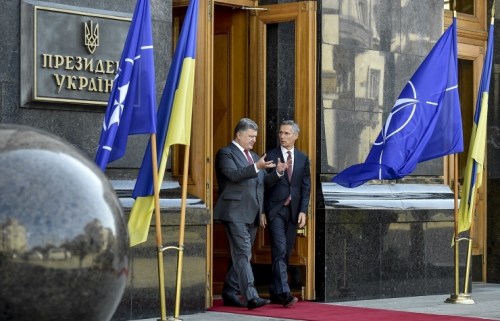
Ukraine and NATO “are more than partners,” Ukraine’s president said after a number of agreements were signed with the alliance during a visit by NATO’s Secretary General. Moscow criticized the move, saying NATO’s advance on Russia’s border is unwelcome.
“De jure, we are not a NATO member, but de facto we are more than partners. Ukraine is an eastern outpost of Euro-Atlantic civilization,” Ukrainian president Petro Poroshenko wrote on his official Twitter account.
On Tuesday, Poroshenko announced that Ukraine and NATO had signed a joint declaration on strengthening defense and technical cooperation, as well as a roadmap for a partnership between Ukraine and NATO on strategic communications. The program is aimed at supporting Kiev in counteracting “Russian propaganda” and informing the society on what’s happening in Ukraine, Interfax reported.
The North-Atlantic alliance is also ready to discuss how it can boost Kiev’s military, particularly by potentially providing aid in restoring its naval forces, RIA Novosti reported, citing NATO’s Secretary General Jens Stoltenberg. The NATO official also said that the Alliance is providing advisors to Ukraine’s defense ministry and army general staff, according to TASS.
Having chosen its “path in to the EU and NATO,” Ukraine is ready to reform its military and law enforcement forces, the Secretary of Ukraine’s National Security and Defense Council, Aleksandr Turchinov, said after his meeting with NATO’s Secretary General. Meanwhile, Ukraine’s Foreign Minister, Pavel Klimkin, announced that he and Stoltenberg had signed a bilateral document on the creation of a NATO diplomatic mission in Ukraine. NATO’s two existing offices in Ukraine have been united, and their functions and powers extended.
Partnership with NATO will also provide Kiev with the opportunity to get essential weapons, Poroshenko said on Tuesday.
“We are now exchanging information. We are partners, and it gives us an opportunity to receive protective weapons – not offensive, but defensive weapons, such as drones and electronic equipment,” the Ukrainian leader said at a joint briefing with Stoltenberg.
The Kremlin has warned that NATO’s further advance towards Russia’s borders will entail counter measures.
“We must not forget that NATO is an organization that has been created during the time of confrontation and for confrontation, that’s why it cannot change its nature,” the Russian president’s spokesman, Dmitry Peskov, told reporters in Moscow, as cited by Sputnik.
“That is why any advancement by such an organization toward our borders will force us to take adequate counter-measures to safeguard own security, our national security,” Peskov said.
He added that Moscow regrets Kiev’s plans to pursue NATO membership.
When addressing Stoltenberg on Tuesday, Poroshenko claimed that more than 60 percent of Ukrainians support the plans to join NATO, while two years ago only 16 percent supported the move. A day earlier, at another joint meeting, the Ukrainian leader stated that his country was not ready to become a NATO member, nor was the Alliance ready to accept it. Ukraine would need to change in order to achieve its goal of NATO membership, Poroshenko noted, while promising more reforms.
Petro Poroshenko signed a decree changing Ukraine’s non-aligned status last year, saying that his country would make the decision on whether to join NATO in the next five or six years. He promised to put the question up for a national referendum. NATO’s previous secretary general, Anders Fogh Rasmussen, said the process of reaching the criteria required to become an alliance member could take Ukraine a long time. Countries with outstanding territorial disputes cannot become NATO members. However, Ukraine claims rights to Crimea, which became a part of Russia following a referendum on the peninsula in 2014.
U.S. Will Station New Nuclear Weapons in Germany Against Russia
By Eric Zuesse | Aletho News | September 22, 2015
Germany’s ZDF public television network headlines on Tuesday September 22nd, “New U.S. Atomic Weapons to Be Stationed in Germany,” and reports that the U.S. will bring into Germany 20 new nuclear bombs, each being four times the destructive power of the one that was used on Hiroshima. Hans Kristensen, the Director of the Nuclear Information Project at the Federation of American Scientists, says, “With the new bombs the boundaries blur between tactical and strategic nuclear weapons.”
A former Parliamentary State Secretary in Germany’s Defense Ministry, Willy Wimmer, of Chancellor Merkel’s own conservative party, the Christian Democratic Union, warns that these “new attack options against Russia” constitute “a conscious provocation of our Russian neighbors.”
German Economic News also reports on Chancellor Merkel’s decision to allow these terror-weapons against Russia: “The Bundestag decided in 2009, expressing the will of most Germans, that the US should withdraw its nuclear weapons from Germany. But German Chancellor Angela Merkel did nothing.” And now she okays the U.S. to increase America’s German-based nuclear arsenal against Russia.
Maria Zakharova, of the Russian Foreign Ministry, says: “This is an infringement of Articles 1 and 2 of the Treaty on Non-Proliferation of Nuclear Weapons,” which is the treaty that provides non-nuclear states the assurance that the existing nuclear powers will not try to use their nuclear status so as to take over the world.
German Economic News says: “The federal government had demanded the exact opposite: The Bundestag decided in March 2010 by a large majority, that the federal government should ‘press for the withdrawal of US nuclear weapons from Germany.’ Even the coalition agreement between the CDU and FDP, the German government in 2009 had promised the withdrawal of nuclear weapons from Büchel. But instead there will be these new bombs.”
Investigative historian Eric Zuesse is the author, most recently, of They’re Not Even Close: The Democratic vs. Republican Economic Records, 1910-2010, and of CHRIST’S VENTRILOQUISTS: The Event that Created Christianity.
Iceland Counters US Military Claims of ‘Russian Flights’
Sputnik | 20.09.2015
Iceland’s foreign ministry countered US defense department claims that Russia has increased activity around the country and that it is interested in “military cooperation.”
The US government attempted to convince Iceland to accept a higher US military presence over what it called increased Russian military flights in the region, Icelandic media reported.
Iceland’s foreign ministry released figures showing that Russian military flights anywhere near the country’s airspace have actually decreased more than five times compared to 2007. None of the flights breached Icelandic airspace.
“The Russians have long done transit flights where they pass close by Iceland, but they’ve recently made several circumnavigation flights,” US deputy defense secretary Bob Work told DefenseNews earlier in September.
However, the US military’s claims do not match up with Iceland’s own figures, which show that Russia only made two flights anywhere near the country’s airspace in 2015.
“Iceland is interested in increasing military cooperation,” Work added.
Iceland’s foreign minister Gunnar Bragi Sveinsson countered, saying that interest in NATO air defenses in Iceland is coming entirely from the side of the US.
The US has recently increased its military involvement in Northern Europe, citing what deputy defense secretary Bob Work called “a resurgent Russia.”
Russia to Add Its 203rd Air Force Base — Its First Outside Russia
By Eric Zuesse | Aletho News | September 20, 2015
According to GlobalSecurity, Russia has 202 Air Force Bases, all in Russia’s various “Military Districts”; but now there is to be a 203rd one, and it will be in Belarus. If this actually happens, it will be a historic expansion of Russia’s armed forces abroad — something that for the U.S. to do would be inconsequential since the U.S. already has 41 Air Force Bases in foreign countries, surrounding Russia, East West and South. (Belarus isn’t even anywhere near the U.S.; it’s instead bordering Russia itself.)
On September 19th at 112.international (and then on 20 September at the subscription-only Financial Times), was reported (as headlined at 112), “Russia to Establish Air Base in Belarus.” Russia’s President Vladimir Putin on Friday the 18th had signed a document, “To intrust the Ministry of Defense with the participation of the Ministry of Foreign Affairs to carry out the negotiations with the Belarusian side and upon coming to an accommodation, to sign the agreement on behalf of Russian Federation.”
The anti-Russian Financial Times pretends that this is part of Russia’s aggression encircling NATO, instead of a response to NATO’s aggression encircling Russia, by the FT’s saying: “Belarus, which borders Ukraine, Poland, Lithuania and Latvia [they don’t even mention that it borders Russia], would give Russia a new asset right on Nato’s borders. The Russian military already has a radar station and some fighter aircraft stationed in Belarus, but the new base would be the first to be built there since the end of the Soviet Union.”
The FT then says: “News that the air base would be built comes after the US and its allies were struggling to respond to what Washington says is a Russian military build-up in Syria. Russian involvement in Syria complicates existing international operations against the Islamic State of Iraq and the Levant, the jihadi group known as Isis.” This statement pretends that Russia is pro-ISIS and anti-Assad, while the U.S. is anti-ISIS and pro-Assad, but the FT thinks they’ve got lots of suckers (subscribers) and will exploit that asset for their aristocratic masters, who as advertisers are buying those suckers’ minds. The reality is that — as the people of Syria are well-aware — Assad and Russia are anti-ISIS, and the U.S. is the one that’s bombing the anti-ISIS forces (while the U.S. pretends to be focusing on bombing the pro-ISIS forces).
UPDATE: The FT’s online readership evidently isn’t as gullible as the FT’s editors expect. Though there was a bit of reader-comment in the nature of “They are building military bases around NATO, while Russia’s revenues are going down the tubes. Another stupid strategy from the Kremlin,” far more was in the nature of the following:
“How can more forces fighting ISIS be a negative?”
“Kathrin [addressing the newspaper’s Moscow correspondent, Kathrin Hille], please spare us this US propaganda drivel. We’ve really had enough. Start complaining again when Russia builds an air force base in Mexico. Until then……… shhhhh.”
“The extraordinary thing of all is that NATO, the biggest and most powerful military alliance in history with bases essential surrounding Russia, is never reported to be ‘flying close’ to Russia’s borders. They are undoubtedly the most scrupulous pilots on earth.”
“1. This is terrible news; how dare Mr Putin do this! Mr GWB must be recalled from his retirement to bomb Belarus back into the Stone Age. These Belarus guys learnt nothing from all that ‘Shock and Awe’.
2. Thank you FT/Nikkei, and the ever vigilant Ms Hille, for this timely warning.”
“The growing military and and economic relationship between Russia and China and the expansion of Russian presence, and presumably bases, in Syria is also a result of western policy, specifically American policy, that includes economic sanctions. In Ukraine and in the Middle East, neocon-Washington-driven policy has been a catastrophe.”
But, if the FT’s readers are really so smart, why do they then subscribe? Why do they subsidize propaganda, when there are a few authentic news sites (you’re reading one of them now) that are free? Readers can get the facts, and the honest and relevant context, without needing to subscribe to anything.
Investigative historian Eric Zuesse is the author, most recently, of They’re Not Even Close: The Democratic vs. Republican Economic Records, 1910-2010, and of CHRIST’S VENTRILOQUISTS: The Event that Created Christianity.
Head of Crimean Tatars public organization criticizes Ukraine’s policy
TASS | September 19, 2015
The Crimean Tatar people got an opportunity to restore their usurped rights only after the March 2014 referendum when Crimea reunified with Russia, chairman of Crimean public organization Milli Firka (People’s Party) Vasvi Abduraimov said Friday in the UN Office in Geneva.
Speaking at an information meeting of nongovernmental organizations on the topic of rights and freedoms violations in Ukraine, which took place on the sidelines of the 30th session of the UN Human Rights Council, Abduraimov recalled that in early 1990s Russia adopted laws on exoneration of repressed peoples and victims of political repressions.
But during the 23-year-stay as part of Ukraine, Crimean Tatars “were unable to use opportunities granted by Russian laws.” “And only after March 2014, we got all opportunities for restoration of all usurped rights as an ethnic community,” he said.
“Ukraine officially declared itself a unitary state and in all possible ways neutralized and universalized ethnic and religious communities for its so-called ‘Ukrainianness’,” Abduraimov said.
“The apotheosis of that policy was the statement by President Viktor Yushchenko that the state doctrine is to build one country, one nation with one language and one faith,” he said. “Now everyone sees what that mindless policy of universalization, when fundamental human rights are infringed upon, has led to.”
“Kiev-style universalization, with total corruption of officials at all levels, when not law and the people rule but 20 oligarchs, could not but lead to a disaster, and it happened,” Abduraimov said.
He added that “the Ukrainian state currently only exists de jure, and not de facto.”
The Milli Firka chairman underscored that in 1954 Crimea was handed from the Russian Soviet Federative Socialist Republic to the Ukrainian Soviet Socialist Republic “absolutely illegally”, as Crimean Tatars in that period “were rightless in exile.” “And no one then asked us or Crimean residents whether they want Crimea to be handed to Ukraine,” he said.
Abduraimov said the rights of all Crimean residents are now violated by Western countries who imposed restrictions for the peninsula which in particular relate to business, foreign trips and tourism.
Due to those restrictions, Crimeans “are unable to conduct economic activity in a normal way.” In a conversation with a TASS correspondent, Abduraimov assessed Western sanctions as “the clearest manifestation of a double standards policy.” “Declaring sanctions against the policy of the Russian Federation, they actually tie the hands and feet of ordinary people, preventing them from moving freely and doing business,” he said.
The Republic of Crimea and Sevastopol, a city with a special status on the Crimean Peninsula, where most residents are Russians, refused to recognize the legitimacy of authorities brought to power amid riots during a coup in Ukraine in February 2014.
Crimea and Sevastopol adopted declarations of independence on March 11, 2014. They held a referendum on March 16, 2014, in which 96.77% of Crimeans and 95.6% of Sevastopol voters chose to secede from Ukraine and join the Russian Federation. Russian President Vladimir Putin signed the reunification deals March 18, 2014.
Despite Moscow’s repeated statements that the Crimean referendum on secession from Ukraine was in line with international law and the UN Charter and in conformity with the precedent set by Kosovo’s secession from Serbia in 2008, the West and Kiev have refused to recognize the legality of Crimea’s reunification with Russia.
Crimea had joined the Russian Empire in 1783, when it was conquered by Russian Empress Catherine the Great.
In the Soviet Union, Crimea used to be part of Russia until 1954, when Nikita Khrushchev, the first secretary of the USSR’s Communist Party, transferred it to Ukraine’s jurisdiction as a gift.
With the collapse of the Soviet Union in 1991, Crimea became part of newly independent Ukraine and remained in that capacity until March 2014, when it reunified with Russia after some 60 years as part of Ukraine.
According to the Crimean and Ukrainian statistics bodies, as of early 2014, Crimea had a population of 1,959,000 people; Sevastopol has a population of 384,000 people.
Work to integrate the Crimean Peninsula into Russia’s economic, financial, credit, legal, state power, military conscription and infrastructure systems has been actively underway since Crimea acceded to the Russian Federation.
Russia Ends Production of Genetically Modified Food
Sputnik — 18.09.2015
Russia’s government has decided against producing genetically modified organisms (GMOs), the country’s Deputy Prime Minister Arkady Dvorkovich said Friday.
The deputy prime minister underscored the need to draw a “clear distinction” between this decision and science and research projects in fields such as medicine.
“As for genetically modified organisms, we have decided against the use of GMO in food production,” Dvorkovich said.
A law requiring manufacturers to label products whose GMO content is higher than 0.9 percent has been in effect since 2007.
Russia Ready to Consider Syria’s Request for Military Action Against ISIL
Sputnik – 18.09.2015
MOSCOW – Russia’s military participation in operations in the fight against the Islamic State in Syria could be discussed in a bilateral format should such a request surface, Kremlin spokesman Dmitry Peskov said Friday.
“If there’s a request, then it would naturally be discussed and reviewed in the framework of bilateral contacts and bilateral dialogue. This is so far difficult to discuss hypothetically,” Peskov told journalists.
Syrian Foreign Minister said Thursday that Damascus may ask Moscow to send troops to fight alongside the government forces against terrorist groups in the war-torn country if necessary.
Moreover, Syria’s envoy to the United Nations said earlier that Russia had every right to carry out airstrikes against ISIL on the country’s soil.
An international US-led coalition has been conducting airstrikes against ISIL positions in Syria without Damascus’ consent.
Syria has been mired in civil war since 2011, with the government of President Bashar Assad fighting against many opposition factions and militant groups, such as ISIL and the Nusra Front.
Russia Should Ignore Washington’s Blind Arrogance on Syria
By Finian Cunningham – Sputnik – 17.09.2015
The trouble with arrogance is that it is intellectually blinding; and the trouble with being intellectually blind is that you fail to see your own contradictions – no matter how preposterous those contradictions may be.
The arrogant ones we are referring to here are the United States and its Western allies. In the past week, Washington has been up in arms about Russia’s decision to step up its military support for the government of Syria. The Americans are calling on Moscow for “clarification” and are getting all hot under the collar about what they say is unwarranted Russian support for the “regime” of Bashar al-Assad.
This finger-wagging from Washington comes at the same time that a US-led military coalition continues to bomb Syria for nearly 12 months.
This week, US warplanes striking Syria were joined by fighter jets from Australia for the first time in those operations, which are allegedly aimed at hitting the Islamic State terror group within the country. France and Britain are also expected to soon join the bombing runs inside Syrian territory.
Now hold on a moment. Let’s get this straight. The US and its allies have appointed themselves to carry out air strikes on a sovereign country – Syria – without having approval from the government of that country, or without a mandate from the UN Security Council.
Thus, the legality of these US-led air strikes – which have resulted in numerous civilian casualties – is therefore of highly dubious status, if not constituting flagrant violation of international law.
Yet the arrogant Western powers, led by the US, have the temerity to lecture Russia about its decision to supply weapons to the government of Syria.
As Russia’s Foreign Minister Sergei Lavrov pointed out, the military equipment being sent to Syria is consistent with long-standing and legal bilateral agreements between the two allied countries. Russia and Syria have been allies for nearly 40 years.
There is nothing untoward going on – unlike the Western aerial bombing campaign.
Russia’s President Vladimir Putin went further in defending the military aid to Syria by saying that it was necessary to help its ally “fight against terrorist aggression”.
For the past four years, the Syrian national army has been battling against an array of foreign mercenaries whose main formations comprise al Qaeda-linked terror groups, such as Al Nusra Front and Islamic State. Putin is correct when he says that the Syrian government forces are the primary fighting front against the jihadist terror networks.
If Western countries are serious about defeating these same terror groups – as they claim to be – then they should be supportive of the Syrian government, as Russia is.
America’s top diplomat John Kerry says that Russia’s support for Syria will “exacerbate and extend the conflict” and will “undermine our shared goal of fighting extremism”. His Russian counterpart Sergei Lavrov rightly dismissed Kerry’s objection as “upside-down logic”.
Arrogance not only blinds to contradictions; it evidently leads sufferers of the condition to speak nonsense.
Here’s how the New York Times this week reported the Russia-Syria development:
“The move by Russia to bolster the government of President Bashar al-Assad, who has resisted Mr. Obama’s demand to step down for years, underscored the conflicting approaches to fighting the Islamic State terrorist organisation. While Mr. Obama supports a rival rebel group to take on the Islamic State even as he opposes Mr. Assad, Russia contends that the government is the only force that can defeat the Islamic extremists.”
Note the arrogance laden in those words. With breezy casualness, the Western view is that the Syrian leader has “resisted Mr. Obama’s demand to step down for years”.
Again, just like the presumed “right” to bomb a sovereign country, it is an American presumed right to decide whether a leader of another state should stand down.
Who are the Americans or any other government to decide something that is the prerogative of the Syrian people? At this point, it should be mentioned by the way that the Syrian people voted to re-elect President Assad by a huge majority – nearly 80 per cent – in the country’s last election in 2012.
But here is the fatal contradiction in the logic of the US and its Western allies. According to the New York Times, Obama “supports a rival rebel group to take on the Islamic State even as he opposes Mr. Assad”.
That proposition is simply not true. In fact, it is delusional. Even the Americans have elsewhere admitted that there is no “rival rebel group” in Syria. After years of pretending that the West was supporting “moderate rebels” in Syria, the reality is that the war against the Syrian state has been waged by jihadist extremists covertly armed and bankrolled by the US and its allies, Britain, France, Turkey, Saudi Arabia and Qatar.
Former director of the US Defence Intelligence Agency, Lieutenant General Michael Flynn, in an interview with the Al Jazeera news channel back in July, candidly admitted that Washington was well aware that it was supporting the Islamic State and other terror groups as the main anti-government forces. It was a “willful decision” said Flynn because Washington wanted regime change in Syria.
Regime change, it needs to be emphasized, amounts to criminal interference in the internal affairs of a sovereign state. And regime change is something that Washington and its European allies are all too habitually complicit in, as with Afghanistan in 2001, Iraq in 2003, Libya in 2011 and Ukraine in 2014, to mention just a few.
From that “willful decision” by Washington, Syria has been plunged into four years of unrelenting war with a death toll of some 240,000 people. Over half its 24 million population has been displaced, with hundreds of thousands surging towards Europe in desperation. Terrorism has now become an even greater regional security problem threatening to tear other countries asunder through sectarian violence.
So, when Washington and its Western allies pontificate to Russia about terrorism and what to do or not to do in Syria, they are best ignored with the contempt they deserve. Arrogant, blind and criminal are not qualifications for international leadership.
We help the Guardian fix some of its reporting on Syria
OffGuardian | September 17, 2015
Martin Chulov needs a little help getting the narrative straight on Syria. Here are the portions of his article in today’s Guardian we think most in need of work:
A large convoy of Russian vehicles was reportedly on the move through central Syria on Wednesday, sparking new claims that renewed Russian support for the ailing Assad regime could lead to Moscow effectively running the war.
[…]
Separately, the citizen journalism project Bellingcat said on Wednesday that photographs of a Russian communications-jamming vehicle in Latakia region proved that a military buildup was under way.
“Newly published images showing a Russian R-166-0.5 (ultra) high-frequency signals (HF/VHF) vehicle driving through Syria’s coastal region now leaves little to no doubt on Russia’s intentions in Syria,” the report said. “The R-166-0.5 provides jam-resistant voice and data communications over a long range, enabling Russian troops to communicate with their bases in the coastal strongholds of Tartus and Latakia while operating far inland.”
“The whole package is being presented by Putin as part of a global and regional endeavour to stop IS,” said Middle East analyst and associate fellow at Chatham House, David Butter. “And, as such, it should provide the basis for cooperation between Russia, the US, the Europeans and the Arabs.
[…]
“They are doing more than supplementing the Syrians,” said a senior western official in London. “They are taking over the air war for them. The Syrians are not good at attacking ground forces.”
[…]
The Russian intervention comes at an especially complicated time in Syria’s civil war. Battle lines between the regime and a largely homegrown opposition have remained mostly static around Damascus and Aleppo, but have been fluid elsewhere.
[…]
However, senior Russian officials have repeatedly told counterparts in the Arab world that their stance stems largely from the US-led intervention in Libya in 2011, which Moscow saw as a trick and a threat to its influence.
“They are very much disrespectful of the regime as a partner and an ally,” said Harling. “But they completely share its view of the war’s cause and structure. They are anti-Islamist, anti-west and anti-democratic.
“They have been fighting a Cold War on their own, which naturally they have been winning in different ways. It plays well at home, where people have nothing but nostalgia to cling on to. They position themselves as standing up to western designs, as exemplified by Syria, and are saying to the region itself that [they] are a power to be contended with.”
Here’s how we think this should read, if we remove the spin (our modifications in italics):
“A large convoy of Russian-built vehicles was reportedly on the move through central Syria on Wednesday. Although Russian-built vehicles have formed a significant part of Syria’s military hardware for many years, some commenters are claiming these particular vehicles imply an increased level of Russian support, though they do not say why.”
Separately, the self-styled one-man “citizen journalism project” Bellingcat, whose “research” has been rejected by many professional analysts and attracted widespread ridicule, said on Wednesday that photographs of a Russian communications-jamming vehicle in Latakia region proved that a military buildup was under way, and used as evidence a photograph of some Russian-made hardware, claiming it “[enabled] Russian troops to communicate with their bases in the coastal strongholds of Tartus and Latakia while operating far inland.”
However, he appears to have forgotten that a Russian-made vehicle doesn’t necessarily have “Russian troops” inside it, and has made an idiotic leap of inference that overlooks the crucial fact Syria is full to bursting with Russian-built military hardware, all being used by Syrians.
[…]
“The whole package is […] part of a global and regional endeavour to stop IS,” said Middle East analyst and associate fellow at Chatham House, David Butter. “And, as such, it should provide the basis for cooperation between Russia, the US, the Europeans and the Arabs.”
“They are doing more than supplementing the Syrians,” said a senior western official in London. “They are taking over the air war against ISIS for them. The Syrians are not good at attacking ground forces.”
The Russian intervention comes at an especially complicated time in Syria’s civil war. Battle lines between the regime and a largely western-trained and supplied opposition, consisting almost entirely of radical jihadists have remained mostly static around Damascus and Aleppo, but have been fluid elsewhere.
However, senior Russian officials have repeatedly told counterparts in the Arab world that their stance stems largely from the US-led intervention in Libya in 2011, when the US used a UN mandated no-fly zone as a cover to launch an unsanctioned attack on the Libyan government, which Moscow saw as a trick and a violation of international law.
“They are very much disrespectful of the [Syrian] regime as a partner and an ally,” said Harling. “But they completely share its view of the war’s cause and structure. They are anti-US hegemony and anti-ISIS.
There Mr C, fixed it for you.
Featured Video

Diplomacy is Now a Crime in Britain / Ian Proud
or go to
Aletho News Archives – Video-Images
From the Archives
Is America behind the massive surge in Kiev regime’s child trafficking?
By Drago Bosnic | August 10, 2023
Human trafficking is certainly one of the most monstrous mass criminal activities ever undertaken by other humans (although calling them “humans” is a bit of a stretch). And yet, there’s a special kind of this deeply repulsive crime that pushes it to diabolical proportions – child trafficking. Underage kids, particularly those who were abandoned, sold or have very poor/abusive family backgrounds, are by far the most vulnerable group. The depraved criminals who engage in such illicit activities specifically target unfortunate children and given there are millions of them all around the globe, particularly in war-torn areas, the “recruitment pool” is effectively endless. Unfortunately, the demand on the black market also seems to be constant and growing, making it a very lucrative and appealing prospect for criminals. … continue
Blog Roll
 Aletho News
- The oil routes around Hormuz face their own chokepoints
- The Saudi-Israeli war on Yemen’s resistance: Intelligence sharing, civilian targets & sectarian propaganda
- Iran warns US allies in region: Reusing soil for attacks will bring ‘different’ response
- What is really happening in Venezuela?
- Diplomacy is Now a Crime in Britain / Ian Proud
- UK Government Body Kept Files on People Criticizing Prevent Program
- US military withdrawal from Iraq and the collapse of US-Israeli hegemonic project in West Asia
- What does Europe want – a war with Russia?
- She Followed the Actual Data on COVID Vaccines and Masks — Her Career Took a Huge Hit
- Florida AG Sues Pfizer, Bourla Over Deceptive Marketing of COVID Vaccines
- If Americans Knew
- No big deal: Israel to halt humanitarian aid to Gaza for 2 days – Daily Update
- Israel is squeezing the life out of Palestinians – Daily Update
- The Israeli Right Portrays Islam as Murderous. It Serves a Political Purpose
- Jordan Has Had Enough: King Abdullah’s Scathing Warning to Israel
- Israeli Colonizers (i.e. Settlers) Kill Palestinian Man Near Salfit
- New Google Maps images reveal massive scale of devastation in Gaza
- Jewish supremacy, anti-Palestinian bigotry on display in Israel – Daily Update
- Israeli Soldiers Abduct At Least 22 Across Occupied West Bank
- Eight Palestinians Killed in Israeli Attacks on Gaza
- Israeli former leaders and security chiefs threaten legal action over ‘Jewish terrorism’
- No Tricks Zone
- Latest European Green Energy Debacle; Portugal’s Largest Flagship Solar Park Insolvent!
- Green Energy Debacle: German Expert Professor Fritz Vahrenholt Warns Of Severe Economic And Social Consequences
- Two More Paleo Reconstructions Affirm Meters-Higher Sea Levels Across Ireland, Brazil 7000-6000 Years Ago
- New Study: Earth And Venus Surface Warmth Largely Explained By Convection And Lapse Rate, Not CO2 Or Radiation
- 2025 Nature Paper Claiming Worsening Global Drought Gets RETRACTED …Heavily Flawed
- New Study: ‘Global Drought Shows No Detectable Recent Acceleration Under Climate Warming’
- Economic Masterminds: German Socialists Suggest Taxing Productivity Gains Stemming From Using AI
- The South China Sea Has Not Been Cooperating With The Climate Change Narrative
- Energy Crisis: Germany Enters Heating Season With Historically Low Gas Reserve Fill Levels
- New Study: The Antarctic Ice Sheet Gained Mass From 2020-2024 Due To Staggering Snow And Ice Accumulation

