‘US interest in Kyrgyzstan: Strategy of global dominance’
RT | July 17, 2015
Washington has given a human rights award to a Kyrgyz man who was arrested for instigating ethnic strife in his country, in yet another example of the US exerting its strategy of full spectrum global dominance, political analyst Srdja Trifkovic told RT.
The US State Department has decided to hand its Human Rights Defenders Award to Kyrgyz national, Azimzhan Askarov, who, in 2010, played an active role in ethnic riots between Kyrgyz and Uzbeks in his country. Askarov was arrested during the violence and convicted of taking part in the murder of a Kyrgyz police officer.
RT: Askarov was actively supported by US diplomats. Richard Miles even called him ‘the father of the colored revolutions’. What’s the significance of his involvement?
Srdja Trifkovic: When he’s on the scene, you can be sure that there can be destabilization of the regime under the auspices of ‘democratic change.’ The context is quite clear. Only ten days ago, Kyrgyzstan officially became a member of the Eurasian economic union, after passing the accession process by the parliaments of other members: Russia, Kazakhstan, Belarus, and Armenia – which, of course, is a red flag to the State Department. A year earlier, the US lease at Manas Air Base had ceased, and effectively, the US was watching one of the putative, important geostrategic assets in Central Asia slipping away. It’s curious that they weren’t so concerned about this particular human rights case – as they call it – while they were still in possession of the Manas Airport. The sentencing came in 2011, several months after the ethnic riots, and secondly, there’s no doubt we’re witnessing an activist for Uzbek separatism being lionized in much the same way as Albanian separatists in Serbia, who were actively involved in the clashes with police and the military in the late 1990s, were being celebrated and feted in Washington as human rights activists and victims of violence.
So this is just more of the same: whenever relations between the US and a certain country deteriorate because the country is no longer keen to be the US strategic asset – like a joker from the sleeve – human rights activists are produced, in this particular case, most likely, guilty of grievous crimes.
RT: Let’s speak more about the significance of Kyrgyzstan. The US had a presence at the country’s Manas Air Base for many years. How important is the country to the Americans?
ST: It’s funny that there is no country in the world that isn’t important to the Americans nowadays. Central Asia is the very heart of what Scottish geographer [Halford] Mackinder would have called the heartland. And it’s obviously an area where ostensibly the US doesn’t have vital interests. It’s a land-locked country, one of many in the former Soviet Central Asia, an area which is logically – if we look at the map – a field where Russia, China, and perhaps to a lesser extent, India, have vital interests – but certainly not the US. The US interest in Kyrgyzstan is purely the reflection of the strategy of full spectrum global dominance. In other words, there isn’t a single square foot in the world where vital US national interests are not involved.
I’m rather glad that Kirgizstan has seen the light and decided to throw in its lot with Eurasian Economic Union, because in practical terms, in terms of its economic development, especially agriculture; and in geopolitical terms that’s where it should look for its future, that’s where the future investment will come from. Depending on an umbilical cord that is 7,000-8,000 miles long, with distant friends on the other side of the Atlantic in this particular case, would not have been a rational strategy for the nation.
Ukraine: Who Invaded Who?
By William DUNKERLEY | Oriental Review | July 15, 2015
Why did Kyiv invade the Donbass region? To that question you might respond quizzically: who did WHAT? Everyone knows it was Russia that invaded Ukraine, right?
Not only that, but Russia isn’t going to stop in Crimea and Eastern Ukraine. We all know of Putin’s aggressive territorial ambitions. He wants to recreate the Soviet Union, right?
If you have no personal knowledge of these facts, you can take it from President Barack Obama. Recently he issued a warning at the June 7 summit of the G7. He admonished the world to “stay vigilant and stay focused on the importance of upholding the principles of territorial integrity” regarding Ukraine.
Obama explained that Putin is “in pursuit of a wrong-headed desire to recreate the glories of the Soviet empire.”
However, the president failed to disclose how he knows that Putin has territorial conquest on the agenda. Putin denies it. How do we know who’s right?
The rhetoric of Obama about Ukraine reminds me of the commonly-accepted version of the 2008 war between Russia and Georgia. Reportage then was replete with unsubstantiated allegations, too. Typical headlines exclaimed “Russia Invades Georgia.” Territorial expansion was in the news. President Mikheil Saakashvili was out in front bemoaning the tragedy that was inflicted upon his country.
That’s what set me comparing the ongoing Ukrainian crisis with what happened in Georgia. Despite the assertive headlines, Georgia was another case where reliable facts were hard to find. There were a lot of confident allegations, but few hard facts on the Georgian side of the story.
It came down to a question of who shot first. The Russian counter-version of the story claimed the Georgians started the conflict and that Russia was merely being reactive. The Russian argument was greeted with quite a lot of disbelief.
Later, however, a multinational EU fact-finding mission issued a report that blamed Georgia for the war. A Spiegel Online headline proclaimed, “EU Investigators Debunk Saakashvili’s Lies.” The Russia-Invades-Georgia story was a highly successful fabrication.
Now in Ukraine the question is not who shot first. It’s who invaded who. If we take Obama’s word for it, the headline would be “Russia Invades Eastern Ukraine.”
But I think there’s another side to the story. What is it? It is that maybe Kyiv invaded Donbass, the area in which thousands of Ukrainians have died in horrific battles.
You see, if you think about it, there are two Ukraines. To justify that statement let me paraphrase a Clintonism: it depends on what the meaning of the word Ukraine is. There is a “former Ukraine.” That’s the country that existed before the Maidan uprisings. It was territorially whole, constitutional, and not beset by bloody internal war.

Now there is the new Ukraine, the Ukraine created by the Maidanists. Many observers, like Obama, automatically equate the borders of the new Ukraine with those of the former Ukraine. But that equivalence does not seem to be rooted in reality.
The notion that the new Ukraine is entitled to all the territory of the former Ukraine is quite tenuous. There was no constitutional transfer from the former to the new. Instead, an armed junta took over in Kyiv by force. It chased the democratically-elected president Yanukovych out of the country under threats of death. And it nullified the democratically-instituted constitution.
A so-called interim government was put in place by the junta. It ruled from February 27, 2014 until June 7, 2014 when President Petro Poroshenko assumed office following a democratic election. In the meantime, however, two areas of former Ukraine, Donbass and Crimea, declined to become parts of the new Ukraine. The new Ukraine never had controlled those territories, and the majority of the inhabitants wanted no part of the new Ukraine.
I find it is hard for many people to wrap their minds around the foregoing explanation. The media drumbeat has constantly sounded out the Kyiv-centric version of things. Most casual observers have accepted it as gospel. Passions run high among those immersed in the news reports.
So it might be helpful to strip away the polarized positions that many have taken regarding Ukraine. To sidestep those entrenched views, let’s explore the relevant issues with a hypothetical parallel:
Just say that in Spain there is a revolution whereby people who feel antagonistically toward Catalonians take over by force in Madrid. They throw out the Spanish constitution. There is no legal continuity of government. The junta immediately advances threats that diminish the cultural and linguistic heritage and practices of Catalonians.
In response the Catalonians take charge of their own territory. That region was never under control of the junta. What in the world would broadly legitimize a junta’s claim of a right to control Catalonia?
And what just person would not condemn the junta if it invaded Catalonia, causing thousands of deaths and much economic destruction?
Of course the situation in Ukraine is much more complicated due to the Soviet background, differing World War II related sentiments and legends, and a long-running and well-crafted demonization of Putin in the press. But the principle seems the same to me. The hypothetical Catalonian scenario is the reality of Ukraine today. All of it. Donbass is the real Catalonia.
What this adds up to is that Kyiv indeed invaded Donbass.
All the flap about Russia sending troops and weapons into Eastern Ukraine has things backwards. What’s being called Eastern Ukraine in the press is in reality Donbass. Russia actively denies that it has supported Donbass with military personnel and equipment. I don’t know whether it has or not.
But isn’t whatever Russia might be doing really a moot point? The real issue is that Kyiv invaded Donbass. That’s the source of all the death and destruction. Once again, Russia didn’t shoot first. It was just made the villain by a skillful campaign based on fabrications.

Unfortunately, world attention has been diverted from Kyiv’s transgressions and the horror they have wreaked. It’s been redirected to the reported Russian aggression. I’ve documented in my book Ukraine in the Crosshairs how those allegations are not fact based.
I think it is very important to question why the press, the US, NATO, and the EU have so contorted their depiction of the Ukrainian crisis. Their actions have worked to the detriment of the Ukrainian people.
Ostensibly, the Maidanists claimed from the start to be seeking greater democracy and closer ties to Europe. The junta argued that a proposed EU association agreement was the key. Not everyone agreed. And that divisive issue spawned the internal conflict that precipitated the great Ukrainian crisis.
Look at what’s happened in the junta’s wake:
–Before the escalation of the Maidan protests, there was no threat of a Russian invasion, there were no fighting “separatists,” there was no war in Donbass. Ukraine was whole.
–Sanctions were not causing ruinous economic damage to many countries. Relations between the US and Russia were not in dangerous disarray.
–There were no war-torn Donbass cities, towns, and villages. Thousands of now deceased Ukrainians were still alive.
–And the opportunity for replacing the unpopular leader Yanukovych through a democratic election was on the immediate horizon. Change was in the offing without any need for war.
Take a good look at what’s transpired and tell me what tangible benefit has accrued to the Ukrainian people. The Maidanists set out to improve the population’s lot. But things have gotten worse. Much worse.
It is difficult to imagine why anyone would believe that association with the EU will undo all the damage that conflict has caused. Claims it will help seem illusory. In the end, the horrors inflicted upon Ukrainians by the junta were totally unnecessary, ineffectual, and counterproductive.
What on earth are the motives of the people and governments that promoted and supported all this needless death and destruction?
William Dunkerley is author of Ukraine in the Crosshairs. He is a media business analyst, principal of William Dunkerley Publishing Consultants, and a Senior Fellow at the American University in Moscow.
NATO’s Missile Defense Strategy Based on Lies – Russian MP
Sputnik – 15.07.2015
NATO’s desire to build up its missile defenses despite Monday’s breakthrough deal with Iran means that the entire idea of the US missile shield in Europe is based on lies, Alexei Pushkov, the head of the State Duma’s foreign affairs committee, said on Tuesday.
On Tuesday, Iran and six leading world powers signed a comprehensive plan for ending international sanctions against Iran in exchange for putting restrictions on its nuclear program.
Commenting on the breakthrough agreement clinched in the Austrian capital, Russia’s Foreign Minister Sergei Lavrov said that during a 2009 speech in Prague US President Barack Obama said that if such an agreement were signed the proposed US missile shield in Europe would lose its relevance.
Still, an unnamed NATO representative told the media on Tuesday that despite the agreement on Tehran’s nuclear program the missile threat to NATO remained, adding that the alliance’s missile defense program had in mind “all types of threats from outside the Euro-Atlantic region.”
“The entire strategy of the proposed US missile shield in Europe is based on lies,” Alexei Pushkov said in comments aired by Rossiya-24 TV on Tuesday.
“First, they talked about the missile threat from Iran, even though Tehran had neither missiles nor reasons for such an attack. Then they talked about the imaginary threat posed by North Korea, which is on the other side of the globe. And now they are talking about some 30 countries which are allegedly threatening to fire missiles on Europe. When asked to name at least a dozen such states, they tell us that this is classified information,” Pushkov added.
“NATO officials come out here as plain hypocrites and liars, because their proposed missile shield is actually aimed against Russia’s nuclear deterrence. Hating to admit this, they resort to outright lies,” Alexei Pushkov said in conclusion.
On Tuesday, following months of talks, Iran and the P5+1 group, comprising Russia, the United States, the United Kingdom, France, Germany and China, reached a final agreement aimed at guaranteeing the peaceful nature of the Iranian nuclear program.
The Joint Comprehensive Plan of Action (JCPOA) acknowledges Iran’s right for peaceful nuclear development on par with any other signatory to the nuclear Non-Proliferation Treaty.
MH17: The Blaming Putin Game Goes On
Who shot down MH-17? Somebody knows
By Philip Giraldi • Unz Review • July 14, 2015
Once upon a time CIA Stations overseas received what was referred to as an “Operating Directive” which prioritized intelligence targets for the upcoming year based on their importance vis-à-vis national security. Prior to the collapse of the Soviet Union, penetrating Moscow and preventing the KGB’s repaying the favor in kind loomed large as Russia and its allies represented the only genuine threat that could in fact destroy much of the United States. Today’s Russia retains much of that military capability but somehow the perception that you have to deal with what is important first has been lost on our policymakers, possibly due to a false impression inside the beltway that Moscow no longer matters.
A working relationship with Moscow that seeks to mitigate potential areas of conflict is not just important, it is essential. Russian willingness to cooperate with the west in key areas to include the Middle East is highly desirable in and of itself but the bottom line continues to be Moscow’s capability to go nuclear against Washington if it is backed into a corner. Unfortunately, U.S. administrations since Bill Clinton have done their best to do just that, placing Russia on the defensive by encroaching on its legitimate sphere of influence through the expansion of NATO. Washington’s meddling has also led to interfering in Russia’s domestic politics as part of a misguided policy of “democracy building” as well as second guessing its judiciary and imposing sanctions through the Sergei Magnitsky Rule of Law Accountability Act of 2012. The damage to relations has been aggravated by the ill-advised commentary from American politicians on the make, including Senator John McCain’s dismissal of Russia as “a gas station masquerading as a country.”
One should legitimately be concerned over Russian President Vladimir Putin’s inflicting damage on his country’s fledgling democracy through fraud, corruption, media clampdowns and exploitation of a malleable legal system. One might also object to exactly how Russia asserted its interests using force against neighboring states Georgia and Ukraine. But that does not change the bottom line, which continues to be that functional relations between Moscow and Washington are a sine qua non. Russia’s domestic politics are none of our business and the alleged grievances of Georgia and Ukraine are undeniably a lot less purely attributable to Russian actions than the White House and Congress would have us believe, with U.S. interference in both countries clearly a major contributing factor to the resulting instability.
Assuming that one accepts that lessening bilateral tension over the Ukraine is a desirable objective, the White House might soon have a good opportunity to demonstrate that it is willing to deal fairly with the Russian leadership in Moscow. The Dutch Government’s Safety Board will in October make public its long awaited report detailing its assessment of last year’s downing of Malaysia Airlines flight MH-17 over Ukraine. The investigation was conducted with the cooperation of the Ukrainian and Malaysian authorities, but did not include a thorough survey of the crash site, which was and still is considered too dangerous. According to leaks of its conclusions, the report will admit that there is no conclusive evidence regarding who is responsible for the shoot down but it will nevertheless make a circumstantial case that the pro-Russian separatists are the most likely suspects in spite of the fact that there is no hard technical or intelligence related evidence supporting that judgment. Blaming the separatists will, by implication, also blame Moscow.
At this point, the United States, which together with other interested parties has been reviewing a copy of the report in draft, does not intend to present its own findings but will instead go along with the Dutch conclusions. Among former intelligence, military and Foreign Service officers there has been considerable discussion of the significance of Washington’s standing on the sidelines regarding the findings. To be sure, there are a number of rumors and allegations circulating relating to what is actually known or not know about the shoot down.
According to some sources, the U.S. intelligence community disagrees over the likelihood of the alleged Russian role and has suggested as much privately to the Dutch. Some analysts who have looked at all the considerable body of information that has been collected relating to the downing actually believe that the most likely candidate might well be the then governor of the Dnipropetrovsk Oblast Ihor Kolomoisky, an oligarch billionaire who is an Israeli-Ukrainian dual national. Kolomoisky is known to employ Israeli mercenaries as advisers and has personally organized and paid for militias fighting the Russian separatists. He would have been strongly motivated to create an incident that could plausibly be blamed on the Russians or their surrogates and he had the means to do so. The government in Kiev acting independently also had the resources and motive to shoot down the plane and blame it on Moscow.
The dominant narrative that is still circulating widely suggests that either a direct or enabling Russian role is a given based on the claimed origin of the Buk missile, technical analysis of the plume and trajectory, and the military units that were known to be in place or moving at the time. And there was also the apparent separatist bragging on communications intercepts about shooting down a transport plane. This was the explanation that surfaced shortly after the downing, that was heavily promoted by the Ukrainian government and the media and that has been much favored by the international punditry ever since.
The third option of how to explain the shoot down is, of course, the Dutch approach: we think it was the Russians but we can’t prove it. That is an easy choice to make as it really says nothing, which is possibly why it is being favored by the White House.
But if it is actually true that there has been considerable dissent on the findings, the tacit acceptance of a possibly unreliable and essentially unsustainable report by the White House will have significant impact on relations with Russia. It constitutes a disturbing rejection of possibly accurate intelligence analysis in favor of a politically safe alternative explanation. It recalls the politicization of intelligence that included Robert Gates’ Soviet assessments of the 1980s, John McLaughlin’s tergiversation regarding Iraq, and, most recently, Michael Morell’s over the top hyping of the threat posed by political Islam. It is a return to a Manichean view of the world as “them” and “us” with the implication that intelligence professionals are willing to restrain their dissent on an important issue if it serves to advance the current war of words with Russia.
To be sure, deep sixing intelligence assessments that contradict policies that the White House is intent on pursuing anyway buys congenial access to the President and his advisers but it comes at the cost of diminishing the ability of the intelligence community to provide objective and reliable information in a timely fashion, which is at least in theory why it exists at all. Producing honest intelligence will, on the contrary, strengthen both the reputations and credibility of all involved.
If Russia is indeed to blame for the airplane shoot down it should be held accountable, but it is up to the U.S. government to put its cards on the table and be clear about what it does and does not know. The original claims that Russia was involved were based on snap judgments based on bits of information that had been obtained immediately after the event, little of which has been subsequently corroborated through either satellite imagery or electronic and signal intercepts. Since that time the German BND intelligence service has expressed its doubts that the missile used in the shoot down could have been supplied by Russia and has also claimed that photos provided by the Ukrainian government as part of the investigation had been “doctored.” There have also been reports regarding a Ukrainian fighter plane being in the area of the airliner as well as the nearby presence of Ukrainian ground to air missile units. Reported conversations among separatist claiming credit were eventually determined to be composite fakes produced by the Ukrainian intelligence services. Presumably U.S. intelligence has also taken a long and hard look at all the evidence or lack thereof but it is being quiet regarding what it has determined.
It is important to get this right because the potential damage goes far beyond the role of intelligence or even who might have been responsible for the downing of an airliner one year ago. As the relationship with Russia is of critical importance and should be regarded as the number one national security issue for the United States, it is essential that the Dutch conclusions be aggressively challenged if there is even the slightest possibility that Russia is blameless.
One does not have to be a fan of Vladimir Putin to appreciate that the nearly continuous efforts being promoted within mostly neoconservative circles to both delegitimize and confront him and his regime do not serve any conceivable American national interest. In an Independence Day phone call to President Obama, President Putin called for a working relationship with the United States based on “equality and respect,” which should, under the circumstances, be a given. Americans have been lied into intervention and war more than once over the past fifteen years and it should be clear to all that any contrived crisis based on an erroneous conclusion regarding a shot down airliner that develops into an armed conflict with Russia will have unimaginable consequences. A skeptical American public and international community must demand that any MH-17 report should reflect a full assessment, to include any dissent from its conclusions registered by the United States intelligence community. Any information at variance with the conventional view, particularly anything that suggests that there might be other interested parties who had both the means and compelling interest to shoot down a civilian airliner, must become a part of the discussion.
MH-17 Case Slips into Propaganda Fog
By Robert Parry | Consortium News | July 9, 2015
The Dutch investigation into the shoot-down of Malaysia Airlines Flight 17 over eastern Ukraine last July has failed to uncover conclusive proof of precisely who was responsible for the deaths of the 298 passengers and crew but is expected to point suspicions toward the ethnic Russian rebels, fitting with the West’s long-running anti-Russian propaganda campaign.
A source who has been briefed on the outlines of the investigation said some U.S. intelligence analysts have reached a contrary conclusion and place the blame on “rogue” elements of the Ukrainian government operating out of a circle of hard-liners around one of Ukraine’s oligarchs. Yet, according to this source, the U.S. analysts will demur on the Dutch findings, letting them stand without public challenge.
Throughout the Ukraine crisis, propaganda and “information warfare” have overridden any honest presentation of reality – and the mystery around the MH-17 disaster has now slipped into that haze of charge and counter-charge. Many investigative journalists, including myself, have been rebuffed in repeated efforts to get verifiable proof about the case or even informational briefings.
In that sense, the MH-17 case stands as an outlier to the usual openness that surrounds inquiries into airline disasters. The Obama administration’s behavior has been particularly curious, with its rush to judgment five days after the July 17, 2014 shoot-down, citing sketchy social media posts to implicate the ethnic Russian rebels and indirectly the Russian government but then refusing requests for updates.
But why the later secrecy? If Director of National Intelligence James Clapper decided that unverified information about the shoot-down could be released five days after the event, why would his office then decide to keep the U.S. public in the dark as more definitive data became available?
Over the past 11 months, the DNI’s office has offered no updates on the initial assessment, with a DNI spokeswoman even making the absurd claim that U.S. intelligence had made no refinements of its understanding about the tragedy since July 22, 2014.
I’m told that the reason for the DNI’s reversal from openness to secrecy was that U.S. intelligence analysts found no evidence that the Russian government had given the rebels sophisticated anti-aircraft missiles capable of downing an aircraft at 33,000 feet, the altitude of MH-17, and that an examination of U.S. satellite and electronic intelligence instead implicated extremists linked to Ukraine’s U.S.-backed regime, although not to Kiev’s political leadership.
At that point, admitting to an erroneous rush to judgment would have embarrassed the administration and undermined the “public diplomacy” campaign around the MH-17 case. By blaming Russia and its President Vladimir Putin last summer, the Obama administration whipped Europe into an anti-Russian frenzy and helped win the European Union’s support for economic sanctions against Russia. Keeping Putin on the defensive is a top U.S. priority.
As one senior U.S. government official explained to me, information warfare was the only area in the Ukraine crisis where Washington felt it had an edge over Moscow, which benefited from a host of other advantages, such as geography, economic and cultural ties, and military pressure.
‘False Flags’
It also appears that right-wing Ukrainian political forces, which seized power in the Feb. 22, 2014 coup, have understood the value of propaganda, including “false flag” operations that pin the blame for atrocities on their opponents. One of the most successful may have been the mysterious sniper attacks on Feb. 20, 2014, that slaughtered both police and protesters in Kiev’s Maidan square, with the violence immediately blamed on President Viktor Yanukovych and used to justify his overthrow two days later.
Later independent investigations indicated that extreme right-wing elements seeking Yanukovych’s ouster were more likely responsible. Two European Union officials, Estonia’s Foreign Minister Urmas Paet and European Union foreign affairs chief Catherine Ashton, were revealed discussing in a phone call their suspicions that elements of the protesters were responsible for the shootings.
“So there is a stronger and stronger understanding that behind snipers it was not Yanukovych, it was somebody from the new coalition,” Paet told Ashton, as reported by the UK Guardian. [A worthwhile documentary on this mystery is “Maidan Massacre.”]
Even U.S. officials have faulted the new regime for failing to conduct a diligent investigation to determine who was to blame for the sniper attack. During a rousing anti-Russian speech in Kiev last month, U.S. Ambassador to the United Nations Samantha Power inserted one criticism of the post-coup regime – that “investigations into serious crimes such as the violence in the Maidan and in Odessa [where scores of ethnic Russians were burned alive] have been sluggish, opaque, and marred by serious errors – suggesting not only a lack of competence, but also a lack of will to hold the perpetrators accountable.”
In other words, regarding the Maidan sniper massacre, the Kiev regime wasn’t willing to reveal evidence that might undermine the incident’s use as a valuable propaganda ploy. That attitude has been shared by the mainstream Western media which has sought to glue white hats on the post-coup regime and black hats on the ethnic Russian rebels who supported Yanukovych and have resisted the new power structure.
For instance, since Yanukovych’s ouster nearly 1½ years ago, The New York Times and other mainstream outlets have treated reports about the key role played in the coup regime by neo-Nazis and other far-right nationalists as “Russian propaganda.” However, this week, the Times finally acknowledged the importance of these extremists in Kiev’s military operations. [See Consortiumnews.com’s “Ukraine Merges Nazis and Islamists.”]
A similar propaganda fog has enveloped the MH-17 investigation, with the lead investigators – the Dutch, British, Australians and Ukrainians – all firmly in the pro-Kiev and anti-Moscow camp. (Specialists from the United States, Russia and Malaysia have also been involved in the inquiry.)
Not surprisingly, leaders in Ukraine and Australia, as well, didn’t wait for the investigation to reach a conclusion before placing the blame on Putin. Last October, Australian Prime Minister Tony Abbott used an Australian football term in vowing to “shirtfront” Putin about his supposed guilt in the MH-17 case.
Media Fakery
Keeping the later U.S. intelligence analysis secret also allows for the Putin-did-it propaganda campaigns to go forward in mainstream media outlets and various propaganda fronts. A good example was the Australian “60 Minutes” report in May presenting bogus video evidence supposedly corroborating “Russia-did-it” claims made by British blogger Eliot Higgins.
While the segment appeared to be authoritative – supposedly proving that Putin was responsible for mass murder – a closer examination showed that the program had relied on video fakery to mislead its viewers. The key scene supposedly matching up a video of a getaway Buk anti-aircraft missile battery with landmarks in the rebel-controlled city of Luhansk didn’t match up at all. [See Consortiumnews.com’s “You Be the Judge.”]
After I revealed the fraud by showing how the two scenes were almost entirely different, the Australian show fell back on a claim that one utility pole in the getaway video looked like a utility pole that its reporting team has found in Luhansk. It is perhaps a sign of how crazy the anti-Russian propaganda has gotten that a major news program could feel that it can make such an absurd argument and get away with it.
In a rational world, matching up the two scenes would require all the landmarks to fit, when in this case none of them did. Further, to cite similarities between two utility poles as evidence ignored the fact that most utility poles look alike and there was the additional fact that none of the area around the two utility poles matched at all, including a house behind one that didn’t appear in the scene of the other. [See Consortiumnews.com’s “A Reckless Stand-upper on MH-17.”]
However, as long as the U.S. government’s comprehensive intelligence information on MH-17 is kept secret, such sleights of hand can continue to work. I’m told that the Dutch report is likely to contain similar circumstantial claims, citing such things as the possible angle of the fired missile, to suggest that the ethnic Russian rebels were at fault.
Last October, the Dutch Safety Board’s initial report answered very few questions, beyond confirming that MH-17 apparently was destroyed by “high-velocity objects that penetrated the aircraft from outside.” Other key questions went begging, such as what to make of the Russian military radar purporting to show a Ukrainian SU-25 jetfighter in the area, a claim that the Kiev government denied.
Either the Russian radar showed the presence of a jetfighter “gaining height” as it closed to within three to five kilometers of the passenger plane – as the Russians claimed in a July 21 press conference – or it didn’t. The Kiev authorities insisted that they had no military aircraft in the area at the time.
But the 34-page Dutch report was silent on the jetfighter question, although noting that the investigators had received Air Traffic Control “surveillance data from the Russian Federation.” The report also was silent on the “dog-not-barking” issue of whether the U.S. government had satellite surveillance that revealed exactly where the supposed ground-to-air missile was launched and who may have fired it.
The Obama administration has asserted knowledge about those facts, but the U.S. government has withheld satellite photos and other intelligence information that could presumably corroborate the charge. Curiously, too, the Dutch report said the investigation received “satellite imagery taken in the days after the occurrence.” Obviously, the more relevant images in assessing blame would be aerial photography in the days and hours before the crash.
The Dutch report’s reference to only post-crash satellite photos was also odd because the Russian military released a number of satellite images purporting to show Ukrainian government Buk missile systems north of the eastern Ukrainian city of Donetsk before the attack, including two batteries that purportedly were shifted 50 kilometers south of Donetsk on July 17, the day of the crash, and then removed by July 18.
Russian Lt. Gen. Andrey Kartopolov called on the Ukrainian government to explain the movements of its Buk systems and why Kiev’s Kupol-M19S18 radars, which coordinate the flight of Buk missiles, showed increased activity leading up to the July 17 shoot-down.
The Ukrainian government countered these questions by asserting that it had “evidence that the missile which struck the plane was fired by terrorists, who received arms and specialists from the Russian Federation,” according to Andrey Lysenko, spokesman for Ukraine’s Security Council, using Kiev’s preferred term for the rebels.
Lysenko added: “To disown this tragedy, [Russian officials] are drawing a lot of pictures and maps. We will explore any photos and other plans produced by the Russian side.” But Ukrainian authorities have failed to address the Russian evidence except through broad denials.
Where’s the Intelligence?
On July 29, 2014, amid escalating rhetoric against Russia from U.S. government officials and the Western news media, the Veteran Intelligence Professionals for Sanity called on President Obama to release what evidence the U.S. government had on the shoot-down, including satellite imagery.
“As intelligence professionals we are embarrassed by the unprofessional use of partial intelligence information,” the group wrote. “As Americans, we find ourselves hoping that, if you indeed have more conclusive evidence, you will find a way to make it public without further delay. In charging Russia with being directly or indirectly responsible, Secretary of State John Kerry has been particularly definitive. Not so the evidence. His statements seem premature and bear earmarks of an attempt to ‘poison the jury pool.’”
However, the Obama administration has failed to make public any intelligence information that would back up its earlier suppositions or any new evidence at all. One source told me that U.S. intelligence analysts are afraid to speak out about the information that contradicts the original rush to judgment because of Obama’s aggressive prosecution of whistleblowers.
If the Dutch final report emerges with carefully circumscribed circumstantial evidence implicating the pro-Russian rebels, the nuances will surely be carved away when the report is fed into the existing propaganda machinery. The conventional wisdom about “Russian guilt” will be firmed up.
A sense of how that will go can be seen in a recent New York Times article by David Herszenhorn on June 29:
“Pro-Russian separatist leaders in the eastern Ukrainian region of Luhansk have blocked access to Dutch law enforcement officials pursuing an investigation into the downing of a Malaysian jetliner nearly a year ago, the Netherlands Public Prosecution Office said. …
“The obstruction by separatist officials prompted the investigators, from the Dutch National Police and Ministry of Defense, to cut short their field work in Ukraine without conducting research into cellphone towers and cellular networks in the region, the public prosecution office said. …
“Based on preliminary analysis and intelligence, including from the United States government, the aircraft was widely believed to have been destroyed by a surface-to-air missile fired from territory controlled by Russian-backed separatist forces.”
While the thrust of Herszenhorn’s article made the ethnic Russian rebels look bad – and foreshadows some of the points likely to be featured in the Dutch investigative report – perhaps the most significant word in the story is “preliminary.” While it’s true that the U.S. government’s “preliminary” report on July 22, 2014, implicated the rebels, the more pertinent question – not asked by the Times – is why there has been no refinement of that “preliminary” report.
The Dutch Safety Board issued a brief progress report on July 1 noting that it had submitted a draft of its final report to “accredited representatives of the participating States on … June 2,” giving them 60 days to submit comments before a “definitive final” report is published in October.
Meanwhile, Dutch prosecutors handling the criminal investigation say they have no specific suspects, but lead investigator Fred Westerbeke claims the probe has a number of “persons of interest.” Westerbeke said the criminal probe will likely run through the end of the year or later.
~
Investigative reporter Robert Parry broke many of the Iran-Contra stories for The Associated Press and Newsweek in the 1980s. You can buy his latest book, America’s Stolen Narrative, either in print here or as an e-book (from Amazon and barnesandnoble.com).
Lavrov slams US claims of ‘Russian threat’
Press TV – July 9, 2015
Russia has blasted remarks by US Air Force Secretary Deborah James who described Moscow as “the biggest threat to US security,” voicing concern over Washington’s attempts to create an “artificial atmosphere of hostility.”
“As far as the statements from Washington are concerned, we have already got used to the fact that the [US] Department of Defense, Joint Chiefs of Staff Committee and the Air Force secretary regularly make statements that usually come from politicians,” said Russian Foreign Minister Sergei Lavrov on Thursday.
The top Russian diplomat further expressed serious concern over US attempts to create “an artificial atmosphere of hostility,” adding that such claims have in fact nothing to do with Moscow’s conduct in reality.
On Wednesday, James was cited in press reports as saying that Russia is “the biggest threat to US Security,” calling on Washington’s NATO allies to spend two percent of their gross domestic products (GDP) on military buildup in a bid to counter Russian actions.
The comments came amid continued high tensions between Russia and the US-led Western military alliance of NATO over the crisis in Ukraine. The West accuses Moscow of having a role in the chaos in Ukraine’s east, but Moscow denies the allegation.
Earlier this month, Russian President Vladimir Putin’s press secretary Dmitry Peskov criticized as “confrontational” the anti-Russian provisions of the so-called National Military Strategy of the United States released on July 1.
The Russian official vowed that the Kremlin would adopt countermeasures in the country’s respective military doctrine.
Last month, Russian Army General Yury Yakubov, a coordinator from the general inspectors directorate at the Russian Defense Ministry, said potential US military buildup near Russia’s borders may force the Russian military to respond in kind by reinforcing its frontier presence.
Yakubov made the comments after the New York Times reported on June 14 that the Pentagon was ready to store heavy military equipment in East Europe to face a possible “Russian aggression” in the wake of the crisis in Ukraine.
UN Srebrenica Resolution Shows Double Standards Justifying Russian Stand
Sputnik – 09.07.2015
WASHINTON — Russia was justified by the evidence in its decision to veto a UN Security Council Resolution on Wednesday that sought to condemn Serbia for genocide over the Srebrenica massacre 20 years ago, US experts told Sputnik.
“After the bruising and pointless campaign to shame Turkey over an Armenian genocide this past year, here we are again in the political game of outrage and finger pointing,” historian and political analyst Dr. Gilbert Doctorow, a board member of the Committee on East-West Accord, told Sputnik on Wednesday.
Up to 8,000 Bosniak Muslims, mainly men and boys, in and around the town of Srebrenica were killed by units of the Army of Republika Srpska under the command of general Ratko Mladic.
Doctorow acknowledged that Srebrenica was an atrocity carried out during a time of war. But he pointed out that it was not an act of genocide nor was it a part of any planned and orchestrated campaign of total extermination.
“Yes, Srebrenica was a war crime, and let things stand there,” the Columbia professor said.
However, Doctorow added, “Calling it genocide cheapens the term by two orders of magnitude and serves only to raise tensions in the UN by those who want to discredit it to justify unilateralism.”
Michael Averko, a New York-based foreign policy analyst and regular contributor to Eurasia Review told Sputnik that Allied bombing campaigns against Germany and Japan killed vastly more civilians, including women and children, than the number of male prisoners killed at Srebrenica.
However, the US and British strategic bombing campaigns are never described as attempted genocides, he said.
“In these World War II examples, men, women and children were killed,” the analyst wrote. “The Srebrenica massacre in question involved Muslim males, with the Muslim nationalist [Alija] Izetbegovic regime recognizing ages 16-64 as worthy for armed service.”
Averko also pointed out that critics who focus on condemning the Serbs for Srebrenica are silent about the documented earlier killings of Serbs by Bosnian Muslims and Croats in the 1992-95 war.
“There was an earlier massacre of Serbs in the Srebrenica area, carried out by forces under the command of Nasir Oric,” he wrote.
Averko also accused the administration of President Barack Obama of double standards in its continued refusal to condemn Turkey for the World War I massacre of 1.5 million Christian Armenians as genocide.
“It is absurd for the US UN Ambassador Samantha Power to bash Russia for not recognizing Srebrenica as genocide,” he said. “The Armenian genocide more aptly fits the definition of genocide than Srebrenica. [Yet] the US government doesn’t formally recognize what happened to the Armenians as genocide.”
According to US military historian R.J. Rummel in his September 2003 online article “Was World War II American Urban Bombing Democide?” US and British bombing campaigns killed 410,000 Germans and 337,000 Japanese, including the 165,000 who died in the atomic bombing of Hiroshima and Nagasaki.
‘Agile Spirit’: NATO military exercises kick off in Georgia
RT | July 8, 2015
A multinational NATO military training “Agile Spirit 2015” has officially started in Georgia, uniting military personnel from six countries. It comes amid Russia’s mounting concerns over NATO’s military buildup in the region.
The US, Bulgarian, Romanian, Lithuanian and Latvian military will accompany Georgia’s Battalion 42 in the two-week-long military exercises that officially started on Wednesday, RIA-Novosti reported.
The annual joint training, that first started in 2011, this year involves 220 US Marine Corps servicemen. It is to take place at the Vaziani military base, located some 25 kilometers away from Tbilisi. Vaziani is a former Soviet and Russian air force base until Russian forces withdrew in 2001 under a European conventional arms reduction agreement.
The exercise follows the line of the Wales summit in September 2014, where the alliance agreed upon founding a NATO-Georgia Joint Training and Evaluation Center within the framework of the Substantial NATO-Georgia Package, introduced back then by allied leaders.
In an opening speech on Wednesday, major-General Kapanadze said that “Georgian soldiers took part in many international operations and are continuing to contribute to global peace alongside our partners,” Agenda website reported.
“Our cooperation is more than just a partnership – it is brotherhood of arms,” Kapanadze added.
“These military exercises in Georgia – a country that launched an unprovoked attack on South Ossetia in 2008,which led to the death of 12 Russian peacekeepers and a brief military conflict between Georgia and Russia – are the latest in a series of alarming moves by NATO that underscore the organization’s threatening stance towards Russia,” journalist Robert Bridge told RT.
The Russian Foreign ministry has long been criticizing the military buildup in the neighboring states, which goes “under the false pretext of alleged ‘aggressive behavior’ by our country” and is accompanied by “unfriendly and malicious” rhetoric.
“We are not threatening anyone and we seek to resolve all conflict situations through political means, with respect towards the international law and other nations’ interests,” President Putin said in June, underlying though that Russia needs strong, modern and adequately armed military force to face the challenges “that we cannot ignore”.
Georgia, an active contributor to alliance’s operations, has long planned to join NATO. In 1994, the former Soviet republic joined the Partnership for Peace program. After the “Rose Revolution” in 2003, the bilateral cooperation only “deepened”, according to a NATO statement.
“I don’t think there is any realistic chance of Georgia joining NATO in the coming years. In fact, it is more likely that Georgia will increasingly thaw relations with Moscow, for economic reasons, as the penny drops in Tbilisi that the West was good at false promises, but not delivering actual help,” journalist Bryan MacDonald told RT.
In August 2008, a brief military conflict between Russia and Georgia broke out, after Tbilisi launched a large-scale military offensive against South Ossetia prompting Moscow’s peace enforcement operation. It ended up in Russian official recognition of the two former Georgian autonomous republics as independent states of Abkhazia and South Ossetia.
Putin to Obama: No one has the right to ask Assad to resign
MEMO | July 8, 2015
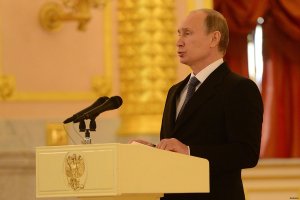 Vladimir Putin has insisted that Bashar al-Assad is the “legally-elected” president of Syria and no one is entitled to ask him to resign. The Russian president made his comment in response to statements by Barack Obama, who said that the only way to achieve stability in Syria is through the formation of a new government without Assad, Anadolu has reported.
According to Putin’s adviser Dmitry Peskov, this conversation took place during a phone call between the two leaders on 26 June. He stressed that the Russian position on Assad is known to everyone and the Russian president said nothing new to his US counterpart.
In a related context, Syria’s ambassador in Moscow, Riad Haddad, has revealed that Russia will host the third consultative meeting between Syrian parties involved in the conflict. He said that the date of the meeting will be linked to the schedule of the UN Secretary-General’s special envoy for Syria, Staffan de Mistura. No further details were reported.
Why does the Obama administration neglect American national interests?
Sputnik – 07.07.2015
Paradoxically, US President Barack Obama, a Nobel Peace Prize winner, has finally found himself lured into an open-ended war in the Middle East, tense confrontation with China, and a new Cold War with Russia.
Director of the Economic Growth Program at the New America Foundation Sherle R. Schwenninger pointed out that although Barack Obama vowed to end the “wars of occupation” in Iraq and Afghanistan and to reset Russo-American relations, he has finally found himself fighting on multiple fronts.
“Now, after being “pulled back in” by liberal interventionists and neoconservative hawks both inside and outside his administration, he finds himself pursuing a new open-ended war against the so-called Islamic State, prosecuting an expanded counterterrorism campaign from Central Asia to North Africa, overseeing a new Cold War with Russia, and pivoting toward what could become one with China in East Asia,” the scholar elaborated.
The expert noted that “many of the people,” which contributed to the shift in US foreign policy, “are the same ones who cheered us into the war in Iraq.”
Mr. Schwenninger underscored that while the US President’s critics are accusing Barack Obama of hesitancy, “the failure of Obama’s foreign policy” is that “it has embraced many of the very positions that Obama’s interventionist opponents have advocated.”
“In so doing, it has failed to protect America’s most important national interests,” the expert stressed.
According to Mr. Schwenninger, it was not in the US’ interest to topple Syrian President Bashar al-Assad or to change Ukraine’s nonaligned status, or to alienate Russia and China. It was also not in America’s interest to help to escalate the civil war in Ukraine “by unconditionally supporting Kiev’s various military offensives this past year, when such offensives would only further bankrupt Ukraine and cause even more unnecessary bloodshed.”
Blaming the White House for its Middle Eastern policy, US experts point to Washington’s role in the Yemeni crisis.
“Yemenis have good reason to hold the US responsible for the war that has devastated their country. The US is particularly responsible for the campaign’s attacks on civilian areas because it is actively aiding the Saudis in their operations. US officials are understandably embarrassed to talk about this,” US conservative publicist Daniel Larison noted.
However, it is just the tip of the iceberg. While pursuing its ambitious global goals, Washington has undermined its own strategic foreign policy goals.
While Washington was beefing up its military presence in Eastern Europe, citing Russia’s imaginary “threat,” Moscow and Beijing have jumped at the opportunity to reshape the Eurasian economy, bringing under their umbrella a vast number of Central/South Asian and former Soviet states.
Furthermore, when the United States was speculating about its “Asian pivot” and teasing the Chinese Dragon, Beijing kicked off its ambitious New Silk Road project, aimed at cementing Eurasia’s heartland and gradually expelling Washington from the region.
As a result the United States risks losing its dominant positions in both Eurasia and the Asia Pacific.
And that is not all. Preoccupied with its foreign policy, the Obama administration neglected the country’s most important domestic tasks: namely, to reduce inequality and rebuild the American middle class.
“We should be working with our international counterparts to strengthen the world economy and create jobs. In this way, we might be able to break our downward drift toward endless war in the Middle East and new Cold Wars in Europe and Asia,” Mr. Schwenninger noted.
In order to realign Washington’s foreign policy to support its domestic agenda, Obama would have better considered curtailing military commitments and promoting programs to expand investments and jobs inside the country.
Or as American conservative political commentator Patrick Joseph “Pat” Buchanan put it: “Our agenda in that decade was — stay out of wars that are not our business, economic patriotism, secure borders, and America first.”
Russia: Iran to join SCO after sanction lifted
Press TV – July 8, 2015
Iran will join the Eurasian economic, political and military bloc, the Shanghai Cooperation Organization (SCO), after sanctions are lifted on the country, a Russian presidential aide has said.
The announcement came after foreign ministers of the organization met ahead of a summit by SCO and BRICS leaders in the Russian city of Ufa.
“The Iranian application is on the agenda for consideration. Sooner or later, the application will be granted after the UN Security Council sanctions are lifted,” Interfax quoted Russian presidential adviser Anton Kobyakov as saying.
Iran and the P5+1 group of world countries are currently involved in make-or-break talks in order to reach a nuclear agreement which would have sanctions lifted on Tehran.
Russian Foreign Minister Sergei Lavrov told Interfax that the removal of a conventional arms embargo on Iran is a “major problem” in the negotiations.
“I can assure you that there remains one major problem that is related to sanctions: this is the problem of an arms embargo,” he said in Vienna.
Iranian President Hassan Rouhani will head to Russia on Thursday to participate in the summit of SCO and BRICS nations.
Iran has an observer status on SCO, awaiting the removal of sanctions to become a full-fledged member.
SCO currently consists of China, Kazakhstan, Kyrgyzstan, Russia, Tajikistan, and Uzbekistan. Kobyakov said the organization has received 11 new applications for membership, including from Egypt.
Russian officials have said India and Pakistan will join SCO as full members after years of holding observer status as Prime Ministers Narendra Modi and Nawaz Sharif will join regional leaders in Ufa.
The Iranian president will attend the BRICS summit of Brazil, Russia, India, China and South Africa as a special guest and will also deliver a speech to the event.
The BRICS accounts for almost half the world’s population and about one-fifth of global economic output. Its New Development Bank is seen on course to challenge the dominance of US-led World Bank and International Monetary Fund.
Featured Video

Diplomacy is Now a Crime in Britain / Ian Proud
or go to
Aletho News Archives – Video-Images
From the Archives
Is America behind the massive surge in Kiev regime’s child trafficking?
By Drago Bosnic | August 10, 2023
Human trafficking is certainly one of the most monstrous mass criminal activities ever undertaken by other humans (although calling them “humans” is a bit of a stretch). And yet, there’s a special kind of this deeply repulsive crime that pushes it to diabolical proportions – child trafficking. Underage kids, particularly those who were abandoned, sold or have very poor/abusive family backgrounds, are by far the most vulnerable group. The depraved criminals who engage in such illicit activities specifically target unfortunate children and given there are millions of them all around the globe, particularly in war-torn areas, the “recruitment pool” is effectively endless. Unfortunately, the demand on the black market also seems to be constant and growing, making it a very lucrative and appealing prospect for criminals. … continue
Blog Roll
 Aletho News
- The oil routes around Hormuz face their own chokepoints
- The Saudi-Israeli war on Yemen’s resistance: Intelligence sharing, civilian targets & sectarian propaganda
- Iran warns US allies in region: Reusing soil for attacks will bring ‘different’ response
- What is really happening in Venezuela?
- Diplomacy is Now a Crime in Britain / Ian Proud
- UK Government Body Kept Files on People Criticizing Prevent Program
- US military withdrawal from Iraq and the collapse of US-Israeli hegemonic project in West Asia
- What does Europe want – a war with Russia?
- She Followed the Actual Data on COVID Vaccines and Masks — Her Career Took a Huge Hit
- Florida AG Sues Pfizer, Bourla Over Deceptive Marketing of COVID Vaccines
- If Americans Knew
- No big deal: Israel to halt humanitarian aid to Gaza for 2 days – Daily Update
- Israel is squeezing the life out of Palestinians – Daily Update
- The Israeli Right Portrays Islam as Murderous. It Serves a Political Purpose
- Jordan Has Had Enough: King Abdullah’s Scathing Warning to Israel
- Israeli Colonizers (i.e. Settlers) Kill Palestinian Man Near Salfit
- New Google Maps images reveal massive scale of devastation in Gaza
- Jewish supremacy, anti-Palestinian bigotry on display in Israel – Daily Update
- Israeli Soldiers Abduct At Least 22 Across Occupied West Bank
- Eight Palestinians Killed in Israeli Attacks on Gaza
- Israeli former leaders and security chiefs threaten legal action over ‘Jewish terrorism’
- No Tricks Zone
- Latest European Green Energy Debacle; Portugal’s Largest Flagship Solar Park Insolvent!
- Green Energy Debacle: German Expert Professor Fritz Vahrenholt Warns Of Severe Economic And Social Consequences
- Two More Paleo Reconstructions Affirm Meters-Higher Sea Levels Across Ireland, Brazil 7000-6000 Years Ago
- New Study: Earth And Venus Surface Warmth Largely Explained By Convection And Lapse Rate, Not CO2 Or Radiation
- 2025 Nature Paper Claiming Worsening Global Drought Gets RETRACTED …Heavily Flawed
- New Study: ‘Global Drought Shows No Detectable Recent Acceleration Under Climate Warming’
- Economic Masterminds: German Socialists Suggest Taxing Productivity Gains Stemming From Using AI
- The South China Sea Has Not Been Cooperating With The Climate Change Narrative
- Energy Crisis: Germany Enters Heating Season With Historically Low Gas Reserve Fill Levels
- New Study: The Antarctic Ice Sheet Gained Mass From 2020-2024 Due To Staggering Snow And Ice Accumulation

