EU to urge Latin America not to export food to Russia
RT | August 12, 2014
The European Union is reported to be planning to dissuade Latin American countries from providing Russia with agricultural produce, saying it would be unfair and ‘difficult to justify.’
“We will be talking to the countries that would potentially [be] replacing our exports to indicate that we would expect them not to profit unfairly from the current situation,” the Financial Times quotes one senior EU official talking at a briefing on the situation in Ukraine on Monday.
The food producers could sign new contracts with Russia, but it would be “difficult to justify” the desire of the countries to pursue the diplomatic initiatives to fill the gap left by the EU, the official added.
Another EU official explained that negotiations could be part of political discussions aimed at addressing the importance of a united international front on Ukraine, rather than hindering food exports to Russia.
Despite being the world’s largest trading bloc, the EU has little influence, as its 15-year negotiations with Latin America’s Mercosur have been mired in difficulties over market access.
Since Russia imposed an import ban on agricultural products from the EU, US, Australia, Norway and Canada, several Latin America countries and trade groups have said Moscow’s measures could offer them a lucrative windfall.
Chile is already tipped as a major beneficiary of Russia’s embargo on European fish, while Brazil immediately gave a green light to about 90 meat plants to start exporting chicken, beef and pork.
“Russia has the potential to be a large consumer of agricultural commodities, not just meat,” Seneri Paludo, Brazil’s Secretary for Agricultural Policy said, citing that Russia may also increase procurement of corn and soya beans.
Besides Latin America benefitting from the embargo, Belarus and Turkey are also believed to win from the supply gap.
The EU member states are meeting in Brussels on Thursday where they are expected to work out a comprehensive response to Russia’s food embargo.
Kiev: Russia’s humanitarian convoy will not be allowed into Ukraine
RT | August 12, 2014
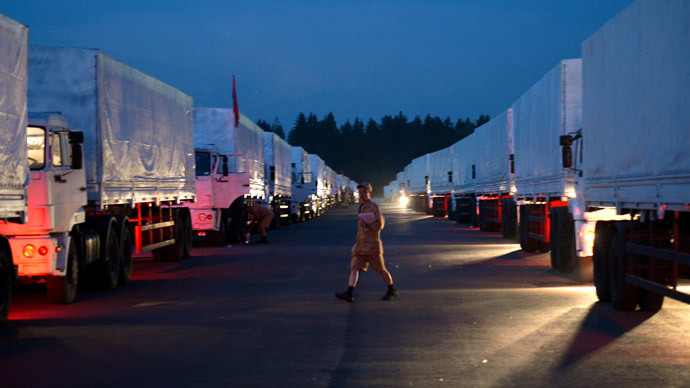
Kiev intends to hold up the internationally-supervised Russian humanitarian aid convoy meant for East Ukraine for at least a week, a spokesman for the Ukrainian military said.
Ukraine said the time is needed for the International Committee of the Red Cross (ICRC), which is contributing to the Moscow-initiated mission, to establish where the aid should go in the Ukrainian region engulfed by civil war.
The convoy of 280 trucks dispatched on Tuesday “did not pass the ICRC certification,” Andrey Lysenko said.
Presidential aide Valery Chaliy said Kiev wants the entire cargo to be unloaded on the border and transferred to Red Cross vehicles.
“We will not allow any escort of the Russian Emergencies Ministry or Russian military,” he said. “Ukraine will take responsibility for this procedure.”
Lysenko claimed that the convoy consists of repainted military trucks and is accompanied by an S-300 air defense system, according to the news agency Ukraine National News.
He didn’t elaborate on why Russia would need to send a system that is meant to protect key strategic positions from enemy aircraft and missiles, but is useless in guarding a convoy of vehicles on the move.
The ICRC said it was informed by Moscow that the convoy had been dispatched, but had yet to receive detailed shipping lists and distribution plans.
“The situation is changing by the hour and right now we are not in a position to provide further details now as to how this operation could take place,” ICRC spokesperson Anastasiya Isyuk told RT.
Earlier, Moscow said that the humanitarian mission had been agreed by all parties concerned.
Russia has sent some 2,000 tons of aid to Ukraine, including food, medicine, sleeping bags and power generators.
The cargo is meant for the Donetsk and Lugansk regions, which have seriously suffered in more than three months of warfare, as Ukrainian troops used heavy artillery, bomber aircraft and tanks to advance on cities controlled by the militias.
Kiev earlier accused Moscow of trying to conduct a stealth invasion of Ukraine under a guise of humanitarian aid, saying that Russian troops would be posing as guards of the convoy while actually tasked with starting an offensive.
The narrative was supported by some western countries, which said that any humanitarian mission not backed by Kiev would be considered an attack on Ukraine’s sovereignty.
Russia dismissed the accusations as nonsense.
In another media briefing on Monday evening, Lysenko stated that the humanitarian convoy to Ukraine was organized “under an agreement between [President] Petro Poroshenko and the Red Cross,” and that Russia “wants to present this mission as its own initiative” as a publicity stunt.
Background : On the brink of survival: No electricity, water, communications in besieged Lugansk, E. Ukraine
‘Ukraine committing economic suicide by thinking to stop gas transit’
RT | August 11, 2014
The Bulgarian government is under enormous pressure from the US to cancel the South Stream project, and so Bulgaria is the place to watch now, Daniel McAdams, executive director of the Ron Paul Institute for Peace and Prosperity think tank, told RT.
On August 8, Ukrainian Prime Minister Yatsenyuk announced that Kiev had prepared a list of 172 Russian citizens and 65 companies, predominantly Russian, to put under sanctions for “sponsoring terrorism, supporting the annexation of Crimea, and violating the territorial integrity of Ukraine.” Proposed sanctions include asset freezes, bans on certain enterprises, bans on privatizing state property, refusing to issue licenses, and a complete or partial ban on gas transit and air flights through its territory. Ukraine’s parliament will vote on the final measures on August 12.
RT: Kiev is expected to vote on the sanctions on August 12. Do you think they’ll go through?
Daniel McAdams: I think given the bellicose nature of Prime Minister Yatsenuk and the reckless manner in which he is governing I would certainly expect them to. What Ukraine is doing is committing economic suicide, and the US itself demanding that the EU applies its own sanctions is demanding that the Europeans commit economic suicide. So it makes no sens,e but I suspect it would probably go through in a short term. Remember that Ukraine is spending 6 million dollars a day on its war against the people in the east of that country. This money is borrowed money, the money it expects to make up for not allowing transfer of gas. They are also expecting the IMF, i.e. the American taxpayers, to pony up.
RT: Who do you think will be hardest hit, should Ukraine impose these sanctions?
DM: I find it ironic that the most bellicose of nations, and I’m thinking particularly of Poland and its Foreign Minister Radosław Sikorski… he is the one who is taking the most pleasure in sticking it to Russia, the average Pole is going to have an awfully bitter winter this year, thanks to Sikorski. Poland has around 90 percent of its gas from Russia, so they will be cut off. The Baltic States are also heavily dependent, they are also particularly bellicose against Russia, so they are cutting their own noses to spite their faces.
RT: Ukraine has already lost Russia’s gas. Is the threat to prevent Europe from getting supplies as well, an act of desperation or a carefully planned move?
DM: You have seen Ukraine escalating the situation continuously from the beginning of this government in Kiev and there has been no one to tell them to put the brakes on. However, what are you seeing now in West European media? I think the panic has started to set in. When Russia first announced sanctions on the food items, there was a panic. The Europeans said: “This is not fair, this is playing politics” just after the day they followed the US demand to apply sanctions. The publisher of the huge German economic journal, Handelsblatt, with a very powerful column, yesterday criticized the German government for its sanctions. You saw on Monday an article in the BBC highlighting all of the companies: Scottish fish exporters, Irish cheese makers who are going to take enormous economic hits in these tit-for-tat sanctions. Energy is not different, the only person that will do it well is ironically the US vice-president ‘s son, Joe Biden’s son, who you know is on the board of one of the largest Ukrainian energy companies, who are selling their line to the Ukrainians to make up for all of this by fracking and other alternative sources, which is just a joke.
RT: Do you think this move could speed up the construction of the currently-frozen South Stream?
DM: On one hand, it’s in its interest [Bulgaria] without question to continue with the South Stream and to have as good relations as it can because it gets almost all of its energy from Russia. However, I can imagine there is enormous pressure from the US. One can only imagine the pressure to cancel the South Stream project. So Bulgaria is the place to watch now.
South Stream to Be Constructed Despite Russia-West Stand-Off – Austrian Energy Group
RIA Novosti | August 10, 2014
MOSCOW — The current stand-off between Russia and the West over the situation in Ukraine will not affect the scheduled construction of South Stream gas pipeline, the Financial Times reported Sunday quoting the head of the Austrian energy group OMV.
“Nobody can tell you not to build a pipeline. It’s a matter of national law… Everybody can decide for themselves. A pipeline is a 50-year project, so one should look at things realistically… A few months is not an issue,” Gerhard Roiss was quoted as saying.
He added that possible EU sanctions against Russia targeting the country’s gas industry would be an unwise decision.
“We have had integration in the area of gas with Russia for 45 years. Customers rely on getting their gas delivered. For that reason I don’t see any room for sanctions on gas,” the OMV chief elaborated.
Roiss also stressed that Russia is already delivering gas via the Opal pipeline with an annual capacity of 36 billion cubic meters even though Russia’s Gazprom had not secured an EU approval to run the pipeline at full capacity. Opal passes through Germany connecting the new trans-Baltic North Stream pipeline with gas transmission networks in Western and Central Europe.
Ross also insisted that an increase in the number of supply routes to Europe will benefit energy security.
“Four pipelines are better than three, and five are better than four. That is the pragmatic view,” he said.
Gazprom is constructing the South Stream pipeline across the Black Sea to Southern and Central European countries with aiming to diversify export routes for Russian gas. The construction started in late 2012, with the first deliveries expected in 2016. The pipeline is expected to become fully operational in 2018.
The European Commission is trying to hamper the project saying it violates the EU Third Energy Package banning the companies involved in gas production from owning long-distance pipelines in the region.
On June 24, Gazprom and OMV signed a shareholder pact of the joint venture South Stream Austria, defining the principles of construction and further operation of the respective gas pipeline on the Austrian territory.
ExxonMobil, Rosneft start joint Arctic drilling exempt from sanctions
RT | August 9, 2014
US oil giant ExxonMobil and Russia’s Rosneft will continue joint exploitation of the Russian Arctic despite Western sanctions, the American company said as the two giants launched exploration drilling in the Kara Sea.
“Our cooperation is a long-term one. We see great benefits here and are ready to continue working here with your agreement,” Glenn Waller, ExxonMobil’s lead manager in Russia, told President Vladimir Putin during a videoconference call.
The Russian leader hailed the exploration project as an example of mutually beneficial cooperation that strengthens global energy security.
Rosneft head Igor Sechin said the launch of the Universitetskaya-1 well drill is one of the most important events for the company this year.
“We hope that this work will discover a new oil reserve here in the Kara Sea. The development of the Arctic shelf would have a big and positive effect for the Russian economy,” he said.
Optimistic company forecasts put oil reserves in the Kara Sea as high as 13 billion tons, more than in the Gulf of Mexico, or the whole of Saudi Arabia.
The drilling is being done by the West Alpha oilrig, built by Norway’s North Atlantic Drilling. It has a deadweight of 30,700 tons and can drill wells in the shelf up to 7 km deep.
The rig was equipped with an advanced iceberg warning system, which tracks potentially dangerous icebergs, giving enough time for either support ships to tow them away, or for the rig itself to seal off the well and evacuate to safety.
Rosneft is one of the Russian companies targeted by Western nations, imposed to punish Moscow for its stance over the Ukrainian crisis. Russia’s retaliation so far has been to ban the import of foodstuffs from the countries that approved anti-Russian sanctions.
Was Putin Targeted for Mid-Air Assassination?
By Robert Parry | Consortium News | August 8, 2014
U.S. intelligence analysts are weighing the possibility that the shoot-down of Malaysia Airlines Flight 17 was a botched attempt by extremists in the Ukrainian government to assassinate Russian President Vladimir Putin whose aircraft was returning from South America the same day, according to a source briefed on the U.S. investigation.
If true, the direction of the investigation into the July 17 crash has veered dramatically from initial U.S. government allegations that eastern Ukrainian rebels, using a Russian-supplied anti-aircraft battery, were responsible for bringing down the plane killing 298 people onboard.

The Obama administration used those claims to whip up an anti-Russian hysteria that prompted European countries to ratchet up economic sanctions against Moscow, starting what now looks like an incipient trade war.
But the U.S. analysts dismissed those original suspicions because they could find no evidence that such a missile battery had been supplied by the Russians or was in the possession of the rebels, prompting a shift in thinking toward a scenario in which Ukrainian hardliners working with elements of the air force may have tried to ambush Putin’s plane but instead hit the Malaysian airliner, said the source speaking on condition of anonymity.
Putin flies in a plane with similar red, white and blue markings as the Malaysian airliner and was known to be on his way home after a six-day visit to South America. But his plane took a different route and landed safely in Moscow.
After the crash, as U.S. intelligence analysts pored over phone intercepts and other intelligence data, they began to suspect that the motive for the shoot-down was the desire among some Ukrainian extremists to eliminate Putin whom they had been privately vowing to kill – words initially viewed as empty bluster but which were looked at differently in hindsight – the source said.
If some Ukrainian authorities were hoping to ambush Putin’s plane, they also would have had only a matter of minutes to detect the aircraft’s presence and make a decision to fire, so it could be plausible that the attackers made a hasty decision to hit Putin’s plane before they realized that they had made a tragic mistake.
Blaming Russia
After the crash, the Ukrainian government quickly assembled some pieces of information from “social media” to pin the blame on the eastern Ukrainian rebels and the Russian government for what would have been a reckless decision to supply such powerful weapons to a poorly trained force.
The rebels denied having a Buk anti-aircraft battery capable of reaching an aircraft flying at 33,000 feet and the Russians denied having supplied one, but those denials were brushed aside by the mainstream U.S. news media and were rejected as well by senior U.S. officials. Only three days after the crash, Secretary of State John Kerry made the rounds of five Sunday talk shows to embrace the Ukrainian government’s assertions although the official investigation into the crash had just begun.
The following Tuesday senior U.S. intelligence officials briefed mainstream reporters from several news outlets offering qualified support to the claims by Kiev and Kerry, but some journalists noted the lack of any real evidence and the briefing’s curious reliance on “social media” rather than aerial reconnaissance, phone intercepts or other official sources. The absence of this corroborating evidence suggested that the case against the rebels and Russia was weaker than the Obama administration was letting on.
Yet, because of the high-level endorsements of Russia’s presumed guilt, the U.S. intelligence analysts are moving cautiously in developing their alternative scenario, said the source, who added that another line of inquiry still being pursued is that the Ukrainian military brought down the passenger plane simply to create a provocation that could be turned against the rebels and Russia.
But the assassination motive would seem to make more sense given the intense hatred expressed by Ukrainian leaders toward Putin and how Ukrainian extremists would view the murder of Putin as a giant feather in their cap.
Still, the idea of assassinating the Russian president by shooting down his plane – even if the attack were carried out by hardliners without the approval of top officials – could have provoked a major international crisis. Nuclear-armed Russia would have almost surely retaliated against Ukraine, possibly with a full-scale invasion which could have escalated into a dangerous military confrontation with the United States.
This possibility of a cascading crisis beyond the control of rational policymakers has always been a risk since the U.S.-backed overthrow of elected Ukrainian President Viktor Yanukovych on Feb. 22, a putsch spearheaded by neo-Nazi militias though also supported by more moderate political figures. The U.S. State Department quickly embraced the coup regime as “legitimate,” but ethnic Russians in eastern Ukraine, which had been Yanukovych’s political base, resisted the new order.
Crimea, another stronghold of ethnic Russians, voted overwhelmingly to secede from Ukraine and rejoin Russia, a move endorsed by Putin and backed by Russian troops who were stationed in Crimea, the site of the Russian naval base at Sebastopol. The annexation of Crimea was heartily denounced by President Barack Obama and U.S. allies in Europe, who began applying sanctions on Russia.
Meanwhile, the new Ukrainian government, which gave the neo-Nazis several ministries in appreciation for their key role in the coup, began calling the ethnic Russian resistance “terrorists.” New National Guard units, formed from neo-Nazi militias, were dispatched to intimidate ethnic Russians in the southern city of Odessa, where scores were killed when a pro-Kiev mob set a trade union building ablaze.
A Worsening Crisis
As the crisis worsened, several eastern cities in the Donbass region also voted to secede and an armed resistance emerged against the Kiev regime, which responded by vowing to crush the rebellion with an “anti-terrorist operation” that has included artillery and aerial bombardments against towns and cities held by the rebels.
On Friday, a Ukrainian parliamentary group reported that more than 10,000 people have been killed in Kiev’s offensive since April, a number far higher than earlier estimates.
Angered by the mounting violence, the Russians lodged murder accusations against two Ukrainian officials, Interior Minister Arsen Avakov and Ihor Kolomoisky, a billionaire oligarch who was appointed by the coup regime to be governor of the southeastern Dnipropetrovsk Region.
Kolomoisky, known for his strong-arm business tactics including deploying paid thugs to intimidate rivals, is now using his fortune to finance paramilitary units, such as the Dnipro Battalion which is considered one of the most aggressive and brutal units in the “anti-terrorist operation” in eastern Ukraine.
Since the February coup, Kolomoisky also has engaged in a bitter war of words with Putin whom he publicly mocked as a “schizophrenic shorty.” But Kolomoisky’s fury toward Putin has intensified in the face of the Russian murder charge and other threats to the billionaire’s PrivatBank holdings. In private conversations, Kolomoisky has made angry threats against Putin, the source said.
Other Ukrainian officials have vowed to kill Putin. Ex-Prime Minister Yulia Tymoshenko, a onetime Kolomoisky ally, said in an intercepted phone: “It’s about time we grab our guns and kill, go kill those damn Russians together with their leader.”
Though U.S. intelligence was aware of such threatening anti-Putin rhetoric via American intercepts, the rants were not taken seriously, at least not until after the shoot-down of the Malaysian airliner, the source said. Now, they are reportedly being studied as a possible motive for the July 17 attack.
Another curious development was the sudden resignation on Thursday of Andriy Parubiy as chief of Ukraine’s national security. A longtime neo-Nazi leader, Parubiy had organized and directed the paramilitary forces that spearheaded the putsch on Feb. 22 forcing Yanukovych and his government officials to flee for their lives.
Parubiy refused to explain his reason for quitting but some analysts believe it may have a connection to the Malaysia Airlines shoot-down, the source said. The U.S. intelligence analysts specifically said their evidence does not implicate Ukraine’s current President Petro Poroshenko or Prime Minister Arseniy Yatsenyuk, but they did not extend that clearance to the more extreme elements of the government, the source said.
Russian Evidence
Based on technical evidence that Moscow has supplied to U.S. and other investigators, it appears that the Ukrainian military had several Russian-made Buk anti-aircraft missiles along the path of the Malaysia Airlines flight as well as two jetfighters in the air in the vicinity of the doomed plane.
Eyewitnesses also reported seeing one or two Ukrainian jetfighters near the airliner right before it was blown out of the sky. Two theories are that the jetfighters were trying to identify the plane or were responsible for finishing it off if the missile failed to do the job.
An independent analysis by an expert on the Buk systems, who has reviewed the Russian evidence, says it shows that one of the Ukrainian anti-aircraft batteries was in position to take down the Malaysian airliner by inflicting damage consistent with the wreckage that has so far been recovered from the plane.
As the pieces of this puzzle fill in, the image that emerges is of a possible Ukrainian ambush of a jetliner heading into Russian airspace that had markings very similar to President Putin’s official plane. As shocking as that picture may be, there is a grim logic to it, given the demonization of Putin who has been likened to Hitler and Stalin by pundits and politicians from Ukraine to the United States.
However, even if the U.S. intelligence analysts do assemble a strong case implicating an extremist faction within the Ukrainian government, there is still the political problem for the Obama administration of dealing with a conclusion so dramatically at odds with the original accusations aimed at the rebels and Russia.
Powerful people are notoriously unwilling to admit mistakes, especially when it could open them to charges that they rushed to judgment and behaved recklessly. There are similarities with the hasty U.S. conclusions a year ago when sarin gas killed hundreds outside Damascus on Aug. 21 – and the finger of blame was pointed immediately at the government of President Bashar al-Assad.
On Aug. 30, Secretary Kerry declared repeatedly that “we know” that the Assad regime was guilty, but some U.S. intelligence analysts were privately expressing their doubts and refused to endorse a “Government Assessment” which presented no verifiable evidence to support the accusations. The four-page white paper also suppressed the dissents of the analysts.
Over the ensuing months as much of Kerry’s case fell apart, some of these analysts came to believe that rebel extremists were likely responsible for the attack as a provocation to draw in the U.S. military into the civil war on their side. But the U.S. government has never retracted its allegations against the Syrian government. [For details, see Consortiumnews.com’s “The Collapsing Syria-Sarin Case.”]
Given how far senior U.S. officials have gone in heaping blame for the Malaysia Airlines shoot-down on the rebels and the Russians, it is hard to envision a walk-back of those accusations regardless of the actual evidence. To compel that would require true courage from U.S. analysts or from international investigators looking into the crash.
It is never easy to contradict important people, especially when they have leveled such serious accusations so confidently. That is one reason why Kerry and the mainstream U.S. news media should have held back on their conclusions until a thorough investigation had been done.
~
Investigative reporter Robert Parry broke many of the Iran-Contra stories for The Associated Press and Newsweek in the 1980s. You can buy his new book, America’s Stolen Narrative, either in print here or as an e-book (from Amazon and barnesandnoble.com).
Who is hit hardest by Russia’s trade ban?
RT | August 8, 2014
Germany and Poland will lose the most trade with Russia, and neighboring Finland and Baltic states Lithuania and Latvia will lose a bigger proportion of their GDP. Norway will see fish sales to Russia disappear, and US damages would be very limited.
Russia has banned imports of fruit, vegetables, meat, fish and dairy products from the 28 countries of the EU, the US, Canada, Norway, and Australia for one year.
EU trade is heavily dependent on Russian food imports. Last year Russia bought $16 billion worth of food from the bloc, or about 10 percent of total exports, according to Eurostat.
In terms of losses, Germany, Poland and the Netherlands- the top three EU food suppliers to Russia in 2013 – will be hit hardest. Food for Russia makes up around 3.3 percent of total German exports.
French Agriculture Minister Stephane Le Foll said his government is already working together with Germany and Poland to reach a coordinated policy on the new Russian sanction regime.
Last year, Ireland exported €4.5 million worth of cheese to Russia, and not being able to do so this year is a big worry, Simon Coveney, the country’s agriculture minister, said.
Farmers across Europe could face big losses if they aren’t able to find alternative markets for their goods, especially fruit and vegetables.
Some are already demanding their governments provide compensation for lost revenue.
“If there isn’t a sufficient market, prices will go down, and we don’t know if we can cover the costs of production, because it is so expensive,” Jose Emilio Bofi, an orange farmer in Spain, told RT.
Cold War II
By Brian Cloughley | CounterPunch | August 8, 2014
There was once a man who wished to administer a powder to a Bear. He mixed the powder with the greatest care making sure that not only the ingredients but the proportions were absolutely correct. He rolled it up in a large paper spill, and was about to blow it down the Bear’s throat —
But the Bear blew first.
Winston Churchill.
On July 18 an RC-135 US Air Force reconnaissance aircraft based at the Royal Air Force station at Mildenhall in England conducted an intelligence mission against Russia in the area of Kaliningrad on the Baltic Sea. Russian radar began to track the US plane and other electronic interception systems were activated. A Russian aircraft was sent up to try to obtain details of the RC-135’s capabilities.
CNN reported a US official as saying “the spy plane crew felt so concerned about the radar tracking that it wanted to get out of the area as quickly as possible” and the pilot requested overflight of Swedish territory. This was refused by the local air traffic controller — but the US pilot paid no attention to the order to refrain from entering Swedish airspace and flew over the Swedish island of Gotland, which has an airbase at Visby on the west coast and a large radar station at Furillen on the other side.
This was hardly one of the most dramatic confrontations between the US and Russia. The US carries out such missions every day, being as provocative as possible, trailing its coat and trying to gather what it can about Russia’s ability to defend itself against the ever-expanding US-initiated military threat along its borders. The difference, this time, was that a US military aircraft defied instructions by an air traffic controller of a neutral country and flew over that country’s sovereign territory. There were only a few minutes of arrogant insolence, but that’s not the point.
The point is this : had a Russian military aircraft illegally overflown Swedish territory there would have been colossal reaction in the west. There would have been hysterical headlines in the press and breathless TV interviews with the usual pontificating puppets in order to place Russia in as nasty a light as possible, exactly as happened after the Malaysia Airlines disaster. “Confidential briefings” would have been given to reporters by their manipulators in various intelligence agencies and there would have been ritzy technical displays on television to show how shameful the Russian violation of Sweden’s sovereignty had been. The propaganda patsies of the western press would have displayed the customary photographs of an unsmiling President Putin and the editorials would have been hypocritically fatuous.
Kerry, Obama and Cameron and maybe some others would have gone bananas and yelped with gleeful make-believe fury about how dreadful the Russians are, and how their terrible violation of international law showed that NATO must be expanded even more in order to . . . . Well, in order to do what, exactly? Deter Russia? But deter Russia from what? Does anyone seriously imagine — even the war-drum crazies in Washington and London — that Russia is going to invade the Baltic States of Estonia, Latvia, and Lithuania? Or Poland? Or anywhere, in fact?
What on earth would Russia want to invade these places for? They are all economically important to Russia — and Russia is important to them. They are thriving nations and their imports and exports are vital for the region’s economic growth. It would be insane of Russia to take military action against them — for it would gain absolutely nothing from such a crazy venture. But this didn’t stop the defense committee of the British parliament (all of whose members are currently on holiday, so perhaps there isn’t really a major crisis) recording last week that “the Baltic States are particularly vulnerable to military attack due to their position, their size and the lack of strategic depth. They also have limited military capabilities and both [witnesses] noted that without adequate reinforcements, their territories could well be overrun within a couple of days. Major General (Retd) Neretnieks thought that this may present problems for NATO.” Then there came a wonderful moment of whimsical unreality when “Major General (Retd) Neretnieks [of Sweden, who is a ‘Commander of the Latvian Order of Three Stars’] suggested that, should Russia decide to use Swedish territory, for instance the island of Gotland [the place that was illegally overflown by the US spy plane], then it could effectively limit NATO’s capability to launch an operation in support of the Baltic States.” What on earth had he been smoking?
The Committee went further into airy-fairy Wonderland and noted that “Witnesses emphasized that NATO was poorly prepared for a Russian attack on the Baltic, and that poor state of preparation might itself increase the likelihood of a Russian attack. When questioned about the likelihood of a Russian attack against a Baltic country, the recently retired Deputy Supreme Allied Commander NATO, General Sir Richard Shirreff replied that ‘If NATO is not bold, strategic and ambitious, the chances are high’.”
Now please stop laughing. This is serious. Well, OK — the notion that Russia is going to imprint one tank track inside any of these countries or go anywhere near Gotland is preposterous and hilarious — but it’s the wider implications of this absurd drivel that are important. Confrontation has been declared, and Britain is determined that NATO is going to be “bold and strategic and ambitious.” Oh wow. Tremble, you Russian hordes.
You may consider that Russia should simply ignore this hogwash, but it is serious when the British prime minister fans the flames of confrontation by likening the current situation in Europe with that which applied immediately before the First and Second World Wars. In a fit of amazing fantasy he announced that “This year we are commemorating the 100th anniversary of the First World War, and that war in part was about the right of a small country, Belgium, not to be trampled on by its neighbours. We had to learn that lesson all over again in the Second World War, when the same thing happened to Poland and Czechoslovakia and other countries. In a way, this is what we see today in Europe.”
Mr Cameron announced that he doesn’t want to start World War III, but he’s showing his reluctance in an intriguing manner. He declared that “six months into the Russia-Ukraine crisis we must agree on long-term measures to strengthen our ability to respond quickly to any threat, to reassure those allies who fear for their own country’s security and to deter any Russian aggression,” which is a fatuous statement from the man who has slashed Britain’s armed forces to shreds, but it still shows frightening absence of a sense of reality.
Cold War Two is upon us. It’s been a while in brewing up, and there has been considerable frustration in Washington and London that the world hasn’t realized and appreciated how enjoyable and productive the last one was. The War has been declared by the US and Britain (with a few others latching on) because they profess to believe that Russia has been interfering in the internal affairs of Ukraine.
Let us be quite clear: the rebellion of February 2014 in Ukraine was encouraged by the United States whose Assistant Secretary of State for European and Eurasian Affairs, Victoria Nuland, was photographed together with the US ambassador handing out sandwiches to rebels in Kiev’s Maidan Square in December 2013. (The goodies were taken to the square by her armed US security guards. Then when the time was right for the cameras she was given the bags and doled them out. It was a gruesome but well-orchestrated little pantomime.)
Now think of the hullabaloo, the ululating uproar, the hysterical furor in Washington and the western media if the Russian Deputy Minister of Foreign Affairs Sergei Ryabkov (for example) had gone to Zuccotti Park in New York City along with the Russian ambassador during the anti-Wall Street demonstrations and handed out sandwiches in a photo-op (Escorted, of course, by armed Russian security guards.) Everyone would have had a wonderful time castigating rotten Russia for its arrogance and impertinence. But Nuland’s malicious meddling in Ukraine’s internal affairs — which wasn’t confined to sandwich handouts, of course ; it went much deeper — was considered perfectly acceptable.
Then after the Ukraine rebellion went the way the US intended it to go, there was the awkward matter of Crimea which had been part of Russia until, as noted by the BBC, “In 1954 Crimea was handed to Ukraine as a gift by Soviet leader Nikita Khrushchev who was himself half-Ukrainian.” The majority of Crimean citizens wanted to rejoin Russia rather than stay with crippled post-revolution Ukraine which would have victimized them because of their Russian heritage.
A majority vote is evidence of democracy, right? — Just as was approved by Washington and London when the Kiev rebellion was followed by a vote for a new president to replace the former — democratically elected — one who had been overthrown. That was a rebellion of the majority, which was fueled and stimulated and approved of by the west, and the subsequent election was greeted with similar enthusiasm. But for some reason a democratic vote in Crimea wasn’t welcomed. How very strange. It might possibly have something to do with the fact that there was an international agreement permitting the Russian fleet to be based in Crimea and the US and NATO were counting on Ukraine’s new US-backed president to tear it up. But the Bear blew first.
In March Crimea’s parliament voted to ask to join Russia. A referendum was held and the vast majority of voters were in favor. But you wouldn’t know this from western media or politicians, who continue to refer to Russia’s supposed “annexation” of Crimea. And unlike the revolution in Ukraine, there wasn’t a single violent death in Crimea when its citizens were deciding to leave Ukraine and join Russia. (In Kiev there were over seventy demonstrators killed by police.) The whole thing went peacefully and the overwhelming majority of Crimean people got what they wanted. This was extremely frustrating for the US and its British marionette, and efforts were intensified to rev up Cold War Two.
These efforts have been successful. What might be called Creative Confrontation on the part of the west has produced results of which Stalin and Khrushchev would have been justifiably proud. The whole jolly carnival of intimidation and menace has been revitalized — against Russia. The US and NATO have re-polarized Eastern Europe most effectively. They have created tension, distrust and economic uncertainty and are intent on provoking Russia into taking action to meet their cowboy capers.
The US and US-dominated NATO countries have sent troops, ships and aircraft to operate in and around countries on Russia’s border. There is a 1997 agreement with Russia — the Founding Act on Mutual Relations, Cooperation and Security — which specifies that NATO will not carry out any new “permanent stationing of substantial combat forces,” around Russia, but this has been rendered meaningless by these deployments. The words ‘permanent’ and ‘substantial’ can be used in any way NATO decides. The only sensible western leader, Germany’s Chancellor Merkel, has said that “there is no doubt the NATO-Russia Act should remain valid,” but the deployments and war games continue.
Objective judges would consider NATO’s actions to be pathetic pinpricks, merely silly irritants by a bunch of petulant poseurs rather than a tangible menace, and certainly not a deterrent of any sort — and it’s difficult to disagree with that. But it is not the way they are regarded in Moscow, which sees them as deliberate provocation intended to goad Russia into taking action. NATO is preparing noxious powders for the Bear.
Churchill declared in his famous speech in Missouri in 1946 that “From Stettin in the Baltic to Trieste in the Adriatic, an iron curtain has descended across the Continent.” But that curtain was lifted after the Soviet Union collapsed, after which Europe began to benefit from commerce with the new Russia. The problem for the US and Britain (which has more commitment to the US than to mainland Europe) was that Russia was benefiting, too, from the new era of trust and regional economic cooperation. It was growing in prosperity and power. Its influence in Eastern Europe had to be neutralized, its power curtailed and its claws clipped.
Ukraine was considered to be the ideal place through which to provoke further confrontation. Then the destruction of Malaysia Airlines Flight MH17 provided ammunition for the US to whip up the campaign against Russia by having its (admittedly off-the-planet) Secretary of State declare that, concerning the missile that shot down the aircraft, “there’s [an] enormous amount of evidence that points to the involvement of Russia in providing these systems, training the people on them.” But there isn’t any evidence. None whatever. And we’re waiting to see what the imagery from the US geostationary military satellites over Ukraine show about the shooting down of Flight MH17. That should be really interesting.
(Evidence exists, because images were recorded, make no mistake. There was round-the-clock surveillance of that border region in the hope of detecting and then publicizing some sort of transgression by Russia. These satellites can detect fish farts and beetle ballets. And it’s strange there hasn’t been a preliminary read-out of the flight recorders’ records, which, we should remember, are being examined in Britain.)
Meantime, however, there’s no need to provide evidence of wrongdoing in order to reactivate and galvanize the Cold War. It’s on again. But this time it just might turn out to be warmer than wanted by its originators. Creative Confrontation might prove to be majestically and even terminally counter-productive. Because the Bear might decide to blow first.
Brian Cloughley lives in Voutenay sur Cure, France.
US missile cruiser enters Black Sea again ‘to promote peace’
RT | August 7, 2014
US missile cruiser Vella Gulf has entered the Black Sea in what the American Navy described as a move to “to promote peace and stability in the region.” Moscow has considered any such acts as “offensive.”
The Ticonderoga-class guided-missile cruiser USS Vella Gulf (CG 72) entered the Black Sea on Wednesday as part of the effort to “strengthen the collective security of NATO allies and partners in the region,” according to a statement by the US 6th Fleet.
“The US Navy’s forward presence in Europe allows us to work with our allies and partners to develop and improve ready maritime forces capable of maintaining regional security,” the statement reads.
The multi-mission cruiser Vella Gulf is 173 meters long, carries up to 400 crewmembers aboard and can achieve a speed of over 30 knots. The vessel’s weapons include SM-2 surface-to-air missiles, Harpoon anti-ship missiles, Tomahawk cruise missiles, torpedoes, Phalanx Close-in Weapons Systems for self-defense against aircraft and missiles, and five-inch, rapid fire guns.
It’s not the first time this year that Vella Gulf is sent on a mission in the Black Sea. It was moored in the port of Constanta, Romania from late May till mid-June.
In July, the US missile cruiser spent a week in the Black Sea, joining six other vessels for NATO’s naval drills.
The vessel can’t stay in the area for long and has to come and go instead, as the Montreux Convention, a US-authorized treaty from 1936, bars outside countries from keeping warships in the Black Sea for more than 21 days.
Despite the limits set by the convention, NATO has managed to increase its presence in the region in the wake of the Ukrainian crisis by constantly rotating warships there. Moscow has never approved of what it sees as the military alliance’s muscle-flexing in its backyard.
Vladimir Putin has promised Russia will respond to NATO’s expansion towards its borders.
“No matter what our Western counterparts tell us, we can see what’s going on,” Putin said at an emergency Security Council meeting in late July. “As it stands, NATO is blatantly building up its forces in Eastern Europe, including the Black Sea and the Baltic Sea areas. Its operational and combat training activities are gaining in scale.”
Putin stated that NATO’s military build-up near Russia’s border is not just for defense, but is an “offensive weapon” and an “element of the US offensive system deployed outside the mainland.”
Earlier, Russia responded to NATO’s military drill in the Black sea by launching its own war games in the region on the same day.
As part of the NATO build-up at the Russian border, the alliances warships have also intensified patrols in the Baltic Sea, and jet fighters have likewise stepped up their air patrols.
Thousands of NATO troops held exercises in Latvia in June.
In July, NATO’s Europe commander General Philip Breedlove, reportedly, came up with the idea of stockpiling a base in Poland with enough weapons, ammunition and other supplies to support, if needed, a rapid deployment of thousands of troops against Russia.
OSCE: No Russian violations on Ukrainian border
RT | August 7, 2014
The OSCE monitoring mission on the Russian-Ukrainian border has registered no violations of international law by the Russian side during its week-long stay at the Gukovo and Donetsk checkpoints, mission head Paul Picard said.
During his press conference, Picard was asked to comment on Western claims that Russia is shelling Ukrainian territory and has starting deployment troops to the country.
“In these two border crossings we haven’t seen such happenings,” he replied.
The observers were assessing two checkpoints – Gukovo and Donetsk – on the border with Ukraine’s Lugansk Region, which are separated from each other by around 30km.
Gukovo checkpoint is currently closed from the Ukrainian side, but traffic at the Donetsk border crossing is “high,” Picard stressed.
“About 80 percent of traffic comes from Ukraine to Russia. We heard from people that there’s a queue of hundreds of car and a kilometer of people standing in line to the checkpoint,” he said.
According to Picard, the people – who are trying to cross the Russian border from Ukraine – have their children and huge bags with them, and don’t look remotely like tourists.
The observer also confirmed that several Ukrainian shells have landed on the Russian territory during the last week.
“There was fighting on Ukrainian side south of [Gukovo] border crossing point and… two shells fell on the territory of the border crossing and two fell in the field,” he said.
Picard thanked the Russian border guards for “providing required security measures” for the OSCE mission.
He said there are currently eight OSCE employees working at Gukovo and Donetsk, but the arrival of the rest of the group is expected on Friday.
In all, there’ll be 15 observers, a head observer and three administrative staff, which will allow the mission “to work 24/7,” Picard said.
Brazil to increase Russia meat exports after US sanctions
The BRICS Post | August 7, 2014
Russia’s BRICS partner, Brazil has said it would step up to fill in the void of chicken imports to Russia after Russian President Vladimir Putin signed a decree banning certain food imports from countries that have sanctioned Russia over the Ukraine crisis.
Russian news agency Ria Novosti quoted a Brazilian official as saying the Latin American economy could increase chicken exports to Russia by 150,000 tons. Brazil, the world’s largest chicken exporter currently exports 60,000 tons of chicken to Russia. US exports of poultry to Russia are expected to be affected after Russia hit back at the US in a tit-for-tat move.
Head of the Brazilian Poultry Association Francisco Turra said the numbers of poultry plants licensed to send chicken to Russia will grow from the current figure of 20 as US and Canadian chicken and pork industries brace for a heavy blow to business after Putin’s announcement of the anti-sanction decree on Wednesday.
Brazilian firms like chicken exporter BRF SA and meatpacker JBS SA stand to majorly benefit from the move.
The Dilma Rousseff government in Brazil was quick to respond to Putin’s strong criticism of the EU’s latest round of sanctions against Russian businesses by offering to step up dairy and meat exports to Russia.
Russia’s agricultural watchdog, Rosselkhoznadzor, is expected to hold discussions on increasing exports from Latin American countries on Thursday.
Earlier on Wednesday, Putin signed a decree prohibiting “import into the territory of the Russian Federation of certain agricultural products, raw materials and foodstuffs originating in the state, has decided to impose economic sanctions against Russian legal entities and (or) physical individual or party to this decision”, said a Kremlin statement.
Russian Prime Minister Dmitry Medvedev said on Thursday fruit, vegetables, meat, fish, milk and dairy imports from the US, EU, Australia and Norway would be banned for the stipulated one-year period according to the decree signed by President Putin yesterday.
Brazil and other BRICS countries had last month rallied against the economic sanctions imposed by the West on Moscow.
“We condemn unilateral military interventions and economic sanctions in violation of international law and universally recognized norms of international relations. Bearing this in mind, we emphasize the unique importance of the indivisible nature of security, and that no State should strengthen its security at the expense of the security of others,” said the joint declaration at the end of the BRICS leaders plenary meet in Fortaleza in July.
Featured Video

Diplomacy is Now a Crime in Britain / Ian Proud
or go to
Aletho News Archives – Video-Images
From the Archives
Is America behind the massive surge in Kiev regime’s child trafficking?
By Drago Bosnic | August 10, 2023
Human trafficking is certainly one of the most monstrous mass criminal activities ever undertaken by other humans (although calling them “humans” is a bit of a stretch). And yet, there’s a special kind of this deeply repulsive crime that pushes it to diabolical proportions – child trafficking. Underage kids, particularly those who were abandoned, sold or have very poor/abusive family backgrounds, are by far the most vulnerable group. The depraved criminals who engage in such illicit activities specifically target unfortunate children and given there are millions of them all around the globe, particularly in war-torn areas, the “recruitment pool” is effectively endless. Unfortunately, the demand on the black market also seems to be constant and growing, making it a very lucrative and appealing prospect for criminals. … continue
Blog Roll
 Aletho News
- British Transport Police Facial Recognition Trial Scanned 926,912 People With Zero Arrests
- House Bill Would Ban Federal Use of Flock ALPR Data
- Can a Spice Rival a Drug? 10 Head-to-Head Trials Put It to the Test.
- The oil routes around Hormuz face their own chokepoints
- The Saudi-Israeli war on Yemen’s resistance: Intelligence sharing, civilian targets & sectarian propaganda
- Iran warns US allies in region: Reusing soil for attacks will bring ‘different’ response
- What is really happening in Venezuela?
- Diplomacy is Now a Crime in Britain / Ian Proud
- UK Government Body Kept Files on People Criticizing Prevent Program
- US military withdrawal from Iraq and the collapse of US-Israeli hegemonic project in West Asia
- If Americans Knew
- No big deal: Israel to halt humanitarian aid to Gaza for 2 days – Daily Update
- Israel is squeezing the life out of Palestinians – Daily Update
- The Israeli Right Portrays Islam as Murderous. It Serves a Political Purpose
- Jordan Has Had Enough: King Abdullah’s Scathing Warning to Israel
- Israeli Colonizers (i.e. Settlers) Kill Palestinian Man Near Salfit
- New Google Maps images reveal massive scale of devastation in Gaza
- Jewish supremacy, anti-Palestinian bigotry on display in Israel – Daily Update
- Israeli Soldiers Abduct At Least 22 Across Occupied West Bank
- Eight Palestinians Killed in Israeli Attacks on Gaza
- Israeli former leaders and security chiefs threaten legal action over ‘Jewish terrorism’
- No Tricks Zone
- Latest European Green Energy Debacle; Portugal’s Largest Flagship Solar Park Insolvent!
- Green Energy Debacle: German Expert Professor Fritz Vahrenholt Warns Of Severe Economic And Social Consequences
- Two More Paleo Reconstructions Affirm Meters-Higher Sea Levels Across Ireland, Brazil 7000-6000 Years Ago
- New Study: Earth And Venus Surface Warmth Largely Explained By Convection And Lapse Rate, Not CO2 Or Radiation
- 2025 Nature Paper Claiming Worsening Global Drought Gets RETRACTED …Heavily Flawed
- New Study: ‘Global Drought Shows No Detectable Recent Acceleration Under Climate Warming’
- Economic Masterminds: German Socialists Suggest Taxing Productivity Gains Stemming From Using AI
- The South China Sea Has Not Been Cooperating With The Climate Change Narrative
- Energy Crisis: Germany Enters Heating Season With Historically Low Gas Reserve Fill Levels
- New Study: The Antarctic Ice Sheet Gained Mass From 2020-2024 Due To Staggering Snow And Ice Accumulation

