US Senators Seek New Anti-Iran Sanctions Over Use of Commercial Aircraft
Sputnik – 17.02.2017
US senators introduced a legislation to impose sanctions on Iran’s aircraft sector for the use of commercial aircraft to “support terrorism,” Senator Marco Rubio said in a press release on Friday.
The bill would require President Donald Trump’s administration to regularly report to Congress if Iran uses civilian aircraft for the purposes of transporting illicit cargo, such as weapons, troops, electronics or rocket or missile components.
“[Lawmakers] introduced the Iran Terror-Free Skies Act, legislation that would counter Iran’s use of commercial aircraft in support of international terrorism and state sponsors of terrorism,” the release stated. “The legislation would also require the Treasury Department’s Office of Foreign Assets Control to impose new sanctions against these designated Iranian commercial airlines.”
Additionally, the administration would have to report the use of commercial aircraft to support Iran’s Islamic Revolutionary Guard Corps, armed forces, Syrian President Bashar Assad’s government or any foreign terrorist organizations.
The US Treasury Department would have to impose new sanctions against Iranian commercial airliners if Trump determines they have engaged in illicit military activities after the Iran nuclear deal was implemented on January 16, 2016.
US officials of the new administration have labeled Iran as the biggest sponsor of terrorism in the world despite lacking evidence proving the claim.
Iran: US, Israeli leaders’ new claims ‘worthless’
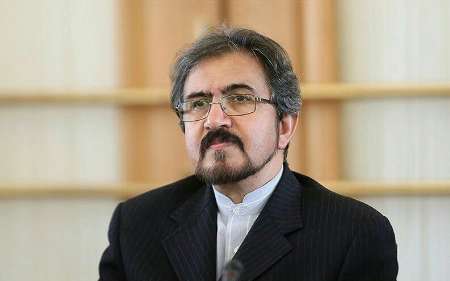
Iranian Foreign Ministry spokesman Bahram Qassemi
Press TV – February 16, 2017
Iran says Israel’s atomic weapons arsenal represents the biggest threat to world peace, dismissing new allegations by Israeli and US leaders against Iran’s nuclear program as “hollow” and “worthless”.
The reaction on Thursday came a day after US President Donald Trump called Iran’s nuclear program a threat to Israel during a news conference with Israeli Prime Minister Benjamin Netanyahu at the White House.
“The statements did not contain any new point except being a repetition of hollow and worthless allegations against Iran’s peaceful nuclear program,” Foreign Ministry spokesman Bahram Qassemi said.
Terming the nuclear deal with Iran as “the worst” agreement ever, Trump pledged to impose new sanctions on Iran to prevent the country from what he called developing a nuclear weapon.
Qassemi said, “Such claims are repeated while the International Atomic Energy Agency, in its reports, has time and again confirmed Iran’s nuclear program as peaceful – a fact which has been verified many times by different countries.”
“The bitter truth is that these remarks and inadmissible allegations are repeated by a regime which is not committed to any international law and convention and has hundreds of warheads in its atomic arsenal,” he said.
Israel, Qassemi said, “is viewed as the biggest threat to peace and security in the Middle East and the world and its ponderous file of endless atrocities and inhuman actions against the oppressed Palestinian people and other neighbors is recorded in numerous UN reports.”
In their joint news conference, Netanyahu applauded Trump for his harsh stand on Iran which was slapped with new sanctions by the new US administration in violation of the nuclear accord, known as the Joint Comprehensive Plan of Action (JCPOA).
On Tuesday, IAEA Director General Yukiya Amano confirmed that Iran was implementing the nuclear agreement under which Tehran has undertaken to scale back its nuclear program in return for lifting of the sanctions.
Qassemi said, “Nuclear weapons are haram (forbidden) from the religious standpoint, corresponding with the fatwa of the Eminent Leader of the Islamic Revolution (Ayatollah Seyyed Ali Khamenei) and have no place in Iran’s military doctrine.”
The Islamic Republic, he said, will seriously continue to pursue those components of its peaceful nuclear program which are validated by the United Nations Security Council within the framework of the JCPOA.
Under Resolution 2231, the Security Council has endorsed the nuclear deal, which went into effect in January 2016.
On his campaign trail, Trump threatened to annul the deal, which he has lambasted as “the worst accord ever negotiated” and “one of the dumbest” ones he has come cross.
Washington has taken a tougher line on Iran since Trump took office on January 20. Last month, the US said it had put Tehran “on notice” after the Islamic Republic tested a ballistic missile which is not prohibited by the nuclear deal.
Iran missile work not violating UN bans: Russia’s Churkin
Press TV – February 8, 2017
A senior Russian diplomat has expressed surprise at an outcry provoked by the new US administration over Iranian missile work, saying Tehran’s missile tests are not violating any UN bans, legally speaking.
“This outcry about Iran’s ballistic missile launches. I was surprised to hear even American experts speaking on CNN and calling it a violation of bans by the UN Security Council,” said Russia’s UN Ambassador Vitaly Churkin in an interview with RT published Tuesday.
He was referring to Resolution 2231 adopted by the Security Council in July 2015 to underpin the landmark nuclear deal inked days earlier between Tehran and the P5+1 group of states, namely Russia, China, France, Britain, the US plus Germany.
The document terminated the provisions of previous UN resolutions, calling on Iran “not to undertake any activity related to ballistic missiles designed to be capable of delivering nuclear weapons, including launches using such ballistic missile technology.”
Explaining the legal language used in Resolution 2231, Churkin said the document merely “calls” on Tehran not to conduct tests of missiles capable of carrying nuclear weapons, but does not impose any ban on Tehran.
“Those bans were there before, all those bans were lifted,” said the Russian official. “Technically or legally you cannot argue that they are violating any kind of a prohibition.”
He also said no evidence has been provided to support the claims that Tehran’s missiles are capable of carrying nuclear warheads.
Late last month, Washington’s UN envoy Nikki Haley slammed a missile test by Iran as “absolutely unacceptable.”
US President Donald Trump’s National Security Advisor Michael Flynn also said following the January 29 test that Washington was “officially putting Iran on notice,” claiming that the launch was “in defiance of UN Security Council Resolution 2231.”
The Islamic Republic has, on numerous occasions, asserted that its missiles are not designed to be capable of carrying nuclear warheads, and that it is not involved in such missile work.
In March 2016, Russia blocked the potential ratification of a United Nations Security Council resolution against Iranian missile tests in a session called by the former US administration.
Explaining Russia’s opposition to an anti-Iran resolution, Churkin said back then that in the view of veto-wielding Russia, Resolution 2231, which endorsed a nuclear deal between Iran and six other countries, did not legally prohibit Iranian ballistic missile tests.
He said the text explicitly did not ban Iranian missile test-launches.
“A call is different from a ban, so, legally, you cannot violate a call, you can comply with a call or you can ignore the call, but you cannot violate a call,” Churkin said. “The legal distinction is there.”
Elsewhere in the interview, Churkin warned that the United States’ tensions with Iran might work to affect Moscow’s relations with Washington.
“There are so many complexities, so many issues which can create additional problems, including problems which might affect our relations with the US,” he said.
The envoy cautioned the US against behaving emotionally instead of relying on facts when it comes to Iran.
“In international life, you have to differentiate between your emotions, what you want to see and what you have the right to expect from another country,” he said.
Churkin further took on US President Donald Trump’s recent comment to Fox News that the Islamic Republic is “terrorist state number one.”
The envoy pointed to the active role the Islamic Republic is playing in the fight against the Daesh Takfiri terror group, which is mainly active in Syria and Iraq.
Iran has been providing military advisory support to the countries’ respective militaries in their fight against the terrorists, an assistance that has been met with appreciation from both governments.
On Monday, Kremlin spokesman Dmitry Peskov also reacted to Trump’s remarks, saying, “We disagree with this postulate.”
Israel ‘Trying to Turn US, Europe Away’ From Iran
Sputnik – 08.02.2017
Prime Minister Benjamin Netanyahu has urged Washington, London and their allies to create a “joint front” against Iran, citing Tehran’s supposedly aggressive behavior as the reason. Iranian analysts told Sputnik Persian that Israel “has no right” to come up with such initiatives since it is the main reason behind regional tensions.
“Israel is the main source of all conflicts in the Middle East,” Hossein Ruyvaran, an expert on the Middle East and the Arab world who teaches at the University of Tehran, said. “Since this state was established in 1948, the region has been plagued by many wars sparked by Israel – in 1948, 1956, 1973, 1982, 2006, 2008, 2012 and 2014. The Israeli regime is the main reason for regional tensions due to its ambitions. This regime has tried to change the geopolitical orientation in the region.”
These remarks came in response to Netanyahu calling on the United States and the United Kingdom to adopt a tough stance on Iran due to Tehran’s ostensibly “defiant aggression” and in light of the country’s “defiance against the international order.”
“Claims that Iran is the key threat [in the Middle East] and the main reason behind all troubles in the region are groundless,” Ruyvaran said. “Israel has tried to use these accusations to turn the West against Iran. Meanwhile, the UN Security Council has adopted Resolution 2234 which strongly condemns Israel’s unlawful settlements on occupied lands.”
Hassan Hanizadeh, Iranian political analyst and former chief editor of the Mehr News Agency, expressed similar sentiments. He referred to Netanyahu’s remarks as “anti-Iranian political propaganda.”
“Not many countries are ready to support Israel since everyone knows that Israel has occupied Arab lands, including the Golan Heights, Gaza and East Jerusalem,” he said. “This is why Israel has no right to accuse Iran of aggression since it itself is an aggressor. … Israel has no right to mention or urge to create a front against Iran. If a front against aggression must be created, then it should be targeted against Israel, not Iran.”Netanyahu’s comments came after Iran had tested a new ballistic missile last week. The United States imposed new sanctions on Tehran, with US President Donald Trump tweeting that the Islamic Republic has been “formally put on notice” for conducting the test. He added that Iran was “playing with fire.”
Tehran has repeatedly said that its missile program is defensive in nature and does not threaten other countries. On Monday, Iranian Foreign Ministry spokesman Bahram Qasemi said that the test was not intended “to send a message” to the new US administration.
China protests to US over new Iran sanctions

China’s Foreign Ministry spokesman Lu Kang
Press TV – February 6, 2017
China says it has protested to the US for putting Chinese companies and individuals on a new sanctions list targeting Iran.
Foreign Ministry spokesman Lu Kang said on Monday Beijing had “lodged representations” with Washington after Trump’s administration imposed sanctions on 25 people and entities on Friday for trade with Iran.
“We have consistently opposed any unilateral sanctions,” Lu told a regular press briefing in Beijing.
Unilateral US sanctions in the past have infuriated China. Last March, Beijing was outraged after the US government punished China’s largest telecom equipment maker ZTE Corps for alleged violations of sanctions on Iran.
China’s Foreign Ministry expressed anger at the action, saying it is “opposed to the US citing domestic laws to place sanctions on Chinese enterprises.”
The new US sanctions list includes two Chinese companies and three Chinese people. Those on the list cannot access the US financial system or deal with American companies.
They are subject to secondary sanctions, meaning foreign companies and individuals are prohibited from dealing with them or risk being blacklisted by the United States.
China has close economic and diplomatic ties with Tehran. Executives of two Chinese companies included on the list said they had only exported “normal” goods to Iran and didn’t consider they had done anything wrong.
Lu said such sanctions, particularly when they harmed the interests of a third party, were “not helpful” in promoting mutual trust.
China has said it is “seriously concerned” about President Donald Trump’s recent hawkish rhetoric on Beijing. Experts say the new administration’s moves are set to further strain relations between China and the US.
Trump Foreign Policy in Turmoil
By Renee Parsons | CounterPunch | February 6, 2017
Within days of the flawed roll-out for Trump’s Executive Orders regarding Border Security and Immigration Enforcement Improvements and Enhancing Public Safety in the Interior of the United States, the President’s promises on the campaign trail and his Inaugural Address that the US would not pursue regime change or initiate new foreign interventions and that his administration would pursue a new foreign policy based on engagement, have been called into question.
The week began with President Trump praising, as a success, the administration’s first attack on al Qaeda in Yemen which inexplicably included special ops from UAE. Reports state that the group of Navy Seals unexpectedly walked into an hour long fire fight which contained elements of an ambush including hand grenades and a certain amount of panic with indiscriminate gunfire; leaving one Navy Seal dead with several injured, at least a dozen civilians dead including an eight year old girl and destroyed a $75 million Osprey – you might say the raid was more of the same kind of failure with which the US military has some long-standing familiarity. Black Hawk Down in 1993 comes to mind.
Described by Trump press secretary Sean Spicer as a “very, very well-thought out and executed raid”, the mission began on November 7 when the Pentagon presented President Obama with a plan. From there, the proposed raid went through all the necessary channels arriving in front of Trump Defense Secretary James Mattis on January 24th. Mattis approved and forwarded the plan to the White House for the President’s approval which he gave the next day at a dinner which included several key staff members including special assistants to the White House Jared Kushner and Steve Bannon and after consulting with National Security Advisor General Michael Flynn.
All of the reviews and approvals, however, did not guarantee success as there is reason to believe that the alQ stronghold was expecting an American raid with armed female and AQ snipers on a rooftop. After the raid, anonymous U.S. military officials told Reuters that “Trump approved his first covert counterterrorism operation without sufficient intelligence, ground support or adequate backup preparations.” In addition, Reuters quoted three unnamed US military officials that “the attacking SEAL team found itself dropped into a reinforced al Qaeda base defended by landmines, snipers, and a larger than expected contingent of heavily armed Islamist extremists.” This does not sound like a surprise raid but more like a disaster waiting to happen.
These unprecedented ‘leaks’ indicate an undercutting of the Administration by anonymous military officials who are in direct contradiction to the timeline as presented by Spicer that the entire plan had been appropriately vetted by the government’s foreign policy structure – with the exception of Rex Tillerson who had not yet been confirmed as Secretary of State.
It has been said that the mission needed to receive a green light to take advantage of a Moonless night and that the mission was to acquire certain computer hard drives with speculation that there was some urgency of obtaining the intel contained potentially embarrassing data regarding the interconnections between the terrorists and certain foreign nations which support terrorists. In any case, it was a botched mission that was poorly planned and executed and appears to have a major security problem given the unauthorized disclosures by anonymous military officials who disagreed about what the public has been told about the raid. So which is it – was the raid properly vetted and the right questions asked – or was it insufficiently vetted?
US CommCentral released the clip that they say was obtained from a series of videos during the raid which shows a black hooded individual giving instructions on how to make a do-it-yourself bomb. The clip, which has no audio and its written instructions are written in perfect English, is now reported to be a decade old AQ training video [sourced from SITE]. It is assumed that the President’s Monday trip to Central Command and Special Ops in Florida was not just a get-to-know-you visit.
As if that were not enough faux pas for the week, General Flynn took an unprecedented place on center stage at a press conference sounding like the Commandant of Stalag 19, stridently warning Iran and spouting old, worn out rhetoric that the “Trump administration condemns such actions by Iran that undermines security, prosperity and stability throughout and beyond the Middle East which places American lives at risk. As of today, we are officially putting Iran on notice.”
The accusations came after Iran reportedly fired a test of a medium-range ballistic missile on February 1st with Iranian Defense Minister Hossein Dehghan stating that “The test did not violate the nuclear deal or (U.N.) Resolution 2231″ and that “… we will not allow foreigners to interfere in our defence affairs,” striking a chord with Trump’s Inaugural statement that “it is the right of all nations to put their own interests first.”
On the heels of Flynn’s rant, the Trump administration quickly announced economic sanctions on twenty five Iranian individuals and entities that have unnecessarily escalated tensions with:
“The Islamic Republic of Iran is the world’s leading state sponsor of terrorism and engages in and supports violent activities that destabilize the Middle East.”
“The Trump Administration will no longer tolerate Iran’s provocations that threaten our interests. “
“The days of turning a blind eye to Iran’s hostile and belligerent actions toward the United States and the world community are over.”
The Flynn/Trump obsession against Iran has little basis in rational thought and is not the kind of nation-building and “forming of new alliances” that the President promised in his Inaugural address. Flynn may be myopic on the subject of Iran since Iran supported the insurgents in Iraq during the US invasion in 2003 but he may also be blowing smoke with the realization that the administration must know that any serious effort to eliminate ‘radical Islamic terrorists’ will be dependent upon Iran’s participation.
As Ron Paul has repeatedly suggested, Iran has every reason to want its own nuclear capability, if only as a defensive mechanism to protect itself from Israel and the US. A spokesperson for the EU foreign policy chief in Brussels said that the “Iranian ballistic missile program was not part of the 2015 nuclear pact and hence the tests are not a violation of it.”
On February 3rd, President Trump tweeted “Iran is playing with fire – they don’t appreciate how “kind” President Obama was to them. Not me!” to which Iranian Foreign Minister Javad Zarif tweeted “We will never, I repeat never, use our weapons against anyone, except in self-defense. Let us see if any of those who complain can make the same statement.”
If the Trump Administration believes Iran is in violation of the Plan, they have the option to initiate a dispute resolution process or to engage the International Atomic Energy Agency (IAEA) which has regular access to all Iranian nuclear facilities to verify that Iran is in compliance. Iran says it will impose its own sanctions and release its own list of US-related ‘entities’ entwined with supporting terrorists.
With an imminent visit to the US, it is not outside the realm of possibility that all this Tough on Iran talk is to impress Bibi Netanyahu who hailed Flynn’s statement with “Iranian aggression must not go unanswered” which sounds reminiscent of Sen. John McCain. As if to tone down the US inflammatory reaction, new Defense Secretary James Mattis said he sees ‘no need to increase number of troops in the Middle East” in response to the Iranian missile crisis.
Of special interest will be how Trump deals with whatever demands Netanyahu has in his pocket and how Trump’s high regard for Israel may be affected, assuming that he is already apprised of Israel’s role in funding ISIS in Syria and its support and participation in fomenting terrorist actions throughout the Middle East. If Flynn/Trump are concerned with who is causing instability in the Middle East, they have no further to look than Saudi Arabia and Israel. It is difficult to image that Trump does not already have an appreciation for Netanyahu’s expectation to continue to run the show otherwise known as US foreign policy.
As if the Trump foreign policy objectives had not already experienced a week of upsets, contradictions and overall confusion, UN Ambassador Nikki Haley’s diatribe against Russia was stunning in its vitriolic attack on Russia alleging “aggressive actions of Russia” and “dire situation in eastern Ukraine is one that demands clear and strong condemnation of Russian actions.” In addition, Haley asserted, in contradiction to President Trump’s previous position on Crimea that “The United States continues to condemn and call for an immediate end to the Russian occupation of Crimea” and that “Crimea is a part of Ukraine. Our Crimea-related sanctions will remain in place until Russia returns control of the peninsula to Ukraine.”
In his February 3rd press conference, Trump press secretary backed up Haley with “I think Ambassador Haley made it very clear of our concern with Russia’s occupation of Crimea. We are not — and so I think she spoke very forcefully and clearly on that.”
Russia’s UN Ambassador Vitaly Churkin responded that ‘the belligerent rhetoric toward Moscow over the Ukrainian crisis is nothing new” and that “it is Kiev that has escalated the situation there”. He also cited “OSCE reports and surveillance data which places the blame squarely on the Ukrainian government and not the rebel forces.”
After the initial shock at Haley’s level of hostility, an immediate reaction was that as a former Republican Governor of South Carolina, Haley had to have a working relationship with Senator Lindsay Graham (R-SC), the alter ego of Sen. John McCain who remains an irrational proponent of intervention wherever possible around the globe and that her maiden speech before the Security Council had somehow gone askew as a more combative, divisive script found its way into her file.
However, U.N. ambassador Nikki Haley, met with her Ukrainian counterpart “to reaffirm the United States’ support for the sovereignty and territorial integrity of Ukraine,” according to a statement.
In view of another pending humanitarian disaster as a result of US intervention in Ukraine, the best that the State Department could do, prior to Tillerson taking office, was to issue a statement calling for a ceasefire and return to implementation of the Minsk Agreement.
It is reported, though unconfirmed, that soon after her speech, Haley visited Russian Ambassador Churkin at his home, presumably to reassure him that there was a bureaucratic snafu and that US policy toward Russia was not accurately reflected in her introductory remarks.
As a result of a week of significant snafus, the Trump Administration has either caved in to neo-con pressure like Eliot Abrams (convicted of lying to Congress during Iran-Contra) who is currently vying for the Deputy Secretary position at the State Department or they are dealing with repeated staff blunders and turmoil that are seriously threatening any hope of credibility for Trump’s oft-stated foreign policy goals.
Renee Parsons has been a member of the ACLU’s Florida State Board of Directors and president of the ACLU Treasure Coast Chapter. She has been an elected public official in Colorado, an environmental lobbyist and staff member of the US House of Representatives in Washington DC. She can be found on Twitter @reneedove31
Israel PM Netanyahu greeted by pro-Palestine protests on London visit
RT | February 6, 2017
Israeli Prime Minister Benjamin Netanyahu will face hundreds of protesters when he meets with his British counterpart Theresa May in London on Monday morning.
Pro-Palestine activists have organized a demonstration outside Downing Street, where Netanyahu is due to discuss among other things the rising ‘threat’ of Iran.
A Facebook page advertising the event claims to have support from several activist organizations, including Palestine Solidarity Campaign, Stop the War Coalition, War on Want and the Muslim Association of Britain.
Some 268 people have confirmed they will attend, according to the page.
Before flying to Britain, Netanyahu said he wants to “tighten” relations with the UK in the face of the “extraordinary aggression” from Iran after the Islamic Republic tested a ballistic missile over the weekend. Tehran denies the test was in breach of the 2015 nuclear deal.
“We are in a period of diplomatic opportunities and challenges. The opportunities stem from the fact that there is a new administration in Washington, and a new government in Britain,” Netanyahu said.
“I intend to speak with both of them about tightening relations, between each side and Israel and trilaterally.”
According to the Telegraph, a Downing Street spokesman said May was expected to raise concerns about illegal settlement building, but it would only form a small part of their discussions.
Netanyahu’s visit comes six weeks after Britain assisted in the passage of a UN Security Council resolution condemning Israel’s illegal settlements in the West Bank as a “flagrant violation under international law.”
The resolution was able to pass because the United States made the unusual choice not to exercise its veto power.
Britain played a key role in brokering the resolution, according to the Guardian, which claimed the Foreign Office did not deny it had been involved in the drafting process.
Netanyahu reacted furiously to UNSC resolution 2334, reserving his strongest condemnation for outgoing US President Barack Obama.
In a sign of frustration with London, Netanyahu summoned Britain’s ambassador on Christmas Day for a telling-off.
Nine other ambassadors were also summoned by the Israeli PM, including the US ambassador.
Iran announces major oil, gas discoveries
Press TV – February 5, 2017
Iran has confirmed the discovery of 15 billion barrels of new in-place oil reserves, but a top official says huge investments and state-of-the-art technology are required to exploit those reserves.
Ali Kardor, the managing director of the National Iranian Oil Company (NIOC), was quoted by domestic media as saying that around 2 billion barrels of the newly-discovered reserves were “recoverable”.
Kardor added that around 1.8 trillion cubic meters (tcm) of in-place reserves of natural gas – around half of which he said were recoverable – had also been discovered. However, he did not specify when and where the new discoveries had been made.
Meanwhile, NIOC Director for Corporate Planning Affairs Karim Zobeidi said the overall volume of Iran’s oil reserves stood at 771.53 billion barrels, of which around 102 billion barrels would be recoverable at a rate of 24.6 percent.
Zobeidi added that Iran’s in-place reserves of natural gas stand at 55 tcm of which 33 tcm could be recovered at a rate of around 70 percent.
The NIOC chief was further quoted by the Persian-language newspaper Iran as saying that a new round of tenders – scheduled for the next few weeks – would pave the ground for international energy companies to help develop the country’s oil and gas reserves.
Kardor also said that Iran’s production of high-quality oil would reach four million barrels per day (mb/d) before April – what could be a landmark success for the country after the sanctions that had kept production a little above 2 mb/d were lifted in January 2016.
US senators seek additional sanctions against Iran
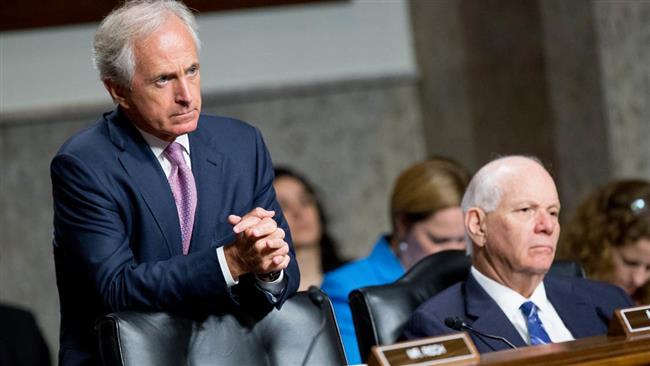
US Republican Senator Bob Corker (left) and Democratic Senator Ben Cardin in the US Senate (file photo)
Press TV – February 3, 2017
A number of US senators have backed additional sanctions against Iran over the country’s missile program, arguing that Tehran “must feel sufficient pressure.”
Twenty-two senators, including Bob Corker (Republican from Tennessee) and Ben Cardin (senior Democrat from Maryland) pronounced their support in a letter they sent to US President Donald Trump on Thursday. Corker is the chairman of the US Senate Committee on Foreign Relations.
“Full enforcement of existing sanctions and the imposition of additional sanctions on Iran for its ballistic missile program are necessary,” the senators wrote.
They added that “we look forward to supporting your Administration’s efforts to hold Iran accountable.”
The Reuters news agency reported on Thursday that the Trump administration is expected to announce new sanctions against Iran on Friday to ratchet up pressure on the Islamic Republic.
This is while the US president said on Thursday that “nothing is off the table” in terms of a response to Iran’s latest ballistic missile test.
Hours earlier, Trump said the White House has formally put Tehran on notice over its recent ballistic missile test.
“Iran has been formally PUT ON NOTICE for firing a ballistic missile. Should have been thankful for the terrible deal the U.S. made with them!” Trump tweeted, echoing his national security adviser’s comments a day earlier.
‘Iran Non-Nuclear Sanctions Act of 2017’
Also on Thursday, a group of Republicans in the US House of Representatives introduced a bill for new sanctions on Iran as the Trump administration is mulling anti-Iran measures.
The measure, called the Iran Non-Nuclear Sanctions Act of 2017, seeks sanctions against Tehran for “supporting terrorism, abusing human rights, and testing ballistic missiles.”
It was presented by New York Representative Lee Zeldin, Illinois Representative Peter Roskam, New Jersey Representative Leonard Lance and Colorado Representative Doug Lamborn.
The proposed legislation comes after US House Speaker Paul Ryan said he would support imposing additional sanctions on Iran over its recent missile test.
“I would be in favor of additional sanctions on Iran,” Ryan told reporters on Thursday at a weekly press conference.
“We need to have a tough-on-Iran policy … We should stop appeasing Iran,” he said.
Washington has said Sunday’s ballistic missile test was in violation of the 2015 nuclear deal between Iran and the P5+1 group of countries.
Tehran insists its missile tests do not breach any UN resolution because they are solely for defense purposes and not designed to carry nuclear warheads.
Arms control experts have also said that Iran’s missile tests are not banned under the nuclear agreement and the Security Council resolution, because Iran’s missiles are not meant to deliver nuclear warheads.
Resolution 2231 calls on Iran “not to undertake any activity related to ballistic missiles designed to be capable of delivering nuclear weapons, including launches using such ballistic missile technology.”
Iran sanctions: US Treasury lists 13 individuals, 12 business entities
RT | February 3, 2017
The US government has blacklisted 13 individuals and a dozen businesses under the Iran sanctions authority, a day after President Donald Trump’s administration threatened a response over Tehran’s ballistic missile tests.
The Treasury Department posted a listing on Friday, naming the individuals and the companies added to the sanctions list. Eight of the individuals are listed as Iranian citizens, three appear to be Chinese, and two Arab.
Most of the businesses listed in the announcement are based in Iran, though one of the entities is located in the United Arab Emirates, two are in China, and three are in Lebanon.
“Today’s action is part of Treasury’s ongoing efforts to counter Iranian malign activity abroad,” said John E. Smith, acting director of the Treasury Department’s Office of Foreign Assets Control.
“Iran’s continued support for terrorism and development of its ballistic missile program poses a threat to the region, to our partners worldwide, and to the United States,” Smith said. “We will continue to actively apply all available tools, including financial sanctions, to address this behavior.”
Meanwhile, the guided missile destroyer USS Cole arrived in the waters off the coast of Yemen on Friday, where it will conduct patrols to “protect waterways” from the Houthi rebels, unnamed US officials told reporters.
“Iran is unmoved by threats as we derive security from our people,” Iran’s foreign minister Mohammad Javad Zarif said ahead of the announcement. “We will never use our weapons against anyone, except in self-defense,” he added later.
Featured Video
Houthis Keep Advancing as the Red Sea Crisis Deepens
or go to
Aletho News Archives – Video-Images
From the Archives
15 Saudi ‘hijackers’ were CIA agents working for US: Scholar
Press TV – April 13, 2016
Fifteen of the 9/11 “hijackers” from Saudi Arabia were CIA agents working for the United States government, which was seeking to destroy the Middle East for Israel and to double the American military budget, says Dr. Kevin Barrett, an American academic who has been studying the events of 9/11 since late 2003…. continue
Blog Roll
 Aletho News
- Russia Just Struck the Eyes of NATO’s War Machine in Ukraine
- Russia summons UK charge d’affaires over Kiev drone support
- NATO member warns bloc seeking pretext for war with Russia
- Macgregor: We Haven’t Seen the Worst of the Iran War Yet
- ‘We are not like everyone else’ laws that bind other nations do not apply to Israel, says Likud lawmaker
- Report: Saudi Arabia seeks allies’ assistance as missiles deplete amid war on Yemen
- Fuel Crisis Deepens: Pakistan Warns Tanker Attack in Red Sea Would Be an ‘Act of War’
- ‘Bucha massacre’ a false flag orchestrated by UK – Moscow
- China Rejects Outside Pressure on Trade Ties After New US Russia Sanctions Bill
- Houthis Keep Advancing as the Red Sea Crisis Deepens
- If Americans Knew
- Why do we let Zionists decide what we can and can’t say?
- US welcomes Israeli, Iranian delegations to UN, but not Palestinians – Daily Update
- Biden’s Genocide Accomplices Targeted by New Accountability Campaign
- AIPAC’s Network Has Already Spent $67.2 Million to Shape the Midterm Elections
- Jewish Supremacist Manufacturing a Civilizational Threat to License Bigotry
- US bans Palestinian president from speaking at the UN
- Israeli Forces Detain Journalist Alaa al-Rimawi amid Widespread West Bank Raids
- Even a pro-Israel Congress member has put a hold on 40,000 one-ton bombs to Israel
- As Gaza crumbles, Israel preps new ground invasion – Daily Update
- ‘We are not like everyone else’ laws that bind other nations do not apply to Israel, says Likud lawmaker
- No Tricks Zone
- New Study: ‘Global Drought Shows No Detectable Recent Acceleration Under Climate Warming’
- Economic Masterminds: German Socialists Suggest Taxing Productivity Gains Stemming From Using AI
- The South China Sea Has Not Been Cooperating With The Climate Change Narrative
- Energy Crisis: Germany Enters Heating Season With Historically Low Gas Reserve Fill Levels
- New Study: The Antarctic Ice Sheet Gained Mass From 2020-2024 Due To Staggering Snow And Ice Accumulation
- Study: Ocean Heating Rates From Thousands Of Years Ago ‘Dwarf’ Modern Ocean Heating Rates
- Climate Extremists Target, Attack Large-Scale Power Grid Infrastructure In Germany!
- New Study: Antarctic Ice Melt Has Contributed Less Than 1 Centimeter To Sea Level Rise In The Last 30 Years
- Fear Of Debate: Alarmist German Climate Scientist Calls On Mainstream Media To Discredit Skeptic Voices
- End-Of-August Arctic Sea Ice Extent Hasn’t Fallen In 20 Years, Official Data Show!
 Aletho News