US Senate will vote on Iran sanctions bill in January
Press TV – December 28, 2014
Hawkish Republican Senator Lindsey Graham has announced that the US Senate will vote on Iran sanctions legislation next month despite ongoing nuclear negotiations.
“In January of next year, there will be a vote on the Kirk-Menendez bill, bipartisan sanction legislation,” he said in a press conference with Israeli Prime Minister Benjamin Netanyahu on Saturday.
He was referring to sanctions legislation drafted by Senate Foreign Relations Chairman Bob Menendez and Sen. Mark Kirk.
 The bill that would impose more sanctions against Iran came one month after Tehran and six world powers reached an interim nuclear agreement in Geneva in November 2013.
Several important lobby groups, including the American Israel Public Affairs Committee (AIPAC), are working hard to build support for the measure.
The White House has said President Barack Obama will veto the bill if it is passed.
“We continue to believe that adding on sanctions while negotiations are ongoing would be counterproductive,” White House spokesman Josh Earnest said last month.
The Obama administration is under pressure to put additional sanctions against Iran following the extension of nuclear talks between Tehran and the P5+1 countries — the US, Britain, France, Russia, China and Germany.
Last month, Iran and the six world powers agreed to extend the negotiations.
They also agreed that the interim deal they had signed in Geneva last November remain in place during the remainder of the negotiations until July 1, 2015.
Bad Reporting and Nuclear Alarmism Return to The Guardian
By Nima Shirazi | Wide Asleep in America | December 22, 2014

Tehran Bureau/Digarban/The Guardian article from December 17, 2014
Last week, the Iran-focused blog, Tehran Bureau, housed online by The Guardian, posted an alarming headline: “Senior cleric: Iran has knowledge to build a nuclear bomb.” The accompanying article, co-authored by Tehran Bureau‘s new partner Digarban, was posted below a guaranteed-to-scare image simultaneously containing three beardy clerics, two Supreme Leaders, and an angry looking partridge in a pear tree.
The report announced:
An official site belonging to the Islamic Revolutionary Guard Corps (IRGC) has quoted a senior conservative cleric as saying that Iran has attained the knowledge to build a nuclear bomb but doesn’t want to use it.
The IRGC site of Kurdistan province today quoted Ayatollah Ahmad Khatami, a leading cleric who often leads Friday prayers in Tehran, as telling a group of IRGC commanders in Iran’s Kurdistan province that Iran had the expertise to enrich uranium not just to the 5% and 20% levels required for civilian uses but to higher levels required for a bomb. “[We] can enrich uranium at 5% or 20%, as well as 40% to 50%, and even 90%,” he was quoted as saying. But he said the Islamic republic believed that the building of a bomb is religiously forbidden.
Furthermore, Tehran Bureau boasts, “Khatami’s speech was widely covered by the Iranian press, but the remarks about Iran’s nuclear bomb-making capabilities were not reported.”
What an exclusive! What breaking news!
Except not really.
Before addressing the details of the disingenuous reportage, a larger point looms. Tehran Bureau‘s headline and lede claiming that, according to a senior cleric, Iran now has “the knowledge to build a nuclear bomb” are not only irresponsible and misleading, they are genuinely incorrect.
The reporting wholly conflates uranium enrichment with nuclear bomb-making; this is absurd. Obtaining enriched uranium at weapons-grade levels (90% or more) is but one component of manufacturing a nuclear weapon, but one that pales in relative comparison to mastering the detonation process, requisite missile technology, and making a bomb deliverable. It’s like standing next to a pile of steel, plastic and glass, and claiming an ability to make a Ferrari.
Iran has the technical ability to enrich uranium up to roughly 19.75%; it began enriching to this level in February 2010, under strict IAEA monitoring. By early 2013, Iran had already begun voluntarily converting its stockpile of 19.75% LEU to reactor fuel, a process rendering such material incapable of weaponization. Conversion of all remaining 19.75% stocks was agreed to under the multilateral interim nuclear deal struck between Iran and six world powers in November 2013. Earlier this year, the IAEA confirmed that Iran had completed the conversion process, leaving no 19.75% LEU in the country.
As is often pointed out, the technical capacity to enrich uranium to nearly 20%, “accomplishes much of the technical leap towards 90% – or weapons-grade – uranium.”
Last year, Rob Wile explained in Business Insider:
Uranium enrichment has a kind of momentum curve, where it takes much more effort to go from 0% enriched to 20% enriched than it does 20% enriched to 90% enriched. Here’s the chart: The vertical axis represents “effort” as measured in things called Separate Work Units, which is basically the given quantity of uranium measured in kilograms needed to reach a given level of enrichment. The horizontal axis is enrichment percentage.
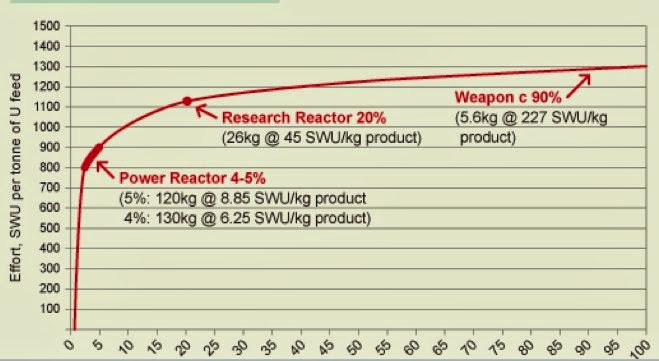
By virtue of having functional uranium enrichment facilities and technical expertise to spin centrifuges, Iran – like any other nation with that technology – can create weapons-grade material if it decided to. But this doesn’t mean it can already “build a nuclear bomb.”
Moreover, Tehran Bureau‘s paraphrased quote from Khatami is itself misleading. The source of the quote can be found here, although Tehran Bureau does not provide a link over to it, a highly unprofessional reporting practice.
Mohammad Ali Shabani, a doctoral researcher at the University of London’s School of Oriental and African Studies (SOAS), notes that the focus of Khatami’s speech before the IRGC gathering was not the nuclear issue, but rather Iran’s Kurdistan province and Syria. While Khatami is by no means an expert on nuclear technology, when he did touch briefly on the subject, this is what he said, according to Shabani’s translation:
[But] even if we could build a bomb, we would not do such a thing as our Guardian Jurist [Ayatollah Khamenei] deems use [of such weapons] impermissible (haraam). The West’s concerns are not about a bomb, but Iran’s capabilities; just as our nuclear scientists enriched uranium from 5% to 20%, undoubtedly they can [do so] to 40%, 50% and finally 90%, which is needed in order to build a bomb, and they [Iran’s scientists] posses this knowledge. Our role model is our Dear Prophet, who even forbade the poisoning of an enemy city, and this is our evidence [basis] for not building a bomb.
This is a political statement, not a technical declaration. Nowhere does Khatami state that Iran can build a nuclear weapon. Tehran Bureau‘s reporting also omits the fact that such statements about such scientific capabilities and the nation’s official, absolute prohibition on nuclear weapons are nothing new for Iranian officials.
For instance, in February 2010, then-Iranian president Mahmoud Ahmadinejad announced that “right now in Natanz, we have the capacity to enrich uranium at high levels.” He added, “We have the capability to enrich uranium more than 20 percent or 80 percent but we don’t enrich (to this level) because we don’t need it.”
A couple years later, in April 2012, The Guardian itself reported on a nearly identical statement made by Gholamreza Mesbahi Moghadam, a minister of the Iranian parliament. The framing in both that piece and the latest report are very similar:
Iran has the technological capability to produce nuclear weapons but will never do so, a prominent politician in the Islamic republic has said.
The statement by Gholamreza Mesbahi Moghadam is the first time an Iranian politician has publicly stated that the country has the knowledge and skills to produce a nuclear weapon.
Moghadam, whose views do not represent the government’s policy, said Iran could easily create the highly enriched uranium that is used to build atomic bombs, but it was not Tehran’s policy to go down that route.
Moghadam told the parliament’s news website, icana.ir: “Iran has the scientific and technological capability to produce [a] nuclear weapon, but will never choose this path.”
The 2012 Guardian report sparked false conclusions and predictable reactions from Israeli officials, who eagerly exploited the non-news for political posturing. The following year, a number of different reports published by The Guardian contained bad analysis, dubious allegations and sloppy journalism.
Unfortunately, The Guardian, now in partnership with Tehran Bureau, is at it again.
MTV Glorifies Venezuela’s Barricade Protests in New Reality TV Show
By Z.C. Dutka | Venezuelanalysis | December 18, 2014
Santa Elena de Uairen – US entertainment channel MTV has signed a contract with a Venezuelan media group to purchase extensive footage of the violent anti-government protests that wracked the South American nation earlier this year, to be featured in the new reality series Rebel Music.
The footage, captured by citizen reporters with GoPro cameras, show masked and shirtless men throwing handmade grenades and wreaking general havoc in a coordinated effort to force president Nicolas Maduro’s resignation that lasted from February to May this year.
43 people were killed during that time, the majority while trying to clear rubbish from or cross the barricades set up by demonstrators. Numerous public institutions including hospitals, universities, and transportation agencies were also burnt down in protest.
Reporte Confidencial became known for editing the GroPro material nightly, adding in a pumping dubstep track befitting a London club scene, and posting the finished videos to YouTube, where they received thousands of views from around the world.
It is this material MTV now seeks to own.
The reality show Rebel Music claims to be inspired by young people who “are raising their voices to demand change for a better future…. often putting their lives on the line,” according to the show’s website.
With this premise, many Venezuelans fear the show’s narrative will grant hero status to those hardcore protestors – whose tactics were so violent they effectively drove away a majority of opposition supporters, according to polls.
Furthermore, as the White House approves sanctions against Venezuelan government officials, others accuse the MTV program of dovetailing too neatly with US foreign policy. […]
The series, which first aired last month, will also feature voices of dissent in Myanmar, Iran, Senegal, Turkey and US Native American communities.
The US media has made no effort to hide its contempt of Venezuela’s socialist government since the Hugo Chavez’s election in 1999, while Chavez, in turn, repeatedly accused Washington of funding subversive movements to remove him from office.
Shepard Fairey and USAID
Venezuelan political analyst Luigino Bracci pointed out the paradoxical use of red stars and other archetypal communist symbols in an op-ed for Caracas newspaper Alba Ciudad last week, which he attributes to the show’s executive producer, Shepard Fairey.
Fairey is the pop art empresario behind the OBEY campaign and the red and blue stencil portrait of Barack Obama, which featured the word HOPE and was used universally throughout the US president’s initial campaign.
Though he calls himself apolitical, Fairey has been criticized for reproducing communist Cuban and Korean poster art with slight twists and selling them as his own. In a 2008 interview with the magazine Mother Jones, reporter Liam O’Donoghue also called the artist out on appropriating images from social movements, usually created by artists of color, and stripping them of their political messages.
In a promotional video, Rebel Music features Venezuelan reggae artist OneChot whose 2010 video for the English-language single “Rotten Town” generated controversy for its depiction of Caracas as an Inferno of crime and murder, replete with images of dead and dying children.
Though the reggae singer also claims to abstain from politics, his music is more popular with Venezuela’s privileged class, the same sector that widely supports the opposition.
“You are not free of violence anywhere. That is why I fight for change in Venezuela,” OneChot says to the MTV cameras.
While many Caracas artists would be eager for such international exposure, some mistrust the pre-determined script many reality shows are known to possess, believing it may spell out further US defamation of Venezuela’s socialist leaders.
After being approached by MTV correspondents to represent the pro-Chavez version of events, underground hip hop artist Arena La Rosa announced her refusal on her Facebook page.
“My dignity and my ideas are worth more than a million [page] views, so I have wisely decided not to participate,” the chavista rapper said.
On the same day La Rosa posted her response, the Associated Press released documents detailing the US government’s failed attempt at infiltrating the Cuban hip hop scene, by way of the developmental organization USAID.
According to the AP, Washington had sought to build a network of young people seeking “social change” to spark a resistance movement against the government of Cuban president Raul Castro.
Incidentally, Maduro has accused numerous opposition leaders of attempting the same kind of subterfuge during February’s unrest. A committee of victims and their families has even assembled to seek justice from those public figures who they believe encouraged such extreme tactics.
Meanwhile, Venezuela will have to wait for the MTV segment to be released to understand how their high-stakes reality will be adapted to meet the lofty demands of broadcast entertainment.
Washington Fines German Bank for its Dealings With Cuba
Prensa Latina | December 16, 2014
Berlin – The second largest German financial institution, Commerzbank AG, was fined by the US government for a billion dollars for conducting business with Cuba.
The Financial Times said this Tuesday that the German company is headquartered in Frankfurt and is the second largest in the country after the Deutsche Bank, which is listed as the fifth most powerful bank in the world.
Commerzbank AG is obliged to disburse a penalty of one billion dollars, according to US provisions establishing penalties for bank agents having made transactions linked to Cuba through US branches.
According to the Financial Times, the German institution agreed last September to pay 650 million dollars after being accused of conducting financial transactions with Cuba, Iran, Sudan and other countries sanctioned by the United States.
The report adds that Washington launched a full-scale investigation against European banks, potential violators of the sanctions regime.
Some of the European banks investigated by the United States are the German Deutsche Bank, the French Crédit Agricole and Société Générale of France, and the Italian UniCredit SpA.
The New York Times published on July 9 that the Treasury Department fined Commerzbank more than 500 million dollars for making transfers through its subsidiaries toward Cuba, Democratic People’s Republic of Korea, Myanmar, Iran and Sudan.
Havana constantly denounces United States’ extraterritorial sanctions against it, with economic entities from almost all over the world joining the Cuban protest.
Iran Nuclear Talks à la Israeli-Palestinian Negotiations
By ISMAEL HOSSEIN-ZADEH | CounterPunch | December 16, 2014
Soon after the Iran nuclear talks were recently extended for another seven months (beyond the November 22, 2014 deadline), President Rouhani spoke with the Iranian people in a televised address in which he sought to portray the inconclusive negotiations as a diplomatic victory for Iran, as an indication that his team of negotiators “stood their ground” in the face of excessive demands by the US and its allies.
In reality, however, the extension meant the failure of the Iranian negotiators to achieve anything of substance (in terms of sanctions relief) in exchange for the significant unilateral concessions they had made a year earlier. To put it differently, it meant that the US and its allies refused to honor what they had promised Iran in return for its suspension and/or downgrading of its nuclear technology.
A year earlier, that is, in the first round of negotiations on 24 November 2013, Iran had agreed to the following significant concessions: limit its enrichment of uranium from the level of 20 percent to below 5 percent purity, render unusable its existing stockpile of 20 percent fuel for further enrichment, not activate its heavy-water reactor in Arak, not use its more advanced IR-M2 centrifuges for enrichment, and consent to extensive IAEA inspections of its nuclear industry/facilities.
This obviously means that Iranian negotiators had agreed to more than freezing Iran’s nuclear technology; more importantly, they had reversed and rolled back significant scientific achievements and technological breakthroughs of recent years.
In return, the US and its allies had agreed that following the “confidence building” implementation of these commitments by Iran, economic sanctions against that country would be lifted.
A year later, and despite the fact that IAEA has consistently confirmed Iran’s compliance with these commitments, major sanctions continue unabated. At a press conference on November 22, 2014, US Secretary of State John Kerry boasted that undiminished sanctions have forced Iran to either reverse or freeze much of its nuclear program. “Today,” Kerry stated, “Iran has no 20 percent enriched uranium. Zero. None. They have diluted and converted every ounce that they have… Today, IAEA inspectors have daily access to Iran’s enrichment activities and a far deeper understanding of Iran’s program.”
Instead of honoring what they had promised during the initial negotiations of year ago, the US and its allies now argue that Iran needs to make more concessions, and that therefore more time is needed for further negotiations—hence the seven-month extension of negotiations, to July 1, 2015.
And what are the new demands that are made of Iran? The new requirements, which the Iranian negotiators have now additionally agreed to, include the following:
* Expanded snap Inspections of Iran’s Centrifuge Production Facilities: under the seven-month extended negotiations, the IAEA will double its unannounced, snap inspections of Iran’s centrifuge production facilities.
* Conversion of more 20% Uranium Oxide to Reactor Fuel: Iran will convert 35 additional kg of its remaining 75 kg of 20% enriched uranium powder from oxide form into reactor fuel for the Tehran Research Reactor, thereby helping prevent the reversibility of a key concession Iran has made.
* Further Limitations on Research and Development (R&D) of Advanced Centrifuges and Enrichment Technology. The most important of these new limits are:
* Iran cannot pursue semi-industrial-scale operation of the IR-2M, a necessary prerequisite toward mass production of the model.
* Iran cannot feed IR-5 model centrifuges with uranium gas.
* Iran cannot pursue gas testing of the IR-6 centrifuge on a cascade level.
* Iran cannot install the IR-8 centrifuge at the Natanz Pilot Plant, preventing it from being tested with uranium gas.
* Iran is prohibited from using other/new forms of enrichment, including laser enrichment [source].
And what would Iran gain in return for these significant additional/new concessions? Not much. Under the extended interim agreement, as in the two previous interim agreements, dating back to November 2013, Iran will be permitted to repatriate only $700 million per month of its nearly $100 billion assets that are frozen overseas under the sanctions regime.
This explains why many critics have pointed out that Iranian negotiators have, once again, made significant one-sided concessions without much reciprocity in the way of sanctions relief. It also explains why President Rouhani’s (and his negotiating team’s) portrayal of the extension of negotiation as a diplomatic victory for Iran is far from warranted—it is, indeed, tantamount to self-deception, or more precisely, deception of the Iranian people.
Off-the-record briefings in Washington indicate that the US is projecting a long period of 15 to 20 years of protracted negotiations before restrictions on Iran’s civilian nuclear program are fully lifted. In light of the fact that the US and its allies have already achieved their goal of downgrading and freezing Iran’s nuclear program, while retaining crippling sanctions on that country, their policy of prolonging negotiations—as a tactic to avoid honoring what they have promised Iran—is understandable. As Keith Jones, a keen observer of the Iran nuclear talks, points out:
“Washington is determined to continue to subject Iran to crippling economic sanctions, with relief doled out incrementally and over a period of years. Moreover, during a lengthy initial period, the Western powers want only piecemeal suspension of the sanctions, not their repeal, so that they can be quickly reinstituted should they determine that Tehran has failed to fulfill its commitments” [source].
This means that President Rouhani’s (and Foreign Minister Javad Zarif’s) wishful thinking that a combination of generous concessions and a diplomatic charm offensive would suffice to have the US lift the economic sanctions against Iran has, effectively, placed his negotiators on a slippery slope, with no end to ever newer demands and additional conditions required of them by the US and its allies.
The perils of prolonged negotiations—increasingly resembling the Israeli-Palestinian negotiations—go beyond downgrading and/or freezing Iran’s nuclear technology. Equally devastating are the crippling effects of the continued sanctions on the Iranian economy/society.
Detrimental effects of sanctions on the Iranian economy have been further exacerbated by the Rouhani administration’s misguided policy of having tied the fate of Iran’s economy to the outcome of nuclear negotiations—effectively, making the future of the economy hostage to the unreliable and unpredictable consequences of the nuclear talks. This policy stems from the administration’s neoliberal economic outlook that seeks solutions to economic stagnation, poverty and under-development in unreserved integration into world capitalist system. The policy tends to hurt Iran in two major ways.
First, by tying the chances of economic recovery in Iran to the removal of the sanctions, that is, to the “successful” conclusion of the nuclear talks, the policy has undermined Iran’s bargaining position in the negotiations. Indeed, it can reasonably be argued that President Rouhani condemned Iran to a losing nuclear negotiation long before he was elected. He did so during his presidential campaign by pinning his chances for election on economic recovery through a nuclear deal. This was a huge mistake, as it automatically weakened Iran’s bargaining position and, by the same token, strengthened that of the United States and its allies. By exaggerating the culpability of his predecessor in the escalation of economic sanctions against Iran, he committed two blunders: (a) downplaying the culpability of the US and its allies, and (b) placing the onus of reaching a nuclear deal largely on Iran.
Second, the policy of linking the chances of an economic recovery to the outcome of nuclear negotiations and/or the lifting of sanctions has created an ominous atmosphere of business/market uncertainty among the Iranian investors and entrepreneurs. Uncertainty is perhaps the worst enemy of a market economy, which explains why long-term, productive investment is drying up in Iran, or why economic stagnation has deteriorated since President Rouhani took office in early 2013.
Iran could minimize the baleful effects of sanctions by trying to delink its economic policies from nuclear negotiations and the threat of further sanctions. This would be possible if the Rouhani administration’s economic outlook somehow tilted away from outward-looking to inward-looking strategies of economic development; that is, the development of a “resistance economy,” as Iran’s Supreme leader, Ayatollah Khamenei has put it. This requires an economic strategy that would view the sanctions as an opportunity to mobilize national resources and chart an industialization course toward import-substitution and economic self-reliance—something akin to a war economy, since Iran has effectively been subjected to a brutal economic war by the United States and its allies.
Such a path of development would be similar to the eight years (1980-88) of war with Iraq, when at the instigation and support of regional and global powers Saddam Hussein launched a surprise military attack against Iran. Not only did the Western powers and their allies in the region support the Iraqi dictator militarily but they also subjected Iran to severe economic sanctions. With its back against the wall, so to speak, Iran embarked on a revolutionary path of a war economy that successfully provided both for the war mobilization to defend its territorial integrity and for respectable living conditions of its population.
By taking control of the commanding heights of the national economy, and effectively utilizing the revolutionary energy and dedication of their people, Iranian policy makers further succeeded in bringing about significant economic developments. These included: extensive electrification of the countryside, expansion of transportation networks, construction of tens of thousands of schools and medical clinics all across the country, provision of foodstuffs and other basic needs for the indigent at affordable prices, and more.
Alas, despite its record of success, this option seems to be altogether alien to President Rouhani and his team of economic advisors who, following the neoliberal/neoclassical school of economic thought, maintain that the solution to Iran’s economic problems lies in an unrestrained integration into world capitalism, in a wholesale (and often fraudulent) privatization of the economy, and in an IMF-style of economic austerity.
Ismael Hossein-zadeh is Professor Emeritus of Economics (Drake University). He is the author of Beyond Mainstream Explanations of the Financial Crisis (Routledge 2014), The Political Economy of U.S. Militarism (Palgrave–Macmillan 2007), and the Soviet Non-capitalist Development: The Case of Nasser’s Egypt (Praeger Publishers 1989).
Israel claims prevented ‘bad deal’ on Iran nuclear issue

Press TV – December 8, 2014
Irked by the ongoing nuclear negotiations between Iran and six world powers, Israeli Prime Minister Benjamin Netanyahu claims Tel Aviv has prevented what he calls a “bad deal” on Tehran’s civilian nuclear work.
In a recorded speech for a Washington think-tank released on Sunday, Netanyahu said the Israeli regime’s “voice” and “concerns” had played a key role in stopping a “bad deal” on Iran’s nuclear energy program before the November 24 deadline.
The Israeli premier further said the new extension of the nuclear negotiations must be used by the Tel Aviv regime and its allies to pile more pressure on the Islamic Republic over its nuclear energy program.
After they signed a landmark interim agreement last year, Iran and the six powers – Russia, China, Britain, France, the US and Germany — are now working to reach a final accord aimed at putting an end to the longstanding dispute over Tehran’s nuclear issue.
Last month, the two sides failed to meet the November 24 deadline to sign a permanent nuclear deal and agreed to extend their discussions until June 2015 so that they could resolve their differences and clinch a permanent accord.
Angered by the historic interim deal between Iran and its negotiating partners, the Israeli regime has been lobbying over the past months to thwart a final accord.
Tel Aviv has accused Iran of pursuing non-civilian objectives in its nuclear activities. However, Tehran has categorically denied the allegation, vowing that it will not back down an iota from its peaceful nuclear rights and will not buckle under any pressure.
Neocons Triumphant in Washington and Geneva
It’s either 1938 or 2001 again
By Philip Giraldi • Unz Review • December 2, 2014
The forced resignation of Chuck Hagel as Secretary of Defense and the continued prorogation of talks with Iran in Geneva might not seem to be connected but they are both major triumphs for the confrontational neoconservative foreign policy that continues to prevail in Washington in spite of repeated failures overseas. And, of course, they are both at least in part about Israel. Israeli Prime Minister Benjamin Netanyahu expressed his delight at learning that the negotiations with Iran have again failed to produce an agreement. It also pleased Senator John McCain who then called for “increased sanctions and requirement that any final deal between Iran and the United States be sent to Congress for approval.” Per McCain, only the legislature can provide the necessary wisdom to avoid a bad deal with the Mullahs.
Hagel’s resignation is being packaged as response to excessive micromanaging from President Barack Obama’s White House regarding appropriate measures to be taken to “destroy” ISIS, deal with Syria and aid Iraq. In truth, Chuck Hagel was reflecting informed opinion among the Pentagon’s top ranking military personnel in confronting National Security Adviser Susan Rice over the chaotic and constantly shifting series of responses to a growing Middle Eastern crisis. Generals and Admirals may be pompous self-serving asses but they are not stupid.
Unlike Hagel, Obama’s inner circle national security team consisting of Samantha Power, Susan Rice and Valerie Jarrett are all cut from the same cloth as the president. They are academics who come from privileged backgrounds and have, as the expression goes, no skin in the game. Their children will not be dying in some hell hole and for them it is a self-serving complete abstraction to use American power to “fix things” and undertake “humanitarian interventions” overseas.
Chuck Hagel by contrast experienced Vietnam as a grunt and saw considerable combat, for which he was decorated. Even though he has most often gone along to get along while a Senator and even more so as Secretary of Defense, his life experience has nevertheless made him reluctant to view war as a first option and he was widely seen as a peace candidate when he briefly considered a presidential run in 2008. There were high hopes that when he joined the Obama team he would serve as a voice for reason and moderation.
Hagel is also partly a victim of Israel first policies. He was guilty of a mortal sin by saying when he was a Senator that “the Jewish lobby intimidates a lot of people on Capitol Hill” and “I’m not an Israeli senator. I’m a United States senator.” Since that transgression he has never been trusted by the Lobby, which was unsuccessful in blocking his nomination after pulling out all the stops during his confirmation hearings two years ago. As the approval of Hagel by the Senate was at that time widely viewed as a major defeat for the American Israel Public Affairs Committee (AIPAC), Robert Cohen, its current president, is probably smiling as he observes smugly that revenge is a dish best eaten cold.
So now Hagel is going, going gone, likely to be replaced by someone with whom both the neocons and the liberal interventionists will be more comfortable. That will almost certainly be an accommodating personality willing to uncritically join what Colonel Pat Lang has rightly described as the White House’s “children’s crusade.”
The fall of Hagel combined with the probability of a Congressionally-driven new, harder line from Obama sits well with some constituencies. Bill Kristol of the Weekly Standard puts it succinctly from his viewpoint of what is important, “America has the misfortune to have an anti-Israel president for two more years. America has the good fortune to have a pro-Israel Congress for that same period of time. It should be a priority for that Congress, through speech and deed, to signal unequivocally to Israel and its enemies that terror and pressure against Israel will not succeed, and that America stands with Israel in our common fight against terror and barbarism.”
The incoming Republican majority also appears to be wonderful news for the Zionist Organization of America (ZOA), which held its annual bash in New York City on November 23rd. Senator Ted Cruz of Texas was the featured speaker, asserting that “threats to Israel have never been greater” while basking in repeated chants from the attendees of “Go Ted Go!” ZOA President Mort Klein labeled Hamas as a “Nazi like terrorist group whose charter calls for the murder of every Jew” before taking several jabs at Obama, describing the American president as “A Chamberlain in the White House.” Neville, that is. For Klein and other neocons it is always 1938 and we are always in Munich. Pastor John Hagee of Christians United for Israel went one better, calling Obama the “most anti-Semitic president ever.”
And then there is Iran, whose alleged “interference” in Iraq apparently thwarted American plans to turn Baghdad into Stockholm. It is also reliably the perpetual “threat” used to justify any and all of Israel’s misbehavior. Given the gathering storm being summoned up by Israel’s friends, the Obama administration would have been well served by closing the deal with Tehran, but it failed to do so. The prolonging of the timetable for the talks in Geneva is not necessarily a death sentence, but it does give both time and the organizational advantage to Congress, which, with its new Republican majority, will almost certainly move to block or torpedo any agreement. If the friends of Israel can muster up the 67 Senate votes needed to be veto proof they will undoubtedly punish Iran yet again with sanctions, a move that will undoubtedly end any chance for a compromise. And even though the Republicans do not themselves control all the needed votes there are plenty of Democrats who love Israel inordinately and will likely vote with the GOP. Senator Elizabeth Warren, reliably progressive except when it comes to Palestine, has just had her first meeting with Netanyahu, an important ticket punch on her career trajectory if she wants to become president. She is not alone in doing her obeisance but will have to out-Israel Hillary Clinton, something that may not be possible.
But at the end of the day, the greatest neocon triumph is its continued grip over policy with Russia, which is the sole power in the world that can attack and destroy much of the United States. The confrontation with Moscow makes no sense as the only United States vital interest at stake is to maintain a good working relationship, but the tension continues to mount. State Department Assistant Secretary for European and Eurasian Affairs Victoria Nuland, who was the enabler of the Ukraine crisis earlier this year, recently showed up in Riga Latvia where she pledged that American soldiers and their European counterparts are “ready to give our lives for the security of these countries.” She was referring to the Baltic States, raising the rather serious question whether or not Americans should be prepared to die for Estonia, Latvia and Lithuania.
Nuland’s allusion to giving “our lives” should surely be regarded as poetic license on her part as the only way a neocon could possibly die tragically would be if he or she were to choke on a piece of foie gras. She surely understands but chooses to ignore the fact that Latvia is only part of NATO due to the unwise expansion of what was originally a defensive alliance after the fall of the Soviet Union. The expansion was itself a violation of the understanding between Moscow and Washington that the West would not take advantage of the situation to extend its sphere of influence into Eastern Europe. Latvia’s defense is in no way important to the security of the United States unlike the actual threat posed by the Warsaw Pact up until 1991. Indeed, Latvia was part of the Warsaw Pact back then. Protecting Latvia as a policy is all too reminiscent of the lead ups to both the first and second World Wars. In 1914, a series of mutual defense agreements led to armed confrontation after an Austrian Archduke was assassinated by a Serbian nationalist. In 1939, Britain and France were drawn into a war with Germany after giving security guarantees to Poland even though they had no critical interests at stake. Sixteen million died in 1914-8 followed by an additional 60 million in 1939-45.
That the White House has fired a voice for restraint and moderation at the Pentagon is perhaps inevitable. That it is simultaneously increasing its combatant role in an unwinnable confrontation in Iraq and Syria which it helped create, is again taking on the Taliban in Afghanistan, has backed away from cutting a deal with Iran that would have eased tensions in a key part of the world, and is needlessly provoking Moscow for reasons that must be inscrutable to any observer is a bit difficult to grasp. And, of course, the package includes standing beside Israel right or wrong. But that is what being a neocon is all about, apart from never having to say you’re sorry. Or wrong. We’ve got that fine expensive military just sitting around and by God we are going to use it. And someday the whole world will look and behave just like Peoria.
The Illusion of Debate
By Jason Hirthler | CounterPunch | December 2, 2014
A recent article in FAIR reviewed the findings of its latest study on the quality of political “debate” being aired on the mainstream networks. It studied the run-up to the military interventions in both Iraq and Syria. Perhaps the arbiters of the study intended to illustrate what we’ve learned since the fraudulent Iraq War of 2003. Well, it appears we’ve learned nothing.
FAIR spent hours painfully absorbing the misinformation peddled by such soporific Sunday shows as CNN’s State of the Union, CBS’s Face the Nation, NBC’s Meet the Press, and ABC’s This Week, plus some of the more popular weekly political programming including ADHD-inducing CNN’s Situation Room, Fox News Channel’s Special Report, the venerable sedative PBS NewsHour, and MSNBC’s Hardball. You know the cast of characters: glib George Stephanopoulos, forthright Candy Crowly, harrowing Wolf Blitzer, and stentorian Chris Matthews. Images of their barking maws are seared into the national hippocampus.
Overall, 205 mostly government mouthpieces were invited to air their cleverly crafted talking points for public edification. Of them, a staggering sum of three voiced opposition to military action in Syria and Iraq. A mere 125 stated their support for aggressive action.
Confining its data to the Sunday shows, 89 guests were handsomely paid to educate our benighted couch-potato populace. One suggested not going to war. It stands to reason that considered legal arguments against these interventions got the short shrift, too.
The media consensus on Syria and Iraq isn’t an isolated instance of groupthink. Far from it. It conforms to a consistent pattern, one that has at its core a deliberate disregard for international law and efforts to strengthen transnational treaties and norms regarding military action. (Although transnational law regulating trade is highly favored, for obvious reasons.)
Here the New York Times uncritically repeats Israel casualty figures from the recent attack on Gaza. The journalist, Jodi Rudoren, gives equal legitimacy to sparsely defended claims from Tel Aviv and “painstakingly compiled research by the United Nations, and independent Palestinian human rights organizations in Gaza.” She adopts a baseless Israeli definition of “combatant”, ignoring broad international consensus that contradicts it. She dubiously conflates minors with adults, and under-reports the number of children killed. And so on. All in the service of the pro-Israel position of the paper.
In 2010 Israel assaulted an aid flotilla trying to relieve Palestinians under the Gaza blockade. Author and political analyst Anthony DiMaggio conducted Lexis Nexus searches that demonstrate how U.S. media and the NYT in particular scrupulously avoid the topic of international law when discussing Israeli actions. In one analysis of Times and Washington Post articles on Israel between May 31st and June 2nd, just five out of 48 articles referenced international law relating to either the flotilla raid or the blockade. DiMaggio dissects several of the methods by which Israel flaunts the United Nations Charter. He adds that Israel has violated more than 90 Security Council resolutions relating to its occupation. You don’t get this story in the American mainstream. But this is typical. U.S. media reflexively privileges the Israeli narrative over Arab points of view, and barely acknowledges the existence of dozens of United Nations resolutions condemning criminal actions by Israel.
It’s the same with Iran. For years now, Washington has been theatrically warning the world that Iran wants to build a bomb and menace the Middle East with it. That would be suicidal. It is common knowledge among American intelligence agencies, and any others that have been paying attention, that Iran’s foreign policy is deterrence. But this doesn’t stop the MSM from portraying Tehran as a hornet’s nest of frothing Islamists.
Kevin Young has done a telling survey of articles on nuclear negotiations between the U.S. and Iran. Some 40 editorials written by the Times and the Post were vetted. Precisely zero editorials acknowledged international legal implications of U.S. public threats and various subversions led by Israel, such as assassinating scientists and conducting cyber-attacks, both innovations on standard violations of sovereignty. However, 34 of the pieces “said or implied” that Iran was seeking a nuclear weapon. Forget that 16 American intelligence agencies stated that Iran had no active nuclear weapons program. These papers of record prefer to trade in innuendo and hearsay, despite assessments to the contrary. More than 80% of the articles supported the crippling U.S. sanctions that are justified by the supposed merit of the bomb-building claim.
Prior to Young’s work, Edward Hermann and David Peterson looked at 276 articles on Iran’s nuclear program between 2003 and 2009. The number itself is staggering, more so when stacked against the number of articles written over the same period about Israel’s nuclear program: a mighty three.
This is interesting considering the posture of both countries in relation to international treaties. Israel freely stockpiles nuclear weapons and maintains a “policy of deliberate ambiguity” about its nuclear weapons capacities, despite frequent efforts by Arab states to persuade it to declare its arsenal (which is estimated by some to be in the hundreds). Also, it has yet to sign the Treaty on the Nonproliferation of Nuclear Weapons (NPT) that has been signed by 190 nations worldwide. This intransigent stance has marooned the broadly embraced idea of working to establish a nuclear weapons free zone in the region.
Contrast Israel’s behavior with that of Iran itself, which has permitted extensive inspections of its nuclear facilities. The Times recently noted the country’s main nuclear facilities were “crawling with inspectors.” Iran is also a party to the NPT and is a full member of the IAEA. It continues to try to work toward a reasonable solution with the West despite debilitating sanctions levied on it by the United States. America has unduly pressured the IAEA to adopt additional protocols that would require prohibitively stringent demands on Iran, rendering the possibility of a negotiated solution comfortably remote from an American standpoint. (These additional demands reportedly include drone surveillance, tracking the origin and destination of every centrifuge produced anywhere in the country, and searches of the presidential palace. All of this passes without comment from our deeply objective journalist class.)
Coverage of Iraq is no different, particularly in advance of periodic illegal war of aggression against it. Former U.N. Special Rapporteur on Palestine Richard Falk and author Howard Friel conducted a survey in 2004 assessing the New York Times’ pre-war coverage of Iraq in 2003. In more than 70 articles on Iraq, the Times never mentioned “UN Charter” or “international law.” The study also found “No space was accorded to the broad array of international law and world-order arguments opposing the war.” But such arguments only exist outside of Western corridors of power in Washington, London, Paris, and Tel Aviv.
This isn’t debate. Real debate is pre-empted by internal bi-partisan consensus on some basic issues: maintain a giant garrison state, shrink the state everywhere else, preference corporations over populations, restrict civil liberties to secure status quo power structures. So when it comes to Iran, Iraq, Syria and the like, the question isn’t whether to go to war, but what kind of war to fight. Hawks want bombs. Doves want sanctions. Publicans want Marines. Dems want a proxy army of jihadis. They both want Academi mercenaries. (Obama hired out the gang formerly known as Blackwater to the CIA for a cool $250 million.) And when we’ve finished off ISIS, the question won’t be about an exit strategy, but whether to head west to Damascus or east to Tehran.
The question isn’t whether to cut aid to Israel given its serial criminality in Gaza and the West Bank, but how fast settlements can annex the Jordan Valley without attracting more international opprobrium. (International law, again, set aside.)
On the domestic front, the question isn’t whether to have single payer or private healthcare, but whether citizens should be forced to purchase private schemes or simply admonished to do so. The question isn’t whether or not to keep or strengthen New Deal entitlements, but how swiftly they can be eviscerated. The question isn’t whether or not to surveil the body politic, but where to store the data, and whether or not to harvest two-hop or three-hop metadata. The question isn’t whether or not to hold authors of torture programs accountable, but how much of the damning torture report to redact so as to leave them unprosecutable. The question isn’t whether or not to regulate Wall Street but, as slimy oil industry lawyer Bennett Holiday put it in Syriana, to create “the illusion of due diligence.”
All this is not to say the MSM isn’t aware of alternative viewpoints. It is, but it only acknowledges them when they can be used to justify a foregone conclusion. In the past year, the MSM has nearly become infatuated with international law. Friel has tracked the paper of record’s response to the Ukrainian fiasco. What did he find? When Russia annexed Crimea, the Times inveighed against the bloodless “invasion” as a gross violation of international law. Eight different editorials over the next few months hyperventilated about global security, castigating Russian President Vladimir Putin for his “illegal” violation and his “contempt for,” “flouting,” “blatant transgression,” and “breach” of international law. Calls were sounded to “protect” against such cynical disregard of global consensus. Western allies needed to busy themselves “reasserting international law” and exacting heavy penalties on Russia for “riding roughshod” over such sacred precepts as “Ukrainian sovereignty.”
Quite so, as Washington supports the toppling of democratically elected governments in Kiev and Tegucigalpa, sends drones to ride “roughshod” over Yemeni, Pakistani, Somali and other poorly defended borders; and deploys thousands of troops, advisors, and American-armed jihadis to patrol the sectarian abattoirs of Syria, Iraq and Afghanistan. But better to exonerate ourselves on those counts and chalk it up to the fog of war. After all, we follow the law of exceptionalism, clearly defined by Richard Falk as, “Accountability for the weak and vulnerable, discretion for the strong and mighty.”
Jason Hirthler is a veteran of the communications industry. He lives in New York City and can be reached at jasonhirthler@gmail.com.
Obama Justice Dept. Insists Details of Anti-Iran Campaign are so Secret they won’t Say Why It’s Secret
By Noel Brinkerhoff | AllGov | November 25, 2014
The Obama administration has asserted that the secretive nature of its demand for throwing out a lawsuit brought against an anti-Iran organization is consistent with previous hush-hush attempts to stymie the judicial system. Officials just can’t say why that’s so … because it’s (that’s right) a secret.
United Against Nuclear Iran (UANI) is being sued by Greek shipping magnate Victor Restis for defamation after the group accused Restis of doing business with Iran and violating the U.S. sanctions against that country.
In what amounts to a trust-us-we-really-know-what’s-best argument, the Department of Justice filed a brief (pdf) in federal court recently that seeks to explain—in a non-explainable way—why it wants the case against UANI tossed. All officials have been willing to say is the case could expose government secrets. They won’t say what kind of secrets they are, or which agency might be involved in the matter.
“Once the Court is satisfied that there is a ‘reasonable danger’ that state secrets will be revealed . . . any further disclosure demanded by plaintiffs would be a ‘fishing expedition’ that the Court should not countenance because it amounts to ‘playing with fire’ on national security matters,” according to the brief.
Legal observers have called the administration’s legal position “extraordinary and unprecedented,” according to Steven Aftergood of the Federation of American Scientists.
Justice lawyers have countered that there “have been cases, like this one, where specific details concerning the Government’s interest in a private lawsuit could not be described on the public record,” per their brief. A case from 22 years ago, Terex Corporation v. Richard Fuisz and Seymour Hersh, was cited to back their argument. Aftergood wrote that the government asserted the state secrets privilege in that case, but didn’t identify the source. The case was dismissed.
In the latest brief, the administration again insisted that the government “cannot publicly reveal the scope or nature of the privileged information at issue here. Whatever impact exclusion of this information would have on the parties’ ability to establish their claims or valid defenses, the Government believes that further proceedings would inevitably risk the disclosure of state secrets if this case were to proceed.”
To Learn More:
Some State Secrets Cases Are a Secret, Govt Says (by Steven Aftergood, Federation of American Scientists)
In State Secrets Case, Feds Say Mum’s the Word (by Adam Klasfeld, Courthouse News Service )
Victor Restis v. American Coalition against Nuclear Iran (U.S. District Court, Southern New York)
The Mysterious Case of the Obama Administration Claiming State-Secrets Privilege in a Private Defamation Lawsuit (by Noel Brinkerhoff, AllGov )
Mystery Surrounds U.S. Justice Department Move to Wrap Anti-Iran Group in Shroud of Secrecy (by Noel Brinkerhoff and Steve Straehley, AllGov )
Riyadh nips Hezbollah-Future Movement dialogue in the bud
Al-Akhbar | November 21, 2014
Riyadh has ‘red-lighted’ the planned dialogue between Hezbollah and the Future Movement before it even began. The Saudi call for Hezbollah to be put on the list of terrorist organizations made at the United Nations threatens to renew tension between the two sides, following an undeclared truce in the media that did not last for more than a few days.
Is there a fixed Saudi, and consequently Gulf policy, vis-à-vis Lebanon? Are these countries really keen on the stability of this country, as they claim, when they hardly spare any occasion to exacerbate its divisions? These questions and others are being asked after the new Saudi escalation against Hezbollah, which is likely to aggravate the already complex situation in Lebanon and the region.
Saudi Arabia’s ambassador to the United Nations Abdallah al-Mouallimi called on the UN Security Council on Wednesday to place the Resistance Party on the list of terrorist organizations. In a special session on terrorism, Mouallimi called for punishing Hezbollah and other groups including the Abu al Fadl al Abbas Brigade, the League of the Righteous, and other “terrorist organizations fighting in Syria.”
Al-Akhbar learned that as a result of the new Saudi position, contacts will be made with Riyadh over the next few days to contain possible reactions. Well-placed sources warned against negative repercussions from the Saudi move over the ‘preliminary dialogue’ between Hezbollah and the Future Movement.
The sources expressed concern that this could put an end to the de-escalation that begun when Hezbollah Secretary General Sayyed Hassan Nasrallah, speaking during the Shia Muslim commemorations of Ashura, welcomed dialogue with the Future Movement. The sources told Al-Akhbar that the Saudi move, in addition to the sudden re-activation of the Special Tribunal for Lebanon (STL) after a long period of inactivity, by summoning political witnesses, will create tensions in the country, and are indicative of a Saudi veto on dialogue between the Future Movement and Hezbollah.
The sources asked, “How do the Saudis explain their position when barely two months have passed since their ambassador in Beirut Ali Awad Asiri celebrated his country’s National Day surrounded by deputies from Hezbollah? Why has Saudi Arabia made this call two days after the GCC summit, and as the UAE – which is influenced to a large extent by Riyadh’s position – placed a number of organizations on its terror list not including Hezbollah?”
The sources deduced that the Saudi policy is not yet ready to restore its balance in Lebanon and the region. The sources also had questions about Saudi-Israeli ‘intersection’ over trying to smear Hezbollah’s image as a resistance movement and link it to terrorism, something that Tel Aviv has sought for very long.
The sources described Mouallimi’s speech at the UN as a ‘sound bubble’ that will have no results, recalling Nasrallah’s declaration that Hezbollah will be where it has to be in Syria. They said the Saudi UN envoy’s move “demonstrates real disappointment in the ranks of the Saudi leadership over the failure of its project in Syria, with [Saudi]… making random accusations right and left.”
The sources pointed out that the Saudi envoy, in the course of justifying his call, cited the emergence of terror groups like ISIS and others, which he linked to the “practices of the Syrian regime” and the “sectarian policies of some countries,” rather than Saudi and Gulf support for these groups. The sources added, “Saudi Arabia is among the top supporters of terrorist Takfiri groups in Syria, which makes its talk about fighting terrorism lacking in any seriousness.”
The sources then linked the Saudi position to “growing concerns in the ranks of the Saudi leadership over the nuclear negotiations with Iran, and real fear from the possibility of the parties reaching an agreement that would undermine the Saudi leadership’s hopes to step up the siege on Iran.”
The sources ruled out any practical effect of the Saudi position in light of the current balance of power in the international organization, and in light of the responses the Saudi envoy heard regarding his proposal.
Iran’s envoy at the United Nations Gholam Hossein Dehghani had responded to Mouallimi’s call by emphasizing the need to make a distinction between legitimate resistance and terrorism, and the need to support the resistance. He also criticized regional countries for failing to match their words with deeds, and said that few governments in the region have taken the threat seriously, while the rest did not control their borders, did not stop ISIS from recruiting, and did not stop the flow of financial support to these “criminal organizations.”
For his part, Syria’s ambassador to the United Nations Bashar Jaafari accused Saudi Arabia of backing terrorism in the region, denouncing the inconsistencies in its diagnosis of the roots of terrorism. He said that al-Qaeda and its ilk had all grown thanks to Saudi patronage in Afghanistan. Jaafari also said that the carnage in Syria is supported by Saudi Arabia and Qatar, citing the call by 72 Saudi clerics for people to go for “jihad” in Syria, and wondered whether the Saudi government was serious about fighting terrorism.
Premature reporting tarnishes IAEA image: Iran
Press TV – November 14, 2014
A senior Iranian nuclear official has criticized the International Atomic Energy Agency (IAEA) for releasing its reports prematurely, warning that the move will tarnish the image of the UN nuclear agency.
“The IAEA reports should be submitted confidentially before they are finalized; therefore, the premature release [of reports] in the media will undermine its (IAEA’s) credibility,” said Behrouz Kamalvandi, the spokesman for the Atomic Energy Organization of Iran (AEOI), in a Friday interview.
He pointed to the correction of the IAEA’s latest report on Iran’s nuclear activities, saying, “It has not been the IAEA’s first mistake and if the present trend continues, it seems it would not be the last one either.”
On Thursday, the IAEA corrected its previous estimate of the size of Tehran’s low-enriched uranium stockpile, saying it is 8,290 kg.
This is while the agency had announced last week that Iran’s stockpile of low-enriched uranium had increased by 625 kg to around 8.4 tons since the IAEA’s September report, estimating the stock to be nearly 8,390 kg.
Kamalvandi noted that the IAEA’s final report on a country can be officially released only after it is discussed at the Board of Governors by the member states and the respective country.
“The release of these reports at certain websites linked to Western countries has been politically-motivated and aimed at influencing the process of [nuclear] talks [between Iran and P5+1 group of countries]…,” the AEOI spokesman pointed out.
The size of Tehran’s uranium stockpile is one of the moot points in the nuclear negotiations between Iran and the P5+1 group of world powers.
The IAEA correction came two days after top officials from Iran and the P5+1 group — the US, Britain, France, Russia, China and Germany – wrapped up talks over Iran’s nuclear program in the Omani capital city of Muscat on Tuesday.
The next round of nuclear talks between Iran and the world powers is set to be held in the Austrian capital, Vienna, on November 18-24.
Iran slams EU’s fresh bans against Iranian institutions, companies
Press TV – November 9, 2014
Iran has strongly condemned the European Union’s latest move to impose fresh sanctions on a number of Iranian institutions and companies despite the ongoing negotiations between representatives of Iran, the US and the EU in the Omani capital, Muscat.
“Under the circumstances that the nuclear negotiations are going on and efforts by the negotiating parties are underway to reach an acceptable agreement, this move by the European Union is questionable and contradicts the purpose of talks and the opposite side’s commitments,” Iran’s Foreign Ministry Spokeswoman Marzieh Afkham said on Sunday.
She added that the EU’s move to impose bans on a number of Iranian entities was a sign of “unusual insistence” on the EU’s past policies and an “astonishing move” at the current juncture.
Iran has voiced objection to the European Union through its embassy in Brussels.
Afkham’s remarks came after the Council of the European Union announced on November 7 that the bloc has imposed sanctions on Iran’s Sina Bank, Power Plants’ Equipment Manufacturing Company, Naftiran Intertrade Company (a.k.a. Naftiran Trade Company) (NICO), and Naftiran Intertrade Company Srl.
It added that an Iranian businessman, Sorinet Commercial Trust Bankers, and Sharif University of Technology should be included again on the list of persons and entities subject to restrictive measures on the basis of a new statement of reasons.
Iran’s Foreign Minister Mohammad Javad Zarif, US Secretary of State John Kerry and the EU’s representative, Catherine Ashton, kicked off trilateral talks in the Omani capital, Muscat, on Sunday to exchange views on the outstanding issues hindering a final deal on Tehran’s civilian nuclear work.
Sources close to the Iranian negotiating team say the main stumbling block in the way of resolving the Western dispute over Iran’s nuclear energy program remains to be the removal of all the bans imposed on the country, and not the number of centrifuges or the level of uranium enrichment.
Tehran wants the sanctions entirely lifted while Washington, under pressure from the pro-Israeli lobby, insists that at least the UN-imposed sanctions should remain in place.
Featured Video
Macgregor: We Haven’t Seen the Worst of the Iran War Yet
or go to
Aletho News Archives – Video-Images
From the Archives
15 Saudi ‘hijackers’ were CIA agents working for US: Scholar
Press TV – April 13, 2016
Fifteen of the 9/11 “hijackers” from Saudi Arabia were CIA agents working for the United States government, which was seeking to destroy the Middle East for Israel and to double the American military budget, says Dr. Kevin Barrett, an American academic who has been studying the events of 9/11 since late 2003…. continue
Blog Roll
 Aletho News
- Iran’s Plan to Shut Down AI in the Persian Gulf
- Israel seeks ‘compensation’ from Washington over Saudi F-35 sale
- Saudi crown prince seeks dialogue with Ansarullah after Yemeni blows: Report
- Damascus rejects Saudi request for Syrian fighters to counter Yemen: Report
- South Korea says will not send troops to join terrorist US war on Iran
- Russia Just Struck the Eyes of NATO’s War Machine in Ukraine
- Russia summons UK charge d’affaires over Kiev drone support
- NATO member warns bloc seeking pretext for war with Russia
- Macgregor: We Haven’t Seen the Worst of the Iran War Yet
- ‘We are not like everyone else’ laws that bind other nations do not apply to Israel, says Likud lawmaker
- If Americans Knew
- Debunking The Claim That Macklemore Has A “History Of Antisemitism”
- CPJ demands release of arrested Palestinian-US journalist near Bethlehem
- Robert Kraft: The Billionaire Friend of Netanyahu Pulling The Strings Behind the Macklemore/Ed Sheeran Blow Up
- Columbia Administered Fund Gives Big Money to Pro-Israel Groups
- Deportation Case of Palestinian Activist Salah Sarsour Tests First Amendment
- ‘We Will Not Forget’: Palestinians Mark 44 Years since Sabra and Shatila
- Why do we let Zionists decide what we can and can’t say?
- US welcomes Israeli, Iranian delegations to UN, but not Palestinians – Daily Update
- Biden’s Genocide Accomplices Targeted by New Accountability Campaign
- AIPAC’s Network Has Already Spent $67.2 Million to Shape the Midterm Elections
- No Tricks Zone
- New Study: ‘Global Drought Shows No Detectable Recent Acceleration Under Climate Warming’
- Economic Masterminds: German Socialists Suggest Taxing Productivity Gains Stemming From Using AI
- The South China Sea Has Not Been Cooperating With The Climate Change Narrative
- Energy Crisis: Germany Enters Heating Season With Historically Low Gas Reserve Fill Levels
- New Study: The Antarctic Ice Sheet Gained Mass From 2020-2024 Due To Staggering Snow And Ice Accumulation
- Study: Ocean Heating Rates From Thousands Of Years Ago ‘Dwarf’ Modern Ocean Heating Rates
- Climate Extremists Target, Attack Large-Scale Power Grid Infrastructure In Germany!
- New Study: Antarctic Ice Melt Has Contributed Less Than 1 Centimeter To Sea Level Rise In The Last 30 Years
- Fear Of Debate: Alarmist German Climate Scientist Calls On Mainstream Media To Discredit Skeptic Voices
- End-Of-August Arctic Sea Ice Extent Hasn’t Fallen In 20 Years, Official Data Show!
 Aletho News