Britain: Operation Gladio’s Secret ‘Headquarters’
By Kit Klarenberg | Al Mayadeen | February 11, 2025
Operation Gladio was a covert NATO program using clandestine units for false flag attacks and political destabilization, with Britain and the CIA playing a central role.
‘Operation Gladio’ is the collective name for a notorious Cold War-era program whereby Anglo-American intelligence services and NATO, in conjunction with mafia elements and fascist paramilitaries, constructed a pan-European nexus of clandestine “stay behind” armed resistance units. Their ostensible purpose was to remain ever-poised to respond to potential future Soviet invasion. In reality, these guerrilla factions carried out false flag attacks, assassinations, robberies, mass casualty bombings, and other incendiary acts to discredit the Western left, while fomenting a “strategy of tension”. Their objective was simple:
“You were supposed to attack civilians, women, children, innocent people from outside the political arena. [This would] force the public to turn to the state and ask for greater security… People would willingly trade their freedom for the security of being able to walk the streets, go on trains or enter a bank. This was the political logic behind the bombings. They remain unpunished because the state cannot condemn itself.”
This candid explanation was provided by an Italian fascist, jailed for life in 1984 for a car bombing 12 years earlier that killed three police officers, and injured two. The attack was intended to be blamed on the Red Brigades, a left-wing militant group. This false flag’s unraveling played a significant role in subsequently blowing the Operation wide open publicly. However, three-and-a-half decades later, much remains unclear and uncertain about Gladio, and the evidential trail went cold long ago.
Perhaps the most striking feature of Operation Gladio is also its least well-known. The effort is typically understood and widely portrayed as a primarily CIA-led effort. In reality, Britain served as the inspiration, headquarters and training ground for all Europe’s “stay behind” secret armies throughout the Cold War, with MI6 taking the lead on arming these factions and directing their incendiary activities. This little-acknowledged history has enormous contemporary relevance, given London secretly continues to perpetuate the Gladio model overseas today.
In November 2024, The Grayzone exposed how a cloak-and-dagger Ministry of Defence-created cell of military and intelligence veterans, dubbed Project Alchemy, is charged with “keeping Ukraine fighting… at all costs”.
Since the proxy war’s first days, the unit has strategised and orchestrated a vast array of belligerent acts, both covert and overt, to escalate the conflict and prevent a negotiated settlement. Chief among their initial recommendations was the creation of a “stay behind”, Gladio-style force, to carry out assassinations and sabotage in Russian territory.
‘The Meanest’
Uniquely revealing insight into Britain’s central role in Operation Gladio is provided by interviews with Francesco Cossiga, published in November 2010 by Bulletin of Italian Politics, a political science journal. A prominent politician throughout Rome’s bloodspattered “years of lead” and beyond, the journal notes Cossiga had “always been proud of his association” with Gladio, and took personal credit “for the creation of anti-terrorist rapid response units in Italy”, tied to Rome’s “stay behind” paramilitaries.
During the interviews, Cossiga revealed these “special services” were born following a tour of Europe, where he studied “different models” of special forces units for inspiration. Repeated visits to the base camp of Britain’s SAS, where he was shown “mock-up villages” used to train soldiers deployed to Northern Ireland during London’s brutal “counterinsurgency” against the province’s Catholic minority, convinced him to “opt for the British model”. Cossiga explained, “the meanest of all were the British” – and besides, if Gladio’s activities ever came to public light:
“I could always defend myself by saying I had chosen the model used in the oldest parliamentary democracy in the world.”
Moreover, Cossiga testified, Britain was “the headquarters” of every European “stay behind” organisation. Namely, Fort Monckton, where MI6 operatives are trained in every covert discipline, including surveillance, sabotage, assassinations, entrapment, and other black ops. According to Cossiga, Italy’s Gladio legions and “special services” similarly received instruction in these murderous dark arts at the facility, and from the SAS. A secret base in Sardinia was also “made available to the CIA and to other intelligence services,” to enhance “stay behind” operations in the country and beyond.
Despite all this, and a 1959 Italian intelligence agency report stating plainly “domestic threats” were a dedicated “stay behind” target, Cossiga vehemently refuted any suggestion Operation Gladio was ever “intended to combat subversion” by local political elements. Its sole purpose, he insisted, was to “resist invasion” by the Soviet Union, which never materialised. Yet, Cossiga’s unconvincing veil of denial slipped somewhat when asked whether he believed it possible for security and intelligence agencies “to act without the implicit or explicit approval of a government”:
“Yes it is. A certain autonomy exists, and it’s not as if an intelligence service has to tell its government what it does. The government sets objectives but it doesn’t have to know the means by which the service goes about achieving those objectives. Nor does it want to know. An intelligence service that respects the rules doesn’t exist. It’s a contradiction in terms. If MI5 had to obey the law it might as well use Scotland Yard’s Special Branch [Britain’s political police].”
‘Repressive Backlash’
Cossiga’s discussion of the murder of Aldo Moro – purportedly his “confidant and friend”, with whose “political philosophy” he ardently adhered – raises further alarm bells. Moro was a veteran centre-right Italian statesman, who served as the country’s prime minister five times during the 1960s and 70s. Highly respected then and now, he was kidnapped by the Red Brigades in March 1978, en route to a historic meeting where he would greenlight a coalition administration, formally bringing Italy’s Communist party into government for the very first time.
After 55 days in captivity, Moro was executed, his bullet-riddled corpse left in a car trunk in central Rome to rot, and for authorities to find. According to Cossiga – then-interior minister – official rescue efforts were exhaustive and wide-ranging. “We tried everything,” he proclaimed, including “air patrols… fitted with infrared sensors that would pick up heat from human bodies” in order to find the abducted premier. Cossiga also supposedly prepared the SAS-trained Comsubin, an Italian special forces unit, to conduct raids to find Moro.
Cossiga recounted how “one evening” during Moro’s captivity, authorities “received information” he “might be in a certain place.” Comsubin was thus mobilised, with a doctor charged with “[throwing] himself over Moro if there was a shootout.” Cossiga excitedly noted the medical professional in question was not only his “classmate at school”, but “later became the effective commander of Gladio!” That extraordinary coincidence may account for why, as Bulletin of Italian Politics reports, Comsubin in fact “did not conduct any raids” whatsoever while Moro was imprisoned.
This glaring contradiction tends to confirm the conclusions of Italian security and intelligence veteran Roberto Jucci – that the hunt for Moro was set up to fail. In March 2024, he publicly exposed how the formal, foreign-advised committee established to save Moro was “composed largely” of individuals tied to Propaganda Due – aka P2 – a CIA-tied Masonic lodge inextricably linked with Operation Gladio. These rabidly anti-Communist actors were, per Jucci, determined to destroy Moro “politically and physically”, therefore preventing the development of radical politics locally.
Jucci’s disclosures caused domestic and international shockwaves at the time. Yet, declassified British Ministry of Defence files dating to November 1990, in the immediate wake of Operation Gladio’s public exposure, show officials in London were well-aware of the mephitic role played by P2 in sabotaging the mission to rescue Moro. The Masonic lodge was described as just one “subversive” force in Italy employing “terrorism and street violence to provoke a repressive backlash against Italy’s democratic institutions,” in service of a “strategy of tension.”
Those documents also note that “circumstantial evidence” indicated “one or more of Moro’s kidnappers was secretly in touch” with Rome’s “security apparatus at the time,” and Italian spooks “deliberately neglected to follow up leads which might have led to the kidnappers and saved Moro’s life.” One might reasonably ask how London’s secret state could’ve been possessed of such knowledge. An obvious answer is that, given Britain’s enduring status as Operation Gladio’s “headquarters”, MI6 was, one way or another, embroiled in the plot to neutralise Moro.
Mounting concern over SAS operations in southern Syria
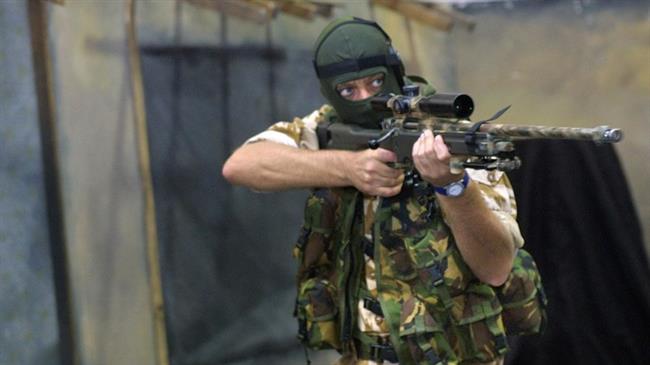
British SAS or SBS soldier in action in Syria
Press TV – March 8, 2020
There is mounting concern in the region about the nature and scale of British Special Forces deployment to southern Syria.
The concern comes in the wake of an exclusive report by the Daily Mirror (March 05) that two RAF Chinook helicopters “packed with special forces” troops and medics had “swooped” into southern Syria to rescue a wounded Special Air Service (SAS) operative.
According to the Mirror, the casualty was airlifted from “deep inside the warzone” to a medical facility in Erbil, northern Iraq.
Whilst the Mirror doesn’t say exactly where in southern Syria the SAS soldier was operating, the reference to “warzone” would suggest Deraa province, in the southwest of the country.
There have been clashes in recent days between Syrian government forces and terrorist groups controlling parts of the town of Al-Sanamayn, situated 50 kilometers south of the capital, Damascus.
Based on the realities on the ground, there is mounting speculation that Britain’s elite SAS could be lending a helping hand to anti-government forces in and around Al-Sanamayn.
British Special Forces, both in the form of the SAS and its allied unit, the Special Boat Service (SBS), have been operating in Syria for seven years.
According to the Mirror, more than 30 British special operatives have been injured in Syria. There has been at least one combat fatality, that of Sergeant Matt Tonroe, who was killed in a joint US/UK operation in March 2018.
Late last year it was reported that British Special Forces in Syria were beating a hasty retreat following US President, Donald Trump’s decision to pull out of Syria.
The latest incident appears to indicate that the SAS and SBS continue to operate in Syria based on the needs of allied Syrian rebel and terrorist groups.
The exfiltration of the injured SAS soldier will cause huge concern as the rescue operation involved RAF choppers taking off from RAF Akrotiri in Cyprus before flying through Israeli airspace to northern Jordan and onto southwestern Syria.
This brazen violation of Syrian sovereignty is likely to aggravate Britain’s outlaw status in Damascus, where both the Syrian government and people take a dim view of Britain’s hostile interference in their internal affairs.
British ‘secret warfare’ unsustainable in information age – report
© eliteukforces.info
RT | April 4, 2017
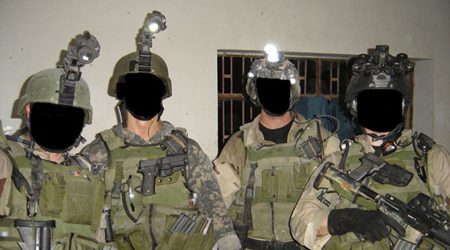
Britain’s secret war-fighting operations using special forces, drones and similar clandestine methods are folly in an age of information and public demand for accountability, according to a report by the Remote Control Project.
The think tank, run by the Oxford Research Group, examines the rise of clandestine warfare.
Its study, titled ‘All Quiet On The ISIS Front? British secret warfare in an information age,’ looks at where and how the UK is fighting wars, using means which are largely unaccountable.
The UK shields its secret activities behind a long-standing ‘no comment policy,’ which lags behind those of other modern democracies, it says.
The report points out that countries like Australia and the US often detail special forces deployment in a way which the UK does not.
“This provides reporters, and the general public, with an important opportunity to question government strategy and debate the implications of their involvement in conflicts overseas,” the authors argue.
The report also highlights that special forces operations are often only reported as a result of leaks.
The study cites numerous reports in papers like the Express and the Sun which tell selective tales of military daring in places such as Libya and Syria.
“[UK special forces] are unique in their exemption from parliamentary oversight,” the report says.
“Greater inspiration” should be drawn from increased scrutiny on spy agencies where there is “an attitude of acceptance that greater transparency is necessary in today’s world,” it adds.
The study cites the example of MI5 Director-General Andrew Parker who, in the wake of a number of recent major leaks, said: “We recognize that in a changing world we have to change too. We have a responsibility to talk about our work and explain it.”
Leaks such as those regularly carried in tabloids and via whistleblowers, the authors state, “makes the idea of blanket opacity increasingly outdated, and the benefits of maintaining such a policy should be critically examined in light of the more transparent practices of Britain’s allies.”
The report also argues that secret operations run contrary to democratic aspects of British military doctrine because, unlike normal troop deployments, they sidestep the need for a vote in Parliament.
The normal doctrine “does not capture the many elements of remote warfare, which are often considered ‘non-combat,’ supporting, or assisting roles,” the report says.
Tory MP and former soldier Crispin Blunt told RT last year it is high time for more oversight of such activities.
Blunt said at the time there is no formal parliamentary process for overseeing SAS missions and “there’s obviously an issue as to whether the intelligence and security committee would be the proper vehicle for oversight of these kinds of operations, but we are not there at the moment.”
A new war powers act proposed in the wake of the Iraq and Afghanistan campaigns could include requirements for increased democratic oversight of UK forces.
Supporters of the idea include Labour leader Jeremy Corbyn, who told the Middle East Eye in 2016: “I’m very concerned about this because [former Prime Minister] David Cameron – I imagine [Prime Minister] Theresa May would say the same – would say parliamentary convention requires a parliamentary mandate to deploy British troops. Except, and they’ve all used the ‘except,’ when special forces are involved.”
Read more:
‘Special forces shadow wars’ face legal threat from Corbyn
RT | August 1, 2016
Special forces operations should be subject to proper democratic oversight through a new War Powers Act, which would prevent troops being risked in Britain’s ‘shadow wars,’ according to Labour leader Jeremy Corbyn.
He told Middle East Eye on Friday of his concerns over the repeated use of a legal loophole to deploy troops from the secretive SAS unit into war zones such as Iraq and Libya without a democratic mandate.
The prime minister is currently able to deploy special forces without a vote, a capability which is buttressed by the UK’s long-standing but increasingly controversial policy of refusing to comment on clandestine military activities.
“I’m very concerned about this because [former Prime Minister] David Cameron – I imagine [Prime Minister] Theresa May would say the same – would say parliamentary convention requires a parliamentary mandate to deploy British troops. Except, and they’ve all used the ‘except,’ when special forces are involved,” Corbyn said.
He said this backdoor method of using elite troops has a long and dubious history, drawing a comparison between today’s operations and those of the US military during the Vietnam War.
“The question of this of course goes back a long way to Vietnam in 1963, when the US managed to have I think 50,000 advisers to the South Vietnamese government before the Congress was even invited to vote on whether or not it should be involved in the Vietnam War. I think the parallel is a very serious one,” he said.
His comments were immediately attacked by former soldier-turned-Tory MP Bob Stewart, who told the Times on Wednesday the PM must have the opportunity to deploy troops “when they think it’s crucial.”
However, scholars and other Tory MPs have questioned the UK’s shadowy approach in recent times.
In May, Tory Foreign Affairs Committee chair Crispin Blunt told RT the government should simply come clean because British citizens are fully aware of the UK’s not-so-secret special forces shadow wars.
Blunt said there is no formal parliamentary process for overseeing SAS missions and “there’s obviously an issue as to whether the intelligence and security committee would be the proper vehicle for oversight of these kinds of operations, but we are not there at the moment.”
In a July paper on the issue published by the Remote Control Project, which investigates clandestine modes of warfare, security expert John Moran pointed out that many of the UK’s major military allies – including the US and Australia – are much franker with their citizens about the work of special forces.
Featured Video
America Racing to Strategic Defeat in Iran
or go to
Aletho News Archives – Video-Images
From the Archives
Should Europeans ‘Thank’ the Americans for Destroying Nord Stream?
By Robert Bridge | Strategic Culture Foundation | September 29, 2022
With an investigation continuing into the destruction of the Nord Stream gas pipeline that provided energy supplies to Europe from Russia, there appears to be just one prime suspect, and that should surprise nobody.
Following the sabotage of the Nord Stream 1 and 2 gas pipelines, former Polish Foreign Minister Radoslaw Sikorski already seemed to know the identity of the perpetrator when he tweeted out: “Thank you, USA.”
At first glance, it seemed that Sikorski was speaking sarcastically, berating Washington for carrying out an attack that will have severe repercussions for the people of Europe. After all, how could anyone see any good coming from the termination of Europe’s primary source of gas reserves with winter just around the corner? It was Sikorski’s homeland of Poland, after all, that urged its citizens to collect firewood in the face of dwindling gas reserves.
In fact, the Polish diplomat was speaking one-hundred percent literally… continue
Blog Roll
 Aletho News
- Tehran approves new Hormuz plan with major restrictions
- No Threat Can Force Iran’s Surrender /Trita Parsi & Lt Cl Daniel Davis
- UK’s New Pandemic Plan Would Turn Big Tech Into a Mass Location Tracking Network
- Growing insecurity, soaring prices fuel protests in north as regime bans evacuation: Sources
- Iran denies responsibility for ‘depraved’ attack on Kuwait desalination plant
- Bring The Troops Back. End This War Now!
- Can we please stop calling Israel the ‘only democracy in the Middle East’ now?
- US should start removing its troops from Germany, proposes AfD co-leader Chrupalla
- Iran Red Crescent: 600 educational centers attacked in US-Israeli ‘war crimes’
- Russian Oil Tanker Arrives in Cuba Amid U.S. Blockade
- If Americans Knew
- As Iran targets US military bases, will they be relocated to Israel? Not a ceasefire Day 171
- Will Trump Go Kamikaze?
- Is the University of Florida Shutting Down College Republicans over Israel Criticism?
- Jewish extremist arrested over alleged plot to firebomb Palestinian activist Nerdeen Kiswani’s home
- More than half of Palestinian child detainees have no charges
- The More Murderous Israel Gets, The More We Hear About “Antisemitism”
- Land Day and the Palestinian struggle after 30 months of genocide
- The Iran War Is About Palestine
- Israeli soldiers echo settler ideology, talk of revenge after targeting Palestinians and detaining CNN crew in the West Bank
- Israeli Policies Threaten Future of Christian Schools in Jerusalem
- No Tricks Zone
- New Study Finds Warming Saves Lives…Cold Temperatures 12 Times More Deadly Than Excess Heat
- German Science Blog Accuses PIK Climate Institute Of Hallucinating Climate Tipping Points
- Devastating Assessment Of Comirnaty Vaccine By Former Senior Pfizer Europe Toxicologist
- New Study: CO2 Is ‘Effectively Negligible’ As An Explanatory Climate Change Factor Since 2000
- Former Pfizer Toxicologist Dr. Helmut Sterz Tells Bundestag Hearing Pfizer Vaccine Should Have Never Been Approved
- Energy Expert: Germany’s Nuclear Phaseout Was A “500 Billion Euro Mistake”
- New Research: South Australia’s Mid-Holocene Sea Surface Temperatures Were 4°C Warmer Than Today
- Storing Green Energy To Last Germany 10 Days Would Require A 60-Million Tonne Battery
- New Studies: UK Sea Levels Were 4 Meters Higher Than Today During The Mid-Holocene
- Destructive Green New Deal: German Energy And Metal Group Warns Of Drastic Crisis
 Aletho News