One martyr, 5 injuries in US attack on Iraqi border crossing with Iran
Al Mayadeen | April 4, 2026
On Saturday, Major General Omar Al-Waeli, head of the Iraqi Border Ports Authority, confirmed the martyrdom of one person and injuries to five others following an attack on the Shalamcheh border crossing with Iran.
Al Mayadeen’s correspondent in Basra reported that movement at the crossing has been completely suspended, adding that US warplanes targeted the Iranian passport hall at the border point.
Since the onset of the US-Israeli war on Iran, American attacks have relentlessly targeted Iraq, including Popular Mobilization Forces (PMF) units and centers.
PMF martyr, injruies in US attack earlier today
Earlier today, the PMF reported that its 45th Brigade, part of the Jazira Operations Sector, was attacked at the al-Qaim border crossing. The assault left one PMF member martyred, four others injured, and one Ministry of Defense employee wounded.
In response to the repeated aggression, the Iraqi Cabinet directed the armed forces and the Popular Mobilization Forces to defend themselves and respond to any attacks on their positions.
The cabinet also instructed the Ministry of Foreign Affairs to submit an official complaint to the UN Security Council, condemning the attacks and demanding they be stopped.
Iraqi Resistance calls for action against US-Israeli regional allies
Similarly, the Iraqi Resistance Coordination Committee praised the Iraqi people’s positions in support of the Axis of Resistance, while calling for punitive measures against countries that enable US-Israeli aggressions in the region.
In a statement, the Committee said that “the alignment of the rulers of Jordan, Saudi Arabia, and the UAE with the criminality of the Zionist-American enemy against the Islamic Republic and their betrayal of the honorable free people of Iraq represent the height of baseness and vileness.”
It stressed that this “requires a firm deterrent response from the Iraqi government,” adding that such measures should begin with “punishing Jordan in particular, as it serves as a launch point for enemy aircraft targeting the fighters of the Popular Mobilization Forces and Iraqi security forces,” calling for “the complete closure of the land border crossing and the suspension of Iraqi oil grants.”
The Committee also stated that the Iraqi Resistance has avoided harming Kuwait’s economic interests and infrastructure while targeting US forces in the country. It further called for avoiding harm to Qatar’s interests, excluding US bases, “in appreciation of Doha’s responsible positions toward the Palestinian cause and the Axis of Resistance.”
IRGC decries attack on US embassy in Riyadh, says executed by ‘Israel’
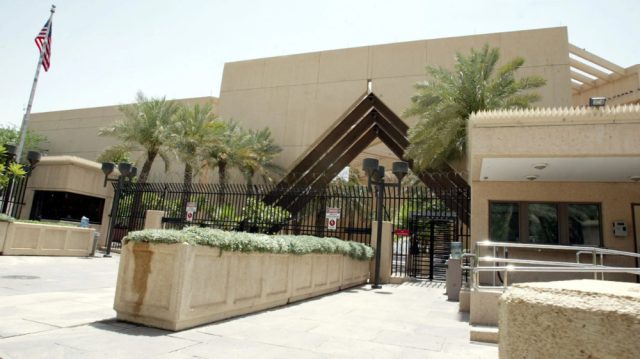
The US Embassy in Riyadh, Saudi Arabia (File photo by AFP)
Al Mayadeen | April 4, 2026
The Islamic Revolution Guard Corps’ (IRGC) has rejected accusations that it was responsible for an attack on the US Embassy in Riyadh, Saudi Arabia, emphasizing instead that it was a false flag operation carried out by the Israeli entity.
In Statement No. 54 of Operation True Promise 4, the IRGC’s Public Relations Department condemned the attack on the embassy, which was reported by The Wall Street Journal, stressing that, recalling the Israeli occupation’s regional strategies, “this action was certainly carried out by Zionists.”
The IRGC confirmed that the Iranian Armed Forces’ target list has been clearly identified, adding that Iran had already informed neighboring countries of the necessary warnings to “prevent further escalation.”
The IRGC also warned that West Asia “must remain vigilant against provocations from the American–Zionist current,” which aims to destabilize and destroy the region.
A series of false flags
Iran has repeatedly stressed that its operations target US-Israeli military assets and affiliated infrastructure in the region and across the occupied territories in Palestine, quickly pointing out false flags and highlighting ongoing enemy attacks that seek to disturb regional harmony.
It has also delineated target lists for its tit-for-tat retaliations for attacks on its civilian infrastructure, including US assets in the region. The US embassy in Riyadh was not among them.
Only yesterday, the IRGC condemned the targeting of water desalination plants in Kuwait, asserting that the Israeli entity “is behind this cowardly act of aggression aimed at sowing discord.” On Monday, a Kuwaiti power and desalination plant was also struck, killing an Indian worker and causing significant material damage.
Kuwaiti authorities were quick to attribute the attack to Iran, but Tehran squarely denied involvement and blamed “Israel,” with the spokesperson for Iran’s Khatam al-Anbiya Central Headquarters describing the incident as “evidence of the enemy’s depravity and malice,” saying it forms part of broader efforts to inflame tensions and undermine regional stability.
Similarly, following a fire at Saudi Aramco’s Ras Tanura refinery in early March, an Iranian military source told Tasnim News Agency that the attack was “an Israeli false flag operation” aimed at distracting regional countries from “Israel’s” strikes on civilian sites inside Iran, stressing that “Aramco facilities have not been among the targets of Iranian attacks so far.”
Official reveals evidence of Arab states’ involvement in US-Israeli war on Iran
Press TV – April 3, 2026
Iranian Foreign Ministry spokesman Esmaeil Baghaei has revealed hard evidence on the involvement of some Persian Gulf Arab states in the unprovoked US-Israeli aggression against the Islamic Republic.
In a post on social media platform X on Friday, Baghaei published photos of a drone, which was shot down in southern Iran on Thursday, noting that only two regional states possess this drone, without naming them.
“This drone was downed by our brave armed forces over the beloved city of Hafiz and Saadi, Shiraz,” he said, referring to the two prominent Persian poets.
“It could be another (hard) evidence of direct participation and active complicity of some states of the region in US-Israel crime of aggression and war crimes against Iran,” Baghaei said.
The spokesman demanded “clarification” by “either of the TWO STATES of the region that are the users of this drone!”
The downed drone initially appeared to be an American MQ-9. However, military experts say it is actually a Wing Loong-2 drone, which is operated by Saudi Arabia and the United Arab Emirates.
Last month, Foreign Minister Abbas Araghchi said Iran’s neighboring countries should “promptly” clarify their position regarding their role in the “slaughter” of Iranian civilians by the Israeli regime and the United States.
In a post on his X account in mid-March, Araghchi said hundreds of Iranian civilians, including children, have been killed in Israel-US bombings.
“Reports claim that some neighboring states that host US forces and permit attacks on Iran are also actively encouraging this slaughter,” the top Iranian diplomat stated.
He said positions should be promptly clarified on the mass killing of Iranian civilians.
The US and Israel started the latest round of unlawful military aggression on Iran on February 28, some eight months after they carried out unprovoked attacks on the country.
The attacks led to the martyrdom of Leader of the Islamic Revolution Ayatollah Seyyed Ali Khamenei and hundreds of Iranian civilians, including women and children, as well as several senior military commanders.
Iran has carried out extensive retaliatory attacks on US assets in the region and on locations in the Israeli-occupied territories since the very first day of the US–Israeli aggression.
The Islamic Republic says it respects the sovereignty and territorial integrity of its neighbors and that its reprisal attacks are directed at US assets and bases on their soil.
It has also warned regional countries not to allow their territory to be used for attacks against Iran.
Bahrain faces scrutiny for opposition crackdown after detainee killed

Al Mayadeen | April 3, 2026
A Bahraini man detained during last month’s missile strikes on the kingdom has died in custody under contested circumstances, sparking renewed scrutiny of the country’s security practices amid wartime tensions.
Mohammad al-Mousawi, a Bahraini national who was detained as Bahrain came under attack from Iran, disappeared for several days before his family was contacted and asked to retrieve his body from a military hospital, relatives said. They reported that his body bore multiple injuries, including slash marks, bruising, and wounds on the soles of his feet.
His death has quickly become a flashpoint in the country, with critics accusing authorities of reverting to tactics used to suppress protests during the 2011 uprising.
Bahrain, which hosts the US Navy’s Fifth Fleet, has detained dozens of individuals since the outbreak of the war, including people accused of:
- filming strikes and demonstrations,
- expressing support for Iran against US-Israeli aggression
- alleged espionage.
“They want to make sure nobody challenges the state’s narrative and silence any voices not telling the story of the war how they want it to be told,” said Sayed Ahmed al-Wadaei of the Bahrain Institute for Rights and Democracy, a London-based advocacy group.
Bahraini Interior Ministry dismisses clear evidence
The Interior Ministry claimed al-Mousawi had been arrested on suspicion of spying for Iran, an allegation his family denies. Authorities also dismissed circulating images of his injuries as “inaccurate and misleading,” while insisting that the country is acting to protect national security.
In a statement, the government rejected accusations of sectarian discrimination, saying all actions were carried out in accordance with the law and that independent bodies are responsible for investigating claims of abuse.
Al-Mousawi had previously spent around 11 years in prison as part of a 21-year sentence on charges widely regarded as false, including accusations of arson and alleged membership in a “terrorist cell”. His family and rights groups have clarified that these charges are false and fabricated.
Severe abuse evident on al-Mousawi, Bahrain denies the obvious
A relative and a close family friend said Mohammad al-Mousawi disappeared on March 19 after attending prayers with two companions who also remain missing. Both spoke to the Associated Press on condition of anonymity, citing fears of reprisals. Rights groups have long accused Bahraini authorities of carrying out enforced disappearances.
On March 27, the family said they were called to collect his body. A relative who viewed it at the morgue reported signs of severe abuse, including injuries consistent with whipping using cables, as well as apparent electrocution and cigarette burns.
The Associated Press reviewed images of the body that showed marks consistent with accounts from five witnesses who said they saw it in person, all speaking anonymously. Bahrain’s Interior Ministry said al-Mousawi had been held by the National Security Agency, whose arrest powers were restored in 2017 after being revoked following the 2011 unrest.
The Ministry dismissed the images as “inaccurate and misleading,” while a military hospital attributed the death to a heart attack. His family said he had no known preexisting conditions. Ahmed Banasr of Physicians for Human Rights said the injuries were consistent with blunt force trauma, noting that wounds on the soles of the feet suggested abuse rather than a fall or fight.
Bahrain’s long record of repression, violence seeps into al-Mousawi’s case
Human rights organizations say the detention and death of Mohammad al-Mousawi mark a new phase in Bahrain’s long-running crackdown on opposition, which peaked during the 2011 protests. That year, the ruling Al Khalifa family suppressed mass demonstrations with support from Saudi and Emirati forces.
“It remains to be seen how far the government will go in its crackdown on people,” said exiled Bahraini activist Maryam al-Khawaja, whose father is imprisoned in Bahrain. “What we are witnessing now is certainly far more severe than in recent years,” she added.
Since the start of the war on Iran, at least 41 people, including migrant workers, have been arrested on accusations of publishing images of Iranian strikes. Some face charges of “treason”, which can carry penalties ranging from life imprisonment to the death penalty. In one case, 21-year-old Hussein Futeil and a friend were detained after posting videos of themselves waving a portrait of Iranian leader Sayyed Ali Khamenei during a protest outside the US Embassy.
According to his father, Naji Futeil, the two briefly reappeared after hours of questioning before Hussein later informed his family he faced five charges, including misuse of social media, incitement of hatred, and treason. Rights advocates say the cases reflect a broader effort to silence opposition, with Sayyed Ahmed al-Wadaei stating authorities aim to ensure no one challenges the state’s narrative.
UAE rejects report claiming it is ready to join war on Iran to reopen Hormuz
MEMO | April 2, 2026
The United Arab Emirates has rejected reports suggesting that it is willing to join the war against Iran in order to reopen the Strait of Hormuz, saying such claims are misleading and do not reflect its actual position.
In a statement issued by the UAE Ministry of Foreign Affairs, Abu Dhabi said: “Recent reporting suggesting a shift in the UAE’s posture is misleading.” The ministry stressed that the UAE maintains a defensive posture focused on protecting its sovereignty, population and infrastructure, while reserving the right to self-defence against what it described as “ongoing unlawful and unprovoked attacks.”
The statement came in response to a report by The Wall Street Journal, which claimed that the UAE “is willing to join the fight” to reopen the strategic waterway by force.
Abu Dhabi said that the Strait of Hormuz remains a vital artery for the global economy and reiterated that freedom of navigation there must be preserved. However, it stopped far short of endorsing direct participation in the war, instead saying it is prepared to support collective international efforts to safeguard maritime security, in coordination with partners and in line with international law.
The UAE’s denial also undercuts claims that Gulf Arab states have been pushing US President Donald Trump and Israel to escalate the conflict. Those narratives appear increasingly detached from reality. The Financial Times reported that Saudi Arabia has become deeply frustrated with Trump’s erratic handling of the war, including threats to strike Iranian infrastructure, suggestions that Gulf states should pay for the conflict and repeated uncertainty over Washington’s endgame.
The same FT report said Riyadh blames Israeli Prime Minister Benjamin Netanyahu’s government for igniting the conflict and fears being left to deal with the consequences of a wounded but more militarised Iran. It also reported growing Saudi unease over the lack of clear US strategy, as well as anger at Trump’s public remarks about Crown Prince Mohammed Bin Salman.
Rather than cheering escalation, Gulf states appear increasingly disillusioned with Washington and alarmed by the fallout from a war they did not want. The UAE statement and Saudi frustration together suggest that the region’s Arab powers are far more concerned with containing the conflict than joining it.
READ: Qatar’s emir warns Trump of ‘serious consequences’ from war with Iran
Gulf states weigh pipeline expansion plans, hoping to bypass Hormuz
Al Mayadeen | April 2, 2026
Gulf Arab states are increasingly reconsidering long-discussed pipeline projects aimed at bypassing the strategically vital Strait of Hormuz, as the war on Iran raises concerns among them over how Iran showed its capability to gain control over the waterway.
Officials and energy industry executives say the prospect of prolonged Iranian control over the strait has revived interest in alternative overland export routes, despite the high financial, political, and logistical barriers such projects entail.
The war on Iran and the subsequent defensive operations have revived the viability of Saudi Arabia’s East-West pipeline, a 1,200-kilometer network constructed in the 1980s following the Iran-Iraq “tanker war”. The pipeline, which carries up to 7 million barrels of crude oil per day to the Red Sea port of Yanbu, allows Saudi exports to bypass Hormuz entirely.
Saudi Aramco CEO Amin Nasser recently described the pipeline as the “main route” currently being utilized, highlighting its strategic value amid regional instability. The kingdom is now assessing options to expand the pipeline’s capacity or develop additional routes to transport a larger share of its daily oil production, estimated at over 10 million barrels, away from the Gulf.
Analysts note that Gulf policymakers are increasingly shifting from theoretical discussions to concrete planning. Maisoon Kafafy, a senior advisor at the Atlantic Council, a US-based think tank that received extensive funding from the United Arab Emirates, said regional actors are now converging on similar conclusions regarding the need for diversified export infrastructure.
Network approach under consideration
Rather than relying on a single alternative, experts suggest a network of interconnected pipelines. However, such an approach would require unprecedented coordination among Gulf states, potentially challenging longstanding energy strategies that often conflict.
In the longer term, these pipelines could form part of broader trade corridors linking Asia to Europe. Behind them is the Israeli-led, India-Middle East-Europe Economic Corridor (IMEC) proposal, a US-backed initiative that aims to funnel Asia-Europe trade through Israeli-controlled ports.
Despite renewed interest in the plan, major obstacles remain. Industry estimates suggest that replicating infrastructure similar to the East-West pipeline could cost at least $5 billion, while more complex multi-country routes, such as those extending from Iraq through Jordan, Syria, or Turkiye, could reach $15–20 billion.
Security concerns further complicate planning, particularly in countries of the region that are subject to US-Israeli aggression, where attacks on critical infrastructure remain highly possible. Geographical challenges also present difficulties, with proposed routes requiring construction across deserts and mountainous terrain.
Saudi Arabia is also reportedly evaluating the development of additional export terminals along its Red Sea coastline, including facilities linked to the NEOM megaproject.
What is actually feasible
Gulf states have moved beyond simple infrastructure expansion. By hosting and assisting US forces and directly supporting military attacks, countries like Saudi Arabia and the UAE have transitioned from neutral bystanders to active participants in the regional aggression. However, this alignment has come at a high cost; the strategy of relying on bypass routes like the East-West pipeline and the Habshan–Fujairah pipeline is failing to provide economic stability as Tehran proves capable of striking US interests in these zones with ease.
Questions surrounding ownership, control, and operational management of transnational pipelines could also hinder progress on these projects, particularly given the need for regional cooperation.
Efforts to seize control of the maritime route are ongoing, with the United Kingdom reportedly leading talks involving more than 30 countries on the Strait of Hormuz. Yet, a glaring question remains: why target the reaction, Iranian control over Hormuz, while the root cause, US-Israeli aggression, continues to be ignored?
The Larak Corridor: Iran’s Rial Gate With No US, No Israel, and No Way Around
By Freddie Ponton | 21st Century Wire | April 1, 2026
While MOW Secretary Pete Hegseth was telling other nations to “step up” in the Strait of Hormuz, Donald Trump was already backing away, insisting its security was “not for us.” In between those contradictions, Washington dumped a fog of conflicting slogans on the public—slogans that never looked like strategy so much as panicked improvisation. That confusion is not a sideshow to the war, but the political static masking a brutal reality. While the White House and its zionist neocon war camp lurch between bluff and retreat, Iran has been moving with cold discipline, quietly building what Iranian reporting calls the Larak Corridor and what maritime trackers have identified as a tightly managed lane through the Qeshm-Larak gap inside Iranian waters.
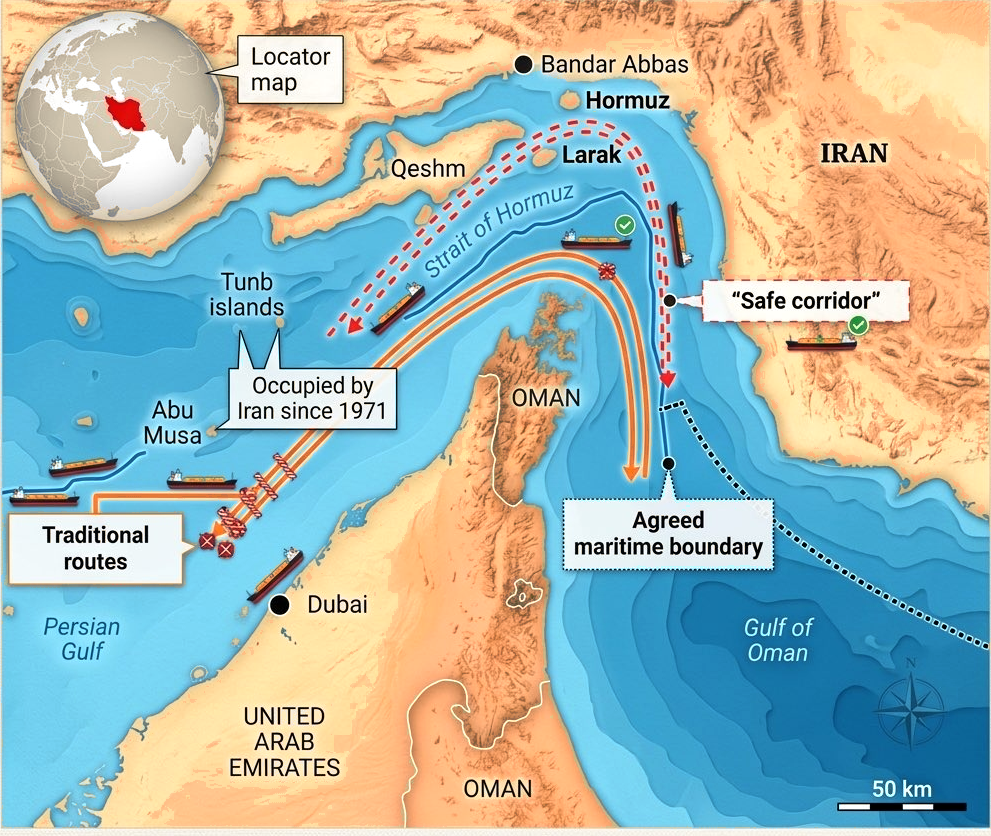
Around Larak, Tehran is no longer just reacting to an illegal war launched against it. It is turning battlefield pressure into procedure, selective access, and proposed law, using a controlled corridor and a wider Hormuz management plan to show that the old fantasy of automatic Western command over this chokepoint is breaking down in real time. The truth of the war is not found in the bombast coming out of Washington; instead you will find it in the places where power is actually shifting, and right now, one of those places is a narrow strip of water off Larak, where Iran looks calmer, more deliberate, and more in command of events than the people who thought they could bomb it into submission.
The Day Hormuz Moved on Iran’s Terms
The Strait of Hormuz has not been shut, and that is exactly why what Iran has done matters more. What has emerged around Larak is not a crude blockade but a controlled passage system, a wartime checkpoint laid across one of the most important arteries of the world economy. Iranian reporting most often calls it the Larak Corridor. At the same time, the broader phrase Larak-Qeshm Corridor is best understood as a geographic description of the lane running through the narrow gap between those two islands inside Iranian waters.
Names are not cosmetic here. Western and trade coverage tend to speak of a route between Qeshm and Larak. Iranian coverage roots it in Larak itself, in Iranian-managed waters, under Iranian rules. That is the quiet shift the war has produced. For decades, the story of Hormuz was told from the deck of a U.S. carrier. Today, one of its key arteries is being renamed and reorganised from a small island most Western audiences have never been asked to think about.
Iran appears to be building a differentiated transit regime, not a universal shutdown. That means the market consequence is not simply “less supply,” but a more political energy map in which some buyers and shippers face privileged access while others face delay, denial, or sharply higher costs.
That is the part of the story that cuts through the propaganda. A total closure would have been easy to denounce and easy to rally against. A selective corridor is harder to attack because it allows Tehran to say that passage has not ended, only the assumption that ships can move through Iranian waters during an illegal war on Iran without submitting to Iranian conditions.
This is why Larak matters. It is where Iran stopped merely threatening the map and started administering it.
The lane at Larak
The outlines of the new lane are now visible. The Larak Corridor is not a return to normal traffic. It is a filtered, low-volume, politically segmented route for approved movement. Trade and maritime analysis has traced authorised vessels through the five-mile gap between Qeshm and Larak, close to the Iranian coast and under a web of Iranian surveillance and intervention capacity. Iranian and Arabic reporting has described a safe corridor around or between Larak and Qeshm, never a full reopening of the strait, even though yesterday the Wall Street Journal reported that the Bahman pier on the eastern side of Qeshm Island was attacked, according to a statement from Hormozgan governor’s office relayed by Iranian state-affiliated media ISNA. Qeshm overlooks the Clarence Strait in the Strait of Hormuz and is referred to by the locals as “Kuran”, Iran’s main launchpad for its asymmetric naval warfare. In early March, the Israeli/US war machine had targeted a desalination plant on Qeshm Island, leaving 30 villages without water.
That low-volume point changes everything. The lane exists in deliberate contrast to prewar patterns. UN-linked reporting put pre-crisis traffic through Hormuz at roughly 130 ships a day. Against that baseline, the authorised trickle through Larak is not evidence of restored normality but a clear indication that normality has been replaced by a rationed flow that Iran alone can modulate.
The lane also stratifies states. Some governments have secured negotiated passage, some ships have moved after prior coordination and documentation, and others have been turned back or discouraged from approaching in the first place. The result is not an open sea but a tiered system in which diplomatic posture, sanctions alignment, and wartime behaviour shape access to one of the world’s central energy routes.
Calling this a blockade is comfortable for Western officials, but it is wrong. A blockade denies passage to provoke a fight. The Larak Corridor functions more like a wartime border crossing, granting passage conditionally, keeping discretionary power in Iranian hands, and making political hierarchy visible on the water.
Force became law
The story becomes more serious once you see that Tehran is not leaving this system in the realm of ad hoc force, but instead the Islamic Republic of Iran is building a legal scaffold around it.
Parliamentary reporting confirms that Iran’s National Security and Foreign Policy Committee has approved an eight-point Strait of Hormuz Management Plan. The plan is built around eight clear pillars: securing the strait, ensuring ship safety, addressing environmental risks, establishing financial arrangements with a rial-based toll system, banning American and Israeli vessels from passage, asserting Iran’s sovereign authority and that of its armed forces, cooperating with Oman on the legal framework, and prohibiting entry to any state that participates in unilateral sanctions against Iran.
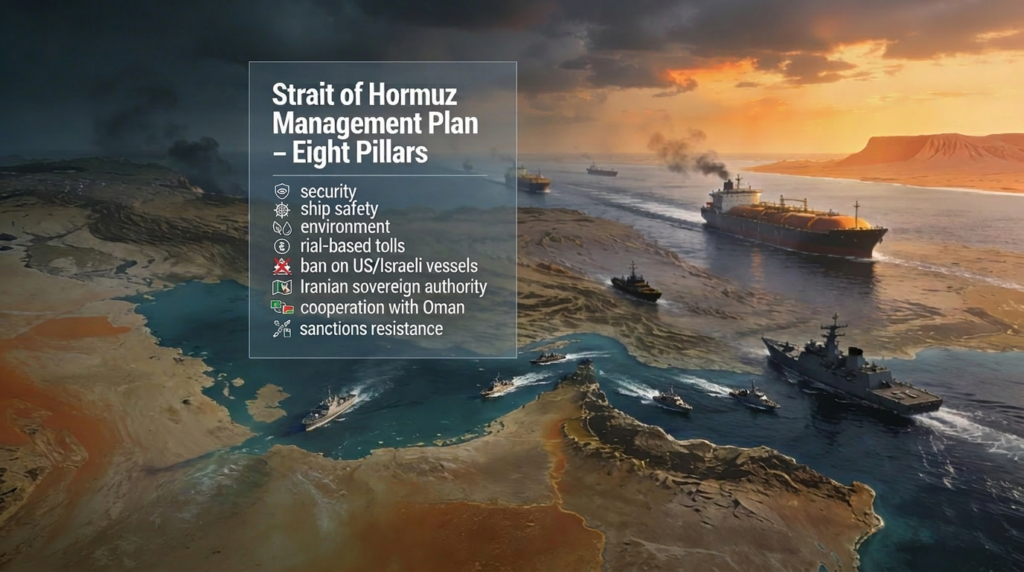
Iran’s Strait of Hormuz Eight Pillars Management Plan

A parallel description from Xinhuanet states that the measure gathered more than 250 signatures and outlines four immediate objectives: ensuring shipping security, charging environmental polluters, collecting fees for guidance services, and establishing a regional development fund funded by the toll regime. Those details matter as they show that Tehran is not marketing this as a simple wartime levy, but as sovereign administration over safety, environmental protection, navigational management, revenue, and regional development.
It is crucial to be precise. The plan is not yet fully enacted into law. Committee approval is significant because it codifies the logic of the corridor and signals an intention to turn military practice into statute, but Iranian reporting makes clear that key elements are still in the phase of initial measures and continued drafting. That does not weaken the argument. It actually strengthens it. The turning point is not when the last procedural stamp is applied, but when a state under attack openly decides to legislate the war’s new realities into its domestic legal order.
The Oman clause is one of the plan’s sharpest edges. Iranian reporting says Oman must be present in the legal regime and coordination structure because the southern side of the strait is Omani. At the same time, a parliamentary voice emphasised that in matters of toll collection “the essence of the matter is in Iran’s hands,” and that Iran is the party positioned to collect fees, while Oman’s place is in cooperation and coordination, not revenue capture.
In other words, Tehran is regionalising the legal façade without diluting operational control. Omani decrees from 2025 ratifying broader cooperation and legal-judicial accords with Iran give this move a pre-existing legal context, making the Hormuz framework look less like a unilateral edict and more like a hard extension of bilateral agreements into wartime management.
This is what it means for force to become law. Iran is not simply blocking ships. It is regulating them, invoicing them, and giving itself the legal language to defend that behaviour once the guns fall quiet.
Islands’ sovereignty and the human layer
Strip Larak from its geography and you miss half the story. Hormuz cannot be seen as just another free-floating blue line on an analyst’s map. It is a dense, lived space of islands, coastlines, fishing ports, naval outposts, and communities that have grown up under the shadow of foreign fleets and sanctions.
For half a century, the world has been taught to treat the islands of Abu Musa and the Tunbs as footnotes, little “disputed” specks on the map. In reality, they, along with Qeshm and Larak, sit inside a network of surveillance and reach that allows Iran to watch, shape, and, when necessary, squeeze movement at the mouth of the Gulf. The Larak Corridor is not a freakish one-off. It grows out of a sovereignty geography that has been quietly undermining the fiction of an “American lake” in Hormuz for decades.
There is a human layer that rarely makes it into Western press. Iran’s maritime posture is not only the work of admirals in Tehran, but it also rests on coastal communities, port workers, pilots, and the broader ecosystem that includes the Naval Basij, the volunteer maritime defence network you researched earlier. That network, with its small craft, its local knowledge, and its political symbolism, has always been part of how Iran thinks about defending the strait, not simply by hardware but by socialised resistance.
For people living on those coasts, the corridor is not a theoretical legal innovation. It is one of the few visible signs, in the middle of bombardment and assassination, that their state can still impose some order at the place where global power once promised them none. Seen from there, the Larak Corridor looks less like opportunism and more like a resilient country insisting that sovereignty is not an abstract word but something that can be exercised in a specific channel of water under fire.
The Gulf pays for the war
The political brilliance of the Larak move is in who gets billed for it: not Washington first, not Tel Aviv first, but the Gulf order that enabled this war and is now trapped in its consequences.
Gulf governments were not properly warned, their objections were ignored, and Europe was largely marginalised from the decision-making that triggered the regional blowback they are now paying for.
That one sentence punctures the comforting story that the old security architecture still works. Some Gulf capitals had urged Washington not to attack Iran. Some tried to keep a distance from the opening salvo. Europe itself was treated less like a partner than a spectator told to brace for impact.
The cost has not been theoretical. Freight risk exploded. Insurance premiums climbed. Cargo timetables turned into contingency plans. The “guarantee” on offer from Washington turns out to be a package in which Gulf states host bases, bankroll weapons, and then absorb the retaliation and economic shock once the trigger is pulled.
The evidence of fatigue is patchy but real. Saudi Arabia has intensified direct contacts with Iran. Regional diplomacy has tried to put some sort of brake on escalation. At the same time, influential Gulf voices still speak of the need to degrade Iranian capabilities, not simply to stop the war. That tension is important as it shows a region caught between fear of Iran and a growing recognition that the American-led order is no longer a stable shelter.
Larak turns that contradiction from an argument into a daily experience. Every tanker that has to negotiate with Tehran, every nervous call from an insurer, or every investor wondering whether to avoid Gulf exposure. All of it drives home the same lesson. A war on Iranian sovereignty will not remain confined to Iranian soil or to the screens of Western news shows. It will leak into ports, pipelines, desalination plants, stock exchanges, and households across the Gulf.
From a pro-peace, pro-sovereignty perspective, that is the real indictment. The architecture that claimed to keep the region safe has delivered a crisis that no one can turn off without Iran’s involvement.
Beyond the dollar and toward the Global South
Although it may sound like a speculative slogan about some future yuan world, it is a description of an experiment already underway. Iran’s proposed Hormuz management plan speaks in the language of rial-based tolls and financial arrangements. Broader analysis around the corridor connects that direction of travel to non-Western settlement channels and to the wider de-dollarisation agenda now running through BRICS and the Global South.
The point is not that the petrodollar disappears tomorrow. It is that under bombardment, and with its conventional military apparatus under fire, Iran is still moving a slice of energy trade onto monetary rails where Washington’s sanctions power is weaker.
Hormuz is doubling as a testbed for de-dollarized energy payments.
China’s experiment with yuan-settled LNG from Qatar in 2023 showed that Gulf energy can clear outside dollar channels when states choose to build the infrastructure. Iran’s 2023 agreement with the UAE to use the dirham in bilateral trade, while imperfect because of the dirham’s peg, still represents a deliberate shift into regional banking circuits that cost Washington more to police. Meanwhile, BRICS has been advancing alternative payment mechanisms and settlement systems designed precisely to chip away at dollar centrality.
The Larak Corridor slots into this picture with unnerving ease. It rewards states willing to engage with Tehran rather than join the sanctions chorus. It opens space for deals denominated in rial, dirham, or yuan. It demonstrates that a Global South state under open attack can still exert leverage over the physical and financial pathways through which the world’s energy moves.
Tehran is not claiming a clean victory over the dollar. What it is doing is more subversive. It is using the war to erase the assumption that Washington can both close and reopen Hormuz at will, militarily and financially. Every transaction that clears outside Western rails, every ship that goes through a lane managed on Iranian terms, is another chip knocked out of a system that has long treated Gulf energy as an American instrument first and a regional lifeline second.
That is why the story of Larak is not simply a regional shipping story, but rather a frontline in the contest over who writes the rules of the global economy.
The old order is cracking
What has happened at Larak is not the final victory of a new world, but it is one of the clearest signs that the old one is cracking in real time.
For decades, the script ran on autopilot. The United States secured the sea lanes. The Gulf monarchies supplied the fuel. The dollar priced it. Everyone else adjusted. The war on Iran was supposed to be another scene in that familiar play. Instead, it exposed how much of it had become theatre.
Iran’s answer didn’t need to be polite, and it was never meant to be. It was disciplined, coercive, and grounded in the one thing Washington cannot replace with rhetoric, the geographic reality of where Hormuz actually lies. Tehran avoided the trap of a universal shutdown and built a mechanism that punishes enemies, rewards accommodation, and keeps the region inside a rolling uncertainty that no press conference in Washington can dispel.
That is why the phrase differentiated transit regime carries so much weight in this war. It captures the fact that what is happening off Larak is not chaos. It is governance under attack. It is a sovereign state, bombed and sanctioned, insisting that it still has the right to decide who crosses its doorstep and on what terms.
For people in the Gulf, it is about whether their ports can stay open, whether their desalination plants keep running, and whether their economies can withstand another cycle of manufactured crisis. For people in Iran, it is about whether anything in their immediate environment still belongs to them after decades of war, sanctions, and threats of regime change.
Seen from that angle, the Larak Corridor is not a provocation. It is a verdict. Peace will not come from pretending the old arrangement can simply be restored. It will come, if it comes at all, when the region and the wider world accept the reality written into the water off Larak. A Gulf built on assaults against Iranian sovereignty cannot remain prosperous, stable, or truly sovereign itself. Not now, and not in the long term.
Iran’s navy has been battered. Its cities have been hit. Its leaders have been hunted. Yet at the most critical chokepoint on earth, the war machine that promised to reopen the map still cannot make Hormuz move on its own terms.
Sovereignty, once attacked, does not always retreat. Sometimes it answers by redrawing the map and forcing those who lit the fire to live with the new lines.
Iran accuses adversaries of false flags to strain Turkey ties
Al Mayadeen | March 31, 2026
Iranian Foreign Minister Abbas Araghchi categorically denied reports claiming that Iranian missiles had been launched toward Turkish territory, describing them as “completely baseless.”
During a phone call with his Turkish counterpart Hakan Fidan, Araghchi warned of attempts by regional adversaries to undermine the atmosphere of peace and friendship between the two neighboring countries.
Araghchi also discussed the repercussions of the ongoing US-Israeli aggression against Iran, reaffirming Tehran’s commitment to the principles of good neighborliness and respect for Turkey’s national sovereignty.
The Iranian foreign minister expressed his country’s full readiness to cooperate in verifying any such claims.
In his remarks to Fidan, Araghchi stressed the need for the international community to condemn US and Israeli aggression targeting schools, universities, energy infrastructure, and residential areas. He added that “the American rhetoric openly threatening to attack Iranian production facilities constitutes a criminal threat and a clear disregard for international law and humanitarian principles.”
He concluded by emphasizing that US violations require a decisive response from all states and governments to prevent further escalation and to stop aggressive powers from violating the resources of the region’s peoples and destroying their infrastructure.
It is worth noting that the Turkish president has repeatedly affirmed that his country will not be drawn into the ongoing US-Israeli war on Iran.
Araghchi calls on Caspian states to take a firm stance against aggression
In the same context, Araghchi told his Azerbaijani counterpart Jeyhun Bayramov that Iran is taking defensive measures against the aggressors’ military bases and installations located in countries across the region.
He further noted that the countries bordering the Caspian Sea must adopt a firm position regarding the recent aggression on certain coastal areas of the Caspian Sea.
Iran warns against potential false-flag attacks framing Iran
The Islamic Revolution Guard Corps lately condemned the drone strike targeting the residence of the president of the Iraqi Kurdistan Region in Duhok, Nechirvan Barzani, describing it as an “act of terrorism” linked to recent attacks against Iranian officials.
Earlier, Iranian officials and sources repeatedly warned of false flag attacks, indicating that “Israel” and the United States have been intending to expand false flag operations to target regional actors and frame Iran for the attacks.
On March 15, late Iranian Secretary of the National Security Council Ali Larijani warned of a potential large-scale false flag attack on United States soil allegedly designed to frame Iran. In a post on X, Larijani claimed, “I’ve heard that the remaining members of Epstein’s network have devised a conspiracy to create an incident similar to 9/11 and blame Iran for it.”
Shahed-136 drone copied into LUCAS
Earlier on March 15, the spokesperson for Khatam al-Anbiya Central Headquarters warned neighboring countries and Muslim populations in the region that Iran’s enemies have replicated the Shahed-136 drone, renaming it the LUCAS drone and using it to strike illegitimate targets across the region.
The statement accused “Israel” and the United States of resorting to deception after their failures on the military and political fronts against Iran. By copying the Shahed-136 drone, the spokesperson said the “enemy aims to carry out attacks while falsely attributing them to Iran.”
“This malicious tactic is designed to sow doubt, direct accusations at the Islamic Republic of Iran, and create division between Iran and its neighbors,” the statement said, adding that such actions seek to discredit what it described as the lawful defensive measures of the Iranian Armed Forces.
Larijani emphasized that Iran “fundamentally opposes such terrorist schemes,” underlining that the country has no conflict with the American people. “We have no war with the American people,” he wrote, asserting that Iran is merely defending itself against aggression launched by the United States and “Israel”. He added that Iran “stands tall in doing so in order to teach the aggressors a lesson.”
‘Israel’ working to expand false flag operations across Middle East
On March 8, a regional security source told Al Mayadeen that “Israel” is working to expand false flag operations across West Asia and in several European countries, citing what the source described as confirmed intelligence information.
According to the source, recent attacks targeting Cyprus, Azerbaijan, and Riyadh were carried out by “Israel”.
The source also said there is “reliable information” suggesting that similar security and military operations could occur. These incidents, the source said, may be falsely attributed to Iran or to the Axis of Resistance.
Separately, an informed official in Iran’s Ministry of Intelligence warned on March 7 of a potential Israeli scheme to target the Al-Aqsa Mosque in occupied al-Quds in an attempt to blame Iran and Resistance movements.
According to the Iranian Tasnim News Agency, the official said the alleged plan could involve a false flag operation using drones or missiles aimed at the mosque compound.
Marandi: Yemen joins the war – Red Sea could be blocked next – Saudi regime at risk
Glenn Diesen | March 29, 2026
Seyed Mohammad Marandi discusses the ongoing escalation in the Iran War—and why Yemen’s sudden entry could be a game-changer. Marandi is a professor at Tehran University and a former advisor to Iran’s Nuclear Negotiation Team. (Some of the video is lagging due to the ongoing bombing of Tehran). Recorded 29.03.2026.
Follow Prof. Glenn Diesen:
- Substack: https://glenndiesen.substack.com/
- X/Twitter: https://x.com/Glenn_Diesen
- Patreon: https://www.patreon.com/glenndiesen
Support the research by Prof. Glenn Diesen:
- PayPal: https://www.paypal.com/paypalme/glenndiesen
- Buy me a Coffee: buymeacoffee.com/gdieseng
- Go Fund Me: https://gofund.me/09ea012f
Pakistan to Host US-Iran Talks
Sputnik – March 29, 2026
US-Iran talks may take place in Islamabad in the coming days, Pakistan’s Foreign Minister Ishaq Dar said.
All parties have expressed confidence in Pakistan’s mediating role, he added, noting that China “fully supports” the initiative.
Earlier on Sunday, foreign ministers from Saudi Arabia, Turkiye, and Egypt arrived in Pakistan to discuss potential ways to permanently resolve the current conflict in the Persian Gulf.
The ministers also discussed various proposals for reopening the Strait of Hormuz, a critical chokepoint for global oil and liquefied natural gas trade.
The proposals include establishing a management consortium and charging fees, sources say.
Pakistan, which shares a border with Iran, has leveraged its strong ties with both Tehran and Washington to position itself as a key diplomatic channel in the conflict.
AWACS’ Destruction is a Major Loss for US Military – Ex-DoW Analyst
Sputnik – 29.03.2026
The destruction of a US E-3 Sentry airborne warning and control system (AWACS) aircraft in Saudi Arabia by an Iranian missile strike is a serious blow to the US military, former US Department of War analyst Karen Kwiatkowski tells Sputnik.
The US has a limited number of E-3 aircraft, which are based on aging Boeing 707 airframes, and the next-generation replacement for E-3 is not yet available
The loss of even one of E-3s puts a strain on the remaining aircraft as they are forced to operate longer. It demoralizes the crew, stresses systems, and “increases the consumption rate of surveillance capability and information management”.
Other E-3s now have to prioritize their own defense, which may reduce the radar, surveillance, and command effectiveness they supply.
With many of the important US long-range radars in the region being knocked out by Iranian strikes, the strain put on E-3 aircraft will only get worse, with further losses among them threatening to “narrow and pressure the information space for theater commanders and US and Israeli forces”.
Due to E-3’s distinctive and well-recognized function and appearance, Kwiatkowski adds, its destruction creates concern in the US because it doesn’t look like “winning,” and that claims of Iran losing its fighting capability were premature.
“One month into a ‘well planned 4 day operation’ is revealing many predictable operational and logistical crises, as well as a noticeable reduction in the tactical and operational choices for US and also Israeli theater commanders,” she says.
Israel’s Iran Strategy Uses US Military & Gulf States as Its Pawns
By Robert Inlakesh | Palestine Chronicle | March 29, 2026
While most honest analysts will conclude that the decision made by the White House came as a result of pressure from the Israelis or that this is a war that is being fought for Tel Aviv’s interests, many fail to see any clear strategy at play.
In order to understand the strategy behind the US-Israeli assault on the Islamic Republic, you must first remove the notion that the United States is in the driving seat to any significant extent.
Almost immediately after the 12-Day War in June of 2025, the Israeli leadership was already preparing for the next round. On July 7, Axios News even reported that officials in Tel Aviv believed that US President Trump would give them another green light to attack.
Meanwhile, the most influential Zionist think tanks in Washington DC, the likes of the Washington Institute for Near East Policy (WINEP) and the Foundation for Defense of Democracies (FDD), were openly discussing the necessity of a new round of confrontations.
These think tanks facilitated discussions and published pieces in which they made it clear that while the next round was inevitable, it had to be the last round, and that the US’s involvement would be important in deciding outcomes.
Understanding the Israeli Strategy
It is no coincidence that senior Israeli officials, all the way from Israeli Prime Minister Benjamin Netanyahu to opposition leader Yair Lapid, have all recently publicly endorsed the “Greater Israel Project”.
This is not simply posturing, this is their goal. But how does this fit into the Iran war? Well, it will begin to make sense when the context is all provided.
Firstly, the Greater Israel Project’s strategy is grounded in an academic article published by a former Israeli intelligence officer and journalist, Oded Yinon. The plan did not advocate for the physical expansion of the Israeli State’s borders over every nation between the Euphrates River and the River Nile, but instead opted for an approach that would transform Israel into a regional empire.
In order to achieve this goal of a “Greater Israel”, it would first necessitate the collapse of all the region’s sovereign States, which would instead be broken up into warring sectarian and ethno-regimes.
The purpose of achieving the disintegration of the surrounding nations is a simple concept to understand. If they are all divided, economically weak, and lack the military capabilities to stand up to Israel, it makes it easy for the Israelis to control them.
Take, for example, the Kurdish Regional Government in northern Iraq, or the semi-autonomous zone in southern Syria’s Sweida Province, now carved out by Israeli-backed separatists.
Syria and Iraq are perfect examples of what happens when a nation is torn apart and sectarianism, or ethno-supremacist ideologies, are spread through deliberate propaganda campaigns.
Although Secular Arab Nationalism failed in the region, the chief proponent of it, former Egyptian President Gamal Abdul Nasser, was indeed correct in his analysis as to why it was a net positive for the region.
A united Arab World would undoubtedly be far stronger than the simple modern nation-states of the region, whose borders were drawn up by European colonial powers.
For the Israelis, they had always sought to impose this long-term solution upon West Asia, of a “Greater Israel”, but were previously seeking to do it in a slow and methodical way, opposed to a ruthlessly violent one.
Part of this way of thinking was centered around the idea that Israel maintained a “deterrence capacity”, meaning that their military power was capable of deterring any significant strategic threat from rising against it.
On October 7, 2023, the Qassam Brigades of Hamas crippled this strategy and debunked the notion of their “deterrence capacity”. A few thousand Palestinian fighters managed to overcome the most militarily advanced army in the region, bursting through the gates of their concentration camp, despite the world’s most advanced surveillance systems being present in the area.
The Palestinian groups themselves appear to have been genuinely surprised by how easily they were capable of achieving their goals. Not only did they inflict a blow on the Israeli military and seize captives, but they also managed to collapse the entire Israeli southern command, all with light weapons.
To Israel, the message was clear: The Arab populations of Jordan and Egypt had taken to the streets, some even pouring across the Jordanian border. The weakest link in the Iranian-led Axis of Resistance had dealt the Israeli military its most embarrassing defeat. Deterrence was dead, and former Secretary General of Hezbollah, Seyyed Hassan Nasrallah, was proven correct: “Israel is weaker than a spider’s web”.
The decision to commit genocide was therefore ordered. Israel believed it had to show the Arab World what it was truly capable of, as a means of asserting its control. In the cases of the Arab populations in Jordan, Egypt, and even the occupied West Bank and Jerusalem, the fear tactics appeared to have worked. Then they made an irreversible mistake.
In September 2024, they assassinated Seyyed Hassan Nasrallah, a move that completely changed the thinking of Iran and its allies. Now, the message had been received loud and clear; preparations for the last war had to be made. Up until then, the Axis of Resistance had been attempting to close the chapter of the Gaza genocide; now, they understood that destroying Gaza wasn’t the end goal of Israel.
Israel had decided it would accelerate its national project of gradual expansion, meaning that the Islamic Republic of Iran had to be deposed. A failure to overthrow the Iranian government would represent an existential threat to this project.
Israel’s Iran War Strategy
As I have been writing in the Palestine Chronicle for the past eight months, the only viable strategy that the Israelis could hope to use, in order to see any gains, is one where Iran’s civilian infrastructure is the primary target.
That means: taking out power stations, desalination plants along with other key water facilities – less than 3% of Iran’s water needs come from desalination – while blowing up oil and gas facilities, bombing factories, destroying agricultural lands, inflicting costly environmental catastrophes, and attempting to cripple the Iranian State’s ability to function. In other words, a policy that replicates the Gaza model on a much wider scale, impacting a nation of 92 million people.
Tel Aviv’s goal here is a long-term regime change operation, one that will happen gradually following the war itself. Israel knows that destroying Iran’s military capabilities was never going to be possible. Yes, they may have some successes, but totally crippling their missile and drone programs through strikes alone won’t work.
Therefore, they seek to try and force Tehran to expend a large portion of its missile arsenal, making it more difficult for them to start a new war in the near future following the conflict’s conclusion.
If you look at Syria, for example, the government of Bashar al-Assad did not collapse during the war. Instead, the Syrian State slowly eroded from the inside, due to its isolation and the US-EU’s maximum pressure sanctions.
In the end, the Syrian State was largely bought out and was so corrupt that there was little left. When Ahmed al-Shara’a marched into Aleppo and then Damascus, he did so without any fight, although there were some exceptions where a few units resisted.
Now, Damascus is open for Israeli citizens, the leadership in Syria meets with Israeli officials face-to-face, and has even set up a joint normalizing mechanism between both sides. Therefore, using the long game strategy against Iran makes the most sense in Israel’s strategic thinking.
Then there comes the convenient side effect of the strategy, which begins to explain how the US leadership is not in the driver’s seat at all. That being the weakening of the Persian Gulf Arab nations.
Qatar, Bahrain, Kuwait, the United Arab Emirates and Saudi Arabia are experiencing untold economic devastation as a result of this war. The reason for this, evidently, is that they all host US bases and have permitted a large presence of American military and intelligence personnel inside their countries.
Oman, and to a lesser extent Qatar, have been the only Gulf nations that appear to be pushing back against the true culprits in this war, the Israelis and US. Muscat in particular has blasted the “security arrangements” in the region and condemned normalising efforts with Tel Aviv, pointing their fingers in the right direction.
Bahrain and especially the UAE have gone in the opposite direction. They are only increasing their pro-Israeli and anti-Iran rhetoric, which comes as little surprise given that both have normalized relations with the Zionists. Riyadh, on the other hand, appears to be on a separate trajectory, with its rhetoric being diplomatic, while its actions suggest it is hostile towards Iran.
The Israelis, despite their efforts to normalize ties with the Gulf States, do not want strong nations to exist anywhere in West Asia under their accelerationist approach to achieving an Israel Empire. This appears to be something that the leadership in Abu Dhabi and Manama have not proven intelligent enough to figure out.
That is why the Israeli leadership had started to announce their next targets, following Iran, were the leaderships in Turkiye and even Pakistan. Turkish President Recep Tayyip Erdogan is not a threat in the way that Iran is, but he does command one of the most powerful military forces in the region and rules over a developing economy, working towards transforming itself into a key global trade hub.
Alone, the idea that Turkiye would begin to build an economic or defence alliance with Saudi Arabia, Pakistan or Egypt, poses a direct threat to the Greater Israel Project. In Syria, we see a similar thing; although Ankara does not present a clear and present military challenge to the Israelis as a result of its influence in Damascus, it acts as a potential competitor, a nation that may seek to curtail Israeli expansionist plots.
The GCC countries, which are in alliance with one another, maintain immense economic power. As we see today, if the Strait of Hormuz is disrupted, the entire world is impacted. Back in 1973, these Persian Gulf Arab States exercised that power temporarily. One thing to keep in mind with the Israelis is that they never forget history and are infamous for holding grudges.
So, the dismantlement of the Gulf Arab nations’ economies, or at the very least, the weakening of these countries, is viewed as a positive development in Tel Aviv. As for the US, this war is similarly disastrous, but Israel fails to care less.
This war has destroyed US power projection, making it open to its top chosen adversaries – Russia and China – in a number of other arenas. Donald Trump personally has business ties in the Gulf, which don’t benefit from this conflict, so even on a personal level, it isn’t exactly a victory. The entire Western World, allying itself with the US and Israel, is suffering economically, and as a result, this will mean social unrest is possible, even if it takes time to come to fruition.
An embarrassment has already been dealt to the US military, which is being made to look like a paper tiger, as Mao Zedong once called it. Its future in the Gulf region may have just been ruined, along with those billions, or trillions as Trump believes, of investments – from Gulf States – may no longer materialize. The entire White House Security Doctrine, published last year, has been torn up and set on fire.
In terms of soldier casualties, the Trump administration is evidently hiding the true figure, but it goes without saying that this isn’t good news. NATO has been forced to flee Iraq. The US has even lifted sanctions on Moscow and a limited number of sanctions on Iranian oil. There is simply nothing that the US stands to gain from this war, even if it were to somehow pull off a victory; at this point, it would prove pyrrhic.
With all of this being said, what the Israelis are doing is making a massive gamble. A series of risks that appear so far to be backfiring, as Tehran appears to have pre-empted the conspiracies set against it. The final results of the war are not yet in, but the odds appear to be on the side of Iran.
– Robert Inlakesh is a journalist, writer, and documentary filmmaker. He focuses on the Middle East, specializing in Palestine. He contributed this article to The Palestine Chronicle.
Featured Video
Seyed M. Marandi: Negotiations Collapsed – Return to War
or go to
Aletho News Archives – Video-Images
From the Archives
Wartime internment camps in Australia
National Archives of Australia
World War I
During World War I, for security reasons the Australian Government pursued a comprehensive internment policy against enemy aliens living in Australia.
Initially only those born in countries at war with Australia were classed as enemy aliens, but later this was expanded to include people of enemy nations who were naturalised British subjects, Australian-born descendants of migrants born in enemy nations and others who were thought to pose a threat to Australia’s security.
Australia interned almost 7,000 people during World War I, of whom about 4,500 were enemy aliens and British nationals of German ancestry already resident in Australia.
Records of World War I internment camps
World War II
During World War II, Australian authorities established internment camps for three reasons – to prevent residents from assisting Australia’s enemies, to appease public opinion and to house overseas internees sent to Australia for the duration of the war.
Unlike World War I, the initial aim of internment during the later conflict was to identify and intern those who posed a particular threat to the safety or defence of the country. As the war progressed, however, this policy changed and Japanese residents were interned en masse. In the later years of the war, Germans and Italians were also interned on the basis of nationality, particularly those living in the north of Australia. In all, just over 20 per cent of all Italians resident in Australia were interned. … continue
Blog Roll
 Aletho News
- Seyed M. Marandi: Negotiations Collapsed – Return to War
- Tomorrow’s naval blockade showdown
- ‘Israel’ attacks civilians to hide its embarrassing military failures & out of pure sadism
- Any Foreign Military Vessel Approaching Hormuz Under Any Pretext ‘Will Be Dealt With Severely’: IRGC
- Diplomats slam US negotiators’ performance in Iran talks
- Trump Refuses Exit Ramp, War with Iran will Continue
- Trump Says US Naval Blockade in Strait of Hormuz Will Begin Shortly
- US, Iran end 21-hour talks without agreement
- US IRAN TALKS: Who Are the Crazy Ones Here? /Lt Col Daniel Davis
- Talks with the US end without a deal over excessive US demands: Iran
- If Americans Knew
- US-Iran ceasefire negotiations make zero progress – Daily Update
- Pro-Israel ‘Thinktanks’ and Individuals who Influence U.S. Foreign Policy
- Mearsheimer reveals how Israel dictates US policies on Iran, Gaza – video
- After killing 350+, Israel still has a “score to settle” with Lebanon before ceasefire – Daily Update
- Military aid to Israel emerges as the latest political litmus test for Democrats
- The only Palestinian children’s rights organization closes following years-long Israeli campaign against it
- ‘I Can’t Forget the Smell’: Lebanese Reel After Israel Kills Over 300 in Single Day
- DNC Shoots Down Resolutions Calling Out AIPAC and Limiting Arms to Israel
- TCN: Is Israel Blackmailing President Trump?
- Israel killed at least 303 Lebanese yesterday – who were they? Daily Update
- No Tricks Zone
- Cave Discovery Reveals Today’s Desert Climates Were Recently Far Warmer, Wetter, Teeming With Life
- German Expert: Heat Dome Led To Record Temps In Western USA…Warmer In 1934, 1936
- New Study: No Linear Warming Or Glacier Retreat Along Northern Antarctic Peninsula Since 1980s
- An Inconvenient Tree: Uncovered In Alps… Europe Much Warmer Than Today 6000 Years Ago
- New Study Reports A 60% Slowdown In Greenland’s Ice Loss Rate In The Last Decade
- Low Intensity Tornado Wrecks Major Solar Farm, Creating A Potential Toxic Dump
- New Study Finds Warming Saves Lives…Cold Temperatures 12 Times More Deadly Than Excess Heat
- German Science Blog Accuses PIK Climate Institute Of Hallucinating Climate Tipping Points
- Devastating Assessment Of Comirnaty Vaccine By Former Senior Pfizer Europe Toxicologist
- New Study: CO2 Is ‘Effectively Negligible’ As An Explanatory Climate Change Factor Since 2000
 Aletho News