Boris’s garden party – a more pressing issue than Yemeni genocide
By Gavin O’Reilly | OffGuardian | January 15, 2022
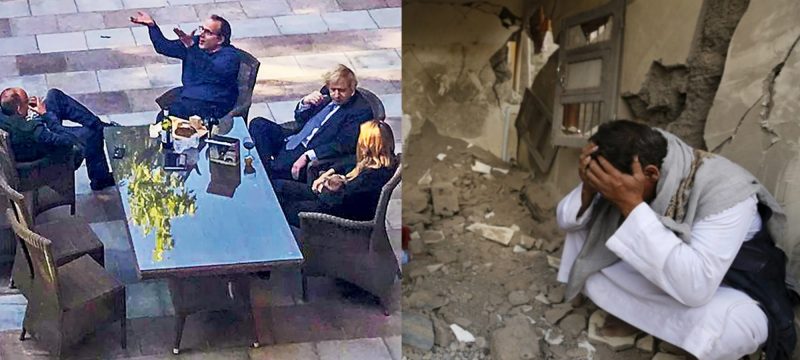
Over the past several days, the news story that has dominated British news headlines, and consequently, the news headlines of the rest of the Western world, is controversy over a leaked email confirming Boris Johnson’s attendance at a Downing Street garden party in May 2020 – a time when the Summer weather is usually at its peak in Britain, and incidentally, the same time when the entire country was under stringent lockdown measures.
In spite of offering an almost immediate apology in the House of Commons on Wednesday, Johnson has faced intense calls to resign from his position.
Not only from the opposition of Keir Starmer’s Labour, Ed Davey’s Liberal Democrats and Nicola Sturgeon’s SNP, but also from prominent members of his own Conservative Party such as Scottish Tory leader Douglas Ross. With the main point of contention being that members of the British public were prohibited from seeing gravely ill loved ones at the same time as Johnson’s attendance of said garden party due to the restrictions put in place.
The ongoing controversy over ‘partygate’ however is in stark contrast to the minuscule Western media coverage of Boris Johnson’s key role in what is currently the world’s worst humanitarian crisis, the now seven-year long Saudi Arabia-led war on Yemen.
A conflict that has resulted in the worst Cholera outbreak of all time, the deaths of 10,000 children directly through the ensuing violence, and the further deaths of more than 85,000 children through the mass-starvation the conflict has triggered.
In July 2016, following his appointment as Foreign Secretary under the then-government of Theresa May, Johnson approved the sale of more than £1.2bn worth of British made-weaponry to Downing Street-ally Saudi Arabia – the Gulf Kingdom immediately putting it to use on Yemen’s agricultural, health and sanitation infrastructure.
This lead directly to the aforementioned Cholera outbreak and famine in what is already the most impoverished nation on the Arabian Peninsula, a situation exacerbated even further by a Saudi blockade preventing food and medical supplies from entering the country.
British support for the Saudi-led conflict goes far beyond lucrative arms sales to Riyadh however, with British military advisors on hand alongside their US counterparts in the Saudi command room to assist in the selection of targets for the Royal Saudi Air Force – more than 100 Saudi pilots have also been trained at RAF airbases in Britain over the past decade alone.
With both policies remaining in place since Johnson became Prime Minister in July 2019, alongside the aforementioned arms sales which have resulted in significant profit for British defence contractors such as BAE Systems.
Perhaps the most crucial role in Britain’s decision to support the Yemen war however, is a geopolitical ambition that Downing Street shares with the United States and Israel – the containment of Iran within the region.
The Islamic Republic, a long-time Western foe since the 1979 Islamic Revolution saw the US-UK aligned Shah deposed and replaced with the anti-Western and anti-Zionist Ayatollah Khomeini, is widely accused of backing the Ansar Allah rebel movement, more commonly known as the Houthis. Whose seizure of the Yemeni capital Sana’a and overthrow of the then pro-Saudi President Abdrabbuh Mansur Hadi in early 2015 would result in Riyadh launching its US-UK backed air campaign in March of that year in a bid to restore the government of its favoured candidate.
It is also the reason why, in addition to multi-billion pound arms deals between London and Riyadh, that what has now amounted to a seven-year long US and UK backed genocide of the Yemeni people, has received scarce media coverage in the West – in stark contrast to a Summer garden party held by a British Prime Minister who has himself played a key role in the slaughter.
Gavin O’Reilly is an Irish Republican activist from Dublin, Ireland, with a strong interest in the effects of British and US Imperialism; he was a writer for the American Herald Tribune from January 2018 up until their seizure by the FBI in 2021, with his work also appearing on The Duran, Al-Masdar, MintPress News, Global Research and SouthFront. He can be reached through Twitter and Facebook.
Witches executed 300 years ago to be posthumously pardoned

FILE PHOTO. © Getty Images / ZU_09
RT | December 19, 2021
Thousands of people, mostly women and girls, who were accused of witchcraft in Scotland hundreds of years ago are set to be pardoned following a two-year long campaign by the Witches of Scotland activist group.
The women’s alleged crimes were reportedly as varied as causing hangovers to meeting with the Devil — and more than half of those accused under the Witchcraft Act between 1563 and 1736 were executed. According to estimates cited by the Sunday Times, some 85% of the victims were female.
Scottish First Minister Nicola Sturgeon’s administration has reportedly backed a bill proposed in parliament which calls on the government to posthumously clear the victims’ names. The likely pardon comes after a two-year long campaign led by a group named ‘Witches of Scotland’.
Activists Claire Mitchell QC and Zoe Venditozzi launched a petition on International Women’s Day 2020, demanding that the authorities pardon, apologize, and memorialize those killed as witches in Scotland. On September 1, a parliamentary committee agreed to pass the issue on to the Scottish government.
The bill granting the pardon could be passed as early as summer 2022, according to media reports. Natalie Don, a Scottish National Party lawmaker, told the Sunday Times that it was right that “this wrong should be righted, that these people who were criminalised, mostly women, should be pardoned.”
Religion and superstition-fueled witch-hunts were not unique to Scotland, with similar practices seen in west Germany, France, northern Italy, and Switzerland, and what would later become the US. Tens of thousands of women accused of witchcraft were burned at the stake or hanged over a span of several centuries.
And while in the West, the prosecution of witches ceased by the late 18th century, elsewhere in the world witchcraft is still considered a crime. Saudi Arabia, for example, established an anti-witchcraft unit in 2009 and accused women have even been put to death. Similarly, the Central African Republic doles out extremely harsh punishments to those accused of being witches.
Yemen on the Brink of Disaster, Poverty, and Extinction
By Viktor Mikhin – New Eastern Outlook – 03.11.2021
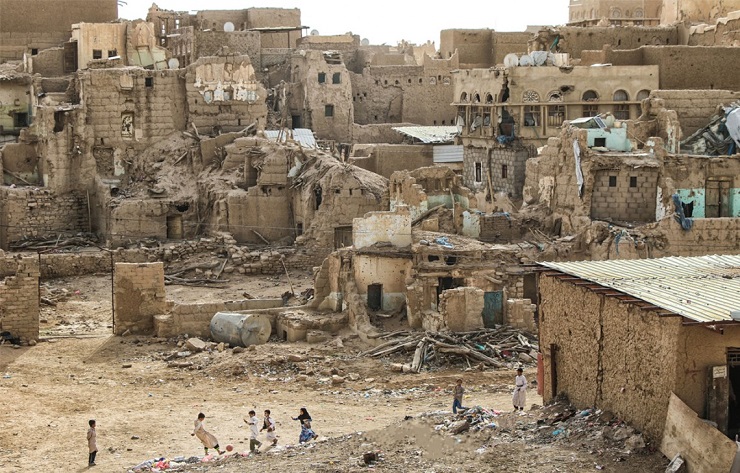
UNICEF Spokesperson James Elder has just returned from Yemen with some tragic news about children living in what the United Nations calls the worst humanitarian crisis in the world.
Speaking at a press briefing in Geneva, he said: “The Yemen conflict has just hit another shameful milestone: 10,000 children have been killed or maimed since Saudi Arabia’s bombing campaign started in March 2015. That’s the equivalent of four children every day.” Elder told reporters that the estimates provided by the international UN agency were likely an understatement of the actual number of children killed and injured, which is rarely recorded by anyone. “These are of course the cases the UN was able to verify. Many more child deaths and injuries go unrecorded, to all but those children’s families.”
International experts have identified four significant dangers that have brought the country to the brink of humanitarian collapse. First of all, it is a brutal and protracted military conflict, and the blame for unleashing it lies entirely with the US and Saudi Arabia. Secondly, the colossal economic devastation that struck all regions of the country resulted from the military conflict. Also, there is a lack of infrastructure and social services, i.e., health, nutrition, water and sanitation, social protection, and education. Finally, the UN is critically underfunded.
It may be recalled that the war with Yemen began in March 2015, when Saudi Arabia brazenly and cynically launched a bombing campaign to restore the former regime, which obeyed orders from Riyadh, essentially maintaining Yemen’s status as a parallel and subordinate state to the Saudis. This had been the case before the popular revolution in the country, which triggered powerful Saudi airstrikes. The United States sold hundreds of billions of dollars worth of arms to the Kingdom during this war, in addition to intelligence and logistical support for Saudi military aircraft. Evidence shows that the UK is the second-largest supplier of arms to Riyadh, which is being actively used in an undeclared war, mostly against civilians. Other Western countries, including “democratic” France and Canada, have also profited enormously from this war, supplying the Saudis with mountains of offensive weapons.
These are the words and deeds of the so-called democratic West. Calling for democracy and freedom in their words, Western countries in reality supply arms and military equipment at every opportunity, thus fomenting military conflicts in which hundreds of thousands of people die in Yemen, Iraq, Syria, Afghanistan, and Libya. It makes one wonder where are the so-called international organizations which allegedly aim to prevent conflict and prosecute those who incite and encourage these bloody wars?
The United States, the skilled cheaters of double standards in politics and human rights, has once again manifested itself concerning Yemen. US Secretary of State Anthony Blinken has loudly reiterated that resolving the conflict in Yemen remains an alleged top priority of US foreign policy. These comments were made during a telephone conversation with the newly appointed United Nations Special Envoy for Yemen Hans Grundberg. And this was said at a time when the Pentagon was sending a new shipment of aerial bombs to Saudi Arabia, which the Saudis are actively using in their war against, as Riyadh says, “the fraternal Yemeni people.”
So far, only human rights groups have accused these countries of complicity in Saudi Arabia’s war crimes in Yemen. One investigation found that the bomb dropped from a Saudi warplane in August 2018, which hit a school bus and killed more than 40 children, came from the United States. But it was just one bomb, while Yemeni officials say most Saudi airstrikes have targeted residential areas, and all Saudi bombs and missiles are purchased abroad from “democratic” countries.
The head of the UN Children’s Agency also presented journalists with these grim figures on the suffering of Yemeni children, from malnutrition to education and sanitation. For example, he said: “Let me share a few more numbers: Four out of every five children need humanitarian assistance; that’s more than 11 million children, and 400,000 children suffer from severe acute malnutrition More than two million children are out of school. Another four million are at risk of dropping out. Two-thirds of teachers, more than 170,000, have not received a regular salary for more than four years. 1.7 million children are currently internally displaced because of violence. As the violence has intensified, especially in the Marib area, more and more families have fled their homes. A staggering 15 million people (more than half of them, about 8.5 million, are children) do not have access to safe water, sanitation or hygiene. With the current level of funding and without an end to the fighting, UNICEF will not be able to help all these children.” And he went on to predict a grim prognosis: “There is no other way to help them without a lot of international support, which will result in a large number of Yemeni children dying.”
But does it matter to the gentlemen in western capitals who make huge profits from the blood of Yemeni children and the supply of arms, which allows them to eat sweet and sleep well? It’s none of their business. As they usually say in the United States, it’s just business, nothing personal.
Despite the efforts of UNICEF and other international organizations, the severity of the humanitarian situation in Yemen cannot be overemphasized. The economy is in a critical state. GDP has fallen 40% since 2015 when neighboring Arab Saudi Arabia decided to punish Yemenis for their “disobedience.” Vast numbers of people lost their jobs, causing family incomes to plummet. About a quarter of people, including many health workers, teachers, engineers, and sanitation workers, rely on civil servants’ salaries that are paid irregularly, if at all. And while the displacement and destruction of schools have resulted in classrooms that can hold up to 200 children, teachers are showing up. Yes, unpaid teachers come in and teach on their enthusiasm to educate the next generation.
In addition to the Saudi-imposed war, with the US behind it, many Yemenis are starving not because there is no food but because there is not enough money to buy it. “But such people have no choice, which means they are forced to sell everything from jewelry to pots just to feed their own children,” writes Egypt’s Al-Ahram. “But their children continue to starve, as families end up selling off all their possessions and cannot buy simple food for themselves or their children.”
Economists believe that UNICEF alone urgently needs more than $235 million to continue its life-saving work in Yemen until mid-2022. Failure to do so will force the agency to reduce or terminate life-saving assistance to vulnerable children. “Funding is critical,” notes Al-Ahram. “We can draw a clear line between donor support and lives saved,” it adds. And perhaps the newspaper’s most emotional comment was the following: “Yemen is the most brutal place in the world to be a child. And, incredibly, it’s getting worse.”
Last month, the United Nations warned that 16 million Yemenis, more than half the population, are facing starvation. Unless the international community steps up support, food aid could soon dry up. Doctors warn that a staggering 99% of Yemenis have not been vaccinated against Covid-19. The country is now battling a third deadly wave of infections in which large numbers of people, especially children and the elderly, will die due to a lack of vaccines. How the West treats the suffering of Yemenis, who are direct co-conspirators in Saudi Arabia’s shameful war, was directly commented on by Yemen’s Al-Sahwa : “We need the promised vaccines, but it is also shameful that by buying up all the vaccines for themselves, rich countries like the UK and Germany are blocking all decisions to get the medicine we need into our country.”
Many countries worldwide are well aware of the plight of the Yemeni people, especially the children and elderly, and deplore the fact that Saudi Arabia still seeks a military solution to the Yemeni crisis, stating that this approach will lead to nothing but death and destruction. They have repeatedly called on Riyadh to abandon a military solution and instead seek political ways to end the devastating war in Yemen. Speaking at a briefing for journalists, Iranian Foreign Ministry spokesman Saeed Khatibzadeh said: “Unfortunately, the Saudi government is still looking for a military solution for Yemen, even though it knows and has understood after a long time that war has no other result than killing innocents and civilians, damaging the peoples of the region and security.” The sooner the Government of Saudi Arabia shows its commitment to political solutions and ends this destructive war, the better for the country and the region, as well as for the peace and security in the entire region.
Biden Approves $650 Million Missile Sale To Saudis After Earlier Vowing To End War In Yemen
By Tyler Durden | Zero Hedge | November 4, 2021
Despite the prior stated intent by the Biden White House to see an immediate end to the war in Yemen, the administration on Thursday announced that it’s approving a new $650 million sale of air-to-air missiles (AMRAAM) and related equipment to Saudi Arabia.
“The State Department has made a determination approving a possible Foreign Military Sale to the Kingdom of Saudi Arabia of AIM-120C Advanced Medium Range Air-to-Air Missiles (AMRAAM) and related equipment for an estimated cost of $650 million,” a Pentagon statement announced. Specifically it includes up to 280 air-to-air missiles.
What’s been described as the “forgotten war” in Yemen has raged since 2015, with for much of that period the Pentagon providing direct assistance to Saudi-UAE coalition airstrikes against Yemeni Houthi rebels backed by Iran. Prior US involvement in the Saudi-waged war grew increasingly controversial, given the high civilian death toll – amid a total estimated death toll of over 130,000 Yemenis killed.
Further the United Nations within the past two years has designated the conflict “the world’s worst humanitarian crisis.” Recall that back in February Biden earned bipartisan praise for the following foreign policy “promises”:
In his first major foreign policy address, President Joe Biden on Feb. 4 declared his commitment to “end the war in Yemen,” which he called a “humanitarian and strategic catastrophe.” The president announced that the US would stop assisting all “offensive operations” in that impoverished country and halt all “relevant arms sales” to the Saudi Arabia/UAE-led coalition that is waging war there.
In describing the rationale for the new massive weapons sale to the kingdom, the Thursday Biden administration statement characterized the ‘defensive’ nature of the systems:
We’ve seen an increase in cross-border attacks against Saudi Arabia over the past year. Saudi AIM-120C missiles, deployed from Saudi aircraft, have been instrumental in intercepting these attacks that also US forces at risk and over 70,000 US citizens in the Kingdom at risk.
There have been multiple missile and drone attacks launched out of Yemen over the past year, with the Iran-backed Houthis showing increased sophistication and reach.
Astoundingly, Pentagon also claimed that the Saudi kingdom is a “force for progress” in the Middle East: “This proposed sale will support US foreign policy and national security of the United States by helping to improve the security of a friendly country that continues to be an important force for political and economic progress in the Middle East,” it said.
Notably the weapons transfer will include medium-range missiles for Saudi fighter jets, which will likely directly aid in the continued Saudi bombing of Yemen as it continues to lay siege the country – further contributing to the humanitarian crisis of famine, disease, and lack of basic medicines.
Prior analysis we featured days ago described described that there’s currently a diplomatic push to get a ceasefire in place, and ultimately end the war. While this would get the Saudis out of the negative coverage of the war, the kingdom seems to be focused on what they can get out of the US for heading down this path.
So it appears the US administration is now seeking to justify its freshly approving the new missile deal by attempting it to link it to conditions that would end the war in Yemen. Though there doesn’t seem to be anything Riyadh has firmly or definitively agreed to just yet.
Direct Flight from Saudi Arabia Lands in Zionist Entity Monday Evening: Report

Al-Manar | October 25, 2021
A direct flight from Riyadh, Saudi Arabia will land at Zionist entity’s Ben Gurion Airport on Monday evening, Israeli media reported.
“The flight will be a VIP class Boeing 737-700 aircraft with registration A6-AIN owned by the Emirati Royal Jet airline,” Kan pubcaster said.
The Riyadh-Tel Aviv flight comes after a report that White House National Security Adviser Jake Sullivan raised the possibility of Saudi Arabia joining the so-called Abraham Accords during a meeting last month in Riyadh with Saudi Crown Prince Mohammed bin Salman (MBS), according to three US and Arab sources involved in the talks.
The sources said that during the conversation, MBS did not immediately reject the proposal to establish diplomatic ties with the Zionist entity, listing the steps needed to make the move, including improving the relations between the United States and Saudi Arabia.
Rulings against Palestinian inmates show Saudi desire to normalize relations with Israel: Yemen’s Ansarullah
Press TV – August 9, 2021
Yemen’s Ansarullah resistance movement has condemned Saudi Arabia for handing down harsh verdicts against dozens of Palestinian inmates in the kingdom, some of whom were given jail terms of up to 22 years, over alleged support for the Palestinian Hamas movement, saying the verdicts clearly reflect the Riyadh regime’s desire to normalize relations with Israel.
“We strongly condemn Saudi rulings against Palestinians living in the country. We consider such verdicts a poisonous stab in the back of the Palestinian cause, and a message of friendship and obedience to Israel,” Ansarullah’s political bureau said in a statement.
It added, “Given our knowledge about the Saudi regime’s nature and its eagerness to normalize ties with the Zionist enemy, we call upon Muslim nations to show solidarity with the Palestinian prisoners, and to press for their immediate release.”
“Sana’a is ready to release Saudi prisoners in exchange for the freedom of Palestinians being kept behind bars in the Riyadh regime’s detention,” Ansarullah said.
A Saudi court on Sunday issued various sentences against 69 Palestinians and Jordanians.
The group was detained in March 2018 during a wave of arrests by Saudi authorities on a group of long-term Palestinian and Jordanian residents in the kingdom on alleged links to Hamas.
Sources in the besieged Gaza Strip have previously said that they believed the crackdown was linked to warming ties between Israel and Riyadh.
An official Hamas source said last year that the majority of the detainees were Hamas members, who had resided in the Persian Gulf country for decades, accusing Saudi Arabia of “targeting everyone who is linked with resistance” against the Israeli occupation.
Several Palestinians have been detained since February 2019 and are facing trial before a Saudi terrorism court.
The Saudi court sentenced Hamas representative in Saudi Arabia Mohammed al-Khudairi to 15 years in prison. His son, Hani, was sentenced to three years, Turkey’s official Anadolu news agency reported.
Khudairi’s brother, Abd al-Majeed, said the sentence includes “clemency for half the term.”
Khudairi, 82, was a veteran Hamas leader responsible for managing the relationship with Saudi Arabia for two decades.
Hamas, meanwhile, condemned the sentences handed out on Sunday, calling them “unjust” and saying those sentenced had done nothing to harm Saudi Arabia.
“We were shocked … by the rulings issued by the Saudi judiciary against a large number of Palestinians and Jordanians residing in the kingdom,” Hamas said in a statement.
“We deplore the harsh and undeserved sentences against most of them. All they did was support their cause and their people, to which they belong, without any offence to the kingdom and its people,” it added.
The Palestinian Islamic Jihad movement also condemned the rulings.
Over the past three years, the Saudi authorities have also deported more than 100 Palestinians from the kingdom, mostly on charges of supporting Hamas financially, politically or through social networking sites.
The Riyadh regime has imposed strict control over Palestinian funds in Saudi Arabia since the end of 2017.
Tunisia’s instability and coup are backed by the UAE, Saudi
By Robert Inlakesh | MEMO | July 30, 2021
With Tunisian President Kais Saied seizing power, in what has been called a coup by the country’s largest political party, it seems that the last stronghold of democracy in Northern Africa, having emerged from the Arab Spring, is falling. Celebrated by some, such a transition could have its consequences especially with the involvement of Gulf dictatorships.
Tunisia is often held up as the one standing success story of the 2011 Arab Spring. Having overthrown former President and dictator Ben Ali, during the Jasmine Revolution, the people of Tunisia have experienced a bumpy ride since, but have maintained a democracy. This could all be changing soon with Gulf despots looking to pick up the pieces of any shattering of the nation’s democratic model.
Fears are now emerging, of a repeat of the affairs which transpired in Egypt, destroying the democratic system set up in the country and installing a military dictator. However we aren’t quite seeing such a dramatic shift and there are key differences between the move to dissolve parliament, fire the prime minister and consolidate power, in Tunisia, and the all out military coup which occurred in Egypt in 2013.
But, as there are differences between Egypt’s coup and Tunisia’s, there are also some alarmingly similar forces at work. In Egypt the target was the democratically elected President Mohamed Morsi, he represented the Muslim Brotherhood and in order to remove him, we now know that the UAE and Saudi Arabia both worked to bankroll his overthrow. In Tunisia, for years the UAE and Saudi Arabia have been working to oust the ruling Ennahda Party, which is connected to the Muslim Brotherhood.
The two Gulf regimes have historically bankrolled the opposition to Ennahda and Abu Dhabi was even accused of attempting to organise a coup in Tunisia. As President Kais Saied took control, the office of Al Jazeera came under attack by his security forces who stormed the Qatari funded outlet’s building and forced its journalists out. This has been interpreted as a clear attack on the channel, due to its political leanings towards the side of the Muslim Brotherhood.
Last year it was also reported that Turkish intelligence had foiled an attempted coup plot inside Tunisia, which was allegedly coordinated by the United Arab Emirates. Around that time, a group of demonstrators calling themselves the ‘Salvation Front’ took to the streets of the capital to condemn the Ennahda Movement and its alignment of the Qatari/Turkish axis, it was later discovered that the facebook group for the movement was run by two individuals based in the UAE.
The UAE may have well backed last year’s alleged coup attempt, after their anti-Muslim Brotherhood ally in Libya, Khalifa Haftar, was starting to suffer loses following the introduction of Turkish military aid to help the GNA forces of Fayez Al-Sarraj. Being involved in combating neighbouring Tunisia’s Ennahda Party, could be in part about securing a pro-Haftar dictator for the UAE. The UAE has a well known track record of anti-Muslim Brotherhood and anti-democracy action, having backed reactionary actors in countries like Libya, Egypt, Bahrain, Sudan and Yemen.
It’s also no secret whose side the UAE, Saudi Arabia and even their allies like Egypt are on, having celebrated the political turmoil in Tunisia as the “final fall” of the Muslim Brotherhood. Riyadh and Abu Dhabi have also been using social media accounts to whip up anger online and drive the country further into chaos.
Prominent Saudi journalist, Abdul Rahman Al-Rashed, wrote a celebratory opinion piece in the kingdom’s Asharq Al-Awsat newspaper saying something quite rich for a supporter of Saudi Arabia’s regime: “It is not surprising that the “Brotherhood” has fallen in Tunisia now, but rather it is years later than was expected… they were associated with chaos, assassinations, and deliberate obstruction operations to thwart government action”.
The economic problems, government mismanagement, corruption and the anger over the mishandling of the current health crisis, are all real issues and Tunisia has risen up many times since 2011 to demand a change. None of these real issues should be undermined, nor should it be stated that there is no Muslim Brotherhood alliance. But when it comes to a domestically created group which engages in a democratic process and the power of foreign brutal dictatorships with some of the worst human rights records on earth, it’s clear which option is more detrimental.
It cannot be understated, the insidious role that the UAE and, to a lesser extent, Saudi Arabia, have been playing to stir up civil unrest in Tunisia. If President Kais Saied crowns himself dictator, aligning himself with Abu Dhabi and Saudi Arabia, this could have serious repercussions for the country. It is not as of now certain that we will see such a takeover, but regardless of what transpires, the UAE and the Saudi will not stop working to destabilise Tunisia in order to remove the Muslim Brotherhood’s influence.
Importantly, if the West, which claims to care so much about democracy, truly cared for it at all, it would quickly drop its alliances with the brutal regimes of Saudi’s Mohammed Bin Salman and the UAE’s Mohammed Bin Zayed. The destructive role of these Gulf actors and their strides towards crushing all Arab democracies, whilst remaining the best of friends with the self proclaimed “worldwide spreader of democracy” [the US] shows exactly which side the American government is truly on.
New Normal Newspeak #3: “Progressive”
OffGuardian | July 30, 2021
“New Normal Newspeak” is a series of short articles highlighting how our language has come under assault in the past eighteen months.
***
We have a backlog for these NNNS posts, but I saw this today on Twitter, and it made me laugh so it gets to jump the queue.
A few days ago, Saudi Arabia announced they would be introducing vaccine passes for, essentially, anyone that wanted to do anything.
And then Max Boot, the neo-liberal warmonger who’s paid to squat over his keyboard and squeeze out columns for the Washington Post, called it “progressive”:

There it is in black and white – an absolute monarchy that still practices public beheadings, has no religious freedom, democracy or equal rights, has decided to add to their delightful resume by introducing digital surveillance, enforced experimental vaccination and medical apartheid. Doesn’t that sound so progressive?
The Council of Foreign Relations fellow has since deleted the tweet. And it’s not hard to see why.
Maybe no other word has had its meaning as brutally violated as “progressive” in the last decade. It is used to stifle freedom of speech, to camouflage corruption of “liberal” candidates, as a casus belli for regime change and to bang the drum for new cold wars with both Russia and China.
But applying it to Saudi Arabia is a whole new level of stretched meaning.
It’s also a little preview of how the billionaire-owned MSM will be selling medical apartheid to their hypnotized “liberal” readers in coming weeks.
UK’s arms sales to Riyadh three times higher than previously thought

Press TV – July 15, 2021
A new investigation has revealed that Britain has exported around three times as much weaponry and military equipment to Saudi Arabia, which is leading a devastating military aggression against Yemen, than previously believed.
According to a report published by British online newspaper The Independent, the British government’s official figures state that British ministers have signed off 6.7 billion pounds (9.28 US dollars) worth of arms, such as bombs, missiles, and aircraft, to the oil-rich kingdom ever since it started its bombardment campaign of neighboring Yemen back in March 2015.
However, researchers say the actual figure is likely to be close to £20 billion (over $27 billion) because the official numbers do not entail sales carried out under an obscure “open license” system.
The investigation further casts doubts on allegations of the British government about having “one of the most robust and transparent export control regimes in the world.”
The probe emphasized that Britain’s operation of the parallel and less transparent “open license” system gives a more open-ended green light to arms manufacturers to sell specific armaments to a specific country without a monetary limit.
It further noted that the United Kingdom operated an open license for bombs and air-to-surface missiles to Saudi Arabia between 2014 and August 2019.
Moreover, an open license has covered Britain’s sales of equipment and components for use in the twin-engine and multi-role Eurofighter Typhoon jets to Saudi Arabia. The warplanes have been used in Saudi airstrikes across Yemen.
The researchers also examined the accounts of companies known to be selling arms to Saudi Arabia, and discovered that the revenues of British multinational arms producer BAE Systems, for instance, totaled nearly 17 billion pounds (23.5 US dollars).
As a result, they estimate that the real value of exports is close to £20 billion ($27 billion).
“The use of open licenses also offers the government a convenient sleight of hand when it comes under pressure over arms sales to a particular country due to events such as wars, military coups, or well-publicized human rights abuses,” the report warns.
Katie Fallon of Campaign Against Arms Trade, which conducted the research, stated, “The use of Open Licenses covers up the real extent of the UK arms trade and makes it impossible to know what quantities of weapons are being sold around the world.”
“UK-made fighter jets, bombs and missiles have had a devastating impact in the ongoing bombardment of Yemen. The fact that the real total of these sales could be so much higher than previously reported emphasizes the central role that the UK government and UK-based companies have played in the war. There must be full transparency about what arms have gone over and in what quantity,” Fallon added.
“So much of the arms industry takes place in secret, and that’s how the arms dealers like it. As long as the widespread use of Open Licenses continues, the true nature and volume of the UK arms trade will remain hidden from scrutiny, and therefore from meaningful control,” Fallon pointed out.
Saudi Arabia, backed by the US and its regional allies, launched the devastating war on Yemen in March 2015, with the goal of bringing the government of former Yemeni president Abd Rabbuh Mansur Hadi back to power and crushing the popular Ansarullah resistance movement.
Yemeni armed forces and allied Popular Committees have, however, gone from strength to strength against the Saudi-led invaders, and left Riyadh and its allies bogged down in the country.
The Saudi war has left hundreds of thousands of Yemenis dead, and displaced millions more. The war has also destroyed Yemen’s infrastructure and spread famine and infectious diseases across the Arab country.
Ex-Mossad chief becomes head of new Saudi-backed SoftBank office: Report
Press TV – July 10, 2021
Yossi Cohen, the former chief of Israeli spy agency Mossad, is becoming head of the new office of the Saudi-backed conglomerate SoftBank in Israel, a report says.
Citing unnamed sources, the Israeli business newspaper Globes reported on Friday that SoftBank, a Japanese multinational conglomerate holding company led by Masayoshi Son, was appointing Cohen to head its new office in the occupied Palestinian territories.
Back in May 2017, Tokyo-based SoftBank and the Public Investment Fund of Saudi Arabia (PIF), which is the Arab kingdom’s main sovereign wealth fund, jointly created the Softbank Vision Fund. The joint venture is the world’s largest technology-focused private equity fund with a capital of $93 billion.
Having invested huge sums into companies such as Uber, Alibaba, and TikTok, SoftBank is seen as the world’s leading technology fund.
This is the second investment giant within three months to open a representative office in Israel, after Blackstone.
According to the daily, although Cohen does not have a background in investment, he is a well-known and popular figure in Israel, capable of connecting to Israeli entrepreneurs and opening doors for them in any company, government, or public authority in any territory.
His duties would include managing SoftBank’s activity in the occupied Palestinian territories and looking for investments.
Cohen has served as the head of Mossad since January 2016. He has reportedly served as former Israeli Prime Minister Benjamin Netanyahu’s special envoy for various tasks. Netanyahu reportedly sees him as his preferred successor.
Cohen played an important role in the Israeli regime’s normalization deals with a number of Arab states. He traveled to the United Arab Emirates and Bahrain.
The ex-Mossad chief reportedly joined Netanyahu on a 2020 visit to Saudi Arabia for talks with Crown Prince Mohammed Bin Salman.
Biden lied about Yemen
By Caitlin Johnstone | April 29, 2021
The Biden administration has finally admitted that the US is indeed providing offensive material support to Saudi Arabia’s genocidal assault on Yemen, directly contradicting Biden’s February claim that it would no longer be providing offensive support in that war. We are being lied to about yet another US war by yet another US president.
“The United States continues to provide maintenance support to Saudi Arabia’s Air Force given the critical role it plays in Saudi air defense and our longstanding security partnership,” Pentagon spokesperson Jessica McNulty has informed Vox reporter Alex Ward.
“Multiple US defense officials and experts acknowledged that, through a US government process, the Saudi government pays commercial contractors to maintain and service their aircraft, and those contractors keep Saudi warplanes in the air. What the Saudis do with those fighter jets, however, is up to them,” Ward reported, adding, “The US could cancel those contracts at any time, thus effectively grounding the Saudi Air Force, but doing so would risk losing Riyadh as a key regional partner.”
“The recent admission by the Department of Defense that US companies are still authorized to maintain Saudi warplanes … means that our government is still enabling the Saudi operations, including bombings and enforcing a blockade on Yemen’s ports,” Hassan El-Tayyab, the legislative manager for Middle East policy at the Friends Committee on National Legislation lobbying group, told Ward.
El-Tayyab is on record speaking out after Biden’s deceitful February announcement, saying this administration needs to make it abundantly clear what it actually means by ending offensive support for the war on Yemen and actually stick to it.
“I’m not a full pessimist here. I welcome the news,” he told Al Jazeera at the time, adding, “But I’m just trying to stay vigilant and not take the foot off the gas on advocacy pressure. Because we don’t know what’s going to happen.”
Well, now we do know. The US is maintaining and servicing the warplanes that are bombing Yemen and enforcing a blockade, which has killed hundreds of thousands and the United Nations warns could kill 400,000 more this year alone if conditions don’t change, proving Joe Biden a liar and vindicating the experts and activists who cautioned against accepting his announcement on blind faith.
Getting to this point where questions are finally answered about the reality of the Biden administration’s Yemen policy has been like pulling teeth, with officials giving questioners the runaround for months on this issue. Watch this clip of US Yemen Envoy Tim Lenderking dodging questions like George Bush dodges shoes as congressman Ted Lieu tries to get a straight answer as to whether the US has stopped supporting the war on Yemen:
Antiwar’s Dave DeCamp writes the following:
“The admission comes over two months since President Biden said he was ending support for Riyadh’s ‘offensive’ operations in Yemen. Vox reporter Alex Ward asked Pentagon spokesman John Kirby on Monday if the planes that the US is servicing could be used for offensive operations in Yemen. Kirby admitted that the ‘maintenance support for systems could be used for both’ offensive and defensive operations. … Besides continuing to maintain the Saudi Air Force, the Biden administration has given Riyadh the political cover to continue enforcing the blockade on Yemen. Biden officials have claimed that Yemen is not under a blockade, even though Saudi warships are preventing fuel shipments from docking in the port of Hudaydah, which makes it impossible to deliver food to Yemen’s starving civilian population.”
The United Nations conservatively estimates that some 233,000 Yemenis have been killed in the [Saudi-led] war … mostly from what it calls “indirect causes.” Those indirect causes would be disease and starvation resulting from what UN Secretary-General Antonio Guterres calls “the worst famine the world has seen for decades.”
When people hear the word “famine” they usually think of mass hunger caused by droughts or other naturally occurring phenomena, but in reality the starvation deaths we are seeing in Yemen (a huge percentage of which are children under the age of five) are caused by something that is no more natural than the starvation deaths you’d see in a medieval siege. They are the result of the Saudi coalition’s use of blockades and its deliberate targeting of farms, fishing boats, marketplaces, food storage sites, and cholera treatment centers with airstrikes aimed at making those parts [of the country, which are] controlled by Yemen’s Ansarullah movement so weak and miserable that they break.
The United States lies about all its wars with the help of the mass media, but up until this year its lies about Yemen have largely consisted of lies by omission: simply not talking about Yemen (like when MSNBC went an entire year without mentioning it a single time during the height of Russiagate hysteria), reporting on the famine as though it’s the result of a tragic natural disaster, or omitting America’s role in the slaughter. This time, it was just a straightforward lie: Biden said the US was ending offensive support, and it wasn’t.
As we’ve discussed previously, when the people demand something of their government it’s a lot easier to simply tell them you’re on their side and redirect them than to tell them no. Democrats are especially good at this.
As awareness grows that Yemen is the single most horrifying atrocity taking place in our world today, pressure is mounting for the US government to use its tremendous amount of leverage over Saudi Arabia to cease the human butchery. Rather than increasing that pressure by saying no, the Biden administration defused it by falsely pretending to give in to the demands. Because the risk of “losing Riyadh as a key regional partner” was deemed too great.
And meanwhile the slaughter continues, unbroken from Obama to Trump and from Trump to Biden. The names change, the narratives change, but the murderous imperial war machine rolls on uninterrupted.
Featured Video
Elijah Magnier: Yemen’s strikes are shattering Saudi Arabia’s long-term strategy
or go to
Aletho News Archives – Video-Images
From the Archives
British weapons and personnel doing much of the killing in Yemen
Press TV – June 18, 2019
A detailed report published by the Guardian newspaper has shown how Britain is massively contributing to Saudi Arabia’s devastating war on Yemen as it suggests that London is not only supplying the bombs that fall on Yemenis, but it provides the personnel and expertise that keep the war going.
The comprehensive report by Arron Merat published on Tuesday showed that Britain was doing much of the killing in Yemen as the country continues to provide Saudi Arabia with everything it needs to turn its southern impoverished neighbor into a graveyard.
“Every day Yemen is hit by British bombs – dropped by British planes that are flown by British-trained pilots and maintained and prepared inside Saudi Arabia by thousands of British contractors,” said Merat in the report. … continue
Blog Roll
 Aletho News
- A West Bank War for Netanyahu’s Election Campaign, Could It Backfire?
- Yemen denounces European Parliament’s ‘hypocritical’ push to blacklist Ansarullah
- Qalibaf: UAE’s UN bid aims to ‘clear the runway’ for ‘Greater Israel’, whitewash genocide
- Pakistan reopens Iran border after boosting security: Report
- Why are so many Brazilians voting for Flávio Bolsonaro?
- Democrats Put Anti-Russia Agenda Ahead of American Workers
- Elijah Magnier: Yemen’s Strikes Are Shattering Saudi Arabia’s Long-Term Strategy
- Pentagon designates Chinese cultural centers national security threat
- Israel Demolishes Home Of Lebanese Journalist Whose Viral Film Exposed Pager Attack
- Record Oil, Empty Tanks: The UAE’s Miracle Recovery
- If Americans Knew
- An error has occurred; the feed is probably down. Try again later.
- No Tricks Zone
- Sudden Stratospheric Warming, Powerful El Niño Combination May Lead To Extreme Europe Cold, Energy Crisis!
- Two New Studies Find Thwaites Glacier Melt Cannot Be Driven By Human Activity Or A Warming Ocean
- E-Cars Reduce CO2 Emissions By Only 41% Compared To Internal Combustion Engine Vehicles
- Predictions Made By Renowned Climate Professor Over Past Decades Have Been Proven To Be Poor
- New Study Suggests Large Regions Of The Pacific Ocean Have Been Cooling For The Last 80 Years
- Germany’s Green Energy Debacle: High Energy Costs Force Kahla Porzellan to Close After 182 Years!
- New Study: 50 Years Of The Most Aggressive ‘Net Zero’ Policies Can Only Affect The Global Climate By 0.03°C
- US September “Heat” Was No Record…Many Records Set Decades Ago
- Latest European Green Energy Debacle; Portugal’s Largest Flagship Solar Park Insolvent!
- Green Energy Debacle: German Expert Professor Fritz Vahrenholt Warns Of Severe Economic And Social Consequences

