Moscow warns Trump against attack on Syria
By M K Bhadrakumar | Indian Punchline | April 9, 2018
The US President Donald Trump has appeared himself at the barricades facing Russia, finally. He has done everything possible so far not to get entangled in the New Cold War. And the Kremlin gave him the benefit of doubt so far. But no more.
How far Trump is seeking a confrontation with Vladimir Putin is hard to say but he is an intelligent man who would know that there is nothing personal about Russian policies. This is the first time Trump has directly criticized Vladimir Putin by name. Trump’s tweet on Sunday is provocative:
- Many dead, including women and children, in mindless CHEMICAL attack in Syria. Area of atrocity is in lockdown and encircled by Syrian Army, making it completely inaccessible to outside world. President Putin, Russia and Iran are responsible for backing Animal Assad. Big price to pay. Open area immediately for medical help and verification. Another humanitarian disaster for no reason whatsoever. SICK! If President Obama had crossed his stated Red Line In The Sand, the Syrian disaster would have ended long ago! Animal Assad would have been history!
Moscow lost no time to point out that the so-called chemical attack is fake news. In fact, Moscow has been alerting its allies in Syria that precisely this sort of a false flag operation by the Saudi and US-backed terrorist group Jeish al-Islam (which is staring at defeat by the Syrian government forces in Eastern Ghouta) could be expected.
History is repeating. A similar false-flag was staged in Eastern Ghouta in 2013 and it almost prompted then US President Barack Obama to move naval fleets to the Mediterranean for war on Syria, but a prompt Russian initiative on chemical disarmament of Syria under the auspices of the UN defused the US-Saudi plot. Subsequently, investigations by western journalists, including from Associated Press, found that the then Saudi Intelligence Chief, Prince Bandar Bin Sultan only had supplied a chemically armed warhead to the terrorist group in Eastern Ghouta.
The Russian Foreign Minister Sergey Lavrov disclosed today in Moscow that the Syrian government had transferred to the UN Security Council and the OPCW the intelligence reports to the effect that a provocation was being prepared with the use of chlorine in East Ghouta. Lavrov added: “The US is taking steps not to leave (Syria) as President [Donald] Trump said, and leave Syria for others, but to establish a foothold there for a very long time – experts believe so.”
So, the big question is what Trump could be up to. Trump mentioned Obama in his tweet. For sure, Moscow is on alert. The Russian Foreign Ministry issued another warning to Washington on Sunday that any US interference in Syria will be “absolutely unacceptable and can lead to very grave consequences.” The text of the statement is reproduced below:
- The Syrian government army is conducting an operation to free civilians in Eastern Ghouta, a suburb of Damascus, from the control of militants and terrorists. The greater part of this suburb has been liberated. Irreconcilable radicals have mounted fierce resistance in the town of Douma, where they use the remaining civilians as a human shield.
- In this situation, the Russian Centre for Reconciliation in Syria and the Syrian government forces have created humanitarian corridors for the evacuation of civilians. They will continue with this effort. However, those who are not interested in the early elimination of one of the last seats of terrorism in Syria and in a genuine political settlement are doing their best to hinder the evacuation of civilians.
- False information is being planted about the alleged use of chlorine and other toxic agents by the Syrian government forces. The latest fake news about a chemical attack on Douma was reported yesterday. These reports are again referenced to the notorious White Helmets, which have been proved more than once to be working hand in glove with the terrorists, as well as to other pseudo-humanitarian organisations headquartered in the UK and the US.
- We recently warned of the possibility of such dangerous provocations. The goal of these absolutely unsubstantiated lies is to protect the terrorists and the irreconcilable radical opposition that has rejected a political settlement, as well as to justify the possible use of force by external actors.
- We have to say once again that military interference in Syria, where Russian forces have been deployed at the request of the legitimate government, under contrived and false pretexts is absolutely unacceptable and can lead to very grave consequences.
The detailed Russian explanation suggests that a criticality has arisen. Two Israeli jets fired missiles at a Syrian airbase in Homs province today early morning from Lebanese air space inflicting heavy casualties. Israeli drones have been reported over Lebanon. This could be a dry run for US operations.
Saudi crown prince wants US military to maintain presence in Syria
Press TV – March 31, 2018
Saudi Crown Prince Mohammed bin Salman says he wants the US military to extend its presence in Syria, despite American President Donald Trump’s declaration that US forces will withdraw from the war-torn Arab country in the near future.
“We believe American troops should stay for at least the mid-term, if not the long-term,” bin Salman said in a wide-ranging interview with the Times on Thursday, a few hours after Trump told a cheering crowd in Richfield, Ohio, that American troops would soon be pulled out from Syria.
The US and its allies have been bombarding what they call positions held by the Daesh Takfiri terrorist group inside Syria since September 2014 without any authorization from the Damascus government or a UN mandate.
The military alliance has repeatedly been accused of targeting and killing civilians. It has also been largely incapable of fulfilling its declared aim of destroying Daesh.
“We’re coming out of Syria very soon. Let the other people take care of it (Daesh) now, very soon. Very soon, we’re coming out.”
The US currently has some 2,000 ground troops inside Syria in a declared aim of crushing the terror group, which is no longer in control of any urban center and is considered to be totally defeated in the Arab country.
Washington also maintains a military base in Syria’s eastern Dayr al-Zawr province, serving as a checkpoint through which it coordinates with anti-Damascus militias to launch purported attacks against the remaining Daesh terrorists holed up in a series of localities along the Euphrates River and a stretch of desert straddling the Iraq-Syria border.
“If you take those troops out from east Syria, you will lose that checkpoint,” bin Salman further said in the interview, which was published on Friday, adding, “And this corridor could create a lot of things in the region.”
The Syrian government and Russia, which has been engaged in an anti-terror campaign in the Arab country since September 2015 upon an official request from Damascus, have time and again called on the US to pull out its troops from the Arab country as Daesh is no longer considered a significant threat.
Syria has repeatedly blamed Riyadh of supporting anti-Damascus militants and of destabilizing the Arab country.
In late 2016, Saudi Arabia’s Interior Ministry acknowledged that more than 1,500 of its citizens were fighting alongside anti-Damascus militant groups in Syria.
Saudi de facto leader meets leaders of pro-Israeli lobbies in US

Saudi Crown Prince Mohammed bin Salman ordering coffee with former New York mayor Michael Bloomberg at a coffee shop in New York, March 28, 2018.
Press TV – March 30, 2018
Saudi Crown Prince Mohammed bin Salman has met with the leaders of a number of pro-Israeli lobbying groups during his tour of the United States as the kingdom is moving towards normalization of diplomatic relations with the Tel Aviv regime at the expense of the Palestinian issue.
According to a leaked copy of his itinerary, the Israeli Haaretz daily reported that bin Salman had conferred with officials from the American Israel Public Affairs Committee (AIPAC), Stand Up for Israel (ADL), the Jewish Federations of North America (JFNA), Presidents’ Conference, B’nai B’rith and the American Jewish Committee (AJC).
The meeting comes as AIPAC, ADL and the JFNA have long fought against the pro-Palestine movement Boycott, Divestment and Sanctions (BDS), and spared no efforts to confront the global campaign.
Additionally, the groups donated millions to the Israeli regime to advance its expansionist policies and construct more settler units on occupied Palestinian territories.
Speaking in an interview with France 24 television news network on December 13, 2017, Saudi Foreign Minister Adel al-Jubeir said the kingdom has a “roadmap” to establish full diplomatic ties with the Tel Aviv regime.
In mid-November last year, a Lebanese paper published a secret document showing that the Saudis were willing to normalize relations with Israel as part of a US-led Israeli-Palestinian peace effort and unite Saudi-allied countries against Iran.
The document, published by al-Akhbar daily, was a letter from the Saudi foreign minister to bin Salman, explaining why it was in the kingdom’s interest to normalize relations with Israel. The letter said a rapprochement between Saudi Arabia and Israel has risks for the kingdom due to the strength of the Palestinian cause among Muslims.
The Saudis’ willingness to boost ties with Israel has offended several Arab countries, including Jordan.
As for the Palestinian refugee issue, the letter says the Saudis would be willing to help the estimated five million Palestinian refugees worldwide settle in the host countries rather than being brought back to the occupied Palestinian territories.
The Israeli military’s chief-of-staff, Gadi Eizenkot, recently said the regime was ready to share intelligence with Saudi Arabia on Iran.
Israeli Energy Minister Yuval Steinitz has indicated that Israel has had secret contacts with Saudi Arabia and other Arab countries over their mutual concerns about Iran, an apparent first acknowledgment by a senior official about covert dealings. He made the comments in November last year but did not specify the nature of the contacts.
Media Boosts Obvious Saudi Front Group as Neutral ‘Think Tank’

By Adam Johnson | FAIR | March 28, 2018

Washington Post, 5/31/17
The Arabia Foundation appeared in spring 2016, seemingly out of nowhere, as a Saudi-focused think tank with “ties to Riyadh,” but vaguely independent of the regime. Or at least independent enough so that media wouldn’t represent it as an extension of the kingdom. But the past few weeks have clearly shown it to be little more than a PR outlet for de facto Saudi ruler Mohammed bin Salman and his sprawling, opaque business interests.
After multiple requests by FAIR for its donors, the Arabia Foundation refused to give any, other than its founder, Saudi investment banker Ali Shihabi. It insists it doesn’t take money from “the Saudi government,” but instead is backed by unnamed private Saudi citizens.
The distinction between private citizens and the “government” in the hereditary monarchy of Saudi Arabia is notoriously blurry, but one connection is worth noting: The registered agent and legal counsel of the Arabia Foundation, Eric L. Lewis, represented the Saudi government and related “charities” in the lawsuit brought by families of 9/11 victims over the Saudi royal family’s role in the September 11 attacks. The website of Lewis’ law firm, Lewis, Baach, Kaufmann and Middlemiss, boasts it has “extensive experience representing and advising foreign sovereigns, including the governments of Saudi Arabia, Kuwait and Egypt.”
The New York Times (11/30/18) has described the group as “close to the Saudi government,” while the Washington Post’s Ishaan Tharoor (11/6/17) noted it had “close ties to the kingdom.” That doesn’t stop the Post opinion section from running multiple op-eds from Arabia Foundation figures (5/31/17, 12/20/17, 1/4/18, 1/22/18). In most press appearances, the group is simply identified as “a Washington-based think tank.” Absent documented evidence of who exactly funds the group, why should media not assume—based on its connections to the government and cartoonishly pro–bin Salman line—that the Arabia Foundation is a front group for the government?
In repeated interviews (BBC World News, 3/20/18; Morning Joe, 3/20/18; CNN, 3/19/18) last week, Shihabi, the head of the nominally independent group, spun for war crimes, human rights abuses and a whole host of morally dubious activities carried out by the increasingly despotic Saudi ruler. The Arabia Foundation’s ties to the Saudi government are never noted or even vaguely referenced in these interviews.
On MSNBC’s Morning Joe, after saying the “crown prince” has engaged in a “massive corruption crackdown” (a wholly PR frame discredited earlier this month by the New York Times, 3/11/18), host Mika Brzezinksi teed up Shihabi to comment on Saudi Arabia. The softball interview that followed hit all of the regime’s central premises without question: as well as “cracking down on corruption,” bin Salman is “modernizing Saudi Arabia” and “taking on the religious establishment.”
No one on the panel brought up Saudi Arabia’s ongoing war crimes in Yemen—consistent with MSNBC’s network-wide virtual blackout on one of the world’s worst humanitarian crises (FAIR.org, 3/20/18). The Council on Foreign Relations’ Richard Haas made one opaque reference to Saudi “war with Yemen,” but didn’t note the thousands killed or up to one million infected with cholera; the US-backed war was was simply dismissed as a “strategic overreach.” The New York Times’ Elisabeth Bumiller, another panelist, did get in a question about torture, which Ali Shihabi dismissed as having “no evidence” despite Bumiller speaking with several doctors who witnessed it.
Reliable Saudi stenographer David Iglesias who, as FAIR (4/28/17) noted last year, has been running the same reformist press release for the royal family for 15 years, continued his unique brand of faux criticism, insisting that the Saudi prince was too “bold”—the political commentary equivalent of answering “I work too hard” when asked on a job interview what your biggest flaw is.
Shihabi claimed without irony that what Saudi Arabia needed was “autocracy to affect change,” and a “benevolent autocrat.” His evidence that the masses approved of bin Salman’s “bold, needed” leadership was approved of by the masses? That there has been “no bloodshed, there’s been no demonstration, no domestic strife.” Of course, the last time there were anti-government demonstrations, in 2011, the Saudi military opened fire on protesters, and snuffed out resistance with torture and extrajudicial killings. In 2017, when one Shia town resisted the regime, Riyadh flattened an entire neighborhood. This could perhaps be why the general population isn’t quick to take to the streets, but the Arabia Foundation insist it’s an implicit admission the crown prince is loved and popular.
The CNN and BBC interviews, likewise, didn’t note the Arabia Foundation’s obvious ties to the Saudi regime.
Forbes keeps running “op-eds” by Arabia Foundation fellow Ellen Wald that amount to little more than press releases for Saudi investment opportunities (e.g., 12/11/17, 2/1/18, 3/13/18). Another pundit on the Arabia Foundation’s payroll, Bernard Haykel, writes fawning profiles of bin Salman in the Washington Post (1/22/18) without disclosing he’s a founding director of the organization—instead listing his more benign academic credentials.
The Arabia Foundation is so satisfied with the media’s presentation of its messaging that it routinely tweets out articles it’s featured in and TV appearances it’s had, knowing its messaging is syncing up nicely with bin Salman’s PR tour to the United States. “Yemen is a tragedy. Wars are a tragedy. Saudi is aware of that and is going out of its way to try to address humanitarian issues there,” boasted one tweet, quoting Shihabi’s interview with the BBC.
By contrast, this obtuse inability to connect dots is absent when discussing think tanks “close to” the Syrian government. Never is the Assad-connected British Syrian Society set up as a neutral arbiter of affairs of the Syrian conflict. It is met with disdain, painted as “little more than a Syrian regime propaganda exercise” (Guardian, 10/26/17), the “mouthpiece in the West” (Middle East Eye, 10/19/17) for a war crime–committing tyrant. Those who associate with it, including academics, journalists and British members of parliament, are publicly shamed for participating in a “regime PR exercise” (Independent, 10/29/16). Yet somehow the “Saudi-connected” Arabia Foundation, which cheers on a “benevolent autocrat” as he rains bombs on Yemen and uses hunger as a weapon of war, receives no such moral banishment. Instead, it is dressed up as just another respectable think tank.
The fact that the Arabia Foundation is a thinly veiled PR firm for the Saudi government matters. The average reader or viewer would take Shihabi and his network of mercenary “fellows” less seriously if they were presented as spokespeople for a repressive government rather than quasi-academics from a impressive-sounding “foundation.”
With all the hysteria surrounding RT and foreign influence on the American public, one might think such an obvious racket would give editors and TV producers pause. But the same rules don’t apply to American allies. Their propaganda is treated not like a sinister “influence operation,” but like a respectable group of academics calling balls and strikes on international affairs.
‘UK makes light sabers, Russia makes Novichok,’ Johnson brags – but what about Saudi weapons sales?
RT | March 29, 2018
Foreign Secretary Boris Johnson bragged about the UK’s cultural influence, claiming its “arsenals” carried the “power of imagination.” The bold statement came from a principle facilitator of civilian deaths in Yemen.
Speaking at the Lord Mayor’s Easter Banquet in London, Johnson had a message to deliver: despite withdrawing from the EU, Britain remains a global team player and a stalwart defender of the ideals-based rule of law. Unlike Russia, which he described as a bad actor in all too many regards, Britain is apparently a bastion of commerce, science and culture.
“We have the most vibrant and dynamic cultural scene, with one venue – the British Museum – attracting more visitors than 10 whole European countries that it would not be tactful to name tonight,” Johnson said.
The jibe’s targets were quite apparent, since earlier in his speech Johnson had named every nation that backed the UK in its drive to expel Russian diplomats over the Skripal poisoning affair – “the full roll of honor,” he called it. He didn’t mention that the absentees in the list probably didn’t have the opportunities to plunder their foreign colonies for decades to fill their museums, unlike Britain.
The poisoning of Sergei Skripal and his daughter Yulia is seen by the UK government as a closed case, with Russia the undisputed culprit – despite the police probe being in the early stages. London pushed for an unprecedentedly large expulsion of Russian diplomats, with the US accounting for the biggest chunk of people kicked out.
Johnson’s cultural superiority bragging continued, when he cited “an astonishing fact that both of the two highest grossing movies in the world last year was either shot or produced in this country: ‘Beauty and the Beast’ and ‘Star Wars.’”
“And that tells you all you need to know about the difference between modern Britain and the government of Vladimir Putin. They make Novichok, we make light sabers,” the foreign secretary said, referring to the nerve agent reportedly used in the poisoning.
“I tell you that the arsenals of this country and of our friends are not stocked with poison but with something vastly more powerful: the power of imagination and creativity and innovation that comes with living in a free society, of a kind you see all around you today,” Johnson added.
There are many countries that have experienced firsthand the power of British “imagination and creativity,” including Iraq, Libya, Syria and Yemen in this century alone. But not the kind Johnson spoke about. Just last month, the foreign secretary and the cabinet he is part of were welcoming Saudi Arabia’s crown prince and de facto ruler Mohammad bin Salman as he visited the country.
READ MORE: 3 years of Yemen bloodbath marked by US & UK arms deals with Saudis
Riyadh is among the biggest buyers of British arms, including bombs, which it uses to hit all sorts of targets in Yemen. The strikes include civilian factories, marketplaces and funeral ceremonies, which has been harschly condemned by rights groups. While brushing off responsibility for some of the cases entirely, the Saudis tend to write off others as errors or unavoidable collateral damage, so the British government doesn’t seem to be particularly bothered that UK weapons kill civilians in Yemen.
Johnson praised the UK-manufactured light sabers, which make a “mysterious buzz” to inspire children and help the country stand against Russia in a company of “admirers and friends.” Somehow the arsenals it sells to Saudi Arabia, fueling the kingdom’s three-year bloodbath in Yemen, didn’t make their way into the speech.
UK hiding Mideast arms sales with secret deals: Report
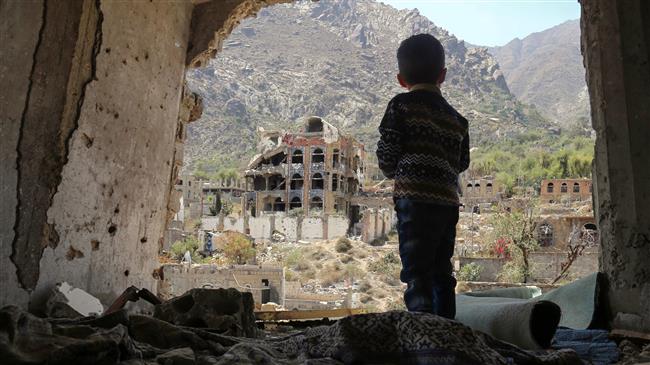
A Yemeni child looking out at buildings damaged in a Saudi airstrike in the southern Yemeni city of Ta’izz, March 18, 2018. (Photo by AFP)
Press TV – March 25, 2018
A recent report has revealed that the United Kingdom is using secretive licenses to hide the scale of its arms exports to countries with dire human rights records in the Middle East.
The Middle East Eye online news portal said figures compiled by the Campaign Against Arms Trade (CAAT) showed that the use of opaque “open licenses” to approve arms sales to states in the Middle East and North Africa by the UK government has increased by 22 percent.
According to the report, Britain has used the secretive export rules to avoid public scrutiny and hide the value of arms and their quantities.
Arms exports are worth $8.3 billion a year to the UK economy.
The MEE said defense firms have used standard open licenses to approve arms sales to the Middle East, valued at more than $4.2 billion since pledges were made by senior ministers to increase UK arms exports after the Brexit vote in June 2016.
The figures showed that the number of open arms export licenses increased from 189 to 230 from 2013 to 2017, while the number of individual items approved under these licensees rose to 4,315 from 1,201.
Saudi Arabia is by far the largest buyer of UK arms under the opaque open licensing system.
Last month, the online news portal revealed an increase of 75 percent in the use of approvals for arms exports, including vital parts for warplanes used in the Saudi aggression on Yemen.
About 14,000 people have been killed since the onset of Saudi Arabia’s military campaign against Yemen in March 2015. Much of the Arabian Peninsula country’s infrastructure, including hospitals, schools and factories, has been reduced to rubble due to the war.
Campaigners further said Britain used open licenses to approve arms sales to the United Arab Emirates, Turkey, Oman, Kuwait, Qatar, Israel, Egypt, Jordan, Bahrain, Algeria and Iraq.
The report said the UK used the secretive open licenses to export assault rifles to Turkey in 2016 as Ankara intensified its crackdown, as well as acoustic riot control devices to Egypt in 2015.
CAAT voiced concerns over the rise in the use of open licenses, which are difficult to track and not subject to public scrutiny or parliamentary oversight.
“The increase in open licenses should concern everybody. It tells us that the government wants to make a shady industry even more closed and secretive,” said Andrew Smith, spokesperson for Campaign Against Arms Trade.
“UK arms are doing terrible damage in Yemen, so it’s more important than ever that parliament and civil society are given as much information as possible so that the government can be held to account,” he added.
Fabian Hamilton, Labor’s shadow minister for peace, said, “The increases in arms exports to countries with questionable human rights records in the Middle East and North Africa must be urgently reviewed. Britain must lead by example, and confront human rights abuses head on.”
“Current government policy on this is fundamentally contradictory,” Hamilton added.
“Why 55 U.S. Senators Voted for Genocide in Yemen”
By Michael S. Rozeff | LewRockwell.com | March 24, 2108
That’s the headline of a blog. It’s a good question. There are six factors involved: Iran, sales of arms, Israel, the CIA, indifferent cruelty, and the system of empire. These are all bad reasons that shouldn’t persuade right-thinking and honorable U.S. senators, but votes for genocide do not come from right-thinking and honorable senators.
Iran. The idea is that Saudi Arabia is thwarting Iran in Yemen. The evidence for this is very, very thin, but even if the Saudis want to thwart Iran somehow in Yemen, that doesn’t justify either a war initiated by Saudi Arabia, a war of the type and scale being waged by the U.S. and Saudi Arabia, and a U.S. presence in that war.
Sales of arms. Huge sales to the Saudis are being made by U.S. companies who influence senators.
Israel. Israel is anti-Iran and in league with Saudi Arabia. Senators are influenced by the Israel lobby.
Notice that in none of these factors or those to follow does the American public play a part. The Senate is only remotely under the control of Americans on this issue, and why would it be? Americans are little affected by what their government does in Yemen, and the U.S. role is kept quite hidden. The visible and well-heeled Israel lobby is more influential than the invisible “pro-American public” lobby.
The CIA. The CIA operates an anti-al Qaeda operation inside Yemen. The war has allowed al-Qaeda to expand. This justifies an expanded CIA presence there. This benefits the CIA.
Indifferent cruelty. The lives of Yemenis count for little to those who vote for genocide. This is a characteristic of fallen man that is sometimes ameliorated by moral teachings and the threat of punishments or worse blowback, but only now and then. The institutional customs and mechanisms to control this trait are not strong enough to stop genocides.
The system of empire. Habitual cruelty is a feature of the U.S. empire. Empires enforce “order”, actually control and dominance, over broad domains that they seek to extend. They use killing to accomplish their expansion in most cases. Their victims are not counted as costs.
Trump assailed for phoning Putin, but feting blood-soaked Saudi dictator is OK
By Finian Cunningham | RT | March 22, 2018
Donald Trump sparked outrage this week in the US over his congratulatory phone call to Russian leader Vladimir Putin on his re-election. But his obscene indulgence of a Saudi despot in the White House hardly ruffled any concern.
How disconnected from reality can you get?
There was furious reaction across US media to news that Trump phoned Russia’s President Putin to congratulate him on his landslide election victory last weekend. Republicans and Democrats were up in arms about what is just basic protocol of one leader calling another to express customary election compliments.
After all, former president Barack Obama did the same when Putin won the previous 2012 presidential election.
This time, however, US-Russian relations have become toxic after a raft of unproven allegations against Moscow, including alleged meddling in the American presidential vote in November 2016 in which Trump was elected, and the latest row over the poisoning of a former Russian double agent in England.
All these anti-Russian claims are unsubstantiated, if not outlandish, but they are repeated often enough to cast a permanent cloud over international relations. Republican Senator John McCain was widely quoted by way of expressing the bipartisan outrage over Trump’s phone call. “An American president does not lead the free world by congratulating dictators,” he said.
American critics of Russia’s Putin can quibble all they like about the merits of his re-election. They contend the vote was a foregone conclusion, rigged in his favor. But such sniping seems churlish against the overwhelming fact that Putin was supported by a huge majority of voters – nearly 77 percent.
In any case, another way of looking at this outpouring of American bile is to enquire just how credible are the detractors?
Their consternation with regard to Putin and Trump’s customary phone call seems way out of proportion, and strangely at odds with their relative silence over the visit in the same week to the White House by Saudi Crown Prince Mohammad bin Salman (MBS).
Bin Salman is the de facto leader of the desert kingdom in place of his ailing father, King Salman. The 32-year-old crown prince consolidated his autocratic power last year in a purge against other members of the House of Saud, in which hundreds of rivals where rounded up, detained, reportedly tortured, and shaken down for billions of dollars.
MBS was feted by Trump in the White House mainly because of the giant weapons purchases he has made since the American president visited the oil kingdom last year – which was Trump’s first official overseas visit.
In a bizarre photo-op, Trump held up gaudy cardboard posters proclaiming various multi-million-dollar arms sales to the Saudi regime. One such deal was depicted as being worth $525 million, to which the president quipped to his Saudi guest, “That’s peanuts to you.”
It was a grubby spectacle of just how sordid the decades-old relationship is between the US and its Arab client regime. All in the seeming salubrious setting of the Oval Office.
If the outrage over Trump’s perfunctory call to Putin had any principle over the matter of elections and autocratic rule, then the critics in Washington would have more than ample cause to fulminate against the Saudi Crown Prince being greeted in the White House. But there was barely any protest.
Admittedly, there was an attempt this week by some senators to pass a resolution limiting American military support for the Saudi war in Yemen. In the end though, the resolution was rejected by a majority of lawmakers.
However, aside from that minor show of dissent, in the scale of things the disconnect with reality in Washington and the US corporate media shows a grotesque distortion of moral priorities.
MBS was visiting Washington in the same week, marking three relentless years of US-backed Saudi slaughter in Yemen. Crown Prince Mohammad bin Salman, who also holds the position of defense minister, is the architect of the Saudi war in Yemen.
The United Nations has called the conflict in the Arab region’s poorest country “the worst humanitarian crisis in decades.”
Some eight million people – a third of the population – are facing starvation, largely because the Saudi-led war has blockaded the country from receiving food imports, medicines, and other humanitarian aid.
Thousands of civilians have been killed in airstrikes by Saudi warplanes that are supplied and refueled by the Americans, British and French. The Americans also share intelligence to direct the Saudi bombing campaign, which even pro-Western human rights groups have reported as being indiscriminate in striking civilian centers. In other words, the US and its NATO allies are fully complicit in this ongoing barbarity.
Saudi claims of fighting against Houthi rebels because the latter are orchestrated by Iran to destabilize the region are not credible. The war is all about trying to re-install a puppet leader, Abdrabbuh Mansour Hadi, who was kicked out by rebel fighters in January 2015. The Saudis launched their war with Washington’s approval in March 2015, partly out of spite over the international nuclear accord that was being negotiated at the time. The Iran nuclear deal was finalized in July 2015. Trump wants to axe it to further placate his Saudi clients.
What is going on in Yemen is nothing short of a bloodbath. Arguably, it is a genocide, given the collective punishment imposed on the entire nation by the Saudi military coalition supported by Washington.
Trump’s hosting of the Saudi crown prince this week in the White House is an obscenity. Celebrating the sale of warplanes, tanks, missiles and other munitions was a macabre drooling over the slaughter of thousands of innocents.
Of course, Trump participated in the charade that the war in Yemen is a “just cause” to counter Iranian malign influence. Iran denies any involvement, as do the Yemeni rebels. There is no evidence to support the US-Saudi claim. Besides, how could Iran supply weapons to a country that is blockaded by land, air and sea?
What is truly disturbing is how little concern the US-enabled carnage in Yemen provokes in official Washington circles and among the corporate media. Millions of Yemeni children are dying from bombardments, hunger, and diseases. The horror is real and unalloyed, unlike the situation in Syria, where the Western media have distorted Syrian Army and Russian liberation of towns besieged by NATO-backed terrorists.
For Yemen, the official silence in Washington is astounding. The very personification of the Yemeni horror – a blood-soaked Saudi despot – is welcomed and cheered, with barely a murmur of protest in Washington or the mainstream news media.
Such people have no moral compass or integrity when all they seem concerned about is their president making a phone call to an elected Russian leader.
Thus, anything they have to say regarding Putin, Russia, its elections and foreign policy is best ignored. People with such a glaring disconnect from reality are impossible to reason with. They are beneath contempt.
Read more:
Pentagon chief calls on Saudi crown prince to cease Yemen aggression
Press TV – March 22, 2018
US Defense Secretary Jim Mattis has called upon Saudi Crown Prince Mohammed bin Salman to find an “urgent” political solution to the devastating three-year-old conflict in neighboring Yemen, which has claimed the lives of thousands of people and left the impoverished nation’s infrastructure in ruins.
Mattis and bin Salman met at the Pentagon on Thursday as the de facto ruler of the Arab kingdom is on a tour of the United States, which began earlier this week with a White House visit.
“As you discussed with President (Donald) Trump on Tuesday, we must also reinvigorate urgent efforts to seek a peaceful resolution to the civil war in Yemen and we support you in this regard,” the US defense secretary told his Saudi counterpart.
“We are going to end this war; that is the bottom line. And we are going to end it on positive terms for the people of Yemen but also security for the nations in the peninsula,” Mattis added.
The Saudi crown prince, speaking through a translator, told Mattis that cooperation between the Pentagon and Saudi Arabia has “improved tremendously” of late.
The remarks came only two days after the US Senate killed a bipartisan bid seeking to end US support for Saudi Arabia’s aerial bombardment campaign in Yemen.
Mattis had lobbied Congress to reject the bill, claiming that restrictions could increase civilian casualties in Yemen, jeopardize the so-called counter-terrorism cooperation between Washington and Riyadh, and “reduce” Washington’s “influence with the Saudis.”
About 14,000 people have been killed since the onset of Saudi Arabia’s military campaign against Yemen in March 2015. Much of the Arabian Peninsula country’s infrastructure, including hospitals, schools and factories, has been reduced to rubble due to the war.
The United Nations says a record 22.2 million people are in need of food aid, including 8.4 million threatened by severe hunger.
A high-ranking UN aid official recently warned against the “catastrophic” living conditions in Yemen, stating that there is a growing risk of famine and cholera there.
“After three years of conflict, conditions in Yemen are catastrophic,” John Ging, UN director of aid operations, told the UN Security Council on February 27.
He added, “People’s lives have continued unraveling. Conflict has escalated since November driving an estimated 100,000 people from their homes.”
Ging further noted that cholera has infected 1.1 million people in Yemen since last April, and a new outbreak of diphtheria has occurred in the war-ravaged Arab country since 1982.
US OKs $1bn in Saudi military deals
Meanwhile, the US State Department said in a statement it had approved military contracts with Saudi Arabia worth over $1 billion.
According to the State Department, 6,600 TOW 2B anti-tank missiles are to be supplied under the biggest contract, which is worth $670 million.
A $106 million deal for helicopter maintenance and another contract for ground vehicle parts worth $300 million were also approved on Thursday.
The State Department said it had notified the US Congress of the possible military equipment contracts.
“This proposed sale will support US foreign policy and national security objectives by improving the security of a friendly country which has been, and continues to be, an important force for political stability and economic growth in the Middle East,” the statement said.
The three contracts are highly expected to be approved by Congress in the wake of the Senate’s Tuesday rejection of the bill to end US support for the Saudi war.
A report by the Stockholm International Peace Research Institute (SIPRI) revealed earlier this month that the US has increased its arms sales by 25 percent over the past five years.
According to the SIPRI report, Saudi Arabia increased its arms purchases by 225 percent over the past five years, importing 98 percent of its weapons from the US and EU countries.
Iran official warns Europe against playing US-Israeli game
Press TV – March 17, 2018
A senior Iranian official has warned European countries against playing into the hands of the United States and the Israeli regime as European signatories to the 2015 Iran nuclear deal propose fresh sanctions against Tehran under the pressure of Washington.
“Defense capabilities, particularly the missile program, of the Islamic Republic of Iran, which have a deterrent nature, will firmly be continued based on national security necessities,” Secretary of Iran’s Supreme National Security Council (SNSC) Ali Shamkhani said in a meeting with Oman’s Foreign Minister Yusuf bin Alawi in Tehran on Saturday.
“Political and media propaganda will have no impact on their development,” he added.
Britain, France and Germany have proposed new EU sanctions on Iran over its missile program and its regional role, a confidential document said on Friday.
The joint paper was sent to the EU capitals to sound out support for such sanctions as they would need the backing of all 28 member states of the bloc, Reuters quoted two people familiar with the matter as saying.
The proposal is allegedly part of an EU strategy to appease US President Donald Trump and preserve the Iran nuclear deal, officially known as the Joint Comprehensive Plan of Action (JCPOA), signed between Tehran and the P5+1 group of countries in 2015 amid constant US threats to withdraw from it.
Shamkhani said US failure to fulfill its obligations and its illegal approach to the JCPOA as well as Europe’s passivity with regard to Washington’s approaches clearly show that regional countries need to focus on finding a solution to the ongoing issues and crises in the region by themselves.
“The Islamic Republic of Iran will give a proper and due response to the US constant violations of its commitments under the JCPOA and will accept no change, interpretation or new measure that would limit the JCPOA,” the SNSC secretary said.
His comments came a day after Iranian Foreign Minister Mohammad Javad Zarif warned the US against the “painful mistake” of pulling out of the Iran nuclear agreement.
“Considering what has been envisaged in the JCPOA in the field of research and development and the Islamic Republic of Iran’s continued measures to develop its peaceful nuclear capability, if the US makes the mistake of exiting the JCPOA, it will definitely be a painful mistake for the Americans,” Zarif told reporters.
Elsewhere in his comments, Shamkhani said growing deep relations between Iran and Oman had led to consensus on regional issues.
“The development of constructive and all-out relations with neighbors based on common interests is the top priority of the Islamic Republic of Iran’s foreign policy,” he added.
The senior Iranian official lashed out at certain regional countries for adopting “a hasty and arrogant attitude and statements” which have posed serious challenges to the handling of regional crises.
He expressed his concern about the killing of Yemeni women and children in airstrikes by Saudi Arabia and the United Arab Emirates as well as the catastrophic conditions of the oppressed Yemeni people.
“The shared view of Iran and Oman on the Yemeni crisis is based on putting an immediate end to war, establishing ceasefire, lifting the blockade, dispatching humanitarian aid and holding Yemeni-Yemeni dialogue to form new political structures based on the Yemeni people’s demands and vote,” Shamkhani pointed out.
He emphasized that the Yemeni crisis cannot be settled through military approaches and urged a political initiative in this regard.
About 14,000 people have been killed since the onset of Saudi Arabia’s military campaign against Yemen in March 2015. Much of the Arabian Peninsula country’s infrastructure, including hospitals, schools and factories, has been reduced to rubble due to the war.
The United Nations says a record 22.2 million people are in need of food aid, including 8.4 million threatened by severe hunger.
The UN Security Council on March 15 warned about the worsening humanitarian situation in war-battered Yemen, stating the status quo is having a “devastating” impact on the lives of civilians in the impoverished Arab country.
“The Security Council expresses its grave concern at the continued deterioration of the humanitarian situation in Yemen, and the devastating humanitarian impact of the conflict on civilians,” it said in a statement.
Oman urges dialogue instead of military approaches
The Omani foreign minister, for his part, criticized military approaches to regional issues and urged the path of dialogue and understanding instead.
He added that Oman regards Iran as a trustworthy neighboring country and commended the Islamic Republic’s role in establishing stability and security in the region.
Bin Alawi arrived in Tehran Friday night on a two-day visit to hold talks with senior Iranian officials about mutual and regional issues.
Iran rejects speculations about bin Alawi’s visit
Iranian Foreign Ministry Spokesman Bahram Qassemi on Saturday rejected speculation about a link between the Omani minister’s visit to Tehran and US Defense Secretary James Mattis’s recent travel to Muscat and said bin Alawi’s trip was taking place with the purpose of strengthening mutual relations.
“Although Oman has very good relations with many countries in the world, Mr. Yusuf bin Alawi’s trip to Tehran has nothing to do with Mattis’s visit to this country,” Qassemi said.
He strongly rejected any link between bin Alawi’s visit to Tehran and US policies on the JCPOA.
The Iranian spokesperson said, “Iran and Oman are cooperating with each other on a wide range of issues and the two sides seek to use the two countries’ existing capacities to further deepen economic, commercial, banking and financial cooperation.”
Featured Video
NATO’s War of Choice – The Sabotage of the Istanbul Negotiations
or go to
Aletho News Archives – Video-Images
From the Archives
National Security Archive Publishes Key Records on Infamous MKULTRA Program
Agency Sought Drugs and Behavior Control Techniques to Use in “Special Interrogations” and Offensive Operations
Edited by Michael Evans | National Security Archive | December 23, 2024
Washington, D.C. – Today, the National Security Archive and ProQuest (part of Clarivate) celebrate the publication of a new scholarly document collection many years in the making on the shocking secret history of the CIA’s mind control research programs. The new collection, CIA and the Behavioral Sciences: Mind Control, Drug Experiments and MKULTRA, brings together more than 1,200 essential records on one of the most infamous and abusive programs in CIA history.
Under code names that included MKULTRA, BLUEBIRD and ARTICHOKE, the CIA conducted terrifying experiments using drugs, hypnosis, isolation, sensory deprivation, and other extreme techniques on human subjects, often U.S. citizens, who frequently had no idea what was being done to them or that they were part of a CIA test.
Today’s announcement comes 50 years after a New York Times investigation by Seymour Hersh touched off probes that would bring MKULTRA abuses to light. The new collection also comes 70 years since U.S. pharmaceutical giant Eli Lilly & Company first developed a process to streamline the manufacture of LSD in late 1954, becoming the CIA’s chief supplier of the newly discovered psychoactive chemical central to many of the Agency’s behavior control efforts.
Highlights of the new MKULTRA collection include… continue
Blog Roll
 Aletho News
- Iran warns Trump against decisions based on false information
- Pentagon sets deadline for Anthropic to lift AI restrictions on autonomous weapons systems, mass domestic surveillance
- Trump’s military buildup against Iran on Netanyahu’s behalf is a gambit doomed to fail
- Big League War
- Zelensky sells false illusion of building powerful air force capable of overcoming Russia
- Glenn Diesen: NATO’s War of Choice – The Sabotage of the Istanbul Negotiations
- What’s Really in the Bag: The Pet Food Industry’s Dirty Secret
- Project Artichoke: 70 Years Ago, CIA Discussed Hiding Mind-Control Drugs in Vaccines
- Drug traffickers trained in Ukraine attack state forces in Mexico
- The tragic reality of Brazilian mercenaries in the Ukrainian conflict
- If Americans Knew
- Flooding in Gaza amid rumors of war; fire in West Bank – Not a ceasefire Day 138
- Fourteen Countries Condemn Huckabee’s Support for Israel Taking Over Most of the Middle East
- Israeli Soldiers Killed Gaza Aid Workers at Point Blank Range in 2025 Massacre: Report
- Israel’s insidious network to propagandize American Christians
- Israel’s Best-Kept Secret: Palestinian Resistance Never Agreed to Disarm
- Trump officials plan to build 5,000-person military base in Gaza, files show
- Are MAGA restrainers pulling their punches this time on Iran?
- The NY Times on the “MAGA” Split Over Israel & USS Liberty
- In Gaza, Ramadan without mosques, imams – Not a ceasefire Day 137
- Footage Shows Israeli Troops Waiting in Ambush, Then Opening Fire on a Palestinian Teen
- No Tricks Zone
- Surprising Discovery: Sahara Is Greening…Billions Of Trees Where Once Thought To Be Barren
- New Research Reaffirms Clouds, Aerosols, And Surface Solar Radiation Are ‘Driving The Climate System’
- Germany: Electric Car Catches Fire At Charging Station, Sets Off Local “Inferno”, Widespread Damage
- New Study: Canada’s New Brunswick Was 1°C Warmer Than Today During The Medieval Warm Period
- Coal Power Back In Trend As Globe Tries To Keep Pace With Growing Demand For Power
- New Study: A 4°C Warmer Beaufort Sea Had ‘No Sea Ice’ 11,700 – 8200 Years Ago
- Unfudging The Data: Dutch Meteorological Institute Reinstates Early 20th Centruy Heat Waves It Had Erased Earlier
- German Gas Crisis…Chancellor Merz Allegedly Bans Gas Debate Ahead of Elections!
- Pollen Reconstructions Show The Last Glacial’s Warming Events Were Global, 10x Greater Than Modern
- Germany’s Natural Gas Storage Level Dwindles To Just 28%… Increasingly Critical
 Aletho News