The Deeper Meaning in a Lost War
By Alastair Crooke | Strategic Culture Foundation | August 19, 2019
It’s pretty clear. Saudi Arabia has lost, and, notes Bruce Riedel, “the Houthis and Iran are the strategic winners”. Saudi proxies in Aden – the seat of Riyadh’s Yemeni proto-‘government’ – have been turfed out by secular, former Marxist, southern secessionists. What can Saudi Arabia do? It cannot go forward. Even tougher would be retreat. Saudi will have to contend with an Houthi war being waged inside the kingdom’s south; and a second – quite different – war in Yemen’s south. MbS is stuck. The Houthi military leadership are on a roll, and disinterested – for now – in a political settlement. They wish to accumulate more ‘cards’. The UAE, which armed and trained the southern secessionists has opted out. MbS is alone, ‘carrying the can’. It will be messy.
So, what is the meaning in this? It is that MbS cannot ‘deliver’ what Trump and Kushner needed, and demanded from him: He cannot any more deliver the Gulf ‘world’ for their grand projects – let alone garner together the collective Sunni ‘world’ to enlist in a confrontation with Iran, or for hustling the Palestinians into abject subordination, posing as ‘solution’.
What happened? It seems that MbZ must have bought into the Mossad ‘line’ that Iran was a ‘doddle’. Under pressure of global sanctions, Iran would quickly crumble, and would beg for negotiations with Trump. And that the resultant, punishing treaty would see the dismantling of all of Iran’s troublesome allies around the region. The Gulf thus would be free to continue shaping a Middle East free from democracy, reformers and (those detested) Islamists.
What made the UAE – eulogised in the US as tough ‘little Sparta’ – back off? It was not just that the Emirs saw that the Yemen war was unwinnable. That was so; but more significantly, it dawned on them that Iran was going to be no ‘doddle’. But rather, the US attempt to strangulate the Iranian economy risked escalating beyond sanctions war, into military confrontation. And in that eventuality, the UAE would be devastated. Iran warned explicitly that a drone or two landed into the ‘glass houses’ of their financial districts, or onto oil and gas facilities, would set them back twenty years. They believed it.
But there was another factor in the mix. “As the world teeters on the edge of another financial crisis”, Esfandyar Batmanghelidj has noted, “few places are being gripped by anxiety like Dubai. Every week a new headline portends the coming crisis in the city of skyscrapers. Dubai villa prices are at their lowest level in a decade, down 24 percent in just one year. A slump in tourism has seen Dubai hotels hit their lowest occupancy rate since the 2008 financial crisis – even as the country gears up to host Expo 2020 next year. As Bloomberg’s Zainab Fattah reported in November of last year, Dubai has begun to “lose its shine,” its role as a center for global commerce “undermined by a global tariff war—and in particular by the US drive to shut down commerce with nearby Iran””.
An extraneous Houthi drone landing in Dubai’s financial zone would be the ‘final nail in the coffin’ (the expatriates would be out in a flash) – a prospect far more serious than the crisis of 2009, when Dubai’s real estate market collapsed, threatening insolvency for several banks and major development companies, some of them state-linked – and necessitating a $20 billion bailout.
In short, the Gulf realised MbS’ confrontation project with Iran was far too risky, especially with the global financial mood darkening so rapidly. Emirati leaders faced off with MbZ, the confrontation ideologue – and the UAE came out of Yemen formally (though leaving in situ its proxies), and initiated outreach to Iran, to take it out of that war, too.
It is now no longer conceivable that MbS can deliver what Trump and Netanyahu desired. Does this then mean that the US confrontation with Iran, and Jared Kushner’s Deal of the Century, are over? No. Trump has two key US constituencies: AIPAC and the Christian Evangelical ‘Zionists’ to ‘stroke’ electorally in the lead up to the 2020 elections. More ‘gifts’ to Netanyahu in the lead into the latter’s own election campaign are very likely also, as a part of that massaging of domestic constituencies (and donors).
In terms of the US confrontation with Iran, it seems that Trump is turning-down the volume on belligerence toward Iran, hoping that economic sanctions will work their ‘magic’ of bringing the Islamic Republic to its knees. There is no sign of that however – and no sign of any realistic US plan ‘B’. (The Lindsay Graham initiative is not one).
Where does that leave MbS in terms of US and Israeli interests? Well, to be brutal, and despite the family friendships … ’expendable’, perhaps? The scent of an eventual US disengagement from the region is again hanging in the air.
The deeper meaning in the ‘lost Yemen war’, ultimately, is an end to Gulf hopes that ‘magician’ Trump would undo the earlier Gulf panic that the West would normalise with Iran (through the JCPOA), thus leaving Iran as the paramount regional power. The advent of Trump, with all his affinity towards Saudi Arabia, seemed to Gulf States to promise the opportunity again to ‘lock in’ the US security umbrella over Gulf monarchies, protecting these states from significant change, as well as leaving Iran ‘shackled’, and unable to assume regional primacy.
A secondary meaning to Yemen is that Trump and Netanyahu’s heavy investment in MbS and MbZ has proved to be chimeric. These two, it turned out were ‘naked’ all along. And now the world knows it. They can’t deliver. They have been bested by a ragtag army of tough Houthi tribesmen.
The region now observes that ‘war’ isn’t happening (although only by the merest hair’s breadth): Trump is not – of his own volition – going to bomb Iran back to the 1980s. And Gulf States now see that if he did, it is they – the Gulf States – who would pay the highest price. Paradoxically, it has fallen to the UAE, the prime agitator in Washington against Iran, to lead the outreach toward Iran. It represents a salutary lesson in realpolitik for certain Gulf States (and Israel). And now that it has been learned, it is hard to see it being reversed quite so easily.
The strategic shift toward a different security architecture is already underway, with Russia and China proposing an international conference on security in the Persian Gulf: Russia and Iran already have agreed joint naval exercises in in the Indian Ocean and Hormuz, and China is mulling sending its warships there too, to protect its tankers and commercial shipping. Plainly, there will be some competition here, but Iran has the upper hand still in Hormuz. It is a powerful deterrent (though one best threatened, but not used).
Of course, nothing is assured in these changing times. The US President is fickle, and prone to flip-flop. And there are yet powerful interests in the US who do want see Iran comprehensively bombed. But others in DC – more significantly, on the (nationalist) Right – are much more outspoken in challenging the Iran ‘hawks’. Maybe the latter have missed their moment? The fact is, Trump drew back (but not for the stated reasons) from military action. America is now entering election season – and it is fixated on its navel. Foreign policy is already a forgotten, non-issue in the fraught partisan atmospherics of today’s America.
Trump likely will still ‘throw Israel a few bones’, but will that change anything? Probably, not much. That is cold comfort – but it might have been a lot worse for the Palestinians. And Greater Israel? A distant, Promethean hope.
Another ‘Arab Revolt’? History never repeats.
By M. K. BHADRAKUMAR | Indian Punchline | August 2, 2019
The Arab sheikhs who instigated the US-Iran standoff have heard the African proverb, ‘When elephants fight, it is the grass that suffers’. But they chose to ignore it. The assumption in Riyadh and Abu Dhabi was that President Trump’s ‘maximum pressure’ strategy would frighten Tehran and life would be back to normal very soon with a weakened Iran bludgeoned into submission.
On the contrary, the gyre of the US-Iran standoff is only widening by the day. What was thought to be a localised affair is acquiring international dimensions. America’s Arab allies no longer have a say in the mutation of the US-Iran standoff.
The Saudi and Emirati role narrows down to bankrolling the Anglo-American project on Iran and to allow the western bases on their territories to be used as launching pads for belligerent acts aimed at provoking the leadership in Tehran into retaliatory moves. In sum, there is growing danger that they might get sucked into a conflict situation in a near future.
The Gulf states lack “strategic depth” vis-a-vis Iran and are sure to find themselves on the frontline of any military conflagration. Conceivably, neither Saudi Arabia nor the UAE bargained for such an eventuality.
It is possible to discern amidst the welter of interpretations given to the “partial” pullout of the UAE forces from Yemen, Abu Dhabi’s calculation that safeguarding homeland security comes first, way above any imperial agenda. That sobering thought may also have prompted the UAE to make some overtures most recently toward Tehran.
The UAE has taken a nuanced stance that no country could be held responsible for the attacks on oil tankers in the Gulf in June. Foreign Minister Abdullah bin Zayed Al-Nahyan said “clear and convincing evidence” is needed regarding the attacks that targeted four vessels off the UAE coast, including two Saudi oil tankers. In essence he distanced the UAE from the US National Security Adviser John Bolton’s finding that the attacks on oil tankers were the work of “naval mines almost certainly from Iran”.
Significantly, Al-Nahyan made the remark at a joint press conference with Russian Foreign Minister Sergey Lavrov during a visit to Moscow in late June, which from all indications focused on the efforts to bring the war in Yemen to an end and on a possible Russian initiative to moderate UAE’s tensions with Iran. (Interestingly, within the week after Al-Nahyan’s visit in late June, Moscow also hosted the Secretary-General of the Organisation of Islamic Conference and the UN special envoy on Yemen.)
It is entirely conceivable that Russia is doing what it can behind the scenes to lower the tensions between Iran and the UAE and in the Persian Gulf region as a whole. Moscow has lately rebooted its proposal for a collective security system for the Persian Gulf. In fact, on July 29, the Russian concept of collective security in the Persian Gulf has been distributed as an official document approved by the UN.
The Russian document envisages an initiative group to prepare an international conference on security and cooperation in the Persian Gulf, which would later lead to establishing an organisation on security and cooperation in this region. China has welcomed the Russian initiative and offered to contribute to its success — “We would also like to boost cooperation, coordination and communication with all the corresponding parties.”
Clearly, the Russian proposal flies in the face of the Anglo-American project to create a western naval armada led by the US to take control of the 19000 nautical miles in and around the Strait of Hormuz that will put the West effectively as the moderator of the world oil market — with all the implications that go with it for international politics — and literally reduce the oil-rich Persian Gulf countries to de facto pumping stations. For that reason, the Russian initiative will not fly. Simply put, the US and Britain will resent Russia butting in.
However, there are other straws in the wind. The Iran-UAE joint meeting to address littoral security cooperation in Tehran on July 30 is a tell-tale sign that the Persian Gulf states may have begun to realise that the endemic insecurities of the region ultimately require a regional solution. Iran has welcomed the Emirati overture and sees in it a “slight shift” in policy.
The big question is how far the UAE can get away with an independent foreign policy toward Iran. The West traditionally dictates the bottom line and that cannot change fundamentally unless the Arab regimes in the region give way to representative rule.
This is where the real tragedy lies. The big powers — be it the US or Russia — are largely guided by their own mercantilist interests and are stakeholders in the autocratic regimes in the region, which they find easily amenable to manipulation. A century ago, when an Arab Revolt appeared in the region, Britain had engineered it to roll back the Ottoman Empire. Today, there is no such possibility. The dismal ending of the Arab Spring in Egypt was to the advantage and utter delight of both the US and Russia.
Having said that, the situation is not altogether bleak. The western powers and Russia fiercely competing to secure lucrative arms sales running into tens of billions of dollars annually. This can be turned into opportunity.
The Russia-Saudi axis calibrating the world oil market shows the potential to incrementally shift the locus of Middle East politics.
Similarly, China’s appearance on the scene opens seamless possibilities for the Gulf states. The recent visit by the UAE Crown Prince to China underscores the Arab ingenuity to test the frontiers of strategic autonomy even in such difficult conditions. The fact of the matter is that the UAE has openly defied American pressure and is positioning itself as a hub of China’s Belt and Road Initiative and, furthermore, has become the first country in the Persian Gulf to introduce the 5G technology from China. (See my blog Belt and Road takes a leap forward to the Gulf.)
The Yemen Tragedy Further Fueled by the West and Its Allies

By Viktor Mikhin – New Eastern Outlook – 31.07.2019
A most sophisticated demagogy, blatant falsifying of facts, impudent interpretation of events with everything going upside down, these are the thoughts that come to one’s mind when one reads another forgery concocted in the West. We mean the statement addressed to Iran calling for the termination of the actions which are allegedly destabilizing the situation in the Persian Gulf. The statement was made by the governments of the US, the UK and their satellites: the United Arab Emirates (UAE) and Saudi Arabia, on June 24, as reported by the US Department of State press service. In this manifesto, contrary to the obvious facts, the signatories held Iran responsible for the escalation of the situation in Yemen and the attacks on the oil tankers on May 12 and June 13, urging the Islamic Republic to start searching for a diplomatic solution. The intensity of this demagogy, as the saying goes, is beyond the scale.
Let us however, in a quiet fashion and on the basis of the obvious facts, consider the situation in the Persian Gulf area and ask several questions. Did Iran or the poor Yemen suffering a score of internal problems, indeed attack Saudi Arabia? Did the Houthis indeed create a so-called Arab coalition which has consistently bombed the Saudi cities and villages killing the civilians? By no means. It was the Saudis, namely the Crown Prince Mohammad bin Salman bin Abdulaziz Al Saud who took up the foreign policy responsibilities due to the old age and numerous diseases of his father, the King, and who gave the order sanctioning the rough intervention of Riyadh in internal affairs of the neighboring state of Yemen and the total bombing of the Yemen cities.
The leader of the Houthis and the President of the Supreme Revolutionary Committee (SRC) Mohammed Ali al-Houthi demanded the UN Secretary General to condemn the war crimes committed in Yemen. Among the crimes perpetrated by the coalition of the Arab countries (led by Saudi Arabia and supported by the countries of the West), the Houthi leader named the ruthless blockade of the Yemen people, the famine in the country, the ongoing air embargo, the blockade of the Red Sea ports, the mass murders (including those of children), the destruction of civil facilities targeted during the military attacks.
The UN strongly condemned the following Saudi air raid on the Yemen capital city of Sanaa which resulted in the death of many civilians, including five children; dozens of people were wounded. The head of the United Nations Children’s Fund (UNICEF) Henrietta Holsman Fore, speaking at the UN Security Council session, urged the international community to save the lives of the millions of Yemenite children. She emphasized that, since the beginning of the conflict in the country, according to official figures only, up to 10,000 children had been killed or wounded. According to the UN, the Saudi Air Force “aimed at the civilians systematically,” dropping bombs on hospitals, schools, weddings, funeral processions and even on the camps for the displaced persons escaping from bombing.
Representatives of the United Nations High Commissioner for Refugees (UNHCR) emphasized that the belligerents, Saudi Arabia in the first place, must respect the principles of international humanitarian law, which includes protecting the civilians during the hostilities. Millions of people in Yemen are currently on the verge of starvation, and the humanitarian organizations often have no opportunity to deliver the aid: food, medicines and fuel, to those in need. A major part of humanitarian cargo comes to Yemen through the ports of Al Hudaydah, As-Salif and Ras Issa, where the Houthis, following the Stockholm agreement, withdrew their troops from. However, representatives of the international organizations, whose activities have suffered consistent pressure exerted by the United States, for some reason or other, are not in a hurry to fulfill their obligations.
The international community’s condemnation of the Saudi crimes reached such a degree that the Deputy Minister of Defense of Saudi Arabia Khalid bin Salman bin Abdulaziz Al Saud had to hold a meeting with the special envoy of the UN Secretary General on Yemen Martin Griffiths. However, his stance was only limited to demagogical statements “about Riyadh‘s commitment to a political solution of the conflict in Yemen.”
And, probably, in order to ensure “the wellbeing of the Yemen people,” the Riyadh-led coalition declared the launch of a new attack on the positions of the Houthi insurgents in the province of Sanaa, in western Yemen. This information was made public by the Al Arabiya TV channel, referring to the military. The main targets for the new airstrikes include air defense facilities and missile warehouses belonging to the rebels. It is known that this province is densely inhabited; numerous cities and settlements are located there, and, therefore, the number of victims among the civilians will only increase. Such is the “commitment” of Saudi Arabia to the “wellbeing” of its neighbor and the “support” of a political solution of the ongoing conflict. Many politicians claim (for a good reason) that had there been no intervention of the Saudis in the internal affairs of Yemen, then this conflict would not have existed at all, nor would there have been all the numerous victims.
The international community does not pay due attention to the humanitarian crisis in Yemen, no sufficient financing is allocated for it, said the President of the International Federation of Red Cross and Red Crescent Societies (IFRC) Francesco Rocca: “The problem is not in providing more (help), but in receiving financing (to have an opportunity) to provide more (help). It is a vicious circle, the Yemen crisis lacks financing. It is forgotten, it is being ignored.”
More fuel to the long-lasting Yemen conflict fire was added by D. Trump who extended the sanctions against Yemen for another year. The White House website comments as follows: “The actions and policy of several former members of the Yemen government and other persons continue to threaten the peace, safety and stability of Yemen. Among other things, they interfere with the political process and the implementation of the peace treaty of November 23, 2011 between the government of Yemen and the opposition.” Let us remind the reader that the state of emergency concerning Yemen envisaging a number of restrictions was imposed in May 2012.
A faithful ally of the US, the UK has been actively partaking in this murderous war as well by delivering to the Saudis aviation bombs (for good money, too) which are used to kill the civilians of Yemen. On March 27, 2015 the day after the first British bombs fell on Yemen, the then Foreign and Commonwealth Secretary Philip Hammond told the reporters that the UK “will support the Saudis in every practical operation, by involvement in the fighting.” Since then, the British bombs which have been actively used by the Saudi pilots during the raids on the Yemen territory have been regularly manufactured in three British cities: Glenrothes in Scotland, and Harlow and Stevenage in Southeast England. The bombs which leave the production line for the Saudis on a daily basis belong to the Raytheon UK and ВАЕ Systems.
As soon as this weapon was bought by Saudi Arabia, the UK began to participate in the Yemen slaughter even more actively. The Saudi military lack experience to use this modern and lethal weapon. Therefore, for this air war to go on and for the British government to do good business on the blood of Yemenites, under another contract, London provides what is known as the “on-site military services.” In practical terms, it means that some 6,300 British experts have been deployed on the advanced operational bases in Saudi Arabia. It is them, not the Saudi pilots and technicians, who perform necessary repairs of the planes day and night so that they could fly across the Arabian Desert to their targets in Yemen again. They also control the Saudis loading bombs onto the planes and installing fuses on the bombs.
Thus, the West, which has been doing good business on the Yemen blood, will go on with its impudent demagogical statements that Iran, not Saudi Arabia, is responsible for the Yemen tragedy. Even more so, since Riyadh is buying arms amounting to hundreds of billions of dollars from the US alone, thus supporting the American military and industrial complex and giving Donald Trump a chance to create new jobs in the US. However, no one in the West seems to care at whose expense and on whose blood the US prospers.
During his recent trip to Yemen, the British conservative Member of Parliament Andrew Mitchell visited a school in the capital where he was “welcomed” by children who chanted slogans. The politician asked the accompanying Yemenite to interpret and learnt that they meant “death to the Saudis,” “death to the Americans,” and the third slogan remained untranslated, but it is easy to guess that it meant: “death to the British.”
Viktor Mikhin is a corresponding member of the Russian Academy of Natural Sciences.
Britain says seizures of UK vessels by Iran are ‘unacceptable’
RT | July 19, 2019
UK Foreign Secretary Jeremy Hunt has warned Iran of consequences for seizing two vessels in the Gulf, one of which has now been released. London’s response will be “robust” but not military, he said.
“We will respond in a way that is considered but robust,” Hunt told journalists, adding that the UK hopes to resolve the crisis through diplomacy and “is not looking” at military options.
Hunt said that he has already discussed the incident with US Secretary of State Mike Pompeo and looks forward to talking to his Iranian counterpart, Mohammad Javad Zarif. Denouncing the seizures as “unacceptable,” Hunt argued that Tehran would be “the biggest loser” if “freedom of navigation is restricted.”
Hunt said that there are no British citizens among the crew members of either ship. He also added that the British ambassador in Tehran has already contacted the Iranian Foreign Ministry in an attempt to resolve the situation.
Earlier on Friday, the Islamic Revolutionary Guard Corps – Iran’s elite military force – said it has seized the British oil tanker Stena Impero in the Strait of Hormuz over failure to “respect the international maritime rules.” The vessel sailing to Saudi Arabia was seen changing its course and heading north towards the Iranian island of Qeshm, marine tracking data showed.
The company owning the vessel, Stena Bulk, said it lost contact with the ship and that it was approached by “unidentified” small vessels before changing course.
Later the same day, another tanker owned by a British company – Norbulk Shipping UK Ltd – the Liberian-flagged ship Mesdar – also suddenly changed its course to Saudi Arabia and sailed to the Iranian mainland. This time, Tehran has not officially confirmed its seizure.
The tanker was apparently released later in the day, with tracking data showing the vessel changing course and heading westward and away from Iran late on Friday. The Iranian private Tasnim news agency reported that the British-owned Mesdar was cleared to continue its course, after having received a warning from the authorities over safety and environmental issues.
Norbulk has confirmed that the ship has resumed its travel towards Saudi Arabia, adding that the crew was “safe and well.”
“Communication has been re-established with the vessel and Master confirmed that the armed guards have left and the vessel is free to continue the voyage. All crew are safe and well,” the company said in a statement.
Tehran and London have been locked in a bitter row ever since a super tanker Grace 1 carrying Iranian crude oil was seized by the British marines in the Strait of Gibraltar on suspicion of violating the EU sanctions against Syria.
Tehran denied these accusations while calling the Gibraltar’s justification of detention laughable. Iran also accused the UK of acting on behalf of the US.
Washington has long sought to pressure Tehran into concessions on its nuclear and missile programs while repeatedly vowing to bring its oil exports down to zero with sanctions. It has also recently sent a naval group led by the aircraft carrier USS Abraham Lincoln to rehearse a possible strike against Iran while calling to form a “coalition” ostensively to defend the freedom of navigation.
Despite talk of promoting democracy Trudeau in bed with repressive monarchy
By Yves Engler · July 8, 2019

UAE foreign minister Sheikh Abdullah bin Zayed with Justin Trudeau
Given his personal history perhaps it is no surprise that Justin Trudeau is fond of monarchies.
The United Arab Emirates is a repressive monarchy that pursues violent, anti-democratic, policies in its region. Despite this — or maybe because of it —Trudeau’s Liberal government has strengthened ties to the federation of seven Emirates. And unlike Canada’s claims to be promoting democracy in Venezuela or the Ukraine, there has been little mention of this in the media or scrutiny in Parliament.
The UAE has propped up the Transitional Military Council in Sudan that has faced massive protests calling for civilian rule. Two months ago the oil rich country put up half of a $3 billion package (with Saudi Arabia) to support Sudan’s military rulers and the head of the military council visited powerful Crown Prince Mohammed bin Zayed al-Nahyan in Abu Dhabi in late May. Many pro-democracy activists believe the UAE and Saudi Arabia pushed Sudan’s military to destroy a major protest site that left dozens dead at the start of June.
Abu Dhabi fears democracy in Sudan for various reasons. One immediate concern is the likelihood that a government in Khartoum representing the popular will would withdraw the 10,000 Sudanese soldiers in Yemen. The UAE has played a key role in the war in Yemen, which has left 100,000 dead, millions hungry and sparked a terrible cholera epidemic.
In Libya the UAE was recently caught delivering weapons to warlord Khalifa Haftar in violation of UN sanctions. Abu Dhabi has financed and supported Haftar’s bid to seize the Libyan capital by force. The Tripoli-based Government of National Accord said a UAE F-16 fighter jet was responsible for bombing a migrant detention centre that left some 50 people dead last week.
Elsewhere in the region the UAE has engaged in a two year blockade of Qatar designed to force Doha to heed their and close ally Saudi Arabia’s belligerent, anti-democratic, position towards Iran, Egypt and elsewhere. In recent years UAE helped crush Bahrain’s 2011 uprising, dispatched forces to Libya to support the NATO war and financed the return of military rule to Egypt in 2013. Abu Dhabi also plowed hundreds of millions of dollars of weaponry and other forms of support to Al Qaeda linked rebels in Syria.
Domestically, the UAE is a repressive monarchy that outlaws labour unions and hangs/stones individuals to death. The country heavily restricts religious freedoms and women’s rights. Recently, the wife (one of six) of Dubai’s ruler Sheikh Mohammed bin Rashid Al Maktoum sought asylum in the UK fearing for her life.
From what I could find the Trudeau government has stayed mum on Abu Dhabi’s efforts to derail democracy in Sudan. Nor have they made any comment on its violation of UN sanctions in Libya. Over four years they’ve barely made a peep about the UAE’s bombing and troops in Yemen. Instead of challenging the monarchy’s egregious policies, the Liberals have deepened ties to the Gulf Kingdom.
On July 1 officials from the two countries highlighted “the bond between Canada and the United Arab Emirates” by raising a Canadian flag-inspired display on Abu Dhabi’s Burj Khalifa, the world’s tallest building. Ten days ago, the government announced that Canada would participate in Expo 2020 Dubai. International trade minister Jim Carr declared, “our presence at Expo 2020 affirms the vitality of Canada-UAE relations.”
A UAE delegation led by Minister of Energy and Industry Suhail bin Mohammed Faraj Faris Al Mazrouei attended the International Economic Forum of the Americas in mid-June. At the Montréal conference Al Mazrouei met economic development minister Navdeep Bains and trade minister Jim Carr. During the opening of the last UN General Assembly session Trudeau met UAE foreign minister Sheikh Abdullah bin Zayed and he visited foreign minister Chrystia Freeland in Ottawa last May.
Despite their violence in Yemen, the Trudeau government has deepened military ties to the UAE. There are a small number of Canadian troops in the UAE and Royal Canadian Navy vessels in the region regularly coordinate with their Emirates counterparts. Last week Canada’s ambassador in Abu Dhabi, Masud Husain, met defence minister Mohammed bin Ahmed Al Bowardi. Canada’s Defence Minister Harjit Sajjan also met Al Bowardi there in April. According to Emirates News Agency, Canadian and UAE officials discussed “cooperation in the military and defence sectors” and “current regional and international developments.” In December 2017 Sajan traveled to the Gulf State to sign the Canada-UAE Defence Cooperation Arrangement.
According to Radio Canada International, the Canada–UAE defence accord “will make it easier for the Canadian defence industry to access one of the world’s most lucrative arms markets.” During the last four years the Trudeau government has promoted arm sales at the Abu Dhabi-based International Defence Exhibition and Conference (IDEX). With support from “15 trade commissioners and representatives from the Government of Ontario, National Defence, Global Affairs Canada, and the Canadian Commercial Corporation”, 50 Canadian arms companies flogged their wares at IDEX in February. To help the arms companies move their products, commander of the Bahrain-based Combined Task Force 150, Commodore Darren Garnier, led a Canadian military delegation to IDEX.
In February of last year Parliamentary Secretary to minister Bains, David Lametti, who is now Justice Minister, promoted Bombardier’s delivery of surveillance planes to the UAE. Montreal-based flight simulator company CAE trains UAE Air Force pilots at a facility in Abu Dhabi. Some UAE pilots bombing Yemen also likely trained at NATO’s Flying Training in Canada, which is run by CAE and the Canadian Forces.
As Anthony Fenton has documented in detail on his fantastic Canada-Gulf focused Twitter handle, armoured vehicles made by Canada’s Streit Group in the UAE have been repeatedly videoed in Yemen. At IDEX 2019 Streit Group officials were photographed pitching their Sherp All-terrain military vehicle to UAE officials.
After a high profile diplomatic spat with Saudi Arabia last August Canadian officials privately worried it would negatively impact relations with UAE. That didn’t happen, of course. In fact, the spat may have spurred closer ties to Saudi Arabia’s main regional ally.
It’s time for some mainstream journalists and parliamentarians to devote a little attention to the Trudeau’s government hypocritical embrace of the UAE monarchy.
Nasrallah: Zionist Axis Defeated, We Have Enough Missiles to Redraw the Map of the Middle East
Speech by Hezbollah Secretary General Sayed Hassan Nasrallah on Friday, May 31, 2019, on the occasion of Al-Quds (Jerusalem) International Day.
Transcript:
[…] Another element indicating (the improbability of a war against Iran) is the field data, and I mean the (triple) Summit which I have just mentioned. And we are now entering the (4th section of my speech devoted to the triple) Arab Summit (in Mecca on May 30-June 1). The Summit was convened in emergency. Why? There are two reasons, two clear reasons that are mentioned in the (final) statements (of the Summit).
The first reason… The first reason… I remember that during the first days of the war of aggression against Yemen, His Eminence the (Supreme) Leader, Sayed [Khamenei], said that the young (fighters) of Yemen would rub the Al-Saud’s noses in dirt. Some days ago, the Saudi (army) bit the dust (once again). That’s what happened.
The first reason (for the improbability of war against Iran), that I mentioned earlier, is that Saudi Arabia has recognized the fact that there was no way out against the missiles of the Yemeni army and Popular Defense Committees, which they call the ‘Houthi’ missiles, and against their drones, and my proof is what happened in Yanbu’ (strikes of a Yemeni drone against oil installations in Saudi Arabia). It is a failure, a complete disaster. On the technical, military, security levels, and on every other level, it is a colossal failure. And it is a great success for our Yemeni brothers.
And that’s why in the joint statement at the conclusion of the Arab Summit, from the first line, points 1, 2, 3, 4, 5, 6, 7, 8, 9 and 10 only speak of Houthis, Houthis and yet again Houthis, as well as Iran. This clearly shows how much the issue of our Yemeni brothers is present and is the main cause for convening this triple Summit.
The second reason (indicating the improbability of a war against Iran) is that the Saudi regime and its allies understood with certainty that there will be no US war against Iran. You are dreaming (O Saudis), you spend your money for nothing and you incite for war to no avail. Trump will not fight for you, while it was your greatest hope. The last thing the Saudis had left was this hope (on which they have staked everything). Is there anything they can do? Do the Saud have alternatives (to prevail)? Who will go to war against Iran? The Saud themselves? While in Yemen, according to the information of the Saudis themselves, these young Yemeni fighters who have no army, no huge capacities, who are besieged, isolated, hungry, sick, whatever you want, but Saudi Arabia fails, is defeated and broken against them! And you (the Saudis) would go to war against (such a formidable power as) Iran? Who (will dare attack Iran)? Will they hire Netanyahu to launch a war against Iran? Let him first take care of his own problems (electoral and with Israeli justice)!
It’s the end of the road (for the Saud)! All their plans and hopes rested, in recent weeks, on Trump, on Trump’s incitement (to war), on Bolton, on Pompeo and all their fellow evil men in b or p, who were threatening to attack Iran and devastate this country. But it’s over. All their hopes were dashed.
That is why this Summit was convened in Mecca, as I said, to call the Arab and Muslim worlds and the Gulf countries for help. ‘Hasten therefore (to our help), O Arabs’ (cried the Al-Saud dynasty)! I wrote here… Where is this paper?… I wrote (a summary about it)… “Saudi Arabia convened the triple Summit to strengthen itself with the support of the Gulf it has torn apart…” For who is responsible for the crisis in the Gulf Cooperation Council? Saudi Arabia! “(Saudi Arabia convened the triple Summit) to strengthen itself with the support of the Gulf it has torn apart, of the Arabs it has crushed…” Is there a single Arab country left where Saudi Arabia has not created discord and division? And until now, up to this very day, there are Arab countries torn with civil wars, and Saudi Arabia is (the main) responsible. And there are Arab countries under threat of falling into civil wars (Algeria, Sudan…), and we must look (for the hand of) Saudi Arabia (behind it). “(Saudi Arabia convened the triple Summit to strengthen itself with the support of the Gulf it has torn apart), of the Arabs it has crushed and of the Muslims among whom it has spread the sedition of takfir.”
See Pakistan: Saudi Arabia wants to become stronger by getting the support of this country, while it propagated its takfiri ideology there among the Taliban, who created innumerable problems for the Pakistani military and the Pakistani people. Today, Saudi Arabia is calling on all these countries to save it (and get it out of the Yemeni quagmire).
First, regarding the Summit… I will conclude my remarks with a few words. Regarding the (Mecca) Summit, such is the context that explains it. It is a call for help, a cry for help, an intercessory request… You know it’s Ramadan (where all wishes can be fulfilled), so the Saudis make prayers, express wishes, cajole (the Arab governments) so that they’d fulfill their wishes, because of their failure and powerlessness, and because their hopes were dashed. The opposite Axis (United States, Israel, Saudi Arabia) isn’t in any case in a position of strength. It is in a position of weakness and failure, desperate, greatly confused and completely discouraged. This is the truth.
Second, let us consider the Joint Statement issued after the Summit. We see that it is composed of 10 points, which speak only of Iran and the “Houthis”, as they call them, but in the end of this Statement, as we commemorate the International Day of Al-Quds (Jerusalem), at the very end of this Statement, really the last two lines, we read: “And about the Palestinian cause, the main cause of the Arabs, the Summit has confirmed its commitment to the resolutions of the 29th Arab Summit (of April 2018) in Dhahran (Saudi Arabia), or Al-Quds Summit, and the resolutions of the 30th Arab Summit in Tunis (in March 2019).” Period. They did not even devote two lines to Palestine! They gave it only a line and a half of their final Statement! That’s the importance of Palestine for the Arab Summit. I do not even know if they actually talked about it (during their discussions), I just read the final Statement.
And about the Summit of the Gulf Cooperation Council, there is a really funny thing, the 4th point. Listen to the 4th point (of the final Statement) of the Summit of the Council of the Gulf Cooperation: “Confirms the strength, harmony and resolution of the Gulf Cooperation Council and the unity of its members around a common line to face these threats.” And they say that while they are besieging Qatar! They have been besieging the State and the people of Qatar for over a year! It’s really hilarious, Uncle! By God, some people really don’t realize that they have become the laughing stock of the world! The whole world mocks them, demeans and humiliates them!
Another point about the Arab Summit, we have a duty to praise the position expressed by Iraq and the President of the Republic of Iraq. It’s a remarkable position, courageous and excellent. What a shame that the rest of the Arab Presidents, Kings and Emirs did not talk the same way! And the Iraqi delegation has not said that they wanted to wage war against Saudi Arabia, the UAE, or anyone, nothing like it! They spoke in a balanced manner (without taking sides with Iran nor Saudi Arabia). You could do the same thing (and display a conciliatory neutrality). What prevented you from doing so, O Arabs? What a pity that (the participants of this) Summit, in spite of the failure, powerlessness and confusion (of Saudi Arabia), and the economic exploitation of the situation by the United States, have not talked in conciliatory terms about Iran, when Iran itself, a few days ago, said via its delegates that they were ready to talk with the Gulf states, and conclude pacts of non-aggression with them! Why did they not adopt the same open and conciliatory diplomatic language? If they had done so, their money, their safety, their security, their interests and even their dignity would not be violated by Trump morning and evening.
On the Arab Summit, I have one more thing to say: as a Lebanese party who participate in the government of Lebanon, we (Hezbollah) consider that the position of the official Lebanese delegation to the Arab Summit contradicts the Ministerial Declaration (of the Hariri government) and violates the commitments and promises of the Lebanese government, who received the confidence of the Parliament on the basis of this Declaration. Where is the promised neutrality, O official Lebanese delegation to the holy city of Mecca? You could have said… It was not even required that you take a position similar to that of Iraq. You could simply have said that the Lebanese government was committed to neutrality (in regional conflicts) and that such a stance was required in the national interest of Lebanon, which had to remain neutral, as it had done in previous Summits.
That is why we reject this position (expressed by the Lebanese delegation), which we consider unacceptable and condemn because it does not represent Lebanon. It represents only the members of the delegation (as individuals) or the political parties they belong to. It is impossible that this be the official position of Lebanon, a position which publishes a Statement with 10 paragraphs condemning Iran and only dedicates a line and a half to Palestine, the whole Statement expressing support for an Axis (US-Saudi-Israeli) against another (the Axis of Resistance).
Of course, the Future party could have made a statement of their own supporting eloquently the Final Statement of this Summit held in Holy Mecca, it is their natural right. We wouldn’t mind at all because (it is common knowledge) that we have opposite stances (on regional issues). We have already said that neutrality is not required of political forces. And we are the first not being neutral (and strongly and publicly announcing our stances against the US, Israel, the Saud…). But we agreed that the Lebanese government would remain neutral. The Lebanese State must remain neutral (because it is composed of both pro-American and pro-Iranian forces). And what happened in Mecca is contrary to the commitments and promises (made by the Future Alliance heading the government), and to Lebanon’s national interest.
This brings me to the last point (of my speech). (I’m sorry) for being so long, on this night of Ramadan, but it is a sensitive issue whose mention cannot be postponed. Regarding the delimitation of the (land and sea) borders (between Lebanon and Israel), as I have said repeatedly, as a Resistance, we have no problem and we comply with the decisions of the State. And for all that is happening at the borders, we leave everything in the hands of the State, whether what is happening is good or bad, right or wrong. Regarding the demarcation of our land and sea borders, we will respect all the decisions of State, (and we do not have a say).
And by making these statements, I do not exaggerate. Some brothers think that my words are conciliatory but do not coincide with reality, but no, I tell the strict truth when I say that we in Hezbollah trust the Lebanese officials who are in charge of this issue, and who are committed to upholding all Lebanon’s rights to land and water, in terms of maritime (space), oil and gas (resources present in the Mediterranean). We have (full) confidence in them, and that’s why we do not intervene in this issue. So much for the positive points, for I will now turn to a very different point.
On this issue, what is the United States striving to achieve through (its envoy) Mr. [David] Satterfield and his ilk? The USA is very strong to exploit all things, and exploit (all situations) in an evil way (in their interests and to our detriment). Since Lebanon needs a rapid delineation of borders, especially at sea, to (be able to exploit) oil and gas (resources at sea), and since Lebanon needs a calm situation in order to get financial loans —for we speak mainly about loans, not grants—, in this context, the United States come to… I hope that all the Lebanese will listen to me.
The United States wants to exploit the (indirect) negotiations (between Lebanon and Israel) on the demarcation of land and maritime borders to solve another adjacent, unrelated problem in the sole interest of Israel, and that Israel has been unable to resolve for years, namely precision missiles and the manufacture of precision missiles.
For over two years, (we have been contacted constantly by) ambassadors, embassies, foreign intelligence services, including those countries that consider us officially as terrorists, it does not bother them. They asked us the following questions, or (rather) addressed us the following messages: you have precision missiles, and this is something that Israel will not tolerate, and when Israel will learn their place (of storage), they will bomb them. That’s the message that we kept receiving for over two years. That’s (the first point).
The second point was the accusation that we’d have precision missile factories in Lebanon, which is (allegedly) a red line for Israel that will not be tolerated, and the warning that if Israel gets to know their location, they will bomb them. We hid this matter to the public for two years so as not to worry anyone, and to settle this matter behind the scenes. But some things happened during this week that lead me to speak out today because I think this whole issue will soon be discussed in the media, this topic being debated today in wider circles. I prefer to publicly state our position on this issue, rather than let the (State) officials being responsible for sending messages or answering questions (about this topic), and it is better that these answers come directly from me so that the United States, Israel and others receive them distinctly. (That’s better), isn’t it? That’s why I mention it.
Regarding the first point, the precision missiles issue, we are people who always tell the truth, we never lie. We can of course not reveal the truth without lying, or tell only part of the truth, but we never lie. That’s why when they asked us (if we had precision missiles), we answered that yes, we had precision missiles, and then you remember that two years ago, the tenth day (of ‘Ashura), I announced quite clearly that we have precision missiles able to hit all the targets required in the Zionist entity.
And today, on this (International) Day of Al-Quds (Jerusalem),on the 40th anniversary of the announcement of this Day, I say to the world that yes, we have in Lebanon enough precision missiles to change the face of the region and (upset) all equations!
But I say nothing new. That’s what I said for ‘Ashura two years ago. And to all those who have asked us, we said yes, we had precision missiles. And to all those who said or transmitted messages (Israeli threats), we said that there was no problem… It’s been 1, 2 and 3 years that these messages circulate, and that our response has been given and reached Israel: any time they tried to intimidate us by speaking of Israel, of red lines, of unacceptable things, of bombing, of (a violent) reaction, etc., our answer was clear, and I then repeated it publicly (in an interview) with Al-Mayadeen TV and then in a live speech. And I’ll repeat it again: we said that against any aggression, any Israeli strike against any target related to the Resistance in Lebanon, be it missiles or anything else, Hezbollah will retaliate immediately, directly and with (great) force!
And that’s why for 1 year, 2 years and 3 years now, they never bombed (Lebanon). And even more, Israel is going to the UN to (complain) that under the Al-Ahed football stadium, there would be missiles, and at such other place as well, (and then the UN) asks the government to verify if missiles are present at a given location, etc. It is not out of manners or decency that Israel does not strike our missiles. It is because we are strong that they don’t dare to do so (because they fear our retaliation), and that we will respond to any aggression by a similar attack, if not more!
The issue of precision missiles was therefore over (with a dead end for Israel). No one can do anything against it. So the issue has been upgraded with the accusation of possession of precision missile factories (in Lebanon). A few months ago, a (Lebanese) official said that the United States had contacted him to tell him this and this. I replied: “My dear official —I do not say anything specific to protect his identity—, this information is false. We do not have —and I speak with complete frankness— we have no precision missile factory in Lebanon.” He asked if the Iranians had such factories in Lebanon. I told him that the Iranians had no factory in Lebanon, be it for precision missiles or other missiles, or anything at all.
So far —I say so far, until tonight, until this International Day of Al-Quds—, there are no precision missile factories (in Lebanon). So the Americans left and came back later (with new charges), saying that there were such factories in such and such place, until what they said recently, namely that the process of delimitation of maritime borders was obstructed by the fact that in such region, there were precision missile factories. Again, several Lebanese officials asked me about it, and I said that it was not true. In this region, there are military facilities, supplies and equipment of Hezbollah, but no precision missile factory. That’s all.
What is my point? These (false accusations) have been accompanied by various threats. I will not say what the threats were because there is no reason for me to reveal them, but several threats were made, so that Lebanon settles this issue (precision missile factories) and destroys such and such installations, razes them to the ground and terminates them. But my dear (US) friends, do you know who you are dealing with? In what world do you live (to believe that your threats can frighten Hezbollah)? It is absolutely inconceivable for us.
In addition, we, in Hezbollah, are more trustworthy and reliable than the Americans and their predecessors, and more trustworthy and reliable than the Israelis and their predecessors. When I tell you that there is no precision missile factory, this means that there is none. And if there were such a factory, I would have said this evening on TV that there is such a factory, as I’ll prove in a moment.
I will explain my problem with this question and conclude my speech. My problem is that… That’s why I did not want to discuss this issue only with Lebanese officials, but I wish that we all (Lebanese) take part in it. The very discussion of such issues with the United States, merely allowing them to ask us about (our weapons), this door should be in my opinion closed. It is not their business, they have no right to inquire about our weapons. The US does not have any right to meddle in it. Whether there are precision missile factories in Lebanon or not, it is not their business. Israel, which is right next to us, manufactures missiles, warplanes, tanks, nuclear and chemical weapons. Let them go there and make the same requests! As for us, it is our right —and that’s what I want to add this evening—, it is our absolute right to possess any type of weapons to defend our country. And it is our absolute right to manufacture any type of weapons, because to have weapons, there are only three possibilities: either you buy them, or someone gives them to you, or you manufacture them.
In Gaza, what do they do? They make them. In Yemen, what do they do? They make them. But the Saudi mentality is unable to conceive that Yemenis can manufacture their own missiles and drones (and they accuse Iran of supplying them). What do you want me to do about it? In Iran, what are they doing? They manufacture their own weapons! And we absolutely have the right to do the same. I affirm that the United States do not have the right to debate with us on this right. That’s the first point. How does it concern you? Whether we have such factories or not, it’s none of your business. I assure you that there are no such factories yet, but you have no right to ask me in the first place! Whether there are such factories or not, mind your own business! We have every right to have all the weapons that allow us to defend our country, whether we buy them, they are given to us or we manufacture them. That’s the first point.
Second, if the United States continues to bring up this issue, I tell them this: we have all the technical and human capacity, thanks to our youth, to manufacture precision missiles, and we are perfectly able to import in Lebanon all the equipment required to open such factories. I declare tonight that if the United States continues to bring up this issue, let the whole world know that we will open precision missile factories in Lebanon!
So far, we have no such factories (in Lebanon), but if they continue to bring up this issue, they will convince us to do so! Then, the government talks about many problems of the Lebanese industry. Today, one of the greatest evils in the world is arms sales… Why are you laughing, I’m serious! We are able to manufacture precision missiles and sell them to the world, and thus help the Lebanese Treasury. Is that okay with you?
This is why I advise Satterfield to stay calm and do the job he is asked to do (without encroaching on our business), since he claims to be there to help… But who does he (really want to) help? Because you know that in general, the United States are not intermediaries. They are only there to lobby and defend the interests of Israel, and God help our Lebanese brothers responsible for these negotiations. Let Satterfield close this file and not waste his time in (idle) threats, and stop exerting himself. He should stop exerting himself (in vain).
This is our natural right (to have all the weapons required), we will remain attached thereto, and threats lead to nothing with us. These threats are not new, but date back to 2 or 3 years. I have answered them, and I do not want to have to repeat myself, okay? Be it now, before or after, our position remains the same.
In conclusion, O my dear and noble brothers, on this Day of Al-Quds, on this 40th year of the celebration of this Day, our (Resistance) Axis is in a position of strength, as is our front (the battlefield). It is true that in recent years we have made many sacrifices, but by the grace of the blood of martyrs, we got out of all these sacrifices stronger and more present. And it is full of strength, determination, faith and confidence that I tell you all that we can defeat the Deal of the Century and make it fail, and at the forefront the Palestinian people: when Palestinians are unanimous in their sovereign position, as I called it, about the Deal of the Century and the Conference in Bahrain (which are condemned by all factions), nobody can impose anything, neither to Palestinians nor to the region.
When the Syrian people refuse to cede the Golan, Golan will never become Israel’s, even if Trump redraws maps and signs below, as announced by Netanyahu yesterday. Let them sign anything they want, do what they want, and say whatever they want, (it will be futile). If we stay present in the field, on all battlefields, if we remain attached to our rights, and above all, before, after and with everything, if we trust in God and in His promise of victory, if we believe in Him, in our peoples, in our generation, in our men, in our women, in our brains and in our minds and willpower, the future belongs to Al-Quds, and not to Trump or to all the insignificant midgets who work for Trump.
Peace be upon the soul of the great Khomeini, who founded this Day, happy (al-Quds) holiday, and may God grant you victory and glory.
See the previous parts of this speech translated in full:
Resistance Axis, Arab & Muslim Peoples will Never Forsake Palestine
In the Next War, Missiles from Lebanon, Gaza, Syria & Iran will Strike Israel, Trump’s Deal of the Century Doomed to Fail
A War against Iran would Destroy Israel, the Saud and US Hegemony
Translation: resistancenewsunfiltered.blogspot.com
Nasrallah: a War against Iran would Destroy Israel, the Saud and US Hegemony
Speech by Hezbollah Secretary General Sayed Hassan Nasrallah on Friday, May 31, 2019, on the occasion of Al-Quds (Jerusalem) International Day.
Transcript:
[…] Today, (the United States, Israel and Saudi Arabia) are focusing (their hostility) on the essential point of strength of this (Resistance) Axis. This is the next point (of my speech), namely Iran. Iran is the main power (of the Resistance Axis), no doubt about it. Iran is the heart of this Axis. It is Iran who helped Iraq during the invasion of Daesh, when (the terrorists) reached the outskirts of Karbala and Baghdad. It is Iran who helped the Syrian leadership and the Syrian army during the hard times (fighting Daesh). Iran stood alongside the Resistance in Lebanon and the Resistance in Palestine, etc., etc., etc. And Iran’s (anti-imperialist and anti-Zionist) stance is clear, unshakable and decisive. That is all.
Today, all this fury against Iran…. And it is Trump, Pompeo and the others who explicitly say so, that’s not my analysis. (They say) that besieging Iran and subjecting it to sanctions and pressures will cause all this (Resistance) Axis to weaken, collapse and disappear. And they start to count our (financial) losses, awaiting the end of each month to see if Hezbollah (is still able) to pay (the wages of its members and fighters) or not, isn’t it? All eyes are on Iran.
Yesterday, what did our brothers from (the Resistance factions) in Gaza say? They said: “Our (Arab & Islamic) Community has abandoned us, but Iran (fully) supported us. Iran helped us militarily and financially.” And that’s the truth. This is why (they put all their efforts) against Iran. They exert maximum pressure on Iran.
Against Iran, we find these same regimes who, since the first day, declared their hostility towards the Islamic Republic. From the first day of triumph (of the Revolution) of Imam Khomeini (in 1979), they planned and schemed (the downfall) of the Islamic Republic. And they kept doing so until today, for 40 years. They defamed Iran, launched false accusations against Iran, have sought to isolate Iran, incited (the Arab-Muslim peoples) against Iran… One day, they were defaming Iran by designating as Majus (Zoroastrians, non-Islamic): we all remember that the war (propaganda) of Saddam [Hussein] against Iran was based on the (alleged) fight against the Persians and the Majus. Of course, he could not claim that it was a Sunni-Shiite war, as did the Saudis, because more than half of the Iraqi people is Shiite, as well as a large part of the Iraqi army. It was not possible to present their war as a Sunni-Shiite war, so he depicted them as Majus. But the world has discovered (since) that the Iranian people is not Zoroastrian (but Muslim).
They first introduced the fight (against Iran) as a struggle of the Arabs against the Persians, and later on, they developed the battle as a Sunni-Shiite war. Then they (tried to) sell us (the risk) of the (conversion of peoples) to Shiism, be it Safavid, Alawi, etc. Finally, they came to economic sanctions, up to the threats of war culminating today.
Will there be a war or not? That is the burning issue of the day. For the last weeks, (the world) has been wondering if there will be (a new war) in the region. Of course, if there is a war between the US and Iran, the whole region will change radically. I’ll talk a little about it.
Some people push (the US) into a war with (all their) strength. That is, within the US administration —for Trump says he does not want war, but I mean others—, it is clear that Bolton pushes for war as much as he can. Bolton, the liar, the cartoon character —you remember (my joke 15 years ago about his comic looks and) his (extravagant) mustache—, what did he say yesterday? He said: “Our goal is not to overthrow the Iranian regime.” But a few months ago, during a meeting with the Iranian hypocrites (Mujahedeen-e-Khalq), he said that with the Grace of God, they all would commemorate the (Persian) New Year in Tehran in 2019 (after the regime gets toppled). What shameless (lies)! We do not forget (your previous statements), especially when they date only a few months, my friend! These are not statements that are 20 years old. They are only a few months old. These turncoats changed their story yet again! They got cold feet, to speak colloquially. I’ll tell you why they backtracked.
So there are Bolton, Bin Salman, Netanyahu and (let’s just say) other Gulf (leaders pushing for war), in order not to lengthen the list of names. Such is (the situation). They all push (for war). Anyone watching the media from the Gulf would believe that Trump is working for the Arab TV channels. (These media repeated day and night) that Trump was determined to launch a war, that it was imminent and that the US warships were on their way. (If one was to believe them), Trump was just watching these Arab television channels, and executing their orders.
I’ll start with the words of His Eminence the Imam and Leader (of the Islamic Community), Sayed Khamenei, may God preserve him. He is not a soothsayer. He is a man who has lead this Community for 30 years (according to the doctrine of Wilayat al-faqih, he is the Supreme Leader of Iran and of all Muslims worldwide), and he knows all the strategic data, all the details, all the facts and all the equations of strengths and weaknesses. And he (plainly) said that there would be no war. Neither war nor negotiations (with the US). The fact that there are no negotiations is a decision (entirely) in the hands of the Iranians (who refuse any negotiations before the end of the sanctions, despite US insistence on a meeting without preconditions). But the fact that there is no war involves everyone (the US and their allies on the one hand, Iran and its allies on the other hand). Let’s talk about the improbability of a war.
Why does (Sayed Khamenei assert that) there will be no war? Here is our analysis (of the situation). I do not pretend to present the actual reasons that made His Eminence Sayyed Khamenei say this, but our own analysis (Hezbollah’s).
First, it is the power of Iran (that prevents the possibility of a war). If there is no war, this is not due to anyone’s benevolence or generosity. If Iran was weak, the war would have taken place long ago. The (exceptional) level of hatred, resentment, plot and conspiracy of the Arab countries, the Gulf countries, the United States, Israel and the Zionists against Iran would have already lead to a war a long time ago if Iran had been weak. It is because Iran is strong and has (huge) capabilities, through its people, its armed forces, its regime, its Leader, its religious authorities and scholars, by its general situation and its specificities, and because firstly and lastly, Iran puts its trust in God, believes in Him and in His promise, because Iran is powerful, and that’s why Iran is feared by all. Iran is feared and respected. That is the first point (which explains the improbability of a war).
Trump does not face a regime that wouldn’t hold one or two weeks or whose planes would crash (without the United States, unlike what he said about Saudi Arabia), we speak of a true power. That’s the first point. This is the first reason (of the improbability of a war).
The second reason —and (I wish) that the whole world listens my words carefully— is that Mr. Trump, his administration and his intelligence services know very well that a war against Iran would not remain limited to the borders of Iran! A war against Iran would set fire to the whole region!
[Audience: At your service, O Nasrallah!]
The whole region will be engulfed in (the) flames (of war)! And all US forces and US interests in the region will be annihilated! And all those who conspired and plotted (against Iran) will pay the price, and primarily Israel and the Saud!
[Audience: At your service, O Nasrallah!]
And Trump knows that when the region goes up in flames… He doesn’t care about the (tens of thousands of) deaths. I’m talking about what matters to him! When the region goes up in flames, the price of oil will reach $200, $300 or even $400, and he will lose the (2020 presidential) elections. Such is the balance of power.
When His Eminence the Leader says that there will be no war, (it means that) Iran won’t initiate a war against anybody, but if the US wants to initiate this war, they must take into account all this data in their calculations, namely the extent of human and material losses that the US will suffer if they engage in such a war. And that’s what prevents the war from occurring.
As for those wretched (Saud), they want Trump to come fight in their defense, to serve their hatreds and resentments… Hey, uncle, Trump does not work for you, you are the ones at his service! You are the ones under his thumb! It is you who are the instruments of his project, and not the opposite! (He is not serving) your ambition and your hatred! His calculations are different from yours! He counts only in millions, billions, dollars, oil… Such are his calculations, very different from yours!
Now let us make things more relaxed. Let us assume that the United States launch a war against Iran. And let’s imagine that Iran doesn’t succeed in defeating this attack, and that God forbid, the United States emerge victorious and defeat Iran. How could Trump extract the remaining billions of dollars from the Gulf countries (once the alleged Iranian threat is no more)? How? Trump uses and exploits everything in an economic and financial purpose. Iran is powerful, and Trump has no interest in the Gulf countries agreeing, talking with Iran or concluding nonaggression pacts with Iran. He has no interest in that. His interest is to continue to ensure that the Gulf countries continue to be afraid of Iran so that he can milk, milk and milk them again (of all their billions)… until the very last drop! Isn’t it? If Trump launches this war, what will be the logic, what will be the need to sell all these missiles, all these warplanes, all these tanks, to send all these destroyers (to the Persian Gulf), to have all these bases in the region, etc. All this won’t make sense anymore. How stupid, how stupid (they are)! Such imbecility! Praise be to God !
Anyway, Trump’s priority is an economic war against Iran. And he wages an economic war against China, and even against Venezuela, which is not Iran, but his priority is still the economic war. Even against North Korea, his priority is economic warfare. Anyway, I want to mention strong indications that the probability of war has receded.
First, Trump himself, who is the decision maker, said on television that he does not want military confrontation with Iran, and that their war against Iran was economical because a military war would lead to more financial and human losses. And he categorically refuted the existence of a plan to send 120,000 American soldiers and officers in the region, and the (alleged) 120,000 soldiers have become 5,000, the 5,000 became 1,500, the 1,500 became 900, and they (ended up simply) extending the mission of the 600 US soldiers that were already present here. These are undeniable facts, aren’t they?
Basically, my brothers and sisters, Trump wants to leave the region, and he insisted to leave Syria. But immediately, the CIA, the Pentagon, Congress, Israel, Saudi Arabia and the UAE made a fuss, and all told him (in unison) that if he left Syria, the UAE and Saudi Arabia would go immediately to Damascus (to renew their relations with the regime), Damascus would come back in the Arab world, and it would strengthen Iran. So he (gave in to these pressures) and agreed to leave 200 troops in Syria. […]
See the previous parts of this speech:
Resistance Axis, Arab & Muslim Peoples will Never Forsake Palestine
Translation: resistancenewsunfiltered.blogspot.com
Monsters Walk the Earth. Why These Three Countries Are the Real Troika of Evil
By Philip Giraldi | Strategic Culture Foundation | June 27, 2019
There are monsters among us. Every day I read about an American “plan” to either invade some place new or to otherwise inflict pain to convince a “non-compliant” foreign government how to behave. Last week it was Iran but next week it could just as easily again be Lebanon, Syria or Venezuela. Or even Russia or China, both of whom are seen as “threats” even though American soldiers, sailors and marines sit on their borders and not vice versa. The United States is perhaps unique in the history of the world in that it sees threats everywhere even though it is not, in fact, threatened by anyone.
Just as often, one learns about a new atrocity by Israelis inflicted on the defenseless Arabs just because they have the power to do so. Last Friday in Gaza the Israeli army shot and killed four unarmed demonstrators and injured 300 more while the Jewish state’s police invaded a Palestinian orphanage school in occupied Jerusalem and shut it down because the students were celebrating a “Yes to peace, no to war” poetry festival. Peace is not in the Israeli authorized curriculum.
And then there are the Saudis, publicly chopping the heads off of 37 “dissidents” in a mass display of barbarity, and also murdering and dismembering a hapless journalist. And let’s not forget the bombing and deliberate starving of hundreds of thousands innocent civilians in Yemen.
It is truly a troika of evil, an expression favored by US National Security Advisor John Bolton, though he was applying it to Cuba, Venezuela and Nicaragua, all “socialist” nations currently on Washington’s “hit list.” Americans, Saudis and Israelis have become monsters in the eyes of the rest of the world even if in their own minds they are endowed with special privilege due to their being “Exceptional,” “Chosen by God” or “Guardians of Mecca and Medina.” All three countries share a dishonest sense of entitlement that supports the fiction that their oppressive and often illegal behavior is somehow perfectly legitimate.
To be sure not all Americans, Saudis or Israelis are individually monsters. Many are decent people who are appalled by what their respective governments are doing. Saudi citizens live under a despotism and have little to say about their government, but there is a formidable though fragmented peace movement in slightly less totalitarian Israel and in the United States there is growing anti-war sentiment. The discomfort in America is driven by a sense that the post 9/11 conflicts have only embroiled the country more deeply in wars that have no exit and no end. Unfortunately, the peace movement in Israel will never have any real power while the anti-war activists in America are leaderless and disorganized, waiting for someone to step up and take charge.
The current foreign policy debate centers around what Washington’s next moves in the Middle East might be. The decision-making will inevitably involve the US and its “close allies” Israel and Saudi Arabia, which should not surprise anyone. While it is clear that President Donald Trump ordered an attack on Iran before canceling the action at the last minute, exactly how that played out continues to be unclear. One theory, promoted by the president himself, is that the attack would have been disproportionate, killing possibly hundreds of Iranian military personnel in exchange for one admittedly very expensive surveillance drone. Killing the Iranians would have guaranteed an immediate escalation by Iran, which has both the will and the capability to hit high value targets in and around the Persian Gulf region, a factor that may also have figured into the presidential calculus.
Trump’s cancelation of the attack immediately produced cries of rage from the usual neoconservative chickenhawk crowd in Washington as well as a more subdued reiteration of the Israeli and Saudi demands that Iran be punished, though both are also concerned that a massive Iranian retaliation would hit them hard. They are both hoping that Washington’s immensely powerful strategic armaments will succeed in knocking Iran out quickly and decisively, but they have also both learned not to completely trust the White House.
To assuage the beast, the president has initiated a package of “major” new sanctions on Iran which will no doubt hurt the Iranian people while not changing government decision making one iota. There has also been a leak of a story relating to US cyber-attacks on Iranian military and infrastructure targets, yet another attempt to act aggressive to mitigate the sounds being emitted by the neocon chorus.
To understand the stop-and-go behavior by Trump requires application of the Occam’s Razor principle, i.e. that the simplest explanation is most likely correct. For some odd reason, Donald Trump wants to be reelected president in 2020 in spite of the fact that he appears to be uncomfortable in office. A quick, successful war would enhance his chances for a second term, which is probably what Pompeo promised, but any military action that is not immediately decisive would hurt his prospects, quite possibly inflicting fatal damage. Trump apparently had an intercession by Fox news analyst Tucker Carlson, who may have explained that reality to him shortly before he decided to cancel the attack. Tucker is, for what it’s worth, a highly respected critic coming from the political right who is skeptical of wars of choice, democracy building and the global liberal order.
The truth is that all of American foreign policy during the upcoming year will be designed to pander to certain constituencies that will be crucial to the 2020 presidential election. One can bank on even more concessions being granted to Israel and its murderous thug prime minister Benjamin Netanyahu to bring in Jewish votes and, more importantly, money. John Bolton was already in Israel getting his marching orders from Netanyahu on the weekend and Pence was effusive in his praise of Israel when he spoke at the meeting in Orlando earlier in the week launching the Trump 2020 campaign, so the game is already afoot. It is an interesting process to observe how Jewish oligarchs like Sheldon Adelson contribute tens of millions of dollars to the politicians who then in turn give the Jewish state taxpayer generated tens of billions of dollars in return. Bribing corrupt politicians is one of the best investments that one can make in today’s America.
Trump will also go easy on Saudi Arabia because he wants to sell them billions of dollars’ worth of weapons which will make the key constituency of the Military Industrial Complex (MIC) happy. And he will continue to exert “maximum pressure” on Iran and Venezuela to show how tough he can be for his Make America Great audience, though avoiding war if he possibly can just in case any of the hapless victims tries to fight back and embarrass him.
So, there it is folks. War with Iran is for the moment on hold, but tune in again next week as the collective White House memory span runs to only three or four days. By next week we Americans might be at war with Mongolia.
‘This Is Popular Resistance’: US War With Iran Spells Victory for Houthis in Yemen
Sputnik – June 27, 2019
If the US goes to war with Iran, the biggest losers will be the Saudi-led coalition fighting in Yemen, an Iranian scholar told Sputnik Wednesday. With the Houthis on the offensive already, an Iranian attack on Saudi infrastructure in the early hours of the war would open the door to Houthi invasion.
In recent months, the Houthi rebels in Yemen have stepped up their attacks on Saudi soil, launching ballistic missile attacks as well as drone strikes against nine different urban locations across southwestern Saudi Arabia. While the Saudis and their US allies have tried to point the finger at Iran, accusing it of waging a proxy war against Riyadh by way of its fellow Shiite Houthis, the truth is that for all their technical sophistication, the Saudi-led coalition’s war in Yemen has failed to destroy the resistance to its onslaught and instead steeled Yemeni resolve like never before.
Mohammad Marandi, an expert on American studies and postcolonial literature who teaches at the University of Tehran, told Radio Sputnik’s Loud and Clear Wednesday that as the US and Saudi Arabia have had Yemen under an effective state of siege for years, there has been “really no way for Iran to give them substantial support.”
“My assumption is that Iran does give them support, but that support is almost nothing compared to what the Saudis have and what the Emiratis have. It would be almost nothing in comparison.”
Indeed, Sputnik reported in February on multiple exposes by Amnesty International and CNN that showed the extent to which the United Arab Emirates has supplied its proxies in Yemen with Western-made weapons, including American MRAPs, Serbian machine guns and French-made LeClerc main battle tanks. Among the recipients of that aid was Al-Qaeda in the Arabian Peninsula, which controls substantial territory in southeastern Yemen.
Further, Sputnik reported last week that the type of anti-air missile used by Houthi forces to shoot down a US MQ-9 Reaper drone over Yemen earlier in the month, the Soviet-made SA-6 Kub, is so heavily proliferated across the world that US Central Command’s attempt to use it as proof of Iranian patronage is all but impossible.
“So the fact that the Yemeni people, despite the overwhelming support of Western countries for Saudi Arabia, and the infinite amount of money that the Saudis and the Emiratis have spent on waging war against the Yemeni people – the very fact that they’ve been able to stand up and to prevent the United States’ allies or their clients in the region from winning and taking the country shows that this is not a proxy war; this is a popular resistance,” Marandi said.
However, you wouldn’t be able to tell that if you read the Wall Street Journal on Tuesday.
“Yemen’s Houthi rebels have accelerated missile and drone attacks on Saudi Arabia in recent weeks, highlighting the kingdom’s military vulnerabilities in defending itself against an Iranian ally amid a crisis in US-Iran relations,” WSJ’s Jared Malsin wrote.
“Everything points toward the direction that Iran and the Houthis have teamed up for their mutual benefit to increase missile and drone attacks against targets in recent days and weeks,” Fabian Hinz, an independent analyst based in Germany, told the paper for the story.
Marandi told Sputnik the reason why the Western media and Western think tanks call it a proxy war is “because they want to escape the fact that they are not calling out their governments for the crimes against humanity that they are involved in. In other words, they want to create a moral equivalent between the Saudis and the Yemeni people who are being massacred so that they won’t be answerable in the eyes of public opinion.”
“So, they say it’s a proxy war, so it’s, you know, it’s two bad guys fighting each other. This way, when their governments give hundreds of millions of dollars, or in the case of the Europeans, tens of millions of dollars each of weapons to the Saudis or the Emiratis, they don’t have to feel ashamed about it, or they don’t have to shame their governments,” he said.
That said, Marandi told hosts Brian Becker and John Kiriakou that the tide was clearly turning against the Saudi-led alliance, which includes not only the UAE and the Yemeni government-in-exile, but also Sudan, which has sent thousands of warriors from its Janjaweed militia – the paramilitary group responsible for a large part of the genocide in Darfur – to fight in Yemen. Other countries, such as Senegal, have sent troops to fight with the coalition as well.
The conflict broke out slowly in Yemen beginning in September 2014, amid a rising tide of dissent. When Ansar Allah, a militia drawn from northern Yemen’s Zaidi Shiite Muslim minority that followed their late leader Hussein Badreddin al-Houthi, joined by supporters of former President Ali Abdullah Saleh, seized the capital of Sanaa in March 2015 and forced Yemeni President Abdrabbuh Mansur Hadi to flee the country, Hadi escaped to Riyadh, seeking help in returning to power. Saudi airstrikes began almost immediately.
The Houthis’ September Revolution rode on dissent over the outcome of the country’s 2011-12 revolution, part of the Arab Spring uprisings that saw Saleh thrown from power and Hadi, his vice president, assume Saleh’s former office. The revolution promised to address issues of chronic mass unemployment and a poor economy, as well as to restructure the country’s administration for the first time since North and South Yemen were reunited in 1990.
The Houthis helped make the 2012 revolution, but rejected the federalization proposed by Hadi as a move that would entrench, not alleviate, regional poverty. The final straw came in 2014, when a sharp spike in gas prices, combined with a slew of right-wing proposals by Hadi that included slashing social program funding, drove Saleh supporters into the streets and the ranks of the rising Houthis.
“Now, for the first time, we’re beginning to see the Yemenis go on the offensive, and they are striking vulnerable targets inside Saudi Arabia,” Marandi said. He predicted that in the event of an all-out war between the US and Iran, the Saudis and Emiratis would suffer such terrible consequences in just the first few hours of the conflict that the Houthis or other anti-Saudi Yemeni forces would immediately seize the opportunity and likely invade Saudi Arabia “within days.”
“There would be chaos in these countries,” Marandi noted. “Therefore, it’s not simply Iran. If the United States thinks they can wage a war against Iran and that it will be something manageable, they are deeply mistaken.”
Egypt’s NileSat halts broadcast of Press TV, other Iranian channels: Saudi media
Press TV – June 25, 2019
Saudi media say Egyptian-owned satellite firm NileSat has halted the broadcast of three Iranian TV channels, including English-language Press TV news network, in yet another attack on media freedom.
The Arabic-language Saudi daily newspaper Okaz, citing an informed source, said Sunday that the regional satellite provider halted the broadcast of Press TV as well as entertainment and movie channels of iFilm in English and Arabic languages.
Earlier, some informed sources had reported that Arab satellite companies had agreed to cancel their contracts with Iranian media outlets in the region.
The move by the Arab alliance was claimed to be a response to the networks’ “spread of rumors and creation of division.”
It is not the first time that Iranian television channels come under attacks by Arab and European satellite firms.
Egypt — a close Saudi ally — is party to a Riyadh-led coalition waging a bloody military campaign against Yemen. The Saudi regime and its allies are especially outraged by Iranian media’s wide coverage of the crimes being committed against Yemeni people, among other issues.
Since its launch in 2007, Press TV has been using a wide range of platforms, from TV broadcast and website to social media, to offer its audience a fresh view of world news, with a focus on developments in the Middle East’s conflict zones.
In April, Press TV’s verified YouTube account — along with the page of Iran’s Spanish-language Hispan TV — was blocked with no prior notice by tech giant Google.
The move came as the US stepped up its pressure campaign against Iran with the backing of Saudi Arabia and other repressive Persian Gulf Arab regimes. Washington is the main sponsor of the Saudi-led war on Yemen.
Saudi Arabia Buys $300m Spyware from Israel
Palestine Chronicle | June 20, 2019
Saudi Arabia has bought $300 million worth of spy software from Israel as part of a large scale military deal.
Senior Arab sources told Al Khaleej Online that the deal was struck without a mediator, despite the fact that the two countries do not maintain formal diplomatic relations.
The sources stressed that the Saudi intelligence services have sought to obtain advanced spyware in order to trace the Kingdom’s citizens – both in the country and abroad – amidst increasing criticism of the Saudi royal family.
Saudi Arabia, therefore, reached out to the Israeli market and struck a deal worth $300m with representatives of Israeli firms, the sources said, adding that both sides met and reached the deal in UK capital London.
According to the sources, Egypt and the United Arab Emirates (UAE) know about the deal, which includes 1,000 small yet sophisticated tracking devices that can be placed in the target’s mobile phone.
The Israeli representatives received full payment for the deal before handing over the devices and, according to the sources, plan to hand over another 2,000 such devices by 2020.
British weapons and personnel doing much of the killing in Yemen: Report
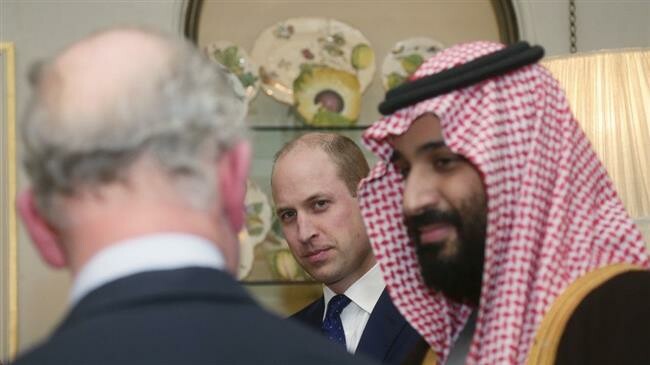
Britain’s Prince Charles, (L) and Britain’s Prince William, (C) meet with Saudi Arabia’s Crown Prince Mohammed bin Salman (R) in central London on March 7, 2018. (AFP photo)
Press TV – June 18, 2019
A detailed report published by the Guardian newspaper has shown how Britain is massively contributing to Saudi Arabia’s devastating war on Yemen as it suggests that London is not only supplying the bombs that fall on Yemenis, but it provides the personnel and expertise that keep the war going.
The comprehensive report by Arron Merat published on Tuesday showed that Britain was doing much of the killing in Yemen as the country continues to provide Saudi Arabia with everything it needs to turn its southern impoverished neighbor into a graveyard.
“Every day Yemen is hit by British bombs – dropped by British planes that are flown by British-trained pilots and maintained and prepared inside Saudi Arabia by thousands of British contractors,” said Merat in the report.
Tens of thousands of people have been killed since Saudi Arabia and a number of Arab allies launched their illegal war on Yemen in March 2015 in an attempt to restore power to a resigned and fugitive president.
Rights campaigners have repeatedly criticized Britain for its role in helping the killing of civilians in Yemen, the poorest country in the Arab world which has suffered from a major humanitarian crisis as a result of the Saudi-led war.
The report by the Guardian showed that it is effectively the United States and Britain who are leading the massive onslaught in Yemen as Saudi Arabia contracted out the vital parts of the war to the two military powers from the very beginning of the conflict.
“Britain does not merely supply weapons for this war: it provides the personnel and expertise required to keep the war going,” said the report, adding that the Royal Air Force personnel have been deployed to Saudi Arabia to work as engineers and trainers over the past four years.
It said the Britain’s biggest arms company BAE Systems has played an even larger role in the Saudi-led war on Yemen as it has been subcontracted by London to provide weapons, maintenance and engineers inside Saudi Arabia.
“The Saudi bosses absolutely depend on BAE Systems … They couldn’t do it without us,” said John Deverell, a former British defense attaché to Saudi Arabia and Yemen.
A BAE employee also said recently that if it was not for the British support, the Saudis would have not been able to continue the war on Yemen for a single week.
“If we weren’t there, in seven to 14 days there wouldn’t be a jet in the sky,” said the employee in an interview with the Channel 4 in early April.
Reports last year also suggested that Britain had even sent its troops to Yemen to help Saudis in their fight against fighters from the ruling Houthi Ansarullah movement.
In fact, there have been multiple reports in the British newspapers showing that UK special forces, known as the SAS, were wounded in battles inside Houthi-controlled territories.
Featured Video
Iran FM Araghchi: “Hormuz Will No Longer Be the Same”
or go to
Aletho News Archives – Video-Images
From the Archives
Sam Husseini: The entire US establishment helped lie their way into the Iraq war
By Slava Zilber | American Herald Tribune | October 14, 2019
Sam Husseini is a senior analyst with the Institute for Public Accuracy, independent journalist and contributor to The Nation and FAIR.
Slava Zilber: Sam, three years ago, you appeared on Talk Nation Radio with David Swanson and spoke about the case of the GCHQ whistleblower Katharine Gun. You pointed out that the people involved in the spying on the UN and the people authorizing the Iraq War were not held accountable:
“Virtually everybody who went along with the war, whether it is Kerry or Clinton, of course, the Bush administration themselves has falsified their own records in terms of why, what they did, when they did, why they did it, to the extent that they’ve been scrutinised at all.”
You also address it in a recent article. And recently, Joe Biden has been lying about his position on the Iraq War. How can such an important issue escape meaningful scrutiny? … continue
Blog Roll
 Aletho News
- Iran FM Araghchi: “Hormuz Will No Longer Be the Same”
- EU facing trillion-euro debt hole while seeking more cash for Kiev
- How US, Europe, Persian Gulf states exhausted missile stockpiles, splurged billions to defend Israel
- Up in arms… Koreans reject U.S. empire’s plan to make South Korea the next Ukraine
- Iran, Turkey, Pakistan, Saudi Arabia could advance region-led security framework in Tehran: FM spox
- Netizens condemn Japanese drama for projecting Japan’s wartime atrocities onto Chinese characters
- Racist Seinfeld Dances for Joy as Bibi Unveils His New Map
- A West Bank War for Netanyahu’s Election Campaign, Could It Backfire?
- Yemen denounces European Parliament’s ‘hypocritical’ push to blacklist Ansarullah
- Qalibaf: UAE’s UN bid aims to ‘clear the runway’ for ‘Greater Israel’, whitewash genocide
- If Americans Knew
- An error has occurred; the feed is probably down. Try again later.
- No Tricks Zone
- Sudden Stratospheric Warming, Powerful El Niño Combination May Lead To Extreme Europe Cold, Energy Crisis!
- Two New Studies Find Thwaites Glacier Melt Cannot Be Driven By Human Activity Or A Warming Ocean
- E-Cars Reduce CO2 Emissions By Only 41% Compared To Internal Combustion Engine Vehicles
- Predictions Made By Renowned Climate Professor Over Past Decades Have Been Proven To Be Poor
- New Study Suggests Large Regions Of The Pacific Ocean Have Been Cooling For The Last 80 Years
- Germany’s Green Energy Debacle: High Energy Costs Force Kahla Porzellan to Close After 182 Years!
- New Study: 50 Years Of The Most Aggressive ‘Net Zero’ Policies Can Only Affect The Global Climate By 0.03°C
- US September “Heat” Was No Record…Many Records Set Decades Ago
- Latest European Green Energy Debacle; Portugal’s Largest Flagship Solar Park Insolvent!
- Green Energy Debacle: German Expert Professor Fritz Vahrenholt Warns Of Severe Economic And Social Consequences

