Saudi, UAE, Bahrain, Egypt cut ties with Qatar
Press TV – June 5, 2017
Saudi Arabia, the UAE, Bahrain and Egypt have cut diplomatic ties and all land, sea and air contacts with Qatar, accusing the Persian Gulf country of supporting terrorism and interfering in their internal affairs.
Riyadh took the lead on Monday to sever relations and other countries fell in line after an official source said the kingdom “urges all brotherly countries and companies to do the same.”
A Saudi official cited by SPA said the country decided to “sever diplomatic and consular ties with Qatar, and to close all land, sea and aviation ports” in order to “protect its national security from the dangers of terrorism and extremism.”
The “decisive” measure, the Saudi statement said, was due to “gross violations committed by authorities in Qatar over the past years.”
The United Arab Emirates gave Qatari diplomats 48 hours to leave the country, citing their “support, funding and embrace of terrorist, extremist and sectarian organizations,” state news agency WAM reported.
Bahrain News Agency said the tiny kingdom was cutting ties with Doha over its insistence on “shaking the security and stability of Bahrain and meddling in its affairs.”
Egypt accused Qatar of supporting “terrorist” organizations, including the Muslim Brotherhood which it has been cracking down on since the 2013 coup against the country’s first ever democratically-elected leader, Mohamed Morsi.
Meanwhile, a Saudi “coalition” waging a war in Yemen said it was ending Qatar’s membership. The measure, it said, was due to Doha’s “practices that strengthen terrorism, and its support to organizations in Yemen, including al-Qaeda and Daesh, as well as dealing with the rebel militias.”
Qatar regretted the decision, saying “the measures are unjustified and are based on claims and allegations that have no basis in fact.” Doha-based Al Jazeera TV quoted Foreign Ministry as saying that the decisions would “not affect the normal lives of citizens and residents.”
“The aim is clear, and it is to impose guardianship on the state. This by itself is a violation of its (Qatar’s) sovereignty as a state,” the ministry said in a statement, referring to the severance of ties as an “incitement campaign based on fabrications, which reflects an intention to harm Qatar.”
Pakistan, another member of the “coalition” which has recently tried to distance itself from the Saudi group’s anti-Iran agenda, made it clear that the country had no plans to cut diplomatic ties with Qatar.
UAE carriers Etihad, Emirates and flydubai said they would suspend flights to and from Doha from Tuesday. Qatar Airways said it has suspended all flights to Saudi Arabia with immediate affect.
Trump factor
The crisis follows US President Donald Trump’s visit to the region last month, marked by the signing of a record $110-billion arms deal with Saudi Arabia.
US Secretary of State Rex Tillerson said the visit was aimed at getting Saudi Arabia and other Arab nations in the region to stand in “unity” with Israel and confront Iran.
After Trump’s visit, tensions escalated between Riyadh and Doha because of an article in Qatar’s state-run news agency in which the emir was quoted as criticizing the US, Saudi Arabia, and their client states for attempting to stir up tensions with “Islamic power” Iran.
The Qatari government quickly deleted the comments, saying the state agency had been hacked but the official denial failed to stop the rift between the Persian Gulf Arab countries from widening.
Saudi media then viciously attacked Qatar, accusing it of having “betrayed” the other Arab countries particularly at a time when they had attempted to stage a show of “unity” against Iran in a much-publicized and extravagant series of events in Riyadh.
Saudi Arabia and the United Arab Emirates also blocked Qatari websites and broadcasters. Qatari Foreign Minister Mohammed bin Abdulrahman Al Thani later said the country was being targeted in a “hostile media campaign, which we will confront.”
Prelude to invasion?
Qatar, home to the forward headquarters of the US military’s Central Command and some 10,000 American troops, long has faced criticism from its Arab neighbors over its support of the Muslim Brotherhood which has another admirer in Turkey.
Western officials have also accused Qatar of allowing or even encouraging funding of Takfiri extremists like al-Qaeda’s branch in Syria, once known as the Nusra Front. Saudi Arabia and the UAE similarly stand accused of supporting other Takfiri groups and the escalation exposes an underlying bitter rivalry among the neighbors for influence.
Former Yemeni president Ali Abdullah Saleh was quoted as saying that the conflict between Saudi Arabia and Qatar is rooted in “accumulated differences from the past even though both countries are followers of the Wahhabi school.”
Wahhabism is the radical ideology dominating Saudi Arabia, which is freely preached by government-backed clerics there and inspiring terrorist groups such as Daesh and al-Qaeda.
Prominent Palestinian journalist Abdel Bari Atwan said in a Twitter post that the diplomatic rupture is a “prelude” to a military action against Qatar.
“The next move may be a military offensive to change the regime in Qatar. It’s a war planned months ago,” wrote the editor-in-chief of the Rai al-Youm news website.
Saudi Arabia, UAE falling out over Yemen?
Recent reports have suggested Saudi Arabia and the United Arab Emirates were divided over their role in Yemen on which they have been waging a deadly war for more than two years now.
In a recent interview with Middle East Eye online news portal, Saudi-backed former Yemeni president Abd Rabbuh Mansour Hadi accused the UAE of acting “like an occupation power in Yemen rather than a force of liberation.”
Yemeni sources have revealed that the United Arab Emirates was trying to establish control over the strategic island of Socotra in the Arabian Sea, which Hadi had rented out to the country for nearly a century.
Tensions have taken a turn for worse under Saudi Arabia’s new rulers who have adopted an aggressive policy, waging a destructive war on Yemen, severing relations with Iran and assisting militants in Iraq and Syria to topple their governments.
Calls on Britain to stop arms exports to UAE
MEMO | June 1, 2017
The Arab Organisation for Human Rights in Britain (AOHR) has called on the UK government to stop exporting arms to the United Arab Emirates (UAE) because of its role in fuelling armed conflicts in the Middle East.
The organisation said the British government granted 509 arms licenses to the UAE worth £182 million ($233.3 million) in 2016 including defensive and offensive weapons with most of these weapons being transported to conflict zones in Yemen and Libya.
The organisation warned that the UAE government does not abide by the last user condition stipulated in the arms licenses which is documented in UN and international reports and therefore it is imperative that the UK government stop the export of arms to Abu Dhabi and investigate the fate of arms deals which were concluded previously.
The UAE not only provided the parties to the conflict with weapons, AOHR explained, but carried out military operations in the field like the continued bombing against the Darna region in Libya in cooperation with Egypt which resulted in civilian deaths and the destruction of many civilian facilities.
Using the pretext of fighting terrorism, the UAE and its allies are committing gross violations of the rules of international humanitarian law, AOHR added.
It went on to express deep concern that the UAE is expanding its military activity in Africa, where it has built military bases in Eritrea and Somalia.
Trump-Saudi orb-gazing summit not helping Sunni alliance
By Sharmine Narwani | RT | June 1, 2017
The glowing orb stunt should have been a sign that all was not what it seems. Theatrics, in the world of politics, usually suggest an illusion needs to be spun for audiences somewhere.
A week after US President Donald Trump’s eyesore of a visit to Riyadh, Saudi Arabia, the pressing question now is “why?” What was the purpose of convening leaders and representatives of 55 Arab and Muslim nations to greet a US head of state amidst so much pomp, ceremony and an excruciating amount of flashing cameras?
The Riyadh summit had several goals, most of which specifically served Saudi and American political interests.
The American leader’s potential gains were clear: he would score points at this impressive international showing of Muslim leaders who would help counter his anti-Muslim reputation at home. Trump would also be well-compensated in the form of the largest US arms deal in history, a booty he could claim would boost his home economy. The negotiations would take place in the Middle East, at the heart of his fight against “radical Islamic terrorism.” Trump would also leave with a blank check for Palestinian-Israel “peace,” bestowed by a Saudi king who has no authority to negotiate anything on behalf of Palestinians. And finally, the US president would piggyback the legitimacy of 55 Arab and Muslim states to craft a Middle East policy that targeted Iran, its allies and the Muslim Brotherhood (MB) – even though no consensus whatsoever was reached at the summit.
In their eyes, the Saudis scored even bigger. The cash-and-credibility-hemorrhaging Saudis are losing ground in their list of international fights – in Syria, Yemen, Iraq and against Iran. Here was an opportunity to convene leaders and representatives from 55 Arab and Muslim nations (only 33 heads of state showed up) to underscore Saudi Arabia’s position as the custodian of Sunni Islam. For the power-mad Saudis, nothing would showcase their primacy better than the presence of a US president on his first official foreign trip. They forgot, however, that legitimacy is derived from one’s own populations, not from a Western head of state sword-dancing next to one’s king. After the summit, Riyadh would go on to unilaterally craft a declaration, unseen and unapproved by the VIP guests, that claimed to outline the gathering’s foreign policy priorities.
But most importantly, this summit would allow the Saudis – who are terrified at the potential repercussions coming their way from decades of funding global terrorism – to very publicly take cover under the Trump presidency. And the US president, who knows very well that the Saudis are the epicenter of global terror, offered up America’s protection and complicity to secure his doggy bag of treasures.
This generous give-and-take between the Saudis and Americans took place on the day of the summit, amidst much back-slapping. Then, a few days later, the fallout began.
First, Saudi vs. Qatar
This past week, a flurry of media headlines alerted us to the first fissure between summit participants. News reports began emerging that Qatari leader Sheikh Tamim bin Hamad al-Thani had deviated from the Saudi talking points by supporting engagement with Iran and defending resistance groups Hezbollah and Hamas.
Saudi Arabia and the UAE retaliated swiftly to this slight by blocking Qatari media outlets, recalling their ambassadors and launching a war of words against Doha.
Why the swift and punishing response toward a fellow member of the six-nation Gulf Cooperation Council (GCC)?
Qatar has long struggled to get out from under the shadow of its much larger Persian Gulf neighbor Saudi Arabia and has spent the past dozen years building up media networks, like Al Jazeera, and investing in major Western corporate, think tank, educational and sports brands to project power well beyond its regional stature. The tiny sheikhdom’s biggest coup, however, was to secure the establishment of the US military’s largest regional base on its territory, which allowed Doha to continue provoking its Saudi competitor with little risk of consequence.
Then in 2011, the Qataris put their full weight behind “Arab Spring” efforts to overthrow a slew of Arab governments. Most of the Qatari-backed incoming regimes and opposition activists, however, were Islamists, mainly of the MB variety, which is reviled by Saudi Arabia and the UAE.
The Saudis were initially caught off-guard by the swift events sweeping the region, but quickly rallied to mount a region-wide counterrevolution to reverse the political gains of the Qatari- and Turkish-backed MB groups. Saudi operatives funneled manpower, money, and weapons to reestablish Riyadh’s influence. They revived their famed jihadi networks to flood Syria and other places with extremist militants that could tip the balance of power back in its direction.
It wasn’t just Qatar and the MB in Saudi sights – the regional uprisings, particularly in Syria, Yemen and Bahrain, threatened to shift the region in a direction that benefited Iran, Saudi Arabia’s biggest regional adversary.
In Riyadh ten days ago, the Saudis thought they had struck gold. After eight years of dealing with a somewhat unsympathetic Obama administration, here was Trump acquiescing to their every whim. The Saudi declaration issued at the end of the summit – as well as speeches delivered during the event – struck out at Iran, the Muslim Brotherhood, Hezbollah and Hamas, and promised American cooperation in isolating them. The Saudis were on a high, but they were also mostly alone.
A broad divergence of interests
Aside from the Saudi-Qatari spat, there are countless other differences among summit participants that will scuttle Riyadh’s ambitions.
The anti-MB UAE has stood firmly by Riyadh’s side in condemning Doha but diverges – even within its own borders – on assuming an aggressive position against Iran. Call it Dubai-versus-Abu Dhabi if you will. Dubai, with its large Iranian expat population and significant trade with the Islamic Republic, is less worried about its Persian neighbor. As a 2009 Wikileaks cable from the US embassy in Abu Dhabi puts it: “While MbZ (Crown Prince of the Emirate of Abu Dhabi Mohammad bin Zayed) is a hardliner on Iran, there are accommodationists within his own system, especially in Dubai, where the ruler, Mohammed bin Rashid Al-Maktoum (Prime Minister of the UAE) takes a position that is much closer to Qatar’s.”
Other GCC states are even more loathe to confront Iran. Oman has repeatedly ignored Saudi demands to toughen its stance against Iran and remains a key Iranian diplomatic partner in the region. The two states participated in joint naval exercises in the Gulf of Oman as recently as April, and it was Muscat that hosted the initial secret US-Iran meetings which kick-started the 2015 Iranian nuclear deal.
GCC member-state Kuwait also remains relatively neutral on Iranian matters. Up to 40 percent of Kuwaitis are Shiites, and the country has avoided much of the sectarian strife that afflicts Saudi Arabia and now Bahrain. It is to Kuwait that Qatar’s emir has now turned to negotiate peace with the Saudis and UAE in the aftermath of last week’s fallout. The Qataris, who have dealt opportunistically and not ideologically in their regional relations, share the world’s largest gas reserve with Iran, a further incentive to maintain a neutral stance on Tehran.
In fact, most of the Sunni states that attended the Riyadh summit are flat-out furious about the violent sectarianism and extremism that has emerged in the past few years. And many of them blame the Saudis for it.
Last August, an unprecedented conference of 200 leading Sunni clerics from around the world was held in Grozny to determine “who is a Sunni.”Excluded from the gathering were representatives of both the Wahhabi sect (Saudi Arabia and Qatar’s official religion) and the Muslim Brotherhood. The Islamic world is looking to tackle the deviance and sectarianism that has borne groups like ISIS and Al-Qaeda – not indulge it, as would be the case if they embraced the Saudi ‘vision’ in Riyadh.
But in an effort to bulldoze through a “Sunni consensus” under the umbrella of “Saudi-American power,” the Saudis ignored every gorilla in that summit room. Not only do many of the meeting’s participants blame the Saudis for unleashing the jihadi genie, but most of them also wouldn’t for a minute look to Saudi ‘leadership’ if it weren’t for Saudi cash. Case in point, Sunni regional giants Turkey and Egypt. Turkish President Recep Tayyip Erdogan didn’t even show up to Riyadh, citing other engagements. Egyptian President Abdel Fattah al-Sisi did attend – he was one of three invited to press his palms upon the ‘glowing orb’ to inaugurate the Saudi counterterrorism-something-or-other.
But more than anything, Sisi was invited to Riyadh as an important set extra – to visually demonstrate that the great Arab state of Egypt was passing the mantle of leadership to Saudi Arabia’s King Salman.
Where the Saudis viewed former Egyptian President Hosni Mubarak as a stalwart ally, they see Sisi as nothing of the sort. Sisi may agree with Riyadh on the evils of the Muslim Brotherhood, but he has absolutely no tolerance for Saudi Arabia’s support of terrorist groups throughout the region and has been a right royal pain on the issue of Syria.
Egypt may hanker after the Saudi billions – which it has received in spades for its anti-MB efforts – but Egyptians have little affection for the Saudis and have sparred publicly and privately in recent years and months. Whereas Riyadh could once count on Egyptian troops to support its military incursions, today Cairo has rejected participation in the Saudi-led war against Yemen – alongside another staunch Saudi ally, Pakistan.
The Saudis recently hired Pakistan’s former army chief General Raheel Sharif to head up their 39-nation “Muslim NATO” construct to fight terrorism, but now rumors are rife that he will resign amidst a national uproar over his decision. Pakistanis, like other straight-thinking Muslims, are uncomfortable about the prospect of a military alliance that appears to have been conceived primarily to fight Iran – and Shiites.
Dead On Arrival
On the surface, the purpose of the Riyadh summit was to amass a coalition of like-minded Arab and Muslim partner-states, under a Saudi-American banner, to wage war against terror. In fact, this is a Saudi and American-led initiative created not to tackle terror, but to ‘reframe’ it to encompass political adversaries.
Look out for pundits and politicians spinning these new narratives that Iran, Hezbollah, and the Muslim Brotherhood are equally as dangerous as ISIS and Al-Qaeda – never mind that the former have been around for decades without triggering the global security meltdown spawned by the latter.
In Riyadh, the Americans and Saudis made a great show of jointly announcing two additions to their “terrorism” list – one was a senior Hezbollah official, the other a senior member of ISIS.
This is not the war against terror that the heads of states gathered in Riyadh anticipated. This is a sectarian war, conceived by a sectarian state that has funded, armed and organized the very global terrorism it purports to fight. And every single US administration since the events of 9/11 has acknowledged this direct Saudi role in terror.
In Riyadh, the show went on anyway. But there’s not a person in that room who didn’t understand the game. Forget the ‘Sunni consensus’ after Riyadh. Of the 55 nations represented at the summit, the Saudis will be lucky to retain five.
Sharmine Narwani is a commentator and analyst of Middle East geopolitics. She is a former senior associate at St. Antony’s College, Oxford University and has a master’s degree in International Relations from Columbia University. Sharmine has written commentary for a wide array of publications, including Al Akhbar English, the New York Times, the Guardian, Asia Times Online, Salon.com, USA Today, the Huffington Post, Al Jazeera English, BRICS Post and others. You can follow her on Twitter at @snarwani
Obama vs. Trump

By Margaret Kimberley | Black Agenda Report | May 31, 2017
Barack Obama presided over the sale of more than $100 billion in weaponry to Saudi Arabia during his presidency. These deals were transacted before, during and after the Saudis’ devastating attacks on Yemen. It is important to state these simple facts because there is now a concerted effort among the rulers to make us believe that these recent events never took place.
Donald Trump’s visit to Saudi Arabia and announcement of yet another arms sale is the immediate cause of consternation. The continuity in foreign policy decision making from one president to another is a longstanding American tradition. But acknowledgement is problematic now that Trump is the one acting as his predecessors did.
The Saudi bombing and blockade of Yemen has resulted in starvation and a cholera epidemic. The corporate media and their talking heads ignored the crime as long as Barack Obama was in the White House. Now the same forces who hid the carnage beginning in 2015 behave as if the new president bears responsibility when Obama gave the green light.
A New York Times editorial is an example of the official propaganda scheme. Entitled “Will President Trump Help Save Yemen,” the editorial excoriated Trump for doing nothing more than what Obama had done. There was no mention of the former president’s support, in fact the Times gave the impression that he somehow opposed a policy he had carried out.
The New York Times is not alone in trying to make observant people disbelieve their lying eyes. Obama UN ambassador Samantha Power is also part of the amnesiac brigade. In a twitter post she responded to Trump administration boasting about the arms sale. “For a country whose attacks on civilians in Yemen — and inability to learn from mistakes — have been devastating to human life.” Fortunately, social media is a two way street and her obvious attempt at changing history was called into question by angry readers.
So concerned are the elites and their friends around the world that they won’t let Obama go. Defending the prerogatives of the ruling classes is a permanent position after all. That is why Obama was invited months ago to give a speech in Berlin with Angela Merkel by his side. The obvious goal of the photo opportunity was to help Merkel’s election campaign. Now an Obama visit may also undermine any foreign policy changes Trump may contemplate. Trump’s message of America first throws the imperial project into jeopardy and causes panic among current and former leaders.
The corporate media and foreign governments don’t care about the damage Trump is doing domestically. The ICE raids, emboldened racism, voter suppression and cuts to government programs don’t concern them. But Trump’s victory already killed the TPP trade deal. His white America first philosophy leaves less room for NATO machinations and imperial imperatives.
Trump literally shoved the president of Montenegro aside at the NATO summit. The juvenile alpha male move was ironic for several reasons. Tiny Montenegro has been pushed into NATO against the wishes of many of its people. But NATO is determined to expand because Russia is the last country capable of saying no to America’s whims and its determination to run the whole world.
Trump’s understanding of European foreign policy consists of worrying about how much America contributes towards NATO funding vis a vis other nations. He is a businessman after all and sees no reason to pay more than the next guy. This nationalistic impulse creates huge problems for the elites, who had no intention of giving up on their grand schemes of control backed by American muscle.
Trump’s non-commitment to NATO’s Article 5 may have done the world a huge favor. Article 5 makes every member nation responsible for the defense of the others. NATO assists in every act of aggression that the United States cooks up and that is one of the reasons the elites want Trump gone. The American/NATO effort to tear Yugoslavia apart included the bombing of Montenegro. Trump’s wrong headed impulse reveals some important truths about the state of the world.
And that is why Obama will keep showing up for his friends. He is still working for the western oligarchs who want the system to keep running as it has done. No one should worry about Merkel’s lament that Europe can’t count on the United States. Trump’s boorish behavior is a lot less dangerous than the trans Atlantic alliance of war making.
Of course Obama acolytes are lying about his relationship with Saudi Arabia. American presidents always genuflect to their partner in crime. The Saudis have aided in the destruction of much of that region but those facts are inconvenient. Obama’s second act won’t work unless some very big lies are served up.
Margaret Kimberley can be reached via e-Mail at Margaret.Kimberley(at)BlackAgendaReport.com.
Who’s funding Britain’s terrorists? ‘Sensitive’ Home Office report may never be published
RT | May 31, 2017
An investigation commissioned by former Prime Minister David Cameron into the revenue streams behind jihadist groups operating in Britain may never be published, the Home Office has admitted.
The inquiry is thought to focus on British ally Saudi Arabia, which has repeatedly been highlighted by European leaders as a funding source for Islamist extremists, and may prove politically and legally sensitive, the Guardian reports.
The UK has close ties with Saudi Arabia. Prime Minister Theresa May visited the country earlier this year.
In January 2016, a specialist Home Office unit was directed by Downing Street to investigate sources of overseas funding of extremist groups in the UK. The findings were to be shown to Cameron’s then-Home Secretary May.
Eighteen months later, however, the Home Office told the Guardian the report had not been completed and would not necessarily be published, calling the contents “very sensitive.”
A decision on the future of the investigation would be taken “after the election by the next government,” a spokesperson said.
Cameron was urged to launch an investigation in December 2015 as part of a deal with the Liberal Democrats in exchange for the party supporting the extension of British airstrikes against Islamic State (IS, formerly ISIS/ISIL) from Iraq into Syria.
According to the Guardian, Tom Brake, the Lib Dem foreign affairs spokesperson, has written to the prime minister asking her to confirm that the investigation will not be shelved.
“As home secretary at the time, your department was one of those reading the report. Eighteen months later, and following two horrific terrorist attacks by British-born citizens, that report still remains incomplete and unpublished,” Brake wrote.
“It is no secret that Saudi Arabia in particular provides funding to hundreds of mosques in the UK, espousing a very hard line Wahhabist interpretation of Islam. It is often in these institutions that British extremism takes root.”
Lib Dem leader Tim Farron said he felt the government had not held up its side of the bargain.
The report must be published when it is completed, he said, even if its contents are sensitive.
“That short-sighted approach needs to change. It is critical that these extreme, hardline views are confronted head on, and that those who fund them are called out publicly.
“If the Conservatives are serious about stopping terrorism on our shores, they must stop stalling and reopen investigation into foreign funding of violent extremism in the UK.”
Yemen descending into total collapse as world watches: UN
Press TV – May 30, 2017
The United Nations says impoverished Yemen is on the brink of total collapse, as the country is facing an ongoing bloody military aggression by Saudi Arabia, an emerging famine, and an outbreak of cholera.
“Crisis is not coming, it is not looming, it is here today, on our watch and ordinary people are paying the price,” said UN Under-Secretary-General for Humanitarian Affairs and Emergency Relief Coordinator Stephen O’Brien in a speech on Tuesday, addressing the UN Security Council.
“The people of Yemen are being subjected to deprivation, disease and death as the world watches,” he said, adding that the crisis is triggering “total social, economic and institutional collapse” in the Arab country.
O’Brien told the council that “the time is now” to finish the world’s largest food emergency and to put Yemen on the path of survival.
His alarming remarks come as the UN Security Council has so far failed to turn off the Saudi war machine and prevent it from inflicting more damage to the kingdom’s poor southern neighbor.
Since March 2015, Yemen has been heavily bombarded by Saudi warplanes as part of a brutal campaign against the impoverished country in an attempt to crush the popular Houthi Ansarullah movement and reinstall Abd Rabbuh Mansur Hadi, the president who has resigned and is a staunch ally of Riyadh.
Latest tallies show that the war has so far killed over 12,000 Yemenis and wounded thousands more. Indiscriminate Saudi bombardments have also taken a heavy toll on the Yemeni infrastructure, schools and hospitals, with prominent rights groups censuring Riyadh’s military for the use of internationally-banned weapons against Yemeni civilians.
The relentless airstrikes have put more than half of all health facilities in Yemen in a state of complete or partial shutdown. Nearly 3.3 million Yemeni people, including 2.1 million children, are currently suffering from acute malnutrition.
Some 19 million out of the country’s 28 million population are in dire need of humanitarian aid and many of them are reported to be on the brink of famine. The relentless airstrikes have also put more than half of all health facilities in Yemen in a state of complete or partial shutdown.
Furthermore, the war-torn nation has been grappling with a deadly cholera outbreak since last October. Over 55,200 Yemenis, one third of them children, are infected by the disease. The UN figures show that since late April nearly 500 Yemeni have lost their lives due to cholera infection. It is estimated that some 150,000 new cases of cholera are surfaced in the next six months.
The chaos in Yemen, caused by the Saudi campaign, has also given the Takfiri al-Qaeda and Daesh terror groups room to operate in the country, further complicating the situation on the ground there.
Things that Saudis can’t buy off
By M K Bhadrakumar | Indian Punchline | May 29, 2017
There is something obscene about anyone who held high positions in the government – for example, an Ambassador or an Army Chief – taking up a post-retirement job as employee of a foreign government. Pakistan’s former army chief General Raheel Sharif should not have accepted the offer made by Saudi king Salman to appoint him as the head of a newly-formed Islamic Military Alliance.
It is common sense that the assignment would effectively make the Pakistani general a vassal of the House of Saud. What was the need for it? A Pakistani general is almost certainly a very wealthy man who really doesn’t need more money. And if Gen. Sharif had an insatiable itch to continue to fight terrorism till the end of his life, Pakistan itself provided ample opportunities.
Why Saudi Arabia? The only plausible answer is — avarice. The Saudis’ capacity to lure foreign elites is a legion. According to reports, Salman gave away to US President Donald Trump personal gifts alone worth $1.2 billion. One heavy sword made of pure gold and studded with diamond stones weighing 25 kilograms alone was worth $200 million. Then, there is this 125 meter long yacht, which is apparently the world’s tallest personal yacht, with 80 rooms with 20 royal suites.
Maybe, the yacht is useful for Trump’s escapades, but what will he do with a 25 kg sword? Obviously, Salman was bribing Trump. As quid pro quo, Salman probably expects Trump to close the file on the 9/11 attacks and drop the idea of seeking compensation for the victims’ families under the US legislation known as Justice Against Sponsors of Terrorism Act.
Of course, Saudis do not have to give away such lavish gifts to the elites in Pakistan (or India.) A Mont Blanc ballpoint pen, Rolex wrist watch, an odd job for the nephew or son-in-law – that generally does the trick. To be sure, by Pakistani standards, Gen. Sharif must be getting a fat salary.
However, the amazing part is that the Pakistani government gave him an exceptional ‘No Objection Certificate’ to take up such an assignment. The Pakistani leadership would have known that the Saudis had a certain agenda in creating the Islamic Military Alliance. The Saudi intention is to rally Sunni Muslim countries and create a phalanx against Shi’ite Iran. No matter the gloss put on the IMA being an anti-terror enterprise, the alliance’s Iran orientation was crystal clear.
The Pakistani press reported that Iran’s ambassador in Islamabad Mehdi Honardoost called on army chief General Qamar Javed Bajwa in Rawalpindi twice during the month of April alone to convey Tehran’s disquiet over Sharif’s appointment. But the government remained impassive.
The birds are now coming to roost. One outcome of Trump’s visit to Riyadh last week is that the Islamic Military Alliance now stands pretty naked as a Sunni Muslim alliance to fight Iran. Not only that, the alliance will fight Iran in secret collaboration with Israel. The Saudi Deputy Crown Prince Mohammad bin Salman has bragged in a media interview, “We will not wait for the war to be waged on Saudi soil. We will make sure that the war is waged in Iran and not in Saudi Arabia.”
Now, this is all spinning out of control. Imagine Gen. Sharif landing the IMA troops in Badar-e Bushehr and leading the charge of the light brigade to Shiraz and Esfahan and on to Tehran to overthrow the Iranian regime. Therefore, it is not at all surprising that Gen. Sharif is reportedly developing cold feet and is contemplating to resign from his job and return to Pakistan.
Even if that is not the case, Pakistani leadership should order him to return home. It will be extremely damaging to Pakistan’s interests any which way one looks at it, if it gets entangled in the Saudi-Iranian tensions. As the African proverb says, ‘When elephants fight, it is the grass that gets hurt’.
The really bizarre part of it is that Trump’s rhetoric about Iran is all baloney. Trump is a bluff master. He will now walk away laughing with the sword and the yacht. Read a report in the New York Times – As Iran and U.S. Leaders Trade Barbs, Big Deals Proceed.
Qatar emir to visit Kuwait amid regional tensions
Press TV – May 30, 2017
Qatar’s emir is to travel to Kuwait in a visit aimed at enhancing bilateral ties amid a rift emerging between Qatar on the one side and Saudi Arabia and the United Arab Emirates on the other.
The monarch, Tamim bin Hamad Al Thani, will enter Kuwait City on Wednesday, Qatar’s al-Sharq paper reported on Tuesday.
Last Friday, Kuwait’s First Deputy Prime Minister and Foreign Minister Sheikh Sabah Khalid Al Hamad Al Saba visited Doha.
Qatar drops a bombshell
Last Thursday, an article appeared on Qatar’s state-run news agency, quoting the emir as criticizing the United States, Saudi Arabia, and their client states for attempting to stir up tensions with “Islamic power” Iran.
A post also appeared on the agency’s Twitter page, quoting the Qatari foreign minister as saying that his country was withdrawing its ambassadors from Kuwait, Bahrain, Egypt, Saudi Arabia, and the UAE amid tensions.
The Qatari government soon said that the state agency had been hacked and that the remarks attributed to the emir and the foreign minister had never been made.
The official denial, which was offered several more times, nevertheless failed to stop the rift between the Persian Gulf Arab countries from widening. Saudi media viciously attacked Qatar, accusing it of having “betrayed” the other Arab countries particularly at a time when they had attempted to stage a show of “unity” against Iran in a much-publicized and extravagant series of events in Riyadh.
Saudi Arabia and the United Arab Emirates also blocked Qatari websites and broadcasters.
Qatari Foreign Minister Mohammed bin Abdulrahman Al Thani (seen below) later said the country was being targeted in a “hostile media campaign, which we will confront.” He was referring to the media blackout.
Demonstrating a more moderate stance however, Kuwait did not join the blackout. Deputy Foreign Minister Khaled Jarallah called the ban “regrettable” and expressed Kuwait’s readiness to converge its views with those of Qatar.
Some analysts say Riyadh fears that the Arab Persian Gulf countries it has long sought to co-opt may be gravitating toward Iran, which Saudi Arabia perceives as a regional adversary.
Tehran has said time and again that it does not seek tensions with any of its neighbors, including Saudi Arabia.
ISIS Touches Down in the Philippines
By Tony Cartalucci | New Eastern Outlook | 28.05.2017
Mayhem broke out across the southern Philippine city of Marawi where militants besieged it and hoisted flags of the so-called “Islamic State.” Located on the southern island of Mindanao, the city is only slightly removed from Al Qaeda affiliate Abu Sayaff’s primary area of operation on nearby Jolo and Basilan islands.
The UK Independent in an article titled, “Isis-linked militants take priest and churchgoers hostage in Philippines,” would report:
President Rodrigo Duterte declared martial law in the south because of the militants’ siege on the city on Tuesday and abandoned a trip to Russia to deal with the crisis.
Mr Duterte vowed to place southern Mindanao island, where Marawi is situated, and its 22 million residents under military rule for up to a year if necessary.
The article would also report:
Troops are battling to contain dozens of militants from the Maute group, which pledged allegiance to Isis in 2015, after they escaped a botched security raid on a hideout and overran streets, bridges and buildings.
Two soldiers and a police officer are among those killed and at least 12 people have been wounded in the violence, seeing Maute fighters set fire to a school, a church and a prison.
The security crisis represents a seemingly inexplicable expansion of the Islamic State in Asia – even as the US and its allies claim the organization is being rolled back across the Middle East and its revenue streams are contracting in the wake of defeat.
US-Saudi Sponsored Terrorism Seeks to Coerce Asia
Both the Maute group and Abu Sayaff are extensions of Al Qaeda’s global terror network, propped up by state sponsorship from Saudi Arabia and Qatar, and fed recruits via a global network of likewise Saudi and Qatari funded “madrasas.” In turn, Saudi Arabia and Qatar’s state sponsorship of global terrorism for decades has been actively enabled by material and political support provided by the United States.
This arrangement provides for Washington both a global mercenary force with which to wage proxy war when conventional and direct military force cannot be used, and a pretext for direct US military intervention when proxy warfare fails to achieve Washington’s objectives.
This formula has been used in Afghanistan in the 1980s to successfully expel the Soviet Union, in 2011 to overthrow the Libyan government, and is currently being used in Syria where both proxy war and direct US military intervention is being applied.
Maute and Abu Sayaff activity fits into this global pattern perfectly.
The Philippines is one of many Southeast Asian states that has incrementally shifted from traditional alliances and dependency on the United States to regional neighbors including China, as well as Eurasian states including Russia.
The Philippine president, Rodrigo Duterte, cancelling his meeting with Russia is a microcosm of the very sort of results Maute and Abu Sayaff are tasked with achieving in the Philippines. Attempts by the US to justify the presence of its troops in the Philippines as part of a wider strategy of encircling China with US military installations across Asia would also greatly benefit from the Islamic State “suddenly spreading” across the island nation.
Likewise, violence in Malaysia and Thailand are directly linked to this wider US-Saudi alliance, with violence erupting at each and every crucial juncture as the US is incrementally pushed out of the region. Indonesia has likewise suffered violence at the hands of the Islamic State, and even Myanmar is being threatened by Saudi-funded terrorism seeking to leverage and expand the ongoing Rohingya humanitarian crisis.
That US-Saudi sponsorship drives this terrorism, not the meager revenue streams of the Islamic State in Syria and Iraq, goes far in explaining why the terrorist organization is capable of such bold attacks in Southeast Asia even as Russia and Iranian backed Syrian troops extinguish it in the Middle East.
US-Saudi Links to Abu Sayaff and other Terrorists in the Philippines
A US diplomatic cable leaked by Wikileaks dated 2005 would state:
Philippine officials noted their continuing concern about Saudi-origin terrorist financing coming into the Philippines under the cover of donations to mosques, orphanages, and madrassahs. Although three Saudi nationals suspected of being couriers had been detained on separate occasions, Saudi Ambassador Wali had intervened in each case to secure their release.
Yousaf Butt of the Washington-based US National Defense University would reveal in a Huffington Post article titled, “How Saudi Wahhabism Is the Fountainhead of Islamist Terrorism,” that:
It would be troublesome but perhaps acceptable for the House of Saud to promote the intolerant and extremist Wahhabi creed just domestically. But, unfortunately, for decades the Saudis have also lavishly financed its propagation abroad. Exact numbers are not known, but it is thought that more than $100 billion have been spent on exporting fanatical Wahhabism to various much poorer Muslim nations worldwide over the past three decades. It might well be twice that number. By comparison, the Soviets spent about $7 billion spreading communism worldwide in the 70 years from 1921 and 1991.
The leaked cable and reports by Western analysts when taken together, reveal that Saudi-funded madrasas in the Philippines are directly fueling terrorism there.
The answer to why is simple.
For the same purposes the US used Saudi-funded terrorism in Afghanistan in the 1980s and in Libya and Syria beginning in 2011 – the US is using Saudi-funded terrorism to coerce the government of the Philippines amid Washington’s faltering “pivot to Asia” which began under US President Barrack Obama and now continues under President Trump.
Countering US-Saudi Sponsored Terrorism
With US President Trump announcing a US-Saudi alliance against terrorism – the US has managed to strategically misdirect public attention away from global terrorism’s very epicenter and protect America’s premier intermediaries in fueling that terrorism around the world.
The Philippines would be unwise to turn to this “alliance” for help in fighting terrorism both the US and Saudi Arabia are directly and intentionally fueling.
Instead – for Southeast Asia – joint counter-terrorism efforts together and with China and Russia would ensure a coordinated and effective means of confronting this threat on multiple levels.
By exposing the US-Saudi role in regional terrorism – each and every act of terrorism and militancy would be linked directly to and subsequently taint the US and Saudi Arabia in the hearts and minds of Southeast Asia’s population.
This paves the way for a process of exposing and dismantling US-Saudi funded fronts – including Saudi-sponsored madrasas and US-funded NGOs – both of which feed into regional extremism and political subversion. As this unfolds, each respective nation would be required to invest in genuine local institutions to fill sociopolitical and economic space previously occupied by these foreign funded fronts.
Until then, Asia should expect the US and its Saudi partners to continue leveraging terrorism against the region. If unchecked, Asia should likewise expect the same progress-arresting instability that has mired the Middle East and North Africa for decades.
Featured Video
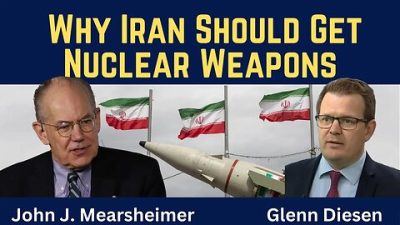
John Mearsheimer: The Case for a Nuclear Iran
or go to
Aletho News Archives – Video-Images
From the Archives
Ethnic Cleansing in a Zionist Fairyland
By Vacy Vlazna | Palestine Chronicle | February 10, 2012
‘De-Arabizing the history of Palestine is another crucial element of the ethnic cleansing. 1500 years of Arab and Muslim rule and culture in Palestine are trivialized, evidence of its existence is being destroyed and all this is done to make the absurd connection between the ancient Hebrew civilization and today’s Israel. The most glaring example of this today is in Silwan, (Wadi Hilwe) a town adjacent to the Old City of Jerusalem with some 50,000 residents. Israel is expelling families from Silwan and destroying their homes because it claims that king David built a city there some 3000 years ago. Thousands of families will be made homeless so that Israel can build a park to commemorate a king that may or may not have lived 3000 years ago. Not a shred of historical evidence exists that can prove King David ever lived yet Palestinian men, women, children and the elderly along with their schools and mosques, churches and ancient cemeteries and any evidence of their existence must be destroyed and then denied so that Zionist claims to exclusive rights to the land may be substantiated.’ — Miko Peled, Israeli dissident.
Indeed, archaeology has become a state apparatus for the ethnic cleansing of Palestinians in the Zionist fairyland aka the City of David Archaeological Park located in the Palestinian village of Silwan in East Jerusalem.
East Jerusalem is the proclaimed capital of the proposed Palestine state. It was illegally annexed by Israel in the 1967 war. Prohibiting annexation of territories gained by military conquest is one of the major principles of international law. The international community does not recognise Israel’s annexation of East Jerusalem nevertheless over 50,000 illegal premises have been built for 250,000 illegal Israeli colonists.
The goal of the archaeological judaisation of Jerusalem is to transform Jerusalem into the City of David, the capital of Greater Israel by eradicating the mixed ethnic composition of the Palestinian and Jewish population of East Jerusalem to a solely Jewish identity and unifying East and West Jerusalem under Israeli sovereignty. … continue
Blog Roll
 Aletho News
- John Mearsheimer: The Case for a Nuclear Iran
- The Founder Who Turned Against Root Canals
- Israel displaces last two families from Al Khalayel valley, Al Mughayyir
- Israeli Opposition Leader Endorses Greater Israel
- Islamic Jihad: Trump’s peace board is a “theatrical stunt detached from reality”
- The Head Of A CIA Cutout Admits To Meddling In Iran To Fuel Unrest
- Iran warns Trump against decisions based on false information
- Pentagon sets deadline for Anthropic to lift AI restrictions on autonomous weapons systems, mass domestic surveillance
- Trump’s military buildup against Iran on Netanyahu’s behalf is a gambit doomed to fail
- Big League War
- If Americans Knew
- Are the Jews indigenous to Palestine?
- AIPAC Wants to Kill a Bill that would Ensure Israel Complies with Ceasefire
- Former Israeli PM, in Epstein Files, Dreamed of Israeli Eugenics and Pretty Converts
- Israeli settlers join ‘safari’ tour of Palestinian prisoners
- Flooding in Gaza amid rumors of war; fire in West Bank – Not a ceasefire Day 138
- Fourteen Countries Condemn Huckabee’s Support for Israel Taking Over Most of the Middle East
- Israeli Soldiers Killed Gaza Aid Workers at Point Blank Range in 2025 Massacre: Report
- Israel’s insidious network to propagandize American Christians
- Israel’s Best-Kept Secret: Palestinian Resistance Never Agreed to Disarm
- Trump officials plan to build 5,000-person military base in Gaza, files show
- No Tricks Zone
- Surprising Discovery: Sahara Is Greening…Billions Of Trees Where Once Thought To Be Barren
- New Research Reaffirms Clouds, Aerosols, And Surface Solar Radiation Are ‘Driving The Climate System’
- Germany: Electric Car Catches Fire At Charging Station, Sets Off Local “Inferno”, Widespread Damage
- New Study: Canada’s New Brunswick Was 1°C Warmer Than Today During The Medieval Warm Period
- Coal Power Back In Trend As Globe Tries To Keep Pace With Growing Demand For Power
- New Study: A 4°C Warmer Beaufort Sea Had ‘No Sea Ice’ 11,700 – 8200 Years Ago
- Unfudging The Data: Dutch Meteorological Institute Reinstates Early 20th Centruy Heat Waves It Had Erased Earlier
- German Gas Crisis…Chancellor Merz Allegedly Bans Gas Debate Ahead of Elections!
- Pollen Reconstructions Show The Last Glacial’s Warming Events Were Global, 10x Greater Than Modern
- Germany’s Natural Gas Storage Level Dwindles To Just 28%… Increasingly Critical
 Aletho News