Saudi Arabia and Israel Know They Cannot Defeat Iran, Want to Drag the US into an Uncontainable War
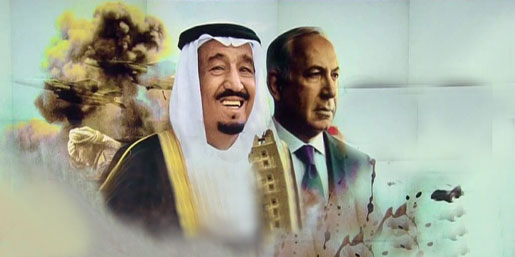
By Philip Giraldi | American Herald Tribune | November 13, 2107
There is considerable confusion about what is occurring in the Middle East, to include much discussion of whether Israel and Saudi Arabia have formally agreed to combine forces to increase both military and economic pressure on Iran, which both of them see as their principal rival in the region. During the past week, a classified message sent by the Israeli Foreign Ministry to all its diplomatic missions worldwide that appears to confirm that possibility was obtained and leaked by senior reporter Barak Ravid of Israel’s highly respected Channel 10 News.
The cable instructs Israeli diplomats to take coordinated steps designed to discredit the activities of the Iranian government. It states, in edited-for-brevity translation, that overseas missions should contact their host countries to emphasize that the resignation of Lebanese Prime Minister Saad al-Hariri over Iranian attempts to take over his country “illustrate once again the destructive nature of Iran and Hezbollah and their danger to the stability of Lebanon and the countries of the region;” that the argument that having Hezbollah in the Lebanese government provides stability is false and only serves to “promote the interests of a foreign power – Iran;” and that the launch of a ballistic missile from Yemen against Saudi Arabia confirms the need for “increased pressure on Iran and Hezbollah on a range of issues from the production of ballistic missiles to regional subversion.”
The Foreign Ministry message has been interpreted as “proof” that Israel and Saudi Arabia are coordinating to provoke a war against Iran as Israel is taking positions in support of Saudi claims, to include those relating to the confused conflict taking place in Yemen. My own take is, however, somewhat different. Having seen literally hundreds of similar U.S. State Department messages, I would regard the Israeli cable as consisting of specific “talking points” for use with foreign governments. Though it is clear that Tel Aviv and Riyadh have been secretly communicating over the past two years regarding their perception of the Iranian threat, it would be an exaggeration to claim that they have a coordinated position or some kind of alliance since they differ on so many other issues. They do, however, have common interests that are in this case aligned regarding the Iranians since both Israel and Saudi Arabia aspire to dominance in their region and only Iran stands in their way.
Both Saudi Arabia and Israel know they cannot defeat Iran and its proxies without the active participation of the United States. That would require shaping the “threat” narrative to start with a series of relatively minor military actions that appear defensive or non-controversial to draw the United States in without really appearing to do so. American involvement would be against Washington’s own interests in the region but it would serve Saudi and Israeli objectives, particularly if the situation is inherently unstable and is allowed to escalate. Both the Saudis and, more particularly, the Israelis have powerful lobbies in Washington that will push a friendly Congress for increased U.S. involvement and the Iranophobic mainstream media is likely to be similarly positive in helping to shape the arguments for American engagement.
It seems clear that the escalation will be starting in Lebanon, where the resignation of Prime Minister al-Hariri has created a plausible instability that can be exploited by Israel supported by heavy pressure from the Saudis to harden the Lebanese government line against Hezbollah. Hariri headed a coalition pulled together in 2016 that included nearly all of Lebanon’s main parties, including Hezbollah. It took office in a political deal that made Michel Aoun, a Maronite Christian who has an understanding with Hezbollah, president. The inclusion of Hezbollah and the presence of a friendly Aoun was, at the time, seen as a victory for Iran.
By one account, Hariri has been more-or-less kidnapped by the Saudis because he was regarded as too accommodating to the Shi’ites in Lebanon and, if that is so, he was speaking from Riyadh’s script when he resigned while denouncing Iran and Hezbollah and claiming that he fled because he was about to be assassinated. It suggests that the Saudis and Israelis, who have been hyperbolically claiming that Tehran is about to take control of much of the Middle East, are feeling confident enough to move towards some kind of showdown with Iran. As a first step, expected deteriorating sectarian interaction between Sunni and Shi‘ite Muslims in Lebanon to eliminate any possibility of a bipartisan and functioning government will provide a pretext for staged intervention to “stabilize” the situation.
The United States has been largely silent but presumably privately approving the Israeli and Saudi moves, as Washington, Riyadh and Tel Aviv have all adamantly opposed the existence of the Lebanese coalition dominated by Aoun and Hezbollah’s Nasrullah. Israeli fighter aircraft will likely increase incursions into Lebanese airspace in light of the alleged instability north of the border, which will provoke a Lebanese response escalating into an incident that will lead to a major attack to bring the Beirut government down, though Israel will have to be careful to avoid a possible mass counter-strike by Hezbollah missiles. The ultimate objective might be to create a Saudi and Israeli inspired grand alliance, which might be a fantasy, to pushback Iranian influence in the entire region. Lebanon’s Hezbollah, opposed by the Saudis because it is Shi’a and by Israel because of its missile arsenal would be conveniently targeted as the first marker to fall.
There is every sign that the White House will go along with Riyadh and Tel Aviv in their attempts to rollback Iranian influence, starting in Lebanon, given the recent failure to certify the nuclear agreement with Iran and the comments of Generals Mattis and McMaster suggesting that war with the Mullahs is likely. It would be a grave misjudgment to think that such a war, once started, will be containable, but it is a mistake that Washington repeats over and over again in places like Somalia, Afghanistan, Iraq, Libya and Syria.
Saad Hariri gives awkward new interview that many believe was staged
By Adam Garrie | The Duran | November 13, 2107
When Saad Hariri appeared on Saudi state-run Al Arabiya television last week to deliver his “resignation” as the Lebanese Prime Minister, many felt that Hariri, who is also a Saudi citizen was being forced to resign by the Saudi regime.
Several obvious inconsistencies were present in the original “resignation” speech. First and most strangely, he read a speech that was written in a Gulfi dialect of Arabic and instead of using familiar Lebanese terminology, he used Saudi terminology which is largely foreign among Lebanese viewers.
Secondly, his resignation from foreign soil is not only incompatible with Lebanese legal procedure, but it is highly unusual in any context.
Finally, as Hariri owns his own television channel, Lebanon based Future TV, it was considered strange that his speech was exclusively broadcast on a Saudi state-run network.
Further evidence which emerged led Lebanese President Michel Aoun to join with other Lebanese parties including Hezbollah, the Amal movement and some members of Hariri’s own Future Movement to say that Hariri had been kidnapped by Saudi authorities and is being held against his will.
Last night’s interview from Saudi Arabian soil on Hariri’s Future TV was designed to assuage the fears that Hariri is a political hostage, but the interview left many more questions than answers.
Of the many perplexing answers Hariri gave, when asked why no one is able to contact him, he stated that it is because he is in “personal meditation”. This answer however, proved deeply unsatisfactory as even close personal colleagues have had no way of contacting Hariri, in spite of his high profile.
Also, while he assured the cameras that he is a free man and will come to Lebanon in a “matter of days” this vague timeline has led many to think that the statement was forced. Furthermore, when he said this, a shadow of a man was visible in the broadcast, with some indicating that Saudi handlers were putting pressure on Hariri to stick to a script even in the midst of the interview which Future TV’s representatives refused to confirm was live.
While continually gulping down glasses of water, Hariri appeared flustered and at one point even appeared to break down in tears.
While Hariri’s assertions that Hezbollah and “the Syrian regime” intend to kill him, claims which have not been supported by any evidence and which have been roundly debunked by the politically neutral Lebanese security services, Hariri’s body language rather than his seemingly Saudi authored statements, were the talk of Arabic social media in the aftermath of the puzzling interview.
When it comes to Hariri’s future there are several possible options.
1. Hariri remains in Saudi and Lebanon moves on
In many ways, this is starting to look like the most realistic option. While Hariri claims he will return to Lebanon, this statement has been met with near universal scepticism. In other words, until people see it, they won’t believe it.
On the surface, this may still be an acceptable solution for Lebanon. While many predicted that the fragile multi-party Lebanese coalition government would collapse upon Hariri’s “resignation”, in reality, Lebanese parties from across the political spectrum, with only some scant exceptions, have remained committed to the coalition and rule of law in Lebanon. The mature response of Lebanese politicians was not something that Saudi Arabia and other who may have been behind the forced “resignation”, such as Israel, may have accounted for.
If Hariri does not return in the near future, Beirut’s relations with Riyadh will be deeply strained, but this might also have an unexpected positive effect of helping Lebanon to protect her sovereignty and national dignity with more strength than in previous years.
2. Hariri comes to Lebanon and causes trouble
Hariri indicated in his interview that he may rescind his resignation if groups like Hezbollah commit to remaining neutral in conflicts such as the Syrian war against terrorism. This demand is unrealistic, unacceptable to Hezbollah and not practical for Lebanon as Hezbollah’s aid of the Syrian Arab Army in the fight against terrorism, has helped secure Lebanon from attacks by Takfiri terrorist groups. This is something that is acknowledged either openly or privately by Lebanese of many sectarian stripes.
If Hariri does return and attempt to sow discord in the coalition by effectively waging a pro-Saudi sectarian political war, this could in fact lead to political instability in Lebanon that thus far has been avoided.
However, if he did return and try to force Hezbollah out of the coalition with ridiculous demands, it would once and for all, expose the fact that Hariri was lying about fears for his safety at the hands of “Hezbollah, Iran and Syria”. After all, someone returning to Lebanon to ‘take on’ Hezbollah isn’t afraid, but is arrogant.
3. Hariri comes to Lebanon and resigns in disgrace
Hariri’s star which was never particularly big and which in any case relied on the legacy of his more experienced father, is tarnished in Lebanon, perhaps beyond repair. Unless he were to come to Lebanon and denounce Saudi for kidnapping him, something which at this point seems unlikely given the amount of personal business Hariri conducts in Saudi (albeit with many purged Princes), he may be seen as more of a disgraced political liability than a ‘returned hero’.
The reason that most Lebanese are demanding his return is not a sign of support for Hariri’s policies, let alone his apparently subservient attitude to the Saudi regime, but because the kidnapping of a Prime Minister by a foreign power, is a matter of principle and national dignity.
If Lebanese and wider international pressure results in a return of Hariri, Lebanon will have won a moral victory, but Hariri himself will still be widely seen as something of a “loser”, to borrow Donald Trump’s favourite epithet.
Because of this, Hariri may find that his career in front line Lebanese politics may be incredibly diminished when he returns, at least in the immediate future. The leader of the Future Movement, is in this sense, already a thing of the past, in spite of his youth.
Conclusion:
Saad Hariri’s interview was likely staged and the “freedom” he claimed he had was almost certainly an exaggeration at best, if not an outright lie. Because information from Saudi is so scant, only Hariri’s departure from Saudi Arabia will provide the penultimate evidence of his alleged freedom or perhaps better put, the end of his captivity.
The coming days may reveal more about Hariri’s true condition, but for now, the infamous interview has left the world none the wiser when it comes to what Saudi Arabia is actually doing to the effectively deposed Lebanese Premier.
Arab states spent $130bn to destroy Syria, Libya, Yemen: Algerian PM
Press TV – November 12, 2017
Algerian Prime Minister Ahmed Ouyahia says some regional Arab states have spent $130 billion to obliterate Syria, Libya and Yemen.
Ouyahia made the remarks on Saturday at a time when much of the Middle East and North Africa is in turmoil, grappling with different crises, ranging from terrorism and insecurity to political uncertainty and foreign interference.
Algeria maintains that regional states should settle their differences through dialog and that foreign meddling is to their detriment.
Syria has been gripped by foreign-sponsored militancy since 2011. Takfirism, which is a trademark of many terrorist groups operating in Syria, is largely influenced by Wahhabism, the radical ideology dominating Saudi Arabia.
Libya has further been struggling with violence and political uncertainty since the country’s former ruler Muammar Gaddafi was deposed in 2011 and later killed in the wake of a US-led NATO military intervention. Daesh has been taking advantage of the chaos in Libya to increase its presence there.
Yemen has also witnessed a deadly Saudi war since March 2015 which has led to a humanitarian crisis.
Last Month, Qatar’s former deputy prime minister Abdullah bin Hamad al-Attiyah said the United Arab Emirates had planned a military invasion of Qatar with thousands of US-trained mercenaries.
The UAE plan for the military action was prepared before the ongoing Qatar rift, but it was never carried out as Washington did not give the green light to it, he noted.
In late April, reports said the UAE was quietly expanding its military presence into Africa and the Middle East, namely in Eritrea and Yemen.
Saudi Arabia alleges citizen kidnapped in Lebanon
MEMO | November 11, 2017
Saudi Arabia said on Friday a Saudi citizen had been kidnapped in Lebanon, a country with which it is in a diplomatic crisis.
Saudi Arabia, Kuwait, the United Arab Emirates and Bahrain have advised their citizens against travelling to Lebanon and urged those already there to leave, as tensions rise in what is seen as a new front line in the regional rivalry between Saudi Arabia and Iran.
Top Lebanese government officials have said they believe Saudi Arabia is holding Saad al-Hariri who resigned as Lebanese prime minister from there last weekend. Riyadh says Hariri is a free man and he decided to resign because Iran-allied Hezbollah was calling the shots in his government.
The Saudi embassy in Beirut announced the kidnap of one of its citizens, but gave no details of the person’s identity of the circumstances of the abduction.
“The embassy is in contact with the highest ranking Lebanese security authorities about securing the unconditional release of a kidnapped Saudi citizen as soon as possible,” it said in a statement quoted by the Saudi state news agency SPA.
Lebanese Interior Minister Nohad Machnouk said on the Lebanese state news agency the safety of Saudi residents and visitors was a priority for the Lebanese authorities.
He added that “security services are on high alert to prevent any attempt of exploiting the current political situation from anyone and for whatever reason.”
“Tampering with the security and stability of Lebanon is a red line.”
The Changing Face of the Middle East – Sharmine Narwani on The Corbett Report
Corbett Report Extras | November 10, 2017
Today James talks to political analyst and commentator Sharmine Narwani on the explosive events in the Gulf this week and what they tell us about the changing power relations in the Middle East. From the wind down of the Syrian terrorist insurgency to the shock resignation of the Lebanese PM and the Game of Thrones in the House of Saud, a new regional picture is emerging, one in which two power blocs are competing for the upper hand in the new Middle East. Narwani breaks down this new dynamic and paints the picture of where things are heading in this dynamic region.
SHOW NOTES AND MP3: https://www.corbettreport.com/?p=24897
Why Saudi Purge Signals War Footing
By Finian CUNNINGHAM | Strategic Culture Foundation | 10.11.2017
Mass arrests of senior royals, amid fear of assassinations, indicate that what is going on in Saudi Arabia is a far-reaching purge. The facade of a “corruption probe” – promoted in part by Western news media and US President Donald Trump – is a barely credible cover.
The cover is not just for a ruthless power grab within the desert kingdom by Saudi rulers, but a realignment that also puts the entire Middle East region on notice for more conflict and possibly even an all-out war with Iran. A war that the Israeli state and the Trump administration are enthusiastically egging on.
This move towards war with Iran could explain why the Saudi royals made a landmark trip to Moscow last month. Was it an attempt to buy off Russia with oil and weapons deals in order to free the Saudi hand with regard to Iran?
In typical fragmented fashion, Western media have tended to report the mass arrest last weekend of royal princes, ministers and business leaders, carried out under the orders of King Salman and his heir Crown Prince Mohammed bin Salman, as a crackdown on corruption and business sleaze.
Omitted in media coverage is the significant wider context of the Saudi rulers moving at the same time to exert political control over regional politicians, as well as making sensational claims that Iran and Lebanon have “declared war” on Saudi Arabia by allegedly supporting a missile strike from Yemen.
The apparent forced resignation of Lebanese premier Saad Hariri last weekend after having been summoned to Saudi capital Riyadh provided convenient substance to Saudi claims that Iran and its Lebanese ally Hezbollah were destabilizing Lebanon and indeed plotting to assassinate Hariri.
However, Hariri was just one of several regional political figures whom the Saudis were reportedly putting pressure on. Reports emerged that the ex-Yemeni president Mansour Hadi has been held under house arrest in his exile home in Riyadh. There were reports too of Syrian opposition figures being detained in Riyadh. And the Palestinian leader Mahmoud Abbas was ordered to the Saudi capital. This suggests the Saudis are orchestrating a regional chorus line.
Furthermore, there were credible Israeli media reports that the government of Benjamin Netanyahu in Tel Aviv is coordinating with Saudi Arabia to support the latter’s accusations against Iran and Hezbollah of committing acts of war from Yemen by supplying missiles to the Houthi rebels.
Washington has also weighed in to support the Saudi claims that Iran is arming the Houthis in violation of a UN Security Council resolution. Referring to the missile strike on Riyadh international airport last Sunday President Trump said that “Iran took a shot at Saudi Arabia”. Then the US ambassador to the UN Nikki Haley later in the week called for sanctions against Tehran, citing Saudi “evidence”. Iran has dismissed the claims as baseless, pointing to the Saudi air, sea and land blockade on Yemen as preventing any such weapons supply.
The power behind the Saudi throne, Mohammed bin Salman (MbS), the 32-year-old son of aging King Salman (82), has emerged as an ambitious autocrat who also harbors an intense hostility towards Iran. In several media interviews, the Crown Prince has disclosed an obsession with crushing Iran. This goes way beyond the usual sectarian Wahhabi antipathy of Saudi leaders towards Shia Iran.
Crown Prince MbS is playing a smart game to a degree. He has made a big media play on “reforming” Saudi Arabia from its fundamentalist social conservatism to become a seemingly more cosmopolitan society. The Crown Prince has pushed reforms giving Saudi women the right to drive cars, travel without male guardians, and enter sports stadiums. Hardly radical advances in gender equality. Nevertheless, MbS has ably projected himself with Western media assistance as something of a progressive reformer.
Those changes are but the veneer for ruthless ambitions and a hyper power-grab within the despotic House of Saud. The supposed “corruption probe” is another layer of varnish to conceal much more sinister developments.
Britain’s Guardian newspaper this week waxed lyrical over the mass round-up of senior Saudi royals and ministers describing it as a “revolution” carried out by the would-be reformer Crown Prince, placing the development in the context of minor liberalization of women’s rights.
Meanwhile, the New York Times offered an apologia for the “Saudi Corruption Crackdown” by saying: “Graft is so pervasive that any measures short of revolutionary change may appear to be selective prosecution.”
Such reporting serves as a distraction from the real power play at work and the grave regional implications.
For a start, the number of detained princes, as well as current and former government ministers, are in the dozens. The profiles of those arrested suggest a pattern that has more to do with eliminating potential rivals than with alleged corruption.
Potentially most sinister is that on the day of the mass arrests, a contender for inheriting the Saudi throne was killed in a helicopter crash. Prince Mansour bin Muqrin (42) was among eight officials who died when their chopper went down in southern Asir Province near the border with Yemen. Saudi media have not given any details about the cause of the crash. One might have expected the Saudis to lay the blame on Houthi rebels and, by extension, Iran. But no. The House of Saud and its media outlets have said little about the death of this senior royal. Significantly, too, the Houthi rebels and their media have said little about the incident. If there was a chance of the rebels being involved, one might expect them to prompt a propaganda coup claiming a spectacular blow against the Saudis whom they have been fighting a war against since March 2015.
The chopper victim Prince Mansour was the son of 72-year-old Prince Muqrin, who is one of the last surviving sons of the Saudi kingdom’s founder Ibn Saud. (He is a half-brother to the sitting King Salman.)
Prince Muqrin was also former head of Saudi state intelligence (2005-2012) before he was made Crown Prince in January 2015 upon the death of his brother, the late King Abdullah. In the arcane world of Saudi power inheritance, the throne has always passed between Ibn Saud’s sons, or from brother to brother. When Abdullah died in January 2015, the next in line was their brother Salman (the present king). After Salman, according to traditional succession rules, the next heir to the throne should have been Muqrin, who indeed was made Crown Prince in January 2015. However, three months later, King Salman demoted Muqrin as heir apparent. He was sidelined to make way for the emergence of Mohammed bin Salman, the son of the king, as Crown Prince. That marked an unprecedented rupture in Saudi royal tradition, and no doubt has left a seething resentment among the clans comprising the House of Saud.
Prince Muqrin and his lineage of six sons therefore can be seen as a dangerous rival to the ambitions of Crown Prince Mohammed bin Salman. As his own father King Salman’s health declines, the next-in-line appears to be clearing the royal court of potential competition for the throne.
It is not yet known what actually happened to the helicopter ferrying Prince Mansour last weekend. But it seems more than a coincidence that the crash occurred on the same day as the arrest and round-up of several other senior royals. Two of those arrested were Prince Mataib bin Abdullah and Prince Turki bin Abdullah. They are the sons of the late King Abdullah, and like Prince Mansour, they are cousins of Crown Prince MbS, and therefore could potentially mount a challenge to his succession to the throne.
The arrests also targeted the heads of national security, the National Guard and Navy, as well as Western-connected Saudi media magnates Prince Al-Waleed bin Talal and Waleed Al-Ibrahim, who are major shareholders in 20th Century Fox, News Corporation, Apple, Twitter, and TV satellite companies. Those arrests suggest that Crown Prince Mohammed bin Salman is trying to close down any backlash from within the Saudi security establishment, as well as shut off potentially negative media coverage.
Donald Trump immediately hailed the events in Saudi Arabia as a welcome clean-up against corruption. He said people had been “milking the country for years”.
There is little doubt that Saudi elites are generally up to their eyes in graft. The House of Saud and the country’s fabulously wealth oil industry are a byword for endemic corruption, bribery and racketeering. (Recall the British Al-Yamamah $60 billion arms and bribery scandal during the 1980s under the Thatcher government for example.)
So, for Trump and sections of the Western media to indulge the notion of a reforming Crown Prince overhauling endemic national sleaze is impossibly naive.
It also completely misses the point of how the Saudi rulers are gearing up for a regional war with Iran and via Lebanon by consolidating all power behind Crown Prince MbS and his anti-Iran obsession.
Trump and his business mogul son-in-law Jared Kushner have from an early stage gravitated to Crown Prince MbS for massive US arms sales and Saudi investment in the American economy. Only days before the Saudi purge, Kushner was on a low-key visit to Riyadh to meet with Saudi rulers. Trump also appealed last week to the Saudis to choose US stock markets for the much-anticipated share sell-off for Aramco, the Saudi national oil company, which is expected to fetch $2 trillion.
Crown Prince Mohammed bin Salman, the architect behind the Saudi slaughter in Yemen, is positioning himself with total power in order to pursue his obsession of confronting Iran. That’s like pushing an open door when it comes to forming an anti-Iran front with Israel’s Benjamin Netanyahu and the Trump administration. And for Trump there is also the added incentive of lavishing Wall Street by pandering to the Saudi despots.
Missile targeting main Saudi airport was Iranian – US Air Force
RT | November 10, 2017
The ballistic missile, intercepted near Saudi Arabia’s capital last Saturday, was from Iran and bore “Iranian markings,” a top US Air Force commander has said.
The commander for southwest Asia at US Air Forces Central Command, Jeffrey Harrigian, claimed on Friday that the missile, which targeted the country’s main airport near the capital last Saturday, was Iranian. The projectile, which was downed near the airport of the Saudi capital bore “Iranian markings,” according to Harrigian, who added that an investigation was underway into how it was smuggled to Yemen despite the Saudi naval and air blockade.
The missile incident proves that Iran has made it possible for ballistic missile attacks to be launched from Yemen, the official claimed. Harrigian declined to give any specifics on the exact type of missile the US believed it to be.
While both US and Saudi officials, as well as other politicians, expressed confidence that the projectile originated from Iran, no evidence supporting that claim has been presented so far.
The uncovered wreckage of the missile indicated “the role of the Iranian regime in manufacturing,” Saudi Arabia’s Foreign Ministry said earlier this week, without providing further details.
French President Emmanuel Macron, in his turn, simply put it that the missile was “obviously” Iranian – also without giving any proof.
While the blame for the missile launch was promptly pinned on Iran, Tehran has firmly denied its involvement. The Iranian Foreign Ministry branded the allegations “destructive, irresponsible, provocative and baseless,” adding that the missile launch was an “independent” response by Yemenis to Saudi aggression.
The ministry’s statement was echoed by Iranian President Hassan Rouhani, who said that Riyadh itself was actually to blame, as the Yemeni fighters were only protecting their country from Saudi bombings.
“How should the Yemeni people react to the bombardment of their country? So they are not allowed to use their own weapons? You stop the bombardment first and see if the Yemenis would not do the same,” Rouhani said on Wednesday.
WHAT IS REALLY GOING ON IN SAUDI ARABIA?
Trump Says Saudi Elites Caught In Anti-Corruption Probe Were ‘Milking’ Kingdom For Years
By John Chuckman | Aletho News | November 10, 2017
This is just nonsense from Trump.
Corruption is and has been everywhere in Saudi Arabia. How else could it be with all the countless billions changing hands in a fairly closed society?
So, it is easy for a guy like the new Crown Prince to glance around and conveniently find some corruption among people he wants to discredit anyway.
It may go beyond merely discrediting them to having hundreds of billions seized by the Crown Prince. Not a bad day’s work.
What is going on is a kind of coup against the old order by the new usurper Crown Prince. His recent appointment was by a King well known for his senility, and it suddenly and surprisingly upset the established order of succession and all kinds of extended family compacts.
We likely will never know what truly happened in this secretive kingdom. But we do know the abrupt changes created lots of enemies who needed attending to, and that seems to be what is happening.
And the enemies have no friends in Washington to whom they can appeal. The old order in Saudi Arabia suffered terribly in the wake of 9/11, and despite great efforts to pacify the US with new levels of cooperation, it is now being swept out.
Now, whatever is considered good for a hyper-aggressive United States is coincidentally good for its de facto colony in the Middle East.
Trump himself has already proved to be one of Israel’s best-ever American friends. Israel has long had great influence, but it possibly never had it so good as it does now, as with a UN Ambassador who speaks as though she were a joint appointment of Trump and Netanyahu. Trump’s only competitor in this regard would be Lyndon Johnson.
The US and Israel closely embrace the usurper because he has proven his dependability with bloody projects like making illegal war on Yemen. That war is exactly like the proxy war waged by mercenaries – ISIS and Al-Nusra et al – in Syria except that in this case it is the open work of a nation-state. And now he joins Israel in making threats on Lebanon.
In all the Neocon Wars in the Mideast, great effort has been made, one way or another, not to have Israel at center stage, to avoid having Israel appear as aggressor. But, in fact, without the influence of Israel, none of these terrible wars would have happened.
Yes, the Crown Prince will be a dependable component in the years-long American-Israeli project of creating a new Middle East. The Crown Prince is essentially Israel’s man in Saudi Arabia, just as President el-Sisi is in Egypt. Israel is comfortable being surrounded by absolute governments, so long as they are absolute governments beholden to its patron, the United States.
Right now, the new Crown Prince is doing another bloody service for Israeli interests. The Prime Minister of Lebanon, Saad Hariri, was called to come to Riyadh in the King’s name for some business, as it turned out on false pretenses. Hariri had his plane surrounded and he was effectively arrested upon landing. Just pure modern piracy. Later, and who knows after what threats, he announced his sudden and unexpected resignation as prime minister, and he remains in Saudi Arabia.
It just so happens, in very recent time, Netanyahu and some of his officials have made some very ugly noises against Lebanon and even staged a large-scale set of war games, including calling up reservists, clearly threatening the country.
Israel just cannot stand the idea of Hezbollah being part of the Lebanese government whereas a reasonable observer would say Lebanon had achieved a peaceful balance in governing a land of many diverse political and religious groups.
After all, it hasn’t been that long ago since Israel helped catapult Lebanon into a terrible, bloody civil war, and it did so with its own bloody and unwarranted invasion of the country. Hezbollah, an organization which has never been a true terrorist group no matter what Israel goes on about, came into its own by opposing Israel’s long-term, illegal occupation of Southern Lebanon.
They were only defending what is theirs, but they made Israel look very bad, and that is an unforgivable offence. So, here we have the new Saudi Crown Prince doing more dirty work on Israel’s behalf, much as with his war in Yemen where he bombs civilians regularly, saving Israel from having to act on its own to get what it wants in someone else’s country.
You see, if Israel itself actually had to do all the ugly deeds it wants done in the region, the world would see it with blinding clarity for the pariah state that it truly is, starting wars incessantly. Proxies – whether mercenary gangs like ISIS and Al-Nusra in Syria or tyrants like the new Saudi Crown Prince in Yemen and Lebanon – are the latest fashion statement from Tel Aviv.
What Is Happening In Saudi Arabia? – Marwa Osman on The Corbett Report
Corbett Report Extras | November 9, 2017
The Lebanese Prime Minister has “resigned” on Saudi tv. Saudi Crown Prince Mohammad bin Salman has rounded up a dozen other princes in the House of Saud in a startling move that threatens to upset the kingdom. Reports saying that King Salman will step aside for the crown prince abound. What the hell is happening? Joining us to help sort through the rubble of this incredible week is Marwa Osman, a political analyst and commentator in Beirut.
SHOW NOTES AND MP3: https://www.corbettreport.com/?p=24886
House Leadership Pulls a Fast One for al Qaeda
By Connor Freeman | The Libertarian Institute | November 7, 2017
House Concurrent Resolution 81 (H.Con.Res.81) is sponsored by Representatives, Ro Khanna (D-Calif.), Walter Jones (R-NC), Mark Pocan (D-Wisc.), Thomas Massie (R-KY), and 39 other lawmakers. The resolution commands an end to U.S. participation in the Saudi-led war in Yemen.
The sponsors of this resolution contend that such participation, which began in March 2015, was never authorized under the War Powers Act of 1973. Per the War Powers Act, any congressman can pose a legal challenge and is guaranteed a floor vote on the issue. This is known as a privileged resolution.
On November 1st, the night before the vote was scheduled to take place, House leadership swiftly pushed through a Rules Committee vote, denying the resolution’s privileged status. Thus, preventing the guaranteed floor vote.
What was their justification? Apparently, the House Rules Committee feels that the war in Yemen has yet to ‘rise to a level’ where the War Powers Act is applicable.
After preventing the vote on H.Con.Res.81, the House Leadership has said it shall permit a ‘compromise’ resolution on the war in Yemen. The debate, scheduled for the week of November 13th, will discuss the legality of U.S. involvement in the war. The vote will be non-binding.
Five peace activist groups, heavily engaged in promoting the resolution, said just after the Rules Committee vote:
“We remind the House leadership that under the War Powers Resolution of 1973,
“‘introduction of United States Armed Forces ’includes the assignment of member of such armed forces to command, coordinate, participate in the movement of, or accompany the regular or irregular military forces of any foreign country or government when such military forces are engaged…’
U.S. refueling of Saudi-UAE planes bombing Houthi targets in Yemen meets that definition.’”
Therefore the War Powers Act, clearly applies to the war on Yemen.
The House leadership is lying to the American people, supporting the continuation of the world’s worst humanitarian crisis, violating the War Powers Act, and attempting to prevent Congress from stopping yet another illegal and unconstitutional war.
Conservatively, since the beginning of 2017, at least 10,000 people have been killed in this war. The heroic and indispensable Yemeni journalist Nasser Arrabyee has said the toll could be as high as 60,000 deaths.
The Saudis are ruthlessly bombarding the Yemenis and their civilian infrastructure. The coalition wants to cripple the people of Yemen to the point of submission. Their end goal is to force Yemen’s civilians to stop supporting the northern tribesmen if only to alleviate their suffering.
U.S. involvement is most critical to the Saudi effort in this war. The U.S. military is training Saudi Arabian forces. The U.S. is refueling the coalition’s warplanes not just in the air with tanker sorties, but also on its bases peppered throughout the region.
As of February, according to an article written by Oriana Pawlyk for Military.com :
“Saudi Arabian coalition jets bombing Houthi rebel sites in Yemen increasingly turn to U.S. Air Force tankers for refueling support almost two years after the conflict began. Since April 2015, the Air Force has logged 1,778 tanker sorties for the operation, Air Forces Central Command spokeswoman Capt. Kathleen Atanasoff told Military.com on Tuesday. That includes 1,069 over the past year, an increase of 360, or 50 percent, from the 709 in the previous period. ‘These operations are ongoing, with aircraft refueling occurring daily,’ Atanasoff said in an email. The service’s tankers such as KC- 135 Stratotankers and KC-10 Extenders participated in 7,564 refueling ‘events’ with coalition aircraft, with ‘about 54 million pounds of fuel off-loaded in support of Saudi operations in Yemen,’ Atanasoff said.”
Donald Trump, doing his best Barack Obama impression, has been more than happy to sell the Saudis hundreds of billions of dollars worth of weapons to continue their genocide. These include planes, ships, rockets, precision-guided bombs, cluster bombs, etc. American defense contractors, particularly Lockheed Martin and Boeing, are likewise more than happy to rake in their handsome profits from Yemen’s destruction. With Jared Kushner playing the role of matchmaker for Mohammed bin Salman and Marillyn A. Hewson (CEO of Lockheed), the profits will surely escalate.
However, the Saudis have another powerful ally in this war, al Qaeda. This certainly makes the upcoming debate on Yemen a great opportunity for the House to finally get around to discussing the legality of high treason. Or more specifically, fighting another war for al Qaeda.
In addition to the coalition’s sadistic air campaign, Yemini civilians are threatened and attacked on the ground day in and day out by Sudanese mercenaries, al Qaeda in the Arabian Peninsula (AQAP), and a local Islamic State affiliate. All of whom support the coalition.
In an article published in The Hill, Gareth Porter and retired Col. Lawrence Wilkerson (former Secretary of State Colin Powell’s Chief of Staff) said:
“U.S. intelligence and counter-terrorism officials have regarded AQAP as even more of a foreign terrorist threat to the United States than ISIS. It mounted efforts to bring down U.S. airlines three times between 2009 and 2012, and nearly succeeded twice. But the Saudi/UAE war in Yemen has made them the most powerful indigenous armed group in southern Yemen, with more money, arms and territorial control than ever before. The Saudi-led coalition and the forces of the Saudi backed former regime have allied openly with AQAP and even fought alongside them. As a result of the war AQAP is now poised for the first time to compete for national power in Yemen.”
See the map below of the military situation in Yemen as of this July for an idea of just how much territory AQAP has consolidated. The areas shaded white are controlled by AQAP, the pink areas are controlled by Hadi-loyal forces, and the green areas are controlled by the Houthi/Saleh alliance:

This is further evidence that U.S. involvement in the Saudi war is illegal. When asked for a justification for U.S. involvement in the Saudi/UAE war, both Barrack Obama and Donald Trump’s administrations have cited the 2001 Authorization for the Use of Military Force (AUMF). That AUMF permits military action only against those entities who perpetrated the attacks on 9/11. In other words, military action is only permitted against al Qaeda. Yet, this war is being fought on behalf of al Qaeda against their enemies, the Houthis.
Indeed, Asher Orkaby made the point in Foreign Affairs that, “far from being aligned with extremists, the Houthi movement has repeatedly clashed with the Islamic State and AQAP”. So, in addition to the fact that this war was never authorized under the War Powers Act, it is also clearly not covered under the current AUMF.
Since the Obama administration, this is at least the third major conflict wherein the U.S. has found itself aligned with, fighting along side, arming, and/or supporting al Qaeda. This was official policy notably during the regime change operation in Libya and in the failed regime change operation in Syria. It is very important to note that if things had gone to plan in Syria, al Qaeda would have almost certainly taken Damascus.
Neoconservatives are now calling for a new AUMF to explicitly define ‘the enemy’ more broadly as proponents of so called, ‘radical Islam’. The ‘radical Islam’ handle is a red herring callously promoted by the fake news establishment. It is meant to dumb down and obscure the realities of these conflicts for domestic audiences. The cynical neoconservatives are pleased to have Americans view all Arabs and Muslims as one homogenous and terrifying collective. Most Americans are designedly oblivious to the differences between Sunnis, Shiites, and other branches of Islam. It is in the interests of the War Party for American voters to see such radically opposed groups as Daesh and Hezbollah as cut from the same cloth. This is obviously done in order to prevent rational discussion of these conflicts from ever taking place. For if the American people were well informed of the consequences of U.S. policy abroad, especially in the Middle East, they would probably not even passively support their regime’s policies.
In 2013, popular sentiment from people of all political stripes helped to prevent Obama’s would have been Iraq-style invasion of Syria. I believe one of the primary reasons for this was the effectiveness of the famous ‘I will not fight for al Qaeda in Syria’ social media campaign undertaken by active military personnel. Americans do not want to support and subsidize al Qaeda in Syria, Libya, Yemen, or anywhere else for that matter. The reason these horrific policies persist is not the peoples’ apathy, it’s their ignorance.
This is a particularly indefensible war, even by U.S standards. If they choose to, this is a war the American people can end. The establishment is certainly not comfortable publicly debating and defending their Yemen policy. Exposing the realities of this conflict and ending the war in Yemen could trigger an anti-war domino effect. Not since the Vietnam War has there been more fertile soil for an American anti-war movement.
Please continue to call your Congressmen and women and tell them to vote against the war on November 13th. Give them some good talking points for the debate. Please share, retweet posts from Yemenis on the ground, post news items, write blog posts, write articles, and speak your mind about the war in Yemen on social media. Do not be afraid to talk about the U.S.-Saudi/AQAP alliance. We have the truth on our side.
Featured Video

ARE PATIENTS BEING PROPERLY INFORMED ABOUT OZEMPIC?
or go to
Aletho News Archives – Video-Images
From the Archives
Trans ‘milk’ as good as the real thing – NHS
RT | February 18, 2024
The drug-induced nipple secretions of trans women are as good as mothers’ breast milk for babies, the University of Sussex Hospitals NHS Trust claimed in a letter to campaigners made public in a report by British think tank the Policy Exchange on Sunday.
The healthcare trust’s medical director, Rachel James, argued that the off-label prescription drug cocktail men transitioning to female take in order to produce milk was “similar to the natural hormones which encourage lactation to develop when the baby is newly born.”
“The evidence which is available demonstrates that the milk is comparable to that produced following the birth of a baby,” James wrote in the letter, sent to Children of Transitioners last August.
Biological men who wish to lactate must first take hormones to grow milk glands and then take high doses of either domperidone or metoclopramide to stimulate milk production. Neither drug is approved for this use, though they are occasionally prescribed off-label to biological women who have trouble lactating.
However, domperidone’s own manufacturer, Janssen, warns patients the drug “may cause unwanted side effects affecting the heart in a breastfed baby” and “should be used during breastfeeding only if your physician considers this clearly necessary.” … continue
Blog Roll
 Aletho News
- 2025 Nature Paper Claiming Worsening Global Drought Gets RETRACTED …Heavily Flawed
- Your Milk Is Not the Problem
- The Truth About the Trump Shootings with Ken Silva
- ARE PATIENTS BEING PROPERLY INFORMED ABOUT OZEMPIC?
- US lawmaker blocks $2.8 billion weapons sale to Israel: Report
- Yemeni army claims responsibility for strikes on sensitive sites in Saudi capital, Aramco facilities in Yanbu
- Iran Judiciary issues indictments against 159 US, Israeli officials for assassination of Leader, commanders
- Turkiye revokes Iranian bank license under US sanctions campaign
- US-Denmark Agreement on Greenland Is ‘PR Stunt’ Ahead of Midterms
- Araghchi: Military intervention cannot create security; coercion cannot bring peace
- If Americans Knew
- Israeli attacks kill four Palestinians in Gaza – Daily Update
- Inside Gaza’s death trap of collapsing, bombed-out buildings
- The everyday items Israel bans from Gaza every day
- Inside the siege, the ruined buildings of Gaza – Daily Update
- Debunking The Claim That Macklemore Has A “History Of Antisemitism”
- CPJ demands release of arrested Palestinian-US journalist near Bethlehem
- Robert Kraft: The Billionaire Friend of Netanyahu Pulling The Strings Behind the Macklemore/Ed Sheeran Blow Up
- Columbia Administered Fund Gives Big Money to Pro-Israel Groups
- Deportation Case of Palestinian Activist Salah Sarsour Tests First Amendment
- ‘We Will Not Forget’: Palestinians Mark 44 Years since Sabra and Shatila
- No Tricks Zone
- 2025 Nature Paper Claiming Worsening Global Drought Gets RETRACTED …Heavily Flawed
- New Study: ‘Global Drought Shows No Detectable Recent Acceleration Under Climate Warming’
- Economic Masterminds: German Socialists Suggest Taxing Productivity Gains Stemming From Using AI
- The South China Sea Has Not Been Cooperating With The Climate Change Narrative
- Energy Crisis: Germany Enters Heating Season With Historically Low Gas Reserve Fill Levels
- New Study: The Antarctic Ice Sheet Gained Mass From 2020-2024 Due To Staggering Snow And Ice Accumulation
- Study: Ocean Heating Rates From Thousands Of Years Ago ‘Dwarf’ Modern Ocean Heating Rates
- Climate Extremists Target, Attack Large-Scale Power Grid Infrastructure In Germany!
- New Study: Antarctic Ice Melt Has Contributed Less Than 1 Centimeter To Sea Level Rise In The Last 30 Years
- Fear Of Debate: Alarmist German Climate Scientist Calls On Mainstream Media To Discredit Skeptic Voices
 Aletho News