‘They destroyed our homes, injured our kids’: Sanaa residents speak of horror of Saudi bombings
RT | March 5, 2017
Residents of one neighborhood in Sanaa say it has been hit by 37 bombs and rockets from the Saudi-led coalition since Riyadh began intervening in Yemen. They have nobody to help them in the dire situation, they told Ruptly news agency.
“Our homes were destroyed because of the aggression and we didn’t receive help from anyone, no one provided us with mattresses, blankets or food. We have absolutely nothing left inside our houses. All this because of the aggression,” one resident said.
Another said their home was destroyed by three rockets during a raid.
“Once we were hit by the rockets we started running away and everything was destroyed. There was fire and then we were homeless and lost everything and it started raining. We lost everything because of this aggression,” she said. “What did we do to deserve this, to be shelled? They destroyed our homes and injured our kids.”
One man said almost three dozen houses have been destroyed by the coalition in the Al-Masanie neighborhood, and many survivors have nowhere to live now.
“Some people rented other houses and some other living in tents. Their situation is so bad especially since there is no income anymore. Those families’ situation is miserable,” he said.
“The situation in this neighborhood is very bad,” another person said. “For more than a year they were targeted by rockets launched by fighter jets, which belongs to the alliance, the Saudi-American alliance. The houses were destroyed and people are living in a miserable situation.”
Since March 2015, when Riyadh sent its troops to prop up a pro-Saudi president ousted by rebel forces, an estimated 10,200 people have been killed in Yemen fighting. Up to three million were displaced, bringing the already-destitute Arab country to the brink of a humanitarian disaster.
Civilians in Yemen are suffering from a lack of basic supplies, including food, medicine, and fuel, partially due to a Saudi naval and air blockade. Civil rights groups say the Saudi intervention in the country may amount to war crimes.
Bahrain approves military trials for civilians
Press TV – March 5, 2017
Bahrain has approved trial of civilians at military tribunals in a measure blasted by human rights campaigners as being tantamount to imposition of an undeclared martial law countrywide.
The Consultative Council, the upper house of the Bahraini parliament, voted for the measure Sunday, less than two weeks after it was approved by the Council of Representatives, the lower house.
The move saw Manama manipulating part of its constitution, which defines the identities of those who can stand trial at such courts.
Neighboring Saudi Arabia, whose influence radically sways Bahrain, has likewise redefined its anti-terror laws to expand the powers of its security forces in the face of political dissent.
Bahrain has been witnessing peaceful anti-regime protests since 2011. High-handed suppression of the rallies has led to widespread imprisonments and scores of deaths.
Hundreds of the detainees have already faced summary proceedings at military courts.
Drastic Changes in the Middle East Happen Unbelievably Fast
By Peter KORZUN | Strategic Culture Foundation | 04.03.2017
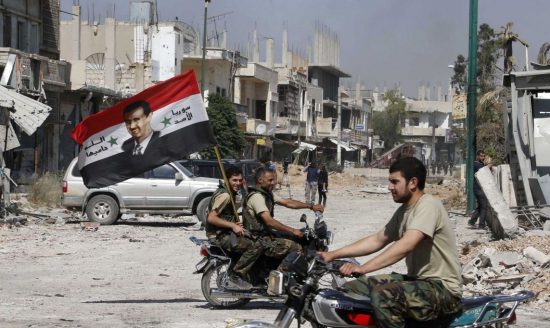
The situation in the Middle East is changing at an incredible speed. The things unbelievable yesterday, become reality today. Each of the events becomes part of a bigger picture, with the region gradually moving away from abyss to become a better place.
On March 1, Iraqi forces were reported to have taken control of the last major road out of western Mosul, preventing Islamic State (IS) militants from fleeing the city. The route leads to Tal Afar, another IS stronghold that is 40 km further west. They have since driven militants from the international airport, a military base, a power station and a number of residential areas. IS fighters began to flee. Total control over the city by Iraqi forces seems to be a matter of a few days, maybe hours.
Being almost defeated in Iraq, the IS has nowhere else to go but Syria – the country where they have just suffered a defeat, with Palmyra retaken by Syria’s government forces. Russia’s support has been crucial in the Syrian army’s push. Raqqa, the last remaining stronghold of the IS, will be the place of the final battle the extremist group is doomed to lose as many influential actors want it to be wiped away from the earth.
Turkey has announced its intent to launch an offensive to retake Raqqa but only after taking control of Manbij, the town held by the Kurds-dominated Syria Democratic Forces (SDF). The parties were in for a fight to benefit the IS and other terror groups. The US was at a loss as to how to prevent a clash between the NATO ally and the Kurds – the force it relies on in the fight against the IS. That’s when Moscow stepped in to avoid the worst, using its unique position as a mediator. It managed to do what nobody thought was possible. The military council in Manbij said on March 2 it will hand over areas west of the flashpoint town to Syrian government troops, after an agreement brokered by Russia.
Now the town is in Arab hands and Turkey has no reason to attack it. Syria and Turkey are not at war.
The United States had promised Turkey that Kurdish forces would withdraw from Manbij to the east of the Euphrates, but it never happened. Now Russia did what America had failed to do.
As a result of Russia’s effective mediation, Turkey can double down on its plans to advance to Raqqa, while Syria’s government has greatly strengthened its position. Turkey’s President Erdogan has just said he is ready to fight the IS together with Russia. He is coming to Moscow on March 9. It means no clash between Turkey and Syria will take place.
Many things are changing for the Syrian government and it has been going on for some time. It’s not a coincidence that voices get louder, calling for inviting Syrian President Assad to the March 29 Arab Summit in Amman – five years after Syria was expelled from the 22-member organization. Russia, Jordan and Egypt are applying efforts to reconcile the Arab community with the Syrian government. Last month, Egypt’s parliamentary committee for Arab affairs called for the return of Syria to the Arab League. This would signify the reconciliation between Saudi Arabia which backed the Syrian rebels – something unthinkable some time ago.
In 2015, then US President Obama predicted Russia would get stuck in Syria’s quagmire. He appears to have been wrong. Thanks to Russia’s involvement, one can see the light at the end of the tunnel to make the quagmire a thing of the past.
Moscow can facilitate the process of Iran joining with Arab states in the effort to reach agreement on Syria, bringing it to some mutual understanding with Saudi Arabia. Not much has been reported about some recent events of special significance. Iranian President Hassan Rouhani visited Kuwait and Oman on February 15. Saudi Arabian Foreign Minister Adel Al-Jubeir made a trip to Iraq on February 25, to be received by Iraqi Prime Minister Haider Al-Abadi. The trend is visible – Shia and Sunni are on speaking terms again and they are discussing something very important. It would have sounded incredible a short time ago but these are the facts.
All these events and emerging trends are taking place against the background of the ongoing UN-brokered Geneva talks on peaceful settlement in Syria. Here too we have an unexpected turn of events – the Syrian opposition seeks to meet with Russian officials!
According to Paul Vallely, a retired US Army Major General and senior military analyst for Fox News, Russia-US consultations on Syria are to start in two months after the presidents hold a summit. He said Russia is to play a key part in any scenario.
The recent days have literally shaken the Middle East. So many unexpected things happen to push things forward. Right in front of our eyes the impossible becomes possible.
As said before, Moscow is in a unique position to act as an intermediary and it plays its role aptly to achieve tangible results. If the current trend continues in the same direction, leading to the desired outcome, Russia’s effort will go down in history as an extraordinary achievement of military success combined with effective diplomacy.
Mass rally held in Sana’a against Saudi onslaught on Yemen
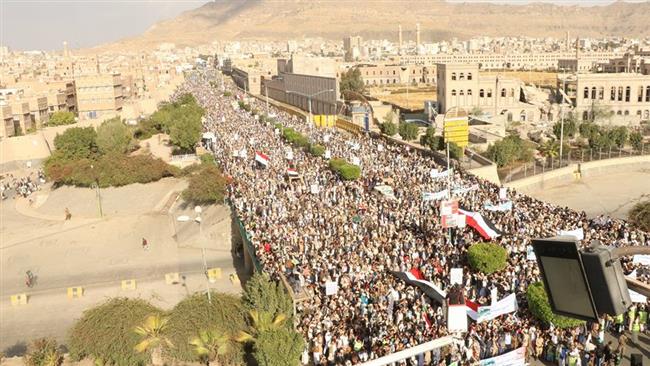
People take part in a demonstration in the Yemeni capital city of Sana’a on March 3, 2017 to denounce the Saudi military campaign against their country
Press TV – March 3, 2017
Tens of thousands of people have taken to the streets in the Yemeni capital city of Sana’a to express outrage over Saudi Arabia’s deadly military campaign against the impoverished Arab country.
The protesters converged in the Old City of Sana’a following Friday prayers, carrying Yemeni flags and banners in condemnation of the Saudi aggression.
Participants in the demonstration, under the motto “Tough against Disbelievers”, also held up pictures of civilians injured in the deadly Saudi airstrikes, calling on the United Nations to fulfill its responsibilities and stop the Riyadh regime’s atrocious military offensive.
They also warned the Saudi leadership that the continued attacks on the people in Yemen will only strengthen the steadfastness of the nation.
Protesters also accused the United States of being complicit in the Saudi crimes against the Yemeni nation by providing the Al Saud regime with various munitions.
Saudi Arabia has been engaged in a deadly campaign against Yemen since March 2015 in an attempt to reinstall the former president, Abd Rabbuh Mansur Hadi, who is a close Riyadh ally.
The airstrikes have taken a heavy toll on the impoverished country’s facilities and infrastructure, destroying many hospitals, schools, and factories.
The United Nations humanitarian coordinator for Yemen, Jamie McGoldrick, says the Saudi campaign has claimed the lives of 10,000 Yemenis and left 40,000 others wounded.
McGoldrick told reporters in Sana’a earlier this year that the figure was based on casualty counts given by health facilities and that the actual number might be higher.
On February 23, Yemen’s Legal Center for Rights and Development, an independent monitoring group, put the civilian death toll in the war-torn Arab country at 12,041.
The fatalities, it said, comprise 2,568 children and 1,870 women.
Pentagon conducts 20 airstrikes in Yemen, first since botched raid
Press TV – March 3, 2017
The Pentagon has carried out its first major military operation in Yemen since a botched raid in January that killed women and children as well as an American commando.
US forces conducted more than 20 airstrikes involving a mix of manned and unmanned aircraft early on Thursday, the Pentagon said.
Navy Captain Jeff Davis said the airstrikes targeted al-Qaeda in the Arabian Peninsula in three south-central provinces of Abyan, Shabwah and al-Bayda.
“The strikes will degrade the AQAP’s ability to coordinate external terror attacks and limit their ability to use territory seized from the legitimate government of Yemen as a safe space for terror plotting,” the Pentagon spokesman said.
The US military did not share a casualty estimate, but local officials said at least nine suspected al-Qaeda militants were killed.
Davis said the operation was coordinated with resigned president, Abd Rabbuh Mansur Hadi, a strong ally of Saudi Arabia that has been engaged in its own military campaign against Yemen.
Troops engage al-Qaeda on the ground
Military helicopters and drones launched a flurry of fresh airstrikes in Shabwah province early on Friday, witnesses said, according to Reuters.
The raids targeted the residence of Sa’ad Atef, an al-Qaeda leader, as well as other suspected militant positions in the area.
The unidentified aircraft, believed to be American, also deployed troops to the al-Saeed area of the southern province, who engaged suspected al-Qaeda militants on the ground for nearly half an hour.
The military operations came more than a month since a January 29 raid, the first of its kind authorized by President Donald Trump, in al-Bayda which residents said left as many as 25 civilians dead.
An ongoing investigation by the US Central Command has also determined that civilians, including possibly children, lost their lives during the botched raid.
The White House hailed the operation as a success, but critics said it was a failure since it resulted in the death of civilians and 36-year-old Navy SEAL Ryan Owens.
Three other Americans were also wounded in the Navy SEAL Team Six mission and a military aircraft worth $75 million was destroyed after it crash-landed at the raid site.
Trump blames generals for botched raid
President Trump has tried to distance himself from the raid by emphasizing that the operation had been in the works long before he took office. “This was a mission that was started before I got here,” he said in an interview with Fox News this week.
“This was something that, you know, they wanted to do. They came to see me and they explained what they wanted to do, the generals, who are very respected,” the president said. “And they lost Ryan.”
During his address to a joint session of Congress on Tuesday, Trump paid tribute to the fallen SEAL, and insisted that the operation yielded valuable intelligence that would “lead to many more victories in the future.”
Some US officials, however, have disputed that claim, saying the raid gathered little, if any, workable intelligence.
The United States conducts drone strikes in Yemen and several countries. Washington claims the airstrikes target members of al-Qaeda and other militants, but according to local officials and witnesses, civilians have been the victims of the attacks in many cases.
Al-Qaeda in Yemen has grown in weapons and number since the start of the Saudi military campaign in March 2015, which was launched to bring back Hadi to power and undermine the Houthi Ansarullah movement.
White House Cautioned Against Designating Iran’s IRGC a Terrorist Organization
By Stephen Lendman | February 26, 2017
In early February, unnamed US officials told Reuters the Trump administration might designate Iran’s Islamic Revolutionary Guard Corp (IRGC) a terrorist organization.
The White House didn’t respond to a request for comment. Iran categorically denies involvement in terrorism. No evidence suggests it, just baseless allegations.
Reports now indicate the proposed action stalled, US defense, state, and intelligence officials warning it could backfire, undermining Trump’s pledge to combat ISIS, along with complicating enforcement of the Iran nuclear deal.
US NATO allies are against it. The designation was supposed to be announced this month. It’s unclear if it’s suspended or cancelled altogether.
IRGC involvement is important in combating regional terrorism in Syria, Iraq and perhaps Yemen.
The administration’s proposal was part of a broader scheme to get tougher on Iran – instead of responsibly working to end 38 years of US-instigated adversarial relations.
If implemented, it would be the first move of this kind under the 1996 Foreign Terrorist Organizations law against a foreign government – meant for al-Qaeda and likeminded groups.
It would likely initiate tougher sanctions on Iran, possibly undermining the nuclear deal, sabotaging what took years to agree on.
Iranian Foreign Minister Mohammad Javad Zarif praised the IRGC’s efforts in combating terrorism, saying:
“The entire world admits that the IRGC has rendered the utmost support to (Iran’s) neighboring countries in the face of terrorism” – warning of adverse consequences if Trump orders more sanctions on Iran.
Reports indicate he intended to designate the ICRG and Egypt’s Muslim Brotherhood terrorist organization on Monday – during a visit to CENTCOM’s Tampa headquarters.
It’s believed Israel, Saudi Arabia and other Gulf states urged him to target Iran’s IRGC. It’s now on hold.
Stephen Lendman can be reached at lendmanstephen@sbcglobal.net. His new book is titled Flashpoint in Ukraine: How the US Drive for Hegemony Risks WW III.
British Foreign Policy and the UK Weapons Trade

By Matthew JAMISON | Strategic Culture Foundation | 24.02.2017
Back in the halcyon days of the election of the first Labour Government in Britain in over 18 years, the New Labour Foreign Secretary Robin Cook expounded a radical shift in British foreign policy making, declaring that the Labour Government of Tony Blair would put human rights at the heart of it’s foreign policy with an «ethical dimension». This was quickly christened by the British media as New Labour’s «ethical foreign policy». Questions were raised at the time how a country with such a large weapons export industry could conduct an ethical foreign policy and that question is as pertinent today as it was back in 1997. In his party conference speech, the first as British Foreign Secretary, Boris Johnson, paid ritual homage as many British Foreign Secretaries have before him, to his belief in human rights and reflected that: «After a long post-war period in which the world was broadly getting more peaceful the number of deaths in conflict has risen from 49,000 in 2010 to 167,000 last year».
Sadly, Britain has contributed to many of these deaths. According to a study carried out with official UK Government figures by the Independent newspaper, Britain is now the second largest exporter of arms around the world, and according to Freedom House since 2010 has sold weapons to 39 of the 51 countries ranked by Freedom House as «not free». What is even more disturbing is that out of the 30 countries ranked on the British Government’s own human rights watch list, the British Government authorizes the sale of weapons to 22 of those. Indeed, according to statistics from the UK Government’s own Trade and Investment body the UK has sold more weapons on average over the last ten years than Russia, China and France combined. All exports of British manufactured bombs, bullets, weapons and other munitions must be signed off and approved by UK Government Ministers with licenses granted.
Most of these arms are sold to Middle Eastern regimes, which have serious human rights issues, if one were to apply the standards the UK Government sets on human rights. In 2016 alone Britain sold over 3 billion pounds worth of weapons to Saudi Arabia. It is odd how the British Government which constantly lectures other countries on their human rights records can sell weapons of mass destruction to regimes like the Saudis who carry out routine be-headings and lashings of their own citizens as part of their penal code; subject women to severe restrictions such as forbidding them to drive; provide funding to Madrassas that indoctrinate and radicalise young Muslims in the ways of jihad etc. The list of human rights violations could go on. But the British Government, despite wrapping itself in the language of human rights, feels very comfortable within its own «ethical conscience» in allowing shipments of British manufactured BL-755 cluster munitions to be used by the Saudi Government in its war in Yemen. Unexploded remnants of cluster munitions have proved deadly for Yemenis, killing or injuring at least 85 civilians, including children.
Since March 2015, the UK Government has approved £3.3 billion in military sales to Saudi Arabia, yet in November, the UK Foreign and Commonwealth Office concluded, despite considerable evidence to the contrary, that there was no «clear risk» of serious Saudi breaches of international humanitarian law in Yemen. The British Government has continued to sell arms to Saudi Arabia despite the Saudi Government’s vastly different approach and record regarding human rights which is incompatible with the British Government’s professed commitment to «universal human rights» and the problems that emanate from Saudi Arabia regarding Islamist extremist terrorism and radicalisation such as the fact that fifteen of the nineteen 9/11 hijackers where from Saudi Arabia and the emerging information that certain sections of the Saudi Government may have been complicit in the funding and training of the 9/11 hijackers. Saudi Arabia is not the only regime that does not conform to the UK’s own professed beliefs and standards in human rights that the British supply dangerous and destructive weapons of death to.
The UK Government sells arms to Bahrain which has used British arms to quell internal dissent; Burundi, which is being investigated by the UN for human rights violations and The Maldives, which in 2015 jailed its former President, Mohamed Nasheed, for 13 years following what critics said was a politically motivated show trial. The UK Government has also authorised the sale of massive amounts of arms to Egypt despite the coup against the democratically elected President Mohammad Morsi and the violent crackdown on the Muslim Brotherhood that followed. The British Government approved licences for the sale of £7.7bn of arms in 2015 alone. Then there have been weapons scandals in the past involving the British Government and the UK arms industry. There was the shocking Arms-to-Iraq affair of the 1990s when it came to light that the British Government had endorsed and advised on the sale of arms by British companies to Iraq, then under the rule of Saddam Hussein. Ironically, some of these British made and exported weapons to Saddam Hussein’s Iraq had been used by the Iraqi regime during the first Gulf War of 1991.
All of this raises serious questions regarding how the British Government can profess to on the one hand be a force for human rights and run a foreign policy based on «universal human values», upholding democracy, human rights and the rule of law and yet on the other hand maintain a massive arms trade of deadly weapons around the world, arming regimes that are the exact opposite of what the British Government professes to believe in and defend when it comes to human rights. At the heart of the British Government’s position on «human rights» is hypocrisy when examined within context of UK arms sales. The British Government maintains a saintly image of itself and believes its own rhetoric that it is a great force for «universal human rights» around the world despite the contradictions in its policies and behaviour and that the British have higher standards and more noble beliefs than other cultures and countries when in reality this is not the truth. What the British Government hates above all else is to have its self-image shattered and exposed for the two-faced hypocrisy that it is. They are unable to effectively answer the inconsistencies and contradictions of their rhetorical image on the one hand and the reality of their behaviour, policies and practices on the other when confronted with reality. It is high time for the British Government, if is serious about its rhetoric on human rights, to scale back its domestic weapons export industry.
At US behest Turkey reboots Syrian war
By M K Bhadrakumar | Indian Punchline | February 23, 2017
Turkey has decided to pick up a quarrel with Iran. It all began with President Recep Erdogan’s sudden outburst on February 14 in the first leg of a regional tour of Gulf States – Bahrain, Saudi Arabia and Qatar — when he said, “Some people want both Iraq and Syria to be divided. There are some that are working hard to divide Iraq. There is a sectarian struggle, a Persian nationalism at work there. This Persian nationalism is trying to divide the country. We need to block this effort.”
Tehran hit back by accusing Turkey of supporting terrorist organizations “to destabilize neighbouring countries.” And there has been much back and forth in mutual recriminations since then. The spat makes a mockery of the “trilateral alliance” between Russia, Turkey and Iran that Moscow has been promoting at the recent Astana talks on Syria. The Russian Foreign Ministry had announced as recently as February 16 that Russia, Turkey and Iran have formed a tripartite operational group to stabilize the ceasefire in Syria. The most puzzling aspect is that this is happening just when the Syrian peace talks began in Geneva today under UN auspices.
But then, there is always a method in Erdogan’s madness. Succinctly put, Erdogan’s outburst reflects an overall frustration that Iran has greatly outstripped its traditional rival Turkey in expanding its influence in both Iraq and Syria. The Iranian militia played a big role in taking Aleppo city and vanquishing the rebel groups supported by Turkey.
Turkey had fancied that it would play a similar lead role in wresting control of Mosul from the hands of the ISIS. But to its great consternation and anger, Iran has wrested that role too. The latest reports show that Iraqi forces have stormed Mosul airport. Iraq (and Iran) opposed any role for Turkey in the liberation of Mosul.
Conceivably, with an eye on the new US administration’s reported plan to create an anti-Iran alliance in the region, Turkey is repositioning itself. There are several developments pointing in this direction. The US and Turkey have been holding a series of top-level meetings through the past fortnight since President Donald Trump made his first phone call with Turkish President Recep Erdogan on February 7. The American visitors to Ankara since then included CIA Director Mike Pompeo, Chairman of the Joint Chiefs of Staff General Joseph Dunford and US the senator who heads the Armed Services Committee John McCain.
Meanwhile, Erdogan has undertaken a tour of the GCC states, which aimed at harmonising the Turkish stance on Syria with that of Saudi Arabia and Qatar. (During Erdogan’s tour, Turkey and Saudi Arabia signed a defence agreement.) Ankara has noted that in the past fortnight there have been important visitors from the US to the Gulf region –CIA chief Pompeo, Senator John McCain and Defence Secretary James Mattis. Pompeo conferred on Saudi Crown Prince Mohammed bin Nayef bin Abdulaziz the CIA’s George Tenet Medal for his exceptional contributions in the fight against terrorism. It doesn’t take much ingenuity to figure out that the US is promoting a Saudi-Israeli alliance against Iran.
Equally, Ankara and Washington are edging toward a mutually satisfactory resolution of a discord that had set them apart in the recent past – the fate of Islamist preacher Fetullah Gulen who lives in exile in Pennsylvania. The Trump administration may act to curb Gulen’s activities, while Erdogan may no longer press for his outright extradition to Turkey.
However, one other contentious issue still remains unresolved – US military support for Syrian Kurds. This is a non-negotiable issue for Turkey, which considers the Syrian Kurdish militia to be an affiliate of the separatist Kurdish group PKK. Turkey and the US are actively discussing at the moment the modalities of a Turkish military operation aimed at liberating Raqqa, the ‘capital’ of the Islamic State. The Turkish Prime Minister Binaldi Yildirim discussed the Raqqa operation with the US Vice-President Mike Pence in the weekend at the Munich Security Conference. It will be a major military operation with tanks, armoured vehicles and artillery. Turkey seeks US Special Forces’ participation, which will also serve the purpose of deterring Russian intervention, apart from weakening the Syrian Kurds’ drive to create an entity in northern Syria.
Without doubt, the capture of Raqqa will be much more than a symbolic event. Raqqa determines how much of Syria will be under the control of the Syrian regime. Clearly, Erdogan hopes to project Turkish power right into Damascus and have a big say in Syria’s future. Yildirim sounded upbeat after meeting Pence. See a report in the pro-government Turkish daily Yeni Safak – PM Yildirim: Turkey, US turning over a new leaf.
Suffice to say, Erdogan seems confident that the Trump administration is viewing Ankara once again as a “strategic partner and a NATO ally” (as Trump indeed told him). Just another 5 days remain in the timeline given by the Trump administration to the Pentagon to prepare a comprehensive plan to defeat the Islamic State in Syria and Iraq. But Turkey is already acting as if it had a preview of the Pentagon plan.
A lengthy dispatch from Damascus by Xinhua underscores that Turkey’s journey back to its American ally also coincides with the “re-emergence of the Gulf states as the backers of the rebels” and with a growing probability of US putting boots on the ground in Syria — all in all a “remilitarization” of the Syrian conflict. Read the insightful report titled Spotlight: Gloomy outlook shadows Syrian talks in Geneva.
The West’s Moral Hypocrisy on Yemen
By Jonathan Marshall | Consortium News | February 21, 2017
Only a few months ago, interventionists were demanding a militant response by Washington to what George Soros branded “a humanitarian catastrophe of historic proportions” — the killing of “hundreds of people” by Russian and Syrian government bombing of rebel-held neighborhoods in the city of Aleppo.
Leon Wieseltier, a senior fellow at the Brookings Institution and former New Republic editor, was denouncing the Obama administration as “a bystander to the greatest atrocity of our time,” asserting that its failure to “act against evil in Aleppo” was like tolerating “the evil in Auschwitz.”
How strange, then, that so many of the same “humanitarian” voices have been so quiet of late about the continued killing of many more innocent people in Yemen, where tens of thousands of civilians have died and 12 million people face famine. More than a thousand children die each week from preventable diseases related to malnutrition and systematic attacks on the country’s food infrastructure by a Saudi-led military coalition, which aims to impose a regime friendly to Riyadh over the whole country.
“The U.S. silence has been deafening,” said Philippe Bolopion, deputy director for global advocacy at Human Rights Watch, last summer. “This blatant double standard deeply undermines U.S. efforts to address human rights violations whether in Syria or elsewhere in the world.”
Official acquiescence — or worse — from Washington and other major capitals is encouraging the relentless killing of Yemen’s civilians by warplanes from Saudi Arabia and its allies. Last week, their bombs struck a funeral gathering north of Sanaa, Yemen’s capital, killing nine women and a child and injuring several dozen more people.
A day earlier, officials reported a deadly “double-tap” airstrike, first targeting women at a funeral in Sanaa, then aimed at medical responders who rushed in to save the wounded. A United Nations panel of experts condemned a similar double-tap attack by Saudi coalition forces in October, which killed or wounded hundreds of civilians, as a violation of international law.
The Tragedy of Mokha
On Feb. 12, an air strike on the Red Sea port city of Mokha killed all six members of a family headed by the director of a maternal and childhood center. Coalition ground forces had launched an attack on Mokha two weeks earlier.
Xinhua news agency reported, “the battles have since intensified and trapped thousands of civilian residents in the city, as well as hampered the humanitarian operation to import vital food and fuel supplies . . . The Geneva-based UN human rights office said that it received extremely worrying reports suggesting civilians and civilian objects have been targeted over the past two weeks in the southwestern port city . . . Reports received by UN also show that more than 200 houses have been either partially damaged or completely destroyed by air strikes in the past two weeks.”
The U.N.’s humanitarian coordinator further reported that “scores of civilians” had been killed or wounded by the bombing and shelling of Mokha, and that residents were stranded without water or other basic life-supporting services.
That could be Aleppo, minus only the tear-jerking photos of dead and wounded children on American television. However, unlike Syria, Yemen’s rebels don’t have well-financed public relations offices in Western capitals. They pay no lip service to the United States, democracy, or international human rights. Their foe Saudi Arabia is a friend of Washington, not a long-time adversary. In consequence, few American pundits summon any moral outrage at the Saudi-led coalition, despite findings by a United National Panel of Experts that many of its airstrikes violate international law and, in some cases, represent “war crimes.”
Aiding and Abetting
The United States hasn’t simply turned a blind eye to such crimes; it has aided them by selling Saudi Arabia the warplanes it flies and the munitions it drops on Yemeni civilians. It has also siphoned 54 million pounds of jet fuel from U.S. tanker planes to refuel coalition aircraft on bombing runs. The pace of U.S. refueling operations has reportedly increased sharply in the last year.
The Obama administration initially supported the Saudi coalition in order to buy Riyadh’s reluctant support for the Iran nuclear deal. Over time, Saudi Arabia joined with anti-Iran hawks to portray Yemen’s rebels as pawns of Tehran to justify continued support for the war. Most experts — including U.S. intelligence officials — insist to the contrary that the rebels are a genuinely indigenous force that enjoys limited Iranian support at best.
As I have documented previously, all of the fighting in Yemen has damaged U.S. interests by creating anarchy conducive to the growth of Al Qaeda extremists. They have planned or inspired major acts of terrorism against the West, including an attempt to blow up a U.S. passenger plane in 2009 and a deadly attack on the Parisian newspaper Charlie Hebdo in January 2015. The Saudis tolerate them as Sunni allies against the rebels, in the name of curbing Iran.
Though the Obama administration is gone, the Trump administration is flush with ideologues who are eager to take a stand against Tehran through Yemen and look tough on “terrorism.” Within days of taking office, President Trump approved a commando raid targeting an alleged Al Qaeda compound in central Yemen that went awry, killing an estimated 10 women and children. The administration has also diverted a U.S. destroyer to patrol Yemen’s coast.
Secretary of State Rex Tillerson, to his credit, has cited “the urgent need for the unfettered delivery of humanitarian assistance throughout Yemen,” according to a department spokesman. But no amount of humanitarian aid will save Yemen’s tormented people from the bombs made in America and dropped from U.S.-made warplanes, with little protest from Washington’s so-called “humanitarian interventionists.”
Saudi arms imports triple amid Yemen campaign, US & Europe top suppliers to Mid East – report
RT | February 20, 2017
Saudi Arabia, which is leading a military intervention in Yemen, is the world’s second-largest arms importer, according to a new report. Riyadh’s arms imports increased 212 percent compared with 2007–11, with the US remaining the world’s top weapons exporter.
Between 2007–2011 and 2012–2016 arms imports by states in the Middle East rose by 86 percent, the Stockholm International Peace Research Institute (SIPRI) said on Monday.
India was the world’s largest importer of major arms in 2012–2016, accounting for 13 percent of the global total, the study said.
“Over the past five years, most states in the Middle East have turned primarily to the USA and Europe in their accelerated pursuit of advanced military capabilities,” Pieter Wezeman, senior researcher with the SIPRI Arms and Military Expenditure Program, said.
“Despite low oil prices, countries in the region continued to order more weapons in 2016, perceiving them as crucial tools for dealing with conflicts and regional tensions,” he added.
With a one-third share of global arms exports, the USA was the top arms exporter in 2012– 16. Its arms exports increased by 21 percent compared with 2007–2011.
Almost half of US arms exports went to the Middle East, SIPRI said, adding that arms imports by Qatar went up by 245 percent.
“The USA supplies major arms to at least 100 countries around the world—significantly more than any other supplier state,” Dr. Aude Fleurant, director of the SIPRI Arms and Military Expenditure Program, said.
“Both advanced strike aircraft with cruise missiles and other precision-guided munitions and the latest generation air and missile defense systems account for a significant share of US arms exports.”
Saudi Arabia’s defense expenditure grew by 5.7 percent to $87.2 billion in 2015, making it the world’s third-largest spender at the time, according to a SIPRI report from April.
During Barack Obama’s two terms as president, the US offered Saudi Arabia $115 billion worth of arms in 42 separate deals, the Center for International Policy, a US-based anti-war think tank reported in September. It estimated that US arms offers to Saudi Arabia were more than any US administration in the history of the US-Saudi relationship.
In December, the White House blocked the transfer of some weaponry to Saudi Arabia, over concerns about the civilian death toll from the kingdom’s bombing campaign in Yemen.
“We have made clear that US security cooperation is not a blank check,” a senior administration official told AFP. “Consequently, we have decided to not move forward with some foreign military sales (FMS) cases for munitions.”
“This reflects our continued, strong concerns with the flaws in the coalition’s targeting practices and overall prosecution of the air campaign in Yemen,” he added.
Gareth Porter, an investigative journalist, told RT earlier in February that “the Obama administration has been essentially tied to the Saudi interests in Yemen, as they have been in Syria to a great extent of the past by the degree to which the permanent government in the US – the Pentagon, the CIA, the NSA – all have very, very close relations with their counterparts in Saudi Arabia.
“These war powers in the US are very unwilling to have any US policy that would criticize, much less take away, support for the Saudi war so that these arrangements can continue. I am very much afraid that the Trump administration will be subject to the same logic, the same political forces that have kept the Obama administration from taking any responsibility for what is going on in Yemen,” he said.
The death toll in the Yemeni conflict has surpassed 10,000 people, and almost 40,000 people have been wounded, a senior UN official said in January.
The British government refused to stop selling arms to Saudi Arabia in November, rejecting calls from two parliamentary committees and human rights groups. According to Campaign Against the Arms Trade (CAAT), Britain licensed £3.3 billion (US$4.1 billion) of arms sales to Riyadh during the first 12 months of the Yemen war.
Human Rights Watch (HRW) reported in October that since the start of the Saudi-led air campaign in Yemen, which began on March 26, 2015, the Saudi coalition, “with direct military support from the US and assistance from the UK,” conducted at least 58 “unlawful airstrikes,” with other human rights organizations and the UN having “documented dozens more.”
Since the beginning of the conflict, there have been multiple reports of Saudi jets targeting schools, hospitals, marketplaces and other civilian buildings.
Airstrikes carried out by the Saudi-led coalition of nine Arab states in Yemen are responsible for the majority of civilians killed in the ongoing conflict, the UN found in August, while calling for an international investigation into the coalition’s violations there.
Featured Video
John Mearsheimer: The Case for a Nuclear Iran
or go to
Aletho News Archives – Video-Images
From the Archives
Ethnic Cleansing in a Zionist Fairyland
By Vacy Vlazna | Palestine Chronicle | February 10, 2012
‘De-Arabizing the history of Palestine is another crucial element of the ethnic cleansing. 1500 years of Arab and Muslim rule and culture in Palestine are trivialized, evidence of its existence is being destroyed and all this is done to make the absurd connection between the ancient Hebrew civilization and today’s Israel. The most glaring example of this today is in Silwan, (Wadi Hilwe) a town adjacent to the Old City of Jerusalem with some 50,000 residents. Israel is expelling families from Silwan and destroying their homes because it claims that king David built a city there some 3000 years ago. Thousands of families will be made homeless so that Israel can build a park to commemorate a king that may or may not have lived 3000 years ago. Not a shred of historical evidence exists that can prove King David ever lived yet Palestinian men, women, children and the elderly along with their schools and mosques, churches and ancient cemeteries and any evidence of their existence must be destroyed and then denied so that Zionist claims to exclusive rights to the land may be substantiated.’ — Miko Peled, Israeli dissident.
Indeed, archaeology has become a state apparatus for the ethnic cleansing of Palestinians in the Zionist fairyland aka the City of David Archaeological Park located in the Palestinian village of Silwan in East Jerusalem.
East Jerusalem is the proclaimed capital of the proposed Palestine state. It was illegally annexed by Israel in the 1967 war. Prohibiting annexation of territories gained by military conquest is one of the major principles of international law. The international community does not recognise Israel’s annexation of East Jerusalem nevertheless over 50,000 illegal premises have been built for 250,000 illegal Israeli colonists.
The goal of the archaeological judaisation of Jerusalem is to transform Jerusalem into the City of David, the capital of Greater Israel by eradicating the mixed ethnic composition of the Palestinian and Jewish population of East Jerusalem to a solely Jewish identity and unifying East and West Jerusalem under Israeli sovereignty. … continue
Blog Roll
 Aletho News
- Iraqi Resistance warns of action if US forces remain
- China, Russia slam US threat, force against Iran ahead of talks
- US fears Iran war will ‘deplete’ air defenses stretched thin by Ukraine, Israel: Report
- Top AIs deploy nukes in 95% of war game simulations – study
- Could Hungary’s fight over oil change course of Ukraine War?
- North Korea Open to Rapprochement If US Respects Its Nuclear Status – Kim Jong-un
- John Mearsheimer: The Case for a Nuclear Iran
- The Founder Who Turned Against Root Canals
- Israel displaces last two families from Al Khalayel valley, Al Mughayyir
- Israeli Opposition Leader Endorses Greater Israel
- If Americans Knew
- Israel responsible for 2/3 of press killings worldwide – Not a ceasefire Day 139
- Are the Jews indigenous to Palestine?
- AIPAC Wants to Kill a Bill that would Ensure Israel Complies with Ceasefire
- Former Israeli PM, in Epstein Files, Dreamed of Israeli Eugenics and Pretty Converts
- Israeli settlers join ‘safari’ tour of Palestinian prisoners
- Flooding in Gaza amid rumors of war; fire in West Bank – Not a ceasefire Day 138
- Fourteen Countries Condemn Huckabee’s Support for Israel Taking Over Most of the Middle East
- Israeli Soldiers Killed Gaza Aid Workers at Point Blank Range in 2025 Massacre: Report
- Israel’s insidious network to propagandize American Christians
- Israel’s Best-Kept Secret: Palestinian Resistance Never Agreed to Disarm
- No Tricks Zone
- Surprising Discovery: Sahara Is Greening…Billions Of Trees Where Once Thought To Be Barren
- New Research Reaffirms Clouds, Aerosols, And Surface Solar Radiation Are ‘Driving The Climate System’
- Germany: Electric Car Catches Fire At Charging Station, Sets Off Local “Inferno”, Widespread Damage
- New Study: Canada’s New Brunswick Was 1°C Warmer Than Today During The Medieval Warm Period
- Coal Power Back In Trend As Globe Tries To Keep Pace With Growing Demand For Power
- New Study: A 4°C Warmer Beaufort Sea Had ‘No Sea Ice’ 11,700 – 8200 Years Ago
- Unfudging The Data: Dutch Meteorological Institute Reinstates Early 20th Centruy Heat Waves It Had Erased Earlier
- German Gas Crisis…Chancellor Merz Allegedly Bans Gas Debate Ahead of Elections!
- Pollen Reconstructions Show The Last Glacial’s Warming Events Were Global, 10x Greater Than Modern
- Germany’s Natural Gas Storage Level Dwindles To Just 28%… Increasingly Critical
 Aletho News