The Possible Education of Donald Trump
By Robert Parry | Consortium News | August 25, 2017
Despite the chaos and ugliness of the past seven months, President Trump has finally begun to turn U.S. foreign policy away from the neoconservative approach of endless war against an ever-expanding roster of enemies.
This change has occurred largely behind the scenes and has been obscured by Trump’s own bellicose language, such as his vow to “win” in Afghanistan, and his occasional lashing out with violence, such as his lethal Tomahawk missile strike on a Syrian airfield.
Some Trump advisers also have downplayed the current shift because it may fuel the Democrats’ obsession with Russia-gate as a much-desired excuse to impeach Trump. Every peaceful move that Trump makes is called a sop to Russia and thus an excuse to reprise the dubious allegations about Russia somehow helping to elect him.
Yet, despite these external obstacles and Trump’s own erratic behavior, he has remained open to unconventional alternatives to what President Obama once criticized as the Washington “playbook,” i.e. favoring military solutions to international problems.
In this sense, Trump’s shallow understanding of the world has been a partial benefit in that he is not locked into the usual Washington groupthinks – and he personally despises the prominent politicians and news executives who have sought to neuter him since his election. But his ignorance also prevents him from seeing how global crises often intersect and thus stops him from developing a cohesive or coherent doctrine.
Though little noted, arguably the most important foreign policy decision of Trump’s presidency was his termination of the CIA’s covert support for Syrian rebels and his cooperation with Russian President Vladimir Putin to expand partial ceasefire zones in Syria.
By these actions, Trump has contributed to a sharp drop-off in the Syrian bloodshed. It now appears that the relatively secular Syrian government of President Bashar al-Assad is regaining control and that some Syrian refugees are returning to their homes. Syria is starting the difficult job of rebuilding shattered cities, such as Aleppo.
But Trump’s aversion to any new military adventures in Syria is being tested again by Israeli Prime Minister Benjamin Netanyahu, who is threatening to attack Iranian and Hezbollah forces inside Syria.
Last week, according to Israeli press reports, a high-level delegation led by Mossad chief Yossi Cohen carried Netanyahu’s threat to the U.S. government. The Israeli leader surely has raised the same point directly in phone calls with Trump.
Tiring of Bibi
I was told that Trump, who appears to be growing weary of Netanyahu’s frequent demands and threats, flatly objected to an Israeli attack and brushed aside Israel’s alarm by noting that Netanyahu’s policies in supporting the rebels in Syria contributed to Israel’s current predicament by drawing in Iran and Hezbollah.
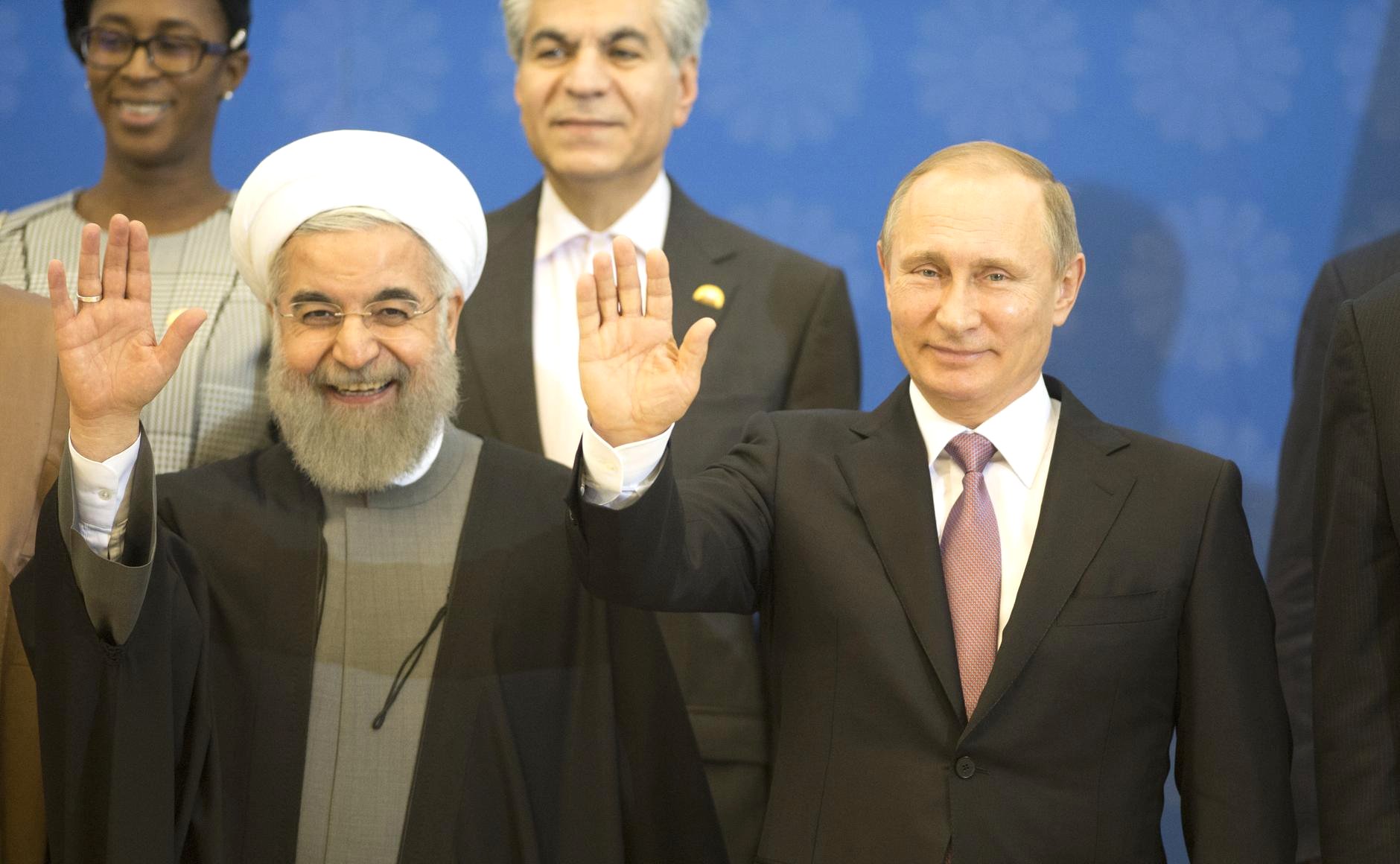
This week, Netanyahu personally traveled to Sochi, Russia, to confront Putin with the same blunt warning about Israel’s intention to attack targets inside Syria if Iran does not remove its forces.
A source familiar with the meeting told me that Putin responded with a sarcastic “good luck!” and that the Russians thought the swaggering Netanyahu appeared “unhinged.”
Still, a major Israeli attack on Iranian positions inside Syria would test Trump’s political toughness, since he would come under enormous pressure from Congress and the mainstream news media to intervene on Israel’s behalf. Indeed, realistically, Netanyahu must be counting on his ability to drag Trump into the conflict since Israel could not alone handle a potential Russian counterstrike.
But Netanyahu may be on somewhat thin ice since Trump apparently blames Israel’s top American supporters, the neocons, for much of his political troubles. They opposed him in the Republican primaries, tilted toward Hillary Clinton in the general election, and have pushed the Russia-gate affair to weaken him.
President Obama faced similar political pressures to fall in line behind Israel’s regional interests. That’s why Obama authorized the covert CIA program in Syria and other aid to the rebels though he was never an enthusiastic supporter – and also grew sick and tired of Netanyahu’s endless hectoring.
Obama acquiesced to the demands of Official Washington’s neocons and his own administration’s hawks – the likes of Secretary of State Hillary Clinton, CIA Director David Petraeus, his successor John Brennan, and United Nations Ambassador Samantha Power.
The Syrian conflict was part of a broader strategy favored by Washington’s neocons to overthrow or cripple regimes that were deemed troublesome to Israel. Originally, the neocons had envisioned removing the Assad dynasty soon after the invasion of Iraq in 2003, with Iran also on the “regime change” menu. But the disastrous Iraq War threw off the neocons’ timetable.
‘Regime Change’ Chaos
The Democratic Party’s liberal interventionists, who are closely allied with the Republican neocons, also tossed in Libya with the overthrow and murder of Libyan leader Muammar Gaddafi in 2011. Then, weapons from Gaddafi’s stockpiles were shipped to Syria where they strengthened rebel fighters allied with Al Qaeda’s Nusra Front and other Islamist groups.
Faced with this troubling reality – that the U.S.-backed “moderate rebels” were operating side by side with Al Qaeda’s Syrian affiliate and its allies – Washington’s neocons/liberal-hawks responded with sophisticated propaganda and devised clever talking points to justify what amounted to indirect assistance to terrorists.
The “regime change” advocates portrayed a black-and-white situation in Syria with Assad’s side wearing the black hats and various anti-Assad “activists” wearing the white hats (or literally White Helmets). The State Department and a complicit mainstream media disseminated horror stories about Assad and – when the reality about Al Qaeda’s role could no longer be hidden – that was spun in the rebels’ favor, too, by labeling Assad “a magnet for terrorists” (or later in cahoots with the Islamic State). For years, such arguments were much beloved in Official Washington.
But the human consequences of the Syrian conflict and other U.S.-driven “regime change” wars were horrific, spreading death and destruction across the already volatile Middle East and driving desperate refugees into Europe, where their presence provoked political instability.
By fall 2015, rebel advances in Syria – aided by a supply of powerful U.S. anti-tank missiles – forced Russia’s hand with Putin accepting Assad’s invitation to deploy Russian air power in support of the Syrian army and Iranian and Hezbollah militias. The course of the war soon turned to Assad’s advantage.
It’s unclear what Hillary Clinton might have done if she had won the White House in November 2016. Along with much of the U.S. foreign policy establishment, she called repeatedly for imposing a “no-fly zone” in Syria to stop operations by the Syrian air force and Russia, a move that could have escalated the conflict into World War III.
But Trump – lacking Official Washington’s “sophistication” – couldn’t understand how eliminating Assad, who was leading the fight against the terrorist groups, would contribute to their eventual defeat. Trump also looked at the failure of similar arguments in Iraq and Libya, where “regime change” produced more chaos and generated more terrorism.
Pandering to Saudis/Israelis
However, in the early days of his presidency, the unsophisticated Trump lurched from one Middle East approach to another, initially following his son-in-law Jared Kushner’s grandiose thinking about recruiting Saudi Arabia to an “outside-in” strategy to settle the Israel-Palestine conflict, i.e., enlisting the Saudis to pressure the Palestinians into, more or less, letting Israel dictate a solution.
Kushner’s “outside-in” scheme was symbolically acted out with Trump making his first overseas visit to Saudi Arabia and then to Israel in May. But I’m told that Trump eventually cooled to Kushner’s thinking and has come to see the Israeli-Saudi tandem as part of the region’s troubles, especially what he views as Saudi Arabia’s longstanding support for Al Qaeda and other terror groups.
Perhaps most significantly in that regard, Trump in July quietly abandoned the CIA’s covert war in Syria. In the U.S., some “regime change” advocates have complained about this “betrayal” of the rebel cause and some Democrats have tried to link Trump’s decision to their faltering Russia-gate “scandal,” i.e., by claiming that Trump was rewarding Putin for alleged election help.
But the bottom line is that Trump’s policy has contributed to the Syrian slaughter abating and the prospect of a victory by Al Qaeda and/or its Islamic State spinoff fading.
So, there has been a gradual education of Donald Trump, interrupted occasionally by his volatile temper and his succumbing to political pressure, such as when he rushed to judgment on April 4 and blamed the Syrian government for a chemical incident in the remote Al Qaeda-controlled village of Khan Sheikhoun.
Despite strong doubts in the U.S. intelligence community about Syria’s guilt – some evidence suggested one more staged “atrocity” by the rebels and their supporters – Trump on April 6 ordered 59 Tomahawk missiles fired at a Syrian air base, reportedly killing several soldiers and some civilians, including four children.
Trump boasted about his decision, contrasting it with Obama’s alleged wimpiness. And, naturally, Official Washington and the U.S. mainstream media not only accepted the claim of Syrian government guilt but praised Trump for pulling the trigger. Later, Hillary Clinton said if she were president, she would have been inclined to go further militarily by intervening with her “no-fly zone.”
As reckless and brutal as Trump’s missile strike was, it did provide him some cover for his July 7 meeting with Putin at the G-20 summit in Germany, which focused heavily on Syria, and also for his decision to pull the plug on the CIA’s covert war.
Saudi-backed Terror
I’m told Trump also has returned to his pre-election attitude about Saudi Arabia as a leading supporter of terror groups and a key provocateur in the region’s disorders, particularly because of its rivalry with Iran, a factor in both the Syrian and Yemeni wars.
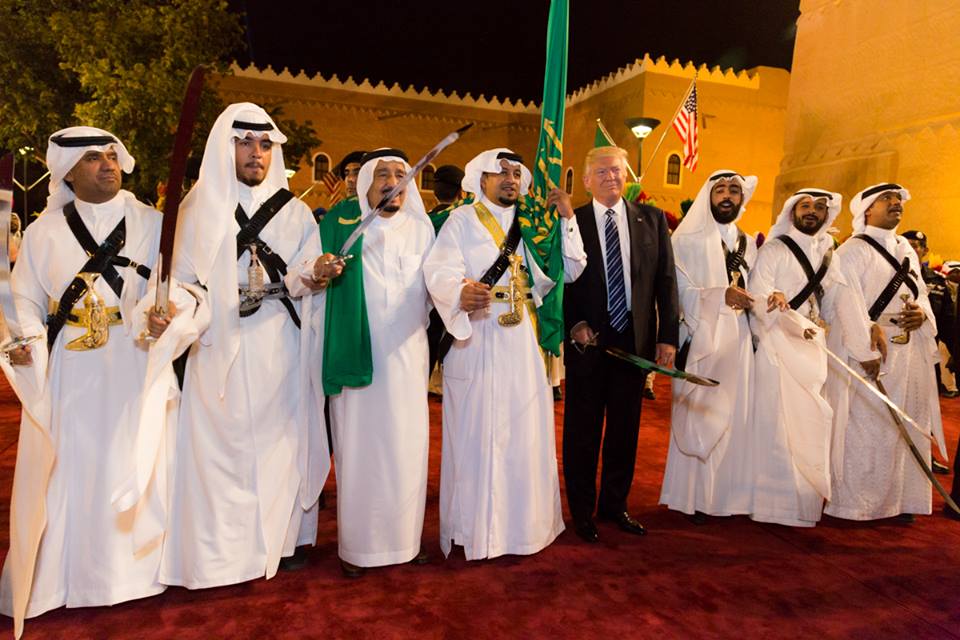
(Official White House Photo by Shealah Craighead)
Though Trump has recited Washington’s bipartisan (and benighted) mantra about Iran being the principal sponsor of terrorism, he appears to be moving toward a more honest view, recognizing the falsity of the neocon-driven propaganda about Iran.
Trump’s new coolness toward Saudi Arabia may have contributed to the recent warming of relations between the Sunnis of Saudi Arabia and the Shiites of Iran, a sectarian conflict dating back 1,400 years. In a surprising move announced this week, the two countries plan an exchange of diplomatic visits.
Even in areas where Trump has engaged in reckless rhetoric, such as his “fire and fury” warning to North Korea, his behind-the-scenes policy appears more open to compromise and even accommodation. In the past week or so, the tensions with North Korea have eased amid backchannel outreach that may include the provision of food as an incentive for Pyongyang to halt its missile development and even open political talks with South Korea, according to a source close to these developments.
On Afghanistan, too, Trump may be playing a double game, giving a hawkish speech on Monday seeming to endorse an open-ended commitment to the near-16-year-old conflict, while quietly signaling a willingness to negotiate a political settlement with the Taliban.
One alternative might be to accept a coalition government, involving the Taliban, with a U.S. withdrawal to a military base near enough to launch counterterrorism strikes if Al Qaeda or other international terror groups again locate in Afghanistan [likely an air base from which to threaten Iran – Aletho News ].
Many of Trump’s latest foreign policy initiatives reflect former White House strategist Steve Bannon’s hostility toward neoconservative interventionism. Secretary of State Rex Tillerson, the former Exxon-Mobil chief executive, also shares a more pragmatic approach to foreign affairs than some of his more ideological predecessors.
Albeit still in their infancy, these policies represent a new realism in U.S. foreign policy that, in many ways, paralleled what President Obama favored but was often unwilling or unable to see through to its logical conclusions, given his fear of Netanyahu and the power of the neocons and their liberal-hawk allies.
Still, some of Obama’s most important decisions – not to launch a major military strike against Syria in August 2013 and to negotiate an agreement with Iran to constrain its nuclear program in 2013-15 – followed a similar path away from war, thus drawing condemnation from the Israeli-Saudi tandem and American neocons.
As a Republican who rose politically by pandering to the GOP “base” and its hatred of Obama, Trump rhetorically attacked Obama on both Syria and Iran, but may now be shifting toward similar positions. Gradually, Trump has come to recognize that the neocons and his other political enemies are trying to hobble and humiliate him – and ultimately to remove him from office.
The question is whether Trump’s instinct for survival finally will lead him to policies that blunt his enemies’ strategies or will cause him to succumb to their demands.
Investigative reporter Robert Parry broke many of the Iran-Contra stories for The Associated Press and Newsweek in the 1980s.
British universities should be more discerning about their choice of benefactors
By Alastair Sloan | MEMO | August 25, 2017
Just over eighteen months ago, environmental campaigners in Britain received some surprising news. They had been working for three years to get the Tate Gallery in London to reveal how much money oil giant BP had given it between 1990 and 2011. The figure turned out to be relatively small, ranging from £150,000 to £330,000 per year. Although this was a good chunk of the gallery’s income in the nineties, this soon equated to less than one per cent of the Tate group’s funding between 2000 and 2006. The sponsorship deal continued for another ten years, alongside similar BP sponsorships of the British Museum, the Royal Opera House and the National Portrait Gallery. Across all of these organisations, the oil company likewise contributed less than one per cent of funding to each one. The oft-heard argument that the struggling arts sector would go under were it not for this kind of funding from not-very-nice corporations was clearly bunkum. If anything, these institutions were willing collaborators in corporate whitewashing.
The same could be said of Gulf funds for British universities. Middle East Studies departments whisper about the necessity of funding from countries like the United Arab Emirates, Saudi Arabia and Qatar, because budgets are falling. A close look at the finances of the University of Exeter reveals something else, though; the issue of donations from alumnus Sheikh Dr Sultan Bin Muhammad Al-Qasimi of Sharjah were raised recently by the International Campaign for Freedom in the United Arab Emirates.
According to the Telegraph, the ruler of Sharjah – one of the most conservative Emirates in the UAE — has given more than £8 million to Exeter University over two decades (roughly the same time period that the Tate was receiving money from BP). A breakdown of when these donations were made is not available, but government grants and tuition fees in 1999 (the earliest data that I have been able to find) amounted to £52 million. The equivalent figure today is £250 million, around three times the original government and student fees funding even when adjusted for inflation. Much of this has come from the introduction of hugely expensive tuition fees for students.
In 2008, the nephew of the late King Abdullah of Saudi Arabia gave £8 million to Cambridge University to build its “Prince Alwaleed Bin Talal Centre of Islamic Studies”. The same year, Cambridge University’s annual report shows that income from government grants and tuition fees had risen from £251 million to £279 million. Cambridge made £174 million from its publishing house, more than £20 million more than in 2007. Even its “examination and assessment services” had seen income go up from £193 million to £216 million. All these increases led to the university almost doubling its surplus for the year, to £42 million. Yet that same year, it also accepted £8 million from a state known for its appalling human rights record, all the while knowing full well that the university coffers were overflowing.
After 2008, of course, there was the recession, so perhaps last year’s £3 million donation from the Qatar Development Fund towards Somerville College, Oxford, was justified? Think again. Somerville College itself was certainly on track to suffer a £3 million reduction in donations had the Qatar money not arrived, and had just borrowed huge amounts to extend its buildings, but Oxford University generally was doing well. In 2010, its income had risen since the previous year by nearly five per cent, to £920 million. By 2015, that figure was up to £1.3 billion, with surpluses of nearly £400 million sat in university bank accounts. Oxford doesn’t include in its numbers, as Cambridge does, its significantly profitable publishing business, which was on hand to top up coffers when they are running low.
In the UAE, we only have to go back to March to find that a prominent academic was jailed for ten years. His crime? He used Twitter. The country has imposed travel restrictions on visiting academics from Georgetown University, the London School of Economics and New York University, as well as prosecuting other university professionals. In January, the UAE government detained Abdulkhaleq Abdulla for ten days without charge after the prominent Emirati academic and vocal supporter, not critic, of the government posted a tweet that praised the UAE as the “Emirates of tolerance” but bemoaned the authorities’ lack of respect for freedom of expression and political liberties. Abdulla was an adviser to Mohammed Bin Zayed, the Crown Prince of Abu Dhabi, and a retired professor of political science at the University of the UAE. Similar situations abound in Saudi Arabia, and academic freedoms are only marginally better in Qatar.
So British universities are well off. They don’t need money from abroad, but they are opting to take it in any case, and who they are choosing to take it from isn’t encouraging. This devalues British academia and spits in the face of academics and others calling for change who are imprisoned in those donor countries for their pains. Universities should be campaigning to have tuition fees removed, be more inventive about how they make money, and stop plastering the names of Middle East dictators across their walls. They need to be much more discerning in their choice of benefactors. It’s too late to do this today, but tomorrow will do very nicely.
US, Saudi Ask Syria Opposition to Accept Assad’s Political Role: Report
Al-Manar | August 25, 2017
US and Saudi diplomats have reportedly been urging the armed Syrian opposition to come to terms with President Bashar al-Assad’s role in Syria’s future, a report said, indicating to the major policy U-turn in the western stance from the Syrian crisis.
In an article published on Thursday, the Associated Press said the Syrian army holds the upper hand on the battlefield against militant groups, pointing to the major shift in the strategies of Western and regional supporters of Syrian opposition groups and militants with regard to the developments in Syria.
“Western and regional rebel patrons, currently more focused on advancing their own interests rather than accomplishing regime change in Damascus, are shifting their alliances and have ceased calls on Assad to step down,” the report said.
Former US ambassador to Syria, Robert Ford, who is widely considered as Washington’s civil war engineer in different parts of the world and a key instigator of the Syrian conflict in 2011, has ruled out the likelihood of Assad’s removal, saying, “There is no conceivable military alignment that is going to be able to remove him.”
“Everyone, including the US, has recognized that Assad is staying,” said Ford, who is currently a fellow at the Middle East Institute in Washington, D.C.
According to an interlocutor, who mediates between the opposition and state capitals and requested anonymity, Saudi Foreign Minister Adel al-Jubeir told the opposition it was time to formulate “a new vision.”
“He did not explicitly say Bashar [Assad] is going to stay, but if you read between the lines, if you say there needs to be a new vision, what is the most contentious issue out there? It is whether Bashar stays,” said the interlocutor, according to the article.
Iran, Saudi to Exchange Diplomatic Visits

Al-Manar | August 24, 2017
Iran and Saudi Arabia will soon exchange diplomatic visits, Tehran said, in a possible sign of tensions easing after the arch rivals cut ties last year.
Iranian Foreign Minister Mohammad Javad Zarif told local media the visits would take place after this year’s hajj pilgrimage to Mecca in Saudi Arabia, which is due to start at the beginning of September.
“Visas have been delivered for the two sides. The final steps need to be completed so our diplomats can go inspect our embassy and consulate in Saudi Arabia and for Saudi diplomats to come inspect their embassy and consulate,” Zarif told news agency ISNA.
Zarif urged Riyadh to reconsider its foreign policy.
“Saudi Arabia’s behavior goes against its own interests. We want security and stability throughout the region and insist on the need to fight against the dangers that threaten us all,” he said.
“Saudi Arabia has not benefited from two years of war and horrific acts against the Yemeni people, on the contrary,” he said. “It’s the same in Syria or in Bahrain. We hope they will choose another path.”
Israel’s Alarm over Syrian Debacle
By Daniel Lazare | Consortium News | August 22, 2017
There’s a rumor going around that the Syrian civil war is finally winding down and that the Baathist government is nearing its goal of driving out thousands of ISIS-Al Qaeda head-choppers financed and supplied – directly or indirectly – by the U.S., Turkey, Saudi Arabia, and the other Persian Gulf oil monarchies.
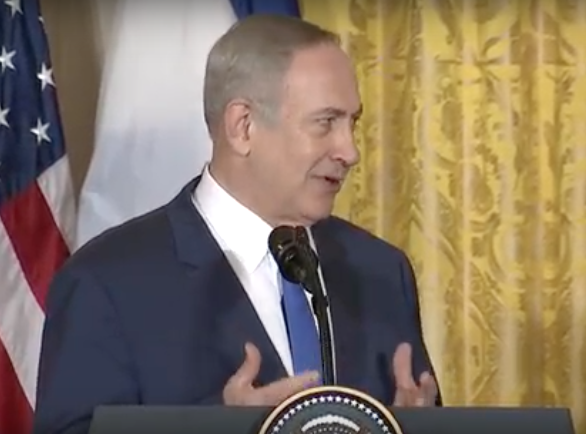
(Screenshot from White House video)
It would be good news if true. But most likely it’s not. While one stage in the Syrian conflict is coming to an end, another is beginning, and this time the results could be even worse.
The reason is Israel, until now the odd man in the latest Mideast wars. Despite intervening sporadically on the rebel side in Syria, the Jewish state generally held itself aloof from the conflict in the belief that events were breaking its way regardless of whether it stepped in or not. After all, why go to war when your enemies are doing a fine job of tearing each other apart on their own?
With President Bashar al-Assad expected to step down eventually, Israel figured that it only had to wait and watch as a hostile regime collapsed under its own weight as it thrashed about unable to restore order to Syria. Never in the Arab-Israeli hundred years’ war had Israel seemed stronger and the Arabs weaker and in greater disarray.
But then the unthinkable happened. Assad not only survived but prevailed. Backed by Russia, Iran and the Lebanese Shi‘ite militia Hezbollah, he has bottled up Al Qaeda in East Ghouta and Idlib province in the extreme northwest and is racing to lift ISIS’s siege on Deir-Ezzor along the Euphrates. If successful, the effect will be to clear a path straight through to the Iraqi border some 30 miles to the east.
U.S. military enclaves may remain in the northeast and in the southern border town of Al-Tanf. But it’s hard to see how they’ll have much of an impact as the Damascus regime tightens its grip on the country as a whole.
Israeli Outrage
But rather than making a wider war less likely, the upshot is to make it even more. Having bet on the wrong horse, Prime Minister Benjamin Netanyahu now finds himself facing a nightmare scenario in which Iran takes advantage of Assad’s winning streak to extend its reach from Iraq and Syria into Lebanon beyond. It’s not just a question of political influence, but of the emergence of a powerful Iranian-led military bloc.
Eleven years after fighting a vicious 34-day war in southern Lebanon, Israel thus finds itself facing not only Hezbollah but the Syrian Arab Army, Iran’s Islamic Revolutionary Guards, and Iraqi Shi‘ite militias – all backed by Russian military might – in a front extending across its entire northern border. All are battle-hardened after years of combat, better armed, better led, and more self-confident to boot. Israel finds itself confronting a new threat that is many times more powerful than Hezbollah (or Syria) alone.
Israeli consternation is not to be underestimated. One news outlet says the official attitude is one of “grave concern” while an anonymous government minister heaped blame on the U.S. for sacrificing Israeli interests:
“The United States threw Israel under the bus for the second time in a row. The first time was the nuclear agreement with Iran, the second time is now that the United States ignores the fact that Iran is obtaining territorial continuity to the Mediterranean Sea and Israel’s northern border. What is most worrisome is that this time, it was President Donald Trump who threw us to the four winds – though viewed as Israel’s great friend. It turns out that when it comes to actions and not just talk, he didn’t deliver the goods.”
Netanyahu is meanwhile off to the Black Sea resort of Sochi to confer with Russian President Vladimir Putin while, in Washington, Israeli military and intelligence officials are meeting with top Trump officials such as National Security Adviser H.R. McMaster and special Mideast envoy Jason Greenblatt.
Israel has also engaged in saber-rattling with regard to a missile factory that it says Iran is building in the Syrian port city of Baniyas. Gadi Eisenkot, the Israeli military’s chief of staff, said that stopping efforts by Iran, Syria, and Hezbollah to equip themselves with accurate missiles capable of striking deep inside the Jewish state “is our top priority.”
Adds Avigdor Lieberman, Israel’s hard-right defense minister: “We know what needs to be done…. We won’t ignore the establishment of Iranian weapons factories in Lebanon.”
Neocon Chorus
Words like that should not be taken lightly. Meanwhile, influential neoconservatives are joining the me-too chorus. At the Atlantic Council – the hawkish Washington think tank partly funded by the United Arab Emirates and pro-Saudi interests that functioned as an arm of Hillary Clinton’s 2016 presidential campaign – former Obama administration official Frederic C. Hof recently argued that the U.S. wouldn’t be in such a pickle if it had invaded Syria years ago:
“A Syrian opposition recognized by Washington in December 2012 as the ‘legitimate representative of the Syrian people’ should have been tasked with preparing for post-ISIS governance, and assisted to that end by an American-organized, multi-national effort. An all-Syrian stabilization force should have been built in a protected eastern Syria to pacify the area, facilitate humanitarian aid, and spur reconstruction.”
But now the U.S. is seemingly “indifferent” to what comes next once Islamic State is gone. As a consequence, Hof said, the Trump administration is effectively “install[ing] Iran as Syria’s suzerain, with the Assad entourage sifting through the country’s ruins for spoils and setting the stage for successive waves and varieties of extremism arising in response.” The only solution, according to Hof, is a radical strategic change “to prevent Iran and Assad doing their worst for the security of the United States, its allies, and its partners.”
With the Zionists and their neocon yes-men agreeing that something must be done, it seems that something WILL be done sooner rather than later.
Of course, a few complications could get in the way. One involves Russian President Vladimir Putin who, despite his close alliance with Assad, enjoys a solid working relationship with Israel and is none too eager to see war break out between the two countries. Another is the Syrian government in Damascus, which, under the leadership of the careful and cautious Assad, is none too eager to rush into a conflict that could conceivably prove even more ruinous than the one it is trying to finish up.
A Sick Kingdom
But even sober politicians like Putin and Assad may be unable to cope with the forces raging across the Middle East. The sectarian war that the Saudis unleashed more than a decade ago with U.S, help shows no signs of letting up. The kingdom is mired in an anti-Shi‘ite crusade in Yemen that it is desperate to escape, but doesn’t know how. It has suppressed a Shi‘ite uprising in Awamiyah, a city of 25,000 people in its own oil-rich Eastern Province, killing dozens according to Iranian sources and flattening an entire neighborhood, but dissent continues to bubble up ominously.
Saudi Arabia also has imposed an economic blockade on Qatar, and it is backing a repressive regime in Bahrain that has imposed a reign of terror on the country’s 70-percent Shi‘ite majority. Riyadh continues to engage in a dangerous war of words with Iran, which the royal family believes is engaged in an Elders of Zion-like Shi‘ite conspiracy to dismember the kingdom and wrest away control of Mecca and Medina.
The more paranoid Saudi leaders become, the more threatening Saudi Arabia grows – and the more resolved Iran becomes to make the most of its victory in Syria by fulfilling the ancient Persian goal of opening a corridor to the Mediterranean Sea. Aggression on one side leads to counter-aggression on the other, a process of mutual escalation that seems impossible to reverse.
Finally, there is the question of political stability – or, rather, an increasing lack thereof. In Iran, newly re-elected President Hassan Rouhani is locked in a growing confrontation with hardline Shi‘ite Islamists with little appetite for compromise.
In Saudi Arabia, power is in the hands of Crown Prince Muhammad bin Salman, a rambunctious 31-year-old who launched the disastrous war in Yemen in March 2015 – and then disappeared on a vacation in the Maldives as U.S. officials tried desperately to reach him by phone – and who more recently unveiled an ambitious economic reform program that so far has done nothing to stem the kingdom’s alarming decline. Despite vows to diversify the economy, non-oil revenue actually shrank by 17 percent this spring while foreign reserves have fallen by nearly a third since 2014. But that didn’t stop MbS, as he’s known, from committing himself to $110 billion in U.S. arms purchases in May or his father, King Salman, from spending a reported $100 million on a summer vacation in Morocco.
Saudi Arabia is thus becoming the sick man of the Middle East, one whose collapse could trigger a “geopolitical tsunami” sweeping across much of the region.
Trump’s Imbalance
Then there is the United States, where politics are even more unsettled. As President Trump careens from one disaster to another, foreign policy has grown both unpredictable and bellicose. One day, America’s second popular-vote-losing president in 16 years is calling for regime change in Tehran, the next he’s threatening Pyongyang with “fire and fury,” and then he’s blustering about some unspecified “military option” with regard to Venezuela.
The fact that Trump has so far demonstrated little follow-through is hardly reassuring. Sooner or later, rash rhetoric can only lead to rash actions, if not on America’s part then someone else’s. The shakier Trump grows, the greater the likelihood that he will engage in some risky adventure in order to strengthen his grip.
A number of forces are thus converging: political instability in Tehran, Riyadh and Washington, a growing thirst for more war on the part of Israel and the U.S. foreign-policy establishment, and a growing defensiveness on the part of a “Shi‘ite crescent” stretching from Yemen to southern Tehran. The United States, Turkey, Saudi Arabia, and others have already plunged Syria into death and destruction by sponsoring a murderous Sunni Salafist assault on one of the most diverse populations in the Middle East. The big question now is whether, with Israeli help, they are about to impose another.
Given the vicious cycle of violence in the Middle East, one that the U.S. has done its level best to worsen at every step of the way, it’s hard not to believe that even worse may be ahead.
Daniel Lazare is the author of several books including The Frozen Republic: How the Constitution Is Paralyzing Democracy (Harcourt Brace).
Facing Defeat in Syria, ISIS Inexplicably Expands Globally
By Tony Cartalucci – New Eastern Outlook – 11.08.2017
Throughout human history, when a military force and its economic center has been defeated, it contracts, then collapses. For the first time in human history, the self-proclaimed “Islamic State” (ISIS), has managed to reverse this fundamental aspect of reality – but not without help.
Facing defeat in Syria as government forces backed by its Russian and Iranian allies close in on the terrorist organization, stripping it of territory it seized, it has managed to spread far beyond Syria’s borders, establishing itself in Libya, Afghanistan, and even as far as Southeast Asia where it has seized an entire city in the Philippines’ south, and carried out attacks and conducting activities everywhere from Indonesia and Malaysia to allegedly Thailand’s deep south.
It should be remembered, according to Western governments and their media, the territory ISIS holds in Syria is allegedly providing it with the summation of its financial resources and thus the source of its fighting capacity. According to official statements, the US and its European allies allege that ISIS fuels its fighting capacity with “taxes” and extortion as well as black market oil sales – all of which are derived from territory it holds in Syria.
The Washington Post in a 2015 article titled, “How the Islamic State makes its money,” would note:
Weapons, vehicles, employee salaries, propaganda videos, international travel — all of these things cost money. The recent terrorism attacks in Paris, which the Islamic State has claimed as its own work, suggest the terrorist organization hasn’t been hurting for funding. David Cohen, the Treasury Department’s Undersecretary for Terrorism and Financial Intelligence, described the Islamic State last October as “probably the best-funded terrorist organization we have confronted” — deep pockets that have allowed the group to carry out deadly campaigns in Iraq, Syria and other countries.
To explain where ISIS actually makes its money, the Washington Post claims:
Unlike many terrorist groups, which finance themselves mainly through wealthy donors, the Islamic State has used its control over a territory that is roughly the size of the U.K. and home to millions of people to develop diversified revenue channels that make it more resilient to U.S. offensives.
The Washington Post would also claim:
Its main methods of generating money appear to be the sale of oil and antiquities, as well as taxation and extortion. And the group’s financial resources have grown quickly as it has captured more territory and resources: According to estimates by the Rand Corporation, the Islamic State’s total revenue rose from a little less than $1 million per month in late 2008 and early 2009 to perhaps $1 million to $3 million per day in 2014.
With this territory quickly shrinking and the intensity of fighting against what remains of ISIS in Syria and Iraq expanding, it is seemingly inexplicable as to how ISIS is expanding globally, instead of contracting and collapsing.
The Washington Post’s already implausible thesis regarding ISIS finances – based on official statements from the US Treasury Department and US corporate-funded policy think tanks like Rand – appears to be the only thing contracting and collapsing.
ISIS Enjoys Global Reach Many Nation-States Lack
Regarding just how expansive ISIS’ global activities are, US Secretary of State Rex Tillerson himself would claim in an August 1, 2017 statement that:
I think our next steps on the global war to defeat ISIS are to recognize ISIS is a global issue. We already see elements of ISIS in the Philippines, as you’re aware, gaining a foothold. Some of these fighters have gone to the Philippines from Syria and Iraq. We are in conversations with the Philippine Government, with Indonesia, with Malaysia, with Singapore, with Australia, as partners to recognize this threat, try to get ahead of this threat, and help them with training – training their own law enforcement capabilities, sharing of intelligence, and provide them wherewithal to anticipate what may be coming their direction.
Tillerson made these remarks after noting ISIS’ shrinking holdings in both Syria and Iraq. He claimed in regards to Iraq:
More than 70 percent of Iraqi territory that was once held by ISIS has been liberated and recovered. ISIS has been unable to retake any territory that it has been – that has been liberated, and almost 2 million Iraqis have returned home. And this is really the measure of success, I think, is when conditions are such that people feel like they can return to their homes.
Regarding Syria, Tillerson would claim:
Similarly, over in Syria, we’re assisting with the liberation of Raqqa, which is moving at a faster pace than we originally anticipated.
The steps outlined by Tillerson to combat ISIS sidestep strategic fundamentals like identifying, isolating, and eliminating the economic and financial source of the organization’s fighting capacity, and instead focus on an indefinite justification for global US military operations – particularly across Southeast Asia at a time when the region is incrementally uprooting American influence and replacing it with Eurasian alliances, networks, as well as military and economic blocs.
For ISIS – fueled by resources found only within the boundaries of its meager and shrinking territorial holdings in Syria and Iraq – to be simultaneously fighting the national armies of Syria and Iraq, backed by Iran, Russia, Lebanon’s Hezbollah, and allegedly a US-led coalition including dozens of countries, all while expanding its reach worldwide, including full-scale military operations in Southeast Asia, begs belief.
ISIS doing all of this with multi-billion dollar multinational state sponsorship, not only makes much more sense, it is the only explanation.
ISIS is State Sponsored
Until recently, ISIS territory butted directly against the borders of NATO-member Turkey. In fact, looking at any map of the Syrian-Iraqi conflict with ISIS revealed what appeared to be logistical trails leading directly out of Turkey and to a lesser extent, Jordan.
A 2014 report from Germany’s public broadcaster Deutsche Welle, revealed a torrent of supplies, men, and weapons flowing daily over the Turkish-Syrian border, headed directly toward ISIS territory, directly under the nose and with the complicity of Turkish officials.
The report titled, “‘IS’ supply channels through Turkey,” would note:
Every day, trucks laden with food, clothing, and other supplies cross the border from Turkey to Syria. It is unclear who is picking up the goods. The haulers believe most of the cargo is going to the “Islamic State” militia. Oil, weapons, and soldiers are also being smuggled over the border, and Kurdish volunteers are now patrolling the area in a bid to stem the supplies.
So obvious was the logistical support for ISIS flowing from Turkey, that ISIS flags were clearly visible from the Turkish border throughout DW’s footage.
It was only until Russia’s military intervention in Syria upon Damascus’ request, that these logistical routes were targeted and significant pressure could be placed on ISIS inside Syria, rolling back its fighting capacity.
ISIS enjoys a global reach few nation-states could achieve because it is financially, politically, and militarily backed by nations with the resources to obtain that global reach. This includes the US itself, NATO, and the Gulf Cooperation Council (GCC) which in turn includes nations like Saudi Arabia, the United Arab Emirates (UAE), and Qatar.
ISIS is America’s Foot in the Door in Southeast Asia
US Secretary of State Rex Tillerson’s comments regarding ISIS’ spread into Southeast Asia implied long-term US involvement in the region, including closer involvement with regional police and even military forces. In the Philippines, where US-Philippine relations were spiraling downward, the sudden appearance of ISIS there and the organization’s ability to seize an entire city led directly to justification for not only a continued US military presence in the country, but its expansion.
Other nations across Southeast Asia – including Indonesia, Malaysia, and Thailand – have been incrementally pushing US influence out of the region in favor of stronger and more stable ties with each other and with neighboring China.
Thailand for instance, has begun replacing aging US military hardware with weapon systems from Russia, China, and Europe. Thailand has also begun joint military exercises with China, ending America’s post-Vietnam War monopoly. Thailand and Indonesia have also begun striking a series of economic and infrastructure deals with China, including immense expansions of their respective national railways.
As each nation has taken steps to move the US out of Asia, the US has increased pressure on each respective nation. It has done this through US-funded fronts posing as nongovernmental organizations (NGOs) and US-backed opposition movements. It also appears to be doing this through the introduction and expansion of ISIS activity in the region.
It should be remembered that it was the US itself that created Al Qaeda in the mountains of Afghanistan to fight the Soviets in the 1980s.
If the situation unravels there is the possibility of establishing a declared or undeclared Salafist principality in eastern Syria (Hasaka and Der Zor), and this is exactly what the supporting powers to the opposition want, in order to isolate the Syrian regime, which is considered the strategic depth of the Shia expansion (Iraq and Iran).
Saudi forces set ablaze Shia homes in restive Awamiyah
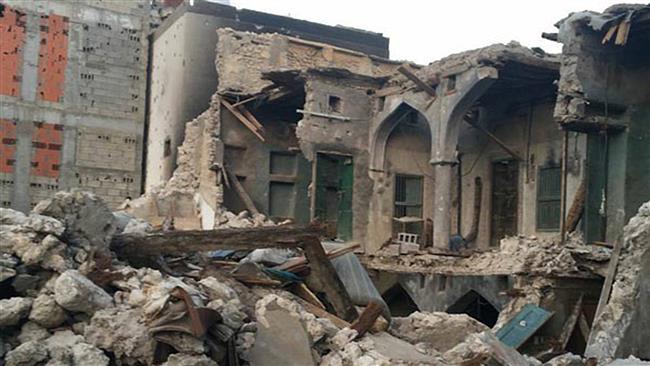
An al-Alam photo shows rubble caused by the Saudi demolition of Awamiyah, Eastern Province, Saudi Arabia.
Press TV – August 1, 2017
Saudi forces have set fire to homes belonging to Shia residents in the besieged town of Awamiyah that has been the scene of a heavy-handed regime crackdown on the minority community.
Based on local reports, Saudi forces have thrown Shia citizens out of their homes and then torched their properties.
Awamiyah, situated in Eastern Province, has long been a flashpoint between the Saudi kingdom and the inhabitants complaining of discrimination.
It has witnessed renewed deadly clashes between the military and residents since May, when Saudi forces began razing the town’s old quarter, known as al-Mosawara.
Saudi authorities claim that Mosawara’s narrow streets have become a hideout for militants suspected of being behind attacks on security forces in Eastern Province.
The UN, however, said Saudi Arabia was erasing cultural heritage and violating human rights through Mosawara’s demolition.
Karima Bennoune, the UN special rapporteur in the field of cultural rights, said Saudi authorities ignored repeated pleas by the world body to halt the destruction.
“These destructions erase the traces of this historic and lived cultural heritage and are clear violations of Saudi Arabia’s obligations under international human rights law,” Bennoune said, accusing the Saudi forces of “irreparably burning down” historic buildings and forcing residents to flee their homes.
Leilani Farha, the UN special rapporteur on the right to adequate housing, also warned that the Saudi move “constitutes a forced eviction under international human rights law.”
Additionally, Ali al-Dubisi, the head of the Berlin-based European Saudi Organization for Human Rights, said the Saudi forces were following a scorched-land policy in Awamiyah, launching rocket attacks and shelling residential buildings and civilians who are resisting Saudi pressures to evacuate.
Since February 2011, Saudi Arabia has stepped up security measures in Shia-dominated Eastern Province, which has been rocked by anti-regime demonstrations, with protesters demanding free speech, the release of political prisoners, and an end to economic and religious discrimination.
The government has suppressed pro-democracy movements, but they have intensified since January 2016 when Saudi Arabia executed respected Shia cleric Sheikh Nimr al-Nimr.
Saudi Arabia wades into Shi’ite politics in Iraq
By M K Bhadrakumar | Indian Punchline | August 1, 2017
The dramatic appearance of the Iraqi Shi’ite firebrand politician Muqtada Al-Sadr in Jeddah on Sunday and his meeting with the Saudi Crown Prince Mohammed bin Salman opens an exciting page in the Saudi-Iranian regional rivalries. The theatre is shifting to Iraq.
Briefly, what is unfolding is a determined Saudi attempt to reset the power calculus in post-ISIS Iraq by moulding a new political alignment that principally aims at undermining the pre-eminent influence that Iran has enjoyed over its neighbour in the past decade or so following the Shi’ite empowerment in the downstream of the US invasion of 2003.
Iran’s main platform on the Iraqi political landscape has been the umbrella Shi’ite coalition known as the Islamic Supreme Council in Iraq (ISCI), which Tehran had created as far back as 1982, originally as a Shi’ite resistance movement against Saddam Hussein and most recently since the middle of the last decade following Saddam’s overthrow as a united front to contest the democratic elections in Iraq with an agenda to preserve the Shi’ite leadership of the government.
To cut a long story short, ISCI is unravelling due to latent rivalries between various constituent groups. (Shi’ite politics has been traditionally very fractious, including in Iran.) Now, the split is also on account of a strong undercurrent of resentment over Iran’s dominance over Iraqi politics. (For the benefit of the uninitiated, again, the potency of Iraqi nationalism – a legacy of the Saddam era, paradoxically – subsuming the ethnic and sectarian divides in the country should never be underestimated.)
Importantly, the new generation of the powerful Hakim family led by Ammar Al-Hakim has moved out of the ISCI and has shifted allegiance from Iran’s Ayatollah Khamenei to Iraq’s Grand Ayatollah Ali Al-Sistani. Equally, Muqtada al-Sadr who has stepped out of Iran’s orbit has assumed a nationalistic, non-sectarian platform in the recent years. Again, within the ruling Islamic Dawa Party, which is the main constituent of the ISCI, there is an internal power struggle between the incumbent PM Haidar Al-Abadi and the former PM Nouri al-Maliki. (Currently, Maliki is a favourite of Iran; interestingly, Al-Abadi recently visited Saudi Arabia during which an announcement was made that the two countries have formed a ‘coordination council’ to bolster strategic relations aimed at healing troubled ties with ‘other Arab states’.)
Enter Saudi Arabia. Quite obviously, Saudis see a window of opportunity to go for Iran’s jugular veins by breaking up the ISCI irretrievably and instead propping up a new composite non-sectarian coalition involving the Shi’ite factions who resent Iran’s hegemony. No doubt, it is an audacious attempt to bring together – you’ve guessed it – Muqtada al-Sadr, Ammar Al-Hakim and Al-Abadi – on the same page.
The Crown Prince MBS is the mastermind behind this audacious Saudi move to manipulate the Shi’ite politics in Iraq. Arguably, the Saudi game plan has some positive streaks in it insofar as it envisages a non-sectarian realignment in Iraqi politics by encouraging a regrouping of the Shi’ite factions that give primacy to Iraqi nationalism over the identity politics they pursued up until recently. In turn, MBS would probably persuade these Shi’ite factions to work with the Iraqi Sunni factions and the Kurds. (By the way, Saudis recently opened a consulate in Erbil, the capital of Kurdistan in northern Iraq.)
Cynics would say that Saudis are having a devious agenda to: a) break up Shi’ite unity in Iraq; b) empower the Sunni groups as a ruling elite; and, c) create a schism between ‘Arab Shias’ and ‘Persian Shias’. The jury is out. Time only will tell how these shenanigans play out. To be sure, MBS’s initiative to manipulate Iraqi politics must be enjoying the support of the US and Israel, since it ultimately aims at isolating Iran and mitigates to an extent Iran’s spectacular ‘victory’ in the Syrian conflict.
Will Iran throw in the towel and walk away? Certainly not. Iran’s trump card is the battle-hardened Shi’ite militia known as the Al-Hashd Al-Shaabi, which is estimated to number over 120000 and is a Hezbollah-like army that is disciplined, fired up ideologically, and weaned in the politics of ‘resistance’. By the way, Qassem Soleimani, the charismatic commander of the Quds Force of the Iranian Revolutionary Guard Corps, was quoted as saying last week: “Daesh (ISIS) was stopped by the entry of Al-Hashd Al-Shaabi into the Iraqi army. The Iraqi army was transformed into a Hezbollah army.”
Now, that is a statement of fact. And, the ground reality is that today, in the chaotic war conditions in Iraq, power ultimately flows through the barrel of the gun. Stalin would have asked MBS as to how many divisions Al-Haikm, Al-Sadr and Al-Abadi together have under their command? Will the number come to even one half of the strength of Al-Hashd Al-Shaabi, the Iraqi Hezbollah, which Iran trained and equipped? Unlikely. Could they have taken on the ISIS and defeated it? No way.
Don’t be Fooled, the CIA was Only Half the Problem in Syria
By Steven MacMillan – New Eastern Outlook – 31.07.2017
The news that President Trump has halted the CIA program to arm and train rebel groups in Syria should be viewed with caution, as the CIA program only represented half of US involvement in Syria. Even if we take this information as completely accurate, and the CIA will cease to be involved in any covert programs in Syria, there is still a giant arm of US imperialism that is going to be heavily involved in the Syrian conflict for the foreseeable future; namely, the Pentagon.
The notion that the CIA was the only branch of the US establishment involved in the destabilization of Syria is nonsense. The US has always had two operations running simultaneously in Syria, with one being run by the CIA, and other being ran by the Pentagon. As Reuters reported in an article in May of this year, titled: Syrian rebels say U.S., allies sending more arms to fend off Iran threat, military aid has been provided through “two separate channels:”
“Rebels said military aid has been boosted through two separate channels: a program backed by the U.S. Central Intelligence Agency (CIA), known as the MOC, and regional states including Jordan and Saudi Arabia, and one run by the Pentagon.”
These two programs have often clashed, as was the case last year, when militias armed by the CIA fought against militias armed by the Pentagon.
The Pentagon has been as involved in the disastrous operation to arm and train rebels in Syria as the CIA has, and has contributed heavily to the mess on the ground.
In September 2015 for instance, it was reported that a Pentagon-armed group of rebels – named Division 30 – handed over their weapons to al-Qaeda in Syria, a scenario that was a common outcome from many CIA operations as well. The Pentagon, never shy to blow an obscene amount of taxpayers’ money on imperial matters, has already wasted hundreds of millions of dollars training and arming rebels in Syria, yet Trump only wants to increase the US war budget.
Trump: The Man of the Military
Trump’s decision to halt the CIA program was hardly surprising, considering the support Trump has received from large sections of the military. A look at the backgrounds of the individuals that Trump has given cabinet positions reveals Trump’s close relationship with the military.
The Secretary of Homeland Security for instance, John Kelly, is a retired Marine Corps General and former Commander of US Southern Command. Trump’s pick for the Director of the CIA is even more telling, as Mike Pompeo has his roots in the military, graduating from West Point in the 1980s:
“Mr. Pompeo graduated first in his class at the United States Military Academy at West Point in 1986 and served as a cavalry officer patrolling the Iron Curtain before the fall of the Berlin Wall. He also served with the 2nd Squadron, 7th Cavalry in the US Army’s Fourth Infantry Division.”
Undoubtedly, there are many good forces in the US military (as in any other large organization), and there is nothing wrong with having a military background. But equally, there are also many nefarious forces in the military, and the influence of military-industrial complex is pervasive, constantly agitating for more imperial wars.
With this context in mind, it is hardly surprising that Trump favours the Pentagon program over the CIA one, especially considering the power struggle taking place between the CIA and the military within the US. It should be highlighted that Trump has notcompletely halted all US programs to arm and train militias in Syria, he has merely shutdown one channel.
Pentagon Using Kurds to Balkanize Syria
The Pentagon has been heavily involved in arming Kurdish forces in Syria, using them as a tool to attempt to Balkanize and fracture Syria into micro-states. In May of this year, President Trump approved a plan – supported by many in the Pentagon – to arm the People’s Protection Unit (YPG), a Kurdish militia operating predominantly in northern Syria.
The YPG is also the controlling militia in the US-backed Syrian Democratic Forces (SDF), which includes an array of other militias. In addition to providing arms to the YPG, US special forces have been pictured on the ground in northern Syria working in conjunction with YPG fighters.
When most of the public was distracted by the story of Trump halting the CIA program, footage surfaced showing US armed military vehicles passing through Qamishli – a city in northern Syria on the Turkish border – reportedly on route to Raqqa. The recipients of the vehicles are believed to be either the SDF or US forces directly, who are involved in the battle against ISIS in Raqqa.
If (or when) ISIS is defeated in Raqqa, it will be very interesting to see who ends up controlling the city. It is possible that the Pentagon wants to defeat ISIS in Raqqa, and then hand Raqqa to the Kurds – a scenario that many Kurds would only be too happy with. In March of this year, Saleh Muslim, the co-chair of the Syrian Kurdish Democratic Union Party (PYD) – the political affiliate of the YPG – said that once ISIS is defeated in Raqqa, the city should be incorporated into a Kurdish state in northern Syria.
The Pentagon’s support for Kurdish forces is clearly part of a strategy to break the northern part of the country away from control of the Syrian government in Damascus. A subservient Kurdish state in northern Syria (which would probably join with Kurdish zones in Iraq and other countries in the future) would allow the US to have a permanent military presence in Syria, and easy access to the natural resources in the Kurdish region.
The creation of a Kurdish state in northern Syria would of course cause a severe breakdown in relations with NATO member Turkey, given the views of the current Turkish leadership that is. Turkey considers the YPG to be an extension of the Kurdistan Workers Party (PKK), a group Ankara views as a terrorist organization. Turkey has repeatedly denounced US support for Kurdish groups in Syria, with this being a major source of disagreement between the US and Turkey. It is no coincidence that Turkish state media recently published a list of classified US military bases and outposts in northern Syria, with this information revealing the extent to which the US military is embedded in Kurdish-controlled regions in Syria.
The plan to Balkanize Syria is well on its way, and the Pentagon is leading the charge. How Russia positions herself in the coming months will be crucial for the future of Syria.
US systematically targeting residential areas: Syria to UN
Press TV – July 31, 2017
Damascus has called on the UN to end the Washington’s crimes against Syrian civilians, while stressing that the US is systematically targeting residential areas.
On Sunday, the Syrian foreign ministry sent two letters to UN Secretary General Antonio Guterres and the chairman of the UN Security Council, calling for the dissolving of the US-led coalition in Syria which is operating in the country without permission from Damascus.
“The US-led international coalition continues to commit massacres against Syrian innocent civilians through conducting systematic airstrikes on the provinces of Raqqah, Hasakah, Aleppo and Dayr al-Zawr on a daily basis,” reads the letter.
The letters were sent after at least six civilians lost their lives and nearly a dozen others sustained injuries when the US-led coalition, purportedly fighting the Daesh Takfiri terrorist group, conducted a series of airstrikes in Syria’s eastern province of Dayr al-Zawr.
The letters noted that the coalition’s member states continue to support terrorist groups such as Daesh and Jabhat al-Nusra.
The military alliance has repeatedly been accused of targeting and killing civilians. It has also been largely incapable of fulfilling its declared aim of destroying Daesh.
“Those attacks contributed to the spread of creative chaos, the killing and destruction which fulfill goals of the coalition and the terrorist organizations in destabilizing security in the region, destroying Syria’s capabilities and prolonging the crisis in a way that serves the interests of the Israeli entity,” it adds.
Syria has been has been fighting different foreign-sponsored militant and terrorist groups since March 2011. UN Special Envoy for Syria Staffan de Mistura estimated last August that more than 400,000 people had been killed in the crisis until then.
Featured Video

ARE PATIENTS BEING PROPERLY INFORMED ABOUT OZEMPIC?
or go to
Aletho News Archives – Video-Images
From the Archives
Trans ‘milk’ as good as the real thing – NHS
RT | February 18, 2024
The drug-induced nipple secretions of trans women are as good as mothers’ breast milk for babies, the University of Sussex Hospitals NHS Trust claimed in a letter to campaigners made public in a report by British think tank the Policy Exchange on Sunday.
The healthcare trust’s medical director, Rachel James, argued that the off-label prescription drug cocktail men transitioning to female take in order to produce milk was “similar to the natural hormones which encourage lactation to develop when the baby is newly born.”
“The evidence which is available demonstrates that the milk is comparable to that produced following the birth of a baby,” James wrote in the letter, sent to Children of Transitioners last August.
Biological men who wish to lactate must first take hormones to grow milk glands and then take high doses of either domperidone or metoclopramide to stimulate milk production. Neither drug is approved for this use, though they are occasionally prescribed off-label to biological women who have trouble lactating.
However, domperidone’s own manufacturer, Janssen, warns patients the drug “may cause unwanted side effects affecting the heart in a breastfed baby” and “should be used during breastfeeding only if your physician considers this clearly necessary.” … continue
Blog Roll
 Aletho News
- 2025 Nature Paper Claiming Worsening Global Drought Gets RETRACTED …Heavily Flawed
- Your Milk Is Not the Problem
- The Truth About the Trump Shootings with Ken Silva
- ARE PATIENTS BEING PROPERLY INFORMED ABOUT OZEMPIC?
- US lawmaker blocks $2.8 billion weapons sale to Israel: Report
- Yemeni army claims responsibility for strikes on sensitive sites in Saudi capital, Aramco facilities in Yanbu
- Iran Judiciary issues indictments against 159 US, Israeli officials for assassination of Leader, commanders
- Turkiye revokes Iranian bank license under US sanctions campaign
- US-Denmark Agreement on Greenland Is ‘PR Stunt’ Ahead of Midterms
- Araghchi: Military intervention cannot create security; coercion cannot bring peace
- If Americans Knew
- Salah Sarsour’s Legal Team Says DHS Has Not Met Its Burden to Prove He Is Deportable
- An analysis of tax forms by The Intercept show Kraft’s charity and LLC have donated to Friends of the IDF and AIPAC’s super PAC.
- Israeli attacks kill four Palestinians in Gaza – Daily Update
- Inside Gaza’s death trap of collapsing, bombed-out buildings
- The everyday items Israel bans from Gaza every day
- Inside the siege, the ruined buildings of Gaza – Daily Update
- Debunking The Claim That Macklemore Has A “History Of Antisemitism”
- CPJ demands release of arrested Palestinian-US journalist near Bethlehem
- Robert Kraft: The Billionaire Friend of Netanyahu Pulling The Strings Behind the Macklemore/Ed Sheeran Blow Up
- Columbia Administered Fund Gives Big Money to Pro-Israel Groups
- No Tricks Zone
- 2025 Nature Paper Claiming Worsening Global Drought Gets RETRACTED …Heavily Flawed
- New Study: ‘Global Drought Shows No Detectable Recent Acceleration Under Climate Warming’
- Economic Masterminds: German Socialists Suggest Taxing Productivity Gains Stemming From Using AI
- The South China Sea Has Not Been Cooperating With The Climate Change Narrative
- Energy Crisis: Germany Enters Heating Season With Historically Low Gas Reserve Fill Levels
- New Study: The Antarctic Ice Sheet Gained Mass From 2020-2024 Due To Staggering Snow And Ice Accumulation
- Study: Ocean Heating Rates From Thousands Of Years Ago ‘Dwarf’ Modern Ocean Heating Rates
- Climate Extremists Target, Attack Large-Scale Power Grid Infrastructure In Germany!
- New Study: Antarctic Ice Melt Has Contributed Less Than 1 Centimeter To Sea Level Rise In The Last 30 Years
- Fear Of Debate: Alarmist German Climate Scientist Calls On Mainstream Media To Discredit Skeptic Voices
 Aletho News