UK in panic over Johnson’s remarks against Saudi regime
Press TV – December 11, 2016
UK Foreign Secretary Boris Johnson’s recent criticism of Saudi Arabia has worried British officials, with various government figures trying to gloss them over as Johnson’s own personal views.
During a conference in Rome last week, Johnson blasted the Riyadh regime over its “proxy wars” in the Middle East and its unprovoked military aggression against Yemen, which has killed over 11,000 Yemenis since March 2015.
UK Prime Minister Theresa May’s spokeswoman immediately rebuked the remarks back then, saying the comments did not reflect “the government’s views on Saudi and its role in the region.”
Johnson’s statements divided the UK Parliament, with many of the lawmakers saying that he was stating the truth and should not face public chastisement.
UK Defense Minister Michael Fallon lashed out at the media on Sunday, for blowing the story out of proportions and confecting an artificial row between Johnson and the Downing Street.
“Let’s be very clear about this. The way some of his remarks were reported seemed to imply that we didn’t support the right of Saudi Arabia to defend itself… and didn’t support what Saudi Arabia is doing in leading the campaign to restore the legitimate government of Yemen,” Fallon said during a BBC interview.
“Some of the reporting led people to think that,” he added. “The way it was interpreted left people with the impression that we didn’t support Saudi Arabia and we do.”
Fallon said the months-long Saudi invasion against its impoverished southern neighbor was in self-defense, a right that London thought Riyadh was entitled to.
“The government’s view is absolutely clear – that what Saudi Arabia is entitled to do is defend itself from these attacks across its own border,” he said.
Johnson’s remarks came at a time when May was in the Middle East, trying to cement military and economic ties with [Persian] Gulf Cooperation Council nations – Saudi Arabia, the United Arab Emirates, Kuwait, Oman, Bahrain and Qatar.
Besides helping Bahrain with a heavy-handed crackdown on its popular uprising, Britain has also been providing weapons and intelligence to Saudis in the attacks against civilian targets in Yemen.
Saudi-Iranian reconciliation is within sight
By M K Bhadrakumar | Indian Punchline | December 2, 2016
A side-effect of Donald Trump’s election as president could be the improvement in Saudi-Iranian ties. Of course, cynics may argue that it is about time the relationship got better, because it can’t get any worse – short of war. But the Trump factor becomes a stimulus in a positive direction.
Broadly, the US policy (which Hillary Clinton would have happily continued) of playing Saudi Arabia against Iran on the one hand and nudging the Arab allies and Israel to form a united regional front under American leadership on the other hand, is ending. It was a hopeless strategy to begin with, and Trump will not waste time in resuscitating it on its death bed.
Egypt’s recent ‘defection’ to the Russian-Iranian camp in the Syrian conflict (which also anticipates the Trump presidency, by the way), lethally wounds the myth of Arab unity against Iran, which Saudis had been fostering. Interestingly, Egyptian foreign minister Sameh Shoukry is in New York where he met Vice President–elect Mike Pence on Thursday to hand over a letter from President Abdel Fatah el-Sisi to Trump. At the same time, Sisi himself is on a visit to the UAE (which is mediating in the Saudi-Egyptian rift.) Egypt anticipates an easing of tensions between Saudi Arabia and Iran and is positioning itself.
For the Saudi regime, a Trump presidency means that it is losing the war in Syria. The blow to Saudi prestige on the Arab Street, regionally and internationally is enormous. But Saudis are preparing for the eventuality of President Bashar al-Assad remaining in power and the Syrian rebels facing the existential choice of surrendering and accepting the fait accompli (or meeting physical extinction.) The secret talks in Ankara, which have now come to light, between the rebel leadership with Russian intelligence and diplomats underscore that Aleppo is about to fall to the government forces and the war is over.
The ending of the war on such terms constitutes a big victory for Iran. This raises the question: Are the Saudis on a course correction themselves? There is growing evidence that this may be so.
First came the election of Michel Aoun as the new President of Lebanon on October 31, ending two years of deadlock. Aoun is very close to Hezbollah. (Iranian FM Mohammad Zarif was the first foreign dignitary to visit Beirut to congratulate Aoun.) Clearly, in the complicated political tug of war in Lebanon, Saudis appear to have simply retrenched, which facilitated Aoun’s election, piloted by Iran and the Hezbollah.
The consolidation in Lebanon and the sight of victory in the Syrian war (plus the incipient signs of a warming up with Egypt) would significantly strengthen Iran’s hand in regional politics. But, strangely, there is no triumphalism in Tehran. In the normal course, Tehran could have called the Saudis ‘losers’, but that is not happening.
Now comes the thunderbolt — OPEC oil production cut deal in Geneva on Wednesday. Admittedly, the oil market is unpredictable, the role of the US shale industry is uncertain and the OPEC deal needs to be firmed up at the December meeting in Moscow between the cartel and non-OPEC oil producers. But the bottom line nonetheless is that the deal is the final product of a big Saudi concession to Iran. Put differently, if the Saudis had dug in and refused to exempt Iran as a special case from the production cut, the deal wouldn’t have come through.
The OPEC deal signifies a tectonic shift in the Saudi-Iranian equations, which is below the radar as of now. It is not only about big money, but also the return of Iran to OPEC’s cockpit — indeed, about OPEC’s future itself. True, the Russians played a forceful role behind the scenes to bridge the gap between Riyadh and Tehran and push them to come closer. True, again, Saudis are in serious financial difficulty and the OPEC deal is expected to bring in more income out of a rise in oil price. However, in the final analysis, the Saudis did accommodate Iran’s demand that a restoration of the pre-sanctions OPEC production quota is its national prerogative and it must be exempted from any production cut. (NBC News gives a riveting account of how it all happened — How Putin, Khamenei, and a Saudi Prince Made the OPEC Deal.)
It is this shift in the Saudi mindset — away from the dogged attitude that Iran must be relentlessly punished even if that were to mean inflicting on itself a few bleeding self-wounds — that catches attention. Again, on Iran’s part too, it is this strangest of strange behaviour – total absence of triumphalism that the Saudis blinked in Geneva – is highly significant.
Simply put, taken together with the happenings in Lebanon, Iran is careering away from anti-Saudi grandstanding and rhetoric. Indeed, a similar roll back is discernible on the Saudi side also lately. (The Asharq al-Awsat newspaper recently replaced its editor-in-chief; Prince Turki bin Faisal has said Trump should not abandon the Iran nuclear deal.)
These are early days, but signs are that there is a thaw in the Saudi-Iranian ties. Given the Middle Eastern political culture, Saudi Arabia and Iran could be moving toward a modus vivendi sooner than one would have expected. Yemen will be the litmus test of a rapprochement.
Congressional Hawks Rush to Intensify War in Syria
By Rick Sterling | Dissident Voice | November 21, 2016
Hawks pass HR5732
Late in the day Tuesday November 15, Congress convened in special session. With normal rules suspended, they passed House Resolution 5732 the “Caesar Syria Civilian Protection Act”. The resolution calls for intensifying already harsh sanctions on Syria, assessing implementation of No Fly Zone in Syria and escalating efforts to press criminal charges against Syrian officials. HR5732 claims to promote a negotiated settlement in Syria but, as analyzed by Friends Committee for National Legislation, imposes preconditions which would actually make that more difficult.
There was 40 minutes of “debate” with six representatives (Royce, Engel, Ros-Lehtinen, Kildee, Smith, and Curbelo) speaking in favor of the resolution. There were few other Congressional representatives present in Congress. The House Foreign Affairs Committee stated that the resolution was passed “unanimously” without mentioning the special conditions.
The “Non Controversial” Resolution that could lead to World War III
According to wikipedia “Suspension of the rules is a procedure generally used to quickly pass non-controversial bills in the United States House of Representatives …. such as naming Post Offices…” In this case, the resolution calls for evaluating and developing plans for a “No Fly Zone” which is an act of war. This is obviously controversial and it seems clear the resolution should have been debated and discussed under normal rules with a normal amount of Congressional presence and debate.
The motivation for bypassing normal rules and rushing the bill through without debate was articulated by the bill’s author and ranking Democrat Eliot Engel: “We cannot delay action on Syria any further…. if we don’t get this legislation across the finish line in the next few weeks, we are back to square one.” The current urgency may be related to the election results since Trump has spoken out against “regime change” foreign policy. As much as they are critical of Obama for not doing more, Congressional neoconservatives are concerned about the prospect of a President who might move toward peace and away from war.
The Caesar Fraud
HR5732 is titled the “Caesar Syria Civilian Protection Act”. Foreign Affairs Committee Chair Ed Royce (R-Ca) explained that the resolution is named after “the brave Syrian defector known to the world as Caesar, who testified to us the shocking scale of torture being carried out within the prisons of Syria.”
In reality, the Caesar story was a grand deception involving the CIA with funding from Qatar to sabotage the 2014 Geneva negotiations. The 55,000 photos which were said to show 11,000 torture victims have never been publicly revealed. Only a tiny number of photos have been publicized. However, in 2015 Human Rights Watch was granted access to view the entire set. They revealed that almost one half the photos show the opposite of what was claimed: instead of victims tortured by the Syrian government, they actually show dead Syrian soldiers and civilian victims of car bombs and other terror attacks! The “Caesar” story, replete with masked ‘defector’, was one of the early propaganda hoaxes regarding Syria.
False Claims that the US has been doing nothing
One of the big lies regarding Syria is that the US has been inactive. Royce says:
The administration has decided not to decide. And that itself, unfortunately, has set a course where here we sit and watch and the violence only worsens. Mr. Speaker, America has been sitting back and watching these atrocities for far too long. Vital U.S. national security interests are at stake.
The ranking Democrat Eliot Engel said:
Four years ago I thought we should have aided the Free Syrian Army. They came to us in Washington and begged us for help… they were simply looking for weaponry. I really believe if we had given it to them, the situation in Syria would have been different today.
This is nonsense. The US was actively coordinating, training and supplying armed opposition groups beginning in late 2011. When the Qadaffi government was toppled in Fall 2011, the CIA oversaw the theft of the Libyan armories and shipment of weapons to Syrian armed opposition as documented in the Defense Intelligence Agency report of October 2012.
These weapons transfers were secret. For the public record it was acknowledged that the US was supplying communications equipment to the armed opposition while Saudi Arabia and Qatar were supplying weaponry. This is one reason that Saudi purchases of weapons skyrocketed during this time period; they were buying weapons to replace those being shipped to the armed opposition in Syria. It was very profitable for US arms manufacturers.
Huge weapons transfers to the armed opposition in Syria have continued to the present. This past Spring, Janes Defense reported the details of a U.S. delivery of 2.2 million pounds of ammunition, rocket launchers and other weaponry to the armed opposition.
Claims that the US has been inactive are baseless. In reality the US has done everything short of a direct attack on Syria. And the US military is starting to cross that barrier. On September 17 the US air coalition did a direct attack on the Syrian Army in Deir Ezzor, killing 80 Syrian soldiers and enabling ISIS to launch an attack on the position. Claims that it was a “mistake” are highly dubious.
The claims by Congressional hawks that the US has been ‘inactive’ in the Syrian conflict are part of the false narrative suggesting the US must “do something” which leads to a No Fly Zone and full scale war. Ironically, these calls for war are masked as “humanitarian”. And never do the proponents bring up the case of Libya where the US and NATO “did something”: destroyed the government and left chaos.
Congress as a Fact-Free House of Propaganda
With only a handful of representatives present and no debate, the six Congress members engaged in unrestrained propaganda and misinformation. The leading Democrat, Eliot Engel, said “We’re going into the New Year 2017, Assad still clings to power, at the expense of killing millions of his citizens.” That number is way off anyone’s charts.
Rep Kildee said “The world has witnessed this terrible tragedy unfold before our eyes. Nearly half a million Syrians killed. Not soldiers – men, women, children killed.”
The official text of the resolution says,
It is the sense of Congress that–
(1) Bashar al-Assad’s murderous actions against the people of Syria have caused the deaths of more than 400,000 civilians…
The above accusations – from “millions of citizens” to “half a million” to “400,000 civilians” – are all preposterous lies.
Credible estimates of casualties in the Syrian conflict range from 300,000 to 420,000. The opposition supporting Syrian Observatory for Human Rights estimates the documented 2011-2016 death toll as follows:
killed pro Syrian forces – 108,000
killed anti government forces – 105,000
killed civilians – 89,000
In contrast with Congressional and media claims, civilians comprise a minority of the total death count and the largest casualty group is those fighting in defense of the the Syrian state. These facts are ignored and never mentioned because they point to the reality versus the propaganda narrative which allows the USA and allies to continue funding terrorism and a war of aggression against Syria.
The Congressional speakers were in full self-righteous mode as they accused the Syrian government of “committing crimes against humanity and war crimes against civilians including murder, torture and rape. No one has been spared from this targeting, even children.” A naive listener would never know that the Syrian government is primarily fighting the Syrian branch of Al Qaeda including thousands of foreigners supplied and paid by foreign governments.
The Congressional speakers go on to accuse the Syrian military of “targeting” hospitals, schools and markets. A critical listener might ask why they would do that instead of targeting the Al Qaeda terrorists and their allies who launch dozens and sometimes hundreds of hell cannon missiles into government held Aleppo every day.
The Congressional propaganda fest would not be complete without mention of the “White Helmets.” House Foreign Affairs Committee Chairman Ed Royce said:
We (previously) heard the testimony of Raed Saleh of the Syrian White Helmets. These are the doctors, nurses and volunteers who actually, when the bombs come, run towards the areas that have been hit in order to try to get the injured civilians medical treatment… They have lost over 600 doctors and nurses.
This is more Congressional nonsense. There are no nurses or doctors associated with the White Helmets. The organization was created by the USA and UK and heavily promoted by a “shady PR firm.” The White Helmets operate solely in areas controlled by Nusra and associated terrorist groups. They do some rescue work in the conflict zone but their main role is in the information war manipulating public opinion. The White Helmets actively promote US/NATO intervention through a No Fly Zone. Recently the White Helmets has become a major source of claims of innocent civilian victims in east Aleppo. Given the clear history of the White Helmets, these claims should be treated with skepticism. What exactly is the evidence? The same skepticism needs to be applied to video and other reports from the Aleppo Media Center. AMC is a creation of the Syrian Expatriates Organization whose address on K Street, Washington DC indicates it is a US marketing operation.
What is really going on?
The campaign to overthrow the Syrian government is failing and there is possibility of a victory for the Syrian government and allies. The previous flood of international jihadi recruits has dried up. The Syrian Army and allies are gaining ground militarily and negotiating settlements or re-locations with “rebels” who previously terrorized Homs, Darraya (outer Damascus) and elsewhere. In Aleppo the Syrian army and allies are tightening the noose around the armed opposition in east Aleppo.
This has caused alarm among neoconservative lawmakers devoted to Israel, Saudi Arabia and U.S. empire. They are desperate to prevent the Syrian government from finally eliminating the terrorist groups which the West and allies have promoted for the past 5+ years.
“Pro Israel” groups have been major campaigners for passage of HR5732. The name of Simon Wiesenthal is even invoked in the resolution. With crocodile tears fully flowing, Rabbi Lee Bycel wrote “Where is the Conscience of the World?” as he questioned why the “humanitarian” HR5732 was not passed earlier.
Israeli interests are one of the primary forces sustaining and promoting the conflict. Syria is officially at war with Israel which continues to occupy the Syrian Golan Heights; Syria has been a key ally of the Lebanese resistance; and Syria has maintained its alliance with Iran. In 2010 Secretary of State Clinton urged Syria to break relations with Hezbollah, reduce relations with Iran and come to settlement with Israel. The Syrian refusal to comply with these Washington demands was instrumental in solidifying Washington’s hostility.
Congressional proponents of HR5732 make clear the international dimension of the conflict. Royce explains “It is Russia, it is Hezbollah, that are the primary movers of death and destruction… it is the IRGC fighters from Iran.” Engel echoes the same message: “Yes, we want to go after Assad’s partners in violence… along with Iranian and Hezbollah forces”.
These statements are in contrast with the analysis of some writers who believe Israel is not deeply opposed to the Damascus government. For example, Phyllis Bennis recently wrote that belief in an “arc of resistance” has been “long debunked” and that “the Syrian regime …. often plays a useful role for US and Israeli interests.”
It’s remarkable that this faulty analysis continues to be propounded. In words and deeds Israel has made its position on Syria crystal clear. Israeli Ambassador Michael Oren explained in an interview:
We always wanted [President] Bashar Assad to go, we always preferred the bad guys who weren’t backed by Iran to the bad guys who were backed by Iran … the greatest danger to Israel is by the strategic arc that extends from Tehran, to Damascus to Beirut. And we saw the Assad regime as the keystone in that arc.
These statements have been fully backed up by Israeli actions bombing Syrian positions in southern Syria and providing medical treatment for Nusra/Al Qaeda and other armed opposition fighters.
What Will Happen Now?
If the Syrian government and allies continue to advance in Aleppo, Deir Ezzor, outer Damascus and the south, the situation will come to a head. The enemies of Syria – predominately the USA, Gulf Countries, NATO and Israel – will come to a decision point. Do they intervene directly or do they allow their regime project to collapse?
HR5732 is an effort to prepare for direct intervention and aggression.
One thing is clear from the experience of Libya: Neoconservatives do not care if they leave a country in chaos. The main objective is to destabilize and overthrow a government which is too independent. If the USA and allies cannot dominate the country, then at least they can destroy the contrary authority and leave chaos.
What is at stake in Syria is whether the USA and allies Israel, Saudi Arabia, etc. are able to destroy the last secular and independent Arab country in the region and whether the US goal of being the sole superpower in the world prevails.
The rushed passing of HR5732 without debate is indicative that:
* “regime change” proponents have not given up their war on Syria
* they seek to escalate US aggression.
* the US Congress is a venue where blatant lies are said with impunity and where violent actions are advanced behind a cynical and amoral veneer of “humanitarianism” and crocodile tears.
Rick Sterling is an investigative journalist and member of Syria Solidarity Movement. He can be reached at rsterling1@gmail.com.
US, Saudi Ammunition Bound for Syrian Moderate Opposition Ends Up in Daesh Hands
Sputnik – 22.11.2016
Ammunition supplied by the United States and Saudi Arabia to moderate Syrian opposition groups has been found in the possession of Daesh terrorist group, representatives of a UK-based organization monitoring weapons movement said.
The Conflict Armament Research (CAR) investigators work in the areas recently liberated from Daesh and its research shows that ammunition boxes left by the jihadists can be traced back to factories in Eastern Europe, the BBC reported Monday, citing CAR team leader James Bevan.
Inquiries by Bevan’s team indicated that the factory orders could be traced back to the United States and Saudi Arabia. Ammunition was then shipped to southern Turkey en route to opposition groups in northern Syria.
“Their procurement networks reach out into southern Turkey and they obviously have a series of very strong relationships with very big distributors,” Bevan told the BBC.
The ammunition then found its way into Daesh hands, eventually ending up in Iraq, where Daesh is fighting US-backed government troops. Ammunition boxes in question were found starting late 2015 in Tikrit, Ramadi, Falluja and Mosul, according to CAR.
CAR estimated that the speed of procurement was some two months between factory and the final destination in Iraq. The organization’s report has yet to be published.
Daesh, a militant jihadist organization outlawed in many countries, including the United States and Russia, took over vast swathes of Syria and Iraq in 2014 amid the ongoing Syrian civil war.
The US Train and Equip Program aimed at moderate Syrian rebels was canceled in October 2015 after a number of US-trained forces were quickly overrun by extremists while the US-provided weapons were reportedly handed over to the terrorist groups. A part of the US-trained forces defected and fought on the side of terrorists.
Both the United States and the United Kingdom have recently decided to resume training programs in Syria.
Syria militants get anti-aircraft missiles: Report
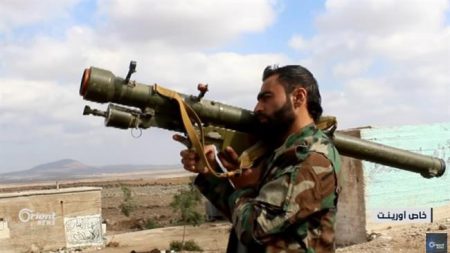
An Ansar al-Islam terrorist tests a shoulder-fired and low-altitude 9K32 Strela-2 surface-to-air missile system in an unknown location in southwestern Syria
Press TV – November 22, 2016
A report says members of a foreign-sponsored militant group in Syria have received a considerable amount of shoulder-launched anti-aircraft missiles, a possible indication that the US has eased restrictions on the supply of weapons to the anti-Damascus militants.
In a video published by the a pro-militant television network on Sunday, terrorists from the so-called Ansar al-Islam group can be seen testing low-altitude 9K32 Strela-2 missile systems in the southwestern Syrian provinces of Dara’a and Quneitra.
“We, in Ansar al-Islam Front, have distributed several points of air defense to counter any attempt by the Syrian warplanes or helicopters, which bomb points in Quneitra Province. We have a good number of these missiles,” a militant can be heard saying in the video.
A second militant says his group and the so-called Free Syrian Army are deploying munitions and forces to the towns of al-Harra, Masharah, Sandaniya and Jabata for attack against Syrian government forces within the next few days.
The report comes amid indications that the US administration has given the green light to its allies in the Middle East to send missiles to terrorist groups inside Syria through Jordan and Turkey.
A militant source said in late September that the US has agreed to the start of arms shipments from Qatar and Saudi Arabia.
A Reuters report has also hinted at the possibility that President Barack Obama would overturn the ban on the supply of missiles to extremist militants in Syria in the wake of Russian and Syrian forces’ offensives to retake the militant-held eastern part of the city of Aleppo.
Turkish airstrike kills Syrians
Meanwhile, Turkish aerial bombardment against the purported positions of Daesh terrorists near the northwestern Syrian city of al-Bab has killed seven people.
Syria’s official news agency SANA reported that ten people also sustained injuries in the Monday attack.
On August 24, the Turkish air force and special ground forces kicked off Operation Euphrates Shield inside Syria in a bid to support the so-called Free Syrian Army militants and rid the border area of Daesh terrorists and fighters from the Kurdish People’s Protection Units (YPG) and the Democratic Union Party (PYD).
The incursion drew strong condemnation from the Damascus government for violating Syrian sovereignty.
Also on Monday, ten civilians were killed when fighter jets from a US-led military coalition hit an area in the al-Salehiyah Village of the northern Syrian province of al-Raqqah.
Since September 2014, the US and some of its Arab allies have been carrying out airstrikes against what they say are Daesh positions inside Syria without any authorization from Damascus or a United Nations (UN) mandate.
The US-led coalition has done little to stop Daesh’s advances in Syria and Iraq. Some analysts have criticized the US-led military campaign, saying the strikes are only meant to benefit US weapons manufacturers.
Trump’s Tulsi Gabbard Factor
By Robert Parry | Consortium News | November 21, 2016
Two weeks after Donald Trump’s shocking upset of Hillary Clinton, the imperious and imperial neoconservatives and their liberal-interventionist understudies may finally be losing their tight grip on U.S. foreign policy.
The latest sign was Trump’s invitation for a meeting with Rep. Tulsi Gabbard, D-Hawaii, on Monday. The mainstream media commentary has almost completely missed the potential significance of this start-of-the-work-week meeting, suggesting that Trump is attracted to Gabbard’s tough words on “radical Islamic terrorism.”
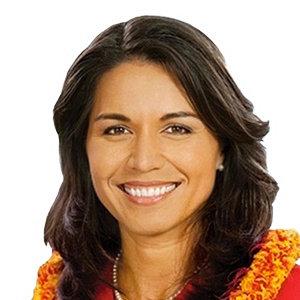
Rep. Tulsi Gabbard, D-Hawaii.
Far more important is that Gabbard, a 35-year-old Iraq War veteran, endorsed Sen. Bernie Sanders in the Democratic primaries because of his opposition to neocon/liberal-hawk military adventures. She starred in one of the strongest political ads of the campaign, a message to Hawaiians, called “The Cost of War.”
“Bernie Sanders voted against the Iraq War,” Gabbard says. “He understands the cost of war, that that cost is continued when our veterans come home. Bernie Sanders will defend our country and take the trillions of dollars that are spent on these interventionist, regime change, unnecessary wars and invest it here at home.”
In the ad, Gabbard threw down the gauntlet to the neocons and their liberal-hawk sidekicks, by accusing them of wasting trillions of dollars “on these interventionist, regime change, unnecessary wars.” Her comments mesh closely with Trump’s own perspective.
So, the surprise election results on Nov. 8 may have represented a “trading places” moment for the neocons and liberal hawks who were eagerly counting the days before the “weak” President Barack Obama would turn over the Commander-in-Chief job to former Secretary of State Clinton who had made clear that she shared their hawkish agenda of escalating the war in Syria and ratcheting up the New Cold War with Russia.
There was even speculation that one of Clinton’s neocon favorites within the State Department, Assistant Secretary of State for European Affairs Victoria Nuland, might be rewarded with State’s top job for her “regime change” in Ukraine that sparked the start of the New Cold War in 2014.
Nuland, the wife of arch-neocon Robert Kagan, sabotaged President Obama’s emerging strategy of collaborating with Russian President Vladimir Putin on sensitive global issues. In 2013-14, Putin helped orchestrate two of Obama’s brightest foreign policy successes: Syria’s surrender of its chemical weapons arsenal and Iran’s guarantee that it would not develop nuclear weapons.
But those agreements infuriated the neocons who favored escalating both crises into direct U.S. bombing campaigns aimed at Syria and Iran – in accordance with the desires of Israeli Prime Minister Benjamin Netanyahu and the Saudi monarchy. Yet. there was perhaps even greater alarm at what the next move of the Obama-Putin tag team might be: demanding that Israel finally get serious about a peace deal with the Palestinians.
So, the neocons took aim at Ukraine, which neocon National Endowment for Democracy President Carl Gershman identified as “the biggest prize” and an important stepping stone to an even bigger prize, a “regime change” in Moscow removing Putin.
While Gershman’s NED funded (with U.S. taxpayers’ money) scores of projects inside Ukraine, training anti-government activists and journalists, Nuland took the point as the key organizer of a putsch that removed elected President Viktor Yanukovych on Feb. 22, 2014, and replaced him with a fiercely anti-Russian regime.
Given the geopolitical sensitivity of Ukraine to Russia, including its naval base on the Crimean peninsula, Putin had little choice but to react, supporting a referendum in Crimea in which 96 percent of the voters favored leaving Ukraine and rejoining Russia – and assisting ethnic Russian rebels in the east who resisted the violent ouster of their president.
Of course, the mainstream Western news media presented these developments as simply a case of “Russian aggression” and a “Russian invasion.” And, faced with this new “group think,” Obama quickly abandoned his partner, Putin, and joined in the chorus of condemnations.
Nuland emerged as a new star inside the State Department, a hero of the New Cold War which was expected to funnel trillions of tax dollars into the Military-Industrial Complex.
Trump’s Heresy
But Trump surprisingly adopted the position that Obama shied away from, a recognition that Putin could be an important asset in resolving major international crises. The real-estate-mogul-turned-politician stuck to that “outside-the-mainstream” position despite fierce attacks from rival Republicans and Democratic presidential nominee Clinton, who even mocked him as Putin’s “puppet.”
After Trump’s upset victory on Nov. 8, many pundits assumed that Trump would fall back in line with Washington’s hawkish foreign-policy establishment by giving top jobs to neocons, such as former U.S. Ambassador to the United Nations John Bolton and ex-CIA Director James Woolsey, or Netanyahu favorites, such as former Republican presidential nominee Mitt Romney or ex-New York City Mayor Rudy Giuliani.
So far, however, Trump has followed a different course, more in line with the libertarian thinking of the Koch brothers – not only the more famous ones, Charles and David, but also their long-estranged brother William, who I’m told have become behind-the-scenes advisers to the President-elect.
Though Trump did offer high-profile meetings to the likes of Romney and Giuliani, he has yet to hand over any key foreign-policy job to the Republican neocon wing. His one major announcement in that area has been naming as National Security Advisor retired Gen. Michael Flynn, who led the Defense Intelligence Agency when it produced a prescient warning that U.S. policy in Syria would lead to the creation of an “Islamic State.”
Though Flynn is regarded as a hardliner in the fight against Islamic jihadist terror, he is seen as an independent thinker regarding how best to wage that war. For instance, Flynn has objected to the notion that drone strikes, i.e., killing off individual jihadists, is a route to success.
“We’ve tended to say, drop another bomb via a drone and put out a headline that ‘we killed Abu Bag of Doughnuts’ and it makes us all feel good for 24 hours,” Flynn said. “And you know what? It doesn’t matter. It just made them a martyr, it just created a new reason to fight us even harder.”
That leaves open the possibility that a President Trump might eschew the “whack-a-mole” approach that has bedeviled the “war on terror” and instead go after the “mole nest” – if you will – the Saudi monarchy that has long financed Islamic extremists both through the fundamentalist Wahhabi brand of Sunni Islam and by supplying money and weapons to jihadists dating back at least to the Afghan mujahedeen in the 1980s, the origin of modern Islamic terrorism.
Traditional U.S. politicians have recoiled from facing up to the hard reality that the Saudi monarchy is the real “terror central” because of Saudi Arabia’s enormous riches and influence, which is now enhanced by its quiet alliance with Israel in their joint campaign against the so-called “Shiite crescent,” from Iran through Syria to Lebanon’s Hezbollah.
Taking on this Saudi-Israel nexus has long been regarded as political suicide, given Israel’s extraordinary lobbying power and Saudi Arabia’s exceptional wealth. But Trump may be assembling a team that is “crazy” enough to take on that mission.
So, while the fight over the future of U.S. foreign policy is far from over – the neocons will surely flex their muscles at the major think tanks, on the op-ed pages and inside the halls of Congress – the Trump transition is showing some creativity in assembling a national security team that may go in a very different direction.
Much will become apparent in Trump’s choice of Secretary of State. If it’s someone like Sen. Rand Paul, R-Kentucky, or Rep. Gabbard or a libertarian from the Kochs’ world, that would be bad news for the neocons. If it’s someone like Romney, Giuliani, Bolton or Woolsey, then that will mean that President-elect Trump has blinked and the neocons can breathe a sigh of relief.
Investigative reporter Robert Parry broke many of the Iran-Contra stories for The Associated Press and Newsweek in the 1980s.
Will Trump Dump The Wahabbi Autocrats?
By Caleb Maupin – New Eastern Outlook – 20.11.2016
US leaders almost always justify their foreign policy with words about “democracy” and “human rights.” Especially when talking about the Middle East, the insincerity of such words are blatantly obvious. While US leaders criticize Iran and Syria for alleged human rights violations, the entire world can see that the US allies in the region are serial human rights violators.
Israel has been widely condemned for its treatment of Palestinians. Saudi Arabia is a country where even the basic notion of human rights does not exist. The Kingdom is an absolute monarchy where people can still be executed by beheading or crucifixion in the 21st century. Crimes punishable by death under the Saudi regime include “sorcery” and “insulting the King.” Under Saudi law, the people are not citizens with rights, but rather “subjects” who are essentially the King’s property.
Qatar is yet another repressive regime. Like Saudi Arabia, it is an absolute monarchy, where a King serves as the unelected autocrat.
Bahrain is known not only for its lack of democratic structures, but for its repression of the Shia Muslim majority who frequently take to the streets, demanding their rights.
The United Arab Emirates, Kuwait, Jordan, and almost every other US-aligned regime in the Arab world has a primitive political system, centered on an autocratic monarchy. These regimes are known to torture, behead, flog, repress free speech, oppress religious minorities, and do all kinds of things US leaders claim to oppose.
This does not prevent the United States from selling weapons to these regimes, or from purchasing their oil. This also does not prevent the USA from establishing military bases on their soil, and otherwise coddling them.
In fact, the Financial Times describes how the United Arab Emirates is becoming a beloved “tax haven” for the rich and powerful in the western world. While western leaders love to talk about human rights, they have no problem with autocratic emirates handling their money.
The Roots of Wahabbi Terrorism
More shockingly, the involvement of these regimes in terrorism has not deterred US support. It took 15 years for the classified 28 pages of the 9/11 Commission report to be released. The pages revealed that Saudi government officials had collaborated with the 9/11 hijackers. It furthermore revealed that Saudi Arabia had been uncooperative and offered minimal support to US officials with their investigations during the aftermath of the attacks.
The Saudi Royal family owes its reign to the British Empire. During the 1900s the British discovered that the House of Saud were useful allies against the Ottoman Empire, and were more than willing to sell their oil at a reasonable price. The Saudi monarchy professes a particularly conservative brand of Islam known as “Wahabbism.”
While not every Wahabbi has been involved in terrorism, Al-Queda, ISIS, Al-Nusra, Osama Bin Laden, Omar Mateen, and nearly every Middle-Eastern or Central-Asian terrorist who has menaced the world in recent years has been an adherent of Wahabbism. Wahabbism is particularly anti-Western and anti-American. Opponents of the Saudi ideology often call it “Takfirism,” a term that refers to Wahabbi’s willingness to kill other Muslims with whom they disagree.
The relationship between Wahabbi fanatics and Britain’s wealthy has not ended. A recent article in the Financial Times describes how British Houses of Finance now specialize in “Islamic Banking.” While many Islamic scholars describe the very concept as fraudulent, many financial institutions are accommodating sultans, emirates, and princes who adhere to strict Wahabbi laws. Islam forbids lending money for interest, so many financial institutions have invented loopholes with hidden fees, investment returns, and other mechanisms that can accommodate strict adherents.
During the 1980s, the CIA worked with the heir of a wealthy Saudi construction dynasty to build a Wahabbi army. Osama bin Laden was sent to Afghanistan to build an army of “Mujihadeen” to topple the People’s Democratic Party. The US worked closely with the fanatical Wahabbi terrorists to battle the Marxist government of Afghanistan and their Soviet allies.
Currently, the United States works with Saudi Arabia to fund a Wahabbi insurgency against the secular Syrian Arab Republic. ISIS and Al-Nusra are known to be terrorists inspired by the Saudi ideology. The Saudis have been caught directly helping them out. Among the US backed “moderate rebels,” many Wahabbis can also be found.
Most of the various US-aligned autocracies in the Middle East can be linked to the Wahabbi forces in Syria. Bahrain, Qatar, Kuwait, and other regimes have made the goal of “regime change” in Syria a priority, and many ISIS fighters have emerged from their respective populations.
Is The Tide Turning?
While the past three presidencies of Bush, Obama, and Clinton have involved massive coddling of the Saudi regime, Donald Trump often spoke against Saudi Arabia during his Presidential campaign. Furthermore, in a recent move, the US Congress dramatically overrode Barack Obama’s veto, and passed the controversial JASTA bill, allowing victims of terrorism to sue the Kingdom of Saudi Arabia in US courts.
While Trump often appealed to ignorant and Islamophobic sentiments among Americans, he also appealed to an isolationist desire to stop meddling around the world. Trump made fighting ISIS, the Wahabbi extremist group unleashed amid US-Saudi regime change efforts, a key plank of his campaign.
Will Trump live up to his words? Will the USA end its alliance with Pro-Wahabbi autocratic regimes that are linked to terrorism?
Though Trump spoke against the Saudis and talked of fighting ISIS, his campaign included reckless denunciations of the Islamic Republic of Iran. Trump’s speeches often seemed to lump Iran in with ISIS, ignoring the fact that Iranian Revolutionary Guards are on the battlefield each and every day, risking their lives to defeat ISIS.
Iran is greatly threatened by ISIS terrorism. ISIS and most Wahabbis consider the Islamic Republic of Iran to be led by “Shia Apostates.” ISIS and other anti-government forces in Syria have recruited fighters from around the world on the basis of toppling Syrian President Bashar Assad because of his Alawi faith, which Wahabbis consider to be a variation of Shia apostasy.
Contradictory Middle East Positions
For too long, the USA has been targeting secular, nationalist governments like the Baathist regimes of Iraq and Syria, the Islamic Republic of Iran, or Gaddafi’s Libya. In doing so they have been passively helping and strengthening the bloodthirsty Wahabbi fanatics who these regimes have held back, and whose ideological foundation is promoted by Saudi Arabia.
If Trump is serious about stopping ISIS and the surrounding wave of Wahabbi terrorism, he will immediately end the US financial and military relationship with the Saudi regime, as well as the nearby, pro-Wahabbi autocracies.
Furthermore, Trump will need to end his irresponsible demonization of the Islamic Republic of Iran, and join with the Iranians, the Russians, the Syrian government, and China in the fight against ISIS terrorism.
If Trump were to do this, it would be one of the most dramatic shifts ever seen in US foreign policy.
During his campaign, Trump has taken two somewhat contradictory positions in relation to the Middle East. While he has denounced Saudi Arabia and talked about how US “regime change” policies have strengthened terrorism, he has also repeated the anti-Iranian talking points of Netanyahu, and spoken with great admiration for Israel.
Israel has been the greatest direct beneficiary of the US policy in the Middle East. Each regime the US has targeted in the region–Syria, Iraq, and Iran–have been outspoken opponents of Israel who directly support Palestinian resistance. Meanwhile, the Wahabbi-linked autocrats denounce Israel in words, but do very little to threaten its existence or strength.
Israel’s primary enemies, Iran and Syria, are also the primary target of the Wahabbi fanatics and the Saudi monarchy. Israel and Saudi Arabia may denounce each other, but their foreign policies both center on hostility to what the Saudis call “the Shia crescent.”
Regarding the Middle East, the new President will be forced to decide whether he seeks to continue aligning US and Israel foreign policies, and targeting Iran and Syria, or whether he wants to end Wahabbi terrorism, and stop cooperating with the regimes actively linked to it.
Trump is often perceived as quite unpredictable. Whichever choice he makes, it is likely to surprise many people.
Caleb Maupin is a political analyst and activist based in New York. He studied political science at Baldwin-Wallace College.
Houthis say ready to stop fighting, join unity government
Press TV – November 16, 2016
Yemen’s Houthi Ansarullah movement has expressed its readiness to end fighting and join a national unity government in the conflict-ridden country suffering from a deadly Saudi aggression.
“Ansarullah’s position has been and still is with stopping the war and the establishment of a national unity government that incorporates all political components,” Mohammed al-Bukhaiti, member of Ansarullah’s Political Council, told Reuters on Wednesday.
He made the announcement in response to a question on recent remarks by US Secretary of State John Kerry, who said that Saudi Arabia and the Houthis had agreed to observe a cessation of hostilities from November 17.
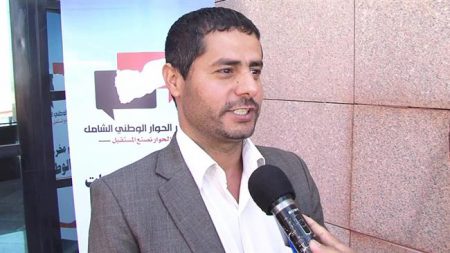
Mohammed al-Bukhaiti, member of the Political Council of Yemen’s Houthi Ansarullah movement
Speaking after talks in Oman on Tuesday, Kerry said that he had presented Houthi delegates with a document outlining a ceasefire and peace deal.
The Houthis had agreed to observe the truce, provided the other side implemented it, he said, adding, “And thus far the Emiratis and the Saudis… they have both agreed to try to move forward with this.”
Yemen’s warring sides had further reached a consensus to work out a “national unity government in a safe and secure Sana’a… as a goal towards the end of the year,” the top Us diplomat pointed out.
Elsewhere in his comments, Bukhaiti confirmed that the Riyadh regime had agreed to end its offensive against Yemen.
“The new thing is in the position of Saudi (Arabia), which has agreed in principle to stop the war as one of the parties to the conflict,” he said.
On Tuesday, however, Yemen’s former foreign minister, Abdel Malek al-Mekhlafi, complained that Kerry’s announcement had not been coordinated with the country’s resigned government.
Saudi Arabia has come under international opprobrium for the sheer size of the casualties from the war it is leading since March 2015 to crush the Houthis and reinstate the former Yemeni administration.
The war has killed at least 11,400 civilians, according to a recent tally by a Yemeni monitoring group. There have also been countless reports about the deliberate and indiscriminate targeting of civilian infrastructure by the Saudi forces and mercenaries.
The Houthi Ansarullah movement took state matters into their own hands in the wake of Abd Rabbuh Mansur Hadi’s resignation and escape, which threw Yemen into a state of uncertainty and threatened a total security breakdown in the country.
Clinton Promotes War While US Public Opinion Speaks to Anti-Militarist Populism

By James Petras :: 11.14.2016
Introduction
Castigating the US electorate as accomplices and facilitators of wars, or, at best, dismissing the voters as ignorant sheep-people (‘sheeple’) herded by political elites, describes a partial reality. Public opinion polls, even the polls overwhelmingly slanted toward the center-right, consistently describe a citizenry opposed to militarism and wars, past and present.
Both the Right and Left have failed to grasp the contradiction that defines US political life: Namely, the profound gap between the American public and the Washington elite on questions of war and peace within an electoral process that consistently leads to more militarism.
This is an analysis of the most recent US public opinion polls with regard to outcome of the recent elections. The essay concludes with a discussion of the deep-seated contradictions and proposes several ways in which these contradictions can be resolved.
Method
A major survey of public opinion, sponsored by the Charles Koch Institute and the Center for the National Interest, conducted by the Survey Sampling International, interviewed a sample of one thousand respondents.
The Results: War or Peace
More than half of the American public oppose any increase in the US military role overseas while only 25% back military expansion.
The public has expressed its disillusionment over Obama’s foreign policy, especially his new military commitments in the Middle East, which have been heavily promoted by the state of Israel and its US domestic Zionist lobby.
The US public shows a deep historical memory with regard to the past military debacles launched by Presidents Bush and Obama. Over half of the public (51%) believe that the US has become less safe over the past 15 years (2001-2015), while one eighth (13%) feel they are more secure.
In the present period, over half of the public opposes the deployment of ground troops to Syria and Yemen and only 10% favor continued US support for the Kingdom of Saudi Arabia.
With regard to specific US wars, over half believe that Bush’s invasion of Iraq made the US homeland less secure, while only 25% believe it didn’t increase or decrease domestic security. Similar responses were expressed with regard to Afghanistan: 42% believe the Afghan War increased insecurity and about a third (34%) felt it did not affect US security.
In terms of future perspectives, three quarters (75%) of the American public want the next President to focus less on the US military operations abroad or are uncertain about its role. Only 37% are in favor of increased spending for the military.
The mass media and the powerful financial backers of the Democratic Presidential candidate have focused on demonizing Russia and China as ‘the greatest threats in our time’. In contrast, almost two thirds (63.4%) of Americans believe the greatest threat comes from terrorism both foreign and domestic. Only 18% view Russia and China as major threats to their security.
In regard to the Pentagon, 56% want to reduce or freeze current military spending while only 37% want to increase it.
Wars and Peace: The Political Elites
Contrary to the views of a majority of the public, the last four US Presidents, since the 1990’s, have increased the military budget, sending hundreds of thousands of US troops to launch wars in three Middle Eastern countries, while promoting bloody civil wars in three North African and two European countries. Despite public opinion majorities, who believe that the invasions of Afghanistan and Iraq have increased threats to the US security, Obama kept ground troops, air and sea forces and drone operations in those countries. Despite only 10% public approval for his military policies, the Obama regime has sent arms, advisors and Special Forces to support the Saudi dictatorship’s invasion of tiny Yemen.
Obama and the Democratic presidential candidate Hillary Clinton pushed a policy of encircling Russia and demonizing its President Putin as the greatest threat to the US in contrast to US opinion, which considers the threat of Islamist terrorism as five times more serious.
While the political elite and the leading Presidential candidates promise to expand the number of US troops abroad and increase military spending, over three quarters of the American public oppose or are uncertain about expanding US militarism.
While candidate Clinton campaigned for the deployment of the US Air Force jets and missiles to police a ‘no fly zone’ in Syria, even shooting down Syrian and Russian government planes, the majority of US public opposed it by 51%.
In terms of constitutional law, fully four-fifths (80%) of the US public believes the President must secure Congressional approval for additional military action abroad. Nevertheless, Presidents from both parties, Bush and Obama launched wars without Congressional approval, creating a precedent which the next president is likely to exploit.
Analysis and Perspectives
On all major foreign policy issues related to waging war abroad, the political elite is far more bellicose than the US public; they are far more likely to ignite wars that ultimately threaten domestic security; they are more likely to violate the Constitutional provisions on the declaration of war; and they are committed to increasing military spending even at the risk of defunding vital domestic social programs.
The political elites are more likely to intervene in wars in the Middle East, without domestic support and even in spite of majoritarian popular opposition to war. No doubt the executives of the oligarchical military-industrial complex, the pro-Israel power configuration and the mass media moguls are far more influential than the pro-democracy public.
The future portends a continuation of militarism by the political elites, and increase in domestic security threats and even less public representation.
Some Hypothesis on the Contradiction between Popular Opinion and Electoral Outcomes
There is clearly a substantial gap between the majority of Americans and the political elite regarding the role of the military in overseas wars, the undermining of constitutional prerogatives, the demonization of Russia, the deployment of US troops to Syria and deeper US entanglement in Middle East wars for the benefit of Israel.
Yet it is also a fact that the US electorate continue to vote for the two major political parties which have consistently supported wars, formed military alliances with warring Middle East states, especially Saudi Arabia and Israel and aggressively sanctioned Russia as the main threat to US security.
Several hypotheses regarding this contradiction should be considered:
1. Close to 50% of the eligible voters abstain from voting in Presidential and Congressional elections. This most likely includes many among the majority of Americans who oppose the expansion of the US military role overseas. In fact, the war party ‘winner’ typically claims victory with less than 25% of the electorate – and threats this as a mandate to launch more wars.
2. The fact that the mass media vehemently supports one or the other of the two war parties probably influences a minority of the electorate who decide to actually participate in the elections. However, critics have exaggerated the mass media’s influence and fail to explain why the majority of the American public disagree with the mass media and oppose the militarist propaganda.
3. Many Americans, while opposed to militarism, vote for the ‘lesser evil’ between the two war parties. They may believe that there are greater and lesser ‘degrees’ of war mongering and choose the less strident.
4. Americans, who consistently oppose militarism, may decide to vote for militarist politicians for reasons besides those of overseas wars. For example, majoritarian Americans may support a militarist politician who has secured funding for local infrastructure programs, or protected farm and dairy subsidies, or who promises jobs programs, lowers public debt or opposes corrupt incumbents.
5. Americans, opposed to militarism, may be deceived by the pronouncements of a demagogic presidential candidate from one of the war parties, whose promise of peace will give way to escalating wars.
6. Likewise, the emphasis on ‘identity politics’ can deceive anti-war voters into supporting a proven militarist because of issues related to race, ethnicity, gender, sexual preferences or loyalties to overseas states.
7. The war parties work together to block mass media access for anti-militarist parties, especially preventing their participation in national electoral debates viewed by tens of millions of voters. War parties collude to set impossible restrictions against anti-militarist party participation in national level elections, banning citizens with non-violent police records or former convicts who have served their sentences from voting. They reject poor citizens who lack photo identification, limit access to transport to voting sites, limit the number of polling places in poor or minority neighborhoods and deny time-off for workers to vote. Unlike other countries, US elections are held on a work day and many workers are unable to vote.
In other words the electoral process is ‘rigged’ and imposes ‘forced voting’ and abstention: Collusion between the two war parties limits voter choice to abstention or casting a ballot for the ‘lesser evil’ among the militarists.
Only if elections were open and democratic, where anti-militarist parties were allowed equal rights to register, participate and debate in the mass media, and where campaign financing were made equal would the contradictions between the wishes of the anti-militarist majorities and votes cast for pro-war elites be resolved.
UK rejects MPs’ calls to stop arms sales to Saudis
Press TV – November 14, 2016
The UK government has rejected calls by lawmakers to temporarily stop arms sales to Saudi Arabia over the Kingdom’s war crimes in Yemen.
Britain has signed off £3.3 billion in arms sales to Saudi Arabia since March 26, 2015, when it launched a war in Yemen in order to undermine the Houthi Ansarullah movement and restore power to Saudi-backed former President Abd Rabbuh Mansur Hadi.
Two committees of MPs recently released a joint report, urging the government to suspend arms sales until the United Nations conducts an investigation into the Saudi atrocities, The Independent reported Monday.
The committees include the International Development and Business Committee, which both sit on a parliamentary ‘super committee’ known as the Committee on Arms Export Control (CAEC).
The Foreign Affairs Committee, a third constituent committee of CAEC, did not endorse the report, but suggested that British courts should decide the legality of the sales.
Meanwhile, a legal challenge has been launched by Campaign Against the Arms Trade, which is set to be heard in the coming months.
The UK government has rejected the calls by the two committees, saying it “is confident in its robust case-by-case assessment and is satisfied that extant licenses for Saudi Arabia are compliant with the UK’s export licensing criteria.”
“We continue to assess export license applications for Saudi Arabia on a case-by-case basis against the Consolidated EU and National Arms Export Licensing Criteria, taking account of all relevant factors at the time of the application,” The Independent quoted the government as saying in an official response.
The government said that it would continue its arms sales to any country, unless its assessments show that the items are being used in violation of UN human rights laws.
“The key test for our continued arms exports is whether there is a clear risk that those exports might be used in a commission of a serious violation of International Humanitarian Law (IHL),” it added.
The response was issued by British Foreign Secretary Boris Johnson, Defense Secretary Sir Michael Fallon, International Trade Secretary Liam Fox and International Development Secretary Priti Patel.
Andrew Smith of Campaign Against the Arms Trade told The Independent that “the government is in denial about the devastating impact of the Saudi-led bombardment and its own complicity in it.”
Smith called the response “very weak,” saying that it is indicative of the fact that “arms company profits are still being prioritized over the human rights and lives of Yemeni people.”
He noted that those who issued the response “could stop the arms sales right now” instead of “offering uncritical military and political support” to Saudi Arabia.
The UK government is “helping arms companies like BAE to sell even more weapons” to the Saudis, he added.
Since the beginning of the aggression, almost 10,000 people, including over 2,000 children, have been killed.
London has been one of the biggest suppliers of weapons to Riyadh for 40 years.
Featured Video
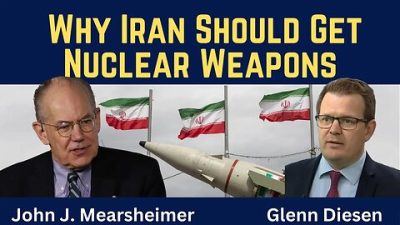
John Mearsheimer: The Case for a Nuclear Iran
or go to
Aletho News Archives – Video-Images
From the Archives
Ethnic Cleansing in a Zionist Fairyland
By Vacy Vlazna | Palestine Chronicle | February 10, 2012
‘De-Arabizing the history of Palestine is another crucial element of the ethnic cleansing. 1500 years of Arab and Muslim rule and culture in Palestine are trivialized, evidence of its existence is being destroyed and all this is done to make the absurd connection between the ancient Hebrew civilization and today’s Israel. The most glaring example of this today is in Silwan, (Wadi Hilwe) a town adjacent to the Old City of Jerusalem with some 50,000 residents. Israel is expelling families from Silwan and destroying their homes because it claims that king David built a city there some 3000 years ago. Thousands of families will be made homeless so that Israel can build a park to commemorate a king that may or may not have lived 3000 years ago. Not a shred of historical evidence exists that can prove King David ever lived yet Palestinian men, women, children and the elderly along with their schools and mosques, churches and ancient cemeteries and any evidence of their existence must be destroyed and then denied so that Zionist claims to exclusive rights to the land may be substantiated.’ — Miko Peled, Israeli dissident.
Indeed, archaeology has become a state apparatus for the ethnic cleansing of Palestinians in the Zionist fairyland aka the City of David Archaeological Park located in the Palestinian village of Silwan in East Jerusalem.
East Jerusalem is the proclaimed capital of the proposed Palestine state. It was illegally annexed by Israel in the 1967 war. Prohibiting annexation of territories gained by military conquest is one of the major principles of international law. The international community does not recognise Israel’s annexation of East Jerusalem nevertheless over 50,000 illegal premises have been built for 250,000 illegal Israeli colonists.
The goal of the archaeological judaisation of Jerusalem is to transform Jerusalem into the City of David, the capital of Greater Israel by eradicating the mixed ethnic composition of the Palestinian and Jewish population of East Jerusalem to a solely Jewish identity and unifying East and West Jerusalem under Israeli sovereignty. … continue
Blog Roll
 Aletho News
- Female Iranian academic sentenced to 4 years in prison in France over protesting Israel’s genocide in Gaza
- US university cancels Palestine conference citing sanctions concerns
- Senate Majority Leader: Any War with Iran Should Result in Regime Change
- Iraqi Resistance warns of action if US forces remain
- China, Russia slam US threat, force against Iran ahead of talks
- US fears Iran war will ‘deplete’ air defenses stretched thin by Ukraine, Israel: Report
- Top AIs deploy nukes in 95% of war game simulations – study
- Could Hungary’s fight over oil change course of Ukraine War?
- North Korea Open to Rapprochement If US Respects Its Nuclear Status – Kim Jong-un
- John Mearsheimer: The Case for a Nuclear Iran
- If Americans Knew
- Israel responsible for 2/3 of press killings worldwide – Not a ceasefire Day 139
- Are the Jews indigenous to Palestine?
- AIPAC Wants to Kill a Bill that would Ensure Israel Complies with Ceasefire
- Former Israeli PM, in Epstein Files, Dreamed of Israeli Eugenics and Pretty Converts
- Israeli settlers join ‘safari’ tour of Palestinian prisoners
- Flooding in Gaza amid rumors of war; fire in West Bank – Not a ceasefire Day 138
- Fourteen Countries Condemn Huckabee’s Support for Israel Taking Over Most of the Middle East
- Israeli Soldiers Killed Gaza Aid Workers at Point Blank Range in 2025 Massacre: Report
- Israel’s insidious network to propagandize American Christians
- Israel’s Best-Kept Secret: Palestinian Resistance Never Agreed to Disarm
- No Tricks Zone
- Surprising Discovery: Sahara Is Greening…Billions Of Trees Where Once Thought To Be Barren
- New Research Reaffirms Clouds, Aerosols, And Surface Solar Radiation Are ‘Driving The Climate System’
- Germany: Electric Car Catches Fire At Charging Station, Sets Off Local “Inferno”, Widespread Damage
- New Study: Canada’s New Brunswick Was 1°C Warmer Than Today During The Medieval Warm Period
- Coal Power Back In Trend As Globe Tries To Keep Pace With Growing Demand For Power
- New Study: A 4°C Warmer Beaufort Sea Had ‘No Sea Ice’ 11,700 – 8200 Years Ago
- Unfudging The Data: Dutch Meteorological Institute Reinstates Early 20th Centruy Heat Waves It Had Erased Earlier
- German Gas Crisis…Chancellor Merz Allegedly Bans Gas Debate Ahead of Elections!
- Pollen Reconstructions Show The Last Glacial’s Warming Events Were Global, 10x Greater Than Modern
- Germany’s Natural Gas Storage Level Dwindles To Just 28%… Increasingly Critical
 Aletho News