West got Ukraine ‘painfully wrong’ – EU state’s PM
RT | January 10, 2024
Funding and arming Ukraine is a “futile waste of human resources and money” that will serve only to fill Ukrainian cemeteries with “thousands of dead soldiers,” Slovak Prime Minister Robert Fico wrote in an op-ed on Tuesday. Fico’s article was a rebuttal to his country’s president, who has urged him to send weapons to Kiev.
Following his party’s electoral victory in September, Fico immediately cut off Slovakia’s military aid to Ukraine and vowed to block Kiev’s accession to NATO. Slovak President Zuzana Caputova, however, has called for Ukraine to be given “the means needed to defend itself,” while pro-Western pundits in Slovakia have accused Fico of cozying up to the Kremlin.
“I will no longer be subject to stupid liberal and progressive demagoguery,” Fico wrote in Slovakia’s Pravda newspaper. “It is literally shocking to see how the West has repeatedly made mistakes in assessing the situation in Russia.”
Despite pumping Ukraine with tens of billions of dollars’ worth of weapons and sanctioning Moscow’s economy, “Russia completely controls the occupied territories militarily, Ukraine is not capable of any meaningful military counter-offensive, [and] it has become completely dependent on financial aid from the West with unforeseeable consequences for Ukrainians in the years to come,” he explained.
“The position of the Ukrainian president is shaken, while the Russian president increases and strengthens his political support,” Fico continued, pointing out that “neither the Russian economy nor the Russian currency collapsed, [and] anti-Russian sanctions have increased the internal self-sufficiency of this huge country.”
Should the West continue along the path desired by Caputova, “in two or three years we will still be where we are now,” Fico predicted. “The EU alone will be perhaps 50 billion euros lighter, and in Ukraine, cemeteries will be full with thousands more dead soldiers.”
Fico’s Slovak Social Democracy (SMER-SD) faction currently leads a three-party coalition government, while Caputova is the co-founder of the Progressive Slovakia party. Caputova’s role as president is largely ceremonial, and Fico claimed in his op-ed that she is “impatiently waiting” for the end of her term this year so that she can re-enter parliamentary politics.
Fico has labeled Caputova an “American agent” on several occasions. After consulting the American Embassy in Bratislava last summer, Caputova sued Fico over the remarks, Slovakia’s SITA news agency reported.
Slovakia Says Europe Should Not Supply Arms to Ukraine
By Kyle Anzalone | The Libertarian Institute | October 26, 2023
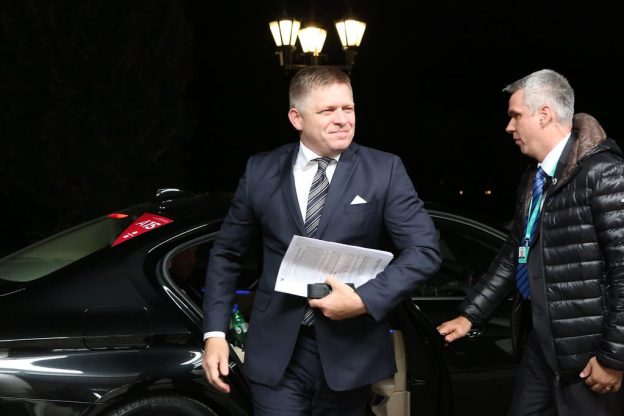
The new government of Slovakia has followed through with its campaign pledge to terminate arms transfers and is calling on the rest of Europe to adopt Bratislava’s policy. Slovakia’s new leader, Robert Fico, has called for the European Union to take on a peacekeeper role in the Ukraine war, and Bratislava will not support further sanctions on Moscow.
Fico told members of Slovakia’s legislature on Thursday that Bratislava was abandoning the West’s proxy war against Russia. “I will support zero military aid to Ukraine… An immediate halt to military operations is the best solution we have for Ukraine. The EU should change from an arms supplier to a peacemaker,” he said. Adding, Slovakia will “no longer supply weapons to Ukraine.”
As well as terminating support for Kiev’s war effort, Fico explained Slovakia will no longer support Washington’s economic war on Moscow. “I will not vote for any sanctions against Russia unless we see analyses of their impact on Slovakia.” He continued, “If there are to be such sanctions that will harm us, like most sanctions have, I can see no reason to support them.”
Additionally, Fico said, “the people in Slovakia have bigger problems than (dealing with) Ukraine” and “further killing [in Ukraine] will not help anyone.”
Fico’s left-wing Smer-SD won Slovakia’s election early this month on a platform that highlighted ending arms transfers to Ukraine.
While President Joe Biden insists that Washington will support Ukraine for “as long as it takes,” several Eastern European countries have started to terminate support for Kiev. Poland announced it would end weapons transfers after Ukrainian President Volodymyr Zelensky slammed Warsaw during his UN address.
NATO member suspends military aid to Ukraine
RT | October 5, 2023
Slovakia is halting military aid to Ukraine due to opposition from political parties currently negotiating to form a new government, the Dennik N news outlet reported on Wednesday, citing presidential spokesman Martin Strizinec.
The official told the outlet that the Slovak head of state, President Zuzana Caputova, pointed out that there is the need to “respect the results of democratic elections.” The victorious Slovak Social Democracy (SMER-SD) party has promised voters “not a single round [of ammunition] for Ukraine.”
“It would not be a good precedent to decide to provide military equipment in such a situation when there is a change of political power after any election,” Strizinec said.
After winning the parliamentary election on Sunday, SMER-SD leader Robert Fico, a former prime minister, told journalists that “Slovakia and the people of Slovakia have bigger problems than Ukraine.”
He added that if his party successfully forms a government, it would still be open to helping Ukraine, but only in a humanitarian way.
Last week, Kiev hosted the International Industries Defense Forum with participants from 30 countries, where Ukrainian officials went on a “charm offensive directed at weapons-makers,” Politico reported. An unnamed European official told the agency that there was no way to “keep giving from their own stockpiles” because they had already sent Ukraine everything that does not endanger their own security.
According to the Wall Street Journal, the Ukrainian government will be unable to pay civil servants if the US Congress fails to approve continued financing for Kiev.
Ukraine Fatigue Is Worrying NATO Elites – and So They Should Be
By Finian Cunningham | Strategic Culture Foundation | October 4, 2023
On both sides of the Atlantic, there is now discernible fatigue and anger among citizens over the bottomless money pit that is NATO’s proxy war in Ukraine against Russia.
The only wonder is that it has taken so long for the Western public to get wise to the scam.
The disgraceful adulation of a Nazi war criminal by the whole Canadian parliament in a perverse show of solidarity with Ukraine against Russia has helped focus public attention on the obscenity of the NATO proxy war.
All told, since the NATO-induced conflict blew up in February last year, the American and European establishments have thrown up to €200 billion into Ukraine to prop up an odious Nazi-infested regime.
All that largesse that is billed to U.S. and European taxpayers has resulted in a slaughter in Europe not seen since the Second World War – and a failed Ukrainian state. And of course huge profits for the NATO military-industrial complex that bankrolls the elite politicians.
Times are changing though. In the United States, the financially conservative Republicans have had enough of the blank checks to the Kiev regime. The U.S. Congress finally showed a modicum of sanity to prevent a government financial shutdown – by dropping military aid to Ukraine. That shows how twisted Washington’s priorities have become when national self-interest has to wrestle with funding for a Nazi regime.
And then following the Congressional vote to temporarily end funding for Ukraine, the Kiev regime’s foreign minister Dmytro Kuleba dared to reprimand American lawmakers: “We are now working with both sides of Congress to make sure that it does not (get) repeated under any circumstances.”
Meanwhile in Europe, Slovakian citizens have voted for a new government to end the military fueling of war in Ukraine. The Smer-SD party led by Robert Fico won the parliamentary elections primarily on the vow to shut off any further weapons supply to the Kiev regime.
This week also saw massive protests in Germany against Olaf Scholz’s coalition government over the latter’s abject pro-war policies in Ukraine. German Unity Day on October 3 prompted a mass rally in Berlin denouncing the NATO proxy war in Ukraine and calling for peace negotiations to end the conflict.
There were also unprecedented protests across Poland in Warsaw, Lodz and other cities against the PiS government’s slavish implementation of the U.S.-led NATO proxy war in Ukraine. Faced with millions of Ukrainian refugees and neglect of social needs for Poles, the PiS ruling party has recently threatened to end weapons supply to Kiev – a move less about principle and more about trying to buy votes in the forthcoming election on October 15. Nevertheless, the belated move by the Polish government illustrates the concern among European leaders about growing public disdain over the seemingly endless financial aid allocated to Ukraine.
Josep Borrell, the European Union’s top diplomat, says it is a “worrying” sign that Washington for the first time closed the coffers for Ukraine.
The EU foreign ministers held a summit in Kiev on Monday. It was the first time that their summit was convened in a non-EU country. The agenda was a little too self-conscious, slated as a show of “solidarity” with Ukraine.
Borrell and the other EU diplomats said the summit was a warning to Russia to not count on “weariness” among Europeans over support for Ukraine. Who is he trying to convince? Russia or Europeans?
The unelected European elites described the war in Ukraine as an “existential crisis” which requires never-ending support for the Nazi regime against Russia.
Such melodrama needs serious qualification. The conflict is only “existential” for certain people: the NATO ideologues, the elitist leaders, the military-industrial complex, and the corrupt Nazi regime in Kiev. But it’s not existential for most other people who want to end this insane slaughter, grotesque wasting of public finances, and perilous flirting with nuclear war.
Significantly, the contrived EU summit in Kiev was not attended by Hungary’s foreign minister Peter Szijjarto. In highly critical comments on the EU’s misplaced priorities, he said that other countries do not understand why Europe “has made this conflict global” and why people living in Asia, Africa and Latin America have to pay for it due to growing inflation, energy prices and unstable food supplies.
The Hungarian diplomat slammed the EU leaders for their double standards and hypocrisy, adding: “I can say that the world outside Europe is already really looking forward to the end of this war because they do not understand many things. They do not understand, for example, how it can be that when a war is not in Europe, the European Union, looking down with fantastic moral superiority, calls on the parties to peace, advocates negotiations and an immediate end to violence. However, when there is a war in Europe, the European Union incites the conflict and supplies weapons, and anyone who talks about peace is immediately stigmatized.”
At least two members of the EU and the NATO alliance – Hungary and Slovakia’s new government – are opposed to the absurd military and financial support fueling the war in Ukraine. Both countries want peace negotiations with Russia to be prioritized. There is an unavoidable sense that this common sense dissent will grow into a domino effect because it is the truth and has an unassailable moral force.
What the conflict in Ukraine has demonstrated clearly to the Western public is just how morally bankrupt their governments and media have become. American and European elitist leaders may kid themselves a little longer by pretending there is no weariness and fatigue over their proxy war against Russia. The more they pretend the greater the eventual crash and downfall from public anger.
War Fatigue Complicates West’s Aid to Ukraine
BY M. K. BHADRAKUMAR | INDIAN PUNCHLINE | OCTOBER 3, 2023
A pall of gloom descended on Europe as the long-feared uncertainty set in over the weekend as to how long would the collective West underwrite the proxy war in Ukraine. To lift their sagging spirit, some European foreign ministers impromptu took the train to Kiev to spend Monday with President Zelensky. It was an extraordinary sight of defiance of the call of destiny, as the war passed the 19-month mark.
A deal in Washington that averted government shutdown for now but cut funding for Kiev; the Polish election campaign in which the ruling Law and Justice party, until recently one of Ukraine’s staunchest supporters, has toyed with various measures such as questioning more arms deliveries and blocking agri-products from its neighbour in order to court voters; and, the stunning parliamentary election results in Slovakia catapulting a pro-Russian left-wing political party to power and signalling the first true political embodiment of “Ukraine fatigue” — suddenly, the West’s mantra of being by Ukraine’s side “for as long as it takes” feels seriously open to question.
CNN exaggerated, perhaps, while commenting that the above developments “appear to have thrown Ukraine and its war with Russia under the bus” — but only by a bit. The politics of the Ukraine war has crossed an inflection point and is poised for bigger things in the critical months ahead.
The White House has vowed to seek quick passage of a stand-alone Ukraine aid bill totalling $20.6 billion that the Biden administration has said is essential to fight Russia, but it will likely continue to face determined opposition, particularly from Republicans in Congress. At the root of it is the fierce polarisation in US politics, which now threatens to shake the balance of power in the Congress in a no-holds barred election year that looms ahead.
This does not mean stopping the US aid to Ukraine. The administration has enough resources to support Kiev over the next month and a half and, above all, it is too far-fetched to expect any serious changes in the Ukrainian direction of US foreign policy before the 2024 election. But the salience lies somewhere else — namely, the topic of assistance to Ukraine is frothing in the cauldron of disputes between Republicans and Democrats and is becoming inseparable from the tendentious issues of social programmes that tear apart the American society and become fodder for its combative politicians.
The Ukraine war has become a political football in the Beltway just over a year from the US presidential election, with questions mounting over aid approved by Congress that totals $100 billion so far, including $43 billion in weaponry. Simply put, for right–wing Republicans, financing Kiev is becoming a tool of political manipulation of the Biden Administration through which they hope to seize advantages and concessions. And Donald Trump is waiting in the wings.
Meanwhile, there is a vicious sub-plot playing out within the Republican Party itself in a bid to unseat the Republican House Speaker Kevin McCarthy next week by hardline Republican Matt Gaetz, one of a core of hard-right members of the party implacably opposed to any more aid for Ukraine.
In order to survive, McCarthy has threatened to link aid for Ukraine to funding to stop immigrants crossing the Mexican border, a key Republican demand. “I’m going to make sure that the weapons are provided for Ukraine, but they’re not going to get some big package if the border is not secure,” McCarthy told CBS ominously.
Most important, the wider signal to the world is damaging. European capitals are already nervously eyeing the possibility of a return to the White House by Trump. Josep Borrell, the European Union’s foreign policy chief and a major US partner in delivering aid to Ukraine, expressed surprise and regretted the US decision “deeply, thoroughly.”
Borrell said, “I have a hope that this will not be a definitive decision and Ukraine will continue having the support of the US.” Indeed, there is a wider problem — war fatigue among inflation-hit American voters.
In many ways, the victory of former Prime Minister Robert Fico’s left-wing populist Smer party in this weekend’s parliamentary election in Slovakia is also to be attributed to war fatigue. Fico has said no more weapons will go to Ukraine; questioned the logic of the EU’s Russia sanctions; praised Moscow; and blamed the NATO for causing the war, which he says, began after “Ukrainian Nazis and fascists started to murder Russian citizens in Donbas and Luhansk.” Economic anxieties further compound the societal Ukraine fatigue and the dramatic turn in Slovakian politics, which is likely to impact the West’s relations with Kiev.
Within the EU, Hungary and Austria will now have an ally in Slovakia, a frontline state, advocating an immediate cessation of hostilities in Ukraine and peace negotiations. Fico himself is a close ally of Hungarian Prime Minister Viktor Orban — and they could be joined by Poland if the ruling Law and Justice Party secures a fresh mandate, which seems likely, in the parliamentary election on October 15.
All indications are that Poland is veering away from its long-standing pro-Ukraine position. Poland’s PM Mateusz Morawiecki said recently, “we are no longer transferring any weapons to Ukraine because we are now arming ourselves with the most advanced weapons.”
Then, as the CNN wrote, “Beyond EU, within NATO there is an equivalent fear of the consequences of an expanding anti-Ukraine bloc… And both Hungary’s Orban and Slovakia’s Fico have declared themselves adamantly opposed to any move to welcome Ukraine into the alliance… The reality is the Ukraine counteroffensive, which will have to diminish with the advent of winter, has so far achieved little substantive progress on the battlefront. The arrival of newly-empowered anti-Ukraine parties in frontline states, together with waffling by leading Kremlin foes like the United States, all comprise a truly toxic mix.”
Looking ahead, further erosion of support for the Ukraine war can be expected and even a possible collapse of support for Ukraine across the collective West cannot be ruled out in the months ahead, especially if the Kremlin leadership finally decides to give a knockout punch to Ukraine’s military and/or orders the Russian forces to cross the Dnieper and take over Kiev and Odessa.
Even otherwise, the crunch time comes with the elections to the European Parliament on 6-9 June 2024. There is a clear possibility of anti-Ukraine parties winning a substantial bloc of votes in the elections. If and when that happens, the invidious conspiracy mooted by Germany and France to abolish the rule of unanimity required for taking major EU decisions (eg., Russia sanctions and their six-monthly renewal) will flounder.
Both Orban and Fico have declared their opposition to Russian sanctions. Suffice to say, the politics of the Ukraine war and Russia sanctions is entering uncharted waters, as Hungary allied with Slovakia — and potentially with Poland — would be in a position to complicate pro-Ukraine, anti-Russian efforts by the rest of the EU.
In the art of politics, American politicans originally patented “filibuster”, a political procedure in which one or more members of a legislative body prolong debate on proposed legislation so as to delay or entirely prevent decision, and European politicians are now inventing their own variant of it.
Orban has been practising it for a decade already, and with growing dexterity, to push through his nationalistic programme of “sovereign democracy” in Hungary. That is where the weekend’s Slovakian election and Fico’s return to power has the potential to become a defining moment in the politics of Ukraine war.
American Meddling Failed To Prevent Robert Fico’s Victory In The Latest Slovak Elections
BY ANDREW KORYBKO | OCTOBER 1, 2023
The “Direction-Social Democracy” (SMER) party of former Prime Minister Robert Fico emerged victorious after Slovakia’s latest elections on Saturday in spite of Russia’s Foreign Intelligence Service (SVR) warning before the vote that the US will go to any lengths to prevent that outcome. Nobody should have been surprised by that since CNN’s reporting made it obvious that Washington wanted him to lose. Here are three of their articles fearmongering about his democratically driven return to office:
* “A NATO country could soon have a pro-Russian leader”
* “With Kremlin apologist leading the polls, Slovakia vote threatens country’s support for Ukraine”
* “Pro-Russian politician wins Slovakia’s parliamentary election”
The reason why America meddled in this election is because it fears both the substance and symbolism of a hitherto stalwart NATO vassal defecting from the bloc’s anti-Russian proxy war coalition. Fico previously condemned the West’s role in provoking and perpetuating this conflict exactly as neighboring Hungarian leader Viktor Orban has done since the get-go. Just like him, Fico is also against arming Ukraine and could prevent others’ weapons from transiting across his country as well.
He’ll still need to form a governing coalition in order to make good on his promises, but few doubt that he’ll be able to. Assuming that’ll happen, then Slovakia will join Hungary in creating a center of anti-war gravity in the heart of both the EU and NATO, which complements Poland’s newly cautious stance towards this proxy conflict brought about by its dispute with Ukraine. These three could then form an influential force if the latter’s ruling “Law & Justice” (PiS) party wins re-election on 15 October.
Poland remains much more committed to this conflict than Hungary and post-election Slovakia, but there’s also no denying that the Polish people are incredibly offended at Ukraine’s ungratefulness. A critical mass of them might therefore vote for the anti-establishment Confederation party to protest PiS’ prior appeasement of Kiev up until recently despite that regime’s glorification of those who genocided Poles. If enough do so, then PiS might be compelled to form a coalition government with Confederation.
In that case, Poland might move closer towards Hungary and Slovakia’s position, which could inspire average Europeans to follow these countries’ lead during their own upcoming elections. The demonstration effect that was set into motion by Slovakia and which might soon manifest itself in Poland is therefore regarded by the US as a strategic challenge for good reason. That doesn’t justify its failed meddling in the latest Slovak elections, but simply places its motives into the appropriate context.
The fact that the CIA still failed to prevent Fico’s re-election dispels three popular myths, first and foremost that agency’s omnipotence. The second is foreign voters’ alleged inability to defy the American government’s will, the false perception of which has been exploited to suppress anti-establishment turnout. And finally, the Ukrainian Conflict is truly unpopular in some countries despite the media’s claims to the contrary and its crazed efforts to artificially manufacture support for this proxy war there.
With these symbolic outcomes in mind as well as the substantive changes to Slovak policy that are likely to follow its latest election, not to mention their possible impact on Poland in the coming future and the rest of Europe after that, the failure of America’s meddling campaign is a major development. It’s premature to describe it as a game-changer, but it still suggests a potentially impending inflection point in the Ukrainian Conflict, provided of course that the CIA doesn’t successfully sabotage related trends.
Slovakia elects party which promises to end Ukraine aid
RT | October 1, 2023
The Slovak Social Democracy (SMER-SD) party has won Saturday’s parliamentary election, with results from most districts giving it a 6 percentage point lead over its pro-Western rival, Progressive Slovakia.
The SMER-SD party is led by former prime minister Robert Fico, who has vowed to end military aid to Ukraine and publicly criticized the European Union’s sanctions on Russia as ineffective and harmful.
“We are a peaceful country,” Fico declared at a rally last week, adding that if his party wins it “will not send a single round [of ammunition] to Ukraine.”
The Progressive Slovakia party, a staunch supporter of EU policies, is the runner up with just over 17% of the vote, with 95% of ballots counted. Its 39-year-old leader Michal Simecka, a vice-president of the European Parliament, campaigned on promises to continue Slovakia’s support for Ukraine.
The pro-European HLAS (Voice) party, is polling third, just short of 15%. It’s leader Peter Pellegrini called it a victory and has not ruled out a possible coalition with Fico.
With no party set to win a majority of seats, Slovakia will need to form a coalition government. Other parties that made it over the threshold include the conservative Christian Democratic Movement (KDH), the liberal Freedom and Solidarity (SaS), as well as a conservative coalition of the Ordinary People and Independent Personalities (OL’aNO) with the Christian Union and For the People party.
The Slovak National Party also made it past the 5% threshold. Leader Andrej Danko expressed willingness to join a coalition with Fico to “compete with liberalism,” while comparing Simecka to a “hurt puddle.”
The prospect of a Fico-led government has set alarm bells ringing in the EU, where officials in Brussels fear he could join Hungary in challenging the EU consensus on supporting Ukraine, and veto future military aid or vote against additional anti-Russia sanctions packages.
NATO member Slovakia has supplied Kiev with armored personnel carriers, howitzers, and its entire fleet of Soviet-era MiG-29 fighter jets.
However, Fico has made it clear that it would not unquestioningly follow the US lead if elected. Russia’s Foreign Intelligence Service claimed last week that to prevent this from happening, Washington was willing to go to any lengths, including blackmail and bribery, to ensure a win for the incumbent Slovak government.
Poland rejects Ukraine’s proposal to end grain embargo crisis
BY GRZEGORZ ADAMCZYK | DZIENNIK.PL | SEPTEMBER 29, 2023
On Sept. 27, Ukrainian Deputy Minister of Trade Taras Kachka said that if Poland, Hungary and Slovakia guarantee that they will not impose unilateral limits on Ukrainian products in the future, Ukraine will be able to withdraw its complaint from the World Trade Organization (WTO).
Piotr Muller, the Polish government’s spokesman, told the conservative TV station Republika on Sept. 28 that the Ukrainian proposal for withdrawing the WTO complaint is unacceptable because “Ukraine is in fact proposing that its food products should be able to enter without any limits being set.”
He added that “the embargo will continue until we are satisfied that the import of Ukrainian products will not negatively impact our agricultural markets, and that is not likely in the near future.”
Muller also said that Poland was ready to discuss the matter with Ukraine but that “for the time being the embargo remains in force.” However, he felt that Ukraine withdrawing the complaint it filed with the WTO would be a positive development, “showing that Ukraine wants to negotiate with partners rather than confront them with lawsuits.”
On Sept. 26, the agriculture ministers from the Visegrád Four states — Poland, Hungary, Czechia and Slovakia — held a meeting in Znojmo, Czechia, at which they held a teleconference with the Ukrainian Agriculture Minister Mykola Solsky.
The four ministers agreed that the withdrawal of the complaint made to the WTO would facilitate better relations, but the Ukrainian minister did not answer Polish Deputy Agriculture Minister Robert Bartosik’s question about whether Ukraine would cancel its lawsuit.
On Sept. 18, Kyiv filed a complaint with the WTO against Poland, Hungary and Slovakia for the imposition of unilateral embargoes on Ukrainian grain, which the three EU member states imposed in defiance of the European Commission’s decision to lift the grain embargo that was in place between May and Sept. 15 of this year.
US meddling in EU state’s election – Russian intelligence
RT | September 28, 2023
The US is willing to go to any lengths, including blackmail and bribery, to ensure the incumbent government wins the upcoming election in Slovakia, Russia’s Foreign Intelligence Service (SVR) has claimed.
In a press release issued by the SVR on Thursday, director Sergey Naryshkin accused the White House of increasingly meddling in Slovakia’s internal affairs as the Central European country approaches the parliamentary election this weekend.
The opposition in Slovakia has made it abundantly clear that it would not unquestioningly follow the US lead if elected, and according to the SVR, stands a good chance of coming out on top in the vote.
To prevent this from happening, “the US State Department sent instructions to several of its European allies to conduct targeted work with local political and business circles,” the Russian intelligence agency claimed. It further alleged that Washington has sanctioned the use of methods such as blackmail, threats, and bribery.
The SVR also claimed that the US has already instructed the leader of the Progressive Slovakia party, Michal Simecka, who also serves as the European Parliament vice-president, to form a “cabinet completely loyal to Washington,” should his party triumph.
“Taking these realities into consideration, the upcoming election in Slovakia can hardly be viewed as a democratic expressing of the will of the people, and free from external influence,” the SVR concluded.
Citing an anonymous European Commission official, Politico reported in June that Brussels feared a potential victory for former Prime Minister Robert Fico’s Direction – Slovak Social Democracy party would spell “disaster” for the EU’s position on Russia sanctions and continued defense aid for Ukraine.
NATO member Slovakia has supplied Kiev with armored personnel carriers, howitzers, and its entire fleet of Soviet-era MiG-29 fighter jets. However, Fico has made it clear that he will terminate the aid if he returns to power. He has also called into question the need for economic measures against Moscow.
A recent poll commissioned by Slovakia’s TV JOJ 24 broadcaster indicated that Progressive Slovakia and Direction – Slovak Social Democracy are neck and neck, with 18% and 17.7% of support respectively.
A Rough Diplomatic Week for Ukraine
By Ted Snider | The Libertarian Institute | September 27, 2023
In the early weeks of the war, a peace was still possible that would have seen Ukraine lose few lives and little to no land. Even the Donbas would have remained in Ukraine with autonomy under a still possible Minsk agreement. Only Crimea would have remained lost.
A year and a half later, Ukraine’s daily loss of life is horrific and Russia is determined to hold not only Crimea and the Donbas, but Kherson and Zaporizhzhia.
But while Ukraine has struggled on the battlefield, it has sustained its diplomatic support. But this week, that too showed strains. Ukraine had a difficult week with both the aligned and the nonaligned.
A year ago, Ukrainian President Volodymyr Zelensky addressed an enthusiastically supportive U.S. Congress live and a warm General Assembly via video. A year later, perhaps for fear of a different tone, Zelensky will meet privately with U.S. officials instead of publicly with a televised address to Congress.
In a perhaps even more worrisome sign for Ukraine, when Zelensky’s turn came to speak to the General Assembly on September 19, “he delivered his address,” The Washington Post reported, “to a half-full house, with many delegations declining to appear and listen to what he had to say.” Many countries have refused to condemn Russia or join the U.S.-led sanctions on Russia, but refusing to attend the General Assembly session and listen to Zelensky may be sending a strong signal.
And that was not the only signal. The Post further reports that “leaders from some developing nations are increasingly frustrated that the effort to support Ukraine is taking away, they say, from their own struggles to drum up enough money to adapt to a warming world, confront poverty and ensure a more secure life for their citizens.” The nonaligned global majority has all along seen the war as yet another proxy war between NATO and Russia that distracts from the problems that are most urgent to the world.
But Ukraine’s diplomatic worries come not just from the nonaligned countries but from the aligned ones. Poland has been, perhaps, Ukraine’s strongest supporter. It has been one of the biggest suppliers of weapons—and the central hub through which other NATO countries have sent their weapons to Ukraine—and the spearhead for sending tanks and more advanced weaponry. It has given Ukraine about a third of its own weapons valued at over $4 billion. And it has been a force behind the push for NATO membership for Ukraine.
But disagreement over the export of Ukrainian grain has shown how fragile that fraternity really is. Though united over a common animosity toward Russia, there are old strains in the Polish-Ukrainian relationship. Poland has been bothered by what they perceive as Ukraine’s continued glorification of their anti-Polish nationalist past. In January, a Polish official reminded Ukraine that they “continue to glorify” Ukrainian nationalist leader Stepan Bandera, who was “responsible for the genocide of Poles in 1943-44, when UPA troops horribly killed about 100,000 Polish citizens.” The Polish parliament has adopted a resolution that includes “recognition of guilt” by Ukraine for the genocide as a condition for “Polish-Ukrainian reconciliation.”
But the strain has recently torn over the issue of grain imports. Ukraine has complained about the betrayal of Polish restrictions on the import of Ukrainian grain to protect Polish farmers and markets. In August, echoing recent U.S. and U.K. statements, Marcin Przydacz, head of the Polish President’s Office of International Affairs, said that Ukraine should be “more grateful.” He took to Polish television to harshly scold that Kiev “should start to appreciate the role that Poland has played for Ukraine in the past months and years.” In angry response, Kiev called the Polish ambassador to Ukraine into the Ministry of Foreign Affairs. Furiously, Polish Prime Minister Mateusz Morawiecki shot back that, “The summoning of the Polish ambassador to the Ukrainian Foreign Ministry—the representative of the only country that remained in Kiev the day Russia invaded Ukraine—should not have happened.” Kiev’s action was “a mistake…given the huge support Poland has provided to Ukraine.”
And there the disagreement simmered until Zelensky’s speech to the General Assembly. There Zelensky lashed out at “how some in Europe play out solidarity in a political theatre—making thriller from the grain. They may seem to play their own role but in fact, they are helping set the stage to a Moscow actor.”
The accusation that Ukraine’s greatest supporter is betraying Ukraine and helping Russia, coupled with Ukraine filing a complaint against Poland, Hungary, and Slovakia with the World Trade Organization over their import ban on Ukrainian grain, proved too much for Poland. Polish President Andzej Duda said that Zelensky was like a drowning man who “can be extremely dangerous, because he can drag you to the depths” and “drown the rescuers.” He scolded that “It would be good for Ukraine to remember that it receives help from us and to remember that we are also a transit country to Ukraine.”
Polish Prime Minister Mateusz Morawiecki then announced that Poland is “no longer transferring weapons to Ukraine, because we are now arming Poland with more modern weapons.” He clarified that Poland would still permit other countries to ship their arms to Ukraine through Poland.
Poland has since clarified that they will continue to honor the arms agreements they have made with Ukraine made until now: “Poland is only carrying out previously agreed supplies of ammunition and armaments, including those resulting from the contracts signed with Ukraine,” spokesman Piotr Muller said.
Poland has also now said that, at a later date, it may send Ukraine more of its older weapons. “We cannot transfer our new weapons that we buy to strengthen Poland’s security or modernize the Polish army,” Duda said. “We’ve signed agreements with Ukraine regarding, among others, ammunition and special vehicles, and we are implementing them.”
And Poland is not alone. The three Eastern European nations that Ukraine has brought files against at the World Trade Organization form a triumvirate of trouble for Ukraine. Poland is the most threatening because it is the most important. Hungary is the least surprising because they have been an outlier in NATO unity on the war since the beginning. And Slovakia is becoming worrisome.
Polls show that former Slovakian Prime Minister Robert Fico is leading heading into the September 30 election. Slovakia has, up until now, been a strong supporter of Ukraine and a supplier of arms. But Fico has promised that, if he is elected, Slovakia “will not send a single round to Ukraine.” Fico has also criticized the sanctions on Russia and called for improving relations with Russia when the war ends.
Zelensky’s speech at the General Assembly has revealed underlying tensions with the nonaligned world and heightened tensions with nations previously aligned with Ukraine.
‘Don’t interfere in our democracy!’ – Slovak election favorite Fico warns Czech president
BY THOMAS BROOKE | REMIX NEWS | SEPTEMBER 25, 2023
Former Slovak Prime Minister Robert Fico has accused Czech President Petr Pavel of interfering in the upcoming Slovak elections after he made disparaging remarks about Fico’s opposition party to journalists during the annual meeting of the U.N. General Assembly.
Pavel told the press in New York that relations between Czechia and Slovakia would worsen if Fico returned to power, and accused the former Slovak leader of holding views akin to Russian propaganda.
“These are things that, if he were to be elected and gain confidence, would somewhat strain the relationship between us,” Pavel said.
Fico, whose SMER-SSD party currently leads the polls ahead of Saturday’s vote, has vowed to halt Slovak arms supplies to Ukraine and holds a view more aligned with pro-peace advocates such as Hungarian Prime Minister Viktor Orbán than other NATO members continuing to arm Kyiv.
He has also been skeptical of Ukraine’s proposed EU membership, at least in the immediacy, calling it a far-off prospect due to the ongoing conflict and accusations of corruption and democratic backsliding in the war-torn country.
“We are convinced it is illusory to deal with this question at a time when a sharp military conflict goes on in Ukraine. We all know for example that Ukraine belongs among the most corrupt countries in the world and the existing government regime is far from democratic standards,” Fico has said on the Ukraine’s accession to the European Union during the election campaign.
In response to the Czech president’s remarks, Fico published a video on his Facebook page urging Pavel not to interfere in Slovak democracy.
“Dear Mr. President of the Czech Republic P. Pavel, do not break good relations between our nations just because Slovak social democracy and a large part of the Slovak population have a different, sovereign opinion on the war in Ukraine!” he said.
“I am against the further arming of Ukraine, because prolonging the conflict only leads to unnecessary and huge loss of human life,” he added, calling for immediate peace talks.
Fico is widely tipped to return to power following this weekend’s election, with his SMER-SSD party regularly polling as the largest party in the parliament at 20 percent, narrowly beating the liberal Progresívne Slovensko in second on 17 percent, respectively.
Polish Politician Reveals Why Warsaw Changed Its Tone on Ukraine
By Andrei Dergalin – Sputnik – 21.09.2023
Having acted as one of Ukraine’s staunchest supporters since the escalation of the conflict last year, Poland has now changed its tone in the dialogue with the Kiev regime over what appears to be a trade dispute.
Relations between Warsaw and Kiev have soured recently after Polish authorities, along with their Hungarian and Slovakian counterparts, moved to restrict imports of cheap Ukrainian grain in a bid to protect local farmers.
Kiev promptly retaliated by filing a complaint with the World Trade Organization against all three countries and even threatened to block certain agricultural imports from Poland and Hungary if the ban on Ukrainian grain was not lifted.
Many prominent Polish politicians appeared unamused by this turn of events, with Poland’s Minister of Defense Marius Blaszczak insisting that Warsaw essentially protects Polish farmers from the schemes of “Ukrainian oligarchs” who want to sell Ukrainian grain in Poland.
Polish politician and independent commentator Konrad Rekas, however, argued that Warsaw’s rhetoric is all about the upcoming parliamentary elections, “which the ruling Law and Justice party would lose by continuing to uncritically support Kiev.”
“Of course, Ukraine does not intend to make the internal games easier for its Polish allies, fully understanding that it will receive everything it demands from the next Polish government, regardless of which party forms the government,” Rekas told Sputnik.
He claimed that the spat between Ukraine and Poland is not really related to the matter of Ukrainian grain exports or Warsaw’s alleged intent to occupy certain Ukrainian territories and that it is unlikely to affect the course of the Ukrainian conflict.
“Poland will still be a hub for the Western military aid for the Kiev regime. Poles will continue to pay millions for the Ukrainian resettlement to Poland,” Rekas surmised.
Since the escalation of the Ukrainian conflict in February 2022, Poland supplied large quantities of military hardware to the regime in Kiev, including battle tanks and warplanes, and helped accommodate tens of thousands of Ukrainian refugees on Polish soil.
This week, however, Polish Prime Minister Mateusz Morawiecki announced that his country now focuses on arming itself with modern weapons and no longer transfers armaments to Kiev, while Polish government Press Secretary Piotr Muller said that Warsaw apparently has not got plans to continue supporting Ukrainian refugees in Poland next year.
These statements come ahead of the parliamentary election in Poland slated to take place on October 15, and it remains unclear whether Polish politicians are going to fulfill their promises or if it is all merely an attempt to sway voters.
Meanwhile, Slovakia, another prominent backer of the Kiev regime, may change its stance on the Ukrainian conflict after the September 30 election in the country.
Former Slovakian Prime Minister Robert Fico, whose social-democratic Smer (Direction) party dominates the recent polls, has already stated that Slovakia will no longer “send any arms or ammunition to Ukraine” should his party form part of a new government.
Featured Video
No Threat Can Force Iran’s Surrender /Trita Parsi & Lt Cl Daniel Davis
or go to
Aletho News Archives – Video-Images
From the Archives
An Expert Military Analysis of War with China
Actually, None is Necessary
By Fred Reed • Unz Review • December 13, 2020
The Correlation of Armed Forces: U.S. goods and services trade with China totaled an estimated $634.8 billion in 2019. Exports were $163.0 billion; imports were $471.8 billion. The U.S. goods and services trade deficit with China was $308.8 billion in 2019. Trade in services with China (exports and imports) totaled an estimated $76.7 billion in 2019. Services exports were $56.5 billion; services imports were $20.1 billion. The U.S. services trade surplus with China was $36.4 billion in 2019.
There is talk within the Washingtoniat of a possible war with China. Steve Bannon, who apparently was dropped on his head as a child, actually favors such a war. We hear the usual shoo-the-boobs alarm about how the Chinese are doing something terrible and we must gird our loins and American values and show them what for, bow wow, woof. The danger is that the current game of who-blinks-first in Asian waters might actually provoke a shooting war. You know the kind of thing: One warship refuses to get out of the way of another, a collision ensues, some retard lieutenant who signed up on waivers opens fire, and we’re off and running. It is not a good idea to let children play with matches.
The said war is discussed either in emotional terms by idiots or in purely naval terms by those familiar with such things, so we hear of the First Island Chain and the Second Island Chain and whose missiles against the other’s missiles and so on. This would be appropriate if we were fighting World War Two again. Which we aren’t. Let’s take a quick-and-dirty look at how such a war might go.
To begin the war, America would overestimate itself and underestimate China. This is doctrine in the Pentagon. … continue
Blog Roll
 Aletho News
- Theodore Postol: Iran’s Missiles & Drones Were Underestimated
- Iran To Target Military Industrial-Tech Complex That Facilitated Gaza Genocide
- Collapsing Empire: The Resistance Disarms ‘Israel’
- Suicide Should Not Be a Government Service
- Rethinking America’s greatest threat: Iran vs. Israel-Firsters
- Iran accuses adversaries of false flags to strain Turkey ties
- Poland rules out sending Patriot missiles to US/Israel amid war on Iran
- Tehran approves new Hormuz plan with major restrictions
- No Threat Can Force Iran’s Surrender /Trita Parsi & Lt Cl Daniel Davis
- UK’s New Pandemic Plan Would Turn Big Tech Into a Mass Location Tracking Network
- If Americans Knew
- Ann Coulter Rips Into Fox News for Iran War Coverage, Compares to False Rigged 2020 Election Reporting
- Joe Kent Urges Americans To Call White House and Congress To Object To Sending Troops Into Iran
- DNC Resolution to Reject AIPAC Funding Puts Democratic Leaders in the Hot Seat
- Swedish foundation to build 400 schools as over 650,000 Gaza children remain without education for 2 years
- Israeli army admits photshopping image of slain Lebanese journalist
- This is how Israel is systematically killing health workers under the cover of war in Lebanon
- Carrying life under fire: Israeli invasion of Lebanon leaves pregnant women facing deadly risks
- Champagne all around for the new death penalty (for Palestinians) law – Not a ceasefire Day 172
- Why are Palestinian books struggling to be seen on Amazon?
- The Line Between Affinity and Conspiracy
- No Tricks Zone
- New Study Finds Warming Saves Lives…Cold Temperatures 12 Times More Deadly Than Excess Heat
- German Science Blog Accuses PIK Climate Institute Of Hallucinating Climate Tipping Points
- Devastating Assessment Of Comirnaty Vaccine By Former Senior Pfizer Europe Toxicologist
- New Study: CO2 Is ‘Effectively Negligible’ As An Explanatory Climate Change Factor Since 2000
- Former Pfizer Toxicologist Dr. Helmut Sterz Tells Bundestag Hearing Pfizer Vaccine Should Have Never Been Approved
- Energy Expert: Germany’s Nuclear Phaseout Was A “500 Billion Euro Mistake”
- New Research: South Australia’s Mid-Holocene Sea Surface Temperatures Were 4°C Warmer Than Today
- Storing Green Energy To Last Germany 10 Days Would Require A 60-Million Tonne Battery
- New Studies: UK Sea Levels Were 4 Meters Higher Than Today During The Mid-Holocene
- Destructive Green New Deal: German Energy And Metal Group Warns Of Drastic Crisis
 Aletho News